 Indigenous bacterial studies of local lettuce and its application to commercial lettuce cultivation in hydroponic systems
ABSTRACT
Plants naturally utilize associated microbes to perform a variety of beneficial functions, including nutrient acquisition. Identifying a consortia of different beneficial microbes that live in harmony with a native ecosystem or living plant is necessary for application in agriculture. The objective of this research was to identify beneficial bacteria for growth promotion in local lettuce and use them in lettuce cultivation in a hydroponic nutrient film technique (NFT) system. Explants of roots (A), stems (B), and leaves (D) from local lettuce were physiologically, genetically, and morphologically identified and utilized in Archivel lettuce production. Indigenous bacteria isolated from local lettuce are capable of IAA production (IPB), nitrogen fixation (NFB) and phosphate solubilization (PSB) and are genetically similar to Marinobacter salsughinis strains 43SY, Delftia acidovorans 11, Brucella rhizosphaerae PB1_7, Stenotrophomonas geniculata 1285, Delftia acidovorans strain 19MWFB29, the uncultured bacterium clone 18447 and the uncultured bacterium clone WBB5. Marinobacter salsughinis strain 43SY, Delftia acidovorans 11, and Brucella rhizosphaerae PB1_7 enhanced the biological freshness, pigmentation, and photosynthate accumulation of Archivel lettuce cultivated in the NFT hydroponic system. These strains have great potential for use in lettuce production and agricultural applications through organic hydroponics.
Index terms:
Lactuca sativa; indigenous; bacteria; growth regulator
RESUMO
As plantas utilizam naturalmente micróbios associados para desempenhar uma variedade de funções benéficas, incluindo aquisição de nutrientes. Encontrar um consórcio de diferentes micróbios benéficos que estejam vivendo em harmonia em um ecossistema nativo ou em uma planta viva é necessário para obter benefícios em aplicações agrícolas comerciais. O objetivo da pesquisa foi identificar bactérias benéficas para a promoção do crescimento na alface local e usá-las no cultivo comercial de alface em um sistema de técnica de filme de nutrientes hidropônicos (NFT). Explantes de raízes (A), caules (B) e folhas (D) de alface local foram identificados fisiológica, genética e morfologicamente e utilizados na produção de alface Archivel. Bactérias indígenas isoladas de alface local têm capacidades na produção de IAA (IPB), fixação de nitrogênio (NFB) e solubilização de fosfato (PSB) e são geneticamente semelhantes à cepa 43SY de Marinobacter salsughinis, Delftia acidovorans 11, Brucella rhizosphaerae PB1_7, Stenotrophomonas geniculata 1285, cepa 19MWFB29 de Delftia acidovorans, clone 18447 de bactéria não cultivada e clone WBB5 de bactéria não cultivada. A cepa Marinobacter salsughinis 43SY, Delftia acidovorans 11 e Brucella rhizosphaerae PB1_7 aumentaram o frescor biológico, a pigmentação e o acúmulo de fotossintatos da alface Archivel cultivada no sistema hidropônico NFT. Essas cepas têm grandes perspectivas na produção de alface e aplicações agrícolas por meio da hidroponia orgânica.
Termos de indexação:
Lactuca sativa; indígena; bactérias; regulador de crescimento
Introduction
Synthetic fertilizer and pesticide contamination are among the primary challenges to sustainable agriculture today. Growing environmental awareness and concerns over food safety have triggered the urgent need for a substantial transformation in food production (Herrero et al., 2023, Islam et al., 2021). However, achieving meaningful reductions in contamination while maintaining agricultural productivity remains particularly challenging in warmer climates. Mutualistic interactions between free-living microbes and plants have been extensively investigated for their beneficial effects on plant productivity. Plant growth-promoting microbes not only enhance plant development but also improve resistance to both biotic and abiotic stresses, contributing to a more sustainable food supply over time (Ramakrishna, Yadav, & Li, 2019).
Endophytes, whether bacterial or fungal, acting individually or in consortia, serve multiple nutritional and protective functions. These include nitrogen-fixing bacteria (NFB (Timofeeva, Galyamova, & Sedykh, 2023), the production of growth regulators such as indole-3-acetic acid and cytokinin (Woźniak et al., 2019, Zhang et al., 2021), phosphate-solubilizing bacteria (PSB (Timofeeva, Galyamova, & Sedykh, 2023, Wang et al., 2023), and the generation of antipathogenic compounds (Wang, Xu, & Liu, 2022). Bacteria have been isolated from various plant tissues, including roots, leaves, and stems (Njoloma, 2023), and have been identified across a wide spectrum of plant hosts (from agronomic crops to perennial species) inhabiting diverse environmental niches (Afzal et al., 2019). The nature and outcomes of these interactions are highly variable and depend on a range of plant- and environment-specific factors, such as geographic location, seasonality, climate conditions, and the colonization frequencies of endophytes, as described by Aleynova and Kiselev (2023).
Isolating innate bacteria that have evolved in specific environments along with specific plant species are thus capable of accelerating agricultural practices (Ouhaddou et al., 2022). Indigenous microbes make consortia of different beneficial species that live together in harmony in a native area or in living plants and play certain roles in growth promotion, protection, and adaptation (Kumar, & Gopal 2015). Inoculating a natural system with native indigenous microbial strains is critical for obtaining quicker benefits while minimizing negative effects (Nadarajah, & Abdul Rahman 2023). Understanding microbe-plant interactions is essential for optimizing their use to enhance plant development. The objective of this study was to identify various beneficial bacterial strains that promote growth in local lettuce varieties and to apply them in commercial lettuce cultivation using a hydroponic NFT system.
Material and Methods
Identification of plant growth-promoting bacteria
Microbial isolates were collected from explants of roots (A), stems (B), and leaves (D) of local lettuce. Prior to isolation, the explants were thoroughly rinsed and subjected to surface sterilization by immersion in 70% ethanol for 1 min, followed by treatment with 3% sodium hypochlorite for 3 min. The sterilized explants were then transferred onto nutrient agar (NA) medium and incubated at 30 °C for 48 h. Individual microbial colonies were purified based on distinct morphological characteristics, including colony color, shape, size, and texture, and were subsequently preserved for further identification. For bacterial isolates, single colonies were inoculated into nutrient broth supplemented with 0.5% tryptophan and incubated at 30 °C for 48 h. Following incubation, the bacterial cultures were centrifuged at 10,000 rpm for 10 min. The resulting cell-free supernatants (2 mL) were mixed with two drops of Salkowski reagent and incubated in the dark for 30 min to assess metabolite production. The IPB was indicated by its pink hue, quantified via a spectrophotometer at 530 nm and expressed as mg L-1. Yeast extract medium (10 g mannitol, 0.5 g potassium dihydrogen phosphate, 0.2 g magnesium sulfate heptahydrate, 0.1 g sodium chloride, 1 g yeast extract, 10 mL bromothymol blue, 20 g agar·L-1 distilled water) was used. A yellow circle around a blue colony after three days of inoculation indicates NFB activity (Wang et al., 2017). PSB analysis was based on Pikovskaya medium agar (Pikovskaya, 1948) enriched with tricalcium phosphate. The bacteria were streaked out and incubated at 30 °C for 2-3 days. The PSB ability was indicated by the clear zone around the isolated colonies and was indicated by the phosphate dissolution index (IP). The phosphate dissolution index (IP) was calculated using the following equation: IP = (DZ - DC)/DC, where DZ is the diameter of the clear zone and DC is the diameter of the colony.
Molecular and morphological identification
Eight isolates - A1, A3, A5, A2, B1, B2, D2, and D4 - associated with NFB, IPB, and PSB were cultured in NB medium and incubated for 24 h at 28 °C. Genomic DNA was extracted from each isolate using the Tiangen Extraction Kit following the manufacturer’s protocol. The extracted DNA was then amplified using the B341 primer set, F/R (CCTACGGGNGGCWGCAG / GACTACHVGGGTATCTAATCC), under the following thermal cycling conditions: an initial denaturation at 94 °C for 2 min, followed by 30 cycles consisting of 30 s at 94 °C, 30 s at 55 °C, and 30 s at 72 °C. The amplicons were examined on 2% agarose in Tris-borate-EDTA (TBE) for gel electrophoresis and sequenced by MyTaq HS Red Mix, Bioline, and the results were compared with data from GenBank via the NCBI BLAST program. The results were subsequently used for similarity analysis using BioEdit v.7.1.3 software. A phylogenetic analysis of the kinship relationships among isolates was conducted using the neighbor-joining algorithm with 1000 bootstrap replicates, which was implemented in MEGA11 software. The morphological characteristics of the bacterial colonies, including color, form, elevation, and margin, were recorded on the NA medium after three days of incubation at 28 °C. Gram staining was performed to classify the PGPB into two major groups: gram-positive cells, which retain a purple color, and gram-negative cells, which appear pink to red. The gram reaction and cellular motility were subsequently examined under a microscope (Cappuccino, & Welsh, 2018).
Evaluation of PGPB and experimental design
A consortium of A2+A5+B1, A2+B1, A2+A5, A5+B1, A2, A5, and B1 was inoculated into lettuce seeds and reapplications at 26 and 33 days after planting. PSB and NFB bacteria were cultivated in solid media. Bacteria were then transferred to liquid NB medium for continued development and used in the inoculation process. Seedlings were cultivated in an NFT hydroponic system fertilized with nutrient mixture (9.90% NO3, 0.48% NH4, 4.83% P2O5, 16.50% K2O, 2.83% MgO, 11.48% CaO, 3.81% SO4, 0.0013% B, 0.025% Mn, 0.015% Zn, 0.002% Cu, 0.003% Mo, and 0.037% Fe; pH 5.5-6.5). The plants were exposed to direct sunlight under plastic UV, and the temperature was maintained at about 25-30 °C. The experiment followed a completely randomized design with 4 replicates. The leaf number, canopy diameter, root length, plant height, biological and commercial fresh weight, shoot and root dry weight, root-shoot ratio (RSR), chlorophyll-a and -b contents, and carotenoid contents were recorded at 50 days after planting. Chlorophyll-a (chl-a) and b (chl-b) and carotenoids were extracted from leaves in 95% ethanol. The mixtures were homogenized and centrifuged at 10,000 rpm for 15 min. The supernatant was diluted tenfold and analyzed using a UV-Vis spectrophotometer at wavelengths of 664 nm, 649 nm, and 470 nm, with calculations performed according to the method described by Lichtenthaler (1987). The resulting data were subjected to analysis of variance (ANOVA), and mean values were compared using Tukey’s test at a 1% probability level (p ≤ 0.01). Additionally, the data were analyzed using principal component analysis (PCA) and hierarchical clustering, employing the MS Excel 2020 program package and XLStat 2019 software.
Results and Discussion
Physiological and morphological identification
Physiological analysis revealed eight bacterial endophytes (A1, A2, A3, A5, B1, B2, D2, and D4) from the roots, stems, and leaves of local lettuce associated with IPB, NFB, and PSB. These bacteria altered the growth medium, producing pink-colored mixtures, yellow coloration on BTM medium, and halo zones on Pikovskaya medium, indicating their capabilities as IPB, NFB, and PSB. The Salkowski reagent (2% of 0.5 M FeCl3 in 35% HClO4) reacts with IAA to produce a pink color, resulting from the formation of an IAA-Fe3+ complex and the reduction of Fe3+ (Kamnev et al., 2001). The results revealed that the bacterial isolates produced IAA within 4.3 to 5.86 ppm. A2, A5, and B1 generated relatively high concentrations of IAA at 5.86, 5.82, and 4.84 ppm, respectively, within five days, as indicated by the relatively dark pink color (RHS Deep Purplish Pink; 68A), whereas A1, A3, B2, and D4 presented a pink color (RHS Deep Purplish Pink; 68C) and produced relatively minute amount of IAA (Table 1).
Physiological performance of IAA-producing (IPB), nitrogen-fixing (NFB), and P-solubilizing (PSB) bacteria; % similarity and assigned bacteria on the basis of NCBI detection; and morphological characteristics, such as color (CC), shape, elevation, Gram-stained (gram), configuration (Conf) and cell shape (CS) of indigenous bacteria of local lettuce.
NFB analysis using IPB isolates revealed that eight isolates turned yellow, indicating their capacity to fix atmospheric nitrogen. The bacterial activity released N into the YEM medium enriched with BTB, leading to pH changes. Ammonium ions produced by NFB activity accumulated in the culture medium and changed the pH. Under alkaline conditions, the quinoid form, carrying a negative charge, predominates and gives a yellow color to the medium (Cordova-Rodriguez et al., 2022). Nitrogen fixation is a biological process whereby bacteria convert atmospheric nitrogen into forms that are bioavailable to plants (Guo et al., 2023). PSB analysis, using microbes associated with IPB and NFB, showed that isolates A1, A2, A3, A5, B1, B2, D2, and D4 produced clear zones around their colonies on Pikovskaya medium, demonstrating their ability to solubilize phosphate compounds.
However, some isolates, such as A4, B3, B4, D1, and D3, did not produce a clear zone. D4 presented the highest SI (1.96), followed by A5 (1.47), B2 (1.24), and B1 (1.08), whereas D2 presented the lowest SI (0.12). The formation of clear zones indicates that the bacteria are capable of producing extracellular acids and increasing enzymatic activity, which enables them to interact with Ca2+ ions bound in the form of Ca3(PO4)2 in Pikovskaya medium (Teng et al., 2019). The phosphatase enzyme plays a crucial role in the phosphate solubilization process by catalyzing demineralization (Margalef et al., 2017). Notably, isolates A5, B2, and D4 appeared to produce higher levels of these enzymes, as evidenced by the larger clear zones they generated. The solubilization index (SI) is used to determine whether bacterial isolates possess high or low phosphate-dissolving potential. Bacteria capable of breaking down phosphate compounds enhance the availability of essential minerals required for plant growth. Furthermore, the detection of bacteria within root and leaf tissues suggests the existence of a symbiotic relationship between the endophytic bacteria and the host plant. It was observed that endophytic bacteria isolated from different plant tissues exhibited capacities associated with IPB, NFB, and PSB. In IPB, NFB, and PSB contributions, roots appeared more frequently than stems and leaves.
Molecular and morphological identification
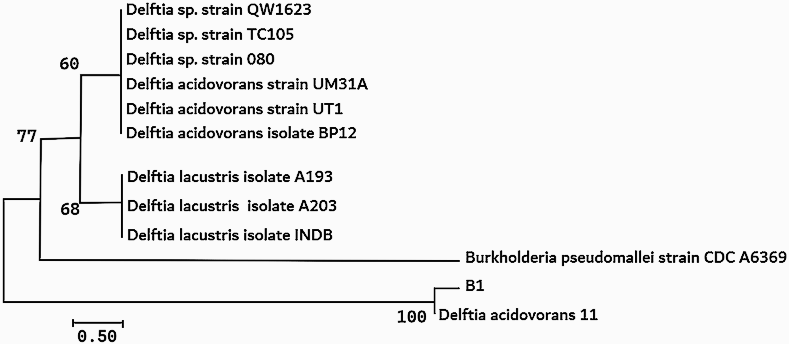
A targeted single band of about 600 bp of bacterial DNA, amplified using the 16S rRNA gene, was purified and sequenced to determine species identity based on similarity to previously characterized bacterial sequences. Sequencing analysis revealed that strain A1 was identified as Uncultured bacterium clone 18447, exhibiting 99% sequence similarity. Strain A2 was identified as Marinobacter salsughinis strain 43SY, showing 100% similarity, while strain A3 was identified as Stenotrophomonas geniculata 1285, also demonstrating 100% sequence similarity. Strain A5 was identified as Brucella rhizosphaerae PB1_7, as it presented 93% similarity. Strains B1 and D4 were identified as Delftia acidovorans strain 11, with 100% and 96% similarity, respectively (Table 2; Figure 1).
Percentage similarity and assigned bacteria on the basis of NCBI detection and genetic distance of indigenous bacterial PGP from local lettuce.

Phylogenetic relationships of strains based on analysis of the 16S rRNA nucleotide sequence of B1. Bootstrap values are shown for each node that had >50% support in a bootstrap analysis of 1000 replicates. The scale bar indicates 0.5 substitutions per site.
Strain B2 was identified as Unculture bacterium clone WBB52, as it presented 99% similarity. Strain D2 was identified as Delftia acidovorans strain 19MWFB29, as it presented 100% similarity. These five groups of endophytes (Unculture, Marinobacter, Stenotrophomonas, Brucella, and Delftia) have relatively wide genetic distances from 0.01 to 0.48. B1 and D4 have the closest genetic distance and were identified similar to Delftia acidovorans strain 11, in contrast to Brucella rhizosphaerae PB1_7 and Unculture bacterium clone 18447. The strain Delftia acidovorans was found in sugarcane as NFB (Da Silveira et al., 2019), whereas the strain Delftia acidovorans strain ZS2 KY486834 was found in Zea mays (Woźniak et al., 2019). Unculture bacterium R.S. 8 and R.S. 11 bitter melon plants (Momordica charantia L.) presented positive results for IPB and PSB capacities (Singh et al., 2022). Stenotrophomonas geniculata NWUBe21 has been reported in cowpea (Omomowo, & Babalola, 2022). Stenotrophomonas and Delftia strains can also synthesize phytohormones, NFB and PSB (Ulrich et al., 2021), as revealed by these results.
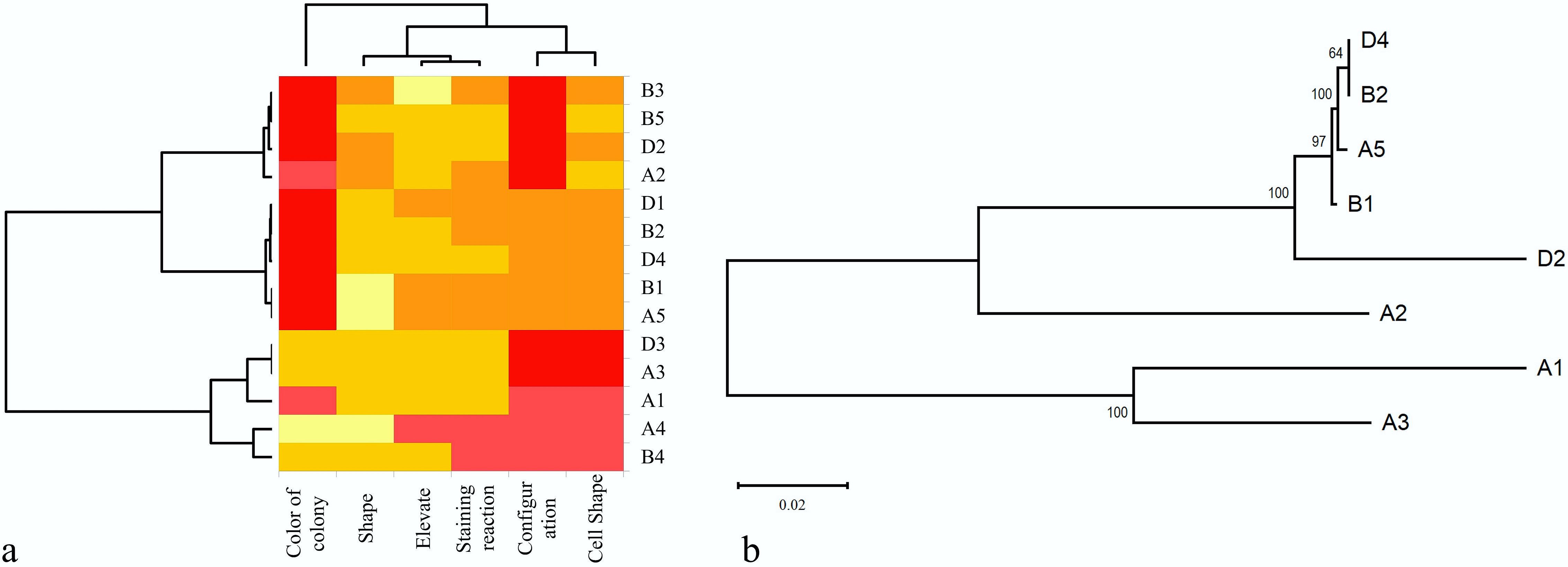
Endophytic diversity in plants is strongly influenced by host species (Ding, & Melcher, 2016), host plant age (growth stages) (Shi et al., 2014), genotype, climate conditions (Afzal et al., 2019), type of plant tissue (Hallmann, & Berg, 2006), and different plant species growing in the same soil (Afzal et al., 2019). In this investigation, bacteria were divided into two types: round (10 isolates) and irregular (4 isolates). The morphology of the bacteria was characterized using selected bacteria capable of promoting growth. The characteristics of the isolates, as observed microscopically, revealed that most bacteria were of the bacillus type, with one isolate identified as a coccus. The majority of the bacteria were Gram-positive, including one Gram-positive coccus, while others were classified as Gram-positive bacilli or Gram-negative. Gram-positive bacteria appear purple due to their thick cell walls, which retain the crystal violet stain, whereas Gram-negative bacteria appear red because their thinner cell walls do not retain the crystal violet after decolorization. All of the bacterial isolates collected exhibited either flat or convex elevations; one isolate was yellowish-white, four were white, and one was transparent. Indigenous endophytic bacteria from the local lettuce cultivar were classified into three distinct groups. Group 1 comprised isolates A2, B3, B5, and D2, all of which shared similar colony colors and configurations. Group 2 included isolates B1, B2, B5, D1, and D4, characterized by similar colony colors, structures, and cell morphologies. Group 3 consisted of isolates A1, A3, A4, B4, and D3, all of which displayed comparable colony structures and cell shapes (Figure 2a). The grouping of bacteria by their morphological characteristics was similar to classifying them on the basis of molecular characteristics derived from 16S rRNA markers (Figure 2b).

Heatmap clustering analysis of the morphological characteristics of 14 indigenous bacteria (a) and clustering analysis of the molecular characteristics of 8 indigenous bacteria (b).
Evaluation of PGPB in Archivel lettuce grown in hydroponics
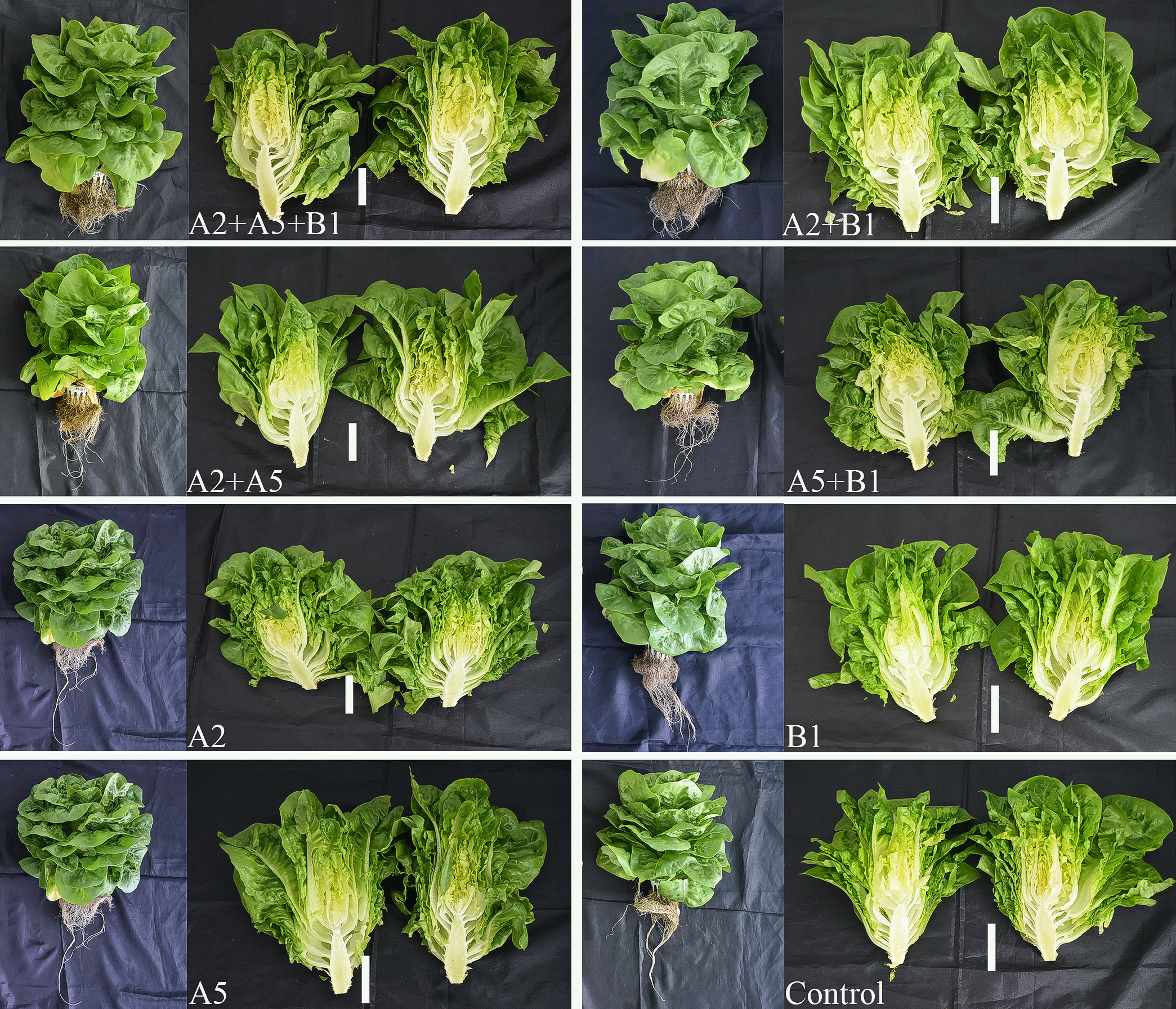
Indigenous PGP bacteria were tested in single consortia and consortia for their effects on lettuce growth. Three bacteria were selected for PGPB testing: Marinobacter salsughinis strain 43SY, Delftia acidovorans 11, and Brucella rhizosphaerae PB1_7. Endophytes in single or consortia positively influence plant development. The study revealed that the application of A2, B1, and a combination of (A2+A5+B1), (A2+B1), (A2+A5), and (A5+B1) increased LN significantly differently (Table 3; Figure 3).

Effects of indigenous inoculation with PGPB on fresh organ characteristics of Archivel lettuce. The dry weight and root-to-shoot ratio indicated that the PGPB had a significant impact on the growth and productivity of Archivel lettuce. Notably, treatments involving isolates A2, the consortium A5+B1+A5, A2, A5, B1, and A5 exhibited higher photosynthetic activity compared to the other treatments, including the control. Among these, the three-isolate consortium (A2+A5+B1) resulted in the greatest increase in BFW and carotenoid content, reaching 369.19 plant-1.
Compared with the control bacteria, A5 bacteria presented significantly lower amounts of LN. However, A5 bacteria had greater average values of CD, PH, and RL than the control, which was not statistically significant. A2+A5 increased the LN within 35-42 leaves plant-1, with a mean of 39.88 leaves plant-1), which was 19.7% greater than that of the control, which had 29-43 leaves (33.31 leaves plant-1). A2, A5, and B1 exhibited synergistic effects with Archivel lettuce. A5 performs poorly in a single application but enhances plant development in consortia with A2 and B1. Bacteria A2 and A5 are more effective at promoting canopy growth, whereas B1 is better at promoting root development. The consortia of A2+A5+B1 achieved a maximum BFW of 369.19 g plant-1, which was not significantly different from those of the other treatments except A2. However, the CFW of a single A5 bacterium peaked at 300 g plant-1, which was much greater (18.8%) than that of the control, A2, and the A2+B1 consortia. Interestingly, A2 therapy resulted in a lower BFW than the control but increased the CFW, SDW, and RDW by 1.7%, 26.5%, and 28.7%, respectively. A5+A5 significantly increased root growth, as measured by the RDW, which reached 4.59 g plant-1, which was 66.9% greater than that of the control (2.75 g plant-1).
PGPB had a positive effect on the growth of rice plants, resulting in mean shoot and primary root growth rates of 60% and 67%, respectively (Lanna-Filho, Pozzebon, & Oliveira, 2022). Overall, endophytic treatment improved the fresh and dry weights compared with the control. In fact, endophytes increase plant growth and vigor, as measured by vigor, but have no negative effect on archived stem function (Figure 3).
Two consortia, A2+A5, increased LN, CD, and pH at 39.88, 23.38 cm, and 21.84, respectively. Consortia A2+B1 increased the chlorophyll-a and b contents by 4.38 and 3.02 μg ml-1, respectively, and consortia A5+B1 increased the carotenoid concentration by 0.97 μg ml-1. A single strain improved the RL at 24.19 cm, the CFW at 300 g plant-1, and the SDW at 25.26 g plant-1 by B1, A5, and A2, respectively. The Archivel lettuce-PGPB interaction led to the extensive development of roots and healthier growth from germination to vegetative production. Bacterial inoculation promoted the germination rate, germination speed, and vigor of the seedlings. A. brasilense and CNPF 316 promoted an increase in the percentage of rooted mini-cuttings and the number and average length of roots (Baldin, Quisen, & Zuffellato-Ribas, 2024). Endophytes are microbes that live in plant tissue without causing disease and are essential for seed germination, seed colonization, and vertical transmission for subsequent generations, benefitting from distinct advantages and healthy crop development (Firdous, Mona, & Muhamad, 2019).
Plants with a higher proportion of root biomass are better equipped to compete for nutrient adsorption, while those with a greater proportion of shoot biomass are more effective at capturing light energy. The root-to-shoot (R/S) ratio is a critical index for evaluating plant health and has garnered increasing attention in recent decades as a sensitive indicator of plant stress induced by chemical or physical agents (Agathokleous et al., 2019). Endophytic microbes play key roles in nutrient delivery to plants, modulation of plant development, enhancement of plant stress tolerance, improvement of disease resistance, and suppression of competing plant species (White et al., 2019). PGPB improved the chlorophyll-a and carotenoid contents but had less influence on the chlorophyll-b concentration. The most effective plant-microbe interaction was discovered for A2+B1, whose chlorophyll-a and chlorophyll-b contents peaked at 4.38 and 3.02 μg mL-1, respectively, which were 33.1 and 30.7% greater than those of the control. The carotenoid content of the consortia of A2+A5+B1 and A5+B1 peaked at 0.97 μg mL-1, which was 135.5% greater than that of the control (Table 4).
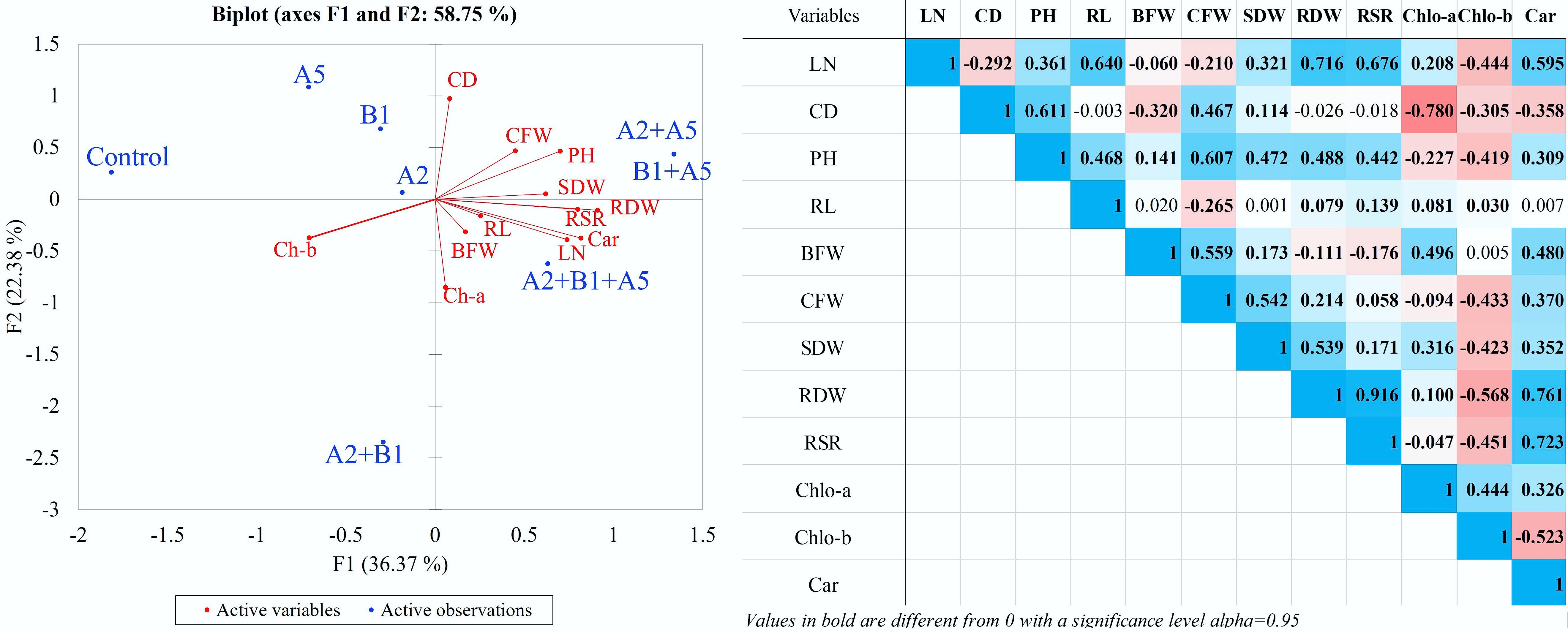
Cluster analysis revealed that A2+A5 and A5+B1 stimulated CD, PH, CFW, and RDW; A2+B1 stimulated chlorophyll-b; and A2+A5+B1 stimulated LN, RL, BFW, chlorophyll-a, and carotenoids (Figure 4.a).

Principal component analysis (PCA) (a) and Pearson’s correlation matrix (b) of the distribution effect of indigenous PGPB on the growth and development characteristics of Archivel lettuce grown under the following conditions: hydroponic LN = leaf number, CD = canopy diameter, PL = plant height, RL = root length, BFW = berry fresh weight, CFW = canopy fresh weight, SDW = shoot dry weight, RDW = root dry weight, RSR = root-shoot ratio, Chlo-a = chlorophyll-a, Chlo-b = chlorophyll-b, Car = carotenoid.
The data indicated that LN was correlated with RL (64%), RDW (&1.6%), RSR (67.6%) and carotenoids (59.5%). CD was correlated with pH (61.1%). BFW was strongly correlated with CFW (55.9%), chlorophyll-a (49.6%) and carotenoid concentrations (48%), and CFW was strongly correlated with pH (54.2%). (Figure 4.b). According to Aquino et al. (2019), both maize and sorghum could benefit from the increased N accumulation and chlorophyll content promoted by inoculation with PGPB.
The ability of endophytic bacteria to fix nitrogen, produce IAA, and solubilize phosphate provides significant benefits to the host plant. IAA, a key plant growth regulator, can be synthesized by both plants and microbes, and it plays a crucial role in promoting plant growth. Numerous bacterial genera, including Bacillus, Enterobacter, Pseudomonas, Azospirillum, Agrobacterium, and Rhizobium are known to produce IAA (Zhang et al., 2021). This important phytohormone is synthesized via both tryptophan-dependent and tryptophan-independent pathways and contributes to various physiological processes, such as cell division, elongation, lateral and adventitious root formation, senescence, and intercellular signaling (Zhang et al., 2021). IAA-producing bacteria facilitate cell wall loosening, which enhances root length and surface area, ultimately improving nutrient uptake (Etesami, Alikhani, & Hosseini, 2015). Additionally, endophytic bacteria play a vital role in phosphate solubilization, either directly or indirectly, thereby supporting plant growth and development (Walia et al. 2017) . The results revealed that the highest PSB were endophytic bacteria originating from leaves (D4). The data also revealed that the stems of lettuce inoculated with PGPB were free of any disease. Endophytes not only increase plant nutrient uptake but also induce plant resistance to pathogens, osmotic stress, heavy metals, xenobiotic contaminants and other forms of abiotic stress. This study demonstrated that various beneficial indigenous microbes isolated from local lettuce improved Archivel lettuce growth and development in a hydroponic NFT system while protecting and adapting to new life conditions.
Conclusions
Indigenous bacteria isolated from local lettuce can produce IAA, fix nitrogen and solubilize phosphate. The consortia Marinobacter salsughinis strain 43SY, Delftia acidovorans 11, and Brucella rhizosphaerae PB1_7 enhanced the biological freshness, pigmentation, and photosynthate accumulation of Archivel lettuce cultivated in the NFT hydroponic system. These strains have great potential for use in lettuce production and agricultural applications through organic hydroponics.
Acknowledgments
We thank to Zijhi Grow Research Center for facilitating experiments and materials.
References
- Afzal, I. et al. (2019). Plant beneficial endophytic bacteria: Mechanisms, diversity, host range and genetic determinants. Microbiological Research, 221:36-49.
- Agathokleous, E. et al. (2019). Does the root to shoot ratio show a hormetic response to stress? An ecological and environmental perspective. Journal of Forestry Research, 30:1569-1580.
- Aleynova, O. A., & Kiselev, K. V. (2023). Interaction of plants and endophytic microorganisms: Molecular aspects, biological functions, community composition, and practical applications. Plants, 12(4):714.
- Aquino, J. P. D. et al. (2019). Plant growth-promoting endophytic bacteria on maize and sorghum. Pesquisa Agropecuária Tropical, 49:e56241.
- Baldin, D. T. S., Quisen, R. C., & Zuffellato-Ribas, K. C. (2024). Endophytic bacteria in seed germination and rooting of pinus spp. Revista Ceres, 71:e71030.
- Cappuccino, J. G., & Welsh, C. T. (2018). Microbiology: A laboratory manual 11th ed. Massachusetts: Addison-Wesley Publishing. 561p.
- Cordova, R. A. et al. (2022). Simple and sensitive spectrophotometric method for estimating the nitrogen-fixing capacity of bacterial cultures. MethodsX, 9:101917.
- Da Silveira, A. P. D. et al. (2019). Exploitation of new endophytic bacteria and their ability to promote sugarcane growth and nitrogen nutrition. Antonie Van Leeuwenhoek, 112:283-295.
- Ding, T., & Melcher, U. (2016). Influences of plant species, season and location on leaf endophytic bacterial communities of non-cultivated plants. PLoS ONE, 11(3):e0150895.
- Etesami, H., Alikhani, H. A., & Hosseini, H. M. (2015). Indole-3-acetic acid (IAA) production trait, a useful screening to select endophytic and rhizosphere competent bacteria for rice growth promoting agents. MethodsX, 2:72-78.
- Firdous, J., Mona, R., & Muhamad, N. (2019). Endophytic bacteria and their potential application in agriculture: A review. Indian Journal of Agricultural Research, 53(1):1-7.
- Guo, K. et al. (2023). Biological nitrogen fixation in cereal crops: Progress, strategies, and perspectives. Plant Commun, 4(9):100499.
- Hallmann, J., & Berg, G. (2006). Spectrum and population dynamics of bacterial root endophytes. In B. J. E Schulz., C. J. C. Boyle, & T. N. Sieber. (eds). Microbial root endophytes. Soil Biology, vol 9. Springer, Berlin, Heidelberg. (pp. 15-31).
- Herrero, M. et al. (2023). A shift to healthy and sustainable consumption patterns. In J. von Braun. et al. (eds). Science and innovations for food systems transformation, Cham Switzerland: Springer, (pp. 59-86).
- Islam, R. et al. (2021). Evaluation of lettuce growth, yield, and economic viability grown vertically on unutilized building wall in Dhaka City. Frontiers in Sustainable Cities, 3:582431.
- Kamnev, A. et al. (2001). Spectroscopic investigation of indole-3-acetic acid interaction with iron (III). Journal of Molecular Structure, 563-564:565-572.
- Kumar, B. L., & Gopal, D. V. (2015). Effective role of indigenous microorganisms for sustainable environment. 3 Biotech, 5:867-876.
- Lanna, F. R., Pozzebon, B. C., & Oliveira, A. M. R. D. (2022). Endophytic bacteria Bacillus safensis and Pseudomonas hibiscicola and their ability to increase rice seedling growth. Arquivos do Instituto Biológico, 89:e00162021.
- Lichtenthaler, H. K. (1987). Chlorophylls and carotenoids: Pigments of photosynthetic biomembranes. Methods in Enzymology, 148:350-382.
- Margalef, O. et al. (2017). Global patterns of phosphatase activity in natural soils. Scientific Reports, 7:1337.
- Nadarajah, K., & Abdul, R. N. S. N. (2023). The microbial connection to sustainable agriculture. Plants, 12(12):2307.
- Njoloma, J. P. B. (2023). Isolation of endophytic bacteria from leaves, stems, or roots. In A. Sankaranarayanan., N. Amaresan, & M. K. Dwivedi (eds). Endophytic microbes: Isolation, identification, and bioactive potentials Springer Protocols Handbooks. Humana, New York, NY. (pp.3-6).
- Omomowo, O. I., & Babalola, O. O. (2022). Genomic insights into two endophytic strains: Stenotrophomonas geniculata NWUBe21 and Pseudomonas carnis NWUBe30 from Cowpea with plant growth-stimulating attributes. Applied Sciences, 12(24):12953.
- Ouhaddou, R. et al. (2022). Application of indigenous rhizospheric microorganisms and local compost as enhancers of lettuce growth, development, and salt stress tolerance. Microorganisms, 10(8):1625.
- Pikovskaya, R. I. (1948). Mobilization of phosphorus in soil in connection with the vital activity of some microbial species. Microbiology, 17:362-370.
- Ramakrishna, W., Yadav, R., & Li, K. (2019). Plant growth promoting bacteria in agriculture: Two sides of a coin. Applied Soil Ecology, 138:10-18.
- Shi, Y. et al. (2014). Illumina-based analysis of endophytic bacterial diversity and space-time dynamics in sugar beet on the north slope of Tianshan mountain. Applied Microbiology and Biotechnology, 98:6375-6385.
- Singh, R. et al. (2022). Isolation and characterization of endophytes bacterial strains of Momordica charantia L. and their possible approach in stress management. Microorganisms, 10(2):290.
- Teng, Z. et al. (2019). Isolation and characterization of phosphate solubilizing bacteria from rhizosphere soils of the Yeyahu Wetland in Beijing, China. Environmental Science and Pollution Research, 26:33976-33987.
- Timofeeva, A. M., Galyamova, M. R., & Sedykh, S. E. (2023). Plant growth-promoting soil bacteria: Nitrogen fixation, phosphate solubilization, siderophore production, and other biological activities. Plants, 12(24):4074.
- Ulrich, K. et al. (2021). Genomic analysis of the endophytic Stenotrophomonas strain 169 reveals features related to plant-growth promotion and stress tolerance. Frontiers in Microbiology, 12:687463.
- Walia, A. et al. (2017). Endophytic bacteria: Role in phosphate solubilization. In D. Maheshwari., & K. Annapurna. (eds) Endophytes: Crop productivity and protection Sustainable Development and Biodiversity, vol 16. Springer, Cham. (pp. 61-93).
- Wang, C. et al. (2023). Phosphorus solubilizing microorganisms: potential promoters of agricultural and environmental engineering. Frontiers in Bioengineering and Biotechnology, 11:1181078.
- Wang, Y., Xu, Y., & Liu, Z. (2022). A review of plant antipathogenic constituents: Source, activity and mechanism. Pesticide Biochemistry and Physiology, 188:105225.
- Wang, Z. et al. (2017). Identification and efficiency of a nitrogen-fixing endophytic actinobacterial strain from sugarcane. Sugar Tech, 19:492-500.
- White, J. F. et al. (2019). Review: Endophytic microbes and their potential applications in crop management. Pest Management Science, 75(10):2558-2565.
- Woźniak, M. et al. (2019). Endophytic bacteria potentially promote plant growth by synthesizing different metabolites and their phenotypic/physiological profiles in the biology GEN III MicroPlateTM test. International Journal of Molecular Sciences, 20(21):5283.
- Zhang, B. X. et al. (2021). Characterization and synthesis of indole-3-acetic acid in plant growth promoting Enterobacter sp. RSC Advances, 11:31601-31607.
-
Editor de seção:
Renato Paiva