 A scale to measure self-efficacy and collective efficacy in the actions taken to implement the Brazilian food guide
Abstract
Background: The promotion of healthy eating in the school environment depends on teachers’ ability to effectively implement the guidelines of the Brazilian Dietary Guidelines.
Objective: Evaluate the psychometric properties of a scale to measure self-efficacy and collective efficacy in actions taken by teachers to implement the Food Guide for the Brazilian Population.
Methods: A methodological study was developed with teachers from municipal schools in Montes Claros (MG). The evaluation of psychometric properties was carried out in three steps: question adaptation, content validation, and construct validation. Data were collected online from December 2019 to June 2021.
Results: The scale had a content validity index of 0.98, demonstrating a clear and representative approach to the proposed theme. Satisfactory fit indices were observed in the confirmatory factor analysis, with factor loadings ranging from 0.56 to 0.83, indicating a positive, statistically significant correlation between the domains (r=0.70, p=0.001). The convergent and discriminant validity of the scale was confirmed. The general internal consistency yielded a Cronbach’s alpha of 0.95, and the intra-class correlation coefficient ranged from 0.80 to 0.85 across both domains.
Conclusion: The scale proved valid for measuring teachers’ self-efficacy and collective efficacy in implementing the Food Guide for the Brazilian Population.
Keywords:
validation study; diet, healthy; professional training; food guide
Resumo
Introdução: A promoção da alimentação saudável no ambiente escolar depende da capacidade dos professores de implementar, de forma eficaz, as diretrizes do Guia Alimentar Brasileiro.
Objetivo: Avaliar as propriedades psicométricas de uma escala para medir a autoeficácia e a eficácia coletiva em ações de implantação do Guia Alimentar Brasileiro por professores.
Métodos: Estudo metodológico desenvolvido com professores de escolas municipais de Montes Claros (MG). A avaliação das propriedades psicométricas foi realizada em três etapas: adaptação das questões, validação de conteúdo e validação de construto. Os dados foram coletados online de dezembro de 2019 a junho de 2021.
Resultados: A escala apresentou índice de validade de conteúdo igual a 0,98, demonstrando uma abordagem clara e representativa do tema proposto. Foram observados índices de ajuste satisfatórios na análise fatorial confirmatória, com cargas fatoriais variando de 0,56 a 0,83, correlação positiva e estatisticamente significante entre os domínios (r=0,70, p=0,001). A validade convergente e discriminante da escala foi confirmada. A consistência interna geral obteve Alfa de Cronbach igual a 0,95, e o coeficiente de correlação intraclasse variou entre 0,80 e 0,85 em ambos os domínios. A validade aparente foi confirmada com 80% de aprovação pelos potenciais usuários da escala.
Conclusão: A escala mostrou-se válida para mensurar a autoeficácia e a efetividade coletiva nas ações de implantação do Guia Alimentar pelos professores.
Palavras-chave:
estudo de validação; dieta saudável; treinamento profissional; guia alimentar
INTRODUCTION
The Food Guide for the Brazilian Population (FGBP), published in 2014, has a holistic approach that considers sustainable and environmental aspects, as well as current dietary standards1. This guide is intended for all Brazilians over 2 years of age and can be used by ordinary citizens, educators, health professionals, among others, in any relevant environment, contributing to its wide dissemination and understanding2.
The FGBP is configured as a theoretical framework for actions to disseminate the proposed educational content. Therefore, strategies must be developed that enable its use across all spheres of health promotion, such as at home, in healthcare systems, and in the school environment. The school environment is relevant because the age of students is conducive to the formation of healthy eating habits, in addition to knowledge and personalities3.
The Brazilian government, through Interministerial Ordinance No. 1010, of May 2006, instituted guidelines for the Promotion of Healthy Eating in public and private preschools, elementary schools, and secondary schools nationwide4. In addition, Law No. 13.666, of May 2018, provided for the mandatory inclusion of Food and Nutrition Education (FNE) in the school curriculum in a transversal manner, justifying proposals that contribute to legislative compliance5.
In evaluating health promotion measures through healthy eating, it is necessary to assess strategy effectiveness by measuring the knowledge, confidence, and professional training of the subjects responsible for carrying out FNE actions. In the school environment, indicators are key to assessing the effectiveness of actions taken by individual teachers to implement the FGBP, as well as those taken by the pedagogical team to which the teachers are assigned3,5. The social cognitive theory developed two constructs that encompass these aspects: self-efficacy and collective efficacy, respectively6,7.
Recently, a scale assessing self-efficacy and collective efficacy perception of healthcare professionals in Primary Care was validated for the FGBP (GAB2) to measure the confidence of these professionals in counseling FNE actions. The instrument underwent content and apparent validation and was shown to be useful for diagnosing what it proposes8. The universe of teachers and the school community are unguarded in this aspect, and there are no instruments in the literature with similar purposes, adapted to this population in the educational context. Faculty and pedagogical teams have great potential to promote healthy eating by building knowledge among a new generation to implement new eating standards9.
According to one of the principles of the Food and Nutrition Education Framework, the diagnosis of each social group must be valued due to the specificities and the need to contextualize the instrument so that the objective is truly achieved10. Therefore, the study aims to evaluate the psychometric properties of a scale that measures teachers’ self-efficacy and collective efficacy in FGBP implementation actions.
METHODS
This is a methodological study, in which the psychometric properties were tested through three steps: adaptation of the questions (step 1); content validation (step 2); and construct validation (step 3).
Step 1: adaptation
The instrument, which already exists for health professionals, named GAB28, was adapted to the target audience of this study. Words and/or phrases were adjusted to fit an educational context, without altering the meaning of the statements. The structure of the original scale was maintained, comprising two sections (domains): self-efficacy and collective efficacy, each with 12 questions, totaling 24 statements. Authorization to use the scale was requested from and granted by the authors of GAB2.
Not at all confident;
A little confident;
Confident; and
Very confident.
This refers to each participant individually and assesses whether he/she can pass on knowledge about healthy eating to students and encourage each student and their family to adopt it. The total score for this section is obtained by adding the responses to the 12 items, ranging from 12 to 48, with higher values indicating greater teacher capacity.
The second section comprises statements about the perception of the pedagogical group. It refers to the team in which the participant is inserted. It measures the same aspect evaluated in the first section, but collectively, indirectly assessing whether there is pedagogical planning on this theme.
False;
Sometimes true;
True; and
Very true.
New paradigm of healthy eating;
How to choose food;
How to prepare meals;
Eating and eating together: eating regularly and attentively, eating in suitable environments, eating with others;
How to overcome obstacles: information, offer, cost, culinary skills, time, and publicity2.
Step 2: content validation
Content was validated by a "panel of judges", in which 11 experts on the subject, 10 nutritionists and 1 educator, evaluated each item on the scale in relation to the proposed content11. This step was performed electronically. Professionals were invited via e-mail and received a manual with guidelines on the research and instructions on this type of validation12. The digital version of the FGBP was also sent, and a prior reading of the document was requested.
The professionals assessed the issues in terms of clarity, relevance, pertinence, and dimensionality. For the first three aspects, grades from 1 to 4 were assigned, and the highest grades were considered more positive. For the last aspect, respondents were asked to classify the construct into the corresponding dimension. There was also an open space for comments and suggestions for changes13,14.
Based on the responses, the proportions of the aspects clarity, relevance, and pertinence for each item that received grades 3 and 4 (considered positive) were calculated, according to the number of respondents. The average of the three values found indicated the Content Validity Index (CVI) for each question, and the average of all CVIs resulted in the scale index (CVIt). CVIs>0.8 are considered satisfactory15.
Step 3: construct validation
The population of this stage consisted of teachers from the municipality of Montes Claros (MG) who were active in the profession, in urban and rural areas, totaling 1,491 teachers. The participation of at least 510 teachers was estimated, considering the number of parameters to be estimated in the measurement model under evaluation, defined as 51 (24 factor loadings, 2 variances of the self-efficacy and collective efficacy domains, 24 variances of errors, and 1 correlation between domains) and the ratio of 10 respondents per estimated parameter. It is noteworthy that the factorial weights of the errors were fixed at 1, indicating that these latent variables have the same metric as the corresponding manifest variables16. The number of participants met the required sample size in a psychometric validation study through Confirmatory Factor Analysis (CFA).
Initially, the managers of the Municipal Education Department of Montes Claros were contacted and granted authorization to conduct the research. Then, school principals were informed about the study and invited to help raise awareness among teachers. Those who consented to participate in the survey received the link via a social network communication group and answered the questionnaire online, via Google Forms, taking an average time of 10 minutes.
To characterize the profile of the participants, the questionnaire included identification characteristics (name, contacts, sex, age, school, self-reported color, marital status, and number of children), socioeconomic background (family income and number of people in the household), training and professional performance (graduation, working time in the teaching role, shifts, weekly workload, type of employment, educational level, job satisfaction, and participation in training), approach to food content and classroom nutrition, anthropometric and health status (self-reported weight and height and presence of chronic diseases), and dietary conditions.
Construct validity was determined by three components: factor validity, convergent validity, and discriminant validity. Factor validity was performed using CFA, in which a model with two domains (self-efficacy and collective efficacy) was tested. Standardized parameters were adopted, such as factor loadings greater than 0.5, which were considered adequate. Values closer to 1 would meet the expectations even more, as they were better correlated with the item factor. Exploratory Factor Validity (EFA) was not performed in the study because it is an unnecessary step aimed at confirming a model that already existed in the literature16.
In the CFA, the following indices were adopted to assess the quality of the adjusted model: Root Mean Square Error of Approximation (RMSEA), Standardized Root Mean Square Residual (SRMR), Comparative Fit Index (CFI), Tucker-Lewis Index (TLI), and the Fit Quality Index (FQI). The RMSEA cutoff points are the following: values<0.08 indicate good fit, between 0.08 and 0.10 indicate medium fit, and >0.10 indicate poor fit17. For the other indices, the following were considered acceptable: SRMR<0.8, CFI>0.95, TLI>0.90, and GFI>0.9018.
Convergent validity was evaluated by the mean extracted variance (MEV) and composite reliability (CR). MEV values greater than or equal to 0.5 and CR values greater than or equal to 0.7 were considered adequate16,19. Discriminant validity was tested by comparing the MEV with the square of the correlations among the factors (within the CFA scope). This analysis aims to show that each factor has an individual part that is different from that of the other factor, although they are related. Such individuality has to be greater than the correlation to justify the presence of the item16.
This study evaluated the reliability of the scale under the criteria of internal consistency and reproducibility. As for internal consistency, the Cronbach’s alpha coefficient was calculated, with values greater than or equal to 0.70 being acceptable20. To assess reproducibility, the test-retest method was used, with a sample of 62 respondents, with more than 10% of the total participating sample chosen at random. Once again, participants responded to the scales after a period of 7 to 15 days21. The reproducibility of the scale was assessed using the intra-class correlation coefficient (ICC), and values greater than 0.75 were considered adequate22,23.
All data were collected from December 2019 to June 2021 and were electronically categorized and processed using the Statistical Package for Social Science (SPSS) software, version 22.0, and Amos.
The ethical aspects of this study are in accordance with Resolution No. 466 of 12/12/2012 of the National Health Council. An Institution Agreement (IA) was signed by the Municipal Secretary of Education of Montes Claros-MG, and all participating teachers provided consent through an Informed Consent Form (ICF). This research was approved by the Research Ethics Committee of the State University of Montes Claros (UNIMONTES) under opinion No. 3,586,107.
RESULTS
In the evaluation of the psychometric properties of the GAB2 for teachers, in the step of adapting the questions (step 1), the scale was adapted to the school context, keeping the 24 statements. Table 1 shows the changes made to the original scale. All adjustments made are highlighted in bold. In the content validation step (step 2), CVIt=0.98 was obtained, being considered satisfactory. The experts’ evaluation was positive, and they approved the scale.
Adaptation of the scale questions to measure self-efficacy and collective efficacy in healthy eating counseling actions for teachers (step 1).
In step 3, 595 teachers from the municipality of Montes Claros participated. These teachers taught different school subjects, from daycare and pre-school to Youth and Adult Education. Of these, 91.4% worked only in the public network, 8.6% also worked simultaneously in the private network, and 87.4% had teaching as an exclusive professional activity (Table 2).
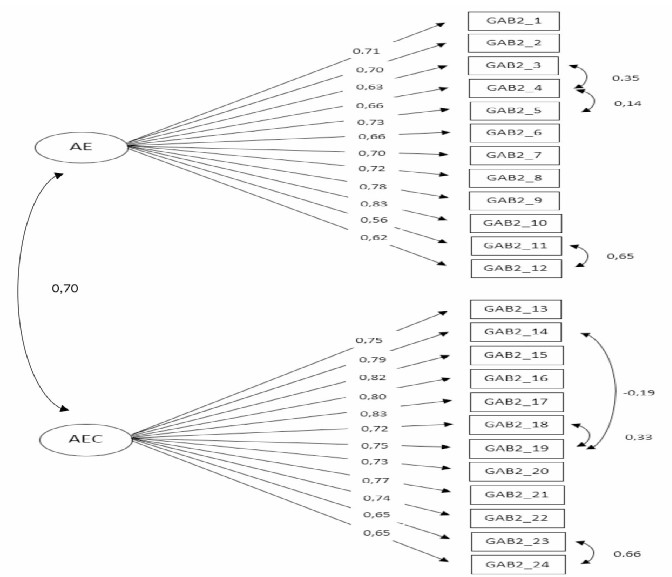
In construct validation, the model’s goodness-of-fit indices were considered adequate: χ2/df=4.55, p=0.001; RMSEA=0.077 [90%; 0.073–0.082]; TLI=0.90; GFI=0.90. The CFI had a borderline result, CFI=0.911. The scale measurement model diagram is shown in Figure 1. The rectangles are the observable variables, that is, each item or statement. The factor loadings are shown on the arrows, ranging from 0.56 to 0.83, and both domains had positive loads, with values close to one, indicating satisfactory reliability. The correlation between the domains was positive and statistically significant (r=0.70, p=0.001).
Diagram of the model correlated with standardized factor loadings.
SE: Self-efficacy; CE: Collective efficacy.
As for convergent validity, the average extracted variance (AEV) had satisfactory results, with values of 0.50 and 0.57 for the domains of self-efficacy and collective efficacy, respectively. CR results were also adequate: AE=0.917; AEC=0.940.
Discriminant validity was observed in the two domains, whose squared correlation (r2=0.49) was lower than the AEV values for each of these factors (AEVAE=0.50; AEVAEC=0.57).
The general internal consistency of the scale yielded a Cronbach’s alpha of 0.95. The two domains (AE and AEC) yielded 0.917 and 0.940, respectively. The ICC was AE=0.85 [0.75–0.91] and AEC=0.80 [0.65 - 0.88], proving to be adequate.
DISCUSSION
In the national scenario, only four studies were identified that measured the psychometric properties of scales related to the content of the FGBP, and none assessed the professional training of those who take FNE actions in the educational context. In 2019, a self-administered scale was developed and validated to assess the adherence of adults to adequate and healthy eating habits according to the FGBP. The authors validated this instrument by analyzing content and construct validity; as well as exploratory factor, confirmatory factor, reliability, and reproducibility12. In 2020, the scale of self-efficacy and collective efficacy of primary care professionals concerning healthy eating counseling actions was validated. The scale was validated through content validity and confirmatory and discriminant factor analysis, which measured the construct8. Also in 2020, a scale to measure eating disorders in adults was validated, based on the item response theory9,24. In another study, the content and appearance validity of a scale assessing dietary education practices in primary healthcare were confirmed, demonstrating its clarity and relevance for nutritional interventions8. This study is important for approaching teachers, a specific and unprecedented audience in the literature, in addition to proposing additional validations for the existing scales.
Studies assessing the validity of this type of scale are necessary, as they support mechanisms to monitor professional training and assess the understanding of the healthy eating guidelines proposed in the FGBP. Such analyses are essential to diagnose whether the teacher is really ready and confident when performing FNE actions in the school environment2,3,12.
The GAB2 for teachers presented content validity through 24 easy-to-understand items, compatible with the reality of teachers starting in basic education. This step made it possible to confirm that all aspects of the domains were sufficiently covered in the scale and that the items were interpreted homogeneously, even after adapting them to the school context. This validation step was essential because it was linked to the subjectivity of the respondent’s interpretation, and raised important technical questions about the correct measurement of the object8,11,12.
It was found that the instrument has construct validity through CFA, convergent, discriminant, and reliability validation, as well as internal consistency and reproducibility in a population of municipal public school teachers in the city of Montes Claros (MG). The CFA proved to be adequate, corroborating other studies8,12. Only the CFI had a borderline result, as well as in a similar study12, not affecting the quality of the adjustment model and indicating that the scale is capable of reproducing the organization and correlation of the variables obtained in the study sample. The psychometric analysis of the proposed instrument is important to capture individualities and reduce the probability of measuring the construct with errors11,12,25.
The present scale had satisfactory factor loadings for the items in both domains. In the second (AEC), the loads were closer to one, considered more positive, as they make the variable more representative. This result was also observed in the model scale8. The correlation between the two domains was moderate (r=0.32) in the instrument for healthcare professionals, while in the educational context, the correlation was considered strong (r=0.70), meeting more expectations8,16.
Convergent validation was found, with satisfactory AEV and CC values. These values indicate a high proportion of item variance. Furthermore, the high factor loadings also confirm this validity, signaling a synchronization to a common point26. In the literature, this type of analysis was not observed in similar instruments involving this theme. The discriminant validity of GAB2 for teachers was verified, demonstrating that the individuality of each item is greater than the correlation between them, which is in accordance with the results found8.
Regarding the reliability of the instrument, there were satisfactory indices of internal consistency, both for the global scale and both domains, proving to be a safe and homogeneous instrument to measure what is proposed. As for reproducibility, adequate correlation indices were found in both domains, indicating that the scale can provide reliable information in different situations of respondents.
The GAB2 instrument for teachers proved to be a good fit, and a valid and reliable model to properly measure the self-efficacy and collective efficacy of teachers in healthy eating counseling actions in the school environment. This aspect denotes that the data generated through this instrument is trustworthy. This is important, as the current FGBP poses a challenge regarding the use of appropriate tools to measure the content of its recommendations, as it has qualitative and not quantitative guidelines3,12.
The evaluation of self-efficacy, treating each teacher individually, is essential to determine the effectiveness of the actions taken as a professional. But also, even if indirectly, it helps teachers perceive their knowledge on the subject. The interdisciplinarity necessary for the success of FNE confirms the importance of evaluating the pedagogical team’s collective efficacy. Using valid instruments is necessary for the collection of accurate and reliable information about teachers, since the school environment is an adequate and favorable scenario for the development of these actions, contributing to learning, formation of healthy eating habits, and growth and biopsychosocial development of students27,28.
Considering the paradigm shift in the reference instrument on adequate and healthy eating, there was a gap in the literature regarding the measurement, through validated instruments, of this guidance in the educational context, specifically aimed at teachers. The scale has satisfactory psychometric properties, being valid for measuring self-efficacy and collective efficacy at adequate values. It is expected that the scale is able to indicate to competent managers the need for teacher training and/or implementation of other methodologies to promote qualified and effective actions, as promising results have already been evidenced in the literature6,29.
The potential limitation of this study is that the data were collected electronically only, making it difficult to offer guidance and/or to answer doubts. More studies should be carried out on this subject, also addressing other types of validation, with teachers from different regions to add more validity to the instrument.
CONCLUSION
The GAB2 instrument for teachers showed adequate psychometric properties regarding content validity, construct validity (factorial, convergent, and discriminant), and reliability (internal consistency and reproducibility). Therefore, the GAB2 version, adapted for teachers, based on this study, can be considered valid and reliable to measure self-efficacy and collective efficacy in FGBP counseling actions.
Funding:
DATA AVAILABILITY STATEMENT
The datasets generated and/or analyzed during this study are available from the author upon request.
How to cite:
Pereira MM, Silveira MF, Brito MFSF, Louzada MLC, Bastos VF, Freire RS, et al. A scale to measure self-efficacy and collective efficacy in the actions taken to implement the Brazilian food guide. Cad. Saúde Colet., 2026;34(2):e34020143. https://doi.org/10.1590/1414-462X202634020143
REFERÊNCIAS
-
1 Oliveira MSS, Amparo-Santos L. Food-based dietary guidelines: a comparative analysis between the Dietary Guidelines for the Brazilian Population 2006 and 2014. Public Health Nutr. 2018;21(1):210-7. https://doi.org/10.1017/S1368980017000428
» https://doi.org/10.1017/S1368980017000428 - 2 Brasil. Ministério da Saúde. Secretaria de Atenção à Saúde. Departamento de Atenção Básica. Guia alimentar para a população brasileira. 2a ed. Brasília: Ministério da Saúde; 2014.
-
3 Food and Agriculture Organization. El estado de las guías alimentarias basadas en alimentos en América Latina y el Caribe: 21 ãnos después de la Conferencia Internacional sobre Nutrición [Internet]. Roma: Organización de las Naciones Unidas para la Alimentación y la Agricultura; 2014 [cited 2026 Apr 30]. Available from: https://www.fao.org/4/i3677s/i3677s.pdf
» https://www.fao.org/4/i3677s/i3677s.pdf - 4 Brasil. Ministério da Saúde. Gabinete do Ministro. Portaria Interministerial no1.010, de 8 de maio de 2006. Institui as diretrizes para a Promoção da Alimentação Saudável nas Escolas de educação infantil, fundamental e nível médio das redes públicas e privadas, em âmbito nacional. Brasília: Diário Oficial da União; 2006.
-
5 Brasil. Lei de diretrizes e bases da educação nacional [Internet]. 2a ed. Brasília: Senado Federal, Coordenação de Edições Técnicas; 2018 [cited 2026 May 1]. Available from: https://www2.senado.leg.br/bdsf/bitstream/handle/id/544283/lei_de_diretrizes_e_bases_2ed.pdf
» https://www2.senado.leg.br/bdsf/bitstream/handle/id/544283/lei_de_diretrizes_e_bases_2ed.pdf -
6 Lígia R, Patricia J. Measuring professional self and collective efficacy for dietary advice in Primary Health Care. Nutr Health. 2021;27(1):49-57. https://doi.org/10.1177/0260106020959595
» https://doi.org/10.1177/0260106020959595 - 7 Bandura A, Azzi RG, Polydoro S. Teoria social cognitiva: conceitos básicos. Porto Alegre: Artmed; 2008.
-
8 Reis LC, Jaime PC. Pool of items to measure Primary Health Care workers’ knowledge on healthy eating. Rev Saude Publica. 2021;55:55. https://doi.org/10.11606/s1518-8787.2021055003218
» https://doi.org/10.11606/s1518-8787.2021055003218 - 9 Santos GS. Investigação sobre a temática alimentação: percepções de docents em formação continuada. Tese (Doutorado). Rio de Janeiro: Instituto Oswaldo Cruz; 2020.
-
10 Macedo IC, Aquino RC. O Marco de referência de educação alimentar e nutricional para políticas públicas no Brasil no contexto do atendimento nutricional. Demetra. 2018;13(1):21-35. https://doi.org/10.12957/demetra.2018.28663
» https://doi.org/10.12957/demetra.2018.28663 - 11 Nunnally JC, Bernstein IH. Psychometric theory. New Delhi: McGraw-Hill Ed; 1994.
- 12 Streiner DL, Norman GR, Cairney J. Health measurement scales: a practical guide to their development and use. 5th ed. Oxford: Oxford University Press; 2014.
- 13 Pasquali L. Psicometria: teoria dos testes na psicologia e na educação. Petrópolis: Vozes; 2013.
- 14 Erthal TC. Manual de psicometria. Rio de Janeiro: Jorge Zahar; 2009.
-
15 Rubio DMG, Berg-Weger M, Tebb SS, Lee ES, Rauch S. Objectifying content validity: Conducting a content validity study in social work research. Social Work Research. 2003;27(2):94-104. https://doi.org/10.1093/swr/27.2.94
» https://doi.org/10.1093/swr/27.2.94 - 16 Marôco J. Análise de equações estruturais: fundamentos teóricos, software & aplicações. Pêro Pinheiro: Report Number; 2010.
-
17 Browne MW, Cudeck R. Alternative ways of assessing model fit. Sociol Methods Res. 1992;21(2):230-58. https://doi.org/10.1177/0049124192021002005
» https://doi.org/10.1177/0049124192021002005 -
18 Hu L, Bentler PM. Cutoff criteria for fit indexes in covariance structure analysis: Conventional criteria versus new alternatives. Struct Equ Modeling. 1999;6(1):1-55. https://doi.org/10.1080/10705519909540118
» https://doi.org/10.1080/10705519909540118 -
19 Colwell SR. The composite reliability calculator user’s guide [Internet]. 2014 [cited 2026 Apr 30]. Available from: https://thestatisticalmind.com/comp-reliability/
» https://thestatisticalmind.com/comp-reliability/ -
20 Hall E, Chai W, Koszewski W, Albrecht J. Development and validation of a social cognitive theory-based survey for elementary nutrition education program. Int J Behav Nutr Phys Act. 2015;12:47. https://doi.org/10.1186/s12966-015-0206-4
» https://doi.org/10.1186/s12966-015-0206-4 - 21 Field A. Descobrindo a estatística usando o SPSS. 2a ed. Porto Alegre: Artmed; 2009.
- 22 Fleiss JL, Cohen J. The equivalence of weighted kappa and the intraclass correlation coefficient as measures of reliability. Educ Psychol Meas. 1973;33:613-9.
-
23 Koo TK, Li MY. A guideline of selecting and reporting intraclass correlation coefficients for reliability research. J Chiropr Med. 2016;15(2):155-63. https://doi.org/10.1016/j.jcm.2016.02.012
» https://doi.org/10.1016/j.jcm.2016.02.012 -
24 Alvarenga MS, Santos TSS, Andrade D. Item response theory-based validation of a short form of the Disordered Eating Attitude Scale (DEAS-s) to a Brazilian sample. Cad Saude Publica. 2020;36(2):e00169919. https://doi.org/10.1590/0102-311X00169919
» https://doi.org/10.1590/0102-311X00169919 -
25 Pinho L, Moura PHT, Silveira MF, Botelho ACC, Caldeira AP. Development and validity of a questionnaire to test the knowledge of primary care personnel regarding nutrition in obese adolescents. BMC Fam Pract. 2013;14:102. https://doi.org/10.1186/1471-2296-14-102
» https://doi.org/10.1186/1471-2296-14-102 - 26 Hair JF, Black WC, Badin BJ, Anderson RE, Tatham RL, Golvêa MA, Sant’anna AS. Análise multivariada de dados. Porto Alegre: Bookman; 2009.
-
27 Borsoi AT, Teo CRPA, Mussio BR. Educação alimentar e nutricional no ambiente escolar: uma revisão integrativa. RIAEE. 2016;11(3):1441-60. https://doi.org/10.21723/riaee.v11.n3.7413
» https://doi.org/10.21723/riaee.v11.n3.7413 -
28 Acciai F, Yedidia MJ, DeWeese RS, Martinelli S, Ohri-Vachaspati P. School food and physical activity environment: a longitudinal analysis of four school Districts in New Jersey. J Adolesc Health. 2019;65(2):216-23. https://doi.org/10.1016/j.jadohealth.2019.01.006
» https://doi.org/10.1016/j.jadohealth.2019.01.006 -
29 Reis LC, Jaime PC. Conhecimento e percepção de autoeficácia e eficácia coletiva de profissionais de saúde para a implementação do guia alimentar na atenção básica. Demetra. 2019;14:e 39140. https://doi.org/10.12957/demetra.2019.39140
» https://doi.org/10.12957/demetra.2019.39140