 Evaluation of pain and vital signs in newborns undergoing physiotherapeutic interventions in a neonatal intensive care unit
ABSTRACT
BACKGROUND AND OBJECTIVES: The neonatal intensive care unit (NICU) is a highly complex therapeutic environment for treating high-risk newborns. However, exposure to excessive light, constant manipulation, temperature changes, lack of adequate sleep and invasive procedures can alter vital signs, cause pain and stress, raising concerns about the baby’s neuropsychomotor development. The aim of this study was to analyze the response parameters of newborns admitted to a NICU, checking pain and vital signs during and after physiotherapy intervention.
METHODS: This was a cross-sectional observational study with a convenience sample. The participants were assessed before, during and after the physiotherapy intervention, in a single session, observing the variables pain, using the Neonatal Infant Pain Scale (NIPS), and vital signs, using a specific form for collection.
RESULTS: Twelve newborns took part in this study, five boys and seven girls, with a mean gestational age of 32.4±3.26 weeks, a mean birth weight of 1677±678.45g and a mean chronological age of 11.5±6.41 days. There was a significant decrease (Z=2.359 and p=0.018) in heart rate after the intervention, and a significant increase (Z=-2.071 and p=0.038) in peripheral oxygen saturation during the intervention. However, the oscillatory parameters remained within the normative values. As for pain, there was no significant difference between the moments before and during (p= 0.41), during and after (p=0.08), and before and after (p=0.18) physiotherapeutic care.
CONCLUSION: The results indicated that the physiotherapeutic intervention in the NICU did not cause pain to the newborn.
Keywords:
Neonatal Intensive Care Units; Newborn; Pain; Physiotherapy; Vital signs
HIGHLIGHTS
Evaluation of pain in newborns undergoing physiotherapy in a neonatal intensive care unit.
The importance of monitoring vital signs and pain in hospitalized newborns.
Pain in newborns.
RESUMO
JUSTIFICATIVA E OBJETIVOS: A unidade de terapia intensiva neonatal (UTIN) é um ambiente terapêutico de alta complexidade para o tratamento do recém-nascido de risco. Entretanto, exposição a luminosidade excessiva, manipulação constante, mudanças de temperatura, ausência de sono adequado e procedimentos invasivos podem alterar os sinais vitais, causar dor e estresse, gerando preocupação quanto ao desenvolvimento neuropsicomotor do bebê. O objetivo deste estudo foi analisar os parâmetros de respostas de recém-nascidos internados em uma UTIN, verificando a dor e os sinais vitais durante e após o momento da intervenção fisioterapêutica.
MÉTODOS: Trata-se de um estudo observacional transversal com uma amostra composta por conveniência. Os participantes foram avaliados antes, durante e após a intervenção fisioterapêutica, em uma única sessão, observando-se as variáveis dor, por meio da Neonatal Infant Pain Scale (NIPS), e os sinais vitais, por meio uma ficha própria para coleta.
RESULTADOS: Participaram do estudo 12 recém-nascidos, cinco meninos e sete meninas, com idade gestacional média de 32,4±3,26 semanas, peso médio ao nascimento de 1677±678,45g e idade cronológica média de 11,5±6,41 dias. Observou-se diminuição significativa (Z=-2,359 e p=0,018) na frequência cardíaca após a intervenção, e aumento significativo (Z=-2,071 e p=0,038) na saturação periférica de oxigênio durante a intervenção. Entretanto, os parâmetros oscilatórios permaneceram dentro dos valores normativos. Quanto à dor, não foi observada diferença significativa entre os momentos antes e durante (p= 0,41), durante e após (p=0,08), e antes e após (p=0,18) o atendimento fisioterapêutico.
CONCLUSÃO: Os resultados indicaram que a intervenção fisioterapêutica na UTIN não causou dor ao recém-nascido.
Descritores:
Dor; Fisioterapia; Recém-nascido; Sinais vitais; Unidade de Terapia Intensiva Neonatal
DESTAQUES
Avaliação da dor em recém-nascidos submetidos a fisioterapia em uma unidade de terapia intensiva neonatal.
A importância da monitorização dos sinais vitais e da dor em recém-nascidos internados.
A dor no recém-nascido.
INTRODUCTION
The neonatal intensive care unit (NICU) is considered a highly complex therapeutic environment, suitable for the treatment of newborns (NB) between the ages of zero and 28 days, and aims to offer specialized care, with intensive monitoring, to clinically unstable neonates1.
The specificity and increase in the number of NICUs has resulted in a significant reduction in neonatal mortality, but the use of different therapeutic resources and invasive procedures constantly exposes NBs to painful situations2. In addition, because they have hemodynamic and/or physiological instability, metabolic alterations, perinatal asphyxia and/or functional disorders after birth, this population is considered to be at high risk3, requiring 24-hour care.
To ensure the survival of these NBs, especially premature ones, a series of procedures are necessary, which often become stressful and painful due to the number and frequency of procedures and specific invasive or non-invasive techniques performed by the multi-professional team. In this multidisciplinary context, physiotherapy becomes essential for the patient’s treatment and good prognosis, preventing and/or minimizing respiratory and motor complications2, but not always preventing pain during care, which leads to the need for professionals to know how to recognize, assess and identify the possible causes of pain in NBs.
For a long time it was believed that newborns didn’t feel pain, but studies have shown that the anatomical pathways responsible for nociception, such as the presence of neurotransmitters and the dendritic and thalamic ramifications, develop early in the 7th week of pregnancy, and by the 20th week these pathways are throughout the body, leaving it subject to the recognition of pain4.
Pain is classified as “an unpleasant sensory and emotional experience associated with, or resembling that associated with, actual or potential tissue damage”5, and its control is crucial for comprehensive patient care. Pain can be considered the 5th vital sign and when it is assessed together with the other vital signs, it is possible to ensure that the patient has access to the necessary interventions to control it6. Thus, managing neonatal pain is a major challenge for health professionals, especially as it should not be compared with the pain of adults. The fact that NBs don’t verbalize their pain is a major obstacle to obtaining control of the clinical condition, so instruments that allow pain to be assessed and quantified have become fundamental in the neonatal routine2.
In the case of NBs, the interpretation of signs suggestive of pain by the professionals who care for them is crucial, since pain, in addition to leading to suffering, can also have organic and emotional repercussions, permanently modifying the organization of the nociceptive system, predisposing to cognitive, psychosomatic and psychiatric alterations throughout neuropsychomotor development, reflected in the childhood, adolescence and adult life of these individuals7. The methods for assessing pain include evaluating the physiological response by measuring and inspecting the NB’s behavior through painful stimuli, and these measures can be divided into multidimensional and unidimensional evaluations8. One-dimensional measuring instruments are used in hospitals or clinics to detect the presence or absence of pain in a non-invasive way and are widely used as they provide quick and relevant information. Multidimensional instruments look at the sensory, affective and motor aspects, which are expressed through the language used to describe the pain process9. However, pain assessment should not only focus on behavioral signs.
Considering the multidimensional assessment, all expressions that indicate the presence of pain should be observed and highlighted, since it is influenced by the type of stimulus used, the state of sleep and wakefulness, the age at which the individual is subjected to the stimulus, the severity of the disease, the use of drugs and their doses, and the length of time one is subjected to situations that provoke pain10. Physiological factors can be taken into account during the assessment to quantify and qualify pain, including: heart rate (HR), mean arterial pressure (MAP), respiratory rate (RR), peripheral oxygen saturation (SpO2), sweating and tone. These factors can indicate the state of health, serving as markers of the severity of the disease. In addition, these factors are indicators of the body’s circulatory, respiratory, neural and endocrine functions11.
The prolonged period of hospitalization, the stress of the hospital environment and the various procedures needed to maintain the NB’s life can cause psychophysiological changes that worsen their clinical condition. These changes include an increase in MAP, a decrease in partial oxygen saturation and an increase in HR and RR12.
This justifies the importance of monitoring vital signs and the need to assess pain in NBs. One of the most widely used instruments in clinical practice for assessing the presence of pain in this population is the multidimensional Neonatal Infant Pain Scale (NIPS)13, considered one of the best scales for assessing pain triggered by procedures in NBs14. This scale assesses seven parameters: facial expression, crying, movements of the extremities, the baby’s sleep/alert state, the need for oxygen supplementation to maintain saturation greater than 95% and changes in heart rate, considering the heart rate indices documented in the 24 hours prior to the assessment. In this assessment, pain is considered to be present when the final score is greater than or equal to 413.
Considering that during hospitalization the NB is exposed to numerous possibilities of feeling pain and seeking to better understand whether physiotherapeutic intervention causes pain, the aim of this study was to analyze the response parameters of NBs submitted to physiotherapeutic interventions during hospitalization in a NICU, verifying pain and vital signs: HR, RR, SpO2 and MAP during and after the moment of physiotherapeutic intervention.
METHODS
This is a cross-sectional observational study, with a convenience sample, of an applied nature, authorized by the parents and approved by the Human Research Ethics Committee (Comitê de Ética em Pesquisa com Seres Humanos - CEP - Opinion No. 3.634.144).
The study included 12 NBs of both genders, admitted to a NICU, with a chronological age between 3 and 28 days. Inclusion criteria were: chronological age between 3 and 28 days, need for admission to the NICU, with or without oxygen support. The exclusion criteria were: NBs on invasive ventilatory support, with severe hemodynamic instability, NBs who had undergone surgical procedures in the last 72 hours prior to the assessment.
After the study was approved by CEP, the multi-professional team was informed about the study with the consent and authorization of the doctor in charge of the sector.
The participants were selected and the parents/guardians were contacted and informed about the objectives and procedures of this study. Participants were selected and data collected between March and July 2022. The NBs were assessed observationally only once. The assessment consisted of observing and recording vital signs (HR, RR, SpO2, MAP) before, during and immediately after the physiotherapeutic intervention with passive mobilization, bronchial hygiene manoeuvres, techniques to improve breathing and positioning in bed. Data from pre-, periand post-natal examinations, as well as data on the NBs’ risk factors, were recorded in an anamnesis script. During the assessment, the participants’ vital signs were recorded and the NIPS scale was filled in, considering the seven pain indicators: facial expression (0- normal/relaxed, 1- contracted/frowns); crying (0- absent, 1- grumbling, 2- vigorous); breathing pattern (0- normal/relaxed, 1- change in pattern); extremity movements (0- relaxed/contained, 1- flexed/extended); alertness (0- asleep/awake, 1- agitated); need for oxygen supplementation to maintain SpO2 greater than 95% (0- no, 1- ≤ 30%, 2- > 30%); and HR (0-10% within baseline, 1-11 to 20% at baseline, or 2-20% above baseline)13. A final score greater than or equal to 4 was considered indicative of the presence of pain. Vital signs were collected using a monitor connected to the NB.
Statistical analysis
The data collected before, during and after the intervention was tabulated in SPSS (Statistical Package for Social Sciences) software, version 22.1, and analyzed descriptively using the median, minimum and maximum, and inferential analysis using the Wilcoxon test, with a 95% Confidence Interval. The significance level adopted for all the analyses was 5% (p<0.05).
RESULTS
The population consisted of 12 NBs, five male and seven female (Table 1).
In terms of gestational age, one NB was born at term (40 weeks), six were moderately preterm (34 to 36 weeks), four were very preterm (28 to 33 weeks) and one was extremely preterm (27 weeks). It was observed that most of the NBs evaluated were born prematurely, confirming their greater susceptibility to comorbidities and risk factors in a NICU, including handling/interventions that can cause pain.
According to the total score obtained in the NIPS assessment (facial expression, crying, respiratory pattern, movement of the extremities, alertness and need for oxygen - table 2), no significant difference was observed between before and during the intervention (Z= 0.816, p=0.41), between during and after (Z= 1.732, p=0.08), and between before and after (Z= 1.342, p=0.18) the physiotherapy intervention (Figure 1).
Frequency of responses to NIPS variables (facial expression, crying, breathing pattern, movement of the extremities, alertness and need for oxygen) before, during and after physiotherapy intervention
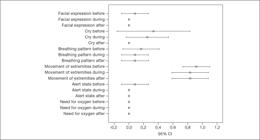
Responses obtained in the Neonatal Infant Pain Scale evaluation before, during and after physiotherapeutic care
With regard to vital signs (HR, RR, SpO2 and MAP) before, during and after the physiotherapy intervention (Table 3), there was only a significant decrease in RR after care (Z= 2.359, p=0.018) and a significant increase in oxygen saturation during the intervention (Z= 2.071, p=0.038). No significant difference was observed in the other variables.
Average frequency of vital signs (heart rate, respiratory rate, peripheral oxygen saturation and mean arterial pressure) observed before, during and after physiotherapeutic intervention
DISCUSSION
This study sought to analyze the clinical response parameters of NBs before, during and after physiotherapeutic intervention. NBs hospitalized in the NICU are exposed to hundreds of invasive and painful procedures, receiving, on average, between 7 and 17 procedures a day, such as: heel lancing, aspiration, venipuncture and peripheral venous catheter insertion15. It is worth noting that preterm NBs who were exposed to a high number of painful and stressful procedures in the NICU during the first 4 weeks of postnatal life had a higher incidence of stress behaviors when they reached 37 weeks of postconceptional age16.
In this study, there was a predominance of preterm NBs admitted to the NICU, who generally need to stay longer in this environment and are therefore more exposed to painful procedures. This result corroborates what is described in the guideline for the prevention and management of acute pain due to painful procedures in the neonatal period, and also indicates the possible impacts on the development of this population15. This guideline found that preterm infants had a lower pain threshold, less developed pain modulation and more exacerbated responses to painful stimuli.
It is worth noting that the negative impacts of neonatal pain on development can be identified early on through the individual’s biobehavioral regulation17. This regulation contributes to the integral development of the NB, evolving from primary biological processes in the neonatal phase (regulation of body temperature, hunger and the cycle of wakefulness and sleep) to more complex psychological and social processes such as the regulation of attention and behavior18.
Considering the parameters assessed by NIPS scale, there was no pain during and after the physiotherapeutic intervention, a result considered important, especially as it refers to a population at risk of comorbidities. In a similar study, carried out in the same NICU19, a minimum handling protocol was applied, in which medical care was provided with a clinical assessment and drugs were checked for clinical progression, followed by care by the nursing team, with bathing, weighing, drug administration and blood collection, when necessary; and finally physiotherapeutic care, with mobilizations, manoeuvres for bronchial hygiene, techniques to improve the respiratory condition and positioning in bed, not exceeding 40 minutes of management with the NB. In this study, there was a significant difference in the NIPS variables: facial expression (Z=2.271, p=0.023), movements of the extremities (Z= 2.00, p=0.046), alertness (Z=2.236, p=0.025) and total score (Z=2.236, p=0.025) during the intervention, indicating pain as a result of minimal handling, in contrast to the results of this study. This may indicate that currently, in this NICU, greater care has been taken during the intervention, seeking to minimize pain in the NB.
Crying and facial expressions are the behavioral responses to pain most widely recognized and observed by health professionals in the neonatal population. However, according to one study20 crying should not be used in isolation, as it can result from different events, such as discomfort and stress; and vocalization can also be absent or inhibited when the NB is intubated. On the other hand, facial expression is considered highly indicative of pain in term and preterm NBs21.
Based on the results of this study, it is essential to constantly seek better practices for the care of these NBs, with the adoption of measures to relieve and prevent pain and stress. International data indicates that although there has been a significant improvement in the care of this population over time, the frequency of painful procedures performed on hospitalized NBs with insufficient analgesia remains high15. In addition, stressful environmental stimuli present in NICUs, such as high luminosity and noise, can interfere with the intensity of pain and should always be considered and controlled, seeking greater neurobehavioral organization of NBs.
Although the use of appropriate scales to assess pain in term and preterm NBs in NICUs is highly recommended, this assessment is still rarely observed in routine care. Thus, considering the existence of 31 guidelines for the prevention and management of acute pain due to painful procedures in the neonatal period, it is necessary to apply them in the routine of care units, since pain is already considered the fifth vital sign22. Based on these premises, it is necessary to implement pain assessment in the routine care of NICUs, paying attention to the characteristics of the population served and correct clinical applicability.
Considering the results of the vital signs, there was a significant decrease (p=0.018) in HR after the physiotherapy intervention, corroborating the results of a previous study carried out in the same NICU19. The RR showed no significant difference, despite a slight change before (47±9.7), during (50.17±15.7) and after the intervention (48.50±13.2), remaining within the normal range for the population23,24.
As for MAP, studies show that this variable is closely related to the care and manipulation needed by the NB. However, in the present study, no significant difference was observed at any of the moments when the newborns’ blood pressure was assessed. The presence of MAP oscillation is directly proportional to cerebral blood flow oscillation, due to the absence of a cardiovascular self-regulation mechanism, which can lead to ischemic lesions15, commonly associated with periand intraventricular hemorrhage14. For NBs, predictive values for normality are: systolic blood pressure between 50 and 80 mmHg, diastolic blood pressure between 30 and 45 mmHg and MAP between 50 and 65 mmHg14. The results observed in this study indicate that the physiotherapy procedures did not cause pain or discomfort to the point of altering the NBs’ MAP. The team’s care in carrying out the intervention could be considered.
With regard to SpO2, a significant increase (p=0.03) was observed during the physiotherapeutic intervention, confirming the positive effect of this intervention, since the conducts (respiratory and motor) used made it possible to improve pulmonary ventilation and also prevent motor and respiratory complications in hospitalized NBs, which can contribute to an improvement in clinical prognosis and a reduction in hospitalization time24.
According to one study25, a newborn’s stay in NICU exposes them to pain due to numerous procedures, and, due to the immaturity of the nervous system, NBs are hypersensitive to various stimuli. These factors can contribute to delays in the infant’s development15. Based on this, it is confirmed that the management and control of neonatal pain is extremely important for neuropsychomotor development, in order to avoid short and long-term impairment26.
Therefore, in order to minimize the pain of hospitalized NBs, who require numerous procedures, it is important to make sure that the NB is calm and alert before starting the physiotherapeutic intervention, to avoid carrying out other manoeuvres that can exacerbate pain reactivity, such as changing diapers or aspiration, to include easy restraint and reducing excessive light and noise and, after the intervention, to maintain easy restraint until the NB returns to their baseline state. It is worth emphasizing that professionals should always carry out measures to prevent and relieve pain and stress in all procedures, as well as offering a more humanized and differentiated treatment for NBs, infants and their families.
In this study, although the number of participants was small, which can be a limiting factor, the results indicated that care protocols, when well established, can contribute to humanized care for NBs, minimizing the pain and stress of hospitalization. Therefore, more studies on these protocols should be carried out with the different populations cared for in NICUs, with the aim of contributing to evidence-based clinical practice on neonatal pain control.
CONCLUSION
The results of this study indicate that the physiotherapeutic intervention carried out on the selected population provided comfort, minimizing pain in NBs. Thus, it is hoped to contribute to evidence-based clinical practice in the management and control of pain in NBs, with humanization of care in NICUs and multidisciplinary participation in the process, which can underpin intervention strategies and preventive measures for this population.
ACKNOWLEDGMENTS
The authors would like to thank the Minas Gerais State Research Support Foundation (Fundação de Apoio à Pesquisa de Minas Gerais (FAPEMIG) for their support, the participation of NBs with the consent of their parents, and the team at the NICU where the study was carried out.
-
Sponsoring sources:
Minas Gerais State Research Support Foundation (Fundação de Apoio à Pesquisa de Minas Gerais (FAPEMIG).
REFERENCES
- 1 Moretto LCA, Perondi ER, Trevisan MG, Teixeira GT, Hoesel TC, Costa LD. Dor no recém-nascido: perspectivas da equipe multiprofissional na unidade de terapia intensiva neonatal. Arq Ciências Saúde UNIPAR. 2019;23(1):29-34
- 2 Carneiro TLP, Molina PD, Santos KSS, Teixeira CS, Leandro JD. Avaliação da dor em neonatos prematuros internados na unidade de terapia intensiva neonatal após fisioterapia respiratória. J Health Sci Inst. 2016;34(4):219-23.
- 3 Santos LM, Pereira MP, Santos LFN, Santana RCB. Avaliação da dor no recém-nascido prematuro em Unidade de Terapia Intensiva. Rev Bras Enferm. 2012;65(1):27-33.
- 4 Oliveira BBB, Fontes DAS, Oliveira MG. Dor em neonatos durante a assistência fisioterapêutica. UNILUS Ensino e Pesquisa. 2015;12(28):101-4.
- 5 DeSantana JM, Perissinotti DM, Oliveira Junior JO, Correia LM, Oliveira CM, Fonseca PR. Definição de dor revisada após quatro décadas. BrJP. 2020;3(3):197-8.
-
6 Sociedade Brasileira para Estudo da Dor. Diretrizes para Implantação da Dor como 5º Sinal Vital. [cited 2021 Oct 1]. Available from: https://sbed.org.br/5o-sinal-vital/
» https://sbed.org.br/5o-sinal-vital/ - 7 Guinsburg R, Cuenca MC. A linguagem da dor no recém-nascido. São Paulo: Sociedade Brasileira de Pediatria; 2010.
- 8 Scopel E, Alencar M, Cruz RM. Medidas de avaliação da dor. Lecturas: Educación física y deportes. 2007;(105):34.
- 9 Sousa FAE. Dor: o quinto sinal vital. Rev Latino-Am Enferm. 2002;10(3):446-7.
- 10 de Melo GM, Lélis AL, de Moura AF, Cardoso MV, da Silva VM. Pain assessment scales in newborns: integrative review. Rev Paul Pediatr. 2014;32(4):395-402.
- 11 Chester JG, Rudolph JL. Vital signs in older patients: age-related changes. J Am Med Dir Assoc. 2011;12(5):337-43.
- 12 Ramos BA, Rézio GS, Peixoto FAO, Gardenghi G. A importância da manipulação mínima em recém-nascidos prematuros na Unidade de Terapia Intensiva Neonatal. Rev Eletr Saúde Ciênc. 2016;6(2):4-8.
- 13 Hudson-Barr D, Capper-Michel B, Lambert S, Palermo TM, Morbeto K, Lombardo S. Validation of the Pain Assessment in Neonates (PAIN) scale with the Neonatal Infant Pain Scale (NIPS). Neonatal Netw. 2002;21(6):15-21.
- 14 Xie W, Wang X, Huang R, Chen Y, Guo X. Assessment of four pain scales for evaluating procedural pain in premature infants undergoing heel blood collection. Pediatr Res. 2021;89(7):1724-31.
- 15 Junqueira-Marinho MF. Diretriz para Prevenção e Manejo da Dor Aguda por Procedimentos Dolorosos no Período Neonatal. Rio de Janeiro: Fiocruz, Instituto Nacional de Saúde da Mulher, da Criança e do Adolescente Fernandes Figueira; 2023.
- 16 Cong X, Wu J, Vittner D, Xu W, Hussain N, Galvin S, Fitzsimons M, McGrath JM, Henderson WA. The impact of cumulative pain/stress on neurobehavioral development of preterm infants in the NICU. Early Hum Dev. 2017;108:9-16.
- 17 Valeri BO, Holsti L, Linhares MBM. Neonatal pain and developmental outcomes in children born preterm: a systematic review. Clin J Pain. 2015;31(4):355-62.
- 18 Sameroff AJ. Conceptual issues in studying the development of self-regulation. In: Olson S, Sameroff A, eds. Biopsychosocial regulatory processes in the development of childhood behavioral problems. New York: Cambridge University Press; 2009. 1-18p.
- 19 Achcar JA, Magalhães JC, Guimarães EL. Dor e sinais vitais em recém-nascidos prematuros submetidos ao protocolo de manuseio mínimo em unidade de terapia intensiva neonatal. Rev Movimenta. 2021;14(1):20-30.
- 20 Balda RCX, Guinsburg R. Avaliação e tratamento da dor no período neonatal. Resid Pediatr. 2019;9(1):43-52.
- 21 Grunau RVE, Craig KD. Pain expression in neonates: facial action and cry. Pain. 1987;28(3):395-410.
- 22 Booss J, Drake A, Kerns RD, Ryan B, Wasse L. Pain as the 5th vital sign [toolkit on the internet]. Illinois: Joint Commission on Accreditation of Healthcare Organizations; 2000.
- 23 Nicolau CM, Falcão MC. Efeitos da fisioterapia respiratória sobre a pressão arterial em recém-nascidos pré-termo. Fisioter Pesqui. 2008;15:235-9.
- 24 Sarmento GJV, et al. Fisioterapia respiratória em pediatria e neonatologia. 2ª Ed. Editora Manole; 2011.
- 25 Perry M, Tan Z, Chen J, Weidig T, Xu W, Cong XS. Neonatal pain: perceptions and current practice. Crit Care Nurs Clin North Am. 2018;30(4):549-61.
- 26 Lim Y, Godambe S. Prevention and management of procedural pain in the neonate: an update. Arch Dis Child Educ Pract Ed. 2017;102(5):254-6.
Edited by
-
Associate editor in charge:
Isabela Freire Azevedo-Santos https://orcid.org/0000-0001-8836-8640