 Phytotoxic characterization of Chrysopogon zizanioides root extracts: inhibitory effects on Eleusine indica and Praxelis clematidea
 ABSTRACT
The reliance on synthetic herbicides has accelerated herbicide resistance, necessitating the development of sustainable, plant-based management strategies. This study evaluated the phytotoxic potential of the root methanolic extract of Chrysopogon zizanioides (vetiver grass) against two noxious weeds, Praxelis clematidea and Eleusine indica. Greenhouse experiments assessed pre- and post-emergence effects at concentrations of 0, 0.1, 10, 50, and 100 mg·mL-1, focusing on growth, photosynthetic, and stress biomarkers. The extract displayed significant, species-specific phytotoxicity. In early post-emergence trials, E. indica exhibited higher sensitivity (63.3% inhibition) compared to P. clematidea (36.7%). Conversely, post-emergence applications caused severe growth suppression in P. clematidea, reducing shoot and root biomass by 91 and 95%, respectively. While E. indica experienced moderate biomass loss (59–69%), it suffered pronounced physiological disruption, evidenced by significant declines in soil-plant analysis development values (SPAD) (34%) and chlorophyll a content (35%). Biochemical analyses indicated that phytotoxicity was mediated by an oxidative burst, as evidenced by elevated proline, malondialdehyde, and superoxide dismutase activity. The results also indicated that the extract was effective in early post-emergence treatment against monocot weed, while inflicting damage on dicot weed in post-emergence treatment. These findings demonstrated that C. zizanioides extracts effectively inhibit weed growth by disrupting photosynthetic machinery and inducing oxidative damage, highlighting their potential as bio-herbicides.
Key words
allelopathy; monocot weed; dicot weed; stress biomarker; vetiver grass
INTRODUCTION
The tropical region is renowned for its diverse plant life, and its adequate sunlight and rainfall promote the growth of both plants and weeds. These conditions provide a suitable environment for weeds to grow and thrive. The weed competes aggressively with crops for essential resources such as nutrients, water, and sunlight, often resulting in reduced yields and increased production costs for farmers. Malaysia’s location in a tropical region with ample rainfall is a significant factor in the country’s vast array of weeds (Nurul Ain et al. 2017). Bakar (2004) listed approximately 100 invasive weed species in Malaysia, encompassing both aquatic and terrestrial plants.
According to FAOSTAT (FAO, 2026), approximately 30,123 tonnes of pesticides were used in Malaysia in 2023, representing a 17.63% increase from 2022. The extensive use of herbicides in the agricultural sector also has its downsides. In 2013, 17 herbicide-resistant weed species were recorded in Malaysia (Heap 2024). Since then, the phenomenon of herbicide-resistant weeds has continued to increase gradually. As herbicide usage continues to rise in tropical countries, it becomes increasingly important to consider the long-term ecological and social implications of this reliance on chemical control methods. Among the various environmentally friendly methods available for weed management, the use of allelopathic mechanisms has gained significant attention from the scientific community (Farooq et al. 2020). The implementation of allelopathy as a weed management strategy in agroecosystems has been identified as a potential approach to mitigate the reliance on herbicides, as suggested by Sathishkumar et al. (2020).
In response to these challenges, environmentally friendly weed management approaches, particularly bio-based inputs such as bioherbicides, have gained increasing attention in recent years (Bratovcic 2025). Bioherbicides derived from plant extracts, and microorganisms, and allelochemicals have demonstrated strong potential as sustainable alternatives to synthetic herbicides. Recent studies have shown that plant-based bioherbicides can effectively suppress weed germination and growth while reducing environmental impact (Motmainna et al. 2021).
Chrysopogon zizanioides (L.) Roberty [syn. Vetiveria zizanioides (L.) Nash ex Small] (vetiver grass) is a perennial grass belonging to the Poaceae family. The grass exhibits a thick and upright growth habit, with a potential maximum height of 2.4 m (National Park Board 2025). The vetiver root system exhibits remarkable penetrative capabilities, enabling it to withstand fractures within the soil structure and thereby enhancing its efficacy in preventing erosion (Galal et al. 2022). Vetiver grass has been recognised for its antioxidant potential and has been studied for its antituberculosis properties (Saravanan and Ramamurthy 2023). In Malaysia, the plant, commonly known as rumput akar wangi and traditionally recognised for its medicinal properties, is used to treat several ailments, including fever, postnatal care, and rheumatic conditions (Yusof 2013). Based on the research conducted by Sahrir et al. (2024), the methanolic extract of C. zizanioides root has shown phytotoxic effects on Brassica rapa (choisum) by reducing chlorophyll content and stomatal size.
Thus, this study was conducted to test the hypothesis that C. zizanioides root methanolic extract (MeOH) possesses phytotoxic activity against Praxelis clematidea and Eleusine indica, with effects varying by weed species and application timing. This experiment examined the extract’s ability to control the target weeds through early post-emergence and post-emergence applications.
MATERIALS AND METHODS
The experiment was conducted within the UniSZA greenhouse, located at 5°45’13.7”N and 102°37’47.4”E, at an altitude of 10 m, from March to April 2022. The experiment was performed in triplicate following a randomised complete block design. The greenhouse conditions were 30.3°C ± 3.3°C and 66.82% ± 13% relative humidity. In all experiments, target weeds were treated with a methanolic extract of C. zizanioides applied at 100 mL.m-2.
Chrysopogon zizanioides root extraction and target plant preparation
The C. zizanioides roots were extracted by a modified method based on those described by Aslani et al. (2014) and Ismail et al. (2016). The roots were washed with tap water and dried in an oven at 60°C for 72 hours. The dried samples were ground with an IKA MF 10 basic microfine grinder. The powdered samples were kept at 4°C for further analysis. Approximately 100 g of roots were weighed and placed in a 1,000-mL Schott Duran bottle. For extraction, 80% methanol was added to the sample, which was then soaked for 72 hours at 4°C. The solution was then centrifuged for 20 minutes at 3,500 rpm, and the resulting supernatant was filtered through a Whatman No. 1 filter with a 0.2-µm membrane to ensure fine filtration. The methanol extract obtained from this process was subsequently evaporated to dryness using a rotary evaporator at 40°C. The crude extract was weighed and diluted with distilled water to produce a 100-mg.mL-1 stock solution (w/v). The stock solution was then diluted with distilled water to produce 0.1, 1, 10, 50, and 100 mg.mL-1 (v/v), tailored to the requirements of the experiment.
In the experiment, two weeds, namely P. clematidea and E. indica, were utilised. The weed seeds were pre-germinated and used when the radicle tip was visible. Subsequently, 10 viable seedlings were transplanted into pots (10 cm high and 8 cm wide), each filled with 300 g of sandy loam soil (pH = 7.7; base saturation = 95%; organic carbon content = 2.47%; sand = 67.90%; clay = 17.30%; silt = 14.80%). All the experiments were conducted in triplicate.
Early post-emergence experiment
The pots containing the seeds were irrigated with water a day before treatment application. Extracts with different concentrations (0.1, 1, 10, 50, and 100 mg.mL-1) were applied to the soil using a 1-L sprayer at a rate of 100 mL.m-2 (Motmainna et al. 2021), while distilled water served as the control. The emergence of the weeds was recorded after 14 days, and on the 21st day, they were collected for biomass determination.
Post-emergence experiment
The experiments commenced upon the emergence of two or three true leaves of P. clematidea and five or six true leaves of E. indica. The diluted extracts (0.1, 1, 10, 50, and 100 mg.mL-1) and distilled water (control) were applied to the entire plants using a sprayer at a rate of 100 mL.m-2. Then, the weed seedlings were watered every two days, and after two weeks, 20 mL of half-strength Hoagland solution was applied to the pots (El-Mergawi and Al-Humaid 2019). On the 21st day after treatment, soil-plant analysis development (SPAD) values of the weeds were measured, and the plants were harvested and extracted for stress biomarker analysis and chlorophyll content determination.
Weeds samples preparation
The experiment utilized fresh weed leaves, which were harvested after 21 days and immediately cleaned. The cleaned weed leaves (0.2 g) were pulverized in a mortar and pestle using liquid nitrogen. Subsequently, 3 mL of 100 mM phosphate-buffered saline (PBS) (pH 7.8) was added, and the mixture was homogenized (Chen and Zhang 2016). The homogenate was then transferred to a 1.5-mL centrifuged tube and centrifuged at 10,000 × g for 20 min at 4°C. The supernatant was transferred to a new centrifuged tube, stored at -80°C, and thawed as needed for further analysis.
Soil-plant analysis development and chlorophyll content determination
Weeds’ soil-plant analysis development (SPAD) values were assessed using a portable Konica Minolta SPAD meter (502 Plus). The quantification of chlorophyll content, specifically chl a and b, was conducted following the procedure outlined by Lichtenthaler and Wellburn (1983). The weed leaves were pulverized in liquid nitrogen, and 100 mg of the samples were extracted in 80% acetone and read at 663 and 645 nm by a spectrophotometer.
Crude protein determination
The crude protein content was determined using the Bradford method, as outlined by Kruger (2002). Crude protein was used to calculate proline, malondialdehyde (MDA), and superoxide dismutase (SOD) in the samples. The Bradford reagent was prepared by combining 100 mg of Coomassie Blue with 50 mL of 95% ethanol. Then, 100 mL of 85% phosphoric
acid was added to the mixture, which was diluted to 1 L with distilled water. The reagents were then filtered with Whatman no. 1 filter paper and stored in an amber bottle. The protein standard was prepared using bovine serum albumin (BSA) with distilled water to produce different concentrations (0, 1, 2, 4, 6, and 10 µL). Then, 5 mL of Bradford reagent was mixed with the prepared standard. The standards were then measured using a spectrophotometer at 595 nm. The sample’s crude protein was determined by mixing 10 µL of the sample with 5 mL of reagents in a tube. After 10 minutes, the mixture was measured at 595 nm using a spectrophotometer. Crude protein was quantified using a standard curve.
Proline determination
Proline determination in the target species was conducted as outlined by Chen and Zhang (2016). The reaction solution was prepared by mixing 10 mL of 3% sulphosalicylic acid, 10 mL of acetic acid, and 20 mL of 2.5% acid ninhydrin. Then, 50 µL of the samples were pipetted into a 1-mL reaction solution in a centrifuge tube, and 50 µL of 100 mM PBS (pH 7.8) was used as the reference. The centrifuge tubes were then boiled in a water bath at 95°C for 15 minutes. Subsequently, the reaction mixture absorbance was measured at 520 nm. The absorbance readings were then quantified with the standard curve of L-proline and expressed as µg/mg protein.
Malondialdehyde determination
The MDA content in weed species was determined by mixing 100 µL of weed samples with 0.25% thiobarbituric acid (TBA) in a tube, while 100 µL of 100 mM PBS (pH 7.8) and 0.25% TBA served as the reference. The mixture was then placed in a water bath at 95°C for 15 minutes, cooled in ice for 5 minutes, and the absorbance was measured at 532 and 600 nm. The MDA was then calculated using the extinction coefficient of 155 (MDA-TBA at 532 mM-1.cm-1). The formula is as shown in Eq. 1.
where: A532: the absorbance at 532 nm; A600: the absorbance at 600 nm; Vr: the volume of the reaction mixture; V: the total volume of the samples; Vt: the volume of the sample used in the tube; Cp: crude protein (mg.mL-1); 155: the coefficient of MDA-TBA at 532 (mM-1.cm-1)
Superoxide dismutase determination
The reaction mixture was prepared by combining 30 mL of 100 mM PBS (pH 7.8), 0.6 mL of 1 mM EDTA-2Na, 2 mL of 130 mM methionine, 2 mL of 750 µL nitro-blue tetrazolium, and 2 mL of 20 µM riboflavin in a flask as described by Chen and Zhang (2016). Next, 50 µL of the weed samples were added to the reaction solution in a Falcon tube, and 50 µL of 100 mM PBS (pH 7.8) was added as a reference. The references or controls were subjected to dark (Ac1) and light conditions (Ac2). The Ac1 was stored in a dark cabinet for 15 minutes. The samples were exposed to light at 4,000 lux for 10–15 minutes. The absorbance of the controls and samples was measured at 560 nm using a spectrophotometer, with Ac1 used as a reference. The SOD was calculated by Eq. 2.
where: Ac2: the absorbance of control in light condition; As: the absorbance of the samples; V: volume of the samples; Vt: volumes of the samples used in the tube; Cp: crude protein of the samples; 0.5: the inhibition of 50% NBT.
Data analysis
Data on weed germination were analysed using a two-way analysis of variance (ANOVA). For the stress biomarker and chlorophyll, the Shapiro-Wilk’s test and ANOVA were performed in Minitab 20.3, with Tukey’s test at the 0.05 significance level to compare means. The analysis was also followed by correlation and linear regression analysis on the extract concentration and response.
RESULTS AND DISCUSSION
Early post-emergence experiment
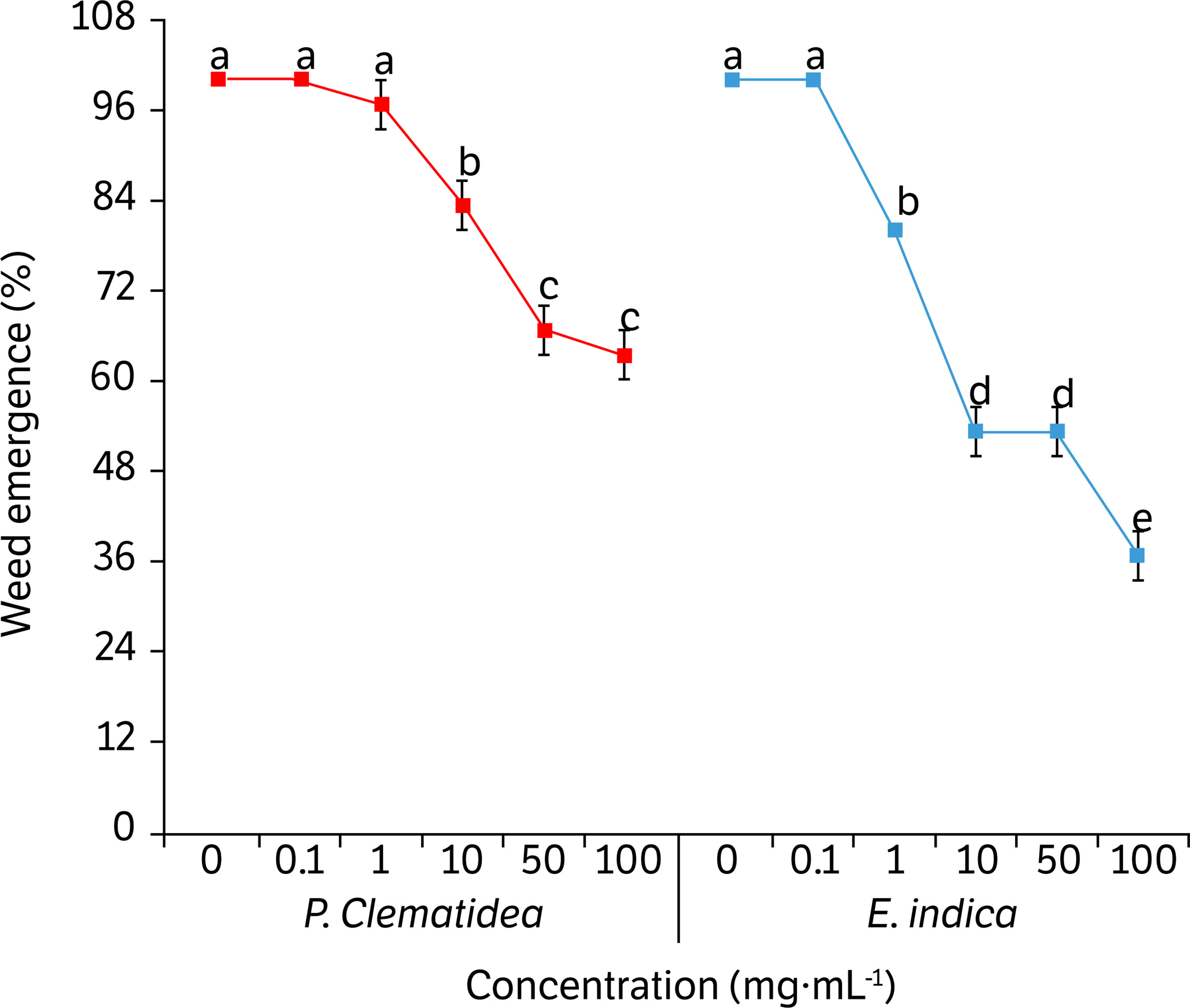
The results of the two-way ANOVA indicated a significant reduction in weed emergence at varying concentrations of C. zizanioides extract across weed species, as shown in Table 1. There were highly significant main effects of both weed species (F(1, 24) = 119.14, p < 0.001) and concentration (F(5, 24) = 173.28, p < 0.001), as well as a significant interaction between the two (F(5, 24) = 15.51, p < 0.001), indicating that the effect of the concentration differs depending on the specific weed species being treated. The coefficient of variation (CV) for the experiment was 9.95%. Pearson’s correlation analysis revealed a strong negative relationship between applied dose and seedling emergence for both weed species. P. clematidea showed a very strong negative response (R2 = -0.896, p < 0.001), with emergence declining linearly as the dose increased. E. indica also exhibited a strong negative correlation (R2 = -0.845, p < 0.001). These results indicate a clear dose-dependent inhibitory effect. The application of C. zizanioides root methanol (MeOH) extract inhibits the emergence of the tested weeds.
Two-way analysis of variance examining the interaction of weed species and concentration upon early post-emergence application of Chrysopogon zizanioides root methanolic extract.
Based on these results, the extract at the concentration of 100 mg.mL-1 effectively reduced the weed of E. indica (63.32%) and P. clematidea (36.67%) compared to the control (Fig. 1). The treatments began to have a notable impact on weed emergence at concentrations of 10 mg.mL-1 for P. clematidea and 1 mg.mL-1 for E. indica. The influence of the root MeOH depends on both the species and the concentration. Allelochemicals have the potential to disrupt the equilibrium of various biological processes, including the antioxidant system, the homeostasis of growth regulators, the activity of enzymes, respiration, photosynthesis, as well as the uptake of water and nutrients, and the synthesis and metabolism of proteins and nucleic acids (Bhatla and Lal, 2018).

The emergence of weeds after 14 days of treatment. The value is presented as mean ± standard error (n = 3). The points for each weed species with the same letter are not statistically different according to Tukey’s test at p < 0.05.
In the early post-emergence experiment, C. zizanioides moderately inhibited the germination of E. indica and P. clematidea by 63.32 and 36.67%, respectively. The early post-emergence treatment results show that the extract was more effective at inhibiting E. indica growth than P. clematidea. The different responses of the two weed species may be due to the variation in seed size. Smaller seeds and early-emerging plants are highly vulnerable to allelopathy (Motalebnejad et al. 2023), as their limited energy stores leave them little margin to overcome chemical suppression during the critical stages of establishment.
The effects of C. zizanioides root MeOH on weed biomass are presented in Table 2. A weak correlation between concentration and the weed biomass was observed in E. indica (fresh weight = -0.239, dry weight = -0.231), while in P. clematidea (fresh weight = -0.231, dry weight = -0.196) there was a significant decrease in the fresh weight of P. clematidea (at concentrations 0.1, 10 and 100 mg.mL-1). However, no significant effect of C. zizanioides root MeOH was observed on the dry weight of P. clematidea compared to the control. Furthermore, the treatments had no significant effect (p ≥ 0.05) on the fresh weight of E. indica compared to the control. However, at 10 mg.mL-1 of the extract concentration, there was a significant decrease in the dry weight of E. indica by 57% compared to the control group.
Early post-emergence effect of Chrysopogon zizanioides root methanolic extract on the biomass of weeds. The data are presented as means ± standard error (n = 9).
The study also demonstrated that early post-emergence treatment did not affect the biomass of P. clematidea or E. indica compared with the control. The presence of allelochemicals in the extract hinders seed germination but has a minimal impact on the growth of already emerged weeds. During treatment, the extract infiltrates the soil and interacts with both the soil and the seed surface. However, once weeds appear, the residual allelochemicals may become less potent or undergo changes and breakdown, diminishing their capacity to hinder weed growth. This could result in weeds emerging with biomass similar to that of the control group. After the initial application, allelochemicals may undergo various transformations or degradations in the soil environment (Scavo et al. 2019). These processes can alter the chemical structure of allelochemicals, reducing their phytotoxicity and leading to the formation of metabolites or byproducts with different or diminished effects.
Post-emergence experiment
Biomass of targeted weeds
The biomass of P. clematidea showed significant reductions in aerial and root biomass (fresh and dry weight) after the treatments (Fig. 2). The linear model accounted for 53.6 and 60.5% of the variance in shoot fresh and dry weight, respectively (adjusted R2). Meanwhile, the model for P. clematidea biomass showed a dramatic, dose-dependent decline, accounting for over 96% of the observed variance (adjusted R2 > 0.96). The treatments at 100 mg.mL-1 of extract concentration have reduced the fresh weight of the aerial part and root by 91 and 95%, respectively (Figs. 2a and 2b). The application of C. zizanioides root MeOH has shown a significant effect on the biomass of the aerial part and root of E. indica (Fig. 3). The model for aerial part explained a substantial portion of the variance, with adjusted R2 values of 72.96 (fresh weight) and 77.91% (dry weight). The aerial section of E. indica exhibited a reduction of 59 and 69% in fresh and dry weight, respectively, when exposed to a concentration of 100 mg.mL-1 (Fig. 3a). Similarly, a decrease in weight was also noted at the root of E. indica (Fig. 3b). The statistical models provided a strong fit to the data, explaining 78.13 (fresh weight) and 77.49% (dry weight) of the variance (adjusted R2). The findings align with those reported by Hussain et al. (2022), who observed that weeds treated with Triticum aestivum exudates exhibited diminished plant vigour and a subsequent drop in biomass.

Effect of Chrysopogon zizanioides root methanolic extract post-emergence application on Praxelis clematidea biomass of (a) aerial part and (b) root. Different letters on the bar indicate significant differences according to Tukey’s test (p ≤ 0.05). Data presented as mean ± error (n = 3), bars indicate standard error.

Effect of Chrysopogon zizanioides root methanolic extract post-emergence application on Eleusine indica biomass of (a) aerial part and (b) root. Different letters on the bar indicate significant differences according to Tukey’s test (p < 0.05). Data presented as mean ± error (n = 3), bars indicate standard error.
Chlorophyll, proline, malondialdehyde, and superoxide dismutase
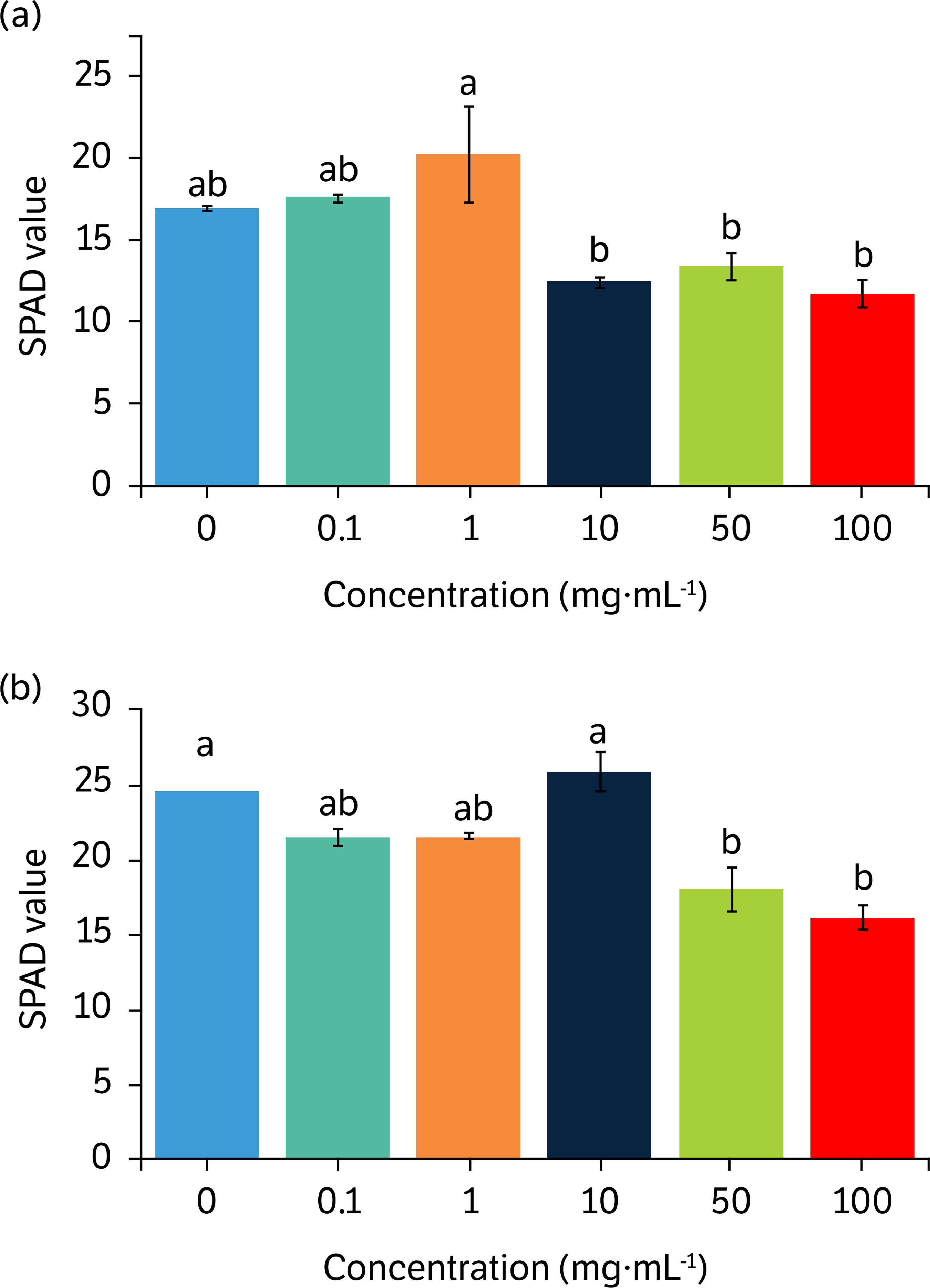
The results presented in Fig. 4a suggest that the SPAD value for P. clematidea at the highest concentration of C. zizanioides root MeOH was not significantly different from the control. The SPAD reading model for P. clematidea explained 60.08% of the variance in the data (adjusted R2). In contrast, the SPAD measures exhibited a significant 34% decrease in E. indica when exposed to the extract at a concentration of 100 mg.mL-1 compared to the control group (Fig. 4b), with a statistical model demonstrating a strong fit, explaining 74.14% of the variance in chlorophyll content (adjusted R2). Nevertheless, a hormetic effect was observed in P. clematidea at 1 mg.mL-1 of extract, with the SPAD value increasing by 19.52% compared to the control.
Effect of Chrysopogon zizanioides root MeOH on the soil-plant analysis development (SPAD) value of (a) Praxelis clematidea and (b) Eleusine indica. Different letters on the bar indicate significant differences according to Tukey’s test (p < 0.05). Data presented as mean ± error (n = 3), bars indicate standard error.
The study’s findings suggest that applying the extract at a concentration of 100 mg.mL-1 does not significantly impact chlorophyll a and b levels in P. clematidea (Fig. 5a). However, a hormetic effect was observed when P. clematidea was exposed to 1 mg.mL-1 of the extract, resulting in a 19% increase in chlorophyll compared to the control. In the case of E. indica, the application of an extract at 100 mg.mL-1 resulted in a 35% reduction in chlorophyll a levels compared to the control (Fig. 5b), with the linear model accounting for 69.38% of the adjusted variance. In chlorophyll b, reading content remained highly variable across all groups, lacking a discernible dose-response trend. The application of C. zizanioides root MeOH extract reduced chlorophyll content in the target weeds. Results show that C. zizanioides MeOH has reduced SPAD readings and chlorophyll a levels in E. indica. The reduction in chlorophyll levels in E. indica was determined by the administered concentration, and this effect has also been documented by Sahrir et al. (2024), who observed that elevated concentrations of C. zizanioides root MeOH reduced chlorophyll content in the target plant. Allelochemicals, primarily phenolic compounds and terpenoids (Marchiosi et al. 2020), affect ATPases and the enzyme system involved in chlorophyll synthesis, ultimately inhibiting plant growth (Ming et al. 2020). Moreover, the effect of the extracts was species dependent. The current investigation concurred with the prior investigation conducted by Zhang et al. (2016) and Ghimire et al. (2020), suggesting that allelochemicals affect target weeds differently. This species-specific response can be attributed to differences in the sensitivity of plant physiological responses and biochemical pathways to allelochemicals. Plant-specific mechanisms for detoxifying or tolerating the allelochemicals directly influence the observed reduction in growth.

Effect of Chrysopogon zizanioides root MeOH on the chlorophyll content of (a) Praxelis clematidea and (b) Eleusine indica. Different letter on the bar indicates significant differences according to Tukey’s test (p < 0.05). Data presented as mean ± error (n = 3), bars indicate standard error.
The application of the extract has more than doubled proline concentrations in P. clematidea and E. indica, particularly at 100 mg.mL-1 (Fig. 6). Regression analysis showed a strong positive linear relationship between extract concentration and proline content in both P. clematidea (R2 = 0.983, p < 0.05) and E. indica (R2 = 0.933, p < 0.05). This finding demonstrates that allelochemicals in C. zizanioides root extract can generate stress, particularly oxidative stress, in the targeted weeds. When applied at 100 mg.mL-1 of C. zizanioides root MeOH, the concentration of MDA in both weed samples was higher than in the control. A strong, positive linear relationship between extract concentration and MDA was observed for P. clematidea (R2 = 0.749, p < 0.05), accounting for nearly 75% of the variance. In contrast, E. indica showed only a moderate relationship (R2 = 0.36, p < 0.05), with extract concentration accounting for just 36% of the variance in MDA. The elevation in MDA readings can be attributed to lipid peroxidation, suggesting that the plants were influenced by the administered allelochemicals (Figs. 7a and 7b). Nevertheless, MDA levels were higher in P. clematidea than in E. indica, suggesting that broad-leaf weeds were more vulnerable to the allelochemicals in the extract. Based on the data presented in Figs. 8a and 8b, the treatment has a considerable impact on SOD activity in the targeted weeds. Compared to the control group, both P. clematidea and E. indica weeds exhibited elevated SOD activity upon exposure to 50 and 100 mg.mL-1 extract concentrations. The regression analysis of SOD activity revealed significant dose-dependent increases in both species (p < 0.001). E. indica exhibited a highly consistent linear response, with the regression model explaining 87.8% of the variance (R2 = 0.878). In contrast, P. clematidea showed a moderate linear fit (R2 = 0.627), characterised by an initial decrease in enzyme activity at the lowest concentration (0.1) before a steady rise at higher dosages. This observation demonstrates the extract’s ability to augment oxidative stress levels in targeted weeds. The SOD activity in P. clematidea increased by 90%, while E. indica by 59% with 100 mg.mL-1 root extract in comparison with the control. The presence of proline in plants under adverse conditions serves as a gauge of tolerance and an indicator of antioxidative capacity (Spormann et al. 2023).

Effect of Chrysopogon zizanioides on the proline contents of (a) Praxelis clematidea and (b) Eleusine indica. Different letter on the bar indicates significant differences according to Tukey’s test (p < 0.05). Data presented as mean ± error (n = 3), bars indicate standard error.

Effect of Chrysopogon zizanioides on the malondialdehyde (MDA) contents of (a) Praxelis clematidea and (b) Eleusine indica. Different letters on the bar indicate significant differences according to Tukey’s test (p < 0.05). Data presented as mean ± error (n = 3), bars indicate standard error.

Effect of Chrysopogon zizanioides on the superoxide dismutase (SOD) contents of (a) Praxelis clematidea and (b) Eleusine indica. Different letters on the bar indicate significant differences according to Tukey’s test (p < 0.05). Data presented as mean ± error (n = 3), bars indicate standard error.
Proline metabolism is involved in the hypersensitive response of plants towards reactive oxygen species (ROS) induced by stress (La et al. 2020). This study suggests that allelochemicals in the root MeOH of C. zizanioides trigger ROS production in targeted weeds, inducing proline synthesis as a potential mechanism to maintain ROS homeostasis. However, excessive ROS accumulation leads to oxidative stress, damaging cellular structures for photosynthesis and respiration, and ultimately hindering weed growth. Therefore, the C. zizanioides extract disrupts normal physiological processes by activating proline synthesis and increasing ROS, ultimately inhibiting weed growth and reducing biomass. Elevated MDA levels indicate the extent of membrane peroxidation within plant cells, signifying oxidative damage and growth inhibition (Bai et al., 2019). Similarly, Šućur et al. (2021) reported that the allelopathy of Ambrosia trifida induced such intense stress that antioxidant enzymes could not mitigate oxidative stress in target plants, leading to a surge in lipid peroxidation.
In comparison to E. indica, the effect of C. zizanioides extracts on MDA levels in P. clematidea was more pronounced. This observation aligns with findings by Marwa et al. (2023), who reported that the dicotyledon Sinapis arvensis showed heightened susceptibility to Eucalyptus maculata extract, resulting in a 12-fold increase in MDA content. SOD is pivotal in safeguarding plants against the detrimental effects of ROS arising from routine cellular metabolic processes or from diverse environmental stressors (Wang et al. 2016). In this experiment, SOD activity in both weeds (P. clematidea and E. indica) increased significantly at 50 and 100 mg.mL-1. Thus, oxidative stress increases in target plants. The allelochemicals induced excessive generation of ROS, which activated antioxidant enzymes to scavenge ROS (Ghimire et al. 2020). However, lower concentrations did not affect the SOD activity in targeted weeds.
CONCLUSION
The methanolic root extract of C. zizanioides exhibited phytotoxic effects under controlled conditions, inhibiting weed emergence and reducing biomass in E. indica and P. clematidea. The effects were both concentration- and species-dependent, with greater sensitivity observed in E. indica during early post-emergence. The extract also induced oxidative stress responses, as indicated by increased proline, MDA, and SOD activity. These findings revealed that the phytotoxic effects of C. zizanioides root extract are species-dependent and concentration-dependent. The extract also shows great potency as an early post-emergence treatment on the targeted weeds.
ACKNOWLEDGMENTS
Not applicable.
-
How to cite:
Sahrir, M. A. S., Yusoff, N. and Aridi, N. A. M. (2026). Phytotoxic characterization of Chrysopogon zizanioides root extracts: inhibitory effects on Eleusine indica and Praxelis clematidea. Bragantia, 85, e20260012. https://doi.org/10.1590/1678-4499.20260012
-
FUNDING
Universiti Sultan Zainal AbidinGrant No.: UniSZA/2022/DPU2.0/08
-
DECLARATION OF USE OF ARTIFICIAL INTELLIGENCE TOOLS
The authors declare that artificial intelligence tools (ChatGPT, OpenAI) were used exclusively to support language revision. All scientific content, analyses, interpretations, and conclusions presented in this manuscript are the sole responsibility of the authors.
DATA AVAILABILITY STATEMENT
All data were generated or analysed in this study.
REFERENCES
-
Aslani, F., Juraimi, A. S., Ahmad-Hamdani, M. S., Omar, D., Alam, M. A., Hashemi, F. S. G., Hakim, M. A. and Uddin, M. K. (2014). Allelopathic effect of methanol extracts from Tinospora tuberculata on selected crops and rice weeds. Acta Agriculturae Scandinavica, Section B — Soil & Plant Science, 64, 165-177. https://doi.org/10.1080/09064710.2014.898784
» https://doi.org/10.1080/09064710.2014.898784 -
Bai, Y., Wang, G., Cheng, Y., Shi, P., Yang, C., Yang, H. and Xu, Z. (2019). Soil acidification in continuously cropped tobacco alters bacterial community structure and diversity via the accumulation of phenolic acids. Scientific Reports, 9, 12499. https://doi.org/10.1038/s41598-019-48611-5
» https://doi.org/10.1038/s41598-019-48611-5 -
Bakar, B. H. (2004). Invasive weed species in Malaysian agro-ecosystems: species, impacts and management. Malaysian Journal of Science, 23, 1-42. https://mjs.um.edu.my/index.php/MJS/article/view/8489/5910
» https://mjs.um.edu.my/index.php/MJS/article/view/8489/5910 - Bhatla, S. C. and Lal, M. A. (2018). Plant physiology, development and metabolism. Singapore: Springer.
- Bratovcic, A. (2025). Eco-friendly weed management: nanoformulated bioherbicides for improved crop productivity. Advances in Nanoparticles, 14, 101-120.
-
Chen, T. and Zhang, B. (2016). Measurements of proline and malondialdehyde content and antioxidant enzyme activities in leaves of drought stressed cotton. Bio-Protocol, 6, e1913. https://doi.org/10.21769/BioProtoc.1913
» https://doi.org/10.21769/BioProtoc.1913 -
El-Mergawi, R. A. and Al-Humaid, A. I. (2019). Searching for natural herbicides in methanol extracts of eight plant species. Bulletin of the National Research Centre, 43, 22. https://doi.org/10.1186/s42269-019-0063-4
» https://doi.org/10.1186/s42269-019-0063-4 -
[FAO] Food and Agriculture Organization (2026). FAOSTAT (Pesticide Use). Available at: https://www.fao.org/faostat/en/#data/RP Accessed on: Jan. 20, 2026.
» https://www.fao.org/faostat/en/#data/RP -
Farooq, N., Abbas, T., Tanveer, A. and Jabran, K. (2020). Allelopathy for weed management. In J.M. Merillon and K. G. Ramawat (Eds.). Co-evolution of secondary metabolites (p. 505-519). Switzerland: Springer Champ. https://doi.org/10.1007/978-3-319-96397-6_16
» https://doi.org/10.1007/978-3-319-96397-6_16 -
Galal, M., Hesham, I. and Khald, A. H. (2022). Evaluating efficiency of vetiver grass (Vetiveria zizanioides L. Nash) in combating water soil erosion hazards under Egyptian environmental conditions. Journal of Environmental Science, 51, 133. https://doi.org/10.21608/JES.2022.123600.1186
» https://doi.org/10.21608/JES.2022.123600.1186 -
Ghimire, B. K., Hwang, M. H., Sacks, E. J., Yu, C. Y., Kim, S. H. and Chung, I. M. (2020). Screening of allelochemicals in Miscanthus sacchariflorus extracts and assessment of their effects on germination and seedling growth of common weeds. Plants, 9, 1313. https://doi.org/10.3390/plants9101313
» https://doi.org/10.3390/plants9101313 -
Heap, I. (2024). The international herbicide-resistant weed database. Available at: https://www.weedscience.org/Home.aspx Accessed on: Mar 24, 2024.
» https://www.weedscience.org/Home.aspx -
Hussain, M. I., Vieites‐Álvarez, Y., Otero, P., Prieto, M. A., Simal‐Gandara, J., Reigosa, M. J. and Sánchez‐Moreiras, A. M. (2022). Weed pressure determines the chemical profile of wheat (Triticum aestivum L.) and its allelochemicals potential. Pest Management Science, 78, 1605-1619. https://doi.org/10.1002/ps.6779
» https://doi.org/10.1002/ps.6779 - Ismail, B.S., Halimshah, S., Wan Ahmad, W. J. and Yusoff, N. (2016). Allelopathic potential of the leaf and seed of Pueraria javanica Benth. on the germination and growth of three selected weed species. Sains Malaysiana, 45, 517-521.
- Kruger, N. J. (2002). The Bradford method for protein quantification. In J. M. Walker (Ed.). The protein protocols handbook (p. 15-21). New Jersey: Humana Press.
-
La, V. H., Lee, B. R., Islam, M. T., Mamun, M. A., Park, S. H., Bae, D. W. and Kim, T. H. (2020). Characterisation of glutamate-mediated hormonal regulatory pathway of the drought responses in relation to proline metabolism in Brassica napus L. Plants, 9, 512. https://doi.org/10.3390/plants9040512
» https://doi.org/10.3390/plants9040512 - Lichtenthaler, H. K., and Wellburn, A. R. (1983). Determinations of total carotenoids and chlorophylls a and b of leaf extracts in different solvents. Biochemical Society Transaction, 11, 591-592.
-
Marchiosi, R., Santos, W. D., Constantin, R. P., Lima, R. B., Soares, A. R., Finger-Teixeira, A., Mota, T. R., Oliveira, D. M., Foletto-Felipe, M. D. P., Abrahão, J. and Ferrarese-Filho, O. (2020). Biosynthesis and metabolic actions of simple phenolic acids in plants. Phytochemistry Reviews, 19, 865-906. https://doi.org/10.1007/s11101-020-09689-2
» https://doi.org/10.1007/s11101-020-09689-2 -
Marwa, K., Ismail, A., Souihi, M., Yassine, M., Dhaouadi, F., Mohsen, H. and Lamia, H. (2023). Chemical composition and herbicidal potential of essential oil of Eucalyptus maculata Hook. Scientific African, 21, e01751. https://doi.org/10.1016/j.sciaf.2023.e01751
» https://doi.org/10.1016/j.sciaf.2023.e01751 -
Ming, Y., Hu, G. X., Li, J., Zhu, Z. J., Fan, X. M. and Yuan, D. Y. (2020). Allelopathic effects of Castanea henryi aqueous extracts on the growth and physiology of Brassica pekinensis and Zea mays Chemistry & Biodiversity, 17, e2000135. https://doi.org/10.1002/cbdv.202000135
» https://doi.org/10.1002/cbdv.202000135 -
Motalebnejad, M., Karimmojeni, H., Majidi, M. M. and Mastinu, A. (2023). Allelopathic effect of aqueous extracts of grass genotypes on Eruca sativa L. Plants, 12, 3358. https://doi.org/10.3390/plants12193358
» https://doi.org/10.3390/plants12193358 -
Motmainna, M., Juraimi, A. S., Uddin, M. K., Asib, N. B., Islam, A. M. and Hasan, M. (2021). Bioherbicidal properties of Parthenium hysterophorus, Cleome rutidosperma and Borreria alata extracts on selected crop and weed species. Agronomy, 11, 643. https://doi.org/10.3390/agronomy11040643
» https://doi.org/10.3390/agronomy11040643 -
National Park Board (2025). Chrysopogon zizanioides (L.) Roberty. Available at: https://www.nparks.gov.sg/florafaunaweb/flora/3/6/3668 Accessed on: Dec 30, 2025.
» https://www.nparks.gov.sg/florafaunaweb/flora/3/6/3668 -
Nurul Ain, M. B., Nornasuha, Y. and Ismail, B.S. (2017). Evaluation of the allelopathic potential of fifteen common Malaysian weeds. Sains Malaysiana, 46, 1413-1420. https://doi.org/10.17576/jsm-2017-4609-09
» https://doi.org/10.17576/jsm-2017-4609-09 -
Sahrir, M. A. S., Yusoff, N., Azizan, K. A. and Aridi, N. A. M. (2024). Assessing the allelopathic effect of Chrysopogon zizanioides (L.) Roberty root methanolic extract on Brassica rapa subsp. chinensis var. parachinensis using an untargeted metabolomic approach. Chilean Journal of Agricultural Research, 84, 154-165. https://doi.org/10.4067/s0718-58392024000200154
» https://doi.org/10.4067/s0718-58392024000200154 -
Saravanan, R. and Ramamurthy, J. (2023). Comparison of Chrysopogon zizanioides mouthwash with Chlorhexidine mouthwash in chronic periodontitis patients. International Journal of Health Sciences, 6, 8847-8858. https://doi.org/10.53730/ijhs.v6nS5.11139
» https://doi.org/10.53730/ijhs.v6nS5.11139 -
Sathishkumar, A., Srinivasan, G., Subramanian, E. and Rajesh, P. J. A. R. (2020). Role of allelopathy in weed management: A review. Agricultural Reviews, 41, 380-386. https://doi.org/10.18805/ag.R-2031
» https://doi.org/10.18805/ag.R-2031 -
Scavo, A., Abbate, C. and Mauromicale, G. (2019). Plant allelochemicals: Agronomic, nutritional and ecological relevance in the soil system. Plant and Soil, 442, 23-48. https://doi.org/10.1007/s11104-019-04190-y
» https://doi.org/10.1007/s11104-019-04190-y -
Spormann, S., Nadais, P., Sousa, F., Pinto, M., Martins, M., Sousa, B., Fidalgo, F. and Soares, C. (2023). Accumulation of proline in plants under contaminated soils—are we on the same page? Antioxidants, 12, 666. https://doi.org/10.3390/antiox12030666
» https://doi.org/10.3390/antiox12030666 -
Šućur, J., Konstantinović, B., Crnković, M., Bursić, V., Samardžić, N., Malenčić, Đ., Prvulović, D., Popov, M. and Vuković, G. (2021). Chemical composition of Ambrosia trifida L. and its allelopathic influence on crops. Plants, 10, 2222. https://doi.org/10.3390/plants10102222
» https://doi.org/10.3390/plants10102222 -
Wang, W., Xia, M. X., Chen, J., Yuan, R., Deng, F. N. and Shen, F. F. (2016). Gene expression characteristics and regulation mechanisms of superoxide dismutase and its physiological roles in plants under stress. Biochemistry, 81, 465-480. https://doi.org/10.1134/S0006297916050047
» https://doi.org/10.1134/S0006297916050047 - Yusof, S. F. (2013). Ensiklopedia tumbuhan ubatan Malaysia. Kuala Lumpur: ArRisalah.
-
Zhang, S. Z., Li, Y. H., Kong, C. H. and Xu, X. H. (2016). Interference of allelopathic wheat with different weeds. Pest Management Science, 72, 172-178. https://doi.org/10.1002/ps.3985
» https://doi.org/10.1002/ps.3985
Edited by
-
Section Editor:
Luis Garrigós Leite https://orcid.org/0000-0001-7947-5698