 Quality, bioactive profile, and consumer acceptance of ‘BRS Magna’ grape juice as affected by rootstocks
ABSTRACT
The production and consumption of grape juice have increased due to its recognized health benefits and functional properties. Rootstocks influence vine physiology and fruit composition, directly affecting the physicochemical, functional, and sensory attributes of the resulting juice. This study evaluated juices from the ‘BRS Magna’ cultivar grafted onto 10 rootstocks under a humid subtropical climate (Cfa) over three production cycles. Soluble solids, pH, titratable acidity, soluble solids/titratable acidity ratio, total phenolic content, and antioxidant capacity (ferric reducing antioxidant power and ABTS) were determined, and sensory acceptance was assessed by 100 untrained consumers. Significant differences were observed among rootstocks and seasons, with seasonal variability exerting a marked influence on acidity, pH, and the sweetness–acidity balance. The juices showed expressive phenolic content and antioxidant potential, reinforcing their functional appeal. Among the evaluated rootstocks, ‘Kober 5BB’ stood out for higher sensory acceptance and purchase intention, whereas ‘IAC 572 Jales’ and ‘SO4’ showed comparatively lower preference scores. Overall, rootstock selection proved to be a strategic factor for modulating technological quality and consumer acceptance, highlighting the importance of aligning rootstock choice with environmental conditions to optimize grape juice production and market competitiveness.
Key words
phenolic compounds; steam distillation; antioxidant capacity; whole grape juice;
Vitis
INTRODUCTION
Brazilian viticulture encompasses a wide range of production niches, including fine wines, colonial wines, table grapes, and grapes for processing—such as juices and jams (Zhou et al. 2022). In recent years, grape juice production in Brazil has shown consistent growth. In 2023, national grape juice production reached 38,216,760.58 L, representing a 7.8% increase compared to 2022 (Governo do Rio Grande do Sul 2023).
Grape juice has increased commercial relevance due to its nutritional value and functional properties associated with human health promotion (Rodrigues et al. 2019, Barbalho et al. 2020). It is notably rich in anthocyanins and phenolic compounds, which exhibit anticarcinogenic, cardioprotective, anti-aging, antiviral, antioxidant, anti-inflammatory, and hypolipidemic activities (Toaldo et al. 2016, Copetti et al. 2018, El-Din et al. 2019, Han et al. 2020, Svezia et al. 2020).
Producing high-quality grape juice requires the preservation of aroma, flavor, balanced acidity, sugar content, and color intensity. Generally, grapes used for wine and juice production belong to European species (Vitis vinifera) and American species (Vitis labrusca) (Barbalho et al. 2020). In Brazil, grape juices are predominantly produced from V. labrusca cultivars, which account for over 80% of national production (Do Nascimento Silva et al. 2015, Kersh et al. 2023). The growing appreciation of whole grape juice in the domestic market has been accompanied by a significant increase in production, particularly in the state of Rio Grande do Sul, which processes more than 90% of the national volume. Brazilian production remained high in 2021, reflecting the consolidation of domestic consumption driven by the beverage’s functional and nutritional attributes. Additionally, family grower’s regional diversification and vertical integration have strengthened local agro-industries and added value to the production chain (Protas et al. 2024).
Given this expansion in consumption and production of whole grape juice, it is essential to evaluate the productive efficiency of newly released cultivars, especially those developed for juice processing. These cultivars must be tested under diverse edaphoclimatic conditions to ensure adaptability and agronomic performance across different growing regions.
The hybrid cultivar ‘BRS Magna’, developed by EMBRAPA, has been extensively evaluated in the northeastern region of the state and has shown excellent characteristics for juice production (Ferreira et al. 2019, Leão et al. 2022). Designed to enhance the flavor and color of Brazilian grape juice, ‘BRS Magna’ belongs to the group of red grapes and demonstrates broad adaptability to tropical and temperate climates. It is distinguished by the typical V. labrusca flavor, producing juice with an intense violet color, high sugar content, low acidity, and raspberry-like aromatic and gustatory notes (Ritschel et al. 2014). With medium vigor and high fertility, its clusters are of medium size, and berries can reach sugar levels between 17 and 19° Brix (Ritschel et al. 2014).
Among the factors that directly influence juice quality, the use of different scions and rootstocks stands out. Rootstocks play a crucial role by affecting both fruit quality and the final characteristics of juice and wine (Facundo et al. 2010, Mantilla et al. 2018, Ausari et al. 2024). These influences result in variations in soluble solids, anthocyanins, flavonoids, and antioxidant capacity—key attributes to produce high-quality grape derivatives (Jogaiah et al. 2014, Ferreira et al. 2019, Santos et al. 2022).
Therefore, this study aimed to evaluate the influence of different rootstocks on the juice quality of the ‘BRS Magna’ grape cultivar through physicochemical, functional, and sensory characterization, in order to identify combinations that enhance desirable attributes for grape juice production under a humid subtropical climate condition.
MATERIAL AND METHODS
The study was conducted in a vineyard located in the experimental area of the Universidade Tecnológica Federal do Paraná (UTFPR), in the municipality of Pato Branco, Paraná, Brazil. The site is situated at an altitude of 764 m, with geographic coordinates of 26°10’38” S latitude and 52°41’24” W longitude. According to the Köppen’s climate classification, the region has a humid subtropical climate (Maack 1981), with an average annual temperature of approximately 18.5°C and annual precipitation ranging from 1,930 to 2,110 mm, evenly distributed throughout the year (Alvares et al. 2013). The soil and topography of the site is a Typic Hapludox dystrophic of basalt origin, with an undulating relief (Bhering et al. 2008, Staff et al. 2014).
The vineyard was established in 2019 using the ‘BRS Magna’ cultivar grafted onto 10 rootstocks with contrasting vigor levels and trained under a vertical shoot positioning system. Evaluations were conducted over three growing seasons, when the vines were one (2021), two (2022), and three (2023) years old.
The experiment followed a randomized complete block design with 10 treatments (rootstocks) and four replicates. Each experimental plot consisted of nine plants, totaling 36 plants per treatment. The rootstocks evaluated were ‘Paulsen 1103,’ ‘IAC 572 Jales,’ ‘IAC 766 Campinas,’ ‘IAC 313 Tropical,’ ‘Freedom,’ ‘Harmony,’ ‘420A,’ ‘101-14 MGT,’ ‘SO4,’ and ‘Kober 5BB.’
Grapes were harvested when soluble solids content exceeded 16 °Brix, which was adopted as the maturity criterion. All treatments were harvested on the same day.
Juices were produced at the Food Technology Laboratory of UTFPR, Pato Branco campus. Grapes were washed with running water, sanitized in sodium hypochlorite solution (200 mg.L-1) for 20 minutes, and rinsed thoroughly. Manual destemming was performed to facilitate juice extraction and initial mass weighing.
For juice extraction, 7.5 kg of grape berries were weighed for each treatment. Extraction was performed in batches using a steam extraction pot. The processing temperature was continuously monitored and maintained between 75 and 85°C. After 40 minutes of heating, bottling was initiated, resulting in a total processing time of 80 minutes per treatment, thus ensuring uniform thermal processing among treatments.
Immediately after filling, the filled containers were cooled under running water at room temperature to promote rapid cooling.
The hot juice was transferred into amber glass bottles (300- and 600-mL capacity), previously sterilized in an autoclave, sealed, and rapidly cooled in running water, followed by storage in a cold chamber at 4°C.
Juice yield was calculated based on the ratio between the volume of juice obtained and the mass of processed grapes (Eq. 1):
Chemical analyses of soluble solids (SS), titratable acidity (TA), and pH were performed after 90 days of juice storage. SS (°Brix) was measured using a digital benchtop refractometer (model TEC-4MP). pH was determined from 10-mL aliquots using a calibrated benchtop pH meter. TA was measured using the same aliquot diluted in 90 mL of distilled water and titrated with 0.1 mol.L-1 NaOH solution until reaching pH 8.1 (Instituto Adolfo Lutz 2008). The SS/TA ratio was calculated to assess flavor balance.
The juices were evaluated for total phenolic content and antioxidant capacity using spectrophotometric assays.
Total phenolic content was determined using the Folin–Ciocalteu colorimetric method according to Singleton et al. (1999). In this method, phenolic compounds react with the Folin–Ciocalteu reagent in an alkaline medium, forming a blue complex measured spectrophotometrically. The results were expressed as mg of gallic acid equivalents (GAE).
Antioxidant activity was evaluated using two complementary assays: ABTS radical scavenging activity and ferric reducing antioxidant power (FRAP).
The ABTS assay was performed according to the method described by Re et al. (1999), with adaptations proposed by Rufino et al. (2007). The ABTS radical cation (ABTS.+) was generated by reacting ABTS with potassium persulfate, allowing the mixture to stand in the dark for 16 h. The resulting solution was diluted with ethanol to obtain an absorbance of 0.70 ± 0.02 at 734 nm. Aliquots of 3 µL of juice samples were mixed with 3,000 µL of ABTS solution, and the decrease in absorbance was measured after 6 min. Results were expressed as Trolox equivalent antioxidant capacity.
The FRAP assay was performed according to the method originally described by Benzie and Strain (1996), following the procedure detailed by Rufino et al. (2006). The FRAP reagent consisted of acetate buffer, TPTZ (2,4,6-tripyridyl-s-triazine) solution in hydrochloric acid, and ferric chloride solution. Antioxidants present in the samples reduce the Fe3+–TPTZ complex to Fe2+, forming an intense blue color that was measured spectrophotometrically at 595 nm. The results were expressed as ferrous sulfate equivalents.
For the chemical, antioxidant capacity, and phenolic compound analyses, three vials per treatment were used. All determinations were performed in triplicate for each vial, ensuring analytical reliability and reproducibility of the results.
Microbiological analyses were performed in accordance with current legislation, targeting total coliforms at 35°C, thermotolerant coliforms at 45°C, and Salmonella spp. Coliform analyses were conducted at the Agroindustrial Quality Laboratory of UTFPR, Pato Branco campus, while Salmonella spp. testing was outsourced to a private laboratory.
Sensory tests were approved by the Research Ethics Committee (CAAE: 48080121.6.0000.5547) and conducted at the Food Technology Laboratory of UTFPR, Pato Branco campus. Evaluations were performed 90 days after juice production, involving 100 untrained panelists aged 18 or older affiliated with the institution.
Each participant evaluated eight samples served in plastic cups containing approximately 20 mL, coded with three-digit random numbers and presented in randomized order. Palate cleansing with room-temperature potable water was performed between samples.
Acceptance of appearance, color, aroma, flavor, and overall impression was evaluated using a nine-point hedonic scale (1 = “disliked extremely”; 9 = “liked extremely”), following the methodology described by Borges et al. (2011). In addition, purchase intention was assessed on a five-point scale (1 = “certainly would not buy;” 5 = “certainly would buy”), as proposed by Pontes et al. (2010). The acceptance index (AI, %) for overall impression was calculated according to Eq. 2. The AI was determined based on the overall impression attribute, where A is the mean score obtained for the product and B is the maximum score assigned to the product (Bispo et al. 2004).
Juices from three harvest seasons—2020/2021, 2021/2022, and 2022/2023—were evaluated for chemical analyses, while sensory evaluations were conducted only for the latter two seasons. Sensory testing for the 2020/2021 season was not authorized by the Ethics Committee due to COVID-19 restrictions. Therefore, sensory analyses were limited to juices from the 2021/2022 and 2022/2023 harvests.
Data were first tested for normality and homogeneity of variance. Variables meeting these assumptions were subjected to analysis of variance (ANOVA) followed by multiple comparisons using the Scott–Knott’s test (p ≤ 0.05). Multivariate analysis was performed to evaluate juice quality parameters (yield, SS, TA, and ratio). All statistical analyses and graphical representations were carried out using the R programming environment (R and RStudio).
RESULTS AND DISCUSSION
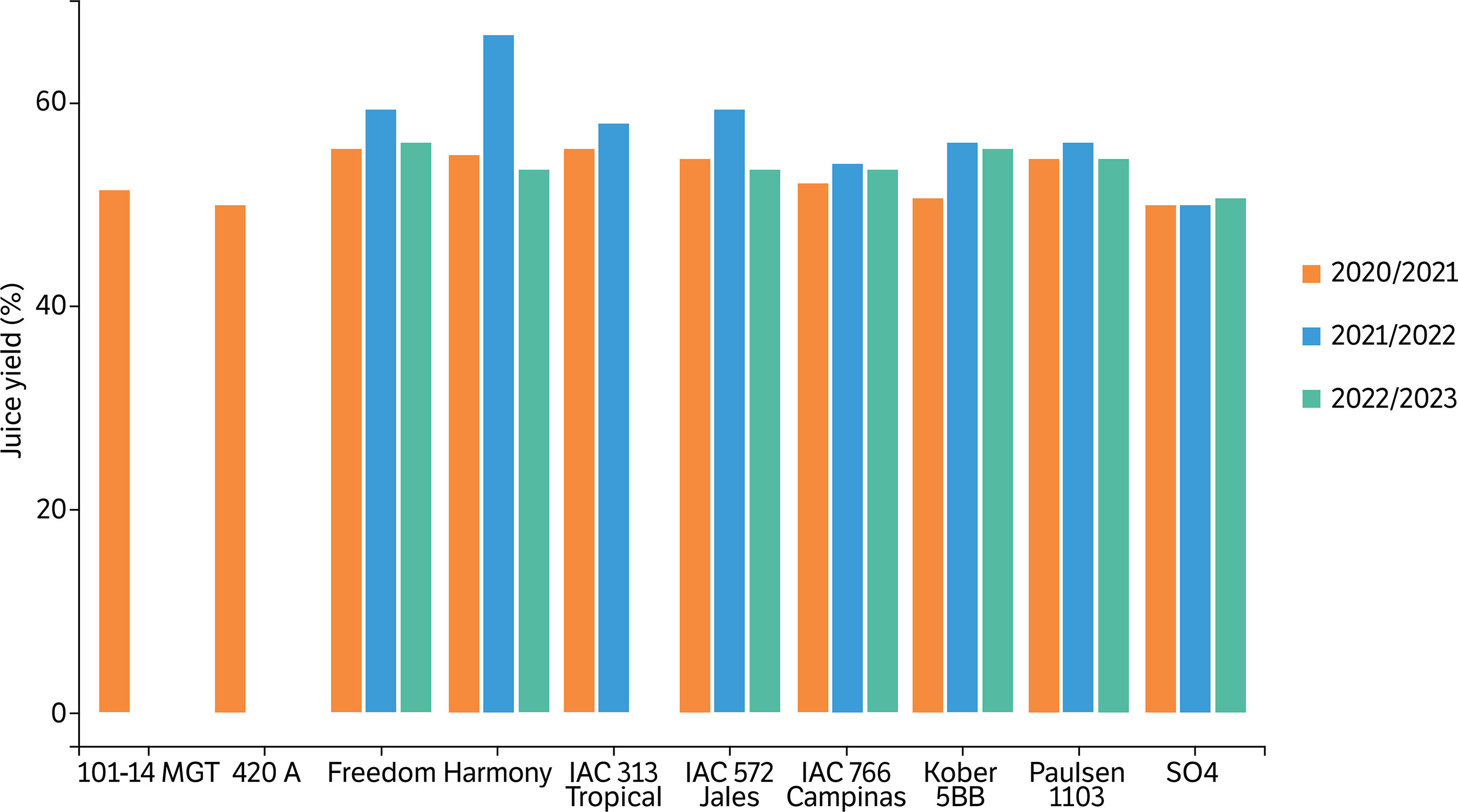
The extraction yield and physicochemical parameters of ‘BRS Magna’ grape juices showed significant variation depending on the agricultural cycles and rootstocks used (Fig. 1).

Juice yield of ‘BRS Magna’ grapes on different rootstocks and production cycles. Bars represent the mean values obtained in each cycle.
The extraction yield was according to the expected range for steam distillation, with values consistent with those reported by Rizzon et al. (1997) and Ide et al. (2021), who cite average yields of 50–60% for this technique. Yield may be influenced by factors such as grape variety, ripeness level, extraction time, and equipment operating conditions.
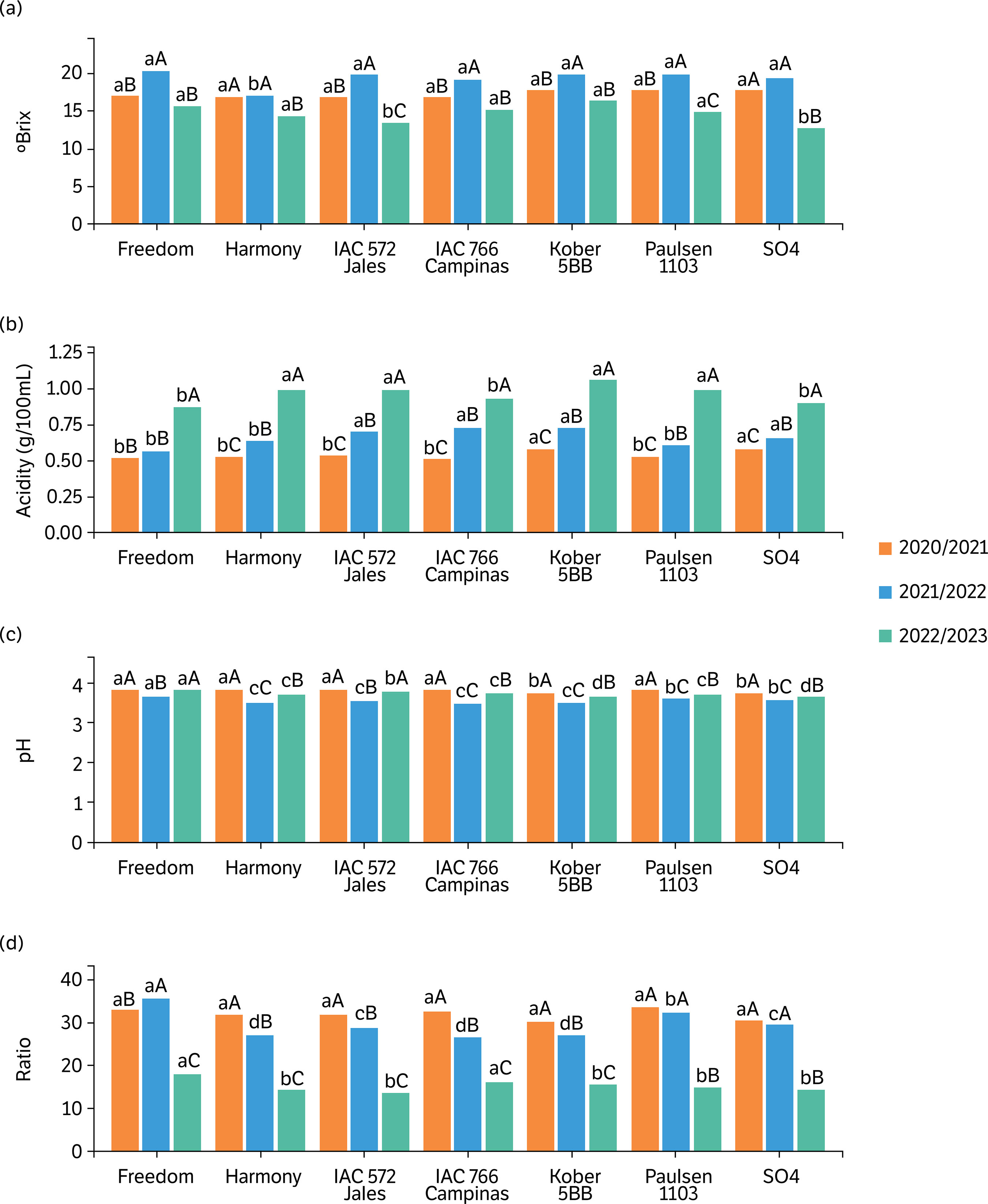
Regarding SS (Fig. 2), values fluctuated across seasons and rootstocks, reflecting the ripening stage at harvest. Most treatments met the legal minimum of 14 °Brix (Brasil 2018), although early harvesting compromised sugar concentration in the 2022/23 season. This pattern may be linked to climatic interference in sugar accumulation rates (Chaves et al. 2004, Robaskewicz et al. 2016) and the rootstock’s effect on photoassimilate translocation (Kaltbach et al. 2022). According to Brasil (2018), Bender et al. (2021) and Ide et al. (2021), harvesting at higher SS levels is recommended to ensure juice quality and compensate for dilution caused by steam distillation, which introduces exogenous water during processing.

Physicochemical characteristics of ‘BRS Magna’ grape juices grafted onto different rootstocks across production cycles: (a) soluble solids (SS), (b) pH, (c) titratable acidity (TA), and (d) SS/TA ratio. Capital letters indicate significant differences between years for the same rootstock, while lowercase letters indicate differences between rootstocks within the same year by the Scott-Knott’s test (p ≤ 0.05).
TA, a key sensory attribute influencing juice stability, flavor balance, and color stability (Rizzon and Meneguzzo 2007, Da Silva et al. 2022), showed an increasing trend across the evaluated seasons, particularly in 2022/23. This behavior may be associated with lower sugar accumulation and greater retention of organic acids in the berries, as previously reported by Guerra (2003). In this season, several combinations approached or exceeded the recommended upper limit of 0.90 g.100mL-1, which may compromise the sensory balance of the juice. Among the evaluated rootstocks, ‘Freedom’ consistently showed the lowest TA values across the evaluated combinations, indicating a more stable effect in reducing juice acidity compared with the other rootstocks, which exhibited greater variation in acidity levels. This behavior suggests that ‘Freedom’ may play an important role in modulating juice acidity. From a sensory perspective, this characteristic can be advantageous, since excessive acidity may negatively affect flavor balance and consumer acceptance (Rizzon and Link 2006, Pinheiro et al. 2009, Dutra et al. 2020).
Average pH values were higher than those reported in the literature for ‘BRS Magna’ (Dos Santos Lima et al., 2014, Ritschel et al. 2014, Ferreira et al. 2020), although only slight variations were observed among rootstocks and across growing seasons. Higher pH values were particularly observed in juices obtained from vines grafted onto ‘Freedom,’ which also corresponded to the treatments with the lowest acidity levels. Although pH values above 3.5 may contribute to a smoother sensory perception, they can reduce microbial stability, shelf life, and color stability of grape juice (Rizzon and Meneguzzo 2007, Da Silva et al. 2022). Therefore, this parameter should be carefully monitored, especially for products intended for longer storage periods.
The SS/TA ratio is widely used as an indicator of sensory balance between sweetness and acidity and is considered an important parameter for consumer acceptance (Pezzi and Fenocchio 1976, Santana et al. 2008). In the present study, the ratio showed substantial variation among treatments and seasons. Higher values were observed in the 2020/21 and 2021/22 seasons, indicating juices with a more balanced and pleasant taste profile. Conversely, the 2022/23 season showed a marked reduction in ratio values, associated with lower sugar concentration and higher acidity, which may negatively affect sensory acceptance. In general, higher SS/TA ratios indicate juices with lower perceived acidity and greater sensory balance (Baiano 2020).
Among the tested materials, ‘Freedom’ produced juices with superior physicochemical characteristics across all three seasons, combining high SS content, lower acidity, and balanced pH. This performance highlights its potential for high-quality juice production, reinforcing its agronomic and technological viability in tropical regions. Conversely, rootstocks such as ‘SO4,’ ‘Kober 5BB,’ and ‘Paulsen 1103’ should be used cautiously in seasons with low sunlight or incomplete ripening, due to their tendency toward higher acidity and a lower ratio.
The functional composition of ‘BRS Magna’ juices grafted onto different rootstocks showed significant variation in total phenolic content (TPC) and antioxidant capacity measured by FRAP and ABTS methods across the three evaluated seasons (Fig. 3).

Phenolic compounds and antioxidant activity by ferric reducing antioxidant power and ABTS of juices from ‘BRS Magna’ grafted onto different rootstocks evaluated in three production cycles. Capital letters indicate significant differences between production cycles for the same rootstock, while lowercase letters indicate differences among rootstocks within the same cycle according to the Scott–Knott test (p ≤ 0.05).
TPC values were according to the range reported for hybrid grape juices (Lima et al. 2014, Viana et al. 2017), ranging from 290 to 451 mg GAE.100 g-1. A strong influence of scion/rootstock combination and season was observed. In the first year, ‘SO4’ yielded the highest TPC values, followed by ‘Harmony’ and ‘Kober 5BB.’ This trend was partially maintained in the second cycle, when combinations with ‘Freedom,’ ‘Paulsen 1103,’ ‘IAC 766 Campinas,’ and ‘IAC 572 Jales’ also showed high antioxidant potential, indicating consistency under variable edaphoclimatic conditions.
Longitudinal analysis revealed a general decline in TPC during the 2022/23 season, except for treatments like ‘Freedom,’ which maintained high values despite probable climatic adversity. This stability may be linked to greater efficiency in secondary metabolite accumulation and retention conferred by this rootstock, suggesting its agronomic and technological superiority for functional juice production. This pattern aligns with previous studies highlighting the impact of solar radiation and temperature on phenolic synthesis in grapes (Teixeira et al. 2013, Wilson et al. 2024).
Antioxidant capacity assessed by FRAP remained relatively stable across treatments and seasons, with no marked differences, possibly indicating lower sensitivity of the method to matrix variation. In contrast, ABTS values showed greater variation among rootstocks and seasons, better reflecting changes in antioxidant compound profiles, especially anthocyanins and flavonols (Domingues Neto et al. 2024).
The superior antioxidant activity of combinations such as ‘SO4’ and ‘Freedom’ may be attributed to TPC and qualitative composition, as different phenolic classes exhibit distinct reducing potentials. Lower activity in treatments like ‘101-14 MGT’ and ‘IAC 572 Jales’ in earlier cycles suggests reduced concentrations of compounds with high radical scavenging capacity.
Combinations of ‘BRS Magna’ with ‘Freedom’ and ‘Paulsen 1103’ showed greater stability under the adverse conditions of the 2022/23 season, suggesting high agronomic adaptability and preservation of functional juice attributes. Although less prominent in sensory attributes, ‘IAC 766 Campinas’ showed consistent performance in physicochemical and antioxidant parameters, making it a technically viable alternative. In contrast, ‘SO4’ showed greater sensitivity to seasonal variation, which may compromise its technological predictability. Furthermore, the lack of direct correlation between TPC and antioxidant activity in certain combinations suggests that compound quality and compositional profile may be more influential than total concentration.
In summary, interannual variability reinforces the need to select rootstocks that ensure compositional and functional stability under different seasonal conditions. The ‘Freedom’ combination stands out for maintaining high phenolic levels and producing juices with high antioxidant activity, making it promising for developing products with consistent functional claims across harvests.
Regarding microbiological quality, all analyzed juice batches were safe for consumption, meeting current legal standards and good manufacturing practices (Gurak et al. 2008). Although Brazilian legislation does not specify microbiological standards for fresh fruit juices regarding total coliforms, such analyses are essential for assessing hygienic-sanitary conditions. No Salmonella spp. was detected, indicating that results reflect the quality of raw materials and the sanitary conditions of the processing environment and personnel involved (Fig. 4).
Microbiological analysis of juices from ‘BRS Magna’ grafted onto different rootstocks for the 2021/22 and 2022/23 production cycles. Bars represent the mean values obtained for each rootstock in each production cycle.
The microbiological evaluation of juice samples from the ‘BRS Magna’ cultivar grafted onto different rootstocks demonstrated compliance with food safety standards established by the current Brazilian legislation (Brasil 2000; Anvisa 2022). Salmonella spp. was absent in all samples, essential for the approval and commercialization of ready-to-consume products. Total coliform counts remained below 23 MPN.mL-1, while thermotolerant coliforms (at 45°C) were mainly below 3 MPN.mL-1, the reference value for ready-to-drink juices.
These results suggest that the extraction, bottling, and storage processes were conducted under good manufacturing and hygiene practices, ensuring the safety of the final product. Minor variations observed between seasons and rootstocks—such as a localized increase in total coliforms in ‘IAC 766 Campinas’ during the 2021/22 harvest—did not compromise sanitary safety but may indicate the need for continuous monitoring of processing conditions, especially when scaling up to industrial production.
The absence of pathogenic microorganisms and the low counts of fecal contamination indicators reaffirm the microbiological quality of the juices, making them suitable for human consumption and compliant with commercialization standards, including those required by markets with high sanitary expectations.
Sensory analysis was conducted with 100 participants in each production cycle (untrained panelists), with balanced gender distribution (2021/22: 55% female; 2022/23: 54% male), aged between 18 and 60 years old, including students and staff affiliated with the institution. Initial data collection included information on participants’ fruit juice consumption habits.
In both evaluated years, most of participants reported weekly juice consumption (61%), while 28% consumed juice daily and 11% monthly, indicating a regular and consolidated intake pattern among evaluators.
Regarding preferred consumption occasions, lunch was identified as the main moment in both cycles, with 52% of respondents in 2021/22 and 46% in 2022/23. This finding reinforces the association between juice consumption and main meals, possibly as a nutritional complement or substitute for other industrialized beverages. To a lesser extent, participants also indicated a preference for juice during dinner (22–23%) and afternoon snacks (22–25%), with 10% reporting consumption at breakfast (2022/23), demonstrating some flexibility in daily intake habits.
In terms of flavor preferences, orange, grape, and lemon juices remained the most consumed in both years, with frequencies above 85%, followed by passion fruit and strawberry. Mango and pineapple juices showed lower relative preference, though still notable, while the other category had minimal representation. These data suggest a predominance of traditional flavors in consumption habits, possibly reflecting familiarity, market availability, or regional cultural preferences.
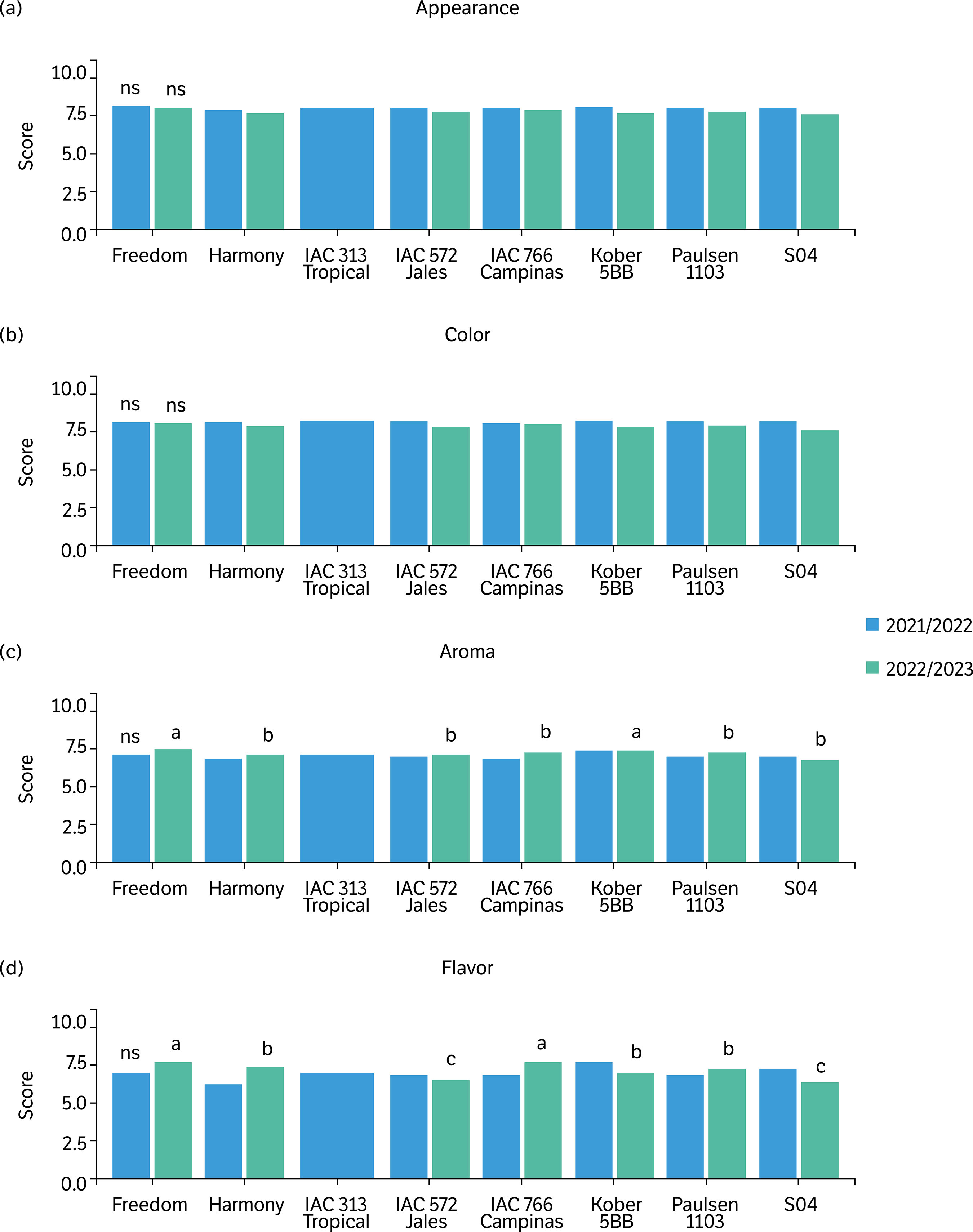
Sensory analysis of juices from the ‘BRS Magna’ cultivar grafted onto different rootstocks revealed relevant nuances between the 2021/22 and 2022/23 cycles. Visual attributes such as appearance and color did not show significant differences among samples (p > 0.05), reinforcing the uniformity of these characteristics across the evaluated treatments (Fig. 5).

Mean scores for appearance, color, flavor, and aroma of ‘BRS Magna’ grape juice from vines grafted onto different rootstocks and evaluated in two production cycles (2021/22 – blue, 2022/23 – green). Lowercase letters indicate differences among rootstocks within the same cycle according to the Scott–Knott’s test (p ≤ 0.05).
As Chen et al. (2020) highlighted, although color is a key determinant in consumer acceptance, it was not a discriminating factor among the juices analyzed in this study across rootstocks and harvest cycles. Other authors also emphasize that visual attributes play an important role in initial purchase decisions, but factors such as aroma and flavor directly influence consumer satisfaction and loyalty (Bender et al. 2024).
Significant variations were observed in the sensory attributes of aroma, flavor, overall impression, purchase intent, and acceptance index. In the 2022/23 season, juices from the ‘BRS Magna/Kober 5BB’ and ‘BRS Magna/Freedom’ combinations achieved the highest aroma scores (7.40 and 7.37, respectively), standing out positively from the other samples. This sensory performance may be associated with a greater expression of desirable volatile compounds resulting from the interaction between genotype and environmental conditions during that agricultural cycle. According to Domingues Neto et al. (2024), the training system strongly influences phenolic composition and volatile compounds formed during grape maturation and juice processing and can directly impact sensory attributes.
Flavor, considered the most influential sensory attribute in purchase intent, showed wide variation among rootstocks. In the 2021/22 season, juices from ‘IAC 766 Campinas’ and ‘Freedom’ were rated highest in flavor. Conversely, combinations with ‘SO4’ and ‘IAC 572 Jales’ received the lowest scores, with the lowest rating (6.30) attributed to the ‘SO4’ sample in the second cycle, reflecting a lack of balance between sweetness and acidity. According to Comarella et al. (2012), increased polyphenol content and intensified aromatic compounds can significantly enhance the sensory acceptance of grape juices.
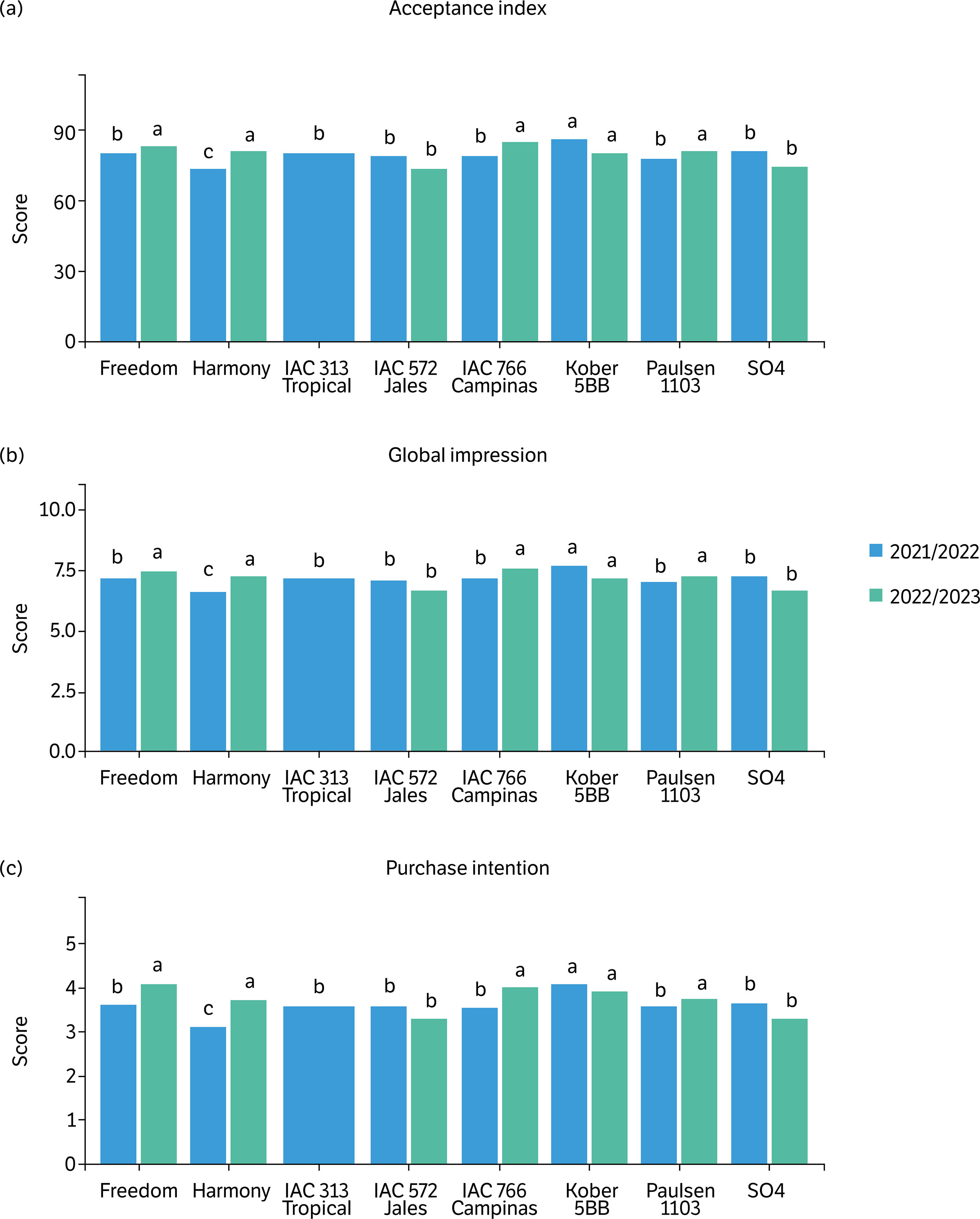
Overall impression and purchase intent (Fig. 6) followed a similar trend, with consistent highlights for the ‘Kober 5BB’ rootstock, which achieved the highest scores in both agricultural cycles, with acceptance indices exceeding 80%. This positive performance, even in the context of lower sweetness in the second year due to early harvesting, suggests that factors beyond SS concentration influenced acceptance—possibly related to the overall harmony among sensory attributes (Coelho et al. 2018).

Average indices of the sensory analyses of ‘BRS Magna’ grape juice obtained from plants grafted onto different rootstocks, evaluated in the years 2021/22 (blue) and 2022/23 (green): acceptance index, overall impression and purchase intention. Means followed by different lowercase letters differ significantly between rootstocks within the same production cycle, according to the mean comparison test (p ≤ 0.05). Comparisons should be made separately for each year: lowercase letters associated with blue bars refer to the 2021/2022 cycle, while lowercase letters associated with green bars refer to the 2022/2023 cycle.
In contrast, juices from ‘SO4’ and ‘IAC 572 Jales’ recorded the lowest acceptance indices (< 75%), even when presenting higher SS levels and moderate acidity, as observed in the 2021/22 cycle. These results reinforce that physicochemical composition, while important, is not the sole determinant of product acceptance. Considering the complete set of sensory attributes perceived by evaluators is essential. This finding is supported by Bender et al. (2024), who argue that sensory balance depends on multiple integrated factors, ranging from phenolic composition to processing conditions.
Previous studies with the hybrid cultivar ‘BRS Magna’ have mainly focused on its agronomic performance under different training systems and rootstocks (Ferreira et al. 2019, Ferreira et al. 2020, Santos et al. 2022). While these investigations provided important insights into yield and basic juice composition, the present study advances the knowledge by integrating physicochemical, functional, microbiological, and sensory analyses across three consecutive production cycles. This broader approach allowed us to identify specific rootstock combinations, particularly ‘Kober 5BB’ and ‘Freedom,’ that not only enhance phenolic stability and antioxidant potential but also promote superior consumer acceptance and purchase intention. Such findings demonstrate the strategic role of rootstock selection in the Brazilian grape juice industry, contributing to the development of value-added products with improved market competitiveness and functional appeal.
CONCLUSION
The juices showed high phenolic content and antioxidant activity, highlighting their functional potential, particularly in combinations with the ‘Kober 5BB’ rootstock. This combination also achieved the highest sensory acceptance and purchase intention, whereas ‘IAC 572 Jales’ and ‘SO4’ resulted in lower preference scores. Overall, juice performance was significantly influenced by the chemical composition, and sensory quality. These findings reinforce the potential of ‘BRS Magna’ for high-quality grape juice production and emphasize rootstock choice as a strategic factor for ensuring technological quality and market acceptance.
ACKNOWLEDGMENTS
I would like to thank UTFPR for the opportunity.
-
How to cite:
Oliveira, L. S., Grigolo, C. R., Bertan, M. A. J., Penso, G. A., Pertille, R. H., Pereira, E. A. and Citadin, I. (2026). Quality, bioactive profile, and consumer acceptance of ‘BRS Magna’ grape juice as affected by rootstocks. Bragantia, 85, e20260013. https://doi.org/10.1590/1678-4499.20260013
-
FUNDING
Coordenação de Aperfeiçoamento de Pessoal de Nível SuperiorGrant No.: 001Ministério da Agricultura, Pecuária e AbastecimentoTED SIAFI Nº 699461Conselho Nacional de Desenvolvimento Científico e TecnológicoGrant No: 303456/2022-1
-
DECLARATION OF USE OF ARTIFICIAL INTELLIGENCE TOOLS
During the preparation of this work the authors used artificial intelligence language model for its assistance in the organization and refinement of the manuscript text. After using this tool/service, the authors reviewed and edited the content as needed and take full responsibility for the content of the publication.
DATA AVAILABILITY STATEMENT
Data available upon request to authors.
REFERENCES
-
Alvares, C. A., Stape, J. L., Sentelhas, P. C., Gonçalves, J. L. M. and Sparovek, G. (2013). Köeppen’s climate classification map for Brazil. Meteorologische Zeitschrift, 22, 711-728. https://doi.org/10.1127/0941-2948/2013/0507
» https://doi.org/10.1127/0941-2948/2013/0507 - [Anvisa] Agência Nacional de Vigilância Sanitária (2022). Instrução Normativa n. 161, de 1º de julho de 2022. Estabelece os padrões microbiológicos dos alimentos. Diário Oficial União, seção X.
-
Ausari, P. K., Gurjar, P. K. S., Somkuwar, R. G., Naruka, I. S., Sharma, A. K. and Gharate, P. S (2024). Effect of rootstocks on yield and wine quality of Sauvignon Blanc variety. Plant Archives, 24, 1477-1482. https://doi.org/10.51470/PLANTARCHIVES.2024.v24.no.1.207
» https://doi.org/10.51470/PLANTARCHIVES.2024.v24.no.1.207 -
Baiano, A. (2020). Phenolic compounds and antioxidant activity of experimental and industrial table grape juices. Journal of Food Processing and Preservation, 44, e14655. https://doi.org/10.1111/jfpp.14655
» https://doi.org/10.1111/jfpp.14655 -
Barbalho, S. M., Bueno Ottoboni, A. M. M., Fiorini, A. M. R., Guiguer, E. L., Nicolau, C. C. T., Goulart, R. D. A. and Flato, U. A. P. (2020). Grape juice or wine: which is the best option? Critical Reviews in Food Science and Nutrition, 60, 3876-3889. https://doi.org/10.1080/10408398.2019.1710692
» https://doi.org/10.1080/10408398.2019.1710692 -
Bender, A., Caliari, V., Sousa, A. L. K., Malgarim, M. B., Kaltbach, P., Costa, V. B. and Arcari, S. G. (2024). Compostos fenólicos individuais em sucos de uva elaborados por diferentes sistemas de extração. Semina: Ciências Agrárias, 45, 429-448. https://doi.org/10.5433/1679-0359.2024v45n2p429
» https://doi.org/10.5433/1679-0359.2024v45n2p429 -
Bender, A., Souza, A. L. K., Malgarim, M. B., Caliari, V., Kaltbach, P. and Costa, V. B. (2021). Physicochemical and sensory properties of grape juices produced from different cultivars and extraction systems. Semina: Ciências Agrárias. 42, 1615-1634. https://doi.org/10.5433/1679-0359.2021v42n3Supl1p1615
» https://doi.org/10.5433/1679-0359.2021v42n3Supl1p1615 -
Benzie, I. F. F. and Strain, J. J. (1996). The ferric reducing ability of plasma (FRAP) as a measure of “antioxidant power”: The FRAP assay. Analytical Biochemistry, 239, 70-76. https://doi.org/10.1006/abio.1996.0292
» https://doi.org/10.1006/abio.1996.0292 -
Bhering, S. B., Santos, H. G., Bognola, I. A., Curcio, G. R., Carvalho Júnior, W. D., Chagas, C. D. S., Manzatto, C. V., Áglio, M. L. D. and Silva, J. D. S. (2008). Mapa de solos do Estado do Paraná: legenda atualizada. EMBRAPA/IAPAR. Available at: https://www.alice.cnptia.embrapa.br/alice/bitstream/doc/513293/1/Mapa-de-solos-do-estado-do-Parana-2009.pdf Accessed on: May 28, 2026.
» https://www.alice.cnptia.embrapa.br/alice/bitstream/doc/513293/1/Mapa-de-solos-do-estado-do-Parana-2009.pdf -
Bispo, E. S., Santana, L. R., Carvalho, R. D. S., Leite, C. C. and Lima, M. A. C. (2004). Processamento, estabilidade e aceitabilidade de Marinado de Vongole (Anomalocardia brasiliana). Food Science and Technology, 24, 353-356. https://doi.org/10.1590/S0101-20612004000300008
» https://doi.org/10.1590/S0101-20612004000300008 -
Borges, R. D. S., Prudêncio, S. H., Roberto, S. R. and Assis, A. M. D. (2011). Avaliação sensorial de suco de uva cv. Isabel em cortes com diferentes cultivares. Revista Brasileira de Fruticultura, 33, 584-591. https://doi.org/10.1590/S0100-29452011000500080
» https://doi.org/10.1590/S0100-29452011000500080 -
Brasil (2000). Instrução Normativa n. 5, de 31 de março de 2000. Aprova o regulamento técnico sobre as condições higiênico-sanitárias e de boas práticas de fabricação para estabelecimentos elaboradores/industrializadores de bebidas e vinagres, inclusive vinhos e derivados da uva e do vinho. Diário Oficial da União. Available at: https://app.sogi.com.br/Manager/texto/arquivo/exibir/arquivo?eyJ0eXAiOiJKV1QiLCJhbGciOiJIUzI1NiJ9AFFIjAvODkxNS9TR19SZXF1aXNpdG9fTGVnYWxfVGV4dG8vMC8wL0RPQ1VNRU5UTyAxLnBkZi8wLzAiAFF_p3krD_7wgo2S1ogaHdmS7OhUvkaYY64mG6l7vh0fz0 Accessed on: May 28, 2026.
» https://app.sogi.com.br/Manager/texto/arquivo/exibir/arquivo?eyJ0eXAiOiJKV1QiLCJhbGciOiJIUzI1NiJ9AFFIjAvODkxNS9TR19SZXF1aXNpdG9fTGVnYWxfVGV4dG8vMC8wL0RPQ1VNRU5UTyAxLnBkZi8wLzAiAFF_p3krD_7wgo2S1ogaHdmS7OhUvkaYY64mG6l7vh0fz0 -
Brasil (2018). Instrução Normativa n. 14, de 8 de fevereiro de 2018. Complementação do padrões de identidade e qualidade do vinho e derivados da uva e do vinho. Diário Oficial da República Federativa do Brasil. Available at: https://www.agricultura.rs.gov.br/upload/arquivos/202008/17121016-instrucao-normativa-14-de-2018-piqs-vinhos-e-derivados-da-uva-e-do-vinho.pdf Accessed on: May 28, 2026.
» https://www.agricultura.rs.gov.br/upload/arquivos/202008/17121016-instrucao-normativa-14-de-2018-piqs-vinhos-e-derivados-da-uva-e-do-vinho.pdf -
Chaves, M. C. V., Gouveia, J. P. G., Almeida, F. A. C., Leite, J. C. A. and Silva, F. L. H. (2004). Caracterização físico-química do suco da acerola. Revista de Biologia e Ciências da Terra, 4, 1-10. Available at: https://www.redalyc.org/pdf/500/50040217.pdf
» https://www.redalyc.org/pdf/500/50040217.pdf -
Chen, J. Y., Du, J., Li, M. L. and Li, C. M. (2020). Degradation kinetics and pathways of red raspberry anthocyanins in model and juice systems and their correlation with color and antioxidant changes during storage. LWT - Food Science and Technology, 128, 109448. https://doi.org/10.1016/j.lwt.2020.109448
» https://doi.org/10.1016/j.lwt.2020.109448 -
Coelho, E. M., Padilha, C. V. S., Miskinis, G. A., Sá, A. G. B., Pereira, G. E., Azevêdo, L. C. and Lima, M. S. (2018). Simultaneous analysis of sugars and organic acids in wine and grape juices by HPLC: Method validation and characterization of products from northeast Brazil. Journal of Food Composition and Analysis, 66, 160-167. https://doi.org/10.1016/j.jfca.2017.12.017
» https://doi.org/10.1016/j.jfca.2017.12.017 -
Comarella, C. G., Sautter, C. K., Ebert, L. C. and Penna, N. G. (2012). Polifenóis totais e avaliação sensorial de suco de uvas Isabel tratadas com ultrassom. Brazilian Journal of Food Technology, 15, 69-73. https://doi.org/10.1590/S1981-67232012005000042
» https://doi.org/10.1590/S1981-67232012005000042 -
Copetti, C., Franco, F. W., Machado, E. D. R., Soquetta, M. B., Quatrin, A., Ramos, V. D. M., Moreira, C. F., Emanuelli, T., Sautter, C. K. and Penna, N. G. (2018). Acute consumption of bordo grape juice and wine improves serum antioxidant status in healthy individuals and inhibits reactive oxygen species production in human neuron-like cells. Journal of Nutrition and Metabolism, 4384012. https://doi.org/10.1155/2018/4384012
» https://doi.org/10.1155/2018/4384012 -
Da Silva, M. J. R., Paiva, A. P. M., Souza, J. F. D., Padilha, C. V. D. S., Basílio, L. S. P., Lima, M. D. S., Pereira, G. E., Corrêa, L. C., Vianello, F., Lima, G. P. P. Moura, M. M. and Tecchio, M. A. (2022). Phytochemical profile of Brazilian grapes (Vitis labrusca and hybrids) grown on different rootstocks. PLoS One, 17, e0275489. https://doi.org/10.1371/journal.pone.0275489
» https://doi.org/10.1371/journal.pone.0275489 -
Domingues Neto, F. J., Pimentel Junior, A., Borges, C. V., Rodrigues, J. D., Figueira, R., Moura, M. F., Minatel, I. O., Nunes, A., Lima, G. P. P. and Tecchio, M. A. (2024). Polyphenolic profile and antioxidant activity of whole grape juices from Vitis labrusca and Brazilian hybrid grapes in two training systems. Antioxidants, 13, 1132. https://doi.org/10.3390/antiox13091132
» https://doi.org/10.3390/antiox13091132 -
Do Nascimento Silva, F. L., Schmidt, E. M., Messias, C. L., Eberlin, M. N. and Sawaya, A. C. H. F. (2015). Quantitation of organic acids in wine and grapes by direct infusion electrospray ionization mass spectrometry. Analytical Methods, 7, 53-62. https://doi.org/10.1039/C4AY00114A
» https://doi.org/10.1039/C4AY00114A -
Dos Santos Lima, M., Silani, I. D. S. V., Toaldo, I. M., Corrêa, L. C., Biasoto, A. C. T., Pereira, G. E., Bordignon-Luiz, M. T. and Ninow, J. L. (2014). Phenolic compounds, organic acids and antioxidant activity of grape juices produced from new Brazilian varieties planted in the Northeast Region of Brazil. Food Chemistry, 161, 94-103. https://doi.org/10.1016/j.foodchem.2014.03.109
» https://doi.org/10.1016/j.foodchem.2014.03.109 -
Dutra, M. D. C. P., Viana, A. C., Pereira, G. E., Nassur, R. D. C. M. R. and Santos Lima, M. (2020). Whole, concentrated and reconstituted grape juice: Impact of processes on phenolic composition, “foxy” aromas, organic acids, sugars and antioxidant capacity. Food Chemistry, 343, 128399. https://doi.org/10.1016/j.foodchem.2020.128399
» https://doi.org/10.1016/j.foodchem.2020.128399 -
El-Din, N. K. B., Ali, D. A. and Abou-El-Magd, R. F (2019). Grape seeds and skin induce tumor growth inhibition via G1-phase arrest and apoptosis in mice inoculated with Ehrlich ascites carcinoma. Nutrition, 58, 100-109. https://doi.org/10.1016/j.nut.2018.06.018
» https://doi.org/10.1016/j.nut.2018.06.018 -
Facundo, H. V. V., Souza Neto, M. A., Maia, G. A., Narain, N. and Garruti, D. S. H. (2010). Changes in flavor quality of pineapple juice during processing. Journal of Food Processing and Preservation, 34, 508-519. https://doi.org/10.1111/j.1745-4549.2008.00356.x
» https://doi.org/10.1111/j.1745-4549.2008.00356.x -
Ferreira, T. D. O., Costa, R. R. D., Félix, D. T., Andrade, E. R. D., Cruz, M. D. M. and Lima, M. A. C. D. (2019). Quality and antioxidant potential of ‘BRS Magna’ grapes harvested in the first half of the year under different training systems and rootstocks in a tropical region. Ciência e Agrotecnologia, 43, e029518. https://doi.org/10.1590/1413-7054201943029518
» https://doi.org/10.1590/1413-7054201943029518 -
Ferreira, T. D. O., Lima, A. D. S., Marques, A. T. B., Rybka, A. C. P. and Lima, M. A. C. D. (2020). Rootstock for the ‘BRS Magna’grapevine grown in a tropical region affects the quality of the stored juice. Revista Ciência Agronômica, 51, e20186562. https://doi.org/10.5935/1806-6690.20200052
» https://doi.org/10.5935/1806-6690.20200052 -
Governo do Rio Grande do Sul (2023). Suco de uva e espumantes registram aumento na safra vitivinícola 2023. Secretaria da Agricultura, Pecuária, Produção Sustentável e Irrigação. Available at: https://www.agricultura.rs.gov.br/suco-de-uva-e-espumantes-registram-aumento-na-safra-vitivinicola-2023 Accessed on: Jan. 29, 2025.
» https://www.agricultura.rs.gov.br/suco-de-uva-e-espumantes-registram-aumento-na-safra-vitivinicola-2023 -
Guerra, C. C (2003). Uva para processamento: pós colheita. Brasília: Embrapa Informação Tecnológica; Bento Gonçalves: Embrapa Uva e Vinho. Available at: https://www.alice.cnptia.embrapa.br/alice/bitstream/doc/1081967/1/COLHEITAEPOSCOLHEITAUvadoplantioacolheitap163185.pdf Accessed on: May 29, 2026.
» https://www.alice.cnptia.embrapa.br/alice/bitstream/doc/1081967/1/COLHEITAEPOSCOLHEITAUvadoplantioacolheitap163185.pdf -
Gurak, P. D., Silva, M. C., Matta, V. M., Rocha-Leão, M. H. and Cabral, L. M. C. (2008). Avaliação de parâmetros físico-químicos de sucos de uva integral, néctares de uva e néctares de uva light. Revista de Ciências Exatas, 27, 1-15. Available at: https://www.alice.cnptia.embrapa.br/alice/bitstream/doc/873217/1/2010051.pdf Accessed on: May 29, 2026.
» https://www.alice.cnptia.embrapa.br/alice/bitstream/doc/873217/1/2010051.pdf -
Han, X., Guo, J., Yin, M., Liu, Y., You, Y., Zhan, J. and Huang, W. (2020). Grape extract activates brown adipose tissue through pathway involving the regulation of gut microbiota and bile acid. Molecular Nutrition & Food Research, 64, 2000149. https://doi.org/10.1002/mnfr.202000149
» https://doi.org/10.1002/mnfr.202000149 -
Ide, W., Sabando, C., Castaño, J., Pettinelli, N., Bustos, R., Linares, A. Mora, L., Müller, N., Pascual, G. and Rodríguez-Llamazares, S. (2021). Grape (Vitis vinifera L. cv. País) juices obtained by steam extraction. Processes, 9, 1670. https://doi.org/10.3390/pr9091670
» https://doi.org/10.3390/pr9091670 -
Instituto Adolfo Lutz (2008). Métodos físico-químicos para análise de alimentos. São Paulo: Instituto Lutz. Available at: https://wp.ufpel.edu.br/nutricaobromatologia/files/2013/07/NormasADOLFOLUTZ.pdf Accessed on: May 29, 2026.
» https://wp.ufpel.edu.br/nutricaobromatologia/files/2013/07/NormasADOLFOLUTZ.pdf -
Jogaiah, S., Ramteke, S. D., Sharma, J. and Upadhyay, A. K. (2014). Moisture and salinity stress induced changes in biochemical constituents and water relations of different grape rootstock cultivars. International Journal of Agronomy, 2014, 789087. https://doi.org/10.1155/2014/789087
» https://doi.org/10.1155/2014/789087 -
Kaltbach, S. B. D. A., Bender, A., Kaltbach, P., Malgarim, M., Herter, F. G., Costa, V. B. and Souza, A. L. K. D. (2022). Juices from ‘Bordô’ and ‘BRS Cora’ grapes grown in an organic production system in the Serra do Sudeste region. Pesquisa Agropecuária Brasileira, 57, e02843. https://doi.org/10.1590/S1678-3921.pab2022.v57.02843
» https://doi.org/10.1590/S1678-3921.pab2022.v57.02843 -
Kersh, D. M. E., Hammad, G., Donia, M. S. and Farag, M. A. (2023). A comprehensive review on grape juice beverage in context to its processing and composition with future perspectives to maximize its value. Food and Bioprocess Technology, 16, 1-23. https://doi.org/10.1007/S11947-022-02858-5
» https://doi.org/10.1007/S11947-022-02858-5 -
Leão, P. C. S., Cunha, M. A. C. and Souza, E. R. (2022). Agronomic performance of rootstocks on the juice grape ‘BRS Magna’grown in a Brazilian semi-arid region. Revista Brasileira de Fruticultura, 44, e-832. https://doi.org/10.1590/0100-29452022832
» https://doi.org/10.1590/0100-29452022832 -
Lima, M. S., Silani, I. S. V., Toaldo, I. M., Corrêa, L. C., Biasoto, A. C. T., Pereira, G. E., Bordignon-Luiz, M. T. and Ninow, J. L. (2014). Phenolic compounds, organic acids and antioxidant activity of grape juices produced from new Brazilian varieties planted in the Northeast region of Brazil. Food Chemistry, 161, 94-103. https://doi.org/10.1016/j.foodchem.2014.03.109
» https://doi.org/10.1016/j.foodchem.2014.03.109 - Maack, R. (1981). Geografia física do Estado do Paraná. Rio de Janeiro: José Olympio.
-
Mantilla, S. M. O., Collins, C., Iland, P. G., Kidman, C. M., Ristic, R., Boss, P. K., Jordans, C. and Bastian, S. E. (2018). Shiraz (Vitis vinifera L.) berry and wine sensory profiles and composition are modulated by rootstocks. American Journal of Enology and Viticulture, 69, 32-44. https://doi.org/10.5344/ajev.2017.17017
» https://doi.org/10.5344/ajev.2017.17017 -
Pezzi, G. M. and Fenocchio, P. (1976). Estudo analítico dos sucos de uva comerciais. Pesquisa Agropecuária Brasileira, 11, 11-13. Available at: https://ainfo.cnptia.embrapa.br/digital/bitstream/item/194819/1/Estudo-analitico-dos-sucos-de-uva-comerciais.pdf Accessed on: May 29, 2026.
» https://ainfo.cnptia.embrapa.br/digital/bitstream/item/194819/1/Estudo-analitico-dos-sucos-de-uva-comerciais.pdf - Pinheiro, É. S., Costa, J. M. C., Clemente, E., Machado, P. H. S. and Maia, G. A. (2009). Estabilidade físico-química e mineral do suco de uva obtido por extração a vapor. Revista Ciência Agronômica, 40, 373-380.
-
Pontes, P. R. B., Santiago, S. S., Szabo, T. N., Toledo, L. P. and Gollücke, A. P. B. (2010). Atributos sensoriais e aceitação de sucos de uva comerciais. Food Science and Technology, v. 30, 313-318. https://doi.org/10.1590/S0101-20612010000200004
» https://doi.org/10.1590/S0101-20612010000200004 -
Protas, J. F. S., Lazzarotto, J. J. and Machado, C. A. E (2024). Panorama da vitivinicultura brasileira em 2022. Bento Gonçalves: Embrapa Uva e Vinho. (Comunicado Técnico, 233.) Availabe at: https://www.infoteca.cnptia.embrapa.br/infoteca/bitstream/doc/1167634/1/ComTec-233-2024.pdf Accessed on: July 16, 2025.
» https://www.infoteca.cnptia.embrapa.br/infoteca/bitstream/doc/1167634/1/ComTec-233-2024.pdf -
Re, R., Pellegrini, N., Proteggente, A., Pannala, A., Yang, M. and Rice-Evans, C. (1999). Antioxidant activity applying an improved ABTS radical cation decolorization assay. Free Radical Biology and Medicine, 26, 1231-1237. https://doi.org/10.1016/S0891-5849(98)00315-3
» https://doi.org/10.1016/S0891-5849(98)00315-3 -
Ritschel, P., Maia, J. D. G., Camargo, U. A., Zanus, M. C., Souza, R. T. D. and Fajardo, T. V. M. (2014). ‘BRS MAGNA’ - a novel grape cultivar for juice making, with wide climatic adaptation. Crop Breeding and Applied Biotechnology, 14, 266-269. https://doi.org/10.1590/1984-70332014v14n4c42
» https://doi.org/10.1590/1984-70332014v14n4c42 -
Rizzon, L. A. and Link, M. (2006). Composição do suco de uva caseiro de diferentes cultivares. Ciência Rural, 36, 689-692. https://doi.org/10.1590/S0103-84782006000200055
» https://doi.org/10.1590/S0103-84782006000200055 -
Rizzon, L. A. and Meneguzzo, J. (2007). Suco de uva. Brasília, DF: Embrapa Informação Tecnológica; Bento Gonçalves: Embrapa Uva e Vinho. (Coleção Agroindústria Familiar.) Available at: https://www.infoteca.cnptia.embrapa.br/bitstream/doc/122741/1/00081370.pdf Accessed on: June 4, 2025.
» https://www.infoteca.cnptia.embrapa.br/bitstream/doc/122741/1/00081370.pdf - Rizzon, L. A., Manfroi, V. and Meneguzzo, J. (1997). Elaboração de suco na propriedade vitícola. Bento Gonçalves: Embrapa Uva e Vinho.
-
Robaskewicz, F., Dambrós, B. P. and Santin, N. C. (2016). Determinação do teor de polifenóis totais e outras características físico-químicas em sucos de uva comerciais. Unoesc & Ciência, 7, 159-166. Available at: https://periodicos.unoesc.edu.br/acbs/article/view/10765 Accessed on: June 3, 2025.
» https://periodicos.unoesc.edu.br/acbs/article/view/10765 -
Rodrigues, R. F. C., Lima, A., Melo, A. C. F. L. and Trindade, R. A. (2019). Physicochemical characterisation, bioactive compounds and in vitro antioxidant activities of commercial integral grape juices. International Food Research Journal, 26, 469-479. Available at: http://webagris.upm.edu.my/8073/ Accessed on: July 17, 2025
» http://webagris.upm.edu.my/8073/ -
Rufino, M. D. S. M., Alves, R. E., Brito, E. S., Morais, S. M., Sampaio, C. D. G., Pérez-Jiménez, J. and Saura-Calixto, F. D. (2006). Metodologia científica: determinação da atividade antioxidante total em frutas pelo método de redução do ferro (FRAP). Comunicado Técnico, 128, 1-4. Available at: https://www.infoteca.cnptia.embrapa.br/bitstream/doc/426954/1/Cot128.pdf Accessed on: June 3, 2025.
» https://www.infoteca.cnptia.embrapa.br/bitstream/doc/426954/1/Cot128.pdf -
Rufino, M. D. S. M., Alves, R. E., Brito, E. S., Morais, S. M., Sampaio, C. D. G., Pérez-Jimenez, J. and Saura-Calixto, F. D. (2007). Metodologia científica: determinação da atividade antioxidante total em frutas pela captura do radical livre ABTS. Comunicado Técnico, 126, 1-4. Available at https://www.infoteca.cnptia.embrapa.br/bitstream/doc/426954/1/Cot128.pdf Accessed on: June 3, 2025.
» https://www.infoteca.cnptia.embrapa.br/bitstream/doc/426954/1/Cot128.pdf -
Santana, M. T. A., Siqueira, H. H. D., Reis, K. C. D., Lima, L. C. D. O. and Silva, R. J. L. (2008). Caracterização de diferentes marcas de sucos de uva comercializados em duas regiões do Brasil. Ciência e Agrotecnologia, 32, 882-886. https://doi.org/10.1590/S1413-70542008000300027
» https://doi.org/10.1590/S1413-70542008000300027 -
Santos, L. F. D., Nascimento, J. H. B., Rodrigues, A. A. M., Andrade Neto, E. R. D. and Lima, M. A. C. D. (2022). Maturation and quality of ‘BRS Magna’ grapes influenced by rootstocks in rainy season. Scientia Agricola, 79, e20200216. https://doi.org/10.1590/1678-992X-2020-0216
» https://doi.org/10.1590/1678-992X-2020-0216 -
Singleton, V., Orthofer, R. and Lamuela-Raventós, R. (1999). Analysis of total phenols and other oxidation substrates and antioxidants by means of Folin-Ciocalteu reagent. Methods in Enzymology, 299, 152-178. https://doi.org/10.1016/S0076-6879(99)99017-1
» https://doi.org/10.1016/S0076-6879(99)99017-1 -
Staff, S. S. (2014). Keys to soil taxonomy. Washington, D.C.: United States Department of Agriculture. Available at: https://soildistrict.org/wp-content/uploads/2022/01/2014_Keys_to_Soil_Taxonomy.pdf Accessed on: May 29, 2026.
» https://soildistrict.org/wp-content/uploads/2022/01/2014_Keys_to_Soil_Taxonomy.pdf -
Svezia, B., Cabiati, M., Matteucci, M., Passino, C., Pè, M. E., Lionetti, V. and Del Ry, S. (2020). Tuscany Sangiovese grape juice imparts cardioprotection by regulating gene expression of cardioprotective C-type natriuretic peptide. European Journal of Nutrition, 59, 2953-2968. https://doi.org/10.1007/s00394-019-02134-x
» https://doi.org/10.1007/s00394-019-02134-x -
Teixeira, A., Eiras-Dias, J., Castellarin, S. D. and Gerós, H. (2013). Berry phenolics of grapevine under challenging environments. International Journal of Molecular Sciences, 14, 18711-18739. https://doi.org/10.3390/ijms140918711
» https://doi.org/10.3390/ijms140918711 -
Toaldo, I. M., Cruz, F. A., Silva, E. L. and Bordignon-Luiz, M. T. (2016). Acute consumption of organic and conventional tropical grape juices (Vitis labrusca L.) increases antioxidants in plasma and erythrocytes, but not glucose and uric acid levels, in healthy individuals. Nutrition Research, 36, 808-817. https://doi.org/10.1016/j.nutres.2016.04.010
» https://doi.org/10.1016/j.nutres.2016.04.010 -
Viana, I. T. S., Fonseca, G. V. A., Bueno, G. H. and Melo, J. O. F. (2017). Physical, chemical-physical and chemical characterization of must and integral juice in grape cultivars. Scientific Electronic Archives, 10, 1-5. https://sea.ufr.edu.br/SEA/article/view/452/pdf
» https://sea.ufr.edu.br/SEA/article/view/452/pdf -
Wilson, A., Ferrandino, A., Giacosa, S., Novello, V. and Guidoni, S. (2024). The effect of temperature and UV manipulation on anthocyanins, flavonols, and hydroxycinnamoyl-tartrates in cv Nebbiolo grapes (Vitis vinifera L.). Plants, 13, 3158. https://doi.org/10.3390/plants13223158
» https://doi.org/10.3390/plants13223158 -
Zhou, D. D., Li, J., Xiong, R. G., Saimaiti, A., Huang, S. Y., Wu, S. X., Yang, Z.-J., Shang, A., Zhao, C.-N., Gan, R.-Y. and Li, H. B. (2022) Bioactive compounds, health benefits and food applications of grape. Foods, 11, 2755. https://doi.org/10.3390/foods11182755
» https://doi.org/10.3390/foods11182755
Edited by
-
Section Editor:
Gabriel Constantino Blain https://orcid.org/0000-0001-8832-7734

 ns: non-significant difference.

 ns: non-significant difference.