 Agronomic and enological potential of ‘Cabernet Franc’ and ‘Malbec’ produced under cycle inversion in subtropical climate in Brazil
ABSTRACT
The cycle inversion technique enhances the maturation and health of grapes by shifting the harvest to months with milder temperatures and lower precipitation. This study aimed to characterize the ‘Cabernet Franc’ and ‘Malbec’, managed using this technique in São Roque, São Paulo, Brazil, focusing on productive parameters, the relationship between vegetative growth and fruit yield, and the evolution of technological and phenolic maturation of the berries. The experiment was conducted in a non-irrigated commercial vineyard, using a vertical trellis system and trained with bilateral spur cordon, over the 2020, 2021, 2022, and 2023 growing seasons. The results indicated that ‘Cabernet Franc’ produced an average yield of 1.71 kg per plant, with looser clusters averaging 64.2 g. On the other hand, ‘Malbec’ yielded an average of 3.12 kg per plant, with denser and heavier clusters averaging 114.3 g. Both cultivars exhibited a Ravaz index (RI) below the recommended threshold, with values of 1.9 for ‘Cabernet Franc’ and 3.6 for ‘Malbec’. Technological maturation followed a similar progression for both cultivars, with only minor differences. Total soluble solids accumulated to levels above 21 °Brix, and total acidity remained below the 5-6 g·L-1 range. Phenolic maturation, particularly in total polyphenols (TP) and total anthocyanins (TA), demonstrated a consistent accumulation trend throughout the maturation process. The ‘Cabernet Fran’ averaged 415.28 mgGAE·100 g-1 for TP and 279.67 mg·100 g-1 for TA, while the ‘Malbec’ showed significantly higher levels of 1,371.06 mgGAE·100 g-1 for TP and 726.18 mg·100 g-1 for TA.
Key words
Vitis vinifera
; double pruning; winter wines; winter harvest; phenolic compounds
INTRODUCTION
The inversion of the grapevine’s natural cycle through two prunings, one for formative and another for production, with a single harvest in autumn or winter, allows for producing grapes with higher concentrations of sugars and phenolic compounds. Shifting the harvest to months with low precipitation, cooler nights, and warmer days contributes to the success of this technique, enabling a slow and healthy maturation process (Mota et al. 2009, Favero et al. 2011). This high-quality raw material results in wines with a more complex and distinctive phenolic profile, resulting in the so-called cycle inversion wines or winter harvest wines.
The efficacy of this technique has been substantiated by studies conducted in Três Corações, Minas Gerais, Brazil, using the Syrah cultivar. These studies revealed an increase in phenolic compound content in the berries, an enhanced color index, and elevated sugar levels, thus eliminating the need for must chaptalization (Mota et al. 2009, Favero et al. 2011). Recently, with the application and subsequent development of this technique, there has been growing interest in understanding its finer details, such as the relationship between scion and rootstock (Dias et al. 2017), as well as in understanding the geographical factors essential for establishing a Terroir (Brant et al. 2021).
The potential for producing high-quality wine is closely associated with the suitability of the grapevine and the plant’s metabolic processes. The chemical composition of the berries is influenced by factors such as vineyard management practices (including pruning, training, pest control, canopy management, and fertilization), as well as topography and environmental conditions (Giovaninni and Manfroi 2013, Magalhães 2015). Given the cycle inversion technique enhances the technological and phenolic maturation of the berries for the production of fine wines, there is a need for further research with different cultivars to characterize them and to develop more suitable agronomic management practices for each region.
The aim of this study was to characterize the ‘Cabernet Franc’ and ‘Malbec’, managed using the cycle inversion technique in the São Roque region, São Paulo, Brazil. The focus was on productive parameters, the relationship between vegetative growth and fruit yield, and the evolution of technological and phenolic maturation of the berries. This characterization sought to evaluate the agronomic and enological potential of these cultivars, thereby contributing to the definition of the region’s distinctive characteristics.
MATERIALS AND METHODS
The experiment was conducted in a non-irrigated commercial vineyard located in the municipality of São Roque, at coordinates 23°35’37.5”S and 47°9’40”W, with the elevation of 890 m, during the 2020, 2021, 2022, and 2023 seasons. According to the Köppen’s classification, the region’s climate is Cfb–humid subtropical with no dry season–and a temperate summer (Alvares et al. 2013), with average temperatures ranging from 23.1°C in the warmest month (February) to 15.5 °C in the coldest month (July) (Abramides et al. 2003). The soil class in the region is classified as PVA15–Typic Dystrophic Red-Yellow Argisol–, with a moderate or prominent A horizon, medium, clayey, or medium-clayey texture, and undulating to strongly undulating relief (Rossi 2017).
The cycle inversion technique was implemented through two distinct prunings. The first step was the formative pruning, a short pruning that left two buds on each spur, conducted in September, with the inflorescences from the initial budding phase removed. The second pruning was for production, a long pruning that left six to eight buds per cane, carried out from late December to mid-January, with localized application of hydrogen cyanamide to the two apical buds.
‘Cabernet Franc’ (clone 214) and ‘Malbec’ (clone 596) grapevines grafted onto ‘Paulsen 1103’ rootstock were planted in 2011, with vine spacing of 1.5 (in rows) and 2.5 m (between rows). The vines were trained on a vertical trellis system with the first wire positioned at the height of 0.9 m and managed using a bilateral spur cordon system under the cycle inversion technique. The rows were kept clean, while the inter-rows were maintained with spontaneous cover crops that were regularly mowed. Canopy management involved: leaf removal around the clusters during stage 73 (groat-size) according to the Biologische Bundesanstalt für Land und Forstwirtschaft, Bundessortenamt und Chemische Industrie (BBCH) scale (Lorenz et al. 1995); no topping; insecticide and fungicide applications, as well as fertilization, conducted according to technical recommendations; and the use of white anti-hail nets to cover the cluster zone, starting from the color change stage, to protect against pest and wildlife attacks.
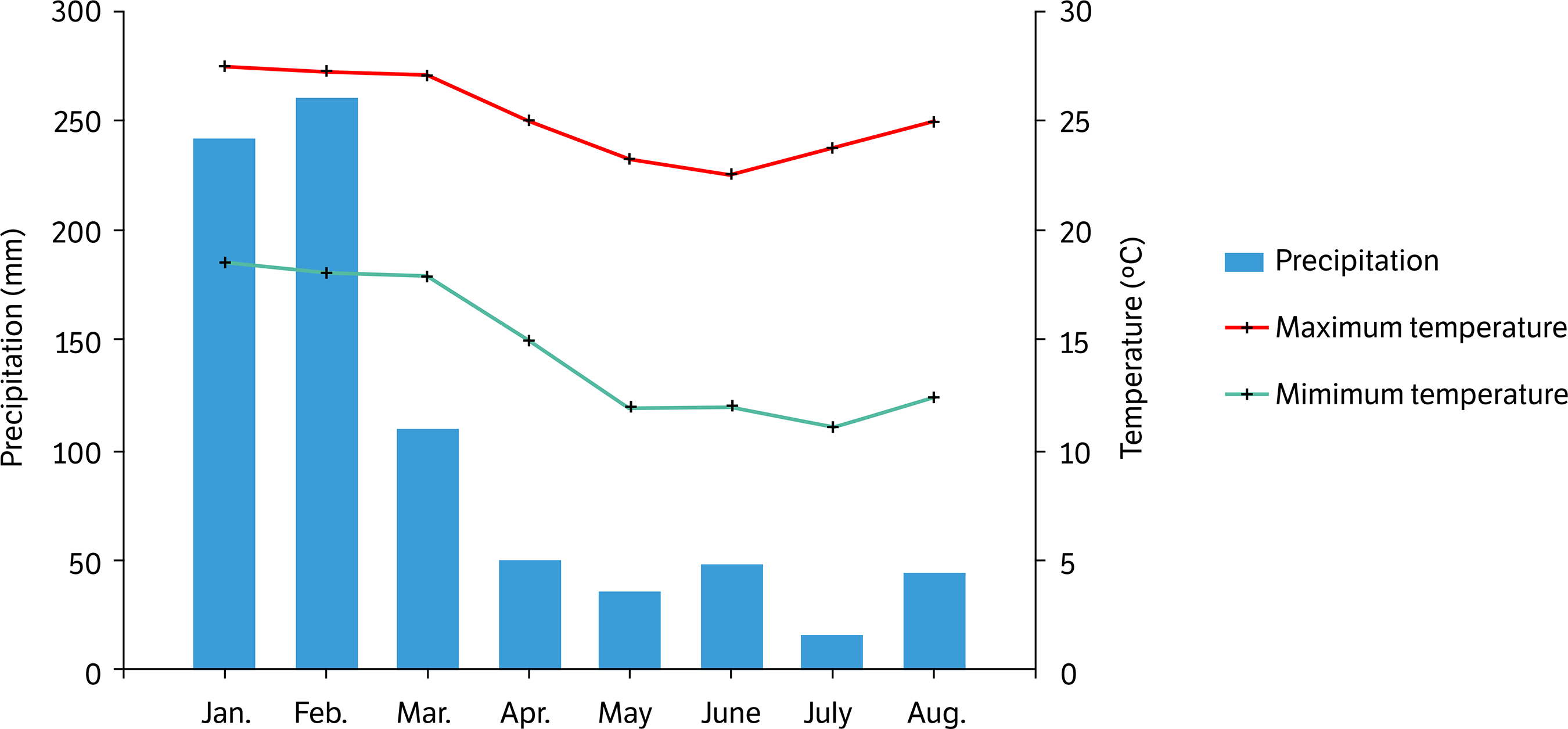
Meteorological data were evaluated starting from the production pruning, with temperatures obtained from NASA Power via Rural Clima (2024) and precipitation collected in loco (Fig. 1).

Monthly averages of maximum temperatures, minimum temperatures, and precipitation in São Roque, SP, Brazil, during the productive period from 2020 to 2023.
The experiment followed a completely randomized design, involving two cultivars with 10 replicates each, with three plants per plot, two of which served as border plants. The physical characterization of the clusters for each cultivar was performed by selecting five clusters with masses close to the overall plot average, while berry characterization was conducted by randomly collecting 50 berries with three replicates.
Production per plant and cluster characteristics were measured using a digital scale at harvest. The following productive parameters were evaluated: total cluster mass per plant; number of clusters per plant; average cluster mass; and yield per hectare. For cluster characterization, the following metrics were assessed: average cluster mass; average number of berries; average berry mass per cluster; average rachis mass per cluster; and the cluster compactness index, calculated using Eq. 1:
For berry characterization, the parameters evaluated included: average berry mass; average skin mass; number of seeds per berry; and average seed mass.
Leaf area estimation was carried out during harvest by counting the total number of shoots per plant, from which 10 shoots located in the middle third of the spur cordon were selected. For each selected shoot, the central vein length of all leaves was measured using a graduated ruler in centimeters. Leaf area was estimated using the mathematical model proposed by Delrot et al. (2010) (Eq. 2):
The total leaf area per plant was determined by multiplying the leaf area of a shoot by the number of shoots per plant. Leaves with central veins ≤ 3 cm were excluded, following the recommendations of Lopes and Pinto (2000).
The balance between vegetative growth and fruit yield was assessed using the Ravaz index (RI). This index was calculated by dividing the grape yield (kg) from a given harvest by the mass of pruned shoots (kg) during the subsequent winter.
Technological and phenolic maturation of the grapes was evaluated from the color change stage (BBCH 81) to harvest (BBCH 89). Weekly, 50 berries per cultivar were randomly collected, with three replicates. Pedicels were removed to obtain the must, and the skins and seeds were separated.
The must obtained by macerating the berries was used to determine the following parameters: total soluble solids (TSS) in °Brix, hydrogen ion concentration (pH), and total titratable acidity at pH 7, expressed as tartaric acid (TA) in g·L-1, according to the OIV methodology (2024).
Extracts were prepared using a methodology adapted from Pereira et al. (2005) and Pereira et al. (2020) to obtain the phenolic compounds from the grape skins. Five grams of cleaned grape skins were ground with 50 mL of 96% ethanol in a 600 W mixer for 1 minute and 40 seconds. The extraction was performed at a cold temperature, between 0 and 5°C, for 1 hour, with agitation every 10 minutes. The extracts were then centrifuged for 15 minutes at 3,500 rpm, and the supernatant was stored in a freezer until the chemical analyses were conducted.
The total polyphenol index (TPI 280) was determined using spectrophotometry at the absorbance of 280 nm (Rizzon 2010), using alcoholic extracts of ‘Cabernet Franc’ and ‘Malbec’ diluted in deionized water at ratios of 1:10 and 1:30, respectively. Total polyphenol (TP) values were expressed in mg·L-1 of gallic acid equivalents (GAE), estimated using a standard calibration curve. The standard curve was generated by preparing a stock solution of 100 mg·L-1 gallic acid. Aliquots of 1, 2.5, 5, 10, 15, and 20 mL were transferred into 100 mL volumetric flasks and diluted to the mark with deionized water. Absorbance measurements were then taken using a spectrophotometer at 280 nm, utilizing a quartz cuvette with a 10 mm optical path length.
The total anthocyanin concentrations (TA) (mg·L-1) were determined using the sodium bisulfite bleaching method and spectrophotometry at the absorbance of 520 nm (Zamorra 2003). A stock solution was prepared by combining 1 mL of the alcoholic extract, 1 mL of 99.5% ethanol, and 20 mL of 0.7% hydrochloric acid (HCl). Two screw-cap test tubes were then prepared: the first contained 5 mL of the stock solution and 2 mL of deionized water, while the second contained 5 mL of the stock solution and 2 mL of 0.7% sodium bisulfite (NaHSO3). The tubes were securely capped, agitated for 10 minutes, and subsequently analyzed using a spectrophotometer set at 520 nm, utilizing a quartz cuvette with a 10 mm optical path length. The TA content was calculated using Eq. 3:
Total tannins (TT) (g·L-1) were quantified using the acid hydrolysis method and spectrophotometry at the absorbance of 550 nm, as proposed by Zamorra (2003). The analysis involved the preparation of two screw-cap test tubes. Each tube received 2 mL of an alcoholic extract diluted at a 1:50 ratio, 1 mL of deionized water, and 6 mL of 12 N HCl. Tube 1 was sealed and incubated in a covered water bath (protected from light) at 100°C for 30 minutes, while tube 2 was maintained at room temperature. After incubation, 1 mL of 99.5% ethanol was added to each tube, followed by shaking and thorough homogenization. Absorbance readings were taken using a spectrophotometer at 550 nm, utilizing a quartz cuvette with a 10 mm optical path length. The tannin concentration was calculated using Eq. 4:
For the analysis of the results, an average of the data from the four harvests was calculated, except for the 2022 harvest concerning productive parameters and the between vegetative growth and fruit yield due to the occurrence of the physiological disorder known as filage, or cluster regression. Technological and phenolic maturation curves were evaluated through regression analysis, except for TT, which were represented by a bar graph. The other parameters assessed in this study were presented as means with standard deviation.
RESULTS AND DISCUSSION
Temperature is crucial for the maturation and development of berries, with an optimal range of 18 to 33°C being ideal for photosynthesis (Jackson and Lombardi 1993), placing the study’s seasons in satisfactory conditions (Fig. 1). The wider temperature range observed in autumn/winter production, combined with low precipitation levels, is favorable not only for sugar accumulation but also for enhancing aromas and phenolic compounds, particularly anthocyanins (Magalhães 2015). Rainfall during the second pruning period supports shoot formation and plant development, although precautions against fungal attacks should not be overlooked. However, during the maturation period leading up to harvest, reduced rainfall and cooler temperatures facilitate a longer maturation process, resulting in a higher health and quality harvest.
The productive parameters of the ‘Cabernet Franc’ and ‘Malbec’ managed using the cycle inversion technique, along with the characteristics of their grape clusters (Table 1), exhibited distinct profiles. Variations in physical and morphological traits, as well as differences in the chemical composition of the berries, are expected due to the genetic makeup of each cultivar and their responses to various factors, including the cycle inversion technique. The average yield per plant for ‘Cabernet Franc’ was 1.71 kg, with a productivity of 4.55 t·ha-1, which exceeds the values reported by Tecchio et al. (2022) for a summer harvest in Jundiaí, São Paulo, Brazil, at 1.01 kg and 4.06 t·ha-1. However, Dias et al. (2017) observed higher yields in ‘Syrah’ managed with cycle inversion and different rootstocks in Andradas, Minas Gerais, Brazil, compared to the results of this study.
Production per plant, number of clusters per plant, yield, average cluster weight, average number of berries per cluster, average berries weight per cluster, average rachis weight per cluster, compactness index, average berry weight, average skin weight per berry, average number of seeds per berry, and average seed weight per berry for the ‘Cabernet Franc’ and ‘Malbec’ produced under cycle inversion technique, averaged across the 2020, 2021, 2022, and 2023 seasons.
The ‘Malbec’, on the other hand, yielded 3.12 kg per plant, with a productivity of 8.33 t·ha-1, which exceeds the values reported under the same rootstock and irrigated vineyard conditions in Mendoza, Argentina, where the average yield was 2.7 kg per plant (Di Filippo and Vila 2011). However, these results were slightly lower than those reported by Pereira et al. (2023) in the Brazilian cerrado, where using the cycle inversion technique combined with the ‘Paulsen 1103’ rootstock resulted in a yield of 3.8 kg per plant.
Yield is closely tied to the number of clusters per plant, which is influenced by the number of spurs on the cordon and the number of fruiting canes. Both ‘Cabernet Franc’ and ‘Malbec’ averaged around 26 clusters per plant, but they exhibited distinct morphological traits. ‘Cabernet Franc’ produced looser clusters with smaller berries, reflected in the average values of cluster weight, mass of berries, and compactness index, recorded at 64.2, 64, and 0.56 g, respectively. In contrast, studies in northeastern São Paulo state found that two-year-old ‘Cabernet Franc’ vines had a higher average cluster weight of 121 g (Regina et al., 2011). The occurrence of bunch stem necrosis, which disrupts the transport of sugars and water (Krasnow et al. 2010) during the ripening stage in two of the evaluated harvests likely contributed to the lower cluster weights observed. However, this physiological disorder is not the sole determinant of final cluster weight and its impact on overall productivity. Interestingly, the average berry weight was similar to that reported by Regina et al. (2011), approximately 1 g. On the other hand, ‘Malbec’ produced heavier, more compact clusters, with an average berry weight of 1.71 g and a compactness index of 1.21, closely matching the berry weight observed in Mendoza, Argentina (Di Filippo and Vila 2011). Among these factors, cluster compactness is particularly significant from a phytosanitary perspective, as it suggests a potential increase in susceptibility to pathogens, especially gray mold (Botrytis cinerea) (Latorre et al. 2015, Albertin et al. 2024).
Berry size is influenced not only by the genetic traits of each cultivar and their interaction with the environment but also by the number of seeds that each berry can potentially develop. The ‘Cabernet Franc’ averaged one seed per berry, whereas ‘Malbec’ averaged two seeds per berry. This difference may impact berry size, as seeds produce auxins, which play a crucial role in cellular growth and division, thereby regulating fruit development (Taiz and Zeiger 2013).
Berry size is important in determining high-quality raw material for fine wine production. From a physiological perspective, smaller berries tend to accumulate more sugars due to reduced evapotranspiration, especially towards the end of the cycle (Dreier et al. 2000). The concentration of total phenolics and anthocyanins is influenced by fruit size, with smaller berries exhibiting higher concentrations, not only due to the reduced volume of solvents but also due to the higher surface area to pulp ratio (Di Filippo and Vila 2011, Chen et al. 2018). It is reported that berries weighing less than 2 g are considered small for processing (Rizzon and Miele 2004), which places the berries in the present study according to these parameters.
The relationship between vegetative growth and fruit yield for the cultivars under study (Table 2) indicates vine development and balance. The results revealed that ‘Malbec’ produced 1 kg of grapes per m2 of leaf area, while ‘Cabernet Franc’ yielded 0.5 kg. However, to produce 1 kg of grapes, ‘Cabernet Franc’ required twice the leaf area compared to ‘Malbec’, resulting in a ratio of 2.07 m·kg-1. These findings are consistent with those of Regina et al. (2011) for ‘Cabernet Franc’ and Dias et al. (2017) for ‘Syrah’, both using the cycle inversion technique on ‘Paulsen 1103’, which reported average ratios of 1.75 and 1.80 m2·kg-1, respectively. Research conducted in Davis, United States of America, indicates that, for grapevines grown on trellises, an ideal range of 0.8 to 1.2 m2·kg-1 is recommended to ensure complete maturation of the clusters, with optimal sugar accumulation, coloration, and mass (Kliewer and Dokoozlian 2005). Nonetheless, these are only indicative values and do not preclude the establishment of new standards according to regional conditions. Despite ‘Cabernet Franc’ exhibiting values above the expected range, there was no detrimental effect on the evolution of technological and phenolic maturation.
Production per unit of leaf area, leaf area required per kilogram of production, and Ravaz index for the ‘Cabernet Franc’ and ‘Malbec’ under cycle inversion technique, averaged across the 2020, 2021, and 2023 seasons.
The RI (Table 2) indicates the balance between vegetative growth and fruit yield, with values between 5 and 10, suggesting the desirable equilibrium for grapevines. In this study, both ‘Cabernet Franc’ and ‘Malbec’ exhibited RI values below 5, averaging 1.9 and 3.6, respectively, indicating an imbalance and the need for management adjustments. This finding underscores the necessity for further research to determine the optimal training system, pruning time, number of buds after pruning, frequency of topping, new combinations of scion and rootstock, irrigation systems to mitigate drought conditions or even the establishment of new RI values for different management systems that deviate from established standards. Similarly low RI values have been also observed in São Joaquim, Santa Catarina, Brazil, where traditional cultivation under hail nets for ‘Cabernet Franc’ trained in a vertical trellis system on ‘Paulsen 1103’ rootstock yielded an average RI of 3.21 without cluster thinning (Marcon Filho et al. 2015); and an RI of 2 for ‘Cabernet Franc’ on ‘Paulsen 1103’, with a load of 50 buds without cycle inversion (Würz et al. 2020).
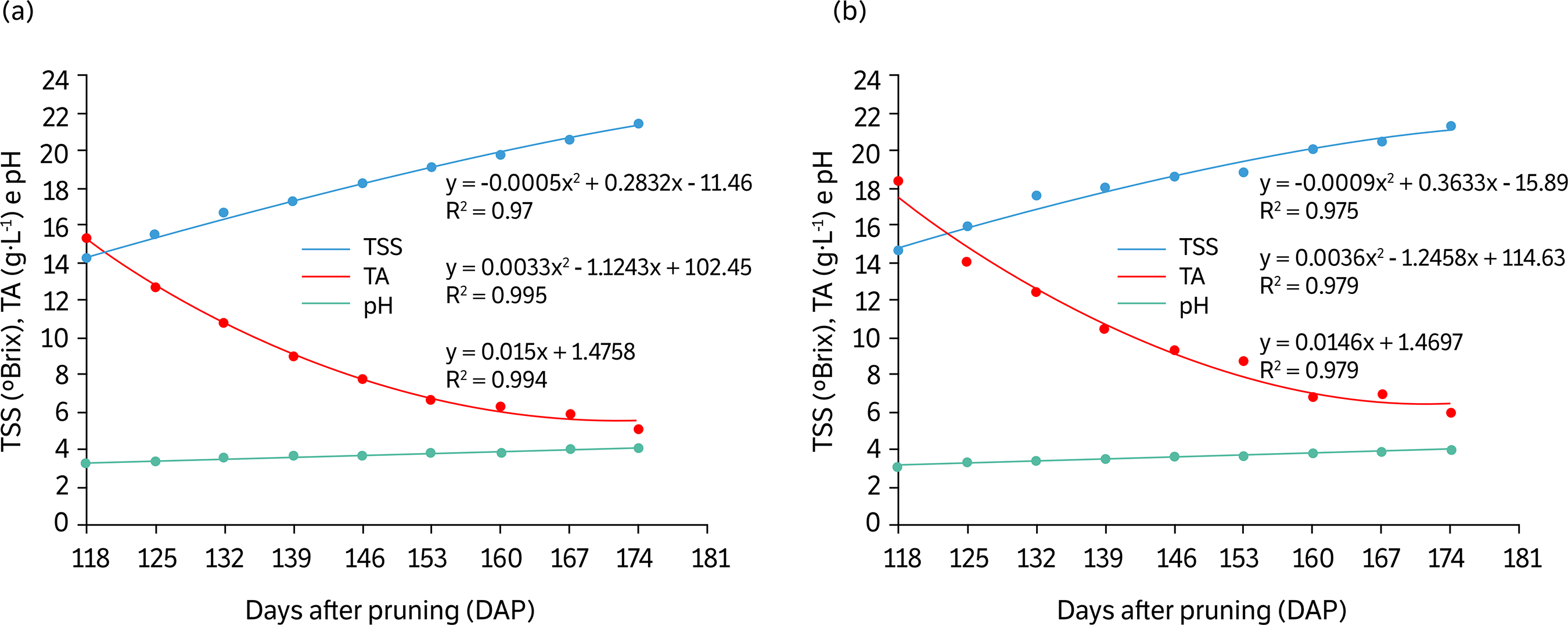
Establishing the maturation profile is essential for understanding the potential and behavior of grape cultivars under a new pruning system and in a specific region. This assessment provides critical insights that inform management practices aligned with the desired product outcomes and the quality of the raw material, while also enhancing overall agronomic practices. The technological maturation curve (Fig. 2) revealed that both cultivars, with an average growth cycle of 174 days, exhibited an increase in TSS and pH during berry ripening, along with a decrease in TA.
The TSS levels in both ‘Cabernet Franc’ and ‘Malbec’ were satisfactory for producing fine wines without the need for chaptalization, averaging 21.45 °Brix and 21.30 °Brix, respectively. The result for ‘Cabernet Franc’ aligns with the trend previously observed by Hernandes et al. (2016) in the same study location, which reported an average of 20.4 °Brix. However, Regina et al. (2011) found higher values in the northeastern region of São Paulo state, reaching 25.43 °Brix. Although the average in São Roque was around 21 °Brix, two harvests recorded values above 22.4 °Brix for both cultivars, highlighting the region’s potential when using the cycle inversion technique combined with favorable climatic conditions (Fig. 1) that enhance the maturation process.

Total soluble solids (TSS) (°Brix), pH, and total acidity (TA) (g·L-1) of ‘Cabernet Franc’ (a) and ‘Malbec’ (b) berries produced using the cycle inversion technique, averaged across the 2020, 2021, 2022, and 2023 seasons, from the color change stage (BBCH 81) to harvest (BBCH 89).
The ability of the berries to accumulate higher sugar concentrations through the cycle inversion technique in this region facilitates achieving TSS levels comparable to or exceeding those found in prominent fine wine-producing areas. This is exemplified in studies by Di Filippo and Vila (2011) in Mendoza, Argentina, and Souza et al. (2021) in Videira, Santa Catarina, Brazil, also using ‘Paulsen 1103’ rootstock, in which average TSS levels of 23.5 and 18.3 °Brix were reported, respectively. The TSS values observed in the cultivars indicate that they will produce fine wines with alcohol content according to the standards required by Law No. 10,970 and the new Normative Instruction (NI 14) in Brazil, which now classify noble wines as those with alcohol levels between 14 and 16%, due to the increased total sugar content in the berries.
The TA values for the cultivars were 5.11 g·L-1 for ‘Cabernet Franc’ and 6.01 g·L-1 for ‘Malbec’, which are consistent with the standards set in Brazil and by the European Community (Regulation CE No. 479/2008), where acceptable values range from 3 to 9.75 g·L-1. The pH values for both cultivars were around 4. Typically, the pH of must in Brazil ranges from 3.4 to 3.8, which is favorable for producing wines with a more intense red color, protection against microbial spoilage, and enhanced malolactic fermentation (Giovaninni and Manfroi 2013). Coloration is influenced by pH, with values above 4.5 leading to the conversion of the cationic (red) form into a more violet to blue hue (Brouillard et al. 1989, Giovaninni and Manfroi 2013). Higher pH values in berries and wines produced in winter may be associated with the cycle inversion technique, which allows for longer maturation and, combined with greater thermal amplitude, maintains lower respiration rates and preservation of malic acid during cool/cold nights (Conde et al. 2007). Although ‘Malbec’ did not exhibit bunch stem necrosis, this condition may also contribute to an increase in pH due to a possible excess of potassium in the berries and rachis, leading to the precipitation of TA in the form of potassium bitartrate (Mpelasoka et al. 2003). Additionally, factors such as excessive fertilization and foliar applications may also impact plant balance and physiology, influencing the physicochemical properties of the berries and disease development.
This observed trend of elevated pH in the must due to the cycle inversion technique has been also documented in other studies. The TA and pH results in this study align with those found for ‘Syrah’ on ‘Paulsen 1103’ in Três Corações, Minas Gerais, Brazil, which also employed cycle inversion but reported lower °Brix, around 19 (Mota et al. 2009). Studies with cultivars such as ‘Pinot Noir’, ‘Tempranillo’, ‘Cabernet Sauvignon’, ‘Chardonnay’ and ‘Sauvignon Blanc’ on the same rootstock and winter cycle also achieved °Brix values greater than 20.4, with pH and TA values comparable to those in the present study (Mota et al. 2010).
The phenolic composition of berries is closely linked to the sensory characteristics of wine and its aging potential. Phenolic compound concentrations vary based on edaphoclimatic conditions, management practices, and cultivar genetics. The cycle inversion technique aims to integrate these factors, facilitating the development and maturation of grapes with significant enological potential. This is further supported by the favorable thermal amplitude observed in São Roque and low precipitation levels.
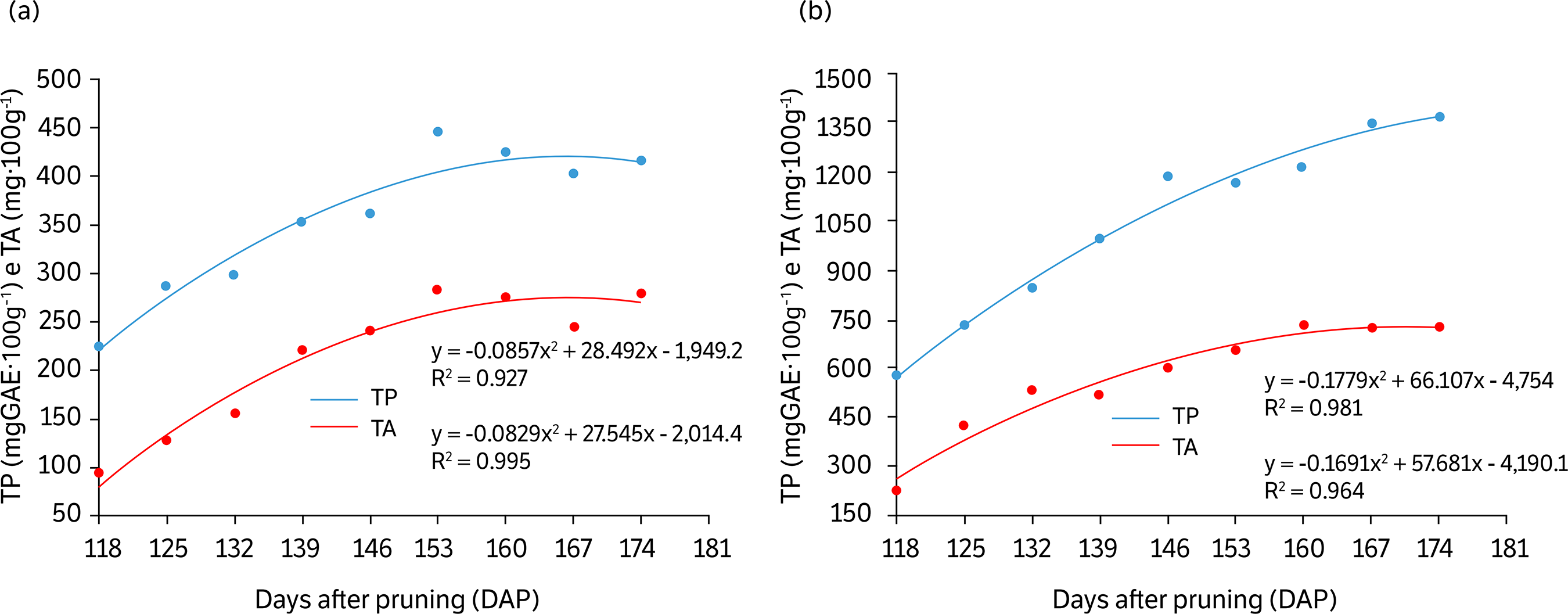
The evolution of phenolic maturation in the cultivars (Figs. 3 and 4) demonstrated an accumulation of TP and TA during maturation, reaching a peak and showing a slight decline after 160 days post-pruning. This pattern indicates an optimal timing for harvest (Magalhães 2015). In contrast, TT exhibited variability throughout maturation until harvest, influenced by extractability and extraction protocols, but remained in a range of 0.27 g·L-1 for ‘Cabernet Franc’ and 0.98 g·L-1 for ‘Malbec’. Additionally, according to Bogs et al. (2005), genes associated with tannin synthesis were not detected after the color change stage, which partially explains the fluctuations in concentrations and values around the beginning of the curve. This pattern suggests that tannin accumulation may occur before this stage and during the early fruiting process.

Concentration of total polyphenols (TP) (mg of gallic acid equivalents·100 g-1) and total anthocyanins (TA) (mg·100 g-1) in ‘Cabernet Franc’ (a) and ‘Malbec’ (b) berries produced using the cycle inversion technique, averaged across the 2020, 2021, 2022, and 2023 seasons, from the color change stage (BBCH 81) to harvest (BBCH 89).

Concentration of total tannins (TT) (g·100 g·) in ‘Cabernet Franc’ (a) and ‘Malbec’ (b) berries produced using the cycle inversion technique, averaged across the 2020, 2021, 2022, and 2023 seasons, from the color change stage (BBCH 81) to harvest (BBCH 89).
According to Zamorra (2003), the values observed at the end of phenolic maturation, even though the alcoholic extract is not precisely wine, fall in the typical range for young wines. This includes anthocyanin levels between 200–1,200 mg·L-1, a TPI 280 range of 20–80 (starting from 550 mgGAE·L-1), and TT ranging from 1–5 g·L-1. For ‘Cabernet Franc’, the TPI 280 value of 15.12 and TT of 0.25 g·100g-1 of fresh weight or 0.25 g·L-1 (Table 3) are slightly below the established standards, but they could have increased if there were a winemaking process. The lower tannin concentrations are also partially because the extract was obtained solely from the grape skins, whereas higher tannin levels are generally found in seeds and stems (Giovaninni and Manfroi 2013, Magalhães 2015).
Concentrations of total soluble solids (TSS), pH, total acidity (TA), total acidity (TA), total polyphenol index at 280 nm (TPI 280), total polyphenols (TP), total anthocyanins (TA) and total tannins (TT) in ‘Cabernet Franc’ and ‘Malbec’ berries produced under cycle inversion technique, averaged across the 2020, 2021, 2022, and 2023 seasons, at harvest (BBCH 89).
The results regarding the evolution of phenolic maturation often differ from those found in the literature due to variations in the methods of compound extraction and analytical methodologies used. Some methodologies employ methanol in the extraction process (Singleton and Rossi 1965), and total polyphenol concentrations can be also expressed in epicatechin or other units of measurement. Although various methodologies and adaptations are available, this does not imply that one produces better or worse results. This is evident in studies attempting to correlate the antioxidant capacity of wines with their total polyphenol content, in which often no clear relationship is found depending on the analytical method employed (Stratil et al. 2008).
Berries of the Syrah cultivar in Andradas, under cycle inversion technique, exhibited an average TP of 319.65 mg·100 g-1 and TA of 124.6 mg·100 g-1 (Dias et al. 2017). These values are lower compared to those found in the present study, in which ‘Cabernet Franc’ had averages of 415.28 mg·100 g-1 for TP and 279.67 mg·100 g-1 for TA, while ‘Malbec’ showed 1,371.06 mg·100 g-1 for TP and 726.18 mg·100 g-1 for TA. Additionally, these findings indicate higher concentrations than those reported for ‘Syrah’ in several cities in the Southeast region of Brazil, including Três Corações, Minas Gerais; Três Pontas, Minas Gerais; Cordislândia, Minas Gerais; São Sebastião do Paraíso, Minas Gerais; Andradas, Minas Gerais; Itobi, São Paulo; and Espírito Santo do Pinhal, São Paulo (Brant et al. 2021).
With an average cycle of 174 days for both cultivars under study, determining the optimal berry maturation stage depends on the desired wine style. The harvest data (Table 3) provide insights into the maturation process. Traditionally, the optimal harvest point is defined by achieving high sugar levels, low acidity, and elevated phenolic compound concentrations, while maintaining a sound phytosanitary condition. Technological maturation and phenolic maturation are independent variables that may follow different evolutionary trends, but both should be considered when deciding the optimal harvest time.
CONCLUSION
The ‘Cabernet Franc’ is characterized by loose clusters with an average mass of 64 g and small berries averaging 0.8 g. In contrast, ‘Malbec’ displays compact clusters with an average mass of 114 g and larger berries of 1.7 g. Both cultivars have a RI below 5, indicating an imbalance between production and vigor, necessitating adjustments in agronomic management.
The application of the cycle inversion technique with ‘Cabernet Franc’ and ‘Malbec’ improves technological and phenolic maturation. Combined with the thermal range and low rainfall during the maturation process, these techniques achieve satisfactory values with enological potential for the production of winter harvest wines.
ACKNOWLEDGMENTS
We would like to thank Vitivinícola Góes LTDA, for allowing this study to be carried out in part of their vineyards.
-
How to cite: Albertin, F., Yamanouchi, F. T., Triches, W. S. and Biasi, L. A. (2025). Agronomic and enological potential of ‘Cabernet Franc’ and ‘Malbec’ produced under cycle inversion in subtropical climate in Brazil. Bragantia, 84, e20240201. https://doi.org/10.1590/1678-4499.20240201
-
FUNDING
Coordenação de Aperfeiçoamento de Pessoal de Nível SuperiorFinance Code 001Conselho Nacional de Desenvolvimento Científico e TecnológicoGrant No. 307.705/2021-8
DATA AVAILABILITY STATEMENT
All dataset were generated and analyzed in the current study.
REFERENCES
-
Abramides, P. L. G., Brunini, O., Pedro Júnior, M. J., Camargo, M. B. P., Ernandes, E. S., Blani, G. C., Brunini, A. P. C., Brigante, R. S. and Santos, L. (2003). CIIAGRO. Available at: http://www.ciiagro.sp.gov.br/ciiagroonline/ Accessed on: Dec. 25, 2019.
» http://www.ciiagro.sp.gov.br/ciiagroonline/ -
Albertin, F., Gelain, J., Maia, J. N., May De Mio, L. L. and Biasi, L. A. (2024). Botrytis cinerea infection in Vitis vinifera cultivars under cycle inversion. Scientia Agricola, 81, e20230142. https://doi.org/10.1590/1678-992X-2023-0142
» https://doi.org/10.1590/1678-992X-2023-0142 -
Alvares, C. A., Stape, J. L., Sentelhas, P. C., Moraes Gonçalves, J. L., and Sparovek, G. (2013). Koppen’s climate identification map for Brazil. Meteorologische Zeitschrift, 22, 711-728. https://doi.org/10.1127/0941-2948/2013/0507
» https://doi.org/10.1127/0941-2948/2013/0507 -
Bogs, J., Downey, M. O., Harvey, J. S., Ashton, A. R., Tanner, G. J. and Robinson, S. P. (2005). Proanthocyanidin synthesis and expression of genes encoding leucoanthocyanidin reductase and anthocyanidin reductase in developing grape berries and grapevine leaves. Plant Physiology, 139, 652-663. https://doi.org/10.1104/pp.105.064238
» https://doi.org/10.1104/pp.105.064238 -
Brant, L. A. C., Souza, C. R., Mota, R. V., Fernandes, F. P., Gonçalves, M. G. M., Menezes, M. D., Peregrino, I., Curi, N. and Regina, M. A. (2021). Macro scale analysis of Syrah vineyards under winter growing cycles: Agronomical and ecophysiological responses. Scientia Agricola, 78, e20200055. https://doi.org/10.1590/1678-992X-2020-0055
» https://doi.org/10.1590/1678-992X-2020-0055 -
Brouillard, R., Mazza, G., Saad, Z., Albrecht-Gary, A. M. and Cheminat, A. (1989). The co-pigmentation reaction of anthocyanins: a microprobe for the structural study of aqueous solutions. Journal of the American Chemical Society, 111, 2604-2610. https://doi.org/10.1021/ja00189a039
» https://doi.org/10.1021/ja00189a039 -
Chen, W.-K., He, F., Xang, Y.-X., Liu, X., Duan, C.-Q. and Wang, J. (2018). Influences of berry size on fruit composition and wine quality of Vitis vinifera L. cv. ‘Cabernet Sauvignon’ grapes. South African Journal of Enology and Viticulture, 39, 67-75. https://doi.org/10.21548/39-1-2439
» https://doi.org/10.21548/39-1-2439 -
Conde, C., Silva, P., Fontes, N., Dias, A. C. P., Tavares, R. M., Sousa, M. J., Agasse, A., Delrot, S. and Gerós, H. (2007). Biochemical changes throughout grape berry development and fruit and wine quality. Food, 1, 1-22. http://www.globalsciencebooks.info/Online/GSBOnline/images/0706/FOOD_1(1)/FOOD_1(1)1-22o.pdf
» http://www.globalsciencebooks.info/Online/GSBOnline/images/0706/FOOD_1(1)/FOOD_1(1)1-22o.pdf - Delrot, S., Medrano, H., Or, E., Bavaresco, L. and Granado, S. (2010). Methodologies and Results in Grapevine Research. Netherlands: Springer.
-
Di Filippo, M. and Vila, H. (2011). Influence of different rootstocks on the vegetative and reproductive performance of Vitis vinifera L. Malbec under irrigated conditions. Journal International des Sciences de la Vigne et du Vin, 45, 75-84. https://doi.org/10.20870/oeno-one.2011.45.2.1487
» https://doi.org/10.20870/oeno-one.2011.45.2.1487 -
Dias, F. A. N., Mota, R. V., Souza, C. R., Pimentel, R. M. A., Souza, L. C., Souza, A. L. and Regina, M. A. (2017). Rootstock on vine performance and wine quality of ‘Syrah’ under double pruning management. Scientia Agricola, 74, 134-141. https://doi.org/10.1590/1678-992X-2015-0384
» https://doi.org/10.1590/1678-992X-2015-0384 -
Dreier, L. P., Stoll, G. S. and Ruffner, H. P. (2000). Berry ripening and evapotranspiration in Vitis vinifera L. American Journal of Enology and Viticulture, 51, 340-346. https://doi.org/10.5344/ajev.2000.51.4.340
» https://doi.org/10.5344/ajev.2000.51.4.340 -
Favero, A. C., Amorim, D. A., Mota, R. V., Soares, A. M., Souza, C. R. and Regina, M. A. (2011). Double-pruning of ‘Syrah’ grapevines: a management strategy to harvest wine grapes during the winter in the Brazilian Southeast. Vitis, 50, 151-158. https://doi.org/10.5073/vitis.2011.50.151-158
» https://doi.org/10.5073/vitis.2011.50.151-158 - Giovaninni, E. and Manfroi, V. (2013). Viticultura e enologia: elaboração de grandes vinhos nos terroirs brasileiros. Bento Gonçalves: IFRS.
-
Hernandes, J. L., Pedro Júnior, M. J., Blain, G. C. and Bardin-Camparotto, L. (2016). Raleio de cachos em videiras Cabernet Sauvignon e Cabernet Franc submetidas ao regime de dupla poda sequencial. Scientia Vitae, 4, 23-29. Available in https://www.revistaifspsr.com/v4n14_3.pdf
» https://www.revistaifspsr.com/v4n14_3.pdf -
Jackson, D. I. and Lombardi, P. B. (1993). Environmental and management practices affecting grape composition and wine quality: a review. American Journal of Enology and Viticulture, 44, 409-430. https://doi.org/10.5344/ajev.1993.44.4.409
» https://doi.org/10.5344/ajev.1993.44.4.409 -
Kliewer, M. and Dokoozlian, N. (2005). Leaf area/crop weight ratios of grapevines: influence on fruit composition and wine quality. American Journal of Enology and Viticulture, 56, 170-181. https://doi.org/10.5344/ajev.2005.56.2.170
» https://doi.org/10.5344/ajev.2005.56.2.170 -
Krasnow, M. N., Matthews, M. A., Smith, R. J., Benz, J., Weber, E. and Shackel, K. A. (2010). Distinctive symptoms differentiate four common types of berry shrivel disorder in grape. California Agriculture, 64, 155-159. https://doi.org/10.3733/ca.v064n03p155
» https://doi.org/10.3733/ca.v064n03p155 -
Latorre, B. A., Elfar, K. and Ferrada, E. E. (2015). Gray mold caused by Botrytis cinerea limits grape production in chile. Ciencia Investigación Agraria, 42, 305-330. https://doi.org/10.4067/S0718-16202015000300001
» https://doi.org/10.4067/S0718-16202015000300001 -
Lorenz, D. H., Eichhorn, K. W., Bleiholder, H., Klose, R., Meier, U. and Weber, E. (1995). Phenological growth stages of grapevine (Vitis vinifera L. spp. vinifera): codes and descriptions according to the extended BBCH scale. Australia Journal of Grape and Wine Research, 1, 100-110. https://doi.org/10.1111/j.1755-0238.1995.tb00085.x
» https://doi.org/10.1111/j.1755-0238.1995.tb00085.x - Lopes, C. M. and Pinto, P. A. (2000). Estimation de la surface foliaire principale et secondaire d’um rameau de vigne. Progrès Agricole et Viticole, 117, 160-166.
- Magalhães, N. (2015). Tratado de viticultura: a videira a vinha e o terroir. 2. ed. Lisboa: Esfera Poetica.
-
Marcon Filho, J. L., Hipólito, J. S., Macedo, T. A., Kretzschmar, A. A. and Rufato, L. (2015). Raleio de cachos sobre o potencial enológico da uva ‘Cabernet Franc’ em duas safras. Ciência Rural, 45, 2150-2156. https://doi.org/10.1590/0103-8478cr20140995
» https://doi.org/10.1590/0103-8478cr20140995 -
Mota, R. V., Amorim, D. A., Fávero, A. C., Gloria, M. B. A. and Regina, M. A. (2009). Caracterização físico-química e aminas bioativas em vinhos da cv. Syrah I: efeito do ciclo de produção. Ciência e Tecnologia de Alimentos, 29, 380-385. https://doi.org/10.1590/S0101-20612009000200023
» https://doi.org/10.1590/S0101-20612009000200023 -
Mota, R. V., Silva, C. P. C., Favero, A. C., Purgatto, E., Shiga, T. M. and Regina, M. A. (2010). Composição físico-química de uvas para vinho fino em ciclos de verão e inverno. Revista Brasileira de Fruticultura, 32, 1127-1137. https://doi.org/10.1590/S0100-29452011005000001
» https://doi.org/10.1590/S0100-29452011005000001 -
Mpelasoka, B. S., Schachtman, D. P., Treeby, M. T. and Thomas, M. R. (2003). A review of potassium nutrition in grapevines with special emphasis on berry accumulation. Australian Journal of Grape and Wine Research, 9, 154-168. https://doi.org/10.1111/j.1755-0238.2003.tb00265.x
» https://doi.org/10.1111/j.1755-0238.2003.tb00265.x -
[OIV] International Organisation of Vine and Wine (2024). Compendium of international methods of wine and must analysis. OIV. Available at: https://www.oiv.int/sites/default/files/publication/2023-05/Compendium%20MA%20complet_EN.pdf Accessed on: Feb. 2, 2024.
» https://www.oiv.int/sites/default/files/publication/2023-05/Compendium%20MA%20complet_EN.pdf -
Pereira, G. E., Gaudillere, J.-P., Van Leeuwen, C., Hilbert, G., Lavialle, O., Maucourt, M., Deborde, C., Moing, A. and Rolim, D. (2005). 1H NMR and Chemometrics to characterize mature grape berries in four wine-growing areas in Bordeaux, France. Journal of Agricultural and Food Chemistry, 53, 6382-6389. https://doi.org/10.1021/jf058058q
» https://doi.org/10.1021/jf058058q -
Pereira, G. E., Padhi, E. M., Girardello, R. C., Medina-Plaza, C., Tseng, D., Bruce, R. C., Erdmann, J. N., Kurtural, S. K., Slupsky, C. M. and Oberholster, A. (2020). Trunk girdling increased stomatal conductance in Cabernet Sauvignon grapevines, reduced glutamine, and increased malvidin-3-glucoside and quercetin-3-glucoside concentrations in skins and pulp at harvest. Frontiers in Plant Science, 11, 707. https://doi.org/10.3389/fpls.2020.00707
» https://doi.org/10.3389/fpls.2020.00707 -
Pereira, G. E., Peccin, E. G., Riste, U. S., Deconti, G. S., Oliveira, J. B., Santos, F. C., Santana, D. P., Albuquerque Filho, M. R. and Figueiredo, A. B. A. (2023). Caracterização agronômica de videiras e enológica de uvas e vinhos de inverno no cerrado brasileiro. Embrapa Uva e Vinho. Available at: https://ainfo.cnptia.embrapa.br/digital/bitstream/doc/1154337/1/BolPesqDes-23-o.pdf Accessed on: Jan. 20, 2024.
» https://ainfo.cnptia.embrapa.br/digital/bitstream/doc/1154337/1/BolPesqDes-23-o.pdf - Regina, M. A., Mota, R. S., Fávero, A. C., Shiga, T. M., Silva, L. H. J., Souza, W. C., Novelli, F. A. D. and Souza, C. R. (2011). Caracterização físico-química de uvas viníferas cultivadas em dupla poda no nordeste de São Paulo. Revista Brasileira de Viticultura e Enologia, 3, 84-92.
- Rizzon, L. A. (2010). Metodologia para análise de vinho. Brasília: Embrapa Informação Tecnológica.
-
Rizzon, L. A. and Miele, A. (2004). Avaliação da cv. Tannat para elaboração de vinho tinto. Ciência e Tecnologia de Alimentos, 24, 223-229. https://doi.org/10.1590/S0101-20612004000200011
» https://doi.org/10.1590/S0101-20612004000200011 - Rossi, M. (2017). Mapa pedológico do Estado de São Paulo revisado e ampliado. São Paulo: Instituto Florestal.
-
Rural Clima (2024). Soluções agrometeorológicas. Rural Clima. Available at: https://ruralclima.com.br/ Accessed on: Jan. 10, 2023.
» https://ruralclima.com.br/ -
Singleton, V. L. and Rossi, J. A. (1965). Colorimetry of total phenolics with phosphomolybdic-phosphotungstic acid reagents. American Journal of Enology and Viticulture, 16, 144-158. https://doi.org/10.5344/ajev.1965.16.3.144
» https://doi.org/10.5344/ajev.1965.16.3.144 -
Souza, A. L. K., Camargo, S. S., Souza, E. L., Feldberg, N. P. and Bender, A. (2021). Influence of grafting production method on agronomic performance of wine grape varieties. Revista Brasileira de Fruticultura, 43, e-020. https://doi.org/10.1590/0100-29452021020
» https://doi.org/10.1590/0100-29452021020 -
Stratil, P., Kubáň, V. and Fojtová, J. (2008). Comparison of the phenolic content and total antioxidant activity in wines as determined by spectrophotometric methods. Czech Journal of Food Sciences, 26, 242-253. https://doi.org/10.17221/1119-CJFS
» https://doi.org/10.17221/1119-CJFS - Taiz, L. and Zeiger, E. (2013). Fisiologia vegetal. Porto Alegre: Artmed.
-
Tecchio, M. A., Silva, M. J. R., Sanchez, C. A. P. C., Callili, D., Vedoato, B. T. F., Hernandes, J. L. and Moura, M. F. (2022). Yield performance and quality of wine grapes (Vitis vinifera) grafted onto different rootstocks under subtropical conditions. Bragantia, 81, e1622. https://doi.org/10.1590/1678-4499.20210214
» https://doi.org/10.1590/1678-4499.20210214 -
Tello, J. and Ibáñez, J. (2014). Evaluation of indexes for the quantitative and objective estimation of grapevine bunch compactness. Vitis, 53, 9-16. https://doi.org/10.5073/vitis.2014.53.9-16
» https://doi.org/10.5073/vitis.2014.53.9-16 -
Würz, D. A., Bonin, B. F., Brighenti, A. F., Canossa, A. T., Reinehr, J., Allebrandt, R., Bem, B. P., Rufato, L. and Kretzschmar, A. A. (2020). Maior carga de gemas da videira resulta em melhora dos índices produtivos e vegetativos da videira ‘Cabernet Franc’ cultivada em região de elevada altitude. Revista de Ciências Agroveterinárias, 19, 171-177. https://doi.org/10.5965/223811711922020171
» https://doi.org/10.5965/223811711922020171 - Zamorra, F. (2003). Elaboración y crianza del vino tinto: aspectos científicos y práticos. Madrid: Mundi-Prensa.
Edited by
-
Section Editor:
Alberto Cargnelutti Filho https://orcid.org/0000-0002-8608-9960