
 Jair Bolsonaro’s Center of Government: Dynamics and Decision-Making
Abstract
This article analyzes the distinctive features of the Center of Government (CoG) under President Jair Bolsonaro, using the framework developed by Cavalcante and Batista (2018). The CoG encompasses a set of units, whether formally or informally linked to the presidential hierarchy, whose primary role is to support presidential decision-making. Our analysis draws on federal legislation that structures the Executive Branch and on Bolsonaro’s official daily schedule to trace interaction patterns and decision-making dynamics within the CoG. The findings show that, although Bolsonaro inherited the basic CoG structure from previous administrations, he diverged from his predecessors by eliminating thematic secretariats within the presidency and by prioritizing interaction with the Institutional Security Bureau over other offices. He also reoriented political coordination toward the Casa Civil, particularly from 2021 onward, when the administration intensified negotiations with political actors during the second half of his term.
Keywords
Center of Government; Presidential Center; Bolsonaro, Executive Branch
Introduction
The Center of Government (CoG) comprises a set of core units that play a central role in strategic decision-making within the Executive Branch. These units may or may not belong to the presidency’s formal organizational hierarchy, as long as they hold the legally defined authority.
Over the past decade, the CoG’s prominence in shaping and negotiating the government agenda has attracted growing scholarly attention. The literature notes a steady institutionalization of key units linked to the Presidency of the Republic, most notably the Casa Civil (Executive Office of the President of Brazil), alongside a growing recognition of the need to strengthen coordination, oversight, and communication capacities to more effectively coordinate the public policies prioritized by the President.
However, Jair Bolsonaro’s election in 2018 introduced significant uncertainty into decision-making processes within the Executive Branch, particularly amid his administration’s downsizing of ministries into secretariats and repeated claims that it was necessary to “tear down tear down a lot of things” (VALOR ECONÔMICO, 2019). Moreover, as Medeiros (2022) and Cruz and Souza (2023) observe, Bolsonaro departed from Brazil’s traditional coalition-presidentialism model. Instead, between 2021 and 2022, he relied on selective, case-by-case negotiations with specific parties and individual legislators, largely to avert the risk of impeachment proceedings. Against this backdrop, this article asks: how was the CoG structured and operated under Jair Bolsonaro, and what interaction and decision-making dynamics characterized these processes?
This study is descriptive and exploratory in nature. Our objective is to examine the specific characteristics of the CoG during Jair Bolsonaro’s presidency through the lens of the model proposed by Cavalcante and Batista (2018), with particular attention to his administration’s governance strategies within the Executive Branch1. Cavalcante and Batista’s framework (2018) enables an analysis of both the formal and informal functioning of the CoG, drawing on information from the legal framework governing the Federal Executive Branch and from the president’s public schedule.
By examining the legal framework, we gain a formal overview of the powers and responsibilities assigned to the CoG, while the president’s public schedule sheds light into its day-to-day practices and interactions. In applying this model to Bolsonaro’s administration, our specific goal is to compare it with previous governments and assess the extent to which the practices and structures he implemented aligned with or diverged from broader trends in the institutionalization of the CoG as a set of units designed to support the President of the Republic. This comparison is essential for understanding how the federal senior bureaucracy operated during a distinctive period in Brazil’s republican history, one that the literature characterizes as marked by an intent to dismantle public policies (GOMIDE, SILVA, and LEOPOLDI, 2023).
As Cavalcante and Batista (2018) emphasize, adopting this perspective is essential for advancing research on the CoG and for understanding its role in presidential governance. The core function of the units that comprise the CoG is to align government action with the president’s policy priorities. Because governability and the capacity to advance a policy agenda hinge on building effective relationships with the other branches of government, the CoG occupies a central position in this process.
Our study also contributes to understanding the dynamics of interaction and decision-making within Bolsonaro’s CoG. The administration displayed two distinct patterns: an anti-coalition discourse during the first half of the term, followed by a tentative shift toward negotiation and alliance-building practices in the latter half. Analyzing these dynamics within the broader framework of the CoG, especially in a government whose objectives diverged markedly from those of its predecessors, is essential for producing an accurate assessment of this administration. Furthermore, the findings of our study may also inform broader discussions about the reforms and adjustments needed to strengthen governance within the Executive Branch.
In addition, this study contributes to the academic debate on Executive governance in Brazil by testing existing theories and models through the analysis of a specific case in comparison with previous administrations. Nevertheless, the research has certain limitations: our examination of the CoG relies on the availability and accuracy of data drawn from the president’s public schedule and the relevant legislation, and any gaps or inconsistencies in these sources may constrain the scope of the analysis.
This article is organized as follows. The next section discusses the theoretical debates that frame this study. We then outline the methodology and data collection procedures. The following section presents and analyzes the findings, comparing Bolsonaro’s CoG with those of his predecessors. The article concludes with final remarks and suggestions for future research.
Center of government: an expanding field of study
The term ‘Center of Government’ is commonly associated with the literature on public administration, though different authors and theoretical traditions have conceptualized it in varying ways. In this study, the structure under examination aligns with what is termed the ‘core executive’ in the British context and the ‘institutional presidency’ in the American one. The literature also employs related expressions such as ‘presidential core executive’ and ‘presidential center’.
The scholarly literature on the Center of Government first emerged in the American and British contexts, driven by distinct objectives but rooted in a shared historical moment that underscored the importance of this subject of study. As Guedes Neto (2021) notes, the relevance of the CoG to Political Science and Public Administration became particularly evident after the two World Wars, when the number of units surrounding heads of government expanded in both presidential and parliamentary systems. This expansion also strengthened the institutional capacity of the Executive Branch. In this context, examining the CoG’s decision-making processes within the Executive help us better understand the strategies through which governments pursue their political and policy agendas, often with direct implications for society (FAWCETT and GAY, 2005).
The political influence of the CoG varies according to each country’s institutional design, political context, and administrative culture. Generally, however, it involves the capacity for interministerial coordination, long-term strategic planning, and effective crisis management. In multiparty systems, the CoG may also serve as the central hub for managing the government’s relationships with coalition partners.
Amid this wide range of theoretical approaches, Alessandro, Lafuente, and Santiso (2013) identify two main conceptual perspectives in the literature on the structure of the Center of Government. The ‘narrow perspective’ defines the CoG as the set of bodies existing solely within the formal structure of the presidency, dedicated to providing direct support to the head of government – a view generally associated with the American literature (MOE, 1985). In contrast, the ‘broad perspective’ conceives the CoG as a hybrid arrangement that includes other executive bodies beyond those directly linked to the head of government, which may perform typical CoG functions such as coordinating and monitoring the government’s priority policies - a view commonly associated with the British literature (RHODES, 1995).
From the American perspective, authors such as Moe (1985) and Rudalevige and Lewis (2005) examine the process of institutionalizing units around the president, as well as a recurring dilemma in the literature concerning centralization versus politicization. This dilemma reflects the strategies through which the head of government exercises power and manages relationships. Centralization is characterized by concentrating autonomy and responsibilities within bodies directly under the president’s hierarchy, typically staffed by loyalists and members of the president’s own party. In contrast, politicization refers to a strategy that involves both co-opting the bureaucracy to support the president and allocating positions and responsibilities to allies who are not necessarily from the same party. This debate is central in the literature insofar as it addresses how presidents structure the administrative and political apparatus to advance their agendas.
In more recent studies of the American case, authors such as Cohen and Hult (2020), Moynihan and Roberts (2010) examine both the presidential styles of specific administrations, such as those of George W. Bush and Donald Trump, and the dynamics of centralization and politicization strategies and their effects on the presidential agenda. In this regard, the literature identifies a recurring pattern in CoG studies, whether from the British or American perspective: within a single presidential administration, executive bodies may assume different roles and responsibilities, causing the agenda to shift depending on whether centralization or politicization prevails. This variation reflects the president’s own approach, as research shows that presidential style shapes the allocation of responsibilities across organizations in line with the president’s individual and political priorities.
In the British context, the concept of the Core Executive closely parallels the approach found in Brazilian and Latin American literature on the Center of Government. The Core Executive refers to the set of ministerial cabinet structures and departmental units involved in decision-making on issues deemed priorities by the prime minister. Its primary difference from the American approach lies in its broader scope. Within the Core Executive tradition, a commonly used methodological perspective is the expanded view of the CoG, which incorporates units not necessarily directly linked to the prime minister’s hierarchy. This distinction, first introduced by Rhodes (1995), remains central to differentiating the American and British methodological approaches: while the American literature primarily seeks to explain the expansion or contraction of units within the CoG, the British literature focuses on understanding the formal and informal functions of these units, often employing descriptive statistical analyses, sometimes combined with interviews.
Despite their methodological differences, studies in both contexts analyze similar institutional units. As noted earlier, the literature emphasizes the strategies that heads of government may adopt to centralize or share decision-making power. Within the Core Executive tradition, these approaches seek to explain how governments are organized, with particular attention to the distribution of power, budgetary capacities, and the administrative and political functions of individual units (PETERS, RHODES, and WRIGHT, 2000).
Over the past decade, research on the Center of Government in Latin America has expanded significantly. In a study assessing the state of the field in the region, Bonvecchi and Scartascini (2011) observe that presidents are supported by advisors. Who report directly to them and, do not necessarily hold formal departmental responsibilities. These characteristics are typical of the presidential office, commonly referred to as the ‘Presidential Center’.
In 2013, Alessandro, Lafuente, and Santiso reviewed the literature on the Center of Government up to that time, defining it as: “The institution or group of institutions that provide direct support to the country’s chief executive, generally for the political and technical coordination of government actions, strategic planning, performance monitoring, and communication of the government’s decisions and achievements”. (ALESSANDRO, LAFUENTE, and SANTISO, 2013, p. 04).
Using an approach that tests hypotheses about the expansion of the CoG in coalition presidential systems, Inácio and Llanos (2015) draw on the concepts of the institutional presidency (MOE, 1993, apud INÁCIO and LLANOS, 2015) and the core executive (PETERS et al., 2000, apud INÁCIO and LLANOS, 2015). To describe the set of units or agencies that provide direct support to the chief executive and to test hypotheses concerning the effects of political-context variables on the expansion or contraction of what they term the institutional presidency. The authors argue that the number of units within the executive bureaucracy operating under the president’s direct hierarchy and tasked with providing direct support may vary depending on the number of parties in the cabinet and the president’s relationship with the National Congress, particularly the lower house.
Cavalcante and Gomide (2018), in turn, adopt an approach more closely aligned with the Core Executive to analyze Brazilian presidential administrations from 1995 to 2014, showing how the roles and composition of units vary in response to the challenges faced by each president and the broader political and socioeconomic context. Cavalcante (2018) refers to these units as the ‘Núcleo de Governo’ (Government Core), a set of institutions that provide direct support to the head of the Executive Branch. Whether formally established or informally organized, these institutions are charged with managing government operations, coordinating policies, and steering strategic priorities across successive administrations.
From a Core Executive–inspired perspective, the volume edited by Cavalcante and Gomide (2018) brings together a series of articles that examine the functions historically performed by agencies within the CoG, including those housed in the ministries of the ‘Esplanada’, the palace ministries, and units located within the president’s hierarchical structure.
In the same volume, Cavalcante and Batista (2018) emphasize the need for clearly defined CoG models to support precise conceptual and measurement criteria for the study subject, and they offer alternative terminology for the categories outlined earlier. According to the authors, the narrow perspective identified by Alessandro, Lafuente, and Santiso (2013) – which they characterize as ‘structural’ – is closely associated with the study of the specific functions of the units closest to the presidency. The expanded perspective, in turn – which they characterize as ‘functional’ – broadens the analytical scope by situating the CoG within the broader context of public administration and public policy.
Another way to analyze CoGs is by distinguishing between the ‘de jure’ and ‘de facto’ dimensions that shape decision-making dynamics. Cavalcante and Batista (2018) argue that understanding the role of institutions within the CoG from this perspective requires combining a document-based analysis, which captures the formal (‘de jure’) structure, with a mapping of interactions recorded in the president’s public schedule, which reveals the informal (‘de facto’) dynamics that are not necessarily documented or institutionalized.
In day-to-day operations, several studies identify the Casa Civil as a key institution for coordinating internal relations within the Executive Branch. Cavalcante, Gomide, and Barbosa (2018) characterize the Casa Civil as a ‘negative coordination’ body, acting as a mediator of conflicts among ministries. Lopez, Silva, and Borges (2018) underscore its role in the dual formation of the agenda, noting that the Casa Civil is responsible for managing and reconciling the priorities originating from both the ministries and the presidency.
The body of literature that this study engages in direct dialogue with. In our analysis, we draw on both the structural and functional perspectives of the CoG, as our goal is to capture the full range of dynamics across different CoG configurations – specifically, the units with which President Bolsonaro interacted and the extent to which their formal status aligns with typical CoG functions. Methodologically, engaging with this literature is warranted insofar as our objective is to analyze and describe the functions performed by public administration bodies. This approach contrasts with the institutional presidency perspective discussed earlier, in which hypotheses are tested by treating presidential units as dependent variables.
In this context, our study draws on Cavalcante and Batista’s (2018) perspective on the ‘Núcleo de Governo’, which enables an analysis based on a methodology adapted from the Core Executive framework to the Brazilian setting: a political system marked by multipartysm, in which presidents cannot secure a congressional majority without support from multiple parties. This analytical approach makes it possible to describe which bodies composed the formal and informal CoG and to explore potential explanations for the president’s adoption of different CoG configurations over the course of the term.
The limitation of this approach lies in its inability to test explanatory hypotheses – namely, to evaluate the strength of associations between variables. Even so, it offers a more detailed view of the internal decision-making environment within Bolsonaro’s CoG by capturing the informal dynamics emphasized by the functional perspective, which are not always visible in the formal CoG configuration. Within this framework, the study aims to understand the internal dynamics of Bolsonaro’s Center of Government, an arrangement the literature characterizes as atypical and one that, over the course of his term, had to navigate a global crisis, the COVID-19 pandemic, while addressing the research question that guides this work.
Given the atypical nature of Bolsonaro’s administration, it is important to compare it with the administrations examined by Cavalcante and Batista (2018) (Fernando Henrique Cardoso I and II, Lula I and II, and Dilma I). In order to identify the key differences between a Center of Government shaped by a far-right ideological alignment and an anti-system platform, as noted by Borges and Vidigal (2023), and those of its predecessors.
Data and methodology
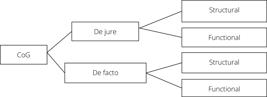
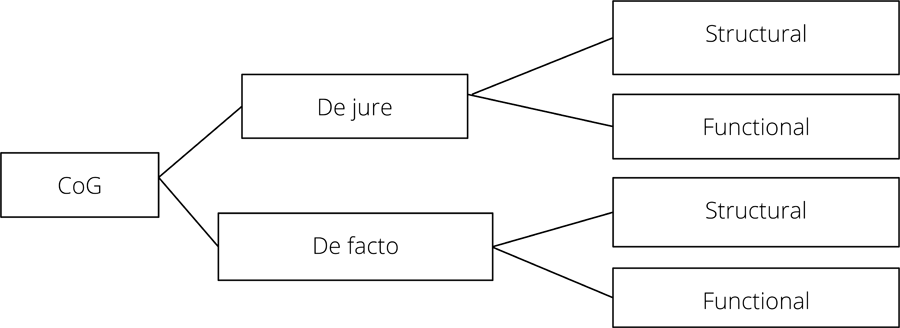
Analyzing Jair Bolsonaro’s Center of Government requires integrating both theoretical and empirical findings from previous studies on CoGs in Brazil. Accordingly, this study builds on the methodology developed by Cavalcante and Batista (2018) to construct analytical categories for Bolsonaro’s CoG. Their methodology classifies the CoG along four dimensions: 01. structural, 02. functional, 03. de jure, and 04. de facto. For the structural de jure dimension, Cavalcante and Batista (2018) recommend a year-by-year examination of laws, provisional measures, and decrees that created or modified units linked to the presidency. These documents are available digitally through the Library of the Presidency of the Republic, where we identified a total of 183 relevant regulatory acts.
To classify the functional de jure aspects, and following Cavalcante and Batista (2018), we searched the legislation governing the presidency for specific descriptors. The descriptors, drawn from the set proposed by the authors, include: control, management, direction, command, supervision, coordination, monitoring, planning, formulation, administration, oversight, and development. Each descriptor was coded as a dummy variable in the legislative database, with ‘0’ indicating its absence and ‘01’ indicating its presence. Under this perspective, a unit is classified only when the descriptor denotes a direct support function to the presidency rather than simply describing the unit’s routine responsibilities.
For the de facto dimension, and following the methodology developed by Cavalcante and Batista (2018) for both the structural and functional perspectives, we used the president’s public schedule to identify interactions between the president and members of the executive branch. As with the legislation, these schedules are available through the Library of the Presidency of the Republic. For the Bolsonaro administration, the dataset covers the period from January 01, 2019, to December 31, 2022, in text format. The information was collected and organized into a spreadsheet for analysis. Resulting in 10,982 observations, comprising thousands of Bolsonaro’s appointments. Including individual and joint meetings, as well as the president’s participation in public events.
The structural and functional logic applied at this stage mirrors that used for the de jure analysis. In practice, when an interaction recorded in Bolsonaro’s schedule involves a unit within the presidency’s direct hierarchy and that unit holds CoG responsibilities according to its formal competencies, the interaction is classified as structural de facto CoG. Conversely, interactions with ministries outside the president’s direct hierarchy – yet endowed with CoG responsibilities – are classified as functional de facto CoG, since these bodies perform legally defined CoG functions while not belonging to the presidency’s immediate structure.
Although this approach has limitations – for instance, not all official commitments are systematically recorded in the president’s public schedule – examining that schedule remains the most feasible and widely used method for studying the functional CoG, as it allows relevant data to be captured and quantified. For the descriptive and cross-sectional analysis of both the president’s public schedule and the relevant legislation, we used RStudio and Excel.
The Figure 01 illustrates the relationship among the different types of CoGs:
Furthermore, to enable comparisons across administrations2, this study draws on the data presented by Cavalcante and Batista (2018) as secondary sources. The authors analyzed the governments from FHC I and II through Dilma I (1995–2014). However, it is important to note that, due to limited data availability, the de facto aspects cover only the FHC and Dilma administrations, as presidential schedule databases for the Lula administrations were not available.
For the primary data, we created two datasets. The first compiles the president’s public schedules, providing the information needed to classify the functional CoG, and the second compiles the descriptors associated with the responsibilities of each unit within Bolsonaro’s administration. We then conducted a descriptive and quantitative analysis of these datasets, presenting the results in both charts (01, 02, 03, 04, 05) and graphs (01, 02, 03, 04, 05, 06,07).


Applied comparative analysis
In this section, we apply the collected data using the framework developed by Cavalcante and Batista (2018) across the four CoG models: 01. structural de jure CoG, 02. functional de jure CoG, 03. structural de facto CoG, and 04. functional de facto CoG. We then compare these CoG configurations under Bolsonaro with those of FHC I and II, Lula I and II, and Dilma I. It is important to note that Cavalcante and Batista (2018) included only administrations that completed uninterrupted terms, as CoG configurations can vary from year to year. The shorter duration of Dilma II and Temer’s governments makes them less suitable for comparison.
The structural de Jure Center of Government
This section presents the structural de jure organization of Bolsonaro’s Center of Government. Within this framework, we analyze all units included in the presidency’s organizational chart. This structure encompasses bodies with cross-cutting coordination functions, i.e., functions that affect the entire executive branch, such as the Casa Civil, as well as advisory bodies, including the Special Advisory Office of the President (CAVALCANTE and BATISTA, 2018).
According to Cavalcante and Batista (2018), beginning with FHC’s second term, the Center of Government experienced a notable strengthening of its public policy coordination functions. Presidents FHC, Lula, and Dilma added thematic secretariats to the formal presidential structure, including the Secretariat for Urban Development and the Secretariat of Ports. The number of units within the presidential structure also expanded, rising from seven in FHC I to thirteen in FHC II and Lula I, and reaching fifteen in Lula II and Dilma I, excluding the deliberative councils. The authors interpret this expansion as a consolidation of the president’s authority to steer and control the policy agenda.
During Bolsonaro’s administration, the presidential structure experienced a slight reduction, though the number of units remained relatively stable, rising from 14 units in 2019–2020 to 15 in 2020–2021, before returning to 14 in 2022. Unlike his predecessors, Bolsonaro did not introduce any thematic secretariats into the presidential structure, which might have signaled a prioritization of specific public policies. The Investment Partnerships Program Council was formally part of the presidential structure, but it convened only 17 times over the four-year term, according to the president’s official schedule. The Chart 01below lists all units within the presidential structure during Bolsonaro’s government.
As of February 2020, the Special Secretariat for Strategic Affairs (SAE) began reporting directly to the Presidency under Decree Nº 10,244/2020 (BRAZIL, 2020). The SAE took over the functions previously performed by the Special Advisory Office of the President, supporting the President in conducting studies and engaging with foreign organizations. Following the framework outlined by Cavalcante and Batista (2018), the SAE is tasked with coordinating national strategic planning and overseeing strategic programs and projects.
Within the Casa Civil, the Special Advisory Office and the Office of Coordination and Monitoring played a key role in coordinating ministries and secretariats in the development of the president’s ‘priority projects’, as outlined in Decree Nº 9,678/19. Responsibility for setting the budgetary priorities of these projects fell to the Special Secretariat for Government Relations, working alongside the aforementioned Office of Coordination and Monitoring. In a similar budgetary capacity, the Secretariat of Institutional Relations within the General Secretariat of the Presidency of the Republic oversaw and evaluated the mandatory execution of funds allocated through parliamentary amendments.
Additionally, Decree Nº 9,979/19 amended Decree Nº 9,678/19 (BRAZIL, 2019a) to designate the Casa Civil as an evaluative body responsible for monitoring government actions and overseeing the management of public administration entities. The Casa Civil was also tasked with coordinating and supervising other ministries in the development of projects and public policies, at least to the extent provided by law.
In terms of relations with the National Congress, both the Casa Civil and the Secretariat of Government (SEGOV) were assigned this responsibility under the legislation governing the Presidency’s structure, through laws or presidential decrees. In the case of SEGOV, this responsibility was shared with the Casa Civil and coordinated with the Secretariat for Federal Affairs as specified in Decree Nº 9,980 of August, 20 (BRAZIL, 2019c).
The functional de jure Center of Government
This section examines the functional perspective to identify the agencies that perform typical Center of Government roles, even if they lie outside the president’s immediate hierarchical structure. These agencies operate transversally across the executive branch to advance the president’s priorities in practice, with their responsibilities defined by law. For this analysis, we constructed the dataset using the descriptors outlined in the Data and Methodology section.
While our focus remains on the defined set of descriptors, one noteworthy competency is that of the Ministry of Justice and Public Security (MJUSP) in advising the president on matters beyond its own ministerial portfolio. Although this ministry does not meet the specified descriptors, this role may reflect the president’s particular interest in the MJUSP or the level of trust he placed in it. Additionally, as Batista (2018) observes, the MJUSP was among the most influential ministries in shaping the executive agenda in previous administrations, a pattern that may have continued under Bolsonaro.
The charts 02 and 03 below summarize the units classified under the functional de jure perspective, as well as those that fall outside this classification.
A key preliminary observation is that some advisory units within the presidential structure do not perform typical Center of Government functions and are therefore excluded from the formal de jure CoG classification. Conversely, certain ministries do carry out CoG responsibilities despite not being formally part of the presidential structure, that is, they perform CoG functions without being directly linked to the president. In general, units responsible for cross-cutting coordination and oversight remained within our classification, consistent with the patterns identified by Cavalcante and Batista (2018) for the FHC, Lula, and Dilma administrations.
The inclusion of the Ministry of Economy in the functional de jure CoG is justified not only because it appears prominently across the descriptors but, more importantly, because its control over resources for policy implementation and fiscal management affects the entire Executive Branch (CAVALCANTE and BATISTA, 2018). It is also worth noting that this ministry inherited the responsibilities of the former Ministries of Finance and Planning, both of which were typically part of the functional de jure CoG in previous administrations.
Compared with earlier administrations, Cavalcante and Batista (2018) show that the functional de jure CoG expanded under FHC as the size of the presidential office grew. In contrast, the Lula and Dilma administrations reduced the functional de jure CoG by creating a larger number of secretariats dedicated to specific public policy areas within the presidential structure. As a result, the expansion of units inside the presidency reflected a shift toward policy-specific bodies rather than a growth in units performing typical CoG functions.
During the Bolsonaro administration, the president did not create thematic secretariats as Lula and Dilma had, although infrastructure and citizenship were incorporated into the functional de jure CoG. Bolsonaro retained many coordination bodies but did not establish the thematic secretariats typical of earlier CoGs, which resulted in the largest number of functional de jure CoG units of any administration – 14 in total, most of which dedicated to cross-cutting coordination. Previously, Lula had the highest number, with 12 units in his first term. Whether Temer followed a similar pattern remains an open question, as this study examines only uninterrupted four-year administrations. The Chart 04 below compares the functional de jure CoG units from FHC I through Dilma I and Bolsonaro.
Furthermore, these findings indicate a convergence between the first period of Bolsonaro’s administration and Vieira’s (2017) observation: presidents whose ideological positions are more extreme relative to their governing coalition tend to centralize power within the CoG and maintain a larger number of units directly under their control. In Bolsonaro’s case – and this will be examined in more detail later – he maintained a functional de jure CoG with a slightly higher number of units compared to other recent presidents. The key difference is that, although it is debatable whether he ever truly built a formal coalition, a form of political alliance – particularly with the Progressive Party (Partido Progressista, PP) and the Liberal Party (Partido Liberal, PL) – only took shape in the second half of his term, following the appointments of Ciro Nogueira to the Casa Civil and Flávia Arruda to the Secretariat of Government. Even with this pragmatic political alignment, and as a president at the far right of the ideological spectrum, Bolsonaro did not further centralize decision-making within the CoG; instead, he shared it with a small political group while maintaining his position at the extreme end of the spectrum.
The structural de facto Center of Government
This section examines the interactions between the President and the units within the structural Center of Government. Analyzing the president’s official schedule allows us to capture day-to-day activities, within the limits of formal records, since some meetings may not have taken place and others may not have been officially documented, and are therefore not included in our dataset. Nonetheless, this approach makes it possible to identify which units were genuinely closest to the president in the decision-making process, going beyond what is visible from the formal/legal perspective. While the specific topics of these meetings are not always known, the data indicate the relative level of involvement of each unit in the president’s decision-making (CAVALCANTE and BATISTA, 2018).
Comparing Bolsonaro’s interactions with those of previous administrations – specifically FHC and Dilma, recalling that public schedule records are unavailable for Lula I and II – Cavalcante and Batista (2018) observe that both presidents maintained a high volume of interactions with the Casa Civil (CC), far exceeding those with other bodies. In FHC I, 66.7% of interactions involved the CC, followed by the Secretariat for Strategic Affairs with 11%. During FHC II, 37.5% of interactions involved the CC, with the General Secretariat ranking second at 25%. In Dilma I, meetings with the CC accounted for 38% of interactions, followed by the Secretariat of Communication at 14.6%.
As shown in the Graph 01 below, Bolsonaro met with the Secretariat of Government in 26.6% of recorded interactions, the Casa Civil in 24.01%, the General Secretariat of the Presidency in 19.6%, and the Institutional Security Bureau (GSI) in 14.7%. Despite these differences, we found that interactions involving the GSI, the SEGOV, and the Casa Civil frequently included other ministries, underscoring their coordinating role within the executive. Additionally, the SEGOV retained responsibility for managing relations with the National Congress, which may explain the increase in interactions over the years.

In the first two years of Bolsonaro’s term, the GSI recorded 168 interactions in 2019 and 161 in 2020. In 2021 and 2022, however, the number of meetings dropped sharply to 43 and 07, respectively. Even so, Bolsonaro interacted far more frequently with the GSI than his predecessors. For FHC, interactions with the bureau appeared only during his second term (6.5%), while for Dilma they represented just 0.6% of meetings with other structural CoG bodies. Throughout his presidency, Bolsonaro often met with the GSI alongside the Ministry of Defense and the heads of the armed forces, reflecting the prominent role of the military in his administration.
Cavalcante and Batista (2018) show that FHC maintained a lean structural de facto CoG, involving only five to six bodies, whereas Dilma interacted with fifteen. Bolsonaro falls closer to the average, with twelve bodies in the structural de facto CoG. The main distinguishing feature of his term is the intense interaction with the GSI and the comparatively limited engagement with the Casa Civil relative to his predecessors. The Attorney General’s Office (AGU) also stands out: although it did not appear in FHC’s list and accounted for only 4.2% of interactions under Dilma, it ranked fifth under Bolsonaro, with 8.2%. Given the AGU’s key role in providing legal counsel and navigating institutional crises, the agency was crucial in mitigating procedural risks.
Furthermore, a comparison of the president’s interactions with CoG bodies versus the broader ministerial cabinet shows that, over time, although presidents tend to meet more frequently with ministries outside the CoG. Simply due to their larger number – the share of interactions involving the structural de facto CoG has grown, rising from 10% under FHC I to 30% under Dilma I (CAVALCANTE and BATISTA, 2018). Under Bolsonaro, this proportion increased further to 41.7%, indicating a notable shift in the pattern of interactions between CoG and non-CoG ministries compared to previous administrations.
The functional de facto Center of Government
This section analyzes the president’s interactions with the bodies previously classified as part of the functional de facto Center of Government. The goal is to identify which units the president actually engaged with in practice, regardless of their formal position within the presidential structure or the presence of descriptors in official regulations. In this sense, the record of meetings helps reveal which units were truly central to the decision-making process.
During Bolsonaro’s administration, the functional CoG was highly concentrated. The president’s public schedule shows that security and defense ranked among the government’s top priorities, with the Ministry of Defense appearing frequently among the bodies he met with most often – even though it was not formally part of the CoG, as discussed later. Although the substance of these meetings is not publicly disclosed, the GSI’s responsibilities, especially its role in crisis management, underscore its importance during this period, particularly throughout the pandemic.
In the final two years of Bolsonaro’s term, however, interactions between the president and the GSI declined, even relative to units outside the CoG. This pattern reflects the president’s growing focus on the 2022 general elections and the increasing involvement of his political allies in government. As a result, 2021 and 2022 recorded the lowest number of entries in the president’s public schedule, as examined further below.
During the FHC and Dilma administrations, the Casa Civil played a central role in coordinating ministerial policies, consistently ranking as the most or second most frequently consulted body. Under Bolsonaro, the Casa Civil remained among the units the president met with most often, but the overall volume of interactions was significantly lower than in previous administrations. This pattern suggests that Bolsonaro may have adopted a different strategy in how he engaged with the Casa Civil.
In comparative terms, and consistent with previous administrations, the Casa Civil has historically performed two central roles across the governments from FHC’s first term through Dilma Rousseff’s first: coordinating government actions and overseeing as well as executing the Presidency’s administrative activities (LAMEIRÃO, 2018). These responsibilities continued under Bolsonaro. However, the Casa Civil gained greater autonomy after the publication of Decrees Nº 10,907 and 10,967 in 2021. It was during this period that Bolsonaro appointed Senator Ciro Nogueira (PP–PI) as Chief of Staff of the Casa Civil. In an effort to strengthen political alliances with parties beyond the one he would eventually join – the Liberal Party (PL) – after a succession of Chiefs of Staff drawn primarily from the military wing of his administration.
These decrees explicitly reorganized the Casa Civil in ways that expanded its autonomy over government coordination. As stated in Decree Nº 10,967: “Art. 23-B. It is the responsibility of the Casa Civil of the Presidency of the Republic to coordinate discussions aimed at resolving disputes between agencies regarding the substance of proposed regulatory acts”. This authority had not been granted in previous administrations, strengthening the argument that the Casa Civil under Bolsonaro gained substantial autonomy – at least on paper. The Chart 05 below summarizes the decrees that defined and redefined the Casa Civil’s responsibilities during Bolsonaro’s administration.
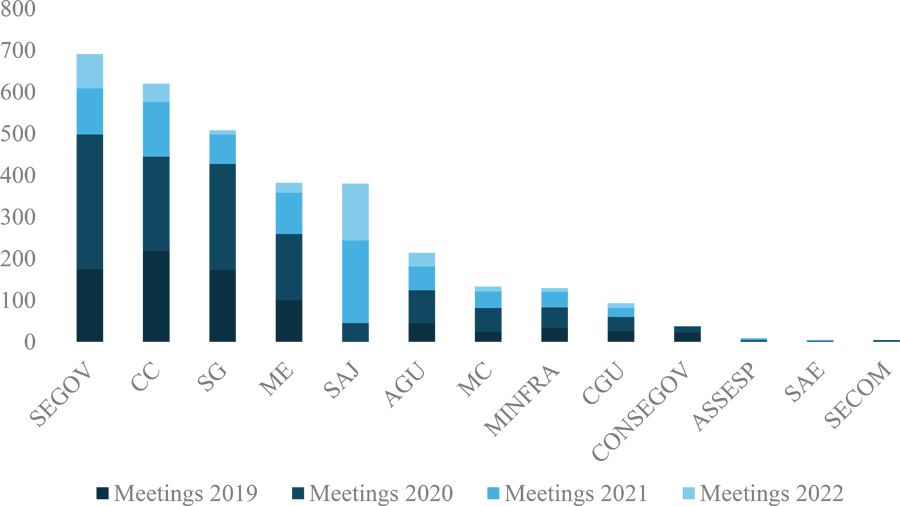
In the case of the Secretariat of Government, Bolsonaro’s interactions with this office spiked in 2020 – the only year in which more than 300 meetings were recorded, compared to fewer than 200 in all other years. This sharp increase may be explained, at least in part, by the COVID-19 pandemic and the resulting need to secure congressional approval for an unusually large volume of bills and provisional measures3. Under Decree Nº 9,980 of August 20, 2019 (Art. 01, I, ‘c’ and ‘f’), the Secretariat of Government was formally responsible for political coordination and relations with the National Congress, serving as the main institutional channel for these negotiations.
In a related development, the Secretariat for Legal Affairs (SAJ) — originally housed within the Casa Civil and responsible for drafting all regulatory acts and legislative proposals submitted to Congress — was transferred to the General Secretariat in August, 2019. However, it was only from late 2020 onward that the president began to treat the SAJ as a priority advisory body. By 2022, it had become the office with which Bolsonaro met most frequently, both within and outside the CoG.
We now turn to the Ministry of Foreign Affairs (MRE) and the Ministry of Justice and Public Security (MJUSP). Fits neither the structural or functional ‘de jure’ classifications of the Center of Government due to the absence of predefined criteria. In the case of the MRE, despite its controversial foreign policy agenda, characterized by a strong alignment with the United States and a prioritized bilateral approach, as noted by Vidigal (2019), the OECD (2022) classifies it as part of the CoG due to its role in coordinating foreign policy. After the Ministry of the Economy, the MRE was the ministry Bolsonaro visited most frequently within the ‘Esplanada’.
Regarding the Ministry of Justice and Public Security (MJUSP), although legislation authorizes the ministry to advise the president on matters that extend beyond its formal domain, it does not clearly define what that advisory role entails. For this reason, we did not use this descriptor as a criterion for classifying the MJUSP as part of the CoG, as our study adheres strictly to the methodology proposed by Cavalcante and Batista (2018). Even so, the MJUSP was among the ten agencies that met most frequently with the president. Public security, the anti-corruption agenda, and especially the pro-gun platform were central themes of Bolsonaro’s 2018 campaign. Based on Bolsonaro’s interactions with the MJUSP and his campaign commitments, we conclude that these issues were treated as priorities. As De Toni (2018) shows, campaign commitments have a significant impact on shaping a president’s CoG priorities.
The CoG is also known to shift during periods of crisis. In Bolsonaro’s case, however, despite the COVID-19 pandemic, the agencies that interacted most frequently with the president in 2020 remained largely the same, with differences appearing mainly in the number of meetings. The Ministry of Health, for example, held 52 meetings with the president in 2020 and 54 in 2021, compared to just 15 in 2019. However, ministries such as the Ministry of Mines and Energy and the Ministry of Education, which were not central to crisis management, recorded as many – or even more – meetings than the Ministry of Health during the pandemic. The belated creation of the COVID-19 Coordination and Response Committee in 2021 resulted in only seven meetings, underscoring Bolsonaro’s limited engagement in pandemic response efforts.
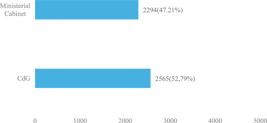
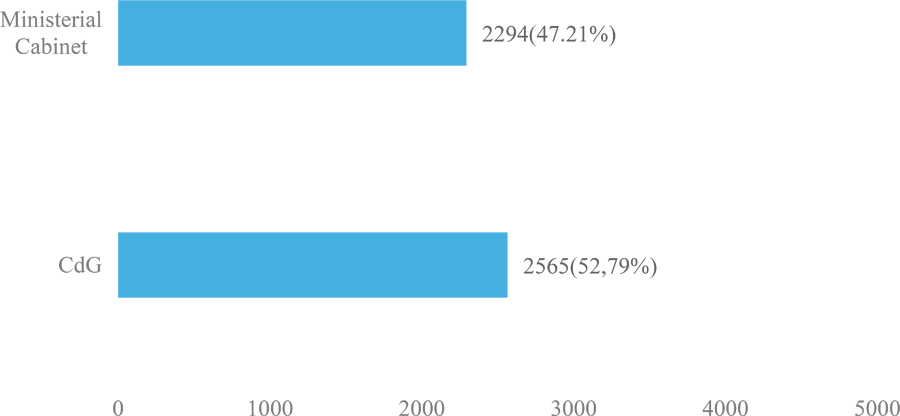
Finally, we compared the president’s interactions with the functional de facto CoG to his interactions with the rest of the ministerial cabinet. In the earlier analysis of the structural de facto CoG, these interactions represented 33.37% of the total; in the present comparison, the share increases to 58.2%. This is higher than the level observed during Dilma Rousseff’s first term (45%) but higher than during FHC’s first and second terms (20%). The substantial volume of interactions with transversal agencies suggests an ongoing institutionalization of decision-making processes through the coordination roles performed by these bodies (CAVALCANTE and BATISTA, 2018).
CoG, ‘public policies’, and political actors under Bolsonaro
To contextualize the day-to-day functioning of the CoG, Silva (2015) notes that under Lula, the Casa Civil operated much like an executive secretariat to the Presidency. As in Dilma’s administration, Lula relied on inputs produced by the Office of Coordination and Monitoring within the Casa Civil to guide decision-making and took an active role in this process. In both the Lula and Dilma governments, the Casa Civil functioned primarily as an advisory and supervisory body, playing a central role in evaluating, monitoring, and coordinating government initiatives.
Our analysis shows that Decree Nº 9,678/19, which established the structure of Bolsonaro’s Casa Civil, largely preserved the office’s traditional emphasis on government management. In addition to these customary functions, however, Bolsonaro’s Casa Civil took on a more assertive role in coordinating ministerial political affairs, at times overlapping with the Secretariat of Government in managing relations with Congress. Its autonomy expanded further with the normative acts issued in 2021, even when compared with earlier administrations. Bolsonaro entrusted Ciro Nogueira’s Casa Civil with the authority to act as the final arbiter in inter-ministerial disputes, granting it broad powers to steer the other ministries and a degree of independence not observed in previous governments.
The Casa Civil undoubtedly played a central coordinating role within the CoG’s management framework. It assessed the relevance of each priority project and engaged with the appropriate ministries whenever necessary. For instance, if a ministry identified the need for funding for an infrastructure project, the Casa Civil could bring the Ministry of Economy into the process to secure financial resources and, should legal issues arise, work through the Secretariat for Legal Affairs to resolve them, in line with the decree outlining its responsibilities. This coordination might include, for example, drafting a budget amendment in partnership with SEGOV to facilitate its approval by the National Congress.
In the early years of his presidency, Bolsonaro attempted to govern without a clearly defined legislative base and struggled to advance his proposals, especially in the economic arena. For example, the pension reform was driven by congressional initiative rather than coordinated by the executive. During the pandemic, Bolsonaro’s governing style shifted to one centered on media visibility. Lacking a clear agenda of his own, he increasingly adopted a reactive posture, often attributing both his inaction and the federal government’s difficulties in coordinating pandemic responses to the Supreme Federal Court’s decision allowing states and municipalities to exercise autonomy in these matters. Nevertheless, this ruling in no way precluded the federal government from formulating its own crisis-management policy agenda - an initiative that, notably, never materialized.
In the final two years of his term, 2021 and 2022, after forging alliances with several parties and individual politicians, the president began sharing his agenda with actors who had joined his support coalition. This shift enabled a more pragmatic approach to policymaking and congressional negotiations (CRUZ and SILVA, 2023). Prior to this, as Inácio (2021) argues, Bolsonaro had pursued a radical politicization of the Executive, targeting ministries whose agendas clashed with his own – an approach that did not entirely disappear in the later years of his presidency. For the new allies who joined him in 2021 and 2022, he granted the same level of autonomy previously afforded to ideologically aligned ministers, placing two of them in key CoG agencies: Ciro Nogueira at the Casa Civil and Flávia Arruda at the Secretariat of Government.
In this regard, Bolsonaro represents an unusual case in the broader debate on centralization versus politicization within studies of the Center of Government. This is because, in the existing literature, there is no evidence that his administration engaged in any pragmatic coalition-building effort. At the same time, as part of a political survival strategy, he began, according to Medeiros (2022), to negotiate on an ad hoc basis with certain parties and individual politicians. In doing so, he even allocated CoG positions to two figures who were not his political allies – a move that could be interpreted as a form of cabinet politicization. However, the absence of a clearly defined coalition makes such an interpretation difficult to sustain.
In 2019 and 2020, before these ministers took office, military officers who, lacking political experience, struggled to negotiate with Congress had occupied those positions. Once new parties joined the government, Bolsonaro granted their appointees considerable autonomy, which in turn shaped their policy agendas. In 2021, the number of meetings and events declined relative to 2019 and 2020, and in 2022 we observe the lowest levels recorded, as shown in the graph below, even though some reduction is expected in an election year.
Below, we present another Graph 07 comparing year-to-year meeting frequencies among the functional CoG bodies. In 2022, activity within the CoG was driven primarily by the Secretariat for Legal Affairs, a particularly relevant body given its role in providing legal counsel to the president. Its heightened involvement contributed to a more pragmatic approach to drafting legislative and regulatory proposals and to managing relations with Congress at the end of the term. By contrast, the other CoG bodies saw a decline in activity between 2021 and 2022.

In summary, our analysis of the Center of Government during the Bolsonaro administration reveals a significant shift both in its formal configuration and in the president’s interaction patterns compared with earlier administrations. Formally, the most striking feature is the absence of thematic secretariats. In terms of interactions, the most prominent finding is the unusually low level of engagement with the Casa Civil. The reasons behind these management choices warrant further investigation in future research drawing on additional data. Although previous studies highlight the Casa Civil’s longstanding role in interministerial coordination and mediation, it was only under Bolsonaro that institutional arbitration was explicitly codified as part of its formal responsibilities. Furthermore, while the incorporation of new parties (PP and PL) brought greater pragmatism and flexibility to the administration, this period also coincided with a noticeable decline in Bolsonaro’s institutional engagement, as reflected in the sharp drop in official commitments on his public schedule.
Concluding remarks
Our overarching goal in this article was to examine the particularities of the Center of Government during Jair Bolsonaro’s presidency, using the model proposed by Cavalcante and Batista (2018) as our analytical framework. Our data and analyses allow us to conclude that Bolsonaro inherited a CoG shaped by an ongoing process of institutionalization, one that gradually established certain agencies as permanent fixtures at the core of the executive. The analysis also reveals distinctive interaction patterns: over time, the CoG has become an increasingly important communication channel between the president and the ministries, with the number of presidential meetings with CoG bodies steadily approaching those held with line ministries. What varies, however, is the flow of communication, which depends heavily on presidential style. Some presidents prefer to interact directly with all agencies, while others structure their decision-making processes in a more hierarchical and centralized manner.
We identified several elements that set Bolsonaro apart from his predecessors. With respect to the de jure structural CoG, Bolsonaro abolished the thematic secretariats within the Presidency. This move accompanied his broader effort to merge ministries and ‘shrink’ the size of the executive. At the same time, these actions align with what Inácio (2021) describes as a radical politicization of the Executive, in which the president sought to govern unilaterally, modifying public policies by decree and appointing individual who opposed the very policy areas they were responsible for overseeing. The dismantling of thematic CoG bodies further highlights this administration’s lack of interest in prioritizing public policy.
Another factor that distinguishes Bolsonaro from his predecessors concerns the set of agencies with which he interacted most frequently: the Secretariat of Government, the Casa Civil, the General Secretariat, the Institutional Security Bureau (GSI), and the Ministry of Economy. Earlier presidents, by contrast, placed considerably greater emphasis on the Casa Civil. Moreover, the formal reorganization of the Casa Civil in 2021 also made clear that the office had gained greater autonomy. Bolsonaro’s comparatively low level of engagement with the Casa Civil suggests that it assumed coordination responsibilities with increased independence, particularly in the second half of the term, from 2021 to 2022. In 2019 and 2020, by contrast, the lower frequency of interactions relative to other agencies likely reflects both the early stages of this shift toward autonomy and the president’s interest in securing the ministry’s routine support in managing government affairs.
Moreover, our documentary and bibliographic research on the entry of the Progressive Party (PP) and the Liberal Party (PL) into the CoG indicates that both the agenda and the responsibilities of the CoG were shared with actors outside the president’s party. As Vieira (2017) observes, when a president accommodates coalition partners into the CoG, the agenda typically remains concentrated among ministers from the president’s own party, often accompanied by some degree of distrust toward coalition members. In Bolsonaro’s case, although no formal partisan coalition was established, the incorporation of the PP and the PL – including within CoG bodies – enabled him to further distance himself from the day-to-day management of government affairs. In other words, the pragmatism that characterized the government’s congressional negotiations in the second half of the term was largely exercised by the political alliance, while the president himself remained detached from the decision-making process, as reflected in the sharp decline in official government commitments in 2021 and, even more markedly, in 2022.
We believe this study contributes to the debate on the CoG by detailing how it operated during a singular moment in Brazilian politics – one in which the executive often challenged or resisted established public policies. In addition, this descriptive and exploratory analysis of Bolsonaro’s CoG offers a foundation for future research, enabling scholars to examine how the features identified here relate to public policy outcomes and to assess the effects of Bolsonaro’s institutional design on the implementation of priority policies.
We also propose a second research agenda arising from this study, centered on a deeper examination of the Center of Government itself. Our analysis shows that certain units consistently remain part of the CoG across administrations, with only minor variations in their functions and patterns of interaction. This continuity creates an opportunity for future research to investigate which units hold greater decision-making authority and how differences in CoG structures shape the implementation of the same priority policy under different presidents.
Finally, we conclude that this article provides important contributions for the senior executive bureaucracy. Career and appointed officials alike may draw on these findings to refine strategies for optimizing the policy formulation process within the policy cycle, identifying the CoG bodies that are most central within the cabinet and the scope of their influence over the president.
References
- ALESSANDRO, Martín; LAFUENTE, Mariano and SANTISO, Carlos (2013), The role of the Center of Government: a literature review. Washington: Inter-American Development Bank. 73 pp..
- BATISTA, Mariana (2018), Como governam os presidentes: a governança do Executivo e a formulação da agenda legislativa. In: O presidente e seu núcleo de governo: a coordenação do Poder Executivo. Edited by CAVALCANTE, Pedro Luiz Costa and GOMIDE, Alexandre de Ávila. Brasília: Instituto de Pesquisa Econômica Aplicada. pp. 251-287.
- BONVECCHI, Alejandro and SCARTASCINI, Juan Carlos (2011), The Presidency and the Executive Branch in Latin America: what we know and what we need to know. Washington: Inter-American Development Bank. 72 pp.
- BORGES, André and VIDIGAL, Robert (2023), Para entender a nova direita brasileira: polarização, populismo, antipetismo. Rio Grande do Sul: Ed. Zouk. 426 pp..
-
BRAZIL (2020), Decreto nº 10.244, de 13 de fevereiro de 2020. Subordina a Secretaria Especial de Assuntos Estratégicos diretamente ao Presidente da República e transfere competências da Assessoria Especial do Presidente da República para a Secretaria Especial de Assuntos Estratégicos da Presidência da República. Available at <https://www.planalto.gov.br/ccivil_03/_ato2019-2022/2020/decreto/d10244.htm> Accessed on August 04, 2024.
» https://www.planalto.gov.br/ccivil_03/_ato2019-2022/2020/decreto/d10244.htm> -
BRAZIL (2019a), Decreto nº 9.678, de 02 de janeiro de 2019. Aprova a Estrutura Regimental e o Quadro Demonstrativo dos Cargos em Comissão e das Funções de Confiança da Casa Civil da Presidência da República, remaneja cargos em comissão e funções de confiança. Available at <https://www.planalto.gov.br/ccivil_03/_ato2019-2022/2019/decreto/D9678.htm> Accessed on August 04, 2024.
» https://www.planalto.gov.br/ccivil_03/_ato2019-2022/2019/decreto/D9678.htm> -
BRAZIL (2019b), Decreto Nº 9.979, de 20 de agosto de 2019. Altera o Decreto Nº 9.678, de 02 de janeiro de 2019, que aprova a Estrutura Regimental e o Quadro Demonstrativo dos Cargos em Comissão e das Funções de Confiança da Casa Civil da Presidência da República e remaneja cargos em comissão e funções de confiança. Available at: <https://www.planalto.gov.br/ccivil_03/_Ato2019-2022/2019/Decreto/D9979.htm#:~:text=DECRETO%20N%C2%BA%209.979%2C%20DE%2020%20DE%20AGOSTO%20DE%202019&text=Altera%20o%20Decreto%20n%C2%BA%209.678,comissão%20e%20funções%20de%20confiança.> Accessed on August 04, 2024.
» https://www.planalto.gov.br/ccivil_03/_Ato2019-2022/2019/Decreto/D9979.htm#:~:text=DECRETO%20N%C2%BA%209.979%2C%20DE%2020%20DE%20AGOSTO%20DE%202019&text=Altera%20o%20Decreto%20n%C2%BA%209.678,comissão%20e%20funções%20de%20confiança.> -
BRAZIL (2019c), Decreto Nº 9.979, de 20 de agosto de 2019. Aprova a estrutura regimental e o quadro demonstrativo dos cargos em comissão e das funções de confiança da Secretaria de Governo da Presidência da República e remaneja cargos em comissão e funções de confiança. Available at https://www.planalto.gov.br/ccivil03/ato2019-2022/2019/decreto/d9980.htmprs> Accessed on January 23,2026.
» https://www.planalto.gov.br/ccivil03/ato2019-2022/2019/decreto/d9980.htmprs> - CAVALCANTE, Pedro Luiz Costa (2018), Núcleo, Centro de Governo, Centro Presidencial, Alto Governo: várias nomenclaturas e uma questão principal. In: O presidente e seu núcleo de governo: a coordenação do Poder Executivo. Edited by CAVALCANTE, Pedro Luiz Costa and GOMIDE, Alexandre de Ávila. Brasília: Instituto de Pesquisa Econômica Aplicada. pp. 27-59.
- CAVALCANTE, Pedro and BATISTA, Mariana (2018), Composição e evolução do núcleo de governo no presidencialismo brasileiro. In: O presidente e seu núcleo de governo: a coordenação do Poder Executivo. Edited by CAVALCANTE, Pedro and GOMIDE, Alexandre. Brasília: Instituto de Pesquisa Econômica Aplicada. pp. 59-88.
- CAVALCANTE, Pedro Luiz Costa and GOMIDE, Alexandre de Ávila (2018), O presidente e seu núcleo de governo: a coordenação do Poder Executivo. Brasília: Instituto de Pesquisa Econômica Aplicada. 414 pp..
- CAVALCANTE, Pedro Luiz Costa; GOMIDE, Alexandre de Ávila, and BARBOSA, Sheila (2018), A coordenação de programas prioritários sob a perspectiva do núcleo de governo federal (2007-2014). In: O presidente e seu núcleo de governo: a coordenação do Poder Executivo. Edited by CAVALCANTE, Pedro Luiz Costa and GOMIDE, Alexandre de Ávila. Brasília: Instituto de Pesquisa Econômica Aplicada. Pp. 171-195.
- COHEN, David B. and HULT, Karen M. (2020), Contemporary Presidency: the office of the Chief of Staff in the Trump White House, 2017-2019. Presidential Studies Quarterly. Vol. 50, Nº 02, pp. 392-417.
- CRUZ, Sandra and SOUZA, Lucas Vieira de (2023), Presidencialismo de coalizão no Governo Bolsonaro. Boletim do Tempo Presente. Vol. 12, Nº 03, pp. 35-48.
- DE TONI, Jackson (2018), Agenda estratégica, planejamento e programas eleitorais: cálculo político e pragmatismo. In: O presidente e seu núcleo de governo: a coordenação do Poder Executivo. Edited by CAVALCANTE, Pedro Luiz Costa and GOMIDE, Alexandre de Ávila. Brasília: Instituto de Pesquisa Econômica Aplicada. pp. 353-381.
- FAWCETT, Paul and GAY, Oonagh (2005), The Centre of Government- Nº 10, the cabinet office and HM treasury. Paper published by House of Commons Library.
- GOMIDE, Alexandre de Ávila; SILVA, Michelle Morais de Sá, and LEOPOLDI, Maria Antonieta (2023), Desmonte e reconfiguração de políticas públicas (2016-2022). Brasília: Instituto de Pesquisa Econômica Aplicada. 564 pp.
- GUEDES NETO, João Victor (2021), Mapping the center of government in Latin America and the Caribbean: a typology. Brazilian Journal of Public Administration. Vol. 55, Nº 05, pp. 1101-1123.
- INÁCIO, Magna (2021), Poder Executivo: Presidência e gabinete. In: Governo Bolsonaro: retrocesso democrático e degradação política. Edited by AVRITZER, Leonardo; KERCHE, Fábio, and MARONA, Marjorie. Horizonte: Ed. Autêntica. pp. 67-83.
- INÁCIO, Magna and LLANOS, Mariana (2015), The Institutional Presidency from a comparative perspective: Argentina and Brazil since the 1980s. Brazilian Political Science Review Vol. 09, Nº 01, pp. 39-64.
- LAMEIRÃO, Camila (2018), A Presidência em movimento: inovações, variações organizacionais e frequências decisórias da Casa Civil (1995-2015). In: O presidente e seu núcleo de governo: a coordenação do Poder Executivo. Edited by CAVALCANTE, Pedro Luiz Costa and GOMIDE, Alexandre de Ávila. Brasília: Instituto de Pesquisa Econômica Aplicada. pp. 321-351.
- LOPEZ, Félix; SILVA, Noelle, and BORGES, Jaqueline (2018), Governo compartilhado? O papel da presidência na formação e coordenação da agenda de política do executivo federal (2003-2014). In: O presidente e seu núcleo de governo: a coordenação do Poder Executivo. Brasília: Instituto de Pesquisa Econômica Aplicada. pp. 289-321.
-
MEDEIROS, Danilo (2022), O Centrão e o presidencialismo de coalizão. Valor Econômico, October 22, 2022. Available at <https://valor.globo.com/politica/noticia/2022/10/02/artigo-o-centrao-e-o-presidencialismo-de-coalizao.ghtml/>. Accessed on March 31, 2025.
» https://valor.globo.com/politica/noticia/2022/10/02/artigo-o-centrao-e-o-presidencialismo-de-coalizao.ghtml/ - MOE, Terry (1985), The politicized presidency. In: The new direction in American Politics Edited by CHUBB, John and PETERSON, Paul. Washington: Brookings Institutional Press. pp. 269-271.
- MOYNIHAN, Donald P. and ROBERTS, Alasdair S. (2010), The triumph of loyalty over competence: the Bush administration and the exhaustion of the politicized presidency. Public Administration Vol. 70, Nº 04, pp. 572-581.
-
ORGANIZATION FOR ECONOMIC CO-OPERATION AND DEVELOPMENT (OECD) (2022), Revisão do Centro de Governo no Brasil: Rumo a um Centro Integrado e Estruturado de Governo. Available at <https://www.oecd.org/pt/publications/2022/06/centre-of-government-review-of-brazil_c0cd0766.html>. Accessed on August 04, 2024.
» https://www.oecd.org/pt/publications/2022/06/centre-of-government-review-of-brazil_c0cd0766.html - PETERS, B. Guy; RHODES, Roderick A. W.; WRIGHT, Vincent (2000), Administering the summit: administration of the Core Executive in developed countries. New York: Palgrave MacMillan. 275pp..
- RHODES, Roderick (1995), From prime ministerial power to core executive. In: Prime minister, cabinet and core executive. Edited by RHODES, Roderick and DUNLEAVY, Patrick. New York: Palgrave MacMillan. pp. 11-37.
- RUDALEVIGE, Andrew and LEWIS, David (2005), Parsing the politicized presidency: centralization and politicization as Presidential strategies for Bureaucratic Control. Paper presented at American Political Science Association.
- SILVA, Noelle (2015), A presidência institucional: o papel e a atuação da Casa Civil na coordenação e no monitoramento das políticas públicas do governo Lula (2003-2010). Master's dissertation. Programa de Pós-Graduação em Ciências Política. Instituto de Ciência Política. Universidade de Brasília.
-
VALOR ECONÔMICO (2019), Nós temos é que desconstruir muita coisa, diz Bolsonaro durante jantar. Available at <https://valor.globo.com/brasil/noticia/2019/03/18/nos-temos-e-que-desconstruir-muita-coisa-diz-bolsonaro-durante-jantar.ghtml> Accessed on August 04, 2024.
» https://valor.globo.com/brasil/noticia/2019/03/18/nos-temos-e-que-desconstruir-muita-coisa-diz-bolsonaro-durante-jantar.ghtml> - VIDIGAL, Carlos Eduardo (2019), Bolsonaro e a reorientação da política exterior brasileira. Meridiano 47, Journal of Global Studies. Vol. 20, pp. 01-16.
- VIEIRA, Marcelo (2017), Composição do gabinete e a criação de burocracias públicas centralizadas na Presidência da República no Brasil. Dados Vol. 60, Nº 01, pp. 111-144.
-
1
Given the study’s research objective, our analysis relies on a descriptive approach to data analysis, consistent with its exploratory nature. We were careful not to draw inferences beyond what the data can reasonably support. Although this approach necessarily limits the study’s analytical depth, it provides a foundation for future research to investigate the explanatory dimensions of these findings in greater detail.
-
2
We recognize that analyzing the Center of Government through the lens of leadership styles and political circumstances would require new data collection and would constitute a separate study, which is beyond the scope of this work. In this study, we limit ourselves to showing which bodies made up Bolsonaro’s CoG and how they changed, either in terms of formal regulations or in their interactions recorded in the official schedule, compared with previous administrations.
-
3
Furthermore, while every administration must secure congressional approval for its legislative proposals, 2020 stands out as the year with the highest proportion of executive-initiated bills approved since 2014. This unusually high volume reflects the government’s efforts to mitigate the economic consequences of the pandemic. These data come from Diap and can be accessed here: <https://www.diap.org.br/index.php/noticias/agencia-diap/91923-analise-da-producao-legislativa-do-congresso-no-1-semestre>.
- Data replication:
-
Financing:
PROEX/CAPES – Process N. 88887.751279/2022-00.
Appendix
This glossary of acronyms, Portuguese names, and English translations has been prepared to help readers identify the specific agencies, units, and bodies discussed throughout the text. The glossary reflects the terminology used consistently in this translation and serves as a reference to clarify the correspondence between the original Portuguese names and their English equivalents.
The term Casa Civil is typically not translated because it denotes a unique government office in Brazil with no direct equivalent in other political systems. It combines administrative, advisory, and coordination functions for the President that do not align neatly with ministries or departments in other countries, and literal translations such as ‘Civil House’ fail to convey its institutional role and authority. Retaining the original name preserves legal and institutional accuracy, as reflected in official Brazilian government communications, while maintaining the specific political and cultural context of the office.
Where available, official English translations provided by the Brazilian government have been used. In cases where no official translation exists, the most commonly accepted or widely used English rendering was adopted, based on academic literature and government publications. The glossary ensures that readers can accurately identify the original bodies or units, particularly because naming conventions are not always consistently applied across official communications or secondary sources.
Edited by
-
Associate editor:
Sandra Gomes

 Source:
  Source: Elaborated by the authors based on data from the president’s public schedule.
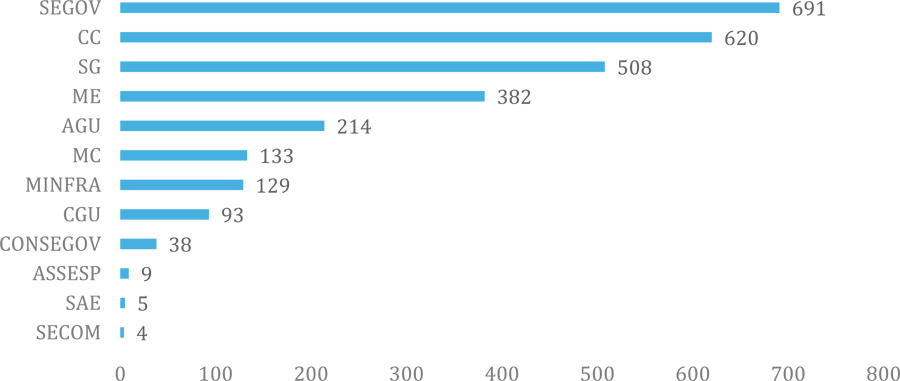 Source: Elaborated by the authors based on data from the president’s public schedule.*Acronym Key: SEGOV – Secretariat of Government; CC – Casa Civil; SG – General Secretariat; ME – Ministry of Economy; AGU – Attorney General’s Office; MC – Ministry of Citizenship; MINFRA – Ministry of Infrastructure; CGU – Office of the Comptroller General; CONSEGOV – Council of Government; ASSESP – Special Advisory Office of the President; SAE – Secretariat of Strategic Affairs; SECOM – Secretariat of Social Communication.
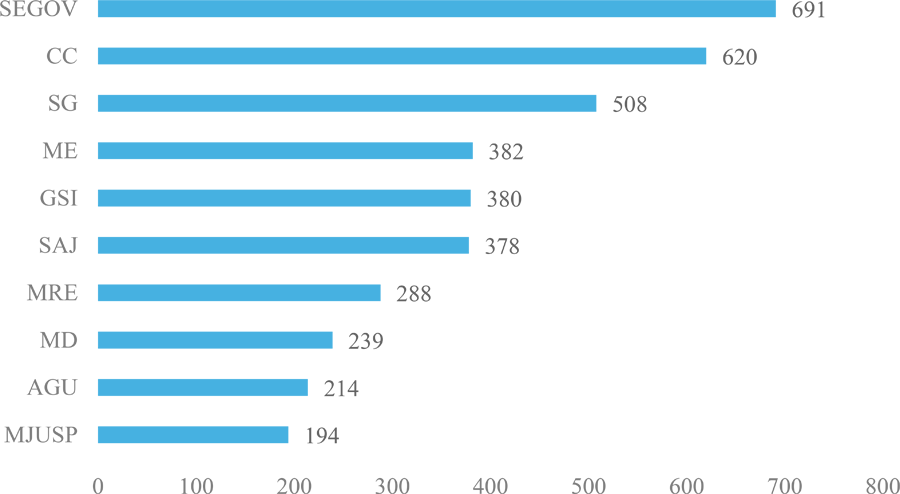 Source: Elaborated by the authors based on data from the president’s public schedule* Acronym Key: SEGOV - Secretariat of Government; CC - Casa Civil; SG - General Secretariat; GSI – Institutional Security Bureau; ME – Ministry of Economy; SAJ – Secretariat for Legal Affairs; MRE – Ministry of Foreign Affairs; MD - Ministry of Defense; AGU - Attorney General’s Office; MJUSP - Ministry of Justice and Public Security.
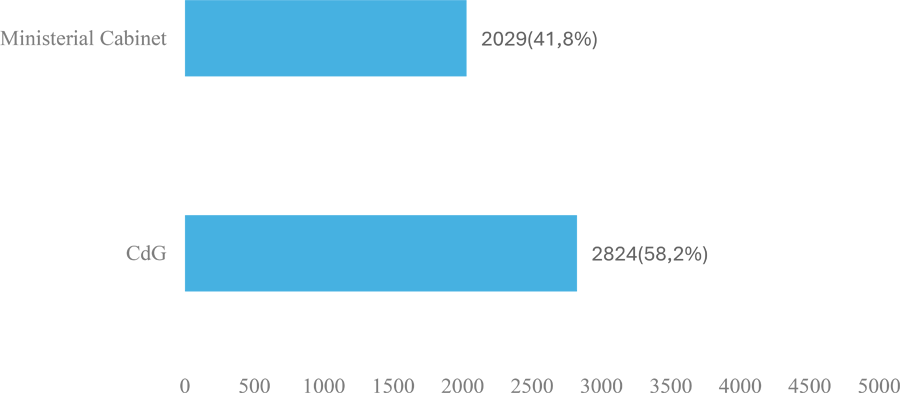 Source: Elaborated by the authors based on data from the president’s public schedule.
 Source: Elaborated by the authors based on data from the president’s public schedule.
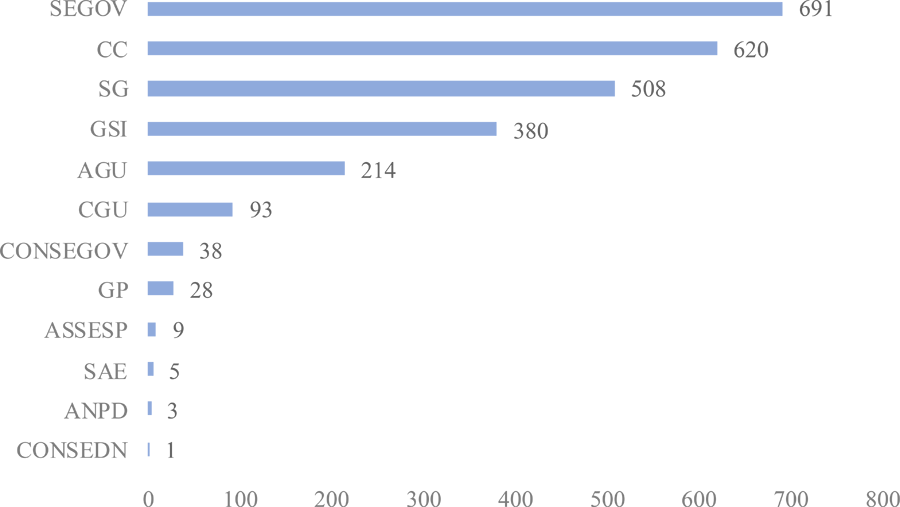 Source: Elaborated by the authors based on data from the president’s public schedule.*Acronym Key: SEGOV – Secretariat of Government; CC – Casa Civil; SG – General Secretariat; GSI – Institutional Security Bureau; AGU – Attorney General’s Office; CGU – Office of the Comptroller General; CONSEGOV – Council of Government; GP – Personal Office of the President; ASSESP – Special Advisory Office of the President; SAE – Secretariat of Strategic Affairs; ANPD – National Data Protection Authority; CONSEDN - National Defense Council.
 Source: Elaborated by the authors based on data from the president’s public schedule.