 Sugar consumption and early childhood caries: a systematic review and meta-analysis of cohort studies
Abstract
The aim of this systematic literature review and meta-analysis was to answer the following research question: “Is sugar consumption associated with early childhood caries among children under 6 years of age in cohort studies?”. The following electronic databases were accessed from December 2020 to May 2025 to identify the existing literature: Bireme, Pubmed/Medline, Scielo, Scopus, and Web of Science. Studies considered eligible for this systematic review were those that investigated sugar consumption as the main exposure and early childhood caries (ECC) as the outcome. Study selection and data extraction were performed independently by two reviewers. Study quality was assessed using the Joanna Briggs Institute (JBI) checklist for cohort studies scale. The search strategy retrieved 718 studies. After title and abstract screening, 59 were selected for full-text review, leading to the inclusion of 17 original studies in this systematic review. Finally, nine studies provided sufficient data for a meta-analysis. The association between sugar consumption and ECC was consistent across most of the cohort studies included in this review, which reported that higher sugar consumption was associated with higher prevalence of dental caries. The pooled effect estimate from the meta-analysis yielded an OR of 1.59 and a 95% CI (1.50-1.68), indicating that children who consumed sugar in early childhood were 59% more likely to develop caries compared to those who did not consume sugar. The included studies had a low risk of bias. Our systematic review and meta-analysis confirmed the association between sugar consumption and ECC in longitudinal cohort studies.
Descriptors:
Sugars; Dental Caries; Epidemiology; Systematic Review; Meta-analysis
Introduction
Dental caries is the most common chronic disease in childhood, affecting around 621 million children worldwide,1 with a prevalence greater than 50% among those under 6 years of age in most countries.1,2 Given this alarming prevalence, in addition to the impact of dental caries on children’s health and well-being,3 it is necessary to identify the determinants of early childhood caries (ECC) to guide preventive interventions,4 which are the most promising strategies for addressing this public health issue. Longitudinal studies have evidenced that sugar intake during the first few years of life is associated with ECC.5-8 Therefore, preventive interventions should focus on reducing the widely acknowledged primary cause of dental caries: presence of added sugars in the diet.9
The recommendation from the World Health Organization (WHO) is to limit the consumption of free sugars by up to 5% of the total energy intake to reduce obesity, caries, and other chronic non-communicable diseases in children and adults.10 In the Bangkok Declaration, a document from the International Association of Pediatric Dentistry (IAPD), the recommendation is to limit the consumption of sugar in food and beverages and avoid free sugars for children under 2 years of age to reduce the prevalence and impact of ECC.11
Sugar continues to be highly consumed from the first year of life.5-8 Given that dental caries is linked to sugar intake, the literature consistently shows that a diet excessively high in sugar, particularly sucrose, is the main cause of dental caries.12 Some evidence supports the relationship between sugar and dental caries; however, such relationship is still controversial. For instance, different terms are used in the scientific literature to describe sugar intake.9 In addition, the association between sugar intake and dental caries was evaluated in different populations and age groups using different designs and methodological approaches. Longitudinal studies, such as cohort studies, are the most appropriate approach to assess the impact of an exposure during the life course on a given outcome,13 but investigation into the association between sugar and dental caries using longitudinal data is still scarce, especially considering data from low- and medium-income countries, where dental caries is more prevalent.
Accordingly, this systemic review and meta-analysis aimed to investigate the association between sugar consumption and ECC in primary dentition using data from longitudinal studies.
Methods
A systematic literature review was performed to identify existing cohort studies on the effect of sugar consumption on dental caries. The review aimed to answer the following research question: “Is sugar consumption associated with early childhood caries among children under 6 years of age in cohort studies?”. The research question was constructed according to the PICO strategy: Participants/population: children under 6 years of age; Intervention/exposure: sugar intake; Control/comparator: no sugar consumption; and Outcome: early childhood caries. This study was reported following the PRISMA (Preferred Reporting Items for Systematic Reviews and Meta-Analyses) guidelines for systematic reviews.14 The review protocol was registered on the International prospective register of systematic reviews (PROSPERO) platform under number CRD42021232374.
Five electronic databases were accessed to identify the existing literature on the subject: Bireme, Pubmed/Medline, Scielo, Scopus, and Web of Science. A search strategy was built based on the research question and adapted for each database, as shown in Table 1. Searches were merged using Rayyan (https://www.rayyan.ai), and duplicates were removed. The review was carried out independently by two reviewers (MSE and FBM) from December 2020 to May 2025 by applying the inclusion and exclusion criteria. Cohort studies were considered eligible for this systematic review if sugar consumption was the main exposure and ECC was the outcome. The following exclusion criteria were applied: a) studies not aligned with the established PICO and those in which sugar was treated only as a covariate; b) non-cohort studies; c) studies including participants from age groups outside the scope of the present study, i.e., samples involving individuals aged 6 years or older; d) studies performed using convenience samples; and e) studies that analyzed dental caries based on parental reports only, without clinical evaluation. Titles and abstracts were initially screened, and eligible studies were then read in full. In case of discrepancies in the assessments, the reviewers discussed them until they could reach a consensus. Persistent disagreements were discussed with a third reviewer (HSS). Interrater agreement was calculated using Cohen’s kappa coefficient, which yielded a value of 0.81.
Systematized database search strategies for studies on sugar consumption and early childhood caries.
Study quality was assessed using the Joanna Briggs Institute (JBI) checklist for cohort studies scale. This scale evaluates 11 categories, with yes, no, and unclear as answer options. The overall score of each study was identified by the sum of “yes” responses. Studies with scores from 0 to 5 were classified as high risk of bias, and those with scores ranging from 6 to 10 were rated as low risk of bias.15
Information was extracted independently from the manuscripts by the two reviewers and stored in a spreadsheet containing the following information: authors, year of publication, sample size and characteristics, exposure and outcome assessment instruments, variables used to control for confounding factors, main findings, and all items included in the risk of bias assessment.
For the nine studies included in the meta-analysis, effect measures expressed as prevalence ratio (PR) and relative risk (RR) were converted to odds ratio (OR) for standardization of the data. The random-effects model was chosen. Data were analyzed using the Stata 15.0 software (Stata Corp, College Station, TX, USA).
Results
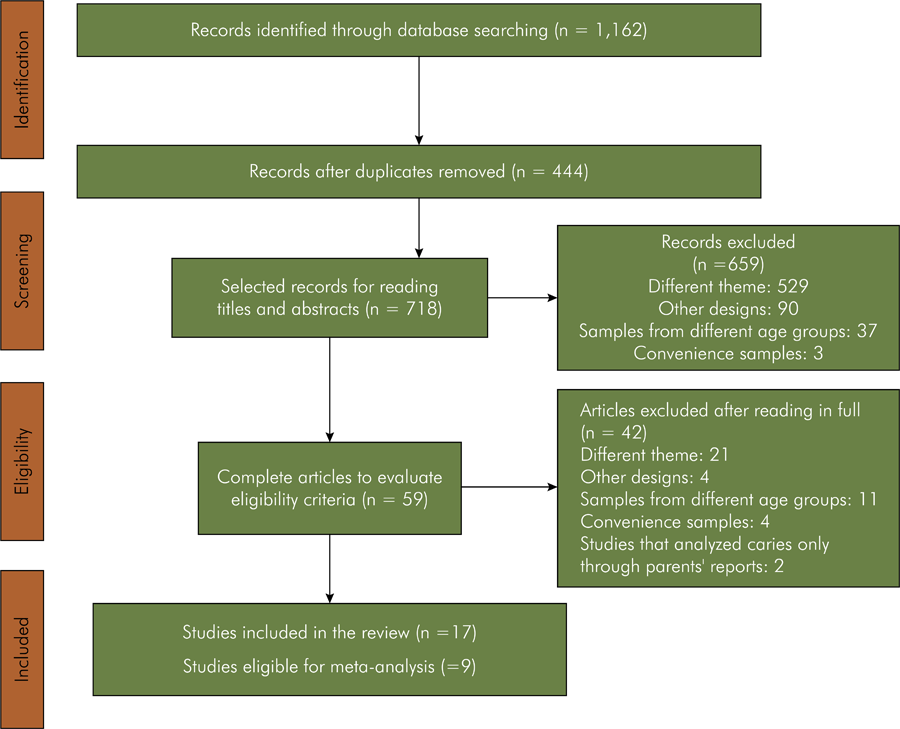
The search strategy retrieved 1,162 studies. Of these, 444 studies were removed for being duplicates. The titles and abstracts of the remaining 718 articles were read, applying the eligibility criteria outlined in the Methods section. After that, 59 articles were still considered potentially eligible and had their full texts evaluated. Finally, 17 original studies were considered eligible and included in this systematic review. Standard measures were available in nine studies, allowing for their inclusion in the meta-analysis. Figure 1 presents the study selection flowchart, as recommended by the PRISMA guidelines.

The studies included in this systematic review were published from 1985 to 2023. In terms of economic background, most studies were carried out in high-income countries. No studies were conducted in low-income countries, and six were performed in developing countries (Brazil and Thailand). Five studies included in this review were conducted in European countries, five in Brazil, four in Asian countries, three in Australia, and one in the USA.
Sugar exposure before the age of one year was reported in 11 studies.5-8,16-22 The study that evaluated sugar consumption in older children assessed it at 36, 48, and 60 months.23 Four studies analyzed the patterns of sugar consumption.5,7,20,24
The methods used to measure sugar consumption varied across the selected studies. The high frequency of sugars was investigated in eight studies.16,18,19,23,25-27 Two studies evaluated the weekly frequency of sugar consumption.16,25 Four articles investigated the daily frequency of sugar-containing foods or beverages.19,23,24,27 Other studies evaluated sugar intake through food diaries with a 24-hour recall.17,19,24,25 In one of the studies, parents/caregivers were instructed to record all food and drink consumption during two weekdays and one weekend day.23 Three studies evaluated the introduction of sugary foods in children’s diets.6,8,22
Considering the 17 selected studies, the outcomes related to ECC were evaluated from 9 months to 5 years of age, with variations between the analyzed studies. To assess the prevalence of ECC, 11 studies investigated lesions at the initial stage (white spot lesions), while the remaining six studies considered only cavitated lesions. Four articles reported using the International Caries Detection and Assessment System (ICDAS) index as the instrument to measure the outcome,5,6,16,19 seven studies evaluated the outcome through the dental caries outcome by the number of decayed, missing, or filled surfaces (dmfs index),7,8,17,18,20,24,25 and one study evaluated dental caries using the criteria proposed by Pitts.23 The remaining studies (n=5) did not specify how ECC was measured.
Much of the literature reviewed (n = 15) reported an association between sugar intake and ECC, with the strongest effect found for candy consumption (OR 2.28, 95% CI: 1.28–4.04).25 This association was not confirmed in two studies included in this review. In one of the studies that did not report an association, it was observed that following a diet based on WHO guidelines was a protective factor for the occurrence of ECC.19 In another study, the association between the patterns of consumption of sugary foods and ECC was lost after adjusting for covariates.20 The studies included in this review are shown in Table 2. All the cohort studies included had a low risk of bias. The quality assessment of the studies is shown in Table 3.
A meta-analysis involving all included studies was not performed due to inconsistencies in the reporting of results. Nine studies, however, provided adjusted effect measures (RR, PR, or OR) and reported the prevalence of caries in the group not exposed to sugar. This allowed the pooled data in the meta-analysis to be expressed as OR.
The pooled (meta-analyzed) effect estimated in this study yielded an OR of 1.59 (95%CI:1.50–1.68). This finding indicates that children who consumed sugar in early childhood were 59% more likely to develop caries compared to those who did not consume it, with a statistically significant overall effect. Furthermore, the Cochran’s Q value of 5.91, p = 0.658, indicates that the heterogeneity test was not significant, i.e., the effects do not differ more than expected by chance. Figure 2 shows the pooled effect of sugar consumption in longitudinal studies and the occurrence of dental caries.

Meta-analysis evaluation and forest plot showing the combined odds ratio of all included studies.
Discussion
The association between sugar consumption and ECC is consistent across the cohort studies included in this review, with most reporting that higher sugar consumption is associated with higher prevalence of dental caries. The meta-analysis yielded a pooled effect estimate of OR 1.59 (95%CI: 1.50–1.68), demonstrating that children who consumed sugar at an early age were almost 60% more likely to have dental caries than those who did not.
A recent large birth cohort study found that higher sugar consumption in the first 48 months of life was strongly associated with a higher prevalence of dental caries at the age 4 years.5
Sugar exposure before the age of 1 year was reported in 11 studies.5,6,8,16-22 Previous studies have reported a high percentage of children consuming sugary foods and beverages by the end of their first year of life.28 The early exposure of a child to sucrose influences their dietary preferences, stimulating their preference for foods and drinks containing added sugars over healthier foods,29 which may, in turn, contribute to caries experience in the future. Moreover, early exposure to sugary foods could influence similar dietary patterns in the subsequent stages of life,5,8,9 increasing the risk for several chronic diseases over the couse of life, including ECC.11 Hence, the IAPD recommends that sugar intake should be limited among children under 2 years of age.9,30 A birth cohort study also showed that the early introduction of sugar is associated with a higher incidence of dental caries.6
The high frequency of sugars and sugar sweetened beverages was associated with ECC in eight studies.16,18,23-27,31 The feeding frequency could play a role in caries development, independently of the amount of potentially cariogenic foods consumed.8,30,32 These findings underscore the importance of identifying risk factors related to eating behaviors in early childhood to prevent caries in children through changes in the diet.
As noted in this review, cohort studies apply various methods for assessing exposure to sugary foods and beverages ,which should be considered when comparing their results. Different instruments were used in the original studies included in this review, but the most frequent were those that measure the daily frequency of sugary foods or beverages,5,6,19,23,27 followed by the assessment of sugar intake using food diaries with a 24-hour recall,19,26 and weekly frequency of sugar consumption16,25 There is a vast literature on ECC, and many studies assess other major exposures. Those studies that use sugar consumption only as a covariate, despite their relevance to the literature, were not included in this review because most lacked detailed information on how sugar consumption was measured.
The current review has several strengths that should be considered, such as the use of multiple databases and the inclusion of only longitudinal studies, in which the temporal relationship between exposure and outcome could be observed. In addition, the review protocol was previously registered, the review process and data extraction were performed independently by two reviewers, and the study was reported following the most recent guidelines. Also, a meta-analysis was carried out with nine studies, and the effect measured confirmed the findings of the qualitative analysis. This review has certain limitations, including the variability in dietary data collection methods, which limited the feasibiity of conducting a meta-analysis,and the lack of studies from low-income countries.
There is a clear need to enhance the quality of dietary data collection. The use of different methods to evaluate sugar intake hinders the comparison between different studies and it is a strong limitation of the studies evaluating diet and health outcomes. Future studies should focus on the development of more accurate methods to measure sugar intake, thus representing a strong contribution to the field.
This review highlights the importance of developing strategies and policy interventions at the population level to reduce sugar consumption during childhood. Therefore, efforts are needed to limit the amount and frequency of sugar consumption, such as promoting sugar-free environments in schools, pre-schools, and workplaces; regulating added sugar content in foods and beverages; restricting advertisement of sugary products; implementing higher taxes on sugary foods and beverages; reformulating the sugar content of foods and beverages; and lowering sugar concentration.9 Furthermore, dentists, when providing personalized care to prevent ECC, may contribute to decreasing the consumption of sugar by implementing educational interventions targeted at individuals and their communities,9 as well as providing guidance to parents and families about the cariogenic potential of sugar consumption and frequent feeding.
All studies included in this review demonstrated that sugar was introduced into the infant’s diet too early (before the age of 24 months). This finding goes against dietary guidelines for healthy eating, possibly revealing parents’ lack of knowledge about proper nutrition for their children, socioeconomic problems that restrict access to healthy foods, and cultural influences on family eating practices. Therefore, it is necessary that health professionals address breastfeeding and healthy eating following WHO and IAPD guidelines.10-11 Educating parents and caregivers about the importance of avoiding sugary foods early in life is crucial for preventing many chronic diseases associated with high sugar consumption, including but not restricted to ECC.
Conclusion
This systematic review and meta-analysis confirmed the association between sugar consumption and ECC using data from good-quality longitudinal cohort studies.
References
-
1 Phantumvanit P, Makino Y, Ogawa H, Rugg-Gunn A, Moynihan P, Petersen PE, et al. WHO Global consultation on public health intervention against early childhood caries. Community Dent Oral Epidemiol. 2018 Jun;46(3):280-7. https://doi.org/10.1111/cdoe.12362
» https://doi.org/10.1111/cdoe.12362 -
2 Chen KJ, Gao SS, Duangthip D, Lo EC, Chu CH. Prevalence of early childhood caries among 5-year-old children: a systematic review. J Investig Clin Dent. 2019 Feb;10(1):e12376. https://doi.org/10.1111/jicd.12376
» https://doi.org/10.1111/jicd.12376 -
3 Zaror C, Matamala-Santander A, Ferrer M, Rivera-Mendoza F, Espinoza-Espinoza G, Martínez-Zapata MJ. Impact of early childhood caries on oral health-related quality of life: a systematic review and meta-analysis. Int J Dent Hyg. 2022 Feb;20(1):120-35. https://doi.org/10.1111/idh.12494
» https://doi.org/10.1111/idh.12494 -
4 Peres MA, Macpherson LM, Weyant RJ, Daly B, Venturelli R, Mathur MR, et al. Oral diseases: a global public health challenge. Lancet. 2019 Jul;394(10194):249-60. https://doi.org/10.1016/S0140-6736 (19)31146-8
» https://doi.org/10.1016/S0140-6736 (19)31146-8 -
5 Echeverria MS, Schuch HS, Cenci MS, Motta JV, Bertoldi AD, Hallal PC, et al. Trajectories of sugar consumption and dental caries in early childhood. J Dent Res. 2022 Jun;101(6):724-30. https://doi.org/10.1177/00220345211068743
» https://doi.org/10.1177/00220345211068743 -
6 Echeverria MS, Schuch HS, Cenci MS, Motta JV, Bertoldi AD, Britto Correa M, et al. Early sugar introduction associated with early childhood caries occurrence. Caries Res. 2023;57(2):152-8. https://doi.org/10.1159/000529210
» https://doi.org/10.1159/000529210 -
7 Bernabé E, Ballantyne H, Longbottom C, Pitts NB. Early introduction of sugar-sweetened beverages and caries trajectories from age 12 to 48 months. J Dent Res. 2020 Jul;99(8):898-906. https://doi.org/10.1177/0022034520917398
» https://doi.org/10.1177/0022034520917398 -
8 Chaffee BW, Feldens CA, Rodrigues PH, Vítolo MR. Feeding practices in infancy associated with caries incidence in early childhood. Community Dent Oral Epidemiol. 2015 Aug;43(4):338-48. https://doi.org/10.1111/cdoe.12158
» https://doi.org/10.1111/cdoe.12158 -
9 Feldens CA, Pinheiro LL, Cury JA, Mendonça F, Groisman M, Costa RAH, Pereira HC, Vieira AR. Added sugar and oral health: a position paper of the Brazilian Academy of Dentistry. Front Oral Health. 2022;6:3:869112. https://doi.org/10.3389/froh.2022.869112
» https://doi.org/10.3389/froh.2022.869112 - 10 World Health Organization. Guideline: sugars intake for adults and children. Geneva: World Health Organization; 2015.
-
11 Pitts NB, Baez RJ, Diaz-Guillory C, Donly KJ, Feldens CA, McGrath C, et al. Early childhood caries: IAPD Bangkok declaration. J Dent Child (Chic). 2019 May;86(2):72. https://doi.org/10.1111/ipd.12490
» https://doi.org/10.1111/ipd.12490 -
12 Moynihan PJ, Kelly SA. Effect on caries of restricting sugars intake: systematic review to inform WHO guidelines. J Dent Res. 2014 Jan;93(1):8-18. https://doi.org/10.1177/0022034513508954
» https://doi.org/10.1177/0022034513508954 -
13 Demarco FF, Peres KG, Peres MA. Life course epidemiology and its implication for oral health. Braz Oral Res. 2014;28(Spec Iss):1-7. https://doi.org/10.1590/S1806-83242014.50000006
» https://doi.org/10.1590/S1806-83242014.50000006 -
14 Page MJ, McKenzie JE, Bossuyt PM, Boutron I, Hoffmann TC, Mulrow CD, et al. The PRISMA 2020 statement: an updated guideline for reporting systematic reviews. Rev Panam Salud Publica. 2022 Dec;46(46):e112. https://doi.org/10.26633/RPSP.2022.112
» https://doi.org/10.26633/RPSP.2022.112 - 15 Joanna Briggs Institute. Joanna Briggs Institute reviewers' manual. South Adelaide: The Joanna Briggs Institute; 2014.
-
16 Amezdroz E, Carpenter L, Johnson S, Flood V, Dashper SG, Calache H, et al. Feasibility and development of a cariogenic diet scale for epidemiological research. Int J Paediatr Dent. 2019 May;29(3):310-24. https://doi.org/10.1111/ipd.12470
» https://doi.org/10.1111/ipd.12470 -
17 Feldens CA, Giugliani ER, Vigo Á, Vítolo MR. Early feeding practices and severe early childhood caries in four-year-old children from southern Brazil: a birth cohort study. Caries Res. 2010;44(5):445-52. https://doi.org/10.1159/000319898
» https://doi.org/10.1159/000319898 -
18 Grytten J, Rossow I, Holst D, Steele L. Longitudinal study of dental health behaviors and other caries predictors in early childhood. Community Dent Oral Epidemiol. 1988 Dec;16(6):356-9. https://doi.org/10.1111/j.1600-0528.1988.tb00581.x
» https://doi.org/10.1111/j.1600-0528.1988.tb00581.x -
19 Hu S, Sim YF, Toh JY, Saw SM, Godfrey KM, Chong YS, et al. Infant dietary patterns and early childhood caries in a multi-ethnic Asian cohort. Sci Rep. 2019 Jan;9(1):852. https://doi.org/10.1038/s41598-018-37183-5
» https://doi.org/10.1038/s41598-018-37183-5 -
20 Manohar N, Hayen A, Scott JA, Do LG, Bhole S, Arora A. Impact of dietary trajectories on obesity and dental caries in preschool children: findings from the healthy smiles healthy kids study. Nutrients. 2021 Jun;13(7):2240. https://doi.org/10.3390/nu13072240
» https://doi.org/10.3390/nu13072240 - 21 Persson LA, Holm AK, Arvidsson S, Samuelson G. Infant feeding and dental caries: a longitudinal study of Swedish children. Swed Dent J. 1985;9(5):201-6.
-
22 Thitasomakul S, Piwat S, Thearmontree A, Chankanka O, Pithpornchaiyakul W, Madyusoh S. Risks for early childhood caries analyzed by negative binomial models. J Dent Res. 2009 Feb;88(2):137-41. https://doi.org/10.1177/0022034508328629
» https://doi.org/10.1177/0022034508328629 -
23 Chankanka O, Levy SM, Marshall TA, Cavanaugh JE, Warren JJ, Broffitt B, et al. The associations between dietary intakes from 36 to 60 months of age and primary dentition non-cavitated caries and cavitated caries. J Public Health Dent. 2015;75(4):265-73. https://doi.org/10.1111/j.1752-7325.2012.00376.x
» https://doi.org/10.1111/j.1752-7325.2012.00376.x -
24 Ha DH, Nguyen HV, Bell LK, Devenish-Coleman G, Golley RK, Thomson WM, et al. Trajectories of child free sugars intake and dental caries - a population-based birth cohort study. J Dent. 2023 Jul;134:104559. https://doi.org/10.1016/j.jdent.2023.104559
» https://doi.org/10.1016/j.jdent.2023.104559 -
25 Grindefjord M, Dahllöf G, Nilsson B, Modéer T. Stepwise prediction of dental caries in children up to 3.5 years of age. Caries Res. 1996;30(4):256-66. https://doi.org/10.1159/000262333
» https://doi.org/10.1159/000262333 -
26 Peltzer K, Mongkolchati A. Severe early childhood caries and social determinants in three-year-old children from Northern Thailand: a birth cohort study. BMC Oral Health. 2015 Sep;15(1):108. https://doi.org/10.1186/s12903-015-0093-8
» https://doi.org/10.1186/s12903-015-0093-8 -
27 Watanabe M, Wang DH, Ijichi A, Shirai C, Zou Y, Kubo M, et al. The influence of lifestyle on the incidence of dental caries among 3-year-old Japanese children. Int J Environ Res Public Health. 2014 Dec;11(12):12611-22. https://doi.org/10.3390/ijerph111212611
» https://doi.org/10.3390/ijerph111212611 -
28 Feldens CA, Vítolo MR, Maciel RR, Baratto PS, Rodrigues PH, Kramer PF. Exploring the risk factors for early-life sugar consumption: a birth cohort study. Int J Paediatr Dent. 2021 Mar;31(2):223-30. https://doi.org/10.1111/ipd.12713
» https://doi.org/10.1111/ipd.12713 -
29 Ventura AK, Worobey J. Early influences on the development of food preferences. Curr Biol. 2013 May;23(9):R401-8. https://doi.org/10.1016/j.cub.2013.02.037
» https://doi.org/10.1016/j.cub.2013.02.037 -
30 Tinanoff N, Baez RJ, Diaz Guillory C, Donly KJ, Feldens CA, McGrath C, et al. Early childhood caries epidemiology, aetiology, risk assessment, societal burden, management, education, and policy: global perspective. Int J Paediatr Dent. 2019 May;29(3):238-48. https://doi.org/10.1111/ipd.12484
» https://doi.org/10.1111/ipd.12484 -
31 Wendt LK, Birkhed D. Dietary habits related to caries development and immigrant status in infants and toddlers living in Sweden. Acta Odontol Scand. 1995 Dec;53(6):339-44. https://doi.org/10.3109/00016359509005998
» https://doi.org/10.3109/00016359509005998 -
32 Feldens CA, Rodrigues PH, de Anastácio G, Vítolo MR, Chaffee BW. Feeding frequency in infancy and dental caries in childhood: a prospective cohort study. Int Dent J. 2018 Apr;68(2):113-21. https://doi.org/10.1111/idj.12333
» https://doi.org/10.1111/idj.12333
-
Data availability:
The authors declare that all data generated or analyzed during this study are included in this published article.
Edited by
-
Editor-in-Chief:
Saul Paiva
The authors declare that all data generated or analyzed during this study are included in this published article.