 Botanical efforts reveals unrecorded thalloid liverworts for both State of Maranhão and Brazilian Cerrado, northeastern Brazil
Abstract
Despite its rich biodiversity, the State of Maranhão, northeastern Brazil, is one of the less explored and known Brazilian states from a bryological perspective. Until recently, the recorded thalloid liverwort flora of Maranhão comprised 13 species, distributed in seven families. This study reports first records of some species of thalloid liverworts for both Maranhão and the Brazilian Cerrado, based on botanical expeditions carried out in different areas of Maranhão between 2017 and 2025. We report 10 species newly recorded for the state, including Riccardia leptophylla, R. multifida, Riccia breutelii and R. subdepilata, which also represent new records for the Brazilian Cerrado, and Pteropsiella frondiformis, new record for Northeastern Brazil. These new records increased the number of thalloid liverwort species documented for Maranhão to nearly double, reaching a total of 23 species. The most rich family is Ricciaceae (9 species), followed by Aneuraceae (6), while Corsiniaceae, Lepidoziaceae, and Pallaviciniaceae are each represented by two species, and Cyathodiaceae and Monocleaceae by one species. This study underscores the importance of floristic and taxonomic research in underexplored regions and emphasizes the need for increased attention to overlooked plant groups such as bryophytes.
Keywords
Bryophytes; Cerrado domain; Marchantiophyta; new records; taxonomy
Resumo
Apesar de sua rica biodiversidade, o estado do Maranhão, nordeste do Brasil, é um dos estados brasileiros menos explorados e conhecidos do ponto de vista briológico. Até recentemente, a flora de hepáticas talosas do Maranhão era composta por 13 espécies, distribuídas em sete famílias. Este estudo relata os primeiros registros de algumas espécies hepáticas talosas para o Maranhão e para o Cerrado brasileiro, com base em expedições botânicas realizadas em diferentes áreas do Maranhão entre 2017 e 2025. São relatadas 10 espécies recém registradas para o estado, incluindo Riccardia leptophylla, R. multifida, Riccia breutelii e R. subdepilata, que também representam novos registros para o Cerrado brasileiro, e Pteropsiella frondiformis, novo registro para o Nordeste do Brasil. Esses novos registros aumentaram para quase o dobro o número de espécies de hepáticas talosas documentadas para o Maranhão, atingindo um total de 23 espécies. A família mais rica é Ricciaceae (9 espécies), seguida por Aneuraceae (6), enquanto Corsiniaceae, Lepidoziaceae e Pallaviciniaceae são representadas por duas espécies cada, e Cyathodiaceae e Monocleaceae por uma espécie. Este estudo sublinha a importância de investigações florísticas e taxonômicas em regiões pouco exploradas e enfatiza a necessidade de uma maior atenção a grupos de plantas negligenciados, como as briófitas.
Palavras-chave
Briófitas; domínio do Cerrado; Marchantiophyta; novos registros; taxonomia
Introduction
Thalloid liverworts are characterized by a dorsiventrally flattened gametophyte or thallus, which lacks differentiation into stems and leaves. The thallus is usually dichotomously branched, occasionally regularly or irregularly pinnate, and highly variable in its internal structure (Bischler-Causse et al. 2005, Gradstein et al. 2001, Gradstein & Costa 2003). These liverworts are commonly terricolous or saxicolous and exhibit notable drought tolerance, allowing them to thrive in arid, harsh, and disturbed habitats (Gradstein & Costa 2003, Bischler-Causse et al. 2005). Their resilience to desiccation is attributed to specific features of gametophyte metabolism, cellular capacity to resume growth following water stress, and the rapid development of gametophytes and fast-maturing sporophytes during brief periods of water availability (Bischler-Causse et al. 2005). Globally, about 850 species of thalloid liverworts have been described (Söderström et al. 2016), of which 105 species were recorded in Brazil (Flora e Funga do Brasil 2025).
This paper presents new records of thalloid liverworts for the State of Maranhão, northeastern Brazil, also including species newly documented for the Brazilian Cerrado. Despite encompassing portions of three major Brazilian phytogeographic domains — Amazonia, Cerrado and Caatinga — as well as important transitional zones between them (Ab’Saber 1977, Montes et al. 1997, Muniz 2006, Dias et al. 2009, Stella 2011, Bandeira 2013, Spinelli-Araujo et al. 2016), Maranhão is one of the less explored and known Brazilian states from a bryological perspective.
To date, 13 species of thalloid liverworts have been reported for Maranhão, based on recent studies (Yano et al. 2009, Peralta et al. 2011, Varão et al. 2011, Silva et al. 2018, Oliveira et al. 2018, Costa et al. 2021, Fernandes et al. 2021, Silva et al. 2024, Carvalho et al. 2025). The first records for the state were provided by Yano et al. (2009), who documented Cronisia weddellii (Mont.) Grolle, Riccia stenophylla Spruce and R. vitalii Jovet-Ast. Additional contributions included the report of Riccia planobiconvexa Steph. (Peralta et al. 2011), and the documentation of R. mauryana Steph. and R. weinionis Steph. in a diversity study of the genus Riccia L. by Silva et al. (2018). Fernandes et al. (2021), studying the bryophyte flora of the Chapada das Mesas National Park, located in the southern portion of Maranhão, reported seven species, four of which were previously undocumented for the state: Cyathodium cavernarum Kunze, Monoclea gottschei Lindb., Pteropsiella metzgeriiformis Steph., and Symphyogyna leptothelia Taylor. Further additions include Riccardia cataractarum (Spruce) Schiffn. (Costa et al. 2021) and, most recently, Riccardia chamedryfolia (With.) Grolle and Symphyogyna brasiliensis (Nees) Nees & Mont., recorded by Silva et al. (2024) in the Nascentes do Rio Parnaíba National Park, the largest protected area of the Brazilian Cerrado.
Between 2017 and 2025, several field expeditions were carried out in different areas of Maranhão, with particularly focus on areas within the Cerrado domain. These surveys resulted in the identification of several thalloid liverwort previously unrecorded for the state, including four species new records for the Brazilian Cerrado and one for Northeastern Brazil. This paper aims to provide a comprehensive list of thalloid liverworts from Maranhão, including these new records. Examined specimens are presented with remarks on their distribution, ecology, morphology as well as photographs of the plants in the field.
Material and Methods
The specimens of thalloid liverworts were collected during expeditions between 2017 and 2025, from different areas of the State of Maranhão (Figure 1), northeastern Brazil: Chapada das Mesas National Park and its surroundings (municipality of Carolina); villages Caraíbas, Estrela and Centro Velho in the Chapada Limpa (municipality of Chapadinha); and village Pau D’arco (municipality of Pedreiras). Collections were carried out in rainy and dry seasons. The specimens were collected in specific and likely areas of colonization such as waterfalls, stream banks, riparian and gallery forests. The methodology of collection followed the one described by Yano (1989). The specimens were sun dried and subsequently deposited in the CCAA herbarium of the Universidade Federal do Maranhão campus Chapadinha. Duplicates of some species were sent to the RB herbarium (in Rio de Janeiro State).

The specimens were identified and described based on specialized studies such as Uribe & Aguirre (1995), Gradstein & Costa (2003), Bischler-Causse et al. (2005), Gradstein & Ilkiu-Borges (2009), Gradstein & Reeb (2018) and Gradstein (2021). The classification system followed Crandall-Stotler et al. (2009). The geographic distribution was based on the studies of Bischler-Causse et al. (2005), Gradstein & Costa (2003) and Gradstein (2021), as well as on online data available on REFLORA (http://floradobrasil.jbrj.gov.br) and TROPICOS (https://www.tropicos.org/home). The species names are in accordance with Söderström et al. (2016). In taxon authorities, the “ex” authors are omitted for brevity since their citation are not obligatory.
The list of thalloid liverwort recorded for the State of Maranhão was based on the following published studies: Yano et al. (2009), Peralta et al. (2011), Varão et al. (2011), Oliveira et al. (2018b), Silva et al. (2018), Fernandes et al. (2021), Costa et al. (2021), Silva et al. (2024) and Carvalho et al. (2025).
Results
1. New records of thalloid liverworts for Maranhão
Ten species of thalloid liverwort are first recorded for the State of Maranhão (see annotated list below), four of these species being also first records for the Brazilian Cerrado domain and on for Northeastern Brazil. The new records belong to four genera (Cronisia Berk., Pteropsiella Spruce, Riccardia Gray and Riccia) and four families (Aneuraceae, Corsiniaceae, Lepidoziaceae and Ricciaceae). Aneuraceae and Ricciaceae was the families that showed the highest increase in species richness with four new records each, followed by Corsiniaceae and Lepidoziaceae with one species each.
The new records are treated in alphabetical order by family, genera and species. Taxa new to state of Maranhão are marked by a single asterisk (*), Northeastern region by two asterisks (**) and for the Brazilian Cerrado by three asterisks (***). Remarks are provided for all new records with data on distribution, ecology and morphology.
ANEURACEAE
*Riccardia digitiloba (Spruce) Pagán

Thalloid liverworts species in the field. A. Riccardia digitiloba. B. Riccardia regnelii. C. Riccardia caractarum. D. Riccardia chamedryfolia. E. Cronisia weddellii. F. Cyathodium carvenarum. G. Riccia vitalii. H. Riccia mauryana. Photograph: Lázaro Nikael Araújo-Oliveira.
EXAMINED SPECIMEN. BRAZIL. Maranhão: Carolina Municipality, Chapada das Mesas National Park, Farinha River, Mariazinha Creek, 06º56’51,30”S, 047º20’23,34”W, 187 m, March 11, 2017, J. A. S. Silva 39 (CCAA).
REMARKS. Riccardia digitiloba is a widespread neotropical species, common in Brazil (Flora e Funga do Brasil 2025, Gradstein 2021). This species usually grows on decaying or living tree trunks and rock, in shaded and humid areas, from sea level to 1400 m (Gradstein & Costa 2003, Flora e Funga do Brasil 2025). Riccardia digitiloba is distinguished by dioicous plants with ca. 1 cm long, prostate, irregularly 1‒2-pinnate to dichotomous, main axis 4–12 cells thick, ellipsoid, cell walls thin, epidermis cells smaller than medullary cells, margin without wing, branches linear with rounded to retuse apex, without wing or occasionally with 1 cell wide wing, margins entire, and gemmae usually present and abundant, produced on decurved branch tips.
***Riccardia leptophylla (Spruce) Herzog

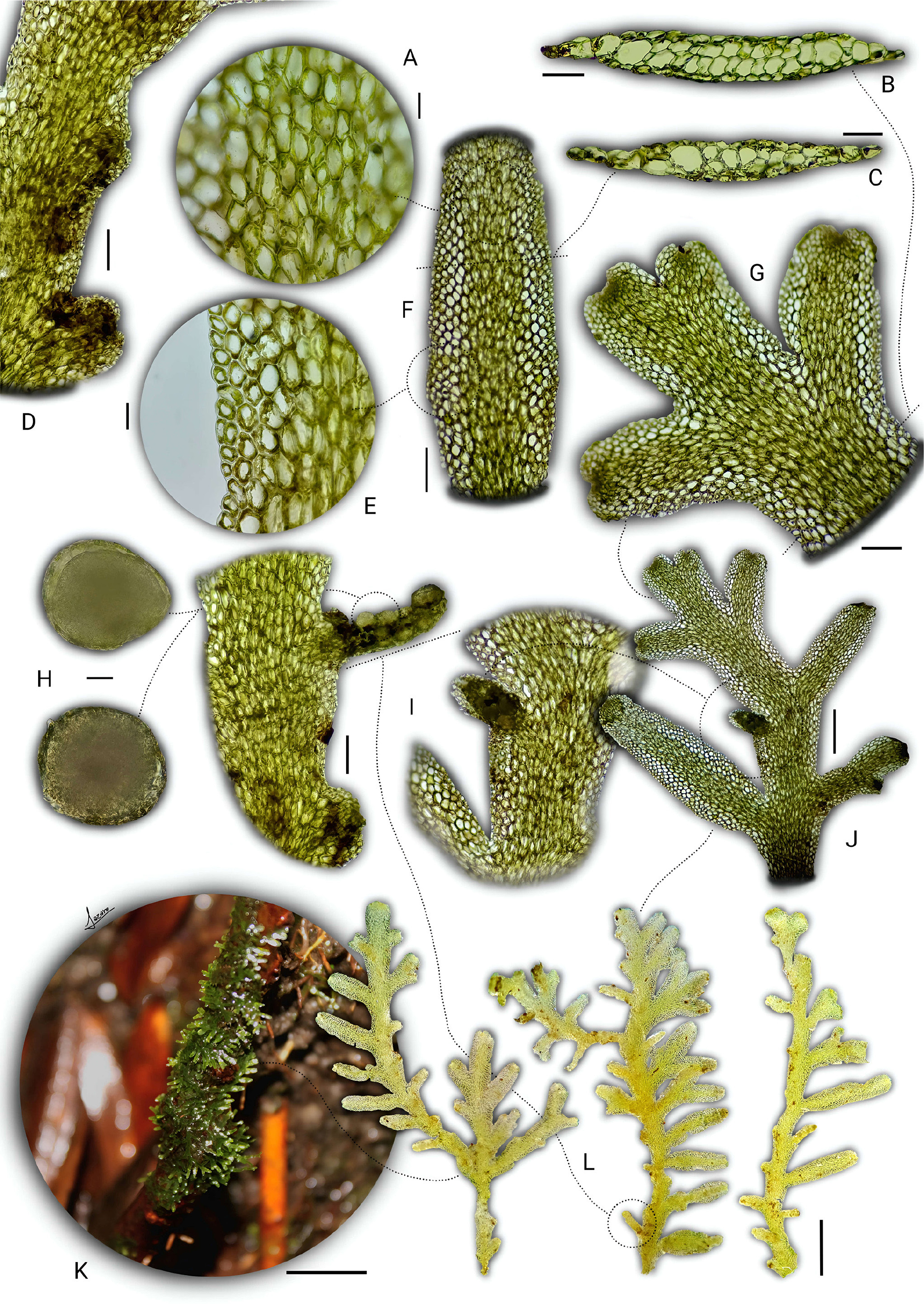
Riccardia leptophylla. A. Median cells. B-C. Cross section of a thallus. D, F-G, I, J, L. Thallus. E. Wing cells. H. Spores. K. Plant in the field (A, E, H = 50 µm; B-D, F-G, I = 200 µm; J = 500 µm; K = 30 cm; L = 25 mm). Photograph: Lázaro Nikael Araújo-Oliveira.
EXAMINED SPECIMEN. BRAZIL. Maranhão: Carolina Municipality, Chapada das Mesas National Park, Prata waterfall, Farinha River, 6º59’39.35”S, 047º09’56.95”W, 228 m, March 12, 2017, J. A. S. Silva 93 (CCAA).
REMARKS. Riccardia leptophylla occurs in tropical America (Gradstein 2021). In Brazil, this species was recorded in Amazonia domain (Amazonas and Pará States) and in the Atlantic Forest (Minas Gerais and São Paulo States), on rotten wood or living tree trunk, in humid sites, in moist lowland and montane forests, at 100–1000 m [Gradstein & Costa 2003, as R. tenuicula (Spruce) Meenks, Flora e Funga do Brasil 2025]. Riccardia leptophylla can be dioicous or rarely monoicous, usually smaller, less than 1 cm long, prostate, irregularly 2-pinnate to palmate, main axis 3–6 cells thick, plano-convex to ellipsoid, cell walls thin, epidermis cells smaller than medullary cells, margin winged, wings 1–3 cells wide, branches linear to tongue-shaped, apex rounded, broadly winged, wings usually wider than the midrib, the midrib vanishing below apex, margins entire, and gemmae present.
***Riccardia multifida (L.) S.F.Gray
Riccardia multifida. A. Branch apex. B. Median cells of a branch. C. Median cells of a main thallus. D. Cross section of a branch. E. Cross section of a main thallus. F-G. Branch. H-I, K-L. Thallus. J. Plant in the field. (A-C, F-G, I = 200 µm; D, E, H = 50 µm; J = 30 cm; K = 25 mm; L = 500 µm). Photograph: Lázaro Nikael Araújo-Oliveira.
EXAMINED SPECIMEN. BRAZIL. Maranhão: Carolina Municipality, Chapada das Mesas National Park, São Romão waterfall, 07º04’25,0”S, 047º05’26,2”W, 227 m, June 7, 2018, J. A. S. Silva 296 (CCAA).
REMARKS. Riccardia multifida is widely distributed in temperate regions of the Northern Hemisphere, South Africa and rare in tropical America (recorded only in Brazil) (Gradstein & Costa 2003, Gradstein 2021). In Brazil, this species was recorded in the Atlantic Forest, where it grows on moist soil, from sea level to 1000 m (Gradstein & Costa 2003, Flora e Funga do Brasil 2025). Riccardia multifida is characterized by delicate, monoicous plants, prostate, regularly 1–3-pinnate, main axis 2–3 cells thick, ellipsoid, biconvex to plane-convex, epidermis cells smaller than medullary cells, margin winged, wings 2–3 cells wide, branches linear, tongue-shaped to oblong, 3–4 cells thick, apex rounded to truncate, winged, wings 3–4 cells wide, and margins crenulate.
*Riccardia regnellii (Ǻngstr.) K.G.Hell
EXAMINED SPECIMEN. BRAZIL. Maranhão: Carolina Municipality, Chapada das Mesas National Park, Vereda Bonita Ecological Ranch, 07º03’45,1”S, 047º15’16,2”W, 191 m, February 5, 2020, J. A. S. Silva 499 (CCAA).
REMARKS. Riccardia regnellii has a wide distribution in tropical South America (Gradstein & Reeb 2018, Gradstein 2021). In Brazil, this species occurs on decaying trunk or rock, in Amazonia, Brazilian Cerrado and Atlantic Forest, from sea level to 2200 m (Gradstein & Costa 2003, Flora e Funga do Brasil 2025). Characteristic are the delicate plants that can be dioicous or monoicous, thallus prostate, 0.5–1.5 cm long, irregularly 1–2-pinnate, main axis 4–8 cells thick, with a flat dorsal side and a convex ventral side, without wing or with a narrow, 1–2-cells wide wing, branches flat, winged, with straight or curved margins, often tongue-shaped, apex rounded to retuse, surface cells on ultimate branches frequently arranged in oblique rows.
LEPIDOZIACEAE
**Pteropsiella frondiformis Spruce

Pteropsiella frondiformis. A, C, D. Cross section of thallus. B. Cells of a thallus. E-F. Rhizoids. G-H. Thallus. I. Margin with elongate slime papillae. J. Gynoecia. K. Plant in the field. L. Thallus. M-N. Thallus with gynoecia (A, C, F, I, J = 200 µm; B, D, E = 50 µm; G, H, N = 500 µm; K = 40 cm; L-M = 25 mm). Photograph: Lázaro Nikael Araújo-Oliveira.
EXAMINED SPECIMENS. BRAZIL. Maranhão: Carolina Municipality, Chapada das Mesas National Park, near the Gavião waterfall, 07°12’33.1”S, 047°06’50.7”W, 222 m, January 17, 2025, L. N. Araújo-Oliveira et al. 342 (CCAA).
REMARKS. Pteropsiella frandiformis is distributed in northern South America (Fulford 1968, Gradstein & Costa 2003). In Brazil, this species occurs on decaying trunk, rocks and moist sand, in the Amazonia, with few records in the Brazilian Cerrado, from sea level to 100 m (Gradstein & Costa 2003, Flora e Funga do Brasil 2025). The species is characterized by prostrate, dioicous plants, thallus olive-green to dark green, 1–3 cm long, with broad lateral wings and a dorsally flattened axis, branches occasionally flagelliform or forked (Frullania-type), wing margin entire or irregularly toothed, with elongate papillae; cells quadrate to rectangular, 0.34–.075 × 0.3–0.4 mm, underleaves 2–4 cells wide. Androecia ventral or terminal, spike-like, gynoecia with large bifid bracts, and perianth cylindrical below, trilobed at apex, lobes ciliate-laciniate.
CORSINIACEAE
*Cronisia fimbriata (Nees) Whittem. & Bischl.
EXAMINED SPECIMEN. BRAZIL. Maranhão: Chapadinha Municipality, Chapada Limpa, Caraíbas village, March 29, 2020, J. A. S. Silva 435 (CCAA).
REMARKS.Cronisia is a rare and small neotropical genus represented by two species, C. fimbriata and C. weddellii (Mont.) Grolle (Bischler-Causse et al. 2005). While the latter species is scattered in tropical America (Bischler-Causse et al. 2005, Gradstein 2021) and recorded for Maranhão in different studies (e.g., Yano et al. 2009, Fernandes et al. 2021), C. fimbriata is known from Mexico, Brazil and Argentina, but cited here for the first time for Maranhão, although currently known from eight states in Brazil (Flora e Funga do Brasil 2025). Cronisia fimbriata grows on exposed rock or soil, in semi-arid zones, from sea level to 300 m (Gradstein & Costa 2003, Bischler-Causse et al. 2005, Flora e Funga do Brasil 2025). The morphological difference between Cronisia fimbriata and C. weddellii is that the latter has dorsal surface of thallus smooth, pores not elevated, and ventral scales not projecting beyond thallus margins, while in C. frimbriata the dorsal surface of thallus is roughened by numerous conical swellings, the pores are elevated, and the ventral scales are projecting beyond thallus margin (Gradstein & Costa 2003, Bischler-Causse et al. 2005).
RICCIACEAE
***Riccia breutelii Steph.

Riccia breutelii. A-B, E. Cross section of a thallus. C. Spore, ventral view. D. Tetrahedral spore. F. Spore, lateral view. G. Spore, dorsal view. H. Cross section of a thallus, showing sporophyte channels. I. Spores. J. Capsule. K. Thallus lobe, dorsal view. L. Thallus lobe, ventral view. N. Habit. M. Plant in the field (A = 200 µm; B, E, H, I = 500 µm; C, D, F, G = 50 µm; J = 40 mm, K = 30 mm, L = 25 mm; N = 20 mm; M = 40 cm). Photograph: Lázaro Nikael Araújo-Oliveira.
EXAMINED SPECIMENS. BRAZIL. Maranhão: Carolina Municipality, Chapada das Mesas National Park, road from Cabeceira das Emas to Elias waterfall, anthropized area, with pasture and farms, on sandy soil by the side of the road, 07°11’15.0”S, 047°13’34.1”W, 210 m, January 18, 2025, L.N. Araújo-Oliveira et al. 366 (CCAA).
REMARKS. Riccia breutelii is a neotropical species occurring in Mexico, Central America, the Caribbean, and South America (Bischler-Causse et al. 2005). In Brazil, this species has been recorded on sandy and clayey soils or on rocks, in the Amazonia domain, 50 to 4175 m (Bischler-Causse et al. 2005, Flora e Funga do Brasil 2025). This species is recognized by its thin thallus, 1–2.2 mm wide, with lobes 2–3 times forked, median groove deep apically, banishing below, and spores subtetrahedral, 100–140 µm in diam., wingless or with incomplete, narrow, yellow strip equator, distal face with 6–10 areoles across diam., with thick, dark red or nearly black ridges and big tubercles. These morphological characters distinguish it from other Neotropical Riccia species, particularly R. brittonii M.Howe and R. elliottii Steph. (see Bischler-Causse et al. 2005).
*Riccia membranacea Gottsche & Lindenb.
EXAMINED SPECIMENS. BRAZIL. Maranhão: Chapadinha Municipality, Chapada Limpa, March 29, 2020, J. A. S. Silva 394, 395 (CCAA); Ibid., Centro Velho village, March 29, 2020, J. A. S. Silva 398 (CCAA). Pedreiras Municipality, Pau D’arco village, balneário Cesário, 04º44’19.9”S, 044º34’20.7”W, July 3, 2021, R. S. Fernandes 1087 (CCAA).
REMARKS. Riccia membranacea occurs in tropical America, tropical Africa and U.S.A (Bischler-Causse et al. 2005). In Brazil, this species grows on soil along rivers and ponds, in open places, in Amazonia, Pantanal and Atlantic Forest, from sea level to 1000 m (Gradstein & Costa 2003, Flora e Funga do Brasil 2025). Riccia membranacea (the only species in subg. Leptoriccia R.M.Schust.) is recognized by the thin thallus with 2–3 cells thick, the thallus with lobes widened toward the apex, and brownish spores, which are densely covered by sharp spines. The thin thallus and the spiny spore distinguished the species from all others neotropical Riccia (Bischler-Causse et al. 2005).
*Riccia sorocarpa Bisch.
EXAMINED SPECIMEN. BRAZIL. Maranhão: Carolina Municipality, Chapada das Mesas National Park, Prata waterfall, Farinha River, 06º59’37,4”S, 047º09’57”W, 228 m, March 12, 2017, J. A. S. Silva 84 (CCAA).
REMARKS. Riccia sorocarpa has a worldwide distribution (Bischler-Causse et al. 2005). In Brazil, this species was recorded in humid soil and rock, in Caatinga, Brazilian Cerrado and Atlantic Forest (Yano & Andrade-Lima 1987, Flora e Funga do Brasil 2025). Riccia sorocarpa (subg. Riccia) is recognized by smooth thallus, subepidermal cells thick-walled (in cross section), and spores winged.
***Riccia subdepilata Jovet-Ast

Riccia subdepilata. A-C. Cross section of a thallus. D. Margin cells of a thallus, dorsal view. E. Imature spore. F. Spore, dorsal view. G. Thallus lobe. H. Cilia. I. Spore, lateral view. J. Spore, ventral view. K. Plant in the field. L. Habit. M. Spores. N. Section of a thallus. O. Capsule (A, B, C, G = 200 µm; D, E, F, H, I, J = 50 µm; K = 20 cm; L = 25 mm; M = 500 µm; N = 30 mm; O = 40 mm). Photograph: Lázaro Nikael Araújo-Oliveira.
EXAMINED SPECIMENS. BRAZIL. Maranhão: Chapadinha Municipality, Chapada Limpa, Estrela village, da Ponte River, 03º53’45,5”S, 043º29’21,8”W, 41 m, July 11, 2019, J. A. S. Silva 371 (CCAA); Ibid., August 23, 2022, V.F. Ferreira & R.S. Fernandes 13 (CCAA).
REMARKS. Riccia subdepilata is a rare species, endemic to Brazil (Gradstein & Costa 2003, Bischler-Causse et al. 2005). It was recorded for Bahia (type locality) and Pernambuco. This species grows on moist soil in Caatinga vegetation, at ca. 200 m (Gradstein & Costa 2003, Bischler-Causse et al. 2005). Riccia subdepilata (subg. Riccia) is recognized by a few cilia in the margin, ventral scales hyaline and spores rather small, with smooth triangular area bounding the pores on the proximal face. The spore wall ornamentation is similar with Riccia horrida but the latter species has numerous, long cilia in the margin and ventral scale violaceous (Bischler-Causse et al. 2005).
2. Thalloid liverworts of Maranhão: an updated list
With these new records, the total number of thalloid liverwort species known from Maranhão has increased to 23 species (Table 1). Among the seven families recorded, Ricciaceae (genus Riccia) exhibits the highest species richness, with nine species, followed by Aneuraceae (Riccardia) with six. Corsiniaceae (Cronisia), Lepidoziaceae (Pteropsiella) and Pallaviciniaceae (Symphyogyna) are each represented by two species, while Cyathodiaceae (Cyathodium Lehm.) and Monocleaceae (Monoclea Hook.) are each represented by a single species.
List of all thalloid liverworts recorded for the State of Maranhão, with data on distribution, citation of the first record and voucher. (*) New record for Maranhão, (**) New record for the northeastern Brazil and (***) New record for the Brazilian Cerrado.
Discussion
With the addition of nearly 44% more species to the previous list of thalloid liverworts of the State Maranhão, this study represents a significant contribution to the knowledge of Brazilian bryophytes, particularly relevant for the Cerrado. This finding reinforces the ecological importance of the region and corroborate the view expressed by several researchers that increased efforts in botanical collection, particularly in poorly studied or unexplored areas, are essential for advancing floristic knowledge (Hallingbäck & Hodgetts 2000, Oliveira-da-Silva & Ilkiu-Borges 2020, Zorzanelli et al. 2017). In this context, Maranhão and the Cerrado emerge as priorities for future bryological research, with the potential to reveal even greater, yet undocumented, diversity.
The thalloid liverwort flora in Brazil, comprising approximately 106 species, includes 37 species recorded in the Brazilian Cerrado (Flora e Funga do Brasil 2025). With 62% of these Cerrado species now documented in Maranhão, the state emerges as a significant area for thalloid liverwort diversity within this biome. These records were compiled from various regional studies and floristic surveys (Yano et al. 2009, Peralta et al. 2011, Silva et al. 2018, Costa et al. 2021, Fernandes et al. 2021). The new occurrences of thalloid liverworts reported in this study were expected, considering the Cerrado’s favorable ecological conditions that promote the establishment and persistence of such species.
Notably, three families found in the Amazonia, Cerrado and in Caatinga, such as Marchantiaceae, Dumortieraceae, and Metzgeriaceae, have not yet been collected in Maranhão. However, this absence is likely due to sampling gaps rather than true absence, as many ecologically suitable areas, including conservation units and remote habitats, remain scientifically unexplored. These regions may harbor not only missing families but potentially new or rare taxa as well.
Thalloid liverworts are not usually the main focus of floristic studies in contrast to other groups of bryophytes (mosses and leafy liverworts). The group often occupy specialized microhabitats such as moist rock surfaces, the margins of streams, and shaded forest understories; niches that are frequently overlooked in broader floristic surveys. This ecological specificity may partially explain their underrepresentation in botanical inventories. Moreover, their sensitivity to environmental changes makes them valuable bioindicators for monitoring ecosystem health, particularly in regions like the Cerrado.
Despite their ecological significance, thalloid liverworts remain among the least studied groups of bryophytes in Brazil. Existing studies are relatively few and often geographically limited (e.g., Hell 1969, Silva et al. 2018, Fernandes et al. 2021), resulting in a fragmented understanding of their distribution and ecological roles. Therefore, expanding field research and taxonomic revisions, supported by molecular tools and ecological data, is crucial for revealing the full extent of species diversity and endemism.
Acknowledgements
Thanks are owed to Dr. Márcio Roberto Pietrobom for help in field expeditions; to MSc. Lucas Oliveira Vieira for the localization map; to Dr. Milena Evangelista dos Santos for the identification of Riccia breutelii; to the Universidade Federal do Maranhão – campus of Chapadinha for the logistical structure. This study was supported by the Fundação de Amparo à Pesquisa e ao Desenvolvimento Científico e Tecnológico do Maranhão (FAPEMA – Universal Process No 01271/2016 to RSF), Conselho Nacional de Desenvolvimento Científico e Tecnológico (CNPq – grant No 307974/2021-9 to FPO), and CNPq/MCTI – Ministério da Ciência, Tecnologia e Inovações (Nº 10/2023, process 404619/2023-1).
Data Availability
The data used in this study are available at: https://doi.org/10.48331/scielodata.FJNBOK.
References
- AB’SABER, A.N. 1977. Os domínios morfoclimáticos na América do Sul: primeira aproximação. Geomoforlogia, São Paulo.
- BANDEIRA, I.C.N. 2013. Geodiversidade do Estado do Maranhão. CPRM, Teresina.
- BISCHLER-CAUSSE, H., GRADSTEIN, S.R., JOVET-AST, S.L., LONG. D.G. & ALLEN, N.S. 2005. Marchantiidae. Flora Neotropica, Monograph 62:1–216.
-
CARVALHO, F.V., SILVA, J.A.S., ILKIU-BORGES, A.L., COSTA, D.P. & FERNANDES, R.S. 2025. Bryophytes of the Cerrado: a floristic study in an urban area and in two conservation units in eastern Maranhão, Brazil. Check List 21:12–38. https://doi.org/10.15560/21.1.12.
» https://doi.org/10.15560/21.1.12 -
COSTA, F.B., SILVA, G.S., SANTOS-SILVA, D.L., GOMES, G.S., PERALTA, D.F. & OLIVEIRA, C.O. 2021. Hepáticas (Marchantiophyta) do Parque Nacional Chapada das Mesas: novos registros para o Bioma Cerrado. Revista Principia 56:191–202. https://doi.org/10.18265/1517-0306a2021id4558.
» https://doi.org/10.18265/1517-0306a2021id4558 -
DIAS, P.A., SANTOS, C.L.C., RODRIGUES, F.S., ROSA, L.C., LOBATO, K.S. & REBÊLO, J.M.M. 2009. Espécies de moscas ectoparasitas (Diptera, Hippoboscoidea) de morcegos (Mammalia, Chiroptera) no estado do Maranhão. Revista Brasileira de Entomologia 53:128–133. https://doi.org/10.1590/S0085-56262009000100027.
» https://doi.org/10.1590/S0085-56262009000100027 -
FERNANDES, R.S., SILVA, J.A.S., OTTONI, F.P. & COSTA, D.P. 2021. Diversity of thalloid liverworts in Brazilian Savanna of Parque Nacional da Chapada das Mesas, Maranhão, Brazil. Check List 17:45–58. https://doi.org/10.15560/17.1.45.
» https://doi.org/10.15560/17.1.45 -
Flora e Funga do Brasil 2025. http://floradobrasil.jbrj.gov.br/ (last access in 08/04/2025).
» http://floradobrasil.jbrj.gov.br/ - FULFORD, M.H. 1968. Manual of the leafy Hepaticae of Latin America III. Memoirs of the New York Botanical Garden 11:1–535.
-
GRADSTEIN, S.R. 2021. The Liverworts and Hornworts of Colombia and Ecuador. Memoirs of the New York Botanical Garden 121:1–723. https://doi.org/10.1007/978-3-030-49450-6.
» https://doi.org/10.1007/978-3-030-49450-6 -
GRADSTEIN, S.R. & REEB, C. 2018. Riccardia regnellii, an older name for R. amazonica (Marchantiophyta: Aneuraceae). Cryptogamie, Bryologie 39:305–308. https://doi.org/10.7872/cryb/v39.iss3.2018.305.
» https://doi.org/10.7872/cryb/v39.iss3.2018.305 - GRADSTEIN, S.R. & ILKIU-BORGES, A.L. 2009. Guide to the Plants of Central French Guiana. Part 4. Liverworts and Hornworts. Memoirs of The New York Botanical Garden 76:1–140.
- GRADSTEIN, S.R. & COSTA, D.P. 2003. The Hepaticae and Anthocerotae of Brazil. Memoirs of the New York Botanical Garden 87:1–336.
- GRADSTEIN, S.R., CHURCHILL, S.P. & SALAZAR-ALLEN, N. 2001. Guide to the Bryophytes of Tropical America. Memoirs of the New York Botanical Garden 86:1–577.
- HALLINGBÄCK, T. & HODGETTS, N. 2000. Mosses, liverworts, and hornworts. Status survey and conservation action plan for bryophytes. International Union for Conservation of Nature, Gland.
- HELL, K.G. 1969. Briófitas talosas dos arredores da cidade de São Paulo (Brasil). Boletim da Faculdade de Filosofia, Ciências e Letras, Universidade de São Paulo.
- MONTES, M.L. 1997. Zoneamento geoambiental do estado do Maranhão: Diretrizes gerais para a ordenação territorial. IBGE, Maranhão.
- MUNIZ, F.H. 2006. A vegetação da região de transição entre a Amazônia e o Nordeste, diversidade e estrutura. In Agroambientes de transição entre o trópico úmido e semi-árido do Brasil: atributos, alterações e uso na produção familiar (E.G. Moura, ed.). Programa de Pós-Graduação em Agroecologia, Universidade Estadual do Maranhão, São Luís, p. 53–69.
-
OLIVEIRA, R.R., SÁ, N.A. & CONCEIÇÃO, G.M. 2018. Hepáticas (Marchantiophyta) do estado do Maranhão, Brasil. Biota Amazônia 8:19–23. https://doi.org/10.18561/2179-5746/biotaamazonia.v8n2p19-23.
» https://doi.org/10.18561/2179-5746/biotaamazonia.v8n2p19-23 -
OLIVEIRA-DA-SILVA, F.R. & ILKIU-BORGES, A.L. 2020. Bryophyte flora of two Natural Parks in Amapá: richness, composition and new record. Anais da Academia Brasileira de Ciências 92 (Suppl. 2):e20181355. https://doi.org/10.1590/0001-3765202020181355.
» https://doi.org/10.1590/0001-3765202020181355 - PERALTA, D.F., BRITO, E.S., VARÃO, L.F., CONCEIÇÃO, G.M. & CUNHA, I.P.R. 2011. Novas ocorrências e lista das briófitas do estado do Maranhão, Brasil. Pesquisa em Foco 19:63–78.
-
SILVA, J.A.S., FERNANDES, R.S. & COSTA, D.P. 2018. Species diversity of the genus Riccia L. (Marchantiales, Ricciaceae) in Maranhão state, Brazil. Check List 14:763–769. https://doi.org/10.15560/14.5.763.
» https://doi.org/10.15560/14.5.763 -
SILVA, J.P., FERNANDES, R.S. & ILKIU-BORGES, A.L. 2024. Bryophytes in one of the largest and little-studied conservation units in the Brazilian Cerrado: Nascentes do Rio Parnaíba National Park. Acta Botanica Brasilica 38:1–18. https://doi.org/10.1590/1677-941X-ABB-2024-0020.
» https://doi.org/10.1590/1677-941X-ABB-2024-0020 -
SÖDERSTRÖM, L., HAGBORG, A., VON KONRAT, M., BARTHOLOMEW-BEGAN, S., BELL, D., BRISCOE, L., BROWN, E., CARGILL, D.C., COSTA, D.P., CRANDALL-STOTLER, B.J., COOPER, E.D., DAUPHIN, G., ENGEL, J.J., FELDBERG, K., GLENNY, D., GRADSTEIN, S.R., HE, X., HEINRICHS, J., HENTSCHEL, J,, ILKIU-BORGES, A.L., KATAGIRI, T., KONSTANTINOVA, N.A., LARRAÍN, J., LONG, D.G., NEBEL, M., PÓCS, T., PUCHE, F., REINER-DREHWALD, E., RENNER, M.A.M., SASS-GYARMATI, A., SCHÄFER-VERWIMP, A., MORAGUES, J.G.S., STOTLER, R.E., SUKKHARAK, P., THIERS, B.M., URIBE, J., VÁŇA, J., VILLARREAL, J.C., WIGGINTON, M., ZHANG, L. & ZHU, R.-L. (2016) World checklist of hornworts and liverworts. PhytoKeys 59:1–828. https://doi.org/10.3897/phyto keys.59.6261.
» https://doi.org/10.3897/phytokeys.59.6261 - SPINELLI-ARAUJO, L., BAYMA-SILVA, G., TORRESAN, F.E., VICTORIA, D., VICENTE, L.E., BOLFE, E.L. & MANZATTO, C. 2016. Conservação da biodiversidadedo estado do Maranhão: cenário atual em dados geoespaciais. Embrapa Meio Ambiente, São Paulo.
- STELLA, A. 2011. Plano de ação para prevenção e controle do desmatamento e queimadas no estado do Maranhão. SEMA, São Luís.
- URIBE, J.M. & AGUIRRE, J.C. 1995. Las especies colombianas del género Symphyogyna (Hepaticae: Pallaviciniaceae). Caldasia 17:429–457.
- VARÃO, L.F., CUNHA, I.P.R. & PERALTA, D.F. 2011. Levantamento de briófitas do distrito Bananal, município de Governador Edison Lobão, Maranhão, Brasil. Revista de Biologia e Ciências da Terra 11:88–92.
- YANO, O. 1989. Briófitas. In Técnicas de coleta, preservação e herborização de material botânico (O. Fidalgo & V.L.R. Bononi, eds.). Instituto de Botânica, manual nº 4. Instituto de Botânica, São Paulo, p. 27–30.
- YANO, O. & ANDRADE-LIMA, D. 1987. Briófitas do nordeste brasileiro: estado de Pernambuco. Revista Brasileira de Botânica 10:171–181.
-
YANO, O., BORDIN, J. & PERALTA, D.F. 2009. Briófitas dos estados do Ceará, Maranhão, Paraíba, Piauí e Rio Grande do Norte (Brasil). Hoehnea 36: 387–415. https://doi.org/10.1590/S2236-89062009000300002.
» https://doi.org/10.1590/S2236-89062009000300002 -
ZORZANELLI, J.P.F., DIAS, H.M., SILVA, A.G., KUNZ, S.H. 2017. Vascular plant diversity in a Brazilian hotspot: floristic knowledge gaps and tools for conservation. Brazilian Journal of Botany 40:819–827. https://doi.org/10.1007/s40415-017-0386-z.
» https://doi.org/10.1007/s40415-017-0386-z