 Bryophytes diversity in Mirador State Park, Maranhão, and floristic similarity among protected areas in the Brazilian Cerrado
Abstract
The Mirador State Park (MSP) is the largest protected area in Maranhão and features typical vegetation formations of the Brazilian Cerrado. We investigated the richness and composition of bryophytes in different vegetation types of the MSP, along with substrates of preference and geographical distribution of the species. Collections were conducted in February and June 2023 and January 2024. A similarity analysis was performed among the protected areas in the Brazilian Cerrado. A total of 1,416 bryophyte specimens were identified, representing 64 species, 35 genera, and 21 families. Six species were new records: Syrrhopodon elatus Mont., for the Cerrado and the Northeast region of Brazil; Fissidens allionii Broth., Chionoloma arboreum (Mitt.) M.Alonso, M.J.Cano & J.A.Jiménez for the Northeast region; C. schlimii (Müll.Hal.) M.Alonso, M.J.Cano & J.A.Jiménez, Fissidens dissitifolius Sull., Chryso-hypnum elegantulum (Hook.) Hampe, for Maranhão. Riparian forests showed the highest species richness and occurrence. The most colonized substrate was the trunks of living trees. Most species have a wide distribution in Brazil and the Neotropical and Pantropical regions. Cluster analysis of the floristic composition revealed clear, ecologically consistent regional structures among the evaluated protected areas. The results highlight the importance of conducting floristic and taxonomic studies in protected areas in the Cerrado and maintaining Mirador State Park to preserve biodiversity.
Keywords
Floristic inventory; liverworts; mosses; protected area; riparian forests
Resumo
O Parque Estadual do Mirador (PEM) é a maior Unidade de Conservação do Maranhão e apresenta formações vegetais típicas do Cerrado brasileiro. Investigamos a riqueza e a composição das briófitas em diferentes tipos de vegetação do PEM, juntamente com substratos de preferência e distribuição geográfica das espécies. As coletas foram realizadas em fevereiro e junho de 2023 e janeiro de 2024. Foi feita análise de similaridade entre as unidade de conservação no Cerrado Brasileiro. Foram identificados 1.416 espécimes de briófitas, representando 64 espécies, 35 gêneros e 21 famílias. Seis espécies foram novos registros: Syrrhopodon elatus Mont., para o Cerrado e região Nordeste do Brasil; Fissidens allionii Broth., Chionoloma arboreum (Mitt.) M.Alonso, M.J.Cano & J.A.Jiménez para região Nordeste; C. schlimii (Müll.Hal.) M.Alonso, M.J.Cano & J.A.Jiménez, Fissidens dissitifolius Sull., Chryso-hypnum elegantulum (Hook.) Hampe, para o Maranhão. As florestas ripárias apresentaram maior riqueza e ocorrência de espécies. O substrato mais colonizado foi troncos de árvores vivas. A maioria das espécies apresenta uma ampla distribuição no Brasil e na região Neotropical e Pantropical. A análise de agrupamento da composição florística revelou uma estrutura regional clara e ecologicamente coerente entre as unidades de conservação avaliadas. Os resultados destacam a importância da realização de estudos florísticos e taxonômicos em Unidades de Conservação no Cerrado e da manutenção do Parque Estadual do Mirador para conservação da biodiversidade.
Palavras-chave
Área protegida; florestas ripárias; inventário florístico; hepáticas; musgos
Introduction
Protected areas, essential for biodiversity conservation, cover approximately 14% of the Earth’s land surface (Butchart et al. 2015, Chape et al. 2005, Vieira et al. 2019). Beyond preserving flora and fauna, they play a crucial role in providing ecosystem services, such as climate regulation (Chape et al. 2005, Dawson et al. 2011, Dinerstein et al. 2019). In Brazil, aproximately 18% of the national territory (about 1.5 million km2) is designated for preservation (MMA 2023). However, the distribution of protected areas is uneven among phytogeographic domains, with some, such as the Cerrado, being underrepresented (Vieira et al. 2019).
The Cerrado, the world’s most biodiverse savanna and Brazil’s second-largest phytogeographic domain, covers approximately 23.9% of the national territory (Myers et al. 2000; Sano et al. 2008). Despite its ecological significance, less than half of its original extent remains, and only 8.3% is legally protected within protected areas (Sano et al. 2008, Françoso et al. 2015). The phytogeographic domain harbors arounds 30% of Brazil’s biodiversity, yet only (11%, of its protected areas have been studied for bryophyte flora (Françoso et al. 2015, Silva et al. 2024). In the state of Maranhão, 14 out of 40 protected areas are located in the Cerrado, covering only a small portion of the state’s territory (Spinelli-Araujo 2016, Barbosa et al. 2020).
Mirador State Park (MSP), located in Maranhão, is a fully protected conservation unit established in 1980 by Decree No. 641 (dated June 4, 1980) to protect the headwaters of the Alpercatas and Itapecuru rivers and to conserve the flora, fauna, and natural landscape of the region (Maranhão 1980; ISA 2022; SEMA 2023). With an area of approximately 502,339 hectares, the MSP is the largest conservation unit in Maranhão, covering 2.31% of the state’s territory (Maranhão 2024).
The MSP hosts a variety of vegetation formations typical of the Cerrado, ranging from riparian forests (forest formations along watercourses) to open grasslands. These formations are subject to natural disturbances (e.g., fire) and anthropogenic pressures (e.g., forest fires, land conversion to pasture, and deforestation) (Miranda & Muniz 2009, Caldas et al. 2014, Silva et al. 2019). Despite the important role of the MSP in preserving the Cerrado environment and protecting the headwaters of the Alpercatas and Itapecuru rivers (IBGE 1998), studies of its flora are limited.
Research on the flora of MSP has focused mainly on vascular plants, especially angiosperms (Conceição & Castro 2009, Conceição & Aragão 2010, Conceição et al. 2011, Morais et al. 2014, Martins et al. 2017, Silva et al. 2020, Silva et al. 2022). In contrast, bryophytes, nonvascular plants, have been the subject of only one floristic survey, which cataloged 23 species from 19 genera and 12 families (Santos & Conceição 2010).
Floristic studies of bryophytes in areas of Maranhão with similar characteristics to the MSP have significantly expanded knowledge of the local flora, with a total of 197 bryophyte species, of which 75 were newly recorded for the state and 12 for the Cerrado (Oliveira et al. 2018, Oliveira et al. 2020, Costa et al. 2021, Fernandes et al. 2021, Silva et al. 2021, silva et al. 2024). The protected areas studied include: the Buriti do Meio Municipal Environmental Protection Area (BMEPA), with 23 species recorded (Costa et al. 2015, Bonfim et al. 2019); the Inhamum Municipal Environmental Protection Area (IMEPA), with 56 species (Costa et al. 2018); the Chapada das Mesas National Park (CMNP), with 132 species (Oliveira et al. 2018, Oliveira et al. 2020, Costa et al. 2021, Fernandes et al. 2021, Silva et al. 2021); the Nascentes do Rio Parnaíba National Park (NRPNP), with 77 species (Silva et al. 2024); and a floristic study in an urban area and in two protected areas, RESEX Chapada Limpa and ARIE Itamacaoca with 54 species (Carvalho et al. 2025). Almost all these studies yielded new records, except for the two conducted in the BMEPA (Costa et al. 2015, Bonfim et al. 2019).
Due to the heterogeneity of the vegetation of MSP, the present study aimed to investigate the richness and composition of bryophytes in the different vegetation types of the MSP, along with substrates of preference and geographical distribution of the species. In addition, species richness was compared with other protected areas in the Brazilian Cerrado to identify patterns of diversity and provide insights to support bryophyte conservation in the region.
Material and Methods
1. Study area
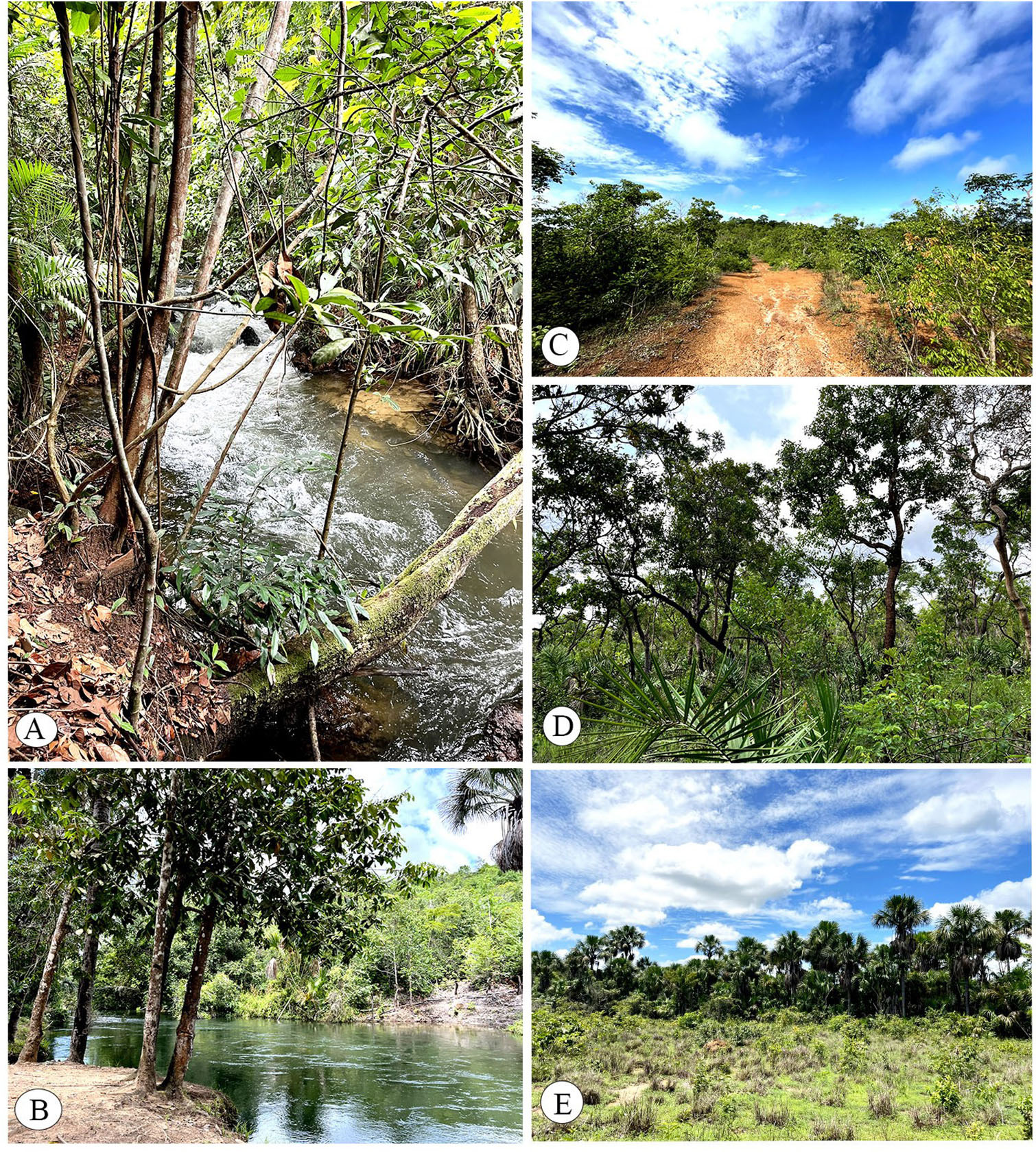
The MSP (06º10’-06º42 ‘S e 44º43’ - 45º54 ‘W) is located in the state of Maranhão, northeastern Brazil, covering an area of 502,339 hectares in the municipality of Mirador (Figure 1) (Maranhão 2024). The MSP hosts the headwaters of the Itapecuru and Alpercatas rivers, the former being one of the longest rivers in the state, traversing diverse topographic and climatic gradients (NUGEO 2009, Conceição & Castro 2009, Silva & Conceição 2011). The predominant vegetation in the MSP is typical of the Brazilian Cerrado and includes plant physiognomies such as campo-cerrado, campo-limpo, typical cerrado, or cerrado sensu stricto; wetland vegetation such as veredas, regionally known as “brejo” or “buritizais”; and riparian forests, commonly referred to as gallery and riparian forests (Machado et al. 2004, ICMBIO 2012). For this study, plant physiognomies were grouped based on the environmental conditions they provide for bryophytes (e.g., vegetation, humidity, and cover), resulting in three simplified categories: Cerrado (campo-cerrado, campo-limpo, typical cerrado, or cerrado sensu stricto), Veredas (including brejo, veredas, or buritizais), and Riparian Forest (including forests along watercourses, such as gallery and riparian forests) (Figure 2).

Map of the geographic location and collection sites within Mirador State Park, Maranhão, Brazil.

A–E. Environments within Mirador State Park. A–B. Riparian Forest (Gallery Forest; Ciliary Forest); C–D. Cerrado (Cerradão; Cerrado sensu stricto). E. Veredas.
The climate is classified as Aw (tropical sub-humid dry), with annual precipitation ranging from 1,200 to 1,400 mm and average temperatures between 19.5 °C and 33 °C (Alcântara 2004, Andrade et al. 2017). The rainy season spans from December to May, while the dry season occurs from June to November.
2. Collection and identification
Botanical collection expeditions were conducted in February and June 2023 and January 2024, each lasting five days. Specimens were collected through free-walking surveys, following the methodology of Filgueiras et al. (1994). The processes of collection, herborization, and preservation were conducted following the techniques described by Glime (2017).
Specimens were identified from the literature (Gradstein et al. 2001, Gradstein & Costa 2003, Buck 1998, 2003, Gradstein & Ilkiu-Borges 2009, Bordin & Yano 2013, Alonso et al. 2019, Bastos & Gradstein 2020a, b, Gradstein 2021). Classification for Bryophyta followed Goffinet et al. (2009), with updates for Sematophyllaceae from Carvalho et al. (2017), and for Marchantiophyta, Crandall-Stotler et al. (2009), and Sukkharak and Gradstein (2017) for Thysananthus Lindenb. Taxonomic identification was performed at the Plant Systematics Laboratory of the Federal University of Maranhão, Chapadinha Campus (UFMA-Chapadinha) and at the Bryology Laboratory of the Museu Paraense Emílio Goeldi (BRIOLAB/MPEG). Identified specimens were deposited in the CCAA herbarium (UFMA-Chapadinha), with duplicates of some specimens in the MG herbarium (MPEG).
Species were classified based on their substrates: corticolous (on live tree trunks or roots), epixylic (on decomposing wood), epiphyllous (on live leaves), rupicolous (on rocks), terrestrial (on soil) (Robbins 1952, Pócs 1996), or on termite mounds (Macedo & Ilkiu-Borges 2014).
Global distribution patterns of species were based on works by Gradstein & Costa (2003), Costa et al. (2011), Bordin & Yano (2013), Brito & Ilkiu-Borges (2014), Oliveira-da-Silva et al. (2018), Gradstein (2021), or the online database Tropicos.org. (2024). The geographic distribution in the Brazilian states was determined using literature or online databases (Costa et al. 2011, Peralta et al. 2011, Brito & Ilkiu-Borges 2014, Macedo & Ilkiu-Borges 2014, Oliveira & Bastos 2014, Cerqueira et al. 2015, Oliveira et al. 2018, Canestraro & Peralta 2022, Flora e Funga do Brasil 2024).
3. Floristic similarity analysis
We compared the list of bryophyte species from Mirador State Park (MSP) with floristic inventories from 17 other protected areas in the Brazilian Cerrado (Table 1). The floristic composition data were compiled into a presence-absence matrix representing the occurrence of species at each sampled site. To reduce noise and the influence of rare species, unique species were removed from the matrix.
Floristic similarity was calculated using the Jaccard dissimilarity index through the vegan package (Oksanen et al., 2019). A dendrogram was constructed using the unweighted pair group method with arithmetic mean (UPGMA). To determine the optimal number of floristic groups, we applied the Partitioning Around Medoids (PAM) algorithm and evaluated the average silhouette width for different values of k (Schubert & Rousseeuw 2019, 2021). The k value with the highest silhouette index was selected as the one that best represents the data structure.
Figures were created using the vegan (Oksanen et al. 2019) and ggplot2 (Wickham 2016) packages. All analyses were performed using R (version 4.3.2; R Core Team, 2023).
Results
1. Bryophyte richness and distribution across MSP plant physiognomies
At MSP, a total of 1,416 bryophyte specimens were identified, comprising 64 species distributed in 35 genera and 21 families (Table 2). Among these, mosses accounted for 38 species, 20 genera and 14 families, while liverworts totaled 26 species, 15 genera and seven families.
Bryophytes of Mirador State Park, Maranhão. Abbreviations: TV = live trunk; TD = decomposing trunk; R = rock; S = soil; C = termite mound; F = leaf; CE = Cerrado; VE = Veredas; RF = Riparian Forests. *New record in Maranhão. **New record in the Northeast region. ***New record in the Brazilian Cerrado.
Within the mosses, the family Fissidentaceae was the most represented, with 11 species. Among the liverworts, Lejeuneaceae exhibited the highest species richness, with 19 species (Figure 3). The most species-rich genus among mosses was Fissidens Hedw. (11 species), while Cheilolejeunea (Spruce) Schiffn. (6 species) dominated among liverworts.

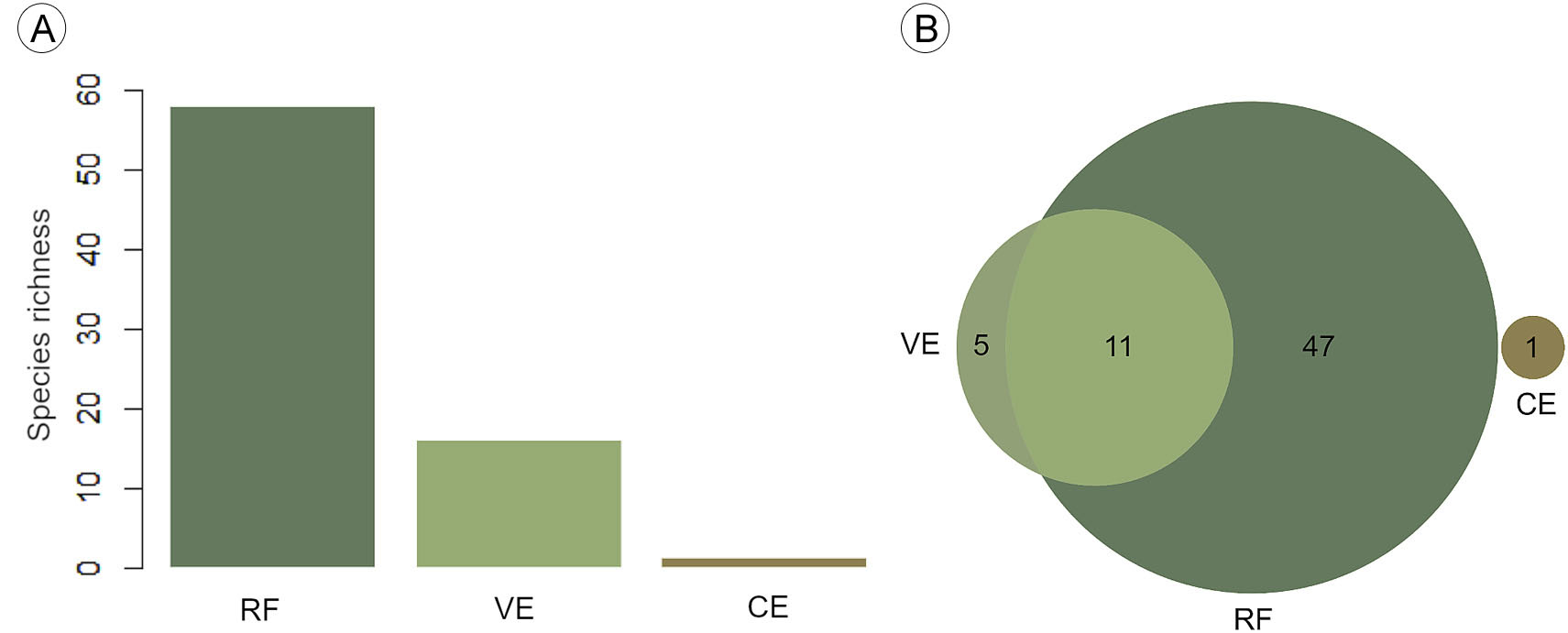
Riparian Forest (58 species/1372 specimens) showed the highest number of species and specimens among the studied phytophysiognomies, followed by Vereda (16 species/42 specimens) and Cerrado (1 species/2 specimens) (Figure 4A). The Cerrado featured only a single species, which was unique to this environment. The Riparian Forest and Vereda displayed 47 and 5 exclusive species, respectively, and shared 11 species (Figure 4B).
A–Species richness across three plant physiognomies: Riparian Forest (RF), Veredas (VE), and Cerrado (CE); B–Venn diagram showing species overlap among the three plant physiognomies of MSP.
Local species distribution was uneven: 24 species had only one recorded occurrence, 27 species appeared between two and ten times, 10 species were recorded between 20 and 60 times, and three species were found over 150 times. The three most abundant species at MSP were Microcalpe subsimplex (Hedw.) W.R.Buck and Octoblepharum albidum Hedw., which occurred in Riparian Forest or Vereda, and Lejeunea flava (Sw.) Nees, found exclusively in Riparian Forest.
2. Substrate preferences for Bryophytes
Regarding the substrates where specimens were collected, corticolous species (on tree trunks) predominated (64%), followed by epixylic (on decomposing wood) (25%), terricolous (on soil) (5%), rupicolous (on rocks) (4%), on termite mounds (1%), and epiphyllous (on live leaves) (1%). Liverworts showed a greater preference for live tree trunks (17 species), while mosses preferred rocks (21 species). Of the 64 species recorded, 30 were found exclusively on a single type of substrate. However, these had few occurrences within the plant physiognomies of MSP (1 to 3 occurrences), with most represented by only a single specimen. The species with the highest number of occurrences, such as Lejeunea flava (481 specimens), Microcalpe subsimplex (389 specimens), and Octoblepharum albidum (162 specimens), were found on four or five types of substrate, though all occurred predominantly on live trunks. Fissidens submarginatus Bruch was collected only 15 times but was found on five different substrate types.
Four species were collected on live leaves, all liverworts from the genera Cololejeunea (Spruce) Steph. and Lejeunea Lib. Only mosses were collected from termite mounds, representing the genera Fissidens, Campylopus Brid., Bryum Hedw., and Microcalpe (Mitt.) W.R. Buck.
3. Global occurrence patterns
Regarding global geographic distribution, most species exhibited a Neotropical distribution pattern (34 species), followed by Pantropical (25 species). Cheilolejeunea savannae L.P. Macedo, Ilk.-Borg. & C. Bastos is endemic to Brazil, while Syrrhopodon elatus Mont. is endemic to South America. Frullania platycalyx Herzog has a restricted distribution in South America (northern Argentina and Brazil), and Leucoloma tortellum (Mitt.) A. Jaeger is found in Central and South America.
Two Chionoloma species, C. schlimii (Müll.Hal.) M. Alonso, M.J. Cano & J.A. Jiménez and C. arboreum (Mitt.) M. Alonso, M.J. Cano & J.A. Jiménez, have broad but disjunct distributions. The former species occurs in the Neotropical region, Oceania, and Southeast Asia and is widely distributed in Brazil, while the latter is found in northern South America, Malawi (Africa), and Japan, with previous records in Brazil’s North, Central-West, and Southeast regions.
Syrrhopodon elatus Mont. is a new record for the Brazilian Cerrado and the Northeast region. Chionoloma arboreum, and Fissidens allionii Broth. are new records for Northeast Brazil. C. schlimii, F. dissitifolius Sull., Chryso-hypnum elegantulum (Hook.) Hampe, is new records for Maranhão.
4. Similarity between MSP and protected areas in the Brazilian Cerrado
Floristic similarity analysis based on the Jaccard index revealed a high degree of representativeness of the UPGMA dendrogram in relation to the dissimilarity matrix, as indicated by the cophenetic correlation coefficient (r = 0.869). The PAM algorithm identified k = 3 as the optimal number of clusters, matching the cutoff point in the UPGMA dendrogram (Figure 5).

Analysis of relationships and similarities between MSP and other protected areas in the Brazilian Cerrado.
The MSP was grouped into Cluster 1 along with 14 other protected areas in the Cerrado. Cluster 2 included the Resex Chapada Limpa (RCL) and the Area of Relevant Interest Ecological Itamacaoca (ARIEI). Cluster 3 consisted solely of the Goiabal Municipal Park (GMP).
Discussion
1. Bryophyte richness and distribution across MSP plant physiognomies
The MSP hosts the third-highest diversity of bryophytes in Maranhão, accounting for 22% of the state’s bryophyte flora, surpassed only by CMNP, with 132 species, and NRPNP with 77 species, have greater diversity, ranking first and second, respectively (Santos & Conceição, 2010, Conceição et al. 2010, Varão et al. 2011, Brito & Ilkiu-Borges 2014, Macedo & Ilkiu-Borges 2014, Costa et al. 2015, Vieira et al. 2017, Costa et al. 2018, Silva et al. 2018, Oliveira et al. 2018a-d, Bonfim et al. 2019, Oliveira et al. 2020, Costa et al. 2021, Silva et al. 2021, Fernandes et al. 2021, Silva et al. 2024, Carvalho et al. 2025).
This study added 51 species to the known bryophyte list for MSP (Santos & Conceição 2010), nearly tripling the number of recorded species for the area. However, despite conducting more intensive sampling and exploring the same plant physiognomies, we did not encounter seven species previously recorded at MSP, namely: Brachymenium exike (Dozy & Molk) Bosch & Sande-Lacoste, Campylopus carolinae Grou, Fissidens intromarginatus (Hampe) A. Jaeger, Sematophyllum galipense (Müll.Hal.) Mitt [Vitalia galipensis (Müll.Hal.) P. E. A. S. Câmara, Carv.-Silva & W. R. Buck], Taxithelium planum (Brid.) Mitt., Frullania ericoides (Nees) Mont. e Arachniopsis monodactyla (Spruce) R.M.Schust. Canestraro & Peralta (2022) reported that some specimens deposited in herbaria as Brachymenium exile, such as those mentioned by Bordin (2008), Peralta & Yano (2006), and Yano & Peralta (2011), actually correspond to Bryum atenense, which in turn was collected at MSP. The absence of these bryophyte species in the study area may reflect the impacts of environmental degradation, including habitat fragmentation and microclimate changes — factors to which these organisms are particularly sensitive (Hallingbäck & Hodgetts 2000, Gignac 2001, Bates 2009, Wolski & Kruk 2020). Loss of habitat continuity compromises the dispersal and local persistence of sensitive species (Löbel et al. 2006), which suggests that anthropogenic disturbances such as those occurring in the MSP compromise the physical environment and ecological conditions essential for maintaining bryophyte diversity.
The dominance of mosses over liverworts at MSP was anticipated, as floristic surveys in the Cerrado typically reveal a significantly higher diversity of mosses compared to liverworts (Genevro et al. 2006, Oliveira et al. 2006, Soares & Guimarães 2010, Yano & Peralta 2011a, b, Costa et al. 2015, Carmo & Peralta 2016, Rios et al. 2016, Peñaloza-Bojacá et al. 2017, Costa et al. 2018, Nascimento et al. 2020). Mosses display a broad range of morphologies, physiological mechanisms, and life histories that allow for greater tolerance to environmental stress, such as low humidity, high solar exposure, and elevated temperatures (Proctor & Smith 1994, Marschall & Proctor 2004). These traits are especially advantageous in the Cerrado, where such challenging conditions are common.
The bryophyte families with the greatest species richness at MSP (Fissidentaceae and Lejeuneaceae) are frequently recorded in Cerrado floristic surveys, particularly in Riparian Forests (Câmara & Costa 2006, Soares et al. 2011, Sousa & Câmara 2015, Carmo & Peralta 2016, Costa et al. 2018, Nascimento et al. 2020). Recognized as some of the most diverse families in both Brazil and the Neotropical region, these families exhibit variable morphological traits and broad ecological adaptability (Buck 1998, Gradstein & Costa 2003, Gradstein & Ilkiu-Borges 2009, Bordin & Yano 2013, Flora e Funga do Brasil, 2024). Floristic surveys conducted across the five protected areas in the Cerrado of Maranhão (i.e., IMEPA, BMEPA, NRPNP, MSP, and CMNP) also confirm the predominance of these families (Santos & Conceição 2010, Varão et al. 2011, Costa et al. 2015, Vieira et al. 2017, Costa et al. 2018, Oliveira et al. 2018a, b).
Fissidens and Cheilolejeunea are often highlighted as the genera with the highest species diversity in Maranhão (Oliveira et al. 2023). Species from these genera are found across a wide range of environments, from natural to urban, colonizing various substrates, and are notable for their high species richness in the Neotropical region (Pursell 2007, Bordin & Yano 2013, Bastos & Gradstein 2020a, Flora e Funga do Brasil 2024).
The abundance and richness of bryophytes in the Riparian Forests of MSP can be attributed to high humidity, shading, and the diversity of microhabitats, which create ideal conditions for bryophyte colonization and establishment (Weberling & Schwantes 1986, Goffinet et al. 2009, Silva et al. 2024). Studies in Cerrado riparian forests emphasize the high bryophyte species richness compared to other plant physiognomies within this phytogeographic domain (Genevro et al. 2006, Câmara 2008a, b, Sousa & Câmara 2015, Dislich et al. 2018, Silva et al. 2024). The greater number of species shared between Riparian Forests and Veredas at MSP suggests that water availability and high humidity favor bryophyte occurrence in these environments (Santos et al. 2021, Silva et al. 2024).
Although Cerrado sensu stricto is the predominant environment at MSP, only one bryophyte species was recorded there: Chionoloma arboreum (Mitt.) M.Alonso, M.J.Cano & J.A.Jiménez (on soil). This species is typically epiphytic or epixylic but can be found on soil or rocks in shrubby vegetation (Alonso et al. 2019). The Cerrado domain where it was collected is characterized by sparse tree and shrub cover, high solar radiation exposure, and low water availability (Ribeiro & Walter, 2008), presenting conditions that limit bryophyte diversity and frequency.
The uneven distribution of species in the study area indicates the presence of distinct microhabitats that benefit certain species over others. Most species were observed infrequently, while some showed significant abundance, a common pattern in tropical inventories (Pantoja et al. 2015). Microcalpe subsimplex and Octoblepharum albidum were frequently found in both Riparian Forests and Veredas in the Cerrado, adapting to varying levels of shading in riparian forests as well as to the moderate sunlight typical of Veredas (Santos et al. 2021, Fernandes et al. 2021, Silva et al. 2024). In contrast, Lejeunea flava, recorded exclusively in Riparian Forests, shows a preference for this plant physiognomy in the Cerrado (Genevro et al. 2006, Oliveira et al. 2006, Pinheiro et al. 2012, Yano & Peralta 2009, Fernandes et al. 2021). This pattern suggests a higher dependency of Lejeunea flava on humid and shaded environments, despite its classification as a generalist species (Fagundes et al. 2016).
2. Substrate preferences for Bryophytes
At MSP, the dominance of corticolous bryophytes, especially liverworts, can be attributed to the abundance of tree trunks that provide humid, shaded microhabitats (Richards 1984, Holz & Gradstein 2005). The ability of bark to retain moisture helps maintain a favorable environment for colonization by these species (Hallingbäck & Hodgetts 2000, Proctor & Tuba 2002, Proctor 2008, Oliveira-da-Silva & Ilkiu-Borges 2018, Gomes et al. 2021). Numerous studies in tropical forests highlight the greater diversity and abundance of bryophytes on live trunks (Gradstein et al. 2001, Gradstein & Costa 2003). Mosses in the MSP were predominantly found on rocks, consistent with recent studies indicating a preference for rocky substrates by these species (Silva et al. 2024, Silva et al. 2025, in press).
Most bryophytes show adaptability to a wide range of substrates and tolerance to variations in substrate characteristics (Kruys & Jonsson 1999). At MSP, approximately 46% of the species studied were collected from only one type of substrate, which may be attributed to variations in humidity, light, and temperature across the plant physiognomies studied. These variations create diverse microclimates that influence species concentrations on specific substrates.
In a previous study at MSP, the species Microcalpe subsimplex, Octoblepharum albidum, and Lejeunea flava showed high occurrence, with the latter found exclusively colonizing live tree trunks (Santos & Conceição 2010). These species are considered generalists and, due to their morphological traits, are commonly found on two or more substrate types, even in open and water-restricted environments (Fagundes et al. 2016, Bastos & Gradstein 2020, Costa et al. 2021, Silva et al. 2024).
Fissidens submarginatus typically occurs on soil, rocks, and termite mounds in humid and shaded environments, being widely distributed across Brazil and regarded as a generalist species (Lisboa 1993, Pursell 2007, Bordin & Yano 2013). At MSP, this species was widely recorded, colonizing not only these substrates but also live and decomposing tree trunks, demonstrating its high adaptability.
The liverworts Cololejeunea cardiocarpa, C. diaphana, Lejeunea flava, and L. laetevirens are frequently found on leaves (Gradstein, 2021) and were the only epiphyllous species recorded at MSP. Epiphyllous species generally have specific ecological requirements (Zartman & Ilkiu-Borges, 2007) and may be either exclusive or facultative to this substrate.
Termite mounds are predominantly colonized by mosses, particularly from the genus Fissidens (Tavares, 2009, Ilkiu-Borges et al. 2009), one of the four genera recorded on this substrate at MSP. The prevalence of Fissidens on termite mounds may be due to lower competition with other bryophytes on this substrate (Reese & Pursel, 2002).
3. Global occurrence patterns
The predominance of Neotropical and Pantropical species was expected, given their frequent presence in floristic studies across Brazil (Tavares 2009, Soares et al. 2011, Garcia 2012, Macedo 2012, Brito & Ilkiu-Borges 2014, Carmo & Peralta 2016, Oliveira-da-Silva & Ilkiu-Borges 2018, 2020, Silva et al. 2021). Cheilolejeunea savannae is the only species identified at MSP that is endemic to Brazil, with a broad distribution throughout the country (Bastos & Gradstein 2020, Bastos & Silva 2023). In Maranhão, this species is found exclusively in Riparian Forests within the Cerrado (Silva et al. 2021, 2024), a pattern consistent with the findings of the present study.
Frullania platycalyx has been previously recorded in 13 Brazilian states and in San Javier in northern Argentina (Gradstein & Costa 2003, Flora e Funga do Brasil 2024). In this study, it was found only once, in a Riparian Forest. Leucoloma tortellum, distributed across Central and South America, is also well-recognized in Brazilian states (Flora e Funga do Brasil 2024). At MSP, it was found colonizing decomposing tree trunks in Riparian Forests.
Syrrhopodon elatus, a new record for the Brazilian Cerrado and the northeast region, is endemic to South America, with occurrences in French Guiana and Suriname (Reese & Buck 1991). In Brazil, it was previously recorded only in Pará (Churchill 1998, Oliveira & ter Steege 2013, Takashima-Oliveira et al. 2020, Sousa-Pereira et al. 2024). In this study, the species was found only once, on a tree trunk in a riparian forest.
Fissidens allionii is a new record for Northeast Brazil (Bordin & Yano 2013, Flora e Funga do Brasil 2024). Previously, this species was primarily known from the Amazon region (Acre, Amazonas, Pará, and Rondônia), with one record from Minas Gerais, commonly found on rocks, soil, and termite mounds (Carmo & Peralta 2016, Bordin & Yano 2013, Flora e Funga do Brasil 2024).
Chionoloma arboreum, newly recorded for Maranhão and Northeast Brazil, is a poorly understood and challenging species to identify. Before the genus revision by Alonso et al. (2019), it was known only from Venezuela and a few Brazilian locations (under various names). The genus remains poorly studied, and many herbarium samples are incorrectly identified, compounding identification errors. The two specimens examined in this study exhibited curled leaves when dry, obovate (never oblong-ligulate, as C. arboreum can also appear), with a slightly narrower or similarly wide base as the upper lamina and an obtuse to acute apex (less common in C. arboreum) (Alonso et al. 2019).
Chionoloma schlimii is recorded for the first time in Maranhão, though it has been documented in several other states, indicating a broad distribution across the country (Alonso et al. 2019). This species is typically found on soil, rocks, banks, river edges, or tree trunks in both exposed and shaded locations (Alonso et al. 2019). At MSP, it was collected on rocks within riparian forests. The species is distinguished by its lanceolate leaves with an excurrent costa, mucronate apex, and central basal cells that are rectangular to short-rectangular, often inflated and hyaline, forming a differentiated area that contrasts with the green, pluripapillose cells of the lamina, giving the plant an opaque appearance (Alonso et al. 2019).
Fissidens dissitifolius is also recorded for the first time in Maranhão, with a rare distribution in Brazilian states (Bahia, Paraná, Piauí, and São Paulo) (Bordin & Yano, 2013). Other species that are newly recorded for the state, Chryso-hypnum elegantulum, Ectropothecium leptochaeton, and Symphyogyna brasiliensis, are found across Brazil’s major phytogeographic domains and are widely distributed in other states (Costa et al. 2011, Flora & Funga do Brasil 2024). Although the occurrence of these species in Maranhão was anticipated, expanding their known geographic range is an important contribution to conservation efforts.
4. Similarity between MSP and protected areas in the Brazilian Cerrado
Cluster analysis of the floristic composition revealed clear, ecologically consistent regional structures among the evaluated protected areas. The separation into three distinct groups indicates the existence of floristic patterns organized by both space and environment. The Cerrado, which is known for its high abiotic heterogeneity, provides a variety of ecological niches that facilitate species coexistence and floristic overlap among areas. Through niche partitioning and divergent responses to the same environmental gradients, species with different adaptive strategies can coexist (Ratter & Dargie 1992, Oliveira-Filho & Ratter 2002, Kraft et al. 2014). Regarding bryophytes, this floristic structure may be influenced by geographic proximity, local ecological contexts, management history, vegetation types, and protected area size (Hutsemekers et al. 2008).
The largest group includes most of the analyzed Cerrado areas, including MSP. This reflects the relatively homogeneous floristic composition of these protected areas, which is possibly associated with the biome’s characteristic broad species distribution and similarities in vegetation types, especially gallery forests. These forests often serve as refuges for bryophytes (Aquino et al. 2015, Silva et al. 2024). This cluster comprises relatively large, floristically rich areas, which suggests a positive relationship between area size and species diversity. This relationship is commonly attributed to greater habitat and vegetation heterogeneity as well as a broader range of ecological niches in larger areas (Hutsemekers et al. 2008).
The MSP and the IMEPA formed a cohesive floristic subgroup within Cluster 1; both are located in the eastern Maranhense. Their geographic proximity likely contributes to this similarity, reflecting short-distance dispersal patterns and habitat compatibility. Although bryophytes can disperse over long distances, spatial distance remains a key factor in floristic composition, particularly at local scales (Patiño & Vanderpoorten, 2018; Vanderpoorten et al. 2019).
The RCL and ARIEI areas may have clustered together due to their geographic proximity. Both areas are located in the same city, just 30 meters apart, and they have very similar vegetation. The high species richness in the Cerrado is closely linked to habitat heterogeneity (Felfili et al. 1994), which contributes to increased floristic similarity among communities in close proximity that share similar ecological conditions (Françoso et al. 2016).
Cluster 3, which consists solely of GMP, exhibits a distinctive floristic composition that may be influenced by factors such as the history of disturbance and the stage of vegetation succession. This distinctiveness may be related to the park’s urban location, which implies greater human impact and altered local ecological dynamics (Lima & Rocha 2015).
The MSP demonstrated significant bryophyte richness and composition for the state of Maranhão, with 51 new species recorded for the area, including new state records (Fissidens dissitifolius, and Chryso-hypnum elegantulum), new records for the Northeast region (Fissidens allionii, Chionoloma arboreum, and C. schlimii), and a new Cerrado record (Syrrhopodon elatus). These results expand our knowledge of the distribution of these species and underscore the importance of MSP in regional biodiversity conservation.
The predominance of species in Riparian Forests reinforces the importance of these plant physiognomies for bryophyte communities, as they provide favorable conditions like high humidity and shading. Furthermore, the uneven distribution of species across different substrates highlights the need to conserve a variety of microhabitats to ensure bryophyte diversity. It was not possible to assess differences between communities because the collections were conducted through free-walk surveys without a standardized sampling effort across vegetation types. This lack of uniformity prevents robust, comparative statistical analyses.
However, the method used is widely adopted in floristic surveys, especially in poorly studied areas, as it allows for broader taxonomic coverage and the recording of previously undocumented species. Even without statistical support, the study fulfills its primary objective of documenting diversity and expanding floristic knowledge, providing a solid foundation for future, more structured ecological research.
The floristic similarity analysis between MSP and other protected areas in the Brazilian Cerrado revealed important affinities, suggesting these areas are complementary for regional biodiversity conservation. This emphasizes the need for integrated conservation strategies that consider connectivity among protected areas.
This study highlights the importance of floristic and taxonomic research in Cerrado protected areas and reinforces the need for ongoing research, monitoring, and preservation efforts, especially in light of anthropogenic pressures and environmental changes.
Acknowledgments
We thank Dr. Felipe Polivanov Ottoni, Sirlane Santos Oliveira, Vanessa Fernandes Ferreira, and Lucas Oliveira for their support in field logistics and collection; Dr. Bianca Kalinowski Canestraro, Dr. Cid Bastos, Dr. Juçara Bordin, and MSc. José Augusto Santos Silva for confirming the identification of Bryum capillare, Cheilolejeunea rigidula, Fissidens allionii, and Riccia plano-biconvexa, respectively; and Dr. Fúvio R. Oliveira-da-Silva for confirming the identification of various species. We thank the State Secretary for the Environment and Natural Resources for the structure of the support bases provided and the assistance of the guides within the Park. We also extend our gratitude to the Fundação de Amparo à Pesquisa do Estado do Maranhão for financial support through a master’s scholarship (BM-01796/23). Chamada CNPq/MCTI Nº 10/2023 - Faixa A - Grupos Emergentes Processo: 404619/2023-1.
Data Availability
The datasets generated during and/or analyzed during the current study are available at: https://doi.org/10.48331/scielodata.4KH9YL.
References
- AB’SABER, A.N. (1967). Domínios morfoclimáticos e províncias fitogeográficas do Brasil. Orientação 3, 45–48.
- ALCÂNTARA, E.H. (2004). Caracterização da bacia hidrográfica do rio Itapecuru, Maranhão-Brasil. Caminhos de Geografia 7, 97–113.
-
ALONSO, M., JIMÉNEZ, J.A., & CANO, M.J. (2019). Taxonomic revision of Chionoloma (Pottiaceae, Bryophyta). Annals of the Missouri Botanical Garden 104, 563–632. https://doi:10.3417/2019381
» https://doi.org/10.3417/2019381 - ANDRADE, V.M.S., CORDEIRO, I.M.C.C., SCHWARTZ, G., RANGEL-VASCONCELOS, L.G.T. & OLIVEIRA, F.A. (2017). Considerações sobre clima e aspectos edafoclimáticos da mesorregião Nordeste paraense. In: Libonati I.F., Pinto A.L. & Silva J.P.L. (Eds.) Nordeste Paraense: panorama geral e uso sustentável das florestas secundárias. Ed. EDUFRA, Belém, Pará, p.59–96.
- AQUINO, H.F.D., RESENDE, I.L.D.M., PERALTA, D F. & ROCHA, L.M D. (2015). Bryoflora of Gallery Forest in Quirinópolis, Goiás State, Brazil. Hoehnea 42:419–424.
-
BARBOSA, B.B., COELHO, C.C.J., MORAES, L.A. & SANTOS, L.A. (2020). Unidades de Conservação no Brasil: um enfoque para a Região dos Cocais, no Leste Maranhense. Research, Society and Development 9, e568997473–e568997473. https://doi:10.33448/rsd-v9i9.7473
» https://doi.org/10.33448/rsd-v9i9.7473 -
BASTOS, C.J.P. & GRADSTEIN, S.R. (2020a). The genus Lejeunea Lib. (Lejeuneaceae, Marchantiophyta) in Brazil. Phytotaxa 453, 55–107. https://doi:10.11646/phytotaxa.453.2.1
» https://doi.org/10.11646/phytotaxa.453.2.1 -
BASTOS, C.J.P. & GRADSTEIN, S.R. (2020b). The genus Cheilolejeunea (Marchantiophyta: Lejeuneaceae) in tropical America. Nova Hedwigia 111, 287–335. https://doi:10.1127/nova_hedwigia/2020/0596
» https://doi.org/10.1127/nova_hedwigia/2020/0596 -
BASTOS, C.J.P. & SILVA, F.V.D.S. (2023). Notas sobre a ocorrência de Cheilolejeunea savannae LP Macedo, Ilk.-Borg. & CJ Bastos e C. intertexta (Lindenb.) Steph. no Brasil, e restabelecimento de Cheilolejeunea compacta (Steph.) ME Reiner (Lejeuneaeceae, Jungermanniidae). Hoehnea 50, e542022. https://doi:10.1590/2236-8906e542022
» https://doi.org/10.1590/2236-8906e542022 - BATES, J. W. (2009). Mineral nutrition and substratum ecology. In: Goffinet, B. & Shaw, A.J. Bryophyte Biology. Cambridge University Press, Cambridge. New York, p.299–356.
-
BONFIM, M.A., OLIVEIRA R.F., OLIVEIRA, R.R., GOMES, G.S., ARAUJO, M.F.V., SILVA, M.L.A.; ...& CONCEIÇÃO, G.M. (2019). Bryophytes in Maranhão/Brazil: A New Area, a New Species List. International Journal of Advanced Engineering Research and Science 6, 188–192. https://doi:10.22161/ijaers.68.24
» https://doi.org/10.22161/ijaers.68.24 - BORDIN, J., & YANO, O., (2013). Fissidentaceae (Bryophyta) do Brasil. Instituto de Botânica (São Paulo) 22:1–168.
- BRITO, E.S., & ILKIU-BORGES, A.L. (2014). Briófitas de uma área de Terra Firme no município de Mirinzal e novas ocorrências para o estado do Maranhão. Iheringia - Série Botânica 69, 133–142.
- BUCK, W.R. (1998). Pleurocarpous mosses of the West Indies. Memoirs of the New York Botanical Garden. 400p.
- BUCK, W.R., (2003). Guide to the Plants of Central French Guiana – Part 3. Mosses. Memoirs of The New York Botanical Garden, p.1–1167.
-
BUTCHART, S.H., CLARKE, M., SMITH, R.J., SYKES, R.E., SCHARLEMANN, J.P., HARTOOT, M., …& BURGESS, N.D. (2015). Shortfalls and solutions for meeting national and global conservation area targets. Conservation Letters 8: 329–337. https://doi:10.1111/conl.12158
» https://doi.org/10.1111/conl.12158 -
CALDAS, J.M., SILVA, F.B., SILVA JUNIOR, C.H.L. (2014). Análise de focos de queimadas no Parque Estadual do Mirador utilizando um Sistema de Informação Geográfica–SIG, Estado do Maranhão, Brasil. In Proceedings of Safety, Health and Environment World Congress 14, 134–138. https://doi:10.14684/SHEWC.14.2014.134-138
» https://doi.org/10.14684/SHEWC.14.2014.134-138 - CÂMARA, P.E.A.S. & COSTA, D.P., (2006). Hepáticas e antóceros das matas de galeria da Reserva Ecológica do IBGE, RECOR, Distrito Federal, Brasil. Hoehnea 33, 41–49.
- CÂMARA, P.E.A.S. (2008a). Musgos pleurocárpicos das matas de galeria da Reserva Ecológica do IBGE, RECOR, Distrito Federal, Brasil. Acta Botanica Brasilica 22, 573–581.
- CÂMARA, P.E.A.S., (2008b). Musgos acrocárpicos das matas de galeria da Reserva Ecológica do IBGE, RECOR, Distrito Federal, Brasil. Acta Botanica Brasilica 22, 1027–1035.
-
CANESTRARO, B.K., PERALTA, D.F. (2022). Synopsis of Anomobryum and Bryum (Bryaceae, Bryophyta) in Brazil. Acta Botanica Brasilica 36, e2021abb0283. https://doi:10.1590/0102-33062021abb0283
» https://doi.org/10.1590/0102-33062021abb0283 -
CARMO, D.M.D., & PERALTA, D.F. (2016). Survey of Bryophytes in Serra Canastra National Park, Minas Gerais, Brazil. Acta Botanica Brasilica 30, 254–265. https://doi:10.1590/0102-33062015abb0235
» https://doi.org/10.1590/0102-33062015abb0235 -
CARVALHO, F.V., SILVA, J.A.S., ILKIU-BORGES, A.L., COSTA, D.P., FERNANDES, R.S. (2025). Bryophytes of the Cerrado: a floristic study in an urban area and in two conservation units in eastern Maranhão, Brazil. Check List 21, 12–38. https://doi:10.15560/21.1.12
» https://doi.org/10.15560/21.1.12 -
CARVALHO-SILVA, M., STECH, M., SOARES-SILVA, L.H., BUCK, W.R., WICKETT, N.J., LIU, Y. & CÂMARA, P.E.A.S. (2017). A Molecular Phylogeny of the Sematophyllaceae Sl (Hypnales) based on plastid, mitochondrial and nuclear markers, and its taxonomic implications. Taxon 66:811–831. https://doi.org/10.12705/664.2
» https://doi.org/10.12705/664.2 - CASTRO, N.M.C.F., PÔRTO, K.C., YANO, O. & CASTRO, A.A.J.F. (2002). Levantamento florístico de Bryopsida de cerrado e mata ripícola do Parque Nacional de Sete Cidades, Piauí, Brasil. Acta Botânica Brasilica 16:61–76.
-
CERQUEIRA, G.R., ILKIU-BORGES, A.L., MANZATTO, A.G., MACIEL, S. (2015). Briófitas de um fragmento de floresta ombrófila aberta no município de Porto Velho e novas ocorrências para Rondônia, Brasil. Biota Amazônia 5, 71–75. https://doi:10.18561/2179-5746/biotaamazonia.v5n2p71-75
» https://doi.org/10.18561/2179-5746/biotaamazonia.v5n2p71-75 - CHAPE, S., HARRISON, J., SPALDING, M. & LYSENKO, I. (2005). Measuring the extent and effectiveness of protected areas as an indicator for meeting global biodiversity targets. Philosophical Transactions of the Royal Society B: Biological Sciences 360, 443–455.
- CHURCHILL, S.P. (1998). Catalog of Amazonian mosses. The Journal of the Hattori Botanical Laboratory 85, 191–238.
- CONCEIÇÃO, G.M. & ARAGÃO, J.G. (2010). Diversidade e importância econômica das Myrtaceae do cerrado, Parque Estadual do Mirador, Maranhão. Scientia Plena 6, 1–8.
- CONCEIÇÃO, G.M. & CASTRO, A.A.J.F. (2009). Fitossociologia de uma área de cerrado marginal, Parque Estadual do Mirador, Mirador, Maranhão. Scientia Plena 5, 1–16.
- CONCEIÇÃO, G.M., RUGGIERI, A.C. & RODRIGUES, R.M. (2011). Malpighiaceae do cerrado do Parque Estadual do Mirador, Maranhão, Brasil. Scientia Plena 7, 1–6.
- CONCEIÇÃO, G.M., RUGIERI, A.C., BRITO, E.S. (2010). Musgos pleurocárpicos do município de Caxias, Maranhão, Brasil. Acta Tecnológica 5, 32–42.
- COSTA, A.M.R., OLIVEIRA, R.R., SANTOS-SILVA, D.L., SÁ, N.A.S. & CONCEIÇÃO, G.M. (2018). Briófitas do Cerrado Maranhense, Nordeste do Brasil. NBC-Periódico Científico do Núcleo de Biociências 8, 33–45.
- COSTA, D.P., PÔRTO, K.C., LUIZI-PONZO, A.P., ILKIU-BORGES, A.L., BASTOS, C.J.P., CÂMARA, P.E.A.S., ...& CHURCHILL, S.P. (2011). Synopsis of the Brazilian moss flora: checklist, distribution and conservation. Nova Hedwigia 93, 277–334.
- COSTA, F.B., SILVA, E.O. & CONCEIÇÃO, G.M. (2015). Hepáticas (Marchantiophyta) e musgos (Bryophyta) da Área de Proteção Ambiental do Buriti do Meio, município de Caxias, Maranhão, Brasil. Scientia Plena 11, 1–4.
- COSTA, F.B., SILVA, G.S., SANTOS-SILVA, D.L., GOMES, G.S., PERALTA, D.F. & OLIVEIRA, H.C. (2021). Hepáticas (Marchantiophyta) do Parque Nacional Chapada das Mesas: novos registros para o Bioma Cerrado. Revista principia 56, 191–201.
- CRANDALL-STOTLER, B., STOTLER, R., LONG D. (2009). Morphology and classification of the Marchantiophyta. In: Goffinet, B. & Shaw, A.J. Bryophyte Biology. Cambridge University Press, Cambridge. New York, p.1–54.
- DAWSON, T.P., JACKSON, S.T., HOUSE, J.I., PRENTICE, I.C. & MACE, G.M. (2011). Beyond predictions: biodiversity conservation in a changing climate. science 332, 53–58.
-
DINERSTEIN, E., VYNNE, C., SALA, E., JOSHI, A.R., FERNANDO, S., LOVEJOY, T.E., ...& WIKRAMANAYAKE, E. (2019). A global deal for nature: guiding principles, milestones, and targets. Science advances 5, eaaw2869. https://doi:10.1126/sciadv.aaw2869
» https://doi.org/10.1126/sciadv.aaw2869 -
DISLICH, R., PINHEIRO, E.M.L. & GUIMARÃES, M. (2018). Corticolous liverworts and mosses in a gallery forest in Central Brazil: Effects of environmental variables and space on species richness and composition. Nova Hedwigia 107, 385–406. https://doi:10.1127/nova_hedwigia/2018/0480
» https://doi.org/10.1127/nova_hedwigia/2018/0480 - FAGUNDES, D.N., TAVARES-MARTINS, A.C.C., ILKIU-BORGES, A.L., MORAES, E.N.R. & SANTOS, R.C.P. (2016). Riqueza e aspectos ecológicos das comunidades de briófitas (Bryophyta e Marchantiophyta) de um fragmento de Floresta de Terra Firme no Parque Ecológico de Gunma, Pará, Brasil. Iheringia Série Botânica 71, 72–84.
- FARIA, A.L.A., DANTAS, T.S. & CÂMARA, P.E.A.S. (2012). Musgos do Vale da Lua, Chapada dos Veadeiros, Goiás, Brasil. Heringeriana 6: 9–20.
-
FELFILI, J.M., SILVA-JÚNIOR, M.C., FILGUEIRAS, T.S. & REZENDE, A.V. (1994). Projeto biogeografia do bioma cerrado:vegetação e solos. Cadernos de Geociências 12:75–167. https://doi.org/10.1590/2236-8906-43/2014
» https://doi.org/10.1590/2236-8906-43/2014 -
FERNANDES, L.R., ATHAYDE-FILHO, F.P. & PERALTA, D.F. (2021). Cachoeiras como refúgio para briófitas no Cerrado Brasileiro. Research, Society and Development 10, e272101119647-e272101119647. https://doi:10.33448/rsd-v10i11.19647
» https://doi.org/10.33448/rsd-v10i11.19647 -
FERNANDES, R.S., SILVA, J.A.S., OTTONI, F.P. & COSTA, D.P. (2021). Diversity of thalloid liverworts in Brazilian Savanna of Parque Nacional da Chapada das Mesas, Maranhão, Brazil. Check List 17, 45–58. https://doi:10.15560/17.1.45
» https://doi.org/10.15560/17.1.45 -
FERREIRA, A.W.C., OLIVEIRA, M.S., SILVA, E.O., CAMPOS, D.S., PANSARIN, E.R. & GUARÇONI, E.A.E. (2017). Vanilla bahiana Hoehne and Vanilla pompona Schiede (Orchidaceae, Vanilloideae): two new records from Maranhão state, Brazil. Check List 13, 1131–1137. https://doi:10.15560/13.6.1131
» https://doi.org/10.15560/13.6.1131 - FILGUEIRAS, T.S., NOGUEIRA, P.E., BROCHADO, A.L. & GUALA, G.F. (1994). Caminhamento: um método expedito para levantamentos florísticos qualitativos. Cadernos de Geociências 12, 39–43.
-
FLORA E FUNGA DO BRASIL. Jardim Botânico do Rio de Janeiro. https://cutt.ly/EMOETMc (last access on 24/04/2024).
» https://cutt.ly/EMOETMc - FRANÇOSO, R.D., BRANDÃO, R., NOGUEIRA, C.C., SALMONA, Y.B., MACHADO, R.B. & COLLI, G.R. (2015). Habitat loss and the effectiveness of protected areas in the Cerrado biodiversity hotspot. Natureza & conservação 13, 35–40.
- FRANÇOSO, R.D., HAIDAR, R.F. & MACHADO, R.B. (2016). Tree species of South America central savanna: endemism, marginal areas and the relationship with other biomes. Acta Botanica Brasilica 30:78–86.
- GARCIA, E.T. (2012). Briófitas (Bryophyta e Marchantiophyta) de Remanescentes Florestais no Reservatório de Tucuruí, Pará, Brasil. Master’s thesis. Universidade Federal Rural da Amazônia, Museu Paraense Emílio Goeldi, Belém, Pará, p.1–87.
- GENEVRO, J.A., ATHAYDE-FILHO, F.P. & PERALTA, D.F. (2006). Briófitas de Mata de Galeria no Parque Municipal Mário Viana, Nova Xavantina, Mato Grosso, Brasil. Boletim do Instituto de Botânica 18, 149–157.
- GIGNAC, L. D. (2001). Bryophytes as Indicators of Climate Change. The Bryologist, 104: 410–420.
-
GLIME, J.M. (2017). Field Taxonomy and Collection Methods. In: Glime JM (Ed.) Bryophyte Ecology. Michigan Technological University and the International Association of Bryologists, p.1–22. https://digitalcommons.mtu.edu/bryophyte-ecology/ (last access on 08/11/2024).
» https://digitalcommons.mtu.edu/bryophyte-ecology/ - GOFFINET, B., BUCK, W.R. & SHAW, A.J. (2009). Morphology, anatomy, and classification of the Bryophyta. In: Shaw AJ & Goffinet B (Eds.). Bryophyte Biology, Cambridge University Press, p.21–70.
-
GOMES, P.W.P., MEDEIROS-SARMENTO, P.S., SANTOS, R.C.P. & TAVARES-MARTINS, A.C.C. (2021). Composition and structure of the bryophyte community of Park Savanna in Marajó Island, Pará, Brasil. Anais da Academia Brasileira de Ciências 93, e20190830. https://doi:10.1590/0001-3765202120190830
» https://doi.org/10.1590/0001-3765202120190830 - GRADSTEIN, S.R. & COSTA, D.P. (2003). The Hepaticae and Anthocerotae of Brazil. Memoirs of The New York Botanical Garden, p.1–318.
- GRADSTEIN, S.R. & ILKIU-BORGES, A.L. (2009). Guide to the Plants of Central French Guiana. Part 4. Liverworts and Hornworts. Memoirs of The New York Botanical Garden, p.1–140.
-
GRADSTEIN, S.R. (2021). The liverworts and hornworts of Colombia and Ecuador. Springer 121, 1–723. https://doi:10.1007/978-3-030-49450-6
» https://doi.org/10.1007/978-3-030-49450-6 - GRADSTEIN, S.R., CHURCHILL, S.P. & SALAZAR, A.N. (2001). Guide to the bryophytes of tropical America. Memoirs of the New York Botanical Garden, p.1–577.
- HALLINBACK, T. & HODGETTS, N. (compilers). (2000). Mosses, Liverworts and Hornworts. Status Survey and Conservation Action Plan for Bryophytes. Bryophyte Specialist Group. Cambridge: IUCN, p.1–106.
- HOLZ, I. & GRADSTEIN, S.R. (2005). Cryptogamic epiphytes in primary and recovering upper montane oak forests of Costa Rica–species richness, community composition and ecology. Plant ecology 178, 89–109.
- HUTSEMEKERS, V., DOPAGNE, C. & VANDERPOORTEN, A. (2008). How far and how fast do bryophytes travel at the landscape scale?. Diversity and distributions, 14:483–492.
-
IBGE – INSTITUTO BRASILEIRO DE GEOGRAFIA E ESTATÍSTICA. Subsídios ao Zoneamento Ecológico-Econômico da Bacia do Rio Itapecuru-MA: Diretrizes Gerais para Ordenação Territorial. Estudos e pesquisas em Geociências. - Rio de Janeiro. n.5, p.1–179, 1998. https://cutt.ly/cMOkQ0Z (last access on 13 /11/ 2022).
» https://cutt.ly/cMOkQ0Z -
ICMBio – INSTITUTO CHICO MENDES DE CONSERVAÇÃO DA BIODIVERSIDADE. (2012). https://cutt.ly/2MOkZha (last access on 30/04/ 2022).
» https://cutt.ly/2MOkZha - ILKIU-BORGES, A.L., SANTOS, R.C.P., MACEDO, L.P.C. & PEREIRA, M.A.V. (2009). As briófitas da ilha do Algodoal Maiandeua, Pará. In: Jardim, M.A.G. (org.). Diversidade Biológica das Áreas de Proteção Ambiental: Ilhas do Combu e Algodoal-Maiandeua - Pará, Brasil. Museu Paraense Emílio Goeldi, Belém, p.227–244.
-
ISA – INSTITUTO SOCIOAMBIENTAL. (2022). Unidades de Conservação no Brasil. Parque Estadual de Mirador. https://cutt.ly/XMObEGd (last access on 03/05/2022).
» https://cutt.ly/XMObEGd - KRAFT, N., CRUTSINGER, G., FORRESTEL, E. & EMERY, N. (2014). Funtional traits diferences and outcome of communitie assembly: na experimental test with vernal pool anual plants. Oikos 23:1391–1399.
- KRUYS, N. & JONSSON, B.G. (1999). Fine woody debris is important for species richness on logs in managed boreal spruce forests of northern Sweden. Canadian journal of forest research 29, 1295–1299.
- LIMA, L.C.L.D. & ROCHA, L.M.D. (2015). Levantamento de musgos (Bryophyta) de um fragmento urbano remanescente de cerrado sl no município de Ituiutaba (MG). Pesquisas, Botânica 67:201–216.
- LISBOA, R.C.L. (1993). Musgos acrocárpicos do estado de Rondônia. Museu Paraense Emílio Goeldi, Belém, 272p.
- MACEDO, L.P.C. & BORGES, A.L.I. (2014). Richness of Marchantiophyta and Bryophyta in a protected area of the Brazilian Amazon. Acta Botanica Brasilica 28, 527–538.
- MACEDO, L.P.C. (2012). Brioflora (Marchantiophyta e Bryophyta) da Reserva Biológica do Gurupi, Maranhão, Brasil. Master’s thesis. Universidade Federal Rural da Amazônia, Museu Paraense Emílio Goeldi, Belém, Pará, 101p.
- MACHADO, R.B., NETO, M.B.R., PEREIRA, P.G.P., CALDAS, E.F., GONÇALVES, D.A., SANTOS, N.S., ...& STEININGER, M. (2004). Estimativas de perda da área do Cerrado brasileiro. Conservation International do Brasil, Brasília, p.1–22.
- MARANHÃO. (1980). Decreto Nº 7641, de 04 de junho de 1980. Cria o Parque Estadual do Mirador e dá outras providencias. Publicado em 20 de junho de 1980 – Ano LXXIII – nº 116.
- MARANHÃO. (2024). Manifestação técnica – SBAP/SARA/SEMA/MA/2024. Estado do Maranhão. Secretaria de estado de Meio Ambiente e Recursos Naturais Superintendência de biodiversidade e áreas protegidas, p.1–12.
- MARSCHALL, M. & PROCTOR, M.C.F. (2004). Are bryophytes shade plants? Photosynthetic light responses and proportions of chlorophyll a chlorophyll b and total carotenoids. Annals of botany 94, 593–603.
-
MARTINS, P.R., SILVA, G. & CONCEIÇÃO, G. (2017). Cyperaceae Juss. e Poaceae Barn. do Herbário Professor Aluízio Bittencourt da Universidade Estadual do Maranhão, Caxias, Brasil. Enciclopédia Biosfera 14, 1287–1307. https://doi:10.18677/EnciBio_2017A107
» https://doi.org/10.18677/EnciBio_2017A107 - MIRANDA, M.C.P.C. & MUNIZ, F.H. (2009). Impacto do gado bovino sobre os ecossistemas do Parque Estadual do Mirador-PEM. Pesquisa em Foco 17(1), 31–42.
-
MMA – MINISTÉRIO DO MEIO AMBIENTE. (2023). Painel Unidades de Conservação Brasileiras. Ministério do Meio Ambiente - Departamento de Áreas Protegidas. https://cnuc.mma.gov.br/powerbi (last access on 10/11/2023).
» https://cnuc.mma.gov.br/powerbi - MORAIS, L., CONCEIÇÃO, G. & NASCIMENTO, J. (2014). Família Myrtaceae: Análise morfológica e distribuição geográfica de uma coleção botânica. Agrarian Academy 1, 317–346.
- MYERS, N., MITTERMEIER, R.A., MITTERMEIER, C.G., FONSECA, G.A. & KENT, J. (2000). Biodiversity hotspots for conservation priorities. Nature 403, 853–858.
-
NASCIMENTO, G.M.G., CONCEIÇÃO, G.M., PERALTA, D.F. & OLIVEIRA, H.C. (2020). Bryophytes of Sete Cidades National Park, Piauí, Brazil. Check List 16, 969–988. https://doi:10.15560/16.4.969
» https://doi.org/10.15560/16.4.969 -
NUGEO - NÚCLEO GEOAMBIENTAL. Universidade Estadual do Maranhão. (2009). Regiões hidrográficas do Maranhão. https://www.nugeo.uema.br/?page_id=233 (last access on 20/01/2025).
» https://www.nugeo.uema.br/?page_id=233 - OKSANEN, J., BLANCHET, F.G., FRIENDLY, M., KINDT, R., LEGENDRE, P., MCGLINN, D., ... & WAGNER, H. (2019). vegan: Community ecology package. R package version 2.5–4.
-
OLIVEIRA, H.C. & BASTOS, C.J.P. (2014). Briófitas epífitas de fragmentos de Floresta Atlântica da Reserva Ecológica Michelin, Estado da Bahia, Brasil. Hoehnea 41, 631–646. https://doi:10.1590/2236-8906-35/2013
» https://doi.org/10.1590/2236-8906-35/2013 - OLIVEIRA, J.R.P.M., ALVARENGA, L.D.P. & PÔRTO, K.C. (2006). Briófitas da Estação Ecológica de Águas Emendadas, Distrito Federal, material coletado por Daniel Moreira Vital. Boletim do Instituto de Botânica 18, 181–195.
-
OLIVEIRA, R.F., SILVA, G.S., OLIVEIRA, R.R., CARMO, D.M., PERALTA, D.F. & CONCEIÇÃO, G.M. (2023). Checklist of Bryophytes (Anthocerotophyta, Bryophyta and Marchantiophyta) of the state of Maranhão, Brazil. Phytotaxa 625, 116–141. https://doi:10.11646/phytotaxa.625.2.1
» https://doi.org/10.11646/phytotaxa.625.2.1 -
OLIVEIRA, R.F., SILVA, G.S., OLIVEIRA, R.R., OLIVEIRA, H.C. & CONCEIÇÃO, G.M. (2018)d. Musgos (Bryophyta) de um fragmento do cerrado maranhense, Brasil. Biota Amazônica 8, 12–18. https://doi:10.18561/2179-5746/biotaamazonia.v8n2p12-18
» https://doi.org/10.18561/2179-5746/biotaamazonia.v8n2p12-18 -
OLIVEIRA, R.R., MEDEIROS, D.L., OLIVEIRA, H.C. & CONCEIÇÃO, G.M. (2018c). Briófitas de área sob o domínio fitogeográfico do Cerrado e novas ocorrências para o Maranhão e região Nordeste do Brasil. Iheringia, Série Botânica 73, 191–195. https://doi:10.21826/2446-8231201873211
» https://doi.org/10.21826/2446-8231201873211 -
OLIVEIRA, R.R., OLIVEIRA, H.C., PERALTA, D.F. & CONCEIÇÃO, G.M. (2018a). Acrocarpic mosses (Bryophyta) of Chapada das Mesas National Park, Maranhão, Brazil. Check List 14, 967–975. https://doi.org/10.15560/14.6.967
» https://doi.org/10.15560/14.6.967 -
OLIVEIRA, R.R., OLIVEIRA, R.F., OLIVEIRA, H.C., PERALTA, D.F. & CONCEIÇÃO, G.M. (2020). Pleurocarpous and cladocarpous mosses (Bryophyta) of Parque Nacional da Chapada das Mesas, with newly recorded species from Maranhão and the northeast region of Brazil. Check List 16, 1733–1745. https://doi:10.15560/16.6.1733
» https://doi.org/10.15560/16.6.1733 -
OLIVEIRA, R.R., SÁ, N.A. & CONCEIÇÃO, G.M. (2018b). Hepáticas (Marchantiophyta) do estado do Maranhão, Brasil. Biota Amazônia 8, 19–23. https://doi:10.18561/2179-5746/biotaamazonia.v8n2p19-23
» https://doi.org/10.18561/2179-5746/biotaamazonia.v8n2p19-23 -
OLIVEIRA, S.M.D. & TER STEEGE H. (2013). Floristic overview of the epiphytic bryophytes of terra firme forests across the Amazon basin. Acta Botanica Brasilica 27, 347–363. https://doi:10.1590/S0102-33062013000200010
» https://doi.org/10.1590/S0102-33062013000200010 -
OLIVEIRA-DA-SILVA, F.R. & ILKIU-BORGES, A.L. (2018). Briófitas (Bryophyta e Marchantiophyta) das cangas da Serra dos Carajás, Pará, Brasil. Rodriguésia 69, 1405–1416. https://doi:10.1590/2175-7860201869334
» https://doi.org/10.1590/2175-7860201869334 -
OLIVEIRA-DA-SILVA, F.R. & ILKIU-BORGES, A.L. (2020). Bryophyte flora of two Natural Parks in Amapá: richness, composition and new records. Anais da Academia Brasileira de Ciências 92, e20181355. https://doi:10.1590/0001-3765202020181355
» https://doi.org/10.1590/0001-3765202020181355 - OLIVEIRA-FILHO, A.T. & RATTER, J.A. (2002). Vegetation physiognomies and woody flora of the Cerrado Biome. In: OLIVEIRA, P.S & MARQUIS, R.J. 2002. The cerrados of Brazil. Columbia University Press, New York. 121–140.
-
PANTOJA, A.C.C., ILKIU-BORGES, A.L., TAVARES-MARTINS, A.C.C. & GARCIA, E.T. (2015). Bryophytes in fragments of Terra Firme Forest on the great curve of the Xingu River, Pará state, Brazil. Brazilian Journal of Biology 75, 238–249. https://doi:10.1590/1519-6984.02814BM
» https://doi.org/10.1590/1519-6984.02814BM - PATIÑO, J. & VANDERPOORTEN, A. (2018). Bryophyte biogeography. Critical Reviews in Plant Sciences 37:175–209.
-
PEÑALOZA-BOJACÁ, G.F., FANTECELLE, L.B., ARAÚJO, C.A.T. & SILVA, A.S.M. (2017). Briófitas na Estação Ecológica da Universidade Federal de Minas Gerais, Brasil. Iheringia, Série Botânica 72, 44–56. https://doi:10.21826/2446-8231201772105
» https://doi.org/10.21826/2446-8231201772105 - PERALTA, D.F., BRITO, E.S., VARÃO, L.F., CONCEIÇÃO, G.M. & CUNHA, I.P.R. (2011). Novas ocorrências e lista das briófitas do estado do Maranhão, Brasil. Pesquisa em foco 19(1), 63–78.
- PINHEIRO, E.M.L., FARIA, A.L.A. & CÂMARA, P.E.A.S. (2012). Riqueza de espécies e diversidade de Marchantiophyta (hepáticas) de capões de mata, no Parque Nacional da Chapada dos Veadeiros, Goiás, Brasil. Revista de Biologia Neotropical 9, 19–27.
- PÓCS, T. (1996). Epiphyllous liverwort diversity at worldwide level and its threat and conservation. Anales del Instituto de Biología Serie Botánica, p.109–127.
- PROCTOR, M.C.F. & TUBA, Z. (2002). Poikilohydry and Homeohydry: Antitheses or spectrum of possibilities? New Phytologist 156, 327–349.
- PROCTOR, M.C.F. (2008). Physiological ecology. In: Goffinet B & Shaw AJ (Eds.) Bryophyte Biology, 2ª ed., University Cambridge Press, Cambridge, p.237–267.
- PROCTOR, M.C.F., SMITH, A.J.E. (1994). Ecological and systematic implications of branching patterns in bryophytes. In: Hoch PC and Stephenson AG (eds.) Experimental and molecular approaches to plant biosystematics. St Louis, MO, USA: Missouri Botanical Garden, p.87–110.
- PURSELL, R.A. 2007. Fissidentaceae. Flora Neotropica, Monograph 101, 1–278.
-
R DEVELOPMENT CORE TEAM. (2023). R: A language and environment for statistical computing. Vienna, R Foundation for Statistical Computing. http://www.R-project.org (last access on 24/04/2024).
» http://www.R-project.org - RATTER, J.A. & DARGIE T.C.D. (1992). An analysis of the floristic composition of 26 cerrado ares in Brazil. Edinburgh Journal of Botany 49:235.517
- REESE, W.D. & BUCK, W.R. (1991). A sample of Calymperes and Syrrhopodon from French Guiana. Bryologist, p.298–300.
- REESE, W.D. & PURSELL, R.A. (2002). The Fissidens flora of Amazonian forest floor termite structures. The Bryologist 105, 185–188.
- RIBEIRO, J.F. & WALTER, B.M.T. (2008). As Principais Fitofisionomias do Bioma Cerrado. In: Sano, S.M., Almeida, S.P. & Ribeiro, J.F. Cerrado Ecologia e Flora. Embrapa Informação Tecnológica, Brasília, DF, v.1, p.153–212.
- RICHARDS, P.W. (1984). The Ecology of tropical forest bryophytes. In: Schuster RM (Ed), New Manual of Bryology. Hattori Botanical Laboratory 2, Nichinan, Japan, p.1233–1269.
-
RIOS, A.B.M., OLIVEIRA, J.P.S., SILVA, R.P., NETO, J.F.O., OLIVEIRA, L.S., PERALTA, D.F. & MACCAGNAN, D.H.B. (2016). Bryophyte diversity in an area of Brazilian Cerrado in Central West. Neotropical Biology and Conservation 11, 132–140. https://doi:10.4013/nbc.2016.113.03
» https://doi.org/10.4013/nbc.2016.113.03 - ROBBINS, R.G. (1952). Bryophyte ecology of a dune area in New Zealand. Plant Ecology, 4, 1–31.
- SANO, S.M., ALMEIDA, S.P., RIBEIRO, J.F. & SEMIRAMIS, PEDROSA DE ALMEIDA P.A.C. (2008). Cerrado: ecologia e flora. Brasília, DF: Embrapa Informação Tecnológica; Planaltina, DF: Embrapa Cerrados, 2008.
-
SANTOS, A.B.S., MORAIS, I.L., PERALTA, D.F. & NASCIMENTO, A.R.T. (2021). Veredas: uma importante fitofisionomia do Cerrado para briófitas. Research, Society and Development 10, e268101119474–e268101119474. https://doi:10.33448/rsd-v10i11.19474
» https://doi.org/10.33448/rsd-v10i11.19474 - SANTOS, F.J.L. & CONCEIÇÃO, G.M. (2010). Espécies da Brioflora do Parque Estadual do Mirador, Maranhão, Brasil. Cadernos de Geociências 7, 136–139.
- SANTOS, N.D.D., COSTA, D.P.D., KINOSHITA, L.S. & SHEPHERD, G.J. (2011). Aspectos brioflorísticos e fitogeográficos de duas formações costeiras de Floresta Atlântica da Serra do Mar, Ubatuba/SP, Brasil. Biota neotropica 11, 425–438.
-
SCHUBERT, E. & PETER J.R. (2019). Faster k-Medoids Clustering: Improving the PAM, CLARA, and CLARANS Algorithms; SISAP 2020 171–187. doi:10.1007/978-3-030-32047-8_16.
» https://doi.org/10.1007/978-3-030-32047-8_16 -
SCHUBERT, E. & PETER J.R. (2021). Fast and Eager k-Medoids Clustering: O(k) Runtime Improvement of the PAM, CLARA, and CLARANS Algorithms; Preprint, to appear in Information Systems (https://arxiv.org/abs/2008.05171).
» https://arxiv.org/abs/2008.05171 -
SEMA – SECRETARIA DE ESTADO DO MEIO AMBIENTE E RECURSOS NATURAIS. (2017). https://www.gov.br/anp/pt-br/rodadas-anp/oferta-permanente/opc/arquivos/da/bacias-terrestres/parecer-sema-r14.pdf (last access on 10/11/2023).
» https://www.gov.br/anp/pt-br/rodadas-anp/oferta-permanente/opc/arquivos/da/bacias-terrestres/parecer-sema-r14.pdf - SILVA, A.L. & ROCHA, L.M. (2015). Hepáticas e Antóceros do Parque Municipal do Goiabal, município de Ituiutaba-MG, Brasil. Pesquisas, Botânica 67:131–142.
- SILVA, A.M., CONCEIÇÃO, G.M.S. & OLIVEIRA, R.R. (2018). Musgos Musgos (Bryophyta) do Morro do Alecrim, centro urbano de Caxias, Maranhão, Brasil. Revista Arquivos Científicos (IMMES) 1, 55–62.
- SILVA, D.J. & CONCEIÇÃO, G.M. (2011). Rio Itapecuru: Caracterização Geoambiental e socioambiental, município de Caxias, Maranhão, Brasil. Scientia Plena 7(1), 1–26.
- SILVA, F.S., PESTANA, A.L.M. & MARTINS, L.S. (2019). Sensoriamento remoto para detecção de queimadas no cerrado maranhense: uma aplicação no Parque Estadual do Mirador. Revista Geográfica Acadêmica 13, 90–105.
-
SILVA, J.A.S., FERNANDES, R.S. & COSTA, D.P. (2018). Species diversity of the genus Riccia L. (Marchantiales, Ricciaceae) in Maranhão state, Brazil. CheckList 14, 763–769. https://doi:10.15560/14.5.763
» https://doi.org/10.15560/14.5.763 -
SILVA, J.P., FERNANDES, R.S. & ILKIU-BORGES, A.L. (2024b). Bryophytes in one of the largest and little-studied conservation units in the Brazilian Cerrado: Nascentes do Rio Parnaíba National Park. Acta Botanica Brasilica, v.38, p. e20240020. https://doi:10.1590/1677-941X-ABB-2024-0020
» https://doi:10.1590/1677-941X-ABB-2024-0020 -
SILVA, J.P., OLIVEIRA-DA-SILVA, F.R., ILKIU-BORGES, A.L. & FERNANDES, R.S. (2021). Leafy liverworts of Chapada das Mesas National Park: a floristic survey and checklist of the leafy liverworts of Maranhão state, Brazil. Check List 17, 479–495. https://doi:10.15560/17.1.479
» https://doi.org/10.15560/17.1.479 - SILVA, J.P., OLIVEIRA-DA-SILVA, F.R., TAKASHIMA-OLIVEIRA, T.T. & ILKIU-BORGES, A.L. (2025). Flora das cangas da Serra dos Carajás, Pará, Brasil. in press.
-
SILVA, M.S., REIS, T.O., SILVA, L.O., CORREIA, A.S., COUTO, A.F.M., SARAIVA, R.V.C. & MUNIZ, F.H. (2022). Conhecendo a flora herbáceo-subarbustiva do Parque Estadual do Mirador, Maranhão/Brasil. Iheringia, Série Botânica 77, 1–14. https://doi:10.21826/2446-82312022v77e2022002
» https://doi.org/10.21826/2446-82312022v77e2022002 -
SILVA, M.S., REIS, T.O., SILVA, L.O., COUTO, A.F.M., CORREIA, A.E., LEITE, A.M.M., SARAIVA, R.V.C. & MUNIZ, F.H. (2020). Fitossociologia do estrato herbáceo-subarbustivo do Parque Estadual do Mirador, Maranhão, Brasil. Brazilian Journal of Development 6, 26435–26449. https://doi:10.34117/bjdv6n5-192
» https://doi.org/10.34117/bjdv6n5-192 - SOARES, A.E.R. & GUIMARÃES, M. (2010). Bryophytes of the Águas Claras Ecological Park, DF, Brazil Brioflora do Parque Ecológico e de Múltiplos Usos Águas Claras, DF, Brasil. Bryophyte Diversity and Evolution 32, 87–96.
- SOARES, A.E.R., CÂMARA, P.E.A.S. & PERALTA, D.F. (2011). Mosses gallery forests from Brasília National Park, Federal District, Brazil. Boletim do Instituto de Botânica 21, 185–192.
- SOUSA, M.A.R., GOMES-KLEIN, V.L. & REZENDE, M.H. & YANO, O. (2008). Antóceros e hepáticas do Parque Estadual da Serra dos Pireneus e arredores, município de Pirenópolis, Goiás, Brasil. Revista Biologia Neotropical/Journal of Neotropical Biology 5: 1–16.
- SOUSA, M.A.R., GOMES-KLEIN, V.L. & YANO, O. (2010). Musgos (Bryophyta) do Parque Estadual da Serra dos Pireneus, Goiás, Brasil. Revista de Biologia Neotropical/Journal of Neotropical Biology, 7:7–26.
-
SOUSA, R.V.D. & CÂMARA, P.E.A.S. (2015). Survey of the bryophytes of a gallery forest in the National Park of Serra do Cipó, Minas Gerais, Brazil. Acta Botanica Brasilica 29, 24–29. https://doi:10.1590/0102-33062014 abb3608
» https://doi.org/10.1590/0102-33062014abb3608 -
SOUSA-PEREIRA, A.K., TAKASHIMA, T.T.G., MACEDO, L.P.C. & ILKIU-BORGES, A.L. (2024). Exploring the diversity of bryophytes in different forests in the eastern Amazonia. Cryptogamie, Bryologie 45, 9–22. https://doi:10.5252/cryptogamie-bryologie2024v45a2
» https://doi.org/10.5252/cryptogamie-bryologie2024v45a2 - SPINELLI-ARAUJO, L., BAYMA-SILVA, G., TORRESAN, F.E., VICTORIA, D., VICENTE, L.E., BOLFE, E.L. & MANZATTO, C. (2016). Conservação da biodiversidade do estado do Maranhão: cenário atual em dados geoespaciais. Embrapa Meio Ambiente, São Paulo, Brazil, p.1–29.
- SUKKHARAK, P. & GRADSTEIN, S.R. (2017). Phylogenetic study of Mastigolejeunea (Marchantiophyta: Lejeuneaceae) and an amended circumscription of the genus Thysananthus Phytotaxa 326:91–107.
-
TAKASHIMA-OLIVEIRA, T.T., MEDEIROS, P.S.D. & TAVARES-MARTINS, A.C.C. (2020). Bryophyte communities across the ecological succession process in the Caxiuanã National Forest, Pará, Brazil. Anais da Academia Brasileira de Ciências 92, e20180626. https:// doi:10.1590/0001-3765202020180626
» https://doi.org/10.1590/0001-3765202020180626 - TAVARES, A.C.C. (2009). Florística e Ecologia das Comunidades de Briófitas em Florestas de Terra Firme no Estado do Pará, Amazônia. Tese de Doutorado. Instituto de Pesquisas Jardim Botânico do Rio de Janeiro/Escola Nacional de Botânica Tropical, Rio de Janeiro, p.1–132.
-
TROPICOS. ORG. JARDIM BOTÂNICO DE MISSOURI. https://www.tropicos.org/home (last access on 30/05/2024).
» https://www.tropicos.org/home - VANDERPOORTEN, A., PATIÑO, J., DÉSAMORÉ, A., LAENEN, B., GÓRSKI, P., PAPP, B., ... & HARDY, O. (2019). To what extent are bryophytes efficient dispersers?. Journal of Ecology 107:2149–2154.
- VARÃO, L.F., CUNHA, I.P.R. & PERALTA, D.F. (2011). Levantamento de briófitas do distrito Bananal, município de Governador Edison Lobão, Maranhão, Brasil. Revista de Biologia e Ciências da Terra 11, 88–92.
- VIEIRA, H.C.A., OLIVEIRA, R.R., SILVA, M.L.A., SILVA, D.L.S., CONCEIÇÃO, G.M. & OLIVEIRA HC. (2017). Briófitas de ocorrências em São João do Sóter, Maranhão, Brasil. Acta Brasiliensis 1, 8–12.
-
VIEIRA, R.R.S., PRESSEY, R.L. & LOYOLA, R. (2019). The residual nature of protected areas in Brazil, Biological Conservation V. 233, Pp.152–161. https://doi:10.1016/j.biocon.2019.02.010
» https://doi.org/10.1016/j.biocon.2019.02.010 - WEBERLING, F. & SCHWANTES, H.O. (1986). Taxionomia Vegetal. EPU, São Paulo.
-
WICKHAM H. (2016). ggplot2: Elegant graphics for data analysis. Springer- Verlag. Retrieved from https://ggplot2.tidyverse.org
» https://ggplot2.tidyverse.org - WOLSKI, G. J. & KRUK, A. Determination of plant communities based on bryophytes: The combineduse of Kohonen artificial neural network and indicator species analysis. Ecological Indicators, v. 113, p. 106160, 2020.
- YANO, O. & PERALTA, D.F. (2009). Flora de Grão-Mogol, Minas Gerais: Briófitas (Bryophyta e Marchantiophyta). Boletim de Botânica da Universidade de São Paulo 27, 1–26.
- YANO, O. & PERALTA, D.F. (2011a). Flora da serra do Cipó, Minas Gerais: briófitas (Anthocerotophyta, Bryophyta e Marchantiophyta). Boletim de Botânica da Universidade de São Paulo 29, 135–299.
- YANO, O. & PERALTA, D.F. (2011b). Bryophytes from Serra de São José, Tiradentes, Minas Gerais, Brasil. Boletim de Botânica da Universidade de São Paulo 21, 141–172.
- ZARTMAN, C.E. & ILKIU-BORGES, A.L. (2007). Guia das hepáticas epífilas da Amazônia Central. Editora INPA, Manaus, Brasil, p.1–150.