 Trailblazer: the Brazilian Cerrado as a resource for Botany teaching
Abstract
Using interpretative trails as a Botany teaching resource for high school students was investigated in tandem with a floristic survey for the Chapada Imperial Ecological Reserve. A plant list was compiled using traditional collecting methods focusing on noteworthy plants to capture the students’ attention. A significant diversity of plant species of the sampled area was revealed, comprising a list of 223 vascular plant species. This knowledge of the local flora was used as a basis for quantitative and qualitative analyses of the students’ plant knowledge and perception, prior to and following the development of activities using nature trails. A significant learning improvement and increased interest in the subject when compared with traditional classroom teaching methods was recorded. A trail developed specifically to inform students about the diversity of the Cerrado biome has proved fundamental in promoting a deeper and more empathetic understanding of plant and environmental sciences, building awareness towards one of Brazil’s most endangered ecosystems.
Keywords
Biology teaching; Brazilian savanna; Floristic list; Nature trail; Plant imperception
Resumo
O potencial do uso de trilhas interpretativas como um recurso para o ensino de Botânica no ensino médio foi investigado juntamente com a elaboração de um inventário florístico na Reserva Ecológica da Chapada Imperial. Uma lista das espécies foi compilada utilizando métodos tradicionais focados nas plantas mais atrativas e notáveis com a finalidade de capturar a atenção dos estudantes. Uma diversidade vegetal significativa foi revelada na área amostrada, atingindo 233 espécies de plantas vasculares. Este conhecimento da flora local foi utilizado como base para análises quantitativas e qualitativas do conhecimento e percepção botânica dos estudantes, antes e depois de desenvolver atividades utilizando as trilhas na natureza. Foi registrado um aumento significativo do aprendizado e um incremento no interesse sobre o assunto quando comparado aos métodos tradicionais de ensino. As trilhas desenvolvidas especificamente para informar estudantes sobre a diversidade do bioma Cerrado tiveram um papel fundamental na promoção de um entendimento aprofundado e maior empatia com a botânica e as ciências ambientais, aumentando a percepção dos estudantes em relação a um dos ecossistemas mais ameaçados do país.
Palavras-chave
Ambiente savânico; Ensino de biologia; Impercepção botânica; Lista florística; Trilha da natureza
Introduction
Botany teaching at school is currently in need of a more contextualized and involved approach to introducing plants into the daily lives of students in a critical and inspiring manner. The importance of recognizing and valuing plant life is fundamental to foster a new generation that cares for the preservation of biodiversity (Schwaida et al. 2025, Neves et al. 2019). Botanical imperception, a reduced capacity to recognize the global importance of plants, currently makes it more challenging to teach and also learn Botany related content (Wandersee and Schussler 2001). Therefore, the adoption of multiple teaching methods (Zompero and Laburu 2010) can assist as a means of presenting botanical themes in more accessible and interesting formats to students, contributing towards teaching quality.
Informal teaching spaces are increasingly gaining relevance, because utilising different space/time configurations to those of the traditional classroom can contribute significantly towards a wider and more effective approach to teaching (Marandino et al. 2009). Such alternative spaces provide the students with unique experiences concerning the real world, establishing practical ways to view theories whilst fostering socialization. From the pedagogical viewpoint, non-formal educational spaces play an intermediate role in the learning process, allowing effective interactions between the subject and the object of knowledge. This approach is in harmony with the vision of Viveiro and Diniz (2009), who consider informal educational spaces as environments that provide more effective facilitation and catalytic learning mechanisms. Classes carried out in such spaces allow students to explore natural environments with the objective of understanding and knowing nature in a profound way, making use of diverse visual resources and immersion in real spaces stimulates the senses in a contextualized, interactive manner, improving the learning experience.
Nature trails have been identified as valuable informal teaching spaces that stimulate discussions regarding the environment (Cazoto and Tozoni-Reis 2008), facilitating the understanding of complex concepts and awakening interest in socio-environmental issues (Pin et al. 2018). The use of these trails integrates theory and practice, allowing for a deeper understanding of environmental phenomena usually approached in an abstract manner in classrooms. Immersion in nature awakens curiosity and promotes hypotheses formulation, transforming the learning process into a more pleasurable and meaningful activity (Freire 1996). Trails included in protected areas provide direct contact with nature, contributing to environmental awareness, one of the pillars of environmental education (Souza 2014). The strategic planning of the use of interpretative nature trails as a teaching tool is fundamental to ensure that environmental awareness is effectively conveyed. A compelling interpretation of the natural environment and a well-prepared interpretation programme in Botany teaching (Vasconcellos 1997) has the power to influence not only immediate behaviour but also participants long term beliefs and attitudes (Kinker, 2002). Nature-trails need to be adapted to the specific objectives and to the target public, and well-devised, meaningful and a conscious Botany educational programme, linked to a variety of personal experiences, may be the best manner to surpass botanical imperception (Wandersee and Schussler 2001). Plant collections performed in such trails aiming at preparing herbarium specimens that usually contribute to a daily application of the botanical knowledge (Silva et al. 2019) can also be an excellent tool for scientific documentation and enhancing the general understanding of plant species (Silva et al. 2020), as their preparation includes the selection, collection, drying and identification of species, awakening a true interest in nature in the students (Braz and Lemos 2014), fostering their protagonism in the learning-teaching process and as producers of their own knowledge.
The Brazilian Cerrado, a biome that covers over two million square km, is regarded as one of the most relevant ecosystems of Latin America (Lahsen et al. 2016). Housing over twelve thousand flowering plant species, with a third of them found nowhere else in the world (Forzza et al. 2012), this biodiversity hotspot is extremely important for nature conservation and towards a sustainable future for our planet (Cardoso et al. 2009). Together with its exceptional biological diversity, this biome plays a crucial role in climate regulation and water catchment, representing a main player in the world´s environmental landscape, however its area is being reduced at an unprecedented speed (Lahsen et al. 2016). In terms of its aesthetic value, this biome has suffered from a low value profile as it is often compared with more midiatic and widely publicised forests, such as the Atlantic or Amazonian rainforests, however there are reports showing positive outcomes of educational research and practice to change this perception (Iared et al. 2017).
Floristic surveys have been extremely important to understand the richness and biogeography of the Cerrado, providing valuable information regarding the composition and distribution of species to prepare management plans towards the preservation of this unique ecosystem (Resende 2012). Conservation units, on the other hand, play an important role in promoting environmental education, offering opportunities for people to be in direct contact with nature, improving their understanding and awareness of interactions between society and the environment (Campanha and Silva 2013).
Interpretative nature trails in the Cerrado allow visitors to explore and learn about its biodiversity and ecological processes. Using leaflets, information boards and specialized guides, visitors may obtain detailed information about the ecosystem and its importance while enjoying an immersive experience (Menghini 2005). Thus, such trails not only promote environmental awareness but also foster opportunities for the conservation of the Cerrado, informing the visitors about relevant cultural and ecological aspects (Schwaida et al. 2025).
The present research reports on the results of using interpretative nature trails as a practical approach that contributes significantly to teaching and learning, but also to awaken interest in and awareness of the conservation of the Cerrado biome, establishing a more grounded connection between students and nature.
Materials and Methods
1. Study site
The Chapada Imperial Ecological Reserve is a model of Cerrado conservation on privately owned land. Sited at the Fazenda Dois Irmãos, in the municipality of Brazlândia – Distrito Federal, this reserve is committed to environmental conservation. The area comprises approximately 4,800 ha included in the Área de Proteção Ambiental (APA) de Cafuringa, occupying a strategic situation in the highest part of the Distrito Federal, reaching an altitude of 1342 m a.s.l.
The area has been preserved since 1985 as an untouched, natural area with outstanding plant diversity (Figure 1) distributed throughout different vegetation types, such as Cerrado sensu stricto, cerrado rupestre, campo sujo, campo limpo, campo brejoso, cerradão and gallery forests (Ribeiro and Walter 2008). These habitats host many animals, some of them considered endangered.

Map of the study area showing (A) The Chapada Imperial Ecological Reserve in detail, (B) Its northwest location in relation to the Distrito Federal, (C) Location in Central Brazil, (D) Wetland vegetation (campo limpo and vereda) with chuveirinhos (Actinocephalus bongardii (A.St.Hil.)Sano – Eriocaulaceae) and buriti (Mauritia flexuosa L.f. – Arecaceae) in the background, (E) View from the edge of the plateau overlooking hills covered by Cerrado vegetation, (F) Gnarled trees in cerrado sensu stricto, note the continuous herbaceous cover that typifies savanna.
The Chapada Imperial Ecological Reserve is very close (approx. 50 km) to the center of the Brazilian capital, and since 1999, its objective has been to support research, ecological tourism and environmental education activities towards promoting awareness and care for the environment for present and future generations (Chapada Imperial 2024). Since 1999, the site has offered a unique immersion in nature providing guided nature trails with options for different age groups and physical abilities. The visitors can explore different Cerrado landscapes, visit waterfalls and learn about the local vegetation while connecting with the natural environment (Chapada Imperial 2024). The light trail is ideal for adults and children from age two, offering a tranquil one km walk that allows participants to visit lagoons, waterfalls and viewpoints while they receive information regarding the Cerrado. A more challenging experience is offered by the light/moderate three km trail lasting about three hours, and the moderate trail for adults and children of seven years and over, comprising four and a half km and lasting five hours, including 30 visitor information points about the different vegetation types in the area.
2. Floristic Survey
To evaluate the vegetation of the Chapada Imperial Ecological Reserve, 12 field expeditions were carried out, with monthly collections from April 2022 to March 2023, using the walking method (caminhamento) suggested by Filgueiras and Pereira (1993), following three stages: identification of the vegetation types; collection, herborization and identification of plant species to prepare a species list; and analysis of the results.
Vegetation types were described using direct observation and images and classified according to Ribeiro and Walter (2008). During the expeditions, fertile material was collected, and sterile specimens were documented with photographs. Information regarding habit, flower and fruit colour and vegetation type were recorded, together with images. The sampling effort of the present survey was biased towards plant families with showy flowers to support the educational purposes of the present project. Plants were pressed and dried according to Fidalgo and Bononi (1989). We attempted to document the variation within populations and individuals. The final species list included our collections and specimens previously included in the Herbarium UB at the University of Brasília.
Identification of specimens was carried out using specialized bibliography, help from specialists, taxonomic guides and online resources such as the Flora and Funga of Brazil (2024) and Specieslink (2024) websites. These identifications were double checked against the collections of the UB Herbarium, where our vouchers were also deposited. The resulting list was enriched by establishing the general distribution and endemism of the species using Flora and Funga of Brazil (2024), the pollination syndrome (for the Angiosperms only) according with Faegri and Van der Pijl (1971), the conservation status according to CNCFlora (2024) and a searchable voucher specimen to document the identifications.
3. High school students learning Botany with the investigative trail
Our target group involved 36 students aged between 15 and 17 years of age from a private school in Brasilia. The objective of developing and evaluating abilities and competencies related to Botany in the target group was carried out by an activity organized over four stages (Figure 2). To perform the research, the project was submitted to the Plataforma Brasil (https://plataformabrasil.saude.gov.br) and was approved by the Ethical Committee of Human and Social Research Sciences (CEP/CHS) of the University of Brasília. Data of the participants were kept under secrecy under the Brazilian law.

The four stages of this activity (Figure 2) are explained as follows: Stage 1 – Planning – Teaching staff – the objectives of the activity were established, and the trail was broken into segments, and the most promising stations for plant and environmental features were highlighted, also taking in consideration the flowering season of the plant species. Setting a date for the field day for the students. Initial questionnaire handed over to the students in the classroom. Stage 2 – Preparation – Teaching staff – Organizing the material necessary to perform the activities and, using previous knowledge of the trail, marking the 12 stations where the pedagogic interventions would take place (Poço Paraíso, Casa da Cuca, Mirante, Cachoeira da Espuma, Hidroelétrica, Poço do Escorrega, Cachoeira Imperial, Cachoeira Rainha, Veredas, Buritis, Campo de sempre-vivas, Campo Rupestre – further details in Supplementary Material S1). Stage 3 – Execution – Teaching staff + Students – visit to the trail. Thirty students were divided in pairs and started walking down the trail at 10 am in the morning and finished at three pm. During the trail, students stopped at the previously defined 12 stations, where they made observations, were informed about plant collection procedures and plant identification and discussed about the ecologic importance of the species they could see in the Cerrado context. Each student couple collected xx plant specimens of their choice, and the plants collected were herborized for further work in the classroom. Stage 4 – Evaluation – Teaching staff + Students – at the end of the trail there was a moment for socializing and reflecting on the experience, allowing the teacher to verify the learning process and effectiveness of the activity. Activities then resumed weekly during biology lessons at school, and students were involved with herbarium sheet and cyanotype preparation for an exhibition. The final questionnaire was completed in the classroom after all the activities using plant specimens collected in the nature trail (choice of specimen for cyanotypes, mounting herbarium sheets, plant identification and plant information research, preparation of exhibition pieces) were concluded, about three weeks after the field day.
The influence of the nature trail over the understanding of the distinct concepts related to the importance of studying Botany and the conservation of the Cerrado plant diversity was gauged through two questionnaire surveys as described by Pádua (2004), one prior to (stage 1 above) and the other following the visit (after stage 4). These questionnaires were prepared in Google Forms and filled by the students in their mobile phones or tablets. The experimental methodology adopted for this study involved qualitative and quantitative variables focussed on Botany teaching emphasising the value of Cerrado vegetation. The study object was identified, the variables selected and the evaluation of the effects of the variables over the objectives were evaluated (Gil 2010). During the initial questionnaire, we requested the students to list three examples of animals and three of plants typical from the Cerrado as a quantitative/qualitative answer. Then students were asked to rate their knowledge about the Cerrado, about plant species, and about Botany. We probed further by combining topics, such as Cerrado & Conservation and Cerrado & Biodiversity, as well as ecologic functions (ecosystem services) of the Cerrado and its plant species. The final questionnaire repeated the first two questions about Cerrado animals and plants, to quantify the progress in the ability to recognize the biota. We then asked them to evaluate the nature trail in terms of its importance for their botanical and Cerrado knowledge. This proactive approach was important in terms of competencies (they were rating) as well as highlighting the abilities they had acquired. Then they were asked to rate their own perception as to whether their knowledge increased, whether they learned something new, whether they thought the trails were efficient as a teaching/learning resource, increased their awareness, and were motivational to foster learning. Finally we collected suggestions of potential activities relating to these topics, maximising the competency-learning of the activity (for questionnaire content see Supplementary Material S2). Student feedback was analysed to capture the effect of the field-based class in their learning process.
An analysis of the students’ answers was performed using the word cloud option of Google Forms, which allows for comparison of the words that appear more frequently in the answers, providing both qualitative and quantitative interpretation of the questionnaire data. The more cited words are presented in larger font sizes indicating their frequency within the context, and words cited in very few answers do not appear in the image, that can be used for free (Vilela et al. 2020). Tabulated answers were also prepared to measure the students interest in the topics before and after the nature trail, as well as their confidence about the learning process (Supplementary Material S3).
The participants took the longest trail, a physical challenge that includes a level drop of 400 m altitude over four and a half km, representing a rich environmental education experience, including more than eight different Cerrado vegetation types. The students were encouraged to collect botanical specimens following their own initiative and curiosity. The students selected criteria such as colour, scent and beauty, throughout different areas of the reserve. The samples were recorded using photographs in their natural habitat, to enable the species identification undertaken later. Careful notes were made of the specific characteristics such as colour of flowers and fruit, size, habit, vegetation type and other details. All samples collected were made into herbarium sheets, a dynamic and educational material that assists in anchoring the study of Botany but also illustrates plant adaptations to the Cerrado environment. Cyanotypes were also prepared using the pressed specimens (see below).
4. Herbarium specimens and cyanotypes as methodologies for teaching-learning Botany
Students were encouraged to collect, press and label plant specimens to mount as herbarium sheets and for preparing cyanotypes. In order to showcase the morphologic variation found in Cerrado plants, all collected specimens were used to experiment with cyanotypes (see below). A small selection of these herbarium specimens was chosen to be mounted in acrylic, for the preparation of an exhibition and for use as didactic material.
Cyanotypes are among the oldest of photographic techniques, using iron salts rather than the silver salts commonly used elsewhere (Campos 2007). Dating back to the 19th century, this technique was used to produce photograms, copies of documents and reproductions of plans and mathematical formulae. They were also an important innovation to morphological characterization in Botany, resulting in a first photographic book “Photographs of British Algae: Cyanotype Impressions” by Anna Atkins (1799–1871), a British botanist and photographer. Cyanotypes are currently appreciated in contemporary art and found in exhibitions and museums. The exposure to sunlight, washing and appropriate storage guarantee the stability of the resulting images. Photographs created by cyanotypy, also known as photogenic drawings, generate intensely blue, very detailed images. Details of the development of cyanotype photographs are displayed in the Appendix (Figure S1).
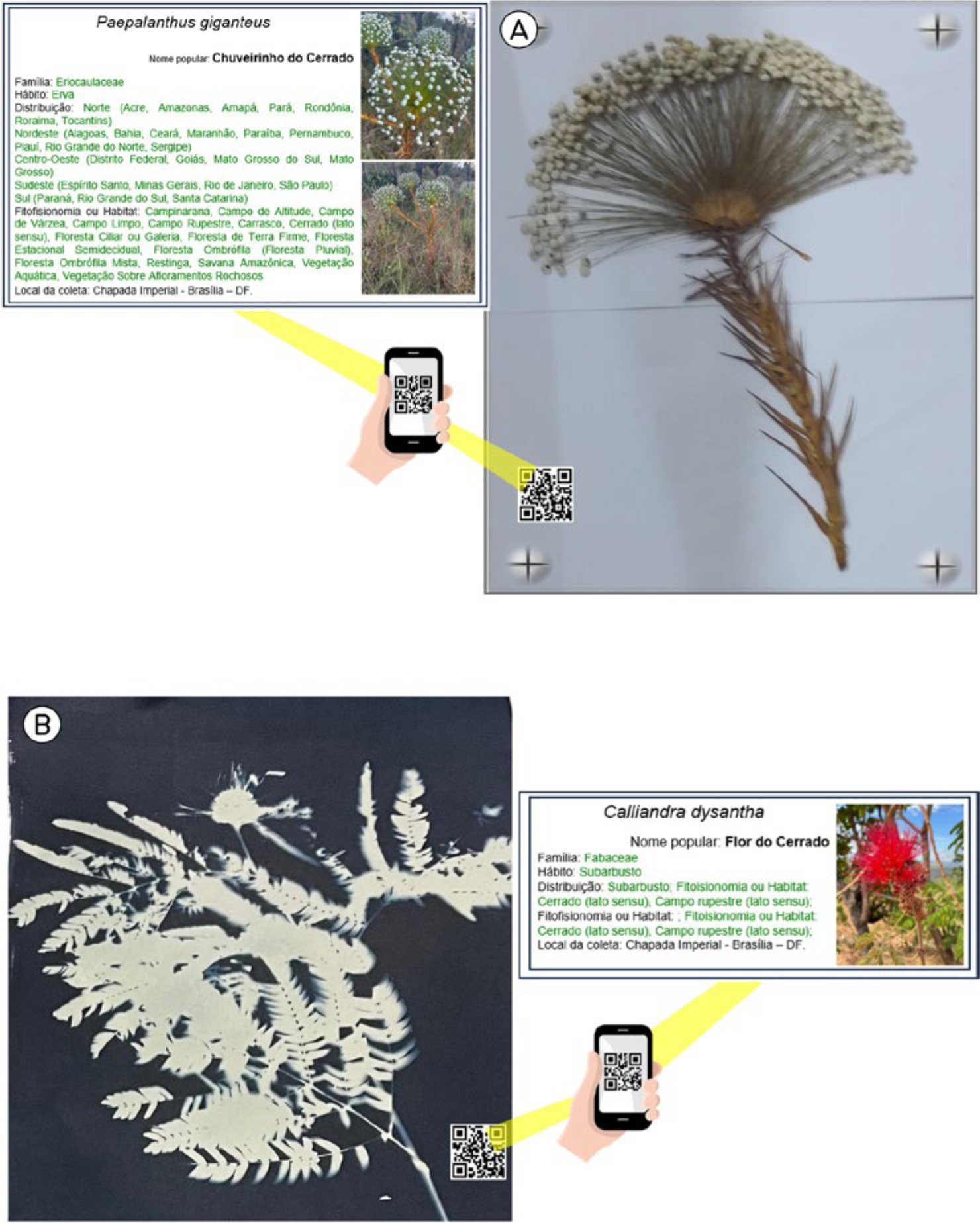
Acrylic mounted specimens and cyanotype plates in the exhibition were enhanced by adding relevant information to a dynamic QR Code that enabled the association of images and information to the mounted specimens (Figure 3).This was another activity facilitating Botany teaching-learning, aiming to diversify the didactic/pedagogic methodology using replicates of morphological structures to allow more concrete learning through exposure to certain structures or biological events (Nariane et al. 2010; Dantas et al. 2016).
A. Model of herbarium specimen in acrylic with associated QR Code including information and images of Cerrado species, B. Cyanotype photograph with associated QR Code used as part of the methodology in Botany teaching.
Results
1. Floristic survey
From the identification of the 294 fertile individuals collected by our team we arrived at a list comprising 223 species distributed in 59 families of vascular plants (Table S2). While 127 species were widely distributed in South America, 90 (42%) of them are endemic in Brazil, of which 48 (22%) are restricted to the Cerrado biome. The predominant pollination syndrome was melittophily (bees – 150 species), either singly or combined with psychophily (butterflies – 25 species) and ornithophily (hummingbirds – 22 species) syndromes. Putative chiropterophily (bat) and sphingophily (hawkmoth) pollination had much lower rates, with four and seven species respectively, while anemophily (wind) pollination was found for 14 species, some of them also possibly pollinated by unspecified small insects (25 species). Cantharophily (beetle) and hydrophily (water) pollination syndrome examples were recorded for a species each.
The 17 plant families with more species (four or more species) in the area comprise approx. 70% of the species total (Figure 4). The three plant families with highest species diversity in the area were the Fabaceae (32 species), Asteraceae (18 species) and Melastomataceae (17 species). The Fabaceae represent 14% of the species collected at the Chapada Imperial Ecological Reserve (Figures 4 and 5). The second largest family is the Asteraceae, with 18 species belonging to 17 genera (Figure 6). The Melastomataceae, also with 17 species in nine genera in the study area, was represented by species growing in wet areas (campos brejosos, veredas). The largest genus in the family was Miconia, with five species recorded in the study area.

A. Main plant families contributing towards species diversity in the Chapada Imperial Ecological Reserve, B. Plant diversity of the Cerrado at the Chapada Imperial Ecological Reserve.

Representative images of the species diversity in Fabaceae at the Chapada Imperial Ecological Reserve. (A) Andira fraxinifolia Benth. (B) Calliandra dysantha Benth. (C) Chamaecrista desvauxii (Collad.) Killip (D) Eriosema rigidum Benth. (E) Mimosa claussenii Benth. (F) Mimosa pseudoradula Glaz. ex Barneby (G) Periandra mediterranea (Vel.) Taub. (H) Senna pendula (G.Don) H.S.Irwin & Barneby and (I) Stryphnodendron adstringens (Mart.) Coville.

Examples of Asteraceae in the Chapada Imperial Ecological Reserve. (A) Chresta sphaerocephala DC. (B) Aldama robusta (Gardner) E.E.Schill. & Panero (C) Aspilia leucoglossa Malme (D) Achyrocline alata (Kunth) DC. (E) Sphagneticola trilobata (L.) Pruski and (F) Vernonanthura polyanthes (Sprengel) A.J.Vega & Dematt.
Other families, such as Rubiaceae, Malvaceae, Malpighiaceae, Vochysiaceae and Myrtaceae, had five or more species recorded and are recognized as important components of the Cerrado. Other families, less typical of the Cerrado, such as Acanthaceae, are present in more hydromorphic habitats, such as campo brejoso and gallery forests, however Justicia lanstyakii and J. irwinii are restricted to the Cerrado biome (Vilar 2009).
2. Activities developed in the interpretative nature trails and afterwards
The student experience in the Chapada Imperial Ecological Reserve interpretative trail has provided them with contact with natural elements, aiming to facilitate the understanding of Botany and the importance of the Cerrado. Students were encouraged not only to see, but to touch, smell and, above all interact with plants in their natural habitat.
A collection of approx. 30 different plant species (highlighted in the checklist found in Supplementary material S3) from the interpretative trail day was prepared as herbarium specimens, with five examples mounted in acrylic for a permanent exhibition. The iconic chuveirinho (Actinocephalus bongardii), medicinal casiruba (Senna rugosa), assa-peixe, (Vernonanthura polyanthes) and hortelã-do-cerrado (Hyptis goyazensis), all angiosperms, and a lycophyte known as pinheirinho-do-brejo (Palhinhaea cernua) were selected to cover large groups such as Lycophytes and Angiosperms (Monocots, Eudicots Rosids and Eudicots Asterids). A total of 30 cyanotypes were prepared from samples collected along the field trail. Both herbarium specimens and cyanotypes were associated to QR Codes containing information regarding the species (such as field images, popular and scientific name, uses, habitat, ecology – all researched by the students) and the resulting material was exhibited in the school hall (Figure 7).

(A) Semi-permanent collections fixed in acrylic with associated QR Codes containing further information regarding the specimen and field images in the school environment. (B) Cyanotype exhibition with associated QR Code in the school environment.
Three weeks after visiting the interpretative nature trail, students were able to rate their experience in the final questionnaire (Supplementary Material S3, Figure S2). The initial questionnaire requested information about vegetation and native Cerrado species, and each student indicated three typical plant species from the Cerrado (question 3, Supplementary Material S2). From the 108 answers expected from the students (n36 × 3), only 47 were provided, totalling 20 different words (Figure 8A). Eight students did not provide any response, alleging lack of knowledge, while the remaining students provided only one or two answers. The responses to the final questionnaire included 102 answers, comprising 26 different words (Figure 8B).

A. Google Forms word cloud generated from the students answers to the initial Cerrado diagnostic questionnaire illustrating their limited knowledge regarding native species. B. Google Forms world cloud displaying answers to the final Cerrado diagnostic questionnaire illustrating their increased knowledge regarding native species.
When questioned regarding the contribution of the trail activities including the material collected, preparation of herbarium specimens and cyanotype photograph production as a teaching aid, 95% of the 36 students questioned affirmed that preparing herbarium specimens made the classes more interesting and dynamic. These perceptions were qualitative, expressed in the following quotes by students:
“The experience did not only make the classes more enjoyable but has also awakened my curiosity regarding Botany.” (Student #4), “I never imagined that learning Botany could be so involving!” (Student #7), “...made the classes more dynamic and stimulating.” (Student #18). “...the activities brought a new aspect to the study of plants.” (Student #30) and “It was an interactive and interesting way to understand the diversity of plant species.” (Student #34)
Student #21 (below) argued that it is relevant to adopt didactic tools that are both instructive and ludic.
“After the classes about the plant kingdom I was already enjoying the subject a lot, however the fieldwork, together with the photography and herbarium sheet preparations, helped me a lot. These activities revised a lot of content that I had already learned and also brought me new knowledge. It was most profitable.” (Student #21).
Among the students answers to the final questionnaire, major emphasis was put on the direct interaction with the environment, and the fact that the methodology was considered active, entertaining and practical, as commented by student #3. Others, such as student #9, highlighted that the use of the trails made the study dynamic and involving. Student #17 said that “direct interaction with the topic made learning more effective and pleasurable”. Moreover, student #19 emphasized that “immersive experience in the environment and the convivial character of the trails have allowed the knowledge regarding the Cerrado to root, greatly increasing the interest in the subject”. Student #30 highlighted “the importance of learning while enjoying the trail experience, observing diverse plants and animals”. Finally, student #32 considered that “the experience increased the valuing of the Cerrado, as before I did not know of its importance”.
Discussion
1. Floristic survey in a rich, preserved Cerrado reserve
Despite its location close to Brasília, this is the first floristic list of the Chapada Imperial. The survey aimed to improve knowledge regarding the area and to establish the information stops in the interpretative nature trails visited yearly by the students, using this opportunity to inform them about the presence of endemic species, Cerrado adaptations and curiosities that might awaken their interest.
It is obvious, when gleaning through the list produced, that plant groups with many species that are harder to differentiate, such as sedges and grasses (Cyperaceae and Poaceae) and other monocots may be under-represented in the list provided, because of the sampling effort was dedicated to the purpose of providing a list for educational purposes. Nevertheless, we recorded a high number of plant species near and around the trail, that offer an excellent sample showcasing the Cerrado diversity to the students. Our intention is to continue recording the species in the study area by expanding it to include areas away from the trail and plant families that were neglected in order to sample the study site in a more comprehensive manner. Nonetheless, the number of species recorded (223 in 59 plant families) is not as high as that found in Cerrado sites in the same region. For instance, Rezende and Cavalcanti (2003) listed 492 species in 91 plant families in a similar habitat. The rate of endemic species found (42% Brazilian endemic and 22%, or one in five species being endemic from the Cerrado) is in line with general data for the Brazilian Cerrado (BFG 2015). The pollination syndromes show a predominance of melittophilous species, but examples of most other existing syndromes were recorded, ensuring that specific examples could be shown to the students while onsite, or further researched in the classroom. All that said, it is important to consider that for educational purposes, the biodiversity associated with this nature trail, together with the abundance of examples of endemic plants and a variety of pollination syndromes, comprise a very appropriate group of data to focus the students’ attention in many fundamental specific aspects of the Botany of the Cerrado.
Fabaceae was the plant family with the highest number of species (Figure 5), coinciding with most Cerrado surveys (Filgueiras and Pereira 1993; Mantovani and Martins 1993; Mendonça et al. 1998; Nascimento and Saddi 1992; Oliveira Filho and Martins 1986; Ribeiro et al. 1985; Silva and Bates 2002; Silva and Scariot 2003). This group of plants have specific adaptations to the low soil fertility of Cerrado soil, with Rhizobium bacterial symbiosis present in their roots (Silveira et al. 2009; Françoso et al. 2016). Fabaceae also present rootstocks (xylopodia) that enable them to resprout after wildfire, an element that shapes the dynamics and composition of many global ecosystems including the Cerrado (Fidelis and Pivello 2011). The study area was recently affected by fires in 2019 and in September 2021, and the fire resilience of these plants may explain their marked presence in the vegetation.
Asteraceae, the second largest plant family, is among the largest Angiosperm families (Bremer 1994), being an extremely important component of the herbaceous layer in the Cerrado (Batalha and Mantovani 2001), especially in wet areas of campos brejosos and veredas (Araújo et al. 2002; Tannus and Assis 2004; Munhoz and Felfili 2006) (Figure 6). Melastomataceae, in the third place, are abundant in Brazil, including many species with restricted distribution and therefore high endemism (Martins 1984). Being highly adaptable to environmental conditions (Somavilla 2011), some species may be considered invasive in veredas in the Distrito Federal, such as Macairea radula and Trembleya parviflora (Giotto et al. 2023). The largest genus in the family in the Distrito Federal is Miconia, with 41 species recorded (Lourenço 2022). In the study area we found five species in this genus, two of them endemic to Brazil (M. burchellii and M. elegans), as well as four endemic species of Microlicia and one of Cambessedesia (Flora and Funga of Brazil 2024).
The five other families with five or more species (Rubiaceae, Malvaceae, Malpighiaceae, Vochysiaceae and Myrtaceae) are known to include species that grow in nutrient poor soils with high free aluminium concentration (Goodland, 1979), with adaptations to flourish in acidic soils (Goodland 1979; Haridasan 1982; Jansen et al. 2002).
By providing links between certain plant groups and these ecological and anatomical aspects (rhizobium nitrogen fixation, rootstocks to grow in fire-prone situations, diversity in the herbaceous layer, aluminium tolerance and accumulation) it becomes possible to address specific points of the ecology of the Cerrado during the visit to the educational trail.
2. Interpretative nature trails for Botany teaching and raising awareness of the importance of the Cerrado
The experience highlights the trail environment as an essential tool in raising environmental awareness, as intimate contact with nature leads to noticing, observing and analysing the environment, enabling the students to see the need for preserving and conserving the environment (Souza 2014), strengthening the argument for interpretative trails as means of including and promoting contact between human beings and nature (Viana 2017). Botany teaching is historically focused on theory and technical terms, often leading to botanical imperception, and this situation can be reverted by the adoption of contextualized practical approaches (Krasilchik 2008). The participation of students during the field class and collection of botanical material, including preparation of herbarium sheets and cyanotype photographs was emphasized, following Paulo Freire’s (1996) approach which aims to improve the learning process. The growth of these informal educational itineraries in the school context has meant that the students were enabled to relate the contents of practical classes using other senses (tact, hearing, smell) that would not be possible to achieve in the classroom environment and with current didactic materials (Barros and Araujo 2016).
The comparison of the initial and the final questionnaire form revealed a significant specific increase in the knowledge regarding the plant species from the Cerrado biome. When asked to list three examples of Cerrado plants, only 47 (of a possible total of 108 answers) answers were recorded (44% below the expected mark). Of the 47 answers, 20 different plants were cited, however many of them did not correspond to a specific species, being generic (capim = grass, orquídea = orchid, samambaia = fern, cacto = cactus) or were introduced and sometimes invasive plants (eucalipto = eucalyptus, pinheiro = pine tree, jambo = Syzigium spp.) (Braga et al. 2014, Whitehead and Beadle 2004), or even variants of the same fruit (caju, cajú, cajuzinho = cashew fruits, Anacardium spp.). The remaining ten words were heavily influenced by the name of fruits that are available as ice-cream and confectionary flavourings marketed in Brazil (baru = Dipterix alata Vogel, buriti = Mauritia flexuosa L.f., cagaita = Eugenia dysenterica (Mart.)DC., mangaba = Hancornia speciosa Gomes, pequi = Caryocar brasiliense Cambess.). The two most cited plants during the initial fase, the ipê (Handroanthus spp.) and the pequi (Caryocar brasiliense), were cited 12 and 10 times respectively. Such predominance may be related to the life experience of the students, as the ipê has bright yellow flowers and is one of the Cerrado species with highest landscaping impact, frequently found in open spaces, enabling contact between people and the native vegetation (Andrade 2022). The pequi is considered a plant symbol of the Cerrado and is used in typical dishes that are consumed by rural communities, with an importance that goes beyond the cultural aspect, as its collection contributes towards the income of rural families, representing 3.2% of the total non-timber extraction products in Brazil (IBGE 2021).
Following the conclusion of the activity, the analysis of the second questionnaire revealed that, even if the total number of citations (108) has not been reached, the 102 words retrieved by the students represented 26 different plant species (Figure 8), of which natives, such as buriti (Mauritia flexuosa) and chuveirinho-do-cerrado (Actinocephalus bongardii) were the most cited plant species, alongside with freshly learned examples showing that the practice was effective in increasing the repertoire of these students regarding the biome. The result obtained is in line with Wandersee and Schussler’s (2001) perspective, which highlights life-experience with plants as favourable to the knowledge and appropriation of the topic. Formerly passive subjects become active in building their own knowledge. Experimentation, associated to research, establishes a bridge between students’ daily reality and scientific knowledge.
Through the analysis of the student feedback we perceive a consensus among them regarding the field class for active learning. As the activity is (unfortunately) still uncommon, it motivated students to write about it. Their answers to the question “Do you consider that the study of Botany using the interpretative nature trail has made the content regarding the Cerrado more interesting, contributing to your learning?”, 100% of students marked yes, and the following qualitative descriptions show how the richness of elements found along the trail has awakened the attention of the students.
“It was possible to see in practice the topics discussed in the classroom, so that to see the plants with my own eyes in their ‘familiar’ environment I was able to associate better the knowledge of Botany to the reality, understanding also the fascinating adaptations of plants to the Cerrado.” (Student #8).
“When able to come into contact with our study object, it became easier to understand the processes explained in the classroom. Certainly, to see the plants close-up made study much more interesting, I even want to gain deeper insight of this at university, for example. We were immersed in the themes, in a motivating environment to learn.” (Student #12).
“The field class about the flora of the Cerrado not only solidified the Botany concepts seen in the classroom, but also allowed me a deeper understanding of the plant adaptations to this particular ecosystem. This experience surpassed the limits of traditional classes, enriching my understanding in a significant way.” (Student #16).
“Extra-class activities such as the field outing make the subject more dynamic and interesting, favouring learning, however we unfortunately have few experiences such as this one. The study of Botany becomes more effective when we are in nature.” (Student #24).
Such answers provided by the students highlight the relevance of trails as a teaching method, exposing them to open air classrooms and true natural laboratories, where their interest can be fostered along with curiosity and discoveries, being excellent alternatives for traditional teaching methods (Souza et al. 2012). Student´s perception of the activity as ‘fun’ finds resonance with Fialho (2007), who defends the use of ludic materials not only to facilitate the understanding of concepts, but also to stimulate social interaction with botanical contents. Students’ rich write-ups demonstrate the positive impact and efficacy of the trails as a captivating strategy to promote learning in the Cerrado biome. This approach involving direct contact with the environment makes the topics more attractive and dynamic but also fosters a real sense of connection between students and nature, leading them to care more for the environment. As seen in the National High School Curriculum Parameters (Brasília 2006), this integration is fundamental to promote effective environmental education that fosters concrete conservation actions.
Trails adapted to the needs and previous knowledge of the students, as stated by Guimarães and Menezes (2006) represent an exceptional tool for teaching-learning, allowing students to understand more about specific environments such as the Cerrado in a more involving and personal manner. Data collected during our research indicate that the elements of the trail facilitate the principle of approaching man with nature and had a very positive influence on Botany teaching.
The exhibition of QR Code associated mounted herbarium specimens and cyanotypes (Figures 3 and 7) was used to support the biology classes focussing on Botany and was also beneficial for teachers of other areas that were able to explore the adaptations found in the Cerrado. The material will be preserved for future classes, as explained by Corrêa et al. (2016) regarding the use of specimens to complement theoretical classes, aiding teaching-learning in Botany. Investigations carried out by Braz and Lemos (2014) revealed that students demonstrate more interest in the study of Botany when they have herbarium samples at hand, as did Santos (2013), who used a botanical reference collection in classes between the three high school years in the Instituto de Aplicação of the Universidade do Estado do Rio de Janeiro, making science teaching more dynamic by allowing a series of activities, such as scientific observations, comparison of plant structures, study of morphology and environmental adaptations.
The results reinforce the relevance of the practical experience in deepening plant knowledge in the biome, demonstrating increased awareness and knowledge regarding the local biodiversity. The identification of some gaps and shortcomings revealed by the selfassessment will be used to improve forthcoming activities at the school in years to come.
Conclusion
The rich sensorial experience provided by the nature trail is incomparable in relation with Botany teaching in the classroom, mostly restricted to textbooks. During the present experience the students were able to fully interact with the rich biodiversity of the Cerrado, which is many times treated as an abstract element in the formal space. The connection between students with their surrounding environment has enhanced their knowledge regarding the Cerrado and hopefully fostered in them lasting concern and care for the environment.
Supplementary Material
The following online material is available for this article:
Supplementary Material S1 – Detailed notes about stations defined during stage 2.
Supplementary Material S2 – Text of the initial and final questionnaires circulated as part of the nature trail experience with students answers.
Supplementary Material S3 – List of Angiosperms, Ferns and Lycophytes listed for the Chapada Imperial Ecological Reserve.
Figure S1 – Step by step for development a cyanotype photograph. Left column: ° Photographic technique ° created in 1842 by John Herschel, astronome and chemist. Differential is using iron rather than silver salts that create Prussian blue effect. Keystone: “Photograph of British algae”, 1843, Anna Atkins, the first book illustrated with photographs – algae photograms. Center column: XX Century Kodak, low cost and use in architecture, hence the word Blueprint. ° First step: emulsionate the papers ° Second step: dry ° Third step, make a sandwich. Glass, Plant, Emulsionated paper, Canson paper, MDF. ° Fourth step: fasten well. Right column: ° Amoniac Iron Citrate, ° Potassium Cyanide, ° Fifth step: place under direct sun ° Sixth step: leave under the sun until paper looks copper brown ° Seventh step: develop ° Eight step: wash, ° Ninth step: hang up to dry.
Figure S2 – Analysis of importance attributed by students to the Cerrado nature trail towards learning about the Biome.
Acknowledgments
We would like to express our sincere thanks to the plant specialists that generously contributed with the identification of many plant families in our study. Special thanks go to Carolyn Barnes Proença, Cássia Beatriz Rodrigues Munhoz, João Bernardo de Azevedo Bringel Junior, Mayco Werllen dos Santos Sousa, Rafaela Campostrini Forzza, Jair Eustáquio Quintino de Faria Júnior and Pedro Henrique Castro Aguiar. We are also grateful to the Herbarium UB of the University of Brasília (UnB) for access to the collection and deposit of the voucher material used in our research. We thank the Colégio Marista for the support in the name of the management, who kindly allowed and encouraged us throughout the project, and to all students that took part in the research, for their dedication and valuable contributions that were vital to the success of the project. We also sincerely thank the owners and staff of the Ecologic Reserve Chapada Imperial for the authorization and logistic support. DCZ holds a productivity grant from CNPq (305428/2024-1).
Data Availability
Data supporting this research can be found at https://doi.org/10.6084/m9.figshare.29375900.
References
- ANDRADE, R.G.C. 2022. A contribuição da vegetação para melhoria do microclima urbano: estudo de caso em Superquadras de Brasília. [Masters Thesis, Universidade de Brasília].
- ARAÚJO, G.M., BARBOSA, A.A.A., ARANTES, A.A. & AMARAL, A.F. 2002. Composição florística de veredas no município de Uberlândia, MG. Revista Brasileira de Botânica 25(4):475–494.
-
ARAUJO, R.S. & FARIAS, M.E. 2010. Trabalhando a trilha ecológica como estratégia de aprendizagem. Revista Educação Ambiental em Ação 34. Available at: https://www.revistaea.org/artigo.php?idartigo=927. Retrieved June 20, 2025.
» https://www.revistaea.org/artigo.php?idartigo=927. - ASSUNÇÃO, S.L. & FELFILI, J.M. 2004. Fotossociologia de um fragmento de cerrado sensu stricto na APA do Paraná, DF, Brasil. Acta Botanica Brasilica 18:903–909.
- BARROS, A.T.C. & ARAÚJO, J.N. 2016. Aula de campo como metodologia para o ensino de ecologia no ensino médio. Areté – Revista Amazônica de Ensino de Ciências, Manaus 9(20):80–88.
- BATALHA, M.A. & MANTOVANI, W. 2001. Floristic composition of the Cerrado in the Pé-de-Gigante reserve (Santa Rita do Passa Quatro, Southeastern Brazil). Acta Botanica Brasilica 15:289–302.
- BRAGA, E.P., ZENNI, R.D. & HAY, J.D. 2014. A new invasive species in South America: Pinus oocarpa Schiede ex Schltdl. BioInvasions Records 3:207–211.
- BFG (BRAZIL FLORA GROUP) 2015. Growing Knowledge: an overview of Seed Plant diversity in Brazil. Rodriguésia 66:1085–1113.
- BRAZ, N.C.S. & LEMOS, J.R. 2014. “Herbário Escolar” como instrumento didático na aprendizagem sobre plantas em uma escola de ensino médio na cidade de Parnaíba, Piauí. Revista Didática Sistêmica 16(2):3–14.
- BREMER, K. 1994. Asteraceae: cladistics and classification. Portland: Timber Press.
- CAMPANHA, L.F.P. & SILVA, P.O.R. 2013. Trilhas ecológicas como recurso de educação ambiental. Revista Centro de Ciências Biológicas, Universidade Estadual de Londrina-PR.
- CAMPOS, J.C.B. 2007. Cianotipia em grande formato: Processo alternativo de reprodução de imagem em câmara clara. Uma abordagem das dimensões da linguagem, cor e espaço. [Masters Thesis, Universidade Estadual de Campinas].
- CARDOSO, E., MORENO, M.I.C., BRUNA, E.M. & VASCONCELOS, H.L. 2009. Mudanças fitofisionômicas do Cerrado: 18 anos de sucessão ecológica na estação ecológica do Panga, Uberlândia – MG. Revista Uberlândia. Caminhos de Geografia 10(32):254–268.
- CAZOTO, J.L. & TOZONI-REIS, M.F.C. 2008. Construção coletiva de uma trilha ecológica no Cerrado: Pesquisa participativa em educação ambiental. Revista Ciência & Educação 14(3):575–582.
-
CHAPADA IMPERIAL 2024. Reserva Ecológica Chapada Imperial. Brazlândia, Brasília – DF. Base de dados. http://www.chapadaimperial.com.br/ Retrieved February 20, 2024.
» http://www.chapadaimperial.com.br/ -
CNCFLORA. 2025. Centro Nacional para a Conservação da Flora. Available at: https://cncflora.jbrj.gov.br/portal/pt-br/listavermelha Retrieved June 20, 2025.
» https://cncflora.jbrj.gov.br/portal/pt-br/listavermelha - CORRÊA, B.J.S. et al. 2016. Aprendendo Botânica no Ensino Médio por meio de atividades práticas. Revista da SBEnBio 9:4314–4324.
- DANTAS, A.P.J., DANTAS, T.A.V., FARIAS, M.I.R.D., SILVA, R.P.D. & COSTA, N.P.D. 2016. Importância do uso de modelos didáticos no ensino de citologia. In: Congresso Nacional de Educação 3.
- FAEGRI, K. & VAN DER PIJL, L. 1971. The principles of pollination ecology. Pergamon Press.
-
FIALHO, N.N. 2007. Os jogos pedagógicos como ferramentas de ensino – FACINTER. Curitiba: IBPEX. Available at: http://www.pucpr.br/eventos/educere/educere2008/anais/posteres2.html Retrieved June 20, 2025.
» http://www.pucpr.br/eventos/educere/educere2008/anais/posteres2.html - FIDALGO, O. & BONONI, V.L.R. 1989. Técnicas de coleta, preservação e herborização de material botânico. Instituto de Botânica do Estado de São Paulo.
- FIDELIS, A. & PIVELLO, V.R. 2011. Deve-se usar o fogo como instrumento de manejo no Cerrado e Campos Sulinos? Biodiversidade Brasileira 1(2):12–25.
- FILGUEIRAS, T.S. & PEREIRA, B.A.S. 1993. Flora do Distrito Federal. In: Novaes Pinto, M., ed. Cerrado: caracterização, ocupação e perspectivas (pp. 345–404). Editora Universidade de Brasília.
-
FLORA & FUNGA OF BRAZIL. 2024. Base de dados. Jardim Botânico do Rio de Janeiro. Available at: http://floradobrasil.jbrj.gov.br/ Retrieved December 22, 2024.
» http://floradobrasil.jbrj.gov.br/ - FORZZA, R.C., BAUMGRATZ, J.F.A., BICUDO, C.E.M., CANHOS, D.A.L., COELHO, M.A.N., COSTA, A.F., COSTA, D.P., HOPKINS, M.G., LEITMAN, P.M., ... & ZAPPI, D.C. 2012. New Brazilian floristic list highlights conservation challenges. BioScience 62:39–45.
- FRANÇOSO, R.D., HAIDAR, R.F. & MACHADO, R.B. 2016. Tree species of South America central savanna: endemism, marginal areas and the relationship with other biomes. Acta Botanica Brasilica 30(1):78–86.
- FREIRE, P. 1996. Pedagogia da autonomia: saberes necessários à prática educativa. Paz e Terra.
- GIL, A.C. 2010. Como elaborar projetos de pesquisa. 5th ed. Ed. Atlas.
- GIOTTO, A.C., EUGÊNIO, C.U.O., MUNHOZ, C.B.R. & RIBEIRO, J.F. 2023. Desenvolvimento inicial de Trembleya parviflora sob diferentes condições hídricas e de serapilheira. Iheringia (série Botânica) 78.
- GOODLAND, R. 1979. A physiognomic analysis of the cerrado vegetation of Central Brazil. Journal of Ecology 59:411–419.
- GUIMARÃES, V.F. & MENEZES, S.O. 2006. Uso de trilha interpretativa na educação ambiental: uma proposta para o município de Rosário da Limeira (MG). II Fórum Ambiental da Alta Paulista.
- HARIDASAN, M. 1982. Aluminium accumulation by some cerrado native species of central Brazil. Plant and Soil 65(2):265–273.
- IARED, V.G., OLIVEIRA, H.T. & REID, A. 2017. Aesthetic experiences in the Cerrado (Brazilian savanna): contributions to environmental education practice and research. Environmental Education Research 23:1273–1290.
-
IBGE – INSTITUTO BRASILEIRO DE GEOGRAFIA E ESTATÍSTICA 2021. PEVS – Produção da Extração Vegetal e da Silvicultura. Rio de Janeiro: IBGE, v. 36. Available at: https://www.ibge.gov.br/estatisticas/economicas/agricultura-e-pecuaria/9105-producao-da-extracao-veg Retrieved March 22, 2024.
» https://www.ibge.gov.br/estatisticas/economicas/agricultura-e-pecuaria/9105-producao-da-extracao-veg - JANSEN, S., BROADLEY, M.R., ROBBRECHT, E. & SMETS, E. 2002. Aluminium hyperaccumulation in angiosperm: a review of its phylogenetic significance. The Botanical Review 68(2):228–269.
- KINKER, S. 2002. Ecoturismo e conservação da natureza em parques nacionais. Papirus.
- KRASILCHIK, M. 2008. Prática de ensino de biologia. 6th ed. Edusp.
-
LAHSEN, M., BUSTAMANTE, M.M.C. & DALLA-NORA, E.L. 2016. Undervaluing and overexploiting the Brazilian Cerrado at our peril. Environment: Science and Policy for Sustainable Development 58(6):4–15. Available at: https://www.tandfonline.com/doi/full/10.1080/00139157.2016.1229537?scroll=top&needAccess=true
» https://www.tandfonline.com/doi/full/10.1080/00139157.2016.1229537?scroll=top&needAccess=true - LOURENÇO, E.C.D.O. 2022. As tribos Cambessedesieae, Marcetieae e Melastomateae (Melastomataceae) no Distrito Federal, Brasil. [Masters Thesis, Universidade de Brasília].
- MANTOVANI, W. & MARTINS, F.R. 1993. Florística do Cerrado na Reserva Biológica de Moji Guaçu, SP. Acta Botanica Brasilica 7(1):33–60.
- MARANDINO, M., SELLES, S.E. & FERREIRA, M.S. 2009. Ensino de biologia: histórias e práticas em diferentes espaços educativos. Ed. Cortez.
- MARTINS, A.B. 1984. Revisão taxonômica do gênero Cambessedesia DC. [Masters Thesis, Universidade Estadual de Campinas].
- MENDONÇA, R.C., FELFILI, J.M., WALTER, B.M.T., SILVA JÚNIOR, M.C., REZENDE, A.V., FILGUEIRAS, T.S. & NOGUEIRA, P.E. 1998. Flora vascular do cerrado. In: Sano, S.M. and Almeida, S.P. (eds.). Cerrado, Ambiente e flora (pp. 289–556). EMBRAPA.
- MENGHINI, F.B. 2005. As trilhas interpretativas como recurso pedagógico. [Masters Thesis, Universidade do Vale do Itajaí].
- MUNHOZ, C.B.R. & FELFILI, J.M. 2006. Floristics of the herbaceous and sub-shrub layer of a moist grassland in the Cerrado Biosphere Reserve (Alto Paraíso De Goiás), Brazil. Edinburgh Journal of Botany 63:343–354.
- NARIANE, Q.V., PONTES, A., PEREIRA, A., BARBOSA, C. & COSTA, V. 2010. Modelos didático-pedagógicos: estratégias inovadoras para o ensino de biologia. In: Simpósio Nacional de Ensino de Ciência e Tecnologia 2:1–13.
- NASCIMENTO, M.T. & SADDI, N. 1992. Structure and floristic composition in an area of cerrado in Cuiabá – MT, Brazil. Revista Brasileira de Botânica 15(1):47–55.
- NEVES, A., BUNDCHEN, M. & LISBOA, C.P. 2019. Impercepção botânica: é possível superá-la a partir da educação? Revista Ciência & Educação (Bauru) 25(3):745–762.
- OLIVEIRA-FILHO, A.T. & MARTINS, F.R. 1986. Distribuição, caracterização e composição florística das formações vegetais da região da Salgadeira, na Chapada dos Guimarães (MT). Revista Brasileira de Botânica 9:207–223.
- PÁDUA, E.M.M. 2004. Metodologia da pesquisa: abordagem teórico-prática. Papirus.
- PIN, J.R., ROCHA, M., RODRIGUES, L. & GÓES, Y. 2018. As trilhas ecológicas como espaços para o ensino de ciências: levantamento de dissertações e teses brasileiras. Revista de Educação, Ciências e Matemática 8(2):125–139.
- RESENDE, N.F. 2012. Cerrado: ecologia, biodiversidade e preservação. Revista Brasileira de Educação e Cultura 6:81–90.
- REZENDE, J.M. & CAVALCANTI, T.B. 2003. Caracterização da vegetação e lista de espécies vasculares do Parque Boca da Mata, Distrito Federal, Brasil. Boletim do Herbário Ezechias Paulo Heringer 12:5–43.
- RIBEIRO, J.F., SILVA, J.C.S. & BATMANIAN, G.J. 1985. Fitossociologia de tipos fisionômicos de cerrado em Planaltina-DF. Revista Brasileira de Botânica 8:131–142.
- RIBEIRO, J.F. & WALTER, B.M.T. 2008. As principais fitofisionomias do bioma Cerrado. In: Sano, S.M. (ed.) Cerrado: ecologia e flora (pp. 151–212). Embrapa.
- SANTOS, M.C.F. 2013. Coleções biológicas para o ensino de ciências: o herbário didático do Instituto de Aplicação da UERJ. Revista Cadernos do Aplicação 26(1):11–18.
- SCHWAIDA, S.F., CICERELLI, R.E., ALMEIDA, T., CUNHA, A.A., CARVALHO, M.M., SOARES, F.H.S., MARINI FILHO, O.J. & SARAIVA, N.A. 2025. A long-distance trail as a strategy to maintain habitat connectivity in the central Brazilian savanna. Ecosystems and People 21.
- SILVA, A.N.F., ALMEIDA JR, E.B. & VALLE, M.G. 2020. Exsicatas como recurso didático: contribuições para o ensino de botânica. Brazilian Journal of Development 6(5):24632–24639.
- SILVA, J.J.L., CAVALCANTE, F.L.P., XAVIER, V.F. & GOUVEIA, L.D.F.P. 2019. Produção de exsicatas como auxílio para o ensino de botânica na escola. Conexões-Ciência e Tecnologia 13(1):30–37.
- SILVA, J.M.C. & BATES, J.M. 2002. Biogeographic patterns and conservation in the South American Cerrado: A tropical savanna hotspot. BioScience 52(3):225–233.
- SILVA, L.A. & SCARIOT, A. 2003. Composição florística e estrutura da comunidade arbórea em uma floresta estacional decidual em afloramento de calcário (Fazenda São José, São Domingos, GO, bacia do rio Paranã). Acta Botanica Brasilica 7:307–315.
- SILVEIRA, E.P., COSTA, R.B. & FELFILI, J.M. 2009. Florística da vegetação remanescente de Cerrado sensu stricto em terra indígena no noroeste de Mato Grosso, Brasil. Revista de Biologia Neotropical 6(2):15–25.
-
SPECIESLINK. 2024. INCT virtual herbarium. Available at: https://specieslink.net/ Retrieved March 21, 2024.
» https://specieslink.net/ - SOMAVILLA, N.S. 2011. Aspectos anatômicos, fenológicos e ecofisiológicos de Melastomataceae em vereda e cerrado sensu stricto [Masters Thesis, Universidade de Brasília].
- SOUZA, M.C. 2014. Educação ambiental e as trilhas: contexto para a sensibilização ambiental. Revista Brasileira de Educação Ambiental 9(2):239–253.
- SOUZA, V.T., RAGGI, F.A.S., FRANCELINO, A.S.S., FIGEIRÓ, R., RODRIGUES, D.C.G.A. & SOARES, R.A.R. 2012. Trilhas interpretativas como instrumento de educação ambiental. Anais III Encontro Nacional de Ensino de Ciências da Saúde e do Ambiente 5:294–304.
- TANNUS, J.L.S. & ASSIS, M.A. 2004. Composição de espécies vasculares de campo sujo e campo úmido em área de cerrado, Itirapina SP, Brasil. Revista Brasileira de Botânica 27(3):489–506.
- VASCONCELLOS, J.M.O. 1997. Trilhas interpretativas: aliando educação e recreação. In: Congresso Brasileiro de Unidades de Conservação (pp. 465–477). IAP, Curitiba.
- VIANA, G.C.S. 2017. O ensino de botânica em ambientes não formais. [Undergraduate thesis, Universidade Federal da Paraíba].
-
VILELA, R.B., RIBEIRO, A. & BATISTA, N.A. 2020. Word cloud as a tool for content analysis: an application to the challenges of the professional master’s degree courses. Millenium – Journal of Education, Technologies, and Health 11, Epub 30-Apr-2020. https://doi.org/10.29352/mill0211.03.00230
» https://doi.org/10.29352/mill0211.03.00230 - VIVEIRO, A.A. & DINIZ, R.E.S. 2009. Atividades de campo no ensino das ciências e na educação ambiental: refletindo sobre as potencialidades desta estratégia na prática escolar. Ciência em Tela 2:1–12.
- WANDERSEE, J.H. & SCHUSSLER, E.E. 2001. Towards a theory of plant blindness. Plant Science Bulletin 47:2–8.
- WHITEHEAD, D. & BEADLE, C.L. 2004. Regulação fisiológica da produtividade e uso de água em Eucalyptus: uma revisão. Ecologia e Manejo Florestal 193:113–140.
- ZOMPERO, A.F. & LABURU, C.E. 2010. As atividades de investigação no ensino de ciências na perspectiva da teoria da aprendizagem significativa. Revista Electrónica de Investigación en Educación en Ciencias 5(2): 12–19.