
 WHEN FOOTWEAR MAKES THE NEWS: political commodities and appropriations of journalism in digital Bolsonarism
ABSTRACT
This article analyzes how the brand Botinas Bolsonaro mobilizes narrative and aesthetic structures associated with journalism in its posts to produce meaning effects that reposition Jair Bolsonaro in the public sphere. The corpus comprises 315 posts (September 2023 – May 2025) and, drawing on French Discourse Analysis, examines how the commodity functions as a vector of political visibility by articulating consumption, propaganda, and simulations of factuality. By moving between the discursive regimes of consumption and news, the brand tensions communicational contracts and operates within a discursive ecosystem that instrumentalizes journalism while simultaneously contesting its foundations.
Keywords
Communication; Consumption; Journalism; Politics
RESUMO
Este artigo analisa como a marca Botinas Bolsonaro mobiliza, em postagens, estruturas narrativas e estéticas do jornalismo para produzir efeitos de sentido que reposicionam Jair Bolsonaro na cena pública. O corpus reúne 315 postagens (set. 2023 – maio 2025) e, com base na Análise de Discurso de linha francesa, examina como a mercadoria atua como vetor de visibilidade política, articulando consumo, propaganda e simulações de factualidade. Ao transitar entre os regimes discursivos do consumo e da notícia, a marca tensiona os contratos comunicacionais e opera em um ecossistema discursivo que instrumentaliza o jornalismo ao mesmo tempo em que contesta seus fundamentos.
Palavras-chave
Comunicação; Consumo; Jornalismo; Política
RESUMEN
Este artículo analiza cómo la marca Botinas Bolsonaro moviliza, en sus publicaciones, estructuras narrativas y estéticas propias del periodismo para producir efectos de sentido que reposicionan a Jair Bolsonaro en la escena pública. El corpus reúne 315 publicaciones (septiembre de 2023 – mayo de 2025) y, a partir de la Análisis del Discurso de línea francesa, examina cómo la mercancía actúa como vector de visibilidad política, articulando consumo, propaganda y simulaciones de factualidad. Al transitar entre los regímenes discursivos del consumo y de la noticia, la marca tensiona los contratos comunicacionales y opera en un ecosistema discursivo que instrumentaliza el periodismo al mismo tiempo que cuestiona sus fundamentos.
Palabras clave
Comunicación; Consumo; Periodismo; Política
1 Introduction
The public figure of Jair Bolsonaro has been repeatedly mediated through the launch of products that operate as symbolic extensions of his political persona. Since the end of his presidential term, he has been associated with the release of various commodities that bear his name or image, such as wines1, perfumes2, and helmets3, among others. In this process, an important articulation can be observed between the fields of communication, consumption, and politics, insofar as each of these items establishes distinct media scenes and activates specific discursive regimes, mobilizing different forms of interpellation of supporters and regimes of visibility for the former president. There are no uniform strategies of self-promotion across these products; rather, they inscribe varied meanings that engage with different segments of his support base.
In this article, we analyze one of these product launches in particular: Botinas Bolsonaro4. We are interested in examining the product’s mediatization on the company’s official Instagram5 page, observing how its posts construct a communicational scene in which advertising discourse is articulated with other media environments characteristic of digital bolsonarism. The analysis is based on a corpus composed of 315 posts published on the @botinas.bolsonaro page between September 8, 2023, and May 31, 2025. One of the discursive particularities of the analyzed posts is the way in which the self-promotional discourse of the boots blends with news-oriented discourses by establishing intertextualities with traditional journalistic productions and by updating recent political events (such as hospitalizations, corruption scandals involving the opposition, electoral disputes, or the promotion of amnesty for those accused in the events of January 8) through affective narratives. We are interested in observing how the Botinas Bolsonaro brand, through its communication on Instagram, participates in the construction of discursive ecosystems that compete over meaning with traditional journalism in the context of digital bolsonarism.
That being said, the objective of this article is to examine the effects of meaning produced by the Botinas Bolsonaro brand in its discursive productions on Instagram, focusing on the ways in which the commodity is mobilized to reinscribe Jair Bolsonaro into a media scene of public visibility through intertextuality with journalistic materials. We seek to understand how the footwear constitutes itself as a symbolic operator within a discursive ecosystem that, at the same time that it takes journalism as a reference and a source of legitimation, negates it through narratives characteristic of the logic of social media.
The relationship between the @botinas.bolsonaro page and journalism fits into a pattern widely identified in the political communication literature, according to which populist groups develop an ambivalent relationship with the press: they appropriate its aesthetics and ethos to produce verisimilitude, while simultaneously strategically discrediting it. As shown by Mazzoleni (2014), Krämer (2014), and Moffitt and Tormey (2014), this dynamic of dependence and attack constitutes a form of performative interdependence characteristic of mediated populism, in which journalistic authority is simultaneously invoked and contested. Within this framework, the media functions both as a resource of symbolic legitimation and as a strategic target of antagonism, allowing populist actors to expand their visibility while reinforcing narratives of opposition to the system.
2 Methodological considerations
Founded in April 2023, the Botinas Bolsonaro brand is an initiative of supporters of the former president, headquartered in Nova Serrana (Minas Gerais). Registered under the company RVMHS Comércio e Distribuição, its portfolio includes footwear such as leather boots, sneakers, and sandals, all stamped with Bolsonaro’s name or signature. The brand markets models such as “Tênis Patriota Style”, “Tênis Bolsonaro: Liberdade Style”, “Bota Bolsonaro: Capitão”, “Sandália Bolsonaro Clássica: Puro Mito”, and “Tênis Bolsonaro: Ultra Soberania”6. The Botinas Bolsonaro brand exemplifies how consumer products can be used as tools for the staging and circulation of political identities, transforming everyday objects into symbols of ideological alignment and expressions of belonging to a specific group (Oliveira & Ayrosa, 2022; Penney, 2012; Paterson, 2017; Nwala, 2020; Miller, 2005; Bittner, 2024).
The discursive intercorrelations between journalism and advertising articulated by the brand can be interpreted in light of media ecology theory as formulated by Emiliano Treré (2025). By understanding media as environments composed of different forms of technologies, communicational practices, affects, and human and non-human actors, this approach makes it possible to observe the posts on the @botinas.bolsonaro page as part of an ecology formed by hybrid discourses that transcends the simple commercial use of digital platforms to sell themed footwear. This is a communicative ecology in which consumer objects (the boots), digital performances, politicized bodies, and public events (hospitalizations, scandals, protests) operate in interaction, producing a specific media presence for Bolsonaro.
As Treré points out, this ecological perspective invites us “to recognize the communicative complexities and multiplicities of social, cultural, and political phenomena through the exploration of variable constellations, entanglements, interconnections, and evolutions of media and people” (Treré, 2025, pp. 24–25). Within this media ecosystem, the commodity (in this case, the footwear) functions as a symbol of narrative and ideological cohesion that updates a discursive memory of the former president in the public sphere, in a context of institutional absence, through intertextualities with journalistic materials. “Thus, these media ecologies appear as multifaceted environments where activists are able to create, invent, and experiment with media technologies” (Treré, 2025, p. 24).
Intending to observe the mobilizations of journalism within this media ecosystem, we adopt the theoretical and methodological assumptions of French Discourse Analysis, particularly drawing on Maingueneau’s (2004, 2005, 2008) contributions regarding enunciative scene, discursive ethos, and intertextuality. The analysis focuses on three main axes: (1) the constitution of a visual political chronicle that reinscribes the figure of the former president, under the pretext of selling footwear, into events of the national conjuncture; (2) the performative simulation, in and through discourse, of a cohesive and mobilized political community, mediated by digital influencers and commodities; and (3) the modes of circulation of the commodity, which appropriate the productive logics of journalism as a reference, both for the structuring of their content and for expanding their visibility in other media arenas, including traditional press outlets.
As of May 2025, the @botinas.bolsonaro page had 203.000 followers. The corpus was constructed based on the observation of the 315 posts published between September 8, 2023 (corresponding to the page’s first post) and May 31, 2025. The decision to conclude data collection on May 31, 2025, was due to the observation that, by that point, the posts already exhibited saturation of the discursive regularities relevant to the research objectives, with no introduction of new significant strategies that would justify extending the temporal scope. The posts were analyzed in terms of their verbal and visual elements, with particular attention to the construction of discursive subjects, the regimes of visibility mobilized, enunciative shifts, and intertextualities with journalistic language. The analysis thus sought to identify the effects of meaning produced at the intersection of communication, consumption, journalistic rhetoric, and politics.
It is important to note that the corpus includes exclusively feed posts from the @botinas.bolsonaro page. Ephemeral content, such as stories, live streams, or short-duration broadcasts, was not considered in the data collection, as these follow different circulation logics and do not remain stably accessible for discursive analysis. Thus, all the materials mobilized in this article derive from fixed publications on the profile, even though some of them present audiovisual formats similar to those used in stories.
Given the qualitative scope of the research and its grounding in French Discourse Analysis, the construction of the corpus does not seek statistical representativeness, but rather the identification of significant discursive regularities. The posts selected for analysis were chosen based on theoretical and analytical criteria that privilege occurrences in which the discursive materiality makes explicit the mechanisms of meaning production discussed throughout the article. Priority was given to posts that: (1) articulate elements of advertising language and journalistic aesthetics; (2) make explicit reference to events reported by the traditional press; (3) mobilize the notion of “controversy” as a narrative strategy; and (4) feature public figures wearing the footwear as a form of symbolic legitimation. The posts are mobilized throughout the text as paradigmatic examples of recurring discursive strategies observed across the collected material, functioning as analytical operators for the investigation of meaning effects. Conversely, posts that did not present discursive articulations relevant to the research objectives were excluded, such as those that were strictly promotional (with an exclusive focus on discounts, payment methods, or shipping) and materials limited to product display without any linkage to news events, public figures, or performances of political support. Such content, although part of the brand’s communicational universe, does not sustain the central discursive operations analyzed in this study.
The article also does not aim to carry out an analysis of the reception of these messages, but rather to understand the strategies of discursive production that guide the page. It is not possible, within this theoretical and methodological scope, to assert whether the effects of meaning constructed are effectively shared by followers. The analysis does not seek to assess how the content is interpreted by the audience in their negotiations of meaning, but rather to understand how meanings are produced in the discursive materiality of the posts.
The material was collected manually through systematic monitoring of the @botinas.bolsonaro Instagram page during the delimited period. Each post was individually recorded and archived, with both image and text, in order to ensure the permanence of the analyzed discursive materiality, regardless of any eventual deletions, edits, or content reorganizations by the platform. The analysis and classification of the materials were carried out by the researcher herself, in accordance with the assumptions of French Discourse Analysis. The analytical perspective is therefore guided by theoretical frameworks that orient the identification of discursive regularities relevant to the object of study.
It is also important to emphasize that, within French Discourse Analysis, meaning does not emerge intentionally or voluntarily from the enunciating subject. The subject is conceived as an effect of language, traversed by discursive formations and inscribed in specific historical and ideological conditions (Maingueneau, 2005). This means that the analysis does not seek communicative intentions, but rather how discourses are socially produced and mediated, updating knowledge, hierarchies, and symbolic disputes within linguistic materiality.
It is important to note that, throughout 2025, the content originally published on the @botinas.bolsonaro page was gradually removed. The removal of the material occurred following the initiation of judicial proceedings involving Jair Bolsonaro and his family, which directly impacted the digital presence associated with the brand. For this reason, the manual collection carried out by the researcher during the observation period became essential for preserving the analyzed discursive materiality. The ephemerality of these contents reinforces the relevance of the recorded corpus and justifies its reconstruction as an analytical object.
This article is part of a broader research project that explores the intersection of communication, consumption, and politics, with particular attention to the symbolic circulation of commodities associated with populist leaderships.
3 Botinas Bolsonaro and the symbolic economy of presence: between journalism and advertising
The media scene constructed through the publicization of Botinas Bolsonaro presents certain particularities, even in relation to other products launched by the former president. Among the items identified throughout the research, this is the commodity that most explicitly weaves intertextualities with current affairs in its posts and official communications.
During periods of Bolsonaro’s hospitalization, the @botinas.bolsonaro account shared content that associates the former president with moments of faith and solidarity. Videos show prayers performed by supporters in front of the hospital, Bolsonaro’s interactions with other patients, and Michelle Bolsonaro becoming emotional while picking up her husband from the hospital7. On the occasion of the INSS fraud scandal, the account promoted content highlighting Bolsonaro’s position as a defender of morality and legality. Videos and posts emphasize that, during his government, measures were taken to combat corrupt practices and that he supported laws aimed at preventing such fraud. The page also followed and reinterpreted political events such as calls for demonstrations and demands for amnesty for those involved in the January 8 acts, and made references to decisions of the Supreme Federal Court8, among other events that were being reported by the press at the time. Other products launched under the Bolsonaro theme (such as wines, cosmetics, and birthday kits) are more generic in terms of representations of the former president. By contrast, the publicization strategies of Botinas Bolsonaro stand out for their direct integration with daily political events, almost as a kind of visual chronicle of bolsonarism.
It is not uncommon for the product for sale (the footwear) not to be mentioned at all in these posts. The boots appear to function as a pretext for commenting on the political conjuncture and for narratively reinscribing Bolsonaro in the public sphere after the end of his mandate. Nevertheless, these everyday events are interspersed on the page with advertising pieces promoting the sale of the footwear, although they do not appear in the same posts, they establish a relationship of communicational contiguity, in which the cult of Bolsonaro’s personality provides the shared narrative element.
The discursive production of the @botinas.bolsonaro page is therefore largely grounded in the production of intertextualities with traditional journalism. Numerous posts make direct reference to headlines from news portals, replicate excerpts from news reports, or recover widely mediatized events as opportunities to reinscribe the former president within a narrative favorable to his image.
This intertextual resource manifests both in aesthetic appropriation (the use of layouts similar to those of news websites, video excerpts with journalistic-style captions, among others) and in the direct or indirect citation of news articles. The brand positions itself within the media ecosystem as an actor that engages in dialogue with journalism and recognizes it as a source of authority (Traquina, 2005), while simultaneously competing with it for authority over meanings and frames of events. By invoking journalism as a reference and at the same time reconfiguring it from a perspective favorable to Bolsonaro’s figure, the page participates in a dispute over interpretations, in which the sale of a shoe becomes a vehicle for the narrative updating of recent political events, thus tensioning the boundaries between brand communication, political propaganda, and the production of informational meaning.
Within French Discourse Analysis, the notion of ethos is central to understanding how subjects and institutions construct effects of credibility, authority, and belonging within discursive materiality. As Maingueneau (2008) points out, ethos does not correspond to psychological traits or communicative intentions, but rather to an image of the self-constructed in and through discourse, articulated with the conditions of production and the enunciative gestures that sustain the communicational scene.
Ethos operates as a “discursive body”, a projection of ways of speaking and being that emerges from linguistic, visual, narrative, and performative choices. Thus, credibility is a discursive effect rather than an intrinsic property of the enunciator. In this sense, the appropriation of markers of journalistic language in the posts on the @botinas.bolsonaro page participates in a movement of constructing an ethos of witness to events, albeit displaced from its original institutional locus.
Below, we select some posts that illustrate how the @botinas.bolsonaro page establishes intertextualities with traditional journalism to express political support (and sell shoes):

In the sample, it is possible to observe posts based on interviews and headlines featuring Bolsonaro in traditional journalistic outlets such as Metrópoles Política, Jovem Pan News, Revista Oeste Sem Filtro, UOL Notícias, and Jornal Nacional, alongside other posts (featuring a fictional “Notícias Agora”) in which the commodity appears inserted as an extension of this narrative: the “official sneaker”, announced as “the most anticipated launch”, blends with political events and references to traditional press outlets. From this, it becomes necessary to investigate the effects of meaning engendered by this intertextual appropriation.
For Maingueneau (2004, p. 142), the insertion of direct discourse (as in this case, a direct quotation from a journalistic article within a post) produces effects of meaning that simultaneously suggest verisimilitude and distance. Intertextuality “creates an effect of authenticity, indicating that the reported words are indeed those that were actually uttered”. In the same process, however, it distances the enunciator, “either because the quoting enunciator does not adhere to what is being said (…) or because the enunciator seeks to make explicit, through direct discourse, a respectful adherence to what is said”. This means that this type of displacement appropriates the credibility of an enunciative scene without truly being inserted into or committed to it.
In the case of the analyzed posts, the brand’s ethos is constructed through the interweaving of Bolsonaro’s figure with the news environment: while drawing on journalistic ethos to present itself as a credible witness to events, the @botinas.bolsonaro account simultaneously distances itself from this very production, allowing it to position itself as a curator, editor, and interpreter of journalism. There is thus the constitution of a discourse in which journalistic language is appropriated to confer an effect of truth, while at the same time being distanced, enabling the brand to preserve its interpretative and ideological autonomy.
This distancing effect serves the construction of a proprietary narrative. It grants the page a dual enunciative position: on the one hand, it presents itself as a translator of journalism for its audience, selecting what should be highlighted and framing events from an ideologically oriented perspective; on the other, it positions itself as a superior instance of reading, one that denounces the supposed omissions, distortions, or silences of traditional media (even while using that very traditional media as a reference).
To cite an example of this enunciative mechanism, we can highlight the post from May 15, 2025, with the caption “There Is Only One Truth”. The video shows an old report from Jornal Nacional stating that “Bolsonaro signed yesterday a provisional measure to combat fraud in INSS10 benefits”.
It is important to note that the recovered report bears no direct relation to the most recent social security system scandal, which occurred in 202511. The provisional measure mentioned in the video addressed fraud committed by beneficiaries and the implementation of stricter control mechanisms for granting benefits; whereas the irregularities of 2025 involved internal schemes in which civil servants and intermediaries manipulated the Social Security systems to release undue payments linked to corruption schemes. These are therefore distinct situations, with different subjects, contexts, and dynamics. Even so, by retrieving this specific excerpt of the report, the post suggests that Bolsonaro had already taken measures against the current problem, positioning him as someone committed to the moralization of the public administration.
In the post, there is a discursive inversion that scrambles the subject positions of the discourse: the video suggests that Bolsonaro’s past action responds to present problems, erasing the distinction between those involved in the two episodes. The beneficiary suspected of fraud in the older report is placed as an equivalent figure to the corrupted civil servant in the current scandal, within a narrative that dilutes the specificities of the facts. By scrambling the scenes and confusing the social roles involved, the post reinscribes Bolsonaro as the protagonist of a continuous morality, one who always acts against corruption, even though the mobilized facts are dissociated from the conjuncture to which they supposedly respond. Enunciation operates through displacement and re-signification: a fragment from an earlier journalistic coverage is extracted and reinscribed into a new discursive scene, where the caption “There Is Only One Truth” functions as a reading key, guiding the audience to interpret the video as evidence of an already validated narrative.
The discursive interplay of distancing from and proximity to journalistic production enables the construction of a narrative that suggests the press silences or distorts the former president’s good actions, paradoxically using a news report as proof of truth. The post uses older reports as evidence that Bolsonaro had already done “what was right” (although a more attentive reading makes it clear that these are two very distinct social security-related events), while insinuating that such actions were forgotten by mainstream media outlets.
It is important to note that this type of reframing of news material is a discursive mechanism recurrent in disinformation pieces, based on the strategic juxtaposition of disconnected statements to produce effects of veracity (Chaise, 2022; Alves & Prudencio, 2023; Prates, 2023). An interesting particularity of the case of the boots, however, is that the circulation of this material is wrapped in the seemingly harmless appearance of a footwear store. By emerging in the space of consumption rather than in more consolidated or highly visible political channels, one can assume a kind of shielding: by presenting itself as a simple shop, the page to some extent exempts itself from accountability for potential distortions.
It must also be considered that, for Paganotti (2019), disinformation is not reduced to misleading content but is also related to enunciative ambiguity. As the author reminds us, the term goes beyond the idea of informational falsity to encompass aesthetic forms that simulate journalism for other purposes, whether humorous, critical, or militant. Even when the posts use truthful excerpts from news reports, they construct an aesthetics of veracity grounded in the graphic, narrative, and linguistic codes of traditional journalism, while simultaneously displacing them from their institutional context. As Paganotti (2019, p. 196) observes, such forms “are free to parody, mock, criticize, and fabricate”, since they are not subject to the ethical protocols of journalistic practice. What is observed in this process is the circulation of journalistic material anchored not in criteria of verification, but in the reframing of narratives.
In the case of the boots, enunciative ambiguity is precisely what allows the page to discursively authorize itself to re-signify journalistic content, since it is not a news outlet, but a store. By using fragments from the press, the page constructs a simulacrum of journalistic coverage but does so from a free discursive position that operates outside the ethical requirements of journalism and, for that very reason, can reframe facts. In addition, ambiguity with advertising content is also important. This indeterminacy between information and advertisement contributes to the effectiveness of the discourse, as it dilutes the boundaries between the communicational contracts that articulate consumption, information, and partisan communication.
The appropriation of journalistic language by the @botinas.bolsonaro page can also be understood as part of a broader strategy of symbolic consumption of credibility, as discussed by Casadei and Ito (2024). The authors argue that credibility is not merely an intrinsic attribute of informational content, but a symbolic value discursively constructed from narrative conventions that are socially recognized as signs of truth. Thus, disinformation pieces, even when anchored in false or reframed content, operate effects of meaning that rely on narrative structures socially recognized as bearers of legitimacy, as is the case with journalistic codes. It is therefore a matter of activating a symbolic value historically associated with journalism (credibility) in order to construct an aesthetics of veracity that allows the brand to present itself as a legitimate mediator of facts, even when operating under logics distinct from journalistic practice.
Not all posts on the page that engage with journalism present the narrative anachronism structure described above, which is common in disinformation pieces. In some posts, interviews, and reports about Bolsonaro referring to recent events are circulated without a direct occurrence of false information. However, these contents are interpreted and commented on by the page’s enunciator (@botinas.bolsonaro) in the captions, from a specific ideological standpoint. In the post from May 1, 2025, for example, which contains a report from Metrópoles Política with the headline “After leaving the ICU, Bolsonaro has a stable clinical condition”, the enunciator adds the caption “Keep praying for him, the war is not over yet… #bolsonaro #direitabrasil #patriota”. In the post from April 24, 2025, with the UOL headline “Bolsonaro shows clinical worsening and increased blood pressure, says bulletin”, the enunciator comments in the caption: “LEAVE YOUR SUPPORT AND YOUR PRAYER IN THE COMMENTS! (…) Tag someone or comment prophesying healing over our president!”
The enunciator also produces posts that mimic journalistic style, even when they do not directly cite a previously published report. The post from April 29, 2025, for example, consists of a video showing the “removal of the nasogastric tube”, accompanied by the caption “The Captain is coming back”. The post from April 28, 2025, presents a video of Bolsonaro undergoing physiotherapy with wording very close to a headline: “President Jair Bolsonaro performs physical exercise in the hospital and sends a message to everyone: ‘if I train a little more, I’ll be a starter for Corinthians!’”, referring to the Brazilian football team.
In these pieces, explicit and implicit intertextualities with journalism continue to operate effects of meaning based on the oscillation between proximity and distance, as proposed by Maingueneau (2004). The posts evoke journalistic discourse, activate its ethos of credibility, and simultaneously, by recontextualizing these references within a non-journalistic and ideologically marked space, the enunciator preserves the freedom to comment on, interpret, and re-signify facts from a perspective aligned with a specific political project. It is therefore an ambiguous enunciation that, as Paganotti (2019) points out, mobilizes the aesthetic and linguistic codes of journalism without submitting to its ethical and epistemological requirements. The enunciator positions itself as a curator of information through this enunciative ambiguity. There is a strategic appropriation of the markers of veracity of journalistic discourse with the aim of constructing a simulacrum of legitimacy (Casadei & Ito, 2024) that allows the brand to position itself as a trustworthy mediator of reality, even while operating outside the conventional parameters of journalistic practice. This repositions common interpretations that digital bolsonarism maintains a relationship of opposition to or delegitimation of traditional institutions such as journalism. The discourse is sophisticated precisely because it appropriates discursive elements from these institutions. Rather than promoting an explicit rupture, it is a discourse that operates through enunciative displacements and ambiguities.
There are also other important effects of meaning articulated through intertextualities with journalism. This media dynamic, in which footwear operates as a narrative pretext to reinscribe Bolsonaro into the public scene, can be interpreted in light of Ortiz’s (2025) reflection on the centrality of visibility in the constitution of the contemporary public sphere: a visibility structured around a symbolic regime in which fame is not necessarily synonymous with prestige, but rather with a form of symbolic capital that projects subjects and objects into expanded discursive spaces. Constant presence functions as a marker of performative relevance within this regime, such that “the intrinsic qualities of someone’s reputation are displaced toward a system of recognition founded on the circulation of the image” (Ortiz, 2025, p. 12).
Based on this understanding, what is at stake in the discursive scene of Botinas Bolsonaro is not merely the publicization of a commodity or even of a narrative favorable to Bolsonaro, but rather its capacity to function as a visual political diary. The @botinas.bolsonaro account becomes one of the operators of his media presence by anchoring Bolsonaro’s image in current political events, beyond simply selling shoes. The page operates as a device of political vigilance, promoting a form of continuous presence through consumable commodities that keeps the former president in symbolic circulation, even in contexts of institutional absence. The monitoring of recent events allows the page to construct a positive visibility for Bolsonaro as a relevant actor in the public sphere. A positive news agenda about the former president is thus established within the brand’s discourse.
For Ortiz (2025), in contemporary regimes of visibility, the circulation of the image operates as symbolic capital in itself. There is the production of a regime of presence in which Bolsonaro is reinscribed into the public scene through the re-creation of the form of journalistic discourse in order to reinforce a narrative of his own truth.
The shoe, therefore, serves as the support for the mediatization and constant circulation of Bolsonaro’s image. The form of journalistic discourse is maintained to create an effect of relevance, but its enunciative locus is displaced (Maingueneau, 2004), emptying it of its institutional conditions of production and reinscribing it into another discursive scene linked to militant bolsonarism. In this context, the shoe operates as a sign that condenses this symbolic economy of presence.
4 Community production in the media ecosystem: support constructed in and through discourse
The media ecosystem mobilized by the posts of @botinasbolsonaro is articulated not only in dialogue with journalistic discourse but also in alignment with the legitimizing dynamics characteristic of digital influence spheres (Karhawi, 2024). Figures such as Nikolas Ferreira, Gustavo Gayer, Michelle Bolsonaro, and other right-wing politicians and influencers appear in the posts as users of the footwear. In addition to regular posts, a “Highlight” module entitled “Partners” was created on the page, featuring Brazilian personalities such as politicians José Medeiros, Cabo Júnior Amaral, Alê Silva, Bruno Engler, Vile Santos, Jessicão, Gleidson Azevedo, Maurício do Vôlei; and artists and influencers Marrone, Fábio Dub, Felipe Ferreira, Marcio Staine, Barbara Kogos, among others, wearing the shoes.
There is, here, an evident commercial logic that seeks to expand the brand’s reach through strategies of influence and aspirational and ideological association. This also follows a logic of legitimation typical of social media environments, in which authority is grounded in circulation among recognizable peers within a discursive community.
Posts that show public figures wearing the footwear also participate in the simulacral logic of journalism, because they activate criteria of newsworthiness and function as operators of visibility. Celebrities and influencers produce media events whose circulation feeds back into the factual aesthetic employed by the page. Thus, these posts are integrated into the corpus as part of the discursive device that sustains the simulation of journalism, insofar as they participate in a logic of visibility typical of media culture, in which the appearance of public figures operates as a trigger of newsworthiness.
Beyond this more general aspect, certain discursive strategies stand out and merit closer analysis. Within this same set of posts, one can observe markers of mimicry of journalistic narrative structures, even without the direct citation of specific reports. Many of these videos begin with the motif: “After all the controversy surrounding the sneaker”, followed by some media figure or influencer who “appears debuting their Botinas Bolsonaro sneakers”, as in the sample below:
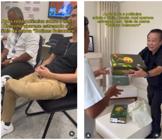
The expression “after the controversy” reproduces narrative logics characteristic of journalism. First, because it structures the narrative according to the logic of sequential events, as in journalistic accounts that situate facts within a precise chronology. Thus, there appears to be a “prior fact” (the controversy), followed by a “development” (the product), as in journalistic coverage that follows unfolding events. Moreover, the reference to a “controversy” presupposes an event of public interest that has already circulated in the media, which places the advertising post in intertextual dialogue with journalistic discourse, even if through a vague evocation of the event. Just as journalistic headlines often employ suspense to attract the reader, the expression “after the controversy” awakens the expectation that something will be revealed, reproducing the logic of the journalistic hook. Finally, the impersonal syntactic structure erases the subject of enunciation, a strategy common in journalistic texts, which reinforces an ethos of factuality. The brand thus presents itself as the narrator of an important episode, attributing to the product the status of the development of a public fact.
Beyond simulating relevance for the brand, it is worth recalling that, for Maingueneau (2005), polemic is a discursive instrument that translates an Other within discourse through a simulacrum. Polemic is “a kind of perverted homeopathy: it introduces the Other into its own space in order better to ward off its threat, but this Other only enters annulled as such, as a simulacrum” (Maingueneau, 2005, p. 113). Even when this Other is articulated in a more or less explicit manner within the statements, polemic is the result of a constitutive interincomprehension of discourse, which constructs an Other that is necessarily caricatural.
Taken together, these two discursive operations (the appropriation of journalistic narrative logic and the mobilization of polemic) function as mechanisms of meaning production that reinforce a logic of visibility (Ortiz, 2025) of their own. By incorporating forms of enunciation associated with journalism, the brand seeks to position itself as an agent of public relevance, inserting itself into a discursive field in which consumption is an act of participation in a community of meaning. The strategic mobilization of “polemic” translates a subject position in discourse that understands itself as an outsider. Its gestures, even the most banal ones, such as wearing a sneaker, are invested with political meaning and perceived as sufficiently disruptive to provoke reactions from a supposed Other. This Other is not named in the discourse but is presupposed as the one who might be offended by the use of the shoe. The community that forms around the brand is summoned to inhabit this discursive position of those who know they cause discomfort and, precisely for that reason, reaffirm their stance. The supposed polemic is, here, the marker of this community of meaning.
In other words, polemic is performed in the act of consumption, through a typically journalistic narrative structure, as a strategy of calling to consumption by insinuating the existence of an antagonistic Other. For Maingueneau (2005), the simulacrum is not synonymous with falsification, but rather with an enunciative displacement that creates the appearance that something is being said by a real Other or that there is a shared consensus. In this case, polemic is mobilized as a discursive simulacrum of a community, as something that stages the existence of a cohesive and dissident collective, reinforced by an implicit enemy who is disturbed by the strong presence of Bolsonaro and his products.
This simulacrum of a cohesive community articulated around Bolsonaro directly engages with the ecosystem of digital influencers. In other analyzed posts, the strategy for publicizing the commodity is carried out through unboxing videos performed by public figures associated with the Bolsonaro-aligned political and media universe. Well-known figures appear opening the product box, commenting on its features, and extolling the supposed symbolism of the sneaker as an expression of support for Jair Bolsonaro.
Beyond a commercial strategy, this constitutes a discursive strategy for the production of political legitimacy. The presence of these personalities endorsing the product operates as public witnesses of loyalty, dramatizing the continuity of a faithful entourage around the former president. What is produced here is a discursive construction of a community of support. By occupying visual spaces with bodies that declare themselves “with him”, a narrative is created in which Bolsonaro does not appear isolated or demobilized but rather sustained by an active community that accompanies him, represents him, and disseminates him. In this way, the idea that Bolsonaro is not alone is reinforced.
The advertising-political discourse present in the Botinas Bolsonaro posts operates as an affective technology that anticipates and projects politicized bodies. The convergence of journalistic, advertising, and digital influencer rhetoric mobilizes a media ecosystem that produces, in and through discourse, the image of a militant collective endowed with symbolic relevance. This entails the discursive construction of a militant body, whether in its literal sense (as a political group) or in a figurative sense (a militant skin constituted through signs of consumption). The shod body becomes an enunciator of a position in the public sphere, reiterating, through its legitimized presence and circulation, the existence of a cohesive discursive community.
This operation resonates with Demuru’s (2024) formulations, for whom bodies have become central in contemporary semiotic disputes, functioning as stages and living screens for political narratives. Demuru (2024) emphasizes that present-day politics is increasingly sensorial and embodied. Subjects do politics with their bodies, whether in the streets, on social media, or through the consumption of visible and incorporable signs. The boot, by marking the bodies of influencers and media personalities who appear in the posts with the signs of bolsonarism, produces an identity choreography that summons the consumer to be a visible subject of the cause, not only on stages or in demonstrations, but in everyday life. There is, here, a re-enchantment of politics through the fetishization of the leader’s body (Demuru, 2024): his signature appears on insoles, sandals, and socks. With each post, it is reaffirmed that Bolsonaro is not alone and that each supporter can continue marching with him, both in the streets and on their feet.
5 Modes of circulation: the commodity as news
The Botinas Bolsonaro posts also signal a circulation strategy that uses journalism as a reference media space. They not only advertise a product through the mimicry of narrative structures typically associated with journalism, as discussed earlier, but also produce media events that reverberate beyond the support base, triggering reactions in different segments of the public sphere, including within traditional journalism itself. The footwear circulates not only as a commodity but as news in the public sphere.
A search on Google News reveals that major traditional press outlets reported on the launch of the store. In January 2024 alone, it is possible to find headlines such as: Bolsonaro becomes the name of a footwear line with prices reaching over R$300 (UOL Notícias)13; ‘Botinas Bolsonaro’: former president lends his name to a footwear brand that sells the ‘puro mito’ sandal and the ‘patriota style’ sneaker (O Globo) 14; Bolsonaro gives his name to a footwear line that includes products such as the ‘patriota style’ sneaker (Carta Capital)15; Bolsonaro becomes the name of a footwear line, including boots and rubber sandals (IstoÉ Dinheiro)16; Businessman from Goiás launches country-style footwear and clothing with the Bolsonaro brand (Jornal Opção)17; ‘Botinas Bolsonaro’: former president’s name becomes a brand of footwear and leather boots (Gazeta do Povo)18; Bolsonaro gets a perfume line with his name, after lending it to boots and appearing on a calendar (Jornal de Brasília)19; Bolsonaro becomes the name of a shoe brand (Revista Oeste)20; Brand turns Bolsonaro into the poster boy for boots and sandals (Metrópoles)21; Ineligible, Bolsonaro uses his name to try to boost product sales (IstoÉ)22; among others.
Although a tone of mockery is perceptible in many of these headlines, it is evident that the launch of the footwear brand was an event capable of producing noise and stimulating news content. There is, here, an aesthetics of provocation, in which the product operates as bait for the journalistic field. We recall that, for Ortiz (2025), the logic of contemporary visibility does not depend on adhesion, but on the capacity to generate noise, engagement, and reaction.
What is at stake is the activation of a visibility device anchored in surprise, dissonance, and the breaking of expectations. After all, this is a highly unusual gesture: a former President of the Republic directly associating his name with footwear bearing hyperbolic names (Patriota Style Sneaker, Bolsonaro Sneaker: Liberty Style, Bolsonaro Boot: Captain, Bolsonaro Classic Sandal: Pure Myth, Bolsonaro Sneaker: Ultra Sovereignty) that link classic signs of his conservative ideology to an openly provocative pop consumption logic. This symbolic operation, which blurs the boundaries between institutional politics and consumer culture, does not follow the conventions of traditional political behavior and, precisely for that reason, mobilizes journalistic attention. Patriota style, for example, summons signs already stabilized in the bolsonarist imaginary (green and yellow and the idea of grassroots patriotism), but, due to its exaggerated tone, also suggests a potential comic effect.
The names attributed to the footwear function as discursive operators that anticipate the mediatization of the object, endowing it with event-making potential. This ambiguity expands the reach of the message: for supporters, it constitutes an aesthetic and political affirmation; for critics or more distanced observers, it presents a scene of self-stylization that borders on the grotesque. It is precisely this tension that contributes to journalistic interest. What emerges here is a sophisticated understanding of the production logics that structure news values. The brand mobilizes elements typical of newsworthiness (such as conflict, unpredictability, polemic, and entertainment) to activate the mediatization of Bolsonaro’s figure, rendering him an irresistible news item.
It is important to emphasize that this is not an isolated action, but rather part of the modus operandi of bolsonarist media circulation. Since the end of his mandate, there has been a systematic launch of products bearing Bolsonaro’s signature: in February 2023, the Bolsonaro Store was launched by Eduardo Bolsonaro, featuring thematic products such as calendars, magic mugs, wooden boards, corkscrews, party kits, aprons, trophies, among others; in March 2023, Michelle Bolsonaro debuted her cosmetics and skincare line, developed by Agustin Fernandez; in July 2023, a themed Bolsonaro birthday kit was launched at the Bolsonaro Store, taking advantage of Eduardo Bolsonaro’s birthday; in August 2023, Agustin Fernandez launched the perfume “Lady M”; in November 2023, Eduardo Bolsonaro became a partner in Vinhos Bolsonaro (with labels such as “Bolsonaro Il Mito”), which opened a physical store in May 2024 in Campos do Jordão; in February 2024, the brand “Botinas do Bolsonaro” was created; in March 2024, the perfume “Mito” was launched; in April 2024, four drones bearing the Bolsonaro brand were announced at the Agrishow event; in December 2024, a company was created to commercialize eyewear and clothing items with the Bolsonaro brand; and in March 2025, the Bravo Grafeno graphene helmet was launched by a company founded by Jair and Flávio Bolsonaro, announced at an automotive parts trade fair in São Paulo.
All of these companies were widely reported by the press at the time of their launches. By promoting a product, the brands participate in the construction of an ecosystem of visibility in which Bolsonaro is constantly reinscribed as a central figure. This occurs independently of his formal political actions, but through the circulation of consumer objects that represent him and update his media presence, including within traditional journalism.
The external circulation of posts from the @botinas.bolsonaro page, materialized in journalistic articles and coverage by traditional outlets, should not be understood as an empirical datum external to the corpus, but rather as a direct effect of the discursive mechanisms analyzed in the profile’s publications. The visibility generated outside Instagram demonstrates that the brand precisely activates enunciative markers and criteria of newsworthiness recognizable by journalism, producing content that circulates easily across different regimes of mediation. Such circulation speaks directly to the research question, insofar as, by replicating criteria of newsworthiness, the profile contributes to the constitution of a discursive ecosystem that disputes meanings with professional media, appropriating its logics in order to redefine agendas and frames.
6 Final considerations
The analysis of the Botinas Bolsonaro brand’s posts makes it possible to identify an articulated set of discursive strategies that combine journalistic, advertising, political-ideological, and commercial discourses, blurring the boundaries between the communicational contracts of each of these instances. Although each discursive axis analyzed (intertextuality with journalism, the simulation of a cohesive community, and the circulation of the commodity as an event) presents specific characteristics, the effects of meaning produced are woven together by a common logic: the construction of a continuous presence of Jair Bolsonaro in the public sphere with a positive agenda, even in a context of institutional absence. The commodity acquires an important political value by being articulated with narratives that update the figure of the former president.
The launch of the Botinas Bolsonaro brand shows how, in the context of contemporary communicative ecologies, mediatized consumer products invested with symbolic density function as important devices of political action. This is because they engender instances of visibility for public figures, produce events, and materialize discursive indices of the persistence of a political project. The Botinas Bolsonaro case reveals a significant shift in the ways political leaders remain in circulation within the public sphere. In this configuration, banal objects are invested with public presence, capable of updating discourses and generating noise and engagement effects, even in contexts of institutional absence. Although often treated as peripheral or even trivial elements, commodities occupy an important place in the contemporary media ecosystem.
This is a logic of visibility sustained less by the authority of office and more by the capacity to remain in circulation as image, narrative, and commodity. Bolsonaro’s figure, inscribed on boots and sandals, resists his condition of ineligibility and reinscribes itself as everyday performance (on bodies, on social media, in journalism, and in disinformation content). Observing these materialities in studies of communication and politics makes it possible to understand more precisely the ways in which political projects remain in circulation even at the margins of formal institutions. Such practices of mediatized consumption invite us to reconsider the role of objects in the symbolic game of contemporary politics.
It is also incumbent upon us to observe how traditional journalism is being mobilized within this media ecosystem as a key element in the logic of discursive production of communicational pieces that, not infrequently, run counter to its foundations and to the principles that guide its social function.
NOTES
-
1
Available at https://www.vinhobolsonaro.com. Accessed on May 31, 2025.
-
2
Available at https://afbeauty.com/ Accessed on May 31, 2025.
-
3
Available at https://www.bravografeno.com.br. Accessed on May 31, 2025.
-
4
The name Botinas Bolsonaro is maintained in Portuguese, as it refers to a commercial brand whose symbolic and political meanings are directly tied to the Brazilian sociocultural context. A literal translation of botinas into English (boots) could dilute the layers of meaning associated with national imagery, rural-popular appeal, and the political references mobilized by the brand in Brazil.
-
5
Available at https://www.instagram.com/botinas.bolsonaro. Accessed on May 31, 2025.
-
6
Available at https://botinasbolsonaro.com.br/. Accessed on May 23, 2025.
-
7
Available at https://www.cnnbrasil.com.br/politica/cirurgia-alta-da-uti-jejum-veja-cronologia-de-internacao-de-bolsonaro/. Accessed on June 6, 2025.
-
8
Information available at https://g1.globo.com/politica/noticia/2025/04/12/anistia-a-golpistas-ainda-depende-de-aprovacao-no-congresso-e-pode-ser-questionada-no-stf-entenda.ghtml. Accessed on June 5, 2025.
-
9
In the images, one reads, respectively: “After leaving the ICU, Bolsonaro has a stable clinical condition”; “Bolsonaro speaks about a possible vice-presidential candidate in 2026: ‘I’m dating a guy’”; “President Jair Bolsonaro says he will go until the very last second to manage to be a candidate. ‘I will go until the very last second! I would like the governors to say, “Why is Bolsonaro ineligible?”’”; “There is only one truth”; and “Bolsonaro enters the sports market: official sneaker is the most anticipated launch.”
-
10
INSS refers to Brazil’s Instituto Nacional do Seguro Social, the federal agency responsible for managing the country’s public social security system, including pensions, retirement benefits, disability allowances, and other social insurance programs for formally employed workers.
-
11
Information available at https://www.cnnbrasil.com.br/economia/financas/fraude-no-inss-entenda-como-vai-funcionar-o-ressarcimento-aos-aposentados/. Accessed on June 5, 2025.
-
12
The images read, respectively: “After all the controversy surrounding the sneaker, Cleitinho appears debuting his Botina Bolsonaro sneaker” and “After all the controversy surrounding the sneaker, Caneta Azul appears debuting his Botina Bolsonaro sneaker.”
-
13
Available at https://noticias.uol.com.br/politica/ultimas-noticias/2024/01/15/botinas-bolsonaro-linha-de-sapatos.htm. Accessed on June 3, 2025.
- 14
-
15
Available at https://www.cartacapital.com.br/cartaexpressa/bolsonaro-da-nome-a-linha-de-calcados-que-tem-entre-produtos-o-tenis-patriota-style/. Accessed on June 3, 2025.
-
16
Available at https://istoedinheiro.com.br/bolsonaro-vira-nome-de-linha-de-calcados-incluindo-botinas-e-chinelos-de-borracha. Accessed on June 3, 2025.
-
17
Available at https://www.jornalopcao.com.br/negocios/empresario-goiano-lanca-calcados-e-roupas-estilo-country-com-grife-bolsonaro-575512/. Accessed on June 3, 2025.
-
18
Available at https://www.gazetadopovo.com.br/republica/botinas-bolsonaro-nome-do-ex-presidente-vira-marca-de-calcados-e-botas-de-couro/. Accessed on June 3, 2025.
-
19
Available at https://jornaldebrasilia.com.br/noticias/brasil/bolsonaro-ganha-linha-de-perfume-com-seu-nome-depois-de-batizar-botina-e-estampar-calendario. Accessed on June 3, 2025.
-
20
Available at https://revistaoeste.com/no-ponto/bolsonaro-vira-nome-de-marca-de-sapato/. Accessed on June 3, 2025.
-
21
Available at https://www.metropoles.com/brasil/marca-transforma-bolsonaro-em-garoto-propaganda-de-botinas-e-chinelos. Accessed on June 3, 2025.
-
22
Available at https://istoe.com.br/inelegivel-bolsonaro-usa-nome-para-tentar-alavancar-vendas-de-produtos. Accessed on June 3, 2025.
-
How to cite this article:
Casadei, E. B. (2026). WHEN FOOTWEAR MAKES THE NEWS: political commodities and appropriations of journalism in digital Bolsonarism. Brazilian Journalism Research, 22(1), e1838. DOI: 10.25200/BJR.v22n1.2026.1838
DATA AVAILABILITY
The data supporting the findings of this study are available within the article.
REFERENCES
- Alves, K. P. E., & Prudencio, K. (2023). Jornalismo de fachada: A retórica da desinformação no programa Os Pingos nos Is. Proceedings of the 10º Congresso da Associação Brasileira de Pesquisadores em Comunicação e Política. Compolítica.
-
Bittner, V. (2024). Iconic Extensions and Memetic Audiences: The MAGA Hat as a Site of Conflict in the US Public Sphere. Cultural Sociology, online first, 1–17. DOI: 10.1177/17499755231225690
» https://doi.org/10.1177/17499755231225690 -
Casadei, E., & De Lucena Lito, L. (2024). O consumo simbólico da desinformação ancorada na credibilidade jornalística: Análise de elementos de legitimação do discurso nas eleições de 2022. Mídia e Cotidiano, 18(1), 169–195. DOI: 10.22409/rmc.v18i1.58480
» https://doi.org/10.22409/rmc.v18i1.58480 - Chaise, M. J. C. (2022). Verdade apócrifa e desinformação: Estratégias de simulação e de ressignificação de sentidos em A Verdade dos Fatos [doctoral dissertation, Universidade de Passo Fundo]. Repositório UPF.
- Demuru, P. (2024). Políticas do encanto: Extrema-direita e fantasias da conspiração Editora Elefante.
-
Karhawi, I. (2024). Entre algoritmos, métricas de engajamento e plataformas digitais: Influenciadores digitais e trabalho de visibilidade. Revista Latinoamericana de Ciencias de la Comunicación, 23(46), 103–114. DOI: 10.55738/alaic.v23i46.1144
» https://doi.org/10.55738/alaic.v23i46.1144 -
Krämer, B. (2014). Media Populism: A Conceptual Clarification and Some Theses on its Effects. Communication Theory, 24(1), 42–60. DOI: 10.1111/comt.12029
» https://doi.org/10.1111/comt.12029 - Maingueneau, D. (2004). Análise de textos de comunicação Cortez.
- Maingueneau, D. (2005). Gênese dos discursos Criar.
- Maingueneau, D. (2008). Cenas da enunciação. Parábola Editorial.
- Mazzoleni, G. (2014). Mediatization and Political Populism. In F. Esser & J. Strömbäck (Eds.), Mediatization of Politics: Understanding the Transformation of Western Democracies (pp. 42–56). Palgrave Macmillan.
-
Miller, K. (2005). T-shirts, Testimony, and Truth: Memories of Violence Made Visible. TEXTILE, 3(3), 250–273. DOI 10.2752/147597505778052468
» https://doi.org/10.2752/147597505778052468 -
Moffitt, B., & Tormey, S. (2014). Rethinking Populism: Politics, Mediatisation and Political Style. Political Studies, 62(2), 381–397. DOI: 10.1111/1467-9248.12032
» https://doi.org/10.1111/1467-9248.12032 -
Nwala, M. (2020). A Pragma-Syntactic Analysis of Slogans on T-shirts. International Journal of Language, Literature and Gender Studies, 9(1), 86–94. DOI: 10.4314/laligens.v9i1.8
» https://doi.org/10.4314/laligens.v9i1.8 -
Oliveira, R., & Ayrosa, E. (2022). Ideologia política e consumo sob a ótica lacaniana. Revista ADM.MADE, 26(2), 1–10. Retrieved from https://mestradoedoutoradoestacio.periodicoscientificos.com.br/index.php/admmade/article/view/10961
» https://mestradoedoutoradoestacio.periodicoscientificos.com.br/index.php/admmade/article/view/10961 -
Ortiz, R. (2025). Visibilidade e espaço público. Matrizes, 19(1), 7–18. DOI: 10.11606/issn.1982-8160.v19i1p7-18
» https://doi.org/10.11606/issn.1982-8160.v19i1p7-18 -
Paganotti, I. (2019). Fake news e a falha da Folha de S.Paulo: Visibilidade da crítica em casos de paródia e sátira jornalística. Estudos de Jornalismo e Mídia, 16, 194–206. DOI: 10.5007/1984-6924.2019v16n1p194
» https://doi.org/10.5007/1984-6924.2019v16n1p194 -
Paterson, L. (2017). Diss/Play: T-shirts as Mobile Meme. Fashion - Scope: (Art & Design), 15(1), 81–86. Retrieved from https://thescopes.org/journal/art-and-design/art-and-design-15/dissplay-t-shirts-as-mobile-meme
» https://thescopes.org/journal/art-and-design/art-and-design-15/dissplay-t-shirts-as-mobile-meme -
Penney, J. (2012). Visible Identities, Visual Rhetoric: The Self-labeled Body as a Popular Platform for Political Persuasion. International Journal of Communication, 6(1), 2.318–2.336. Retrieved from https://ijoc.org/index.php/ijoc/article/view/1528
» https://ijoc.org/index.php/ijoc/article/view/1528 -
Prates, V. (2023). O engano, a doença, a morte: Como as fake news simularam técnicas canônicas do jornalismo durante a pandemia de Covid-19. ECCOM: Educação, Cultura e Comunicação, 14(28), 91–104. Retrieved from https://seer.unifatea.edu.br/index.php/eccom/article/view/589
» https://seer.unifatea.edu.br/index.php/eccom/article/view/589 - Traquina, N. (2005). Jornalismo: Questões, teorias e “estórias” MinervaCoimbra.
-
Treré, E. (2025). Ecologias das mídias, movimentos sociais e ativismo. Matrizes, 19(1), 19–38. DOI: 10.11606/issn.1982-8160.v19i1p19-38
» https://doi.org/10.11606/issn.1982-8160.v19i1p19-38
-
Desk review editor:
Fred Tavares

 Source:
  Source: