 Phytochemical screening and pharmacological assessment of the anxiolytic potential of ethanolic extract of Gerbera jamesonii adlam flowers in swiss albino mice
The brain is particularly vulnerable to oxidative stress, which is associated with neurodegenerative and neuropsychiatric disorders, including anxiety. Antioxidant therapy, particularly with polyphenols and flavonoids, shows promise in mitigating these conditions. This study evaluated the anxiolytic effects of an ethanolic extract of Gerbera jamesonii Adlam flowers (EEGJ) in Swiss albino mice. The anxiolytic activity was assessed using the elevated plus maze, hole board, open field, and light-dark tests, with EEGJ administered at doses of 200-400 mg/kg and compared to buspirone (10 mg/kg). Phytochemical analysis of EEGJ revealed the presence of various bioactive compounds, with total phenolic and flavonoid contents measured at 329.39 mg GAE/g and 635.22 mg RT/g, respectively. EEGJ demonstrated potent antioxidant activity (IC50 = 64.0 µg/mL) similar to ascorbic acid (53.6 µg/ mL). At 400 mg/kg, EEGJ showed significant anxiolytic effects (p < 0.05) across all tests, marked by increased entries and time spent in open arms of the elevated plus maze and significant results in other behavioural tests. These results indicate that EEGJ has notable anxiolytic potential, supporting its potential role as a natural antianxiety agent.
Keywords:
Antianxiety; Gerbera jamesonii Adlam; Elevated plus maze; Hole board; Open field; Light-dark test.

INTRODUCTION
Anxiety disorders have emerged as a significant public health concern, with their prevalence rising steadily in recent years. This increase has been further intensified by the COVID-19 pandemic, which has introduced a host of stressors, including social isolation, health concerns, and economic uncertainties, all contributing to elevated levels of anxiety (Di Bonaventura et al., 2022). Although traditional pharmacological treatments, such as benzodiazepines, are commonly prescribed for anxiety management, they are often associated with adverse effects, including sedation, dependency, and the development of tolerance. These limitations have driven interest in finding safer and more natural alternatives for managing anxiety (Agrawal et al., 2024; Lader, Morton, 1991).
Historically, plants have been utilized for their therapeutic properties in treating various health conditions, including mental health disorders. Phytochemicals, which are bioactive compounds found in plants, have shown the potential in alleviating anxiety symptoms by interacting with the central nervous system (Banu, Poduri, Bhattamisra, 2024). These interactions can influence neurotransmitter levels and receptor activity, potentially leading to mood stabilization and anxiety reduction. Research has indicated that certain plants, such as chamomile, lavender, valerian root, and passionflower, possess anxiolytic properties (Hieu et al., 2019; Donelli et al., 2019; Esmaeili, Razzaghi, Okhovatian, 2022; Akhondzadeh et al., 2001). The growing interest in plant-based therapies is driven by the rising prevalence of anxiety disorders, the side effects of conventional treatments, and the potential benefits of natural compounds.
Gerbera jamesonii Adlam, widely known for its ornamental appeal, has also been traditionally utilized for its medicinal properties. This plant is a rich source of bioactive compounds, including coumarin derivatives, alkaloids, flavonoids, terpenoids, and phenolic compounds, which contribute to its therapeutic potential. Historically, G. jamesonii has been employed to address a range of health conditions, such as digestive disorders (e.g., constipation, gastritis), hepatobiliary issues (e.g., gallbladder and liver ailments), and genitourinary problems (e.g., urinary tract disorders, dysmenorrhea, and cystitis). Despite its extensive traditional use, scientific investigations into its pharmacological properties remain limited, particularly in the realm of mental health, such as anxiety management (Naaz et al., 2024; Negm El-Dein et al., 2023).
Given the presence of these bioactive compounds and its historical applications, this study aims to explore the potential of G. jamesonii as an anxiolytic agent. The research focuses on characterizing the chemical composition of its ethanolic extract and evaluating its activities, with an emphasis on antioxidant and anxiolytic properties. Preclinical studies are conducted to assess the extract efficacy, providing foundational data on its potential as a novel therapeutic option for anxiety disorders. While current scientific evidence on its pharmacological effects and safety profile, particularly in animal models, remains limited, this investigation advances understanding of G. jamesonii’s mechanisms of action and its role in mitigating anxiety. Such findings pave the way for the development of safer, plant-based alternatives for anxiety treatment, addressing the limitations of conventional therapies.
MATERIAL AND METHODS
Plant material
Gerbera jamesonii Adlam flowers were collected from Gudimalkapur, Hyderabad, India, in June 2024. Their botanical identity was confirmed by Dr. Vijaya Bhasker Reddy. The authentication number assigned to the flowers was OUAS-180.
Preparation of plant extract
The G. jamesonii flowers were washed with distilled water, air-dried in shade, powdered using the grinder, and sieved. A 200 g sample was extracted with 500 mL of 90% ethanol using a Soxhlet at 60°C for 48 h. The extract was concentrated to one-fourth of its volume with a rotary evaporator and stored at -20°C after the complete removal of ethanol (Naaz et al., 2024).
Preliminary phytochemical screening
To assess the presence of various phytoconstituents, a preliminary phytochemical analysis of the ethanolic extract of G. jamesonii flowers was conducted following established protocols (Trease, Evans, 1989; Trease, Evans, 1996).
Quantitative analysis
Quantitative analysis was conducted to determine the total phenolic and flavonoid contents of the ethanolic extract of G. jamesonii (EEGJ).
Total phenolic content (TPC)
Total phenolic content in EEGJ was quantified using the Folin-Ciocalteu method with gallic acid as the standard. Diluted extracts were mixed with Folin-Ciocalteu reagent and sodium carbonate, followed by incubation and centrifugation. Absorbance was measured at 760 nm, and results were expressed as mg gallic acid equivalents (GAE) per gram of extract (Molole, Gure, Abdissa, 2022).
Total flavonoid content (TFC)
Total flavonoids were measured using the aluminium chloride colorimetric assay with rutin as the standard. Extracts were mixed with NaNO2, AlCl3, and NaOH, then diluted to 10 mL. Absorbance was recorded at 415 nm, with a blank containing a pure solvent for comparison. Flavonoid content was expressed as mg rutin equivalents (RE) per gram of extract (Naaz et al., 2024).
DPPH free radical scavenging assay
This assay evaluates antioxidant activity by measuring the ability to scavenge free radicals through hydrogen donation to DPPH, resulting in a color change from purple to yellowish-purple. Separate methanolic solutions of DPPH and ascorbic acid (ASC) were prepared. For the reaction, 1 mL of ASC, 3 mL of plant extract, or 3 mL of methanol (control) were mixed with 3 mL of DPPH. The mixtures were incubated in the dark for two hours, and absorbance was recorded at 515 nm. All tests were performed in triplicate for consistency (Molole, Gure, Abdissa, 2022).
Evaluation of the anxiolytic activity of G. jamesonii
Experimental animals
Male Swiss albino mice (22-25 g) were procured from Jeeva Life Sciences, Hyderabad, India. They were housed under controlled conditions (12-h light-dark cycle, 25°C ± 2°C, 75% ± 5% humidity) with ad libitum access to food and water. The study was approved by the IAEC (RBVRR 1328/11/2024) and conducted in accordance with CCSEA guidelines.
Administration of the buspirone and extracts
Buspirone (10 mg/kg) and EEGJ (200 and 400 mg/ kg) were dissolved in 0.5% Na-CMC and administered orally once daily for seven consecutive days. The control group received only the 0.5% Na-CMC solution. The doses of EEGJ were selected based on acute toxicity findings from our previous study, where the LD50 was determined to be greater than 2000 mg/ kg. Consequently, 1/5th and 1/10th of the LD dose were chosen for the present study (Naaz, Banu, 2024).
Sample size determination
The sample size was calculated using power analysis (G*Power, 3.1) with 80% power (α = 0.05) and an expected medium effect size (Cohen’s f=0.25). Each group required 6 animals, leading to a total of 24 animals across 4 groups.
Experimental design
Twenty-four male mice were randomly assigned to four groups (n=6) as detailed in Table I: Group I (control), Group II (Buspirone 10 mg/kg), Group III (EEGJ 200 mg/kg), and Group IV (EEGJ 400 mg/ kg). The anxiolytic activity was evaluated based on behavioural parameters 30 min post-treatment. The observed effects were primarily attributed to the acute impact of the final administration.
Behavioural studies
Elevated plus maze
The elevated plus maze (EPM), consisting of two open arms and two closed arms elevated 25 cm above the floor, was utilized to evaluate anxiolytic behavior in mice. The animals were fasted for 18 h prior to the experiment. Forty-five minutes post-administration of the test compounds, each mouse was placed at the center of the maze, facing an open arm. Behavioral parameters were recorded over a 5-min period, including (a) first entry preference, (b) number of open-arm entries, and (c) average time spent in the open arms, which are indicative of anxiolytic activity (Kumar, Bhat, Shah, 2012) (Figure 1A).

Behavioural studies A. Elevated plus maze B. Hole board test C. Light dark test D. Open field test.
Hole board test
The hole board apparatus consisted of a wooden box (40 × 40 × 25 cm) with 16 evenly spaced holes (3 cm in diameter) on the base, elevated 25 cm above the ground. During a 5-min observation period, the number of head dips and the duration of head dipping were recorded as indicators of exploratory behaviour and anxiolytic activity, as depicted in Figure 1B (Brown, Nemes, 2008; Kaur, Shri, Kamboj, 2017).
Light dark test
The light-dark apparatus consisted of two compartments (40 × 60 × 20 cm): a brightly illuminated area (40 × 40 cm) and a dark area (40 × 20 cm), separated by a wall with a 7 cm diameter opening. A 100 W white light source was positioned 17 cm above the illuminated section, as shown in Figure 1C. Mice were individually placed in the light compartment, and during a 5-minute test session, the following parameters were recorded: total crossings between light and dark areas, time spent in each compartment, number of rearings, and defecation units. The apparatus was thoroughly cleaned between experiments to prevent olfactory cues (Malmberg-Aiello et al., 2002).
Open field test
The apparatus consisted of a wooden box (60 × 60 × 60 cm) divided into 16 squares (15 × 15 cm), including four inner squares and 12 peripheral squares. The testing room was dark and sound-attenuated, illuminated by a 40-W lamp positioned 75-100 cm above, as shown in Figure 1D. 60 min after oral administration of the vehicle, buspirone, or EEGJ, each mouse was placed in a corner square. Over a 5-min observation period, the number of rearings, assisted rearings, and squares crossed were recorded to assess locomotor and exploratory behaviour (Agrawal et al., 2024).
Statistical analysis
The data were presented as Mean ± S.E.M. (n = 6). Group differences were analyzed using one-way analysis of variance (ANOVA), followed by Dunnett’s multiple comparisons test. A p-value < 0.05 was considered statistically significant. Statistical analysis was performed using GraphPad Prism version 10.1.1 for Windows (GraphPad Software Inc., San Diego, CA, USA).
RESULTS
Extraction yield of G. jamesonii
The percentage yield of the solvent-free extract was 42.92%, calculated by dividing the weight of the extract (85.54 g) by the weight of the plant powder (200 g) and multiplying by 100.
Preliminary phytochemical screening
The preliminary phytochemical screening of G.jamesonii showed the presence of alkaloids, carbohydrates, reducing sugars, saponins, phytosterols, phenolic compounds and flavonoids as depicted in Table II.
Quantitative analysis
Total Phenolic Content
The total phenolic content (TPC) of the ethanolic extract of G. jamesonii (EEGJ)was assessed using the Folin-Ciocalteu method, a well-established spectrophotometric technique for phenolic compound analysis. The TPC was found to be 329.39 mg gallic acid equivalents (GAE) per gram of extract, as shown in Figure 2.

Total Flavonoid Content
The total flavonoid content (TFC) of the ethanolic extract of G. jamesonii (EEGJ) was quantified using the aluminum trichloride (AlCl3) method, a reliable spectrophotometric technique for flavonoid analysis in plant extracts. The TFC was measured at 635.22 mg rutin equivalents (RE) per gram of extract, as illustrated in Figure 3.

Antioxidant activity of G. jamesonii
The DPPH (2,2-diphenyl-1-picrylhydrazyl) radical scavenging activity of the ethanolic extract of G. jamesonii (EEGJ) and ascorbic acid was evaluated. The IC50 values were 64.0 µg/ml for EEGJ and 53.6 µg/ ml for ascorbic acid, indicating that although EEGJ is less potent, it still demonstrates significant antioxidant activity, as presented in Table III and Figure 4.

Anxiolytic activity of G. jamesonii
Elevated plus maze (EPM)
The EPM test is a widely used behavioral assay to evaluate anxiety-related responses in rodents. As shown in Table IV and Figure 5, the control group exhibited the least time spent (58.83 s) and entries (6.00) in the open arms, indicating normal anxiety levels. Buspirone (10 mg/kg) significantly increased both parameters (p < 0.001), confirming its strong anxiolytic effect. EEGJ treatment demonstrated a dose-dependent anxiolytic response, with the 200 mg/kg dose increasing open-arm time to 72.01±4.47 s and entries to 12.83±2.09 (p < 0.05), while the 400 mg/kg dose further enhanced these measures to 90.42±2.25 s and 14.17±1.62 (p < 0.001 and p < 0.01).

Effect of EEGJ on EPM test. (A) Time spent in open arm (B) No. of open arm entries. All values are mean ± SEM (n = 6); *p < 0.05, **p < 0.01, ***p < 0.001 when compared to control. One-way ANOVA, followed by Dunnett’s test.
Hole board test
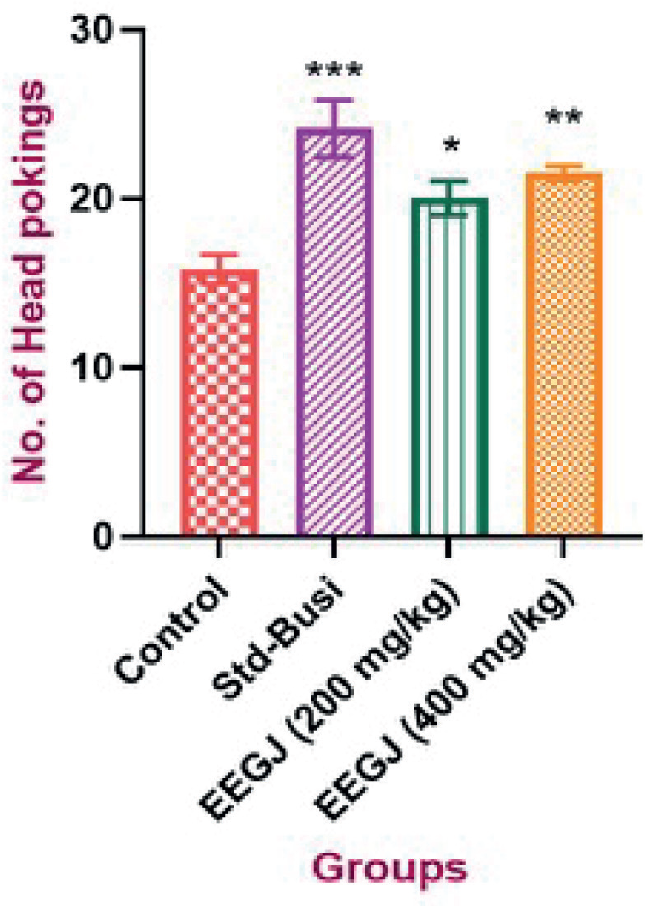
The hole board test is a widely used behavioral assay to evaluate exploratory behaviour and potential anxiolytic effects in rodents. As shown in Table V and Figure 6, the control group exhibited the lowest head-poking frequency (15.83±0.87), indicating heightened anxiety and reduced exploration. Buspirone (10 mg/kg) significantly increased head pokings (24.17±1.70, p < 0.001), confirming its strong anxiolytic effect. EEGJ treatment showed a dose-dependent increase, with 200 mg/kg elevating head pokings to 20.03±1.00 (p < 0.05) and 400 mg/kg further increasing them to 21.50±0.43 (p < 0.01). These findings suggest that EEGJ exhibits anxiolytic properties, with higher doses enhancing exploratory behavior.

Effect of EEGJ on hole board test. All values are mean ± SEM (n = 6); *p < 0.05, **p < 0.001, ***p < 0.001 when compared to control. One-way ANOVA, followed by Dunnett’s test.
Light-dark test
The light-dark box test is a well-established behavioral model for assessing anxiety-like behaviour in rodents. As shown in Table VI and Figure 7, the control group exhibited the least time spent in the light area (5.22±0.32 s) and the lowest number of light area entries (3.17±0.87), indicating heightened anxiety. Buspirone (10 mg/kg) significantly increased both parameters (17.17±2.21 s, 18.25±1.09 entries; p < 0.001), confirming its strong anxiolytic effect. EEGJ treatment demonstrated a dose-dependent anxiolytic response, with 200 mg/kg increasing light area time to 11.50±1.18 s and entries to 9.00±1.57 (p < 0.05), while 400 mg/kg further enhanced these measures to 14.33±1.15 s (p < 0.01) and 16.02±1.46 entries (p < 0.001). These findings suggest that EEGJ possesses anxiolytic properties, with higher doses effectively reducing anxiety-like behavior.

Effect of EEGJ on Light-dark test. (A) Time spent in light area (B) No. of entries in light area. All values are mean ± SEM (n = 6); *p < 0.05, **p < 0.01, ***p < 0.001 when compared to control. One-way ANOVA, followed by Dunnett’s test.
Open Field Test
The open-field test is a widely used behavioral assay to assess locomotor activity and anxiety-like behavior in rodents. As shown in Table VII and Figure 8, the control group exhibited the lowest number of squares crossed (26.50±2.49) and rearings (14.33±2.30), indicating reduced exploratory activity and heightened anxiety. Buspirone (10 mg/kg) significantly increased both locomotion (85.16±8.97 squares, p < 0.001) and rearing behavior (59.00±7.37, p < 0.001), confirming its anxiolytic and stimulatory effects. EEGJ treatment showed a dose-dependent increase in exploratory behavior, with 200 mg/kg elevating the number of squares crossed to 69.66±6.16 (p < 0.01) and rearings to 40.17±8.49 (p < 0.05). The 400 mg/kg dose further enhanced these measures (80.33±7.86 squares, p < 0.001; 46.83±5.04 rearings, p < 0.01), suggesting that EEGJ exhibits anxiolytic and stimulatory properties, with higher doses promoting greater exploratory activity.

Effect of EEGJ on Open field test. All values are mean ± SEM (n = 6); *p < 0.05, **p < 0.01, ***p < 0.001 when compared to control. One-way ANOVA, followed by Dunnett’s test.
DISCUSSION
Oxidative stress plays a crucial role in the development of neurodegenerative and neuropsychiatric disorders, including anxiety, as it can lead to cellular damage, inflammation, and impaired brain function (Kim et al., 2015). Antioxidant therapy has emerged as a promising approach to managing these conditions, particularly through the use of polyphenols and flavonoids, which can mitigate oxidative damage and support overall mental health (Vauzour et al., 2008). This study investigated the anxiolytic properties of G. jamesonii flowers, specifically analyzing the effects of its ethanolic extract (EEGJ) on anxiety-related behaviours in Swiss albino mice. Phytochemical analysis of EEGJ identified several bioactive compounds, including alkaloids, carbohydrates, reducing sugars, saponins, phytosterols, phenolic compounds, and flavonoids. Quantitative assessments revealed a high total phenolic content (TPC) of 329.39 mg gallic acid equivalents (GAE) per gram of extract and a total flavonoid content (TFC) of 635.22 mg rutin equivalents (RT) per gram of extract. These compounds are known for their antioxidant properties, which have shown promise in reducing the effects of oxidative stress (Naaz et al., 2024; Negm El-Dein et al., 2023). The antioxidant activity of EEGJ was further evaluated using the DPPH assay, where it demonstrated a strong free radical scavenging capacity, with an IC50 value of 64.0 µg/mL, comparable to that of ascorbic acid (IC50 = 53.6 µg/mL). This high antioxidant potential indicates that EEGJ could counteract oxidative stress, potentially aiding in neuroprotection and anxiety reduction. However, further confirmation through in vivo antioxidant studies is required to validate these effects and strengthen the findings. The anxiolytic effects of EEGJ were assessed in Swiss albino mice. The study employed 4 groups, each comprising 6 animals, ensuring adherence to ethical principles such as the 3Rs (Replacement, Reduction, and Refinement) to minimize animal suffering and the number of animals used. The groups were administered EEGJ orally at doses of 200 mg/kg and 400 mg/kg. This dose was selected based on the previous acute toxicity study reported by Naaz and Banu (2024). In this study, we employed Dunnett’s test since we are comparing treatment groups (buspirone, low dose, and high dose of EEGJ) to a single control group.
Behavioural tests were then conducted, including the elevated plus maze, hole board, open field, and light/dark box tests. These tests are standard assays for evaluating anxiety-like behaviors in animal models and offer insights into the potential anxiolytic effects of substances. The findings from these tests demonstrated that EEGJ significantly improved anxiety-like behaviours at both doses, particularly at 400 mg/kg. Results included an increase in entries and time spent in the open arms of the elevated plus maze, which suggests reduced anxiety levels. Similarly, EEGJ increased head-dipping behaviour in the hole board test, an indication of reduced neophobia and anxiety. However, one limitation of the hole board test is that it primarily assesses locomotion rather than emotional states, which may not fully capture the nuanced aspects of anxiety-related behavior. In the open field test, mice treated with EEGJ crossed more squares, indicating increased behaviour and reduced anxiety. However, this test primarily evaluates general locomotor activity rather than anxiety-specific behaviors, which might overlook subtle anxiety-related effects. Finally, in the light-dark test, EEGJ-treated mice spent more time in the light area, reflecting reduced aversion to light and lowered anxiety levels. While the light-dark test is widely used to assess anxiety, a limitation of this test is that it primarily measures approach-avoidance behavior rather than emotional or cognitive aspects of anxiety, potentially limiting its sensitivity to complex anxiety-related responses.
These outcomes suggest that G. jamesonii flowers may act as a natural anxiolytic agent. The anxiolytic effects of EEGJ are likely due to its high polyphenolic and flavonoid content, contributing to its antioxidant and anxiolytic properties. This aligns with previous research indicating that polyphenolic compounds can influence neurotransmitter systems, particularly those involved in the regulation of anxiety, such as serotonin and GABA. For instance, research by Aguirre-Hernández et al. (2016) demonstrated that polyphenol-rich extracts from various plant species possess anxiolytic effects due to their ability to modulate oxidative stress and improve neurotransmission. Similarly, flavonoids have been recognized for their role in reducing anxiety-like behaviors by enhancing brain GABAergic activity, which promotes a calming effect (Karim et al., 2018). Our results contribute to this body of evidence by providing new insights into the potential anxiolytic effects of G. jamesonii extract, reinforcing the therapeutic potential of polyphenolic-rich plants in managing anxiety. Moreover, our findings support previous studies on natural anxiolytics, such as those involving extracts from plants like Passiflora incarnata and Hypericum perforatum, which have demonstrated anxiolytic effects through similar mechanisms (Grundmann et al. 2009; Vandenbogaerde et al., 2000). These comparisons highlight G. jamesonii as a novel candidate for anxiety management, particularly given its promising anxiolytic activity without the side effects commonly associated with synthetic drugs.
Therefore, EEGJ offers a promising natural approach to managing anxiety, potentially complementing or serving as an alternative to conventional therapies with undesirable side effects. Further research is warranted to explore the specific mechanisms through which EEGJ exerts its anxiolytic effects, as well as its long-term safety and efficacy in diverse populations.
CONCLUSION
The ethanolic extract of G. jamesonii demonstrated significant anxiolytic activity in Swiss albino mice, as evidenced by enhanced exploratory behavior across multiple behavioral paradigms, including the elevated plus-maze, hole board test, open field test, and light-dark test. Quantitative analysis identified high levels of phenolic compounds and flavonoids in G. jamesonii extract, correlating with potent antioxidant activity. In vitro DPPH assays showed its radical scavenging capacity was comparable to ascorbic acid, suggesting efficacy in mitigating oxidative stress, a key factor in neuronal damage and anxiety disorders. These findings indicate that G. jamesonii may be a promising natural treatment for anxiety disorders by reducing oxidative stress-related neuronal damage. Further research is needed to identify the specific bioactive compounds responsible for its anxiolytic effects.
ACKNOWLEDGEMENT
The authors are thankful to RBVRR Women’s College of Pharmacy for providing the necessary facilities to carry out this research work.
DATA AVAILABILITY STATEMENT
The data that support the findings of this study are available from the corresponding author upon reasonable request.
REFERENCES
- Agrawal P, Singh T, Pathak D, Chopra H, Singh K. Evaluation of the anxiolytic activity of ethanolic extract of Ziziphus mauritiana Lam. in Swiss albino mice. Pharmacol Res Mod Chin Med. 2024;10:100348.
- Aguirre-Hernández E, González-Trujano ME, Terrazas T, Herrera Santoyo J, Guevara-Fefer P. Anxiolytic and sedative-like effects of flavonoids from Tilia americana var. mexicana: GABAergic and serotonergic participation. Salud mental. 2016;39(1):37-46.
- Akhondzadeh S, Naghavi HR, Vazirian M, Shayeganpour A, Rashidi H, Khani M. Passionflower in the treatment of generalized anxiety: A pilot double-blind randomized controlled trial with oxazepam. J Clin Pharm Ther. 2001;26(5):363-367.
- Banu Z, Poduri, RR, Bhattamisra SK. A comprehensive review on phytochemistry, health benefits, and therapeutic potential of Elaeocarpus angustifolius Blume. Ann Phytomed 2024;13(1):370-383.
- Brown GR, Nemes C. The exploratory behaviour of rats in the hole-board apparatus: Is head-dipping a valid measure of neophilia? Behav Processes. 2008;78(3):442-428.
- Di Bonaventura EM, Botticelli L, Del Bello F, Giorgioni G, Piergentili A, Quaglia W, et al. Investigating the role of the central melanocortin system in stress and stress-related disorders. Pharmacol Res. 2022;185:106521.
- Donelli D, Antonelli M, Bellinazzi C, Gensini GF, Firenzuoli F. Effects of lavender on anxiety: A systematic review and meta-analysis. Phytomedicine. 2019;65:153099.
- Esmaeili S, Razzaghi M, Okhovatian F. Efficacy of valerian root extract on anxiety via bioinformatics. Res J Pharmacogn. 2022;9(4):13-20.
- Grundmann O, Wähling C, Staiger C, Butterweck V. Anxiolytic effects of a passion flower (Passiflora incarnata L.) extract in the elevated plus maze in mice. Die Pharmazie-An Int J Pharm Sci. 2009;64(1):63-64.
- Hieu TH, Dibas M, Surya Dila KA, Sherif NA, Hashmi MU, Mahmoud M, et al. Therapeutic efficacy and safety of chamomile for state anxiety, generalized anxiety disorder, insomnia, and sleep quality: A systematic review and meta-analysis of randomized trials and quasi-randomized trials. Phytother Res. 2019;33(6):1604-1615.
- Kumar D, Bhat ZA, Shah MY. Anti-anxiety activity of successive extracts of Angelica archangelica Linn. on the elevated T-maze and forced swimming tests in rats. J Tradit Chin Med. 2012;32(3):423-429.
- Kaur D, Shri R, Kamboj A. Evaluation of anti-anxiety effect of Brassica oleracea L. extracts in experimental animals. Pharmacognosy J. 2017;9(5);638-643.
- Karim N, Khan I, Khan H, Ayub B, Abdel-Halim H, Gavande N. Anxiolytic potential of natural flavonoids. SM J. Endocrinol Metab. 2018;4:1018s.
- Kim GH, Kim JE, Rhie SJ, Yoon S. The role of oxidative stress in neurodegenerative diseases. Exp Neurobiol. 2015;24(4):325-340.
- Lader M, Morton S. Benzodiazepine problems. Br J Addiction. 1991;86(7):823-828.
- Malmberg-Aiello P, Ipponi A, Bartolini A, Schunack W. Mouse light/dark box test reveals anxiogenic-like effects by activation of histamine H1 receptors. Pharmacol Biochem Behav. 2002;71(1-2):313-318.
- Molole GJ, Gure A, Abdissa N. Determination of total phenolic content and antioxidant activity of Commiphora mollis (Oliv.) Engl. resin. BMC Chem. 2022;16(1):48
- Naaz S, Banu Z, Nikilitha G, Mujeeb SA. Pharmacological benefits of Gerbera jamesonii Adlam flower: Qualitative and quantitative analysis of the extract. J Phytonanotech Pharm Sci. 2024;4(2):30-36.
- Naaz S, Banu Z. Antidepressant, antiamnesic activity, and toxicity profile of the ethanolic extract of Gerbera jamesonii Adlam flowers. J Phytonanotech Pharm Sci. 2024;4(4):1-8.
- Negm El-Dein S, Hussein A, Abu-Bakr MS, Negm El-Dein A, Awad HM, Ragab EA. Phytochemical analysis and determination of antioxidant, anti-cholesterol, anti-inflammatory and anti-proliferative activities of Gerbera jamesonii flowers. Adv Tradit Med. 2023;23(3):863-875.
- Trease GE, Evans WC. A Textbook of Pharmacognosy. 11th ed. Brailliar Tindall Ltd, London. 1989;45-50.
- Trease GE, Evans WC. Pharmacognosy. Alden Press, Oxford. 1996;213-232.
- Vauzour D, Vafeiadou K, Rodriguez-Mateos A, Rendeiro C, Spencer JP. The neuroprotective potential of flavonoids: a multiplicity of effects. Genes Nutr. 2008;3:115-126.
- Vandenbogaerde A, Zanoli P, Puia G, Truzzi C, Kamuhabwa A, De Witte P, et al. Evidence that total extract of Hypericum perforatum affects exploratory behavior and exerts anxiolytic effects in rats. Pharmacol Biochem Behav. 2000;65(4):627-633.
Edited by
-
Associate Editor:
Mônica Pupo