 Yacon-kefir beverage: a symbiotic product with improved antioxidant properties and no toxic effects
Abstract
The aim of the present study was to obtain a symbiotic drink of a non-dairy matrix based on yacon juice fermented by kefir grains, biomonitored by antioxidant activity and pH value. A Box-Behnken experimental design was carried out to evaluate the effects of the concentrations of yacon juice and kefir grains, as well as of the fermentation temperature, on the antioxidant activity and pH. Thus, it was possible to define the optimal concentrations and temperature for the production of the drink with the best profile. Subsequently, in vitro analyses were performed to evaluate the physical-chemical and microbiological characteristics of the drink, in addition to the in vivo assay using the experimental model Caenorhabditis elegans to assess a possible degree of acute toxicity. The results showed that the drink made with 82.7% yacon juice, fermented with 2% kefir grains at a temperature of 35ºC presented antioxidant potential, increased phenolic compounds, adequate physical-chemical characteristics and chemical composition, and the presence of probiotic microorganisms, in addition to not presenting acute toxicity in vivo.
Keywords:
Antioxidant activity; Probiotic; Prebiotic; Functional foods; Non-dairy matrices
INTRODUCTION
In recent years, the world population has been adopting changes towards a healthier diet (Mieziene et al., 2022). People are increasingly seeking foods that provide the nutrients necessary for the maintenance of health and well-being, and which also contain elements in their composition capable of promoting benefits for the prevention and/or treatment of diseases (Mantzourani et al., 2020). In this context, functional foods appear as an important alternative to meet the growing demand generated by the consumption of healthy foods (Konstantinidi, Koutelidakis, 2019).
Fermented beverages that are rich in probiotics are an affordable alternative to preserve and improve the functional characteristics of foods (Pontonio et al., 2019). Evidence shows that fermentation promotes changes in the biochemical profile of foods which may enhance their biological activities (Fiorda et al., 2016). In addition, fermentation improves quality through the biosynthesis of vitamins and bioactive compounds, as well as preserving the integrity of components that confer functional properties, such as phenolic compounds (Verni, Verardo, Rizzello, 2019; Ye et al., 2019).
Kefir is a probiotic beverage that has been consumed for several centuries and has widespread health benefits (Silva-Cutini et al., 2019). Water and milk Kefir grains are used to produce water and dairy Kefir beverages with different physical, chemical and microbiological characteristics (de Souza et al., 2024; Gökirmakli, Güzel-Seydim, 2022). However, the most common form of kefir consumption is through the fermentation of grains in a dairy matrix (Mechmeche et al., 2018), which is not suitable for vegetarian or vegan subjects, nor for those allergic to milk proteins and/or intolerant to dairy products (Corona et al., 2016; Fiorda et al., 2016). Thus, in order to expand the possibilities for the consumption of probiotic drinks, new options of non-dairy matrices are being considered for the fermentation of kefir grains, such as fruits, vegetables, cereals and sugar (Chen et al., 2018; Corona et al., 2016).
Several studies have aimed at evaluating the functional, nutritional and sensory characteristics of probiotic drinks prepared with different matrices for fermentation (Dahal, Ojha, Karki, 2020; Fiorda et al., 2016; Koh et al., 2018; Segura-Badilla et al., 2020). In addition, studies using predictive mathematical models have enabled the production of foods in which the components necessary for a better nutritional and functional profile are present in ideal concentrations (Koh et al., 2018; Mechmeche et al., 2018; Segura-Badilla et al., 2020).
In this regard, yacon, a vegetable rich in functional properties, has the potential to be used as a substrate for the fermentation of kefir. The leaves and roots of yacon contain large amounts of phenolic compounds giving the plant a potent antioxidant activity (Cao et al., 2018). In addition, the yacon root is rich in fructooligosaccharides (FOS) and prebiotics that favor the healthy development of probiotics (Dahal, Ojha, Karki, 2020). The association between the prebiotics present in yacon and the probiotics present in kefir can result in a symbiotic combination that might favor the growth of microorganisms, resulting in the biosynthesis of biologically active compounds or in the enhancement of their effects (Dahal, Ojha, Karki, 2020).
Given the evidence that both kefir and yacon present functional properties, it is believed that a functional food in which these two are combined would have a synergistic effect and act more efficiently, expanding the range of beneficial effects that these foods can produce. Thus, the aim of this work was to obtain a symbiotic drink composed of a non-dairy matrix based on yacon juice fermented by kefir grains, biomonitored by antioxidant activity and pH value, and to evaluate its physical-chemical and microbiological characteristics. In addition, we sought to evaluate acute toxicity in vivo using the nematode Caenorhabditis elegans as an experimental model.
MATERIAL AND METHODS
Material
Kefir grains were kindly provided by professor Célia L. L. F. Ferreira from the Federal University of Viçosa - UFV and organic yacon roots were purchased in natura at a local commercial establishment in the city of Vila Velha, ES. The grains were maintained in milk, in a 5% p/v concentration. Since the amount of kefir grains was increasing, it was aliquoted to maintain 5% of concentration. Every day, the grains were removed, and a new sample of milk was added until the drink was prepared.
Experimental design
The effects of different yacon juice concentrations (X1), kefir grain concentrations (X2) and fermentation temperatures (X3) on antioxidant activity were studied using the Box-Behnken experimental design (Box, Behnken, 1960), which consisted of a factorial with three 2³levels and its extensions, the central point (13) being repeated 3 times, totaling 15 products.
Evaluated parameters were described by means of standardized variables, with zero as a mean value and standard deviation equal to 1 (-1, 0, 1) in order to facilitate the understanding of the results, as the variables had different scales. The actual values for the concentrations of X1, X2, X3 and their coded substitutes are shown in Table I.
The combinations between the experimental variables used in the experiment – X1, X2 and X3 – are shown in Table II. The central point was repeated three times. The driving order for the 15 tests was completely random.
Box—Behnken design for the experimental conditions of fermentation of yacon beverages with kefir
All 15 drinks produced here were evaluated for antioxidant activity and pH. The drink that yielded the best results was selected for further analysis.
From the selected yacon drink fermented with kefir grains (KY), a second experiment was carried out following a Completely Randomized Design (CRD), with 3 repetitions. Both the KY drink and the unfermented yacon juice (Y) were evaluated then, the latter having been prepared at the same dilution as the juice used for the production of the fermented drink. These drinks were evaluated for physicochemical composition, microbiology, pH, total titratable acidity, content of total phenolic compounds, flavonoids, antioxidant activity and toxicity to C. elegans.
Preparation of fermented products
Yacon roots were washed, peeled, cut into approximately 0.5 cm-thick slices and homogenized. Citric acid was then added at a concentration of 0.1% (w/w) in relation to the yacon content as an anti-browning agent (Vasconcelos et al., 2015). The mixture was ground in a food processor (Britânia, Diamente 800, SC, Brazil) until a homogeneous-looking juice was obtained. The juice was filtered through a domestic plastic sieve and the kefir grains immediately added to it, according to the design presented in Table II.
The drinks were kept in a BOD incubator (Biochemical Oxygen Demand, TECNAL, TE-371, São Paulo, BR) for fermentation, at the predefined temperatures disclosed in the experimental design, for 24 hours. After the fermentation period, the drinks were filtered and kept under refrigeration (5ºC) for 24 more hours. At the end of this process, the drinks were separated into aliquots, which were stored in tubes and kept frozen at -20ºC for no more than two days.
In vitro antioxidant activity - free radical scavenging 2,2-azino-bis [3-ethylbenzothiazoline-6-sulfonic acid] (ABTS)
The antioxidant activity of each of the 15 fermented drinks was determined by the free radical scavenging method (2,2-azino-bis [3-ethylbenzothiazoline-6-sulfonic acid]) (ABTS) according to Re et al. (1999), with a few modifications. The analysis was performed in triplicate and conducted at room temperature with ABTS+ (Sigma-Aldrich, USA) solution (ABTS 7.0 mmol/L, K2S2O8 2.45 mmol/L); it was then diluted in 50% ethanol solution until the absorbance value of 0.70 ± 0.02 at 734 nm (SpectraMax 190 microplate reader, Molecular devices, Sunnyvale, CA). The standard curve for each drink was then elaborated with at least 5 points of the original sample, diluted in concentrations of 45 to 0.5% (v/v). Subsequently, the analysis was performed with 30 μl of each dilution and 270 μl of the ABTS + solution, using ethanol as a blank. Absorbance was measured at 734 nm in a microplate reader (SpectraMax 190 Microplate Reader, Molecular Devices, Sunnyvale, CA).
The resulting curves were deemed acceptable when R2 > 0.98. The results were expressed as IC (concentration in which 50% of free radicals were reduced) and calculated using a calibration curve in the linear range by plotting the concentration end of the drink versus the corresponding reduction rate. The radical scavenging activity was calculated using the equation: IR (%) = [(AbsB - AbsT) /(AbsB)] × 100, with IR being the index of reduction of ABTS radicals; AbsB the average absorbance of the blank solution; and AbsT the absorbance of the test (Guidoni et al., 2019).
Determination of pH
The pH value of each of the 15 drinks was measured in triplicate using a digital pH meter (KASVI, K39-1014B), duly calibrated. The electrode was directly immersed in the sample and the reading performed after stabilization (AOAC, 2000). All readings were performed in triplicate.
Characterization of the selected drink
Determination of titratable acidity
Total titratable acidity was performed in triplicate and determined by titrating the drink with 0.01mol/L sodium hydroxide solution, with phenolphthalein as color indicator, until a pink color was obtained, following method number 942.15 from AOAC (2000).
Determination of centesimal composition
For centesimal composition, the analysis was performed in triplicate and moisture was determined by drying the sample in an oven at 105°C until constant weight; lipid content was determined by the petroleum ether extraction method in a Goldfish apparatus; protein content was determined by the Kjeldahl method, using 5.75 as a conversion factor; ashes were obtained by muffle incineration at 550°C. Carbohydrate content was determined by the difference between the total sample (100%) and the proportion of lipids, ashes, proteins and moisture (AOAC, 2000).
Microbiological analysis
The analyses were performed according to Yu et al. (2019), in triplicate. The samples were serially diluted, using sterile saline (NaCl 0,9%p/v) as the dilution medium, and plated on agar for the identification and counting of colonies with the culture media Man Rogosa and Sharpe agar (MRS, Sigma Aldrich) for Lactobacillus sp; Plate Count Agar (PCA) Biolog® for total bacterial count; Sabouraud Dextrose Kasvi® Agar for yeast counting. MRS plates were incubated at 37ºC for 48 h, including the counting time. PCA and Sabouraud plates were incubated aerobically at 37ºC for 48 h, including the counting time. Colony counting was performed from plaques with bacterial growth between 30 and 300 CFU/plate for the PCA medium and between 15 and 150 CFU/plate for the other media. Results were expressed as colony forming units per ml of sample (CFU/ml).
Total phenolic compounds content
Total phenolic content was performed in triplicate and determined using the Folin-Ciocalteu reagent according to Karou et al. (2005). Initially, polyphenol extracts were prepared according to Vinson et al. (2001). The samples were mixed with extracting solution containing methanol (Neon, SP, Brazil) at 50% and hydrochloric acid (Neon, SP, Brazil) at 1.2mol/L, and then incubated at 90ºC in a water bath for 3h. Pure methanol (Neon, SP, Brazil) was then added to the samples, which were centrifuged at 4193 relative centrifugal force (RCF) for 5 min (Revan, 14000A, SP, Brazil). The extract containing polyphenols was recovered from the supernatant.
To determine the polyphenol content, Folin's solution (1:1) was added to the polyphenolic extract. After 5 min of reaction, 20% sodium carbonate solution (Dinâmica, SP, Brazil) was added and the volume completed with deionized water. At the end, the absorbance was read at 750 nm (SpectraMax 190 Microplate Reader, Molecular Devices, Sunnyvale, CA). The total polyphenol content was determined from the standard curve of gallic acid (Sigma, USA) (concentrations ranging from 3.0 to 40.0 μg/ml) and calculated by fitting the standard curve (fitting parameters: y = 230.51x – 11.37, R² = 0.997). The results were expressed in mg of gallic acid equivalents (GAE) per ml of sample.
Total flavonoid content
Total flavonoid content was performed in triplicate and determined as described by Yang, Martinson and Liu (2009), with the modifications proposed by Fawole, Opara & Theron (2012). Briefly, 250 μL of the samples were mixed with 75 μl of 5% sodium nitrite solution (Dinâmica, SP, Brazil), 150 μl of 10% aluminum chloride (Dinâmica, SP, Brazil), 500 μl of sodium hydroxide (Neon, SP, Brazil) (1 mol/L) and 775 μl of distilled water. The absorbance of the mixture was measured at 510 nm (Multi-Mode Microplate Reader, Filter Max F5, Molecular Devices Spectra, USA). The standard quercetin curve was drawn from the absorbance plot generated by quercetin (Sigma, USA), with 5 concentrations ranging from 0.25 to 5.0 mg/ml. Total flavonoid content was calculated by fitting the standard curve with a straight-line equation (fitting parameters: y = 0.0281x + 0.0317, R² = 0.9985). The results were expressed in quercetin equivalents (QE) per ml of sample.
Evaluation of in vitro antioxidant activity by ABTS and DPPH
Antioxidant activity was evaluated by the free radical scavenging ABTS method according to Re et al. (1999), modified as described above.
The scavenging activity of the 2,2-diphenyl-1-picrylhydrazyl (DPPH) radical was assessed according to Scherer & Godoy (2009). The analysis was performed in triplicate. The sample was mixed with the DPPH solution (25mg/L) in a 96-well microplate and incubated for 60 min in the dark at room temperature, after which the absorbance was determined at 515 nm (Multi-Mode Microplate Reader, Filter Max F5, Molecular Devices Spectra, USA). The DPPH radical scavenging activity was calculated using the equation: IR (%) = [(AbsB - AbsT) /(AbsB)] × 100, in which IR stands for the DPPH radical reduction index; AbsB for mean absorbance of the blank control; and AbsT for the absorbance of the test. The results were expressed as IC50 and calculated using a calibration curve in the linear range by plotting the final concentration of the drink versus the corresponding reduction index. The curve for determining IC50 was deemed acceptable when R2 > 0.98.
In vivo toxicity assessment using Caenorhabditis elegans
Strains of Caenorhabditis elegans, maintenance and synchronization
All in vivo tests were performed in triplicate on wild type strains of Caenorhabditis elegans (N2), kindly provided by Professor Solange Cristina Garcia, responsible for the Toxicology Laboratory (LATOX), Analysis Department, School of Pharmacy, Federal University of Rio Grande do Sul (UFRGS), Porto Alegre, RS, Brazil.
Synchronization and treatment
The strains were maintained in nematode growth medium (NGM) plates, sown with Escherichia coli OP50 and incubated at 20ºC (Brenner, 1974). The synchronization process was performed to release the eggs from the pregnant nematodes and obtain C. elegans in the first larval stage (L1) according to Charão et al. (2015). The procedure is initiated with the lysis of the pregnant nematodes, using the NaOCl 1% solution (Neon, SP, Brazil) and 0.25 mol/L NaOH (Neon, SP, Brazil), followed by the centrifugation and resuspension of the eggs in an M9 buffer. Then, the eggs are placed in plates with NGM without bacteria and taken for incubation for 16h (Augusti et al., 2017; Charão et al., 2015).
Previously synchronized worms were treated with either the selected kefir-fermented yacon drink (KY) or the unfermented drink (Y) and kept under stirring for 30 minutes at 20°C. Worms treated with autoclaved distilled water were used as controls. After exposure, the worms were washed 3 times with 0.5% NaCl to remove the treatment drinks, being then transferred to NGM plates inoculated with E. coli OP50 for further testing (Augusti et al., 2017).
Mortality assessment
The plates were kept in a B.O.D incubator (TECNAL, TE-371, São Paulo, BR) at 20ºC for 24 hours. After the incubation period, the number of surviving worms in each plate was counted under a microscope (Nikon, Eclipse e200, Japan) to determine the effect of the samples on the mortality rate (Augusti et al., 2017; Charão et al., 2015).
Development analysis
Development was assessed 48h after treatment by measuring the body area (µm²) of adult worms under a microscope according to the methodology described by Charão et al. (2015). The worms were photographed using an Olympus SZ61 microscope (Olympus, Tokyo, Japan). Images were obtained with a digital camera Axiocam ERC5s (Carl Zeiss AG, Oberkochen, Germany) and their body contour was measured manually (10 measurements for each plate) with help of the AxioVision software LE version 4.8.2.0 for Windows (Augusti et al., 2017; Charão et al., 2015).
Statistical analysis
The response surface methodology (RSM) was used to simultaneously evaluate the effect of X1, X2 and X3 on antioxidant activity and pH, based on experimental design. For each response variable, the variance was decomposed into linear, quadratic and interaction components. The second order model, mentioned below, was used to adjust the regression equation:
The model described above was estimated by:
Where b0, b1, b2, b11, b22 and b12 represent the model's constants and regression coefficients; X1i and X2i are the linear levels of the independent variables; X1i2 and X2i2 are the quadratic levels of the independent variables and X1iX2i is the intercession level of the independent variables.
The significance of the equation parameters for each response variable was assessed by the F test at the level of 5% probability. For the modeling, the pure error was used with regression fitting and the significance of the coefficients having been evaluated, adopting the 95% confidence interval to infer statistical significance (p≤0.05). When a lack of fit for the complete model was detected, regression analysis (p≤0.05) was performed only for the significant coefficients. Graphs were constructed from the equations fitted to response surfaces.
The data were analyzed through analysis of variance (ANOVA), in order to estimate the value of F, the lack of fit and the coefficient of determination (R2) of the experimental model, as well as the effects of linear, interaction and quadratic components based on the IC50 values. Significant effects were submitted to the Tukey post-hoc test, adjusted for multiple comparisons, with accepted significance set to 5% (p<0.05). Statistical analyses were performed using the SAS statistical program (Statistical Analysis System SAS Institute Inc., North Carolina, USA), online version.
To analyze the parameters used to characterize the selected drink, the unpaired t-Student test was applied. For analysis of acute toxicity, the data were submitted to one-way analysis of variance (ANOVA) and adjusted for multiple comparisons, with the significance of the difference between means having been determined by Tukey's post-hoc test. The results were expressed as mean ± standard error of the mean (S.E.M.), with accepted significance set to 5% (p <0.05).
RESULTS
Selection of the product fermented by kefir grains in a non-dairy matrix based on yacon juice
ANOVA demonstrates that both the concentration of yacon alone (X1) and its interaction with the concentration of kefir (X1X2) significantly affected (p≤0.05) the antioxidant activity assessed by the ABTS method, while the pH was influenced only by the fermentation temperature (X3) (p≤0.05), as shown in Table III.
ANOVA summary of the antioxidant activity (IC50) and pH of yacon drinks in different concentrations (X1) fermented with different concentrations of kefir (X2) and fermented at different temperatures (X3)
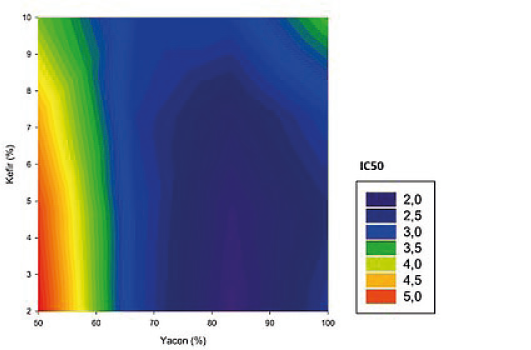
Next, a response surface graph (Figure 1) was constructed by plotting the variation of antioxidant activity as a function of the concentration of yacon (X1) and kefir (X2).

Response surface graph of the variation in antioxidant activity as a function of yacon (X1) and kefir (X2) concentrations.
This graph shows that kefir concentration has little influence over the variation of antioxidant activity - this was in fact proven by fitting the model - which did not yield regression coefficients involving significant kefir variables (p≤0.05). Thus, to select the variables to be used in the development of the drink evaluated in the second part of this work, we considered only the influence of yacon concentration when evaluating antioxidant activity, while temperature was used for the evaluation of pH, as shown in Table IV.
Regression models for antioxidant activity (IC50) and pH as a function of yacon concentration and temperature, respectively, and their regression coefficients and p values
To fit the regression model of antioxidant activity, a non-significant lack of fit was adopted, with p>0.01. On the other hand, despite the low R² value, significant regression coefficients (p≤0.05) and non-significant fits (p>0.05) were obtained for the pH regression model, thus allowing its use.
Centesimal composition analysis
The results for the centesimal composition of yacon beverages not fermented and fermented with kefir are shown in Table V. The results showed that there was an increase in the moisture content of the fermented drink (KY), compared to the non-fermented drink (p <0.05). Another change found was in relation to the carbohydrate content. The fermented drink (KY) had a lower carbohydrate content than the non-fermented drink (Y) (p <0.05). The other parameters analyzed did not change.
Centesimal composition of unfermented yacon drink (Y) and kefir drink fermented in yacon matrix (KY)
Microbiological analysis, pH and total titratable acidity
The results of microbial quantification, pH and total titratable acidity of unfermented and kefir-fermented yacon juice are shown in Table VI. The microbiological analysis of the products showed that the KY drink demonstrated greater growth of microorganisms, Total Bacterial Count (TBC), Lactic Acid Bacteria (LAB) and Yeasts compared to drink Y (p <0.05) (Table VI). The pH and the value of the titratable acidity also showed changes in the fermented beverage compared to the non-fermented beverage (p <0.05).
Total Bacteria Count (CFU.ml-1), pH and total titratable acidity of kefir beverages fermented in yacon juice (KY) and unfermented yacon beverage (Y) in different culture media
Phenolic compounds, flavonoids and in vitro antioxidant activity
The results regarding phenolic compounds, flavonoids and antioxidant activity obtained by the DPPH and ABTS tests are shown in Table VII. The data show that fermentation with kefir was able to increase total phenolic content (p=0.0035), although the flavonoid content did not differ between products (p>0.05). The product fermented with kefir (KY) also showed greater capacity to eliminate DPPH (p=0.0117) and ABTS (p=0.0365) radicals (i.e. reduced IC50), when compared to the control juice (Y). In addition, it should be noted that the IC50% value found in the ABTS test of the selected product is in accordance with the theoretical value found through the predictive mathematical analysis carried out with the biomonitoring data of the fermented products.
Total phenolic compounds, flavonoids and antioxidant activity of unfermented yacon (Y) and kefir fermented yacon (KY) beverages
Toxicity analysis using the in vivo Caenorhabditis elegans experimental model
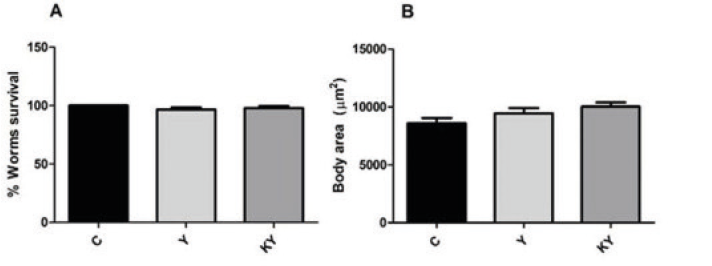
The acute toxicity test was performed with samples of Y and KY using the in vivo C. elegans experimental model. The effect of each product was assessed through tests that evaluated survival rate and the development of worms (Figure 2). Treatments showed no statistical differences (p>0.05) regarding survival rates when compared to the control group (Figure 2A). In addition, both Y and KY were unable to induce significant differences as to the development of worms when compared to the control group (Figure 2B), suggesting that the analyzed products have no acute toxicity effects.
Evaluation of the acute toxicity of unfermented (Y) and kefir-fermented (KY) yacon juice in relation to the control group (C) for survival rate (A) and body area (B). The results were expressed as mean ± standard error of the mean (S.E.M. The data were analyzed by one-way ANOVA/Tukey post hoc test. (p<0.05).
DISCUSSION
The aim of the present study was to obtain a symbiotic drink composes of a non-dairy matrix based on yacon juice fermented by kefir grains, biomonitored to evaluate its physical-chemical and microbiological characteristics and evaluate acute toxicity in vivo using the nematode Caenorhabditis elegans. We demonstrated, for the first time, that the drink made with 82.7% yacon juice, fermented with 2% kefir grains at 35ºC showed that the product did not present toxicity in vivo and presented positive results for antioxidant activity, an increase in phenolic compounds, adequate physical-chemical characteristics and chemical composition and increase in total count of LAB and yeast.
Some studies have demonstrated that beverages produced from plant foods fermented by probiotic microorganisms have improved functional properties, including antioxidant activity (Dahal, Ojha, Karki, 2020; Mechmeche et al., 2018; Sabokbar, Khodaiyan, 2016). Similarly, Sabokbar and Khodaiyan (2016) found that the fermentation of a drink based on pomegranate juice and whey with kefir resulted in an increase in the total content of phenolic compounds and in antioxidant capacity.
The ABTS test consists of an in vitro experiment widely used to assess the antioxidant property of natural products (Pontonio et al., 2019; Fawole, Opara, Theron, 2012). In the present study, the predictive mathematical analysis performed with data from the biomonitoring of fermented products showed that the lowest ABTS radical reduction index (2.03) occurred at a concentration of 82.7% yacon. The use of theoretical models that optimize the achievement of the best functional profiles has been adopted in the process of biotechnological development of fermented foods (Koh et al., 2018; Mechmeche et al., 2018; Segura-Badilla et al., 2020). Koh et al. (2018) used a mathematical model to assess the influence of ingredient concentrations and temperature on the functional and sensory characteristics of a drink made from a pumpkin base fermented by kefir grains. The experimental results and those estimated through mathematical analysis showed that the desirable responses for the product were achieved with a content of 9.07% brown sugar, 22.29% pumpkin puree and fermentation temperature set at 32ºC.
Regarding pH, the results of the predictive mathematical analysis revealed it to be most significantly reduced (pH = 3.8) in the product fermented at 35ºC, indicating that an increase in temperature favors a reduction in pH as a result of organic acids being produced through the lactic fermentation process (Ye et al., 2019). In addition, besides limiting the growth of unwanted microorganisms in fermented beverages (Lopusiewicz et al., 2019), lowering the pH can also promote the growth of yeasts, thus contributing to the improvement of the sensory characteristics of the product (Johansen et al., 2019).
Fermentation temperature is an important factor for the production of fermented beverages, with ideal pH values for maintaining probiotic characteristics (Koh et al., 2018; Segura-Badilla et al., 2020). Dahal, Ojha and Karki (2020) evaluated the viability of yacon in the production of probiotic juice, testing the viability of microorganisms and bioactive compounds. The product was obtained from yacon juice inoculated with a probiotic culture, followed by fermentation at 37ºC for 24h. Prior to the fermentation process, the product had a pH = 6.8, dropping to 4.58 just after fermentation and to 4.02 after being stored under refrigeration at 4ºC. Following various analyses, the aforementioned study concluded that fermentation provided a good conservative effect on the phenolic content and on the antioxidant activity of the product.
As the kefir content showed no difference (p≤0.05) or had very little influence on the analyzed parameters, as observed in the interaction that generated the response surface graph, the drink was prepared using the lowest concentration of grains (2%). Kök-Tas et al. (2013) performed a preliminary sensory analysis to define the kefir inoculation rate in fermented dairy drinks that were the subject of further studies. The drinks were prepared with three different concentrations of kefir inoculum (2, 3 and 5% w/v) and evaluated by means of sensory acceptance analysis, using a 0 - to 10- point scale, with 0 = absence of the attribute and 10 = extremely high attribute intensity. The analysis showed that the drink prepared with 2% kefir had ideal inoculum content, with higher scores for flavor, aroma, texture and appearance attributes.
In a predictive mathematical study, M’hir et al. (2019) demonstrated that 2.08% kefir grains, 2.99% whey and 36.76% date syrup correspond to the ideal values for the formulation of a nutritious, low-cost fermented drink. The drink had acceptable organoleptic properties, which were tested through general sensory analysis using an acceptance test, with scores increasing from 1 (extremely unpleasant) to 9 (extremely appreciated).
As expected, the fermented drink had lower pH and increased total acidity values when compared to unfermented juice; such values were compatible to those of other kefir-fermented products (Corona et al., 2016; Dahal, Ojha, Karki, 2020; Fiorda et al., 2016; Koh et al., 2018; Segura-Badilla et al., 2020). A reduction of pH is an important safety strategy in the preparation of fermented beverages, as non-desirable microorganisms grow poorly in media with pH<4.5 (Aneja et al., 2014). In addition, the reduction of pH indicates that the yacon matrix has characteristics that promote fermentation by kefir microorganisms. Among them is the presence of FOS that act as substrates for fermentation of lactic acid bacteria and leads to the formation of short-chain fatty acids and other organic acids, contributing to the reduction of pH (Dahal, Ojha, Karki, 2020; Yan et al., 2019). FOS are also fermented by yeasts, which have their growth facilitated in media with acidic pH, being responsible for the formation of important metabolites for the development and preservation of the sensory characteristics of the product, such as organic acids and aromatic compounds (Aneja et al., 2014; Dahal, Ojha, Karki, 2020).
Regarding the centesimal composition analysis, the fermented drink showed reduced carbohydrate content when compared to the unfermented drink as a result of sugars having been used as an energy source by the bacteria and yeasts present in the former (Mantzourani et al., 2020). The predominant carbohydrates encountered in these drinks are fructooligosaccharides, which are selectively fermented by probiotics (Yan et al., 2019). Similar results were found by Dahal, Ojha and Karki (2020), who reported a reduction in the sugar content of a drink prepared with yacon fermented with a culture of probiotic microorganisms.
The fermentation of beverages produced with vegetable matrices has been used as a strategy to preserve their nutritional characteristics, improving the bioavailability of bioactive components (Verni, Verardo, Rizzello, 2019; Ye et al., 2019). In the present study, fermentation increased the drink's humidity and preserved the levels of lipids, proteins and ashes. Therefore, the fermentation process contributed to obtaining a product with preserved and/or improved nutritional composition, thus ensuring the viability of probiotics and contributing to the achievement of this product’s functional benefits (Valero-Cases et al., 2020). The drink fermented with kefir showed increased numbers of microorganisms (bacteria and yeasts), with the quantities found being in accordance with the recommendations of the World Health Organization (WHO), which proposes that foods containing kefir should contain a minimum of 107 CFU/g and 104 CFU/g for bacteria and yeasts, respectively (WHO, FAO, 2011). Although we cannot confirm the growth of probiotic microorganisms in our experiments, in a previous study we identified the microorganisms in the kefir grain used in our Laboratory. The main species found were: Acetobacter aceti, Acetobacter sp., Lactobacillus delbrueckii delbrueckii, Lactobacillus fermentum, Lactobacillus fructivorans, Enterococcus faecium, Leuconostoc spp., as well as Lactobacillus kefiranofaciens, and yeasts (Candida famata, Candida krusei) (Friques et al., 2015). Additionally, the FOS present in yacon is known to be an adequate nutrient source for the growth of probiotics (Dahal, Ojha, Karki, 2020; Yan et al., 2019). Therefore, the possible combination of probiotics and prebiotics can give rise to a symbiotic product, with beneficial properties that can be achieved through the presence of microorganisms and products formed from the fermentation process, such as short-chain fatty acids and phenolic compounds (Dahal, Ojha, Karki, 2020; Yan et al., 2019).
Microbial growth in functional drinks using different matrices for kefir fermentation has been evaluated in several studies (Corona et al., 2016; Koh et al., 2018; ?opusiewicz et al., 2019). The increase in probiotic microorganisms in kefir-fermented beverages has also been demonstrated by Fiorda et al. (2016), who assessed the use of different functional foods as matrices for kefir fermentation, having verified the increase in probiotics after fermentation, with a count of 106 CFU/ml for the total amount of lactic acid bacteria.
Fermentation may increase the contents of phenolic compounds and the antioxidant activity of vegetable juices through biotransformation reactions (Ye et al., 2019). Such reactions are induced by endogenous enzymes produced by probiotic microorganisms, leading to the biosynthesis of bioactive compounds (Verni, Verardo, Rizzello, 2019; Ye et al., 2019). Evidence shows that microbial enzymatic reactions and biochemical changes in the environment (e.g., pH reduction) promote metabolic transformations of phenolic compounds that lead to the biosynthesis of compounds with higher antioxidant properties than their precursors (Verni, Verardo, Rizzello, 2019). In addition, fermentation also improves the bioavailability of phenolic compounds through reactions induced by enzymes that act by releasing the phenolic acids bound to the polysaccharides in the plant cell wall (Verni, Verardo, Rizzello, 2019).
The findings of the present study are compatible with different studies that show greater antioxidant capacity and increased content of phenolic compounds in fermented vegetable drinks, when compared to unfermented drinks (Dahal, Ojha, Karki, 2020; Mechmeche et al., 2018; Sabokbar, Khodaiyan, 2016). The potentiation of antioxidant effects found in the present study indicates that the kefir-fermented drink prepared with a yacon matrix may have important attributes that possibly characterize it as a food with functional properties.
Regarding the flavonoid content, it is possible that the molecules present in yacon influenced the fermentation so that the values did not change. In vitro studies show that some flavonoids, such as quercetin and its derivatives, may be more stable in the face of conditions that resemble the gastrointestinal tract and the fermentation suffered by fecal microbiota (López-Nicolás et al., 2014).
Furthermore, within the food development process, it is essential to examine whether the ingredients of the product cause adverse effects, characterizing some degree of toxicity and, thus, making consumption unfeasible (Kabadi et al., 2019). Toxicity analysis using C. elegans shows that the products evaluated by the present study have no detrimental effects on the in vivo experimental model. C. elegans is a widespread experimental model for studies in different areas, such as neurobiology, studies on life expectancy and toxicology. In particular, the safety of the results is based on the fact that there is a similarity between the intestinal cells of C. elegans and the intestinal cells of humans, allowing these nematodes to also be used to investigate the action of probiotics as health promoting agents.
In summary, the results of the present study show that: 1) the drink made with 82,7% yacon juice fermented with 2% kefir grains at 35ºC exhibit the best antioxidant profile; 2) this effect is the result, at least partially, of the increase in phenolic compounds; 3) the effect on Caenorhabditis elegans suggest the analyzed products have no acute toxicity effects.
In the present study, it was possible to predict the appropriate conditions for obtaining a drink with the best antioxidant profile. The drink made with 82.7% yacon juice, fermented with 2% kefir grains at 35ºC, appears as a possible symbiotic, non-dairy food option, capable of meeting the growing demand for this type of functional food, aimed at vegetarians, vegans, and consumers who are lactose intolerant or allergic to milk protein. Experimental tests showed that the product did not present toxicity in vivo and presented positive results for antioxidant activity, increase in phenolic compounds, adequate physical-chemical characteristics and chemical composition and increase in LAB and Yeast counting.
ACKNOWLEDGMENTS
This work was financed in part by the Coordenação de Aperfeiçoamento de Pessoal de Nível Superior - Brasil (CAPES; Finance Code 001), by the Fundação de Amparo à Pesquisa e Inovação do Espírito Santo (FAPES; grant number 0279/2016), and by Conselho Nacional de Desenvolvimento Científico e Tecnológico (CNPq: grant number 311925/2018-9).
-
CONFLICT OF INTERESTOn behalf of all authors, the corresponding author states that there is no conflict of interest.
DATA AVAILABILITY STATEMENT
All data is available within the article or its supplementary materials.
REFERENCES
- AOAC - Association of Official Analytical Chemistry. Official methods of analysis of the association of official analytical chemistry (17th ed.). Washington: AOAC. Association of Official Analytical Chemistry. 2000.
- Aneja KR, Dhiman R, Aggarwal NK, Kumar V, Kaur M. Microbes Associated with Freshly Prepared Juices of Citrus and Carrots. Int J Food Sci. 2014;2014:1-7.
- Augusti PR, Brasil AVS, Souto C, Göethel G, de Oliveira Rios A, Emanuelli, T, et al. Microcystin-LR exposure induces oxidative damage in Caenorhabditis elegans: Protective effect of lutein extracted from marigold flowers. Food Chem Toxicol. 2017;109:60–67.
- Box GEP, Behnken DW. Some New Three Level Designs for the Study of Quantitative Variables. Technometrics. 1960;2(4):455–475.
- Brenner, S. The Genetics of Caenorhabditis elegans. Genetics. 1974;77(1):71–94.
- Cao Y, Ma ZF, Zhang H, Jin Y, Zhang Y, Hayford F. Phytochemical Properties and Nutrigenomic Implications of Yacon as a Potential Source of Prebiotic: Current Evidence and Future Directions. Foods (Basel, Switzerland). 2018;7(4):59.
- Charão MF, Souto C, Brucker N, Barth A, Jornada DS, Fagundez D, et al. Caenorhabditis elegans as an alternative in vivo model to determine oral uptake, nanotoxicity, and efficacy of melatonin-loaded lipid-core nanocapsules on paraquat damage. Int J Nanomedicine. 2015;10:5093–5106.
- Chen YT, Lin YC, Lin JS, Yang NS, Chen MJ. Sugary Kefir Strain Lactobacillus mali APS1 Ameliorated Hepatic Steatosis by Regulation of SIRT-1/Nrf-2 and Gut Microbiota in Rats. Mol Nutr Food Res. 2018;62(8):1700903.
- Corona O, Randazzo W, Miceli A, Guarcello R, Francesca N, Erten H, et al. Characterization of kefir-like beverages produced from vegetable juices. LWT - Food Sci Technol. 2016;66:572–581.
- Dahal S, Ojha P, Karki TB. Functional quality evaluation and shelf life study of synbiotic yacon juice. Food Sci Nutr. 2020;8(3):1546–1553.
- De Souza HF, Monteiro GF, Bogáz LT, Freire ENS, Pereira KN, Vieira de Carvalho M, et al. Bibliometric analysis of water kefir and milk kefir in probiotic foods from 2013 to 2022: A critical review of recent applications and prospects. Food Res Int. 2024; 175:113716.
- Fawole OA, Opara UL, Theron KI. Chemical and Phytochemical Properties and Antioxidant Activities of Three Pomegranate Cultivars Grown in South Africa. Food Bioproc Technol. 2012;5(7):2934–2940.
- Fiorda FA, de Melo Pereira GV, Thomaz-Soccol V, Medeiros AP, Rakshit SK, Soccol CR. Development of kefir-based probiotic beverages with DNA protection and antioxidant activities using soybean hydrolyzed extract, colostrum and honey. LWT - Food Sci Technol. 2016;68:690–697.
- Friques AG, Arpini CM, Kalil IC, Gava AL, Leal MA, Porto ML, et al. Chronic administration of the probiotic kefir improves the endothelial function in spontaneously hypertensive rats. J Transl Med. 2015;13:390. doi: 10.1186/s12967-015-0759-7.
- Guidoni M, De Christo Scherer MM, Figueira MM, Schmitt EFP, De Almeida LC, Scherer R, et al. Fatty acid composition of vegetable oil blend and in vitro effects of pharmacotherapeutical skin care applications. Braz J Med Biol Res. 2019;52(2):1–8.
- Gökirmakli Ç, Güzel-Seydim ZB. Water kefir grains vs. milk kefir grains: Physical, microbial and chemical comparison. J Appl Microbiol. 2022;132(6):4349-4358.
- Johansen PG, Owusu-Kwarteng J, Parkouda C, Padonou SW, Jespersen L. Occurrence and Importance of Yeasts in Indigenous Fermented Food and Beverages Produced in Sub-Saharan Africa. Front Microbiol. 2019;10(1789).
- Kabadi SV, Zang Y, Fisher JW, Smith N, Whiteside C, Aungst J. Food ingredient safety evaluation: Utility and relevance of toxicokinetic methods. Toxicol Appl Pharmacol. 2019;382:114759.
- Karou D, Dicko MH, Simpore J, Traore AS. Antioxidant and antibacterial activities of polyphenols from ethnomedicinal plants of Burkina Faso. Afr J Biotechnol. 2005;4(8):823–828.
- Koh WY, Utra U, Rosma A, Effarizah ME, Rosli WIW, Park YH. Development of a novel fermented pumpkin-based beverage inoculated with water kefir grains: a response surface methodology approach. Food Sci Biotechnol. 2018;27(2):525–535.
- Kök-Tas T, Seydim AC, Özer B, Guzel-Seydim ZB. Effects of different fermentation parameters on quality characteristics of kefir. J Dairy Sci. 2013;96(2):780-789.
- Konstantinidi M, Koutelidakis AE. Functional Foods and Bioactive Compounds: A Review of Its Possible Role on Weight Management and Obesity’s Metabolic Consequences. Medicines. 2019;6(3):94.
- López-Nicolás R, González-Bermúdez CA, Ros-Berruezo G, Frontela-Saseta C. Influence of in vitro gastrointestinal digestion of fruit juices enriched with pine bark extract on intestinal microflora. Food Chem. 2014;157:14–19.
- Lopusiewicz L, Droz?owska E, Siedlecka P, M??y?ska M, Bartkowiak A, Sienkiewicz M, et al. Development, characterization, and bioactivity of non-dairy kefir-like fermented beverage based on flaxseed oil cake. Foods. 2019;8(11):544.
- M’Hir S, Rtibi K, Mejri A, Ziadi M, Aloui H, Hamdi M, et al. Development of a Novel Whey Date Beverage Fermented with Kefir Grains Using Response Surface Methodology. J Chem. 2019;2019:1-13.
- Mantzourani I, Terpou A, Bekatorou A, Mallouchos A, Alexopoulos A, Kimbaris A, et al. Functional pomegranate beverage production by fermentation with a novel synbiotic L. paracasei biocatalyst. Food Chem. 2020;308:125658.
- Mechmeche M, Kachouri F, Ksontini H, Setti K, Hamdi M. Bioprocess development and preservation of functional food from tomato seed isolate fermented by kefir culture mixture. J Food Sci Technol. 2018;55(10):3911–3921.
- Mieziene B, Emeljanovas A, Novak D, Kawachi I. Social Capital Promotes a Healthier Diet among Young Adults by Reducing Psychological Distress. Nutrients. 2022;14(23):5187.
- Pontonio E, Montemurro M, Pinto D, Marzani B, Trani A, Ferrara G, et al. Lactic Acid Fermentation of Pomegranate Juice as a Tool to Improve Antioxidant Activity. Front Microbiol. 2019;10:1550.
- Re R, Pellegrini N, Proteggente A, Pannala A, Yan, M, Rice-Evans C. Antioxidant activity applying an improved ABTS radical cation decolorization assay. Free Radic Biol Med. 1999;26(9–10):1231–1237.
- Sabokbar N, Khodaiyan F. Total phenolic content and antioxidant activities of pomegranate juice and whey based novel beverage fermented by kefir grains. J Food Sci Technol. 2016;53(1):739–747.
- Scherer R, Godoy HT. Antioxidant activity index (AAI) by the 2,2-diphenyl-1-picrylhydrazyl method. Food Chem. 2009;112(3):654–658.
- Segura-Badilla O, Lazcano-Hernández M, Kammar-García A, Vera-López O, Aguilar-Alonso P, Ramírez-Calixto J, et al. Use of coconut water (Cocus nucifera L) for the development of a symbiotic functional drink. Heliyon. 2020;6(3):e03653.
- Silva-Cutini MA, Almeida SA, Nascimento AM, Abreu GR, Bissoli NS, Lenz D, et al. Long-term treatment with kefir probiotics ameliorates cardiac function in spontaneously hypertensive rats. J Nutr Biochem. 2019;66:79–85.
- Valero-Cases E, Cerdá-Bernad D, Pastor JJ, Frutos MJ. Non-dairy fermented beverages as potential carriers to ensure probiotics, prebiotics, and bioactive compounds arrival to the gut and their health benefits. In Nutrients. 2020;12(6):1666.
- Vasconcelos CM, de Oliveira EB, Rossi SN, Arantes LF, Puschmann R, Chaves JBP. Evaluating Strategies to Control Enzymatic Browning of Minimally Processed Yacon (Smallanthus sonchifolius). Food Bioproc Tech. 2015;8(9):1982–1994.
- Verni M, Verardo V, Rizzello CG. How fermentation affects the antioxidant properties of cereals and legumes. In Foods. 2019;8(9):362.
- Vinson JA, Su X, Zubik L, Bose P. Phenol antioxidant quantity and quality in foods: Fruits. J Agric Food Chem. 2001;49(11):5315–5321.
- WHO, FAO. CODEX ALIMENTARIUS Milk and Milk Products. 2011; 2 Ed.
- Yan MR, Welch R, Rush EC, Xiang X, Wang X. A sustainable wholesome foodstuff; health effects and potential dietotherapy applications of yacon. Nutrients. 2019;11(11):1–16.
- Yang J, Martinson TE, Liu RH. Phytochemical profiles and antioxidant activities of wine grapes. Food Chem. 2009;116(1):332–339.
- Ye JH, Huang LY, Terefe NS, Augustin MA. Fermentation-based biotransformation of glucosinolates, phenolics and sugars in retorted broccoli puree by lactic acid bacteria. Food Chem. 2019;286:616–623.
- Yu Z, Peruzy MF, Dumolin C, Joossens M, Houf K. Assessment of food microbiological indicators applied on poultry carcasses by culture combined MALDI-TOF MS identification and 16S rRNA amplicon sequencing. Food Microbiol. 2019; 82: 53–61.
Edited by
-
Associate Editor:
Carmen Favaro-Trindade