|
Alves, 2022
|
Brazil |
Descriptive and quantitative research |
33 |
27% |
Vitamin C (60.6%) Dipyrone (48.5%) Paracetamol (48.5%) |
Public Health |
During the pandemic, 72.7% of public health undergraduates participated in this study, and they used medications for flu-like syndromes or COVID-19, with 27.3% using them without a prescription. The majority of students reported having knowledge about self-medication |
Simple symptoms, difficulty accessing hospitals, ease of purchase, and seeking prevention for COVID-19 |
| Ivermectin (36.4%) |
| Zinc (36.4%) Azithromycin (30.3%) |
|
Andrade, Moreno, Ortiz, 2021
|
Brazil |
Observational |
59 |
52% |
Ivermectin (35.59%) Vitamin D (23.73%) Vitamin C (18.64%) Azithromycin (8.47%) Dexamethasone (3.39%) |
Pharmacy, Biomedicine, and Medicine |
The students engaged in self- medication during the pandemic and reported having this practice outside of this context with: analgesics, anti-inflammatories, antipyretics, and antibiotics |
Seeking prevention for COVID-19 |
|
Faria et al., 2020
|
Brazil |
Cross-sectional study |
226 |
93% |
Analgesics/ antiemetics (72.1%) |
Medicine |
There is a high prevalence of students who self-medicate. When compared to the student’s academic year, it was observed that all third, fourth, and seventh-semester students self-medicate, followed by fifth and first-semester students |
NI |
| NSAIDs (49.1%) Antiallergics and antihistamines (40.3%) Corticosteroids (12%) |
| Mauricio, 2022 |
Brazil |
Cross-sectional study |
160 |
63% |
Vitamin C (32.6%) Medicinal plants and herbal medicines (21.2%) |
Physics, Mathematics, Chemistry, Biology, Nursing, Pharmacy, and Nutrition |
Among the medications listed in the questionnaire, vitamin C was the most commonly described. Those not included in the questionnaire were analgesics and antipyretics, anti-inflammatories, systemic antihistamines, and muscle relaxants. Headache was the most reported symptom that prompted the use of medications (14.9%). According to the respondents, the medications were already being used before the pandemic (80.4%) |
Prior knowledge, family recommendations, the health issue does not require a visit to the doctor |
| Mineral and vitamin supplements (16.5%) |
| Ivermectin (9.8%) Azithromycin (8.9%) |
| Vitamin D (8.5%) Analgesics and antipyretics (30.6%) Anti-inflammatories (16.6%) Antihistamines (12%) |
|
Santos et al., 2022
|
Brazil |
Cross-sectional study |
193 |
53% |
Analgesics/ Antipyretics (62.1%) |
Biomedicine, Biological Sciences (Bachelor’s), Pharmacy, Nutrition, Dentistry, and Psychology |
A self-medication prevalence of 53.0% was observed among the respondents. The main symptoms reported for practicing self-medication were: cold/flu (89.1%), followed by menstrual cramps (69.9%), stomachache/indigestion (62.1%), and headache/fever (61.1%) |
Previous experience with the medication used, mild symptoms, considered it unnecessary to see a doctor, the need for immediate improvement, and the ease of going to the pharmacy and purchasing the medication |
| Cold remedies (87.0%) Anti- inflammatories (15.5%) |
| Antiallergic (12.9%) Vitamins (4.1%) Antacids/ |
| Digestives (59.5%) Antibiotics (4.1%) |
|
Silva et al., 2021a
|
Brazil |
Cross-sectional study |
83 |
95% |
Analgesic (72.1%) |
Nursing, Physiotherapy, Biomedicine, Physical Education, Esthetics and Cosmetics, Pharmacy, Nutrition, Psychology, and Social Work |
It was observed that the relationships between the level of knowledge and self-medication are interconnected |
Influence of the media, knowledge of the drug, recommendations from neighbors, family, colleagues, and difficulty accessing health services |
| Antibiotic (13.9%) |
|
Souza, 2022
|
Brazil |
Cross-sectional study |
1553 |
14% |
Ivermectin (4.24%) Vitamin C (1.60%) Vitamin D (1.48%) Azithromycin (0.3%) |
Medicine, Dentistry, Pharmacy, Nursing, Nutrition, Public Health, Speech Therapy, Physiotherapy, Occupational Therapy, and Physical Education |
The study shows that 14.9% of health area students practice self-medication with the aim of preventing or treating COVID-19 infection. Medication consumption has changed during the pandemic, with several drugs gaining focus, such as ivermectin, azithromycin, and vitamin C/D |
Prevent or treat a coronavirus infection |
| Zinc (0.25%) |
|
Cienfuegos et al., 2022
|
Peru |
Observational |
2401 |
88% |
Paracetamol, NSAIDs (anti- inflammatory drugs), amoxicillin, and antihistamines |
Medicine |
Fourth-year students are the most likely to self-medicate, with 85.8%. The main complaints were pain, cold/ flu, and allergies. It was observed that students believe that advertising influences self-medication (71.31%) and that they had relatives or friends who sometimes bought these medications (73.77%) |
Reasons include economic factors, over-the-counter availability, and considering having sufficient knowledge about the use of medications |
| Tapia et al., 2020 |
Peru |
Cross-sectional study |
718 |
51% |
Paracetamol (41.4%) |
Health Science |
The study shows that students often self-medicate in the context of COVID-19, largely motivated by respiratory symptoms, and experience side effects. One in ten students who self-medicated reported having side effects, occurring frequently in those who self-medicated with macrolides (clarithromycin) and ivermectin, both medications used and recommended in the health protocols of Peru in the context of the COVID-19 pandemic |
Believing that the symptoms were not severe enough to warrant a doctor’s visit, reporting having relatives/friends who are healthcare professionals, and economic reasons |
| Ibuprofen (21.1%) Azithromycin (4.9%) Clarithromycin (1.1%) Erythromycin (1.4%) |
| Prednisone (4.2%) Dexamethasone (10.7%) Methylprednisolone (0.7%) |
| Warfarin (0.4%) Enoxaparin (0.6%) Hydroxychloroquine (1.1%) |
| Chloroquine (0.9%) |
| Ivermectin (0.9%) |
|
Rojas-Miliano et al., 2022
|
Peru |
Cross-sectional study |
166 |
14% |
Paracetamol (70.8%) |
Health Sciences, Architecture and Engineering, Administrative Sciences, Accounting and Economics, Social Sciences and Education, and Agricultural Sciences |
A self-medication for COVID-19 among students in the health field and those not in the health field in this study is low. The most commonly used medications were paracetamol, aspirin, and cold remedies. Those who self-medicated with aspirin, ivermectin, dexamethasone, and chlorine dioxide reported experiencing side effects after consumption. The perception that self-medication is harmful to health and having doctors as a source of information about medications is associated with lower self-medication due to COVID-19 |
Sore throat, fever, and prevention of COVID-19 |
| Aspirin (62.3%) |
| Cold remedies (62.5%) |
| Naproxen (41.7%) Ivermectin (37.5%) |
| Ibuprofen (37.5%) Dexamethasone (25%) |
| Cetirizine (16.7%) Azithromycin (16.4%) |
| Penicillin (12.5%) |
| Chlorine dioxide (8.3%) Hydroxychloroquine (4.2%) |
|
Escobar et al., 2022
|
Peru |
Cross-sectional study |
388 |
77% |
Cold remedies (33.77%) |
Nursing, Pharmacy and Biochemistry, Obstetrics, Dental Medicine, and Psychology |
We found that self-medication is a common practice among university students in the health field. Among the characteristics of self-medication, the majority of students who self- medicate (75.50%) do so for 2 to 4 months; 50.67% self-medicate for pain, with headache being the most frequent (33.77%). Additionally, according to our findings, 53.97% of those who self-medicated indicated some improvement |
Did not have time to see a doctor |
| Analgesics (37.79%) |
| NSAIDs (24.17%) Antimicrobials (4.30%) |
| Antacids (2.65%) Antidiarrheal (1.66%) Antihistamines (0.99%) Antidepressants (0.66%) |
|
Sapana et al., 2021
|
Peru |
Cross-sectional study |
168 |
89% |
Analgesics/ anti-inflammatories (76.3%) |
Medicine |
An associated factor evaluated in the study is the increase in self-medication according to the academic year, ranging from 86.2% in the first year to 100% in the sixth year, except for the fourth year, which showed a self-medication rate of 75.9%. The symptoms that most led to self- medication were fever, abdominal pain, and headache |
Lack of time for a medical appointment, adequate knowledge of medications, and difficulty accessing a medical consultation |
| Analgesics/ antipyretics (54.5%) |
| Vitamins (38.5%) Antihistamines (30.7%) |
| Sallem, Butt, Ahmad, 2021 |
Pakistan |
Cross-sectional study |
520 |
58% |
Analgesics (55.96%) Antipyretic (34.44%) Antibiotic (38.74%) Antihistamine (20.86%) |
Medical and non-medical |
The practice of self-medication is relatively higher among undergraduate medical students compared to non- medical university students during the COVID-19 pandemic. However, the prevalence of self-medication was high in both groups |
The symptoms are minor, past experience, saving time, pharmacist advice, and saving money |
| Antidiarrheal (8.28%) Antiemetic (9.27%) Antacids (5.96%) Vitamins (17.55%) |
|
Yasmin et al., 2022
|
Pakistan |
Cross-sectional study |
489 |
83% |
Paracetamol (65.2%), Multivitamins (56.0%), Ibuprofen (29.0%), Cetirizine (27.8%), Azithromycin (25.6%) |
Medicine |
The incidence of self-medication revealed is around 83%. The study showed that being in the 3rd year of the medical course or having already been infected with COVID-19 were the factors associated with respondents who were more likely to self-medicate |
Preventive measures for COVID-19 or self-medication for COVID-19 symptoms |
|
Zeb et al., 2022
|
Pakistan |
NI |
1250 |
NI |
Antimicrobials (50.4%), Anti-inflammatories (26.4%), |
Health Science |
Antibiotics were more commonly used to treat sore throat, prolonged fever, lung infections, and other upper respiratory infections. High antibiotic consumption was found in the majority of students enrolled in the healthcare field, as they had affiliations with healthcare professionals. They had good knowledge about antibiotics and other medications |
Exemption from medical fees, a convenient and inexpensive source of medications, and the lack of pharmacy availability |
| Multivitamins (11.3%), Gynecological purposes (4.7%), Analgesics (5.7%), |
| Herbal medicines (1.2%) |
|
Yousaf et al., 2021
|
Pakistan |
Cross-sectional study |
826 |
28% |
Antibiotics |
Biological Sciences |
This study indicates a moderate level of knowledge regarding the use and resistance to antibiotics. Regarding the effectiveness of antibiotics against antiviral infections, the majority of participants in the current study knew that antibiotics are effective only against bacterial infections |
NI |
|
Palikhey et al., 2021
|
Nepal |
Cross-sectional study |
519 |
69% |
Paracetamol (45.7%) Ibuprofen (26.6%) Chlorpheniramine (25%) |
Medical and non-medical |
This study revealed that one of the main benefits of self-medication in students is the quick relief of symptoms. Headache was the most common symptom that led to self- medication, followed by cough and cold |
Quick relief, ease and convenience, previous experience, and the mildness of the illness |
| Pantoprazole (14.3%) Vitamin C (3.5%) |
|
Shrestha, Kushwaha, Tiwari, 2021
|
Nepal |
Cross-sectional study |
199 |
50% |
Analgesics (62%) Antipyretics (52%) Antihistamines (28%) |
Medicine and Dentistry |
The study revealed that the most common indication for self-medication was headache (47%). However, 16.6% of students encouraged and 23.6% considered self-medication to be safe |
Pharmacology knowledge, mild illness, previous exposure to the disease, immediate relief, and familiarity with pharmacology education |
| Cough suppressants (28%) |
| Antacids (24%) Vitamins (16%) |
|
Subedi, 2021
|
Nepal |
Cross-sectional study |
206 |
100% |
Analgesics (33.4%) |
Fields of Science and Technology, Management, Humanities, Law, and Education |
All students reported self-medication practices. The diseases included in this study that led to self-medication were headache (62.9%), fever (32.7%), gastric acidity (23.9%), cough (27.3%), and common cold |
Previous experience, mild illnesses, timesaving, seeking quick relief, ease, and personal convenience |
| Cold remedies (27%) |
| Antiulcer agents (14.1%) |
| Antipyretics (38.6%) Antibiotics (17.7%) Antihistamines/ sedatives (5.5%) |
|
Alduraibi, Altowayan, 2022
|
Saudi Arabia |
Cross-sectional study |
316 |
63% |
Analgesics (88.29%) Antipyretics (49.68%) Antihistamines (36.71%) Cough syrups (13.9%) Antacids (9.49%) Antiemetics (3.8%) |
Pharmacy and Medicine |
With regard to knowledge, 94.6% of students showed a good level of knowledge about self-medication. The proportion of pharmacy students with good knowledge on the subject was significantly higher than that of medical students. Regarding the practice of self-medication, the results showed that 63.9% of pharmacy and medical students had at least one occurrence of self-medication in the last 6 months |
Due to the non- severity of the illness and quick relief |
|
Qahtani et al., 2022
|
Saudi Arabia |
Cross-sectional study |
205 |
60% |
Antibiotics (25%) |
Medicine |
About a quarter of the students (25.36%) used antibiotics for self- care. Students mentioned headaches, colds and flu, fever, gastric acidity, and ulcers as common illnesses for which self-medication is practiced |
Less severe nature of the illness, quick relief, good pharmacological knowledge, prior information about medications, privacy, greater distance to a healthcare unit, and learning opportunities |
| Analgesics (25%) NSAIDs (52.7%) Antipyretics (13.7%) |
| Antacids (12.7%) Paracetamol (20%) |
| Diclofenac (1%) Ibuprofen (1%) Pantoprazole (5.4%) Amoxicillin (3.9%) |
| Hyoscine (2.9%) Vitamin C (2%) Domperidone (1.5%) |
|
Mannasaheb et al., 2021
|
Saudi Arabia |
Cross- sectional study |
371 |
55% |
Antipyretics (37.7%) Multivitamins (36.4%) Sedatives (20.2%) Antihistamines (18.6%) Anti-inflammatories (17.3%) |
Pharmacy, Medicine, and Applied Sciences |
The overall adequacy of students’ knowledge and attitude towards self- medication was satisfactory. The study shows that 78.7% of students are aware of responsible self-medication |
Mild illnesses, previous experience, and lack of time to go to the health service |
|
González et al., 2022
|
Mexico |
Pesquisa anônima |
284 |
23% |
Vitamins C and D (53.9%) Paracetamol/NSAIDs (17.1%) Herbal remedies (10.5%) |
NI |
A significant percentage of students self-medicated with the intention of preventing COVID-19. Considering that the studied population has a high level of education, the use of chlorine dioxide (3.9%) as a preventive product for COVID-19 was concerning |
Intention to prevent COVID-19 |
| Chlorine dioxide (3.9%) |
|
Roblero et al., 2022
|
Mexico |
Cross-sectional study |
310 |
74% |
Analgesics (Paracetamol and Ibuprofen) |
Medicine |
Students who conducted all academic activities virtually in the last semester experienced muscle pain and use medications to alleviate the pain. In general, they spend more than 10 hours a day on class, work, or study schedules. During the vacation period, the symptoms of muscle pain and the consumption of analgesics significantly decreased |
Muscle pain |
|
Alahendra et al., 2021
|
Sri Lanka |
Cross-sectional study |
138 |
87% |
Analgesics (83.2%) |
Biotechnology, Law, Psychology, Physical Sciences, Biological Sciences, English, and Nursing |
Analgesics, vitamins, and minerals were the most commonly used types of medications for self-medication. Headache and cold were the main health conditions that led participants to engage in self-medication |
The restrictions of Covid-19, the belief that it is unnecessary to consult a doctor for minor illnesses, and prior relief |
| Vitamins and minerals (47.8%) |
| Antiallergics (39.8%) |
|
Bello et al., 2022
|
Nigeria |
Cross-sectional study |
356 |
65% |
Paracetamol (43%) |
NI |
Self-medication was significantly associated with the occurrence of COVID-19 symptoms. The study further reveals that the experience of COVID-19 symptoms significantly influences self-medication among Nigerian university students |
Perceived symptoms of COVID-19 |
| Tramadol (2%) |
| Cough syrup (8.1%) |
| Vitamin C (52%) |
| Herbal remedies (28.7%) |
| Antimalarial (24.7%) |
| Antidiarrheal (2.2%) |
| Antiallergic (3.4%) |
| Hydroxychloroquine (2%) |
| Johora et al., 2021 |
Bangladesh |
Cross-sectional study |
916 |
51% |
Paracetamol (88.9%) |
Medicine |
The most common illnesses that led to the practice of self-medication among students from 14 medical colleges were fever, headache, and dry cough. The rate of self-medication with anti- infective agents such as azithromycin (22.6%) was high among future doctors during the pandemic |
8.5% engaged in self-medication as a prophylactic measure against COVID-19, driven by perceived symptoms |
| Antihistamine (48.5%) |
| Vitamin C (40.2%) |
| Zinc (31.3%) |
| Azithromycin (22.6%) |
| Doxycycline (7.2%) |
| Ivermectin (6.8%) |
|
Sarango et al., 2020
|
Chile |
Cross-sectional study |
62 |
85% |
Paracetamol (40.31%) |
Nursing |
85% of fourth-cycle nursing students engaged in self-medication, which is a significantly high percentage. A large proportion of the surveyed students self-medicate primarily for headaches, with 31% choosing this option as their most common reason, followed by the flu at 16% |
They don’t have time to go to the doctor and don’t believe it’s always necessary to consult a doctor |
| Ibuprofen (9.67%) |
| Amoxicillin (6.45%) |
| Azithromycin (6.45%) |
| Loratadine (6.45%) |
| Cetirizine (3.22%) |
| Acetylsalicylic acid (Aspirin) (3.22%) |
| Omeprazole (3.22%) |
| Cold remedies (3.22%) |
|
Alhaj et al., 2021
|
Sudan |
Cross-sectional study |
725 |
79% |
Antibiotics |
Medical and non-medical |
The study revealed that many participants did not exhibit appropriate behavior regarding the use of antibiotics, possibly due to decreased awareness of the adverse effects of unnecessary antibiotic use. Moreover, 37% of participants stop taking the medication when they feel better, while 79% use antibiotics as prophylaxis, and this is common among non-medical students. Additionally, 21% take antibiotics when they experience symptoms of the common cold |
Prophylaxis of diseases and the common cold |
|
Misli et al., 2021
|
Malaysia |
Cross-sectional study |
214 |
70 % |
Antipyretics (35%), Vitamins (14.5%), Antibiotics (13.1%), Antiallergics (2.8%) |
Nursing |
The overall prevalence of self- medication reported in this study was (70.1%). The majority of respondents (92.5%) had good knowledge of self-medication. Most (40.7%) of the undergraduates in this study choose to practice self-medication as soon as they fall ill, followed by seeking medical consultation (39.3%) |
Previous experience, emergency use, quick relief, lack of time for a doctor consultation, and costs |
|
Armillo et al., 2022
|
Philippines |
Descriptive and quantitative research |
327 |
NI |
Analgesic/Antipyretic (78.9%) |
Medical and non-medical |
The students reported that they only self-medicate two to four times a year to manage a mild illness because they believe it helps them improve. Researchers demonstrated that the internet could influence the self- medication habits of the interviewees. There is no significant relationship between the extent of internet use and the level of self-medication |
Managing mild illnesses |
| NSAIDs (11.62%) |
| Antibiotics (36.70%) Antacid (12.2%) |
| Eye drops (12.8%) Cough suppressant/ |
| expectorant (20.18%) Antihistamine (21.10%) |
| Nasal decongestant (23.85%) |
|
Silva et al., 2021b
|
Portugal |
NI |
2029 |
4% |
Valerian (62.1%) and (Stilnoite®) (12.1%) |
Social Sciences and Humanities, Sciences and Engineering, and Arts |
Approximately 31% of students report suffering from insomnia. Regarding the frequency of consumption, 35.5% of individuals in the sample indicated consuming “every day or almost every day,” 32.9% reported consuming “when they are stressed,” and 10.5% reported consuming “two or three times a week” |
Difficulty sleeping |
|
Witteveen, 2021
|
United States |
NI |
45 |
11 % |
(Adderall), (Ritalin), (Vyvanse), and Dexedrine |
Nursing |
20% of students have an official diagnosis of Attention Deficit Hyperactivity Disorder (ADHD) or Attention Deficit Disorder (ADD) and are prescribed medication to help with their symptoms. When asked if they have ever taken (Adderall), (Ritalin), (Vyvanse), or Dexedrine without a prescription, 11.1% of students admitted to doing so. |
Students resort to medication to stay awake longer and enhance their focus capacity. They believe that using these medications will improve academic performance |
| Cvitkovic, 2021 |
Croatia |
Cross-sectional studyl |
213 |
3% |
Diazepam (2.34%) Alprazolam (0.46%). |
Pharmacy and Biochemistry |
During the COVID-19 pandemic, almost half of the students experienced a deterioration in mental health. The majority of students in this study sought professional help for mental health issues. The frequency of antidepressant use was 11.7%. Five of these individuals use diazepam, and one person uses alprazolam without a professional prescription. |
NI |
|
Sljivo et al., 2022
|
Bosnia and Herzegovina |
Cross-sectional study |
827 |
19% |
Lorazepam, diazepam, bromazepam, phenobarbital, and zolpidem |
NI |
Students reported anxiety symptoms due to COVID-19. Individuals who reported depressive symptoms associated with COVID-19 were more likely to be female, exhibit anxiety symptoms, be unemployed, and use sedatives or alcohol |
NI |

 Profile of drugs used by university students for self-medication in times of the COVID-19 pandemic: A scoping review
 Thumbnail
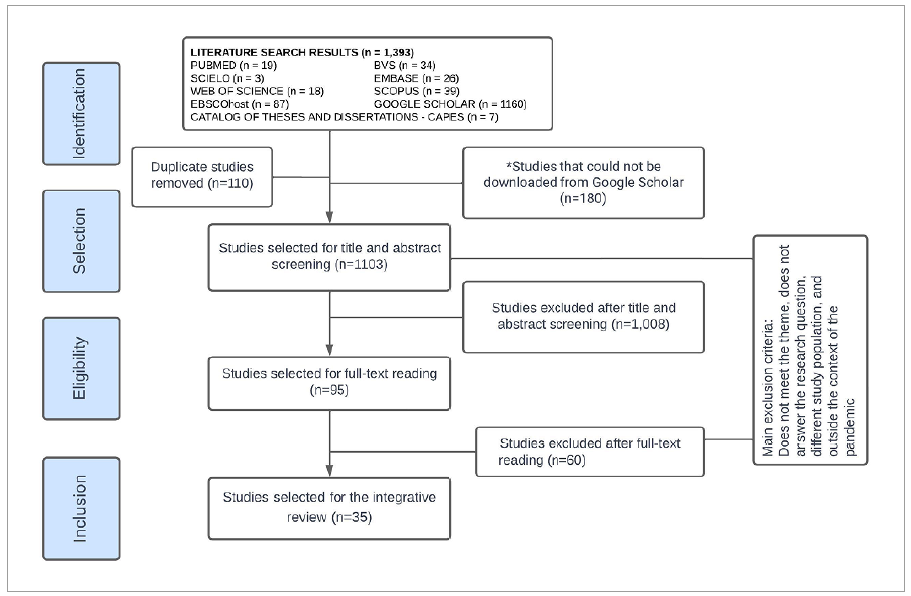 * 180 studies could not be viewed due to the limitations of Google Scholar, which only allowed access to 980 studies.