 Designing a Humanized Immunotoxin Based on Gelonin Against HER2+ Breast Cancer: An In-Silico Study
Abstract
Recombinant immunotoxins (RITs) are considered tumor-specific therapeutics because their variable antibody fragment can specifically bind to target cells, and their engineered toxin fragment specifically kills cancerous cells upon internalization. Human epidermal growth factor receptor 2 (HER2) is a transmembrane tyrosine kinase receptor that is overexpressed in breast cancer (BC) patients and can be used for targeted therapies in the form of immunotoxins. The current study aimed to develop pertuzumab gelonin as a targeted immunotoxin for HER2-positive breast cancer cells using bioinformatics methods and to analyze its properties in silico. The Fab light and heavy chain of pertuzumab were linked to gelonin's ribosome-inactivating region (RIP) region. The amino acid sequence of the antibody chains was obtained from the Protein Data Bank Server (PDB), and the sequence of the RIP region of gelonin was obtained from the National Center for Biotechnology Information (NCBI). The immunotoxin's physicochemical properties, secondary, tertiary, and 3D structure, mRNA folding, allergenicity, solubility, and antigenicity were predicted from online servers, and protein-protein docking was also performed. The immunotoxin is stable, non-allergenic, and binds to HER2 receptors with high affinity. Based on our findings, it can be a good targeted therapy for HER2 breast cancer.
Keywords:
Breast cancer; Immunotoxin; Bioinformatics; HER2; Gelonin
INTRODUCTION
According to Global Cancer Statistics, there were more than 2.26 million new cases of breast cancer in 2020. Breast cancer cells are classified as estrogen-positive (ER+), progesterone-positive (PR+), or ER/ PR-positive (ER+/PR+). This classification depends on whether hormone receptors (HRs) express progesterone (PR), estrogen (ER), or both. Most breast cancers are ER+ diseases, and over half of them are also PR+ diseases, with only about 2% being ER+. Triple-negative breast cancer (TNBC) refers to cancer cells that either do not express the human epidermal growth factor receptor 2 (HER2) at all or do not express it enough and lack ER and PR. TNBCs account for approximately 10–15% of all breast cancers (Ye et al., 2023) and about 20–30% of patients with overexpressed HER2 (Nika et al., 2019). HER2 is one of the four types of the epidermal growth factor receptor (EGFR) tyrosine kinase cell membrane receptor family. These receptors are expressed in normal cells, but their overexpression in cancer cells is associated with more aggressive tumor biology and poorer patient outcomes (Bredin, Walshe, Denduluri, 2020). However, targeting HER2 as a specific treatment option for this subset of carcinoma cells significantly improved patient survival (Le Du, Diéras, Curigliano, 2021). Therefore, research and the search for developing and deciphering novel targeted therapies are a necessity to increase patients' life expectancy and quality of life.
Based on a 2023 review study, there are four groups of targeted therapies, each containing its subgroups. These targeted therapies include exosomes, cell therapy, antibodies, and immunotherapy (Mercogliano et al., 2023). Immunotoxins are tumor-specific recombinant proteins. These molecules consist of cytotoxic proteins linked to a specific antibody used to deliver toxins into tumor cells (Mahmoudi et al., 2021). To develop an immunotoxin, a fragment is needed to transport Her2 antigens to the surface of tumor cells and a toxic fragment to kill cancer cells. The Food and Drug Administration (FDA) has approved some antibody-based drugs for the targeted therapy of HER2+ due to their positive effects with various molecules such as trastuzumab (Herceptin®), lapatinib (Tykerb®), pertuzumab (Perjeta®), and Ado-trastuzumab. For breast cancer, approved drugs include emtansine (Kadcyla® or T-DM1), neratinib (Nerlynx®), and trastuzumab deruxtecan (Enhertu® or DS-8201a) (Kreutzfeldt et al., 2020). The toxic component of immunotoxins can be derived from bacteria, animals, and even plants.
Gelonium multiflorum (Suregada multiflora) is a plant in the Euphorbiaceae family found in India and Myanmar (Global Biodiversity Information Facility, 2022). The seeds of this plant were found to be sources of a 30 kDa glycoprotein called gelonin, a single-chain ribosome-inactivating protein (RIP) (Ding et al., 2022). RIPs are classified into three groups based on their physical properties. Type 1 RIP consists of a single polypeptide domain with N-glycosidase activity and another subset that are low molecular weight type 1 RIPs due to their low molecular weight, usually less than 12 kDa. Type 1 RIP has been identified in many plants such as Gelonium multiflorum and some bacteria. Polypeptide proteins containing two domains are type 2 RIPs, with the second domain (B domain) or the lectin domain possessing sugar-binding properties and mediating the transport of the A domain to the cytosol of cells, causing more toxic effects than type 1 RIPType 3 ribosome-inactivating proteins (RIPs) contain a C-terminal domain fused to the N-terminus, the function of which remains unknown. These RIPs have only been identified in corn and barley. Gelonin, a type 1 RIP, cleaves adenine at the 4324 site through its N-glycosidase activity on the 28S ribosomal RNA of eukaryotic ribosomes, irreversibly inhibiting protein synthesis and leading to cell death. Type 1 RIPs, such as gelonin, are suitable candidates for immunotoxin synthesis due to their low molecular weight. By binding to monoclonal antibodies, they can exert a targeted effect on cancer cells (Berstad, Cheung, Weyergang, 2020; Ding et al., 2019; Liu et al., 2020).
Based on research in 2019, gelonin was fused to human scFv C6.5 and murine scFv e23 with a flexible linker containing four glycine repeats and a serine (G4S), combined with Herceptin for targeted treatment of HER2+ breast cancer (Park et al., 2019).
In 2020, researchers designed an scFvCD133/r Gelonin to target CD133, showing high cytotoxicity in both CD133high and CD133low cancer cells (Olsen et al., 2020). In another study in 2020, Stoessel and colleagues created an immunotoxin named nano-HER2-K3E3-TOX. This immunotoxin combines peptides K3 and E3 from the tetramerization domain of p53 to target Nano-Her2, with the toxic fragment being Pseudomonas aeruginosa exotoxin (TOX). In vitro, studies demonstrated successful killing of HER2-overexpressing breast cancer cells with IC50 values in the picomolar range. In another study in 2020, an immunotoxin was designed by binding a single-chain variable fragment (scFv) derived from trastuzumab to the functional part of the cytolethal distending toxin (Cj-CdtB) of Campylobacter jejuni, proposing it as a promising candidate for breast cancer treatment (Vafadar et al., 2020). Researchers in 2021 developed an immunotoxin against Her2-positive cancer cells, predicting its effects using computational methods. They linked RTX-A (an isoform of actinoporins from Radianthus macrodactylus) to pertuzumab scFv with amino acid sequences VL and VH. Their findings suggest potential benefits for breast cancer patients (Samavarchi Tehrani et al., 2021). In a study Pseudomonas exotoxin A (PE) was combined with two antibodies to create an immunotoxin (IgBD-HER2-PDGFRβ-PE38), demonstrating potential antitumor effects (Guo et al., 2021). In 2022, Movahedpour et al. synthesized an immunotoxin by linking the ScFv fragment of Herceptin to the DEF40 toxin using peptide linkers, suggesting it as a promising candidate for breast cancer therapy. Barkhordari and Rismani in 2022 developed an immunotoxin using computational methods, combining a ribosome-inactivating protein made from alpha-luffin with a single-chain variable fragment of an antibody, showing potent cytotoxicity. In 2022 Trx-pHLIP-gelonin was designed, composed of a thioredoxin (Trx) tag, a pH low-insertion peptide (pHLIP), and gelonin, demonstrating inhibition of SKOV3 solid tumors in mice and effects on apoptosis and protein synthesis (Ding et al., 2022). In 2023, Peng and his collaborators produced 4D5FvPE25, an immunotoxin with potent inhibition of Her2-positive tumor cells. The toxin portion of 4D5FvPE25 is a fragment of Pseudomonas exotoxin A, and the antibodies are anti-CD22 fragments. In this study, we aimed to develop an immunotoxin containing the RIP region of gelonin for the first time, along with the heavy and light chain of Pertuzumab, using in silico methods. We analyzed its properties and potential for cancer therapy based on computational methods.
MATERIAL AND METHODS
Immunotoxin construction
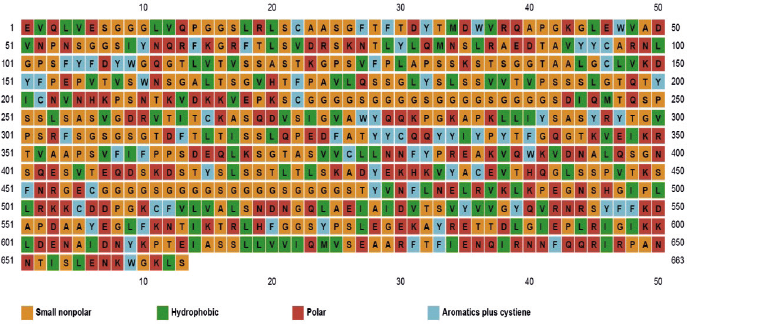
The amino acid sequence of Ribosome inactivating region of Gelonin [Suregada multiflora] (GenBank: AAA16312.1) was obtained from the National Center for Biotechnology Information (NCBI) and amino acid sequence of monoclonal antibody (FAB HEAVY CHAIN of Pertuzumab, PDB ID: 6OGE_3 and FAB LIGHT CHAIN of |Pertuzumab, PDB ID: 6OGE_2) was obtained from the Protein Data Bank Server (PDB). The heavy and light chain of antibody were linked with four repeats of glycine and one serine (G4S) and the light chain of the antibody is linked with the RIP region of Gelonin with the same linker. The amino acid sequence of the designed immunotoxin is shown in Figure 1.

Immunotoxin sequence including Pertuzumab Fab heavy chain, Pertuzumab Fab light chain and RIP sequence of Gelonin that are linked with Glycine and Serine.
Prediction of secondary structure and physicochemical properties of Immunotoxin
The secondary structure of immunotoxin was predicted with PSIpred server (http://bioinf.cs.ucl.ac.uk/psipred/) and some physical and chemical properties such as GRAVY (Grand average of hydropathicity), molecular weight, isoelectric point (PI), aliphatic index, and, in vitro and in vivo half-life of IT were determined with ProtParam server (https://web.expasy.org/protparam/) (Buchan, Jones 2019).
Prediction and validation of tertiary structure of Immunotoxin
The GalaxyWEB server (http://galaxy.seoklab.org/) produces the tertiary structure of immunotoxin with the highest stable structure and lowest energy (Ko et al., 2012). The predicted 3D structure was visualized with the VADAR online server (http://vadar.wishartlab.com/) and it was used for generating the Ramachandran plot too. The Ramachandran plot measures the total consistency of a protein structure by assessing the torsion angles of amino acids in a protein 3D structure. Moreover, the 3D structure of IT and some important parameters including C-score, TM-score, and RMSD were predicted by the I-TASSER server (Ko et al., 2012).
Determining allergenicity and mRNA stability
The AllergenFP v.1.0 (http://ddg-pharmfac.net/AllergenFP/data.html) server was used to predict the allergenicity of the IT construct. Furthermore, the RNAfold (http://rna.tbi.univie.ac.at//cgi-bin/RNAWebSuite/RNAfold.cgi) server was employed to calculate the free energy and the secondary structure of the RNA (Nugent, Cozzetto, Jones 2014).
Protein-Protein docking
Binding affinity between HER2 as the receptor and immunotoxin as the ligand was predicted using Hex protein-protein software (http://hexserver.loria.fr/) (Macindoe et al., 2010; Srivastava et al., 2020; Yan et al., 2020). First of all, the PDB format of Her2 was downloaded from PDB, and 3d structure of designed immunotoxin was inserted into chimera software (one by one) and their H2O and ligand were deleted; then H bonds and charges were added to their structure and they were saved in PDB format. Finally, docking was done with Hex software.
RESULTS
Secondary structure and physicochemical properties of IT:
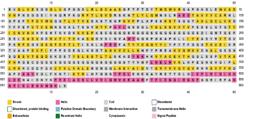
Secondary structure of IT based on each amino acid. In this figure number of amino acids and their structure is shown, most of them are coil. They are usually containing a repeated pattern, hxxhcxc, of hydrophobic (h) and charged (c) amino acids.

The secondary structure of a protein can be determined based on the polarity of each amino acid. Another important aspect of the secondary structure of a protein is its polarity properties. In this context, most amino acids are small and nonpolar. The small nonpolar amino acids include alanine, valine, leucine, proline, methionine, tryptophan, glycine, isoleucine, and phenylalanine. (Each letter in the squares represents the name of an amino acid, and the color indicates its property.).
The number of amino acids in IT was quantified to be 663. As shown in Figure 2, 35.29% of this structure is a strand, 12.21% is a helix, and the remaining amino acids are in a coil conformation. Figure 3 illustrates that amino acids can be small nonpolar, hydrophobic, polar, and aromatic, with the majority being small nonpolar amino acids.
Based on the ExPASy ProtParam tool, the estimated
In this table, the results of the ExPASY ProtParam are summarized.
Prediction and validation of tertiary and 3D structure of Immunotoxin
The tertiary structure of the immunotoxin was predicted using GalaxyWeb (Figure 4), and the 3D structure was predicted with the I-TASSER server (Figure 5). The two top models were predicted, and the best predicted model had a C-score of 1.68, a TM-score of 0.95±0.05, and an RMSD of 4.4±9 Å. The 3D structure was also visualized (Figure 6), and the Ramachandran plot showed that 99.6% of the residues were in the favored and allowed regions.

Tertiary structure of Immunotoxin This figure shows tertiary arrangement of the immunotoxin polypeptide chain in space.

3D structure of Immunotoxin 3D structure of the immunotoxin shows antibody fragment, linker and gelonin substructure formation.

The Ramachandran plot is used to validate the 3D model of an immunotoxin. This plot illustrates the location of each amino acid within the immunotoxin. The majority of amino acids are situated in permissible regions and do not fall outside of the expected areas.
Determining allergenicity and mRNA stability
Based on servers, this immunotoxin is probably non-allergenic. Results for thermodynamic ensemble prediction show that the free energy of the thermodynamic ensemble is -859.44 kcal/mol. The secondary structure of the mRNA is illustrated in Figure 7.

Protein-Protein docking
Protein’s preparations and docking were done and ΔE is -1109.49 (Figure 8).

DISCUSSION
Approximately 20-30% of patients diagnosed with certain subtypes of breast cancer exhibit an overexpression of the HER2 gene, as reported by Nika et al. (2019). Additionally, the tumor microenvironment exhibits resistance to both chemotherapeutic agents and radiation therapy. Furthermore, these treatment modalities are associated with a multitude of adverse effects. Consequently, researchers are exploring immunotherapy as a viable alternative for targeting cancer cells (Islam, 2021). This research aimed to develop an immunotoxin specifically tailored for the treatment of HER2+ breast cancer, to enhance therapeutic effectiveness while minimizing adverse reactions. The results show that the designed immunotoxin could have a potential medical application. Analyzing the structural properties of a macromolecule is one of the essential requirements in biological modeling. Since these analyses are costly and time-consuming, exploiting molecular modeling methods could circumvent numerous challenges ahead of empirical experimentation, even though it can be useful for models with low accuracy. Molecular modeling helps researchers improve the quality of their experimental tests and avoid different ethical issues due to fewer requirements compared to animal models (Sefid et al., 2021). Therefore, we have launched an in-silico study to design a humanized immunotoxin for the targeted therapy of HER2+ breast cancer. Our immunotoxin is composed of gelonin, a type 1 RIP. Its endocytosis to cells is complicated. To improve gelonin endocytosis and targeted delivery to HER2+ cells, the Fab heavy and light chains of Pertuzumab were linked to the RIP region of gelonin by a peptide linker. A flexible linker combining glycine and serine residues could make complementary Vh and Vl pairs to associate to form a bivalent dimer, termed a diabody. G4S is the most prevalent linker (Ganji et al., 2020). Based on studies, the Fab format will increase stability and in vivo toxin neutralization capacity of recombinant immunotoxins (Bera et al., 2014; Quintero-Hernández et al., 2007). Physicochemical properties of the immunotoxin were computed with the Expasy online server. Among 663 amino acids, 12.2% of them are serine and 11.9% are glycine, thus it can be related to the coil structure of the secondary structure of the protein. The molecular weight of the immunotoxin is 70813.15 (70.81 kDa). The isoelectric point (PI) is 8.68; this parameter is related to the pKa value of amino acids, which is related to the side chain of amino acids having a significant role in defining pH. The pH of proteins is related to the solubility, denaturation, and stability of proteins. The total number of negatively charged residues (Asp + Glu) is 55, and that of positively charged residues (Arg + Lys) is 63. A high number of positively charged residues versus negatively charged residues contributes to the positive charge of the protein. The extinction coefficients of a protein demonstrate how much light is absorbed at a specific wavelength, having units of M-1 cm-1, which, with regard to the immunotoxin, was measured at 280 nm in water. Extinction coefficients can be used in the quantitative study of protein-protein or protein-ligand interactions in solutions and the measurement of protein concentration. The estimated half-life is more than 10 hours in E. coli. The instability index (II) predicts that the stability of the protein in the test tube is 39.34 and is classified as stable (Moghadam et al., 2019).
The aliphatic index is a comparative measure of the volume of specific amino acids, including alanine, valine, isoleucine, and leucine. It ranges from 76.24 to 96.31 and is regarded as a positive factor in enhancing the thermal stability of globular proteins. The aliphatic index of the protein in question is 71.13 (Macindoe et al., 2010). The GRAVY (Grand Average of Hydropathy) value is -0.330, indicating that this protein is hydrophilic. As the positive score increases, hydrophobicity also increases. The protein's secondary structure was predicted using the PSIpred server. Our findings reveal that random coils and nonpolar amino acids, particularly serine and glycine, are predominant (Moghadam et al., 2019). In comparison to other immunotoxins targeting HER2+ breast cancer that utilize the single-chain variable fragment (scFv) of pertuzumab instead of the Fab fragment (Samavarchi Tehrani et al., 2021), the aliphatic index of our designed immunotoxin is higher, suggesting greater thermal stability. However, both types of immunotoxins are stable and hydrophilic.
The three-dimensional (3D) structure of the immunotoxin was predicted using the I-TASSER server, and the model with the highest C-score was selected. The C-score is utilized to evaluate the quality of predicted models, typically ranging from -5 to 2. The model with the highest C-score was deemed the most accurate. Furthermore, the TM-score and root mean square deviation (RMSD) were employed to assess the accuracy and similarity of the models (Keshtvarz et al., 2021).RNAfold web server was utilized to determine the secondary structure of the immunotoxin mRNA. The estimated free energy of the thermodynamic ensemble is -859.44 kcal/mol, indicating that the mRNA is stable. This stability enhances the feasibility of in vivo cloning and the production of the immunotoxin (Islam, 2021).
In biochemical reactions, the enthalpy change (ΔH) must decrease while the entropy must increase for the overall Gibbs free energy to become negative. Consequently, the more negative the Gibbs free energy, the greater the affinity between proteins acting as ligands and those acting as receptors, which is a critical parameter in molecular docking. The affinity of the immunotoxin for the receptor was assessed using the Hex software. The principles of docking are based on electrostatic interactions and molecular conformation. The docking results indicate a high affinity between the immunotoxin and HER2, the receptor, with a binding energy of ΔE: -1109.49 (Macindoe et al., 2010; Srivastava et al., 2020; Yan et al., 2020).
Utilizing plant toxins in the synthesis of immunotoxins offers a cost-effective and readily accessible alternative. A diverse range of phytotoxins, each with unique mechanisms of action, can serve as viable candidates for immunotoxin development, providing a preferable option compared to bacterial or animal-derived toxins. The widespread availability of plants allows for cultivation in various environments, making them a safe and easily accessible resource for therapeutic applications. In contrast, cultivating bacteria requires specialized laboratory conditions, and handling toxic animals demands specific expertise. Therefore, plants represent a plentiful and convenient reservoir of therapeutic agents for targeted t herapies.
CONCLUSION
A computational immunotoxin utilizing the plant toxin gelonin has been developed, and its characteristics were predicted through online platforms. The research indicates that this immunotoxin has the potential to inhibit the proliferation of HER2+ breast cancer cells due to its strong binding affinity to HER2 receptors, thereby presenting a promising avenue for targeted therapy. To optimize its effectiveness, it is recommended to conduct dynamic simulation analyses and to utilize smaller antibody fragments. The results suggest that plant toxins could rival bacterial toxins in terms of efficacy, highlighting the need for further exploration of toxic plants. It is important to note that all outcomes are derived from computational models, and it is advisable to synthesize the immunotoxin in a laboratory setting for subsequent evaluation of its pharmacological and toxicological effects through in vivo experimentation, which is a limitation of the current study.
ACKNOWLEDGEMENT
Not applicable.
-
AVAILABILITY OF DATA AND MATERIALS
The authors assert that all data supporting the findings of this study are available with in the paper.
-
FUNDING
Not applicable.
-
ETHICAL APPROVAL
This article does not contain any studies with human participants or animals performed by any of the authors.
-
INFORMED CONSENT
Informed consent was obtained from all individual participants included in the study.
DATA AVAILABILITY STATEMENT
Data available on request due to privacy/ethical restrictions.
REFERENCES
- Barkhordari F, Rismani E, Tabasinezhad M, Asgari S, Nematollahi L, Talebkhan Y. Computational analysis of fusion protein of anti-HER2 scFv and alpha luffin: A new immunotoxin protein for HER2 positive cancers. Braz J Pharm Sci. 2022;58.
- Bera TK, Onda M, Kreitman RJ, Pastan I. An improved recombinant Fab-immunotoxin targeting CD22 expressing malignancies. Leuk Res. 2014 Oct 1;38(10):1224–9.
- Berstad MEB, Cheung LH, Weyergang A. Production of recombinant gelonin using an automated liquid chromatography system. Toxins (Basel). 2020 Aug 1;12(8).
- Bredin P, Walshe JM, Denduluri N. Systemic therapy for metastatic HER2-positive breast cancer. Semin Oncol. 2020 Oct 1;47(5):259–69.
- Buchan DWA, Jones DT. The PSIPRED Protein Analysis Workbench: 20 years on. Nucleic Acids Res. 2019 Jul 1;47(W1):W402–7.
- Ding G B, Wu G, Li B, Yang P, Li Z. High-yield expression in Escherichia coli, biophysical characterization, and biological evaluation of plant toxin gelonin. 3 Biotech. 2019 Jan 1;9(1).
- Ding GB, Zhu C, Wang Q, Cao H, Li BC, Yang P, et al. Molecularly engineered tumor acidity-responsive plant toxin gelonin for safe and efficient cancer therapy. Bioact Mater. 2022 Dec 1;18:42-55.
- Ganji M, Khalili S, Mard-Soltani M, Khalesi B, Karkhah A, Amani J. A Precisely Designed Immunotoxin Against VCAM1 Consisting of a Humanized Antibody Variable Domain Fused to Granzyme: An In Silico Approach. Int J Pept Res Ther. 2020 Mar 1;26(1):129–37.
-
Global Biodiversity Information Facility [Internet]. Vol. 41, Choice Reviews Online. 2022. p. 41-5289-41–5289. Available from: https://www.gbif.org/species/3054898
» https://www.gbif.org/species/3054898 - Guo R, Yang Y, Zhang D, Du J, Zhu X, Liu Y, et al. A bispecific immunotoxin (IHPP) with a long half-life targeting HER2 and PDGFRβ exhibited improved efficacy against HER2-positive tumors in a mouse xenograft model. Int J Pharm. 2021 Jan 5;592.
- Islam E. Development of chemokine CXCL12-dependent immunotoxin against small cell lung cancer using in silico approaches. Inform Med Unlocked. 2021 Jan 1;25.
- Keshtvarz M, Mahboobi M, Kieliszek M, Miecznikowski A, Sedighian H, Rezaei M, et al. Engineering of cytolethal distending toxin b by its reducing immunogenicity and maintaining stability as a new drug candidate for tumor therapy; an in silico study. Toxins (Basel). 2021 Nov 1;13(11).
- Ko J, Park H, Heo L, Seok C. GalaxyWEB server for protein structure prediction and refinement. Nucleic Acids Res. 2012 Jul;40(W1).
-
Kreutzfeldt J, Rozeboom B, Dey N, De P. The trastuzumab era: current and upcoming targeted HER2+ breast cancer therapies. Am J Cancer Res [Internet]. 2020;10(4):1045–67. Available from: www.ajcr.us/
» www.ajcr.us/ - Le Du F, Diéras V, Curigliano G. The role of tyrosine kinase inhibitors in the treatment of HER2+ metastatic breast cancer. Eur J Cancer. 2021 Sep 1;154:175–89.
- Liu Q, Zhang L, Ji X, Shin MC, Xie S, Pan B, et al. A self-assembly and stimuli-responsive fusion gelonin delivery system for tumor treatment. J Ind Eng Chem. 2020 Sep 25;89:409–15.
- Macindoe G, Mavridis L, Venkatraman V, Devignes MD, Ritchie DW. HexServer: An FFT-based protein docking server powered by graphics processors. Nucleic Acids Res. 2010 May 5;38(SUPPL. 2).
- Mahmoudi R, Dianat-Moghadam H, Poorebrahim M, Siapoush S, Poortahmasebi V, Salahlou R, et al. Recombinant immunotoxins development for HER2-based targeted cancer therapies. Cancer Cell Int. 2021 Dec 1;21(1).
- Mercogliano MF, Bruni S, Mauro FL, Schillaci R. Emerging Targeted Therapies for HER2-Positive Breast Cancer. Cancers (Basel). 2023 Apr 1;15(7).
- Moghadam ZM, Halabian R, Sedighian H, Behzadi E, Amani J, Fooladi AAI. Designing and analyzing the structure of DT-STXB fusion protein as an anti-tumor agent: An in silico approach. Iran J Pathol. 2019 Sep 1;14(4):305–12.
- Movahedpour A, Ahmadi K, Taheri-Anganeh M, Amiri A, Ahmadi N, Khatami SH, et al. Designing a Humanized Immunotoxin Based on HER2 Specific scFv and DFF40 Toxin Against Breast Cancer: An In-Silico Study. Int J Pept Res Ther. 2022;28(5).
- Nika L, Cuadrado-Castano S, Arunkumar GA, Grünwald-Gruber C, McMahon M, Koczka K, et al. An HER2-displaying virus-like particle vaccine protects from challenge with mammary carcinoma cells in a mouse model. Vaccines. 2019 Jun 1;7(2).
- Nugent T, Cozzetto D, Jones DT. Evaluation of predictions in the CASP10 model refinement category. Proteins Struct Funct Bioinforma. 2014 Feb;82(SUPPL.2):98–111.
- Olsen CE, Cheung LH, Weyergang A, Berg K, Vallera DA, Rosenblum MG, et al. Design, characterization, and evaluation of scFvCD133/rgelonin: A CD133-targeting recombinant immunotoxin for use in combination with photochemical internalization. J Clin Med. 2020 Jan 1;9(1).
- Park T, Min KA, Cheong H, Moon C, Shin MC. Genetic engineering and characterisation of chlorotoxin-fused gelonin for enhanced glioblastoma therapy. J Drug Target. 2019 Oct 21;27(9):950–8.
- Peng Y, Wu Z, Pang Z, Zhang L, Song D, Liu F, et al. Manufacture and evaluation of a HER2-positive breast cancer immunotoxin 4D5Fv-PE25. Microb Cell Fact. 2023 Dec 1;22(1).
- Quintero-Hernández V, Juárez-González VR, Ortíz-León M, Sánchez R, Possani LD, Becerril B. The change of the scFv into the Fab format improves the stability and in vivo toxin neutralization capacity of recombinant antibodies. Mol Immunol. 2007 Feb;44(6):1307–15.
- Samavarchi Tehrani SS, Gharibi S, Movahedpour A, Goodarzi G, Jamali Z, Khatami SH, et al. Design and evaluation of scFv-RTX-A as a novel immunotoxin for breast cancer treatment: an in silico approach. J Immunoass Immunochem. 2021;42(1):19–33.
- Sefid F, Payandeh Z, Azamirad G, Baradaran B, Afjadi MN, Islami M, et al. Atezolizumab and granzyme B as immunotoxin against PD-L1 antigen; an insilico study. Silico Pharmacol. 2021 Feb 15;9(1).
- Srivastava S, Verma S, Kamthania M, Kaur R, Badyal RK, Saxena AK, et al. Structural Basis for Designing Multiepitope Vaccines Against COVID-19 Infection: In Silico Vaccine Design and Validation. JMIR Bioinforma Biotechnol. 2020;1(1).
- Stoessel A, Groysbeck N, Guyot L, Barret L, Nominé Y, Nguekeu-Zebaze L, et al. Modular Conjugation of a Potent Anti-HER2 Immunotoxin Using Coassociating Peptides. Bioconjug Chem. 2020 Oct 21;31(10):2421–30.
- Vafadar A, Taheri-Anganeh M, Movahedpour A, Jamali Z, Irajie C, Ghasemi Y, et al. In silico design and evaluation of scFv-CdtB as a novel immunotoxin for breast cancer treatment. Int J Cancer Manag. 2020 Jan 1;13(1).
- Yan Y, Tao H, He J, Huang SY. The HDOCK server for integrated protein–protein docking. Nat Protoc. 2020 May 1;15(5):1829–52.
- Ye F, Dewanjee S, Li Y, Jha NK, Chen ZS, Kumar A, et al. Advancements in clinical aspects of targeted therapy and immunotherapy in breast cancer. Mol Cancer. 2023 Jul 6;22(1):105.
Edited by
-
Associate Editor:
Silvya Stuchi Maria-Engler