 Characterization of whitening toothpastes: pH, solid content, abrasive particle morphology, and commercial aspects
Abstract
Aim To evaluate whitening toothpastes by analyzing labels, active ingredients, prices, commercial appeal, pH, and characteristics of abrasives.
Methods 18 whitening toothpastes and 4 regular toothpastes sold by different manufacturers were assessed. The pH of the slurry was determined in triplicate, and the percentage of solid weight by desiccation. The abrasive particles were sieved and analyzed using scanning electron microscopy (SEM). The average price (BRL, USD) was established, the labels were analyzed for advertising approach, type of abrasive, and presence of fluoride, and the whitening active ingredients were categorized as abrasive, chemical, or optical agents. The data were analyzed using the Mann-Whitney test to compare regular and whitening toothpastes (α=0.05), and the categorical data were analyzed by absolute and relative frequencies.
Results The toothpastes had a pH close to neutral or > 7, with no difference between whitening and regular toothpastes (p=0.173). Whitening toothpastes had solids between 26.70% and 66.46% and did not differ statistically from regular ones (p=0.394). The average price of regular toothpastes is lower than that of whitening toothpastes (p=0.033). Concerning whitening toothpastes, the most common abrasive was silica, the chemical agent was sodium pyrophosphate, and the optical agent was blue covarine. SEM analysis revealed that some whitening toothpastes presented amorphous particles of different sizes, unlike the composition of regular toothpastes. In addition, three whitening toothpastes did not contain fluoride in their composition.
Conclusion The whitening toothpastes can differ from regular toothpastes in terms of price, advertising, and the shape and size of the abrasive.
Keywords:
Tooth bleaching; Dentifrices; Color; Tooth abrasion
Introduction
Toothpastes are products used in combination with toothbrushes to maintain or restore oral health1. They can be considered complex healthcare formulations that, even after thousands of years of use, remain the subject of continuous research and formulation improvements1,2. Commonly, toothpastes are composed of an abrasive agent suspended in humectants using a hydrocolloid2. Flavorings, colorings, surfactants, preservatives, active ingredients, and other excipients are incorporated into their base2-4. Among the different active ingredients in toothpaste composition, some whitening agents are designed to change tooth color3,5.
Today’s beauty standards drive the search for a perfect smile and increasingly whiter teeth. In response to this challenge, toothpastes aimed at treating or changing the color of teeth have emerged on the market in recent decades5-7. Color change and tooth staining can be categorized as intrinsic in origin (i.e., medications, genetic changes, dental trauma) or extrinsic (i.e., diet, smoking, or stain produced by microorganisms)8.
In this sense, toothpastes marketed as whitening products commonly have a greater number of abrasives and detergents compared with regular toothpastes7. Therefore, their action can whiten teeth or remove and control superficial/extrinsic staining3,7,9. Although removing stains from the tooth surface can promote a change in tooth color, the real whitening efficacy of these toothpastes is questioned when comparing them with conventional/regular toothpastes or bleaching agents used in dental offices, or recommended by dentists for at-home use9-11. Despite extensive investigation of the effects of whitening toothpastes on enamel, dentin, and restorative materials, studies addressing their physicochemical characteristics and commercial aspects remain limited.
The whitening agents present in toothpastes can be classified as abrasive, chemical, or optical3. Abrasive agents can be exemplified by silica, calcium carbonate, sodium bicarbonate, and charcoal3,10. Examples of chemical agents include hydrogen peroxide, pyrophosphates, and papain, while blue covarine can be considered an optical agent3,10. Although whitening toothpastes are affordable, they have been linked to harmful effects on enamel, dentin, restorative materials, and initial caries lesions, and to increasing tooth sensitivity3,10-12. Considering the number of products sold to whiten the tooth structure, the study of these toothpastes regarding their properties is pressing. Moreover, the characterization of whitening toothpastes is relevant not only for clinical decision-making and product indication, but also for supporting future studies aimed at explaining the adverse effects involved when different surfaces (e.g., teeth, restorative materials, and prosthetic materials) are brushed with these products.
Although the effects of these toothpastes are constantly studied in the literature, they have rarely been characterized13. Encouraged by social media and the desire for whiter teeth, individuals seek new whitening toothpastes with different compositions often made available on the market, but there is little information about their properties. It is important to validate these whitening oral care products regarding particle morphology, % of solid weight, and abrasiveness13,14-16. Thus, the objective of this study was to characterize whitening toothpastes by analyzing labels and active ingredients, price, commercial aspects, pH, and type/morphology of the abrasive. The null hypothesis tested is that whitening toothpastes do not differ from regular toothpastes in regard to their properties.
Methodology
Experimental design
For this study, commercially available toothpaste brands widely distributed in the Brazilian market were investigated. The study design, sample size calculation, and selection criteria are described below.
Sample size calculation: The primary objective of this study was to characterize the properties of whitening toothpastes rather than to perform direct inter-product comparisons. However, because quantitative variables were analyzed, a comparative analysis between whitening and regular toothpastes was planned. Therefore, an a priori sample size calculation was performed using G*Power software (version 3.1.5; Heinrich Heine University Düsseldorf, Germany). The calculation was based on an alpha level of 0.05, a statistical power of 80% (1−β = 0.80), and an effect size derived from previously published data13. This analysis indicated that a minimum of three independent repetitions per group (whitening vs. regular toothpastes) would be required to ensure adequate statistical power for the planned comparisons (price, pH and solid content).
Selection of whitening toothpastes: Initially, two independent collaborators identified whitening toothpastes by systematically searching the official websites of major oral care manufacturers operating in the Brazilian market (December 2022 – January 2023). Only products with wide commercial availability in supermarkets, pharmacies, and e-commerce platforms were considered. This process resulted in the identification of forty-five whitening toothpastes from manufacturers including Colgate, Curaprox, Sensodyne, Oral-B, Close-Up, Sorriso, doTerra, Bianco, Edel White, Hinode, and Restore. The following criteria were applied:
Inclusion criteria: Toothpastes commercially sold in Brazil that explicitly claimed “whitening” or “whiter teeth” on their packaging or promotional materials.
Exclusion criteria: Products from the same brand or product line with similar formulations, as well as discontinued products.
After applying these criteria, eighteen whitening toothpastes were included in the study.
Selection of regular toothpastes: Regular toothpastes were selected to serve as control products. Selection was performed by the same two collaborators based on predefined criteria aimed at representing conventional formulations commonly available in the Brazilian market.
Inclusion criteria: High market share, conventional formulation, recognized manufacturers, and representation of the most common abrasive/fluoride agents (silica/sodium fluoride and calcium carbonate/sodium monofluorophosphate).
Exclusion criteria: Any whitening-related claims, desensitizing agents, or ingredients commercially associated with whitening effects.
Initially, the inclusion of one regular toothpaste per manufacturer was planned; however, this was not possible for all brands due to the absence of products meeting the predefined criteria. Consequently, four regular toothpastes were selected for comparison.
Final sample and studied variables: In total, eighteen whitening toothpastes and four regular toothpastes were included in the study. All selected products are listed in supplementary material. The following variables were evaluated: label and advertising claims, price, pH, percentage of solid content, and abrasive particle characterization by scanning electron microscopy (SEM).
Product acquisition, storage, and label analysis
The products were purchased from pharmacies and supermarkets located in the cities of Rio de Janeiro and Campinas, Brazil. Products available exclusively through online platforms were acquired via e-commerce. All products were purchased in February 2023. The toothpastes were stored according to the manufacturers’ recommendations. The components described on the packaging were categorized according to the abrasive present in the formulation, and the presence or absence of fluoride. The whitening agents (abrasive, chemical, and optical agents) in each toothpaste were described by analyzing the labels and the technical profile, as shown in Table 1.
Marketing, advertising strategies, and price analysis
The wording used on toothpaste packaging was analyzed according to its whitening appeal. To this end, the words described on the packaging (disregarding the ingredients) were evaluated according to the number of times they appeared on the label, and to the type of toothpaste analyzed. Toothpaste prices were determined through an online survey, considering the average price obtained from the first five websites listed in the Google Shopping search function (https://www.google.com/). Price data were collected in February 2023. All prices were initially recorded in Brazilian reais (BRL) and subsequently converted to US dollars (USD) using the commercial exchange rate applicable on the date of data collection.
pH analysis
The product pH was evaluated in triplicate using a pHmeter (MPA 210, MS Tecnopon Instrumentação, Piracicaba, Brazil). The pH meter was calibrated using standard solutions of pH=4 and pH=7. The toothpastes were diluted with distilled water in a 1:3 weight ratio.
% of solid weight analysis – desiccation loss
The % of solid weight was analyzed by weighing each toothpaste (OHAUS Corp, Adventurer, USA) to obtain 40 mL slurry, and then centrifuging (20 minutes, 3000 RFC, 25°C)13,16. The supernatant was carefully removed, and the residual solids were kept in a lab oven (Odontobrás, Ribeirão Preto, Brazil), at 40°C for 10 days. Then, the dried solid particles were weighed, and the % of solid weight was calculated to arrive at the total weight of the toothpaste13,16. This % of solid weight was determined in triplicate.
Scanning electron microscopy (SEM)
After analyzing the % of solid weight, the dried toothpastes were sifted with a sieve (ASTM 270, Tyler/MESH 270, Bertel, Caieiras, Brazil) with a 0.053 µm opening, and the powders were analyzed using SEM (Jeol, JSM 5600LV, Tokyo, Japan) to characterize the particles. Thus, the particles were dispersed on a glass plate, affixed with carbon tape, and coated with gold (Sputter Coater, EMITECH K450, UK). The SEM was operated at 10 kV and 50 pA, and the images were captured at 1000× magnification. The images were evaluated qualitatively, without quantitative analysis.
Statistical analysis
The characteristics of both regular/conventional and whitening toothpastes were studied using descriptive statistics. Averages for the data on % of solid weight, pH, and price were calculated for regular and whitening toothpastes. In addition, the Mann-Whitney test was used to compare the toothpastes. Categorical data were analyzed descriptively using absolute and relative frequencies. The analyses were carried out using the R program (R Foundation for Statistical Computing, Vienna, Austria), at a significance level of 5%.
Results
Table 2 presents the whitening ingredients of the toothpastes, as reported on the product labels. The abrasive approach was the most common strategy in both regular and whitening toothpastes. Whitening toothpastes contained a greater diversity of chemical agents compared with regular products. Silica was the most common abrasive in both types, while calcium carbonate and sodium bicarbonate were more prevalent in regular toothpastes. Whitening toothpastes also included calcium pyrophosphate, charcoal, and hydrogen peroxide. Sodium pyrophosphate was present in both regular and whitening toothpastes, whereas sodium tripolyphosphate and blue covarine were detected only in some whitening formulations.
As shown in Table 3, only Bianco Carbon Whitening, On Guard Creme Dental Clareador (doTerra), and Restore Speed Whitening Nano Repair did not contain fluoridated agents, whereas one product (Curaprox Black Is White) contained 950 ppm of fluoride. Notably, 55.6% of whitening toothpastes contained sodium fluoride, while 27.8% contained sodium monofluorophosphate.
Table 4 presents the frequency (%) of marketing-related words associated with whitening, according to toothpaste group. The most frequently observed term in whitening toothpastes was “White” (61.1%). Additionally, words derived from “white” or “whitening” were often combined with expressions suggesting rapid effects and were frequently presented in English.
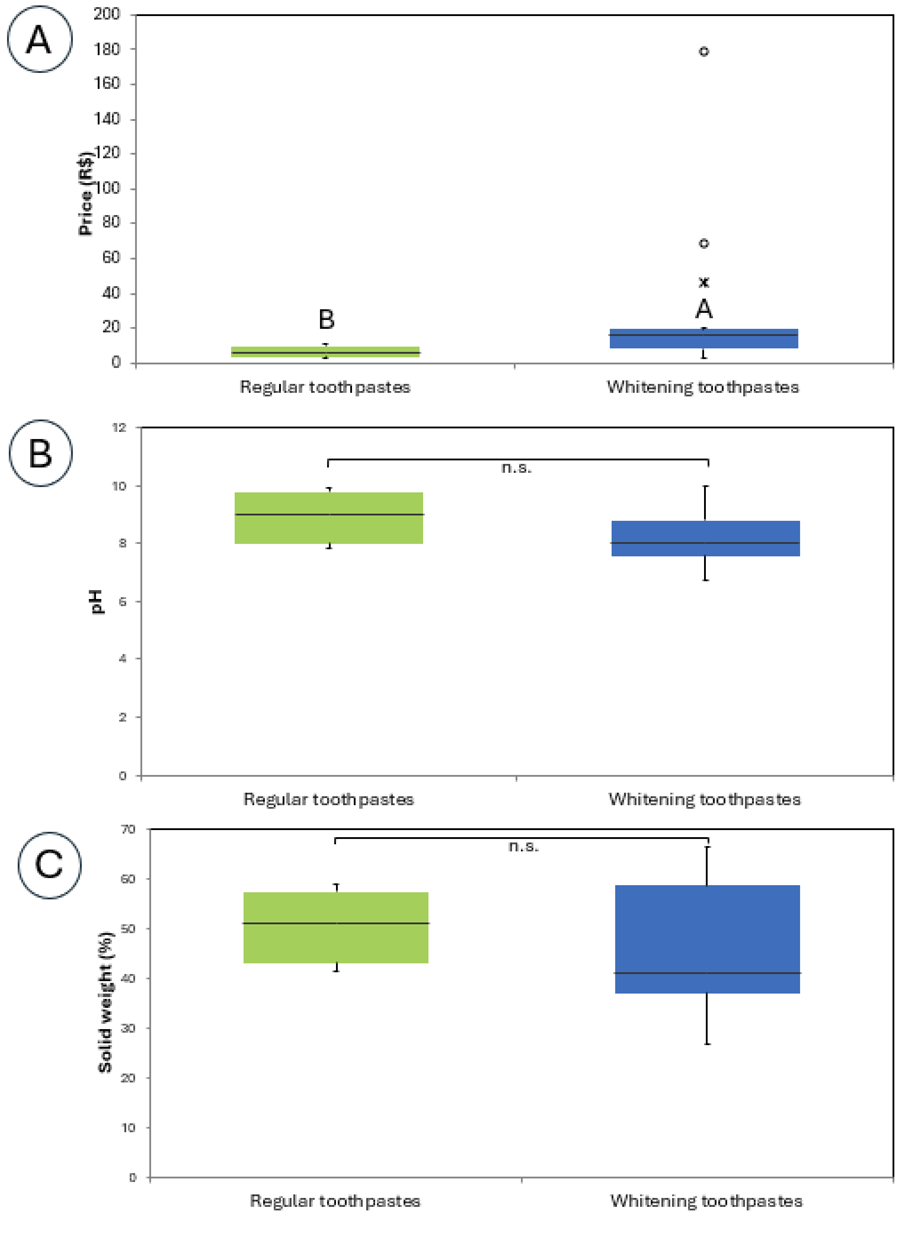
Table 5 and Figure 1 present the results for the quantitative variables. Figure 1A shows the prices, which were significantly higher in whitening toothpastes compared with regular toothpastes (p = 0.033). The pH values were neutral or alkaline, with no statistically significant difference between groups (p = 0.173). No significant differences were observed between toothpastes for the percentage of solid weight (p = 0.394); however, the range was wider for whitening toothpastes (26.7%–66.46%) than for regular toothpastes (41.27%–58.84%).
Comparison between regular toothpastes (n = 4) and whitening toothpastes (n = 18). (A) Price (p = 0.033; * statistically significant difference). (B) pH (p = 0.173; not statistically significant [n.s.]). (C) Percentage of solid weight (p = 0.394; not statistically significant [n.s.]).
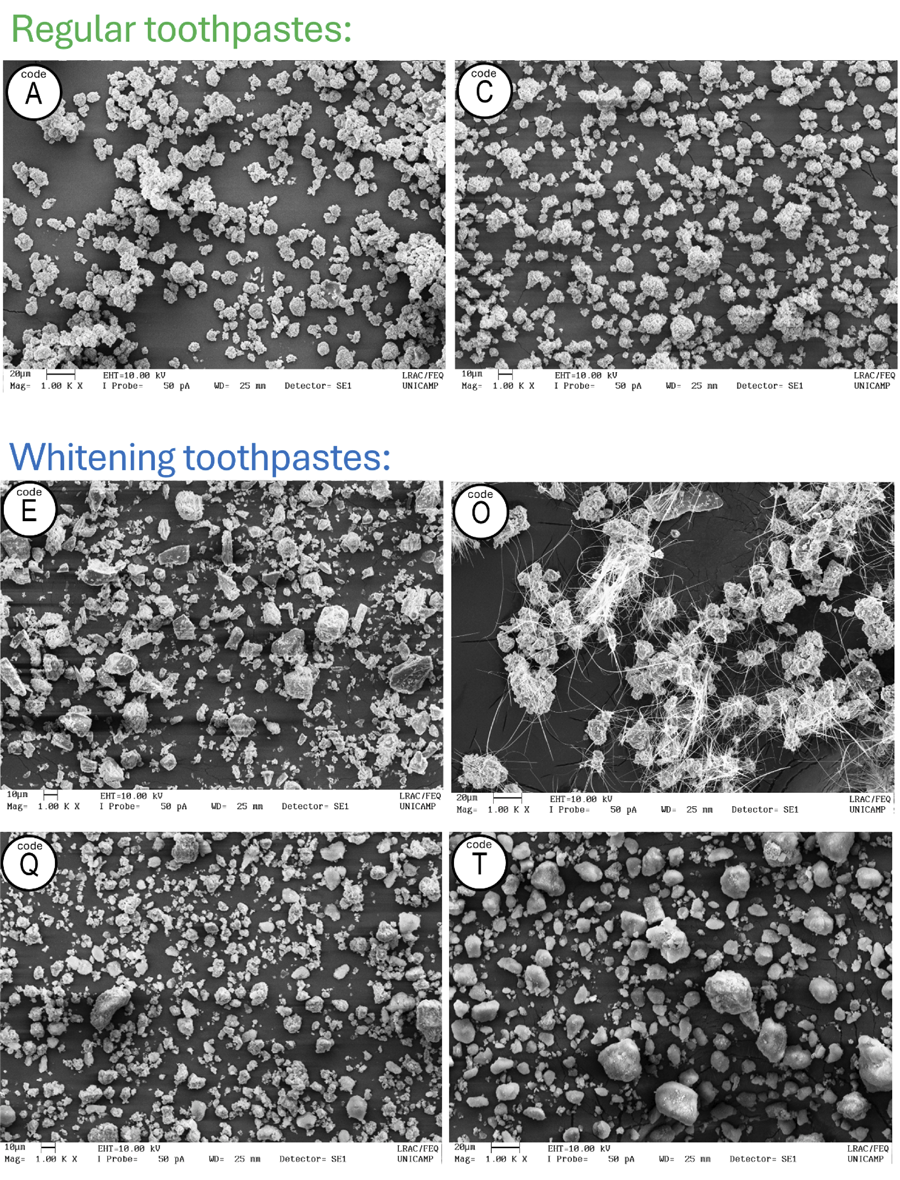
Figure 2 summarizes the main findings regarding toothpaste particles, highlighting the predominant morphological patterns (SEM). Representative images of all toothpastes are provided in the supplementary material. Regular toothpastes exhibited well-defined, predominantly spherical particles of relatively small size (code A and C). Whitening toothpastes displayed greater morphological diversity: some samples showed irregular and pointed particles (code E), others exhibited amorphous and filamentous structures (code O), some contained mostly small particles with occasional larger ones (code Q), and some presented a heterogeneous mixture of particles varying in size and shape (code T).
Representative scanning electron microscopy (SEM) images of regular and whitening toothpastes at 1000× magnification. Images of all toothpastes and their respective codes are available in the supplementary material.
Discussion
The null hypothesis was rejected due to differences among the evaluated toothpastes across the studied variables. A part of the oral care products market, comprising toothpastes, gels, mouthwashes, and several other products, offers an attractive alternative to achieving a beautiful smile easily and cheaply6. The present study found that manufacturers can use predatory advertising to attract their customers. The most common words found on the packaging of whitening toothpastes were ‘white’ and ’whitening,’ thus showing the appeal that words in another language have as a method of attracting attention on the shelves of pharmacies and markets. Moreover, the promise of effective whitening by these products is not validated by the literature6,7, which presents the potential effect of removing extrinsic staining17associated with different adverse effects11,18.
The appeal for these toothpastes has been spreading in the marketplace, encouraged by the media and advertising, and by keen profit-driven interests. Manufacturers constantly develop improvements and new approaches to attract the population, and the outcome drives market prices to high levels10,13. Demand is associated with prices and profits, and the present study found that whitening toothpastes are more expensive than regular toothpastes, even though both have similar properties.
The toothpastes studied had a neutral or alkaline pH, with no difference among the toothpaste groups. The pH of a toothpaste is critical to ensure the stability, acceptance, and effectiveness of the product19. However, considering the hydrogen-ionic potential alone, the toothpastes evaluated showed no potential for damage to enamel or dentin20. Garcia et al.13described pH values similar to those found in the present study. However, further studies should consider the role of storage, since the lack of stability of active ingredients can often result in pH changes in the toothpaste.
Initially, it was expected that the analysis of toothpaste ingredients and general composition could rely on the information provided in the Material Safety Data Sheets (MSDS; FISPQ in Portuguese). However, these documents were not available, as they had not been submitted by the manufacturers, and the information on the product labels was outdated. The toothpastes contained key functional ingredients, including humectants to solubilize components, surfactants to promote foaming and sensory properties, colorants and flavoring agents for taste and appearance, thickeners and buffers to ensure rheological stability, and fluoride for anticaries effects1,21.
Fluoride acts in the remineralization process and reduces the effects of tooth demineralization22-24. Of the toothpastes studied, On Guard Creme Dental Clareador Natural doTerra, Bianco Carbon Whitening, and Restore Speed Whitening Nano Repair whitening toothpastes did not contain any type of fluoridated agent. Sodium fluoride, present in most of the toothpastes studied, has a mechanism that triggers the formation of calcium fluoride in the oral environment22-24. All regular toothpastes analyzed presented more than 1000 ppm of fluoride, a concentration considered adequate to achieve an anti-caries effect25. In terms of the whitening toothpastes, only the Curaprox Black is White toothpaste had a concentration lower than 1000 ppm. However, studies must be designed to validate the amount of active and bioavailable fluoride in whitening toothpastes, especially those containing sodium monofluorophosphate, which could form insoluble fluoride salts while still in the packaging26.
Among the whitening compounds, abrasive agents are insoluble components that provide the effective removal of extrinsic stains or the prevention of new stains3,27. As expected, abrasive agents were found in both regular and whitening toothpastes, as a function of the cleaning/whitening action proposed by these products. However, 88.9% of the whitening products contained silica, making this the most found abrasive. In general, the incorporation of abrasive agents followed by an association with chemical agents was the most common approach for whitening toothpastes, thus corroborating Alshara et al.21 who reported that the mode of action of toothpastes is mainly mechanical/physical, and that the abrasive level of the toothpaste determines its whitening effectiveness. Nonetheless, cleaning or removal by abrasion does not promote intrinsic color change, and acts only on extrinsic staining2,6,10,11.
Chemical agents were found in whitening toothpastes, and helped to remove and prevent extrinsic stains3. They included sodium pyrophosphate, hydrogen peroxide, and sodium tripolyphosphate. Peroxides are oxidative chemical compounds used in in-office bleaching protocols, and their application in toothpastes is extremely challenging due to their instability in toothpaste formulation and low exposure time in the oral cavity, usually 2 min versus 40-45 min in the in-office procedures7,10,28-30.
Categorization of titanium dioxide poses a challenge because it can be classified as a physical agent, an optical agent or a pigment that gives color to the toothpaste4,31. This is not addressed on the product labels. Furthermore, titanium dioxide is the most popular white pigment, and is currently found in different formulations4,31. Therefore, the real role of this active ingredient in regular toothpaste formulation could not be determined precisely. In contrast, blue covarine is considered an optical agent, and was found only in whitening toothpastes3,32. Blue covarine works by modifying the visual perception of tooth color, transferring the reflected color of the teeth from yellow to blue, by resorting to an illusion of greater luminosity32.
There are several techniques for evaluating toothpaste abrasiveness, including RDA (relative dentin abrasivity) and REA (relative enamel abrasivity) approaches, weight and volume loss techniques that measure the amount of abrasive material in the products, and profilometry and light reflection techniques, which measure the roughness of the abrasive agent14,33,34. Manufacturers could be contacted to provide information on the RDA of toothpastes, as this data is not always publicly available. This is partly due to the fact that not all countries have regulatory policies requiring such information to be disclosed on product labels. Thus, other methods were used in an attempt to characterize the quantity and characteristics of the abrasives, such as % of solid weight and residue analysis by SEM13,16.
Abrasiveness depends on the amount of abrasive present in the toothpaste, the particle size, and the chemical influence of the other components on the composition1,14,33,34. Although no statistical differences were found between whitening and regular toothpastes in the analysis of % of solid weight, the range of solid content was greater in whitening products. In regular toothpastes, the % of solid weight was similar to that reported by another study13that evaluated regular and desensitizing toothpastes. Determining the real impact of % of solid weight on the abrasive potential of the toothpastes was a challenge, since higher values were associated with increased degradation of resin composites13 and lower values of tin formulations were associated with increased wear on dentin35.
Based on the SEM images, particles in the whitening toothpastes exhibited highly heterogeneous morphologies. Toothpastes containing amorphous or irregularly shaped particles may be associated with increased dentin abrasion1,14. However, some whitening toothpastes exhibited particle characteristics similar to those of regular toothpastes. Toothpastes labeled as containing the same abrasive may display different particle morphologies, likely due to variations in manufacturing processes and the intrinsic shapes of particles from different manufacturers28.
Combining the results, although some whitening toothpastes resemble regular toothpastes, others may have a higher % of solid weight, in addition to amorphous and non-uniformly distributed particles. Furthermore, silica was the most found abrasive, and it is suggested that toothpaste abrasiveness increases with the volume of silica12, which could be harmful in toothpaste with a high % of solid weight.
Therefore, the professional and the patient must consider the inconsistency and non-standardization of the properties of these products, thus demeriting their use or indication. Moreover, the classification of the action mechanism of ingredients in toothpaste is complex because the manufacturers can promise beneficial effects without needing scientific validation, or the product may not even have any chemical or abrasive whitening effect. The present study has limitations, including its focus on Brazilian toothpastes and the evaluation being centered solely on the toothpaste itself. Other factors that can influence the effects of brushing, such as the toothbrush, dental substrate, saliva, and patient habits, were not considered in this design. In general, additional studies should be conducted to assess other properties of toothpastes, the interactions of various factors, or to evaluate other oral care products with a whitening appeal.
It is possible to suggest that whitening toothpastes are available in various compositions, some resembling regular toothpastes, while others contain distinct components or properties. Additionally, they may differ from regular toothpastes in terms of price, marketing strategies, and the shape and size of the abrasives.
Supplementary Material
Supplementary Material
Acknowledgements
None.
References
-
1 Lippert F. An introduction to toothpaste - its purpose, history and ingredients. Monogr Oral Sci. 2013;23:1-14. doi: 10.1159/000350456.
» https://doi.org/10.1159/000350456 - 2 Watson CA. Synthetic hydrocolloids and dentifrices. J Soc Cosmet Chem. 1970;21:459-470.
-
3 Joiner A. Whitening toothpastes: a review of the literature. J Dent. 2010;38 (Suppl 2):e17-24. doi: 10.1016/j.jdent.2010.05.017.
» https://doi.org/10.1016/j.jdent.2010.05.017 -
4 Rompelberg C, Heringa MB, van Donkersgoed G, Drijvers J, Roos A, Westenbrink S, et al. Oral intake of added titanium dioxide and its nanofraction from food products, food supplements and toothpaste by the Dutch population. Nanotoxicology. 2016 Dec;10(10):1404-14. doi: 10.1080/17435390.2016.1222457.
» https://doi.org/10.1080/17435390.2016.1222457 -
5 Brooks JK, Bashirelahi N, Reynolds MA. Charcoal and charcoal-based dentifrices: A literature review. J Am Dent Assoc. 2017 Sep;148(9):661-70. doi: 10.1016/j.adaj.2017.05.001.
» https://doi.org/10.1016/j.adaj.2017.05.001 -
6 Carey CM. Tooth whitening: what we now know. J Evid Based Dent Pract. 2014 Jun;14 Suppl:70-6. doi: 10.1016/j.jebdp.2014.02.006.
» https://doi.org/10.1016/j.jebdp.2014.02.006 -
7 Casado BGS, Moraes SLD, Souza GFM, Guerra CMF, Souto-Maior JR, Lemos CAA, et al. Efficacy of Dental Bleaching with Whitening Dentifrices: A Systematic Review. Int J Dent. 2018 Oct 30;2018:7868531. doi: 10.1155/2018/7868531.
» https://doi.org/10.1155/2018/7868531 -
8 Watts A, Addy M. Tooth discolouration and staining: a review of the literature. Br Dent J. 2001 Mar;190(6):309-16. doi: 10.1038/sj.bdj.4800959.
» https://doi.org/10.1038/sj.bdj.4800959 -
9 Naidu AS, Bennani V, Brunton JMAP, Brunton P. Over-the-counter tooth whitening agents: a review of literature. Braz Dent J. 2020 Jun;31(3):221-35. doi: 10.1590/0103-6440202003227.
» https://doi.org/10.1590/0103-6440202003227 -
10 Freitas MR, Carvalho MM, Liporoni PCS, Fort ACB, Moura RM, Zanatta RF. Effectiveness and adverse effects of over-the-counter whitening products on dental tissues. Front. Dent. Med. 2021 Jun 24;2. doi: https://doi.org/10.3389/fdmed.2021.687507
» https://doi.org/10.3389/fdmed.2021.687507 -
11 Devila A, Lasta R, Zanella L, Agnol MD, Rodrigues-Junior SA. Efficacy and adverse effects of whitening dentifrices compared with other products: a systematic review and meta-analysis. Oper Dent. 2020 Mar/Apr;45(2):E77-E90. doi: 10.2341/18-298-L. Epub 2019 Nov 18.
» https://doi.org/10.2341/18-298-L -
12 Enax J, Meyer F, Schulze Zur Wiesche E, Fuhrmann IC, Fabritius HO. Toothpaste abrasion and abrasive particle content: correlating high-resolution profilometric analysis with relative dentin abrasivity (RDA). Dent J (Basel). 2023 Mar;11(3):79. doi: 10.3390/dj11030079.
» https://doi.org/10.3390/dj11030079 -
13 Garcia RM, Vieira Junior WF, Sobral-Souza DF, Aguiar FHB, Lima DANL. Characterization of whitening toothpastes and their effect on the physical properties of bulk-fill composites. J Appl Oral Sci. 2023 May;31:e20220428. doi: 10.1590/1678-7757-2022-0428.
» https://doi.org/10.1590/1678-7757-2022-0428 -
14 González-Cabezas C, Hara AT, Hefferren J, Lippert F. Abrasivity testing of dentifrices - challenges and current state of the art. Monogr Oral Sci. 2013;23:100-7. doi: 10.1159/000350476.
» https://doi.org/10.1159/000350476 -
15 Greenwall LH, Greenwall-Cohen J, Wilson NHF. Charcoal-containing dentifrices. Br Dent J. 2019 May;226(9):697-700. doi: 10.1038/s41415-019-0232-8.
» https://doi.org/10.1038/s41415-019-0232-8 -
16 Pinto SC, Hilgenberg SP, Wambier DS, Farago PV, Bandéca MC, Santos FA. Characterization of dentifrices containing desensitizing agents, triclosan or whitening agents: EDX and SEM analysis. Braz Dent J. 2014;25(2):153-9. doi: 10.1590/0103-6440201302209.
» https://doi.org/10.1590/0103-6440201302209 -
17 Soeteman GD, Valkenburg C, Van der Weijden GA, Van Loveren C, Bakker E, Slot DE. Whitening dentifrice and tooth surface discoloration-a systematic review and meta-analysis. Int J Dent Hyg. 2018 Feb;16(1):24-35. doi: 10.1111/idh.12289. Epub 2017 Jun 2.
» https://doi.org/10.1111/idh.12289 -
18 Roselino LMR, Torrieri RT, Sbardelotto C, Amorim AA, Arruda CNF, Tirapelli C, et al. Color stability and surface roughness of composite resins submitted to brushing with bleaching toothpastes: an in situ study. J Esthet Restor Dent. 2019 Sep;31(5):486-92. doi: 10.1111/jerd.12495.
» https://doi.org/10.1111/jerd.12495 -
19 Cheng CY, Balsandorj Z, Hao Z, Pan L. High-precision measurement of pH in the full toothpaste using NMR chemical shift. J Magn Reson. 2020 Aug;317:106771. doi: 10.1016/j.jmr.2020.106771.
» https://doi.org/10.1016/j.jmr.2020.106771 - 20 Dawes C. What is the critical pH and why does a tooth dissolve in acid? J Can Dent Assoc. 2003 Dec;69(11):722-4.
-
21 Alshara S, Lippert F, Eckert GJ, Hara AT. Effectiveness and mode of action of whitening dentifrices on enamel extrinsic stains. Clin Oral Investig. 2014;18(2):563-9. doi: 10.1007/s00784-013-0981-8.
» https://doi.org/10.1007/s00784-013-0981-8 -
22 Magalhães AC, Wiegand A, Rios D, Buzalaf MAR, Lussi A. Fluoride in dental erosion. Monogr Oral Sci. 2011;22:158-170. doi: 10.1159/000325167.
» https://doi.org/10.1159/000325167 -
23 Lussi A, Buzalaf MAR, Duangthip D, Anttonen V, Ganss C, João-Souza SH, Baumann T, Carvalho TS. The use of fluoride for the prevention of dental erosion and erosive tooth wear in children and adolescents. Eur Arch Paediatr Dent. 2019 Dec;20(6):517-27. doi: 10.1007/s40368-019-00420-0.
» https://doi.org/10.1007/s40368-019-00420-0 -
24 Cury JA, Ricomini-Filho AP, Tabchoury CPM. Chapter 5.1: Physicochemical interactions between enamel and oral fluids. Monogr Oral Sci. 2023;31:50-61. doi: 10.1159/000530559.
» https://doi.org/10.1159/000530559 -
25 Walsh T, Worthington HV, Glenny AM, Marinho VC, Jeroncic A. Fluoride toothpastes of different concentrations for preventing dental caries. Cochrane Database Syst Rev. 2019 Mar;3(3):CD007868. doi: 10.1002/14651858.CD007868.pub3.
» https://doi.org/10.1002/14651858.CD007868.pub3 -
26 Miranda LFB, Tabchoury CPM, Cury JA. Optimization of a validated protocol that determines bioavailable fluoride in toothpastes. Caries Res. 2023;57(5-6):619-24. doi: 10.1159/000533154.
» https://doi.org/10.1159/000533154 - 27 Schemehorn BR, Moore MH, Putt MS. Abrasion, polishing, and stain removal characteristics of various commercial dentifrices in vitro. J Clin Dent. 2011;22(1):11-8.
-
28 Pascaretti-Grizon F, Mabilleau G, Chappard D. Abrasion of 6 dentifrices measured by vertical scanning interference microscopy. J Appl Oral Sci. 2013 Sep-Oct;21(5):475-81. doi: 10.1590/1679-775720130204.
» https://doi.org/10.1590/1679-775720130204 -
29 Tomás DBM, Pecci-Lloret MP, Guerrero-Gironés J. Effectiveness and abrasiveness of activated charcoal as a whitening agent: a systematic review of in vitro studies. Ann Anat. 2023 Jan;245:151998. doi: 10.1016/j.aanat.2022.151998. Epub 2022 Sep 29.
» https://doi.org/10.1016/j.aanat.2022.151998 -
30 Rode SM, Sato TDP, Matos FS, Correia AMO, Camargo SEA. Toxicity and effect of whitening toothpastes on enamel surface. Braz Oral Res. 2021 Feb;35:e025. doi: 10.1590/1807-3107bor-2021.vol35.0025.
» https://doi.org/10.1590/1807-3107bor-2021.vol35.0025 - 31 Weir A, Westerhoff P, Fabricius L, Hristovski K, von Goetz N. Titanium dioxide nanoparticles in food and personal care products. Environ Sci Technol. 2012 Feb;46(4):2242-50. doi: 10.1021/es204168d.
- 32 Joiner A. A silica toothpaste containing blue covarine: a new technological breakthrough in whitening. Int Dent J. 2009 Oct;59(5):284-8.
-
33 Johannsen G, Tellefsen G, Johannsen A, Liljeborg A. The importance of measuring toothpaste abrasivity in both a quantitative and qualitative way. Acta Odontol Scand. 2013 May-Jul;71(3-4):508-17. doi: 10.3109/00016357.2012.696693. Epub 2012 Jul 2.
» https://doi.org/10.3109/00016357.2012.696693 - 34 White DJ, Schneiderman E, Colón E, St John S. A profilometry-based dentifrice abrasion Method for V8 brushing machines. Part I: Introduction to RDA-PE. J Clin Dent. 2015;26(1):1-6.
-
35 Sakae LO, Kairalla CA, Viana ÍEL, Carvalho TS, Niemeyer SH, Hara AT, et al. Characteristics of tin-containing fluoride toothpastes related to erosive tooth wear protection. J Dent. 2024 Apr;143:104901. doi: 10.1016/j.jdent.2024.104901.
» https://doi.org/10.1016/j.jdent.2024.104901
-
Data Availability:
The datasets generated during and/or analyzed during the current study are available from the corresponding author on reasonable request.
-
Institutional Review Board Statement:
Not applicable.
Edited by
-
Editor:
Dr. Altair A. Del Bel Cury
The datasets generated during and/or analyzed during the current study are available from the corresponding author on reasonable request.