 Tooth loss associated with use of preventive dental services in Brazilian adolescents aged 15-19 years
Abstract
Objective To verify the association between the use of preventive dental services and tooth loss in adolescents aged 15-19 years.
Methods This cross-sectional study utilized data from the National Health Survey (NHS) 2019. The outcome of interest was “tooth loss of one or more teeth.” The principal predictor was the use of preventive dental services in the past year. The predictor was dichotomized into two groups: those who sought dental services on a preventive basis (e.g., cleaning, check-ups) and those who did not seek preventive care but rather attended for non-routine reasons. Multivariate analysis was conducted using Poisson regression with robust variance to estimate both crude and adjusted prevalence ratios (PR), with adjustment for socioeconomic and demographic factors.
Results A total of 4,336 adolescents (15-19 years) from all Brazilian regions participated in this study. The adjusted analysis revealed that individuals who used preventive dental services in the past 12 months had a 62% lower prevalence of tooth loss (PR: 0.38 [95% CI: 0.30-0.49]) compared to those who did not use preventive services.
Conclusion This study highlights the importance of public policies that promote equity in access to preventive oral health services for adolescents in Brazil. The use of these services is associated with a lower occurrence of tooth loss, indicating that investing in prevention can reduce inequalities and improve the oral health of this population. To ensure fairer access to healthcare, it is essential that public strategies address risk factors, such as socioeconomic inequalities, and strengthen primary care services, promoting better overall health conditions. The study objective was achieved, as the use of preventive dental services was shown to be associated with lower prevalence of tooth loss among adolescents.
Kerwords
Adolescent; Preventive dentistry; Tooth loss
Introduction
Dental loss is one of the most prevalent global health issues, recognized as a major oral health concern due to its significant aesthetic, functional, psychological, and social impacts1. Previous studies have identified dental loss as a marker of social inequality, with higher rates observed among socioeconomically disadvantaged groups compared to their more affluent counterparts2,3. Providing access to dental care poses a significant challenge for health systems, largely due to the high prevalence and incidence of oral diseases, the size and distribution of the dental workforce, available financial resources, and the low priority assigned to oral health within public health policies4. The discussion on use and access to dental care in Brazil is particularly pertinent, as, despite being legally guaranteed, use and access to public health services remains selective, targeted, and exclusionary4,5.
Adolescence is a crucial period for maintaining good oral health, as tooth loss often affects the first permanent molars during this stage2. Preventing tooth loss requires a combination of oral health maintenance practices, public policies like water fluoridation, and addressing socioeconomic, demographic, behavioral factors, access and utilization of dental services6,7. Utilization of preventive dental services are influenced by a complex interplay of socioeconomic, cultural, environmental, and individual factors8,9.
In many countries, a substantial portion of the population, particularly those from lower socioeconomic backgrounds, have limited access to comprehensive dental care and use of preventive dental services4. This disparity highlights the need for targeted interventions and policies to improve access and utilization of preventive dental services among adolescents, especially those from disadvantaged communities3,10. Investing in preventive dental care for adolescents can have far-reaching benefits, including reducing the burden of oral diseases, improving overall health and quality of life, and reducing long-term healthcare costs associated with untreated dental problems3,11. By addressing the barriers to use of dental preventive services and implementing effective public health strategies, policymakers and healthcare professionals can help ensure that all adolescents have the opportunity to maintain good oral health throughout their lives11,12.
Considering these factors, the objective of this study is to verify the association between the use of preventive services and dental loss in adolescents, with the hypothesis that the use of preventive services is equally distributed among this population. This analysis can contribute to the development of new public policy strategies aimed at reducing inequities in oral health within this age group, particularly by emphasizing preventive measures as a mean to promote greater equity in care.
Methodology
Design and scenario
This cross-sectional study used data from the National Health Survey (NHS) 2019. The NHS is a population-based survey with a representative sample of the Brazilian population. The interviews were carried out between August 2019 and March 2020. The NHS allows the estimation of results for the urban and rural population, at the level of the five Brazilian macroregions, states, state capitals, and metropolitan areas. For the present analysis, we extracted information from adolescents aged 15–19 years who participated in the survey and had complete data on preventive dental service use and tooth loss. Further details of the sampling design and data collection procedures have been published elsewhere13.
Ethical aspects
The NHS data are available for public access and use at the official website of the Brazilian Institute of Geography and Statistics (IBGE) (https://www.ibge.gov.br/ estatisticas/sociais/saude.html). The NHS was approved by the National Research Ethics Commission (CONEP 3.529.376). An Informed Consent Form was obtained from all participants at the time of the interview.
Participants and sample selection
The NHS 2019 interviewed 88.531 individuals aged 15 years or older. The participants, who were randomly selected, answered an individual questionnaire. For this study we included only adolescents aged 15-19 years (n=4.336). For this study we included only adolescents aged 15–19 years (n=4,336), a subgroup for which the PNS sampling design ensures national representativeness13. The research sample excluded households located in special or sparsely populated census sectors, such as indigenous groups, barracks, military bases, accommodation, camps, boats, penitentiaries, penal colonies, prisons, jails, long-term institutions for older adults, networks of integrated care for children and adolescents, convents, hospitals, agricultural villages for settlement projects, and quilombola groups13. The data collection was coordinated by the IBGE and carried out by field researchers, supervisors, and state coordinators. Data was collected face-to-face using mobile devices at the participants’ home. More details about the NHS methodology are published elsewhere13.
Variables
Outcome
The outcome of this study was “tooth loss of one or more teeth.” The sample was dichotomized into two groups: one with no tooth loss and the other with at least one tooth loss. This metric has been used in previous studies2,14.
Use of preventive dental services (Predictor)
The principal predictor was the use of preventive dental services in the last year. This was assessed through the individual questionnaire by asking: “Did you seek dental care in the last 12 months?” (yes/no) and “What was the reason for this dental appointment?” with options such as “cleaning review,” “toothache,” “extraction,” “treatment,” “gum problem,” “pain,” “implant,” “orthodontic treatment,” “prosthetic installation/revision,” “radiography,” “treatment estimate,” or “others.” Based on these questions, a dichotomous variable was created, classifying participants as those who sought dental care for preventive purposes (cleaning review) and those who attended for nonroutine reasons (all other options)9.
Covariates
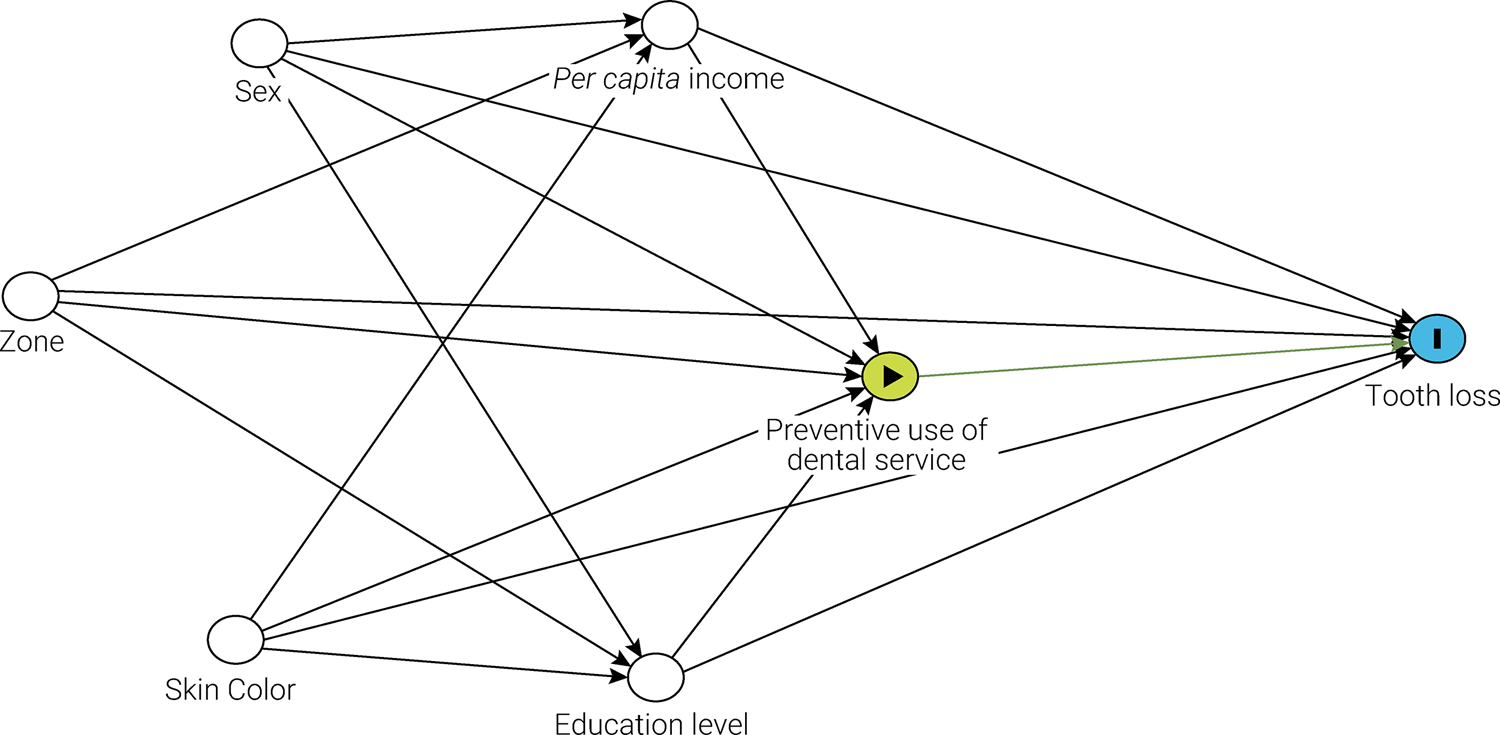
Covariates were selected using a Directed Acyclic Graph (DAG) (Figure 1) to identify potential confounders of the association between the exposure and outcome. The sociodemographic variables included were: zone of residence (urban/rural), sex (male/female), skin color (white/non-white), age group (18–29, 30–39, 40–49 years), per capita household income (<1 minimum wage, 1–3 minimum wages, 3–5 minimum wages, >5 minimum wages), and education level (0–8 years, ≥9 years of study). The DAG serves as a scientific strategy to visually represent causal relationships and identify confounding variables, ensuring that the analysis accurately captures the true causal effect by minimizing bias. Although DAGs are commonly used in longitudinal studies, they can also be applied in cross-sectional studies to identify and control for confounders, thereby improving the validity of the associations observed in a single point in time15.
Directed Acyclic Diagram (DAG) representation, was created to identify potential confounders in the relationship between the exposure and the outcome.
Statistical analysis
Data analysis adopted sampling weights for primary sampling units, households and selected resident, following complex survey sampling. The analyzes were carried out in Stata software, version 14.0 (College Station, TX). The descriptive analysis presented the general prevalence of sample characteristics and proportions by use of preventive dental service. Subsequently, multivariate analysis was performed using the Poisson regression model with robust variance to estimate crude and adjusted prevalence ratios (PR), their respective 95% confidence intervals (95% CI) and a significance level of 5%. Data are presented for the general sample of adults aged 15 to 19.
Results
A total of 4,336 adolescents from all Brazilian regions participated in this study. Table 1 presents the descriptive analyses and the proportions of tooth loss (one or more teeth) for each category analyzed. Most of the sample consisted of individuals living in urban areas (83.5%), females (50.0%), individuals identified as Black or Brown (61.8%), those with a household income of less than one minimum wage (69.8%), individuals with up to 8 years of formal education (75.0%), and those who did not use dental services for preventive care in the last 12 months (55.4%). Regarding the proportions, adolescents living in urban areas had a higher prevalence of tooth loss, with 76.8% (95% CI: 72.9-80.3), as did Black and Brown adolescents, with 67.8% (95% CI: 62.1-73.1). Additionally, individuals with an income of less than one minimum wage showed a prevalence of 72.5% (95% CI: 66.7-71.8), those with up to 8 years of formal education had 76.6% (95% CI: 71.5-80.2), and those who did not use dental services for preventive care in the last 12 months had a prevalence of 24.3% (95% CI: 19.6-29.6).
Descriptive analysis and proportion of tooth loss (≥1 tooth) in brazilian adolescents (n=4,336).
The association analysis is detailed in Table 2. The crude analysis suggested that individuals who used preventive dental services in the last 12 months had a 61% lower prevalence (Prevalence Ration RP: 0.39 [95% CI: 0.30-0. 51]) of losing one or more teeth compared to those who did not use preventive services. The adjusted analysis indicated that individuals who used preventive services in the last 12 months had a 62% lower prevalence (PR: 0.38 [95% CI: 0.30-0.49]) of loss of one or more teeth compared to those who did not use preventive services.
Discussion
This study found a significant association between the use of preventive dental services and a lower prevalence of tooth loss among Brazilian adolescents. Adolescents who utilized preventive services, such as dental prophylaxis and check-ups, within the last 12 months were 62% less likely to have lost one or more teeth compared to those who did not seek these services. These findings underscore the importance of oral health policies aimed at promoting the regular use of preventive care, particularly among young populations
The findings align with the existing literature, which emphasizes preventive services as a critical strategy for maintaining oral health, particularly among vulnerable groups14,16. Tooth loss, which adversely affects esthetics, masticatory function, and adolescents’ self-esteem, is also an important indicator of social inequality, as evidenced by previous studies17,18. In our study, adolescents from disadvantaged socioeconomic backgrounds, such as those with lower income and education levels, showed higher prevalence’s of tooth loss2,16.
Moreover, the protective impact of using preventive services identified in our study underscores the need for targeted interventions that promote the utilization of these services among adolescents19. Previous studies indicate that a lack of access to preventive care can lead to a cycle of dental diseases that culminates in tooth loss, negatively affecting overall health and quality of life3,16. Therefore, ensuring that adolescents have regular access to these services is crucial for mitigating the burden of oral diseases and their long-term consequences20. Another relevant point is the need to integrate preventive strategies into broader public oral health policies, considering the cultural and socioeconomic factors that influence the use of dental services21,22. Including initiatives such as water fluoridation and oral health education programs in schools can expand the reach of preventive measures, particularly in areas where access to healthcare services is limited.
The association between the use of preventive dental services and tooth loss in adolescents can be analyzed from the perspective of the Common Risk Factor Approach23. In this context, tooth loss and unequal access to healthcare services share socioeconomic and cultural determinants that limit the ability of low-income or less educated individuals to maintain good oral health21,22. Our findings showed that adolescents who utilized preventive services had a significantly lower prevalence of tooth loss, suggesting that access to these services is a protective factor. However, the socioeconomic barriers that hinder equitable access to preventive care are also common risk factors that negatively affect both oral health and other aspects of health23,24. Therefore, disparities in the utilization of preventive services reflect the same social determinants that influence the prevalence of tooth loss among adolescents.
This study has some limitations that should be considered when interpreting the results. First, the cross-sectional design prevents the determination of causal relationships, limiting our conclusions about the temporality between the use of preventive services and tooth loss. Additionally, reliance on self-reported data may introduce recall biases, as participants may not accurately remember the services they used25. Moreover, the self-reported classification of race may reflect social and cultural perceptions rather than genetic ancestry, which could influence the interpretation of disparities in oral health outcomes. Another aspect to consider is that the study included only adolescents aged 15 to 19 years, which may limit the generalizability of the findings to other age groups. Furthermore, the variable for the use of preventive services was simplified into a dichotomy, which may not capture the complexity of access to and utilization of preventive care; future research could adopt a more detailed and qualitative analysis of these factors. On a positive note, this study was conducted with a nationally representative sample of Brazilian adolescents, which enhances the generalizability of the findings across the country. The use of a large and diverse sample strengthens the reliability of the results, providing valuable insights into the oral health behaviors and outcomes among Brazilian youth. Despite its limitations, the study offers important evidence supporting the protective role of preventive services in reducing tooth loss and highlights the need for equitable access to these services across different population groups.
In conclusion, this study aimed to verify the association between preventive dental service use and tooth loss among adolescents in Brazil. The findings indicate that the utilization of preventive dental services is associated with a lower prevalence of tooth loss, highlighting the importance of investing in preventive care to reduce disparities in oral health. Public health strategies should address common risk factors, such as socioeconomic inequalities, and strengthen primary care services. Translating this knowledge into inclusive policies and reinforced primary healthcare can contribute to improved oral and overall health outcomes for the adolescent population in Brazil.
Acknowledgments
None.
References
-
1 Peres MA, Macpherson LMD, Weyant RJ, Daly B, Venturelli R, Mathur MR, et al. Oral diseases: a global public health challenge. Lancet. 2019 Jul;394(10194):249-60. doi: 10.1016/S0140-6736(19)31146-8. Erratum in: Lancet. 2019 Sep;394(10203):1010. doi: 10.1016/S0140-6736(19)32079-3.
» https://doi.org/10.1016/S0140-6736(19)31146-8 -
2 Casarin M, Nolasco WDS, Colussi PRG, Piardi CC, Weidlich P, Rösing CK, et al. Prevalence of tooth loss and associated factors in institutionalized adolescents: a cross-sectional study. Cien Saude Colet. 2021 Jul;26(7):2635-42. doi: 10.1590/1413-81232021267.07162021.
» https://doi.org/10.1590/1413-81232021267.07162021 -
3 Colussi PRG, Hugo FN, Muniz FWMG, Rösing CK. Tooth loss and associated factors in adolescents - impact of extractions for orthodontic reason. Braz J Oral Sci. 2018;17:e18149. doi: 10.20396/bjos.v17i0.8652653.
» https://doi.org/10.20396/bjos.v17i0.8652653 -
4 Fagundes MLB, Bastos LF, Amaral Júnior OLD, Menegazzo GR, Cunha ARD, Stein C, et al. Socioeconomic inequalities in the use of dental services in Brazil: an analysis of the 2019 National Health Survey. Rev Bras Epidemiol. 2021 Dec;24(suppl 2):e210004. doi: 10.1590/1980-549720210004.supl.2.
» https://doi.org/10.1590/1980-549720210004.supl.2 -
5 Freire DEWG, Freire AR, Lucena EHG, Cavalcanti YW. Oral health access in Brazil: analysis of inequities and non-access from the service user's perspective, according to the National Primary Care Access and Quality Improvement Program, 2014 and 2018. Epidemiol Serv Saude. 2021 Sep;30(3):e2020444. doi: 10.1590/S1679-49742021000300016.
» https://doi.org/10.1590/S1679-49742021000300016 -
6 Rosário BSM, Rosário HD, de Andrade Vieira W, Cericato GO, Nóbrega DF, Blumenberg C, et al. External control of fluoridation in the public water supplies of Brazilian cities as a strategy against caries: a systematic review and meta-analysis. BMC Oral Health. 2021 Aug;21(1):410. doi: 10.1186/s12903-021-01754-2.
» https://doi.org/10.1186/s12903-021-01754-2 -
7 Bulgareli JV, Faria ET, CortellazziI KL, Guerra LM, Meneghim MC, Ambrosano GMB, et al. [Factors influencing the impact of oral health on the daily activities of adolescents, adults, and the elderly]. Rev Saude Publica. 2018;52:44. Portuguese. doi: 10.11606/S1518-8787.2018052000042.
» https://doi.org/10.11606/S1518-8787.2018052000042 -
8 Rausell-Köster P, Ghirardi S, Sanjuán J, Molinari F, Abril B. Cultural experiences in the framework of "cultural cities": measuring the socioeconomic impact of culture in urban performance. City Territ Archit. 2022;9(1):40. doi: 10.1186/s40410-022-00189-8.
» https://doi.org/10.1186/s40410-022-00189-8 -
9 Amaral Junior OL, Menegazzo GR, Fagundes MLB, de Sousa JL, Tôrres LHN, Giordani JMA. Perceived discrimination in health services and preventive dental attendance in Brazilian adults. Community Dent Oral Epidemiol. 2020 Dec;48(6):533-9. doi: 10.1111/cdoe.12565.
» https://doi.org/10.1111/cdoe.12565 - 10 Barasuol JC, Garcia LP, Freitas RC, Dalpian DM, Menezes JVNB, Santos BZ. Dental care utilization among children in Brazil: an exploratory study based on data from national household surveys. Cien Saude Colet. 2019 Feb;24(2):649-657. doi: 10.1590/1413-81232018242.03232017.
-
11 Roncalli AG, Sheiham A, Tsakos G, Watt RG. Socially unequal improvements in dental caries levels in Brazilian adolescents between 2003 and 2010. Community Dent Oral Epidemiol. 2015 Aug;43(4):317-24. doi: 10.1111/cdoe.12156.
» https://doi.org/10.1111/cdoe.12156 -
12 Vettore MV, Ahmad SFH, Machuca C, Fontanini H. Socio-economic status, social support, social network, dental status, and oral health reported outcomes in adolescents. Eur J Oral Sci. 2019 Apr;127(2):139-46. doi: 10.1111/eos.12605.
» https://doi.org/10.1111/eos.12605 -
13 Stopa SR, Szwarcwald CL, Oliveira MM, Gouvea ECDP, Vieira MLFP, Freitas MPS, et al. National Health Survey 2019: history, methods and perspectives. Epidemiol Serv Saude. 2020 Oct;29(5):e2020315. doi: 10.1590/S1679-49742020000500004. Erratum in: Epidemiol Serv Saude. 2021 Sep;30(3):e2021830. doi: 10.1590/S1679-49742021000300031.
» https://doi.org/10.1590/S1679-49742020000500004 -
14 Tôrres LHN, Zanatta J, Pizolato RA, Grillo CM, Frias AC, Sousa MDLRD. Reasons related to tooth loss among adolescents in São Paulo, Brazil. Braz J Oral Sci. 2014;13(1):37-42. doi: 10.1590/1677-3225v13n1a08.
» https://doi.org/10.1590/1677-3225v13n1a08 -
15 Tennant PWG, Murray EJ, Arnold KF, Berrie L, Fox MP, Gadd SC, et al. Use of directed acyclic graphs (DAGs) to identify confounders in applied health research: review and recommendations. Int J Epidemiol. 2021 May;50(2):620-32. doi: 10.1093/ije/dyaa213.
» https://doi.org/10.1093/ije/dyaa213 -
16 Massoni ACLT, Porto É, Ferreira LRBO, Silva HP, Gomes MDNC, Perazzo MF, et al. Access to oral healthcare services of adolescents of a large-size municipality in northeastern Brazil. Braz Oral Res. 2020 Mar;34:e029. doi: 10.1590/1807-3107bor-2020.vol34.0029.
» https://doi.org/10.1590/1807-3107bor-2020.vol34.0029 - 17 Pazos CTC, Austregésilo SC, Goes PSA. Self-esteem and oral health behavior in adolescents. Cien Saude Colet. 2019 Oct 28;24(11):4083-4092. doi: 10.1590/1413-812320182411.02492018.
-
18 Kaur P, Singh S, Mathur A, Makkar DK, Aggarwal VP, Batra M, et al. Impact of dental disorders and its influence on self esteem levels among adolescents. J Clin Diagn Res. 2017 Apr;11(4):ZC05-8. doi: 10.7860/JCDR/2017/23362.9515.
» https://doi.org/10.7860/JCDR/2017/23362.9515 -
19 Salam RA, Das JK, Lassi ZS, Bhutta ZA. Adolescent health interventions: conclusions, evidence gaps, and research priorities. J Adolesc Health. 2016 Oct;59(4S):S88-S92. doi: 10.1016/j.jadohealth.2016.05.006.
» https://doi.org/10.1016/j.jadohealth.2016.05.006 -
20 Amaral JCP, Gawlinski BC, Duque C, Cunha RF. Oral condition of adolescents who participated in an oral health program during the first decade of life. Pesqui Bras Odontopediatria Clín Integr. 2023;23:e220002. doi: 10.1590/pboci.2023.023.
» https://doi.org/10.1590/pboci.2023.023 - 21 Sheiham A, Watt RG. The common risk factor approach: a rational basis for promoting oral health. Community Dent Oral Epidemiol. 2000 Dec;28(6):399-406. doi: 10.1034/j.1600-0528.2000.028006399.x.
- 22 Watt RG, Sheiham A. Integrating the common risk factor approach into a social determinants framework. Community Dent Oral Epidemiol. 2012 Aug;40(4):289-96. doi: 10.1111/j.1600-0528.2012.00680.x.
-
23 Moysés SJ. Inequalities in oral health and oral health promotion. Braz Oral Res. 2012;26 Suppl 1:86-93. doi: 10.1590/s1806-83242012000700013.
» https://doi.org/10.1590/s1806-83242012000700013 -
24 Corrêa LLG, Sousa MDLR, Frias AC, Antunes JLF. Factors associated with dental caries in adolescents: a cross-sectional study, São Paulo State, Brazil, 2015. Epidemiol Serv Saude. 2020 Sep;29(5):e2019523. doi: 10.1590/S1679-49742020000500007.
» https://doi.org/10.1590/S1679-49742020000500007 -
25 Althubaiti A. Information bias in health research: definition, pitfalls, and adjustment methods. J Multidiscip Healthc. 2016 May;9:211-7. doi: 10.2147/JMDH.S104807.
» https://doi.org/10.2147/JMDH.S104807