 Oral health-related quality of life in hemimandibulectomy patients with guide flange prosthesis: a prospective study
Abstract
Aim To assess the quality of life in patients who have undergone hemimandibulectomy and rehabilitated with a guide flange prosthesis.
Methods This is a prospective study conducted at two time points: immediately after prosthesis delivery and three months after prosthesis use. Forty-four patients who had undergone hemimandibulectomy and were rehabilitated with a guide flange prosthesis were included in the assessment. OHRQol was assessed in these patients using the Obturator Functioning Scale (OFS) and a novel scale Maxillofacial Prosthesis Performance Scale (MFPPS). The scores were obtained 1 week after and 3 months of guide flange prosthesis usage. The data were analyzed using unpaired and paired sample t-tests.
Results After 3 months, the results showed significant improvement with the prosthesis. There was a notable improvement in chewing, swallowing, appearance, and psychological issues. The scores of OFS and MFPPS for mandibular guidance prosthesis after 1 week were 25.48 and 26.82, respectively, and scores after 3 months were 20.28 and 13.16, respectively.
Conclusion The findings of the study show significant improvement in the scores after prosthesis usage in terms of functional, physical, social, and psychological parameters in the patients after following up.
Keywords:
Quality of life; Oral health; Neoplasms; Mandibular osteotomy; Dental prosthesis
Introduction
Health has been defined by the World Health Organization as a “state of complete physical, mental, and social well-being, not merely the absence of disease or infirmity.” Health includes a range of states from wellness to illness to disability. Health lacks a commonly held global measurement. Health status, functional status and health-related quality of life are terms that are often used interchangeably to refer to the health of an individual1.
Health-related quality of life is a multidimensional concept with five broad domains: opportunity/resilience, health perception, functional states, impairments/diseases, and duration of life. The health-related quality of life approach has provided a greater opportunity for investigation of the interrelations among oral health, health, and related outcomes2.
One of the most consistently challenging areas of rehabilitation is the maxillofacial rehabilitation of patients who have had radical cancer surgery of the tongue, floor of the mouth, and mandible. Mandibulectomy and commando procedures involve the extensive loss of tissues and associated functions. Swallowing, speech, mandibular movements, mastication, control of saliva, respiration, and psychic functions are adversely affected by radical mandibular surgery. These dysfunctions radically alter the prosthetic prognosis and quality of life of individuals3.
Over the years, Oral Health–Related Quality of Life has gained enormous impact in cancer patients. However, only a few studies have evaluated the changes in quality of life in maxillofacial defect patients with intraoral prosthesis4. Thus, this study was designed to establish the questionnaire system for mandibular defects and evaluate the impact of mandibular guidance prosthesis on OHRQol in mandibular defects by the Obturator Functioning Scale (OFS) and Maxillofacial Prosthesis Performance Scale (MFPPS).
Methods
Study Design
This was a prospective study conducted in the Department of Prosthodontics and crown & bridge, Government Dental college and hospital, Ahmedabad, Gujarat, between September 2023 and January 2024, with approval from the ethical committee. Forty-four patients with Brown’s classification were selected for this study. Informed consent was taken from all the participants. The ‘inclusion criteria’ were hemimandibulectomy defects having a provision of a guidance prosthesis and has worn for at least 2 months. Patients with other facial defects or paralysis and a completely edentulous mandible were excluded from the study. All the patients were rehabilitated with a mandibular guidance prosthesis, respectively. Post maintenance instructions are given, and recalled visits are scheduled periodically. Oral health-related quality of life is measured 1 week after and 2 months of prosthesis function. Patients are asked a series of questions using 2 scales: Obturator Functioning Scale (OFS-15) and Maxillofacial Prosthesis Performance Scale (MFPPS-10). Answers are recorded by a single operator.
Questionnaires
The Obturator Functioning Scale (OFS) was developed at Memorial Sloan Kettering Cancer Center (New York, NY, USA) as a means of assessing self-reported functioning of an obturator. It was designed by Kornblith et al. to assess eating ability, speech, and cosmetic satisfaction. To rate the items with higher scores (reflecting greater difficulty with obturator function), a 5-point Likert scale was used (“not at all”, “a little difficult”, “somewhat difficult”, “very difficult”, “extremely difficult”). One item, i.e., “difficulty talking on the phone”, was added to the scale to assess communication difficulties in the absence of visual cues5.
Maxillofacial prosthesis performance scale (MFPPS) comprises 10 statements which include functional discomfort, retention/stability, phonetics, aesthetics, oral hygiene, saliva, taste ability, psychology, and satisfaction. The data were analyzed using unpaired and paired sample t-tests.
Results
The mean scores of the total 44 patients after 1 week and 3 months of follow-up were 25.48 and 26.82 for OFS-15 and 20.28 and 13.16 for MFPPS-10.
Result of OFS-15
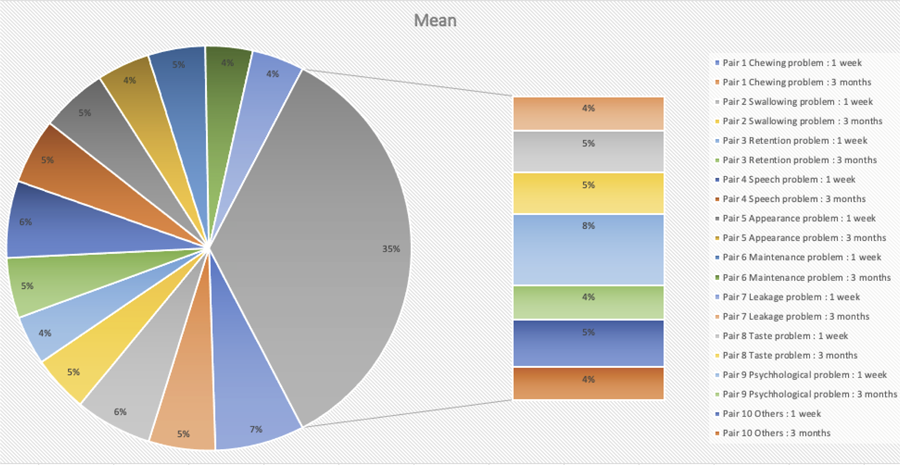
The result of the scale reveals significant improvements in various patient-related outcomes over a period of three months. Specifically, chewing problems (p < 0.001), swallowing problems (p < 0.001), speech problems (p < 0.001), appearance problems (p < 0.001), maintenance problems (p < 0.01), psychological problems (p < 0.001), and other miscellaneous issues (p < 0.001) all showed substantial reductions in severity from 1 week to 3 months. Conversely, retention problems significantly increased (p < 0.01), indicating a deterioration in retention over time. Leakage problems and taste problems did not exhibit significant changes, with p-values of 0.210 and 1.000, respectively. Overall, the results suggest notable improvements in most areas, except for retention (Figure 1, Table 3).
Result of MFPPS-10
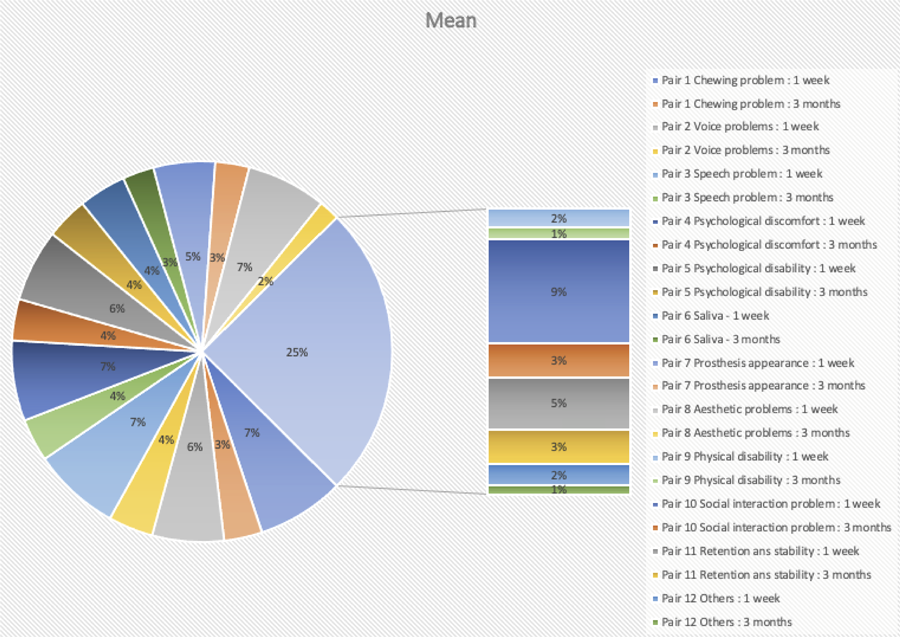
The scores of the index show chewing problems decreased from a mean score of 2.98 at 1 week to 1.30 at 3 months. Voice issues improved, with mean scores reducing from 2.43 at 1 week to 1.52 at 3 months. Speech difficulties saw a reduction from a mean of 2.98 at 1 week to 1.45 at 3 months. Psychological discomfort decreased from 2.73 to 1.41, and psychological disability from 2.45 to 1.43, indicating better psychological well-being. Saliva-related problems reduced from a mean of 1.61 at 1 week to 1.07 at 3 months. Concerns about prosthesis appearance dropped from 2.09 to 1.16, and aesthetic issues from 2.70 to 0.70. Social interaction problems showed a significant decrease from 3.64 to 1.16. Other miscellaneous issues also improved, with scores dropping from 0.73 to 0.32. Minor improvements were observed in physical disability (0.66 to 0.41) and retention and stability issues (1.82 to 1.23). Overall, these results indicate substantial positive impacts on patient satisfaction and quality of life following the interventions (Figure 2, Table 4).
Mean, standard deviation of MFPPS-10 scale after 1 week and 3 months of guidance prosthesis: paired samples statistics
Discussion
The mandible, a crucial structure in the human skeletal system, plays an integral role in various complex functions of the oral cavity and hypopharynx, including mastication, speech, and deglutition. The mandibular anatomy, with its unique combination of strength and mobility, is essential for these critical actions. Historically, segmental mandibular resection, often necessitated by malignancies, trauma, or severe infections, resulted in significant functional and aesthetic deficits6.
Patients undergoing such resections frequently faced profound disabilities. The loss of mandibular continuity disrupted occlusion and masticatory efficiency, leading to compromised nutrition and speech difficulties7. Additionally, the absence of structural support often caused severe facial disfigurement. These physical impairments were compounded by the psychological impact, as patients struggled with social isolation and reduced quality of life8.
The primary challenge in the early management of mandibular defects was the lack of reliable reconstructive techniques9. Traditional methods were often inadequate in restoring both form and function. The limitations of early grafting techniques, which included high rates of infection, graft resorption, and mechanical failure, rendered many reconstructive efforts unsuccessful10. Consequently, patients were left with debilitating conditions that hindered their daily activities and social interactions. The interventions aimed to restore functional balance and improve the quality of life for individuals who have undergone mandibulectomy.
Guidance therapy plays a pivotal role in enhancing both the form and function of individuals who have undergone mandibulectomy or experienced significant occlusal derangements. By providing a structured framework for neuromuscular adaptation, guidance therapy serves as an interim measure to correct existing occlusal discrepancies. This therapeutic approach helps in re-establishing proper occlusal relationships, thereby facilitating more coordinated mandibular movements and improving overall masticatory efficiency11.
The OFS-15 scores after 3 months showed significant improvement in chewing (25.7%), swallowing (26.6%), aesthetics (20.6%), and psychological well-being (51%) post-treatment. However, retention problems increase (22.2%) after prosthesis usage. Overall, the results reflect positively on the rehabilitative efforts and patient adaptation over time.
The MFPPS score data also indicated the dramatic improvement and positive outcomes associated with the rehabilitative efforts and patient adaptation processes. The results support the effectiveness of the interventions in enhancing patients’ quality of life and functional capabilities. The patients were reviewed again 3 months later, confirming an even higher level of overall satisfaction with the mandibular resection prosthesis.
The study concludes that there is a remarkable improvement in prosthesis outcomes in terms of functional, physical, psychological, and social parameters after long-term follow-up (3 months). Significant differences were found in all three scales at both 1 week and 3 months follow-up, indicating that the Mandibular Resection Guidance Prosthesis significantly enhances oral health-related quality of life. Within the confines of this study, there is a highly positive association between OHRQoL and the use of maxillofacial prosthesis.
Acknowledgement
We would like to express our sincere gratitude to all those who contributed to this study. We are grateful to the Maxillofacial Prosthetics Department at Gujarat Cancer Research Institute (GCRI), Ahmedabad, for their support and collaboration throughout this study. Special thanks to Dr. Vijay for his expert guidance and assistance in the clinical and technical aspects of the prosthetic rehabilitation process. The authors gratefully acknowledge the assistance of Dr. Shireen Ali for her contribution in conducting the statistical analysis for this study. Her expertise and guidance have been instrumental in strengthening the quality of this work.
References
-
1 Schramme T. Health as Complete Well-Being: The WHO definition and beyond. Public Health Ethics. 2023 Jul;16(3):210-8. doi: 10.1093/phe/phad017.
» https://doi.org/10.1093/phe/phad017 -
2 Gift HC, Atchison KA. Oral health, health, and health-related quality of life. Med Care. 1995 Nov;33(11 Suppl):NS57-77. doi: 10.1097/00005650-199511001-00008.
» https://doi.org/10.1097/00005650-199511001-00008 -
3 Cantor R, Curtis TA. Prosthetic management of edentulous mandibulectomy patients. I. Anatomic, physiologic, and psychologic considerations. J Prosthet Dent. 1971 Apr;25(4):446-57. doi: 10.1016/0022-3913(71)90236-8.
» https://doi.org/10.1016/0022-3913(71)90236-8 -
4 Hassan SJ, Weymuller EA Jr. Assessment of quality of life in head and neck cancer patients. Head Neck. 1993 Nov-Dec;15(6):485-96. doi: 10.1002/hed.2880150603.
» https://doi.org/10.1002/hed.2880150603 -
5 Ali MM, Khalifa N, Alhajj MN. Quality of life and problems associated with obturators of patients with maxillectomies. Head Face Med. 2018 Jan;14(1):2. doi: 10.1186/s13005-017-0160-2.
» https://doi.org/10.1186/s13005-017-0160-2 -
6 Paré A, Bossard A, Laure B, Weiss P, Gauthier O, Corre P. Reconstruction of segmental mandibular defects: current procedures and perspectives. Laryngoscope Investig Otolaryngol. 2019 Nov;4(6):587-96. doi: 10.1002/lio2.325.
» https://doi.org/10.1002/lio2.325 -
7 Young CW, Pogrel MA, Schmidt BL. Quality of life in patients undergoing segmental mandibular resection and staged reconstruction with nonvascularized bone grafts. J Oral Maxillofac Surg. 2007 Apr;65(4):706-12. doi: 10.1016/j.joms.2006.05.064.
» https://doi.org/10.1016/j.joms.2006.05.064 -
8 Handschel J. Psychological impact of facial disfigurement. In: Meyer U, editor. Fundamentals of craniofacial malformations. Springer, Cham; 2021. p.265-7. doi: 10.1007/978-3-030-46024-2_17.
» https://doi.org/10.1007/978-3-030-46024-2_17 -
9 Kumar BP, Venkatesh V, Kumar KA, Yadav BY, Mohan SR. Mandibular Reconstruction: Overview. J Maxillofac Oral Surg. 2016 Dec;15(4):425-41. doi: 10.1007/s12663-015-0766-5. Epub 2015 Apr 19.
» https://doi.org/10.1007/s12663-015-0766-5 -
10 Sass T, Piffkó J, Braunitzer G, Oberna F. Esthetic and functional reconstruction of large mandibular defects using free fibula flap and implant-retained prosthetics - a case series with long-term follow-up. Head Face Med. 2021 Oct;17(1):43. doi: 10.1186/s13005-021-00297-9.
» https://doi.org/10.1186/s13005-021-00297-9 - 11 Jacob RF. Prosthodontic rehabilitation of a mandibulectomy patient. In: Taylor TD, editor. Clinical Maxillofacial Prosthetics. Illinois: Quintessence; 2000. p.171-88.
-
Data Availability:
All data generated or analysed during this study are included in this article. Additional datasets are available from the corresponding author upon reasonable request.
-
Funding:
None.
Edited by
-
Editor:
Dr. Altair A. Del Bel Cury
All data generated or analysed during this study are included in this article. Additional datasets are available from the corresponding author upon reasonable request.