 Proterozoic taphrogenic history recorded in the pre-collisional sedimentary basins of the Araçuaí Orogen, Southern Espinhaço Range, Southeastern Brazil
Abstract
The Proterozoic pre-collisional basins of the Araçuaí orogen consist of a succession of superimposed basins that overlie the eastern margin of the São Francisco Craton. This report proposes new stratigraphic and tectonic models for the evolution of the pre-collisional basins of the Araçuaí orogen. They are younger than the Rhyacian orogeny and predate the Ediacaran orogeny. The Orosirian Costa Sena sineclisis was a submerged, N-S asymmetric basin. The onset of the Statherian Espinhaço rift system followed, consisting of four asymmetric rifts, bounded by N-S, west dipping normal faults. The faults are connected at depth to a detachment, exposed at the eastern border of the southern Espinhaço range. The taphrogenic process was caused by an asthenospheric heat flow, from underneath the São Francisco proto-Craton, moving eastward, below the Gouveia complex. After a geological hiatus greater than 400 Ma, the basin activity resumed when the temperature below the Gouveia complex was high enough to create a thermal heat flow, directed toward the east, below the Guanhães complex. Asthenospheric heat flow acting below a younger detachment zone governed the development of the remaining Stenian Tonian Cryogenian pre-collisional basins, continental breakup and oceanic crust generation.
KEYWORDS:
Araçuaí orogen; stratigraphy of pre-collisional basins; Proterozoic tectonic evolution
1. INTRODUCTION
The Araçuaí-West Congo orogen comprises the northern portion of the South Atlantic Brasiliano orogenic system in southeastern Brazil. The orogen abuts the São Francisco Craton to the west and the Congo Craton to the east. It outlines a large arc, with an opening facing the south (Almeida, 1977). To the north, the Bahia-Gabon Cratonic Bridge, considered as part of the São Francisco Craton, constituted of rocks of Archean and Paleoproterozoic ages, physically limits the orogen (Figure 1A). The cratonic bridge lasted from the Rhyacian orogeny until its complete breakup in the Cretaceous, during the drift of the South American and African continents. Toward the south, the Araçuaí orogen transitions into the Brasiliano Ribeira orogenic belt.

(A) Geotectonic setting of the Araçuaí orogen. (B) Geological map of the Araçuaí orogen (Pedrosa-Soares et al., 2001, 2007, simplified). (C) Topographic map of the southern Espinhaço range, showing the location of the mapped areas.
The Neoproterozoic Araçuaí-West Congo orogen is composed of marginal belts that border the cratonic boundaries, and an inner zone representing the high-grade, crystalline core of the orogen (Pedrosa-Soares et al., 2007; Pedrosa-Soares & Alkmim, 2011). The Araçuaí belt is located at the western portion of the orogen and includes a basement inlier, which is the Guanhães complex, as well as an external fold-thrust belt composed of Archean basement rocks and Proterozoic successions. Ediacaran compressive deformation associated with the Araçuaí orogeny, originated in the orogenic core, progressively advanced toward the São Francisco and Congo Cratons, creating a centrifugal pattern of tectonic transport. This complex structural pattern gave rise to the nutcracker tectonic model, proposed by Alkmim et al. (2006). Deformation within the Araçuaí belt was directed westward, accompanied by syn-tectonic metamorphism under greenschist to amphibolite facies conditions. The southern Espinhaço range comprises the external belt of the Araçuaí orogen. It is bounded to the west by the São Francisco Craton and to the east by igneous rocks of the Guanhães complex (Figure 1B).
The southern Espinhaço range is an N-S chain of spectacular mountains of paramount importance to the Araçuaí orogen. It is the most prominent geomorphologic feature of the orogen. The mountain range begins at the Serra do Cipó, on the outskirts of Belo Horizonte, and extends northward for more than 250 km, reaching the northern portion of the Minas Gerais State. Aiming to obtain a complete stratigraphic section of the cordillera, three main areas were selected for detailed geological investigation (Figure 1C).
The geological history of the Araçuaí orogen spans from the Tonian to the Ediacaran period. Substantial evidence supports that the Araçuaí orogen represents a complete Wilson cycle, involving a phase of distension followed by the convergence of tectonic plates. This model is corroborated by the preservation of tectonic constituents, representative of each phase of the Wilson cycle, including rift, drift, subduction, collision and collapse (Caxito et al., 2022). The Neoproterozoic Macaúbas basins are identified as the precursor basins of the Araçuaí orogen, formed during the rift/drift phases of the Wilson cycle (Alkmim et al., 2007; Pedrosa-Soares et al, 2020). The pre-glacial Macaúbas rift 1 began its evolution approximately 930 Ma ago. It was followed by a glaciogenic continental margin, around 900 Ma (Kuchenbecker et al., 2015). The complete breakup of the basement took place around 660 Ma ago and is marked by the generation of juvenile oceanic crust (Queiroga et al., 2007).
During the Tonian and Cryogenian, the breakup of the Archean basement occurred through pure shear deformation, forming a symmetric rift system (Alkmim et al., 2007, 2017), or by simple shear deformation, forming an asymmetric rift system (Pedrosa-Soares et al., 2008; Caxito et al., 2022). Despite differences in the proposed mechanism of crustal fragmentation, these authors agree that the complete breakup of the igneous basement, the onset of the Macaúbas continental margin and the development of juvenile oceanic crust were driven by the rise of an asthenospheric mantle plume, as evidenced by the Tonian (920-900 Ma) Bahia-Gangila Large Igneous Province (LIP). It includes basic dyke swarms (Pedro Lessa suite), along with intrusive basic and acid units, which occur across extensive areas of the Araçuaí orogeny. The Pedro Lessa suite marks the initial attempts to break the basement (Chaves et al., 2019).
The stratigraphy of the southern Espinhaço range is constituted of three major lithostratigraphic units: an Archean basement overlain by the Rio Paraúna and Espinhaço supergroups, which are separated by regional angular unconformities (Scholl & Fogaça, 1979; Pflug & Renger, 1973; Fogaça et al., 1984). The Rio Paraúna supergroup comprehends a basal unit (Pedro Pereira group), which is made up of volcanic and sedimentary rocks interbedded. This group is covered by a succession of clastic rocks, showing an inverse granulometric trend (Costa Sena group). The Mesoproterozoic Espinhaço supergroup was first defined by Pflug (1965, 1968), who correlated it to the Proterozoic Minas supergroup of the Quadrilátero Ferrífero region. It outcrops along the southern Espinhaço range and represents an epiclastic succession, with an estimated thickness of few thousand meters, composed predominantly of quartz-arenites, sandstones, arkosic sandstones, pelites, conglomerates and volcanic rocks. Along the northern portion of the southern range, the deposits of the Neoproterozoic São Francisco supergroup unconformably overlie the Archean basement and older sedimentary units (Schobbenhaus, 1993; Kuchenbecker et al., 2015).
The geochronologic ages of the pre-collisional basins of the Araçuaí orogen are well constrained. They are younger than the Archean basement, which was reworked to varying degrees by the Rhyacian orogeny, and older than the Araçuaí orogeny. The pre-orogenic basins have been included in the time interval known as the “boring billion years” discouraging further efforts into the geological research of the southern Espinhaço range. The existence of a significant geological hiatus between some pre-collisional basins undoubtedly presents a challenge in understanding their tectonic evolution, but it certainly does not make the task itself boring. The boring billion years is known as the “earth´s middle age” which is characterized by a prolonged period of tectonic stability. This period began after the orogenic assembly of tectonic blocks between 2.0 and 1.8 Ga, which evolved in the amalgamation of Columbia supercontinente. Since then, Columbia acted as a continental lid, and, regardless of numerous failed attempts, was not fully broken until 0.8 Ga (Roberts, 2013; Cawood & Hawkesworth, 2014). The São Francisco-Congo paleocontinent was amalgamated during the Rhyacian orogeny and remained stable until its complete breakup, approximately 0.7 Ga ago, despite unsuccessful extensional and magmatic events recorded during that time (Pedrosa-Soares & Alkmim, 2011). Except for the Tonian Cryogenian Macaúbas rift-continental margin, the older pre-collisional basins were not considered as part of the continental breakup process or any other geological process related to the Araçuaí orogen (Alkmim et al., 2017; Fossen et al., 2020; Pedrosa-Soares et al., 2020; Caxito et al., 2022; Caxito & Alkmim, 2023).
The tectonic origin and significance of the Espinhaço supergroup remain debated. The pioneering interpretation suggests that it formed as a geosyncline sequence, characterized by strong E-W facies change (Pflug, 1968; Pflug & Renger, 1973). This model evolved into the interpretation that it represents a Proterozoic intracontinental rift-sag sequence (Almeida-Abreu, 1995; Martins-Neto, 2000; Martins-Neto et al., 2001). With the development of geochronologic research applied to stratigraphy, in the 1990’s, the Espinhaço supergroup was reinterpreted to represent two distinct basins with a poly-historic evolution. These basins are separated by an important geological hiatus, representing more than 0.4 Ga. The lower Espinhaço basin represents a rift and was deposited from 1.8 to 1.66 Ga. The upper Espinhaço basin is characterized by a rift-sag basin, which was deposited between 1.2 and 0.9 Ga (Chemale Junior et al., 2011; Santos et al., 2013). Note that the Orosirian Costa Sena sineclisis is interpreted as belonging to the basement of the Espinhaço supergroup, being developed during late Rhyacian orogeny (Pagung et al., 2023).
Sedimentary basins were adopted as the basic units of the stratigraphic record. They are limited above and below by unconformities and/or correlative conformities. Some basins were subdivided into smaller units, representing distinct sequences, T/R- and R/T-sedimentary cycles or depositional systems. This research integrates data from extensive geological mapping campaigns, focusing not only on the identification and characterization of the pre-collisional basins but also on uncovering structural and stratigraphic relationships between them. A detailed structural analysis was conducted alongside basin analysis, as a reliable reconstruction of the original stratigraphy requires accounting for the effects of superimposed tectonism.
Combining traditional field techniques with the fundamental principles of sequence stratigraphy, this paper presents a fresh perspective on the stratigraphic and structural framework of the pre-collisional basins of the Araçuaí orogen, focusing on the southern Espinhaço range as the type area. Each pre-orogenic basin represents a specific evolutionary stage, characterized by its own stratigraphic position and structural style, providing valuable information about the tectonic processes that took place during sedimentation. This paper aims to contribute to an in-depth understanding of the hidden processes involved in the evolution of the eastern cratonic margin. New stratigraphic and tectonic models for the evolution of the pre-collisional basins of the Araçuaí orogen are proposed.
2. GEOCHRONOLOGIC AGES OF THE PRE-COLLISIONAL BASINS
Geological mapping made it possible to identify six distinct pre-collisional basins: Orosirian Costa Sena sineclisis; Statherian Espinhaço rift system; Stenian Sopa-Brumadinho graben system; Stenian Galho do Miguel sag; Stenian Conselheiro Mata graben and Tonian Cryogenian Macaúbas rift/continental margin. Stratigraphic and geochronologic data compiled from the literature were used to constrain the ages of the pre-collisional basins, as presented in Figure 2. Table 1 show the relationships between lithostratigraphic formal units and pre-collisional basins.

Stratigraphy of the pre-collisional basins of the southern Espinhaço range, The correlations of the lithostratigraphic formal units with the pre-collisional basins are presented.
Synoptic table presenting the stratigraphy of the southern Espinhaço range and the correlations between lithostratigraphic formal units with the pre-collisional basins of the Araçuaí orogen.
In the southern Espinhaço range, the pre-collisional basins overlie the Archean Gouveia complex, which comprises tonalite trondhjemite granodiorite terrains, with a crystallization age of 2.839 Ga (Noce et al., 2007). This complex is exposed at the core of overturned anticlines in the central range, developed in association with thrust tectonics. The Guanhães complex consists of TTG terrains, with magmatic crystallization ages ranging from 2.867 to 2.711 Ga (Noce et al., 2007). The ages for the Mantiqueira and Juiz de Fora complexes distinctly mark the maximal depositional age of the pre-collisional basins of the Araçuaí orogen. These complexes consist of continental fragments of the Rhyacian orogeny, developed between 2.2 and 2.05 Ga. The Mantiqueira complex consists of banded orthogneisses, ranging in composition from tonalitic to granitic, with localized occurrence of migmatites. It is interpreted as the product of partial melting of older continental crust. The magmatic crystallization of the orthogneisses occurred between 2.180 and 2.041 Ga. The Paleoproterozoic Juiz de Fora complex consists of orthogneisses metamorphosed under granulitic facies conditions, representing juvenile magmatism that occurred between 2.134 and 2.084 Ga (Noce et al., 2007).
The Orosirian Costa Sena sineclisis is the oldest pre-collisional basin of the Araçuaí orogen. At the eastern border, U/Pb data of detrital zircons, extracted in sericite quartz-schists and phyllites of the Meloso formation, indicate that the succession is younger than 1.990 Ma (Rolim et al., 2016). The rocks of the Meloso formation belong to the fine epiclastic succession deposited at the base of the Costa Sena sineclisis. Supporting this age is the presence of metarhyolites exposed at the eastern border, presenting zircons with an igneous crystallization of 2.05 Ga (Machado et al., 1989).
Intense extensional tectonism occurred during the Statherian. Detrital zircons of the rift deposits, specifically sandstones of the Bandeirinha formation, indicates ages younger than 1,785 Ma. U Pb data on detrital zircons from sandstones of the São João da Chapada formation suggests ages younger than 1,683 Ma (Chemale Junior et al., 2012). The Statherian rift deposits, exposed on the eastern edge of the Espinhaço range are named Serra do São José group. The U Pb dating of detrital zircons from this group reveals ages as old as 1,666 Ma (Rolim et al., 2016) (Figure 2 and Table 1).
In the central region, banded iron formations (BIF), composed of hematite-phyllites and minor chlorite- sericite-phyllites, is an important stratigraphic mark. The hematite-phyllites form tabular layers, concordant with the sedimentary bedding. They are interpreted as the record of multiples basic lava flows. These rocks consist basically of hematite, and minor amounts of sericite, chlorite, chloritoid and tourmaline. They are interpreted to represent K-rich volcanic rocks of basic composition, weathered and leached in a Proterozoic continental environment. They were later metamorphosed under low-greenschist facies conditions, forming hematite phyllites (Knauer & Schrank, 1994). The U Pb geochronological dating of zircons extracted from the hematite-phyllites indicated that crystallization occurred around 1,715 Ma ago (Machado et al., 1989). In the eastern border, the layers of BIFs are exposed at the top of the Jacém formation, as described by Rolim et al. (2016) and Rosière et al. (2019). They occupy a similar stratigraphic position as the hematite phyllites mapped in the central range, suggesting that they are correlated units.
Along the eastern border, widespread occurrences of acid magmatic rocks are spatially and temporally related to the Espinhaço rift system. These magmatic rocks include meta-rhyolites and intrusions of leucogranites. The U Pb dating of igneous zircon grains of the rhyolites yielded crystallization ages of 1,770 Ma (Brito-Neves et al., 1979) and 1,711 Ma (Machado et al., 1989). Bodies of alkaline leucogranites, associated with charnockitic rocks and syenites, grouped within the Borrachudos Suite, are intruded in the Guanhães complex. U Pb geochronological data from igneous zircons of the granites indicate a crystallization age of 1,730 Ma (Dussin & Dussin, 1995).
The maximal depositional age of the Sopa-Brumadinho formation is 1.192 Ma, as indicated by U Pb dating performed on zircons extracted from the conglomerate matrix of this formation. These data suggest the existence of a geological hiatus of more than 400 Ma, occurred between the Statherian Espinhaço rifts and the Stenian Sopa-Brumadinho grabens (Chemale Junior et al., 2011, 2012). Data from the Galho do Miguel sag and Conselheiro Mata graben are inconclusive, as no detrital zircon has provided ages younger than the early Stenian (Santos et al., 2013). This is most likely due to the fact that these basins were found in intracratonic settings, without the access of debris and volcanic rocks from external sources.
An important stratigraphic mark of the beginning of the deposition of the Macaúbas rift 1 is the Pedro Lessa suite of volcanic rocks, which do not intrude in the rift 1 deposits. The crystallization ages of igneous zircons from basic metavolcanic rocks furnished ages of 906 Ma (Machado et al., 1989). The U Pb geochronological data of detrital zircons from sandstones of the Macaúbas rift 1 (Matão formation) indicate that this unit is younger than 1.16 Ga (Martins et al., 2008). The development of the Macaúbas continental margin occurred between 900 Ma and the formation of oceanic crust. The Ribeirão da Folha formation consists of phyllites and schists, originally deposited in pelagic marine environments. Oceanic remnants, including ophiolites, tectonically thrusted within the sedimentary succession, is constituted of slices of basic and ultrabasic rocks and plagiogranites, occurring as veins and dikes in banded ortho-amphibolites. The U Pb ages of zircons from the plagiogranites yield a crystallization age of 660 Ma, marking the generation of juvenile oceanic crust (Queiroga et al., 2006, 2007).
3. THE PRE-COLLISIONAL BASINS OF THE SOUTHERN ESPINHAÇO RANGE
The southern Espinhaço range comprises the external belt of the Araçuaí orogen. The metasedimentary successions display tectonic contacts to the west with the São Francisco Craton, and to the east with the Archean Guanhães complex. Ediacaran compressive, heterogeneous and progressive deformation was pervasively imprinted across rock units in the southern range. Tectonic structures indicate that deformation advanced towards the east, in the direction of the São Francisco Craton. This compressive deformation governed the development of a prominent fold-thrust belt, which comprehends an imbricated thrust system along the eastern border. This system is genetically linked to a duplex thrust system that marks the structural framework of the central and western borders of the range (Silva, 1995, 2011). The geological maps of the selected areas are presented in Figures 3, 4 and 5.


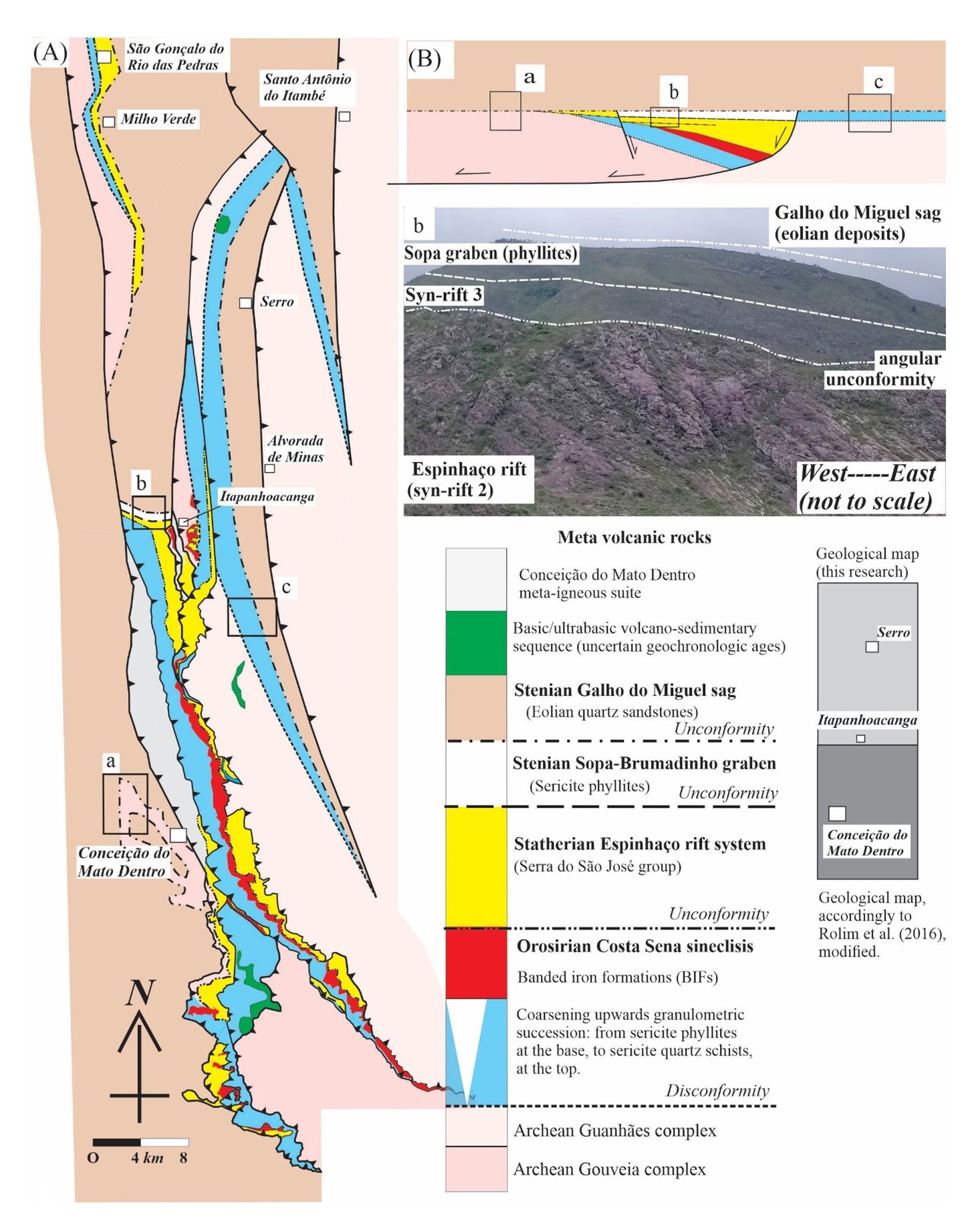
(A) Simplified geological map of the eastern border of the southern Espinhaço range. (B) Stratigraphic framework of the pre-collisional basins.
3.1 The Orosirian Costa Sena sineclisis
Reconstructing the stratigraphy of the Orosirian sineclisis is particularly challenging because the record was severely eroded during the Statherian. Furthermore, the deposits are mainly restricted to isolated and residual outcrops. They are partially preserved along the central area and eastern border of the southern Espinhaço range. Further east, overlying the Guanhães complex, exposures of the remnants of sedimentary successions containing sericite quartz schists and BIFs were deposited in the sineclisis.
Along the eastern border, the deposits of the Costa Sena sineclisis cover the igneous basement. Across this area, the sineclisis was filled with a complete transgressive regressive (T/R) succession, which can exceed 1.000 m in thickness. The basal section consists of lenses of quartz-arenites, with sericite-quartz-schists and chlorite-sericite-quartz-schists interbedded. Overling the basal unit, a succession of massive phyllites with scattered sandstone lenses can exceeds 500 m in thickness. It vertically transitions into sericite-quartz-shists and BIFs. These rocks are characterized by millimeter- to centimeter-thick quartz-rich layers, interstratified with hematite-rich layers. The BIFs layer can reach thicknesses greater than 700 m (Rosière et al., 2019). The uppermost portions of the T/R cycle are marked with intra-formational breccias developed in dolomites. This fact may be indicative of esporadic subaereal exposition of a shallow-marine platform (Figures 66B).

Orosirian Costa Sena sineclisis evolution. (A) Block diagram illustrating the initial tectonic phase, forming a symmetric sineclisis. (B) Final tectonic phase, characterized by an asymmetric sineclisis. This schematic cross-section was originally published by Pagung et al. (2023, modified). (C) Photo of the basal unconformity of the pre-collisional basins, Leucogranites of the igneous basement are covered by lutites of the base of the sineclisis.
In the central range, the preserved sections of the sineclisis record a complete T/R succession, characterized by an inverse-granulometric trend. Overlying the Gouveia complex, a succession of sericite-phyllites, marked by the absence of quartz grains, shows slaty cleavage (Figure 6C). This basal layer reaches a maximum thickness of 50 meters and grades vertically into sericite-muscovite-quartz-schists, with subordinate amounts of kyanite, lazulite and magnetite, that can be up to 600 m thick. In some sections, east of Gouveia, the sericite-quartz-chists transition into fine quartz-arenites with wave ripples and horizontal stratification.
Toward the east of the Espinhaço range, overlying the Guanhães complex, the stratigraphic record begins with a basal succession composed of sericite-quartz-schists, which vertically passes to BIFs. It is genetically related to the sericite phyllites and BIFs mapped in the eastern border of the Espinhaço range. These rocks are covered by sericite-quartz-schists, presenting a high amount of quartz grains, interpreted as have been deposited by proximal turbiditic currents (Pagung et al., 2023).
The sineclisis evolved through two distinct tectonic phases (Figures 66B). During the initial phase, it likely represents an N-S symmetric sineclisis, formed by slow downwarping of the Archean basement complex. This warping allowed the sea to advance over continental areas, resulting in a T/R cycle. The presence of an expressive sedimentary package of Orosirian BIFs indicates that the N-S tectonic axis of the sineclisis was located along the eastern border of the range, at least during the initial tectonic phase of its evolution. The final tectonic phase is marked by the eastward shift of the depocenter’s position that caused selective subsidence of the area located above the Archean Guanhães complex. As a result, the sineclisis acquired an asymmetrical topographic profile. Deposition occurred from proximal turbiditic currents along the eastern slope and a shallow marine platform was built on the western lateral slope. Flexural subsidence involved crustal stretching without the development of normal faults. Pagung et al. (2023) point to a late Transamazonian orogenic setting, in which the sineclisis represents a back-arc basin, within a context of extensional tectonics. Despite this interpretation, no detrital particles of volcanic rocks were found in the deposits of the sineclisis, suggesting an intracratonic environment.
3.2 The Statherian Espinhaço rift system
The Espinhaço rift system comprises four asymmetric rifts, bounded by N-S normal faults with steep dips to the west. The rifts are filled with three distinct sequences (Figures 77B). The basal Olaria sequence (syn-rift 1) is followed by the Natureza sequence (syn-rift 2), with a significant angular unconformity separating these two basal sequences from the overlying São João da Chapada sequence (syn-rift 3) (Silva 1995, 1998, 2013). Detailed geological mapping suggests that the Serra de São José group, in the eastern border, corresponds to the Espinhaço rift system (Rolim et al., 2016).

(A) Schematic cross-section of the pre-collisional basins, before the Ediacaram orogeny. (B) Detailed paleogeographic reconstruction of the pre-collisional basins of the Araçuaí orogeny, located above. Field photographs of the unconformities of the rift phase. (C) The sub-Olaria unconformity outlines an entrenched canyon, filled with conglomerates, mainly deposited by subaerial grain flows. (D) Large clasts, preferentially in vertical positions, are indicative of free-fall of debris inside the canyon. (E) The sub-Natureza unconformity is an irregular surface, shaped by hydraulic erosion. (F) The significant sub-São João da Chapada angular unconformity.
The evolution of the Espinhaço rift system began with the deposition of the Olaria sequence, which is less than 100 m thick. The basal contact is an unconformity marked by entrenched alluvial canyons, filled with conglomerates derived from debris flows. The occurrence of angular, large clasts in vertical positions are indicative of the free fall of debris inside the canyons (Figures 77D). Coalescing alluvial lobes are notably present, formed by successive debris-flow deposition (Silva, 1995). This type of debris-flow is classified as “cohesive debris-flow” by Nemec and Steel (1984). Mantles of pediments also occur, which are indicative of erosive braided fluvial channels, flowing over an east-dipping ramp. A succession of arkosic sandstones onlaps the basal conglomerates, advancing progressively toward the west. The sandstones are fine- to medium-grained and exhibit well-developed horizontal stratification, with sericite films covering the sandstone lamina sets.
The Natureza sequence is separated from the lower sequence by an unconformity. This sequence can reach thicknesses of up to 150 m. Conglomerates, interpreted as deposits of alluvial fans and braided fluvial system, overlie the basal unconformity (Figure 7E). They are followed by medium-grained arkosic sandstones, with tabular cross-bedding, interpreted as fluvial deposits. Above, mature, very fine sandstones are characterized by large cross-stratifications, which may be the record of barchan eolian dunes. At the top of the sequence, fine arkosic sandstones with cross-lamination and wave ripples are interpreted as the record of a late marine transgression (Silva, 1995).
A significant angular unconformity separates the São João da Chapada sequence from the older sequences (Figure 7F). This unconformity is developed through a system of N-S synthetic normal faults, steeply dipping to the west. During tectonism, eastward block tilting of older rocks, erosion and the deposition of conglomerates synchronously occurred. Conglomerates were deposited from successive planar debris-flow along eastward dipping planes. The geometry of the conglomeratic bodies resembles sedimentary wedges, which can exceed 70 m in thickness, with a progressive decrease toward the west.
A succession of quartz-arenites onlaps the conglomerates. The sandstones are fine- to medium-grained and well-sorted, with predominant horizontal and low-angle cross-stratification. This succession can reach up to 100 m in thickness, with a gradual decrease to the west due to the basal onlap contact. Basic igneous rocks overlays the transgressive succession. These rocks will be later transformed into hematite-phyllites. An alluvial succession of sandstones and minor conglomeratic lenses cover the older sedimentary and volcanic rocks. It can be up to 250 m thick. This succession is characterized by normal granulometric cycles, typically of deposition in ephemeral, high-energy, braided channels, draining eastward (Martins-Neto, 1998).
Each asymmetric rift of the system consists of an alluvial platform, an eastward-slopping ramp and an asymmetric depocenter, limited by N-S west dipping normal fault. Tectonic activity of normal faults caused uplift of the platforms, an increase in the angle of the tectonic ramps and asymmetric subsidence. Extensional tectonism is marked by the development of unconformities and coeval deposition of alluvial conglomerates. During periods of tectonic quiescence, marine incursions along the troughs of the individual rifts occur. The stratigraphic architecture of the rift system suggests that the normal faults of the rifts are linked at depth with a significant extensional fault/shear zone. This N-S detachment is exposed at the eastern border of the southern Espinhaço range and separates the Gouveia complex from the Guanhães complex, located east of the detachment (Figure 7A).
3.3 Stenian Sopa-Brumadinho graben system
The system comprises four full-grabens, bounded by N-S normal faults. These grabens occupy the same depositional locus as those of the ancient Espinhaço rifts, likely due to renewed tectonic activity along pre-existing extensional faults (Santos et al., 2013). An unconformity separates the graben deposits from the overlying Galho do Miguel sag deposits and represents a significant geological hiatus of over 400 Ma. Along the eastern border, the deposits of the graben can achieve a thickness of up to 100 m and is predominantly filled with sericite-phyllites, originally massive pelites. Across the central cordillera, the remaining three grabens were filled with three coarsening-upward granulometric cycles, representing successive T/R cycles. The total thickness of the graben-fill does not exceed 220 m (Martins-Neto, 1998, 2000).
The first and second cycles range in thickness from 30 to 60 m and comprise siliciclastic successions characterized by basal pelites that gradually transition upward into coastal sandstones, and, at the top, conglomerates, interpreted as deposits of subaerial gravitational flows. These inverse-graded cycles begin with the deposition of pelites on the floor of the submerged grabens. As erosion and transport intensified in the source area, deposition was marked by the progradation of delta fans, constituted of stream-flow sandstones interbedded with subaerial debris flow conglomerates. The occurrence of delta fans in the stratigraphic record suggests that erosion in the source area was governed by entrenched alluvial canyons that fed the delta fans. Fining upward successions observed above delta fans reflect the abandonment of the alluvial channel and the cessation of tectonic activity (Martins-Neto, 1998, 2000).
The third inverse-graded cycle was investigated in detail (Figures 88B). The basal unit is approximately 20 m thick, with the total thickness of the T/R cycle not exceeding 40 m. The transgressive unit consists of normal-graded cycles, presenting coastal sandstones covered by mudstones, which were deposited in underwater calm environments. This unit is overlain by metric intercalations of sandstones and conglomeratic beds, forming the upper deltaic system. These beds were deposited by waning current flows on deltaic fronts (Figure 8C) and pro-deltaic environments. The clasts of the conglomerates were preferentially oriented along westward dipping planes, which form angles of up to 30º with the sedimentary bedding (Figures 88E). This pattern indicates deposition of pebbles by slipping on the deltaic fronts. The two-dimensional, tabular deltas indicate that erosion and transport in the source area were driven by a braided fluvial system, developed along an alluvial plain, without entrenchment of canyons. The external tabular shape of deltaic deposits and their paleocurrent patterns suggested deposition on submerged ramps with gentle eastward dips.

Sopa-Brumadinho graben. (A) Block diagram of the third T/R cycle of the Stenian Sopa-Brumadinho graben. (B) Lutites overlays wavy-rippled sandstones, indicative of a relative sea level rise. (C) Inclined sandstones outlines the delta front. (D) The prograding deltaic system comprehends sandstones interbedded with conglomerates. (E) The clasts are predominantly oriented along eastward sloping planes, representing deposition of clasts by slipping on delta fronts.
Sedimentation across the grabens was governed by tectonic activity of normal faults. Along the western margins of the grabens, the deposition of delta fans over fine-grained sediments was enhanced due to normal faulting. On the eastern margin of the grabens, textural-immature, matrix- and clast-supported conglomerates, interpreted as talus breccias, were deposited adjacent to normal faults (Martins-Neto, 1998). Recurrent tectonic activity resulted in repeated subsidence of the main graben floor, creating accommodation space for the deposition of successive inverse-graded cycles. Initially, transgressive, fine-grained sediments infilled the grabens, followed by erosion and transport of clastic particles from the source areas, which fed the system of deltas. The erosion of relative uplifted basement has evolved from the entrenchment of alluvial canyons to hydraulic erosion on braided fluvial plains. This shift reflects the progressive topographic denudation of the basement during the evolution of the graben system. The vertical transition of delta fans to braided deltas recorded in the Sopa-Brumadinho grabens was also described by Chemale Junior et al. (2011).
3.4 Stenian Galho do Miguel sag
The architecture of the sag consists of a submerged depocenter, located in the central cordillera, limited to the east and west by gentle dipping subaerial lateral slopes. The sag was likely asymmetric, as the depocenter was limited by lateral slopes, verging at different angles (Figure 9A). This interpretation is corroborated by the fact that above the central and western portions of the Guanhães complex no eolian deposits of the sag were observed. The submerged depocenter is marked by a shallow-marine transgressive succession, while the entire sag is overlain by eolian quartz-sandstones.

Stenian Galho do Miguel sag. (A) Topographic section and stratigraphic framework of the Galho do Miguel sag. (B) Basal unconformity of the sag, showing the deposits of a T/R cycle. (C) Stenian Conselheiro Mata graben. Reconstruction of a T/R cycle (D and E) Syn-sedimentary normal faults. (F) Tilted layers of sandstones covered by massive, sub-horizontal beds of fine sandstones and siltites. (G) Horizontal sandstones grading upward into inclined well stratified coarse sandstones, outlining the progadation of a sandstone lobe.
The basal unconformity of the sag is overlain by a succession that records a marine transgression, as indicated by the onlap basal contact of the sandstones (Silva, 1995). The transgressive succession reaches a few tens of meters in thickness and is exposed only in the central cordillera. It consists of normal-graded cycles. Hummocky cross-stratified and wavy-rippled sandstones represent deposition on shallow platforms, while mudstones are deposited in underwater calm environments (Figure 9B).
Eolian quartz-arenites typify the Galho do Miguel sag in the southern Espinhaço range. The deposits of the eolian sandstones are remarkable thick, extending across a vast region; from the eastern edge of the mountain range, passing through the central area and western border, and continuing westward toward the São Francisco proto-Craton. Eolian deposits comprise mature, fine quartz-sandstones that can exceed 2,000 m in thickness. They reflect a significant expansion of the basin, from its depocenter, where greater thicknesses are observed, toward the eastern- and western-lateral slopes. The quartz sandstones predominantly present cross-stratifications of metric to decametric sizes, representing barchan-type eolian dunes. They also contain intercalations of horizontal-stratified fine-grained sandstones, a few meters thick, which are interpreted as the record of laminar eolian flows at the base of the dunes.
The interpreted stratigraphic framework of the Galho do Miguel sag is illustrated in Figure 9A. Flexural tectonism was absorbed by subsidence and coeval uplift of the basement, without the development of normal faults. In the depocenter, sedimentation occurred below sea level, indicating that subsidence allowed a marine transgression to occur above the continent. The uplift of the lateral slopes created subaerial accommodation space, which was responsible for preserving the eolian sandstones. It acted as a shield to protect eolian deposits against erosion, furthermore wind flow became more turbulent over the sag, leading to a reduction in flow velocity, enhancing eolian deposition.
3.5 Stenian Conselheiro Mata graben
The deposits of the graben cover the eolian sandstones of the Galho do Miguel sag over a large area on the western border of the range. The stratigraphic record represents three stacked T/R cycles. The total thicknesses of the graben deposits can reach 900 m (Dupont, 1995; Santos et al., 2015).
The first T/R cycle is approximately 140 m thick. The basal unit is transgressive, which can be up to 90 m thick. It consists of pelites that grade into fine sandstones, characterized by abundant symmetrical and asymmetrical wave ripples. The regressive unit of the first cycle is 50 m thick, and consists of laminated fine sandstones with wave ripples forming tabular sets and cross-stratified sandstones, indicating deposition on a platformal environment (Dupont, 1995, 1996).
The second T/R cycle has a thickness of 350 m, with the transgressive unit reaching 100 m. It is composed of very fine detritic rocks, including gray siltstones with lutites and sandstones lenses finely interbedded. The regressive unit is 250 m thick and is predominantly made up of cross-stratified sandstones, which represent delta plains developed above the trangressive unit. Paleogeographic reconstruction of a minor inverse-graded cycle is shown in Figure 9C. The early stages of the cycle are marked by the development of growth faults and deposition of syn-tectonic sandstones (Figures 99E). A coarsening-upward granulometric succession overlies the syn-tectonic sandstones, filling the accommodation space generated by normal tectonism. Massive siltites and fine sandstones grade upwards to medium and coarse, horizontal stratified sandstones passing to low-angle, stratified, coarse sandstones, marking the progradation of a deltaic sandstone lobe (Figures 9F and G). Active tectonism was followed by a relative rise of the sea level that caused the deposition of the transgressive unit. The regressive unit is represented by the deltaic sandstones lobes.
The third T/R cycle is approximately 750 m thick. The transgressive unit is characterized by gray pelites and siltstones with isolated lenses of conglomerates and sandstones, which are interpreted as being deposited from turbiditic currents. The regressive unit comprehends a package of stromatolitic dolomites, interpreted as the record of a regressive carbonate platform (Santos et al., 2015; Araújo et al., 2020). The dolomites were later karstified along pre-existing fractures, suggesting subaerial exposition of the platforms, marking the basal unconformity of the Macaúbas continental margin. The cavities of the paleocarst and dikes were filled with sand and pebbles from the overlying Macaúbas diamictites (Silva, 1998).
The Conselheiro Mata graben is composed by N-S normal faults and an intervenient platform. Each inverse-graded cycle records a phase of tectonism followed by relative sea level rise. Initially, the submerged platforms were filled with very fine-grained sediments (transgressive units), gradually covered by shallow-marine clastic sandstones, deltac deposits or chemical sedimentary rocks (dolomites). It remains unclear whether the filling of the graben during regressive phases occurred through N-S axial- or E-W lateral-drainage, or both.
3.6 Tonian/Cryogenian Macaúbas rift-continental margin
The Macaúbas rift 1 is characterized by a system of N-S rifts. The rift deposits are separated from the eolian sediments of the Galho do Miguel sag by an unconformity, locally limited by normal faults. The stratigraphic record of the rifts consists of a R/T cycle. The regressive unit, 30 m-thick, is represented by alluvial fans, consisting of debris-flow and stream-flow deposits interbedded. During tectonic activity, the alluvial fans acquired a progradational pattern, as evidenced by debris-flow conglomerates overlying coarse-grained, poor-stratified sandstones. The transgressive unit, 200 m in thickness, is constituted of fine quartz-arenites and lenses of conglomerates, presenting a normal-graded granulometric trend. The sandstones are fine-grained, presenting hering-bones and hummocky cross-stratifications. The sedimentary structures and rocks suggest deposition on a shallow-marine/platformal environment (Martins et al., 2008).
The stratigraphy of the Macaúbas continental margin was described by Pedrosa-Soares et al. (2020), who identified five lithofacies associations, representing, from west to east: proximal glaciogenic platform; glaciogenic marine slope; marine slope; distal marine and distal marine with exhalative deposits. In the southern Espinhaço range, the continental margin is characterized by a significant basal unconformity, a planar surface, overlaid by massive diamictites of glacio-continental origin. Along the eastern border of the cordillera, a significant topographic relief formed as more than 1,000 m of eolian sandstones of the Galho do Miguel sag were extensively eroded and transported. The topographic relief was covered by siliciclastic successions consisting of glacio-marine, gravitational deposits, such as debris flow and diamictites, interbedded with sandstones originated from turbidites currents (Uhlein et al., 1999, 2007). The topographic relief represents the slope of the passive continental margin and record the onset of a vast marine basin, eastward from the southern Espinhaço range, over the Guanhães complex.
The most significant tectonic stage of the Macaúbas continental margin is marked by the abrupt shift of the depocenter position, caused by the tectonic subsidence of a vast area located to the east of the Espinhaço range. This stage coincides with the continental glaciation over the São Francisco proto-Craton, resulting in a significant relative sea-level fall and exposure of the range to subaerial erosion. This erosive process may have been controlled by the eastward movement of continental glaciers toward the depocenter. An eastward, gentle-dipping glacio-continental platform was developed above a planar unconformity, connecting the source area of the continental glaciers, located above the São Francisco proto-Craton, with the depocenter of the basin, located above the Guanhães complex.
4. TECTONIC EVOLUTION OF THE PRE-COLLISIONAL BASINS
Six basins or basin systems were identified, resulting from two distinct long-lived taphrogenic process. A significant geological hiatus of over 0.4 Ga separates these processes (Table 2).
The stratigraphic framework of the Orosirian/Statherian pre-collisional basins suggests that they are successor basins resulting from the same taphrogenic process. Initially, a symmetric N-S sineclisis was nucleated. A subsequent shift of the basin depocenter toward the east led to the formation of an asymmetric sineclisis. The sineclisis evolved accompanied by generalized anatexis at the base of the continental lithosphere, until increasing temperature and pressure caused mechanical rupture. This event was followed by the formation of the Statherian Espinhaço rift system. Significant crustal extension resulted in the formation of a detachment zone, which delineates two distinct tectonic blocks: the western block, consisting of the Gouveia complex and the extended Guanhães complex, located to the east of the detachment. The structural asymmetry of the sineclisis and rifts suggests that the heat flow displacement progressed eastward. The E-W extensional stress-field endured throughout the whole process.
Four compelling pieces of evidences support the existence of an Orosirian/Statherian asthenospheric heat flow, originated beneath the São Francisco proto-Craton and directed eastward, below the Gouveia complex. The first evidence is the location of the southern Espinhaço range, adjacent to the southern cratonic area, exactly where lithospheric thicknesses are reported to be significantly greater, ranging from 300 to 400 km, compared to the peripheral belts, where thicknesses range from 200 to 300 km (Assumpção et al., 2017). Specific characteristics of cratonic areas are large lithospheric thicknesses; significant low values of thermal flow as well as a tectonic framework characterized by thick lithospheric mantles, acting as keels inside the asthenosphere (Alkmim, 2004). This unique cratonic signature probably was responsible for the development of thermal anomalies below the São Francisco proto-Craton, representing the origin of the Orosirian/Statherian heat flow.
The second line of evidence is the presence of intrusive acid igneous bodies, specifically porphyritic granites and leucogranites found around Gouveia, with a crystallization age of 1.811 Ga. These granites are interpreted to be the product of anatexis of the continental crust, driven by thermal input from a mantle plume, within an extensional tectonic setting (Chaves & Coelho, 2013, 2018). The third line of evidence is the occurrence of BIFs in both sineclisis and rift system. Asthenospheric heat flows, at the base of the lithosphere, created the conditions for basic magmatism associated with abundant hydrothermal Fe supply (Rosière et al., 2019). The upward migration of basic magma through the basement was facilitated by incremental deformation and crustal thinning. The fourth line of evidence refers to the complexity of Statherian alkaline bimodal igneous rocks, including volcanic and plutonic rocks, which occurs in association with the Statherian detachment zone. The presence of an asthenospheric heat flow, beneath the Gouveia complex, justifies intense alkaline bimodal magmatic activity associated with extensional tectonics.
During the early Stenian, the evolution of the pre-collisional basins recommenced as elevated temperatures beneath the Gouveia complex overcame inertial resistance, generating an eastward directed thermal heat flow, beneath the extended Guanhães complex. Within a context of extensional tectonism, this heat flow, active from the Stenian to the Cryogenian/Ediacaran boundary, gave rise to the remaining successor pre-collisional basins, and resulted in the complete breakdown of the Archean lithosphere. The final stage of the tectonic evolution was marked by the development of the Macaúbas continental margin, which is related to the rise of a large mantle plume, registered by the Tonian Bahia-Gangila LIP. The proposed stratigraphic and tectonic models for the evolution of the pre-collisional basins of the Araçuaí orogen are presented in Figures 1010B.

(A) Stratigraphic evolution of the Proterozoic pre-collisional basins of the Araçuaí orogen, exposed in the southern Espinhaço range. (B) Tectonic evolution of the pre-collisional basins.
The breakup of the Archean basement occurred as a consequence of two distinct taphrogenic processes. The oldest was driven by an asthenospheric heat flow originated beneath the São Francisco proto-Craton, migrating eastward beneath the Gouveia complex. This process is recorded by the Orosirian sineclisis and Statherian rift system. After more than 0.4 Ga, a younger taphrogenic process began, as another heat flow originating below the Gouveia complex moved eastward, below the extended Guanhães complex. This second taphrogenic phase led to the formation of the remaining pre-collisional basins, which are successor basins related to the same taphrogenic process. Initiating in the early Stenian, this taphrogenic process persisted until the early Ediacaran, culminating in the formation of juvenile oceanic crust.
5. FINAL REMARKS
The pre-collisional basins record a significant part of the history associated with the evolution of the Araçuaí orogen, preserving the geological legacy of the events that predate the Ediacaran orogeny. Together, the pre-collisional basins represent the rift phase of the Wilson cycle. As a direct consequence of the taphrogenic history, three distinct Archean lithospheric blocks were developed, from west to east: Gouveia complex, Guanhães complex and the proto-crystalline core of the orogen. The thicknesses of the lithospheric blocks progressively decrease from west to east, from block to block. The two Proterozoic taphrogenic processes have acted together, driving progressive lithospheric delamination, leading to the development of a hyper extended block, which is the proto-crystalline core of the Araçuaí orogen, detached from the extended Guanhães complex. Thus, the pre-collisional basins were formed during a time interval that was far from a “boring billion years” but rather a “discovery billion years” of taphrogenic processes that laid the foundations of the Araçuaí orogen.
ACKNOWLEDGEMENTS
I want to thank geologist Raiza Toledo Rodrigues (University of Queensland/Australia) for her fruitful discussions and help translating the text into English. I thank Professor Carlos Alberto Rosière (Instituto de Geociências/UFMG) for discussions on the origin of the Costa Sena sineclisis and for the critical review of an early draft of the report. I would also like to note the help of Professor Jarbas Lima Dias Sampaio (Instituto de Geociências/UFMG), who kindly provided me with the topographic map of the southern Espinhaço range. The author is very grateful to the anonymous reviewer, Associate Editor and Editor-in-Chief of the BJG.
-
Manuscript ID: BJGEO-2025-0035.R2.
-
How to cite:
Silva, R. R. Proterozoic taphrogenic history recorded in the pre-collisional sedimentary basins of the Araçuaí Orogen, Southern Espinhaço Range, Southeastern Brazil. Braz. J. Geol. (2026), 56:e20250035. https://doi.org/10.1590/2317-4889e20250035
-
Financial support:
The author declares no financial support.
-
Data availability statement:
The data used in the article is presented in the manuscript.
REFERENCES
- Alkmim, F. F. (2004). O que faz de um cráton um cráton? O cráton do São Francisco e as revelações almedianas ao delimitá-lo. In: V. Mantesso-Neto, C. D. R. Bartorelli & B. B. Brito-Neves (Eds), Geologia do Continente Sul-Americano: Evolução da Obra de Fernando Flávio Marques de Almeida (pp. 17-34). Beca.
-
Alkmim, F. F., Kuchenbecker, M., Reis, H. L. S., & Pedrosa-Soares, A. C. (2017). The Araçuaí belt. In M. L. Heilbron, U. G. Cordani, & F. F. Alkmim (Eds.), São Francisco Craton, Eastern Brazil: Tectonic Genealogy of a Miniature Continent (Series: Regional Geology Reviews, pp. 255-276). Springer. https://doi.org/10.1007/978-3-319-01715-0_14
» https://doi.org/10.1007/978-3-319-01715-0_14 -
Alkmim, F. F., Marshak, S., Pedrosa-Soares, A. C., Peres, G. G., Cruz, S. C. P., & Whittington, A. (2006). Kinematic evolution of the Araçuaí–West Congo orogen in Brazil and Africa: Nutcracker tectonics during the Neoproterozoic assembly of Gondwana. Precambrian Research, 149(1-2), 43-64. https://doi.org/10.1016/j.precamres.2006.06.007
» https://doi.org/10.1016/j.precamres.2006.06.007 -
Alkmim, F. F., Pedrosa-Soares, A. C., Noce, C. M., & Cruz, S. C. P. (2007). Sobre a evolução do tectônica do orógeno Araçuaí-Congo occidental. Geonomos, 15(1), 25-43. https://doi.org/10.18285/geonomos.v15i1.105
» https://doi.org/10.18285/geonomos.v15i1.105 -
Almeida, F. F. M. (1977). O Cráton do São Francisco. Revista Brasileira de Geociências, 7(4), 349-364. https://doi.org/10.25249/0375-7536.1977349364
» https://doi.org/10.25249/0375-7536.1977349364 -
Almeida-Abreu, P. A. (1995). O Supergrupo Espinhaço da Serra do Espinhaço (Minas Gerais): O rift, a bacia e o orógeno. Geonomos, 3(1), 1-18. https://doi.org/10.18285/geonomos.v3i1.211
» https://doi.org/10.18285/geonomos.v3i1.211 -
Araújo, A. L. B., Barbosa, D. M. D., Rosa, P. A. S., & Roncato, J. (2020). Caracterização geológica- estrutural da conexão Araçuaí–São Francisco na área-tipo da Formação Rio Pardo Grande (Supergrupo Espinhaço, Minas Gerais). Geonomos, 28(1), 25-46. http://doi.org/10.18285/geonomos.v28i1.29652
» http://doi.org/10.18285/geonomos.v28i1.29652 -
Assumpção, M., Azevedo, P. A., Rocha, M. P., & Bianchi, M. B. (2017). Lithospheric features of the São Francisco Craton. In M. L. Heilbron, U. G. Cordani, & F. F. Alkmim (Eds.), São Francisco Craton, Eastern Brazil: Tectonic Genealogy of a Miniature Continent (Series: Regional Geology Reviews, pp. 15-25). Springer. https://doi.org/10.1007/978-3-319-01715-0_2
» https://doi.org/10.1007/978-3-319-01715-0_2 -
Brito-Neves, B. B., Cordani, U. G., Kawashita, K., & Delhal, J. (1979). A evolução geocronológica da Cordilheira do Espinhaço: Dados novos e integração. Revista Brasileira de Geociências, 9(1), 71-85. https://doi.org/10.25249/0375-7536.19797185
» https://doi.org/10.25249/0375-7536.19797185 -
Cawood, P. A., & Hawkesworth, C. (2014). Earth’s middle age. Geology, 42(6), 503-506. https://doi.org/10.1130/G35402.1
» https://doi.org/10.1130/G35402.1 -
Caxito, F. A., & Alkmim, F. F. (2023). The role of V-shaped and ribbon continents in the Brasiliano/Pan-African assembly of Western Gondwana. Scientific Reports, 13(1), 1568. https://doi.org/10.1038/s41598-023-28717-7 PMid:36709389.
» https://doi.org/10.1038/s41598-023-28717-7 -
Caxito, F. A., Hartmann, L. A., Heilbron, M. L., Pedrosa-Soares, A. C., Bruno, H., Basei, M. A. S., & Chemale Junior, F. (2022). Multi-proxy evidence for subduction of the Neoproterozoic Adamastor Ocean and Wilson cycle tectonics in the South Atlantic Brasiliano Orogenic System of Western Gondwana. Precambrian Research, 376, 106678. https://doi.org/10.1016/j.precamres.2022.106678
» https://doi.org/10.1016/j.precamres.2022.106678 -
Chaves, A. O., & Coelho, R. M. (2013). Petrografia, geoquímica e geocronologia do leucogranito peraluminoso do complexo de Gouveia-MG. Geonomos, 21(2), 1-12. https://doi.org/10.18285/geonomos.v21i2.267
» https://doi.org/10.18285/geonomos.v21i2.267 -
Chaves, A. O., & Coelho, R. M. (2018). Reinterpretação da ambiência tectônica de formação do leucogranito de Gouveia. Geonomos, 26(1), 51-55. https://doi.org/10.18285/geonomos.v26i1.1239
» https://doi.org/10.18285/geonomos.v26i1.1239 -
Chaves, A. O., Ernst, R. E., Söderlund, U., Wang, X., & Naeraa, T. (2019). The 920–900 Ma Bahia-Gangila LIP of the São Francisco and Congo Cratons and link with Dashigou-Chulan LIP of North China Craton: New insights from U-Pb geochronology and geochemistry. Precambrian Research, 329, 124-137. https://doi.org/10.1016/j.precamres.2018.08.023
» https://doi.org/10.1016/j.precamres.2018.08.023 -
Chemale Junior, F., Dussin, I. A., Alkmim, F. F., Martins, M. S., Queiroga, G., Armstrong, R., & Santos, M. N. (2012). Unraveling a Proterozoic basin history through detrital zircon geochronology: The case of the Espinhaço Supergroup, Minas Gerais, Brazil. Gondwana Research, 22(1), 200-206. https://doi.org/10.1016/j.gr.2011.08.016
» https://doi.org/10.1016/j.gr.2011.08.016 -
Chemale Junior, F., Dussin, I. A., Martins, M., & Santos, M. N. (2011). Nova abordagem tectono- estratigráfica do Supergrupo Espinhaço em sua porção meridional. Geonomos, 19(2), 173-179. https://doi.org/10.18285/geonomos.v19i2.52
» https://doi.org/10.18285/geonomos.v19i2.52 - Dupont, H. (1995). O grupo Conselheiro Mata no seu quadro paleográfico e estratigráfico. In Anais do 8º Simpósio de Geologia de Minas Gerais (Vol. 13, pp. 9-10). Sociedade Brasileira de Geologia/Núcleo Minas Gerais.
- Dupont, H. (1996). O Supergrupo São Francisco entre a Serra do Cabral e as Serras do Espinhaço e de Minas: estudo estratigráfico e estrutural e relações de contato com o Supergrupo Espinhaço. In: Anais do 39º Congresso Brasileiro de Geologia (Vol. 5, pp. 489-493). Salvador.
-
Dussin, I. A., & Dussin, T. M. (1995). Supergrupo Espinhaço: Modelo de evolução geodinâmica. Geonomos, 3(1), 19-26. https://doi.org/10.18285/geonomos.v3i1.212
» https://doi.org/10.18285/geonomos.v3i1.212 - Dussin, I. A., Dussin, T. M., & Chaves, L. L. S. C. (1990). Compartimentação estratigráfica do Espinhaço Supergroup em Minas Gerais – Os Grupos Diamantina e Conselheiro Mata. Revista Brasileira de Geociências, 20(1-4), 178-186.
- Fogaça, A. C. C., Almeida Abreu, P. A., & Schorscher, H. D. (1984). Estratigrafia da sequência supracrustal arqueana na porção mediana-central da Serra do Espinhaço, MG. In Anais do 33º Congresso Brasileiro de Geologia (Vol. 2, pp. 2652-2667). Sociedade Brasileira de Geologia.
-
Fossen, H., Cavalcante, C., Konopásek, J., Meira, V. T., Almeida, R. P., Hollanda, M. H. B., & Trompette, R. (2020). A critical discussion of the subduction-collision model for the Neoproterozoic Araçuaí–West Congo orogeny. Precambrian Research, 343, 105715. https://doi.org/10.1016/j.precamres.2020.105715
» https://doi.org/10.1016/j.precamres.2020.105715 -
Knauer, L. G., & Schrank, A. (1994). A origem dos filitos hematíticos da Serra do Espinhaço Meridional, Minas Gerais. Geonomos, 1(1), 33-38. https://doi.org/10.18285/geonomos.v1i1e2.235
» https://doi.org/10.18285/geonomos.v1i1e2.235 -
Kuchenbecker, M., Pedrosa-Soares, A. C., Babinski, M., & Fanning, M. (2015). Detrital zircon age patterns and provenance assessment for pre-glacial to post-glacial successions of the Neoproterozoic Macaúbas Group, Araçuaí Orogen, Brazil. Precambrian Research, 266, 12-26. https://doi.org/10.1016/j.precamres.2015.04.016
» https://doi.org/10.1016/j.precamres.2015.04.016 - Machado, N., Schrank, A., Abreu, F. R., Knauer, L. G., & Almeida-Abreu, P. A. (1989). Resultados preliminares da geocronologia U-Pb na Serra do Espinhaço Meridional. In Anais do 5º Simpósio de Geologia (Vol. 10, pp. 171-174). Sociedade Brasileira de Geologia/Núcleo Minas Gerais.
-
Martins, M. S., Karfunkel, J., Noce, C. M., Babinski, M., Pedrosa-Soares, A. C., Sial, N. A., & Liu, D. (2008). A sequência pré-glacial do Grupo Macaúbas na área tipo e o registro da abertura do rifte Araçuaí. Revista Brasileira de Geociências, 38(4), 761-772. https://doi.org/10.25249/0375-7536.2008384761772
» https://doi.org/10.25249/0375-7536.2008384761772 -
Martins-Neto, M. A. (1998). O Supergrupo Espinhaço em Minas Gerais: Registro de uma bacia rift- sag do Paleo/Mesoproterozoico. Revista Brasileira de Geociências, 28(2), 151-168. https://doi.org/10.25249/0375-7536.1998151168
» https://doi.org/10.25249/0375-7536.1998151168 -
Martins-Neto, M. A. (2000). Tectonics and sedimentation in a Paleoproterozoic rift-sag basin (Espinhaço basin, southeastern Brazil). Precambrian Research, 103(3-4), 147-173. https://doi.org/10.1016/S0301-9268(00)00080-2
» https://doi.org/10.1016/S0301-9268(00)00080-2 -
Martins-Neto, M. A., Pedrosa-Soares, A. C., & Lima, S. A. A. (2001). Tectono-sedimentary evolution of sedimentary basins from Late Paleoproterozoic to Late Neoproterozoic in the São Francisco Craton and Araçuaí fold belt, eastern Brazil. Sedimentary Geology, 141-142, 343-370. https://doi.org/10.1016/S0037-0738(01)00082-3
» https://doi.org/10.1016/S0037-0738(01)00082-3 - Nemec, W., & Steel, R. J. (1984) Alluvial and coastal conglomerates: Their significant features and some comments on gravelly mass-flow deposits. In E. H. Koster & R. J. Steel (Eds.), Sedimentology of Gravels and Conglomerates (Vol. 10, pp. 1-31). Canadian Society of Petroleum.
-
Noce, C. M., Pedrosa-Soares, A. C., Silva, L. C., & Alkmim, F. F. (2007). O embasamento Arqueano e Paleoproterozóico do orógeno Araçuaí. Geonomos, 15(1), 17-23. https://doi.org/10.18285/geonomos.v15i1.104
» https://doi.org/10.18285/geonomos.v15i1.104 -
Pagung, R., Rosière, C. A., & Silva, R. C. F. (2023). The Serra da Serpentina group: A back-arc basin related to the Paleoproterozoic Minas-Bahia orogeny? Journal of South American Earth Sciences, 128, 104427. https://doi.org/10.1016/j.jsames.2023.104427
» https://doi.org/10.1016/j.jsames.2023.104427 -
Pedrosa-Soares, A. C., & Alkmim, F. F. (2011). How many rifting events preceded the development of the Araçuaí–West Congo craton? Geonomos, 19(2), 244-251. https://doi.org/10.18285/geonomos.v19i2.56
» https://doi.org/10.18285/geonomos.v19i2.56 -
Pedrosa-Soares, A. C., Alkmim, F. F., Tack, L., Noce, C. M., Babinsk, M., Silva, L. C., & Martins-Neto, M. A. (2008). Similarities and diferences between the Brazilian and African counter parts of the Neoproterozoic Araçuaí-West Congo Orogen. Special Publication - Geological Society of London, 294(1), 153-172. https://doi.org/10.1144/SP294.9
» https://doi.org/10.1144/SP294.9 - Pedrosa-Soares, A. C., Deluca, C., Araujo, C. S., Gradim, C., Dussin, I., Silva, L. C., & Babinski, M. (2020). O Orógeno Araçuaí à luz da geocronologia: Um tributo a Umberto Cordani. In A. Bartorelli, W. Teixeira, & B. B. Brito-Neves (Eds.), Geocronologia e evolução tectônica do continente sul- americano (pp. 250-271). Solaris.
-
Pedrosa-Soares, A. C., Noce, C. M., Alkmim, F. F., Silva, L. C., Babinski, M., Cordani, U., & Castañeda, C. (2007). Orógeno Araçuaí: Síntese do conhecimento – 30 anos após Almeida (1977). Geonomos, 15(1), 1-16. https://doi.org/10.18285/geonomos.v15i1.103
» https://doi.org/10.18285/geonomos.v15i1.103 -
Pedrosa-Soares, A. C., Noce, C. M., Wiedemann, C. M., & Pinto, C. P. (2001). The Araçuaí–West Congo Orogen in Brazil: An overview of a confined orogen formed during Gondwanaland assembly. Precambrian Research, 110(1-4), 307-323. https://doi.org/10.1016/S0301-9268(01)00174-7
» https://doi.org/10.1016/S0301-9268(01)00174-7 - Pflug, R. (1965). A geologia da parte meridional da Serra do Espinhaço e zonas adjacentes (Boletim DNPM, Vol. 226). Divisão de Geologia e Mineração.
- Pflug, R. (1968). Observações sobre a estratigrafia da Série Minas na região de Diamantina, Minas Gerais (Boletim DNPM, 142). Divisão de Geologia e Mineração.
- Pflug, R., & Renger, F. E. (1973). Estratigrafia e evolução geológica da margem SE do Cráton Sanfranciscano. In Anais do 27º Congresso Brasileiro de Geologia (pp. 5-19). Sociedade Brasileira de Geologia.
- Queiroga, G. N., Pedrosa-Soares, A. C., Noce, C. M., Alkmim, F. F., Pimentel, M. M., Dantas, E., Martins, M., Castañeda, C., Suita, M. T. F., & Prichard, H. (2007). Age of the Ribeirão da Folha ophiolite, Araçuaí orogen: the U-Pb zircon (LA-ICPMS) dating of a plagiogranite. Geonomos, 15(1), 61-65.
-
Queiroga, G. N., Pedrosa-Soares, A. C., Quemeneur, J., & Castañeda, C. (2006). A unidade metassedimentar do ofiolito de Ribeirão da Folha, Orógeno Araçuaí, Minas Gerais: Petrologia, geotermobarometria e calcografia. Geonomos, 14(1), 25-35. https://doi.org/10.18285/geonomos.v14i1.119
» https://doi.org/10.18285/geonomos.v14i1.119 -
Roberts, N. M. W. (2013). The boring billion? – Lid tectonics, continental growth and environmental change associated with the Columbia supercontinent. Geoscience Frontiers, 4(6), 681-691. https://doi.org/10.1016/j.gsf.2013.05.004
» https://doi.org/10.1016/j.gsf.2013.05.004 -
Rolim, V. K., Rosière, C. A., Santos, J. O. S., & McNaughton, N. J. (2016). The Orosirian– Statherian banded iron formation-bearing sequences of the southern border of the Espinhaço Range, southeast Brazil. Journal of South American Earth Sciences, 65, 43-66. https://doi.org/10.1016/j.jsames.2015.11.003
» https://doi.org/10.1016/j.jsames.2015.11.003 -
Rosière, C. A., Bekker, A., Rolim, V. K., & Santos, J. O. S. (2019). Post-Great Oxidation Event Orosirian–Statherian iron formations on the São Francisco Craton: Geotectonic implications. The Island Arc, 28(4), e12300. https://doi.org/10.1111/iar.12300
» https://doi.org/10.1111/iar.12300 -
Santos, M. N., Chemale Junior, F., Dussin, I. A., Assis, T. A., Jelinek, A. R., Gadagnin, F., & Armstrong, R. (2013). Sedimentological and paleoenvironment constraints of the Statherian and Stenian Espinhaço rift system, Brazil. Sedimentary Geology, 290, 47-59. https://doi.org/10.1016/j.sedgeo.2013.03.002
» https://doi.org/10.1016/j.sedgeo.2013.03.002 -
Santos, M. N., Chemale Junior, F., Dussin, I. A., Martins, M. S., Queiroga, G., Pinto, R. T. R., Santos, A. N., & Armstrong, R. (2015). Provenance and paleogeographic reconstruction of a Mesoproterozoic intracratonic sag basin (Upper Espinhaço Basin, Brazil). Sedimentary Geology, 318, 40-57. https://doi.org/10.1016/j.sedgeo.2014.12.006
» https://doi.org/10.1016/j.sedgeo.2014.12.006 - Schobbenhaus, C. (1993). O Proterozóico Médio no Brasil com ênfase à região Centro-Leste: uma revisão (Ph.D. Thesis). Universität Freiburg, Germany.
- Scholl, W. U., & Fogaça, A. C. C. (1979). Estratigrafia da Serra do Espinhaço na região de Diamantina (Serra do Espinhaço (MG) (Boletim, Vol. 1, pp. 55-71). Sociedade Brasileira de Geologia.
- Silva, R. R. (1995). Contribution to the stratigraphy and paleogeography of the lower Espinhaço Supergroup (Mesoproterozoic) between Diamantina and Gouveia, Minas Gerais State, Brazil (Ph.D. Thesis). Universität Freiburg, Germany.
-
Silva, R. R. (1998). As bacias Proterozóicas do Espinhaço e São Francisco em Minas Gerais: uma abordagem do ponto de vista da estratigrafia de sequências. Geonomos, 6(1), 1-13. https://doi.org/10.18285/geonomos.v6i1.159
» https://doi.org/10.18285/geonomos.v6i1.159 -
Silva, R. R. (2011). O sistema de cavalgamentos do tipo duplex Neoproterozóico da Serra do Espinhaço em Minas Gerais. Revista Brasileira de Geociências, 41(2), 157-169. https://doi.org/10.25249/0375-7536.2011412157169
» https://doi.org/10.25249/0375-7536.2011412157169 -
Silva, R. R. (2013). Roteiro geológico da área de Diamantina, Minas Gerais: A fase rift da bacia Proterozóica do Espinhaço, a partir do reconhecimento de discordâncias sedimentares. Geonomos, 21(1), 42-55. https://doi.org/10.18285/geonomos.v21i1.255
» https://doi.org/10.18285/geonomos.v21i1.255 -
Uhlein, A., Trompette, R. R., & Alvarenga, C. (1999). Neoproterozoic glacial and gravitational sedimentation on a continental rifted margin: The Jequitaí-Macaúbas sequence (Minas Gerais, Brazil). Journal of South American Earth Sciences, 12(5), 435-451. https://doi.org/10.1016/S0895-9811(99)00032-2
» https://doi.org/10.1016/S0895-9811(99)00032-2 -
Uhlein, A., Trompette, R. R., Egydio, S. M., & Vauches, A. (2007). A glaciação Sturtiana (~750 Ma) do rifte Macaúbas-Santo Onofre e a estratigrafia do Grupo Macaúbas, Faixa Araçuaí. Geonomos, 15(1), 45-60. https://doi.org/10.18285/geonomos.v15i1.106
» https://doi.org/10.18285/geonomos.v15i1.106
Edited by
-
SCIENTIFIC EDITOR:
Carlos Henrique Grohmann https://orcid.org/0000-0001-5073-5572
-
ASSOCIATE EDITOR:
Andres Folguera https://orcid.org/0000-0001-8965-8543
The data used in the article is presented in the manuscript.