
 Vegan and gluten-free biscuits with Amazonian peach palm (Bactris gasipaes Kunth): Agroindustrial potential and quality assessment
Abstract
Growing demand boosts innovation in vegan and gluten-free biscuits. The Amazon, rich in biodiversity, offers underused fruits like peach palm (PB), high in oleic acid, fiber, carotenoids, and phenolic compounds. Utilizing this fruit enhances local income and forest conservation, spurring the development of peach palm biscuits. This study reports the physicochemical and sensory characteristics as well as the stability of vegan and gluten-free peach palm biscuits with and without added sugar. The results demonstrated that Amazonian peach palm biscuits, with sugar and maltitol, have advantageous physicochemical characteristics as follows: low moisture (~1.6%), ideal Aw (0.22–0.27), proteins (8.7% and 8.5%), lipids rich in unsaturated fatty acids (62%, of which 69% is oleic acid), and high dietary fiber (20% and 19%). The replacement of sugar by maltitol did not significantly change the composition, suggesting an option for diabetics. Sensory tests indicated good acceptance, although potential consumers in the Northern region appreciated the products more than those in the Southeast region of Brazil. The relevant descriptors were soft to the bite, pleasant aftertaste, and crunchy. In the stability study, although small changes in color, odor, and crispness occurred, without an increase in peroxides, the shelf life of both products could be six months under the study conditions. This study demonstrated the high agroindustrial potential of Amazonian peach palm biscuits, presenting satisfactory physical-chemical and sensory attributes, in addition to stability for six months, constituting a functional, sustainable, and promising alternative for the market.
Keywords:
Physical-chemical properties; Dietary fiber; Oleic acid; Maltitol; Sensory acceptance; Shelf life; Cookie
HIGHLIGHTS
Vegan and gluten-free peach palm (Bactris gasipaes Kunth) biscuits have a high content of fiber and omega-9
The product was well accepted, and the replacement of sugar by maltitol proved viable
The biscuits maintained their quality and stability for six months
1 Introduction
Biscuits are consumed worldwide by all social classes and ages and comprise a wide selection of shapes, types and flavors. The increasing demand for convenience, ready-to-eat snacks, easily storable food, availability in different types, and affordability, coupled with the expansion of the urban population, particularly in established and emerging nations, is driving the growth of the global biscuit market. The biscuit market size was valued at USD 108.9 billion in 2023. The biscuits industry is projected to grow from USD 115.3 billion in 2024 to USD 172.3 billion by 2032, exhibiting a Compound Annual Growth Rate (CAGR) of 5.90% during the forecast period (Gupta, 2024). In Brazil, the market value of biscuits in 2023 was R$ 32.4 billion, and the volume produced was 1.5 million tons according to BraziIian Association of Industries of Biscuits, Pasta, Breads and Industrialized Cakes (Associação Brasileira das Indústrias de Biscoitos, Massas Alimentícias e Pães & Bolos Industrializados, 2023). Although the per capita quantity (7 kg/inhabitant, in 2019) is still lower than in other countries, biscuits are widely consumed in Brazil, present in more than 90% of homes in the country (Rego et al., 2020).
In recent years, there has been a significant increase in demand for gluten-free and more nutritious and functional biscuits. Thus, this trend is driving the market CAGR and the biscuits have been formulated with the incorporation of ingredients recognized by their positive health effects such as wholemeal flour, oats, chia, quinoa, pea, dried fruits, spices, herbs, and others (Nabil et al., 2020; Alves et al., 2021; Starowicz et al., 2021; Saeed et al., 2022; Aljutaily et al., 2022; Krajewska & Dziki, 2023; Gélinas & Théolier, 2024; Lazou, 2024; Tibaldi et al., 2025). However, a crucial trend that is becoming increasingly popular in the market is product innovation.
The Amazon forest, considered one of the richest biodiversity of the world, has several native species of fruit plants that have economic, technological, sensorial, and functional potential. Numerous species of fruit trees, although well known regionally, are economically underutilized. Among these species, those from the Arecaceae family stand out, to which the peach palm (Bactris gasipaes Kunth) belongs. The peach palm tree has, in principle, two edible parts, the palm heart and fruit. In the South and Southeast of Brazil, the peach palm tree is almost exclusively cultivated for palm heart purposes, and the fruits are considered waste. In the Brazilian Amazon, the peach palm tree is almost exclusively cultivated for fruit production purposes (Spacki et al., 2022). In addition to its peculiar sensory characteristics and high local consumption, peach palm fruit has different shapes (conical, ovoid, or ellipsoid) and the thin skin adhered to the pulp has different colors, such as red, orange or yellow and green (Soares et al., 2022). There are at least three distinct peach palm varieties, with different colors, flavors, and nutritional constituents (Pires et al., 2019; Costa et al., 2022). The main criterion for classification of fruits is through the thickness of the pulp, separating the peach palm groups into microcarp, mesocarp, and macrocarp. The microcarp race has small fruits, relatively little pulp compared to seed volume, and the pulp is generally fibrous and oily. The mesocarp and macrocarp progressively have larger fruits, with a higher pulp percentage in relation to microcarp, higher starch content and lower lipids (Costa et al., 2022). Studies that correlate physical characterization and chemical composition data show that generally smaller fruits tend to be more fibrous and oilier, while larger fruits tend to be rich in starch, with these two major components (starch and lipid) in an inversely proportional ratio (Costa et al., 2022; Soares et al., 2022). Despite differences in the chemical composition of the different eco-varieties, these fruits are characterized by the predominance of monounsaturated oleic acid in the lipid fraction, rich in carotenoids with a predominance of β-carotene, protein, fiber, and a wide variety of phenolic compounds (Araújo et al., 2021; Costa et al., 2022). Furthermore, it has been suggested that the full exploitation of the peach palm tree. Residues from processing—such as the fibrous material from palm hearts and the peels and seeds from fruit—can be upcycled into high-value products. These include prebiotics, enzymes, cellulose nanofibrils, and high-fiber flours, which are crucial for stimulating the entire peach palm production chain (Pinheiro et al., 2022; Spacki et al., 2022).
The fruit of the native peach palm tree is abundant in the state of Amazonas and serves as an important food source. Considering the expected global food shortage and environmental challenges, the use of existing food resources is a promising approach to global sustainability. The real use of this Amazon fruit is an important contribution to the livelihoods of rural and peri-urban dwellers, generating opportunities and local income and consequently, wealth for society and forest conservation. This rationale led to the start of the research to establish the technology for elaboration of biscuits with peach palm, to add value to Amazon native fruits, and develop a new food product that takes into account the market macrotrends.
Thus, in this paper, it is reported the chemical, physical, and sensory characteristics of vegan and gluten-free biscuits elaborated with flour of peach palm as well as the study of stability to estimate the shelf life of peach palm biscuits with and without added sugar.
2 Materials and methods
2.1 Fruit flour preparation
Peach palm fruit from Careiro Castanho city, Amazonas, Brazil, was processed into flour as described by Oliveira et al. (2024), with access registered (AF65CD0) in SISGEN. SISGEN is a National System for the Management of Genetic Heritage and Associated Traditional Knowledge, a Brazilian electronic platform that functions as a mandatory registration for research activities involving genetic resources.
2.2 Biscuits preparation
Biscuits were prepared following Manley (2000), involving ingredient weighing, mixing (KitchenAid mixer), lamination (Braslaer table), manual cutting, baking (Perfecta Turbo oven, Vipinho model) at 120 °C for 55 min, cooling, and packaging. Ingredients included peach palm flour (36.5%), sucrose or maltitol (8.3%), Brazil nut flour (5.8%), oat flour (4.2%), pea protein concentrate (3.5%), palm oil (7.3%), water (32.3%), monoglyceride emulsifier (1.0%), and baking powder (1.0%). In the sugar-free version, sucrose was replaced with maltitol. Biscuits were packaged in a co-extruded multilayer polyethylene film featuring dual-sided coloration, with a black outer surface and a white inner surface. The secondary packaging (LillyPlas) was composed by PET/metallized PET film + PE with oxygen and water vapor transmission rates of 1.28 ml (STP).m2/day (American Society for Testing and Materials, 2017) and 1.28 g water/m2/day (American Society for Testing and Materials, 2020), respectively.
2.3 Chemical and physical characterization
2.3.1 Determination of water activity (Aw)
The Aw was measured using an Aqualab Decagon 4TEV equipment, which is based on the measurement of the “dew point”, indicating the amount of free water in the sample, according to the Association of Official Analytical Chemists (1978). Results are the mean and standard deviation of three readings.
2.3.2 Determination of proximate composition
The biscuit samples were homogenized in a PowerChop food processor (Philips/Walita). The proximate composition was determined by the Association of Official Analytical Chemists (2012). The moisture and volatile content were determined in a vacuum oven at 100 °C for 5 h until constant weight. The ash content was determined by incineration in a muffle furnace at 550 °C. The protein was determined by the Kjeldahl method and factor 5.75, and total fats were determined by quantification of petroleum ether soluble substances extracted in a Butt-type extractor. The total, soluble, and insoluble dietary fiber was by the enzymatic-gravimetric method and MES-TRIS buffer. Carbohydrates were determined by difference, considering 100 - (g/100 g moisture + g/100 g ash + g/100 g total fat + g/100 g protein + g/100 g total dietary fiber (TDF)). The energy value was calculated by the sum of the percentages of protein and carbohydrates multiplied by a factor of 4 (kcal/g), total fat multiplied by a factor of 9 (kcal/g), and soluble dietary fiber multiplied by a factor of 2 (kcal/g) (Brasil, 2005).
2.3.3 Determination of sugars
The fructose, glucose, sucrose and maltose contents were determined by High Performance Liquid Chromatography (HPLC), after extraction in aqueous medium, in an Agilent equipment, with RID detector and NH2 Phenomenex column. The conditions used were column oven and detector temperature: 30 °C to 40 °C, Mobile phase acetonitrile: water (1 to 1.5 mL/min), Luna column (NH2), 150 x 4.6 mm, 3 µm SUGAR, 100 A. The peaks identification was by comparison with the retention time of sugar standards under the same conditions, and results expressed in g/100 g (Bugner & Feinberg, 1992).
2.3.4 Determination of fatty acid composition
The lipid fraction was cold extracted with petroleum ether and stirred overnight. The lipid fraction was saponified with a 2% NaOH solution in methanol, followed by esterification with ammonium chloride, sulfuric acid, and methanol, according to Hartman & Lago (1973). The methyl esters were injected into a gas chromatograph equipped with a Flame Ionization Detector (FID), automatic sampler, capillary column CP-Sil 88 (100 m, 0.25 mm internal diameter and 0.20 µm film thickness), and hydrogen as carrier gas (flow rate of 0.9 mL/min). The column oven temperature was programmed at 130 °C/12 minutes, with a heating ramp from 130 °C to 230 °C (3 °C/min), and the temperature remained at 230 °C for 10 minutes. The injector was a split type, with a ratio of 1:75 and a temperature of 260 °C. The FID was maintained at 260 °C, with 30 mL/min for both the carrier gas and the make-up gas (nitrogen). The quantification was by area percentage, and the results were expressed in g/100 g sample.
2.3.5 Determination of the peroxide index
The lipid fraction used was mentioned in item 2.3.4. The titrimetric analysis used was according to the American Oil Chemists Society (2017), and the results were expressed in milliequivalents of peroxides per kg of sample.
2.3.6 Determination of sodium
The samples were incinerated in a muffle furnace at 450 °C. The ashes were cooled and moistened with purified water, added 37% hydrochloric acid and transferred to a 50 mL volumetric flask. The analytical blanks were prepared following the same procedure. For sodium quantification, an ICP OES (5100 VDV, Agilent Technologies) equipped with a 27 MHz radiofrequency (RF) source, with a simultaneous optical detector, radial view, peristaltic pump, double-pass cyclonic nebulization chamber, 1.8 mm quartz torch, and seaspray nebulizer was used. The plasma gas was high-purity liquid argon. The operating conditions were: plasma power, 1.20 kW; argon flow rate, 12.0 L/min; nebulization flow rate, 0.7 L/min; stabilization and reading time, 12 s; wavelength, Na (589,592 nm). The analytical curve was prepared from dilutions of analytical standards in the range of 0.041 to 41.0 mg/100 mL, with a correlation coefficient (r) greater than 0.9999.
2.3.7 Determination of colorimetric parameters
The color parameters L*a*b*, as established by the Commission Internationale de L’Eclairage (CIE), were measured by the Konica Minolta CM-5 spectrophotometer, software version 1.13.000, under the following conditions: Illuminant D65, observation angle of 10°, mode reflectance, area: 8 mm. Results are the mean and standard deviation of four readings.
2.3.8 Determination of texture parameters
The texture parameters were measured by Stable Micro Systems TA-XT2i texturometer using a 3-Point Bending Rig probe (HDP/3PB) and HDP/90 platform, according to the method reported by Gomes-Ruffi (2011).
2.4 Microbiological analysis
It was performed the plate count of Bacillus cereus (U.S. Food and Drug Administration, 2012) and Molds and Yeasts (U.S. Food and Drug Administration, 2001), detection of Salmonella sp. (International Organization for Standardization, 2017) and MPN of Escherichia coli (American Public Health Association, 2015).
2.5 Sensory consumer test
The test was performed by potential consumers, corresponding to 83 from the Southeast (SE) region (Campinas city, São Paulo, Brazil) and 84 from the Northern (N) region (Manaus city, Amazonas, Brazil). At the beginning of the test, consumers answered questions about their biscuit consumption habits and personal characteristics according to the Brazilian Economic Classification Criteria (Associação Brasileira de Empresas de Pesquisa, 2024). This research was approved by the Ethics in Research Committee (CAAE 74414423.5.0000.8119) of the Institute Federal of Education, Science and Technology of Amazonas (IFAM).
The biscuits were presented according to a monadic sequential balanced complete block design and identified by random 3-digit codes. Between samples, the palate was cleaned with natural mineral water. A 20-second interval was set between biscuit evaluations to avoid residual flavor effects. The identification of the fruit used to produce the biscuits was provided because, as it is an innovative or non-traditional product, it was considered that knowledge of its origin would be important for potential consumers. In the Southeast region, the test was performed at the Reference Laboratory Unit for Physical and Sensory Analyses (Lafise) of the Food Science and Quality Center (Centro de Ciência e Qualidade de Alimentos - CCQA) of the Food Technology Institute (Instituto de Tecnologia de Alimentos - ITAL), in individual booths with white light (daylight). The Compusense Cloud computerized system was used to analyze the data from both regions. In the Northern region, potential consumers could choose to evaluate the biscuits using cards or directly on their cell phones. The data from the cards were later transferred to the computerized system.
The biscuits were evaluated in terms of overall acceptability and, in particular, their appearance, aroma, texture, flavor and sweetness, using a nine-point hedonic scale (9 = I liked it very much, 5 = I neither liked nor disliked it, and 1 = I disliked it very much) according to the Brazilian Association of Technical Standards (Associação Brasileira de Normas Técnicas, 2016b). They were also evaluated in terms of the intensity of the fruit flavor, using a Just-About-Right (JAR) 5-point ideal scale (5 = too much intense than I like it, 3 = just right, 1 = too little intense than I like it) and the purchase intention, using a 5-point attitude scale (5 = I definitely would buy it; 3 = maybe I would, maybe I would not buy it; 1 = I definitely would not buy it) (Meilgaard et al., 2007). The data obtained were subjected to analysis of variance and Student's test using the XLSTAT 2022 statistical program.
The sensory profile of the product was evaluated using the Check-all-that-apply (CATA) method. Consumers were presented with a list of 24 attributes and instructed to select all terms they found appropriate for describing the sample. The descriptors/atributes used were orange color, brown color, weak fruit aroma, strong fruit aroma, strange aroma, aroma reminiscent of chestnut, hard to bite, soft to bite, dry, greasy, grainy/sandy, crunchy, pleasant aftertaste, unpleasant/bad aftertaste, did not feel any aftertaste, weak aftertaste, slightly sweet, slightly bitter, very bitter, slightly crunchy, very crunchy, oat flavor, did not feel any bitterness, chestnut flavor. The frequency of mention for each attribute was analyzed using the Cochran Q test (p < 0.05) to identify significant differences among the samples.
A penalty analysis was conducted on the JAR data to evaluate the impact on overall acceptability when the fruit flavor intensity was rated as non-ideal (either below or above the ideal). This analysis was also applied to the CATA results to determine the statistical impact of descriptors cited by at least 20% of consumers on the average overall acceptability, following the methodology of Varela & Ares (2014). Additionally, purchase intention was presented graphically as response frequencies.
2.6 Stability study by sensory characterization and determination of peroxide value
To assess sensory characteristics over the 6-month period, the biscuits were stored in a chamber at 30 (± 2) °C / 75 (± 5) % relative humidity corresponding to zone IVB (hot and very humid), based on Guide for Determining Food Shelf Life No. 16/2018 of the National Health Surveillance Agency (Brasil, 2024) and controlled by Testo model Saveris II system. The products were evaluated at the initial period (freshly processed) and after 2, 4 and 6 months in the SE region. The method consensus profile, according to the Brazilian Association of Technical Standards (Associação Brasileira de Normas Técnicas, 2021), was used by a panel of five assessors from Lafise/CCQA/ITAL, selected for sensory acuity based on the Associação Brasileira de Normas Técnicas (ABNT) (Associação Brasileira de Normas Técnicas, 2016a, 2017). The attributes of appearance, odor, flavor, and texture/mouthfeel were evaluated. A scale from 0 to 10 was used to quantify the intensities of the main characteristics of the samples. On this scale, the value 0 corresponds to nonexistent or weak, the value 5 to moderate and the value 10 corresponds to extremely strong. The mean values assigned by the panel were presented in parentheses after the description of the respective attribute. At each evaluation period, samples of the biscuits frozen immediately after processing were used as a reference for comparison of sensory characteristics, at room temperature. Peroxide value of the biscuits was determined as mentioned in item 2.3.5. for three and six months.
3 Results and discussion
3.1 Chemical and physical characterization
The proximate composition of biscuits made with Amazonian peach palm flour with sugar (PB) and maltitol (PMB) is shown in Table 1. The ingredients of the peach palm biscuits developed in this work were compared to those reported by Ribeiro et al. (2021) for biscuits elaborated with two types of flour from peach palm fruits (whole fruit [pulp + peel] and only pulp). Their formulation included 40% peach palm flour, 24% margarine, 24% refined sugar, and 12% egg. The present study, aiming to produce a vegan biscuit, used a different formulation: 36.5% peach palm flour, 8.3% sucrose or maltitol, 7.3% palm oil, 5.8% Brazil nut flour, 4.2% oat flour, 3.5% pea protein concentrate, and 32.3% water. These distinct formulations resulted in notable differences in the proximate composition. Compared to the study by Ribeiro et al. (2021), our biscuits presented lower moisture content and higher concentrations of protein and ash, while the carbohydrate and total lipid contents were comparable. Although the final lipid content was similar, the fat sources were markedly different. The reference study utilized 24% margarine as the sole primary lipid source. In contrast, our formulation used a much lower quantity of palm oil (7.38%), with the final lipid content being supplemented by naturally occurring fats from other ingredients, namely the Brazil nut and oat flours. Furthermore, the observed increase in protein and ash is directly attributed to the inclusion of Brazil nut flour, oat flour, and pea protein concentrate as a substitute for egg.
To contextualize the chemical characterization findings, the proximate composition (Table 1) and fatty acid profile (Table 2) of the biscuits were compared with data from other functional biscuit studies in the literature. The moisture content of peach palm biscuits (1.62% and 1.53%) is lower than typical values reported in the literature. Cortat et al. (2015) cited 1.01% – 2.14% for gluten-free biscuits with green banana flour, Arogundade et al. (2023) reported 2.33% – 3.87% for flour blends and ginger-flavored biscuits, Ribeiro et al. (2021) found 4.9% - 6.26% for peach palm biscuits, Meenakumari et al. (2023) found 5.63% – 6.33% for multigrain and sweet potato flour biscuits, and Rocha et al. (2020) reported 8.65% – 10.75% for biscuits with chia mucilage. The low moisture in peach palm biscuits may stem from the flour's low water-holding capacity, enhancing shelf life and stability. Their Aw values (0.22 and 0.27) also minimize lipid oxidation, which is optimal in the 0.2–0.4 range (Labuza, 1980). The ash content (2.32% and 2.34%) of peach palm biscuits exceeds the values reported by Ribeiro et al. (2021) for peach palm biscuits (1.24% and 1.34%), Rocha et al. (2020) for chia mucilage biscuits (1.19%–1.44%) and Ronoh et al. (2024) for wheat biscuits fortified with sorghum and grasshopper (0.76%–1.77%). It is also higher than the ash content in gluten-free rice flour biscuits (1.63%) reported by Saeed et al. (2022), though similar or higher values (2.14%, 3.04%, 3.94%) were found in biscuits with blends of rice flour, Assyrian plum flour, and date-pit flour. Protein content in peach palm biscuits was similar (8.73% in PB, 8.53% in PMB) and higher than values reported by Ribeiro et al. (2021) for peach palm biscuits (6.33%–7.01%), Klerks et al. (2023) for biscuits from Germany, the Netherlands, Spain, and the UK: 7.7% (6.8–8.4) for baby biscuits, 6.9% (5.8–7.8) for children’s biscuits, and 6.5% (5.5–7.5) for adult biscuits. These findings highlight the nutritional advantage of Amazonian peach palm biscuits.
Fatty acids composition (g/100 g) of Amazonian peach palm biscuits (PB and PMB) and peach palm flour.
For lipids, a similar trend to protein content was observed, with both peach palm biscuits showing comparable values (24.61% and 24.68%) due to the only difference in the formulation of both biscuits being the replacement of sugar with maltitol. These values align with Ribeiro et al. (2021) for peach palm biscuits (25.0%–26.4%) and Ronoh et al. (2024) for sorghum- and grasshopper-fortified wheat biscuits (20.97%–26.38%) but are higher than those reported by Saeed et al. (2022) for gluten-free biscuits (17.18%–22.12%), Rocha et al. (2020) for chia mucilage biscuits (9.63%–12.55%), Meenakumari et al. (2023) for sweet potato multigrain biscuits (21.04%–21.12%), and Klerks et al. (2023) for biscuits with fat contents of 12.8% (baby), 20.0% (children), and 22.5% (adults). Conversely, higher fat content was found by Bakar et al. (2022) in sweet potato peel biscuits (34.2%–34.8%) and by Arogundade et al. (2023) in ginger powder biscuits (26.17%–27.50%).
The TDF in Amazonian peach palm biscuits (20.28% in PB, 19.08% in PMB) is high compared to literature values. Masmoudi et al. (2021) reported lower TDF (10.91%–15.01%) in wheat biscuits with jujube flour, and Gao et al. (2022) found a similar TDF (19.1%) in pumpkin seed meal biscuits. Lower TDF values were observed in gluten-free biscuits with date pit and Assyrian plum flours (3.88%–10.82%, Saeed et al. 2022), in biscuits for targeted populations (3.0%–3.1%, Klerks et al. 2023), and in doum fruit fiber biscuits (3.87%–10.23%, Aboshora et al. 2019). The slightly lower TDF found in PMB compared to PB may be attributed to the analytical interference of maltitol. In fiber determination methods, polyols are known to interact with fiber in complex ways, altering its physical properties and chemical accessibility, which can lead to inaccurate results. These interactions, whether non-covalent or covalent, can occur by complexing with polyphenols or changing the water structure around the fiber, thus affecting its extraction and solubility during analysis. To mitigate this, analytical methods integrating enzymatic-gravimetric procedures with liquid chromatography are recommended for a more accurate measurement, as they are designed to correct for interferences from polyols and oligosaccharides (McCleary & Prosky, 2001; McCleary & McLoughlin, 2023). Despite these analytical considerations, the high fiber content is a key finding, as dietary fiber is increasingly used to enrich baked goods due to its nutritional, functional, and technological properties (Taraseviciene et al., 2021; Bakar et al., 2022; Krajewska & Dziki, 2023). The consumption of dietary fiber is strongly associated with the prevention of diseases such as cardiovascular conditions, cancer, and diabetes, as well as the promotion of gastrointestinal health, with its effects being dictated by physicochemical properties like solubility, viscosity, and fermentability (Gill et al., 2021).
The carbohydrate contents for the two biscuit samples were very similar, which makes sense, since they were obtained by calculation, and the values for ash, protein, total fat, and TDF were also very close. Gao et al. (2022) reported 59.2% of carbohydrate content in pumpkin seed meal biscuits, a higher value when compared to both peach palm biscuits. The energy value of the biscuits was the same, 439 kcal/100 g. Both the carbohydrate content and the caloric value are completely dependent on the formulation of the products and each added ingredient. In the case of the biscuits studied, the formulation was the same, except for the addition of sugar in one of them and maltitol in the other. Since these analytes are already considered in the sum of carbohydrates for the calculation of the energy value, the data obtained for the two samples are coherent and justify their composition.
Regarding sugar content, only one formulation used sucrose, yielding 13.98 g/100 g, as expected based on the biscuit's mass balance. The same applies to the maltitol formulation, which allows consumption by diabetics or those restricting sugar. Sugars, the second major biscuit component, affect taste, flavor, and shelf life. Public health campaigns advocating sugar reduction have popularized low-sugar biscuits, though this alters texture and sensory properties. European studies report sugar reductions of 2–15 g/100 g in biscuits and cakes (Goubgou et al., 2021).
The sodium values (Table 1) were similar in both peach palm biscuits (167.9 mg/100 g and 180.6 mg/100 g), fall within the variation coefficient for the method used, and are classified as low sodium, considering a 30 g portion according to current legislation (Brasil, 2020). Klerks et al. (2023) reported median salt content of 0.21% (baby), 0.64% (children) and 0.50% (adults) in biscuits targeted for different populations. Based on 40% sodium in the salt, the sodium content in biscuits would be 84 mg/100 g, 240 mg/100 g, and 200 mg/100 g, respectively.
The energy value of peach palm biscuits was 439 kcal/100 g, similar to baby biscuits (434 kcal/100 g) reported by Klerks et al. (2023), but lower than rice flour biscuits (483 kcal/100 g) and blends of rice with date pit or Assyrian plum flours (410–453 kcal/100 g) noted by Saeed et al. (2022), demonstrating that addition of blend flours had higher nutritional qualities with higher protein, ash, and fiber contents, and were lower in kcal. Rocha et al. (2020) found values of 404.13 to 422.07 kcal/100 g in biscuits with chia mucilage fat replacement and control formulations. Sugar-free quinoa flour biscuits (432.68 kcal/100g) were reported by Nadian et al. (2021), and Arogundade et al. (2023) found higher energy values (510.16 to 516.20 kcal/100 g) in wheat, bambara groundnut, and plantain flour blends.
The fatty acids composition of Amazonian peach palm biscuits, as well as that of peach palm flour used for biscuit production, is demonstrated in Table 2. For peach palm flour, the unsaturated fatty acids (USFA) corresponded to 70% and saturated fatty acids (SFA) to 30% of the total lipid content (13.20%), with oleic acid (6.59%) found in the highest value, followed by palmitic acid (3.60%) and linoleic acid (1.02%). The flour total lipid content is in agreement with the value (13%) reported by Rojas-Garbanzo et al. (2012) and within the range of lipid content from 5.39% to 17.30% reported by Oliveira et al. (2024) for the peach palm flours elaborated with peach palm fruits from three different geographical origins of Amazonas state. The proportion of USFA and SFA in the biscuits (Table 2) was different when compared to the peach palm flour due to the addition of other ingredients in the formulation. In the biscuits, the proportion of USFA (62%) was also higher than the proportion of SFA (38%), but the proportion of SFA was higher in the biscuits than in the peach palm flour (30%) due to the addition of palm oil in the biscuits. Considering the proportion of polyunsaturated fatty acids (PUFA), the highest proportion was found in the biscuits (17%) when compared to the peach palm flour (10%) due to the addition of Brazil nut flour in the formulation, characterized by having a high content of linoleic acid (Wadt et al., 2023). The biscuit's fatty acid profile followed the same as that observed in the flour, with the highest value for oleic acid, followed by palmitic acid and linoleic acid. The trans fatty acid content of 0.04 g/100 g found in the biscuits is within the limits established by Agência Nacional de Vigilância Sanitária (Anvisa) (Brasil, 2020) in Normative Instruction 75, Annex IV, which establishes that trans fats less than or equal to 0.1 g per reference portion, per 100 g or mL, and per individual package are considered insignificant quantities and in compliance with Brazilian legislation. Because the biscuits contain percentages of mono- and polyunsaturated fats in their composition, the formation of insignificant amounts of trans fatty acids was likely a result of the high temperature applied to the products during baking, which can cause geometric isomerization of the double bonds. Of the total lipid content in the biscuits, 62% consisted of USFA, of which 73% was monounsaturated fatty acids (MUFA), mainly oleic acid. Oleic acid is a beneficial fatty acid that protects the skin, has antioxidant action, and helps to reduce the risk of cardiovascular diseases. PUFAs were present in 27%, mainly linoleic acid, an essential fatty acid which appear to have a predominantly protective role in reducing the risk of cardiovascular diseases, certain cancers, and all-cause mortality in the general population (Sadeghi et al., 2025).
The average texture parameters showed some variations between the products (Table 3), as expected, as well as alters the sensory properties. The hardness values of both biscuits (PB and PMB) were lower than the hardness obtained by Aboshora et al. (2019), Arogundade et al. (2023), and Masmoudi et al. (2021), who used fruit flours as a partial replacement for wheat flour. In this study, the biscuits were formulated without wheat flour, therefore gluten-free, using peach palm flour, which may have contributed to the lower hardness of the biscuits. The biscuit with maltitol showed greater hardness, as did those obtained by Roze et al. (2021). Polyols can interfere with biscuit hardening during and after baking, affecting protein denaturation and starch gelatinization temperatures, and may also present a lower expansion index compared to the biscuit with sugar. Correlating instrumental results with sensory results, both biscuits presented a positive impact. The selected panel, in the Southeast, perceived this from 0 to 4 months, and potential consumers evaluated the texture of biscuits freshly processed with "liked it a lot" and "liked it" in both regions (Tables 5 and 6).
Experimental texture parameters (hardness and fracturability), specific volume and expansion index of Amazonian fruit biscuits.
Results obtained in the acceptability assessment of Amazonian fruit biscuit samples carried out in the two regions together and in each region.
3.2 Microbiological analysis
The microbiological analyses (Table 4) showed no microbial growth, indicating good hygienic-sanitary quality of the raw materials and good handling practices in the production of biscuits.
3.3 Sensory consumer test
A total of 167 potential consumers were recruited to evaluate the acceptability of the biscuits. The participants were drawn from two regions: 84 from the Northern (N, Manaus city) and 83 from the Southeast (SE, Campinas city). The N group included 51 women and 33 men, while the SE group was composed of 65 women and 18 men.
The characterization of the consumers is shown in Figure 1. The comparative analysis of biscuit consumers revealed distinct profiles between the N and SE regions. In the N, there was a predominance of consumers from classes C1 and B2 (60%) and young people (61%). In contrast, the SE region concentrated consumers from classes A and B1 (58%), with a lower percentage of young people (38%). Chestnuts, buttery, and chocolate flavors were the most consumed in the N (between 55% and 77%). In the SE, these flavors were also popular, but with the inclusion of fruit biscuits, increasing the preference range to 67% to 88%. In the N region, the biscuits were primarily consumed during afternoon coffee (58%), with a frequency described as 'sometimes' by 57% of consumers. In contrast, consumption in the SE region was more varied and frequent, with peaks at both breakfast (63%) and afternoon coffee (80%). Furthermore, 43% of participants in the Southeast consumed the biscuits more than once a week, indicating more regular usage.

Characteristics of the group composed of 167 consumers, Northern (left) and Southeast (right) groups, regarding age group, social class, types of biscuits consumed, and frequency of consumption, in percentage.
The results obtained in the acceptability of peach palm biscuits were evaluated considering the two regions together as well as the regions separately (Table 5). In both regions together, peach palm and peach palm maltitol biscuits showed no differences in appearance, aroma, and texture. For the flavor, sweetness, and overall liking attributes, a significant difference was observed between the biscuits, and the peach palm biscuits were better evaluated between ‘like it moderately’ and ‘like it slightly’ than peach palm maltitol biscuits, perceived by the consumers with ‘like it slightly’. In the N region, both peach palm biscuits did not differ significantly from each other in terms of appearance and aroma, but differed in texture, flavor, sweetness, and overall liking, with peach palm biscuit being better evaluated between ’like it very much’ and ‘like it moderately’. In the evaluation of the SE region, neither biscuit differed significantly from the other in terms of appearance, aroma, texture, flavor, and overall liking; however, both differed from each other in terms of sweetness, with the peach palm biscuit evaluated with ‘like it slightly’. The low score of the flavor, sweetness, and overall liking may be attributed to the consumers' unfamiliarity with peach palm. These facts were reflected in a higher score of acceptance of biscuits by potential consumers in the N region than those in the SE region. The descriptors identified by Check-All-That-Apply (CATA) evaluation (Figures 3 and 4) explained the acceptance differences, the classifications for fruit flavor intensity, and the classification of purchase intention (Figure 2).

CATA evaluation, by penalty analysis, for both biscuits, in the Northern and Southeast regions.

Frequency of citations for the CATA descriptors in relation to the biscuits, according to consumers.

Frequency (%) of ideal, above and below ideal classification for the fruit flavor intensity (left) and classification of positive, maybe, and negative purchase intention (right) of biscuits in the evaluation of consumers in the Northern and Southeast regions.
Classifications for fruit flavor intensity (above ideal: values 5 and 4, ideal: value 3, below ideal: values 2 and 1) and the results of penalty analysis for overall acceptability are shown in Figure 2. Varela & Ares (2014) suggested that 20% of responses above or below the ideal for an attribute indicate potential improvement needs. The peach palm biscuit was rated as having just the right fruit flavor intensity by 63% and 53% of evaluators in the N and the SE regions, respectively. It was rated as too low by 25% and 27%, reducing overall acceptability by 1.3 points. In the SE, 20% found it too high, with a 2.8 points reduction. For the peach palm maltitol biscuit, 39% and 34% rated fruit flavor as too low, reducing acceptability by 1.3 points. Too high ratings (25% and 24%) caused reductions of 1.2 and 2.0 points in N and SE, respectively. The fact that pupunha is a traditional food in the Amazonian diet, consumed from breakfast to snacks, probably explains why the ideal fruit flavor intensity result was higher among consumers in the N region.
The percentages of classification of positive purchase intention (values 5 and 4), doubt (value 3), and negative purchase intention (values 2 and 1) of the biscuits, in the N and the SE regions, are shown in Figure 2. The peach palm and peach palm maltitol biscuits will certainly/probably be purchased by 85% and 57% of the evaluators from the N region and by 39% and 27% of the evaluators from the SE region, respectively. Possibly, the lack of knowledge or habit of consuming fruits with these flavors in the SE region caused the low frequencies of positive purchase intention.
The potential consumers used the CATA method to select descriptors for each sample, as shown in the penalty analysis for both biscuits and regions. Figure 3 illustrates how the penalty analyses calculate the impact (approximately 1.0 point) on acceptability by comparing evaluations between groups that considered an attribute significant and those that did not. A negative impact of 0.6 and 1.5 points on the acceptability of biscuits for dryness was observed in N and SE regions, respectively. Conversely, positive impacts of 1.0 and 1.3 points in the N were noted for crunchiness and aftertaste, respectively, while the SE showed a 1.7 points gain for aftertaste.
The frequency of attributes described by at least 20% of biscuit consumers in the N and the SE regions is shown in Figure 4. In the Northern region, the perceived descriptors that impacted acceptability of the peach palm maltitol biscuit were soft to the bite (0.7), pleasant aftertaste (1.4) and crunchy (1.0). For peach palm biscuit, the descriptors were orange color (0.7), aroma reminiscent of chestnut (0.8), pleasant aftertaste (1.1), slightly sweet (-0.8), and very crunchy (1.0). In the Southeast region, the perceived descriptors that impacted acceptability of the peach palm maltitol biscuit were soft to the bite (1.4), dry (-1.4) and grainy/sandy (-1.0). For peach palm biscuit, the descriptors were aroma reminiscent of chestnut (1.1), chestnut flavor (2.3), pleasant aftertaste (1.6), dry (-1.5), and did not feel bitterness (2.1).
3.4 Stability study by sensory characterization and peroxide value
The sensory characteristics of Amazonian peach palm biscuits were carried out over six months by the panel of evaluators with sensory acuity. In the first evaluation, the sensory characteristics of the samples were described in detail and, at the other times, observations were made regarding changes in the intensity of each of these attributes. The characteristics not mentioned did not undergo changes in relation to the previous time.
At the beginning of the study, the biscuit had an orange color (Figure 5), cereal odor and flavor, and in the peach palm maltitol biscuit it was observed a less intense sweet taste and a slightly more intense salty taste (Table 6).

Biscuits with Amazonian peach palm (left) and peach palm maltitol (right) produced at the ITAL Chocotec/Cereal pilot plant.
The CATA description by potential consumers (Figure 4) aligned with the acuity sensory panel’s evaluation conducted post-processing (Table 6). Both matched the typical characteristics of biscuits, consistent with Sahin et al. (2023), comparing wheat flour biscuits to fiber-enriched ones. Control and one fiber sample excelled in overall quality, featuring sweeter taste, less residual flavor, softer texture, and no dryness differences among samples. The peach palm biscuit in this study showed similar traits and slightly higher fiber content than its maltitol counterpart.
At two (2) months, a slight decrease in dryness was noted in both biscuits. At four (4) months, the peach palm maltitol biscuits showed a slight reduction in orange color intensity, and both samples presented a less pronounced odor and flavor characteristics, described as reduced freshness, along with slightly reduced crunchiness. At six (6) months, slight color changes were observed (Table 6).
The biscuits showed a slight drop in freshness. Both showed a small reduction in crispness and dry product texture, as illustrated in Figure 6.
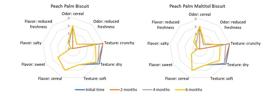
Both biscuits showed slight changes in color, flavor, and texture, with reduced freshness and crispness. The peach palm maltitol biscuit exhibited slightly greater changes, including a reduction in characteristic odor. Based on the acuity sensory team’s evaluation, the shelf life of both products could be six months under the study conditions, but consumer acceptability at the study’s end would better define acceptable changes.
The colorimetric parameters of both biscuits analyzed over the six months are presented in Table 7.
At the sixth month, both biscuits showed significant variations in the L* (luminosity) and a* coordinates. However, for the PMB biscuit, a significant change in the a* coordinate had already been detected at the fourth month, resulting in a coloration described by the sensory team as less intense orange (Table 7).
Regarding the peroxide value, the results found for the biscuit formulations at periods initial, three, and six months were below the method's detection level, which is 0.07 meq/kg. Therefore, there was no oxidative change detected during the study period.
4 Conclusion
This study highlights the potential of Amazonian peach palm (Bactris gasipaes Kunth) flour in the development of innovative, vegan, and gluten-free biscuits that align with current market trends for functional foods. The findings demonstrate that peach palm biscuits, both with sugar and maltitol, exhibit favorable chemical, physical, and sensory properties, including high dietary fiber content, high lipid levels in USFA, and protein, which contribute to their nutritional and functional value. The low moisture content and water activity give the product high shelf life stability. At the initial period, sensory evaluation indicates broad consumer acceptance, particularly in the Northern part of Brazil. This result is attributed to the perceived flavor of peach palm fruit, a fruit intrinsically linked to regional food culture. The biscuits maintained overall quality and stability over six months of storage, with no oxidative deterioration detected.
The results suggest that peach palm biscuits can serve as a sustainable and innovative alternative to traditional snacks, promoting the use of underutilized Amazonian fruits in the food industry. Although there are already peach palm production chains in Amazonas, with producers supplying the fruit to markets and selling simple products such as the cooked and packaged version, the development of more industrialized items remains a potential to be explored in the state. Future research may explore strategies to optimize sensory attributes and further enhance consumer appeal across diverse regions. These efforts could strengthen the value chain for Amazonian fruits, contributing to local economic development and environmental conservation.
-
Cite as:
Boeira, L. S., Florêncio, I. M. N., Miguel, A. M. R. O., Cipolli, K. M. V. A. B., Ormenese, R. C. S. C., Ito, D., Vianna, C. L. C., & Ruffi, C. R. G. (2026). Vegan and gluten-free biscuits with Aamazonian peach palm (Bactris gasipaes Kunth): Agroindustrial potential and quality assessment. Brazilian Journal of Food Technology, 29, e2025070. https://doi.org/10.1590/1981-6723.0702026
-
Funding:
Fundação de Amparo à Pesquisa do Estado do Amazonas (01.02.016301.03244/2021-10).
Data Availability Statement
All data generated or analyzed in this study are included in this published article.
References
-
Aboshora, W., Yu, J., Omar, K. A., Li, Y., Hassanin, H. A. M., Navicha, W. B., & Zhang, L. (2019). Preparation of Doum fruit (Hyphaene thebaica) dietary fiber supplemented biscuits: Influence on dough characteristics, biscuits quality, nutritional profile and antioxidant Properties. Journal of Food Science and Technology, 56(3), 1328-1336. PMid:30956312. https://doi.org/10.1007/s13197-019-03605-z
» https://doi.org/10.1007/s13197-019-03605-z -
Aljutaily, T., Elbeltagy, A., Ali, A. A., Gadallah, M. G. E., & Khalil, N. A. (2022). Anti-obesity effects of formulated biscuits supplemented with date’s fiber; agro-waste products used as a potent functional food. Nutrients, 14(24), 5315. PMid:36558474. https://doi.org/10.3390/nu14245315
» https://doi.org/10.3390/nu14245315 - Alves, J. N. P., Silva, J. M. M., Pereira, S. P., & Freitas, R. F. (2021). Análise físico-química e sensorial de biscuit integral enriquecido com farinha de guaraná (Paullinia cupana) e banana desidratada (Musa sp.). Biodiversidade, 20(1), 94-105.
- American Oil Chemists Society – AOCS. (2017). Official methods and recommended practices of the American Oil Chemists Society (Met. Cd 8b-90, 7th ed.). Urbana: AOCS.
- American Public Health Association – APHA. (2015). Compendium of methods for the microbiological examination of foods (15th ed.). Washington, D.C.: APHA.
- American Society for Testing and Materials – ASTM. (2017). ASTM D3985-17: Standard test method for oxygen gas transmission rate through plastic film and sheeting using a coulometric sensor. West Conshohocken: ASTM International.
- American Society for Testing and Materials – ASTM. (2020). ASTM F1249-20: Standard test method for water vapor transmission rate through plastic film and sheeting using a modulated infrared sensor. West Conshohocken: ASTM International.
-
Araújo, N. M. P., Arruda, H. S., Marques, D. R. P., Oliveira, W. Q., Pereira, G. A., & Pastore, G. M. (2021). Functional and nutritional properties of selected Amazon fruits: A review. Food Research International, 147, 110520. PMid:34399498. https://doi.org/10.1016/j.foodres.2021.110520
» https://doi.org/10.1016/j.foodres.2021.110520 -
Arogundade, T. J., Oluwamukomi, M. O., & Dada, M. A. (2023). Nutritional qualities and antioxidant properties of ginger-flavored biscuits developed fromwheat, bambara groundnut, and plantain flour blends. Food Frontiers, 4(1), 407-419. https://doi.org/10.1002/fft2.203
» https://doi.org/10.1002/fft2.203 -
Associação Brasileira das Indústrias de Biscoitos, Massas Alimentícias e Pães & Bolos Industrializados – ABIMAPI. (2023). Estatísticas de mercado Retrieved in 2025, June 29, from https://abimapi.com.br/estatisticas-mercado/
» https://abimapi.com.br/estatisticas-mercado/ -
Associação Brasileira de Empresas de Pesquisa – ABEP. (2024). Critério de Classificação Econômica Brasil Retrieved in 2024, July 21, from http://www.abep.org/criterio-brasil
» http://www.abep.org/criterio-brasil - Associação Brasileira de Normas Técnicas – ABNT. (2016a). ABNT NBR ISO 8586:2016: Análise sensorial: Guia geral para a seleção, treinamento e monitoramento de avaliadores selecionados e avaliadores sensoriais especialistas/experts. Rio de Janeiro: ABNT.
- Associação Brasileira de Normas Técnicas – ABNT. (2016b). ABNT NBR ISO 11136: Análise sensorial: Guia geral para condução de testes hedônicos com consumidores em ambientes controlados. Rio de Janeiro: ABNT.
- Associação Brasileira de Normas Técnicas – ABNT. (2017). ABNT NBR ISO 5492: Análise sensorial: Vocabulário. Rio de Janeiro: ABNT.
- Associação Brasileira de Normas Técnicas – ABNT. (2021). ABNT NBR ISO 13299: Análise sensorial: Metodologia: Orientação geral para o estabelecimento de um perfil sensorial. Rio de Janeiro: ABNT.
- Association of Official Analytical Chemists – AOAC. (2012). Official methods of analysis of the Association of Official Analytical Chemists (19th ed.). Gaithersburg: AOAC.
- Association of Official Analytical Chemists – AOAC. (1978). Official methods of analysis of the Association of Official Analytical Chemists (Method 978.18: Water Activity of Foods). Rockville: AOAC.
-
Bakar, M. F. A., Ranneh, Y., & Kamil, N. F. M. (2022). Development of high fiber rich antioxidant biscuits from purple and orange sweet potato peels. Food Research, 6(1), 12-19. https://doi.org/10.26656/fr.2017.6(1).036
» https://doi.org/10.26656/fr.2017.6(1).036 - Brasil. Ministério da Saúde. Agência Nacional de Vigilância Sanitária. Universidade de Brasília. (2005). Rotulagem nutricional obrigatória: Manual de orientação às indústrias de Alimentos - 2º Versão (44 p.). Brasília: ANVISA/UnB.
- Brasil. Ministério da Saúde. Agência Nacional de Vigilância Sanitária – ANVISA. (2020, outubro 8). Estabelece os requisitos técnicos para a declaração da rotulagem nutricional dos alimentos embalados (Instrução Normativa IN nº 75). Diário Oficial [da] República Federativa do Brasil, Brasília.
- Brasil. Ministério da Saúde. Agência Nacional de Vigilância Sanitária – ANVISA. (2024, julho 3). Guia para determinação de prazos de validade de alimentos versão 2 (Guia, No. 16). Diário Oficial [da] República Federativa do Brasil, Brasília.
-
Bugner, E., & Feinberg, M. (1992). Determination of mono - and disaccharides in foods by interlaboratory study: Quantitation of Bias components for liquid chromatography. Journal of AOAC International, 75(3), 443-464. https://doi.org/10.1093/jaoac/75.3.443
» https://doi.org/10.1093/jaoac/75.3.443 -
Cortat, C. M. G., Glielmo, J. L. A. P., Iglesias, R. A., Peixoto, V. O. D. S., Fontanive, R., Citelli, M., Zago, L., & Santana, I. (2015). Desenvolvimento de biscoito tipo cookie isento de glúten à base de farinha de banana verde e óleo de coco. Revista HUPE, 14(3), 20-26. https://doi.org/10.12957/rhupe.2015.19876
» https://doi.org/10.12957/rhupe.2015.19876 -
Costa, T., Veronezi, C. M., & Jorge, N. (2022). Propriedades físico-químicas e antioxidantes de óleo de pupunha (Bactris gasipaes). In C. M. Veronezi, A. C. Silva, I. R. Freitas, & N. Jorge (Orgs.), Óleos vegetais: Propriedades físico-químicas, bioativas e antioxidantes São Carlos: Agron Food Academy. https://doi.org/10.53934/9786585062022-2
» https://doi.org/10.53934/9786585062022-2 -
Gao, D., Helikh, A., Duan, Z., Liu, Y., & Shang, F. (2022). Development of pumpkin seed meal biscuits. Eastern-European Journal of Enterprise Technologies, 2(11(116)), 36-42. https://doi.org/10.15587/1729-4061.2022.254940
» https://doi.org/10.15587/1729-4061.2022.254940 -
Gélinas, P., & Théolier, J. (2024). How to reduce gluten in foods: A critical review of patentes. International Journal of Food Science & Technology, 59(11), 8069-8081. https://doi.org/10.1111/ijfs.17550
» https://doi.org/10.1111/ijfs.17550 -
Gill, S. K., Rossi, M., Bajka, B., & Whelan, K. (2021). Dietary fibre in gastrointestinal health and disease. Nature Reviews. Gastroenterology & Hepatology, 18(2), 101-116. PMid:33208922. https://doi.org/10.1038/s41575-020-00375-4
» https://doi.org/10.1038/s41575-020-00375-4 -
Gomes-Ruffi, C. R. (2011). Desenvolvimento e avaliação tecnológica de biscoito tipo cracker com incremento no teor de proteínas e de fibras pela incorporação de derivados de soja (Dissertação de mestrado). Universidade Estadual de Campinas, Campinas. https://doi.org/10.47749/T/UNICAMP.2011.841839
» https://doi.org/10.47749/T/UNICAMP.2011.841839 -
Goubgou, M., Songré-Ouattara, L. T., Bationo, F., Lingani-Sawadogo, H., Traoré, Y., & Savadogo, A. (2021). Biscuits: A systematic review and metaanalysis of improving the nutritional quality and health benefits. Food Production, Processing and Nutrition, 3(1), 26. PMid:40477342. https://doi.org/10.1186/s43014-021-00071-z
» https://doi.org/10.1186/s43014-021-00071-z -
Gupta, S. (2024). Biscuits market research report information by type (crackers, savoury biscuits and sweet biscuits), by distribution channel (independent bakeries, online channels, convenience stores, supermarkets and others), and by region (Northern America, Europe, Asia-Pacific, and Rest of the World) - Forecast Till 2032. MRFR/F-B & N/1386-HCR Retrieved in 2025, June 29, from https://www.marketresearchfuture.com/reports/biscuits-market/toc
» https://www.marketresearchfuture.com/reports/biscuits-market/toc - Hartman, L., & Lago, R. C. A. (1973). Rapid preparation of fatty acid methyl esters from lipids. Laboratory Practice, 22(6), 475-476. PMid:4727126.
- International Organization for Standardization – ISO. (2017). ISO 6579:2017-1 (E): Microbiology of food and animal feeding stuffs: Horizontal methods for detection of Salmonella sp. Geneva: ISO.
-
Klerks, M., Román, S., & Sánchez-Siles, L. (2023). Baby, children, and adult biscuits. Differences in nutritional quality and naturalness. Food Science & Nutrition, 11(12), 7946-7956. PMid:38107111. https://doi.org/10.1002/fsn3.3711
» https://doi.org/10.1002/fsn3.3711 -
Krajewska, A., & Dziki, D. (2023). Enrichment of biscuits with fruits and their by-products: Chemical composition, antioxidant properties, and sensory changes. Molecules, 28(10), 4005. PMid:37241744. https://doi.org/10.3390/molecules28104005
» https://doi.org/10.3390/molecules28104005 - Labuza, T. P. (1980). The effect of water activity on reaction kinetics of food deterioration. Food Technology, 34(4), 36-41.
-
Lazou, A. E. (2024). Properties, structure, and acceptability of innovative legume‐based biscuits with alternative sweeteners. International Journal of Food Sciences, 2024(1), 8216796. PMid:38566753. https://doi.org/10.1155/2024/8216796
» https://doi.org/10.1155/2024/8216796 -
Manley, D. (2000). Technology of biscuits, crackers and cookies (3rd ed.). Cambridge: Woodhead Publishing. https://doi.org/10.1533/9781855736597
» https://doi.org/10.1533/9781855736597 -
Masmoudi, M., Yaich, H., Borchani, M., Mbarki, R., & Attia, H. (2021). Chemical, physical and sensory characteristics of biscuits enriched with jujube (Zizyphus lotus L.) flour and fiber concentrate. Journal of Food Science and Technology, 58(4), 1411-1419. PMid:33746269. https://doi.org/10.1007/s13197-020-04652-7
» https://doi.org/10.1007/s13197-020-04652-7 -
McCleary, B. V., & McLoughlin, C. (2023). Determination of insoluble, soluble, and total dietary fiber in foods using a rapid integrated procedure of enzymatic-gravimetric-liquid chromatography: First action 2022.0. Journal of AOAC International, 106(1), 127-145. PMid:35972331. https://doi.org/10.1093/jaoacint/qsac098
» https://doi.org/10.1093/jaoacint/qsac098 - McCleary, B. V., & Prosky, L. (2001). Advanced dietary fibre technology Oxford: Blackwell Science.
-
Meenakumari, R., Ravichandran, C., & Vimalarani, M. (2023). Nutritional, sensory, and antioxidant characteristics of composite multigrain flour biscuits blended with sweet potato flour. International Food Research Journal, 30(1), 173-181. https://doi.org/10.47836/ifrj.30.1.14
» https://doi.org/10.47836/ifrj.30.1.14 - Meilgaard, M., Carr, B. T., & Civille, G. V. (2007). Sensory evaluation techniques (4th ed.). Boca Raton: CRC Press.
-
Nabil, B., Ouaabou, R., Ouhammou, M., Essaadouni, L., & Mahrouz, M. (2020). Functional properties, antioxidant activity, and organoleptic quality of novel biscuit produced by moroccan cladode flour “Opuntia ficus-indica”. Journal of Food Quality, 2020, 3542398. https://doi.org/10.1155/2020/3542398
» https://doi.org/10.1155/2020/3542398 -
Nadian, N., Azizi, M. H., Ahangar, H. A., & Aarabi, A. (2021). Textural and sensory characteristics of sugar-free biscuit formulated with quinoa flour, isomalt, and maltodextrin. Food Science & Nutrition, 9(12), 6501-6512. PMid:34925781. https://doi.org/10.1002/fsn3.2564
» https://doi.org/10.1002/fsn3.2564 -
Oliveira, A. H. M., Menezes, V. S., Rodrigues, L. V., Marques, E. M. A., Cavalcante, R. S., & Boeira, L. S. (2024). Comparison of physical-chemical parameters of fresh and dehydrated amazonian fruits pulps from different regions. Observatorio de la Economía Latinoamericana, 22(12), e8059. https://doi.org/10.55905/oelv22n12-032
» https://doi.org/10.55905/oelv22n12-032 -
Pinheiro, R. C., Ballesteros, L. F., Cerqueira, M. A., Rodrigues, A. M. C., Teixeira, J. A., & Silva, L. H. M. (2022). Peach palm (Bactris gasipaes Kunth) and mammee apple (Mammea americana L.) seeds: Properties and potential of application in industry. Lebensmittel-Wissenschaft + Technologie, 170, 114089. https://doi.org/10.1016/j.lwt.2022.114089
» https://doi.org/10.1016/j.lwt.2022.114089 -
Pires, M. B., Amante, E. R., Lopes, A. S., Rodrigues, A. M. C., & Silva, L. H. M. (2019). Peach palm flour (Bactris gasipae KUNTH): Potential application in the food industry. Food Science and Technology, 39(3), 613-619. https://doi.org/10.1590/fst.34617
» https://doi.org/10.1590/fst.34617 - Rego, R. A., Vialta, A., & Madi, L. F. (2020). Biscoitos industrializados: Nutrição e indulgência na cultura alimentar São Paulo: BB Editora-Abimapi.
-
Ribeiro, G. S., Monteiro, M. K. C., Carmo, J. R., Pena, R. S., & Chisté, R. C. (2021). Peach palm flour: production, hygroscopic behaviour and application in cookies. Heliyon, 7(5), e07062. PMid:34041403. https://doi.org/10.1016/j.heliyon.2021.e07062
» https://doi.org/10.1016/j.heliyon.2021.e07062 -
Rocha, M. C., Píccolo, M. P., Abreu, W. C., Maradini Filho, A. M., & Barcelos, M. F. P. (2020). Physicochemical properties and use of chia mucilage (Salvia hispanica L.) in the reduction of fat in biscuits. Brazilian Journal of Development, 6(9), 69019-69034. https://doi.org/10.34117/bjdv6n9-374
» https://doi.org/10.34117/bjdv6n9-374 -
Rojas-Garbanzo, C., Pérez, A. M., Castro, M. L. P., & Vaillant, F. (2012). Major physicochemical and antioxidant changes during peach palm (Bactris gasipaes H.B.K.) flour processing. Fruits, 67(6), 415-427. https://doi.org/10.1051/fruits/2012035
» https://doi.org/10.1051/fruits/2012035 -
Ronoh, A. K., Serrem, C. A., Tumwebaze, S. B., & Were, G. M. (2024). Effect of fortifying sorghum and wheat with Longhorn grasshopper (Ruspolia differens) powder on nutritional composition and consumer acceptability of biscuits. Food Science & Nutrition, 12(5), 3492-3507. PMid:38726424. https://doi.org/10.1002/fsn3.4018
» https://doi.org/10.1002/fsn3.4018 -
Roze, M., Crucean, D., Diler, G., Rannou, C., Catanéo, C., Jonchere, C., Le-Bail, A., & Le-Bail, P. (2021). Impact of maltitol and sorbitol on technological and sensory attributes of biscuits. Foods, 10(11), 2545. PMid:34828826. https://doi.org/10.3390/foods10112545
» https://doi.org/10.3390/foods10112545 -
Sadeghi, R., Norouzzadeh, M., Rashedi, M. H., Jamshidi, S., Ahmadirad, H., Alemrajabi, M., Vafa, M., & Teymoori, F. (2025). Dietary and circulating omega-6 fatty acids and their impact on cardiovascular disease, cancer risk, and mortality: A global meta-analysis of 150 cohorts and meta-regression. Journal of Translational Medicine, 23(1), 314. PMid:40075437. https://doi.org/10.1186/s12967-025-06336-2
» https://doi.org/10.1186/s12967-025-06336-2 -
Saeed, S. M. G., Ali, A. S., Faheem, K., Rashida, R. A., & Giuffrè, A. M. (2022). The Impact of innovative plant sources (Cordia myxa L. fruit (Assyrian plum) and Phoenix dactylifera L. biowaste (date pit)) on the physicochemical, microstructural, nutritional, and sensorial properties of gluten-free biscuits. Foods, 11(15), 2346. PMid:35954112. https://doi.org/10.3390/foods11152346
» https://doi.org/10.3390/foods11152346 -
Sahin, A. W., Atzler, J. J., Crofton, E., Gallagher, E., Zannini, E., Walter, E., & Arendt, E. K. (2023). Impact of different fibre ingredients on a low-FODMAP biscuit model system. Food & Function, 14(15), 7082-7095. PMid:37455535. https://doi.org/10.1039/D3FO00830D
» https://doi.org/10.1039/D3FO00830D -
Soares, S. D., Santos, O. V., Nascimento, F. C. A., & Pena, R. S. (2022). A review of the nutritional properties of different varieties and byproducts of peach palm (Bactris gasipaes) and their potential as functional foods. International Journal of Food Properties, 25(1), 2146-2165. https://doi.org/10.1080/10942912.2022.2127761
» https://doi.org/10.1080/10942912.2022.2127761 -
Spacki, K. C., Correa, R. C. G., Uber, T. M., Barros, L., Ferreira, I. C. F. R., Peralta, R. A., Moreira, R. F. P. M., Helm, C. V., Lima, E. A., Bracht, A., & Peralta, R. M. (2022). Full exploitation of peach palm (Bactris gasipaes Kunth): State of the art and perspectives. Plants, 11(22), 3175. PMid:36432904. https://doi.org/10.3390/plants11223175
» https://doi.org/10.3390/plants11223175 -
Starowicz, M., Arpaci, S., Topolska, J., & Wronkowska, M. (2021). Phytochemicals and antioxidant activity in oat-buckwheat dough and cookies with added spices or herbs. Molecules, 26(8), 2267. PMid:33919764. https://doi.org/10.3390/molecules26082267
» https://doi.org/10.3390/molecules26082267 -
Taraseviciene, Z., Čechoviciene, I., Jukniute, K., Šlepetiene, A., & Paulauskiene, A. (2021). Qualitative properties of cookies enriched with berries pomace. Food Science and Technology, 41(2), 474-481. https://doi.org/10.1590/fst.02120
» https://doi.org/10.1590/fst.02120 -
Tibaldi, C., Oliveira, S., Dinelli, G., Marotti, I., & Raymundo, A. (2025). Nutritional features of organic peas (Pisum sativum L.) cultivated in different Italian environments and rheological profile of pea-enriched crackers. Journal of the Science of Food and Agriculture, 105(7), 3606-3619. PMid:39907070. https://doi.org/10.1002/jsfa.14156
» https://doi.org/10.1002/jsfa.14156 - U.S. Food and Drug Administration – FDA. (2001). Bacteriological Analytical Manual (BAM): Yeast, mold and mycotoxin Beltsville: FDA.
- U.S. Food and Drug Administration – FDA. (2012). Bacteriological Analytical Manual – BAM Beltsville: FDA.
-
Varela, P., & Ares, G. (2014). Novel techniques in sensory characterization and consumer profiling Boca Raton: CRC Press. https://doi.org/10.1201/b16853
» https://doi.org/10.1201/b16853 - Wadt, L. H. O., Maroccolo, J. F., Guedes, M. C., & Silva, K. E. (2023) Castanha-da-amazônia: Estudos sobre a espécie e sua cadeia de valor: Pós-coleta e tecnologia de alimentos (Vol. 2). Brasília: EMBRAPA.
Edited by
-
Associate Editor:
Gerson Lopes Teixeira.


