 Valorization of common bean protein extraction residues: production and characterization of polysaccharide-rich ingredients for food applications
Abstract
Insoluble residue from common bean protein extraction was used to obtain three polysaccharide-rich ingredients: bean starch, fiber-rich flour, and carbohydrate-rich flour. The residue was fractionated by water suspension and centrifugation. Bean starch had high purity (90.71%) with minimal ash and fiber contamination. Its granules were oval to semi-elliptical, with slight surface porosities and some adhered protein bodies, showing a typical legume "C" crystallinity pattern, and gelatinization temperature of 74.65 °C. Viscosity curves were similar to those of bean starch in its native state. Fiber-rich flour had particles 5.6 times larger than carbohydrate-rich flour, due to higher fibrous content. It also showed higher water (5.09 g/g) and oil (1.52 g/g) holding capacities than carbohydrate-rich flour (3.16 g/g and 0.96 g/g, respectively). Phytate levels in both ingredients were below 0.7%, and no tannins were detected. This study demonstrates that the protein extraction process preserved flour macromolecules, reinforcing the potential of these byproducts in food applications.
Keywords:
Starch; Fiber; Carbohydrate-rich flour; Physical properties; Technological properties; Phaseolus vulgaris
Highlights
Three upcycled polysaccharide-rich ingredients show distinct physicochemical profiles
Bean starch has high purity (90.71%) and shows typical legume morphology and crystallinity pattern
Fiber-rich flour shows higher water and oil holding capacities than carbohydrate-rich flour
1 Introduction
Vegetable proteins extracted from cereals and legumes are essential ingredients to meet the growing demand in the plant-based food market (Affrifah et al., 2023). Most of these proteins are obtained as concentrates or isolates, produced mainly through wet extraction processes. These processes often result in by-products that are rich in starch and fiber. About 75% of crop biomass in North America is used for low-value purposes, such as animal feed or landfill disposal (Eastham et al., 2023). The valorization of these by-products is crucial for the adoption of sustainable practices embedded in a circular economy system. Repurposing residues into valuable ingredients not only supports the achievement of the Sustainable Development Goals (United Nations, 2016), but also aligns with plant-based market expectations for sustainable and health-conscious choices. Also, it favors the expansion and strengthens the vegetable protein industry.
Common bean (Phaseolus vulgaris) is one of the pulses used for protein ingredient extraction (Gouvêa et al., 2023). In addition to its high protein content (19% to 24%), these beans contain between 34% to 50% starch and 12% to 33% fiber (Shevkani et al., 2022). After protein removal by the classical wet protein concentration alkaline process, a significant volume of insoluble material is generated, predominantly composed of starch and fiber. Meanwhile, the food ingredients market is seeking new sources of starch and fiber, driven by the need to diversify raw materials and reduce dependence on traditional sources. In this context, upcycled ingredients are gaining prominence, increasingly valued for their sustainability and potential to meet the evolving demands of the industry (Felisberto et al., 2017).
The wet milling process using NaOH is commonly employed to extract starch from ground grains and involves multiple steps: suspension in water, separation of fiber and protein, centrifugation, purification, and drying. The alkali disrupts the interactions between the proteins and starch granules, favoring their separation, while physical processes such as filtration remove the cell wall components (Zhao et al., 2020), resulting in high-purity starch. Although alkaline conditions are employed for both starch isolation and protein extraction, variations in the type and concentration of alkali, as well as the extraction time and temperature, can influence the functionality of the macromolecules (Spigno & De Faveri, 2004). While numerous studies have explored starch isolation under alkaline conditions directly from ground grains, research on recovering starch from the insoluble residue generated during protein extraction remains scarce. It is known that under strongly alkaline conditions, commonly used for protein extraction, native starch can be adversely affected, undergoing gelatinization or chemical modifications, even at room temperature (Tagliapietra et al., 2021). These changes are influenced not only by the aforementioned factors but also by the type of starch (Spigno & De Faveri, 2004). Therefore, it is crucial to assess the impact of protein extraction on the integrity and functionality of the macromolecules present in the resulting insoluble residue.
This study aimed to assess the insoluble residue generated from common bean protein extraction as a substrate for obtaining three polysaccharide-rich ingredients (bean starch, fiber-rich flour, and bean carbohydrate-rich flour) while also evaluating the influence of protein removal conditions on the properties of these fractions.
2 Material and methods
2.1 Material
Common bean grains (Phaseolus vulgaris cv Carioca) were provided by Josapar (Brazil) and ground using a LM3100 hammer mill (0.8 mm sieve) (Perten Instruments, Sweden). The total starch kit was purchased from Megazyme International (Megazyme, Ireland). All other reagents were of analytical grade.
2.2 Purification and fractionation of the residue from protein extraction
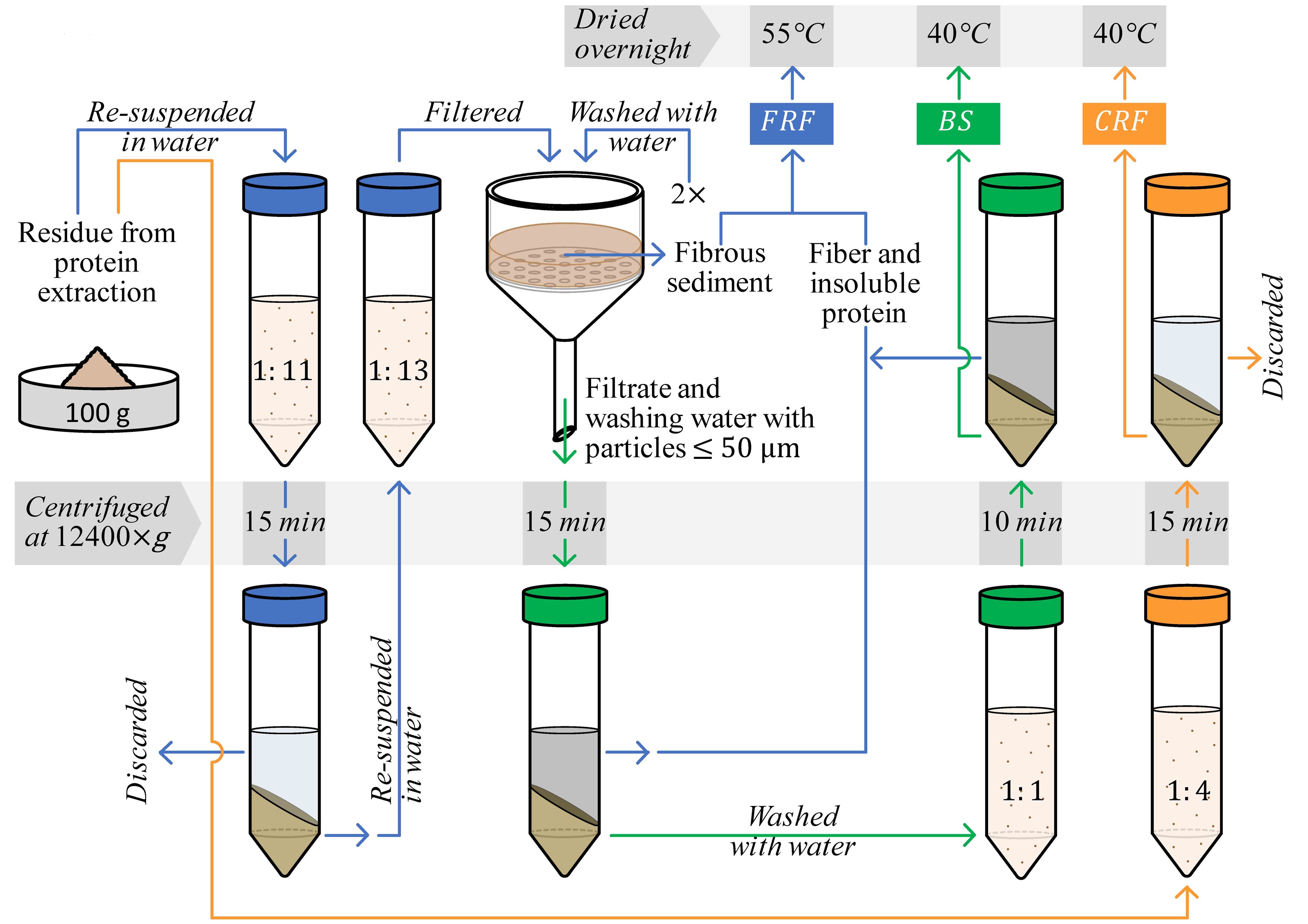
Lima et al. (2025) have previously described the process for obtaining common bean protein concentration. The insoluble residue generated from protein extraction was fractionated into three ingredients: bean starch (BS), fiber-rich flour (FRF), and carbohydrate-rich flour (CRF) (Figure 1). BS was isolated according to Romero & Zhang (2019), with modifications. The insoluble residue was suspended in distilled water (1:1, w/w) and centrifuged (12,400 x g, 15 min) (Thermo Scientific, Germany). The supernatant was discarded, and the precipitate was re-suspended (1:13, w/w) and filtered through a 50-μm mesh sieve. The retentate was washed twice and filtered again, yielding the fibrous sediment. The filtrate (plus retentate washing water) was centrifuged (12,400× g, 15 min), and the precipitate was washed (1:1, w/w) and centrifuged again (12,400× g, 10 min). After each centrifugation, the grayish upper layer (fiber and insoluble protein) on top of the white precipitate (starch) was scraped off and added to the fibrous sediment. Starch and fibrous sediment (called here as FRF) were dried overnight at 40 °C and 55 °C, respectively, and ground (LM3100 hammer mill, 0.8 mm sieve) (Perten Instruments, Sweden). To obtain CRF, the insoluble residue generated after protein removal was suspended in distilled water (1:4, w/w) to eliminate off-flavors. The slurry was centrifuged (12,400× g, 15 min), the supernatant discarded, and the precipitate dried overnight at 40 °C, then ground as described above. All processes were performed in triplicate. Yields were calculated by dividing the product weight by the raw material weight and multiplying the result by 100.

Stages for obtaining ingredients from the common bean protein extraction residue. FRF: fiber-rich flour; BS: bean starch; CRF: carbohydrate-rich flour.
2.3 Physicochemical composition
BS, FRF, and CRF were evaluated for proximate composition using AOAC methods (Association of Official Analytical Chemists, 2005). Total starch content was determined using the Megazyme kit following the methods 996.11 (Association of Official Analytical Chemists, 2005) and 76-13.01 (American Association of Cereal Chemistry, 1999). Briefly, 100 mg of the sample was mixed with 200 µL of 80% ethanol and 3.0 mL of α-amylase, incubated in boiling water for 6 min, and then cooled. Amyloglucosidase (0.1 mL) was added, and the sample was incubated at 50 °C/30 min. After the centrifugation (7500 ×g, 10 min), 50 µL of supernatant was reacted with 1.5 mL of GOPOD reagent at 50 °C/20 min. Glucose concentration was measured spectrophotometrically at 510 nm. All analyses were performed in triplicate.
2.4 Resistant starch
Resistant starch (RS) was determined using the K-RSTAR kit (Megazyme International, Ireland). Pancreatic α-amylase and amyloglucosidase were added to 100 mg of sample and incubated (37 °C/16 h, 100 rpm). Ethanol was added, and the mixture was centrifuged (3,000 × g, 10 min). The supernatant was removed, and the precipitate was re-suspended in ethanol and homogenized (1,200 rpm, 3 min). The supernatants were combined, and this step was repeated. The precipitate was treated with 2M KOH in an ice bath (450 rpm/20 min). Sodium acetate buffer (1.2 M, pH 3.8) was added, followed by amyloglucosidase incubation (50 °C, 30 min). Glucose was quantified using the GOPOD method at 510 nm.
2.5 Particle size
Particle size was determined by laser diffraction using a MICROTRAC S3500 analyzer (Microtrac Inc., USA). The analysis was performed in triplicate using isopropyl alcohol as dispersant fluid. Results were expressed as the volume-weighted mean particle diameter [D(4,3)] and percentiles (d10, d50, and d90).
2.6 Thermal properties
Gelatinization temperature and enthalpy were determined in triplicate using a DSC Q200 calorimeter (TA Instruments, USA). Three mg of BS were weighed into hermetic aluminum pans, and water was added (water: starch ratio, 3:1). The sealed pans were kept overnight at room temperature, and then heated from 10 to 120 °C at a rate of 10 °C/min. Onset (To), peak (Tp), conclusion (Tc) temperatures, and calorimetric enthalpy (ΔH) were calculated using the Universal Analysis 2000 software.
2.7 Pasting properties
The pasting properties of BS were determined using an RVA-4 (Newport Scientific Ltd., Australia). Three grams of the sample (14% moisture) were dispersed in 25 mL of distilled water and stirred at 160 rpm. The time-temperature profile was 25 °C for 2 min, heating from 25 °C to 95 °C in 5 min, holding at 95 °C for 3 min, cooling from 95 °C to 25 °C in 5 min, and remaining at 25 °C for 5 min. The parameters measured were paste temperature (PT), cold viscosity at 25 °C (CV), peak viscosity (PV), breakdown viscosity (BV), setback viscosity (SV), and final viscosity at cooling (FV).
2.8 Swelling power and water solubility
Starch swelling power (SP) and water solubility (WS) of BS were determined by Sangokunle et al. (2020). About 1 g of sample was heated at different temperatures (55 °C to 95 °C) for 30 min, then centrifuged (4,800 × g, 10 min). The supernatant was evaporated to obtain the soluble solids. SP was calculated as mass of wet sediment/mass of (dry matter – soluble solids). WS was calculated as the mass of soluble solids/the mass of dry matter.
2.9 X-ray diffraction
The diffraction pattern of bean starch was determined using a D2 Phaser X-ray diffractometer (Bruker, Germany), operated with Cu-Kα, with 0.154 nm of wavelength, a target voltage of 30 kV, and a current of 10 mA. Samples were analyzed over a 2° to 32° (2θ). The relative crystallinity was calculated as the ratio of the areas under the curve of the crystalline region and the total region using OriginPro 2024 (OriginLab, USA).
2.10 Scanning electron microscopy (SEM)
SEM images of the ingredients were obtained using a Hitachi TM-3000 SEM (Hitachi High-Tech, Japan) at 15 kV. Samples were placed on aluminum stubs using double-sided conductive metal tape, and the images were captured at 500× magnification.
2.11 Hydration and oil-holding properties
Water holding capacity (WHC) of FRF and CRF was determined according to Anderson et al. (1969). One gram of the sample was mixed with 10 mL of water, shaken (30 min), and centrifuged (4,800 × g, 10 min). Oil holding capacity (OHC) of FRF and CRF was determined as described by Gouvêa et al. (2023). About 0.01 g of the sample was mixed with 1 mL of oil, vortexed (1 min), rested for 30 min, and centrifuged (10,836 × g, 20 min). Both supernatants were discarded, and the wet or oily sediment was weighed. WHC and OHC were calculated as described in the methods.
2.12 Condensed tannins and phytates
FRF and CRF were evaluated for condensed tannins and phytate contents. Tannin content was determined according to Price et al. (1980). Extracts were dissolved in methanol, shaken (20 min), centrifuged (2,057 × g, 20 min), and absorbance was measured at 500 nm. Phytate content was determined by extracting 1 g of sample with 50 mL of 0.2N HCl (150 rpm, 2 h), filtering (14–18 µm), and adding 1 mL of ferric solution to 0.5 mL of extract. The mixture was heated in a boiling water bath (30 min), centrifuged (2,447 × g, 30 min), and 1.5 mL of bipyridine solution was added to 1 mL of the supernatant. Absorbance was measured at 519 nm (Haug & Lantzsch, 1983).
2.13 Statistical analysis
Results were subjected to one-way ANOVA and Tukey’s test at a 5% significance level, except for the analysis of protein and lipid content, for which the Student t-test was used (Statistic 14.1, StatSoft, USA). Results are presented as mean ± standard deviation.
3 Results and discussion
3.1 Process yields and physicochemical composition
The processes’ yield (dry basis) starting from common bean whole flour and following the procedures detailed in Figure 1 were 31.0%, 30.1%, and 62.0% for BS, FRF, and CRF, respectively. Although isolating starch from pulses is challenging due to the high proportion of fiber surrounding the starch granule (Singh et al., 2004), the extraction of bean starch from protein extraction residue yielded values similar to those reported in the literature for various bean varieties (19 to 32%) (Ambigaipalan et al., 2011; Vanier et al., 2019). A yield higher than 30% is expected when selecting starch for potential extraction for commercial purposes (Tagliapietra et al., 2021).
The three ingredients showed significant differences in their chemical compositions (Table 1). BS contains around 91% total starch and low levels of ash and fiber. The total starch content was lower than that reported by Chung et al. (2008) for common beans (94–100%), which may explain the high mass yield obtained. Previous studies have observed higher amounts of residual minerals and fibers attached to bean starch granules after isolation, and these findings are directly related to the conditions of processing used (Vázquez-León et al., 2022).
FRF and CRF presented contrasting levels of fiber and starch. FRF had 64% fiber and 26% starch, while CRF contained 30% fiber and 63% starch. The protein content ranged from 1.82% in CRF to 6.44% in FRF, with low lipid content (0.11% and 1.38%, respectively) and ash content (2.24% and 4.84%, respectively). The fiber content in FRF is comparable to that found in other studies isolating fibers from pulses, as well as commercially available high-fiber ingredients (Huber et al., 2016). Upcycled fiber-rich ingredients are in high demand within the food industry. In addition to the health benefits, their use in formulations results in improved texture, stability, and shelf-life of the product (Huber et al., 2016). CRF exhibited total fiber content like oat and rice bran (Andersson et al., 2009; Sharif et al., 2014), but lower than wheat bran (Raupp et al., 2004), which are fibrous sources commonly used in food product formulation.
The raw BS showed 6.31% resistant starch (RS). Previous studies reported wide variation in RS content among starches of different bean cultivars. Du et al. (2014) found RS levels between 9.8% and 11.0% in four varieties. Other studies reported 2.9% in black beans (Vázquez-León et al., 2022) and 23% to 35% in 16 common bean varieties (Zhang et al., 2022). Such variation reveals considerable diversity in the digestibility of bean phenotypes, influenced by factors like cultivation site, moisture content, storage conditions, and milling methods (Bozkır et al., 2023). Beans typically contain more RS than cereals due to their unique starch characteristics: high amylose content, large amounts of B-type crystallites, strong amylose–amylose interactions, and intact cell structures enclosing starch granules (Vázquez-León et al., 2022). RS is considered to be indigestible in the small intestine and is slowly fermented in the large intestine. RS consumption is related to many functional and health benefits, such as hypoglycemic effects and prevention of colorectal cancer (Zhang et al., 2022).
3.2 Characterization of BS
3.2.1 Particle size distribution
The particle size distribution of BS ranged from about 16 to 33 μm, with an average value of 24.04 μm (Table 2). These dimensions correspond to the equivalent diameters of individual common bean starch granules (19 to 47 µm) (Vázquez-León et al., 2022), confirming the absence of agglomerates, as observed in the SEM image shown below (section 3.2.6). Our results align with reported size ranges for common bean starches (Romero & Zhang, 2019; Wang & Ratnayake, 2014).
3.2.2 Thermal properties
The gelatinization temperatures and enthalpy (ΔH) of BS are presented in Table 2. The melting of crystalline regions initiated at 65.05 °C, reached the peak at 74.65 °C, and concluded at 82.12 °C. The Tpeak was consistent with the ranges reported by Ovando-Martínez et al. (2011) (70.14–75.42 °C) and Los et al. (2022) (70.8–76.6 °C) for bean starches obtained directly from ground seeds. This comparison is crucial for assessing the impact of the protein extraction process on starch granules, indicating that the process was mild. Minor differences may be attributed to variations in amylose content, granule size, and arrangement of starch fractions within the granules (Singh et al., 2004). Additionally, the presence of minerals and proteins can increase gelatinization temperature, as these components provide a protective effect by restricting water entrance into the granules (Pelissari et al., 2012), which helps to explain these differences. The gelatinization temperature range (Tc - To) was 17.07 °C, and the heat absorption (ΔH) required to disrupt the crystalline regions of granules was 11.25 J/g, within reported values for starch of common bean cultivars (15.5 °C–20.7 °C and 9.11–14.24 J/g, respectively) (Los et al., 2022; Vázquez-León et al., 2022). These results confirm that starch extracted from the insoluble residue after protein removal remained in its native state.
3.2.3 Pasting properties
The pasting profile of BS (Figure 2) was typical of native bean starch, indicating that the alkaline treatment used to remove proteins did not damage the granules. This is supported by the low CV (52.5 cP), indicating structural integrity. PT was 77.5 °C, which is close to the gelatinization temperature observed by DSC. A high PT value indicates a strong resistance to swelling and rupture (Singh et al., 2004), which is characteristic of pulse starches. During pasting, starch granules absorb water and swell, increasing PV, which for BS was 3,195 cP and occurred at 7.2 min. Three minutes after the PV, the suspension achieved a TV of 2,195 cP, resulting in a BV value of 1,000 cP. BV indicates the degree of granule disintegration. The lower the BV value, the greater the shear strength, and the higher the stability of the starch in processes involving heating (Los et al., 2022). Pulse starch generally resists shear-thinning at high temperatures, which is important for canned foods and extruded snacks. During cooling, the paste reached its maximum FV of 13,105 cP at 19.3 min (SB of 10,910 cP). SB is used to indicate the ability of starch to retrograde and form a strong gel upon cooling. The high SB and FV values of BS, characteristic of pulse starches, suggest a great extent of amylose leaching and aggregation (Hoover & Ratnayake, 2002). The amylopectin branch chain length and the presence or absence of unfragmented rigid swollen granules embedded in the leached amylose network also influence SB (Ambigaipalan et al., 2011). A high tendency of retrogradation (ability to make elastic gels) is a property especially valuable in the production of sausages, pâté-type meat products, and gluten-free oriental noodles (Wang & Ratnayake, 2014). Similar PT, PV, TV, and BV values were reported in the literature for common bean starches (Demiate et al., 2016; Los et al., 2022), confirming that the protein extraction process did not damage or modify the starch granules. However, BS had a final viscosity (FV) 1.5 to 3.6 times higher than that reported in these studies.

3.2.4 Swelling power (SP) and water solubility (WS)
Heating starch in excess water weakens granules, allowing water absorption and swelling as hydrogen bonds are replaced by water. Solubility results from amylose leaching during swelling (Jia et al., 2023). Figure 3 shows SP and WS of BS at different temperatures. At 55 °C and 65 °C, SP and WS were low since gelatinization temperature had not yet started (Table 2). At 75 °C, SP and WS increased as this temperature exceeded the gelatinization peak (Vázquez-León et al., 2022). At this temperature, amylose leaching occurs because swollen starch granules have open surface pores and expanded internal radial channels, enhancing starch solubility (Romero & Zhang, 2019). SP increased continuously up to 95 °C, while WS decreased after 75 °C. The reduction in WS at high temperatures could be due to structural changes induced by heat treatments, which increase crystallinity, making the granules less accessible to water, thereby reducing solubility (Adebowale et al., 2009).

Swelling power (SP) and water solubility (WS) of bean starch. Different letters at the same response indicate significant differences between temperatures (Tukey´s test, p ≤ 0.05). Ids: insoluble dry solids; ss: soluble solids; ds: dry solids.
BS showed SP and WS values similar to other common bean starches (Romero & Zhang, 2019; Rupollo et al., 2011), suggesting that it retains starch characteristics in its native state. Several factors influence SP and WS, including amylose content, amylose-lipid complex, and polymeric interactions at the interphase of amorphous and crystalline regions (Reddy et al., 2017). Higher amylose content implies a more packaged structure, limiting swelling (Romero & Zhang, 2019), which may explain the higher resistance to swelling of pulse starches compared to cereal starches (generally have lower amylose content) (Santos et al., 2023).
3.2.5 Crystallinity
The BS X-ray diffraction pattern (Figure 4) exhibited a typical "C" pattern for legume starches. Distinct peaks at diffraction angles (2θ) of 5.6°, 15°, 17°, 20°, 23°, and 26.6° were observed, consistent with the findings of Ovando-Martínez et al. (2011) for common bean starches from different cultivars. The most intense diffraction peaks were located at 15°, 17°, and 23° (2θ).

The “C” pattern is a crystalline polymorph combining A- and B-types, characteristic of cereals and tubers, respectively. The peak at 2θ = 5.2°–5.6° is representative of the B polymorphic form (Wang & Ratnayake, 2014), while the peak at 10°–11° is indicative of the A-type pattern (Buléon et al., 1998). The combination of A- and B-type patterns makes C-type more complex and variable, with properties influenced by the distribution and proportion of these polymorphs (He & Wei, 2017). C-type crystalline starches generally exhibit restricted swelling, low solubility, high gelatinization temperature, fast retrogradation, and enhanced resistance to digestion (Ratnayake & Naguleswaran, 2022).
BS relative crystallinity was 24.61% (Table 2), within the range reported for other common bean starch varieties (20%–33%) (Vanier et al., 2019). Starch crystallinity is affected by the number of crystalline regions, orientation of double helices within the crystalline domains, and extent of interaction between double helices (Hoover & Ratnayake, 2002).
3.2.6 Morphology
SEM analysis (Figure 5) showed that BS granules ranged from spherical to elliptical granules for the smaller ones, while the larger ones were oblong to elliptical. This is consistent with previous reports (Romero & Zhang, 2019; Wang & Ratnayake, 2014). Most had smooth surfaces, although some exhibited indentations, cracks, or striations likely caused by grinding before protein extraction, as also observed by Los et al. (2022) and Vázquez-León et al. (2022). BS purity (Table 1) aligns with the image, with some non-starch particles visible.

SEM micrographs of the products. (A) bean flour, (B) bean starch, (C) bean fiber and, (D) carbohydrate-rich flour. Magnification: 500×.
The morphology of isolated starch was similar to that of the granules found in raw bean flour (Figure 5), although flour granules showed slightly fewer imperfections. This may be influenced by the presence of cell wall material or protein bodies on the surface, which hinders detailed visualization. Overall, the images suggest that the processes the granules underwent - protein extraction and starch isolation - did not significantly affect their structural integrity. Granule morphology and size influence properties like solubility, swelling, pasting properties, and digestibility. Granules with a smooth surface are less susceptible to enzymatic action because the absence of grooves hinders the enzyme’s diffusivity and delays the hydrolysis (Romero & Zhang, 2019).
3.3 FRF and CRF characterization
3.3.1 Morphology
The morphologies of FRF and CRF are shown in Figure 5 (C and D, respectively). In general, both had similar microstructures, with the main difference being the ratio between starch granules and cell wall fragments. CRF had more starch granules and fewer cell wall fragments, consistent with the starch and fiber contents presented in Table 2. Compared to raw bean flour (protein 19.0%, dietary fiber 18.5%, and total carbohydrates 40.1%), CRF showed slightly fewer cell wall fragments. These variations are expected to influence their physical properties. The dietary fibers of common beans are composed of insoluble fiber, predominantly cellulose and hemicelluloses (seed coat), and soluble fiber, mainly pectic substances (cotyledon). Microstructurally, common bean soluble dietary fiber appears as thin, irregularly shaped sheets attached to a framework of long, thin rods (Hughes & Swanson, 1989). As soluble fibers solubilize in water, much of these fibers may have been removed during washing, explaining their absence in the images.
3.3.2 Physicochemical properties
The physicochemical properties of the FRF and CRF are shown in Table 3. All particle size parameters differed significantly between samples. The D(4,3) value of FRF was 5.6 times higher than that of CRF. The size of coarse particles (d90) in FRF was 1040 µm, while for the CRF this value was approximately five times smaller (213 µm). Coarse particles in these products are bean tegument residues, free or adhered to some starch granules. Grinding fibrous materials is more difficult due to their complex structure. The higher fiber content in FRF – over twice that of CRF (Table 1) –, made it more resilient to breaking down into smaller particles (Hemery et al., 2011). Most studies on fibrous powders derived from by-products reported particle sizes below 425 μm, which is consistent with our findings. However, the desired particle size depends on the intended application: finer powders blend better in dairy products, while bakery, meat, or extruded products do not require such fineness (Garcia-Amezquita et al., 2018). Particle size influences functional properties of food ingredients, but how particle size influences the ability of materials to retain water or oil sometimes appears contradictory. Sangnark & Noomhorm (2003) observed increased water retention with larger sugarcane bagasse particles, whereas Auffret et al. (1994) found that smaller particles enhanced water retention in pea hulls. Generally, larger particles retain more water under conditions where external forces are not continuously applied, while smaller particles increase water retention due to a higher surface area (Stephen & Cummings, 1979). When grinding damages the regions that have affinity to interact with water, the WHC of the sample decreases (Elleuch et al., 2011). Regarding oil holding capacity (OHC), studies on coconut residues (Raghavendra et al., 2006) and lemon pomace (Lario et al., 2004) showed that OHC remains constant at high particle sizes but decreases in samples ground below 400 μm (Sangnark & Noomhorm, 2003).
The WHC of CRF and FRF were 3.16 and 5.09 g water/g sample, respectively, indicating their ability to absorb 3 and 5 times their weight in water. This difference can be attributed to variations in chemical composition and particle size, as discussed above. WHC depends on hydrophilic groups that bind water molecules. Ingredients with a high WHC lead to products that are more succulent and stable during storage. The WHC of CRF was slightly higher than that of ingredients derived from cassava bagasse (2.63 g/g) (Fiorda et al., 2013), wheat bran (2.72 g/g), and young bamboo culm (2.23 g/g) (Sampaio et al., 2023), while FRF´s WHC was lower than fibrous residue of sugarcane bagasse (17.3 g/g) (Yadav et al., 2017), but higher than bamboo shoot shell (2.83 g/g) (Luo et al., 2017). OHC was 1.52 g oil/g sample for FRF and 0.96 g oil/g sample for CRF, slightly lower than other insoluble fiber sources (Hua et al., 2019; Zhao et al., 2020). The macromolecules present in the materials significantly influence both properties, with dietary fibers being the main component responsible for increased water and oil holding (Huber et al., 2016). However, fiber content alone does not determine these capacities; factors such as fiber chemical structure, ratio of soluble to insoluble fractions, porosity, particle size, hydrophilic nature of the constituents, and charge density also play important roles (Garcia-Amezquita et al., 2018). WHC and OHC guide the applications of ingredients in food products. Ingredients with high OHC allow the stabilization of high-fat products and emulsions, as well as prevent fat losses upon cooking; they can be used as fat replacers in meat products. Ingredients with high WHC help control syneresis and modify the viscosity and texture of formulated foods, extending shelf life (Elleuch et al., 2011).
Phytate and tannin levels in FRF and CRF were determined (Table 3) due to their potential to cause adverse physiological effects or reduce the bioavailability of certain nutrients (Segura-Campos et al., 2014). Phytates were higher in CRF (0.61%) and FRF (0.70%) than in the raw material (ground whole beans) (0.49%). However, since 75% of phytate is associated with fiber (Saura-Calixto et al., 2007), this relative increase can be attributed to the higher fiber content resulting from protein and starch removal during processing. Furthermore, the phytate levels in the formulated product will be reduced by the dilution effect, as these ingredients are part of a formulation that includes other components. Elhardallou & Walker (1994) reported a lower phytic acid content in fiber-rich common bean fractions (0.42%) than that observed in this study. Tannins (0.17%) were present in the raw material but absent in the ingredients. Being water-soluble, they were likely removed during protein extraction. Moreover, due to their ability to form complexes with proteins — which explains their effect on reducing protein digestibility — this also justifies their absence in the ingredients, which have low protein content (Morzel et al., 2022). Segura-Campos et al. (2014) further add that certain processing practices employed in the treatment of fibrous residues, such as soaking at alkaline pH, may also reduce tannin and phytate contents. The role of phytates and tannins in human health has been described as a dual issue since their discovery. Although traditionally seen as antinutritional, both compounds have documented health benefits, including antioxidant, cardioprotective, antimicrobial, anticancer effects, and reduction of chemotherapy side effects. Tannins can help manage metabolic disorders and respiratory diseases, while phytates can reduce pathological calcifications in blood vessels (Pires et al., 2023).
4 Conclusion
With the growing demand for sustainable solutions, the use of residues from the plant protein industry for the extraction of high-value food ingredients has become increasingly relevant. Three ingredients were obtained from the insoluble residue generated by the extraction of common bean protein through purification or fractionation steps: bean starch, fiber-rich flour, and carbohydrate-rich flour. Both the alkaline process used for protein removal and the techniques employed for the obtention of the ingredients did not alter the components present, including the starch granules. The ingredients, with their distinct characteristics, show great potential for incorporation into a variety of food formulations. This study positions common bean protein residue as a valuable and sustainable resource, capable of providing multifunctional ingredients that can enhance both the nutritional profile and texture of various food products.
Acknowledgements
The authors thank Brazilian Agricultural Research Corporation - Embrapa (Grant number 20 0.19.03.008 0.00.00 – Development of vegetable protein ingredients from pulses to replace animal protein in food), The Good Food Institute - GFI (Grant number SAIC 22 100.20/00 42-1 – Proteins from beans as alternative ingredients for plant-based meat products), and Conselho Nacional de Desenvolvimento Científico e Tecnológico – CNPq (process 308574/2022-2) for financial support for the research.
-
Cite as:
Galdeano, M. C., Lima, J. R., Felberg, I., Vargas-Solórzano, J. W., Bassinello, P. Z., Gottschalk, L. M. F., & Mellinger, C. G. (2026). Valorization of common bean protein extraction residues: production and characterization of polysaccharide-rich ingredients for food applications. Brazilian Journal of Food Technology, 29, e2025090. https://doi.org/10.1590/1981-6723.0902025
-
Funding:
Brazilian Agricultural Research Corporation - Embrapa (20 0.19.03.008 0.00.00). Conselho Nacional de Desenvolvimento Científico e Tecnológico - CNPq (308574/2022-2). Good Food Institute (SAIC 22 100.20/00 42-1)
Data Availability Statement
The data supporting this study are not publicly available, but can be requested from the corresponding author upon reasonable request.
References
-
Adebowale, K. O., Henle, T., Schwarzenbolz, U., & Doert, T. (2009). Modification and properties of African yam bean (Sphenostylis stenocarpa Hochst. Ex A. Rich.) Harms starch I: Heat moisture treatments and annealing. Food Hydrocolloids, 23(7), 1947-1957. https://doi.org/10.1016/j.foodhyd.2009.01.002
» https://doi.org/10.1016/j.foodhyd.2009.01.002 -
Affrifah, N. S., Uebersax, M. A., & Amin, S. (2023). Nutritional significance, value‐added applications, and consumer perceptions of food legumes: A review. Legume Science, 5(4), e192. https://doi.org/10.1002/leg3.192
» https://doi.org/10.1002/leg3.192 -
Ambigaipalan, P., Hoover, R., Donner, E., Liu, Q., Jaiswal, S., Chibbar, R., Nantanga, K. K. M., & Seetharaman, K. (2011). Structure of faba bean, black bean and pinto bean starches at different levels of granule organization and their physicochemical properties. Food Research International, 44(9), 2962-2974. https://doi.org/10.1016/j.foodres.2011.07.006
» https://doi.org/10.1016/j.foodres.2011.07.006 - American Association of Cereal Chemistry – AACC. (1999). Approved methods of analysis (11th ed.). St. Paul: Cereals & Grains Association.
- Anderson, R. A., Conway, H. F., Pfeifer, V. F., & Griffin, L. J. (1969). Gelatinization of corn grits by roll-and extrusion-cooking. Journal of Cereal Science, 14(1), 4-11.
-
Andersson, R., Fransson, G., Tietjen, M., & Åman, P. (2009). Content and molecular-weight distribution of dietary fiber components in whole-Grain rye flour and bread. Journal of Agricultural and Food Chemistry, 57(5), 2004-2008. PMid:19219994. https://doi.org/10.1021/jf801280f
» https://doi.org/10.1021/jf801280f - Auffret, A., Ralet, M.-C., Guillon, F., Barry, J.-L., & Thibault, J.-F. (1994). Effect of Grinding and Experimental Conditions on the Measurement of Hydration Properties of Dietary Fibres. Lebensmittel-Wissenschaft + Technologie, 27(2), 166-172. https://doi.org/10.1006/fstl.1994.1033
- Association of Official Analytical Chemists – AOAC. (2005). Official method of analysis of the Association of Officiating Analytical Chemists (18th ed.). Gaithersburg: AOAC.
-
Bozkır, E., Santamarina, C., Mariotti, M., & Saia, S. (2023). Resistant starch in common beans: Concentration, characteristics, uses and health effects. A systematic map and review of the studies from 1962 to 2023. International Journal of Food Science & Technology, 58(8), 4088-4099. https://doi.org/10.1111/ijfs.16522
» https://doi.org/10.1111/ijfs.16522 -
Buléon, A., Colonna, P., Planchot, V., & Ball, S. (1998). Starch granules: Structure and biosynthesis. International Journal of Biological Macromolecules, 23(2), 85-112. PMid:9730163. https://doi.org/10.1016/S0141-8130(98)00040-3
» https://doi.org/10.1016/S0141-8130(98)00040-3 -
Chung, H. J., Liu, Q., Peter Pauls, K., Fan, M. Z., & Yada, R. (2008). In vitro starch digestibility, expected glycemic index and some physicochemical properties of starch and flour from common bean (Phaseolus vulgaris L.) varieties grown in Canada. Food Research International, 41(9), 869-875. https://doi.org/10.1016/j.foodres.2008.03.013
» https://doi.org/10.1016/j.foodres.2008.03.013 -
Demiate, I. M., Figueroa, A. M., Zortéa Guidolin, M. E. B., Rodrigues dos Santos, T. P., Yangcheng, H., Chang, F., & Jane, J. (2016). Physicochemical characterization of starches from dry beans cultivated in Brazil. Food Hydrocolloids, 61, 812-820. https://doi.org/10.1016/j.foodhyd.2016.07.014
» https://doi.org/10.1016/j.foodhyd.2016.07.014 -
Du, S., Jiang, H., Ai, Y., & Jane, J. (2014). Physicochemical properties and digestibility of common bean (Phaseolus vulgaris L.) starches. Carbohydrate Polymers, 108, 200-205. PMid:24751265. https://doi.org/10.1016/j.carbpol.2014.03.004
» https://doi.org/10.1016/j.carbpol.2014.03.004 -
Eastham, L., Panescu, P., Costa, S., Bess, A., Le, B. Q., Radovanović, V., & Mijušković, V. (2023). The Good Food Institute Retrieved in 2025, August 21, from https://gfi.org/resource/cultivating-alternative-proteins-from-commodity-crop-sidestreams/
» https://gfi.org/resource/cultivating-alternative-proteins-from-commodity-crop-sidestreams/ -
Elhardallou, S. B., & Walker, A. F. (1994). Phytic acid content of three legumes in the raw, cooked and fibre forms. Phytochemical Analysis, 5(5), 243-246. https://doi.org/10.1002/pca.2800050505
» https://doi.org/10.1002/pca.2800050505 -
Elleuch, M., Bedigian, D., Roiseux, O., Besbes, S., Blecker, C., & Attia, H. (2011). Dietary fibre and fibre-rich by-products of food processing: Characterisation, technological functionality and commercial applications: A review. Food Chemistry, 124(2), 411-421. https://doi.org/10.1016/j.foodchem.2010.06.077
» https://doi.org/10.1016/j.foodchem.2010.06.077 -
Felisberto, M. H. F., Miyake, P. S. E., Beraldo, A. L., & Clerici, M. T. P. S. (2017). Young bamboo culm: potential food as source of fiber and starch. Food Research International, 101, 96-102. PMid:28941702. https://doi.org/10.1016/j.foodres.2017.08.058
» https://doi.org/10.1016/j.foodres.2017.08.058 -
Fiorda, F. A., Soares Junior, M. S., Silva, F. A., Souto, L. R. F., & Grossmann, M. V. E. (2013). Farinha de bagaço de mandioca: aproveitamento de subproduto e comparação com fécula de mandioca. Pesquisa Agropecuária Tropical, 43(4), 408-416. https://doi.org/10.1590/S1983-40632013000400005
» https://doi.org/10.1590/S1983-40632013000400005 -
Garcia-Amezquita, L. E., Tejada-Ortigoza, V., Serna-Saldivar, S. O., & Welti-Chanes, J. (2018). Dietary fiber concentrates from fruit and vegetable by-products: Processing, modification, and application as functional ingredients. Food and Bioprocess Technology, 11(8), 1439-1463. https://doi.org/10.1007/s11947-018-2117-2
» https://doi.org/10.1007/s11947-018-2117-2 -
Gouvêa, L., Caldeira, R., de Lima Azevedo, T., Galdeano, M. C., Felberg, I., Lima, J. R., & Grassi Mellinger, C. (2023). Physical and techno-functional properties of a common bean protein concentrate compared to commercial legume ingredients for the plant-based market. Food Hydrocolloids, 137, 108351. https://doi.org/10.1016/j.foodhyd.2022.108351
» https://doi.org/10.1016/j.foodhyd.2022.108351 -
Haug, W., & Lantzsch, H. (1983). Sensitive method for the rapid determination of phytate in cereals and cereal products. Journal of the Science of Food and Agriculture, 34(12), 1423-1426. https://doi.org/10.1002/jsfa.2740341217
» https://doi.org/10.1002/jsfa.2740341217 -
He, W., & Wei, C. (2017). Progress in C-type starches from different plant sources. Food Hydrocolloids, 73, 162-175. https://doi.org/10.1016/j.foodhyd.2017.07.003
» https://doi.org/10.1016/j.foodhyd.2017.07.003 -
Hemery, Y., Chaurand, M., Holopainen, U., Lampi, A.-M., Lehtinen, P., Piironen, V., Sadoudi, A., & Rouau, X. (2011). Potential of dry fractionation of wheat bran for the development of food ingredients, part I: influence of ultra-fine grinding. Journal of Cereal Science, 53(1), 1-8. https://doi.org/10.1016/j.jcs.2010.09.005
» https://doi.org/10.1016/j.jcs.2010.09.005 -
Hoover, R., & Ratnayake, W. S. (2002). Starch characteristics of black bean, chickpea, lentil, navy bean and pinto bean cultivars grown in Canada. Food Chemistry, 78(4), 489-498. https://doi.org/10.1016/S0308-8146(02)00163-2
» https://doi.org/10.1016/S0308-8146(02)00163-2 -
Hua, M., Lu, J., Qu, D., Liu, C., Zhang, L., Li, S., Chen, J., & Sun, Y. (2019). Structure, physicochemical properties and adsorption function of insoluble dietary fiber from ginseng residue: A potential functional ingredient. Food Chemistry, 286, 522-529. PMid:30827642. https://doi.org/10.1016/j.foodchem.2019.01.114
» https://doi.org/10.1016/j.foodchem.2019.01.114 -
Huber, E., Francio, D. L., Biasi, V., Mezzomo, N., & Ferreira, S. R. S. (2016). Characterization of vegetable fiber and its use in chicken burger formulation. Journal of Food Science and Technology, 53(7), 3043-3052. PMid:27765975. https://doi.org/10.1007/s13197-016-2276-y
» https://doi.org/10.1007/s13197-016-2276-y - Hughes, J. S., & Swanson, B. G. (1989). Soluble and insoluble dietary fiber in cooked common bean (Phaseolus vulgaris) seeds. Food Microstructure, 8, 15-21.
-
Jia, R., Cui, C., Gao, L., Qin, Y., Ji, N., Dai, L., Wang, Y., Xiong, L., Shi, R., & Sun, Q. (2023). A review of starch swelling behavior: its mechanism, determination methods, influencing factors, and influence on food quality. Carbohydrate Polymers, 321, 121260. PMid:37739518. https://doi.org/10.1016/j.carbpol.2023.121260
» https://doi.org/10.1016/j.carbpol.2023.121260 -
Lario, Y., Sendra, E., Garcia-Perez, J., Fuentes, C., Sayasbarbera, E., Fernandez-Lopez, J., & Perez-Alvarez, J. (2004). Preparation of high dietary fiber powder from lemon juice by-products1. Innovative Food Science & Emerging Technologies, 5(1), 113-117. https://doi.org/10.1016/j.ifset.2003.08.001
» https://doi.org/10.1016/j.ifset.2003.08.001 -
Lima, J. R., Azevedo, T. de L., Galdeano, M. C., Felberg, I., & Mellinger, C. G. (2025). Common bean processing to obtain a protein ingredient for the plant-based market. Brazilian Journal of Food Technology, 28, e2024060-e2024068. https://doi.org/10.1590/1981-6723.06024
» https://doi.org/10.1590/1981-6723.06024 -
Los, F. G. B., Chezini, A., Piroski, C. S., Lacerda, L. G., Nogueira, A., & Demiate, I. M. (2022). Evaluation of physicochemical properties of starch from brazilian carioca beans (Phaseolus vulgaris). Stärke, 74(1–2), 2000281. https://doi.org/10.1002/star.202000281
» https://doi.org/10.1002/star.202000281 -
Luo, X., Wang, Q., Zheng, B., Lin, L., Chen, B., Zheng, Y., & Xiao, J. (2017). Hydration properties and binding capacities of dietary fibers from bamboo shoot shell and its hypolipidemic effects in mice. Food and Chemical Toxicology : An International Journal Published for the British Industrial Biological Research Association, 109(Pt 2), 1003-1009. PMid:28237776. https://doi.org/10.1016/j.fct.2017.02.029
» https://doi.org/10.1016/j.fct.2017.02.029 -
Morzel, M., Canon, F., & Guyot, S. (2022). Interactions between salivary proteins and dietary polyphenols: potential consequences on gastrointestinal digestive events. Journal of Agricultural and Food Chemistry, 70(21), 6317-6327. PMid:35583948. https://doi.org/10.1021/acs.jafc.2c01183
» https://doi.org/10.1021/acs.jafc.2c01183 -
Ovando-Martínez, M., Bello-Pérez, L. A., Whitney, K., Osorio-Díaz, P., & Simsek, S. (2011). Starch characteristics of bean (Phaseolus vulgaris L.) grown in different localities. Carbohydrate Polymers, 85(1), 54-64. https://doi.org/10.1016/j.carbpol.2011.01.043
» https://doi.org/10.1016/j.carbpol.2011.01.043 -
Pelissari, F. M., Andrade‐Mahecha, M. M., Sobral, P. J., & Menegalli, F. C. (2012). Isolation and characterization of the flour and starch of plantain bananas (Musa paradisiaca). Stärke, 64(5), 382-391. https://doi.org/10.1002/star.201100133
» https://doi.org/10.1002/star.201100133 -
Pires, S. M. G., Reis, R. S., Cardoso, S. M., Pezzani, R., Paredes-Osses, E., Seilkhan, A., Ydyrys, A., Martorell, M., Sönmez Gürer, E., Setzer, W. N., Abdull Razis, A. F., Modu, B., Calina, D., & Sharifi-Rad, J. (2023). Phytates as a natural source for health promotion: A critical evaluation of clinical trials. Frontiers in Chemistry, 11, 1174109. PMid:37123871. https://doi.org/10.3389/fchem.2023.1174109
» https://doi.org/10.3389/fchem.2023.1174109 -
Price, M. L., Hagerman, A. E., & Butler, L. G. (1980). Tannin content of cowpeas, chickpeas, pigeon peas, and mung beans. Journal of Agricultural and Food Chemistry, 28(2), 459-461. PMid:7391382. https://doi.org/10.1021/jf60228a047
» https://doi.org/10.1021/jf60228a047 -
Raghavendra, S. N., Ramachandra Swamy, S. R., Rastogi, N. K., Raghavarao, K. S. M. S., Kumar, S., & Tharanathan, R. N. (2006). Grinding characteristics and hydration properties of coconut residue: A source of dietary fiber. Journal of Food Engineering, 72(3), 281-286. https://doi.org/10.1016/j.jfoodeng.2004.12.008
» https://doi.org/10.1016/j.jfoodeng.2004.12.008 -
Ratnayake, W. S., & Naguleswaran, S. (2022). Utilizing side streams of pulse protein processing: A review. Legume Science, 4(1), e120. https://doi.org/10.1002/leg3.120
» https://doi.org/10.1002/leg3.120 - Raupp, D. da S., Staron, E. A., Almeida, F. C. C., Onuki, N. S., Chaimsohn, F. P., & Borsato, A. V. (2004). The production of fibrous bran from edible stalk-of-palm (Bactris gasipaes). Publicatio UEPG: Ciências Exatas e da Terra, Agrárias e Engenharias, 10(2), 29-36.
-
Reddy, C. K., Luan, F., & Xu, B. (2017). Morphology, crystallinity, pasting, thermal and quality characteristics of starches from adzuki bean (Vigna angularis L.) and edible kudzu (Pueraria thomsonii Benth). International Journal of Biological Macromolecules, 105(Pt 1), 354-362. PMid:28705501. https://doi.org/10.1016/j.ijbiomac.2017.07.052
» https://doi.org/10.1016/j.ijbiomac.2017.07.052 -
Romero, H. M., & Zhang, Y. (2019). Physicochemical properties and rheological behavior of flours and starches from four bean varieties for gluten-free pasta formulation. Journal of Agriculture and Food Research, 1, 100001. https://doi.org/10.1016/j.jafr.2019.100001
» https://doi.org/10.1016/j.jafr.2019.100001 -
Rupollo, G., Vanier, N. L., Zavareze, E. R., Oliveira, M., Pereira, J. M., Paraginski, R. T., Dias, A. R. G., & Elias, M. C. (2011). Pasting, morphological, thermal and crystallinity properties of starch isolated from beans stored under different atmospheric conditions. Carbohydrate Polymers, 86(3), 1403-1409. https://doi.org/10.1016/j.carbpol.2011.06.055
» https://doi.org/10.1016/j.carbpol.2011.06.055 -
Sampaio, U. M., da Silva, M. F., Goldbeck, R., & Clerici, M. T. P. S. (2023). Technological and prebiotic aspects of young bamboo culm flour (Dendrocalamus latiflorus) combined with rice flour to produce healthy extruded products. Food Research International, 165, 112482. PMid:36869495. https://doi.org/10.1016/j.foodres.2023.112482
» https://doi.org/10.1016/j.foodres.2023.112482 -
Sangnark, A., & Noomhorm, A. (2003). Effect of particle sizes on functional properties of dietary fibre prepared from sugarcane bagasse. Food Chemistry, 80(2), 221-229. https://doi.org/10.1016/S0308-8146(02)00257-1
» https://doi.org/10.1016/S0308-8146(02)00257-1 -
Sangokunle, O. O., Sathe, S. K., & Singh, P. (2020). Purified starches from 18 pulses have markedly different morphology, oil absorption and water absorption capacities, swelling power, and turbidity. Stärke, 72(11-12), 2000022. https://doi.org/10.1002/star.202000022
» https://doi.org/10.1002/star.202000022 -
Santos, T. B., Freire Neto, R. S., Collantes, N. F., Chávez, D. W. H., Queiroz, V. A. V., & Carvalho, C. W. P. (2023). Exploring starches from varied sorghum genotypes compared to commercial maize starch. Journal of Food Process Engineering, 46(10), e14251. https://doi.org/10.1111/jfpe.14251
» https://doi.org/10.1111/jfpe.14251 -
Saura-Calixto, F., Serrano, J., & Goñi, I. (2007). Intake and bioaccessibility of total polyphenols in a whole diet. Food Chemistry, 101(2), 492-501. https://doi.org/10.1016/j.foodchem.2006.02.006
» https://doi.org/10.1016/j.foodchem.2006.02.006 -
Segura-Campos, M. R., Manrique-Reynoso, L., Chel-Guerrero, L., & Betancur-Ancona, D. (2014). Fiber residues from Canavalia ensiformis L. seeds with potential use in food industry. Agricultural Sciences, 5(13), 1227-1236. https://doi.org/10.4236/as.2014.513131
» https://doi.org/10.4236/as.2014.513131 -
Sharif, M. K., Butt, M. S., Anjum, F. M., & Khan, S. H. (2014). Rice bran: A novel functional ingredient. Critical Reviews in Food Science and Nutrition, 54(6), 807-816. PMid:24345050. https://doi.org/10.1080/10408398.2011.608586
» https://doi.org/10.1080/10408398.2011.608586 -
Shevkani, K., Kaur, R., Singh, N., & Hlanze, D. P. (2022). Colour, composition, digestibility, functionality and pasting properties of diverse kidney beans (Phaseolus vulgaris) flours. Current Research in Food Science, 5, 619-628. PMid:35373145. https://doi.org/10.1016/j.crfs.2022.03.006
» https://doi.org/10.1016/j.crfs.2022.03.006 -
Singh, N., Sandhu, K. S., & Kaur, M. (2004). Characterization of starches separated from Indian chickpea (Cicer arietinum L.) cultivars. Journal of Food Engineering, 63(4), 441-449. https://doi.org/10.1016/j.jfoodeng.2003.09.003
» https://doi.org/10.1016/j.jfoodeng.2003.09.003 -
Spigno, G., & De Faveri, D. M. (2004). Gelatinization kinetics of rice starch studied by non-isothermal calorimetric technique: influence of extraction method, water concentration and heating rate. Journal of Food Engineering, 62(4), 337-344. https://doi.org/10.1016/S0260-8774(03)00248-6
» https://doi.org/10.1016/S0260-8774(03)00248-6 -
Stephen, A. M., & Cummings, J. H. (1979). Water-holding by dietary fibre in vitro and its relationship to faecal output in man. Gut, 20(8), 722-729. PMid:488767. https://doi.org/10.1136/gut.20.8.722
» https://doi.org/10.1136/gut.20.8.722 -
Tagliapietra, B. L., Felisberto, M. H. F., Sanches, E. A., Campelo, P. H., & Clerici, M. T. P. S. (2021). Non-conventional starch sources. Current Opinion in Food Science, 39, 93-102. https://doi.org/10.1016/j.cofs.2020.11.011
» https://doi.org/10.1016/j.cofs.2020.11.011 -
United Nations. (2016). The sustainable development goals report 2016 Retrieved in 2025, August 21, from https:// unstats.un.org/sdgs/report/2016/
» https:// unstats.un.org/sdgs/report/2016/ -
Vanier, N. L., Oliveira, J. P., Bruni, G. P., El Halal, S. L. M., Villanova, F. A., Zavareze, E. da R., Dias, A. R. G., & Bassinello, P. Z. (2019). Characteristics of starch from different bean genotypes and its effect on biodegradable films. Journal of the Science of Food and Agriculture, 99(3), 1207-1214. PMid:30058215. https://doi.org/10.1002/jsfa.9292
» https://doi.org/10.1002/jsfa.9292 -
Vázquez-León, L. A., Aparicio-Saguilán, A., Martínez-Medinilla, R. M., Utrilla-Coello, R. G., Torruco-Uco, J. G., Carpintero-Tepole, V., & Páramo-Calderón, D. E. (2022). Physicochemical and morphological characterization of black bean (Phaseolus vulgaris L.) starch and potential application in nano-encapsulation by spray drying. Journal of Food Measurement and Characterization, 16(1), 547-560. https://doi.org/10.1007/s11694-021-01181-5
» https://doi.org/10.1007/s11694-021-01181-5 -
Wang, H., & Ratnayake, W. S. (2014). Physicochemical and thermal properties of Phaseolus vulgaris L. var. Great Northern bean starch. Journal of Food Science, 79(3), C295-C300. PMid:24506235. https://doi.org/10.1111/1750-3841.12357
» https://doi.org/10.1111/1750-3841.12357 -
Yadav, M. P., Kale, M. S., Hicks, K. B., & Hanah, K. (2017). Isolation, characterization and the functional properties of cellulosic arabinoxylan fiber isolated from agricultural processing by-products, agricultural residues and energy crops. Food Hydrocolloids, 63, 545-551. https://doi.org/10.1016/j.foodhyd.2016.09.022
» https://doi.org/10.1016/j.foodhyd.2016.09.022 -
Zhang, C., Narayanamoorthy, S., Ming, S., Li, K., Cantre, D., Sui, Z., & Corke, H. (2022). Rheological properties, structure and digestibility of starches isolated from common bean (Phaseolus vulgaris L.) varieties from Europe and Asia. Lebensmittel-Wissenschaft + Technologie, 161, 113352. https://doi.org/10.1016/j.lwt.2022.113352
» https://doi.org/10.1016/j.lwt.2022.113352 -
Zhao, Y., Tan, X., Wu, G., & Gilbert, R. G. (2020). Using molecular fine structure to identify optimal methods of extracting starch. Stärke, 72(5-6), 1900214. https://doi.org/10.1002/star.201900214
» https://doi.org/10.1002/star.201900214
Edited by
-
Associate Editor:
Maria Teresa B. Pacheco.