
 Effect of toasting temperature on the generation of volatile compounds in sugar cane bagasse
Abstract
This study investigated the potential of toasted sugarcane bagasse as an innovative alternative for ageing distillates, taking advantage of the fact that bagasse is an abundant and renewable by-product of panela production (a solid, naturally sweet product made from unrefined sugarcane juice), with little or no information available on the subject. The research focused on its composition after being toasted at 180 °C, 200 °C, and 210 °C, seeking to identify volatile compounds that could contribute to the ageing process. Using solid-phase microextraction and gas chromatography, 27 main volatile compounds were identified, including lactones, phenols, and furans. Volatile compounds such as isovaleric acid, 4-vinylguaiacol, guaiacol, maltol, trans-whisky lactone, acetovainillone, coniferaldehyde, syringaldehyde, vanillin, furfural and 5-methylfurfural increased with temperature, with 210 °C generating the highest concentration of these compounds. Low concentrations of 5-hydroxymethylfurfural (5-HMF), trans-2-nonenal, valeric acid, furfurylthiol, cis-whisky lactone, geraniol, syringol, o-cresol, 2, 6-dimethoxyphenol, 4-vinylphenol, 3, 4-dimethylphenol, 4-ethylphenol, isoeugenol, and 4-ethylguaiacol were also detected in low concentrations. A key finding was the similarity of these compounds to those present in traditional ageing woods (American and French oak) and alternative woods (acacia, chestnut, cherry). These results suggest that toasted sugarcane bagasse has promising potential for usage in the ageing of wines and distillates, offering another alternative for utilising this resource beyond sugar or ethanol production. However, further research into this by-product is essential to optimise its application in ageing.
Keywords:
Ageing; Alcoholic beverages; Oak wood; Sugar cane bagasse; Whisky lactones; Phenolic aldehydes; Furanic compounds; Phenolic compounds; SPME-GC/MS
Highlights
Twenty-seven volatile compounds were identified in bagasse toasted at 180 °C, 200 °C, and 210 °C
Volatiles found in bagasse showed similarities with woods used in ageing distillates
Toasted bagasse could be a promising alternative for wines and alcoholic beverages
1 Introduction
Wood has been used for centuries in the production of various alcoholic beverages, as well as vinegars. Its use is crucial in ageing, as it contributes significantly to the flavour, aroma, colour, and stability of the final product. This process allows compounds from the wood to interact with the beverage, transforming it and improving its sensory properties. Sugarcane bagasse and oak wood are lignocellulosic materials that share similar components but in different proportions, which influences their ageing potential (Courregelongue et al., 2025; Resano et al., 2022).
Sugarcane bagasse is an abundant and renewable by-product of panela production. It is a natural, traditional, and unrefined solid sweetener obtained from cane juice through cooking, evaporation, and crystallization, being popular in Asia and Latin America, including Colombia (Flórez Martínez, 2013). It represents 40% to 50% of the fresh weight of sugarcane. Despite its high energy value, a substantial portion is discarded or used for steam generation within the production process, thereby limiting its potential application in the ageing of wines or distillates. As a lignocellulosic material, sugarcane bagasse is mainly composed of cellulose (38% to 50%), hemicellulose (17% to 32%), lignin (15% to 30%) (Alokika et al., 2021; Tarko et al., 2023; Cárdenas et al., 2015), and sucrose (6% to 7%). These proportions vary depending on the cane variety, soil conditions, climate and fertilisers use (Resano et al., 2022, Niju & Swathika, 2019). Its composition makes it versatile for applications in energy, conglomerates, construction materials, and the paper industry (Resano et al., 2022; Niju & Swathika, 2019; Nosratpour et al., 2018). It is estimated that in Colombia, for every 1,000 kg of cane processed for panela, approximately 400 kg of bagasse is generated (Durán Castro et al., 1992). In contrast, oak Wood, commonly used for ageing, contains cellulose (35% to 50%), hemicellulose (23% to 32%), and lignin (15% to 25%) (Ghadiriasli et al., 2021; Olate-Olave et al., 2025; Zhang et al., 2015).
Toasting, an essential process in the ageing of wines and distilled beverages, induces chemical transformations in the wood (Collins et al., 2015; Kubovský et al., 2020). This releases substances that confer sensory attributes to the beverage, and their complexity and quantity depend on the degree of toasting (light, medium or strong), determined by temperature and time, thus defining the final sensory profile of the distillate (Del Alamo-Sanza & Nevares, 2018; Cernîşev, 2017; Tarko et al., 2023; Kainuma et al., 2024; Coldea et al., 2020; Courregelongue & Pons, 2024; Olate-Olave et al., 2025). Lignin, a complex polymer of phenylpropanoids that provides rigidity and protection to the plant cell wall, is composed of coniferyl, p-coumaric, and sinapic alcohols (Figure 1) (Amit et al., 2021; Maceda et al., 2021; Martínková et al., 2023), and it decomposes by thermolysis during the toasting of wood or bagasse, generating important volatile compounds such as guaiacol, eugenol, syringol, vanillin, syringaldehyde, coniferaldehyde, and acetovanillin, which contribute aromatic and flavour notes to beverages (Cernîşev, 2017). These compounds are transferred to distillates, especially those with higher alcohol content, significantly influencing their organoleptic characteristics and contributing to the development of complex flavours and aromas during ageing. Figure 2 illustrates the thermal degradation of lignin and the formation of these compounds. Different authors described the formation and extraction of these compounds during toasting and ageing, highlighting their importance in the final quality of beverages (Chávez-Sifontes & Domine, 2013; Tarko et al., 2023).


Hemicellulose is a heterogeneous polymer composed of pentoses, hexoses, and hexuronic acids that is crucial for the structure of plant cell walls. It intertwines with cellulose, pectin, and deoxyhexoses to provide support and flexibility (Rao et al., 2023; Xu et al., 2025). During toasting, hemicellulose degrades to form volatile furans and heterocyclic compounds such as furfural, 5-methylfurfural, 5- hydroxymethylfurfural, and furfuryl alcohol. These compounds impart aromas reminiscent of bread, almonds, caramel, and acetic acid. Different authors have found that during the ageing of Cachaças in American and French oak barrels, the acetic acid content increases up to values higher than 1 g/L (Bortoletto et al., 2016), and therefore, it is possible to find related sensory notes. The Maillard reaction, which is also present in this process, produces compounds such as maltol, which imparts honey and toasted aromas, and dimethylpyrazines, which impart cocoa and coffee aromas. These compounds all contribute significantly to the aromatic profiles of aged beverages (Kainuma et al., 2024; Luo et al., 2023; Murata, 2021; Smailagić et al., 2025) (see Figure 3).

Substances formed during the toasting and caramelization of hemicellulose (Tarko et al., 2023).
Compared to lignin, cellulose is much more resistant to thermal degradation. Toasting increases its crystallinity by degrading its amorphous portion, thereby making it more resistant. 5-hydroxymethyl-2-furaldehyde, an important flavour compound in distilled beverages, is derived from cellulose's glucose units (Kubovský et al., 2020; Luo et al., 2023).
Traditionally, wood has been used for ageing wines and other alcoholic beverages or vinegars, both by using wooden barrels and by adding pieces of wood to these beverages (Canas et al., 2019; González-García et al., 2024; Martínez-Gil et al., 2018). After coming into contact with the wood, the beverages develop chemical and sensory characteristics that are valued by consumers. However, different producers are looking for new products and new sources to make their beverages, and sugarcane bagasse may be an interesting alternative. Both oak wood and sugarcane bagasse contain minor lipids that play a key role in the aroma and flavour of distillates, particularly when toasted. During toasting, these lipids undergo oxidation and hydrolysis to form β-methyl-γ-octalactones, also known as whisky lactones. These lactones are present in both the cis and trans isomeric forms and contribute slightly different aromatic characteristics, giving rise to coconut or woody notes (Feng et al., 2023). While most existing studies have focused on the volatile composition of traditional woods such as oak (American and French), chestnut, acacia and cherry (Coldea et al., 2020; Martínez-Gil et al., 2018; Jordão & Cosme, 2022; Jordão et al., 2025), little information is available on the volatiles generated from the thermal degradation of sugarcane bagasse at different toasting temperatures.
Toasted sugarcane bagasse is a promising sustainable alternative for ageing wines and spirits, offering advantages over oak. Thus, bagasse, a by-product of panela production that would otherwise be wasted or used for energy purposes, is given added value and an existing resource is put to good use by being repurposed in the ageing of alcoholic beverages and vinegars. This is a significant advantage over oak wood, which requires the felling of trees. By using bagasse, pressure on forests is reduced, and more sustainable practices in agriculture and production are promoted (Martínez-Gil et al., 2018; Romero-Sáez. M, 2022).
From a sustainability perspective, it should be noted that the oak wood used in ageing, especially in the production of barrels, comes from forests managed for this purpose, but there is an imbalance between supply and demand (Martínez-Gil et al., 2018). Although forest management aims to be sustainable, oak growth is a slow process that can take decades. Oak production also generates a large amount of waste, with between 50% and 73% of the wood processed becoming waste (Pandey, 2022). In contrast, bagasse is a renewable and abundant material, as it is produced annually with each sugarcane harvest. This makes it a constant and easily accessible source, making it an economically viable and environmentally friendly option (Hiranobe et al., 2024). By toasting bagasse and using it in the form of chips or shavings, the contact surface with the distillate is increased. This accelerates the extraction of compounds, reducing ageing time and beverage losses due to evaporation, which is something common when using oak barrels. Although both materials contain lignin and hemicellulose, which generate compounds of interest during toasting, the unique proportions of bagasse, together with its residual sucrose, give it a distinctive flavour and aroma profile that allows for the creation of beverages with their own identity (Nie et al., 2023).
Bagasse, a by-product of panela production, is emerging as a promising alternative to wood for ageing distillates thanks to its similar chemical composition. This work involves analysing the volatile compounds of toasted sugarcane bagasse at different temperatures to evaluate its potential use in distillate ageing processes.
2 Materials and methods
The sugarcane bagasse used in this study was purchased from a local supplier in the community of Valencia, southern Spain. In order to homogenize the sample, the bagasse was dried in two phases: initially, it was air-dried for 72 hours to reduce its moisture content, and subsequently, it was dried in an oven at 40 °C for 24 hours to eliminate the remaining moisture. Toasting was carried out in an oven APT-COM V 1.0, Mod.ED56 (Binder GmbH, Germany), following the protocol used by the UVaMOX research group in the toasting of wood (Fernández de Simón et al., 2010). Fifteen grams of bagasse per sample, cut into small pieces and placed in stainless steel cups, were subjected to three different toasting temperatures: 180 °C, 200 °C, and 210 °C, for 15 minutes in each case. Bagasse and oven temperatures were monitored in real time using temperature probes, ensuring the accuracy and reproducibility of the process.
For the determination of volatile compounds present in cane bagasse toasted at different temperatures, the prepared samples were analyzed by solid-phase microextraction and gas chromatography with a mass detector (GC/MS/SPME) following the Díaz-Maroto et al. (2004) methodology with some modifications. In brief, the samples were prepared before solid phase microextraction and gas chromatography with a mass detector (GC/MS/SPME). Approximately 5 g of the sample was macerated in 200 mL of a 12% v/v hydroalcoholic solution at room temperature for two weeks with manual stirring once a day.
Next, 10 mL of the macerated sample, along with 1.5 g of NaCl and 50 μL of the internal standard (2-octanol), were taken. The aromas were then extracted and purified using a triple SPME fibre composed of polydimethylsiloxane (PDMS), divinylbenzene (DVB), and carbon wide range (CWR) (CTCPal II). The samples were then incubated at 50 °C for 40 minutes and desorbed for five minutes in the injector. A gas mass chromatograph (chromatograph 7890 and mass 5975) from Agilent Technologies was used. Using a SupraWax-280 chromatographic column, a temperature ramp up to 220 °C, and an injector at 250 °C in splitless mode with a helium flow of 1 mL/min, the different compounds were separated before reaching the detector. The total time was 99.5 minutes. Retention times were determined for standard compounds and quantification was based on calibration curves of the respective standards at 13 different concentrations (R2 0.990- 0.999) (Table 1). The analyses were conducted in duplicate. This technique allows the identification and quantification of the volatile compounds present in the sample, providing valuable information on their composition and potential for ageing wines and distilled beverages.
Statistical analyses were performed using the Statgraphics Centurion statistical program (version 19.4.02; StatPoint, Inc., The Plains, VA, USA). The Analysis of Variance (ANOVA) test allows for the evaluation of the existence of statistically significant differences between the different compounds produced by the samples with different toasting levels. To assess whether there are significant differences between the parameters studied, a Tukey test was performed. Statistical significance levels of p ≤ 0.05 were considered significant.
3 Results and discussion
Table 1 shows the different compounds, retention time, R2 regression line, and odor threshold value (the lowest concentration that can be perceived). Thus, the impact of compounds with a very low perception threshold is higher than the impact of compounds with a very high perception threshold, such as furfurans. OAV (Odor Activity Value) is calculated as the ratio of the concentration of a compound to its odour threshold. If the OAV is greater than or equal to 1, the compound contributes significantly to the perceived odour. Therefore, the OAV evaluates the ability of a volatile compound to contribute to the perceived aroma. The following Figures 4, 5, 6, and 7 show the OAV values of the compounds that contribute to aroma, i.e., those whose OAV is greater than 1. The results of the analysis of the volatile compounds present in sugarcane bagasse toasted at different temperatures are presented next. These figures show specifically those compounds that experienced significant changes in concentration with increasing toasting temperature.

Representative furanic compounds in sugarcane bagasse at different toasting temperatures, different lowercase letters indicate differences between the different toasting level.

Representative phenolic aldehydes and phenylketones in sugarcane bagasse at different toasting temperatures, different lowercase letters indicate differences between the different toasting level and OAV>1 has been included.

Representative lactones and linear hydrocarbon in sugarcane bagasse at different toasting temperatures and different lowercase letters indicate differences between the different toasting level.
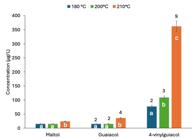
Representative phenolic compounds in sugarcane bagasse at different toasting temperatures, different lowercase letters indicate differences between the different toasting level and OAV>1 has been included
The variation in the concentration of these compounds with toasting temperature is also relevant to understanding how different temperatures affect the composition of volatile compounds in toasted bagasse.
A total of 27 substances were identified in the analysis of volatile compounds present in sugarcane bagasse toasted at different temperatures. These substances were classified into various chemical categories, including furanic compounds, phenolic aldehydes and phenylketones, lactones, phenolic compounds,and linear hydrocarbons that can influence aromatic complexity.
Table 2 presents the statistical significance of the differences in the concentration of these volatile compounds found because of bagasse toasting. It is important to note that the table shows only those compounds that presented significant differences in their concentration as a function of toasting temperature. This means that these compounds are the ones that are most affected by the toasting process and, therefore, are the ones that can contribute most to the sensory profile provided by the toasted bagasse. These compounds will be extracted by the wine and distillate differently depending on the degree of toasting of the cane bagasse used in its ageing. Some compounds increase significantly with the degree of toasting (furfural, 5-methylfurfural, vanillin, syringaldehyde, coniferaldehyde, acetovanillone, maltol, guaiacol and 4-vinylguaiacol) (Table 2 and figures 4, 5, 6) while furfuryl alcohol and trans-whisky lactone decrease with toasting due to degradation with temperature. This is a crucial aspect in its final chemical and sensory properties.
Results of analysis of variance for compounds with significant differences (** p<0.01, ***<0.001).
In the analysis of volatile compounds present in sugarcane bagasse toasted at different temperatures, several furanic compounds were identified, including furfural, 5-hydroxymethylfurfural, 5-methylfurfural, furfuryl alcohol and furfurylthiol. These compounds are products of the degradation of sugars present in the bagasse during the toasting process (Tarko et al., 2023; Luo et al., 2023; Murata, 2021).
The concentrations of 5-hydroxymethylfurfural and furfurylthiol were found to be less than 15 μg/L in toasted sugarcane bagasse at the three temperatures evaluated. This suggests that 5- hydroxymethylfurfural, although present, has a limited impact on the sensory profile of toasted bagasse.
Furfural, on the other hand, was the most abundant compound identified in sugarcane bagasse toasted at the different temperatures evaluated in this study. Its concentration increased significantly (Table 2 and Figure 4) with increasing toasting temperature, reaching values of 724±36 μg/L at 180°C, 1492±90 μg/L at 200°C and 2720±150 μg/L at 210°C. In fact, 5-methylfurfural also showed a significant increase in its concentration (Figure 4) with increasing toasting temperature, with values of 43±4 μg/L, 82±8 μg/L and 219±11 μg/L, respectively. According to (Tarko et al., 2023), the olfactory perception, threshold for furfural is 15 mg/L and for 5-methylfurfural is 16 μg/L, indicating that toasted bagasse with light, medium and strong levels can contribute perceptible toasted or bitter almond notes in distillates. In contrast, the concentration of furfuryl alcohol decreased significantly with increasing temperature (Table 2), with values of 1700±153 μg/L, 1018±61 μg/L and 573±55 μg/L (Figure 4). The above results are consistent with those performed on several oak varieties, including American and French, as well as acacia and chestnut woods. This suggests that the compounds generated during the toasting of sugarcane bagasse are like those generated during the toasting of other woods used in the ageing of distilled beverages.
Hemicellulose, due to its high thermosensitivity, generates furanic compounds during toasting, particularly furfural derived from pentoses, which contributes to the characteristic nutty and toasted aromas in aged products. This explains the high concentration of furfural observed in sugarcane bagasse and its increase with temperature. In contrast, 5-hydroxymethylfurfural, 5-methylfurfural and furfurylthiol, derived from cellulose (thermally more stable) and furfuryl alcohol, a product of the reduction of furfural during toasting, contribute caramel and toasted aromas (Tarko et al., 2023). The continuous increase in the concentration of these compounds is attributed to their increased production from cellulose and hemicelluloses, as well as to the thermal degradation of furanic compounds at temperatures close to 170 °C (Martínez-Gil et al., 2018).
Furfural and 5-hydroxymethylfurfural are also formed through the Maillard reaction and caramelization during toasting. These processes are complex and result from the interaction between sugars and amino acids at high temperatures. Hexoses are transformed into 5-hydroxymethylfurfural and 5-methylfurfural, while pentoses are converted to furfural (Bortoletto et al., 2016; Duan et al., 2024; Canas et al., 2019).
Figure 5 illustrates the phenolic aldehydes and phenylketones identified in toasted sugar cane bagasse. These compounds are important contributors to the aromatic profile of toasted bagasse, and their concentration increases or decreases significantly with increasing toasting temperature (Table 2). These compounds are of particular interest because their formation and concentration are directly dependent on the toasting temperature. Therefore, it is expected that the wine and distillate will extract these compounds differently, which means that the flavor and aroma profile of the final product will vary according to the degree of toasting of the bagasse used for ageing. Vanillin was the predominant compound among the phenolic aldehydes and phenylketones identified, with concentrations of 38±3 μg/L at 180°C, 58±4 μg/L at 200°C and 185±13 μg/L at 210°C. This significant increase (Table 2) with toasting temperature indicates that vanillin is generated in greater amounts as toasting temperature increases. As reported by different authors (Luo et al., 2023; Ling et al., 2023; He et al., 2023), the olfactory perception threshold for vanillin is 60 μg/L. Since vanillin concentrations in bagasse toasted at medium (200°C) and high (210°C) temperatures exceed this threshold, it is likely that toasted bagasse with medium and strong toasting levels can contribute perceptible vanilla notes to final products, such as distilled beverages. The OAV , calculated as the ratio between the concentration of a compound and its odour threshold, indicates 1, 1 and 3 for light, medium and strong toasting levels, respectively, suggesting that vanillin could contribute significantly to the odour perceived in aged beverages.
The next aldehyde is syringaldehyde, whose values ranged from less than 15±1 μg/L at 180 °C, 28±3 μg/L at 200 °C, and 129±5 μg/L at 210 °C. Like vanillin, syringaldehyde shows a significant increase in concentration with increasing toasting temperature. Despite having a relatively high perception threshold of 50 mg/L, which is much higher than its concentration in toasted bagasse, this aldehyde indirectly contributes to the aromatic profile of beverages. Its vanilla aroma is not directly perceived; this compound forms synergy with other aldehydes. Thus, when it interacts with vanillin, they mutually enhance each other and reinforce the overall vanilla and spicy aroma. Although syringic aldehyde is not the main player, its presence is essential to achieve a more complex and complete vanilla profile (Jordão & Cosme, 2022; Luo et al., 2023; Courregelongue et al., 2025). Coniferaldehyde was also detected, with concentrations of 18±3 μg/L at 180 °C, 41±3 μg/L at 200 °C, and 84±5 μg/L at 210 °C. No olfactory perception threshold has been reported for coniferaldehyde, making it difficult to determine its direct contribution to aroma. This compound contributes subtle aromatic notes that complement and complexify the final distillate profile (Casassa et al., 2021; Jordão & Cosme, 2022).
Acetovanillone is a compound that, like other aldehydes, is directly affected by toasting temperature. Its concentrations in bagasse are lower than 15 μg/L at 180 °C and 200 °C, but increase to 20 μg/L when the temperature reaches 210 °C. Despite this increase, acetovanillone has a very high perception threshold (1000 μg/L), which means that its aroma is not perceptible on its own at the concentrations found in toasted bagasse. However, its real importance lies in its ability to act synergistically with other compounds, such as vanillin and syringaldehyde (Tarko et al., 2023).
Although they are not individually detectable by the senses, coniferaldehyde, acetovainillone, and syringaldehyde can act as aromatic enhancers, interacting synergistically with other volatile compounds present in toasted sugarcane bagasse. This interaction can modify and enrich the overall aromatic profile, contributing to the complexity and subtlety of the final aroma of the beverage (Luo et al., 2023).
The concentration of vanillin, acetovanillone, syringaldehyde, and coniferaldehyde increased with the temperature of toasting, a trend consistent with that observed in woods such as oak (Table 2). This increase is due to the oxidative degradation of lignin structural units, specifically guaiacyl and syringyl, which are key components of lignin. At temperatures close to 165 °C, these structural units decompose and release related compounds (Vichi et al., 2007; Martínez-Gil et al., 2018). Intense toasting promotes the decomposition of lignin into phenolic aldehydes, mainly vanillin and syringaldehyde. The production of compounds related to vanillin aroma starts at 150 °C -160 °C, reaches its maximum at 195 °C to 215 °C and ceases at temperatures above 250 °C (Sánchez-Gómez et al., 2020). This indicates that there is an optimal temperature range for vanillin generation during sugarcane bagasse toasting.
The olfactory perception thresholds for the phenolic aldehydes syringaldehyde, coniferaldehyde and acetovanillone vary significantly. Syringaldehyde has a relatively low perception threshold of 50 mg/L, which means that it cannot be detected by the human olfactory system at relatively low concentrations, providing a characteristic floral aroma. Acetovanillone, on the other hand, has a perception threshold of 1,000 μg/L, indicating that a lower concentration is required to be perceptible to the human sense of smell. On the other hand, no olfactory perception threshold has been reported for coniferaldehyde, which makes it difficult to determine its direct contribution to the aroma (Luo et al., 2023; Tarko et al., 2023). Although not individually detectable, these compounds can act as aromatic enhancers, interacting synergistically with other volatile compounds present in toasted sugarcane bagasse. This interaction can modify and enrich the overall aromatic profile, contributing to aroma complexity and subtlety.
As for the lactones (β-methyl-γ-octalactone) detected (Figure 6), cis-whisky lactone was found in concentrations below 15𝜇 g/L at all temperatures evaluated, showing no differences in relation to the level of toasting applied to the sugarcane bagasse. This suggests that cis-whisky lactone formation is not significantly affected by toasting temperature in the range studied. On the other hand, trans-whisky lactone presented a concentration of 38±5 μg/L at 180°C, showing a slight decrease as temperature increased (Table 2), with values of 33±3 μg/L at 200°C and 34±3 μg/L at 210°C. This slight decrease suggests that trans-whisky lactone may be slightly unstable at higher temperatures, although the variation in concentration is not very pronounced. These results are consistent with those reported in previous studies conducted on American oak and French oak, where it is observed that trans-whisky lactone concentrations are generally higher than those of cis-whisky lactone (Luo et al., 2023). This suggests that trans-whisky lactone, although having a lower perception threshold, may have a greater impact on the sensory profile of products aged in contact with toasted sugarcane bagasse, similar to that observed with oak.
Lactones, volatile compounds that contribute characteristic coconut or wood aromas, are generated mainly through two routes during the toasting of sugarcane bagasse: the decomposition of lipids, especially the oxidation of fatty acids, and the thermal degradation of glycosidic precursors that begins at temperatures close to 95°C, reaching a maximum at around 100 °C to 110 °C. However, at temperatures above 150 °C to 160 °C, lactones begin to degrade, resulting in a decrease in their concentration. On the other hand, increases in lactone concentration have been reported at higher temperatures, in the range of 200 °C - 220 °C, according to studies (Sánchez-Gómez et al., 2020). This phenomenon suggests that lactone formation from lipid breakdown may occur at higher temperatures, compensating for the degradation of lactones formed from glycosidic precursors. Olfactory perception thresholds for lactones vary according to their isomeric structure. Cis-whisky lactone has a perception threshold ranging from 20 μg/L to 46 μg/L, whereas trans-whisky lactone has a higher perception threshold ranging from 140 μg/L to 370 μg/L (Tarko et al., 2023). This means that cis-whisky lactone is more readily detectable by human olfaction at lower concentrations, suggesting that it may have a greater impact on the sensory profile of toasted cane bagasse and aged products in contact with it.
Three linear hydrocarbons were identified in toasted sugarcane bagasse, the most abundant being isovaleric acid (Table 2) with concentrations of 60±3 μg/L at 180 °C, 80±3 μg/L at 200 °C, and with a very small decrease at 210 °C with a value of 72±5 μg/L (Figure 6). This reduction suggests a possible instability of isovaleric acid at higher toasting temperatures. On the other hand, valeric acid and trans-2-nonenal acid remained at concentrations below 15 μg/L at all toasting temperatures evaluated, indicating a limited impact on the aromatic profile of toasted bagasse, at least at the concentrations found in this study.
In the analysis of phenolic compounds present in sugarcane bagasse toasted at different temperatures, thirteen phenolic compounds were identified, including geraniol, syringol, o-cresol, 2, 6-dimethoxyphenol, 4-vinylphenol, 3, 4-dimethylphenol, ethylphenol, isoeugenol, eugenol, and 4-ethylguaiacol with concentrations lower than 15 μg/L, at all temperatures evaluated. Moreover, their concentrations did not show significant variations with increasing toasting temperature. This suggests that these compounds are relatively stable during the toasting process and that their formation or release is not affected by temperature in the range studied. As indicated above, the low impact of these compounds at the individual level is due to their high olfactory perception thresholds (Table 1). However, their importance derives from their ability to interact and contribute synergistically to the overall aromatic profile (Courregelongue et al., 2025).
However, three phenolic compounds were identified that showed different behavior: 4-vinylguaiacol, guaiacol and maltol. These three compounds showed an increase in concentration as the toasting temperature increased (Figure 7). This increase indicates that the formation or release of these compounds is favored by higher toasting temperatures. In addition, 4-vinylguaiacol is another compound present in toasted sugarcane bagasse. Its concentration increased significantly with toasting temperature (Table 2), reaching values of 77±5 μg/L at 180 °C, 109±6 μg/L at 200 °C, and 362±20 μg/L at 210 °C. This compound is known to impart spicy, clove-like, or smoky notes to aged distillates. Since its olfactory perception threshold is 40 μg/L (Tarko et al., 2023; Luo et al., 2023), toasted sugarcane bagasse in its three toasting levels (light, medium and strong) can contribute these notes to wines and distillates, as its concentrations exceed this threshold. The OAV, calculated as the ratio between the concentration of a compound and its olfactory threshold, indicates that the contents of 4- vinylguaiacol for light, medium and strong toasting levels are 2, 3 and 9, respectively, which indicates the importance of this compound in the aroma perceived in aged beverages with bagasse.
Guaiacol, on the other hand, showed concentrations below 15 μg/L in toasts at 180°C and 200 °C, with its concentration increasing to 36±3 μg/L at 210 °C. This compound contributes smoky notes, and its perception threshold is between 9.5 μg/L and 10 μg/L (Luo et al., 2023; Tarko et al., 2023), indicating that sugarcane bagasse toasted at high temperatures (210 °C) can impart smoky notes to distillates. The OAV indicates 2, 2, and 4 for light, medium, and strong toasting levels, suggesting that guaiacol could contribute significantly to the odour perceived in aged beverages.
Maltol showed similar behavior to guaiacol, increasing significantly in concentration with increasing toasting temperature (Table 2). It showed concentrations below 15 μg/L in toasts at 180°C and 200 °C, and an increase to 24±2 μg/L at 210 °C. Maltol contributes toasted or caramel notes, and its olfactory perception threshold is 5 mg/L (Tarko et al., 2023). This suggests that sugarcane bagasse toasted at high temperatures (210 °C) cannot individually contribute notes to the distillates it ages due to its high perception threshold.
At toasting temperatures between 180 °C and 190 °C, volatile phenols such as guaiacol, ethylphenol and cresols are generated (Sánchez et al., 2020). These compounds contribute to the aromatic profile of toasted bagasse and can influence the flavor and aroma of distillates aged in contact with it. Several studies have shown that the concentration of volatile substances present in wood increases with toasting temperature (Sánchez-Gómez et al., 2020; Collins et al., 2015), a trend that was also found in some of the substances identified in toasted sugarcane bagasse, such as vanillin, furfuryl alcohol, furfural, 4-vinylguaiacol, guaiacol, while furfuryl alcohol decreased with temperature.
The volatile compounds identified in toasted sugarcane bagasse showed remarkable similarities to those in woods used for ageing distillates such as American and French oak, as well as to alternative woods such as acacia, chestnut and cherry. Table 3 presents a list of the most relevant volatile compounds identified in toasted sugarcane bagasse and in various woods according to the literature.
Volatile compounds identified in cane bagasse toasted with French and American oaks and alternatives such as cherry, acacia, chestnut and ash.
4 Conclusions
As with wood, the toasting temperature of sugarcane bagasse directly affects the concentration of volatile compounds. The study identified 27 compounds, 12 of them in significant concentrations, which are responsible for complex aromas such as vanilla, caramel, walnut, coconut, and smoky notes. At higher temperatures, such as 210 °C, a significant increase in key compounds such as vanillin, guaiacol, and furfural is observed, allowing the desired flavour profile to be controlled.
The volatile compounds generated by the thermal degradation of hemicellulose and lignin confer desirable profiles. Compounds such as vanillin and furfural increase dramatically with temperature. Furfural, the most abundant, contributes intense, toasted, and caramel notes. Vanillin reaches sufficient concentrations (OAV > 1 at 200 °C and 210 °C) to contribute directly to the vanilla aroma. Indeed, 4-vinylguaiacol (clove/spice notes) has a very low perception threshold, meaning that bagasse contributes these notes even in light roasts. Guaiacol, which imparts smoky notes, is generated significantly only when toasted at 210 °C.
Compounds such as cis-whisky lactone, 5-hydroxymethylfurfural, valeric acid, and numerous phenolic compounds (syringol, o-cresol, eugenol, etc.) were detected in very low concentrations (<15 ug/L) and did not show significant variations with temperature, limiting their individual aromatic impact.
Compounds such as syringaldehyde, acetovanillone, and maltol (with honey/toasted notes), despite their high thresholds, increase significantly at 210°C. Their presence ensures a synergistic effect that enriches the vanilla note and the spicy character contributed by other compounds, adding complexity.
Sugarcane bagasse, due to its chemical composition similar to wood (lignin, cellulose, and hemicellulose), its ability to generate volatile compounds during toasting, and its sustainable nature, positions it as a material with great potential to be an alternative to oak wood in the ageing of alcoholic beverages and vinegars.
Sugarcane bagasse is a promising and sustainable alternative for ageing distilled beverages. Unlike traditional woods such as oak, which require long growth and felling processes, bagasse is an abundant and renewable by-product of panela production. By giving it a new use, pressure on forests is reduced, a material that would otherwise be waste is utilised, and a more efficient circular economy is promoted.
Although this research confirms that sugarcane bagasse produces key volatile compounds, further research is needed to optimise its use. It is important to explore how variables such as toasting time and different varieties of cane influence the aromatic profile. The long-term impact of toasted bagasse compounds on aged beverages is not yet known, nor is it known whether unique interactions might occur during the process. This research could lead to the creation of products with unique sensory characteristics that cannot be achieved with traditional wood.
Acknowledgements
I express my gratitude to the UVaMOX research group of the University of Valladolid, Spain, for the valuable opportunity they gave me during my research stay. In particular, I extend my sincere appreciation to Dr. Maria Del Alamo Sanza for her constant technical, academic, and human support, as well as to María Asensio Cuadrado for sharing her enriching experiences.
To Minciencias and the General System of Royalties, through the Bicentennial Doctoral Excellence Scholarship Program, Second Cohort 2019, Colombia, for funding my research stay and the project entitled: "Obtaining tafia through a chemical-enzymatic, fermentative and ageing method applied to sugarcane bagasse from the production of panela in the department of Boyacá", from which this research is derived.
-
Cite as:
Valcárcel-Bolívar, N. J., del Alamo-Sanza, M., Asensio-Cuadrado, M., Martínez-Gil, A. M., & Nevares, I. (2026). Effect of toasting temperature on the generation of volatile compounds in sugar cane bagasse. Brazilian Journal of Food Technology, 29, e2025053. https://doi.org/10.1590/1981-6723.0532025
-
Data Availability Statement
All data generated or analyzed in this study are included in this published article.
-
Funding:
Bicentennial Doctoral Excellence Scholarship Program.
References
-
Alokika, Anu, Kumar, A., Kumar, V., & Singh, B. (2021). Cellulosic and hemicellulosic fractions of sugarcane bagasse: Potential, challenges and future perspective. International Journal of Biological Macromolecules, 169, 564-582. PMid:33385447. https://doi.org/10.1016/j.ijbiomac.2020.12.175
» https://doi.org/10.1016/j.ijbiomac.2020.12.175 -
Amit, T. A., Roy, R., & Raynie, D. E. (2021). Thermal and structural characterization of two commercially available technical lignins for potential depolymerization via hydrothermal liquefaction. Current Research in Green and Sustainable Chemistry, 4, 100106. https://doi.org/10.1016/j.crgsc.2021.100106
» https://doi.org/10.1016/j.crgsc.2021.100106 -
Bortoletto, A. M., Correa, A. C., & Alcarde, A. R. (2016). Aging practices influence chemical and sensory quality of cachaça. Food Research International, 86, 46-53. https://doi.org/10.1016/j.foodres.2016.05.003
» https://doi.org/10.1016/j.foodres.2016.05.003 -
Canas, S., Caldeira, I., Anjos, O., & Belchior, A. P. (2019). Phenolic profile and colour acquired by the wine spirit in the beginning of ageing: alternative technology using micro-oxygenation vs traditional technology. Lebensmittel-Wissenschaft + Technologie, 111, 260-269. https://doi.org/10.1016/j.lwt.2019.05.018
» https://doi.org/10.1016/j.lwt.2019.05.018 -
Casassa, F., Ceja, G., Osorno, A., Du Fresne, F., & Llodrá, D. (2021). Detailed chemical composition of Cabernet Sauvignon wines aged in French oak barrels coopered with three different stave bending techniques. Food Chemistry, 340, 127573. PMid:33032144. https://doi.org/10.1016/j.foodchem.2020.127573
» https://doi.org/10.1016/j.foodchem.2020.127573 -
Cárdenas, L.M.Z., Ones, O.P., Ramos, P.A.R., Cárdenas, B.M.Z., & Lombardi, G. (2015). Potencialidades del bagazo para la obtención de etanol frente a la generación de electricidad. Ingeniería, Investigación y Tecnología, 16(3), 407-418. https://doi.org/10.1016/j.riit.2015.05.001
» https://doi.org/10.1016/j.riit.2015.05.001 -
Cernîşev, S. (2017). Analysis of lignin-derived phenolic compounds and their transformations in aged wine distillates. Food Control, 73, 281-290. https://doi.org/10.1016/j.foodcont.2016.08.015
» https://doi.org/10.1016/j.foodcont.2016.08.015 -
Chávez-Sifontes, M., & Domine, M. (2013). Lignin, structure and applications depolymerization methods for obtaining aromatic derivatives of industrial interest. Avances en Ciencias e Ingeniería, 4(4), 15-46. Retrieved in 2025, May 19, from https://riunet.upv.es/server/api/core/bitstreams/064dc00d-6338-4d9c-88b7-cedede1006ed/content
» https://riunet.upv.es/server/api/core/bitstreams/064dc00d-6338-4d9c-88b7-cedede1006ed/content -
Coldea, T. E., Socaciu, C., Mudura, E., Socaci, S. A., Ranga, F., Pop, C. R., Vriesekoop, F., & Pasqualone, A. (2020). Volatile and phenolic profiles of traditional Romanian apple brandy after rapid ageing with different wood chips. Food Chemistry, 320, 126643. PMid:32208184. https://doi.org/10.1016/j.foodchem.2020.126643
» https://doi.org/10.1016/j.foodchem.2020.126643 -
Collins, T. S., Miles, J. L., Boulton, R. B., & Ebeler, S. E. (2015). Targeted volatile composition of oak wood samples taken during toasting at a commercial cooperage. Tetrahedron, 71(20), 2971-2982. https://doi.org/10.1016/j.tet.2015.02.079
» https://doi.org/10.1016/j.tet.2015.02.079 -
Courregelongue, M., Albertin, W., Prida, A., & Pons, A. (2025). Molecular characterization of toasted oak wood (Quercus petraea) volatilome by untargeted GCxGC-ToFMS analysis. Applied Food Research, 5(2), 101078. https://doi.org/10.1016/j.afres.2025.101078
» https://doi.org/10.1016/j.afres.2025.101078 -
Courregelongue, M., & Pons, A. (2024). The aroma of toasted oak wood (Quercus petraea): from sensory analysis to molecular characterization. OENO One, 58(4), https://doi.org/10.20870/oeno-one.2024.58.4.7883
» https://doi.org/10.20870/oeno-one.2024.58.4.7883 -
Culleré, L., Escudero, A., Cacho, J., & Ferreira, V. (2004). Gas chromatography-olfactometry and chemical quantitative study of the aroma of six premium quality Spanish aged red wines. Journal of Agricultural and Food Chemistry, 52(6), 1653-1660. PMid:15030226. https://doi.org/10.1021/jf0350820
» https://doi.org/10.1021/jf0350820 -
Culleré, L., Fernández de Simón, B., Cadahía, E., Ferreira, V., Hernández-Orte, P., & Cacho, J. (2013). Characterization by gas chromatography-olfactometry of the most odor-active compounds in extracts prepared from acacia, chestnut, cherry, ash and oak woods. Lebensmittel-Wissenschaft + Technologie, 53(1), 240-248. https://doi.org/10.1016/j.lwt.2013.02.010
» https://doi.org/10.1016/j.lwt.2013.02.010 -
Del Alamo-Sanza, M., & Nevares, I. (2018). Oak wine barrel as an active vessel: a critical review of past and current knowledge. Critical Reviews in Food Science and Nutrition, 58(16), 2711-2726. PMid:28557529. https://doi.org/10.1080/10408398.2017.1330250
» https://doi.org/10.1080/10408398.2017.1330250 -
Díaz-Maroto, M. C., Sánchez-Palomo, E., & Pérez-Coello, M. (2004). Fast screening method for volatile compounds of oak wood used for aging wines by headspace SPME-GC-MS (SIM). Journal of Agricultural and Food Chemistry, 52(23), 6857-6861. PMid:15537286. https://doi.org/10.1021/jf049032m
» https://doi.org/10.1021/jf049032m -
Duan, B., Chang, W., Zhang, L., Zheng, M., Su-zhou, C., Merkeryan, H., Xu, M., & Liu, X. (2024). Characterization of volatile compounds and sensory properties of spine grape (Vitis davidii Foex) brandies aged with different toasted wood chips. Food Chemistry: X, 23(22), 101777. PMid:39295964. https://doi.org/10.1016/j.fochx.2024.101777
» https://doi.org/10.1016/j.fochx.2024.101777 -
Duran Castro, N., Gil Zapata, N., & García, H. (1992). Manual de elaboración de panela y otros derivados de la caña. Barbosa: CIMPA. Retrieved in 2025, May 19, from https://repository.agrosavia.co/handle/20.500.12324/30071
» https://repository.agrosavia.co/handle/20.500.12324/30071 -
Feng, Z., Martínez-Lapuente, L., Ayestarán, B., & Guadalupe, Z. (2023). Volatile and sensory characterization of Tempranillo wines aged in Quercus alba oak barrels of different geographical origins in USA. Lebensmittel-Wissenschaft + Technologie, 173, 114328. https://doi.org/10.1016/j.lwt.2022.114328
» https://doi.org/10.1016/j.lwt.2022.114328 -
Fernández de Simón, B., Cadahía, E., del Álamo, M., & Nevares, I. (2010). Effect of size, seasoning and toasting in the volatile compounds in toasted oak wood and in a red wine treated with them. Analytica Chimica Acta, 660(1–2), 211-220. PMid:20103165. https://doi.org/10.1016/j.aca.2009.09.031
» https://doi.org/10.1016/j.aca.2009.09.031 -
Flórez Martínez, D. H. (2013). Agenda prospectiva de investigación de la cadena productiva de la panela y su agroindustria. Tecnura, 17(36), 72-86. Retrieved in 2025, May 19, from http://www.scielo.org.co/scielo.php?script=sci_arttext&pid=S0123-921X2013000200007
» http://www.scielo.org.co/scielo.php?script=sci_arttext&pid=S0123-921X2013000200007 -
Ghadiriasli, R., Mahmoud, M. A. A., Wagenstaller, M., van de Kuilen, J. W., & Buettner, A. (2021). Chemo-sensory characterization of aroma active compounds of native oak wood in relation to their geographical origins. Food Research International, 150(Pt A), 110776. PMid:34865791. https://doi.org/10.1016/j.foodres.2021.110776
» https://doi.org/10.1016/j.foodres.2021.110776 -
González-García, J. A., Cereceda, M., Durán-Guerrero, E., Rodríguez-Dodero, M. C., & Castro, R. (2024). Comparative study on the use of seasoned or unseasoned casks made of wood from different origins for the ageing of Sherry vinegar. Journal of the Science of Food and Agriculture, 104(3), 1271-1281. PMid:37756429. https://doi.org/10.1002/jsfa.13009
» https://doi.org/10.1002/jsfa.13009 -
Gómez García-Carpintero, E., Sánchez-Palomo, E., & González Viñas, M. A. (2014). Volatile composition of Bobal red wines subjected to alcoholic/malolactic fermentation with oak chips. Lebensmittel-Wissenschaft + Technologie, 55(2), 586-594. https://doi.org/10.1016/j.lwt.2013.10.024
» https://doi.org/10.1016/j.lwt.2013.10.024 -
He, Y., Wang, X., Li, P., Lv, Y., Nan, H., Wen, L., & Wang, Z. (2023). Research progress of wine aroma components: a critical review. Food Chemistry, 402, 134491. PMid:36303386. https://doi.org/10.1016/j.foodchem.2022.134491
» https://doi.org/10.1016/j.foodchem.2022.134491 -
Hiranobe, C. T., Gomes, A. S., Paiva, F. F. G., Tolosa, G. R., Paim, L. L., Dognani, G., Cardim, G. P., Cardim, H. P., dos Santos, R. J., & Cabrera, F. C. (2024). Sugarcane bagasse: challenges and opportunities for waste recycling. Cleanroom Technology, 6(2), 662-699. https://doi.org/10.3390/cleantechnol6020035
» https://doi.org/10.3390/cleantechnol6020035 -
Jordão, M., Correia, A. C., Botelho, R. V., & Ortega-Heras, M. (2025). Phenolic content, volatile composition and sensory profile of red wines macerated with toasted woods from different South American botanical species. Journal of Food Composition and Analysis : An Official Publication of the United Nations University, International Network of Food Data Systems, 137, 106854. https://doi.org/10.1016/j.jfca.2024.106854
» https://doi.org/10.1016/j.jfca.2024.106854 -
Jordão, A. M., & Cosme, F. (2022). The application of wood species in enology: chemical wood composition and effect on wine quality. Applied Sciences (Basel, Switzerland), 12(6), 3179. https://doi.org/10.3390/app12063179
» https://doi.org/10.3390/app12063179 -
Kainuma, G., Mochizuki, A., Watanabe-Saito, F., Hisamoto, M., Kusumoto, N., de Revel, G., & Okuda, T. (2024). Understanding wood polysaccharide depolymerization and denaturation under different toasting conditions through analysis of sugars extracted from french oak chips. Beverages, 10(4), 1-13. https://doi.org/10.3390/beverages10040118
» https://doi.org/10.3390/beverages10040118 -
Kubovský, I., Kačíková, D., & Kačík, F. (2020). Structural changes of oak wood main components caused by thermal modification. Polymers, 12(2), 485. PMid:32098208. https://doi.org/10.3390/polym12020485
» https://doi.org/10.3390/polym12020485 -
Ling, M., Bai, X., Cui, D., Shi, Y., Duan, C., & Lan, Y. (2023). An efficient methodology for modeling to predict wine aroma expression based on quantitative data of volatile compounds: A case study of oak barrel-aged red wines. Food Research International, 164, 112440. PMid:36738004. https://doi.org/10.1016/j.foodres.2022.112440
» https://doi.org/10.1016/j.foodres.2022.112440 -
Luo, M., Cui, D., Li, J., Zhou, P., Duan, C., Lan, Y., & Wu, G. (2023). Factors in modulating the potential aromas of oak whisky barrels: origin, toasting, and charring. Foods, 12(23), 4266. PMid:38231733. https://doi.org/10.3390/foods12234266
» https://doi.org/10.3390/foods12234266 -
Maceda, A., Soto-Hernández, M., Peña-Valdivia, C. B., Trejo, C., & Terrazas, T. (2021). Lignin: composition, synthesis and evolution. Madera y Bosques, 27(2), e2722137. https://doi.org/10.21829/myb.2021.2722137
» https://doi.org/10.21829/myb.2021.2722137 -
Martínez-Gil, A., Del Alamo-Sanza, M., Sánchez-Gómez, R., & Nevares, I. (2018). Different woods in cooperage for oenology: A review. Beverages, 4(4), 94. https://doi.org/10.3390/beverages4040094
» https://doi.org/10.3390/beverages4040094 -
Martínková, L., Grulich, M., Pátek, M., Křístková, B., & Winkler, M. (2023). Bio-based valorization of lignin-derived phenolic compounds: A review. Biomolecules, 13(5), 717. PMid:37238587. https://doi.org/10.3390/biom13050717
» https://doi.org/10.3390/biom13050717 -
Murata, M. (2021). Mini review. Browning and pigmentation in food through the Maillard reaction. Glycoconjugate Journal, 38(3), 283-292. PMid:32910400. https://doi.org/10.1007/s10719-020-09943-x
» https://doi.org/10.1007/s10719-020-09943-x -
Nie, X., Liu, K., Zhang, Y., Wang, Z., Meng, C., Liu, K., Zhao, Z., & Ao, C. (2023). Effect of oak chips on quality and flavor of persimmon brandy: A comprehensive analysis of volatile and non-volatile compounds. Lebensmittel-Wissenschaft + Technologie, 183, 114915. https://doi.org/10.1016/j.lwt.2023.114915
» https://doi.org/10.1016/j.lwt.2023.114915 -
Niju, S., & Swathika, M. (2019). Delignification of sugarcane bagasse using pretreatment strategies for bioethanol production. Biocatalysis and Agricultural Biotechnology, 20(May), 101263. https://doi.org/10.1016/j.bcab.2019.101263
» https://doi.org/10.1016/j.bcab.2019.101263 -
Nosratpour, M. J., Karimi, K., & Sadeghi, M. (2018). Improvement of ethanol and biogas production from sugarcane bagasse using sodium alkaline pretreatments. Journal of Environmental Management, 226(July), 329-339. PMid:30125812. https://doi.org/10.1016/j.jenvman.2018.08.058
» https://doi.org/10.1016/j.jenvman.2018.08.058 -
Olate-Olave, V. R., Pino-Ramos, L. L., Peña-Martínez, P. A., Castro, R. I., Muñoz-Vera, M., Reyes-Manríquez, S., Casaubon, G., & Laurie, V. F. (2025). Red wine maceration with grape vine-cane residues: influence of format and toasting level. Heliyon, 11(3), e42164. PMid:39916825. https://doi.org/10.1016/j.heliyon.2025.e42164
» https://doi.org/10.1016/j.heliyon.2025.e42164 -
Pandey, S. (2022). Wood waste utilization and associated product development from under-utilized low-quality wood and its prospects in Nepal. SN Applied Sciences, 4(6), 168. https://doi.org/10.1007/s42452-022-05061-5
» https://doi.org/10.1007/s42452-022-05061-5 -
Rao, J., Lv, Z., Chen, G., & Peng, F. (2023). Hemicellulose: structure, chemical modification, and application. Progress in Polymer Science, 140, 101675. https://doi.org/10.1016/j.progpolymsci.2023.101675
» https://doi.org/10.1016/j.progpolymsci.2023.101675 -
Resano, D., Guillen, O. W., Ubillús, F. D. R., & Barranzuela, J. L. (2022). Caracterización fisicoquímica del bagazo de caña de azúcar industrial y artesanal como material de construcción. Información Tecnológica, 33(2), 247-258. https://doi.org/10.4067/S0718-07642022000200247
» https://doi.org/10.4067/S0718-07642022000200247 -
Romero-Sáez, M. (2022). Los residuos agroindustriales, una oportunidad para la economía circular. TecnoLógicas, 25(54), 1-4. https://doi.org/10.22430/22565337.2505
» https://doi.org/10.22430/22565337.2505 -
San Juan, F., Cacho, J., Ferreira, V., & Escudero, A. (2012). Aroma chemical composition of red wines from different price categories and its relationship to quality. Journal of Agricultural and Food Chemistry, 60(20), 5045-5056. PMid:22480297. https://doi.org/10.1021/jf2050685
» https://doi.org/10.1021/jf2050685 -
Smailagić, A., Natić, M., Veljović, S., Popović, J., & Dabić Zagorac, D. (2025). Review of wood materials used for the aging of alcoholic beverages: chemical composition and the potential of reusing of the cooperage by-products. Journal of Food Composition and Analysis : An Official Publication of the United Nations University, International Network of Food Data Systems, 147, 1-22. https://doi.org/10.1016/j.jfca.2025.108077
» https://doi.org/10.1016/j.jfca.2025.108077 -
Tarko, T., Krankowski, F., & Duda-Chodak, A. (2023). The impact of compounds extracted from wood on the quality of alcoholic beverages. Molecules (Basel, Switzerland), 28(2), 620. PMid:36677678. https://doi.org/10.3390/molecules28020620
» https://doi.org/10.3390/molecules28020620 -
Vichi, S., Santini, C., Natali, N., Riponi, C., López-Tamames, E., & Buxaderas, S. (2007). Volatile and semi-volatile components of oak wood chips analysed by Accelerated Solvent Extraction (ASE) coupled to gas chromatography-mass spectrometry (GC-MS). Food Chemistry, 102(4), 1260-1269. https://doi.org/10.1016/j.foodchem.2006.07.023
» https://doi.org/10.1016/j.foodchem.2006.07.023 -
Xu, R. R., Doskaliuk, N., Pang, B., Xu, J., Xu, W., Xu, C., Antonietti, M., & Filonenko, S. (2025). Hemicellulose from mild extraction of biomass: revealing structural insights and advancing potential value. Carbohydrate Polymer Technologies and Applications, 10, 100843. https://doi.org/10.1016/j.carpta.2025.100843
» https://doi.org/10.1016/j.carpta.2025.100843 -
Zhang, B., Cai, J., Duan, C. Q., Reeves, M. J., & He, F. (2015). A review of polyphenolics in oak woods. International Journal of Molecular Sciences, 16(4), 6978-7014. PMid:25826529. https://doi.org/10.3390/ijms16046978
» https://doi.org/10.3390/ijms16046978
Edited by
-
Section Editor:
Mateus Petrarca.
All data generated or analyzed in this study are included in this published article.


