 Validation and adaptation of an ion-exchange HPLC-DAD method for simultaneous analysis of organic acids in artisanal goat coalho cheese
Abstract
This study adapted and validated an HPLC-DAD method for the simultaneous quantification of eight organic acids in artisanal goat coalho cheese. The sample preparation used ion-exchange resin that ensures high selectivity for the complex protein matrices. The optimized method demonstrated excellent linearity (R2 > 0.998), precision (RSD < 4.5%), and recoveries ranging from 70% to 107%. The method was successfully applied to monitor the organic acid profiles in cheeses matured for 1, 20, 40, or 60 days, made with raw or pasteurized milk, with or without the addition of Limosilactobacillus mucosae CNPC007. Lactic acid was the predominant metabolite, negatively correlated with moisture, while acetic acid was inversely correlated with yield. These correlations reflect biochemical and technological transformations influenced by autochthonous culture. Overall, the validated method proved to be a robust, practical, and cost-effective tool for quality control and biochemical understanding of artisanal cheeses, broadening the possibilities for goat dairy products evaluation.
Keywords:
Method validation; Chromatographic analysis; Low-molecular-weight metabolites; Fermented dairy foods; Food quality control; Ripening process
Highlights
Organic acids are an important parameter for the production and maturation of cheeses
Simultaneous identification of organic compounds by HPLC.
Efficiency in the analysis by HPLC of organic compounds in cheese
Validation of the organic acids method for goat coalho cheese
Reduction of interferers in the analysis method using ion exchange resin.
1 Introduction
The expansion of goat farming for the production of meat, milk, and their derivatives has been gaining traction worldwide, including in Brazil (Miller & Lu, 2019; Instituto Brasileiro de Geografia e Estatistica, 2017). Among the derivatives, goat coalho cheese is the most commonly produced. Typically, small producers manufacture goat coalho cheeses on a limited scale and in an artisanal manner (Miller & Lu, 2019; Delgado-Júnior et al., 2020; Brasil, 2019; Queiroga et al., 2013; Dias et al., 2019). Artisanal cheeses are produced using traditional methods, influenced by regional culture, and valued for their connection to local communities (Brasil, 2019; Penna et al., 2021). Among the cheeses produced in the Northeast of Brazil, coalho cheese is among the most consumed due to its cultural significance and economic importance (Queiroga et al., 2013; Silva & Damasceno, 2021).
The variety and distinctive flavors of cheese are largely influenced by the type of milk used and the specific cultures of microorganisms involved in its production. Cheese made from raw milk retains the intrinsic characteristics of its natural microbiota, which provide unique compounds formed through various metabolic processes, particularly during maturation. In contrast, when milk is pasteurized and supplemented with starter or autochthonous cultures, fermentation is guided in a controlled manner, resulting in specific biochemical profiles in the final product (Olson, 1990; Perry, 2004; Bruno & Carvalho, 2009; Widyastuti et al., 2014; Aqeel et al., 2021).
Microbial cultures associated with milk enzymes initiate a series of complex biochemical reactions during ripening, converting lactose into lactic acid and other organic acids, which, in turn, influence sensory characteristics of the cheeses (Coelho et al., 2022; Widyastuti et al., 2014).
Due to their natural abundance of lipids, proteins, and minerals, cheeses present significant challenges for the analysis of organic acids. Effective strategies for sample preparation, such as filtration, dilution, or protein precipitation, are therefore required to eliminate interferents and preserve the analytes of interest (Costa et al., 2016). The use of techniques such as ion-exchange resin becomes indispensable, acting as a selective “clean-up” step that removes unwanted components and enables analytical methods to more accurately reveal the profile of organic acids (Pochet et al., 2018).
In food analysis, choosing an appropriate method is a strategic decision that must balance accuracy, detection capability, and, most importantly, accessibility and cost-effectiveness. While advanced techniques such as chromatography coupled with mass spectrometry (GC-MS or LC-MS/MS) offer exceptional sensitivity and specificity for detecting trace and complex compounds, their high acquisition, maintenance, and operational costs often pose a substantial barrier for many laboratories, particularly in regions with limited resources (Tolentino Júnior et al., 2021; Brasil, 2017).
Within this scenario, High-Performance Liquid Chromatography (HPLC), particularly when coupled with diode array detection (DAD), is a robust and widely accessible alternative for the quantification of compounds such as organic acids in complex matrices like cheese, as it offers precision, accuracy, and selectivity at a considerably lower cost (Costa et al., 2016). This accessibility makes HPLC-DAD an essential tool for quality control, research, and development activities across a broader range of laboratories, helping to democratize access to biochemical analyses that are fundamental for food safety and product characterization (Costa et al., 2016).
Several studies have employed high-performance liquid chromatography (HPLC) to quantify organic acids in plant-based matrices such as coffee, fruits, and beverages (Rodrigues et al., 2007; Diviš et al., 2019; Bressani et al., 2020; Santiago et al., 2020). However, the accurate analysis of these metabolites in fermented dairy products, such as cheese, remains challenging due to the complexity of the matrix. Previous studies on cheese, such as the study by Akalin et al. (2002), presented chromatographic methods but reported limitations in sensitivity, with high detection ranges (e.g., 200 µg/mL for pyruvic acid), which motivated the development of more sensitive approaches in this work. Although Gámbaro et al. (2017) investigated variations in the organic acid profiles of cheeses, the lack of formal validation weakens the robustness of their results. More recently, Olonimoyo et al. (2025) developed an efficient and cost-effective HPLC-PDA method for the analysis of organic acids; however, its validation was limited to fermentation broths, restricting its direct applicability to solid and complex food matrices.
Given this gap, the present study aimed to adapt and validate an HPLC-DAD method combined with sample preparation using ion-exchange resin for the simultaneous quantification of eight organic acids in artisanal goat's milk cheese produced under different technological treatments and maturation times. The method was based on established validation criteria to ensure greater selectivity, improved recoveries, and lower detection limits in a matrix as complex as cheese. In doing so, the study seeks to provide a robust, cost-effective analytical tool suitable for routine quality control and biochemical monitoring of regional fermented dairy products.
2 Material and methods
2.1 Material
2.1.1 Solvents, reagents, and standards
All reagents were of HPLC or analytical grade. Analytical standards for acetic, citric, formic, lactic, malic, propionic, succinic, and tartaric acids (Sigma-Aldrich, Darmstadt, Germany) and Dowex® 1x4, 100 mesh strong anion exchange resin (Sigma-Aldrich, Darmstadt, Germany) were used to analyze the organic acids. The autochthonous culture Limosilactobacillus mucosae CNPC007 was obtained from the microorganism collection of Embrapa (Empresa Brasileira de Pesquisa Agropecuária, Brazil).
2.1.2 Raw material
The analytical method was validated using real samples of goat coalho cheese produced with raw milk (RC) or pasteurized milk (PC), with or without the addition of the autochthonous culture Limosilactobacillus mucosae CNPC007 (LM), after 60 days of ripening. Cheeses were evaluated at 1, 20, 40, and 60 days of maturation, resulting in 16 treatments in total. Figure 1 illustrates the experimental design and classification of samples (e.g., RCLM, PCLM), according to milk treatment, culture addition, and ripening time.

Experimental design of goat coalho cheeses under different processing factors and treatments.
2.2 Methods
2.2.1 Sample extraction, cleaning, and preparation
The optimal mass for analysis was defined as 0.50 g of freeze-dried sample. Quintuplicate cheese samples were then fortified with a standard solution containing the eight target organic acids (acetic, citric, formic, lactic, malic, propionic, succinic, and tartaric acids) at concentrations of 2 mg.g-1, 3 mg.g-1, 6 mg.g-1, or 10 mg.g-1. To minimize potential interference, various extraction conditions were tested by adjusting the column eluent and the amount of ion exchange resin. For optimization, an ion exchange column was paired with Dowex®-1x4 resin. The procedure involved activating the resin with 20 mL of 0.1 M NaOH (aq), followed by sequential elutions with 20 mL of H2O, 20 mL of 0.5 M H3PO4(aq), another 20 mL of 0.1 M NaOH (aq), and 60 mL of H2O. The extract was then eluted with 25 mL of H2O, 25 mL of acetonitrile, and 60 mL of 0.5 M H3PO4(aq) solution.
The tests carried out were based on the methods described by Bressani et al. (2020), Diviš et al. (2019), and Khamitova et al. (2020), as shown in Figure 2. After eluting the samples through an ion exchange column, the solution was filtered through a 0.45 µm PVDF membrane and then injected into a high-performance liquid chromatography (HPLC) system, with a diode array detector (DAD) and the conditions described below.

2.2.2 Analyte determination and quantification
To quantify the analytes, a Shimadzu high-pressure liquid chromatography system (Shimadzu Corporation, Tokyo, Japan) was used. This system consists of a quaternary pump (model LC-20AT), an automatic injector (model SIL-20A) with a 20 μL injection capacity, a column oven (model CTO-20A) at a temperature of 30 °C, and a diode array detector (model CTO-20A). The wavelength used to detect the acids was 210 nm. The chromatographic column used was a C18 Zorbax SB column (4.6 x 250 mm, 5 μm, Agilent, Santa Clara, United States), with an Eclipse Plus C18 pre-column (2.1 x 5 mm, 1.8 μm, Agilent, Santa Clara, United States). To separate the compounds, a mobile phase gradient was applied at a flow rate of 1.0 mL/min as follows: mobile phase (MP) A: 0.1 M K2HPO4 at pH 2.5 with acetonitrile (99:1) and mobile phase (MP) B: acetonitrile (40:60). MP A was used at 100% from 1 to 25 minutes, followed by MP B at 100% from 25 to 40 minutes, and ending with MP A at 100% from 40 to 50 minutes. Analytes were quantified using the external standardization method, involving the construction of an analytical curve.
Although advanced techniques such as LC-MS and NMR provide high sensitivity and excellent resolution for complex matrices, their high acquisition, operation, and maintenance costs often limit their routine use in food research laboratories. In this context, HPLC-DAD combined with ion-exchange resin represents a practical and cost-effective alternative for the quantification of organic acids in artisanal cheeses. This approach offers robust selectivity and reliability, while maintaining analytical quality comparable to more sophisticated methods, ensuring accessibility for laboratories with limited resources.
To validate the method, the following analytical criteria were considered: selectivity, linearity, precision, accuracy, limit of detection, and limit of quantification (Codex Alimentarius Commission, 1997; Instituto Nacional de Metrologia Qualidade e Tecnologia, 2020).
2.2.3 Selectivity
Selectivity was assessed based on retention time and peak purity in the chromatogram, evaluating the method's ability to accurately identify and quantify the target analytes in the presence of potential matrix interferents (Brasil, 2017).
2.2.4 Linearity
Linearity was assessed by constructing an analytical calibration curve for each organic acid. The calibration was performed at five concentration levels: 25, 50, 75, 100, and 200 ppm for each acid, with all solutions diluted in purified water. Linearity was then calculated as follows (Equation 1):
Where r represents each of the test results; n is the number of variables, and r2 is the regression coefficient.
2.2.5 Precision and accuracy
Precision was assessed through analyses of repeatability and precision intermediate, along with analyte recovery from each assay, expressed as a percentage relative to the applied concentrations. For precision intermediate, samples were analyzed on the same day in quintuplicate for each concentration level (2 mg.g−1, 3 mg.g−1, 6 mg.g−1, and 10 mg.g−1 of cheese), totaling twenty independent determinations for each organic acid. These concentrations were selected to encompass the lowest detection limits of the assay (5 ppm, 10 ppm, and 20 ppm - were analyzed in triplicate). Detection was carried out at a wavelength of 210 nm to measure peak areas.
Accuracy was determined using Equations 2 and 3, based on the average recovery and the coefficient of variation.
Where CVMAX, studied concentration expressed as a power of 10 (ex. 1 mg.1000 g-1 (ppm) = 10-6, CV = 24 = 16%).
Where = average recovery; CV = coefficient of variation; = square root of the number of analyses.
2.2.6 Limit of Detection and Quantification (LoD and LoQ)
The limits of detection (LoD) and limits of quantification (LoQ) were estimated using a supplementary calibration curve with concentrations below the lowest concentration of the analytical curve, being 5 ppm, 10 ppm, and 20 ppm, also analyzed in triplicate. The LoD and LoQ were calculated following Equations 4 and 5:
Where Ybl is the linear coefficient obtained from the concentration/area curve equation; Sbl is the linear coefficient obtained from the concentration/s curve equation; b is the angular coefficient of the analytical curve; and s is the standard deviation estimate.
2.3 Statistical analysis
The statistical analyses were performed using STATISTICA v14.0.0.15 (TIBCO® Software, CA, USA). The analyses were performed in triplicate for real cheese samples, considering three independent biological replicates per treatment and ripening time. For method validation, the samples were evaluated in quintuplicate. Data normality and homoscedasticity were verified using the Shapiro–Wilk and Levene tests prior to ANOVA, respectively. Data from real cheese samples were subjected to one-way Analysis of Variance (ANOVA), and differences among means were assessed by Tukey’s test at a significance level of p < 0.05. Linear regression was applied to evaluate the relationship between treatments and responses. Principal Component Analysis (PCA) was used to explore the effects of treatments on variations in organic acid concentrations during ripening. Pearson’s correlation coefficient was employed to determine the association between lactic and acetic acids and physicochemical parameters (moisture and yield). Results were visualized as a heat map generated with Python’s Seaborn library, enabling the identification of significant linear relationships between fermentation activity and the physicochemical changes occurring throughout cheese maturation.
3 Results and discussion
3.1 Selection of conditions using reference standards
Preliminary tests defined the optimal extraction, purification, and chromatographic parameters, confirming method recovery, selectivity, precision, and linearity. The chromatogram (Figure 3) showed well-resolved peaks for all target acids, with retention times ranging from 2.9 min (tartaric) to 8.9 min (propionic). This indicates efficient gradient separation even in the complex cheese matrix. However, an unidentified peak appeared after the peak for succinic acid.
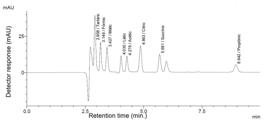
Chromatogram of organic acids in goat coalho cheese, with their respective retention times and detection at 210 nm. Peak 2 was identified as tartaric acid and the last peak as propionic acid.
3.2 Selectivity
Selectivity was assessed using pasteurized goat coalho cheese (1 day maturation) compared with fortified and blank samples. No coelutions or interferences were observed, and all peaks showed high spectral purity (0.999–1.000), confirming unequivocal identification (Table 1). Chromatograms of fortified samples (2–10 mg.g-1) maintained resolution across acids (Figure 4), demonstrating the method’s ability to discriminate eight organic acids in the complex cheese matrix.
Retention time and purity of target organic acid peaks within the goat coalho cheese matrix.

Chromatographic profile of the goat coalho cheese sample, (a) sample fortified with 3 mg of all evaluated organic acids and (b) sample without fortification, detected at 210 nm.
3.3 Linearity
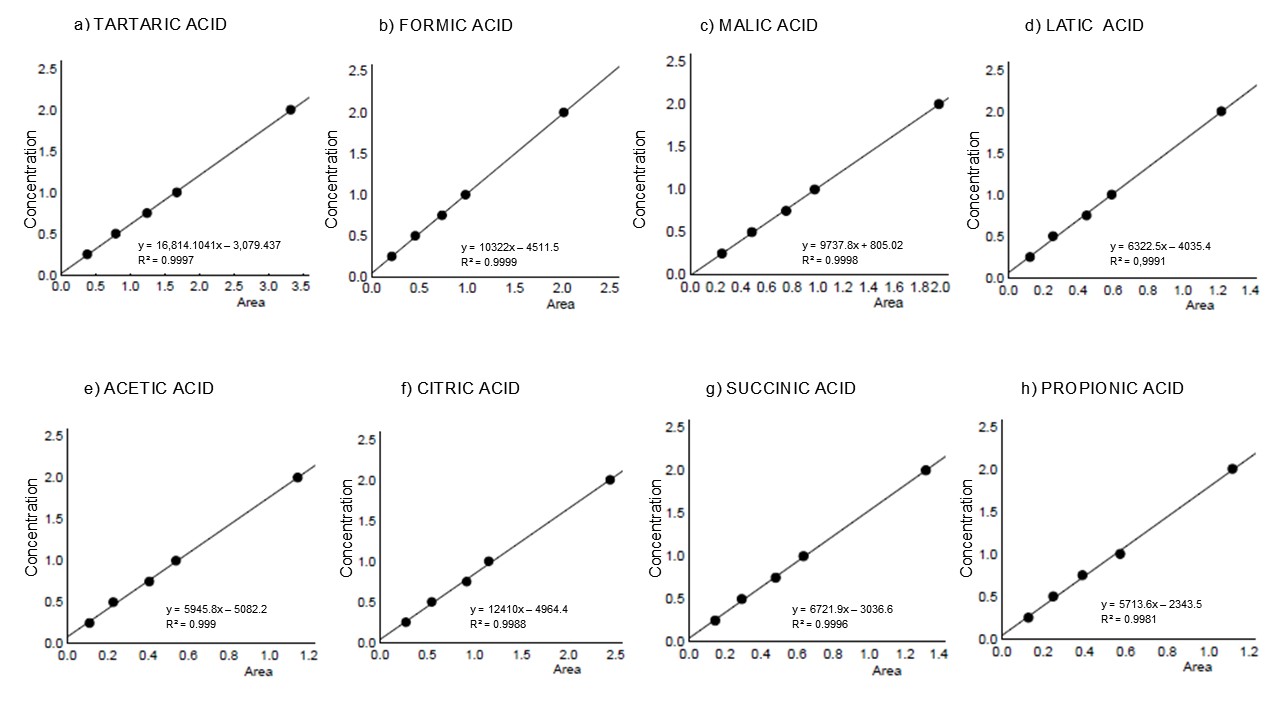
All calibration curves obtained for each organic acid exhibited a linear regression coefficient (r) equal to or greater than 0.99 (Figure 5ah), indicating excellent linear correlation between analyte concentration and detector response within the evaluated range (25–200 ppm). These values meet or exceed the minimum threshold of 0.99 recommended for analytical validation by Codex Alimentarius Commission and INMETRO guidelines, confirming the statistical robustness of the generated curves.

Calibration curve of each organic acid evaluated in the goat coalho cheese matrix by HPLC-DAD.
Deviations from linearity were assessed using the linear regression equation, comparing the calculated t-value to the tabulated t-value at a 95% confidence level and (n-1) degrees of freedom. The calculated t-values for the acids evaluated were as follows: 99.98 for tartaric; 173.20 for formic; 57.71 for lactic; 49.97 for citric; 54.74 for acetic; 122.46 for malic; 86.59 for succinic, and 39.70 for propionic. As all calculated t-values exceeded the tabulated value of 2.78, the results had adequate linearity across the established concentration range for all compounds.
3.4 Precision
The precision of the method was evaluated based on four independent measurements and assessed using the Horwitz equation (Horwitz, 1982), expressed as the coefficient of variation (CV). According to the equation, the maximum acceptable CV for the evaluated concentration range lies between 4% and 5%, while the observed values were all below 0.5%. Specifically, CVs were 0.02% for tartaric, formic, and citric acids; 0.04% for acetic and succinic acids; 0.10% for propionic acid; and 0.21% for lactic acid, demonstrating excellent repeatability of the method. However, malic acid could not be evaluated, as it was absent in the samples analyzed.
3.4.1 Precision intermediate
The intermediate fortification level of 3 mg.g-1 of organic acid standards was selected to evaluate the intermediate precision. Table 2 presents the intermediate precision results, based on analyses carried out by the same analyst over five consecutive days (interday), to assess the consistency of the method over time.
Recovery of fortified organic acids at a concentration of 3 mg.g-1 for intermediate precision for goat coalho cheese matrix.
Results were evaluated using the coefficient of variation (CV). The average interday recovery percentage ranged from 74% to 115.5% across the different analytes, with the lowest recovery observed for succinic acid and the highest for citric acid. CV values for organic acids were 3% for tartaric, 5% for formic, 5% for malic, 7% for lactic, 4% for acetic, 4% for citric, 10% for succinic, and 4% propionic acids.
The greatest variation was observed for lactic (7%) and succinic (10%) acids, which may be attributed to the matrix effects. Nevertheless, all values remained within acceptable limits for analytical validation, indicating that the method demonstrated good intermediate precision under the tested conditions.
3.5 Accuracy
Accuracy was determined based on the recovery values of standards in samples fortified with organic acids at four concentration levels (2 mg.g-1, 3 mg.g-1, 6 mg.g-1, and 10 mg.g-1) (Table 3). The results revealed average recovery rates ranging from 70% to 107%, demonstrating the suitability of the method for quantifying analytes within the tested concentration ranges.
Fortification levels and recovery of organic acids evaluated for the goat coalho cheese matrix.
Tartaric and malic acids showed the highest recoveries, with values ranging from 102.5% to 107% in the intermediate concentration levels. Lactic acid presented average recovery rates between 84% and 97%, while citric, acetic, and succinic acids ranged from 76% to 100%. These recovery percentages indicate that the detection limits were acceptable for the evaluated concentrations, in accordance with the criteria established by Ribani et al. (2004) and the European Commission (2002), which recommend recovery rates between 70% and 120% for validated methods in food analysis.
Previous studies have also reported satisfactory recovery rates for organic acids in dairy products. In a validation study using isocratic HPLC analysis to quantify organic acids in yogurt, Fernandez-Garcia & McGregor (1994) compared two extraction methods (acetonitrile and water, and H2SO4) and obtained average recoveries above 70% for citric, lactic, acetic, and propionic acids. Similarly, Zeppa et al. (2001) validated an HPLC method for sugars and organic acids in cheeses and reported high recoveries (≥ ~85%), supporting the upper accuracy range observed in cheese matrices, which is slightly higher than that obtained in the present study.
3.6 Limit of detection (LoD) and limit of quantification (LoQ)
The limits of detection (LoD) and quantification (LoQ) were determined using supplementary analytical curves constructed with concentrations below the lowest level of the main curve (5 ppm, 10 ppm, and 20 ppm), in accordance with analytical validation guidelines. The estimated LoD values were 15.1 mcg.g-1 for tartaric, 9.8 mcg.g-1 for formic, 52.4 mcg.g-1 for malic, 26.7 mcg.g-1 for lactic, 24.8 mcg.g-1 for acetic, 30.5 mcg.g-1 for citric, 50.0 mcg.g-1 for succinic, and 90.1 mcg.g-1 for propionic acids. The LoQ parameter values were 51.4 mcg.g-1 for tartaric, 44.7 mcg.g-1 for formic, 137.6 mcg.g-1 for malic, 57.6 mcg.g-1 for lactic, 80.4 mcg.g-1 for acetic, 98.8 mcg.g-1 for citric, 120.6 mcg.g-1 for succinic, and 232.2 mcg.g-1 for propionic acids.
Compared to the HPLC method of Ahmed et al. (2023), which efficiently quantified organic acids in commercial cheeses, the proposed method exhibits superior sensitivity. The use of Dowex® resin improved selectivity and precision intermediate, while HPLC-DAD ensured practicality and low cost compared to LC-MS or NMR, making this approach suitable for routine quality control and monitoring of artisanal cheeses.
3.7 Application of the proposed method to real samples
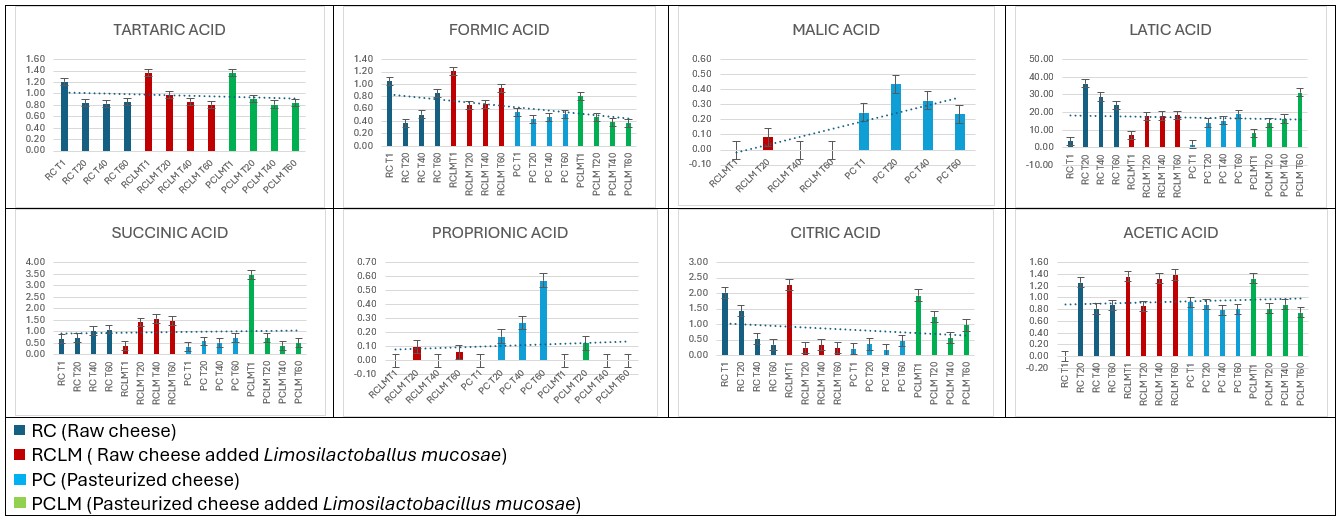
After validation, the method quantified eight organic acids in 16 cheese types differing in milk treatment, culture addition, and ripening time (1, 20, 40, and 60 days). LoD and LoQ values were satisfactory, although tartaric, malic, and propionic acids were often undetectable. Organic acid levels varied with ripening and treatment, consistent with microbial activity and fermentation conditions reported by Gámbaro et al. (2017). The application of the validated HPLC-DAD method enabled detailed monitoring of organic acid kinetics and revealed that pasteurization strongly influenced the initial acid composition. At Day 1 (T1), citric acid concentrations were consistently lower in pasteurized cheeses (PC and PCLM) than in raw-milk cheeses (RC and RCLM) (Table 4), reflecting the impact of heat treatment on the native microbiota responsible for early citrate consumption in raw milk. However, the addition of Limosilactobacillus mucosae CNPC007 (PCLM) progressively reduced these differences during ripening, demonstrating the culture’s ability to compensate for the reduced microbial diversity of pasteurized milk.
Evaluation of organic acids in samples of goat coalho cheese freeze-dried in different treatments.
Lactic, acetic, formic, citric, and succinic acids were detected in all samples, while malic and propionic acids appeared only in pasteurized cheeses without culture. Lactic acid predominated and served as the main reference for treatment and ripening effects. Cheeses made from raw milk without culture showed higher lactic-acid levels, particularly at 20–40 days, reflecting intense native microbiota activity, which declined at 60 days as microbial balance diversified. According to Franco et al. (2001), cheeses aged briefly contain higher L-lactic acid than those stored longer, a phenomenon intensified in bacteria-ripened cheeses. Pediococcus and Lactobacillus species exhibit racemizing activity that converts L-lactic to D-lactic acid during ripening (Chou et al., 2003; Rajbhandari & Kindstedt, 2005; Franco et al., 2001), potentially undesirable since D-lactic acid is toxic to humans, causing inflammatory and metabolic disorders (Agência Nacional de Vigilância Sanitária, 2019; Ardasheva et al., 2017; Pohanka, 2020).
In pasteurized cheeses with added culture, lactic acid increased gradually throughout ripening, confirming its acidifying effect (Moraes et al., 2017). After 60 days, levels became comparable to those in raw milk with culture and pasteurized milk without culture, indicating modulation of acid synthesis. As expected, pasteurized cheeses without culture exhibited the lowest organic-acid content, consistent with limited microbial activity (Figure 6). Formic acid decreased during ripening in pasteurized cheeses, in line with its consumption by Lactobacillus bulgaricus and other Lactobacillales (Courtin & Rul, 2004), although a natural increase was observed in raw-milk cheeses, as reported by Bulat & Topcu (2020). Malic acid appeared only in pasteurized cheeses, showing slight variation at T20–T40, possibly due to enzymatic degradation. Citric acid declined over 60 days in most samples, reflecting decarboxylation or conversion to Krebs-cycle intermediates, while in pasteurized cheeses with culture, its fluctuation was consistent with CO2 fixation via pyruvate carboxylase (Bulat & Topcu, 2020). Tartaric acid reduction, restricted to pasteurized cheeses, may also result from decarboxylation (Sarkar et al., 2020).

Evaluation of organic acids in lyophilized goat coalho cheese samples under different treatments.
Acetic acid varied in cheeses with complex microbiota but remained stable in pasteurized cheeses without culture, confirming that controlled flora yields more consistent acid profiles (Perry, 2004; Bulat & Topcu, 2020). Succinic acid occurred at low levels overall, with higher values observed in PCLM at T1 and in RC at 60 days, likely associated with NSLAB metabolism (Ocando et al., 1993; Bulat & Topcu, 2020). Propionic acid was mostly undetectable, suggesting limited biosynthesis or early degradation.
These findings align with the physicochemical and technological parameters observed, such as increased syneresis and reduced lactose content in cheeses with L. mucosae CNPC007 at the end of ripening, indicating enhanced metabolic and fermentative activity.
3.7.1 Principal Component Analysis (PCA)
Principal Component Analysis (PCA) evaluated the correlation between organic acid profiles and treatments, considering milk type, culture addition, and ripening time. Based on the data in Table 4 (Figure 7), PC1 and PC5 explained 99.99% of the total variance (PC1 = 99.9%; PC5 = 0.09%), confirming the strong discrimination among treatments and the influence of the starter culture Limosilactobacillus mucosae CNPC007 on the overall organic acid profile.
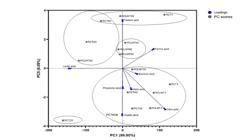
PCA evaluation of organic acids in real goat cheese samples under different treatments during a 60-day maturation period.
The RCLM and PCLM groups were consistently segregated from the controls (RC and PC), particularly at intermediate and late ripening stages (T20–T60), demonstrating that the autochthonous culture modulated the metabolic pathways and generated a distinct acidic profile regardless of milk pasteurization. Acetic, formic, citric, malic, succinic, and propionic acids clustered mainly in pasteurized cheeses, whereas lactic acid was positioned oppositely, prevailing in raw and culture-added cheeses (Silva et al., 2012).
Samples RC T40, RC T60, and PCLM T60 were primarily influenced by lactic acid, as also confirmed by univariate analysis. The quantification of succinic and propionic acids, particularly in RCLM and PCLM at T40, suggests that L. mucosae CNPC007 metabolism favors secondary heterofermentative pathways, leading to metabolites that contribute to flavor and aroma complexity. Overall, the PCA reinforced univariate findings, indicating that raw milk cheese with the autochthonous culture promoted greater lactic acid accumulation, whereas pasteurized cheeses exhibited higher acid diversity.
3.7.2 Correlation between organic acids and physicochemical parameters
Although eight organic acids were quantified, only lactic and acetic acids were included in the correlation analysis because they are the main end-products of lactic and heterofermentative pathways and exhibited consistent distribution and relevant concentrations across all samples. The remaining acids showed low variability or were detected in a few samples, making them unsuitable for reliable statistical evaluation. Thus, focusing on lactic and acetic acids ensured greater analytical robustness and technological relevance in interpreting the results.
Correlation analysis (Figure 8) revealed treatment-dependent patterns. Acetic acid showed a negative correlation with yield, reflecting solids loss during fermentation (Bulat & Topcu, 2020). In raw milk cheeses without culture (RC), lactic acid peaked at 20 days (36.45 mg.g−1) without significant moisture reduction, indicating spontaneous fermentation and limited curd contraction. In RCLM cheeses, lactic acid strongly correlated with decreasing moisture (r = –0.78), evidencing intensified syneresis and protein network compaction (Coelho et al., 2022). In pasteurized cheeses without culture (PC), lactic acid accumulated more slowly, with moderate structural impact, suggesting residual microbiota activity. Conversely, in PCLM cheeses, lactic acid increased to 31.27 mg. g−1 at 60 days, while moisture remained relatively stable (46–51%), indicating balanced acidification and structural preservation typical of controlled fermentations (Coelho et al., 2022).

Lactic acid displayed a consistent negative correlation with moisture, reflecting the biochemical and technological transformations that occur during ripening. As lactic acid production increased, reaching its maximum at day 20 in raw milk and Limosilactobacillus mucosae CNPC007 inoculated cheeses, a marked pH decrease was observed, promoting greater whey release (syneresis), lower moisture, and firmer texture, attributes highly valued in artisanal cheeses (Bansal & Veena, 2024; Sgarbi et al., 2013; Morais et al., 2022; Lunardi et al., 2021; Gobbetti et al., 2015).
In contrast, acetic acid exhibited a weaker inverse relationship with yield, suggesting that, although acetate contributes to the overall acid profile, its impact on the main technological properties of the curd is less pronounced. These associations align with the lactic and heterofermentative metabolic pathways described by Fox et al. (2017).
Beyond its analytical robustness, the validated method proved effective for elucidating such biochemical dynamics during ripening, confirming its suitability for physicochemical and sensory monitoring of goat coalho cheeses. The innovation lies in the adaptation of an ion-exchange HPLC-DAD method for the simultaneous quantification of multiple organic acids, ensuring sensitivity, selectivity, and applicability for the technological control of artisanal dairy products.
4 Conclusions
The HPLC-DAD method, combined with ion exchange resin sample preparation, has been successfully validated as a robust, accurate, and accessible analytical tool for the simultaneous quantification of organic acids in artisanal goat's milk cheese. The protocol demonstrated high selectivity, sensitivity, and excellent performance in complex dairy matrices. In addition to providing reliable analytical data, the method enabled precise monitoring of biochemical transformations during cheese maturation and the influence of the autochthonous culture Limosilactobacillus mucosae CNPC007. The observed correlations between organic acids and physicochemical parameters, such as moisture and yield, reinforce the potential of the method not only for routine laboratory analyses but also as a strategic tool for quality control, product development, and valorization of artisanal cheeses. This study advances chromatographic methodologies for challenging food matrices and offers a robust and cost-effective alternative for research and technological monitoring in the production of fermented dairy products.
Data Availability Statement
The datasets generated and analyzed during the current study are available from the corresponding author upon reasonable request.
Cite as:
Funding:
References
-
Agência Nacional de Vigilância Sanitária – ANVISA. (2019). Guia para instrução processual de petição de avaliação de probióticos para uso em alimentos (Guia No. 21/2019 – Versão 1). Brasília: ANVISA. Retrieved in 2025, October 15, from https://antigo.anvisa.gov.br/documents/10181/5280930/21.pdf
» https://antigo.anvisa.gov.br/documents/10181/5280930/21.pdf -
Ahmed, M. E., Hammam, A. R. A., Ali, A. E., Alsaleem, K. A., Elfaruk, M. S., Kamel, D. G., & Moneeb, A. H. M. (2023). Measurement of carbohydrates and organic acids in varieties of cheese using high-performance liquid chromatography. Food Science & Nutrition, 11(5), 2081-2085. PMid:37181312. https://doi.org/10.1002/fsn3.2438
» https://doi.org/10.1002/fsn3.2438 -
Akalin, A. S., Gönç, S., & Akbaş, Y. (2002). Variation in organic acids content during ripening of pickled white cheese. Journal of Dairy Science, 85(7), 1670-1676. PMid:12201516. https://doi.org/10.3168/jds.S0022-0302(02)74239-2
» https://doi.org/10.3168/jds.S0022-0302(02)74239-2 -
Aqeel, Z., Stone, A., & Kennedy, D. (2021). HPLC separation of common organic acids in food and beverages (Technical Note, TN 1297). Phenomenex Inc. Retrieved in 2025, October 15, from https://phenomenex.blob.core.windows.net/documents/41752fb5-d307-4d54-aab2-b3c50c9c2361.pdf
» https://phenomenex.blob.core.windows.net/documents/41752fb5-d307-4d54-aab2-b3c50c9c2361.pdf -
Ardasheva, R. G., Argirova, M. D., Turiiski, V. I., & Krustev, A. D. (2017). Biochemical changes in experimental rat model of abdominal compartment syndrome. Folia Medica, 59(4), 430-436. https://doi.org/10.1515/folmed-2017-0056
» https://doi.org/10.1515/folmed-2017-0056 -
Bansal, V., & Veena, N. (2024). Understanding the role of pH in cheese manufacturing: General aspects of cheese quality and safety. Journal of Food Science and Technology, 61(1), 16-26. PMid:38192705. https://doi.org/10.1007/s13197-022-05631-w
» https://doi.org/10.1007/s13197-022-05631-w -
Brasil. Agência Nacional de Vigilância Sanitária – ANVISA. Ministério da Saúde. (2017). Resolução da Diretoria Colegiada - RDC nº 166, de 24 de Julho de 2017 Dispõe sobre a validação de métodos analíticos e dá outras providências. Diário Oficial [da] República Federativa do Brasil, Brasília, Retrieved in 2025, October 15, from https://bvsms.saude.gov.br/bvs/saudelegis/anvisa/2017/rdc0166_24_07_2017.pdf
» https://bvsms.saude.gov.br/bvs/saudelegis/anvisa/2017/rdc0166_24_07_2017.pdf -
Brasil. (2019). Lei nº 13.860, de 18 de Julho de 2019. Dispõe sobre a elaboração e a comercialização de queijos artesanais e dá outras providências. Diário Oficial [da] República Federativa do Brasil, Brasília. Retrieved in 2025, October 15, from http://www.planalto.gov.br/ccivil_03/_ato2019-2022/2019/lei/L13860.htm
» http://www.planalto.gov.br/ccivil_03/_ato2019-2022/2019/lei/L13860.htm -
Bressani, A. P. P., Martinez, S. J., Sarmento, A. B. I., Borém, F. M., & Schwan, R. F. (2020). Organic acids produced during fermentation and sensory perception in specialty coffee using yeast starter culture. Food Research International, 128, 108773. PMid:31955746. https://doi.org/10.1016/j.foodres.2019.108773
» https://doi.org/10.1016/j.foodres.2019.108773 -
Bruno, L. M., & Carvalho, J. D. G. (2009). Lactic microbiota of artisanal cheeses (Technical Bulletin, No. 124). Brazilian Agricultural Research Corporation. Retrieved in 2025, October 15, from https://www.infoteca.cnptia.embrapa.br/bitstream/doc/748514/1/Doc124.pdf
» https://www.infoteca.cnptia.embrapa.br/bitstream/doc/748514/1/Doc124.pdf -
Bulat, T., & Topcu, A. (2020). Oxidation-reduction potential of UF white cheese: impact on organic acids, volatile compounds and sensory properties. Lebensmittel-Wissenschaft + Technologie, 131, 109770. https://doi.org/10.1016/j.lwt.2020.109770
» https://doi.org/10.1016/j.lwt.2020.109770 -
Chou, Y. E., Edwards, C. G., Luedecke, L. O., Bates, M. P., & Clark, S. (2003). Nonstarter lactic acid bacteria and aging temperature affect calcium lactate crystallization in cheddar cheese. Journal of Dairy Science, 86(8), 2516-2524. PMid:12939075. https://doi.org/10.3168/jds.S0022-0302(03)73846-6
» https://doi.org/10.3168/jds.S0022-0302(03)73846-6 -
Codex Alimentarius Commission. (1997). Codex Alimentarius procedural manual FAO/WHO. Retrieved in 2025, October 15, from https://www.fao.org/4/w5975e/w5975e00.htm
» https://www.fao.org/4/w5975e/w5975e00.htm -
Coelho, M. C., Malcata, F. X., & Silva, C. C. G. (2022). Lactic acid bacteria in raw-milk cheeses: From starter cultures to probiotic functions. Foods, 11(15), 2276. PMid:35954043. https://doi.org/10.3390/foods11152276
» https://doi.org/10.3390/foods11152276 -
Costa, M. P., Frasao, B. S., Lima, B. R. C. C., Rodrigues, B. L., & Conte Junior, C. A. (2016). Simultaneous analysis of carbohydrates and organic acids by HPLC-DAD-RI for monitoring goat’s milk yogurts fermentation. Talanta, 152, 162-170. PMid:26992507. https://doi.org/10.1016/j.talanta.2016.01.061
» https://doi.org/10.1016/j.talanta.2016.01.061 -
Courtin, P., & Rul, F. (2004). Interactions between microorganisms in a simple ecosystem: Yogurt bacteria as a study model. Le Lait, 84, 125-134. https://doi.org/10.1051/lait:2003031
» https://doi.org/10.1051/lait:2003031 -
Delgado-Júnior, I. J., Siqueira, K. B., & Stock, L. A. (2020). Produção, composição e processamento de leite de cabra no Brasil (Circular Técnica, No. 122). Juiz de Fora: Embrapa Gado de Leite. Retrieved in 2025, October 15, from https://www.infoteca.cnptia.embrapa.br/handle/doc/1126798
» https://www.infoteca.cnptia.embrapa.br/handle/doc/1126798 -
Dias, G. M. P., Silva, F. O., Porto, T. S., Holanda, M. T. C., & Porto, A. L. F. (2019). Profile of bioactive peptides obtained from queijo de coalho cheeses with antimicrobial potential. Pesquisa Agropecuária Pernambucana, 24(1), 1-10. https://doi.org/10.12661/pap.2019.001
» https://doi.org/10.12661/pap.2019.001 -
Diviš, P., Pořízka, J., & Kříkala, J. (2019). Effect of coffee beans roasting on their chemical composition. Potravinarstvo Slovak Journal of Food Sciences, 13(1), 344-350. https://doi.org/10.5219/1062
» https://doi.org/10.5219/1062 -
European Commission. (2002). Implementation of Council Directive 96/23/EC concerning the performance of analytical methods and the interpretation of results Retrieved in 2025, October 15, from https://www.fao.org/faolex/results/details/en/c/LEX-FAOC049615/
» https://www.fao.org/faolex/results/details/en/c/LEX-FAOC049615/ -
Fernandez-Garcia, E., & McGregor, J. U. (1994). Determination of organic acids during fermentation and cold storage of yogurt. Journal of Dairy Science, 77(10), 2934-2939. PMid:7836580. https://doi.org/10.3168/jds.S0022-0302(94)77234-9
» https://doi.org/10.3168/jds.S0022-0302(94)77234-9 - Fox, P. F., McSweeney, P. L. H., Cogan, T. M., & Guinee, T. P. (2017). Cheese: Chemistry, physics and microbiology (4th ed.). USA: Elsevier.
-
Franco, I., Prieto, B., Urdiales, R., Fresno, J., & Carballo, J. (2001). Study of the biochemical changes during ripening of Ahumado de Áliva cheese: A Spanish traditional variety. Food Chemistry, 74(4), 463-469. https://doi.org/10.1016/S0308-8146(01)00164-9
» https://doi.org/10.1016/S0308-8146(01)00164-9 -
Gámbaro, A., González, V., Jiménez, S., Arechavaleta, A., Irigaray, B., Callejas, N., Grompone, M., & Vieitez, I. (2017). Chemical and sensory profiles of commercial goat cheeses. International Dairy Journal, 69, 1-8. https://doi.org/10.1016/j.idairyj.2017.01.009
» https://doi.org/10.1016/j.idairyj.2017.01.009 -
Gobbetti, M., Angelis, M., Cagno, R., Mancini, L., & Fox, P. F. (2015). Pros and cons for using non-starter lactic acid bacteria (NSLAB) as secondary/adjunct starters in cheese ripening. Trends in Food Science & Technology, 45(2), 167-178. https://doi.org/10.1016/j.tifs.2015.07.016
» https://doi.org/10.1016/j.tifs.2015.07.016 - Horwitz, W. (1982). Evaluation of analytical methods used for regulation of foods and drugs. Journal - Association of Official Analytical Chemists, 65(4), 667-672.
-
Instituto Brasileiro de Geografia e Estatistica – IBGE. (2017). Agricultural census 2017 Retrieved in 2025, October 15, from https://censoagro2017.ibge.gov.br/
» https://censoagro2017.ibge.gov.br/ -
Instituto Nacional de Metrologia Qualidade e Tecnologia - INMETRO. (2020). Orientação sobre validação de métodos analíticos. Documento de caráter orientativo (DOQ-CGCRE-008 Revisão 09). Retrieved in 2025, October 15, from https://www.gov.br/cdtn/pt-br/assuntos/documentos-cgcre-abnt-nbr-iso-iec-17025/doq-cgcre-008/view
» https://www.gov.br/cdtn/pt-br/assuntos/documentos-cgcre-abnt-nbr-iso-iec-17025/doq-cgcre-008/view -
Khamitova, G., Angeloni, S., Fioretti, L., Ricciutelli, M., Sagratini, G., Torregiani, E., Vittori, S., & Caprioli, G. (2020). The impact of different filter baskets, heights of perforated disc and amount of ground coffee on the extraction of organics acids and the main bioactive compounds in espresso coffee. Food Research International, 133, 109220. PMid:32466917. https://doi.org/10.1016/j.foodres.2020.109220
» https://doi.org/10.1016/j.foodres.2020.109220 -
Lunardi, A., Dantas Filho, J. V., Ferreira, C. C., Cavali, J., Vais, J. O., Dias, A. A., & Gasparotto, P. H. G. (2021). Non-starter lactic acid bacteria (NSLAB): A challenge to the cheese industry. Brazilian Journal of Development, 7(3), 26383-26409. https://doi.org/10.34117/bjdv7n3-372
» https://doi.org/10.34117/bjdv7n3-372 -
Miller, B. A., & Lu, C. D. (2019). Current status of global dairy goat production: An overview. Asian-Australasian Journal of Animal Sciences, 32(8), 1219-1232. PMid:31357263. https://doi.org/10.5713/ajas.19.0253
» https://doi.org/10.5713/ajas.19.0253 -
Moraes, G. M. D., Abreu, L. R., Egito, A. S., Salles, H. O., Silva, L. M. F., Nero, L. A., Todorov, S. D., & Santos, K. M. O. (2017). Functional properties of Lactobacillus mucosae strains isolated from Brazilian goat milk. Probiotics and Antimicrobial Proteins, 9(3), 235-245. PMid:27943049. https://doi.org/10.1007/s12602-016-9244-8
» https://doi.org/10.1007/s12602-016-9244-8 -
Morais, J. L., Garcia, E. F., Vieira, V. B., Pontes, E. D. S., Araújo, M. G. G., Figueiredo, R. M. F., Moreira, I. S., Egito, A. S., Santos, K. M. O., Soares, J. K. B., Queiroga, R. C. R. E., & Oliveira, M. E. G. (2022). Autochthonous adjunct culture of Limosilactobacillus mucosae CNPC007 improved the techno-functional, physicochemical, and sensory properties of goat milk Greek-style yogurt. Journal of Dairy Science, 105(3), 1889-1899. PMid:34998541. https://doi.org/10.3168/jds.2021-21110
» https://doi.org/10.3168/jds.2021-21110 -
Ocando, A. F., Granados, A., Basanta, Y., Gutierrez, B., & Cabrera, L. (1993). Organic acids of low molecular weight produced by lactobacilli and enterococci isolated from Palmita-type Venezuelan cheese. Food Microbiology, 10(1), 1-7. https://doi.org/10.1006/fmic.1993.1001
» https://doi.org/10.1006/fmic.1993.1001 -
Olonimoyo, A. E., Amradi, N. K., Lansing, S., Asa-Awuku, A. A., & Duncan, C. M. (2025). An improved underivatized, cost-effective, validated method for six short-chain fatty organic acids by high-performance liquid chromatography. Journal of Chromatography Open, 7, 100193. https://doi.org/10.1016/j.jcoa.2024.100193
» https://doi.org/10.1016/j.jcoa.2024.100193 -
Olson, N. F. (1990). The impact of lactic acid bacteria on cheese flavor. FEMS Microbiology Reviews, 7(1-2), 131-148. https://doi.org/10.1111/j.1574-6968.1990.tb04884.x
» https://doi.org/10.1111/j.1574-6968.1990.tb04884.x -
Penna, A. L. B., Gigante, M. L., & Todorov, S. D. (2021). Brazilian artisanal cheeses: History, marketing, technological and microbiological aspects. Foods, 10(7), 1562. PMid:34359432. https://doi.org/10.3390/foods10071562
» https://doi.org/10.3390/foods10071562 -
Perry, K. S. P. (2004). Cheeses: Chemical, biochemical, and microbiological aspects. Química Nova, 27(2), 273-279. https://doi.org/10.1590/S0100-40422004000200020
» https://doi.org/10.1590/S0100-40422004000200020 -
Pochet, S., Arnould, C., Debournoux, P., Flament, J., Rolet-Répécaud, O., & Beuvier, E. (2018). A simple micro-batch ion-exchange resin extraction method coupled with reverse-phase HPLC (MBRE-HPLC) to quantify lactoferrin in raw and heat-treated bovine milk. Food Chemistry, 259, 36-45. PMid:29680060. https://doi.org/10.1016/j.foodchem.2018.03.058
» https://doi.org/10.1016/j.foodchem.2018.03.058 -
Pohanka, M. (2020). D-Lactic acid as a metabolite: Toxicology, diagnosis, and detection. BioMed Research International, 3419034(1), 3419034. PMid:32685468. https://doi.org/10.1155/2020/3419034
» https://doi.org/10.1155/2020/3419034 -
Queiroga, R. C. R. E., Santos, B. M., Gomes, A. M. P., Monteiro, M. J., Teixeira, S. M., Souza, E. L., Pereira, C. J. D., & Pintado, M. M. E. (2013). Nutritional, textural and sensory properties of coalho cheese made of goats’, cows’ milk and their mixture. Lebensmittel-Wissenschaft + Technologie, 50(2), 538-544. https://doi.org/10.1016/j.lwt.2012.08.011
» https://doi.org/10.1016/j.lwt.2012.08.011 -
Rajbhandari, P., & Kindstedt, P. S. (2005). Compositional factors associated with calcium lactate crystallization in smoked cheddar cheese. Journal of Dairy Science, 88(11), 3737-3744. PMid:16230679. https://doi.org/10.3168/jds.S0022-0302(05)73059-9
» https://doi.org/10.3168/jds.S0022-0302(05)73059-9 -
Ribani, M., Bottoli, C. B. G., Collins, C. H., Jardim, I. C. S. F., & Melo, L. F. C. (2004). Validation for chromatographic and electrophoretic methods. Química Nova, 27(5), 771-780. https://doi.org/10.1590/S0100-40422004000500017
» https://doi.org/10.1590/S0100-40422004000500017 -
Rodrigues, C. I., Marta, L., Maia, R., Miranda, M., Ribeirinho, M., & Máguas, C. (2007). Application of solid-phase extraction to brewed coffee caffeine and organic acid determination by UV/HPLC. Journal of Food Composition and Analysis : An Official Publication of the United Nations University, International Network of Food Data Systems, 20(5), 440-448. https://doi.org/10.1016/j.jfca.2006.08.005
» https://doi.org/10.1016/j.jfca.2006.08.005 -
Santiago, W. D., Teixeira, A. R., Santiago, J. A., Lopes, A. C. A., Brandão, R. M., Caetano, A. R., Cardoso, M. G., & Resende, M. L. V. (2020). Development and validation of chromatographic methods to quantify organic compounds in green coffee (Coffea arabica) beans. Australian Journal of Crop Science, 14(08), 1275-1284. https://doi.org/10.21475/ajcs.20.14.08.p2433
» https://doi.org/10.21475/ajcs.20.14.08.p2433 -
Sarkar, T., Salauddin, M., Hazra, S. K., & Chakraborty, R. (2020). The impact of raw and differently dried pineapple (Ananas comosus) fortification on the vitamins, organic acid and carotene profile of dairy rasgulla (sweetened cheese ball). Heliyon, 6(10), e05233. PMid:33102856. https://doi.org/10.1016/j.heliyon.2020.e05233
» https://doi.org/10.1016/j.heliyon.2020.e05233 -
Sgarbi, E., Lazzi, C., Tabanelli, G., Gatti, M., Neviani, E., & Gardini, F. (2013). Nonstarter lactic acid bacteria volatilomes produced using cheese components. Journal of Dairy Science, 96(7), 4223-4234. PMid:23684038. https://doi.org/10.3168/jds.2012-6472
» https://doi.org/10.3168/jds.2012-6472 -
Silva, M. M. A., & Damasceno, M. N. (2021). Local production and trade of coalho cheese in Morada Nova - Ceará. Conexões – Ciência e Tecnologia, 15, e021033. https://doi.org/10.21439/conexoes.v15i0.2141
» https://doi.org/10.21439/conexoes.v15i0.2141 -
Silva, R. C. S. N., Mínim, V. P. R., Simiqueli, A. A., Moraes, L. E. S., Gomide, A. I., & Mínim, L. A. (2012). Optimized descriptive profile: A rapid methodology for sensory description. Food Quality and Preference, 24(1), 190-200. https://doi.org/10.1016/j.foodqual.2011.10.014
» https://doi.org/10.1016/j.foodqual.2011.10.014 -
Tolentino Júnior, D. S., Santos, S. N., Marques, A. B. S., Farias, K. P., Souza, A. B., Lima, G. N., & Rodrigues, J. L. (2021). Review on liquid chromatography coupled to mass spectrometry applied to food toxicological analysis. Research, Social Development, 10(5), e47910515419. https://doi.org/10.33448/rsd-v10i5.15419
» https://doi.org/10.33448/rsd-v10i5.15419 -
Widyastuti, Y., Rohmatussolihat, & Febrisiantosa, A. (2014). The role of lactic acid bacteria in milk fermentation. Food and Nutrition Sciences, 5(4), 435-442. https://doi.org/10.4236/fns.2014.54051
» https://doi.org/10.4236/fns.2014.54051 -
Zeppa, G., Conterno, L., & Gerbi, V. (2001). Determination of sugars, organic acids, and alcohols in dairy products by high-performance liquid chromatography. Journal of Agricultural and Food Chemistry, 49(6), 2722-2726. PMid:11409957. https://doi.org/10.1021/jf0009403
» https://doi.org/10.1021/jf0009403
*
Corresponding Author: Angela Matilde da Silva Alves, Universidade Estadual de Campinas (UNICAMP), Faculdade de Engenharia de Alimentos (FEA), Departamento de Alimentos e Nutrição, Rua Monteiro Lobato, 80, Cidade Universitária Zeferino Vaz, Caixa Postal: 6121, CEP: 13083-862, Campinas/SP - Brasil, e-mail: angela_matilde@hotmail.comSection Editor: