 Using the Google Trends tool to analyze searches for cyanobacteria
Abstract
Cyanobacteria carry out processes essential to sustaining life on Earth, such as oxygenic photosynthesis and nitrogen fixation. However, the excessive growth of their populations due to eutrophication and global warming can cause serious problems for the environment and humans. Because of the importance of quickly monitoring information about these organisms, digital tools such as Google Trends (GT), which monitors and stores all search history, are very useful. This study was conducted to investigate the temporal and seasonal patterns of searches for cyanobacteria using search data stored by GT. For this purpose, 10 countries with access to the Google platform were selected, searches were filtered by the term “cyanobacteria” in english and official languages, and the data collected covers the period from 2004 to September 2021. Most of the selected countries showed temporal search patterns in terms of interest in cyanobacteria regardless of language, with Brazil, Canada, India and Mexico standing out. In terms of seasonality, the flow of research between countries in tropical regions is associated with the drier seasons, such as spring and fall. For countries in temperate regions, this flow occurs during the seasons when the temperature rises. The relationships of interest in online research may change as other topics become relevant, but this can be reversed if these relevant points are identified and excluded.
Keywords:
bloom; blue-green algae; online search; culturomics; temporal variation
Resumo
As cianobactérias realizam processos essenciais para a manutenção da vida na Terra, como a fotossíntese oxigenada e a fixação de nitrogênio. No entanto, o crescimento excessivo de suas populações devido à eutrofização e ao aquecimento global pode causar sérios problemas ao meio ambiente e aos seres humanos. Devido à importância de monitorar rapidamente informações sobre esses organismos, ferramentas digitais como o Google Trends (GT), que monitora e armazena todo o histórico de buscas, são muito úteis. Este estudo foi realizado com o objetivo de investigar os padrões temporais e sazonais das pesquisas sobre cianobactérias utilizando os dados de pesquisa armazenados pelo GT. Para o efeito, foram selecionados 10 países com acesso à plataforma Google, as pesquisas foram filtradas pelo termo “cyanobacteria” em inglês e nas línguas oficiais, e os dados recolhidos abrangem o período de 2004 a setembro de 2021. A maioria dos países selecionados apresentou padrões temporais de pesquisa em termos de interesse em cianobactérias independentemente da língua, destacando-se o Brasil, Canadá, Índia e México. Em termos de sazonalidade, o fluxo de pesquisas entre países de regiões tropicais está associado às estações mais secas, como a primavera e o outono. Para os países de regiões temperadas, esse fluxo ocorre durante as estações em que a temperatura aumenta. As relações de interesse na investigação em linha podem mudar à medida que outros tópicos se tornam relevantes, mas esta situação pode ser invertida se esses pontos relevantes forem identificados e excluídos.
Palavras-chave:
floração; algas verdes azuis; pesquisa online; culturomics; variação temporal
1. Introduction
Cyanobacteria play important roles in the environment, including oxygenic photosynthesis and biological nitrogen fixation (BNF) (Vitousek et al., 2013; Chorus and Welker, 2021). However, due to their microscopic size, these microorganisms often go unnoticed as providers of important ecosystem services, thereby limiting the available knowledge about them to the scientific community. In scientific research, BNF is widely studied in symbiotic associations between cyanobacteria and other organisms, such as aquatic macrophytes, and generally in applications to irrigated cereal crops as a form of fertilization to increase production (Newton and Burgess, 1983; Elmerich and Newton, 2007; De Reviers, 2006). The presence of research on cyanobacteria in different regions of the planet can be explained by the ability of cyanobacteria to adapt to different environmental conditions (De Reviers, 2006; Genuário et al., 2019). These organisms have been documented in a wide array of habitats, including glaciers, desert environments, hot springs with temperatures ranging from 50°C to 70°C, and both pure and salt-saturated aquatic environments (De Reviers, 2006; Rosso and Giannuzzi, 2011).
The scientific community has demonstrated a keen interest in the ecological and environmental ramifications of cyanobacteria, including their excessive growth (Wang et al., 2022; Hallegraeff, 2024). This phenomenon, referred to as a “bloom,” has the potential to inflict harm on aquatic environments, primarily through the obstruction of light penetration into the water column and the production of toxins by these organisms (Dismukes et al., 2001; Elmerich and Newton, 2007; O’Neil et al., 2012). This phenomenon, characterized by the uncontrolled proliferation of cyanobacteria, is discernible to the naked eye and has been documented in both natural aquatic environments and drinking water supply wells (Jia et al., 2019; Zhang et al., 2022). This phenomenon has garnered public curiosity. The manipulation of hydrological regimes can lead to the formation of water layers with different temperatures that favor the proliferation of cyanobacteria and, consequently, the occurrence of algal blooms, with negative impacts on water quality and aquatic ecosystems (Mitrovic et al., 2011; González-Piana et al., 2018; Ostrovsky et al., 2020). Another more common way for the population to access cyanobacteria is the availability of products on the market, with specific groups such as the genus Spirulina in the production of supplements and in the fight against toxicity caused by toxin-producing species (Ferrão Filho, 2009; Bellém et al., 2013). These are also accessible ways that can stimulate the interest of the general population in these organisms (Yunes, 2019).
The advent of the Internet as the prevailing medium of communication has concomitantly given rise to a marked increase in the pursuit of knowledge and information on research platforms, which have emerged as the expeditious conduit for the general population to access information (Stocker et al., 2023; Le et al., 2023). The evolution of Internet access from 2000 to 2021 reflects significant advances and disparities influenced by several factors, including technological developments, demographic changes, and the impact of the pandemic caused by the severe acute respiratory syndrome (Covid-19) virus (Campens et al., 2024; Stocker et al., 2023).
This period has seen a significant increase in Internet use, especially among older demographics and in response to global crises, thereby highlighting both progress and ongoing inequalities (Campens et al., 2024; OECD, 2024). Among the search platforms available, Google is the most accessed in the world, as it is free to access and the information is widely available (Ripberger, 2011; Cappellozza and Moraes, 2014). To this end, Google launched the Google Trends (GT) tool in 2006, which provides an index of searches carried out on Google according to time, region, and search volume (Choi et al., 2018; Google Trends, 2021).
Given the ecological and economic significance of the ecosystem services provided by cyanobacteria and the pervasiveness of Google as a search engine, the objective of this study was to examine the temporal and seasonal patterns of searches for cyanobacteria using data stored by GT. The following research questions were addressed: (I) Does public interest in cyanobacteria vary on an annual basis? and (II) Can cyanobacteria research be influenced by the seasons?
2. Materials and Methods
2.1. Data collection
The data were collected on the GT platform (https://trends.google.com.br) by searching for the term of interest in the period from 2004 to September 2021 (18 years), the maximum period of data made available by the tool until the date of collection. Searches were filtered among ten countries (Brazil, Australia, United States, Japan, Russia, Argentina, Mexico, Canada, Portugal, and India) of different languages, selected due to the search relationship within the platform.
The GT data were evaluated from 0 to 100 points (100 being a peak of high popularity, 50 points of average popularity and 0 points of low popularity), providing four search sessions (Region, Time, Category and Web Search). To standardize the search, only the “region” and “time” sections were specified, following the line of research proposed for this study. The language search was separated in two ways. First, for each country, a search was performed for the term “cyanobacteria” in their respective official languages to recognize the pattern of interest in terms of the general population of the countries (Table 1). However, based on the assumption that cyanobacteria are organisms that are not part of the daily knowledge of the general population, a search was also performed for each country for the term “cyanobacteria”. This second search was chosen in order to try to identify research related to the term in academic environments, since english is the most used language in these environments. It was recognized that the terms “cyanobacteria” and “cyanobacteria” differ from each other only in Portuguese. Thus, the term “cyanobacteria” could produce results that positively affected the evaluation of interest due to the relativization of the data because it broadly covered the researched group and, according to GT, contained more research information, thus allowing us to answer the objectives proposed in this study.
Identification and standardization of the term cyanobacteria in the official languages of each country.
After collection, the data were separated into two spreadsheets, one for data collected with the term in the official language of the countries and another for data collected with the term in english. Both the United States of America (USA) and Australia already have english as their official language. Thus, for both, the results were unique, and a subsequent collection with the term in english was not necessary.
2.2. Data analysis
To ascertain whether the relative interest in the search term differed across the evaluated years, a generalized linear model (GLM) was executed for each nation and for each search term (official language and english term). Additionally, a GLM was implemented to ascertain whether there was a discrepancy in searches for the term “cyanobacteria” (in both English and the official language) across the four seasons for each country. Subsequently, the Tukey test was performed to verify paired differences. The analyses were performed using the Systat © and Minitab © software.
3. Results
3.1. Annual relative interest
From January 2004 to September 2021, a total of 2,130 monthly data points were collected for the annual relative interest of the term in the official language across ten countries, and 1,704 data points were recorded for the interest of the term in the english language. In the survey conducted to ascertain the relative interest of the term as a function of the season, an equal number of data points were collected for the term in both the official language and english, totaling 7,668 data points throughout the sampling period. The observed difference in data between searches using the term in english and the official language was explained by the fact that Australia and the USA have english as their official language.
A comprehensive analysis of annual fluctuations in the relative interest in the term in english revealed significant variations in Brazil, Canada, India, Japan and Mexico. Specifically, Brazil exhibited a substantial number of searches between 2004 and 2006, followed by a notable decline in 2007, with a sustained low level in subsequent years (r2 = 0.36; F = 9.09; p = 0.008; Figure 1A). In Canada, the volume of research remained high but showed a gradual decline from 2005 to 2020, with a further reduction in 2021 (r2 = 0.58; F = 22.04; p < 0.01; Figure 1B). Research in India demonstrated a consistent high level in 2004 and 2005, followed by a decline from 2007 to 2013 and the subsequent maintenance of a constant level. However, in 2019, a further increase was observed (r2 = 0.44; F = 12.88; p = 0.002; Figure 1C). Japan demonstrated a gradual oscillation in the decrease of interest rates over time, with peaks of increase in 2004, 2009, and 2018 (r2 = 0.41; F = 11.15; p = 0.004; Figure 1D). A comparable trend was observed in Mexico, characterized by a decline commencing in 2005 and persisting until 2016, followed by an uptick between 2017 and 2019, and then a subsequent decline (r2 = 0.29; F = 6.81; p = 0.02; Figure 1E). In contrast, the other countries—namely Argentina (r2 = 0.18; F = 3.59; p = 0.07), Portugal (r2 = 0.17; F = 3.37; p = 0.08), and Russia (r2 = 0.10; F = 1.89; p = 0.18) maintained constant interest data for the english term, without showing an annual difference.

Annual interest in the search term “cyanobacteria”, from 2004 to 2021; (A) Brazil; (B) Canada: (C) India; (D) Japan; (E) Mexico; (F) Australia.
In the USA, the interest related to the term remained consistent over the years (r2 = 0.054; F = 0.90; p = 0.35). In contrast, the analysis of interest in Australia revealed an annual discrepancy in relation to the search for the term (r2 = 0.68; F = 34.86; p < 0.01; Figure 1F). The search frequency exhibited a heightened trend between 2004 and 2005, followed by a decline until 2010 and a subsequent steady trend from 2012.
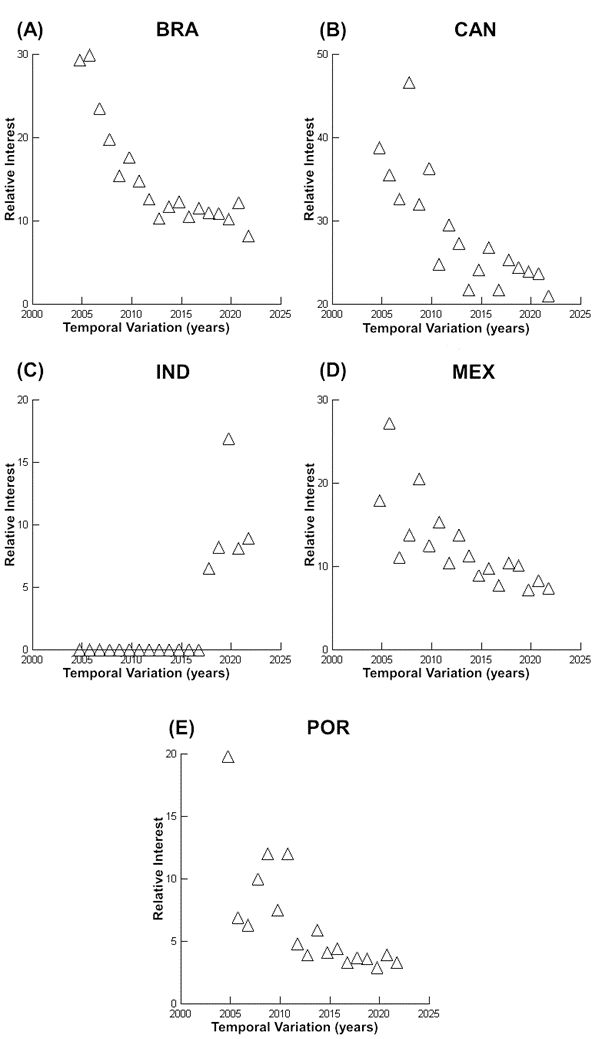
An analysis of the survey data pertaining to the official language of each nation revealed an annual fluctuation of interest relative to the search term in Brazil, Canada, India, Mexico, and Portugal. In the case of Brazil, this annual fluctuation can be attributed to an initial surge in studies until 2005, followed by a decline until 2013, and subsequently, a period of stability (r2 = 0.71; F = 40.57; p < 0.01; Figure 2A). In Canada, a high number of studies was observed, which fluctuated until 2009, followed by a decrease in interest and becoming constant in subsequent years (r2 = 0.63; F = 27.87; p < 0.01; Figure 2B). The data obtained from India demonstrated a modest interest in the term from 2004 to 2017, subsequently followed by a substantial increase during the subsequent years (r2 = 0.52; F = 17.26; p = 0.001; Figure 2C). The annual discrepancy in Mexico can be attributed to an elevated number of studies during the initial years, followed by a decline from 2010 to 2015 and a subsequent maintenance of the figure in subsequent years (r2 = 0.57; F = 21.88; p < 0.01; Figure 2D). Portugal exhibited a substantial decline in searches between 2004 and 2005, followed by a surge in interest between 2006 and 2010. However, this was subsequently followed by a decline until 2012, after which a period of stability in searches ensued (r2 = 0.53; F = 18.36; p = 0.001; Figure 2E). In the other countries, Argentina (r2 = 0.01; F = 0.16; p = 0.69), Japan (r2 = 0.003; F = 0.04; p = 0.83), and Russia (r2 = 0.005; F = 0.07; p = 0.79) demonstrated no discernible change in the search for the term over the years.

List of annual interest in searching for the term in the official languages from 2004 to 2021; (A) Brazil; (B) Canada: (C) India; (D) Mexico; (E) Portugal.
3.2. Relative interest by season
The analyses conducted to ascertain the relative interest in the term “cyanobacteria” (and its equivalents in the official language of each country) across the various seasons of the year revealed that searches were influenced by seasonality in certain countries, while in others, this influence was absent. For both the United States and Australia, the search patterns for the term in question exhibited variation across the seasons. In the United States (r2 = 45.95; F = 22.80; p < 0.01; Figure 3A), the seasonal difference was found in the lower number of studies conducted in summer compared to spring (T = -7, 09; p < 0.01), autumn (T = -6.74; p < 0.01), and winter (T = -6.35; p < 0.01). In Australia (r2 = 18.27; F = 6.29; p = 0.001; Figure 3B), a greater number of searches was observed in winter and a reduced number in the warmer seasons, spring (T = -3.45; p = 0.005) and summer (T = -3.65; p = 0.003), with no significant difference from autumn (T = -1.21; p = 0.622).

Relation of the difference in interest between the seasons in searches from 2004 to 2021 carried out for the term “cyanobacteria”; (A) United; and (B) Australia, (C) Canada. And the term in the official languages; (D) Brazil; (E) Canada; (F) Mexico.
With regard to searches conducted using the term in english, searches performed solely in Canada (in addition to those in the USA and Australia previously mentioned) varied across the seasons (r2 = 8.61; F = 3.23; p = 0.028; Figure 3C). These searches were higher in autumn and lower in summer (T = -2.99; p = 0.020), and did not differ between spring (T = -1.70; p = 0.331) and winter (T = 2.24; p = 0.122). The findings of the study demonstrated that there was no significant difference in search interest for the term in english and the seasons, as evidenced by the data from Argentina (r2 = 0; F = 0.15; p = 0.930), Brazil (r2 = 0; F = 0.85; p = 0.470), India (r2 = 0; F = 0.77; p = 0.513), Japan (r2 = 0; F = 0.09; p = 0.963), and Mexico (r2 = 3.98; F = 1.98; p = 0.125), Portugal (r2 = 0; F = 0.82; p = 0.487), Russia (r2 = 1.10; F = 1.26; p = 0.294).
A comparative analysis of search trends for terms denoting the official languages of various countries across different seasons was conducted. The findings revealed a distinct pattern in search activity for Brazil, Canada, and Mexico. In contrast, Argentina (r2 = 0; F = 0.30; p = 0. 827), India (r2 = 0; F = 0.59; p = 0.623), Japan (r2 = 0; F = 0.93; p = 0.431), Portugal (r2 = 0; F = 0.86; p = 0.466), and Russia (r2 = 1.35; F = 1.32; p = 0.274) did not show differences in searches between the seasons.
In Brazil, the variation in research interest concerning the term between seasons was observed in autumn (r2 = 17.77; F = 6.11; p = 0.001; Figure 3D) due to a heightened average level of interest when contrasting autumn with winter (T = 2.98; p = 0.021), spring (T = -3.83; p = 0.002), and summer (T = -3.48; p = 0.005). In Canada, a marked seasonal difference was observed in search trends, with a heightened search activity during the spring months relative to winter (r2 = 18.85; F = 6.50; p = 0.001; Figure 3E). This heightened activity was further pronounced in the summer months compared to the autumn (T = 3.35; p = 0.007) and winter (T = 3.79; p = 0.002). In Mexico (18.59; F = 6.41; p = 0.001; Figure 3F), a discernible seasonal fluctuation in search activity was observed, with a decline in interest during the summer months relative to the spring (T = -4.29; p < 0.01) and autumn (T = -2.92; p = 0.024) periods.
4. Discussion
The GT delineates the relativity and constancy of the search by means of an analysis of user behavior utilizing a designated term. It is noteworthy that the data disseminated by the platform may have been influenced by factors such as internet access levels, the relativity of the search term, and the interplay between the region and the language of the search. The findings reveal that the trend of relative interest in the term “cyanobacteria” (in both english and the official language of the country) is sensitive to the data provided by the GT platform, as evidenced by the accumulation of research related to cyanobacteria in 2004. This is likely attributable to the platform's launch in 2006, which does not preclude the possibility of data migration from previous years (as indicated by GT directories). A notable observation in the data is the low rate of research on cyanobacteria between 2020 and 2021, a period coinciding with the pandemic. The initial phase of the pandemic, which commenced in 2020, elicited widespread concern and mobilized the global population. This heightened awareness led to a substantial surge in research interest concerning the topic of COVD-19 (Xavier et al., 2020), thereby subsequently diminishing interest in the field of cyanobacteria.
A 1999 UN Human Development Report on a new media landscape revealed that less than 7% of the world's population was connected to the internet (Portcom, 2001). According to a study conducted by Knime Analytics Platform (2020), there was an intention to increase internet access with more than 1 billion users worldwide by 2005, corroborating the high rate of data in the same period as mentioned above. Queiroz et al. (2021) posit that the constancy of interest in a given term can vary over time according to the percentage of the population with Internet access. Exposure to the subject in the media and on social networks has also been shown to trigger mutual interest, thereby increasing the number of studies on the topic (Vardaka and Kormas, 2020; Moreira et al., 2022). A further salient consideration pertains to the industrial and economic disparities among nations, with Europe exhibiting the highest access rates, while Africa and certain regions of Central Asia demonstrate considerable lag, with numerous countries exhibiting access rates below 10% (Wang and Lin, 2024). A similar outcome was observed in the research conducted by Wang and Lin (2024), who found that certain countries with diverse industrial development trajectories, including Brazil, Mexico, Portugal, and Canada, where French is the official language, exhibited comparable results. This observation suggests that research on cyanobacteria, despite its sporadic nature, remained pertinent during the specified period. Pratama and Alshaikh (2012) corroborate this assertion, asserting that between 2000 and 2010, the disparity between developed and developing nations persisted, with developed countries experiencing faster growth in Internet access.
The term “cyanobacteria” exhibited varied patterns across the five countries, with three of them not utilizing english as their primary language. According to Hamel (2013), the use of english for academic purposes is on the rise. Today, a growing number of researchers are publishing studies in english instead of their native language. This phenomenon is part of a broader global educational and research process, which has led to the establishment of exchange scholarships for scientists and academics (Hamel, 2013). As the globalized world becomes increasingly interconnected, it is essential to have a fundamental understanding of the lingua franca (LFA) (Vavrus and Pekol, 2015). However, it has been observed that studies conducted in english may not fully reflect academic research. Given that academic searches are typically conducted on designated platforms and databases, such as Web of Science, the interest in the term “cyanobacteria” may also be indicative of general population searches.
Brazil, India, Mexico, and Japan are countries where english is used in academia, driven by globalization and the job market's emphasis on intercultural experiences (Gualda and Silva, 2019). In Brazil, the english language has seen significant advancements since 2000, marked by substantial developments in educational policies, teaching methodologies, and the integration of english in higher education (Cogo et al., 2024). This evolution is indicative of a mounting cognizance of english as a pivotal instrument for academic and professional accomplishment, giving rise to numerous initiatives that are focused on enhancing english proficiency among Brazilian students (Monteiro, 2001; Finardi et al., 2016). India has witnessed consistent growth since 2019, a trend that is evidenced by the expansion of internet access (Roser et al., 2020) and the substantial increase in rice cultivation, which surged by 142% between 2014 and 2015 (Samal, 2024; Gupta, 2024). As chemical fertilizers become increasingly costly, India has begun to explore cyanobacterial fertilizers as a cost-effective and environmentally sustainable alternative for grain cultivation (González, 2003; Cortes et al., 2018; Bhooshan et al., 2020). Concurrently, Mexico has witnessed an escalation in ecological research, underscoring the pressing need to address the deleterious effects of toxic cyanobacteria and devise effective monitoring and management strategies. This imperative is further compounded by the need to assess the environmental conditions conducive to the proliferation of these cyanobacteria and their potential ramifications for water quality and public health (Tomasini-Ortiz et al., 2012; Cartajena Alcántara et al., 2020). This surge in interest can be attributed to the substantial growth in the population with internet access, particularly in 2017 and 2019, which is concomitant with the increase in research studies during this period (Roser et al., 2020). Despite the influence of the initial period of data accumulation in this study, Japan continued to exhibit a high rate of english language searches for the term in subsequent years. The study of cyanobacteria in Japan has led to significant advancements in taxonomy, ecological dynamics, and biotechnological applications (Tuji and Niiyama, 2012; Nuryadi et al., 2024). According to Strunecký et al. (2022), between 2014 and 2021, at least 273 new species of cyanobacteria were described in the country. Furthermore, the exploration of marine cyanobacteria has led to the discovery of new compounds with potential pharmaceutical applications, emphasizing their importance in drug development (Tevs and Shevchenko, 2022; Iwasaki, 2023).
In Canada, the decline in interest was more pronounced between 2020 and 2021, coinciding with the ongoing public health crisis of the novel Coronavirus (Covid-19) pandemic, which has led to recurrent outbreaks of infection and significant public health impact (Fisman et al., 2024). However, the country has demonstrated a consistent interest in the term “cyanobacteria” over the years encompassed by this study. According to Favot et al. (2023), a notable increase in cyanobacterial blooms has been observed across Canada, particularly in Ontario, where confirmed reports of blooms have continued to increase since 1994, with significant increases observed until 2019 (Favot et al., 2023). This increase has been influenced by anthropogenic factors and climate change, posing significant risks to human health and aquatic ecosystems (Pick, 2016; Favot et al., 2023).
A parallel can be drawn between the United States and Australia, as both are predominantly english-speaking nations where the general population and the academic community engage in research with a shared objective. The country's research agenda in this domain is focused on water quality and public health, with the proliferation of cyanobacteria in nutrient-rich waters typically resulting from agricultural runoff, which promotes their rapid growth (Lal and Hargreaves, 2020; Crampton and Ragusa, 2023). Despite the recognized risks, the extant Australian research on cyanobacteria remains limited in the international literature, indicating the need for more comprehensive studies and management strategies (Crampton and Ragusa, 2023).
The presence of cyanobacteria is known to be associated with temperature and precipitation, with the emergence of these microorganisms being more prevalent in warmer environments and during periods of less precipitation (Chorus and Welker, 2021; Amin et al., 2024). In countries with tropical and subtropical climates, where the seasons are clearly defined, the period when cyanobacteria emerge is well marked (Reynolds, 1987; Bouvy et al., 1999; Ferrão Filho, 2009).
In Brazil, studies have shown that cyanobacterial blooms are more prevalent during the dry season, primarily due to increased nutrient concentrations and reduced water flow, which create favorable conditions for their growth (Mânica and Isaac, 2023; Regis et al., 2024). This explains the research concentrated from autumn onwards. Mexico has significant seasonal variability influenced by environmental factors and anthropogenic activities. This variability is evident in the dominance of different species of cyanobacteria during the wet and dry seasons. For instance, lower temperatures in January corresponded to the highest biovolumes of heterocyst filaments (Lind et al., 2016; Pineda-Mendoza et al., 2020).These observations corroborate the low interest in cyanobacteria in summer, when the climate is wetter and precipitation is abundant. In contrast, studies conducted in Australia have indicated an abundance of cyanobacteria during summer, accompanied by a greater diversity in fall, suggesting seasonal changes in community composition (May, 1981; Baker and Humpage, 1994; Robson and Hamilton, 2003; Foysal et al., 2024). This observation, however, does not align with the data indicating a lack of interest in cyanobacteria during summer, suggesting a need for further research to understand the seasonal dynamics of cyanobacterial communities in Australia. According to climate scientists, there is currently a lack of consensus on definitions of climate, rainfall, and temperature, with these definitions differing primarily between the northern and southern regions of the country. This discrepancy hinders the ability to make comparisons and communicate findings effectively. To address this challenge, a bi-seasonal model is proposed, delineating cold (April-September) and warm (October-March) seasons. This approach aligns more closely with the rainfall patterns observed in Australia (Freund et al., 2017; Fiddes et al., 2021).
In countries situated in the colder, polar regions, such as Canada, a rigid winter period that extends beyond the other seasons has been documented (Sipari, 2023). Research conducted in both languages occurred during seasons marked by a certain degree of temperature increase, such as spring (official language) and fall (english). These observations align with the findings of Rolland et al. (2005) study conducted in Quebec City. According to these researchers, the maximum toxicity of the water column typically occurs at the end of summer, with some lakes exhibiting peak toxicity in the spring. Other studies have indicated an exponential growth of cyanobacteria, which has been linked to climate change and the creation of more favorable conditions for the formation of blooms (Favot et al., 2023). In the USA, studies demonstrate that cyanobacterial blooms exhibit seasonal peaks during summer months, aligning with the findings of this study. These peaks can be subject to variations in bloom dynamics due to the direct effects of precipitation and temperature (Mishra et al., 2023; Kieley et al., 2023). While the prevailing trend points to a multifaceted interplay between climatic elements and nutrient management, certain regions have witnessed a decline in the intensity of these blooms, contradicting the anticipated rise in cyanobacteria occurrences.
5. Conclusion
In sum, the findings of this study demonstrate that the spatio-temporal variations concerning research on cyanobacteria stored by the GT tool are satisfactory within the issues addressed. However, these variations have been influenced by occurrences pertinent to the socialization of the internet and globalization. It is therefore recommended that future studies delimit the sampling period in order to obtain more concise data on the object of study, as well as comparative studies between different media. The dissemination of scientific knowledge through prominent media channels is paramount to ensure the general public is cognizant of the biodiversity and significance of cyanobacteria, along with other subjects within the scientific realm.
Acknowledgements
The authors would like to express their gratitude to Ana Fávaro and Ícaro Wilker Gonzaga e Carvalho for their contributions to the conception of the work, and to the Universidade Federal de Lavras (UFLA) for its provision of digital tools and physical space for the development of this work.
References
-
AMIN, N., JAISWAL, M. and KANNAUJIYA, V.K., 2024. Effects of temperature on morphology, physiology, and metabolic profile of diazotrophic cyanobacteria inhabiting diverse habitats. Plant Physiology and Biochemistry, vol. 216, pp. 109186. http://doi.org/10.1016/j.plaphy.2024.109186 PMid:39388751.
» http://doi.org/10.1016/j.plaphy.2024.109186 -
BAKER, P.D. and HUMPAGE, A.R., 1994. Toxicity associated with commonly occurring cyanobacteria in surface waters of the Murray-Darling Basin, Australia. Marine and Freshwater Research, vol. 45, no. 5, pp. 773-786. http://doi.org/10.1071/MF9940773
» http://doi.org/10.1071/MF9940773 -
BELLÉM, F., NUNES, S., MORAIS, M. and FONSECA, R., 2013. Cianobactérias e Toxicidade: impacte na saúde pública em Portugal e no Brasil (Cyanobateria and Toxicity: Public Health Impact in Portugal and Brazil). Revista Brasileira De Geografia Física, vol. 5, no. 6, pp. 1374-1389. http://doi.org/10.26848/rbgf.v5i6.232928
» http://doi.org/10.26848/rbgf.v5i6.232928 -
BHOOSHAN, N., SINGH, A., SHARMA, A., VERMA, C., KUMAR, A. and PABBI, S., 2020. Cyanobacterial biofertilizer’s successful journey from rural technology to commercial enterprise: an Indian perspective. Journal of Applied Phycology, vol. 32, pp. 3995-4002. http://doi.org/10.1007/s10811-020-02237-7
» http://doi.org/10.1007/s10811-020-02237-7 -
BOUVY, M., MOLICA, R., DE OLIVEIRA, S., MARINHO, M. and BEKER, B., 1999. Dynamics of a toxic cyanobacterial bloom (Cylindrospermopsis raciborskii) in a shallow reservoir in the semi-arid region of northeast Brazil. Aquatic Microbial Ecology, vol. 20, no. 3, pp. 285-297. http://doi.org/10.3354/ame020285
» http://doi.org/10.3354/ame020285 -
CAMPENS, J., VERCRUYSSEN, A., SCHIRMER, W. and DE WITTE, N., 2024. Inequalities in internet use among older people between 2004 and 2021. Journal of Digital Social Research, vol. 6, no. 3, pp. 93-111. http://doi.org/10.33621/jdsr.v6i3.27424
» http://doi.org/10.33621/jdsr.v6i3.27424 -
CAPPELLOZZA, A. and MORAES, G.H.S.M., 2014. Os países diferem entre si no acesso a internet? Revista Eletrônica de Negócios Internacionais: Internext, vol. 9, no. 1, pp. 61-80. http://doi.org/10.18568/1980-4865.9161-80
» http://doi.org/10.18568/1980-4865.9161-80 -
CARTAJENA ALCÁNTARA, M.G., CARMONA JIMÉNEZ, J. and PERONA URIZAR, E., 2020. Aspectos ecológicos, taxonómicos y de distribución de cianobacterias bentónicas en cinco ríos de la región central de México. Acta Botánica Mexicana, vol. 127, pp. 31. http://doi.org/10.21829/ABM127.2020.1639
» http://doi.org/10.21829/ABM127.2020.1639 -
CHOI, D., HAN, J., CHUN, S., RAPPOS, E., ROBERT, S. and KWON, T.T., 2018. Bit. ly/practice: uncovering content publishing and sharing through URL shortening services. Telematics and Informatics, vol. 35, no. 5, pp. 1310-1323. http://doi.org/10.1016/j.tele.2018.03.003
» http://doi.org/10.1016/j.tele.2018.03.003 - CHORUS, I. and WELKER, M., 2021. Toxic cyanobacteria in water: a guide to their public health consequences, monitoring and management London: Taylor and Francis, 858 p.
- COGO, A., GIMENEZ, T., CABRINI CALVO, L. and EL KADRI, M., 2024. English is the natural language of science: discourses and ideologies concerning EMI in two Brazilian universities. Journal of English as a Lingua Franca, vol. 13, no. 1, pp. 51-72.
- CORTES, A.L., DELGADO, Y.L.M., DIEGUEZ, E.T. and HERNANDEZ, L.L., 2018. Cianobacterias criptobióticas: una alternativa de agricultura orgánica La Paz: Centro de Investigaciones Biológicas del Noroeste, S.C.
-
CRAMPTON, A. and RAGUSA, A.T., 2023. Bloomin’ridiculous: climate change, water contamination and algal blooms in a land down under. Hydrology, vol. 10, no. 9, pp. 185. http://doi.org/10.3390/hydrology10090185
» http://doi.org/10.3390/hydrology10090185 - DE REVIERS, B., 2006. Biologia e filogenia das algas. Porto Alegre: Artmed Editora, New Book editoração LTDA.
-
DISMUKES, G.C., KLIMOV, V.V., BARANOV, S.V., KOZLOV, Y.N., DASGUPTA, J. and TYRYSHKIN, A., 2001. The origin of atmospheric oxygen on Earth: the innovation of oxygenic photosynthesis. Proceedings of the National Academy of Sciences of the United States of America, vol. 98, no. 5, pp. 2170-2175. http://doi.org/10.1073/pnas.061514798 PMid:11226211.
» http://doi.org/10.1073/pnas.061514798 -
ELMERICH, C. and NEWTON, W. E., 2007. Associative and endophytic nitrogen-fixing bacteria and cyanobacterial associations USA: Springer eBooks, vol. 5. https://doi.org/10.1007/1-4020-3546-2
» https://doi.org/10.1007/1-4020-3546-2 -
FAVOT, E.J., HOLETON, C., DESELLAS, A.M. and PATERSON, A.M., 2023. Cyanobacterial blooms in Ontario, Canada: continued increase in reports through the 21st century. Lake and Reservoir Management, vol. 39, no. 1, pp. 1-20. http://doi.org/10.1080/10402381.2022.2157781
» http://doi.org/10.1080/10402381.2022.2157781 - FERRÃO FILHO, A.D.S., 2009. Bioacumulação de cianotoxinas e seus efeitos em organismos aquáticos. Oecologia Brasiliensis, vol. 13, no. 2, pp. 272-312.
- FIDDES, S., FIDDES, S., PEPLER, A., SAUNDERS, K. and HOPE, P., 2021. Redefinindo regiões e estações climáticas do sul da Austrália. Journal of Southern Hemisphere Earth Systems Science, vol. 71, no. 1, pp. 92-109.
-
FINARDI, K.R., LEÃO, R.G. and PINHEIRO, L.M., 2016. English in Brazil: insights from the analysis of language policies. Internationalization Programs and the CLIL Approach., vol. 2, no. 1, pp. 54. http://doi.org/10.5296/ELR.V2I1.9150
» http://doi.org/10.5296/ELR.V2I1.9150 - FISMAN, D., HORTON, J., OLIVER, M., UNGRIN, M., VIPOND, J., WRIGHT, J.M. and ZOUTMAN, D., 2024. Canada needs a national COVID-19 inquiry now. BMC Medicine, vol. 22, no. 1, pp. 537. PMid:39548532.
-
FOYSAL, M.J., TIMMS, V. and NEILAN, B.A., 2024. Dynamics of the benthic and planktic microbiomes in a Planktothrix-dominated toxic cyanobacterial bloom in Australia. Water Research, vol. 249, pp. 120980. http://doi.org/10.1016/j.watres.2023.120980 PMid:38101053.
» http://doi.org/10.1016/j.watres.2023.120980 -
FREUND, M., HENLEY, B.J., KAROLY, D.J., ALLEN, K. and BAKER, P.J., 2017. Reconstruções pluviométricas de vários séculos de estação fria e quente para a Austrália. Clima do Passado, vol. 13, no. 12, pp. 1751-1770. http://doi.org/10.5194/CP-13-1751-2017
» http://doi.org/10.5194/CP-13-1751-2017 - GENUÁRIO, D.B., VAZ, M.G., SANTOS, S.N., KAVAMURA, V.N. and MELO, I.S. 2019. Cyanobacteria from Brazilian Extreme environments: toward functional exploitation. In: S. DAS and H.R. DASH, eds. Microbial diversity in the genomic era Cambridge, MA: Academic Press, pp. 265-284.
- GONZÁLEZ, A.Á., 2003. Optimización de la producción de biomasa de la cianobacteria Scytonema ocellatum cepa slc1097-22, evaluación de su capacidad como biofertilizante y su contribución en la retención de humedad en el suelo La Paz: Centro de Investigaciones Biológicas del Noroeste S.C., 166 p. Tesis de maestría.
-
GONZÁLEZ-PIANA, M., PICCARDO, A., FERRER, C., BRENA, B., PÍREZ, M., FABIÁN, D. and CHALAR, G., 2018. Effects of wind mixing in a stratified water column on toxic cyanobacteria and Microcystin-LR distribution in a subtropical reservoir. Bulletin of Environmental Contamination and Toxicology, vol. 101, no. 5, pp. 611-616. http://doi.org/10.1007/s00128-018-2446-x PMid:30229275.
» http://doi.org/10.1007/s00128-018-2446-x -
GOOGLE TRENDS, 2021 [viewed 24 February 2021]. Google [online]. Available from: https://trends.google.com/
» https://trends.google.com/ -
GUALDA, L.C. and SILVA, A.R., 2019 [viewed 3 October 2024]. A importância do intercâmbio em língua inglesa para o estudante universitário brasileiro: principais modalidades e oportunidades [online]. Revista Processando O Saber, vol. 11, no. 11, pp. 102–116. Available from: https://www.fatecpg.edu.br/revista/index.php/ps/article/download/29/24
» https://www.fatecpg.edu.br/revista/index.php/ps/article/download/29/24 -
GUPTA, P., 2024. A study of trends in rice production in India: post millennium. International Journal of Scientific Research, vol. 13, no. 7, pp. 349-353. http://doi.org/10.21275/sr24705171353
» http://doi.org/10.21275/sr24705171353 -
HALLEGRAEFF, G.M., 2024. Microalgae and human affairs: massive increase in knowledge drives changes in perceptions of good and bad blooms In: Y.H. HENDLIN, J. WEGGELAAR, N. DEROSSI, S. MUGNAI, eds. Being algae, critical plant studies Leiden: Brill Academic Pub, pp. 175-194. http://doi.org/10.1163/9789004683310_010
» http://doi.org/10.1163/9789004683310_010 - HAMEL, R.E., 2013. L'anglais, langue unique pour les sciences? Le rôle des modèles plurilingues dans la recherche, la communication scientifique et l'enseignement supérieur. Synergies Europe, no. 8, pp. 53-66.
-
IWASAKI, A., 2023. Sarco/endoplasmic reticulum Ca2+-ATPase (SERCA) inhibitors isolated from subtropical marine cyanobacteria in Japan. In: H. ISHIKAWA and H. TAKAYAMA, eds. New tide of natural product chemistry Singapore: Springer. http://doi.org/10.1007/978-981-99-1714-3_2
» http://doi.org/10.1007/978-981-99-1714-3_2 -
JIA, T., ZHANG, X. and DONG, R., 2019. Long-Term spatial and temporal monitoring of cyanobacteria blooms using MODIS on Google Earth engine: a case study in Taihu Lake. Remote Sensing, vol. 11, no. 19, pp. 2269. http://doi.org/10.3390/rs11192269
» http://doi.org/10.3390/rs11192269 -
KIELEY, C.M., ROELKE, D.L., PARK, R., CAMPBELL, K.L., KLOBUSNIK, N.H., WALKER, J.R., CAGLE, S.E., KNEER, M., STROSKI, K.M., BROOKS, B.W. and LABONTÉ, J.M., 2023. Concentration of total microcystins associates with nitrate and nitrite, and may disrupt the nitrogen cycle, in warm-monomictic lakes of the southcentral United States. Harmful Algae, vol. 130, pp. 102542. http://doi.org/10.1016/j.hal.2023.102542 PMid:38061823.
» http://doi.org/10.1016/j.hal.2023.102542 -
KNIME ANALYTICS PLATFORM, 2020 [viewed 24 February 2025]. The internet - a platform for business [online]. Zurich, Switzerland: KNIME AG. Avaiable from: https://www.cbothma.co.za/ECSAM/Chap1.pdf
» https://www.cbothma.co.za/ECSAM/Chap1.pdf -
LAL, A. and HARGREAVES, J., 2020. An epidemiologic approach to environmental monitoring: cyanobacteria in Australia’s Murray–Darling basin. Stochastic Environmental Research and Risk Assessment, vol. 34, no. 7, pp. 949-958. http://doi.org/10.1007/s00477-020-01811-2
» http://doi.org/10.1007/s00477-020-01811-2 -
LE, T., GALPERIN, H. and TRAUBE, D.E., 2023. The impact of digital competence on telehealth utilization. Health Policy and Technology, vol. 12, no. 1, pp. 100724. http://doi.org/10.1016/j.hlpt.2023.100724
» http://doi.org/10.1016/j.hlpt.2023.100724 -
LIND, O.T., DÁVALOS-LIND, L., LÓPEZ, C., LÓPEZ, M. and BRESSIE, J.D., 2016. Seasonal morphological variability in an in situ Cyanobacteria monoculture: example from a persistent Cylindrospermopsis bloom in Lake Catemaco, Veracruz, Mexico. Journal of Limnology, vol. 75, no. s1. http://doi.org/10.4081/jlimnol.2016.1190
» http://doi.org/10.4081/jlimnol.2016.1190 -
MAY, V., 1981. The occurrence of toxic cyanophyte blooms in Australia. In: W.W. CARMICHAEL, ed. The water environment: algal toxins and health Boston, MA: Springer, pp.127-142. http://doi.org/10.1007/978-1-4613-3267-1_10
» http://doi.org/10.1007/978-1-4613-3267-1_10 -
MÂNICA, A.N. and ISAAC, R.L., 2023. Seasonal dynamics and diversity of cyanobacteria in a eutrophied Urban River in Brazil. Water Science and Technology: Water Supply, vol. 23, no. 9, pp. 3868-3880. http://doi.org/10.2166/ws.2023.216
» http://doi.org/10.2166/ws.2023.216 -
MISHRA, S., STUMPF, R.P., SCHAEFFER, B.A. and WERDELL, P.J., 2023. Recent changes in cyanobacteria algal bloom magnitude in large lakes across the contiguous United States. The Science of the Total Environment, vol. 897, pp. 165253. http://doi.org/10.1016/j.scitotenv.2023.165253 PMid:37394074.
» http://doi.org/10.1016/j.scitotenv.2023.165253 -
MITROVIC, S., HARDWICK, L.J. and DORANI, F., 2011. Use of flow management to mitigate cyanobacterial blooms in the Lower Darling River, Australia. Journal of Plankton Research, vol. 33, no. 2, pp. 229-241.http://doi.org/10.1093/plankt/fbq094
» http://doi.org/10.1093/plankt/fbq094 - MONTEIRO, L., 2001. A internet como meio de comunicação: possibilidades e limitações. In: XXIV Congresso Brasileiro da Comunicação, Setembro 2001, Campo Grande/MS. São Paulo: INTERCOM – Sociedade Brasileira de Estudos Interdisciplinares da Comunicação, vol. 24.
-
MOREIRA, C., VASCONCELOS, V. and ANTUNES, A., 2022. Cyanobacterial blooms: current knowledge and new perspectives. Earth, vol. 3, no. 1, pp. 127-135. http://doi.org/10.3390/earth3010010
» http://doi.org/10.3390/earth3010010 -
NEWTON, W.E. and BURGESS, B.K., 1983. Nitrogen fixation: its scope and importance. In: A. MÜLLER and W.E. NEWTON, eds. Nitrogen fixation: the chemical biochemical genetic interface Boston, MA: Springer, pp. 1-19. https://doi.org/10.1007/978-1-4684-8523-3_1
» https://doi.org/10.1007/978-1-4684-8523-3_1 -
NURYADI, H., SUMIMOTO, S. and SUDA, S., 2024. Discovery of novel Nodosilinea species (Cyanobacteria, Nodosilineales) isolated from terrestrial habitat in Ryukyus campus, Okinawa, Japan. Algae - Korean Phycological Society, vol. 39, no. 2, pp. 59-74. http://doi.org/10.4490/algae.2024.39.6.5
» http://doi.org/10.4490/algae.2024.39.6.5 -
O’NEIL, J.M., DAVIS, T.W., BURFORD, M.A. and GOBLER, C.J., 2012. The rise of harmful cyanobacteria blooms: the potential roles of eutrophication and climate change. Harmful Algae, vol. 14, pp. 313-334. http://doi.org/10.1016/j.hal.2011.10.027
» http://doi.org/10.1016/j.hal.2011.10.027 -
OECD, 2024 [viewed 24 January 2025]. Society at a Glance 2024: OECD Social Indicators [online]. Available from: https://doi.org/10.1787/e01b0e44-en
» https://doi.org/10.1787/e01b0e44-en -
OSTROVSKY, I., WU, S., LI, L. and SONG, L., 2020. Bloom-forming toxic cyanobacterium Microcystis: quantification and monitoring with a high-frequency echosounder. Water Research, vol. 183, pp. 116091. http://doi.org/10.1016/j.watres.2020.116091 PMid:32623244.
» http://doi.org/10.1016/j.watres.2020.116091 -
PICK, F.R., 2016. Blooming algae: a Canadian perspective on the rise of toxic cyanobacteria. Canadian Journal of Fisheries and Aquatic Sciences, vol. 73, no. 7, pp. 1149-1158. http://doi.org/10.1139/cjfas-2015-0470
» http://doi.org/10.1139/cjfas-2015-0470 -
PINEDA-MENDOZA, R.M., BRIONES-ROBLERO, C.I., GONZALEZ-ESCOBEDO, R., RIVERA-ORDUÑA, F.N., MARTÍNEZ-JERÓNIMO, F. and ZÚÑIGA, G., 2020. Seasonal changes in the bacterial community structure of three eutrophicated urban lakes in Mexico city, with emphasis on Microcystis spp. Toxicon, vol. 179, pp. 8-20. http://doi.org/10.1016/J.TOXICON.2020.02.019 PMid:32142716.
» http://doi.org/10.1016/J.TOXICON.2020.02.019 -
PRATAMA, A.R. and ALSHAIKH, M., 2012. Relation and growth of internet penetration rate with human development level from 2000 to 2010. Communications of The IbIMA, vol. 2012, pp. 778309. https://doi.org/10.5171/2012.778309
» https://doi.org/10.5171/2012.778309 -
PORTCOM, 2001 [viewed 24 January 2025]. Intercom 2001: XXIV Congresso tem número recorde de apresentações de trabalho [online]. Available from: https://portalintercom.org.br/eventos1/congresso-nacional/2001
» https://portalintercom.org.br/eventos1/congresso-nacional/2001 -
QUEIROZ, A.C., WILKER, I., LASMAR, C.J., MOUSINHO, E., RIBAS, C.R. and VAN DEN BERG, E., 2021. No matter where you are, ants (Hymenoptera: Formicidae) get attention when it is warm. Myrmecological News, vol. 31, pp. 71-83. http://doi.org/10.25849/myrmecol.news_031:71
» http://doi.org/10.25849/myrmecol.news_031:71 -
REGIS, A.S., DA SILVA, R.F., DE OLIVEIRA, F.H.P.C. and DE OLIVEIRA, E.J.A., 2024 [viewed 24 January 2025]. Abiotic factors and the growth of cyanobacteria in surface water reservoirs in the state of Pernambuco. In: SEVEN PUBLICAÇÕES, org. Frontiers of knowledge: multidisciplinary approaches in academicresearch [online]. São José dos Pinhais: Seven Editora, pp. 610–624. Available from: https://sevenpublicacoes.com.br/editora/article/view/5616
» https://sevenpublicacoes.com.br/editora/article/view/5616 -
REYNOLDS, C.S., 1987. Cyanobacterial water-blooms. Advances in Botanical Research, vol. 13, pp. 67-143. http://doi.org/10.1016/S0065-2296(08)60341-9
» http://doi.org/10.1016/S0065-2296(08)60341-9 -
RIPBERGER, J.T., 2011. Capturing curiosity: using internet search trends to measure public attentiveness. Policy Studies Journal: the Journal of the Policy Studies Organization, vol. 39, no. 2, pp. 239-259. http://doi.org/10.1111/j.1541-0072.2011.00406.x
» http://doi.org/10.1111/j.1541-0072.2011.00406.x -
ROBSON, B.J. and HAMILTON, D.P., 2003. Summer flow event induces a cyanobacterial bloom in a seasonal Western Australian estuary. Marine and Freshwater Research, vol. 54, no. 2, pp. 139-151. http://doi.org/10.1071/MF02090
» http://doi.org/10.1071/MF02090 -
ROLLAND, A., BIRD, D.F. and GIANI, A., 2005. Seasonal changes in composition of the cyanobacterial community and the occurrence of hepatotoxic blooms in the eastern townships, Québec, Canada. Journal of Plankton Research, vol. 27, no. 7, pp. 683-694. http://doi.org/10.1093/PLANKT/FBI042
» http://doi.org/10.1093/PLANKT/FBI042 -
ROSER, M., RITCHIE, H., ORTIZ-OSPINA, E. and HASELL, J. 2020 [viewed 24 January 2025]. Coronavirus disease (COVID-19) [online]. Available from: https://ourworldindata.org/coronavirus
» https://ourworldindata.org/coronavirus - ROSSO, L. and GIANNUZZI, L., 2011. Factores ambientales y antropogénicos que afectan la formación de floraciones de cianobacterias y cianotoxinas. In: MINISTERIO DE SALUD DE LA NACIÓN, ed. Cianobacterias como determinantes ambientales de la salud Buenos Aires: Ministerio de Salud de la Nación, pp. 84-106.
-
SAMAL, P., 2024. Eastern region holds the key to future increase in rice production in India. Open Access Journal of Agricultural Research, vol. 9, no. 3, pp. 1-8. http://doi.org/10.23880/oajar-16000364
» http://doi.org/10.23880/oajar-16000364 -
SIPARI, S., 2023. Winter, the forgotten season. Global Change Biology, vol. 30, no. 1, pp. e17085. http://doi.org/10.1111/gcb.17085 PMid:38273566.
» http://doi.org/10.1111/gcb.17085 - STOCKER, V., LEHR, W. and SMARAGDAKIS, G., 2023. COVID-19 and the Internet: Lessons learned. In: W.H. LEHR, S. VOLKER and J. WHALLEY, eds. Beyond the Pandemic? Exploring the Impact of COVID-19 on Telecommunications and the Internet Bradford: Emerald Publishing Limited, pp. 17-69.
-
STRUNECKÝ, O., IVANOVA, A.O. and MAREŠ, J., 2022. An updated classification of cyanobacterial orders and families based on phylogenomic and polyphasic analysis. Journal of Phycology, vol. 59, no. 1, pp. 12-51. http://doi.org/10.1111/jpy.13304 PMid:36443823.
» http://doi.org/10.1111/jpy.13304 -
TEVS, K.O. and SHEVCHENKO, O.G., 2022. Dynamics of phytoplankton in the coastal waters at Vladivostok in 2019–2021. Известия Тихоокеанского Научно-Исследовательского Рыбохозяйственного Центра, vol. 202, no. 4, pp. 880-893. http://doi.org/10.26428/1606-9919-2022-202-880-893
» http://doi.org/10.26428/1606-9919-2022-202-880-893 - TOMASINI-ORTIZ, A.C., MOELLER-CHÁVEZ, G., SÁNCHEZ CHÁVEZ, J.J. and BRAVO INCLÁN, L.A., 2012. Cianobacterias y Cianotoxinas en el Lago de Pátzcuaro, Michoacán, México. Revista AIDIS de ingeniería y ciencias ambientales: Investigación, desarrollo y práctica, vol. 5, no. 2, pp. 93-101.
- TUJI, A. and NIIYAMA, Y., 2012. Three new combinations of Japanese planktonic cyanobacteria species. Bulletin of the National Musum of Nature and Science, vol. 38, no. 1, pp. 37-38.
-
VARDAKA, E. and KORMAS, K.A., 2020. Advancing knowledge on cyanobacterial blooms in freshwaters. Water, vol. 12, no. 9, pp. 2583. https://doi.org/10.3390/W12092583
» https://doi.org/10.3390/W12092583 -
VAVRUS, F. and PEKOL, A., 2015. Critical internationalization: moving from theory to practice. FIRE: Forum for international research in education, vol. 2, no. 2, pp. 5-21. http://doi.org/10.18275/fire201502021036
» http://doi.org/10.18275/fire201502021036 -
VITOUSEK, P.M., MENGE, D.N., REED, S.C. and CLEVELAND, C.C., 2013. Biological nitrogen fixation: rates, patterns and ecological controls in terrestrial ecosystems. Philosophical Transactions of the Royal Society of London. Series B, Biological Sciences, vol. 368, no. 1621, pp. 20130119. http://doi.org/10.1098/rstb.2013.0119 PMid:23713117.
» http://doi.org/10.1098/rstb.2013.0119 -
WANG, J. and LIN, P.-C., 2024. Spatial spillover of the global internet penetration rate and the digital gender divide. SAGE Open, vol. 14, no. 2. http://doi.org/10.1177/21582440241255448
» http://doi.org/10.1177/21582440241255448 -
WANG, S., ZHANG, X., CHEN, N., TIAN, L., ZHANG, Y.R. and NAM, W.-H., 2022. A systematic review and quantitative meta-analysis of the relationships between driving forces and cyanobacterial blooms at global scale. Social Science Research Network, vol. 216, no. Pt. 3, pp. 114670. http://doi.org/10.2139/ssrn.4058807 PMid:36341794.
» http://doi.org/10.2139/ssrn.4058807 -
XAVIER, F., OLENSCKI, J.R.W., ACOSTA, A.L., SALLUM, M.A.M. and SARAIVA, A., 2020. Análise de redes sociais como estratégia de apoio à vigilância em saúde durante a Covid-19. Estudos Avançados, vol. 34, pp. 261-282. http://doi.org/10.1590/s0103-4014.2020.3499.016
» http://doi.org/10.1590/s0103-4014.2020.3499.016 -
YUNES, J.S., 2019. Cyanobacterial toxins. In: A.K. MISHRA, D.N. TIWARI and A.N. RAI, eds. Cyanobacteria: from basic science to applications Cambridge, MA: Academic Press, pp. 443-458. https://doi.org/10.1016/B978-0-12-814667-5.00022-2
» https://doi.org/10.1016/B978-0-12-814667-5.00022-2 -
ZHANG, W., LIU, J., XIAO, Y., ZHANG, Y., YU, Y., ZHENG, Z., LIU, Y. and LI, Q., 2022. The impact of cyanobacteria blooms on the aquatic environment and human health. Toxins, vol. 14, no. 10, pp. 658. http://doi.org/10.3390/toxins14100658 PMid:36287927.
» http://doi.org/10.3390/toxins14100658