 Consumption and handling time of Euborellia annulipes and Marava arachidis (Dermaptera: Anisolabididae) on Spodoptera frugiperda (Lepidoptera: Noctuidae)
Abstract
Spodoptera frugiperda is one of the pests that causes the most damage to corn, with chemical control being the main method. However, the increase in cases of resistance emphasizes the need for alternative methods, such to the biological control. In this context, Euborellia annulipes and Marava arachidis stand out for their high voracity on pests. Therefore, the objective of the research was to evaluation the consumption and handling team of E. annulipes and M. arachidis on S. frugiperda. For this, Jaboatão and hybrid corn were planted in a greenhouse, infested with S. frugiperda and adult predators were released. To analyze the consumption of S. frugiperda, a generalized linear model with binomial distribution was used. Handling time was subjected to analysis of variance and the means were compared using Tukey's test (0.05%). The results showed that when evaluating the consumption rate, in Jaboatão and in the hybrid, there were node significant differences. Regarding the analysis of variance of handling time, in the hybrid, the treatment factor was significant, with less time on the IV instar (2':13”) and more on eggs/I urge (3':12”). For the insect factor, there were node significant differences. Regarding the analysis of variance, in Jaboatão, no factor was significant. Therefore, E. annulipes and M. arachidis are promising in the consumption of S. frugiperda, with M. arachidis proving to be as effective as E. annulipes under semi-field conditions. In addition, the predators handle, in a few minutes, the different stages of S. frugiperda, including the most advanced ones.
Keywords:
fall armyworm; predatory behavior; earwigs
Resumo
Spodoptera frugiperda é uma das pragas que mais causam danos ao milho, tendo o controle químico como principal método. Entretanto, o aumento dos casos de resistência enfatiza a necessidade de métodos alternativos, como o controle biológico. Nesse contexto, Euborellia annulipes e Marava arachidis se destacam pela alta voracidade sobre pragas. Portanto, o objetivo da pesquisa foi avaliar o consumo e o tempo de manuseio de E. annulipes e M. arachidis sobre S. frugiperda. Para isso, foram plantados milho Jaboatão e híbrido em casa de vegetação, infestados com S. frugiperda e liberados predadores adultos. Para analisar o consumo de S. frugiperda utilizou-se um modelo linear generalizado com distribuição binomial. O tempo de manuseio foi submetido a análise de variância e as médias comparadas pelo teste de Tukey (0,05%). Os resultados mostraram que ao avaliar a taxa de consumo, no Jaboatão e no híbrido, não houve diferenças significativas. Sobre a análise de variância do tempo de manuseio, no híbrido, foi significativo o fator tratamento, com tempo menor sobre o IV ínstar (2’:13”) e maior sobre ovos/I ínstar (3’:12”). Para o fator inseto, não houve diferenças significativas. Sobre a análise de variância, no Jaboatão, nenhum fator foi significativo. Portanto, E. annulipes e M. arachidis são promissores no consumo de S. frugiperda, tendo M. arachidis mostrado-se tão quanto eficaz quanto E. annulipes em condições de semi-campo. Além disso, os predadores manuseiam, em poucos minutos, os diferentes estágios de S. frugiperda, incluindo os mais avançados.
Palavras-chave:
lagarta-do-cartucho; comportamento predatório; tesourinhas
1. Introduction
The species Spodoptera frugiperda (Smith, 1797) (Lepidoptera: Noctuidae) is a migratory polyphagous pest that attacks more than 350 plant species (Marcos et al., 2023; Russo et al., 2021). Among the commercial plant families attacked by S. frugiperda are Brassicaceae, Fabaceae, Poaceae, and Solanaceae, which include crops relevant to the agricultural sector, such as corn (Zea mays L.) (family Poaceae), one of the most important grains for generating financial subsidies for global agriculture due to the great variability of commercial uses, (Marcos et al., 2023; Souza and Queiroz, 2023).
The control chemical and to the plants genetically modified (what express the bacterium Bacillus thuringiensis (Bt)) are some of the most widely used control methods in S. frugiperda management programs. However, in chemical control, repeated applications and inadequate dosages have resulted in a series of problems, one of the main ones being the increase in cases of pest resistance (Mota-Sanchez and Wise, 2023; Schirmer et al., 2023). Currently, there are about 200 registered cases of resistance in S. frugiperda populations related to the active ingredients of most groups chemicals and of plants Bt what before they were known to present high lethality (Mota-Sanchez and Wise, 2023; Schirmer et al., 2023).
Thus, alternative pest control methods, such as biological control, emerge as a means of reducing excessive costs for rural producers in managing S. fugiperda, as they use groups of natural enemies to control infestations (Mota-Sanchez and Wise, 2023; Schirmer et al., 2023). Among the groups of natural enemies used in biological control programs is that of predatory insects, with emphasis on earwigs, the popular name for representatives of the order Dermaptera, which have been gaining recognition for their diverse, generalist feeding habits and high voracity on both eggs and larval stages of Lepidoptera (Bortolotto, Santos and Ochonski, 2024; Silva et al., 2024). Some of the Dermaptera what more he has been studied for this purpose are the species Euborellia annulipes (Lucas, 1847) (Dermaptera: Anisolabididae) and Marava arachidis (Yersin, 1860) (Dermaptera: Labiidae) (Kamimura et al., 2023; Pacheco et al., 2021).
E. annulipes and M. arachidis are predators terrestrial and nocturnal, what have habit cryptic, usually hiding in dark places during the day (Coelho et al., 2024; Silva et al., 2009). In recent years, studies have shown the promising potential of these insects in the control of agricultural pests, for example, E. annulipes has stood out in the control of larvae and pupae of Diatraea saccharalis (Fabricius, 1794), (Lepidoptera: Crambidae), eggs, larvae, nymphs and adults of the mite Dermanyssus gallinae (De Geer, 1778) (Acari: Dermanyssidae) and larvae and pupae of the cotton boll weevil (Anthonomus grandis (Boheman, 1843) (Coleoptera: Curculionidae)) (Silva and Brito, 2014), the species M. arachidis stands out in the control of A. grandis and the aphid Brevicoryne brassicae (Linnaeus, 1758) (Hemiptera: Aphididae) (Oliveira-Filho et al., 2023).
Given the potential of these species, research involving predation and handling time of E. annulipes and M. arachidis is essential to assess their ability of these predators on the dynamic population of S. frugiperda us agroecosystems. Therefore, the objective of this study was to evaluate the consumption rate of E. annulipes and M. arachidis on S. frugiperda and the handling time of these predators on the pest.
2. Materials and Methods
2.1. Study location
The research was conducted in a greenhouse belonging to the Department of Biosciences located at the Center of Agricultural Sciences (CCA) of the Federal University of Paraíba (UFPB), Campus II, Areia – PB, Brazil.
The municipality of Areia is located in the Brejo Paraibano microregion, with: 6°56’15”S (latitude), 35°41’15”W (longitude) and 623 m of average altitude. According to the Köppen classification, the climate is type AS, hot and humid, with a rainy season from January to September. and the precipitation rainwater average annual and of 1,305 mm, with temperature average annual varying between 22 and 26 °C (Jacomine et al., 1972).
2.2. Creation and maintenance of Euborellia annulipes and Marava arachidis in the laboratory
E. annulipes and M. arachidis rearings were maintained at 25 ± 1 °C, 70 ± 10% humidity, and a 12-h photophase. The insects were separated into 500 mL plastic containers. The predators were fed an artificial diet proposed by Guimarães et al. (2006), consisting of: starter culture for broilers (350 g); wheat bran (260 g); brewer's yeast (220 g); and Nipagin® (40 g). The diet was changed every three days.
Absorbent paper moistened with distilled water was added to the containers and changed every two days to prevent the proliferation of fungi.
To guarantee the survival of the eggs of E. annulipes, those they were removed from the containers with a brush together with the female, being placed in Petri dishes lined with absorbent paper moistened with distilled water, containing an artificial diet.
Each offspring of M. arachidis was separated from its parents and transferred to another container at two or three days of age.
2.3. Creation and maintenance of Spodoptera frugiperda in laboratory
To establish the S. frugiperda breeding, larvae were collected at the Chã de Jardim Experimental Farm (one collection) and at Sítio Flores (two collections), located in the rural area of the municipality of Areia – PB.
The collected larvae were transported to the laboratory in 250 mL plastic containers at a temperature of 25 ± 1 °C, humidity of 60 ± 10%, and a photoperiod of 12 h. Larvae were maintained daily, with approximately 5 cm of corn leaves per container being offered. The containers were sealed with voile.
To the larvae they were maintained us containers until the phase pupal, being made sexing of pupae and the transfer of the couples to cages of PVC (seven males and seven females), that were coated internally with paper sulfite, prohibited with polystyrene in the part lower and covered with voile wrapped in elastic at the top.
The pupae were placed in the cages in a rectangular capsule of paper sulfite. The part bottom and sides from the cage they were coated with paper sulfite, for facilitate egg collection.
The moths were fed with cotton balls soaked in distilled water and other soaked with one solution of water distilled and honey the 10%. The F1 generation of collected larvae were kept in 500 mL plastic containers and fed with the adaptation from the diet artificial from Poitout and Buès (1974), as shown in Table 1.
2.4. Corn cultivation (Zea mays L.)
The seeds used were the Jaboatão Amarelo creole corn variety and the triple hybrid cultivar B2688PWU/2B688RR from Brevant® Sementes, a brand of Corteva Agriscience™, obtained through rural producers from Sítio Flores and from the Enterprise of Assistance Technique and Rural Extension (EMATER) of the municipality of Areia, Paraíba, and the municipality of Guarabira, Paraíba.
The objective of using native and hybrid seeds was to determine whether there was a difference in predation by E. annulipes and M. arachids on these plants, considering the particular characteristics of each plant, such as the hairiness and waxiness of their leaves, which can positively or negatively influence predation.
Planting was carried out in 25 cm plastic pots, containing soil classified as Argisol Red of agreement with the System Brazilian Soil Classification System (SiBCS) of Embrapa Solos, a unit of the Brazilian Agricultural Research Corporation (Embrapa) (Santos et al., 2018), in addition of sand in one proportion of 1:1, both collected from 0 to 20 cm depth at the Chã do Jardim Experimental Farm.
Soil analysis was performed by the Soil Laboratory, part of the Center for Agricultural Sciences and Environmental (CCAA) from the University State from the Paraíba (UEPB), located node Campus II, municipality of Lagoa Seca – PB, Brazil. Soil correction was carried out by the Laboratory of Soil Geology and Mineralogy, part of the Department of Soils and Rural Engineering at CCA/UFPB. The nutrient requirements for this soil were calculated based on the recommendations of Novais et al. (1991), which are specific for corn crops. The concentrations used for soil correction were, respectively: 134 g of urea; 2,045 g of single superphosphate (SPS); and 180 g of potassium chloride (KCL), which were calculated for 600 kg of substrate, consisting of 300 kg of Red Argisol and 300 kg of sand in a 1:1 ratio. The concentrations used for soil correction were respectively: 134 g of urea; 2,045 g of super phosphate simple (SPS); and 180 g of chloride potassium (KCL), what they were calculated to 600 kg of substrate, being 300 kg of Argisol Red and 300 kg of sand in a 1:1 ratio.
The experiments were carried out between the period of February of 2024 the August of 2024. To assess the temperature and humidity of the greenhouse daily, a Digital Thermo-Hygrometer with an External Temperature Probe Incoterm 7666.02.0.00 was used. According to the thermo-hygrometer, the monthly temperature averages varied between 30.8 °C (first month) and 24.9 °C (last month), and to the averages of humidity relative of air varied between 54% (first month) and 58% (last month).
Three seeds were distributed in each pot, 3 cm from the surface, with a spacing of 3 cm between seeds. After seedling emergence, thinning was carried out, leaving only one plant per pot. Corn irrigation management was carried out according to the plant's needs, following criteria proposed by Albuquerque and Resende (2002). After the distribution of seeds us vases, was added 1,000 mL of water, with interval of one day. With the emergency of seedlings, the irrigation passed the to be between 1,000 and 1,200 mL of water, at one- to two-day intervals. From the V4 stage onwards, the plants were irrigated with 1,500 mL of water, at one-day intervals. The spacing between the pots was 25 cm horizontally and 55 cm vertically.
2.5. Bioassay 1. Consumption of eggs and larvae of Spodoptera frugiperda by Euborellia annulipes and Marava arachidis
2.5.1. Infestations of eggs and larvae of Spodoptera frugiperda and releases of predators
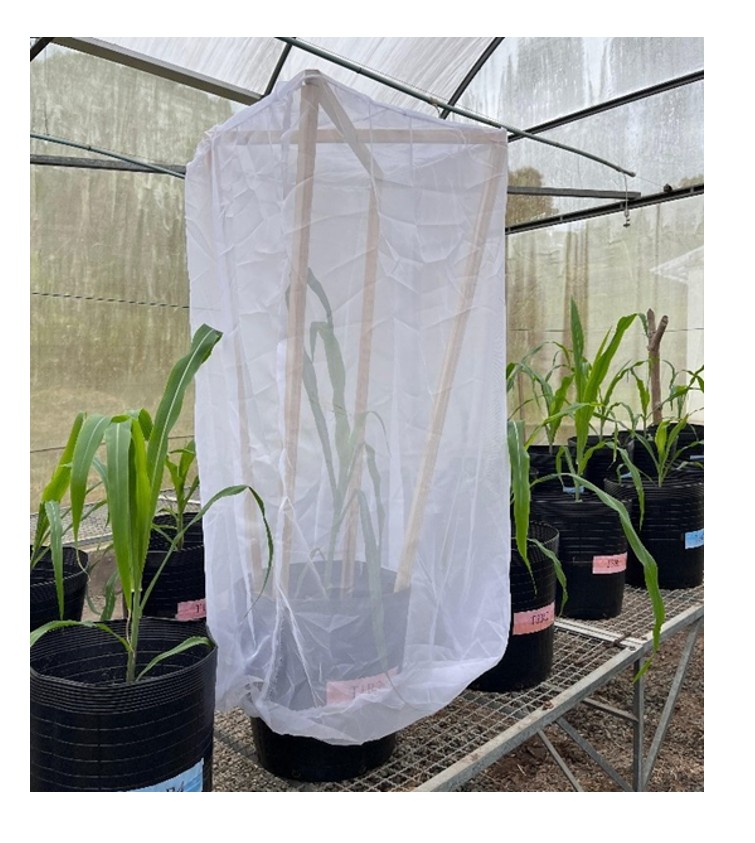
To the infestations of the eggs and of larvae of S. frugiperda in the plants of corn they were carried out from the 14th day of seedling emergence, whose crop development was at the V4 stage (Figure 1).
Wooden cage covered with voile, used to allow the release of insects in corn planted in a greenhouse.
Twenty-four-hour-old eggs and second and fourth instar larvae of S. frugiperda were used. Egg applications were preferably made on the corn stalk with a paintbrush, using 30 eggs per plant, for a total of 240 eggs. Second and fourth instar larvae were added with tweezers, preferably on the upper surface of the leaves and on the corn stalk, using ten larvae of each instar per plant, for a total of 120 larvae.
After the pest was released, a pair of each earwig species was released per plant, being manually distributed on the leaves at the apex, on the stem and preferably on the corn cartridge, and private of food by 24 h. To avoid escapes of insects, vases were covered with wooden cages (1.20 m × 0.60 m diameter) (Figure 1) and completely
covered with voile, according to the methodology adapted of Hellwig et al. (2017). The parameter evaluated was the daily consumption of E. annulipes and M. arachidis on eggs/I, II/III and IV urge of S. frugiperda. To the reviews had duration of ten days. After daily assessments, the earwigs that died were replaced.
To evaluate if the eggs and the larvae of S. frugiperda died put consumption of E. annulipes and M. arachidis was observed along the length of the plants to see if there were any traces of dried-out body parts of these insects. This is considered one of the main traces visible post-consumption of predators with chewing mouthparts (Silva et al., 2023). Observations were made with the naked eye or with the aid of a hand-held magnifying glass, and larvae that showed signs of predation were transported to the laboratory and observed under a stereoscopic microscope.
The experimental design was randomized blocks (RBD), with a draw for the distribution of the pots. In total, there were six blocks (each block with four pots). The experiment was carried out in a 2×3 factorial arrangement, with two predators (E. annulipes and M. arachidis) and three types of prey (eggs/larvae of first instar, larvae of second/third instar and larvae of fourth instar of S. frugiperda).
2.5.2. Analysis statistics
To analyze the consumption of S. frugiperda, a generalized linear model with distribution was used binomial. The adjustment of model was evaluated with one graphic quite normal of package “hnp” (Moral et al., 2017). To the averages of diet vs insect they were compared using the function “glht” from the “multcomp” package (Hothorn et al., 2008), using R software (R Core Team, 2023).
2.6. Bioassay 2. Time of handling of Euborellia annulipes and Marava arachidis on eggs and larvae of Spodoptera frugiperda
To analyze the handling time of E. annulipes and M. arachidis on S. frugiperda eggs and larvae, after infesting the pest, earwigs were manually released, preferably in the corn stalk and on the upper side of the leaves, and the time these predators spent handling the pest was timed. Observations were made with the naked eye or with the aid of a hand-held magnifying glass, and larvae that showed signs of predation were transported to the laboratory and observed under a stereoscopic microscope.
The parameter evaluated node experiment he was the time of handling of E. annulipes and M. arachidis on eggs/larvae of I, II/III and IV urge of S. frugiperda. The experimental design used was the same as the previous experiment.
2.6.1. Analysis statistics
The handling time of E. annulipes and M. arachidis on S. frugiperda was subjected to analysis of variance and, when significant, the means were compared according to Tukey's test at 0.05% probability, using R software (R Core Team, 2023).
3. Results
3.1. Bioassay 1. Consumption of eggs and larvae of Spodoptera frugiperda by Euborellia annulipes and Marava arachidis
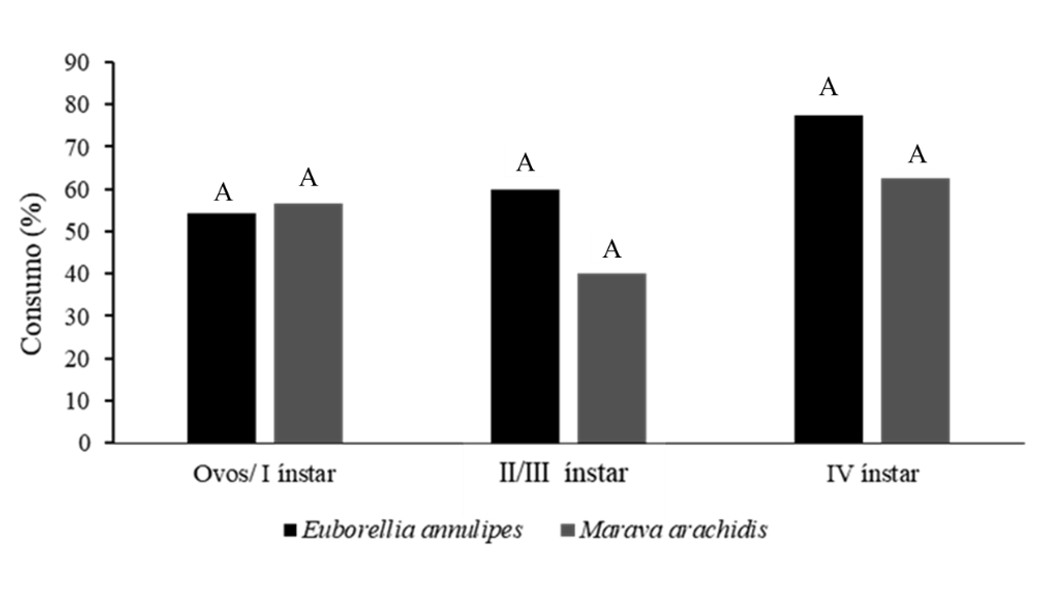
When evaluating the consumption rate of the different stages of S. frugiperda by E. annulipes and M. arachidis, in Jaboatão corn, it was possible to observe that there were no significant differences according to the contrasts of the generalized linear model, with binomial distribution (P ≤ 0.05) (Figure 2).

Average proportion of consumption of Spodoptera frugiperda (eggs/larvae of instar I, II/III and IV) during ten days by adults of Euborellia annulipes and Marava arachidis in Jaboatão corn. Averages followed by letters do not differ from each other for each insect according to the contrasts of the generalized linear model with binomial distribution (P ≤ 0.05).
Regarding hybrid corn, when evaluating the consumption rate, it was also found that there were no significant differences (Figure 3).

Average proportion of consumption rate of Spodoptera frugiperda (eggs/larvae of I instar, II/III and IV instar) during ten days by adults of Euborellia annulipes and Marava arachidis in hybrid corn. Averages followed by letters do not differ from each other for each insect according to the contrasts of the generalized linear model with binomial distribution (P ≤ 0.5).
3.2. Bioassay 2. Time of handling of Euborellia annulipes and Marava arachidis on eggs and larvae of Spodoptera frugiperda
On the test of analysis of variance of time of handling of E. annulipes and M. arachidis, in corn hybrid, was significant only the treatment factor at 0.01% (Table 2).
Analysis of variance for handling time of Euborellia annulipes and Marava arachidis in hybrid corn.
When evaluating the handling time of E. annulipes and M. arachidis preying on S. frugiperda, in hybrid corn, according to the Tukey test, in relation to the treatment factor, it was observed that the time of handling he was minor on larvae of IV urge (2':13”) and bigger on eggs/I urge (3':12”) (Table 3).
Average handling time of Euborellia annulipes and Marava arachidis preying on eggs/larvae of instar I, II/III and IV of Spodoptera frugiperda in hybrid corn.
Regarding the insect factor, there were no significant differences between the predators, with 2':38” for E. annulipes and 2':42” for M. arachidis, in hybrid corn (Table 3). As only the treatment factor was significant, it is suggested that the different stages of S. frugiperda have an effect on the handling time of the predators, but the insect factor, as it was not significant, indicates that the predator species had no impact on the handling time.
Regarding the analysis of variance test of handling time of E. annulipes and M. arachidis, in Jaboatão corn, no factor was significant (Table 4).
Analysis of variance for handling time of Euborellia annulipes and Marava arachidis in Jaboatão corn.
That absence of significance of the factors means what none from them he had effect significant about the time of handling, indicating what E. annulipes and M. arachidis no changed your time handling according to the different stages of S. frugiperda.
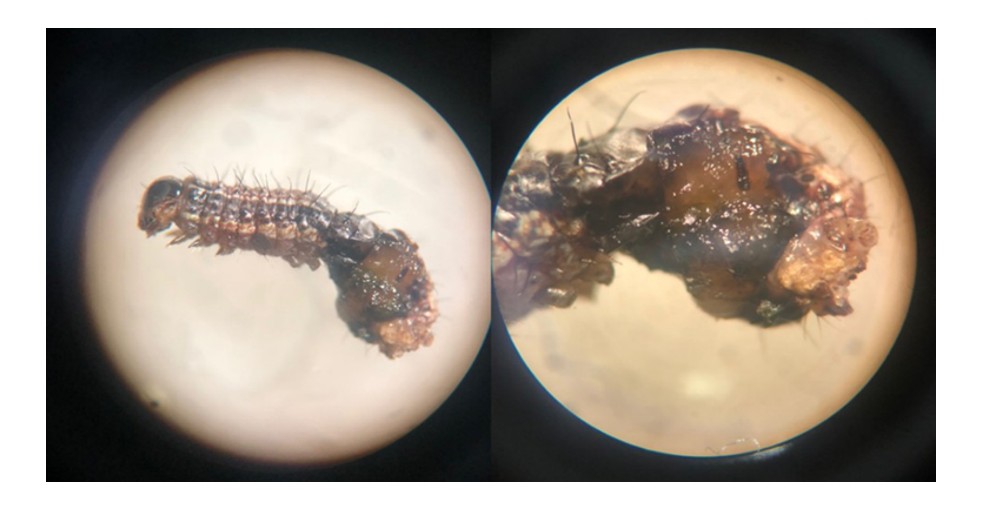
In Figure 4, it is possible to visualize a fourth instar larval of S. frugiperda collected in Jaboatão corn and transported to the laboratory for analysis under a stereoscopic microscope, after showing signs of predation by E. annulipes.
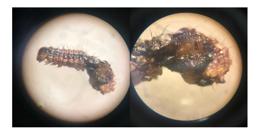
IV instar larval of Spodoptera frugiperda collected in Jaboatão corn, showing signs of predation by Euborellia annulipes, observed under a stereoscopic microscope.
4. Discussion
4.1. Bioassay I. Consumption of eggs and larvae of Spodoptera frugiperda by Euborellia annulipes and Marava arachidis
Given the results obtained, it can be stated that both predators consume high fees of S. frugiperda both in your internships initials, as in the more advanced stages. For example, it was observed that the fourth larval instar of the pest obtained 77.5% consumption by E. annulipes in Jaboatão corn and 75% in hybrid corn. These high percentages may be related to the fact that the larvae, from this stage onwards, are larger in size and thickness. According to Chaves (1998), in some cases, these are factors that can contribute to attracting the attention of predators, since in addition to larger larvae representing a large quantity of food, they also represent more biomass for the diet of these insects, giving the impression of satiety for a long period of time.
The 60% consumption rate obtained on second/third instar larvae of S. frugiperda by E. annulipes in Jaboatão, and 70% by M. arachidis in the hybrid, may be related to the fact that these larvae are smaller, which may facilitate their movement within the plant. These larvae have a habit of traveling from the cartridge to the tip of the leaves and the base of the corn stalk, moving intensely during these journeys, also tending to attract the attention of predators. This pattern of movement within the plant versus consumption by predators was observed by Nunes et al. (2018) and, later, put other study of Nunes et al. (2020), to the affirm that, in some cases, prey movements can stimulate predator attacks, as observed on the predation of Plutella xylostella (L.) (Lepidoptera: Plutellidae) put nymphs and adult females of E. annulipes.
Regarding the consumption of eggs and newly hatched larvae, although trends indicate that eggs, because they remain static, and first-instar larvae, because they are smaller, tend to move less and/or make less abrupt movements, and may be less likely to be consumed by predators, it can be seen from the results of this study that both E. annulipes and M. arachidis, in Jaboatão corn and hybrid corn, consumed rates above 50% of the treatment corresponding to these stages of S. frugiperda, which are considered promising results.
These data also showed that M. arachidis, a predator little explored in the literature and pest management programs when compared to E. annulipes, for example, is as effective in consuming different stages of S. frugiperda in semi-field conditions, including early stages of the pest. This is essential for the success of IPM programs, due to the fact that this pest is known to cause more severe damage to corn crops from its third larval instar.
Others results of studies using the predator E. annulipes and also others species of dermapterans demonstrated the same promising potential on different stages of S. frugiperda. For example, Silva et al. (2009) found consumption average of 1,481 eggs and 89.20 larvae of I urge for the V urge of E. annulipes, in just ten days of experiment, what he was the same time evaluative used in the present study, Souza et al. (2021) found an average consumption of 70 eggs and 43 first instar larvae by the fifth instar of Doru luteipes (Scudder, 1876) (Dermaptera: Forficulidae).
Before of exposed, the potential predatory observed in that study in relationship the E. annulipes and M. arachidis on S. frugiperda, show what the use of both to the species in programs of biological control and promising, considering what those results they were obtained through of tests in semi-field conditions, being relevant for optimizing predator releases in the field.
4.2. Bioassay 2. Time of handling of Euborellia annulipes and Marava arachidis on eggs and larvae of Spodoptera frugiperda
As show you results of the present study, factors what characterize larvae of IV urge, such as greater size, thickness, strength and resistance, may have contributed to making them more difficult prey to beings handled by predators (Dixon, 1959; Schoener, 1971), resulting in the shortest handling time. In this sense, the handling time for first instar eggs and larvae tends to be bigger for the fact of your eggs remain static and of to the larvae if move little, making less abrupt movements, thus facilitating handling by predators, as cited by Nunes et al. (2018) and corroborated by another study by Nunes et al. (2020). Furthermore, these results reinforce the idea of what the dynamics predator vs prague it needs to be considered for the development of strategies of control more efficient us MIP programs.
In conditions of laboratory, others studies they were carried out with the purpose of report the handling time of dermapterans on lepidopteran pests, such as that of Silva et al. (2024), who, when evaluating the time spent by the predator M. arachidis in handling A. grandis larvae, found that the female spent only 22.20 minutes handling the prey.
Therefore, considering that the present experiment was developed in semi-field conditions, standing out as an experimental method capable of providing necessary information for releases of predators in the field, and subsequently, for the management of these insects in agroecosystems, the results show what both E. annulipes as M. arachidis can handle, in few minutes, the different stages of S. frugiperda, even when it comes to more advanced stages, as the IV larval instar.
5. Conclusions
E. annulipes and M. arachidis they are predators promising node consumption of different internships of S. frugiperda in Jaboatão corn and hybrid corn, including early stages, with M. arachidis proving to be as effective as E. annulipes under semi-field conditions. Furthermore, both predators handle, in few minutes, with different internships of S. frugiperda, in both corns, even at more advanced stages.
Acknowledgements
We thank the Coordination for the Improvement of Higher Education Personnel (CAPES) and the Federal University of Paraíba for funding. This study was supported by a grant from the National Council for Scientific and Technological Development (CNPq) (grant number 420064).
Data Availability Statement
The entire data set that supports the results of this study was published in the article itself.
References
-
ALBUQUERQUE, P.E.P. and RESENDE, M., 2002 [viewed 31 October 2024]. Cultivo do mulho: manejo de irrigação [online]. Sete Lagoas: Embrapa Milho e Sorgo, 8 p. Comunicado Técnico, no. 47. Available from: https://ainfo.cnptia.embrapa.br/digital/bitstream/item/69853/1/Irrigacao-1.pdf
» https://ainfo.cnptia.embrapa.br/digital/bitstream/item/69853/1/Irrigacao-1.pdf -
BORTOLOTTO, O.C., SANTOS, J.V.C. and OCHONSKI, A.G., 2024. First report of earwig Doru luteipes (Dermaptera: Forficulidae) preying on corn leafhopper Dalbulus maidis (Hemiptera: Cicadellidae) nymphs. Brazilian Journal of Biology = Revista Brasileira de Biologia, vol. 84, e285975. http://doi.org/10.1590/1519-6984.285975 PMid:39442152.
» http://doi.org/10.1590/1519-6984.285975 - CHAVES, G.W., 1998. The influence of morphological and behavioral characteristics of caterpillars on predator attack: an experimental study with artificial larvae. Campinas: Universidade Estadual de Campinas, 101 p. Master's Dissertation in Biological Sciences.
-
COELHO, R.S., PEC, M., PEREIRA, P., PEÑAFLOR, M.F.G.V. and MARUCCI, R.C., 2024. Predatory earwigs, Euborellia annulipes, use guava volatiles to find shelter and fruit-fly prey. Arthropod-Plant Interactions, vol. 18, pp. 1-10. http://doi.org/10.1007/s11829-024-10099-w
» http://doi.org/10.1007/s11829-024-10099-w -
DIXON, A.F.G., 1959. An experimental study of the searching behaviour of the predatory coccinellid beetle Adalia decempunctata (L.). Journal of Animal Ecology, vol. 28, no. 259, pp. 259-281. http://doi.org/10.2307/2082
» http://doi.org/10.2307/2082 -
GUIMARÃES, M.R.F., SILVA, R.B., FIGUEIREDO, M.L.C. and CRUZ, I., 2006 [viewed 31 October 2024]. Avanços na metodologia e criação de Doru luteipes (Scudder, 1876) (Dermaptera: Forficulidae). In: Anais do 26º Congresso Nacional de Milho e Sorgo; 2º Simpósio Brasileiro Sobre a Lagarta-do-Cartucho, Spodoptera frugiperda; 1º Simpósio Sobre Colletotrichum graminicola [online], 2006, Belo Horizonte. Sete Lagoas: ABMS. Available from: https://www.alice.cnptia.embrapa.br/alice/handle/doc/490125?mode=full
» https://www.alice.cnptia.embrapa.br/alice/handle/doc/490125?mode=full -
HELLWIG, L., GRÜTZMACHER, A.D., SANTOS, P.M., TRECHA, C.O., MEDINA, L.B., MANICA-BERTO, R. and ROSA, A.P.S.A., 2017. Effect of increasing Spodoptera frugiperda larval density on conventional corn in a greenhouse. Brazilian Journal of Corn and Sorghum, vol. 16, no. 3, pp. 337-350. http://doi.org/10.18512/1980-6477/rbms.v16n3p337-350
» http://doi.org/10.18512/1980-6477/rbms.v16n3p337-350 -
HOTHORN, T., BRETZ, F. and WESTFALL, P., 2008. Simultaneous inference in general parametric models. Biometrical Journal. Biometrische Zeitschrift, vol. 50, no. 3, pp. 346-363. http://doi.org/10.1002/bimj.200810425 PMid:18481363.
» http://doi.org/10.1002/bimj.200810425 -
JACOMINE, P.K.T., RIBEIRO, M.R., MONTENEGRO, J.O., SILVA, A.P. and MELO FILHO, H.F.R. 1972 [viewed 31 October 2024]. I. Levantamento exploratório-reconhecimento de solos do Estado da Paraíba. II. Interpretação para uso agrícola dos solos do Estado da Paraíba [online]. Rio de Janeiro: Equipe de Pedologia e Fertilidade do Solo, 670 p. Boletim Técnico, no. 15. Available from: https://www.infoteca.cnptia.embrapa.br/infoteca/handle/doc/330784
» https://www.infoteca.cnptia.embrapa.br/infoteca/handle/doc/330784 -
KAMIMURA, Y., LEE, C.Y., YAMASAKO, J. and NISHIKAWA, M., 2023. Identification and reproductive isolation of Euborellia species (Insecta, Dermaptera, Anisolabididae) from East and Southeast Asia. ZooKeys, vol. 1146, pp. 115-134. http://doi.org/10.3897/zookeys.1146.98248 PMid:37214591.
» http://doi.org/10.3897/zookeys.1146.98248 -
MARCOS, R.A., USSENE, A.M., JOÃO, E.S.F., JOSÉ, F., CHAMUENE, A. and GUIDIONE, R., 2023. Resistance of corn (Zea mays L.) genotypes to natural infestation of fall armyworm (Spodoptera frugiperda) (J. E. Smith, 1797) (Lepidoptera: Noctuidae) in Mozambique. Focus, vol. 16, no. 6, e2383. http://doi.org/10.54751/revistafoco.v16n6-145
» http://doi.org/10.54751/revistafoco.v16n6-145 -
MORAL, R.A., HINDE, J. and DEMÉTRIO, C.G.B., 2017. Half-normal plots and overdispersed models in R: the hnp package. Journal of Statistical Software, vol. 81, no. 10, pp. 1-23. http://doi.org/10.18637/jss.v081.i10
» http://doi.org/10.18637/jss.v081.i10 -
MOTA-SANCHEZ, D. and WISE, J., 2023 [viewed 10 September 2024]. Arthropod Pesticide Resistance Database [online]. Available from: https://www.pesticideresistance.org/
» https://www.pesticideresistance.org/ -
NOVAIS, R.D., NEVES, J.C.L., BARROS, N.D., OLIVEIRA, A.D., GARRIDO, W.E., ARAÚJO, J.D. and LOURENÇO, S., 1991 [viewed 31 October 2024]. Soil fertility research methods [online]. Brasília: Embrapa, vol. 3, pp. 363-392. Available from: https://www.scienceopen.com/document?vid=b3303b23-8fb4-4c2b-adff-69afa534337e
» https://www.scienceopen.com/document?vid=b3303b23-8fb4-4c2b-adff-69afa534337e -
NUNES, G.S., DANTAS, T.A.V., FIGUEIREDO, W.R.S., SOUZA, M.D.S., NASCIMENTO, I.N. and BATISTA, J.L., 2018. Predation of diamondback moth larvae and pupae by Euborellia annulipes. Agrária, vol. 13, no. 3, pp. 1-8. http://doi.org/10.5039/agraria.v13i3a5557
» http://doi.org/10.5039/agraria.v13i3a5557 - NUNES, G.D.S., PAULO, H.H.D., DIAS, W.S.R. and BORTOLI, S.A.D., 2020. Feeding preference of Euborellia annulipes to Plutella xylostella: effects of temperature and prey development stage. Tropical Agricultural Research, vol. 50, e57778.
-
OLIVEIRA FILHO, L.S., ABREU, K.G., SALUSTINO, A.S., MORAIS, M.M.D., RIBEIRO, L.S., SOUSA, N.R. and BRITO, C.H., 2023. Effect of temperature on the biological development of Marava arachidis (Dermaptera: labiidae). Scientific Electronic Archives, vol. 16, no. 1, pp. 5. http://doi.org/10.36560/16120231642
» http://doi.org/10.36560/16120231642 -
PACHECO, R.C., SILVA, D.D., MENDES, S.M., LIMA, K.P., FIGUEIREDO, J.E.F. and MARUCCI, R.C., 2021. How omnivory affects the survival and choices of earwig Doru luteipes (Scudder) (Dermaptera: Forficulidae)? Brazilian Journal of Biology = Revista Brasileira de Biologia, vol. 83, e243890. http://doi.org/10.1590/1519-6984.243890 PMid:34133491.
» http://doi.org/10.1590/1519-6984.243890 - POITOUT, S. and BUÈS, R., 1974. Elevage de chenilles de vingt-huit especes de Lepidopteres Noctuidae et de deux especes d’Arctiidae sur milieu artificiel simple. Particularites de l’elevage selon les especes. Annales de Zoologie Ecologie Animale, vol. 6, no. 3, pp. 431-441.
- R CORE TEAM, 2023. R: a language and environment for statistical computing. Vienna: R Foundation for Statistical Computing.
-
RUSSO, M.L., JABER, L.R., SCORSETTI, A.C., VIANNA, F., CABELLO, M.N. and PELIZZA, S.A., 2021. Effect of entomopathogenic fungi introduced as corn endophytes on the development, reproduction, and food preference of the invasive fall armyworm Spodoptera frugiperda. Journal of Pest Science, vol. 94, no. 3, pp. 859-870. http://doi.org/10.1007/s10340-020-01302-x
» http://doi.org/10.1007/s10340-020-01302-x -
SANTOS, H.G., JACOMINE, P.K.T., ANJOS, L.H.C., OLIVEIRA, V.A., LUMBRERAS, J.F., COELHO, M.R., ALMEIDA, J.A., ARAÚJO FILHO, J.C., OLIVEIRA, J.B. and CUNHA, T.J.F., 2018 [viewed 10 October 2024]. Brazilian soil classification system [online]. 5. ed. Brasília, DF: Embrapa Solos, 356 p. Available from: https://www.infoteca.cnptia.embrapa.br/infoteca/handle/doc/1094003
» https://www.infoteca.cnptia.embrapa.br/infoteca/handle/doc/1094003 -
SCHIRMER, F.G., FAVETTI, B.M., CLARK, T., GALVAN, T., CORDEIRO, E.M.G., TRAN, K., BROMS, K. and MIRANDA, R., 2023. Mating suppression and damage reduction of Spodoptera frugiperda (JE Smith, 1797) in cotton. Entomological Communications, vol. 5, ec05026. http://doi.org/10.37486/2675-1305.ec05026
» http://doi.org/10.37486/2675-1305.ec05026 -
SCHOENER, T.H., 1971. Theory of feeding strategies. Annual Review of Ecology and Systematics, vol. 2, no. 1, pp. 369-404. http://doi.org/10.1146/annurev.es.02.110171.002101
» http://doi.org/10.1146/annurev.es.02.110171.002101 -
SILVA, A.B., BATISTA, J.L. and BRITO, C.H., 2009. Predatory capacity of Euborellia annulipes (Lucas, 1847) on Spodoptera frugiperda (Smith, 1797). Acta Scientiarum. Agronomy, vol. 31, pp. 7-11. http://doi.org/10.4025/actasciagron.v31i1.6602
» http://doi.org/10.4025/actasciagron.v31i1.6602 -
SILVA, A.B. and BRITO, J.M., 2014 [viewed 5 October 2025]. Bioecology of Euborellia annulipes: Dermaptera: Anisolabididae. Green Journal of Agroecology and Sustainable Development [online], vol. 9, no. 5, pp. 8. Available from https://dialnet.unirioja.es/servlet/articulo?codigo=7389663
» https://dialnet.unirioja.es/servlet/articulo?codigo=7389663 -
SILVA, L.P., SOUZA, I.L., MARUCCI, R.C. and GUZMAN-MARTINEZ, M., 2023. Doru luteipes (Dermaptera: Forficulidae) and Orius insidiosus (Hemiptera: Anthocoridae) as nocturnal and diurnal predators of thrips. Neotropical Entomology, vol. 52, no. 2, pp. 263-272. http://doi.org/10.1007/s13744-022-00982-7 PMid:35831705.
» http://doi.org/10.1007/s13744-022-00982-7 -
SILVA, J.G., SILVA, T.G.F., SALUSTINO, A.S., LEITE, E.L., ABREU, K.G., SILVA, A.S., BATISTA, J.L., BRITO, C.H., ARAÚJO, E.K., CÂNDIDO, B.A.P., SILVA, I.V.I., VIAGEM, C.R.S.M., RAMÍREZ, I.M.B., CORREIA NETO, D.F. and MALAQUIAS, J.B., 2024. Estimation of predation rate and handling time of boll weevil larvae by Marava arachidis (Dermaptera: Labiidae) using different mathematical methods. Brazilian Journal of Biology = Revista Brasileira de Biologia, vol. 84, e282251. http://doi.org/10.1590/1519-6984.282251 PMid:39230078.
» http://doi.org/10.1590/1519-6984.282251 -
SOUZA, C.S.F., SILVEIRA, L.C.P., SOUZA, B.H.S., NASCIMENTO, P.T., DAMASCENO, N.C.R. and MENDES, S.M., 2021. Efficiency of biological control for fall armyworm resistant to the protein Cry1F. Brazilian Journal of Biology = Revista Brasileira de Biologia, vol. 81, no. 1, pp. 154-163. http://doi.org/10.1590/1519-6984.224774 PMid:32159617.
» http://doi.org/10.1590/1519-6984.224774 -
SOUZA, J.C.S. and QUEIROZ, E.S., 2023. Analysis of the economic and environmental effects of corn ethanol production. Engineering and Science, vol. 11, no. 1, pp. 18-27. http://doi.org/10.6008/CBPC2318-3055.2023.001.0003
» http://doi.org/10.6008/CBPC2318-3055.2023.001.0003
Edited by
-
Editor:
Takako Matsumura Tundisi