 Efficacy, selectivity, and application technology aspects of pyraflufen-ethyl for Raphanus raphanistrum control in wheat pre-sowing
Abstract
This study aimed to evaluate the efficacy of the herbicide pyraflufen-ethyl, with and without the adjuvant, for the control of Raphanus raphanistrum (wild radish) in wheat pre-sowing, as well as the spray deposition dynamics and physicochemical properties of the spray solutions. Two experiments were conducted under field and laboratory conditions, comprising 12 treatments: pyraflufen-ethyl (7.5, 8.75, 10.0, 11.25, and 12.5 g ha-1), applied with and without the adjuvant (Lanzar® 0.2% v/v), iodosulfuron-methyl (10.0 g ha-1), and an untreated control, in a completely randomized design. Results indicated that the tank mixture of pyraflufen-ethyl with the adjuvant reduced pH, increased electrical conductivity, and had little effect on the static surface tension of the solutions. The combination of pyraflufen-ethyl with the adjuvant Lanzar® (0.2% v/v) decreases pH, increases electrical conductivity, and has minimal effect on the surface tension of the solutions. Pyraflufen-ethyl, from a dose of 7.5 g ha−1 combined with the adjuvant Lanzar® (0.2% v/v), significantly enhanced spray deposition and the speed of control of Raphanus raphanistrum, while also demonstrating selectivity for use in pre-sowing applications in wheat cultivation.
Keywords:
herbicide; adjuvant; wild radish; Triticum aestivum L
Resumo
Este estudo teve como objetivo avaliar a eficácia do herbicida pyraflufen-ethyl, com e sem a adição de adjuvante, no controle de nabo (Raphanus raphanistrum) na pré-semeadura do trigo, bem como a dinâmica de deposição da pulverização e as propriedades físico-químicas das caldas. Foram conduzidos dois experimentos em condições de campo e laboratório, compreendendo 12 tratamentos: pyraflufen-ethyl (7,5; 8,75; 10,0; 11,25; e 12,5 g ha−1), aplicados com e sem adjuvante (Lanzar®️ 0,2% v/v), iodosulfuron-methyl (10,0 g ha−1) e uma testemunha sem aplicação, em um delineamento inteiramente casualizado. A combinação de pyraflufen-ethyl com o adjuvante Lanzar® (0,2% v/v) reduz o pH, aumenta a condutividade elétrica e exerce efeito mínimo sobre a tensão superficial das soluções. O pyraflufen-ethyl, a partir da dose de 7,5 g ha−1 combinado com o adjuvante Lanzar® (0,2% v/v), aumentou significativamente a deposição da pulverização e a velocidade de controle de Raphanus raphanistrum, além de demonstrar seletividade para uso em aplicações de dessecação pré-semeadura na cultura do trigo.
Palavras-chave:
herbicida; adjuvante; wild radish; Triticum aestivum L
1. Introduction
The efficacy of herbicides depends on several factors that influence their performance, ranging from the physicochemical properties of the spray solution, application rate, weed species and growth stage, spray technology, and environmental conditions at and after application (Freitas et al., 2022). Among these factors, spray application technology remains one of the most neglected components by growers, often due to difficulties in producing droplets suitable for adequate target coverage (Gazziero, 2015; Maciel et al., 2022).
The addition of adjuvants to spray mixtures can be a fundamental tool in weed management. Adjuvants are substances added to formulations to improve the solubilization and dispersion of active ingredients, potentially intensifying the efficacy of pesticides against target organisms (Loureiro et al., 2026). These products improve the physicochemical properties of herbicide solutions and may provide several benefits, such as enhanced absorption of the active ingredient, increased retention on the target, and enhanced persistence. Moreover, the enhanced spreading of spray droplets promoted by adjuvants on leaf surfaces, can directly affect herbicide efficacy (Salvalaggio et al., 2018). However, recommendations for adjuvant use are complex, as their interaction with agrochemicals varies according to physical, chemical and physiological aspects. Both the rate and formulation of adjuvants can directly affect the physicochemical properties of herbicide, fungicide, and insecticide sprays (Decaro Júnior et al., 2015; Hama et al., 2018).
The herbicide pyraflufen-ethyl [Ethyl 2-chloro-5-(4-chloro-5-(difluoromethoxy)-1-methylpyrazol-3-yl)-4-fluorophenoxyacetate], belongs to the chemical group of phenylpyrazoles and is marketed in Brazil as an emulsifiable concentrate formulation for pre-harvest desiccation in cotton, potato, and bean crops (Brasil, 2025b). This herbicide acts by contact, inhibiting the enzyme protoporphyrinogen oxidase (PROTOX/PPO) in plant chloroplasts, mainly dicotyledonous weeds. Light is essential for the activity of PROTOX inhibitors, and once applied to leaves, these herbicides exhibit very limited or no translocation within the plant (Kogan and Pérez, 2003.).
Raphanus raphanistrum is an annual winter and spring weed species, commonly known as wild radish, and belongs to the Brassicaceae (Cruciferae) family (Lorenzi, 2014). Species within this family, such as Raphanus sativus, have been studied for their physiological and biometric responses to different fertilization and management systems, highlighting their importance in crop rotation (Targino et al., 2025). According to Reeves et al. (1981) and Young and Cousens (1998), the high reproductive and germination potential, combined with seed dormancy and longevity, allows R. raphanistrum to form a large soil seedbank, making control difficult across different agricultural practices. Wild radish is considered one of the most frequent and problematic weeds in winter cereals, particularly in Brazilian wheat production systems (De Mori et al., 2012; Lamego et al., 2013; Vitorino et al., 2014).
In addition to chemical control strategies, the use of cover crops and beneficial microorganisms has emerged as a promising approach for more sustainable agricultural systems. Seed inoculation with plant growth-promoting bacteria, such as Azospirillum brasilense and Bacillus amyloliquefaciens, can enhance germination, seedling vigor, and root development in species like Avena sativa, Vicia sativa, and Raphanus sativus, although responses are species-dependent. This integration of biological inputs may contribute to improved plant establishment and more efficient weed management (Pedrozo et al., 2025).
In Southern Brazil, resistance of wild radish (Raphanus raphanistrum) to ALS (acetolactate synthase)-inhibiting herbicides was reported in 2013, particularly to metsulfuron-methyl, with cross-resistance also observed to chlorimuron-ethyl, cloransulam-methyl, imazethapyr, iodosulfuron, nicosulfuron, and imazapic + imazapyr. This resistance led to widespread grower complaints and, in some cases, even to the abandonment of wheat cultivation in infested areas (Costa and Rizzardi, 2013). Therefore, management of this species through herbicide rotation with alternative modes of action is crucial, since resistance of the genus Raphanus to ALS inhibitors is not new in Brazil. The first case of resistance in Raphanus sativus was officially reported in 2001 (Heap, 2001). Theisen (2008) documented biotypes of R. sativus with cross-resistance to five ALS-inhibiting herbicides, and Costa and Rizzardi (2014) later confirmed R. raphanistrum resistance to metsulfuron-methyl.
This research aimed to evaluate the efficacy of pyraflufen-ethyl, with and without adjuvant, for wild radish control in wheat pre-sowing, well as the spray deposition dynamics and the physicochemical properties of the spray solutions.
2. Material and Methods
The field experiment was conducted at the experimental area of the Department of Agronomy, Universidade Estadual do Centro-Oeste (UNICENTRO), CEDETEG Campus, Guarapuava, Paraná State, Brazil (25°23'07.5'' S latitude, 51°29''45.4'' W longitude, and 1,024 m altitude). The climate of the region is classified as humid subtropical mesothermal (Cfb) according to Köppen-Geiger, with cool summers, cold winters with frequent severe frosts, and rainfall is well distributed throughout the year, without prolonged dry periods (Costa and Andrade, 2017).
Climatological data were obtained from the UNICENTRO weather station located CEDETEG Campus, approximately 150 m from the experimental site (Figure 1).

Climatological data during the experimental period. Source of the image: Authors. Source: UNICENTRO weather station. CEDETEG Campus. Universidade Estadual do Centro-Oeste (UNICENTRO) - Guarapuava (Brazil).
The soil is classified as a Latossolo Vermelho distrófico típico (EMBRAPA, 2018) - Typic Hapludox - USDA Soil Taxonomy, with a clay texture (72% clay, 21% sand, and 7% silt). Chemical analysis of soil samples (0–20 cm depth) indicated the following properties: pH (CaCl2) of 5.0; H+ + Al3+ = 5.13 cmolc dm-3; Ca2+= 3.90 cmolcdm-3; Mg2+= 0.23 cmolc dm-3; K+= 0.18 cmolc dm-3; P (Mehlich)= 2.6 mg dm-3; and organic carbon = 4.29 g dm-3.
The field experiment was arranged in a randomized complete block design with 12 treatments and four replications (Table 1). Experimental units consisted of 3.0 × 2.0 m plot (6.0 m2). Ten days after herbicide application, 12 rows of wheat were sown in each plot. To estimate spray deposition, the tracer Brilliant Blue (FDC&1, 1500 ppm) was added to all spray solutions. Thirty replicates were used, each represented by one wild radish plant at the 4-6 leaf stage.
Herbicide treatments. application doses. spray quality. and solution properties for pre-sowing control of wild radish in wheat. Guarapuava. PR. Brazil.
Applications were carried out on August 10, 2016, between 13:35 and 14:20 pm, using a CO2-pressurized backpack sprayer equipped with four TTi 110.015 flat-fan nozzles, spaced 0.5 m apart, positioned 0.5 m above the canopy. Spray volume was 200 L ha−1 at 207 kPa and 3.6 km h−1. At application, weed infestation consisted mainly of wild radish plants, averaging 16 plants m-2 at the 4-leaf stage and 12 plants m-2 at the 6-leaf stage (28 plants m-2 total). Weather conditions during spraying averaged 17.3 °C, 51.5% relative humidity, and wind speed between 2.0 and 4.0 km h−1, measured with a thermo-hygro-anemometer.
No insecticide applications were required. Disease management included tebuconazole + trifloxystrobin (60 + 120 g ha−1) at tillering and stem elongation, and tebuconazole + trifloxystrobin (60 + 120 g ha−1) plus propiconazole (150 g ha−1) at heading, both with methylated vegetable oil (0.25% v/v).
Direct sowing of wheat cultivar BRS Sabiá was performed on August 20, 2016 (10 days after application), using a 20 cm row spacing and 350 viable seeds m-2, according to technical recommendations for wheat sowing in southern Brazil. Fertilization at sowing consisted of 240 kg ha-1 of the 8-20-20 NPK formulation, and topdressing was performed with 60 kg ha-1 of urea (45% N).
Weed control and wheat crop performance were visually assessed at 3, 7, 14, 21, and 28 days after application (DAA) using the SBCPD (1995) scale, where 0% = no injury and 100% = complete plant death. Since pyraflufen-ethyl was applied during pre-sowing burndown desiccation and has minimal residual activity in the soil, the evaluations in wheat were related to the effectiveness of weed control rather than residual crop phytotoxicity. Assessments were performed within the useful area of each plot, excluding border rows and 0.5 m from each plot end. Electron transport rate (ETR; μmol m−2 s−1) in wild radish leaves was measured at 1, 24, 48, 72, and 216 h after application (HAA) using an Opti-Science Y(II) portable fluorometer, with five replications per treatment. In addition, the production components hectolitre weight (kg hL−1), determined according to the Rules for Seed Analysis (Brasil, 2025a), and grain yield (kg ha-1), with moisture corrected to 13%, were also determined at harvest.
For spray deposition evaluation, tracer solution recovery was performed in the laboratory. Target plants were washed with 25 mL of distilled water in plastic bags under constant agitation for 20 s. The amount of tracer deposited on wild radish leaves was determined spectrophotometrically. Absorbance at 630 nm was converted to μg L-1 based on the slope of the standard calibration curve, following the methodology of Maciel et al. (2019). Deposition values were expressed as μL g-1 dry mass. After washing, the aerial parts of the plants were placed in paper bags, oven-dried at 65 °C for 72 h in forced air circulation and weighed on an analytical balance.
Spray solution pH, electrical conductivity, and static surface tension were determined immediately after preparation under laboratory conditions in a completely randomized design with 12 treatments and three replications (15 for surface tension). Static surface tension was measured using the drop-weight method, weighing droplets formed at the burette tip with an analytical balance (0.001 mg precision) over 25-30 s (Maciel et al., 2010).
In the laboratory, physicochemical properties of herbicide spray solutions were also assessed, including pH, electrical conductivity and static surface tension, immediately after solution preparation. A completely randomized design was used, with 12 treatments and 3, 3, and 15 replications, respectively. Static surface tension was measured according to the methodology described by Maciel et al. (2010), by weighing droplets formed at the tip of a burette positioned over an analytical balance (precision 0.001 mg) within 25–30 s. Solution pH and electrical conductivity were determined using digital pH and conductivity meters.
Data were tested for normality (Shapiro–Wilk) and homogeneity of variances (Hartley’s test). Analysis of variance (ANOVA) was performed using the F-test, and means were compared using the Scott–Knott clustering test. Physicochemical properties, spray deposition, and electron transport rate (ETR) were also presented as bar charts with 95% confidence intervals (CI95%) at p < 0.05. Treatments were considered statistically different when confidence intervals did not overlap (Concenço et al., 2018). Confidence intervals were additionally used to provide a graphical and more robust interpretation of treatment variability and biological relevance over time, particularly for repeated evaluations, whereas mean comparison tests were applied for single-point variables. Cumulative frequency distributions (%) of deposition values were also plotted to provide a broader biological interpretation of spray deposition patterns.
3. Results and Discussion
Regarding the physicochemical properties of the spray solutions, it was observed that pyraflufen-ethyl, at all doses studied, reduced the pH of the solutions compared to water (control), reaching mean values around 3.25 and 4.50, respectively, when applied with or without the adjuvant Lanzar® (0.2% v/v) (Figure 2a). The addition of the adjuvant decreased the pH of the pyraflufen-ethyl solutions by approximately 1.0 unit, regardless of the herbicide rate. Conversely, the mixture of pyraflufen-ethyl with adjuvant significantly increased the electrical conductivity of the solutions by 31.1% and 24.5%, respectively, compared to the absence of the adjuvant and to the standard herbicide iodosulfuron-methyl (Figure 2b).

Physicochemical characteristics pH (a). electrical conductivity (b). and static surface tension (c) of herbicide spray solutions with and without the adjuvant Lanzar™ (M.O. 0.2% v/v). Fcal = F calculated; CV = coefficient of variation. Means in the same column followed by the same letter are not significantly different according to the Scott-Knott test (p ≤ 0.05). Bars represent confidence interval (CI95%). ** significant at 1% probability.
These results are like reported by Cunha and Alves (2009), who also observed reduced pH and increased electrical conductivity in aqueous solutions without herbicides, depending on the adjuvant used. In contrast, Cunha et al. (2017) reported minimal variation in pH and electrical conductivity values with the use of adjuvants. Nevertheless, the addition of adjuvants to spray solutions can alter their physicochemical properties and primarily influence variables such as droplet spectrum, surface tension, and droplet contact angle on target surfaces (Decaro Júnior et al., 2015; Costa et al., 2017).
For static surface tension, increasing concentrations of pyraflufen-ethyl in the solutions led to a progressive reduction, reaching maximum levels of 41.8 and 43.9 mN m-1, respectively, when applied with or without the adjuvant (Figure 2a). Similar reductions in surface tension following adjuvant addition have been reported for both aqueous and agrochemical-containing solutions (Janků et al., 2012). Furthermore, it is important to highlight that adjuvants composed of petroleum-derived oils, such as Lanzar®, may enhance herbicide absorption and spreading due to the variable percentage of surfactant in their composition, as well as exerting anti-evaporative effects and helping maintain droplet integrity during environmental exposure (Raetano and Chechetto, 2019; Santos et al., 2019).
Regarding the spray deposition on wild radish plants, the combination of pyraflufen-ethyl at rates of 7.5, 8.75, 10.0, 11.25, and 12.5 g ha−1 with the adjuvant resulted in significant increases of 12.4%, 21.9%, 18.0%, 6.0%, and 16.5%, respectively (Figure 3a). In comparison to iodosulfuron-methyl, the mixture of pyraflufen-ethyl with the adjuvant, starting from 8.75 g ha-1, significantly increased deposition by 14.7% to 24.2%. In contrast, pyraflufen-ethyl alone showed no significant differences in deposition at the 11.25 and 12.5 g ha-1 rates.

Mean deposition of the pyraflufen-ethyl spray solution on wild radish (Raphanus raphanistrum) with and without the adjuvant Lanzar™ (M.O. 0.2% v/v) (a). cumulative frequency of individual deposits per treatment (b). and cumulative frequency of deposits for herbicide (c). F calculated; CV = coefficient of variation. Means with the same uppercase letter for dry matter and lowercase for plant density in the columns do not differ from each other by the Scott-Knott test (p ≤ 0.05).
Murata et al. (2002) further highlighted that foliar deposition and absorption of pyraflufen-ethyl vary according to the morphology, surface structure, and epicuticular wax composition of leaves. When comparing the deposition of 14C-pyraflufen-ethyl on the leaves of the weed Galium aparine and wheat, they observed that unabsorbed foliar radioactivity was approximately three to five times greater in the weed than in wheat. Moreover, at 1 and 42 hours after application, absorbed herbicide levels were seven and thirteen times higher in G. aparine, respectively. These results indicate that the higher absorption of pyraflufen-ethyl in G. aparine was not only due to higher spray deposition but also to a higher absorption rate. Differences in foliar deposition and absorption may play an important role in the selectivity of pyraflufen-ethyl between crops, such as wheat, and broadleaf weed species, directly affecting weed control efficacy.
Complementarily, the spray deposition results of pyraflufen-ethyl on wild radish (Figures 33c) reflected the actual behavior obtained by the cumulative frequency distribution of the entire dataset, highlighting the contribution of the adjuvant when associated with the herbicide. In Figure 3b, the deposition curves of pyraflufen-ethyl + Lanzar® shifted further to the right, indicating greater unitary deposition on weed leaves (µL g-1 dry matter). In this sense, it can be inferred that the smaller the rightward shift of the curves, the lower the amount of product deposited on the targets, represented by wild radish plants. Thus, in Figure 3c, the overall deposition results of pyraflufen-ethyl doses combined with the adjuvant clearly showed superior performance, with average increases of 15.2% and 11.7% compared with the absence of the adjuvant and iodosulfuron-methyl, respectively.
For wild radish control, it was observed that despite the low efficacy at 3 DAA for all treatments (≤ 20%), the combinations of pyraflufen-ethyl with Lanzar® (M.O. 0.2% v/v) were significantly superior to treatments without the adjuvant (Table 2). From 7 DAA onwards, only pyraflufen-ethyl combined with the adjuvant at 8.75, 10.0, 11.25, and 12.5 g ha-1, as well as pyraflufen-ethyl alone at 12.5 g ha-1, achieved satisfactory wild radish control (≥ 80.0%), according to SBCPD (1995) criteria (Table 2). Therefore, at 7 DAA, all pyraflufen-ethyl treatments with the adjuvant were significantly superior to pyraflufen-ethyl alone. These results demonstrate the potential for a synergistic effect and, consequently, a faster action of pyraflufen-ethyl when applied with the adjuvant, resulting in approximately a 10% increase in control efficacy. Vranješ and Đekić (2022) also reported control improvements of 10-15% in potato pre-harvest desiccation when mineral oil was added to pyraflufen-ethyl (26.5 g ha-1).
Wild radish (R. raphanistrum) control at 3. 7. 14. 21. and 28 days after post-emergence application (DAA) prior to wheat sowing. Guarapuava. PR. Brazil. 2016.
Other studies conducted under controlled conditions have shown rapid control of certain broadleaf weeds with pyraflufen-ethyl, even when applied at low rates (3-10 g ha−1) and without adjuvants, achieving satisfactory efficacy levels as early as 2 to 3 days after application (Murata et al., 2002; Mabuchi et al., 2002).
At higher pyraflufen-ethyl rates, Amaro‐Blanco et al. (2018) concluded that 22 g ha-1 effectively reduced soil cover by three Conyza spp. biotypes, although it did not provide satisfactory reduction in seed production of surviving plants. Under controlled conditions, Kanatas et al. (2020) reported 100% control of glyphosate-resistant Conyza canadensis biotypes at 7 days after application of 22 g ha-1, either alone or in combination with the ALS-inhibiting herbicide florasulam (5 g ha-1). It is noteworthy that in both studies, no adjuvants were mentioned in the applications.
Combinations of 8.75, 10.0, 11.25, and 12.5 g ha−1 of pyraflufen-ethyl with adjuvant stood out, achieving highly efficient control (≥ 93.8%) of wild radish at 14 DAA. These treatments were significantly superior to other pyraflufen-ethyl treatments, which achieved at least satisfactory control, even when compared to iodosulfuron-methyl, which did not reach satisfactory control during this period (62.5%). Similarly, Hojnowski (2024) found that tank mixes of pyraflufen-ethyl at doses of 3.75 and 5.00 g ha−1, combined with the grass herbicide clodinafop-propargyl (96 g ha−1) and the adjuvant Dash® (0.5% v/v), were highly efficient in controlling wild radish (> 90%) from 14 DAA onwards.
At 21 DAA, all treatments further increased wild radish control levels, with particular emphasis on all doses of pyraflufen-ethyl + Lanzar®, which maintained excellent control levels (≥ 95.5%) (Table 2). In this evaluation, pyraflufen-ethyl + Lanzar® significantly outperformed the same rates of pyraflufen-ethyl alone, although the latter also provided satisfactory to excellent control according to SBCPD (1995) criteria. Moreover, it is noteworthy that all pyraflufen-ethyl treatments, whether alone or with the adjuvant, were superior to iodosulfuron-methyl from 21 DAA onward, even though iodosulfuron-methyl also achieved satisfactory wild radish control (82.1%).
The enhancement of herbicide efficacy by adjuvants is a common finding in scientific studies, being associated with increased leaf wettability, reduced surface tension, and reduced droplet contact angle (Maciel et al., 2014). Procópio et al. (2003), when characterizing wild radish leaves as having a thick adaxial cuticle, noted that the use of adjuvants may be an effective strategy to improve herbicide penetration in this species. Within this context, at 28 DAA, only pyraflufen-ethyl treatments at 10.0, 11.25, and 12.5 g ha-1 combined with adjuvant reached maximum control efficacy and complete aboveground dry matter reduction (100%) (Table 2, Figure 4). However, with the exception of iodosulfuron-methyl, all other treatments maintained satisfactory wild radish control (≥ 84.3%), with emphasis on the 7.5 and 8.75 g ha-1 pyraflufen-ethyl + Lanzar® combinations, which outperformed all equivalent pyraflufen-ethyl treatments without the adjuvant.
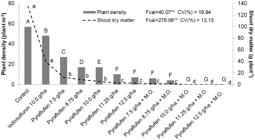
Shoot dry matter and plant density of wild radish (R. raphanistrum) at 28 days after application (DAA) of pyraflufen-ethyl with and without the adjuvant Lanzar™ (M.O. 0.2% v/v). Similar bars do not differ from each other by the confidence interval (CI 95%). at 95% probability (p ≤ 0.05). ** significant at 1% probability.
The control efficacy results were consistent with those obtained for aboveground dry matter and wild radish plant density (Figure 4).
For these variables, two distinct groups of higher performance were observed: the first, with the lowest averages, comprised the treatments with 10.0, 11.25, and 12.5 g ha-1 of pyraflufen-ethyl + Lanzar®; the second included 7.5 and 8.75 g ha-1 of pyraflufen-ethyl + Lanzar®, as well as 11.25 and 12.5 g ha-1 of pyraflufen-ethyl alone. These findings highlight the importance of adjuvant in maintaining the faster action of pyraflufen-ethyl and achieving maximum efficacy at rates above 10.0 g ha-1. The rapid activity of pyraflufen-ethyl on broadleaf weeds depends on sensitivity, application rate, and growth stage, which can be explained by interspecific differences in absorption and/or detoxification, especially among problematic weed species in winter cereals (Murata et al., 2002; Mabuchi et al., 2002; Miura et al., 2003).
Furthermore, it is important to emphasize that all pyraflufen-ethyl treatments achieved significantly greater control than iodosulfuron-methyl at all evaluation times, regardless of adjuvant use. This result indicates the potential feasibility of using pyraflufen-ethyl as a strategic alternative for herbicide mode-of-action rotation in wheat cultivation, thereby helping to prevent resistance development in wild radish (Raphanus raphanistrum) to ALS-inhibiting herbicides such as iodosulfuron-methyl, as well as others including chlorimuron-ethyl, cloransulam-methyl, imazapic, imazapyr, metsulfuron-methyl, and sulfometuron-methyl, for which resistant biotypes have already been reported in the northern region of Paraná State (Heap, 2001).
Regarding the electron transport rate (ETR) in wild radish plants, significant reductions were observed as early as 1 and 24 hours after application (HAA) for all herbicide treatments, with the most pronounced decreases occurring at the higher pyraflufen-ethyl rates, with or without the adjuvant (Figure 5). Murata et al. (2004) reported peaks of protoporphyrinogen IX (Protogen) accumulation 4 to 7 hours before protoporphyrin IX (Proto IX) in cucumber (Cucumis sativus L.) cotyledons immediately after pyraflufen-ethyl application. The authors suggested that Protogen accumulation in intact plants may represent the first biological response following application of PROTOX inhibitors.

Electron transport rate (ETR) in wild radish at 1. 24. 48. 72. and 216 hours after application (HAA) of pyraflufen-ethyl with and without the adjuvant Lanzar™ (M.O. 0.2% v/v). F calculated; CV = coefficient of variation. Averages with the same lowercase letter for hectoliter weight and uppercase for productivity in the columns do not differ from each other by the Scott-Knott test (p ≤ 0.05).
From 72 HAA (3 DAA) onwards, all pyraflufen-ethyl treatments significantly reduced ETR compared with iodosulfuron-methyl, and no significant differences were observed between treatments with and without the adjuvant. At 216 HAA (9 DAA), the adjuvant enabled the lowest pyraflufen-ethyl rate (7.5 g ha-1) to reduce physiological activity, with results not differing significantly from the higher solo herbicide rates.
With respect to the selectivity of wheat cultivar BRS Sabiá, sown 10 days after application, no visual phytotoxicity symptoms were detected, regardless of herbicide rate or treatment characteristics. These findings are consistent with Mabuchi et al. (2002), who reported that only mild visible injury symptoms (<10%) were observed at rates above 100 g ha-1 of pyraflufen-ethyl in greenhouse experiments with wheat and barley.
For test weight and wheat grain yield, no significant differences were observed among treatments with pyraflufen-ethyl and iodosulfuron-methyl, all of which were superior to the untreated control (Figure 6). The persistence of wild radish infestation after wheat sowing reduced average grain yield by 16.4% I the untreated control compared with the mean yield of herbicide-treated plots.

Test weight and grain yield of the wheat cultivar ‘BRS Sábia’ sown after the application of herbicides with and without the adjuvant Lanzar™ (M.O. 0.2% v/v). Source of the image: Author.
4. Conclusions
The combination of pyraflufen-ethyl with the adjuvant Lanzar® (0.2% v/v) decreases pH, increases electrical conductivity, and has minimal effect on the surface tension of the solutions.
Pyraflufen-ethyl, from a dose of 7.5 g ha−1 combined with the adjuvant Lanzar® (0.2% v/v), significantly enhanced spray deposition and the speed of control of Raphanus raphanistrum, while also demonstrating selectivity for use in pre-sowing applications in wheat cultivation.
Acknowledgements
This study was financed in part by the Coordenação de Aperfeiçoamento de Pessoal de Nível Superior (CAPES, Finance Code 001) and the Conselho Nacional de Desenvolvimento Científico e Tecnológico (CNPq) - Processo Nº 302923/2022-5 - Bolsa de produtividade em pesquisa - Chamada CNPq Nº 09/2022. To the Coordenação de Aperfeiçoamento de Pessoal de Nível Superior (CAPES) for granting scholarships for scientific initiation, master's and doctoral degrees. To the Weed Research Group of the Universidade Estadual do Centro-Oeste (UNICENTRO) and Universidade Estadual do Centro-Oeste (UNICENTRO), for the support and structure for the development of the project.
Data Availability Statement
The research data is available upon prior request via email to the corresponding author.
References
-
AMARO‐BLANCO, I., FERNÁNDEZ‐MORENO, P.T., OSUNA‐RUIZ, M.D., BASTIDA, F. and DE PRADO, R., 2018. Mechanisms of glyphosate resistance and response to alternative herbicide‐based management in populations of the three Conyza Species introduced in southern spain. Pest Management Science, vol. 74, no. 8, pp. 1925-1937. https://doi.org/10.1002/ps.4896 PMid:29479817.
» https://doi.org/10.1002/ps.4896 -
BRASIL Ministério da Agricultura, Pecuária e Abastecimento - MAPA, 2025a [viewed 24 July 2025]. Rules for seed testing [online]. Available from: https://wikisda.agricultura.gov.br/Laboratórios/Metodologia/Sementes/RAS_2025/Amostragem
» https://wikisda.agricultura.gov.br/Laboratórios/Metodologia/Sementes/RAS_2025/Amostragem -
BRASIL. Ministério da Agricultura, Pecuária e Abastecimento - MAPA, 2025b [viewed 24 July 2025]. AGROFIT [online]. Available from: https://agrofit.agricultura.gov.br/agrofit_cons/principal_agrofit_cons
» https://agrofit.agricultura.gov.br/agrofit_cons/principal_agrofit_cons -
CONCENÇO, G., ANDRES, A., SCHREIBER, F., SCHERNER, A. and BEHENCK, J.P., 2018. Statistical approaches in weed research: choosing wisely. Revista Brasileira de Herbicidas, vol. 17, no. 1, pp. 45-58. https://doi.org/10.7824/rbh.v17i1.536
» https://doi.org/10.7824/rbh.v17i1.536 -
COSTA, C. and ANDRADE, A.R., 2017. Dinâmica da precipitação pluviométrica na cidade de Guarapuava, PR: condicionantes locais e regionais. Revista Brasileira de Climatologia, vol. 21, pp. 205-224. https://doi.org/10.5380/abclima.v21i0.51625
» https://doi.org/10.5380/abclima.v21i0.51625 -
COSTA, L.L., SILVA, H.J.P.S., ALMEIDA, D.P., FERREIRA, M.C. and PONTES, N.D.C., 2017. Droplet spectra and surface tension of spray solutions by biological insecticide and adjuvants. Engenharia Agrícola, vol. 37, no. 2, pp. 292-301. https://doi.org/10.1590/1809-4430-eng.agric.v37n2p292-301/2017
» https://doi.org/10.1590/1809-4430-eng.agric.v37n2p292-301/2017 -
COSTA, L.O. and RIZZARDI, M.A., 2013. Herbicidas alternativos para o controle de Raphanus raphanistrum L. resistente ao herbicida metsulfurom metílico. Revista Brasileira de Herbicidas, vol. 12, no. 3, pp. 268-276. https://doi.org/10.7824/rbh.v12i3.240
» https://doi.org/10.7824/rbh.v12i3.240 -
COSTA, L.O. and RIZZARDI, M.A., 2014. Resistance of Raphanus raphanistrum to the herbicide metsulfuron-methyl. Planta Daninha, vol. 32, no. 1, pp. 181-187. https://doi.org/10.1590/S0100-83582014000100020
» https://doi.org/10.1590/S0100-83582014000100020 -
CUNHA, J.P.A.R. and ALVES, G.S., 2009 [viewed 24 July 2025]. Características físico-químicas de soluções aquosas com adjuvantes de uso agrícola. Interciencia [online], vol. 34, no. 9, pp. 655-659. Available from: https://www.interciencia.net/wp-content/uploads/2018/01/655-c-CUNHA-5.pdf
» https://www.interciencia.net/wp-content/uploads/2018/01/655-c-CUNHA-5.pdf -
CUNHA, J.P.A.R., ALVES, G.S. and MARQUES, R.S., 2017. Surface tension, hydrogen-ion potential and electrical conductivity in spray solutions of plant protection products and adjuvants. Revista Ciência Agronômica, vol. 48, no. 2, pp. 261-270. https://doi.org/10.5935/1806-6690.20170030
» https://doi.org/10.5935/1806-6690.20170030 -
DE MORI, C., HARGER, N., PRANDO, A.M., SILVA, S.R., TAVARES, L.C.V., BASSOI, M.C., FOLONI, J.S.S., OLIVEIRA, A.B., LIMA, D. and SILVA FILHO, P.M., 2012 [viewed 24 December 2024]. Uso de tecnologias em lavouras de trigo tecnicamente assistidas no Paraná - Safra 2012 [online]. EMBRAPA TRIGO, vol. 148, p. 31. Available from: http://www.cnpt.embrapa.br/biblio/do/p_do148.htm
» http://www.cnpt.embrapa.br/biblio/do/p_do148.htm -
DECARO JÚNIOR, S.T., FERREIRA, M.C. and LASMAR, O., 2015. Physical characteristics of oily spraying liquids and droplets formed on coffee leaves and glass surfaces. Engenharia Agrícola, vol. 35, no. 3, pp. 588-600. https://doi.org/10.1590/1809-4430-Eng.Agric.v35n3p588-600/2015
» https://doi.org/10.1590/1809-4430-Eng.Agric.v35n3p588-600/2015 - EMPRESA BRASILEIRA DE PESQUISA AGROPECUÁRIA – EMBRAPA, 2018. Sistema Brasileiro de Classificação de Solos 5th ed. Brasília: Embrapa.
- FREITAS, F.C.L., FERREIRA, L.R., SOUZA, W.M., MORAES, H.M.F. and PAIVA, M.C.G., 2022. Desafios e avanços na tecnologia de aplicação de herbicidas. In: K.F. MENDES and A.A. SILVA. Plantas daninhas: herbicidas São Paulo: Oficina de Textos, vol. 2, pp. 129-171.
-
GAZZIERO, D.L.P., 2015. Misturas de agrotóxicos em tanque nas propriedades agrícolas do Brasil. Planta Daninha, vol. 33, no. 1, pp. 83-92. https://doi.org/10.1590/S0100-83582015000100010
» https://doi.org/10.1590/S0100-83582015000100010 -
HAMA, J.T., SOUZA, J.I., MACIEL, C.D.G., SILVA, A.A.P., HELVIG, E.O., CZARNIESKI, G.M., GRASSATO, K., LEAL, G.B. and PEREIRA, A.C., 2018 [viewed 18 October 2024]. Avaliação de características físico-químicas de misturas em tanque de herbicida, inseticida e fungicida com adjuvantes. Journal of Agronomic Sciences [online]., vol. 7, no. 1, pp. 152-164. Available from: https://pag.uem.br/anteriores/v7n1
» https://pag.uem.br/anteriores/v7n1 -
HEAP, I., 2001 [viewed 16 October 2024]. The international survey of herbicide resistant weeds database [online]. Available from: https://www.weedscience.org/Home.aspx
» https://www.weedscience.org/Home.aspx -
HOJNOWSKI, É.M., 2024 [viewed 22 August 2025]. Seletividade e eficácia de herbicidas aplicados em isolado ou associados para o controle de plantas daninhas em trigo Erechim: Universidade Federal da Fronteira Sul. 38 p. Undergraduate Thesis, Bachelor of Agronomy. Available from: https://rd.uffs.edu.br:8443/handle/prefix/8190
» https://rd.uffs.edu.br:8443/handle/prefix/8190 -
JANKŮ, J., BARTOVSKÁ, L., SOUKUP, J., JURSÍK, M. and HAMOUZOVÁ, K., 2012. Density and surface tension of aqueous solutions of adjuvants used for tank-mixes with pesticides. Plant, Soil and Environment, vol. 58, no. 12, pp. 568-572. https://doi.org/10.17221/556/2012-PSE
» https://doi.org/10.17221/556/2012-PSE -
KANATAS, P., TRAVLOS, I., KOLIVAS, M., TATARIDAS, A. and MAVROEIDIS, A., 2020 [viewed 22 August 2025]. Pyraflufen-ethyl and florasulam efficacy against glyphosate resistant horseweed (Conyza Canadensis) biotypes. Scientific Papers Series A. Agronomy [online], vol. 63, no. 1, pp. 335-340. Available from: https://agronomyjournal.usamv.ro/pdf/2020/issue_1/Art45.pdf
» https://agronomyjournal.usamv.ro/pdf/2020/issue_1/Art45.pdf - KOGAN, M. and PÉREZ, A., 2003. Mecanismos de acción de los herbicidas: sitios de acción y causas de la muerte de plantas sensibles. In: autores. Herbicidas: fundamentos fisiológicos y bioquímicos del modo de acción Santiago: Universidad Católica de Chile, pp. 167-222.
-
LAMEGO, F.P., RUCHEL, Q., KASPARY, T.E., GALLON, M., BASSO, C.J. and SANTI, A.L., 2013. Habilidade competitiva de cultivares de trigo com plantas daninhas. Planta Daninha, vol. 31, no. 3, pp. 521-531. https://doi.org/10.1590/S0100-83582013000300004
» https://doi.org/10.1590/S0100-83582013000300004 - LORENZI, H., 2014. Manual de identificação e controle de plantas daninhas 6th ed. São Paulo: Instituto Plantarum de Estudos da Flora Ltda, 383 p.
-
LOUREIRO, E.S., OLIVEIRA, G.S., RODRIGUES, A.S., PESSOA, L.G.A., AMARAL, T.S., PESSOA, M.B., GREGORI, G.S., MESA, N.E.S. and DIAS, P.M., 2026. Potential of adjuvants and an entomopathogenic fungus for the management of Helicoverpa armigera. Brazilian Journal of Biology = Revista Brasileira de Biologia, vol. 86, pp. e303128. https://doi.org/10.1590/1519-6984.303128
» https://doi.org/10.1590/1519-6984.303128 -
MABUCHI, T., MIURA, Y. and OHTSUKA, T., 2002. Herbicidal activity and characteristics of pyraflufenethyl, a broadleaf weed control agent for wheat. Pyraflufen ethyl: a highly active protox inhibitory herbicide (First report). Journal of Pesticide Science, vol. 27, no. 1, pp. 39-46. https://doi.org/10.1584/jpestics.27.39
» https://doi.org/10.1584/jpestics.27.39 - MACIEL, C.D.G., COSTA, A.G.F. and SOFIATTI, V., 2022. Tecnologia de aplicação de herbicidas e sua dissipação no ambiente. In: K.F. MENDES, M.H. INOUE and V.L. TORNISIELO. Herbicidas no ambiente: comportamento e destino Viçosa: Editora UFV, pp. 266-282.
-
MACIEL, C.D.G., GUERRA, N., OLIVEIRA NETO, A.M., POLETINE, J.P., BASTOS, S.L.W. and DIAS, N.M.S., 2010. Tensão superficial estática de misturas em tanque de glyphosate + chlorimuron-ethyl isoladas ou associadas com adjuvantes. Planta Daninha, vol. 28, no. 3, pp. 673-685. https://doi.org/10.1590/S0100-83582010000300025
» https://doi.org/10.1590/S0100-83582010000300025 -
MACIEL, C.D.G., HELVIG, E.O., SILVA, A.A.S., MATIAS, J.P., SANTOS NETO, J.C. and KARAM, D., 2019 [viewed 22 June 2025]. Deposição da aplicação de herbicidas e fertilizante foliar no manejo de plantas daninhas na cultura do milho. Revista Brasileira de Milho e Sorgo [online], vol. 18, no. 3, pp. 364-378. Available from: https://rbms.sede.embrapa.br/ojs/article/view/1114/pdf
» https://rbms.sede.embrapa.br/ojs/article/view/1114/pdf -
MACIEL, C.D.G., OLIVEIRA NETO, A.M.D., SILVA, A.A.P.D., KARPINSKI, R.A.K., BARBOSA, A.P., SILVA, A.F.M., MENDES, M.A. and HELVIG, E.O., 2014. Efficiency and quality of glyphosate + carfentrazone application in controlling Commelina diffusa depending on the spray nozzles and Triunfo Flex™ adjuvant. Revista Brasileira de Herbicidas, vol. 13, no. 2, pp. 156-162. https://doi.org/10.7824/rbh.v13i2.285
» https://doi.org/10.7824/rbh.v13i2.285 -
MIURA, Y., MABUCHI, T., HIGASHIMURA, M. and AMANUMA, T., 2003. Development of a new herbicide, pyraflufen-ethyl. Journal of Pesticide Science, vol. 28, no. 2, pp. 219-220. https://doi.org/10.1584/jpestics.28.219
» https://doi.org/10.1584/jpestics.28.219 -
MURATA, S., KIMURA, Y., MABUCHI, T. and MIURA, Y., 2004. Accumulation of protoporphyrinogen IX prior to protoporphyrin IX in intact plants treated with protoporphyrinogen IX oxidase-inhibiting herbicides. Journal of Pesticide Science, vol. 29, no. 3, pp. 195-199. https://doi.org/10.1584/jpestics.29.195
» https://doi.org/10.1584/jpestics.29.195 -
MURATA, S., YAMASHITA, A., KIMURA, Y., MOTOBA, K., MABUCHI, T. and MIURA, Y., 2002. Mechanisms of selective action of a protoporphyrinogen IX oxidase-inhibiting herbicide pyraflufen-ethyl between wheat (Triticum Aestivum) and cleavers (Galium Aparine): Pyraflufen-ethyl: a potent Protox inhibiting herbicide. Journal of Pesticide Science, vol. 27, no. 1, pp. 47-52. https://doi.org/10.1584/jpestics.27.47
» https://doi.org/10.1584/jpestics.27.47 -
PEDROZO, C.D., FERRARI, A.S., FRONZA, L.G.L., HINTZ, A.H.R., MARQUES, A.C.R., MICHELON, C.J. and JUNGES, I. 2025. Cover crops as a vehicle for soil application of bio-inputs based on Azospirillum brasilense and Bacillus amyloliquefaciens. Brazilian Journal of Biology = Revista Brasileira de Biologia, vol. 85, pp. e299282. https://doi.org/10.1590/1519-6984.299282
» https://doi.org/10.1590/1519-6984.299282 - PROCÓPIO, S.O., CABRERA, C.G., CARDOSO, C.L.L.L. and CALONEGO, S.B., 2003. Anatomia foliar de plantas daninhas do Brasil Viçosa: UFV, Suprema Gráfica Editora, vol. 1, 118 p.
- RAETANO, C.G. and CHECHETTO, R.G., 2019. Adjuvantes e formulações. In: U.R. ANTUNIASSI and W. BOLLER. Tecnologia de aplicação para culturas anuais 2nd ed. Passo Fundo: Aldeia Norte; Botucatu: FEPAF, pp. 29-47.
-
REEVES, T., CODE, G. and PIGGIN, C., 1981. Seed production and longevity, seasonal emergence and phenology of wild radish (Raphanus raphanistrum L.). Australian Journal of Experimental Agriculture and Animal Husbandry, vol. 21, no. 112, pp. 524-530. https://doi.org/10.1071/EA9810524
» https://doi.org/10.1071/EA9810524 -
SALVALAGGIO, A.C., COSTA, N.M.V., CAZZO, V.N. and ECKERT, A.F., 2018. Espalhamento e tensão superficial de gotas de soluções com herbicidas e adjuvantes em folhas de Digitaria insularis. Revista de Agricultura Neotropical, vol. 5, no. 3, pp. 60-64. https://doi.org/10.32404/rean.v5i3.1721
» https://doi.org/10.32404/rean.v5i3.1721 -
SANTOS, R.T.S., FERREIRA, M.C. and VIANA, R.G., 2019. Does the use of adjuvants alter surface ternsion and contact angle of herbicide spray droplets on leaves of Sida spp.? Planta Daninha, vol. 37, pp. e019185603. https://doi.org/10.1590/s0100-83582019370100082
» https://doi.org/10.1590/s0100-83582019370100082 - SOCIEDADE BRASILEIRA DA CIÊNCIA DAS PLANTAS DANINHAS – SBCPD, 1995. Procedimentos para instalação, avaliação e análise de experimentos com herbicidas Londrina: SBCPD.
-
TARGINO, V.A., DIAS, T.J., SOUSA, V.F.O., SILVA, M.M., RIBEIRO, J.E.S., LOPES, A.S., SILVA, T.I., SILVA, R.F., SILVA, J.H.B., HENSCHEL, J.M., BATISTA, D.S., NOGUEIRA, J.C., SOARES, P.S., SILVA, A.J. and SANTOS, S.S., 2025. Optimizing radish (Raphanus sativus L.) production through alternative nitrogen sources. Brazilian Journal of Biology = Revista Brasileira de Biologia, vol. 85, pp. e301745. https://doi.org/10.1590/1519-6984.301745 PMid:41637273.
» https://doi.org/10.1590/1519-6984.301745 - THEISEN, G., 2008. Aspectos botânicos e relato da resistência de nabo silvestre aos herbicidas inibidores da ALS Pelotas: Embrapa Clima Temperado, vol. 239, 24 p.
-
VITORINO, H.S., CAMPOS, C.F. and MARTINS, D., 2014. Eficácia de herbicidas na dessecação de nabiça e sua ação na germinação de sementes. Semina. Ciências Agrárias, vol. 35, no. 3, pp. 1119-1128. https://doi.org/10.5433/1679-0359.2014v35n3p1109
» https://doi.org/10.5433/1679-0359.2014v35n3p1109 -
VRANJEŠ, F. and ĐEKIĆ, R., 2022. Desiccation of potatoes using herbicides. Acta Herbologica, vol. 31, no. 2, pp. 105-112. https://doi.org/10.5937/actaherb2202105V
» https://doi.org/10.5937/actaherb2202105V - YOUNG, K.R. and COUSENS, R.D., 1998. Predicting the emergence of wild radish (Raphanus raphanistrum). In: G.T. CHAMPION, A.C. GRUNDY, N.E. JONES, E.J.P. MARSHALL and R.J. FROUD-WILLIAMS. Weed seedbanks: determination, dynamics and manipulation Wellesbourne: Association of Applied Biologists, pp. 69-74.
Edited by
-
Editor:
Takako Matsumura Tundisi