
 Integrated management of soft rot of pseudostem and rhizome of banana (Musa spp.) caused by Dickeya ssp.
Abstract
Soft rot of the banana pseudostem and rhizome, associated with Dickeya spp., is a significant limitation to its productivity. Under in vitro conditions, granulated copper sulfate pentahydrate (CuSO4·5H2O) showed the largest zone of inhibition (12.6 mm), significantly outperforming the other treatments by more than 16%, while the control showed no inhibition. Under field conditions, the integrated treatment of granulated CuSO4·5H2O + effective microorganisms (EM) + agronomic practices (AP) achieved the lowest AUCPE (332.88) compared to the control (570.38; 71.3% higher), reduced disease severity (0.29; -88.7%), increased bunch weight (50.57 kg; +4.7%), and achieved the highest yield (2713.26 boxes ha−1 year−1), with a benefit-cost ratio of 1.615 (+33.8% compared to the control). All treatments differed significantly (p < 0.05). These results indicate that the integrated use of bactericides, organic amendments, and sustainable agronomic practices constitutes an effective strategy for reducing the severity of pseudostem soft rot and improving banana productivity and profitability.
Keywords:
compost; inhibition halo; efficient microorganisms; biocontrol; copper sulfate pentahydrate
Resumo
A podridão mole do pseudocaule e do rizoma da bananeira, associada a Dickeya spp., é uma limitação significativa para sua produtividade. Em condições in vitro, o sulfato de cobre penta-hidratado granulado (CuSO4·5H2O) apresentou a maior zona de inibição (12,6 mm), superando significativamente os demais tratamentos em mais de 16%, enquanto o controle não apresentou inibição. Em condições de campo, o tratamento integrado com CuSO4·5H2O granulado + microrganismos eficazes (ME) + práticas agronômicas (PA) apresentou a menor AUCPE (332,88) em comparação ao controle (570,38; 71,3% maior), reduziu a severidade da doença (0,29; -88,7%), aumentou o peso do cacho (50,57 kg; +4,7%) e alcançou a maior produtividade (2713,26 caixas ha−1 ano−1), com uma relação custo-benefício de 1,615 (+33,8% em comparação ao controle). Todos os tratamentos diferiram significativamente (p < 0,05). Esses resultados indicam que o uso integrado de bactericidas, adubos orgânicos e práticas agronômicas sustentáveis constitui uma estratégia eficaz para reduzir a severidade da podridão mole do pseudocaule e melhorar a produtividade e a rentabilidade da banana.
Palavras-chave:
composto; halo de inibição; microrganismos eficientes; biocontrol; sulfato de cobre penta-hidratado
1. Introduction
Bananas (Musa spp.) are a crop characteristic of tropical regions, with great economic and nutritional importance worldwide (Mehendran et al., 2022). They are cultivated in more than 150 countries, covering an area of over 12 million hectares and with an annual production exceeding 130 million tons, making them the most traded tropical fruit and the fourth most important food crop in the world (Kaur et al., 2020; Yan et al., 2021; Voora et al., 2020). India leads global production, while Latin America and the Caribbean stand out as the main exporting regions, primarily supplying the European Union, the United States, China, Russia, and Japan, which together account for approximately 69.2% of global imports (Crawford and Kueffner, 2020; FAO, 2023).
In Peru, banana cultivation occupies approximately 165,000 hectares. However, the Piura region accounts for 93% of the national organic banana production, with an approximate area of 9,580 ha and an average yield of 13.9 t·ha−1 (DRAT, 2021). The Chira Valley, in the province of Sullana, is the main production area, favored by optimal soil and climate conditions, such as temperatures between 26 and 28 °C, high relative humidity, and a constant supply of water for irrigation (Távara, 2020). This production system contributes significantly to local socioeconomic development by generating employment and strengthening organic farming practices geared towards export markets (Vilela et al., 2021).
However, the sustainability of the crop is compromised by pseudostem soft rot caused by Dickeya spp. (Martínez-Solórzano et al., 2020; Rafael-Rutte et al., 2022), a pectinolytic phytopathogen with a worldwide distribution whose impact is greater in tropical and subtropical climates, where high temperatures and humidity favor the pathogen's survival and the progression of the disease (van der Wolf et al., 2021). Dickeya chrysanthemi acts as an opportunistic pathogen that enters the host mainly through wounds associated with the banana weevil (Cosmopolites sordidus), phytoparasitic nematodes, and inadequate agricultural practices (Vargas and Hurtado, 2020; Aguilar-Anccota et al., 2021). Once established, it rapidly colonizes tissues by secreting pectinolytic enzymes, causing tissue necrosis, malodorous exudates, and, in advanced stages, plant collapse (Dadrasnia et al., 2020). Under favorable conditions, yield losses can exceed 30%, highlighting its economic impact on tropical banana systems (van der Wolf et al., 2021).
Furthermore, the genus Dickeya has a wide host range, infecting monocots and dicots of horticultural, ornamental, and fruit-growing importance, as well as high genetic variability. These factors favor its persistence and spread in diversified agricultural systems and hinder the design of effective phytosanitary management strategies (van der Wolf et al., 2021).
Several studies agree that pseudostem soft rot management should be based on integrated approaches that combine cultural practices, soil management, and biological control (van der Wolf et al., 2021). In this context, antagonistic bacteria such as Bacillus subtilis and Paenibacillus polymyxa have shown potential to inhibit Dickeya spp. in in vitro assays (Hossain et al., 2023; Gatta et al., 2025). However, a knowledge gap persists regarding the efficacy of integrating previously validated bactericides with sustainable agronomic practices under real-world organic production conditions in the Piura region. Therefore, the objectives of this study were: (1) to evaluate the in vitro efficacy of bactericides against Dickeya spp., and (2) to assess the effectiveness of integrated management strategies combining bactericides, organic amendments, and cultural practices for reducing disease severity and improving banana productivity and profitability in the Chira Valley.
2. Materials and Methods
2.1. Study area
The study was conducted in the village of Tangarará, Marcavelica District, Sullana Province (Piura Region, Peru), located at 4° 52′ 58.38″ S and 80° 49′ 30.75″ W. The climate is warm and dry, with an average annual temperature of 26 to 28 °C and relative humidity between 70 and 80%.
2.2. Laboratory phase
2.2.1. Sampling and collection
Samples were collected from banana plants that showed symptoms of pseudostem soft rot on the rhizome and pseudostem. Small fragments of affected tissue were taken from each plant and placed in identified kraft paper bags. Finally, the material was transferred to the Plant Pathology Laboratory of the National University of Piura for analysis.
2.2.2. Isolation of Dickeya spp.
Fragments of pseudostem were collected from banana plants exhibiting characteristic pseudostem soft rot symptoms. These fragments were placed in test tubes containing 10 mL of sterile distilled water and allowed to stand for 10 min to promote bacterial cell release. Subsequently, streak plates were placed on Petri dishes containing nutrient agar (NA) and incubated at 29 ± 1 °C for 24 h. The resulting colonies were purified by successive subculturing and stored at 4 °C until use.
Preliminary identification was based on cultural characteristics observed on NA medium (Snehalatharani and Khan, 2010) and morphological evaluation using Gram staining (Cappuccino and Welsh, 2020). The designation of the isolates was carried out following current taxonomic criteria for the Dickeya/Pectobacterium complex (van der Wolf et al., 2021).
2.2.3. Pathogen reactivation
Dickeya spp. isolates were preserved in the Phytopathology Laboratory on nutrient agar at 4 °C for approximately up to 6 months. Prior to pathogenicity and bactericide susceptibility tests, the preserved cultures were reactivated by transferring a portion of the bacterial growth to Petri dishes containing fresh nutrient agar, which were incubated at 29 ± 1 °C for 24 h. Bacterial suspensions were prepared from young, active colonies for use in subsequent experiments.
2.2.4. Pathogenicity assays
Virulence assays were performed on potato tubers. For this final test, the tubers were washed, disinfected with 1.5% sodium hypochlorite for 2 minutes, rinsed with sterile distilled water, and then incised in the central area with a sterile scalpel. A 0.5 mL bacterial suspension (3 × 10⁸ cells/mL) was applied to each wound and incubated in a humid chamber for 48 h. Finally, reisolation in nutrient agar (NA) medium was performed to verify pathogenicity.
Potato was used as a model host due to its high pectin content and tissue homogeneity, which facilitates the rapid onset of pseudostem soft rot symptoms and allows for greater reproducibility in compliance with Koch's postulates. Furthermore, the potato test is a widely accepted standard method for Dickeya and Pectobacterium studies, recommended in international diagnostic protocols for Soft Rot Pectobacteriaceae (EPPO, 2023) and used in multiple recent investigations to confirm the virulence of these pathogens (Fujimoto et al., 2020; Charkowski et al., 2020). This model reduces the variability associated with banana tissue, shortens times (48–72 h), and allows maceration to be quantified.
2.2.5. Bactericide susceptibility test (antibiogram)
The concentrations of bactericides evaluated in vitro (Table 1) corresponded to the manufacturer-recommended doses for agricultural use. These concentrations were selected to ensure agronomic relevance and practical comparability, as the assay was designed as a comparative screening test rather than a dose–response or minimum inhibitory concentration study.
The susceptibility of Dickeya spp. to the treatments (Table 1) was evaluated using the disk diffusion method, as described by Baquero et al. (2000). From active cultures incubated for 18–24 hours, a bacterial suspension adjusted to 1 × 10⁶ cells/mL was prepared using a spectrophotometer (BOECO, model S-220). Using a sterile swab previously soaked in the suspension, the surface of the nutrient agar (NA) medium was inoculated, ensuring even distribution. The swab was then left to stand for 5 minutes to ensure inoculum adhesion.
Subsequently, agar discs containing the bactericides were inserted at the four cardinal points of each plate, placing three discs per treatment and one untreated disc (control). Each plate represented a replicate, totaling four replicates per treatment. The plates were incubated at 29 ± 1°C for 48 hours, after which the diameter of the inhibition zones (mm) was measured using reflected light against a red background.
The variable "inhibition diameter" was chosen because it allows for comparative quantification of the efficacy of different treatments against bacterial growth. The inclusion of a control without bactericide (negative control) ensured that any inhibition observed corresponded solely to the effect of the applied product. All treatments followed the manufacturer's recommended doses, ensuring that the concentration used was adequate to evaluate antibacterial activity. This methodology is limited to in vitro testing and did not include resistance inducers or other management methods, given that the main objective was to compare the efficacy of commercial bactericides on the isolate.
Statistical analysis, a DCA with six treatments and one control was used in four replicates. Data were analyzed using one-way ANOVA and Tukey's test (p < 0.05). Results were presented as means ± SE, with letters indicating significant differences, using SPSS v20.
2.3. Field phase
2.3.1. Plant material
Healthy, 1- to 2-month-old organic banana seedlings were selected. Each experimental plot consisted of seven plants arranged in blocks.
2.3.2. Treatments
Six combinations of chemical, biological, and organic amendments were evaluated, plus a control without applications (Table 2). Foliar and pseudostem applications were made every 15 days: three during the vegetative-preflowering phase and two during the bunch-filling phase, for a total of five applications. The doses used corresponded to those recommended commercially (Table 1) and, in the case of goat compost and bioslurry, they were used according to the quantities specified per treatment in Table 2.
2.3.3. Activation of EM1 (Efficient Microorganisms) and agronomic management
The efficient microorganisms used were the commercial product EM1, a microbial consortium composed of yeasts (Saccharomyces spp.), lactic acid bacteria (Lactobacillus spp.), and photosynthetic bacteria (Rhodopseudomonas spp.), applied according to the manufacturer's recommendations. Since it was a standardized formulation, the overall biological effect of the consortium was evaluated without individual microbiological characterization.
EM1 was activated by diluting 1 L in 20 L of water with molasses and fermented for seven days under shaded conditions. Application was directed to the soil, in the pseudostem and rhizosphere area, using a backpack sprayer. Agronomic management included sanitary defoliation, grubbing and manual weeding, applied uniformly for all treatments.
2.3.4. Verification of infection in the field
Pseudostem soft rot and rhizome occurred naturally in the study area. The presence of the disease was confirmed by observing characteristic symptoms, such as soft, watery, and necrotic tissue, accompanied by a foul odor. The experimental field has a history of recurring outbreaks of the disease, indicating high natural inoculum pressure, favored by warm environmental conditions.
2.3.5. Nature of the application
Because all plots showed initial symptoms at the start of the trial, with average severity scores between 2.71 and 3.0 on a scale of 0 to 5 (approximately 35% of the tissue affected), the treatments were applied for curative purposes. No artificial inoculation was performed, allowing for the evaluation of treatment efficacy under real-world conditions of natural infection in the field.
2.3.6. Variables evaluated
-
Pseudostem diameter: Measurements were made on successive daughter plants, at a height of 1 m from the ground, before the first application.
-
Severity of the disease: It was evaluated using a scale of 0 to 5 grades based on the percentage of infected tissue (Figure 1; Table 3). The evaluation was nondestructive, as it was performed on the same plants on eight dates over a period of 212 days, considering visible symptoms on the outer layers of the pseudostem (soft, watery, and brown lesions) without sacrificing the plants. Disease severity was estimated using a standard plant pathology method (Bock et al., 2022) (Equation 1)
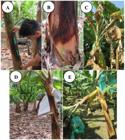 Figure 1
Severity scale of soft rot of the pseudostem and rhizome of banana caused by Dickeya spp. A) Grade 1, incipient watery lesions on the pseudostem. B) Grade 2, localized watery rot and partial softening of the pseudostem. C) Grade 3, extensive rot with lower leaf necrosis and initial reduction in pseudostem diameter. D) Grade 4, advanced rot with very soft pseudostem, marked reduction in stem diameter, and bunch involvement. E) Grade 5, plant collapse with rotting pseudostem and rhizome.
Where: 𝑎: severity grade value; 𝑏: number of plants per category; 𝑛: total number of plants evaluated; 𝑘: maximum degree of the scale.
And the Area Under the Disease Progress Curve (AUDPC) was calculated to summarize the progression of severity over time, following the procedure commonly applied in modern epidemiological studies (Equation 2).
Where: : Level of tissue infection observed over time 𝑡j; 𝑡j: Evaluation periods; 𝑛: number of evaluations.
-
Boxes/cluster ratio: The number of export boxes of 18.24 kg per bunch of bananas was determined according to the treatment.
-
Bunch weight: The fresh weight (kg) at the cut was evaluated for each bunch according to the treatment.
-
Economic analysis: Production costs, gross value, and the benefit-cost ratio per treatment were estimated, projected per hectare. Phytosanitary variables (severity and AUD/PE), productive variables (bunch weight and box/bunch ratio), and economic variables (B/C) were evaluated. These variables allowed for measuring the effectiveness of the treatments, reflecting the agronomic impact of the disease on yield, and determining the sustainability of the proposed practices.
Statistical analysis, the trial was conducted using a randomized complete block design (RCBD) with six treatments and one control, in seven replicates. Data were analyzed using ANOVA and Tukey's test (p < 0.05) in SPSS v20.
3. Results and Discussion
3.1. Symptoms
On the rhizome, parenchyma necrosis with dark edges and watery rot with an unpleasant odor was observed (Figure 2A). On the pseudostem, soft, moist lesions on the outer sheaths progressed toward the base, affecting 50%–70% of the tissue. Eventually, plants showed yellowing, wilting (Figure 2B), leaf necrosis (Figure 2C), reduction in stem diameter (12–15 cm vs. 48 cm in healthy plants), and structural collapse due to weakening of the pseudostem (Figure 2D). Photographs were included as diagnostic evidence to identify characteristic symptoms of Dickeya spp.

Symptoms of pseudostem soft rot in banana (Musa spp.): (A) necrosis and watery rot in the rhizome; (B) leaf chlorosis; (C) advanced necrosis; (D) stem reduction and structural collapse of the plant.
The symptoms observed in this study are consistent with those described by Blomme et al. (2017), who reported that bacterial pseudostem rot is characterized by soft, watery, and foul-smelling tissues, consistent with the aforementioned findings. This process has been explained in recent reviews that point to the central role of pectinolytic and cellulolytic enzymes in tissue degradation (Czajkowski et al., 2011).
3.2. Isolation and identification of Dickeya spp.
On AN medium, the isolates formed mucous, shiny, yellowish-cream colonies with morphology consistent with pectinolytic bacteria associated with soft rot of banana pseudostem (Aguilar-Anccota et al., 2021). Gram staining confirmed the presence of Gram-negative bacilli, consistent with what has been reported for Dickeya species associated with this disease (Aguilar-Anccota et al., 2021; Rafael-Rutte et al., 2022). The cultural and morphological characteristics coincided with previous descriptions of Dickeya spp. (Lin et al., 2010); however, considering the scope of the phenotypic approach used, the isolates were conservatively designated as Dickeya spp., according to current taxonomic criteria (van der Wolf et al., 2021). Likewise, previous studies by the same authors, using partial sequencing of the 16S rRNA gene and phylogenetic analysis, have confirmed the presence of Dickeya chrysanthemi and Dickeya paradisiaca associated with this pathology in Piura, Peru, which supports the relevance of the genus Dickeya as the predominant causal agent in this pathosystem (Rafael-Rutte et al., 2022).
3.3. Pathogenicity test
Pseudostem soft rot symptoms were observed 48 hours post-inoculation, with loss of tissue firmness and translucency (Figure 3A). On the third day, maceration progressed toward the center of the tuber, taking on a watery and shiny appearance (Figure 3B). On the fifth day, a foul odor associated with bacterial volatile compounds was detected (Figure 3C). These results are consistent with those of Maldonado-Duque et al. (2024) and Rafael-Rutte et al. (2022), who reported that Dickeya spp. induces pseudostem soft rot between 2 and 7 days post-inoculation.

Pathogenicity in potato slices inoculated with Dickeya spp.: A) initial symptoms of pseudostem soft rot at 48 h; B) watery, shiny appearance of the tissue on day 3; C) development of a foul odor and progress of rot on day 5
Reisolation on AN medium reproduced the original colonies, fulfilling Koch's postulates and confirming the isolate as the causative agent. Pathogenicity is attributed to pectinolytic and cellulolytic enzymes that degrade the cell wall and middle lamella, causing loss of turgor and tissue liquefaction (Charkowski et al., 2020). Although Pectobacterium spp. can also cause pseudostem soft rot, the combination of symptoms, cultural and morphological characteristics, and the observed virulence supports the identification of the isolate as Dickeya spp.
Similar findings have been reported in Japan, where Dickeya chrysanthemi causes blackleg in potatoes (Fujimoto et al., 2020). Likewise, symptoms characterized by watery exudates, foul odor, and tissue collapse, attributed to Dickeya chrysanthemi, have been described in bananas grown in tropical regions of Africa and Latin America (Blomme et al., 2017). The agreement with these reports reinforces the preliminary identification.
3.4. Effect of in vitro Bactericides on Dickeya spp.
In vitro analysis showed significant differences (p < 0.05) in the inhibition of Dickeya spp. among the bactericides evaluated (Figure 4). Granulated copper sulfate pentahydrate (CuSO4·5H2O) exhibited the largest inhibition zone (12.6 mm; group “a”, Figure 5), being statistically 16% superior to the other formulations. For illustrative purposes, Figure 4 shows the results of this treatment. Mastercop (10.6 mm) and Factor-Cu (10.5 mm) formed an intermediate group (“b”), while Gringo, Fosfo-Cu, and Sulpenta showed significantly smaller zones (7.1 mm; group “c”); the control showed no inhibition.

Inhibition halo of bactericidal products against Dickeya spp. in vitro. Bars with different letters differ significantly (Tukey, p < 0.05).

Inhibition halos generated by CuSO4·5H2O treatment against Dickeya spp. under in vitro conditions. The plate includes an untreated control and three replicates (R1–R3); arrows indicate the diameter of the inhibition halo.
The greater efficacy of CuSO4·5H2O can be explained by copper's multifactorial bactericidal mechanism, widely described for Gram-negative phytopathogenic bacteria, associated with the release of Cu2+ ions. These ions denature bacterial proteins through interaction with sulfhydryl and amino groups, inhibit key enzymatic processes, disrupt cell membrane integrity, and promote the generation of reactive oxygen species (ROS), causing irreversible oxidative damage and cell death (Heck et al., 2019; Lamichhane et al., 2018).
Furthermore, the superiority of granulated CuSO4·5H2O can be attributed to its gradual and sustained release of Cu2+, which maintains effective concentrations of the active ion throughout the exposure period. This difference in the availability of active copper has been reported as a determining factor in efficacy against pectinolytic bacteria of the Dickeya/Pectobacterium complex (van der Wolf et al., 2021), consistent with previous studies by Viera-Viera (2018) and Loor-Véliz (2020).
Taken together, the results confirm that not all copper formulations exhibit the same efficacy, identifying CuSO4·5H2O as the most promising alternative. Furthermore, the in vitro assays were corroborated through field evaluations, validating its efficacy under real environmental conditions and ruling out potential phytotoxic effects, thus integrating the treatments into an integrated pseudostem soft rot management approach.
3.5. Field severity assessment
During the 212-day evaluation period, the integrated treatments progressively reduced the severity of pseudostem soft rot caused by Dickeya spp. Statistically significant differences between treatments were observed from day 92 onward, intensifying toward the end of the evaluation period (Figure 4; ANOVA, F = 2.561; p = 0.033; CV = 27.99%).
Treatment T5 was the most effective, reducing severity from 2.71 ± 0.47 to 0.29 ± 0.18, representing an 88.7% decrease. This placed it in statistical group “a,” significantly outperforming the control and the other treatments. Treatment T6 also showed high efficacy, with a final severity of 0.43 ± 0.25 (84.9%; group “ab”). Treatments T1 (0.86 ± 0.47; 68.3%) and T2-T3 (reductions between 54% and 62%; group “c”) showed intermediate effects, while the control maintained the highest severity values throughout the trial (2.57 ± 1.59; 14.3%; group “d”). These trends, shown in the disease progression curve (Figure 6), demonstrate a differential efficacy of the treatments over time.

Evolution of the severity of soft pseudostem rot in banana (Dickeya spp.) over 212 days. Letters indicate significant differences between treatments (Tukey, p < 0.05).
The greatest reduction in severity observed in T5 can be attributed to the combined effect of the copper bactericide, the organic amendment, and the efficient microorganisms (EM1). Since the EM corresponds to a commercial microbial consortium composed mainly of Saccharomyces spp. and Lactobacillus spp. and Rhodopseudomonas spp., the observed effect can be interpreted as the result of the complementary action of these functional groups in the rhizosphere. In particular, lactic acid bacteria and yeasts can limit the establishment of Dickeya spp. through competition for ecological niche and the production of metabolites with antibacterial activity, while photosynthetic bacteria contribute to improving soil microbial activity and the physiological state of the plant. Together, these interactions create a less favorable soil environment for pectinolytic pathogens, which explains the sustained reduction in severity observed in the integrated treatments. Comparable results have been reported for antagonistic bacteria such as Bacillus subtilis and Paenibacillus polymyxa, where the suppression of Dickeya spp. is associated with microbial antagonism and indirect effects on the host plant (Gatta et al., 2025; Hossain et al., 2023). Considering the consortial nature of commercial EMs, the observed effects should be interpreted as an integrated response of the soil-plant-microorganism system (Galecio-Julca et al., 2020).
3.6. Area Under the Disease Progress Curve (AUDPC)
AUDPC values reflected disease accumulation over the 212 days of evaluation (Figure 7). Treatment T5 showed the lowest value (332.88 ± 29.6; group “a”), with a 41.6% reduction compared to the control (570.38 ± 50.7; group “c”), which was 71.3% higher than T5. Treatment T6 showed similar values (369.19 ± 32.8; group “ab”), while treatments T1, T2, T3, and T4 presented intermediate values (403.13 ± 35.9–452.25; group “b”). These results agree with those reported by Viera-Viera (2018) for the AUDPC of banana pseudostem soft rot. The significant reduction in AUDPC in the integrated treatments demonstrates sustained suppression of the pathogen, attributable to the combined effect of bactericides (direct inoculum reduction), efficient microorganisms (microbial competition and production of antimicrobial metabolites), and cultural practices aimed at improving the soil and strengthening the host plant (Loor-Véliz, 2020).

Area Under the Disease Progress Curve (AUDPC), as an effect of the treatments applied for the control of Dickeya spp. (Tukey, p < 0.05 SPSS v21)
3.7. Stem diameter, boxes/bunch ratio, and bunch weight
Treatments T5, T3, T1, and T2, which included CuSO4·5H2O, goat compost, and EM, showed the highest pseudostem diameter values (63.86, 65.36, 64.79, and 64.86 cm, respectively), statistically superior to the control (p ≤ 0.05). Treatment T5 stood out for achieving the highest average bunch weight (50.57 kg), the highest yield (2713.26 boxes·ha−1·year−1), the best ratio (1.59), and the highest benefit/cost ratio (1.615), demonstrating that the reduction of the disease resulted in physiological and productive improvements in the crop (Galecio-Julca et al., 2020).
Although treatments T1, T4, and T5 incorporated CuSO4·5H2O in similar proportions, only T5 showed significant simultaneous improvements in pseudostem diameter, stem ratio, and bunch weight, indicating that copper's efficacy depends on its interaction with other inputs and agronomic practices. The combination of CuSO4·5H2O with a higher proportion of goat compost (5 kg·plant−1) and EM contributed to improved soil structure, aeration, and moisture retention, favoring the natural suppression of Dickeya spp. and enhancing copper's efficacy (Trinidad-Santos and Velasco-Velasco, 2016). Soil management through tillage and ridge formation optimized nutrient availability and copper absorption, promoting more vigorous vegetative growth and higher yields (Galecio-Julca et al., 2020; Choqueluque-Atamari and Condori-Condori, 2024).
Overall, the significant reduction in AUDPC, along with the improvement in agronomic and productive indicators, demonstrates the superiority of integrated management over strategies based exclusively on chemical products, supporting its application as a sustainable alternative for controlling banana soft rot without compromising the health of the agroecosystem.
4. Conclusions
-
Granulated copper sulfate pentahydrate exhibited the greatest in vitro bactericidal activity against Dickeya spp.
-
The integrated management strategy, combining copper sulfate, efficient microorganisms, and sustainable agronomic practices, significantly reduced disease severity and the average annualized root rot (AUDPC).
-
The integrated treatment increased bunch weight, and overall yield, improving the cost-benefit ratio.
-
Integrated management of pseudostem soft rot in bananas represents a technically and economically viable alternative for organic producers in the Chira Valley.
-
Future studies should include molecular characterization of the pathogen and biocontrol agents to optimize management strategies and better understand their interactions.
Data Availability Statement
The data that support the findings of this study are available from the corresponding author upon reasonable request.
References
-
AGUILAR-ANCCOTA, R., RUIZ, W.R., MORALES-PIZARRO, A., RAFAEL-RUTTE, R., TIRADO-LARA, J., SAUCEDO-BAZALAR, M. and TEODOR, K.K., 2021. Pudrición blanda en el pseudotallo de banano orgánico (Musa sp): Sintomatología, caracterización cultural y bioquímica, patogenicidad y alternativas de manejo. Scientia Agropecuaria, vol. 12, no. 4, pp. 571-578. https://doi.org/10.17268/sci.agropecu.2021.061
» https://doi.org/10.17268/sci.agropecu.2021.061 - BAQUERO, F., CANTON, R., CAMPOS, J., CASTILLO, J., GARCIA-SANCHEZ, J.E., GOBERNADO, M. and VILA, J., 2000. Recommendations from MENSURA for selection of antimicrobial agents for susceptibility testing and criteria for the interpretation of antibiograms. Revista Española de Quimioterapia, vol. 13, no. 1, pp. 73-86. PMid:10856132.
-
BLOMME, G., DITA, M., JACOBSEN, K.S., PÉREZ-VICENTE, L., MOLINA, A., OCIMATI, W., POUSSIER, S. and PRIOR, P., 2017. Bacterial diseases of bananas and enset: current state of knowledge and integrated approaches toward sustainable management. Frontiers in Plant Science, vol. 8, pp. 1290. https://doi.org/10.3389/fpls.2017.01290 PMid:28785275.
» https://doi.org/10.3389/fpls.2017.01290 -
BOCK, C.H., CHIANG, K.S. and DEL PONTE, E.M., 2022. Plant disease severity estimated visually: a century of research, best practices, and opportunities for improving methods and practices to maximize accuracy. Tropical Plant Pathology, vol. 47, no. 1, pp. 25-42. https://doi.org/10.1007/s40858-021-00439-z
» https://doi.org/10.1007/s40858-021-00439-z -
CAPPUCCINO, J.G. and WELSH, C.T., 2020 [viewed 3 October 2025]. Microbiology: a laboratory manual [online]. 12th ed. Boston: Pearson. Available from: https://lccn.loc.gov/2004044548
» https://lccn.loc.gov/2004044548 -
CHARKOWSKI, A., SHARMA, K., PARKER, M.L., SECOR, G.A. and ELPHINSTONE, J. 2020. Bacterial diseases of potato. In: H. CAMPOS and O. ORTIZ, eds. The potato crop: its agricultural, nutritional and social contribution to humankind. Cham: Springer, pp. 351–388. https://doi.org/10.1007/978-3-030-28683-5_10
» https://doi.org/10.1007/978-3-030-28683-5_10 -
CHOQUELUQUE-ATAMARI, M.R. and CONDORI-CONDORI, K.Y., 2024 [viewed 3 October 2025]. Análisis de la calidad del compost aplicando microorganismos eficaces en la provincia de Puno-2023 [online]. Puno: Universidad Continental. Tesis de bachiller. Available from: https://hdl.handle.net/20.500.12394/17015
» https://hdl.handle.net/20.500.12394/17015 -
CRAWFORD, A. and KUEFFNER, S., 2020 [viewed 3 October 2025]. Disease is ravaging the $25 billion banana industry [online]. Available from: https://www.bloomberg.com
» https://www.bloomberg.com -
CZAJKOWSKI, R., PEROMBELON, M.C., VAN VEEN, J.A. and VAN DER WOLF, J.M., 2011. Control of blackleg and tuber soft rot of potato caused by Pectobacterium and Dickeya species: a review. Plant Pathology, vol. 60, no. 6, pp. 999-1013. https://doi.org/10.1111/j.1365-3059.2011.02470.x
» https://doi.org/10.1111/j.1365-3059.2011.02470.x -
DADRASNIA, A., USMAN, M.M., OMAR, R., ISMAIL, S. and ABDULLAH, R., 2020. Potential use of Bacillus genus to control banana diseases: approaches toward high-yield production and sustainable management. Journal of King Saud University. Science, vol. 32, no. 4, pp. 2336-2342. https://doi.org/10.1016/j.jksus.2020.03.011
» https://doi.org/10.1016/j.jksus.2020.03.011 -
DIRECCIÓN REGIONAL DE AGRICULTURA TUMBES – DRAT, 2021 [viewed 3 October 2025]. Oficina de Estadística Agraria [online]. Tumbes, Perú: DRAT. Informe Institucional. Available from: https://www.regiontumbes.gob.pe
» https://www.regiontumbes.gob.pe -
EUROPEAN AND MEDITERRANEAN PLANT PROTECTION ORGANIZATION – EPPO, 2023. PM 7/155 (1) Pectobacterium spp. and Dickeya spp. Bulletin OEPP. EPPO Bulletin. European and Mediterranean Plant Protection Organisation, vol. 53, no. 2, pp. 309-353. https://doi.org/10.1111/epp.12935
» https://doi.org/10.1111/epp.12935 - FOOD AND AGRICULTURE ORGANIZATION OF THE UNITED NATIONS – FAO, 2023. Crops and livestock products 2021 Rome: FAO.
-
FUJIMOTO, T., YASUOKA, S., AONO, Y., NAKAYAMA, T., OHKI, T. and MAOKA, T., 2020. First report of potato blackleg caused by Dickeya chrysanthemi in Japan. Journal of General Plant Pathology, vol. 86, no. 5, pp. 423-427. https://doi.org/10.1007/s10327-020-00934-2
» https://doi.org/10.1007/s10327-020-00934-2 -
GALECIO-JULCA, L., LEÓN-HUAMÁN, K.L. and AGUILAR-ANCCOTA, R., 2020. Efecto de fuentes orgánicas y microorganismos eficientes en el rendimiento del cultivo de banano orgánico (Musa spp. L.). Manglar, vol. 17, no. 4, pp. 301-306. https://doi.org/10.17268/manglar.2020.045
» https://doi.org/10.17268/manglar.2020.045 -
GATTA, R., IWANICKI, A., CZAJKOWSKI, R. and OBUCHOWSKI, M., 2025. Antagonistic interactions between Dickeya solani and Bacillus subtilis. International Journal of Molecular Sciences, vol. 26, no. 15, pp. 7193. https://doi.org/10.3390/ijms26157193 PMid:40806325.
» https://doi.org/10.3390/ijms26157193 -
HECK, D.W., GHINI, R. and BETTIOL, W., 2019. Deciphering the suppressiveness of banana Fusarium wilt with organic residues. Applied Soil Ecology, vol. 138, pp. 47-60. https://doi.org/10.1016/j.apsoil.2019.02.021
» https://doi.org/10.1016/j.apsoil.2019.02.021 -
HOSSAIN, A., ALI, M.A., LIN, L., LUO, J., YOU, Y., MASUM, M.M.I., JIANG, Y., WANG, Y., LI, B. and AN, Q., 2023. Biocontrol of soft rot Dickeya and Pectobacterium pathogens by broad-spectrum antagonistic bacteria within Paenibacillus polymyxa complex. Microorganisms, vol. 11, no. 4, pp. 817. https://doi.org/10.3390/microorganisms11040817 PMid:37110240.
» https://doi.org/10.3390/microorganisms11040817 -
KAUR, L., DHULL, S.B., KUMAR, P. and SINGH, A., 2020. Banana starch: properties, description, and modified variations—a review. International Journal of Biological Macromolecules, vol. 165, no. Pt B, pp. 2096-2102. https://doi.org/10.1016/j.ijbiomac.2020.10.058 PMid:33075337.
» https://doi.org/10.1016/j.ijbiomac.2020.10.058 -
LAMICHHANE, J.R., OSDAGHI, E., BEHLAU, F., KÖHL, J., JONES, J.B. and AUBERTOT, J.N., 2018. Thirteen decades of antimicrobial copper compounds applied in agriculture. A review. Agronomy for Sustainable Development, vol. 38, no. 3, pp. 28. https://doi.org/10.1007/s13593-018-0503-9
» https://doi.org/10.1007/s13593-018-0503-9 -
LIN, B.R., SHEN, H.F., PU, X.M., TIAN, X.S., ZHAO, W.J., ZHU, S.F. and DONG, M.M., 2010. First report of a soft rot of banana in mainland China caused by a Dickeya sp. (Pectobacterium chrysanthemi). Plant Disease, vol. 94, no. 5, pp. 640. https://doi.org/10.1094/PDIS-94-5-0640C PMid:30754454.
» https://doi.org/10.1094/PDIS-94-5-0640C -
LOOR-VÉLIZ, S.A., 2020 [viewed 3 October 2025]. Identificación y caracterización morfológica del agente patógeno que causa la enfermedad del “dedo pudre” en el cultivo de banano [online]. Esmeraldas, Ecuador: Universidad Técnica de Esmeraldas. Bachelor’s Thesis. Available from: https://repositorio.uteq.edu.ec/handle/43000/607
» https://repositorio.uteq.edu.ec/handle/43000/607 -
MALDONADO-DUQUE, E.A., VIGÍL-CORREA, A.M., ZURITA-CHINGUEL, L.G., LEÓN, M.D., MENDOZA-RENDÓN, R., SAAVEDRA-RIOS, C.Y., VILLAR GUEVARA, I.D., CUBAS ZÚÑIGA, C.E., PEÑA ZARATE, M.C., VILCHEZ ESTRADA, K.N. and POLO, A.A.R., 2024. Patogenicidad de Pectobacterium chrysanthemi en Solanum tuberosum y PCR del espaciador transcrito interno (ITS) del ADNr 16S/23S en aislados de Musa sp. del norte del Perú. Manglar, vol. 21, no. 3, pp. 299-304. https://doi.org/10.57188/manglar.2024.032
» https://doi.org/10.57188/manglar.2024.032 -
MARTÍNEZ-SOLÓRZANO, G., REY-BRINA, J., PARGAS-PICHARDO, R. and MANZANILLA, E., 2020. Marchitez por Fusarium raza tropical 4: estado actual y presencia en el continente americano. Agronomía Mesoamericana, vol. 31, no. 1, pp. 259-276. https://doi.org/10.15517/am.v31i1.37925
» https://doi.org/10.15517/am.v31i1.37925 -
MEHENDRAN, Y., KARTHEESWARAN, T. and KODIKARA, N., 2022. Banana freshness identification using image-processing techniques. In: Proceedings of the 7th International Conference on Business and Industrial Research (ICBIR), 19-20 May 2022, Bangkok, Thailand. New York: Institute of Electrical and Electronics Engineers, pp. 347–352. https://doi.org/10.1109/ICBIR54589.2022.9786519
» https://doi.org/10.1109/ICBIR54589.2022.9786519 -
RAFAEL-RUTTE, R., ZAVALA, L., MALDONADO, E.A., AGUILAR-ANCCOTA, R., SAUCEDO-BAZALAR, M., TIRADO-LARA, J. and AQUIJE, C., 2022. Characterization of rhizome and pseudostem wet rot of organic banana (Musa sp.) in Piura, Peru. Chilean Journal of Agricultural & Animal Science, vol. 38, no. 2, pp. 176-188. https://doi.org/10.29393/CHJAA38-17CRRC70017
» https://doi.org/10.29393/CHJAA38-17CRRC70017 -
RODRÍGUEZ-ROJAS, A. and ROLFF, J., 2022. Antimicrobial activity of cationic antimicrobial peptides against stationary phase bacteria. Frontiers in Microbiology, vol. 13, pp. 1029084. https://doi.org/10.3389/fmicb.2022.1029084 PMid:36386690.
» https://doi.org/10.3389/fmicb.2022.1029084 -
SNEHALATHARANI, A. and KHAN, A.N.A., 2010. Biochemical and physiological characterisation of Erwinia species causing tip-over disease of banana. Archiv für Phytopathologie und Pflanzenschutz, vol. 43, no. 11, pp. 1072-1080. https://doi.org/10.1080/03235400802285422
» https://doi.org/10.1080/03235400802285422 -
TÁVARA, H.M., 2020 [viewed 3 October 2025]. Efectos del cambio climático en la productividad del banano orgánico en el Valle del Chira, Sullana, Piura [online]. Piura, Perú: Universidad de Piura. Master’s Thesis. Available from: https://hdl.handle.net/11042/4772
» https://hdl.handle.net/11042/4772 -
TRINIDAD-SANTOS, A. and VELASCO-VELASCO, J. 2016. Importance of organic matter in the soil. Agro Productividad, vol. 9, no. 8, pp. 52–58. https://doi.org/10.22004/ag.econ.352507
» https://doi.org/10.22004/ag.econ.352507 -
VAN DER WOLF, J.M., DE BOER, S.H., CZAJKOWSKI, R., CAHILL, G., VAN GIJSEGEM, F., DAVEY, T., DUPUIS, B., ELLICOTT, J., JAFRA, S., KOOMAN, M., TOTH, I.K., TSROR, L., YEDIDIA, I. and VAN DER WAALS, J.E., 2021. Management of diseases caused by Pectobacterium and Dickeya species. In: F. VAN GIJSEGEM, J.M. VAN DER WOLF and I.K. TOTH, eds. Plant diseases caused by Dickeya and Pectobacterium species, Cham: Springer, pp. 175–214. https://doi.org/10.1007/978-3-030-61459-1_6
» https://doi.org/10.1007/978-3-030-61459-1_6 - VARGAS, A.J. and HURTADO, L.R., 2020. La bacteriosis del cultivo de banano y plátano Apartadó, Colombia: Centro de Investigaciones del Banano (CENIBANANO-AUGURA). Boletín técnico, no. 19.
-
VIERA-VIERA, J.F., 2018 [viewed 3 October 2025]. Evaluación in vitro de compuestos bactericidas y eficacia en campo en el control de la enfermedad de pudrición blanda (Pectobacterium chrysanthemi) en el cultivo de banano, Piura [online]. Piura, Perú: Universidad Nacional de Piura. Bachelor’s Thesis. Available from: https://repositorio.unp.edu.pe/handle/UNP/1678
» https://repositorio.unp.edu.pe/handle/UNP/1678 -
VILELA, L.M.G., MALCA, S.J.C.C., MORALES, M.V.S. and COBEÑAS, G.F., 2021 [viewed 3 October 2025]. Gestión empresarial de Asociaciones de banano orgánico del Valle del Chira, Sullana-Perú [online]. Revista de Ciencias Sociales, vol. 27, no. 3, pp. 404-416. Available from: https://www.redalyc.org/articulo.oa?id=28068276031
» https://www.redalyc.org/articulo.oa?id=28068276031 -
VOORA, V., LARREA, C. and BERMÚDEZ, S., 2020 [viewed 3 October 2025]. Global market report: Bananas [online]. Winnipeg, Manitoba, Canada: International Institute for Sustainable Development. Available from: https://www.iisd.org/system/files/publications/ssi-global-market-report-banana.pdf
» https://www.iisd.org/system/files/publications/ssi-global-market-report-banana.pdf -
YAN, H., JIANG, G., WU, F., LI, Z., XIAO, L., JIANG, Y. and DUAN, X., 2021. Sulfoxidation regulation of transcription factor NAC42 influences its functions in relation to stress-induced fruit ripening in banana. Journal of Experimental Botany, vol. 72, no. 2, pp. 682-699. https://doi.org/10.1093/jxb/eraa474 PMid:33070185.
» https://doi.org/10.1093/jxb/eraa474
Edited by
-
Editor:
Takako Matsumura Tundisi


