 Storage of baru fruits for obtaining fresh nuts and quality of roasted nuts
Abstract
Baru (Dipteryx alata Vogel) has been recognized for the flavor of its roasted nut and nutritional quality. Due to the impossibility of immediate processing of the entire baru harvest and the lack of post-harvest information, studies on fruit storage are extremely important for the development of technologies to maintain the quality of nuts for longer periods. Storage conditions can influence the shelf life of roasted nuts. This work was divided into two stages. The objective of stage 1 was to evaluate the effect of fruit storage time on the quality of fresh nuts and in stage 2, the effect of storage on the quality of roasted nuts was evaluated through physicochemical analyses. Baru fruits can be stored at room temperature for up to 12 months in raffia bags without changing the lipid quality and antioxidant capacity. The storage of fresh fruits increases total phenols and decreases total tannins. Baru nuts roasted at 180 °C for 15 minutes and packed in polypropylene packaging can be stored for up to 60 days, preserving lipid quality.
Keywords:
post-harvest; Dipteryx alata Vogel; roasting; bioactive compounds; lipid oxidation
Resumo
Os frutos de baru (Dipteryx alata Vogel) apresentam sementes oleaginosas, conhecidas como amêndoas ou castanhas, que se destacam pelo sabor característico após a torrefação e pelo elevado valor nutricional. Devido à impossibilidade de processamento imediato de toda a safra do baru e à carência de informações sobre a pós-colheita, estudos sobre armazenamento dos frutos são de extrema importância para o desenvolvimento de tecnologias visando a manutenção da qualidade das castanhas por mais tempo. As condições de armazenamento podem influenciar a vida útil das amêndoas torradas. Este trabalho foi dividido em duas etapas. Objetivou-se na Etapa 1 avaliar o efeito do tempo de armazenamento dos frutos na qualidade das castanhas in natura e na Etapa 2, o efeito do armazenamento na qualidade de castanhas torradas, por meio de análises físico-químicas. Os frutos de baru podem ser armazenados na temperatura ambiente por até 12 meses, em sacos de rafia, sem alterar a qualidade lipídica e a capacidade antioxidante. O armazenamento dos frutos in natura aumenta os fenóis totais e diminui os taninos totais. Amêndoas torradas de baru a 180 °C por 15 minutos e acondicionadas em embalagens de polipropileno podem ser armazenadas por até 60 dias, preservando a qualidade lipídica.
Palavras-chave:
pós-colheita; Dipteryx alata Vogel; torrefação; compostos bioativos; oxidação lipídica
1. Introduction
Fruits of the Dipteryx alata Vogel species, native to the Brazilian Cerrado (Santiago et al., 2018), known as baru, cumbaru, pau-cumbaru, fruta-de-macaco, barujo, castanha do burro, coco barata, coco feijão, among others (Carrazza and Ávila, 2010), present nuts with high content of lipids (36.3%), proteins (21.3%), fibers (12%), calcium (88 mg 100g-1) and magnesium (107 mg 100g-1) (Santiago et al., 2018), in addition to iron (3 mg 100g-1), selenium (0.1 mg 100g-1), sodium (2.0 mg 100g-1) and zinc (2.0 mg 100g-1) (Siqueira et al., 2015).
Nut lipids have 83.28% unsaturated fatty acids and more than 50% monounsaturated fatty acids, with 9: 1 w-6 and w-3 ratio (Alves et al., 2016; Quadros et al., 2025), favoring the reduction of risks of cardiovascular diseases (Freitas and Naves, 2010). Raw and roasted baru nuts also have phenolic compounds (Santiago et al., 2018), which according to Watanabe et al. (2011), are related to the body's antioxidant defense.
Baru nuts and peanuts have chemical composition similar to other nuts (Freitas and Naves, 2010), of excellent quality for use in cooking and haute cuisine (Brasil, 2015). They can be used in the food industry and their production chain can contribute to the economy of the Brazilian Midwestern region (Santiago et al., 2018).
The storage of baru fruits is justified due to the impossibility of immediate processing during the harvest to obtain the nut; therefore, investigating the physicochemical quality of stored nuts is relevant because according to Lorini et al. (2018), oilseeds like nuts continue to breathe and since they contain unsaturated lipids in their composition, they can undergo oxidative processes over time. There are no reports in literature on the effect of storage time on the stability of bioactive compounds present in baru nuts.
Baru nuts can be submitted to roasting (Carrazza and Ávila, 2010), which according to Silva and Fernandes (2011), reduces the content of antinutrient compounds and increases the acceptability of chichá seeds. The shelf life of roasted baru may vary according to the characteristics of the film used. Donadon et al. (2015) found that the quality of crambe abyssinica oilseeds varied with the type of packaging, environment and storage time.
Thus, this study aimed to evaluate the effect of the storage time of baru fruits on the quality of fresh nuts and the effect of the storage time on the quality of roasted nuts.
2. Material and Methods
Baru fruits were collected in the municipality of Campo Grande, Mato Grosso do Sul in October 2015 to evaluate the effect of storage time on the quality of fresh nuts (Experiment 1), and in October 2016 to evaluate the effect of storage time on the quality of roasted nuts (Experiment 2). In Experiment 1, after being harvested and transported to the Laboratory of Vegetable Food Processing, fruits were manually selected, eliminating spoiled ones, packed in 60 kg raffia bags and stored at room temperature for up to 12 months. Temperature and relative humidity of the storage environment were daily recorded using Impac TH-1 digital thermo-hygrograph. From December 2016 to February 2017, data were obtained from the website of the National Meteorological Institute (INMET, 2017).
At 0, 3, 6, 9 and 12 months of storage, samples with 10 kg of baru were randomly collected in three replicates and nuts were separated from fruits by means of manual breaker attached to a wooden easel, which presses the pericarp until the endocarp ruptures. Samples were evaluated for water content, water activity, apparent density, insect damage, electrical conductivity, titratable acidity, oil content, acidity and peroxide index, total phenols, tannins and antioxidant activity.
Water content was evaluated in an oven at 105 °C for 24 hours (Brasil, 2009). Water activity (AW) was determined using the Hydropalm ModelAw43 equipment, apparent density using container with known volume and Shimadzu analytical scale. Electrical conductivity was evaluated using the methodology of Vieira and Krzyzanowski (1999). Four sub-samples of 10 seeds were weighed, placed in containers with 200 mL of deionized water at 25 °C for 24 h. Reading was performed on a bench digital conductivimeter for HEF - Hydrated Ethanol Fuel mCE-105.
To determine the percentage of seeds infested by insects, 30 units were randomly taken and submitted to immersion in drinking water for 24 h. Then, they were cut off for observation. Result was expressed as percentage of infested seeds, according to Brasil (2009).
Titratable acidity and the oil content of nuts were determined according to methodologies of the Adolfo Lutz Institute (IAL, 2008). Titratable acidity determination used alcohol as solvent.
The oil content was obtained in Soxhlet extractor using hexane as solvent, under constant reflux, for 8 hours. The solvent was removed under reduced pressure using rotary evaporator. The oil used to determine the acidity and peroxide indexes was obtained from 100g of crushed seeds and transferred to a filter paper cartridge immersed in petroleum ether (1:10 seed: solvent ratio) for 24h, with boiling point between 30-40 °C. The solvent was removed under reduced pressure.
The acidity index of the oil and peroxide was determined by the official methodology of the Adolfo Lutz Institute (IAL, 2008). The acidity index methodology was adapted. In a 125 ml Erlenmeyer flask, 1 to 2 g of oil and 30 ml of ethyl ether and ethyl alcohol (1:1) solution were added. Then, three drops of alcoholic solution of the acid/ phenolphthalein indicator were added. Titration was performed with 0.025M NaOH solution until pink color appeared stable for 30 seconds.
To determine total phenols, total tannins and antioxidant capacity, extracts were obtained according to methodology proposed by Roesler et al. (2007). The solvent used was acetone (80%) and water (20%). Extracts were submitted to colorimetric reaction to determine phenolic compounds according to Swain and Hillis (1959). To determine the antioxidant capacity, the IC50 value was defined as the final concentration of the integral extract required to decrease the initial DDPH concentration by 50%. Tannins were determined by the colorimetric method, by Folin Dennis reduction (IAL, 2008).
In Experiment 2, after harvested in the municipality of Campo Grande, MS, baru fruits were selected and broken according to Experiment 1 to obtain nuts. Intact nuts were roasted in an oven at 180 °C for 15 minutes and packed in polypropylene package of 0.08 mm in thickness, with permeability evaluated according to Sarantópoulos et al. (2002), sealed with the aid of “Irmãos Habib” sealer. Packages were stored at room temperature for four months and evaluated at 0, 30, 60, 90 and 120 days, in three replicates regarding water content, water activity, titratable acidity and acidity and peroxide indexes of the extracted oil.
Air temperature and relative humidity were monitored according to Experiment 1. From December 2016 to February 2017, data were obtained from the website of the National Meteorological Institute (INMET, 2017).
Experiments were carried out using a completely randomized design (CRD), with five storage times. Results were submitted to analysis of variance (ANOVA) and regression.
Means were compared using the Tukey test, adopting 5% significance level. Models were selected based on the biological phenomenon and regression coefficient (R2).
3. Results and Discussion
Figure 1 shows that during the storage of baru fruits, the maximum air temperature was increased during the first six months of storage (30.3-32.4 °C), and then decreased until the eighth month and gradually increased until the twelfth month (31.4 °C), while the minimum temperature was lowest in the period between the seventh and tenth month of storage (22.4-24.2 °C).

The maximum relative air humidity increased from approximately 55-58% to 90% between the first and third months of storage, remained at approximately 60% between the fourth and eighth months, and then decreased to 45-50%, while the minimum humidity ranged from 32 to 55%, with lower values in the sixth month and between the ninth and twelfth months (Figure 1).
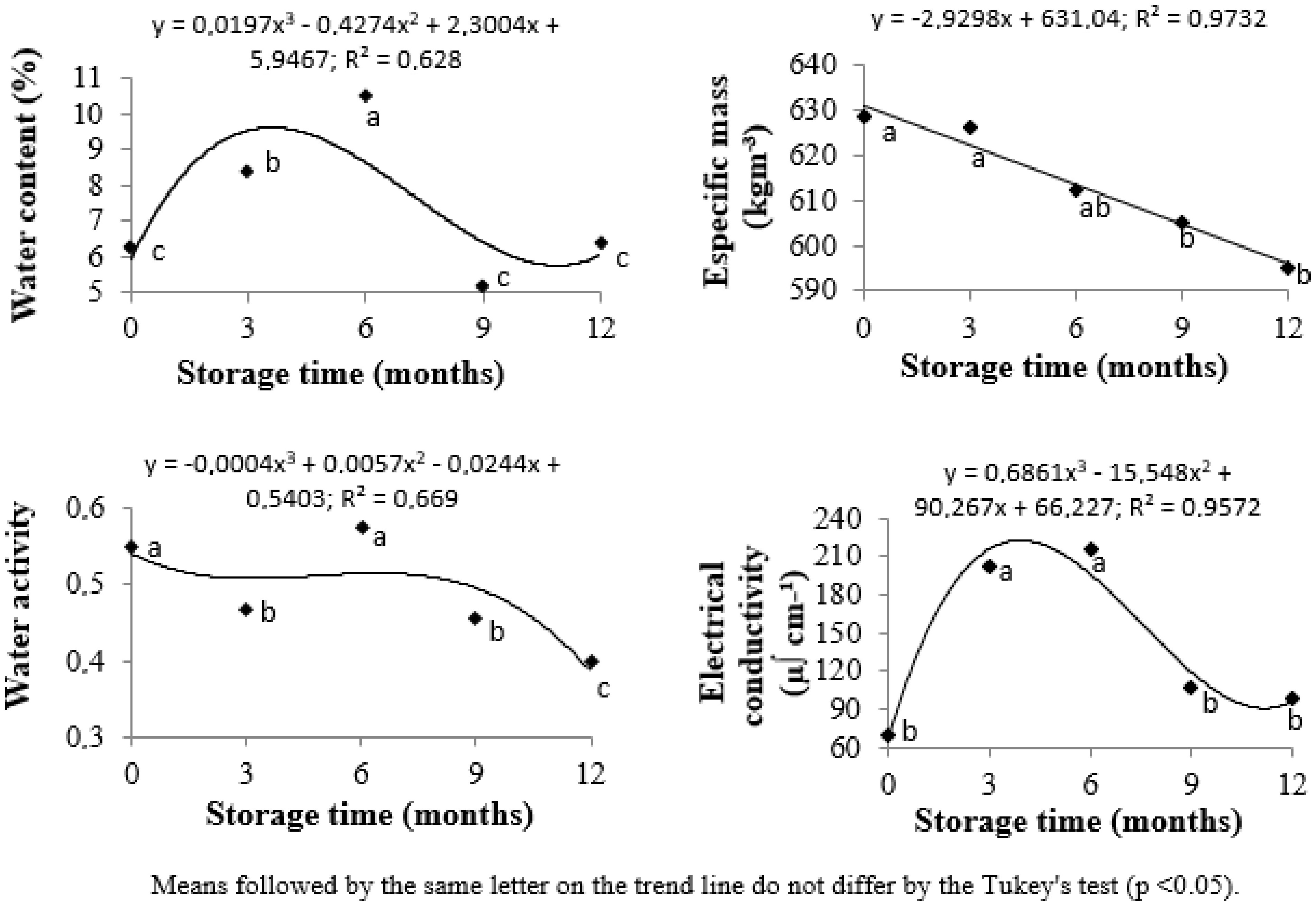
The water content of nuts increased until the sixth month of storage from 6.25% to 10.45%, after this period it decreased, presenting values similar to those at the beginning of storage (5.17%) (Figure 2).

Evolution of physical parameters of baru nuts during the storage of baru fruits for up to 12 months.
The increase in water content can be attributed to the hygroscopicity of fruits and seeds (Oliveira et al., 2014) and coincided with the increase in relative air humidity in the first four months of storage, which reached values of 64%. The increase in water content during storage was observed by Garcia et al. (2014) in Araucaria angustifolia (Bertol.) Kuntze seeds. The water content values found were higher than those obtained by Freitas and Naves (2010), who found 3.23% in fresh baru nuts. Santiago et al. (2018) found high values when compared to time 0 of this study (9.9%). The ideal water content for the safe storage of oilseeds is 4-9% (w.b.) (Harrington, 1973).
Figure 2 shows that the density of baru nuts decreased during storage. Oliveira et al. (2014) analyzed baru nuts harvested in the municipality of Aquidauana-MS and found high density values (734 kgm-3) when compared to those obtained in this study (628 kgm-3).
The density of baru nuts is directly influenced by their water content, relative humidity and temperature of the storage air, due to its hygroscopic characteristics, suffering interference in the cellular structure of tissues (Oliveira et al., 2014). The dimensions of the largest axis, medium axis and smallest axis of seeds can change when they absorb water vapor from the air. According to Zuffo et al. (2014), different seed biometry values affect density values.
Water activity or free water of baru nuts decreased after the sixth month of storage from 0.58% to 0.39% (Figure 2). The free water content interferes with food microbial growth and sensory and nutritional qualities. Water activity values <0.6% preserve food by reducing or stopping microbiological growth (Celestino, 2010).
In the nuts of freshly harvested fruits, 1.33% of insect infestation was observed; however, during storage, nuts did not show signs of contamination. Adopting normative instruction nº. 32 of year 2016 for peanuts, nuts in this study are within the maximum limit of 5% for infestation and damage by insects (Brasil, 2009).
Electrical conductivity increased significantly until the sixth month, when the air temperature of the storage environment reached higher values, after this period, a considerable decline was observed, coinciding with the reduction in temperature, and nuts reached values similar to those obtained at the beginning of storage (Figure 2). This behavior was observed for soybeans with 17.4% humidity from the third month of storage in bag-type silo (Faroni et al., 2009) and in crambe fruits (Bessa et al., 2015). According to Vieira and Krzyzanowski (1999), the electrical conductivity test assesses damage to cell membranes by means of ions leached in imbibition solution, according to the deterioration degree.
The lipid content did not change during storage, and the mean value found was 36.71%, value close to that found by Martins et al. (2013), Santos et al. (2024) and Freitas and Naves (2010), 39.82% and 41.04%, respectively, in baru nuts.
The titratable acidity of nuts remained stable until the ninth month of storage, increasing from then on. At the beginning of storage, nuts had acidity of 0.59 ml of NaOH 100g-1 and at the end of 3.06 ml of NaOH 100g-1 (Figure 2). The increase in acidity during storage was also observed by Belmiro et al. (2010) in pumpkin seeds during storage and attributed to lipid degradation, causing formation of free fatty acids.
Figure 3 shows that the oil acidity index increased during storage from 0.24 mg NaOH g-1 of oil to 2.57 mg NaOH g-1 of oil, in 12 months. This increase was more significant after the sixth month. Even though there was no decrease in the lipid content during storage, there was increase in the oil acidity probably due to the lipid degradation in nuts. According to the Adolfo Lutz Institute (IAL, 2008), this evaluation determines the oil's conservation status, whose decomposition by hydrolysis, oxidation or fermentation increases the concentration of hydrogen ions.

Evolution of chemical parameters in baru nuts during the storage of baru fruits for up to 12 months.
Siqueira et al. (2016) analyzed baru oil and found 0.28mg KOH g-1 of oil, value very close to that found in this study. Compared with refined soybean oil, the values found in baru nuts are higher. Resolution nº. 270 of 2005 (Brasil, 2005) describes that for refined soybean oil, the maximum limit is 0.6 mg KOH g-1, while baru oil showed this value up to the sixth month of storage.
Regarding the peroxide index (Figure 3), there was no peroxide production until the third month of storage, production was stable between the sixth and ninth month, and increased significantly over time, reaching values of 4.28 meq O2 kg-1 of oil in the twelfth month, indicating lipid oxidation, as observed by Donadon et al. (2015) on crambe fruits.
After twelve months of storage, the oil obtained from the nut remains within the legal limit of 15 meq O2 kg-1 of oil (Brasil, 2005).
Faroni et al. (2009) found no differences in the peroxide index of soybean oil during storage for up to six months. Siqueira et al. (2016) analyzed oil obtained from freshly harvested baru nuts and observed 1.61 meq O2 kg-1 of oil, a very high value compared to that found in this study.
Total phenol values showed statistical differences during storage, with minimum values in the third month (60.60 mg100g-1) and maximum values between the sixth and twelfth months (Figure 3). Nectarine, mango, black plum, red cabbage and eggplant had total phenol values lower than those found in this study: 28.78 mg100g-1, 34.71 mg100g-1, 57.67 mg100g-1, 75.45 mg100g-1, 85.08 mg100g-1, respectively (Machado et al., 2013), indicating that baru nuts have significant phenol values. The phenolic content is associated with the system of adaptation and resistance of plants to the environment (Rocha et al., 2011). These compounds interrupt oxidative reactions in the human body, reducing the risks of chronic non-communicable and degenerative diseases (Silva et al., 2010).
Santiago et al. (2018) found higher total phenol values in fresh baru nuts from the state of Goiás (1,107 ± 44mg100g-1) when compared to results of this study, while Lemos et al. (2012) obtained similar values and reported that 50% of the phenolic content is present in the nut peel.
There was a significant drop in the total tannin values during storage (Figure 3), from 279 mg100g-1 to 0 mg 100g-1, behavior observed in pigeon pea, scarlet eggplant and bur gherkin during storage (Benevides et al., 2010). Damiani et al. (2013) found 1210 mg100g-1 in fresh pequi nuts. The antioxidant capacity of fresh nuts did not change during storage (36.3 ± 0.19mg g-1 DPPH), possibly due to the balance obtained between the increase in total phenol content and reduction in the tannin content (Figure 3).
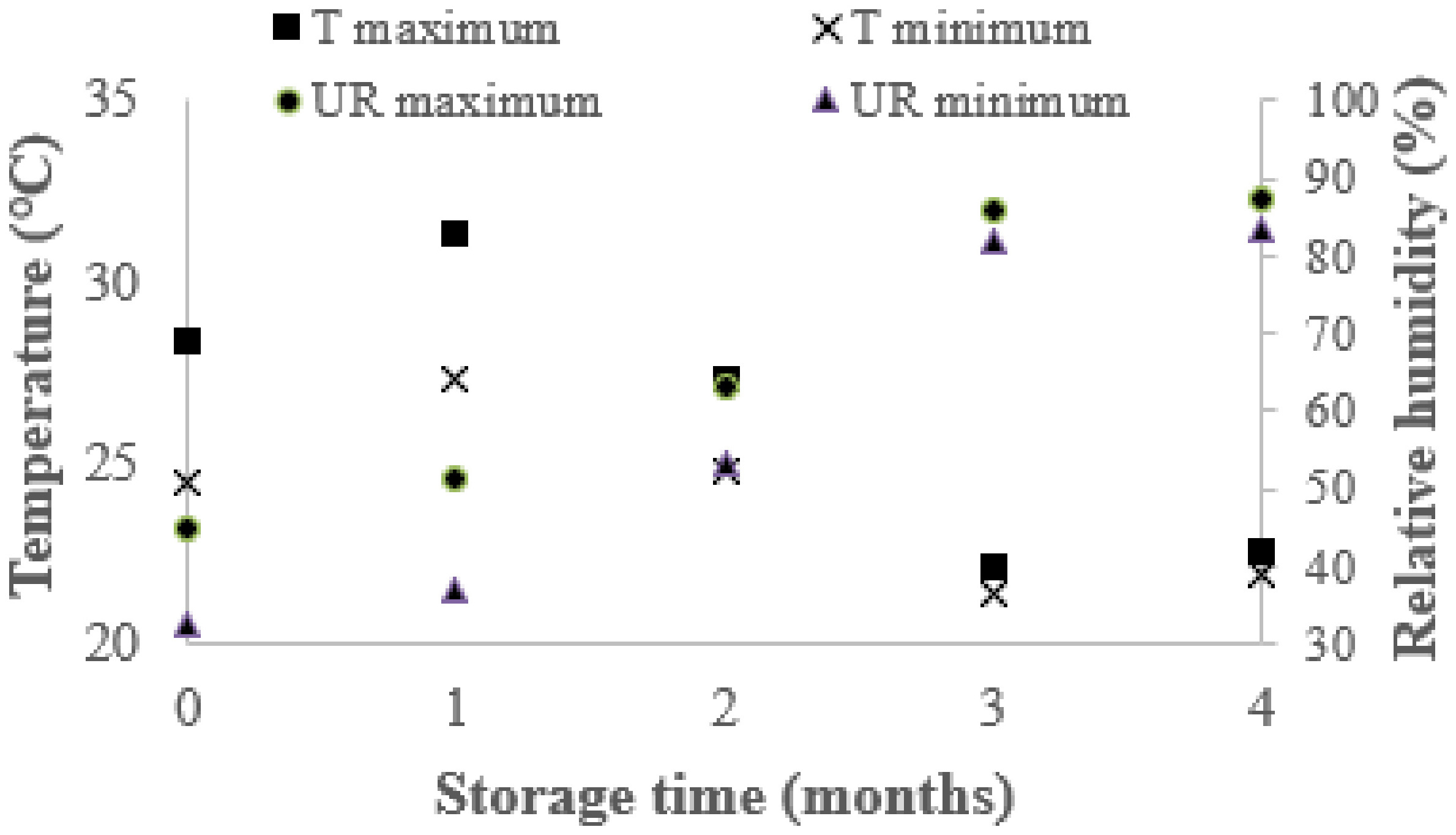
In Experiment 2, roasted nuts were stored in packages with water vapor permeability of 34.25 g of water/m2 day. During storage, the relative air humidity gradually increased from 30-40% to approximately 80-90%, while temperature varied between 21.88 and 31.36 °C (Figure 4).

Average temperature and relative humidity values during the storage of roasted baru nuts in polypropylene packages for up to 4 months.
The water content (Figure 5) of roasted nuts increased during the 120 days of storage due to the high water vapor permeability of the packaging, coinciding with the increase in relative humidity during the four months of storage. Shortly after the roasting of baru nuts, the moisture content was 2.63%, higher than that obtained by Damiani et al. (2013) in roasted pequi nuts (1.70%).

Evolution of the chemical parameters in roasted baru nuts stored in polypropylene packaging for up to 4 months.
The water activity values (Figure 5) did not show significant differences up to 90 days of storage. The maximum value was found in 120 days of storage (0.515%) being within the range for microbiological food safety (Celestino, 2010).
Titratable acidity remained stable until sixty days of storage, with significant increase after this period from 3.38 mL of normal NaOH 100g-1 solution to 5.40 mL of normal NaOH 100g-1 solution (Figure 5). When compared to fresh nuts (Figure 3), these values are higher, which is attributable to the roasting process.
The oil acidity increased significantly after sixty days of storage (Figure 5). This increase in acidity indicates that the oil is being degraded, as this analysis is one of the parameters to evaluate the quality of oils and fats (Brasil, 2005). Even after 120 days of storage, it was possible to verify that the oil quality is adequate according to RDC nº. 270 (Brasil, 2005).
The peroxide index of roasted nuts increased linearly during the storage period (Figure 5), indicating oil degradation and oxidation, showing increase of almost 25% after 120 days. According to Resolution nº. 270 of 2005 (Brasil, 2005), nuts are within the limits for marketing up to 60 days of storage. The degradation and oxidation of nut lipids can be attributed to packaging, which is probably permeable to water vapor and oxygen. Donadon et al. (2015) studied different packaging for storing crambe seeds and concluded that polyethylene terephthalate is more suitable for maintaining lipid quality, as they are impermeable to oxygen.
4. Conclusion
The results demonstrate that storing baru nuts (Dipteryx alata Vogel) in raffia bags under ambient conditions is a viable strategy for long-term postharvest storage, allowing the lipid quality and antioxidant capacity of the kernels to be maintained for up to 12 months. Furthermore, storage induces significant changes in the profile of bioactive compounds, with an increase in total phenolic content and a reduction in tannins, without compromising antioxidant activity, indicating a possible positive modulation of the functional quality of the kernels over time.
Regarding thermal processing, roasting almonds at 180 °C for 15 minutes was effective in achieving satisfactory initial physicochemical stability. However, during storage, the roasted almonds showed progressive lipid degradation, indicated by rising acidity and peroxide values, particularly after 60 days, which restricts their shelf life under the tested conditions. Therefore, while packaging in polypropylene bags is technically possible, it has limitations as a barrier to gases and water vapor, which adversely affects oxidative stability during storage.
This study's findings enhance understanding of baru fruit's postharvest handling and preservation, offering technical insights to improve storage and processing. These improvements have direct implications for the production chain, value addition, and the sustainable use of this native Brazilian Cerrado species.
5. Futures Perspectives and Study Limitations
Although this study provides relevant insights into the post-harvest storage of baru fruits (Dipteryx alata Vogel) and the stability of fresh and roasted nuts, some limitations must be considered. The storage conditions were restricted to ambient environment and a single packaging system (raffia bags for fruits and polypropylene for roasted nuts), which limits the extrapolation of the results to other storage systems with controlled temperature, humidity, or modified atmospheres. In addition, the evaluation focused predominantly on physicochemical parameters, without including sensory analysis, microbiological stability, or detailed profiling of bioactive compounds, such as individual phenolics or lipid oxidation products, which could provide a more comprehensive understanding of quality changes during storage.
Another limitation refers to the absence of evaluation of alternative packaging materials with higher barrier properties to oxygen and water vapor, which could significantly influence lipid stability, especially in roasted nuts. Furthermore, seasonal and environmental variability inherent to fruit collection in different harvest years may impact the reproducibility of results, indicating the need for multi-seasonal studies.
From a future perspective, further investigations should explore controlled storage conditions, including refrigeration, modified atmosphere packaging, and the use of high-barrier materials, aiming to extend shelf life and preserve the functional quality of baru nuts. Studies focusing on detailed metabolomic and lipidomic profiling are also recommended to better elucidate the biochemical changes occurring during storage. In addition, evaluating sensory attributes and consumer acceptance over time would be essential to support industrial applications.
Moreover, considering the increase in total phenolic compounds observed during storage, future research should investigate the mechanisms involved in this behavior, as well as its implications for bioavailability and health-promoting properties. Expanding the application of baru nuts in functional foods and nutraceutical products also represents a promising research avenue, particularly in the context of sustainable use of Brazilian Cerrado biodiversity and valorization of native species.
Acknowledgements
We thank the Graduate Program in Health and Development in the Central-West Region, Medical School, Federal University of Mato Grosso do Sul, Campo Grande, and the Federal University of Mato Grosso do Sul-UFMS for the support. The authors also thank the Coordination for the Improvement of Higher Education Personnel (Coordenação de Aperfeiçoamento de Pessoal de Nível Superior-CAPES). This research was partially supported by the Brazilian Research Council (CNPq) (CNPq: process 304312/2025-8 and Coordenação de Aperfeiçoamento de Pessoal de Nível Superior-Brasil (CAPES)-Finance Code 001. CNPq Nº. 409183/2016-4.
Data Availability Statement
Data will be made available on request.
References
-
ALVES, A.M., FERNANDES, D.C., BORGES, J.F., SOUSA, A.G.O. and NAVES, M.M.V., 2016. Oilseeds native to the Cerrado have fatty acid profile beneficial for cardiovascular health. Revista de Nutrição, vol. 29, no. 6, pp. 859-866. https://doi.org/10.1590/1678-98652016000600010
» https://doi.org/10.1590/1678-98652016000600010 -
BELMIRO, T.M.C., QUEIROZ, A.J.M., FIGUEIRÊDO, R.M.F., FERNANDES, T.K.S. and BEZERRA, M.C.T., 2010. Alterações químicas e físico-químicas em grãos de abóbora durante o armazenamento. Revista Brasileira de Engenharia Agrícola e Ambiental, vol. 14, no. 9, pp. 1000-1007. https://doi.org/10.1590/S1415-43662010000900013
» https://doi.org/10.1590/S1415-43662010000900013 - BENEVIDES, C.M.J., SOUZA, R.D.B., SOUZA, M.V. and LOPES, M.V., 2010. Efeito do processamento sobre os teores de oxalato e tanino em maxixe (Cucumis anguria L.) Jiló (Solanum gilo), feijão verde (Vigna unguiculata (L.) Walp) e Feijão Andu (Cajanus cajan (L.) Mill SP). Brazilian Journal of Food and Nutrition, vol. 24, no. 3, pp. 321.
-
BESSA, J.F.V., DONADON, J.R., RESENDE, O., ALVES, R.M.V., SALES, J.F. and COSTA, L.M., 2015. Armazenamento do crambe em diferentes embalagens e ambientes: parte I - qualidade fisiológica. Revista Brasileira de Engenharia Agrícola e Ambiental, vol. 19, no. 3, pp. 224-230. https://doi.org/10.1590/1807-1929/agriambi.v19n3p224-230
» https://doi.org/10.1590/1807-1929/agriambi.v19n3p224-230 - BRASIL. Ministério da Saúde. 2005. Resolução nº 270, de 22 de setembro de 2005. Regulamento Técnico para Óleos vegetais, gorduras vegetais e creme vegetal. Diário Oficial da República Federativa do Brasil, Brasília.
- BRASIL, 2009. Exame de sementes infestadas. In: BRASIL, ed. Regras para análise de sementes. Brasília: Ministério da Agricultura, Pecuária e Abastecimento/ACS, cap. 8, pp. 341-342.
- BRASIL. Ministério da Saúde, 2015. Alimentos regionais brasileiros. 2. ed. Brasília: Ministério de Saúde.
- CARRAZZA, R.S. and ÁVILA, J.C.C., 2010. Manual tecnológico de aproveitamento integral do fruto do baru (Dipteryx alata). Brasília: Instituto Sociedade, População e Natureza, 56 p.
- CELESTINO, S.M.C., 2010. Princípios da secagem de alimentos Planaltina: Embrapa Cerrados, 51 p.
-
DAMIANI, C., ALMEIDA, T.L., COSTA, N.V., MEDEIROS, N.X., SILVA, A.G.M., SILVA, F.A., LAGE, M.E. and BECKER, F.S., 2013. Perfil de ácidos graxos e fatores antinutricionais de amêndoas de pequi cruas e torradas. Pesquisa Agropecuária Tropical, vol. 43, no. 1, pp. 71-78. https://doi.org/10.1590/S1983-40632013000100004
» https://doi.org/10.1590/S1983-40632013000100004 -
DONADON, J.R., BESSA, J.F.V., RESENDE, O., CASTRO, C.F.S., ALVES, R.M.V. and SILVEIRA, E.V., 2015. Armazenamento do crambe em diferentes embalagens e ambientes: Parte II - Qualidade química. Revista Brasileira de Engenharia Agrícola e Ambiental, vol. 19, no. 3, pp. 231-237. https://doi.org/10.1590/1807-1929/agriambi.v19n3p231-237
» https://doi.org/10.1590/1807-1929/agriambi.v19n3p231-237 -
FARONI, R.A., ALENCAR, E.R., PAES, J.L., COSTA, A.R. and ROMA, R.C.C., 2009. Armazenamento de soja em silos tipo bolsa. Engenharia Agrícola, vol. 29, no. 1, pp. 91-100. https://doi.org/10.1590/S0100-69162009000100010
» https://doi.org/10.1590/S0100-69162009000100010 -
FREITAS, J.B. and NAVES, M.M.V., 2010. Composição química de nozes e sementes comestíveis e sua relação com a nutrição e saúde. Revista de Nutrição, vol. 23, no. 2, pp. 269-279. https://doi.org/10.1590/S1415-52732010000200010
» https://doi.org/10.1590/S1415-52732010000200010 -
GARCIA, C., COELHO, C.M.M., MARASCHIN, M. and OLIVEIRA, L.M., 2014. Conservação da viabilidade e vigor de sementes de Araucaria angustifolia (Bertol.) Kuntze durante o armazenamento. Ciência Florestal, vol. 24, no. 4, pp. 857-867. https://doi.org/10.5902/1980509816586
» https://doi.org/10.5902/1980509816586 - HARRINGTON, J.F., 1973. Packaging seed for storage and shipment. Seed Science and Technology, vol. 1, no. 3, pp. 701-709.
- INSTITUTO ADOLFO LUTZ – IAL, 2008. Normas analíticas do IAL: métodos químicos e físicos para análise de alimentos 5. ed. São Paulo: Instituto Adolfo Lutz, 1020 p.
-
INSTITUTO NACIONAL DE METEREOLOGIA – INMET [online], 2017 [viewed 25 August 2017]. Available from: http://www.inmet.gov.br/portal/
» http://www.inmet.gov.br/portal/ -
LEMOS, M.R.B., SIQUEIRA, E.M.A., ARRUDA, S.F. and ZAMBIAZI, R.C., 2012. The effect of roasting on the phenolic compounds and antioxidant potential of baru nuts (Dipteryx alata Vog.). Food Research International, vol. 48, no. 1, pp. 592-597. https://doi.org/10.1016/j.foodres.2012.05.027
» https://doi.org/10.1016/j.foodres.2012.05.027 -
LORINI, A., WOBETO, C., ROSA, C.C.B., HATEM, T.A. and BOTELHO, S.C.C., 2018. Influence of packaging on the quality of Brazil nuts. Acta Amazonica, vol. 48, no. 4, pp. 368-372. https://doi.org/10.1590/1809-4392201701772
» https://doi.org/10.1590/1809-4392201701772 - MACHADO, W.M., PEREIRA, A.D. and MARCON, M.V., 2013. Efeito do processamento e armazenamento em compostos fenólicos presentes em frutas e hortaliças. Ciências Exatas e da Terra, Ciências Agrárias e Engenharia, vol. 19, no. 1, pp. 17-30.
-
MARTINS, F.S., BORGES, L.L., PAULA, J.R. and CONCEIÇÃO, E.C., 2013. Impact of different extraction methods on the quality of Dipteryx alata extrats. Revista Brasileira de Farmacognosia, vol. 23, no. 3, pp. 521-523. https://doi.org/10.1590/S0102-695X2013005000033
» https://doi.org/10.1590/S0102-695X2013005000033 -
OLIVEIRA, L.C., COSTA, E., CARDOSO, E.D., BINOTTI, F.F.S. and JORGE, M.H.A., 2014. Propriedades físicas de sementes de baru em função da secagem. Revista de Agricultura Neotropical, vol. 1, no. 1, pp. 92-96. https://doi.org/10.32404/rean.v1i1.223
» https://doi.org/10.32404/rean.v1i1.223 -
QUADROS, G.O., POTT, A., OLIVEIRA, L.C.S., MICHELS, F.S., CAVALHEIRO, L.F., FERNANDES, C.D.P., NAZÁRIO, C.E.D., DONADON, J.R., VARGAS, M.O.F., FERREIRA, R.S., INADA, A.C., HIANE, P.A., FREITAS, K.C., NASCIMENTO, V.A. and GUIMARÃES, R.C.A., 2025. Lipidic composition and thermal stability of oils from Dipteryx alata, Acrocomia totai, Mauritia flexuosa and Caryocar brasiliense. Brazilian Journal of Biology, vol. 85, e299903. https://doi.org/10.1590/1519-6984.299903 PMid:41810626.
» https://doi.org/10.1590/1519-6984.299903 -
ROCHA, W.S., LOPES, R.M., SILVA, D.B., VIEIRA, R.F., SILVA, J.P. and AGOSTINI-COSTA, T.S., 2011. Compostos fenólicos totais e taninos condensados em frutas nativas do cerrado. Revista Brasileira de Fruticultura, vol. 33, no. 4, pp. 1215-1221. https://doi.org/10.1590/S0100-29452011000400021
» https://doi.org/10.1590/S0100-29452011000400021 -
ROESLER, R., MALTA, L.G., CARRASCO, L.C., HOLANDA, R.B., SOUZA, C.A.S. and PASTORE, G.M., 2007. Atividade antioxidante de frutas do cerrado. Food Science and Technology, vol. 27, no. 1, pp. 53-60. https://doi.org/10.1590/S0101-20612007000100010
» https://doi.org/10.1590/S0101-20612007000100010 -
SANTIAGO, G.L., OLIVEIRA, I.G., HORST, M.A., NAVES, M.M.V. and SILVA, M.R., 2018. Peel and pulp of baru (Dipteryx alata Vog.) provide high fiber, phenolic content and antioxidant capacity. Food Science and Technology, vol. 38, no. 2, pp. 244-249. https://doi.org/10.1590/1678-457x.36416
» https://doi.org/10.1590/1678-457x.36416 -
SANTOS, J.M.D., BORGES, J.A.T., SANTOS, S.M.D., SILVA, R.M.M.F., TRICHEZ, V.D.K. and FORMAGIO, A.S.N., 2024. Baru (Dipteryx alata): a comprehensive review of its nutritional value, functional foods, chemical composition, ethnopharmacology, pharmacological activities and benefits for human health. Brazilian Journal of Biology, vol. 84, e278932. https://doi.org/10.1590/1519-6984.278932 PMid:39109711.
» https://doi.org/10.1590/1519-6984.278932 - SARANTÓPOULOS, C.I.G.L., OLIVEIRA, L.M., PADULA, M., COLTRO, L., ALVES, R.M.V. and GARCIA, E.E.C., 2002. Embalagens plásticas flexíveis: principais polímeros e avaliação de propriedades. Campinas: CETEA/ITAL, 267 p.
-
SILVA, A.G.M. and FERNANDES, K.F., 2011. Composição química e antinutrientes presentes nas amêndoas cruas e torradas de chicha (Sterculia striata A. St. Hill & Naudin). Revista de Nutrição, vol. 24, no. 2, pp. 305-314. https://doi.org/10.1590/S1415-52732011000200011
» https://doi.org/10.1590/S1415-52732011000200011 -
SILVA, M.L., COSTA, R.S., SANTANA, A.S. and KOBLITZ, M.G.B., 2010. Compostos fenólicos, carotenoides e atividade antioxidante em produtos vegetais. Semina. Ciências Agrárias, vol. 31, no. 3, pp. 669-681. https://doi.org/10.5433/1679-0359.2010v31n3p669
» https://doi.org/10.5433/1679-0359.2010v31n3p669 -
SIQUEIRA, A.P.S., CASTRO, C.F.S., SILVEIRA, E.V. and LOURENÇO, M.F.C., 2016. Chemical quality of Baru almond (Dipteryx alata oil). Ciência Rural, vol. 46, no. 10, pp. 1865-1867. https://doi.org/10.1590/0103-8478cr20150468
» https://doi.org/10.1590/0103-8478cr20150468 -
SIQUEIRA, A.P.S., PACHECO, M.T.B. and NAVES, M.M.V., 2015. Nutritional quality and bioactive compounds of partially defatted baru almond flour. Food Science and Technology, vol. 35, no. 1, pp. 127-132. https://doi.org/10.1590/1678-457X.6532
» https://doi.org/10.1590/1678-457X.6532 -
SWAIN, T. and HILLIS, W.E., 1959. The phenolic constituents of Prunus domestica: the quantitative analysis of phenolic constituents. Journal of the Science of Food and Agriculture, vol. 10, no. 1, pp. 63-68. https://doi.org/10.1002/jsfa.2740100110
» https://doi.org/10.1002/jsfa.2740100110 - VIEIRA, R.D. and KRZYZANOWSKI, F.C., 1999. Teste de condutividade elétrica. In: F.C. KRZYZANOWSKI, R.D. VIEIRA and J.B. FRANÇA NETO, eds. Vigor de sementes: conceitos e testes. Londrina: ABRATES, pp. 1-26.
-
WATANABE, T., ROZANE, D.E., NATALE, W. and FURLAN, C.M., 2011. Avaliação da influência 559 de substâncias fenólicas e carotenoides na anomalia do pericarpo da goiaba, “anelamento”. Revista Brasileira de Fruticultura, vol. 33, no. 1, pp. 8-13. https://doi.org/10.1590/S0100-29452011005000046
» https://doi.org/10.1590/S0100-29452011005000046 - ZUFFO, A.M., ANDRADE, F.R. and ZUFFO JÚNIOR, J.M., 2014. Caracterização biométrica de frutos e sementes de baru (Dipteryx alata Vog.) na região leste de Mato Grosso, Brasil. Revista de Ciências Agrárias, vol. 37, no. 4, pp. 463-471.
Edited by
-
Editor:
Takako Matsumura Tundisi