 Faunistic analysis of phlebotomine sand flies (Lutzomyia spp.) in the municipality of Crato, Ceará, Brazil
Abstract
This study conducted a faunistic survey of phlebotomine sand flies in the municipality of Crato, Ceará, an endemic area for leishmaniasis. A total of 662 individuals were collected, belonging to five species of the genus Lutzomyia: L. longipalpis (89%), L. lenti (8%), L. intermedia (2%), L. evandroi (2%), and L. migonei (0.1%). L. longipalpis demonstrated absolute dominance, being classified as constant and eudominant, with the highest abundance in the Palmeiral, Pimenta, and São José neighborhoods. Temporal analysis revealed a significant difference in abundance between the dry and rainy seasons (Mann-Whitney test, P = 0.001), with higher population density in the dry period. Principal Component Analysis (PCA) identified three spatial patterns: a cohesive cluster of most neighborhoods dominated by L. longipalpis; the locality Gisélia Pinheiro as an outlier, with a distinct composition; and the Parque Grangeiro and Romualdo neighborhoods associated with L. evandroi. The results confirm the adaptation of L. longipalpis to anthropic environments and highlight the spatial and temporal heterogeneity of the sand fly community, reinforcing the need for vector control strategies differentiated by locality and seasonal period.
Keywords:
mosquito-palha; Lutzomyia longipalpis; leishmaniasis; zoonosis
Resumo
Este estudo realizou um levantamento faunístico de flebotomíneos no município de Crato, Ceará, área endêmica para leishmanioses. Foram coletados 662 indivíduos, pertencentes a cinco espécies do gênero Lutzomyia: L. longipalpis (89%), L. lenti (8%), L. intermedia (2%), L. evandroi (2%) e L. migonei (0,1%). Lutzomyia longipalpis demonstrou dominância absoluta, sendo classificada como constante e eudominante, com maior abundância nos bairros Palmeiral, Pimenta e São José. A análise temporal revelou diferença significativa na abundância entre estações seca e chuvosa (Teste de Mann-Whitney, p=0,001), com maior densidade populacional no período seco. A Análise de Componentes Principais (PCA) identificou três padrões espaciais: um agrupamento coeso da maioria dos bairros dominados por L. longipalpis; a localidade Gisélia Pinheiro como outlier, com composição distinta; e os bairros Parque Grangeiro e Romualdo associados a L. evandroi. Os resultados confirmam a adaptação de L. longipalpis a ambientes antrópicos e destacam a heterogeneidade espacial e temporal da comunidade de flebotomíneos, reforçando a necessidade de estratégias de controle vetorial diferenciadas por localidade e período sazonal.
Palavras-chave:
mosquito-palha; Lutzomyia longipalpis; leishmaniose; zoonoses
1. Introduction
Phlebotomine sand flies (Diptera: Psychodidae: Phlebotominae), popularly known as “mosquito-palha” (Neves et al., 2016), are small-bodied insects (2 to 4 mm), have their bodies covered with hairs and some scales, and their wings are lance-shaped (Basano and Camargo, 2004; Neves et al., 2016; Galati, 2018). These animals exhibit sexual dimorphism, with males having genitalia with articulated and well developed appendages at the end of the abdomen, while females have the final portion of the abdomen rounded, containing a pair of spermathecae inside. Both the reproductive structures of males and females are relevant for taxonomic identification (Neves et al., 2016).
Currently, there are approximately 1,060 described species of sand flies worldwide, with 556 species recorded in the Americas (Galati and Rodrigues, 2023). They represent a group of extreme medical and veterinary relevance (Rangel and Lainson, 2009), as females are hematophagous and serve as vectors for various pathogens (Rey, 2008; Neves et al., 2016). Approximately 30 species have been confirmed as vectors of leishmaniasis (Akhoundi et al., 2016). In the Americas, the transmission of these pathogens occurs through sand flies of the genus Lutzomyia (Neves et al., 2016). Among the 306 species described in Brazil (Shimabukuro et al., 2025), ten are recognized in the transmission of Cutaneous Leishmaniasis (CL) and two in Visceral Leishmaniasis (VL) (Rey, 2008; Neves et al., 2016). Leishmaniases constitute a complex of neglected infectious diseases with a global distribution. In Brazil, these diseases exhibit a zoonotic character and are caused by protozoa of the genus Leishmania. Visceral Leishmaniasis, in particular, is of notable public health importance, with Lutzomyia longipalpis serving as the primary vector in the American continent, characterized by high lethality and incidence (Rey, 2008; Neves et al., 2016).
The dispersal dynamics of Lutzomyia species and the epidemiology of the disease are influenced by multiple environmental and ecological factors. However, the influence of abiotic factors on the abundance and composition of these insects can show significant regional variations. While some studies have found no direct correlation between population density and strict climatic variables such as temperature and precipitation (Garcia et al., 2025), the community structure can be significantly altered by abiotic disturbances and habitat modifications (Alexander et al., 2001). Such disturbances, including wildfires or forest regeneration processes, may even favor an increase in the abundance and species richness of sand flies in disturbed areas, possibly due to a higher dependence on and availability of small mammal hosts adapted to these degraded environments (Alexander et al., 2001).
Consequently, understanding how the local fauna responds to these variables is crucial for effective surveillance and epidemiological control (Gómez-Bravo et al., 2017; Niño and Pérez-Español, 2021; Souza Fernandes et al., 2022). Given this scenario, the present study aimed to conduct a faunistic analysis of phlebotomine sand flies (Lutzomyia spp.) in the municipality of Crato, Ceará, Brazil, to identify circulating species and evaluate their distribution and relative density in response to the specific environmental characteristics of the region.
2. Materials and Methods
2.1. Study area
The study was conducted in the urban zone of the municipality of Crato (7°12′16-7°18′05”S, 39°21′30-39°26′52”W), located in Ceará State, Brazil (Figure 1), during the period from August 2024 to March 2025. The municipality is part of the Southern Ceará Mesoregion, specifically the Cariri Metropolitan Region, situated approximately 592 km from Fortaleza, the state capital. It has an altitude of 528 m, with remnants of Primary Ombrophilous Forest, an average temperature of 30°C to 35°C for most of the year, and an annual rainfall index of 1,260 mm (FUNCEME, 2025). This area is considered endemic for American Tegumentary Leishmaniasis (ATL) (Municipios do Ceará, 2025). In order to obtain a more detailed and representative analysis of the study area, collections were carried out in the main neighborhoods of the municipality of Crato (see Figure 1).

2.2. Sampling and identification of phlebotomine sand flies
For phlebotomine sampling, monthly collections were carried out over a period of six months, covering three months of the dry season and three of the rainy seasons. In each locality, four CDC (Centers for Disease Control) light traps were used, installed 1m above the ground and operating for three consecutive nights (from 5:00 PM to 6:00 AM) (Sudia & Chamberlain, 1962; Alexander et al., 2001; Neves et al., 2016). The distribution of the traps prioritized favorable microhabitats, with one unit installed indoors (intradomicile) and three in the surrounding area (peridomicile). In the latter, the traps were strategically positioned in areas with higher humidity, lower incidence of artificial light, and, depending on availability at each point, in locations where animals gather (such as corrals), aiming to maximize the chance of capture due to blood-feeding attractiveness and ecological conditions.Captured specimens were transferred to nylon cages placed in plastic bags containing moistened cotton wool, in order to maintain adequate humidity and temperature during transport. Subsequently, the material was stored in polystyrene boxes (Styrofoam) and sent to the ntomology Laboratory of the Faculty of Medicine at the Universidade Federal do Cariri (UFCA).
In the laboratory, the insects were sorted with the aid of a manual Castro aspirator and kept under refrigeration at 4°C until processing. The males were conditioned in hemolysis tubes containing 70% alcohol and stored at room temperature for later preparation, mounting, and identification. The females were preserved in Eppendorf-type microtubes (1.5 mL) containing 6% dimethyl sulfoxide (DMSO) solution and frozen at −20°C until the time of dissection. For taxonomic identification, the head and the last three abdominal segments of the females were dissected and mounted between a slide and coverslip using Berlese's fluid, according to the modified technique of Langeron (1949). The determination of the specimens was carried out according to the classification proposed by Young and Duran (1994).
2.3. Faunistic analyses
Faunistic analyses were conducted with the objective of characterizing the structure of the phlebotomine sand fly populations in the study area. The parameters of constancy, dominance, abundance, relative frequency, and species richness were considered.
Species constancy was calculated according to the Formula 1:
where: 'C' represents the constancy in percentage, 'p' is the number of samples in which the species was present, and 'N' is the total number of samples analyzed. Based on the results, the species were classified into three categories: constant (present in more than 50% of the samples), accessory (present between 25% and 50%), and accidental or rare (present in less than 25% of the samples).
Dominance was determined according to the method proposed by Palissa et al. (1979), using the Equation 2:
where: 'i' corresponds to the abundance of a species and 't' to the total number of individuals collected. Species were classified into five categories: eudominant (D > 10%), dominant (5% < D ≤ 10%), subdominant (2% < D ≤ 5%), recessive (1% < D ≤ 2%), and rare (D < 1%).
Abundance was expressed by the total number of individuals of each species collected during the sampling period, serving as an indicator of the population's representativeness in relation to the total number of specimens recorded. In turn, relative frequency was calculated by the percentage relationship between the number of individuals of a species and the total number of phlebotomine sand flies captured, according to the Formula 3:
where: 'nᵢ' represents the number of individuals of species 'i' and 'N' the total number of individuals collected. Finally, species richness was defined as the total number of species registered at each collection point, being used as a descriptive measure of local diversity.
2.4. Statistical analyses
We performed a Principal Component Analysis (PCA), an unsupervised ordination technique to explore the distribution patterns of phlebotomine sand fly species among the different collection localities. The objective of the analysis was to reduce the dimensionality of the multivariate data set and identify the species that contribute most to the variation in faunal composition among the studied areas.
The species abundance data by locality were organized into a matrix, with localities represented in the rows and species in the columns. Before performing the PCA, the data were standardized (or scaled), centering them to a mean of zero and a variance of one. This standardization was necessary to ensure that species with higher abundance did not dominate the analysis and that all species had equal weight in the total variation.
The analysis was performed using the statistical software R (Version 4.4.2) (R Core Team, 2024), utilizing the stats package. Results visualization was done through a biplot generated with the ggplot2 library (Wickham, 2016), which allows for the simultaneous representation of localities (as points) and species (as vectors). Data manipulation and preparation were carried out with the aid of the dplyr package (Wickham et al., 2022). The biplot displays the first two principal components (PC1 and PC2), which together explain most of the total data variation. The interpretation of the biplot was based on the proximity of the points to infer similarity between localities and on the direction and length of the vectors to identify the species most influential in the variation structure and their association with the respective localities.
Finally, the normality of the phlebotomine sand fly abundance data and the homogeneity of variance between the two seasons (dry and rainy) were evaluated using the Shapiro-Wilk and Levene's Tests, respectively. As the data violated the assumptions of normality and homogeneity of variance, the comparison of phlebotomine abundance between seasons was performed using the Mann-Whitney U Test (also known as the Wilcoxon Rank-Sum Test), a non-parametric test that compares the medians of two independent samples based on their ranks. The statistical analyses were conducted in the R software (version 4.4.2), using the stats package.
3. Results
A total of five phlebotomine sand fly species was collected, all belonging to the same genus: Lutzomyia evandroi Mangabeira, 1941; L. intermedia Lutz and Neiva, 1912; L. lenti Mangabeira, 1938; L. longipalpis Lutz and Neiva, 1912; and L. migonei França, 1920. The general faunistic analysis revealed a total of 662 phlebotomine sand fly individuals collected (Table 1). The community was dominated by few species, with L. longipalpis standing out as the most abundant, representing 89% of the total abundance. Due to its high frequency (F% of 93%) and dominance (Eudominant), it was classified as a constant species of great importance in the study area. The second most abundant species, L. lenti, contributed 8% of the total abundance. Its presence in 64% of the samples classifies it as a constant and dominant species, reinforcing its relevance to the local faunal composition. The remaining species, L. intermedia (2%), L. evandroi (2%), and L. migonei (-), showed very low abundance and frequency. They were classified as accidental and recessive or rare, indicating their low contribution to the overall community structure.
Phlebotomine sand fly species in the study area, based on absolute abundance (AB), relative abundance (AB%), frequency (F%), constancy, and dominance.
The temporal faunistic analysis of phlebotomine sand fly species revealed marked differences in abundance and dominance between the dry season and the rainy season. During the dry season, the total number of individuals collected was 528 (Table 2). The species L. longipalpis was the most abundant, representing an impressive 93% of the total abundance. Its high frequency and dominance classify it as constant and eudominant, respectively. The second most abundant species was L. lenti, which, with 26 individuals, represented 5% of the total. Its presence in 100% of the samples classifies it as constant and subdominant, indicating its relevance in the local fauna. The remaining species, L. evandroi, L. intermedia, and L. migonei, were considered accidental or rare, with minimal contributions to the total abundance.
Phlebotomine sand fly species by seasonal period in the study area, based on total abundance (Total), relative abundance (AB%), constancy, and dominance of each species during the dry and rainy periods.
In contrast, the rainy season showed a drastic reduction in the number of individuals, with a total of 115 collected (Table 2). As in the dry season, L. longipalpis maintained its prominent position, representing 96% of the total abundance. This consistency in dominance, coupled with its presence in 100% of the samples, maintains its classification as constant and eudominant. The species L. lenti was the second most abundant, totaling 11 individuals. Its constant presence was also notable, reinforcing its role in the community composition. The other species were collected in very low numbers or were absent, corroborating their classification as rare.
The distribution of species among the sampled neighborhoods revealed that L. longipalpis was the predominant species, registering the highest abundance in neighborhoods such as Palmeiral (118 specimens), Gisélia Pinheiro (120 specimens), and Romualdo (72 specimens). In turn, L. lenti also showed expressive records in Lameiro (13 specimens) and Gisélia Pinheiro (16 specimens). The remaining species, such as L. evandroi, L. intermedia, and L. migonei, were found in smaller quantities, with L. migonei registered only in the Gisélia Pinheiro neighborhood (one specimen) (Table 3 and Figure 2).
Abundance of phlebotomine sand fly species by neighborhood in the municipality of Crato, Ceará. The table presents the number of individuals collected for each species in each locality, the total number of individuals per neighborhood, and the species richness in each of them.

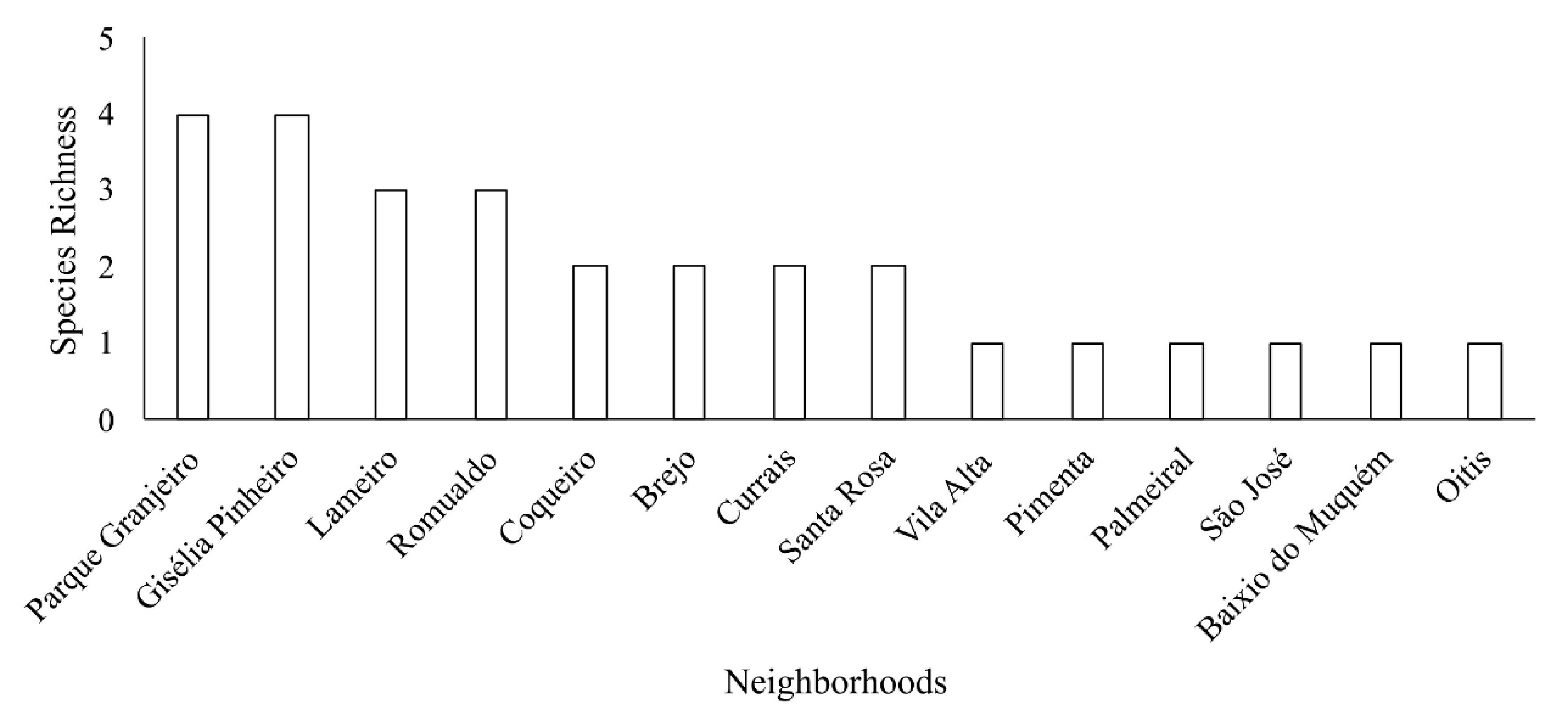
Species richness varied among the neighborhoods, being highest in Parque Grangeiro and Palmeiral (4 species each) and lowest in neighborhoods such as Vila Alta, Pimenta, Brejo, and Baixio (1 species each). The total abundance per neighborhood showed the highest concentration in Palmeiral (142 specimens), followed by São José (66 specimens) and Romualdo (81 specimens), while neighborhoods such as Vila Alta and Oitis recorded the lowest numbers of phlebotomine sand flies (two and nine specimens, respectively) (Table 3 and Figure 3).

Species richness of phlebotomine sand flies by neighborhood in the municipality of Crato, Ceará.
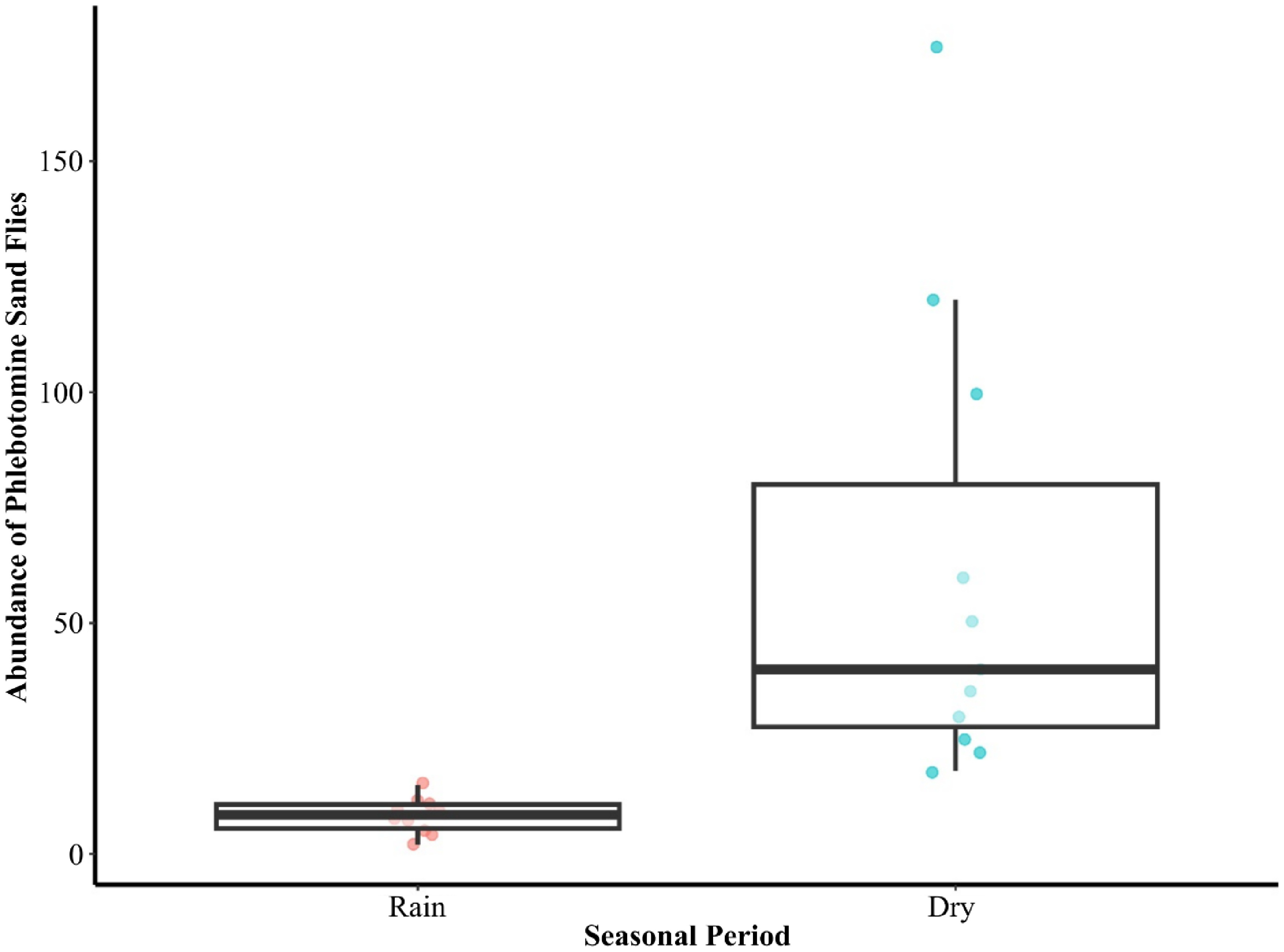
The abundance of phlebotomine sand flies was compared between the seasonal periods (dry and rainy season). Initial data evaluation, using the Shapiro-Wilk Test, indicated that the abundance distribution was not normal (W = 0.91, p-value = 0.043), leading to the rejection of the normality hypothesis. Additionally, the homogeneity of variance was tested using Levene's Test, which also revealed a significant difference in data variability between the two periods (F = 6.02, p-value = 0.022).
Due to the violation of the assumptions of normality and homogeneity of variance, the Mann-Whitney U Test, a non-parametric test, was used to compare the abundance distributions between the seasons. The results indicated a statistically significant difference between the groups (W = 13.5, p-valor = 0.001). These results demonstrate that phlebotomine sand fly abundance differs significantly between the seasons, with the highest values recorded in the dry season, confirming the influence of seasonality on the population dynamics of these insects (Figure 4).

Abundance of phlebotomine sand flies between seasonal periods in the municipality of Crato, Ceará, Brazil.
The Principal Component Analysis (PCA) was performed to explore the variation in the phlebotomine sand fly community composition among the different collection localities. The first two principal components (PC1 and PC2) were responsible for explaining most of the total data variation, with PC1 representing 55.92% and PC2 contributing 22.6%, totaling 78.52% of the variability (Figure 5).

Principal Component Analysis (PCA) of the phlebotomine sand fly community by sampled neighborhood in the municipality of Crato, Ceará. The arrows indicate the direction and strength of each species' contribution, while the points represent the ordination of each locality based on its faunistic composition.
The ordination of the localities in the biplot revealed well defined distribution patterns. The Gisela Pinheiro locality stood out as an outlier, isolated in the left quadrant of the graph, suggesting a radically distinct species composition from the others. The localities of Parque Grangeiro and Romualdo were also distinct, projecting positively on the PC2 axis, indicating that the variation in their faunistic composition is secondary to that observed in PC1. In contrast, most of the other localities (e.g., Baixio do Muquém, Brejo, Coqueiro, etc.) formed a cohesive cluster on the right side of the biplot, indicating great similarity in species composition among them.
The projection of species vectors in the biplot elucidated the faunistic associations. The vector for L. longipalpis was the longest, projecting sharply onto the PC1 axis and in opposition to the Gisela Pinheiro locality. This pattern indicates that the abundance of L. longipalpis is primarily responsible for the differentiation between most localities and Gisela Pinheiro. Additionally, the vector for L. evandroi, projecting into the upper right quadrant, was associated with Pq. Grangeiro and Romualdo, suggesting that the abundance of this species is a key factor in distinguishing these localities. The vectors for the remaining species (L. lenti, L. migonei, and L. intermedia) clustered near the origin, with smaller projections, indicating a lesser contribution to the overall community variability.
4. Discussion
The city of Crato is strategically located at the foot of the Araripe Plateau, and its economic activity is influenced by subsistence agriculture and the raising of small animals, often in areas close to the peridomicile (Soares et al., 2017a; Gomes et al., 2019; Araújo et al., 2021). The process of settlement and urbanization in these areas has, over time, led to the construction of small farms and condominiums that offer a refuge from the urban bustle. Associated with this, some clubs are located near springs and watercourses, unbalancing the habitat of most phlebotomine sand fly species (Cardoso et al., 2021).
The species composition of phlebotomine sand flies collected in Crato, consisting of L. evandroi, L. intermedia, L. lenti, L. longipalpis, and L. migonei, is supported by faunistic diversity studies conducted in other regions of Brazil, which frequently report the sympatry of species of this genus (Oliveira et al., 2000, 2010; Santos et al., 2019; Thies et al., 2023). The presence of L. longipalpis, in particular, is an epidemiologically significant finding, as it is the main vector of VL in the Americas (Carrasquilla and Kaufman, 2015; Neitzke-Abreu et al., 2023). Its adaptation to different habitats and climates, including anthropic environments, explains its wide geographical distribution and frequent collection in various studies (Costa et al., 2013).
Similarly, the occurrence of L. intermedia and L. migonei corroborates records of their importance as vectors of TL (Rangel et al., 1987; Azevedo et al., 1990; Costa et al., 2012). Specifically, L. migonei has already been found naturally infected with peripylar flagellates in a focus of cutaneous leishmaniasis in Ceará, the state where Crato is located, strengthening the hypothesis of its role in disease transmission in the region (Azevedo et al., 1990). The collection of L. evandroi and L. lenti, in turn, aligns with faunistic inventories that list them among the diversity of phlebotomine sand flies in the country (Castro et al., 2019).
The faunistic inventory conducted in Crato reveals a phlebotomine sand fly community with a clear dominance of L. longipalpis, which represented 89% of the 662 individuals collected and was classified as constant and eudominant. This pattern is typical of urban and peri-urban areas in Brazil, where this species frequently reaches high abundance and constancy indices in faunistic studies, corroborating its notable adaptation to anthropic environments (Cavalcante et al., 2024).
The second most relevant species was L. lenti, which was constant and dominant, a taxon frequently recorded in inventories in North-east Brazil. The remaining species (L. intermedia, L. evandroi, and L. migonei) were categorized as accidental and recessive, contributing marginally to the community structure. However, the low abundance does not rule out the epidemiological risk, since L. intermedia is a known vector of TL, and L. migonei, besides its role in cutaneous leishmaniasis transmission, showed high susceptibility to L. infantum infection under experimental conditions, developing infective metacyclic forms in certain vectors (Guimarães et al., 2016).
The temporal faunistic analysis conducted corroborates entomological studies in other endemic regions, which frequently record seasonal dominance patterns associated with climatic variables such as rainfall, temperature and relative humidity, influencing phlebotomine abundance throughout the year (Souza et al., 2014). The constant eudominance of L. longipalpis in both seasons, representing over 90% of the community, is an already documented phenomenon. Research carried out in Mato Grosso do Sul and north-eastern Pará also identified L. longipalpis as the most frequent species, with abundance superior to 85% and 35% of the total phlebotomine sand flies captured, respectively, ratifying its role as the main vector in different geographical contexts (Oliveira et al., 2010; Santos et al., 2019).
The drastic reduction in total abundance during the rainy season observed in the present study differs from what has been reported in studies conducted in other regions of Brazil, such as Mato Grosso do Sul (Oliveira et al., 2008, 2010), Pará (Santos et al., 2019) and Maranhão (Nascimento et al., 2024), which associated the peak abundance of phlebotomine sand flies with the rainy season.This apparent divergence highlights that temporal patterns can be influenced by local ecological factors, such as temperature and soil humidity, which are critical determinants for the population dynamics of L. longipalpis (Gómez-Bravo et al., 2017).
The constant, yet less abundant, presence of L. lenti as a subdominant species, and the accidental occurrence of other species like L. intermedia and L. migonei are also aligned with faunistic inventories that list them as components of the phlebotomine sand fly diversity in the country (Kono et al., 2023; Cardoso et al., 2025). Therefore, the temporal faunistic profile described not only validates L. longipalpis as a key species in the area but also highlights the sensitivity of the vector community to climatic factors.
The spatial distribution observed in the neighborhoods of Crato, with the clear dominance of L. longipalpis, corroborates ecological studies conducted in other regions of Brazil, which frequently point to this species as the most abundant and adapted to anthropic environments (Oliveira et al., 2008; Costa et al., 2013; Salomón, 2021). Its predominance in neighborhoods such as Palmeiral, Pimenta, and São José signals the role of this phlebotomine sand fly as the main vector of VL in the Americas, being commonly found in high densities in peridomiciliary areas, especially where there is animal shelter, such as chicken coops (Lainson et al., 1985; Costa et al., 2013).
The occurrence of L. lenti as the second most relevant species is also documented in the literature, which records it as a frequent taxon in faunistic inventories, although its epidemiological role needs to be better clarified (Costa et al., 2013). The presence of the remaining species (L. evandroi, L. intermedia, and L. migonei) in low abundance does not dismiss their importance. L. evandroi was recently reported in a new leishmaniasis focus in a high-altitude area in the North-east, raising an alert for its possible participation in transmission (Ubirajara Filho et al., 2020).
The greater species richness in neighborhoods such as Parque Grangeiro and Palmeiral is commonly associated with greater environmental complexity and habitat heterogeneity. Studies conducted in other regions of Brazil show that urban forest fragments, such as woodlands, function as refuges and breeding sites for a more diverse range of phlebotomine sand fly species, including those with more sylvatic habits (Machado et al., 2017). This diverse environment offers more resources and micro-habitats, sustaining an insect community with greater species richness. However, the lower richness but high dominance of a species like L. longipalpis in neighborhoods such as Pimenta is a phenomenon typical of more anthropized urban environments with more homogeneous ecological conditions (Thies et al., 2023).
The significant result of the Mann-Whitney U Test (W = 13.5, p-value = 0.001) confirms that the insect abundance does indeed differ between the seasons. This pattern of seasonal fluctuation is a phenomenon recorded in the literature. A similar study conducted in the Municipality of Três Lagoas, Mato Grosso do Sul, also identified a significant correlation between the abundance of phlebotomine sand flies, notably L. longipalpis, and climatic factors (Oliveira et al., 2010). In addition, research in the Maranhão Amazon documented that these populations fluctuate throughout the year, with peaks of abundance often associated with the rainy season or the transition to the dry period (Nascimento et al., 2024). In contrast, a study conducted in Maceió, Alagoas, did not identify a statistical correlation between population density and precipitation (Garcia et al., 2025). Souza et al. (2002) and Dias-Lima et al. (2003) list factors that can influence the abundance and attraction of insects to light, such as nocturnal temperature, rainfall, wind, lunar phases, flight height, and pheromones. According to FUNCEME (2025), Crato presented high rainfall values during the months of December 2024 and March 2025. High rainfall levels can destroy phlebotomine ecotopes, contributing to the elimination of pupae in the soil (Macedo et al., 2008; Scandar et al., 2011); perhaps, for this reason, a decrease in phlebotomine abundance was observed during the rainy season. It is possible that local phlebotomine populations are adapted to drier conditions, being negatively affected during the rainy period.However, further studies must be conducted to fully understand this differing pattern.
The heterogeneous spatial distribution of phlebotomine sand fly species observed is an ecologically significant phenomenon with important implications for leishmaniasis surveillance. The dominance of L. longipalpis in most neighborhoods is fully aligned with its known synanthropic behavior and its wide distribution as the main vector of VL in the Americas (Sousa-Paula and Dantas-Torres, 2021). Studies in other urban areas of Brazil, such as Teresina (Piauí) and Campo Grande (Mato Grosso do Sul), have also documented the presence and high adaptation of this vector to the anthropic environment, frequently associated with shelters for domestic animals, which sustains the formation of high-density “hotspots” (Oliveira et al., 2000; Soares et al., 2017b).
The relevance of L. evandroi in Parque Grangeiro and Romualdo highlights the complexity of the phlebotomine sand fly community. Likewise, the presence of the other species, even at low density, maintains an epidemiological alert. Species such as L. migonei and L. intermedia are proven or putative vectors of leishmaniases (Oliveira et al., 2000; Carvalho et al., 2010; Costa et al., 2012). Particularly, L. migonei has already been found naturally infected with Leishmania infantum in Pernambuco, suggesting its role as an alternative vector for VL where it is present (Carvalho et al., 2010).
Therefore, the stratification of neighborhoods into groups with distinct phlebotomine sand fly clusters not only validates the spatial heterogeneity but also demands differentiated vector control strategies, intensifying the fight against L. longipalpis in most areas and investigating the environmental factors that shape the unique community in Gisélia Pinheiro and the relevance of L. evandroi in the other neighborhoods.
The variation in phlebotomine abundance observed among the different localities suggests that the trap spatialization strategy may have influenced capture success. In the areas of Parque Granjeiro, Gisélia Pinheiro, São José, and Palmeiral, where the devices were installed more equidistantly, the higher numerical productivity might reflect a more comprehensive coverage of different microhabitats, increasing the probability of intercepting individuals at various resting sites or food sources. On the other hand, the lower density recorded in Baixo do Muquém, Vila Alta, Oitis, and Pimenta, where the traps were positioned closer to one another, may indicate that the concentration of collection points limited the attraction radius to specific niches, possibly underestimating the population present in adjacent areas.
Anthropic and environmental factors favor the proliferation of phlebotomine sand flies in the city of Crato-CE, where the large number of specimens demands continuous entomological monitoring, coupled with control and prevention strategies. The faunistic composition, which includes L. evandroi, L. intermedia, L. lenti, L. longipalpis, and L. migonei, has a clear epidemiological significance. The eudominance and persistence of L. longipalpis, the main vector of VL, across all analyzed dimensions (general, temporal, and spatial), ratify its extreme adaptation to the city's urban environments and consolidate it as the main target for public health actions (Oliveira et al., 2010; Neves et al., 2016; Soares et al., 2017b).
The population dynamics are sensitive to environmental factors, with the seasonal fluctuation confirming the highest abundance of phlebotomine sand flies during the dry season. This variation, although diverging from some regional patterns, underscores the importance of local ecological factors and the necessity of adjusting control strategies to coincide with the period of highest entomological risk. The spatial heterogeneity observed is of paramount importance because the dominance of L. longipalpis in most neighborhoods creates high-risk “hotspots,” typical of areas with a high density of domestic animals and suitable shelters. However, the unique faunistic profile of neighborhoods like Gisélia Pinheiro, and the relevance of L. evandroi in other localities, raise an alert about the complexity of leishmaniasis transmission.
Therefore, this study validates the presence of VL and TL vectors in Crato and emphasizes that entomological surveillance and vector control must be differentiated and stratified. It is essential to prioritize the intervention of L. longipalpis in areas of greater dominance and, simultaneously, investigate the environmental factors that sustain the diversity and presence of other putative vector species, such as L. migonei and L. intermedia, for a more effective public health management against leishmaniasis in the municipality.
Acknowledgments
The authors would like to thank the Fundação Cearense de Apoio ao Desenvolvimento Científico e Tecnológico (FUNCAP) for research fellowship grants to M.F.B.G.D. (BMD-0008-02422.01.09/23), Secretaria de Ciência, Tecnologia e Educação Superior do Ceará (Secitece) for research fellowship grants to AAMT (PVS-021500125.01.00/23).
-
Data Availability Statement
The entire data set supporting the results of this study was published in the article itself.
References
-
AKHOUNDI, M., KUHLS, K., CANNET, A., VOTÝPKA, J., MARTY, P., DELAUNAY, P. and SERENO, D., 2016. A historical overview of the classification, evolution, and dispersion of Leishmania parasites and sandflies. PLoS Neglected Tropical Diseases, vol. 10, no. 3, e0004349. https://doi.org/10.1371/journal.pntd.0004349 PMid:26937644.
» https://doi.org/10.1371/journal.pntd.0004349 -
ALEXANDER, B., FREITAS, J.M. and QUATE, L.W., 2001. Some Psychodidae (Diptera) from Atlantic Forest in South-Eastern Brazil, with descriptions of Trichomyia dolichopogon sp. nov. and Trichomyia riodocensis sp. nov. Brazilian Journal of Biology = Revista Brasileira de Biologia, vol. 61, no. 3, pp. 467-474. https://doi.org/10.1590/S1519-69842001000300017 PMid:11706575.
» https://doi.org/10.1590/S1519-69842001000300017 - ARAÚJO, R.S., OLIVEIRA, C.W., SOARES, B.F. and OLIVEIRA, J.C.A., 2021. Urban space and environmental impact: reflections based on the analysis of the expansion process of the cities of Crato, Juazeiro do Norte and Barbalha-CE. Caderno Prudentino de Geografia, vol. 1, no. 43, pp. 104-126.
-
AZEVEDO, A.C.R., RANGEL, E.F. and QUEIROZ, R.G., 1990. Lutzomyia migonei (França, 1920) naturally infected with peripylarian flagellates in Baturité, a focus of cutaneous leishmaniasis in Ceará State, Brazil. Memórias do Instituto Oswaldo Cruz, vol. 85, no. 4, pp. 479-480. https://doi.org/10.1590/S0074-02761990000400016 PMid:2152202.
» https://doi.org/10.1590/S0074-02761990000400016 -
BASANO, S.A. and CAMARGO, L.M.A., 2004. American tegumentary leishmaniasis: history, epidemiology and control perspectives. Revista Brasileira de Epidemiologia = Brazilian Journal of Epidemiology, vol. 7, no. 3, pp. 328-337. https://doi.org/10.1590/S1415-790X2004000300010
» https://doi.org/10.1590/S1415-790X2004000300010 -
CARDOSO, A.M.N., CALLOU CRUZ, R.S.B.L., SILVA, U.M., SILVA, E.J.R., FIDELIS, K.R., BARROS, L.M. and BARBOSA FILHO, V.M., 2021. Distribuição espaço-temporal das espécies de flebotomíneos identificadas no Triângulo CRAJUBAR. In: D.L.V. CRUZ, ed. Doenças negligenciadas: leishmaniose Triunfo: Omnis Scientia, pp. 20-35. https://doi.org/10.47094/978-65-88958-22-3/20-31
» https://doi.org/10.47094/978-65-88958-22-3/20-31 -
CARDOSO, K.T.S.N., SOUSA, R.L.T., ARAÚJO-PEREIRA, T., FREIRE, S.M., SOARES, M.R.A., BARBOSA, D.B.S., PITTA-PEREIRA, D. and VILELA, M.L., 2025. First record of Migonemyia migonei (França, 1920) (Diptera, Psychodidae, Phlebotominae) in the state of Piauí, Brazil. Revista do Centro de Pesquisas Avançadas em Qualidade de Vida, vol. 17, no. 3, pp. 7. https://doi.org/10.36692/V17N3-5R
» https://doi.org/10.36692/V17N3-5R -
CARRASQUILLA, M.C. and KAUFMAN, P.E., 2015. The sand fly Lutzomyia longipalpis (Lutz and Neiva) (Insecta: Diptera: Psychodidae: Phlebotominae): EENY 625/IN1091, 6/2015. EDIS, vol. 2015, no. 5, pp. 6. https://doi.org/10.32473/edis-in1091-2015
» https://doi.org/10.32473/edis-in1091-2015 -
CARVALHO, M.R., VALENÇA, H.F., SILVA, F.J., PITA-PEREIRA, D., ARAÚJO PEREIRA, T., BRITTO, C. and BRANDÃO-FILHO, S.P., 2010. Natural Leishmania infantum infection in Migonemyia migonei (França, 1920) (Diptera: Psychodidae: Phlebotominae), the putative vector of visceral leishmaniasis in Pernambuco State, Brazil. Acta Tropica, vol. 116, no. 1, pp. 108-110. https://doi.org/10.1016/j.actatropica.2010.03.009 PMid:20457120.
» https://doi.org/10.1016/j.actatropica.2010.03.009 -
CASTRO, J.C., BUENO, L.L., MILAGRES, T.F., RÊGO, F.D., GONTIJO, C.M.F., PECONICK, A.P., ANDRADE, A.J., BARÇANTE, T.A. and BARÇANTE, J.M.P., 2019. Molecular detection of Leishmania spp. in Lutzomyia longipalpis in the city of Lavras, Minas Gerais, Brazil. Brazilian Journal of Medical and Biological Research = Revista Brasileira de Pesquisas Médicas e Biológicas, vol. 52, no. 9, e8224. https://doi.org/10.1590/1414-431x20198224 PMid:31482975.
» https://doi.org/10.1590/1414-431x20198224 -
CAVALCANTE, K.S., GALARDO, A.K.R., SARAIVA, J.F., BARBOSA, T.A., GALENO, É.O., LIMA NUNES, M.C. and GALATI, E.A.B., 2024. First record of Lutzomyia longipalpis (Lutz & Neiva, 1912) in Macapá, Amapá, Brazil. Revista de Saúde Pública, vol. 58, no. 1, pp. 49. https://doi.org/10.11606/s1518-8787.2024058005963 PMid:39607212.
» https://doi.org/10.11606/s1518-8787.2024058005963 -
COSTA, P.L., DANTAS-TORRES, F., SILVA, F.J., GUIMARÃES, V.C.F.V., GAUDÊNCIO, K. and BRANDÃO-FILHO, S.P., 2013. Ecology of Lutzomyia longipalpis in an area of visceral leishmaniasis transmission in northeastern Brazil. Acta Tropica, vol. 126, no. 2, pp. 99-102. https://doi.org/10.1016/j.actatropica.2013.01.011 PMid:23369878.
» https://doi.org/10.1016/j.actatropica.2013.01.011 -
COSTA, W.A., COSTA, S.M., RANGEL, E.F., SANTOS-MALLET, J.R. and SERRÃO, J.E., 2012. Eggshell as a characteristic to identify Lutzomyia (Nyssomyia) intermedia (Lutz & Neiva, 1912) and Lutzomyia (Nyssomyia) neivai (Pinto, 1926), vectors of cutaneous leishmaniasis. Revista Pan-Amazônica de Saúde, vol. 3, no. 1, pp. 6. https://doi.org/10.5123/S2176-62232012000100003
» https://doi.org/10.5123/S2176-62232012000100003 -
DIAS-LIMA, F.O.P., LOROSA, E.S. and REBÊLO, J.M.M., 2003. Fonte alimentar sanguínea e a peridomiciliação de Lutzomyia longipalpis (Lutz & Neiva, 1912) (Psychodidae, Phlebotominae). Cadernos de Saúde Pública, vol. 19, no. 5, pp. 1373-1380. https://doi.org/10.1590/S0102-311X2003000500015 PMid:14666218.
» https://doi.org/10.1590/S0102-311X2003000500015 -
FUNDAÇÃO CEARENSE DE METEOROLOGIA E RECURSOS HÍDRICOS – FUNCEME, 2025 [viewed 25 October 2025]. Precipitation data [online]. Available from: http://www3.funceme.br/web/storage/obs/modhydro/engecorps-inmet-ana-sinda-estados/
» http://www3.funceme.br/web/storage/obs/modhydro/engecorps-inmet-ana-sinda-estados/ -
GALATI, E.A.B. and RODRIGUES, B.L., 2023. A review of historical Phlebotominae taxonomy (Diptera: Psychodidae). Neotropical Entomology, vol. 52, no. 4, pp. 539-559. https://doi.org/10.1007/s13744-023-01030-8 PMid:36897326.
» https://doi.org/10.1007/s13744-023-01030-8 -
GALATI, E.A.B., 2018. Phlebotominae (Diptera, Psicodidae): classification, morphology and terminology of adults and identification of American taxa. In: E. RANGEL and J. SHAW, eds. Brazilian sand flies. Cham: Springer, pp. 9-212. https://doi.org/10.1007/978-3-319-75544-1_2
» https://doi.org/10.1007/978-3-319-75544-1_2 -
GARCIA, F.C., SANTOS, C.D., SANTOS, L.D., MIRANDA, P.D., BASSI, Ê.J. and ANDERSON, L., 2025. Entomological study of Phlebotomine Sand flies in Maceió (Brazil): 2011–2020 analysis. Brazilian Journal of Biology = Revista Brasileira de Biologia, vol. 85, e290425. https://doi.org/10.1590/1519-6984.290425 PMid:40396822.
» https://doi.org/10.1590/1519-6984.290425 -
GOMES, J.F., LUNA, V.F., SILVA, C.C.J. and SILVA, J.M.O., 2019. Evolution of thermal differences on the surface of the urban area of Crato/CE (1984–2011). Revista da Casa da Geografia de Sobral, vol. 21, no. 2, pp. 993-1005. https://doi.org/10.35701/rcgs.v21n2.569
» https://doi.org/10.35701/rcgs.v21n2.569 -
GÓMEZ-BRAVO, A., GERMAN, A., ABRIL, M., SCAVUZZO, M. and SALOMÓN, O.D., 2017. Spatial population dynamics and temporal analysis of the distribution of Lutzomyia longipalpis (Lutz & Neiva, 1912) (Diptera: Psychodidae: Phlebotominae) in the city of Clorinda, Formosa, Argentina. Parasites & Vectors, vol. 10, no. 1, pp. 352. https://doi.org/10.1186/s13071-017-2296-0 PMid:28743283.
» https://doi.org/10.1186/s13071-017-2296-0 -
GUIMARÃES, V.C.F.V., PRUZINOVA, K., SADLOVA, J., VOLFOVA, V., MYSKOVA, J., BRANDÃO-FILHO, S.P. and VOLF, P., 2016. Lutzomyia migonei as a permissive vector competent for Leishmania infantum. Parasites & Vectors, vol. 9, no. 1, pp. 159. https://doi.org/10.1186/s13071-016-1444-2 PMid:26988559.
» https://doi.org/10.1186/s13071-016-1444-2 -
KONO, I.S., BERTÃO-SANTOS, A., SILVA, D.A., FREIRE, R.L., NAVARRO, I.T., CASTILHO, P.M. and CALDART, E.T., 2023. Southern Brazilian geographic distribution of Migonemyia migonei (Diptera: Psychodidae), a putative vector of Leishmania infantum (Kinetoplastida: Trypanosomatidae): a systematic review. Semina: Ciências Agrárias, vol. 44, no. 1, pp. 61-72. https://doi.org/10.5433/1679-0359.2023v44n1p61
» https://doi.org/10.5433/1679-0359.2023v44n1p61 -
LAINSON, R., SHAW, J.J., RYAN, L., RIBEIRO, R.S. and SILVEIRA, F.T., 1985. Visceral leishmaniasis in the Amazon Region and further observations on the role of Lutzomyia longipalpis (Lutz & Neiva, 1912) as the vector. Transactions of the Royal Society of Tropical Medicine and Hygiene, vol. 79, no. 2, pp. 223-226. https://doi.org/10.1016/0035-9203(85)90340-2 PMid:4002291.
» https://doi.org/10.1016/0035-9203(85)90340-2 - LANGERON, M., 1949. Précis de microscopie. Paris: Masson et Cie, 206 p.
- MACEDO, I.T.F., BEVILAQUA, C.M.L. and MORAIS, N.B., 2008. Sazonalidade de flebotomíneos em área endêmica de leishmaniose visceral no município de Sobral, Ceará, Brasil. Ciência Animal, vol. 18, no. 2, pp. 67-74.
-
MACHADO, T.D.O., ROCHA, L.S., SILVA, A.S., COSTA, R.E. and ANDRADE, A.J., 2017. The role of gallery forests in maintaining Phlebotominae populations: potential Leishmania spp. vectors in the Brazilian savanna. Memórias do Instituto Oswaldo Cruz, vol. 112, no. 10, pp. 681-691. https://doi.org/10.1590/0074-02760170126 PMid:28953996.
» https://doi.org/10.1590/0074-02760170126 -
MUNICÍPIOS DO CEARÁ [online], 2025 [viewed 15 October 2025]. Available from: http://municipios-ce.com.br/
» http://municipios-ce.com.br/ -
NASCIMENTO, J., MORAES, J.L.P., BANDEIRA, M.D.C.A., PINHEIRO, V.C.S. and REBÊLO, J.M.M., 2024. Seasonality of phlebotomine sand flies (Diptera, Psychodidae) in degraded forest areas in eastern Amazon. Caderno Pedagógico, vol. 21, no. 7, e5350. https://doi.org/10.54033/cadpedv21n7-013
» https://doi.org/10.54033/cadpedv21n7-013 -
NEITZKE-ABREU, H.C., ANDRADE, G.M.C., ALMEIDA, P.S., RIBEIRO, G.C., RIBEIRO, T.A., BARRIOS, D.A.M., PUSSI, K.F., ANDRADE FILHO, J.D., DUTRA-RÊGO, F. and OVOLLOS, F.G., 2023. Natural infection of Lutzomyia longipalpis (Lutz & Neiva, 1912) by Leishmania infantum in a municipality with a high incidence of visceral leishmaniasis in the Brazilian Midwest. Revista da Sociedade Brasileira de Medicina Tropical, vol. 56, e02592023. https://doi.org/10.1590/0037-8682-0259-2023 PMid:37792832.
» https://doi.org/10.1590/0037-8682-0259-2023 - NEVES, D.P., MELO, A.L., LINARDI, P.M. and VITOR, R.W.A., 2016. Human parasitology 13th ed. São Paulo: Atheneu, 616 p.
-
NIÑO, L. and PÉREZ-ESPAÑOL, S., 2021. Geographical distribution and environmental factors associated with sand flies of the genus Lutzomyia (Diptera: Psychodidae) in Cundinamarca, Colombia. Revista Chilena de Entomología, vol. 47, no. 2, pp. 275-303. https://doi.org/10.35249/rche.47.2.21.15
» https://doi.org/10.35249/rche.47.2.21.15 -
OLIVEIRA, A.G., FALCÃO, A.L. and BRAZIL, R.P., 2000. First record of Lutzomyia longipalpis (Lutz & Neiva, 1912) in the urban area of Campo Grande, MS, Brazil. Revista de Saúde Pública, vol. 34, pp. 654-655. https://doi.org/10.1590/S0034-89102000000600014 PMid:11175612.
» https://doi.org/10.1590/S0034-89102000000600014 -
OLIVEIRA, A.G., GALATI, E.A.B., FERNANDES, C.E., DORVAL, M.E. and BRAZIL, R.P., 2008. Seasonal variation of Lutzomyia longipalpis (Lutz & Neiva, 1912) (Diptera: Psychodidae: Phlebotominae) in an endemic area of visceral leishmaniasis, Campo Grande, State of Mato Grosso do Sul, Brazil. Acta Tropica, vol. 105, no. 1, pp. 55-61. https://doi.org/10.1016/j.actatropica.2007.09.008 PMid:18022137.
» https://doi.org/10.1016/j.actatropica.2007.09.008 -
OLIVEIRA, G.M.G., FIGUEIRÓ FILHO, E.A., CASTRO ANDRADE, G.M., ARAÚJO, L.A., OLIVEIRA, M.L.G. and CUNHA, R.V., 2010. Phlebotomines (Diptera: Psychodidae: Phlebotominae) in the municipality of Três Lagoas, an area of intense visceral leishmaniasis transmission, Mato Grosso do Sul State, Brazil. Revista Pan-Amazônica de Saúde, vol. 1, no. 3, pp. 12. https://doi.org/10.5123/S2176-62232010000300012
» https://doi.org/10.5123/S2176-62232010000300012 - PALISSA, A.E., WIEDENROTH, M. and KLIMT, K., 1979. Anleitung zum ökologischen Geländepraktikum. Potsdam: Wissenschaftliches Zentrum der Pädagogischen Hochschule Potsdam, 186 p.
-
R CORE TEAM, 2024 [viewed 15 October 2025]. R: a language and environment for statistical computing [online]. Vienna: R Foundation for Statistical Computing. Available from: https://www.R-project.org/
» https://www.R-project.org/ - RANGEL, E.F., SOUZA, N.A., WERMELINGER, E.D. and BARBOSA, A.F., 1987. Biologia de Lutzomyia intermedia Lutz & Neiva, 1912 e Lutzomyia longipalpis Lutz & Neiva, 1912 (Diptera, Psychodidae), em condições experimentais. II. Influência de fatores ambientais no comportamento das formas imaturas e adultas. Memórias do Instituto Oswaldo Cruz, vol. 83, pp. 385-394.
- RANGEL, E.F. and LAINSON, R., 2009. Flebotomíneos do Brasil Rio de Janeiro: Editora Fiocruz.
- REY, L., 2008. Parasitology: parasites and parasitic diseases of man in the Western tropics. 4th ed. Rio de Janeiro: Guanabara Koogan.
-
SALOMÓN, O.D., 2021. Lutzomyia longipalpis, gone with the wind and other variables. Neotropical Entomology, vol. 50, no. 2, pp. 161-171. https://doi.org/10.1007/s13744-020-00811-9 PMid:32840741.
» https://doi.org/10.1007/s13744-020-00811-9 -
SANTOS, W.S., MORAES, J.L.P., AZEVÊDO, P.C.B. and REBÊLO, J.M.M., 2019. Phlebotomines (Psychodidae: Phlebotominae) in an endemic area for cutaneous and visceral leishmaniasis in northeastern Pará State, Brazil. Revista Pan-Amazônica de Saúde, vol. 10, pp. 8. https://doi.org/10.5123/S2176-6223201900059
» https://doi.org/10.5123/S2176-6223201900059 - SCANDAR, S.A.S., SILVA, R.A., CARDOSO-JÚNIOR, R.P. and OLIVEIRA, F.H., 2011. Ocorrência de leishmaniose visceral americana na região de São José do Rio Preto, estado de São Paulo, Brasil. Boletim Epidemiológico Paulista, vol. 8, pp. 13-22.
-
SHIMABUKURO, P.H.F., ANDRADE, A.J. and GALATI, E.A.B., 2025 [viewed 4 October 2025]. Phlebotominae. In: JARDIM BOTÂNICO DO RIO DE JANEIRO, ed. Taxonomic catalog of the fauna of Brazil [online]. Rio de Janeiro: JBRJ. Available from: http://fauna.jbrj.gov.br/fauna/faunadobrasil/3297
» http://fauna.jbrj.gov.br/fauna/faunadobrasil/3297 - SOARES, B.F., CHACON, S.S., QUEIROZ, I.S., LAUDECI, F. and SOUZA, M., 2017a. Territory and urban space: an analysis of the formation and expansion of the Seminário neighborhood in Crato - CE. Revista de Geografia, vol. 34, no. 3, pp. 63-85.
-
SOARES, M.R.A., ANTUNES, J.E.L., MENDONÇA, I.L., LIMA, R.N. and COSTA, C.H.N., 2017b. Occurrence of Lutzomyia longipalpis (Lutz & Neiva, 1912) and Cerdocyon thous (Linnaeus, 1777) in a visceral leishmaniasis endemic area in Brazil. Acta Tropica, vol. 174, pp. 118-121. https://doi.org/10.1016/j.actatropica.2017.06.021 PMid:28712973.
» https://doi.org/10.1016/j.actatropica.2017.06.021 -
SOUSA-PAULA, L.C. and DANTAS-TORRES, F., 2021. Who is Lutzomyia longipalpis (Lutz & Neiva, 1912)? Acta Tropica, vol. 224, pp. 106151. https://doi.org/10.1016/j.actatropica.2021.106151 PMid:34562425.
» https://doi.org/10.1016/j.actatropica.2021.106151 -
SOUZA FERNANDES, W., MELO, S.C.C.S., MASSAFERA, R., ROSSI, R.M., SILVEIRA, T.G.V. and TEODORO, U., 2022. Phlebotomine sandfly fauna and the association between climatic variables and the abundance of Lutzomyia longipalpis sensu lato in an intense transmission area for visceral leishmaniasis in central western Brazil. Journal of Medical Entomology, vol. 59, no. 3, pp. 997-1007. https://doi.org/10.1093/jme/tjac006 PMid:35139201.
» https://doi.org/10.1093/jme/tjac006 -
SOUZA, C.F., QUARESMA, P.F., ANDRADE FILHO, J.D. and BEVILACQUA, P.D., 2014. Phlebotomine fauna in the urban area of Timóteo, State of Minas Gerais, Brazil. Acta Tropica, vol. 134, pp. 72-79. https://doi.org/10.1016/j.actatropica.2014.02.019 PMid:24613154.
» https://doi.org/10.1016/j.actatropica.2014.02.019 -
SOUZA, N.A.C.A., ANDRADE-COELHO, M.L., VILELA, M.L., PEIXOTO, A.A. and RANGEL, E.F., 2002. Seasonality of Lutzomyia intermedia and Lutzomyia whitmani (Diptera: Psychodidae: Phlebotominae), occurring sympatrically in area of Cutaneous Leishmaniasis in the State of Rio de Janeiro, Brazil. Memórias do Instituto Oswaldo Cruz, vol. 97, no. 6, pp. 759-765. https://doi.org/10.1590/S0074-02762002000600001 PMid:12386692.
» https://doi.org/10.1590/S0074-02762002000600001 - SUDIA, W.D. and CHAMBERLAIN, R.W., 1962. Battery light trap, an improved model. Mosquito News, vol. 22, pp. 126-129.
- THIES, S.F., MENEGATTI, J.A., MORAES, S.C. and MARTINS, M.F., 2023. List of Phlebotominae species (Diptera: Psychodidae) and spatial distribution of the main vector species of leishmaniases in the state of Mato Grosso, Brazil. Revista Pan-Amazônica de Saúde, vol. 14, e202301427.
-
UBIRAJARA FILHO, C.R.C., SILVA SALES, K.G., LIMA, T.A.R.F., DANTAS-TORRES, F., ALVES, L.C., CARVALHO, G.A. and RAMOS, R.A.N., 2020. Lutzomyia evandroi in a new area of occurrence of leishmaniasis. Acta Parasitologica, vol. 65, no. 3, pp. 716-722. https://doi.org/10.2478/s11686-020-00215-0 PMid:32378156.
» https://doi.org/10.2478/s11686-020-00215-0 -
WICKHAM, H., 2016. ggplot2: elegant graphics for data analysis. New York: Springer. https://doi.org/10.1007/978-3-319-24277-4
» https://doi.org/10.1007/978-3-319-24277-4 -
WICKHAM, H., FRANÇOIS, R., HENRY, L. and MÜLLER, K., 2022 [viewed 15 October 2025]. dplyr: a grammar of data manipulation. R package version 1.0.9 [online]. Available from: https://dplyr.tidyverse.org/
» https://dplyr.tidyverse.org/ -
YOUNG, D.G. and DURAN, M.A., 1994. Guide to the identification and geographic distribution of Lutzomyia sand flies in Mexico, the West Indies, Central and South America (Diptera: Psychodidae). Memoirs of the American Entomological Institute, vol. 54, pp. 1-881. https://doi.org/10.21236/ADA285737
» https://doi.org/10.21236/ADA285737
Edited by
-
Editor:
Takako Matsumura Tundisi
The entire data set supporting the results of this study was published in the article itself.