 Eco-enviro analysis of climate change impacts on tropical aquaculture: assessing economic risks to food security and livelihoods in freshwater ecosystems
Abstract
Tropical freshwater aquaculture is immense significance for ensuring food security and livelihood for large numbers of people in the tropical parts of the world. This study conducted to evaluate the economic and environmental effects of climate change on tropical freshwater aquaculture and risks on food security and livelihood. By taking an integrated approach and comparative study in major areas of Southeast Asia, Central Africa, and Latin America, the effect of the RCP 6.0senario was evaluated till 2050 in this study. The results show a considerable reduction in water quality, with a rise in water temperature by 1.8 to 2.1 °C and a reduction in dissolved oxygen concentration. This scenario has resulted in a reduction in growth rate performance of key species like tilapia and carp by 7 to 15%. At a macro-level, the output will affected by a decline of 14 to 21%, with the highest impact on Southeast Asia, specifically a reduction of 21.2%. For a macro-level economic assessment, the profit margins, particularly small-scale farming, will be highly impacted, specifically by a reduction of 28 to 33%. The principal method through which this economic loss will be generated is through the reduction in efficiency, specifically a rise in feed conversion ratio by 18-20%. The benefits social impact of these trends is severe. This is because 35-60% income dependence on this segment puts them under high risk. The findings show that the number of days of protein deficiency per year for households would rise between 22-40 days. The Composite Risk Index shows that Central Africa has high vulnerability with a score of 8.5 on a scale of 10 based on high sensitivity and extremely low capacity to adapt to climate change. This paper shows how important is to develop equity-based adaptation programs to support smallholder farmers and to invest in cost-effective technologies and breeding.
Keywords:
tropical aquaculture; climate change; economic risk; food security
Resumo
A aquicultura tropical de água doce é de imensa importância para garantir a segurança alimentar e os meios de subsistência de um grande número de pessoas nas regiões tropicais do mundo. Este estudo foi conduzido para avaliar os efeitos econômicos e ambientais das mudanças climáticas na aquicultura tropical de água doce e os riscos para a segurança alimentar e os meios de subsistência. A partir de uma abordagem integrada e de um estudo comparativo nas principais áreas do Sudeste Asiático, África Central e América Latina, o efeito do cenário RCP 6.0 foi avaliado até o ano de 2050. Os resultados indicam uma redução considerável na qualidade da água, com um aumento na temperatura da água de 1,8 a 2,1 °C e uma dimimuição na concentração de oxigênio dissolvido. Esse cenário resultou em uma redução na taxa de crescimento de espécies-chave, como tilápia e carpa, entre 7% e 15%. Em um nível macroeconômico, a produção será afetada por uma queda de 14% a 21%, com o maior impacto no Sudeste Asiático, com redução de 21,2%. Para avaliação econômica em larga escala, as margens de lucro, sobretudo na aquicultura de pequena escala, serão altamente impactadas, com uma redução de 28% a 33%. O principal mecanismo de geração dessas perdas econômicas está associado à redução da eficiência produtiva, especificamente um aumento na taxa de conversão alimentar de 18% a 20%. O impacto social dessas tendências é severo, uma vez que 35% a 60% da renda das famílias depende diretamente desse setor, colocando-as em situação de alto risco. A análise mostra que o número de dias de deficiência de proteína por ano para as famílias aumentaria entre 22 e 40 dias. O Índice de Risco Composto mostra que a África Central tem alta vulnerabilidade, com uma pontuação de 8,5 em uma escala de 10, com base na alta sensibilidade e na capacidade extremamente baixa de adaptação às mudanças climáticas. Este estudo demonstra como é importante desenvolver programas de adaptação baseados na equidade para apoiar os pequenos agricultores e investir em tecnologias e melhoramento genético com boa relação custo-benefício.
Palavras-chave:
aquicultura tropical; mudanças climáticas; risco econômico; segurança alimentar
1. Introduction
The latest scientific publications are replete with studies conducted from a wide range of perspectives about the general implications of climate change (Weatherdon et al., 2016; Lam et al., 2020). Yet a considerable gap persists and here lies the crux, when it comes to the specific impacts on tropical freshwater systems. The aquaculture industry is highly linked with environmental changes and is dependent on the aquatic ecosystems health (Oyinlola et al., 2020; Luqyana et al., 2023). In the tropics, it is not just a source of protein; it forms the backbone of local economies (Muthoka et al., 2024; Maulu et al., 2024). Tropical freshwater ecosystems, river systems, lakes and ponds are under unprecedented pressure. Warmer waters, erratic rainfall, floods, droughts; these have varied the status for aquatic organisms (Abisha et al., 2022; Murshitha et al., 2025). These effects cascade through health, growth, reproduction and possibly nutritional quality (Tan et al., 2024). Also the feasibility of fish farming projects that feed millions of people is now in risk.
The global dependence on aquatic protein is profound. The aquaculture sustainability has never been more important (Pernet and Browman, 2021; Abeysinghe et al., 2025). According to Habib et al. (2024), in the tropics, most rural households link completely on this sector for survival. Production declines regarding the climate change can quickly cause a food insecurity and poverty (Habib et al., 2024). A better understanding of the process is necessary to model robust countermeasures. The tropical aquaculture industry has been marginalized, overshadowed by excessive attention to rain-fed agriculture, and fewer issues that specifically affect it are addressed. While some farmers have adjusted planting dates or adopted pest-resistant crops, those in aquaculture face forces largely beyond their control, a challenge that exists even for traditional systems (McCoy et al., 2017; Syafwandi et al., 2025), a point that is often lost in general analyses. This issue will not often be mentioned. From an economic view, this threat can create uncertainty. As Kholikov (2025) and Yulius (2024) mentioned, reduced production can increase local food price; and countries dependent on the production chain will lose the exports.
There is the cultural dimension for this, as a vital aspect that often overlooked. Over the past years, farmers acquired valuable knowledge in water management issue and cultivation local species, expertise that is recognized as the crucial for adaptation (Shaffril et al., 2024; Bol and van Niekerk, 2023; Abukari, 2025; Mohammad et al., 2025). This erosion of these expertise is not just a cultural fringe, and carries practical costs for adaptation. And the main part of studies on freshwater ecosystems cannot be overstated in this regard. Aquaculture is sometimes overlooked in climate adaptation programs that continue to pay attention on agriculture or coastal parts. As some researchers studied project meeting, inland waters are often a blind spot in building food system resilience (Yacout et al., 2025; Nazori et al., 2024). To assess the economic risks of climate change for tropical aquaculture, as mentioned by Akash et al. (2025) and Abdurahmanov et al. (2025), needs an integrated point of view and supported by predictive modeling and high improved communication. It also requires elucidating the dense linkages between ecosystem health and the functioning of economic and social systems. Only then can a clear view of the challenges and opportunities for adaptation be obtained.
Some other studies have been biased in marine systems. Some of them have studied increasing temperatures, ocean acidification, variation of the migration models of open-water fish. It is well agreed that changes in key water parameters can disrupt the physiology and reproduction of aquatic organisms. But however, it is less understood, and here the field has a myopic blind spot, is how chronic warming, by gradually altering metabolic landscapes, damages in growth potential long before signs of mortality appear. And very little attention has been done to the complex and high regulated environment for tropical freshwater aquaculture. This neglect should be considerable, given that these systems are notably more sensitive and support far greater livelihoods in this regard. Selecting a procedure to address this issue is not simply an academic exercise. It is a practical and ethical work for a secure future. Food production in the tropics deponds on the health of water-dependent environments, so developing a specific response to climate variations is necessary to create a resilient food system and preserve the dignity of those who depend on it. It is necessary to consider that this is a gap that has been going on for far too long.
Surprisingly, economic assessments have focused on acute shocks. Previous studies has emphasized the damage caused by natural disasters (storms or floods) to fish farming infrastructure, usually through post-event damage estimates (Souza et al., 2023; Bjelica et al., 2023). Less actions have been done to prosody analyze chronic and creeping economic risks; the kind that erode viability over time through deteriorating water quality, increasing feed and drug prices regarding the environmental stress, and persistent production declines. According to Reverter et al. (2020), a crucial, but often overlooked, dimension is the intersection of climate stress and animal health, which could amplify the use of antimicrobials and create a public health crisis (Reverter et al., 2020). Some researchers have studies that little slow convergence may be more damaged in the long run than the occasional storm. Then we recall a debate in the corridors of a 2019 FAO workshop in Rome that is a veteran fish nutritionist grumbled that “we continue to model mortality but ignore the silent tax of feed inefficiency.” And the comment has stuck with us here. In relation to food security and livelihoods in this issue, some studies have showed the dependence of local economies in water resources matter. And however, a conceptual gap remains here in this environment. What is important and need is a framework that combines climate conditions, biological responses, and socio-economic factors as an undeniable requirement for developing accurate forecasts and effective adaptation strategies to overcome tipping points in tropical aquaculture. Moreover, the adaptation apparatus remains rigid in many of these areas, and interdisciplinary integration seems to be a difficult, but it is necessary, that needs to be study by researchers.
2. Materials and Methods
2.1. Research framework and scope
Three regions have been selected as the study uses a comparative design method in some tropical index regions and uses a risk assessment approach for this study. This location cover the important places of Southeast Asia, the floodplains of Central Africa, and area in active aquaculture development in Latin America arear. This area selection was made considering the diversity of climate patterns and temperature and rainfall, the degree of regional reliance on freshwater aquaculture, and the availability of robust baseline data is considered. Basically, this research pay attention in fish farming practices based on earthen ponds and cages in inland waters such as lakes and slow-flowing rivers in this area. A finding that remains in the literature, is that such the systems do not benefit from this type of systematic risk profiling applied to coastal operations and has been considered in this study.
2.2. Data collection and analysis
In this study we use both qualitative and quantitative data collection sources to collect data about climate, which is both historical and projected, from general circulation models and from greenhouse gas emission scenarios here. Biological data on thermal tolerance, oxygen demand and growth of important commercial species (tilapia, carp, catfish) are extracted from previous studies. Then there is the socio-economic aspect. Production costs, market characteristics, final prices of commodities and household income shares are obtained through structured interviews with respondents. The risk assessments use an integrated simulation approach that tracks physical changes from the farm level to profitability and food security indicators. In effect, it is a linked chain of models. (As one might expect, interview fatigue in these settings can introduce a slight bias, but triangulation of sources compensates for this to some extent.)
2.3. Economic and livelihood risk assessment criteria
Economic risk is assessed at both micro and macro scales. The micro-level assessment tracks the variability in the internal rate of return on investment, production breakeven point and net profit margin for a standard farm. Meanwhile, the macro-level assessment uses parameters such as variability in physical and economic access to aquatic protein and changes in the income composition of farming households. Different scenario options will be constructed, each involving a degree of climate vulnerability and the assumed effectiveness of simple adaptations, such as changing harvest dates or adjusting stocking densities. The outputs are then assessed to determine critical thresholds and actions that may actually be effective. It should be noted that some low-tech settings could compete with expensive interventions under moderate warming conditions.
3. Results
This analysis reveals a distinct and worrying trajectory for tropical freshwater aquaculture under moderate climate change (RCP 6.0 by 2050). One of the emerging patterns is that of significant biophysical stresses, which in turn will lead to significant economic losses and exacerbate risks to food security. The resulting tables and figures in the Results section quantify and connect these intersecting strands.
In Table 1 as we can see that by 2050, water temperatures will rise by average of 2°C in all study areas, with Southeast Asia experience the greatest temperature increase. This increasing is along with a high decline in dissolved oxygen, and coupled with a shift toward more acidic conditions issue, a combination that is physiologically with full of stress and for farmed species. Some model providers have acknowledged that these predictions, although they are quite accurate, they are still underestimate the extremes of annual announcement.
The growth modeled performance for 2050 conditions, which can be seen in Table 2, and shows significant decline in all important species. Nile tilapia, is a heat-sensitive and plays important role in tropical aquaculture environment, and has suffered the most declines, particularly in Southeast Asia place. Also African catfish show higher resilience, however, this is a secondary issue and may point to species diversity as a limiting factor.
The effect issue on total production is also severe. As Table 3 can be seen, total production is projected to decline between 14 and 21 percent by 2050 years. Southeast Asia faces the decline (-21.2 percent), and large decline of 265,000 metric tons that threatens regional and global supply chains that the numbers are worrying to be about.
The economic consequences are profound as in Table 4 the details the decline in profit margins from 21% to more than 32%. A key finding is the disproportionate burden on small farms as they will experience a 5-7% more decline than commercial operations, showing the equity dimension to climate vulnerability and no one is entirely convinced that markets alone can cushion the blow of the issue.
One of the key factors in evaporative profitability is reduced feed efficiency. As shown in Table 5, warmer waters increase metabolic rates and worsen feed conversion ratios (FCR) by approximately 18-20%. Since feed currently accounts for 50-70% of operating costs, more feed per unit of fish directly increases costs and reduces profit margins.
Socio-economic sensitivity to production shocks is very high. Table 6 shows that aquaculture accounts for between 35 and 60 percent of average household income in these regions. Central Africa shows the highest dependency, indicative of a population with few alternative livelihoods and, consequently, greater exposure to climate-induced disruptions.
The convergence between production and economic shocks directly impacts food security. Table 7 models the additional days per year that a typical household faces protein deficiency. Under the 2050 scenario, households in Central Africa are projected to face an additional 40 days of deficit annually, as more than a full month of food insecurity deepens, directly linked to aquaculture losses.
Not all adaptation strategies are the same. Table 8 shows the criteria according to their technical efficiency in offsetting production losses. And genetic improvement by selecting breeding shows that the highest potential is as 20-30% reduction; Then simple management adjustments offer more modest here, and though still is meaningful, gains. The study in this regard in a 2019 workshop once showed that breeding for heat tolerance is a quiet revolution that is no one funding enough.
Economic feasibility determines adoption. Table 9 presents a 20-year net present value (NPV) analysis for infrastructure-based measures. Despite higher initial costs, aeration improvements have the strongest financial returns, justifying the investment as a risk-reduction strategy. This can be discussed as the indication of targeted capital subsidies which can re-align the incentives here in this matter.
So Table 10 presents the common results of overview the results of this study. The composite factor, considers exposure to physical change, and socio-economic vulnerability and adaptive capacity, identifies Central Africa as in a high-risk region as it is (8.5). This is due to high vulnerability and low adaptive capacity in this study, and despite moderate exposure here. Southeast Asia is also a close second as it is (8.1), largely due to high exposure in this study. The vulnerability can be see in Central Africa which appears to be rigid, underfunded and slow to absorb innovation here.
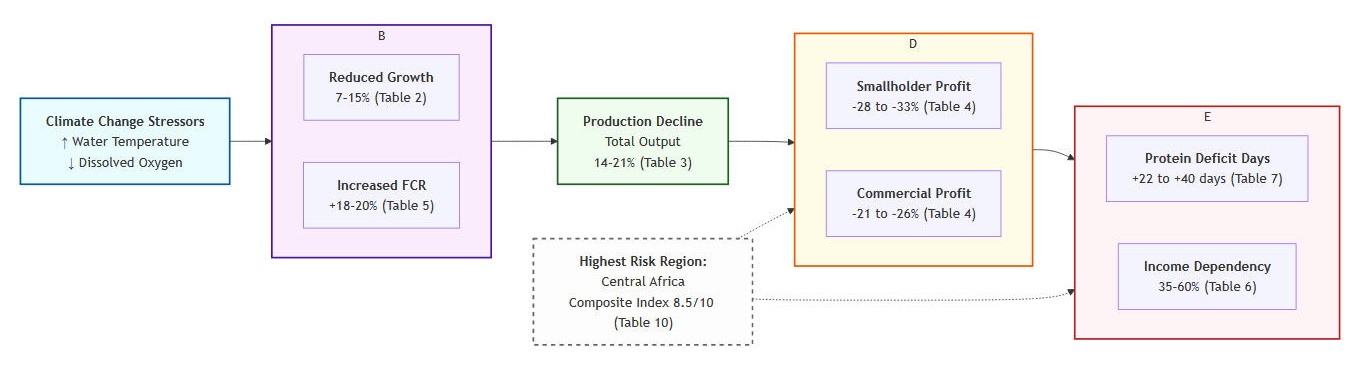
Figure 1 shows the cascading logic of the previous results in the following tables. A straight line runs from the initial biophysical decline in production (as can be seen in Table 3) and to the socioeconomic impacts analysis. This decline in the production causes a more decline in measured profits, among the most vulnerable groups of populations and smallholders who show deeper socioeconomic sensitivity (see Table 4). This economic shock will also ultimately manifests itself as a more pronounced adverse impact on household welfare, which reflects in the increase in the number of days of protein deficiency in each year (see the Table 7). This cascade is clearly seen in Central Africa, where the modest decline in production becomes a severe downside in food security.
4. Discussion
The results show evidence-based findings of climate change impacted future for tropical aquaculture issue. It emerges from Table 3 and Figure 1 and is not a random data point of a 14-21% decline in production, and rather the flashpoint of a chain of outcomes and will affect the lives of many people in the study areas. The geography of these impacts is one of the most important findings of this study. The data in Table 4 also clearly show that small-scale farming parts are more vulnerable than large-scale farming parts, and suggests that climate change is not simply an environmental problem here, but it also involves social justice here. Small-scale farmers, despite their important contribution to production and employment, which are disproportionately exposed to risks such as rising feed prices (as see in Table 5). And it is likely that this pattern will be replicated beyond the study areas here.
Paying attention to food security in Table 7, and the causal chain show two devastating effects here. The high increase in protein-deficient days, especially in this areas with high income dependency such as Central Africa, should be seen as an important note. It shows how a sustained disruption in a sector such as aquaculture can slowly undo decades of progress against malnutrition and poverty at the household level and lead to a humanitarian catastrophe. Table 10 further illustrates the composite vulnerability indicators and sheds light on the distinct roles of exposure, sensitivity and adaptive capacity. The analysis shows that while Southeast Asia is seeing severe physical changes, and Central Africa’s vulnerability is increasing with high sensitivity and minimal adaptive capacity in this regard. This can be considered as “fit-for-purpose” adaptation strategies in this study.
Such strategies should consider more that immediate fixes and, as Torre et al. (2023) noted, invest in institutional strengthening can be useful. The assessment of adaptation options as in Tables 8 and 9 provide a list of potential actions in this matter. While improving aeration makes economic make sense, the capital-intensive nature of infrastructure solutions may be effectively exclude smallholder farmers to the adaptation of these process. In this issue, investment in breeding programs will increase genetic potential and can be more inclusive and transformative here. In sum, the findings show the importance of a paradigm shift in risk management for these sectors. And traditional post-disaster, while relevant for acute events, are not suited with the long-term, and creeping pressures which climate change imposes to it. Instead of it, it is needed to a shift towards sustainable monitoring, and also integrating climate risk to development planning, and designing new financing mechanisms which can absorb chronic stress here in this scope.
5. Conclusions
After evaluating the effects of climate change on tropical freshwater aquaculture, in this research we make it clear that the sector is the verge of serious challenges. The projected decline in production quantity and quality is merely the first connection in a group link of threats that move beyond the economic stability of farms to the security and livelihoods of communities which are dependent in these activities. And also climate change is a multidimensional threat here, and this study proves this fact. A second key finding of this research studies the urgent need to address inequalities in vulnerability and adaptive capacity of this field. The analysis also makes it clear that small-scale households and those households who depend highly on the sector are at the forefront of adverse impacts. So therefore, any adaptation strategy aimed at sustainability at the sector level which must consider the resilience of these vulnerable groups as a key objective in this regard.
The future of tropical aquaculture also focuses on the choices and actions taken now. The transition from the current unstable situation to a sustainable one is inevitable. This article has provided some evidence of the challenges and the need for quick and smart decisions. And preserving and sustaining this industry means not just the survival of the industry itself; it means protecting the survival and dignity of a vast population across the tropics.
Data Availability Statement
Data will be available based on the request.
References
- ABDURAHMANOV, D., XURSANDOV, I., SALAEV, D., YUSUFOV, S., ABDULAZIZOVA, S., SAYIDOVA, M. and SURMANOV, S., 2025. Climate change and its impact on local ecosystems: Solutions and sustainable management. Procedia Engineering and Management, vol. 12, no. 3, pp. 913-922.
-
ABEYSINGHE, K.C., WEERARATHNE, A.G.P.T., COLONNE, D.K.C. and BELLANTHUDAWA, B.K.A., 2025. Sustainable development goals (SDGs), climate change, and the development of aquaculture and fisheries industries. Environmental Reviews, vol. 33, no. 2, pp. 1-15. https://doi.org/10.1139/er-2024-0136
» https://doi.org/10.1139/er-2024-0136 -
ABISHA, R., KRISHNANI, K.K., SUKHDHANE, K., VERMA, A.K., BRAHMANE, M. and CHADHA, N.K., 2022. Sustainable development of climate-resilient aquaculture and culture-based fisheries through adaptation of abiotic stresses: a review. Journal of Water and Climate Change, vol. 13, no. 4, pp. 1579-1600. https://doi.org/10.2166/wcc.2022.045
» https://doi.org/10.2166/wcc.2022.045 -
ABUKARI, A., 2025. Indigenous knowledge and climate change adaptation in Ghana: empirical evidence from the Tolon District. Environmental Research and Technology, vol. 2, no. 1, pp. 1-12. https://doi.org/10.35208/ert.1593474
» https://doi.org/10.35208/ert.1593474 -
AKASH, J.H., PRIYA, K.L.N., SARUKASAN, D. and KAYELVIZHI, C., 2025. Communication and predictive modeling to bridge climate knowledge gaps in aquaculture. International Journal of Environmental Sciences, vol. 5, no. 1, pp. 10-25. https://doi.org/10.64252/ggbzq739
» https://doi.org/10.64252/ggbzq739 -
BJELICA, D.L., MIHIĆ, M., KAVČIČ, K. and GOŠNIK, D., 2023. Relationship between project success factors, project success criteria and project success in SME: evidence from selected European transitional economies. International Journal of Industrial Engineering and Management, vol. 14, no. 4, pp. 297-310. https://doi.org/10.24867/IJIEM-2023-4-340
» https://doi.org/10.24867/IJIEM-2023-4-340 -
BOL, G.K. and VAN NIEKERK, D., 2023. African indigenous knowledge of climate change and disaster risk management in changing climate. Journal of Ethology & Animal Science, vol. 6, no. 4, pp. 1-9. https://doi.org/10.23880/jeasc-16000132
» https://doi.org/10.23880/jeasc-16000132 -
HABIB, A., BORAZON, E., NALLOS, I.M. and MACUSI, E., 2024. Climate change vulnerability, adaptation and ecosystem services in different fisheries and aquaculture in Asia: a review. Marine and Fishery Sciences, vol. 37, no. 1, pp. 1-15. https://doi.org/10.47193/mafis.3822025010101
» https://doi.org/10.47193/mafis.3822025010101 -
KHOLIKOV, K., 2025. Studying the risk-taking of financial market investors and its relationship with financial literacy. Economic Annals-XXI, vol. 215, no. 5-6, pp. 10-15. https://doi.org/10.21003/ea.V215-02
» https://doi.org/10.21003/ea.V215-02 -
LAM, V.W.Y., ALLISON, E.H., BELL, J.D., BLYTHE, J., CHEUNG, W.W.L., FRÖLICHER, T.L., GASALLA, M.A. and SUMAILA, U.R., 2020. Climate change, tropical fisheries and prospects for sustainable development. Nature Reviews. Earth & Environment, vol. 1, no. 9, pp. 440-454. https://doi.org/10.1038/s43017-020-0071-9
» https://doi.org/10.1038/s43017-020-0071-9 -
LUQYANA, D., MUHAMAD, A.M. and ROSYIDI, C.N., 2023. Application of quality function deployment (QFD) in die redesign to lowering rework of stamping parts. International Journal of Industrial Engineering and Management, vol. 14, no. 3, pp. 257-270. https://doi.org/10.24867/IJIEM-2023-3-337
» https://doi.org/10.24867/IJIEM-2023-3-337 -
MAULU, S., HASIMUNA, O.J., CHIBESA, M., BBOLE, I., MPHANDE, J., MWANACHINGWALA, M., NAWANZI, K., CHIBEYA, D., SIAVWAPA, S., MBEWE, J., NAMUKONDA, L., BALUNGU, F., MUMBULA, I., KABIKA, M., MWEEMBA, S., SIKANYENYENE, M., SIANKWILIMBA, E., IMBWAE, I. and MWEETWA, H.M., 2024. Perceived effects of climate change on aquaculture production in Zambia: status, vulnerability factors, and adaptation strategies. Frontiers in Sustainable Food Systems, vol. 8, pp. 1348984. https://doi.org/10.3389/fsufs.2024.1348984
» https://doi.org/10.3389/fsufs.2024.1348984 -
MCCOY, D., MCMANUS, M.A., KOTUBETEY, K., KAWELO, A.H., YOUNG, C., D’ANDREA, B., RUTTENBERG, K.C. and ALEGADO, R., 2017. Large-scale climatic effects on traditional Hawaiian fishpond aquaculture. PLoS One, vol. 12, no. 11, e0187951. https://doi.org/10.1371/journal.pone.0187951 PMid:29145446.
» https://doi.org/10.1371/journal.pone.0187951 -
MOHAMMAD, A.A.S., SALINAS, L., MUZRAPOVA, S., BAXRIDDINOV, N., AHROROV, Z. and BORONOV, B., 2025. The impact of online accounting through the expansion of financial technologies on improving the performance of financial institutions and banks. Economic Annals-XXI, vol. 215, no. 5-6, pp. 16-21. https://doi.org/10.21003/ea.V215-03
» https://doi.org/10.21003/ea.V215-03 -
MURSHITHA, M.P.M., ANSAR, A.C.P. and NISHMA, F., 2025. The impact of climate change on aquaculture: challenges and adaptation strategies. a review. Journal of Research in Environmental and Earth Sciences, vol. 3, no. 4, pp. 45-61. https://doi.org/10.35629/2532-11034561
» https://doi.org/10.35629/2532-11034561 -
MUTHOKA, M., OUKO, K.O., MBOYA, J.B., NDAMBUKI, M.N., OUTA, N., OGELLO, E., OBIERO, K., OGOLA, R.J., MIDAMBA, D.C. and NJOGU, L., 2024. Socio‐economic impacts of climate change and adaptation actions among smallholder fish farmers in Sub‐Saharan Africa. Aquaculture, Fish and Fisheries, vol. 4, no. 1, e182. https://doi.org/10.1002/aff2.182
» https://doi.org/10.1002/aff2.182 - NAZORI, A., TRIYONO, G., BROTOSAPUTRO, G., MAHDIANA, D. and SOLICHIN, S., 2024. The use of artificial intelligence in the development of clean energy for the transportation industry. Procedia Environmental Science Engineering and Management, vol. 11, pp. 27-36.
-
OYINLOLA, M.A., REYGONDEAU, G., WABNITZ, C. and CHEUNG, W.W.L., 2020. Projecting global mariculture diversity under climate change. Global Change Biology, vol. 26, no. 4, pp. 2134-2148. https://doi.org/10.1111/gcb.14974 PMid:32037631.
» https://doi.org/10.1111/gcb.14974 -
PERNET, F. and BROWMAN, H.I., 2021. The future is now: marine aquaculture in the anthropocene. ICES Journal of Marine Science, vol. 78, no. 9, pp. 3159-3167. https://doi.org/10.1093/icesjms/fsaa248
» https://doi.org/10.1093/icesjms/fsaa248 -
REVERTER, M., SARTER, S., CARUSO, D., AVARRE, J.-C., COMBE, M., PEPEY, E., POUYAUD, L., VEGA-HEREDÍA, S., DE VERDAL, H. and GOZLAN, R.E., 2020. Aquaculture at the crossroads of global warming and antimicrobial resistance. Nature Communications, vol. 11, no. 1, pp. 1870. https://doi.org/10.1038/s41467-020-15735-6
» https://doi.org/10.1038/s41467-020-15735-6 -
SHAFFRIL, H.A.M., LEAL FILHO, W., BARBOSA, L.G. and BURHAN, N.A.S., 2024. A systematic literature review on adaptation strategies towards climate change impacts among Indigenous fishers. Inland Waters, vol. 14, no. 3, pp. 1-15. https://doi.org/10.1080/20442041.2024.2413756
» https://doi.org/10.1080/20442041.2024.2413756 -
SOUZA, V.H., SATYRO, W., CONTADOR, J.C., PINTO, L.F. and MITIDIERO, M.C., 2023. The Technology Analysis model-TAM 4.0 for implementation of Industry 4.0. International Journal of Industrial Engineering and Management, vol. 14, no. 4, pp. 271-281. https://doi.org/10.24867/IJIEM-2023-4-338
» https://doi.org/10.24867/IJIEM-2023-4-338 -
SYAFWANDI, S., BUDIMAN, J., TURSUNKHODJAEVA, S., RUZIEV, S., ALIMKHANOVA, N. and BOYMURODOV, J., 2025. The effect of excellent service, diversity of banking products and physical environment on customer loyalty through customer satisfaction. Economic Annals-XXI, vol. 215, no. 5-6, pp. 35-40. https://doi.org/10.21003/ea.V215-06
» https://doi.org/10.21003/ea.V215-06 -
TAN, K., RANSANGAN, J., TAN, K. and CHEONG, K., 2024. The impact of climate change on Omega-3 long-chain polyunsaturated fatty acids in bivalves. Critical Reviews in Food Science and Nutrition, vol. 63, no. 33, pp. 11378-11394. https://doi.org/10.1080/10408398.2023.2242943 PMid:37555502.
» https://doi.org/10.1080/10408398.2023.2242943 -
TORRE, N., LEO, C. and BONAMIGO, A., 2023. Lean 4.0: an analytical approach for hydraulic system maintenance in a production line of steel making plant. International Journal of Industrial Engineering and Management, vol. 14, no. 3, pp. 186-199. https://doi.org/10.24867/IJIEM-2023-3-332
» https://doi.org/10.24867/IJIEM-2023-3-332 -
WEATHERDON, L.V., MAGNAN, A.K., ROGERS, A.D., SUMAILA, U.R. and CHEUNG, W.W.L., 2016. Observed and projected impacts of climate change on marine fisheries, aquaculture, coastal tourism, and human health: an update. Frontiers in Marine Science, vol. 3, pp. 48. https://doi.org/10.3389/fmars.2016.00048
» https://doi.org/10.3389/fmars.2016.00048 -
YACOUT, D.M.M., KHALIL, H.H. and YACOUT, M.M., 2025. Climate change impacts on Egyptian aquaculture: challenges, opportunities, and research gaps. Frontiers in Sustainable Food Systems, vol. 9, pp. 1527798. https://doi.org/10.3389/fsufs.2025.1527798
» https://doi.org/10.3389/fsufs.2025.1527798 - YULIUS, Y., 2024. Green human resource management an investment and sustainable development approach. Procedia Environmental Science, Engineering and Management, vol. 11, no. 1, pp. 1-10.
Edited by
-
Editor:
Takako Matsumura Tundisi