 Synergizing fertilizer management and planting patterns as a unified technology package for early maturing rice optimization
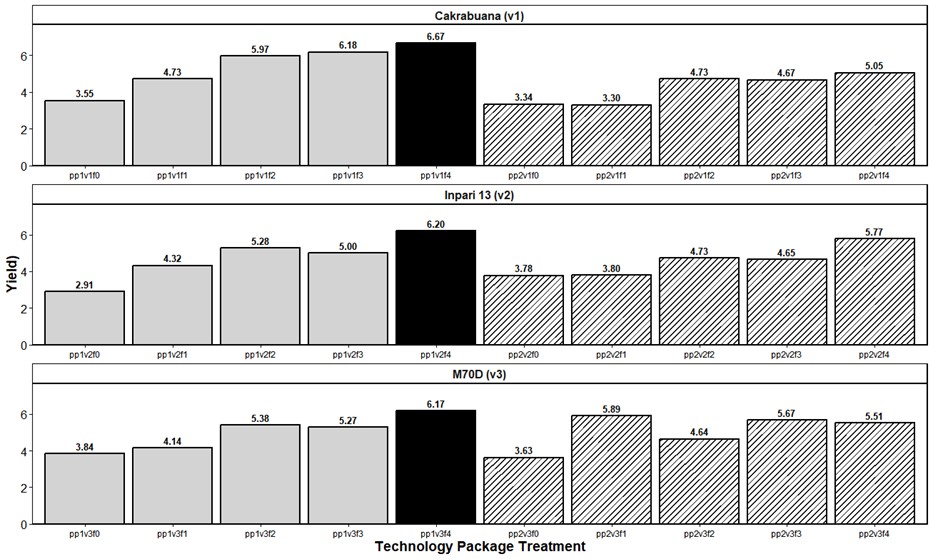
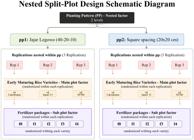
Climate change threatens rice production, making early-maturing rice varieties an important adaptation strategy. However, information on optimal technology packages for maximizing the productivity of these varieties remains limited. This study aimed to assess the effects of different technology packages on yield and yield components and to determine which package showed the most favorable performance across early-maturing rice varieties. A nested split-plot design was employed, consisting of two planting patterns (Jajar Legowo and square planting), three early maturing rice (Cakrabuana, Inpari 13, and M70D), and five fertilizer management packages. Analysis of variance revealed that fertilizer management significantly affected plant height, panicles per clump, weight per panicle, number of total grain, weight of 1000 grain, and yield. Planting pattern significantly influenced total tiller number and panicles per clump, whereas varietal effects were significant only for the number of total grain. Yield showed strong positive correlations with weight per panicle (r = 0.65**), number of total grain (r = 0.59**), and weight of 1000 grain (r = 0.51**). The highest yield under the Jajar Legowo was achieved by Cakrabuana supplied with 100 kg ha−1 trichocompost, 3.3 mL L−1 biofertilizer, 100 kg ha−1 non-subsidized urea, and 300 kg ha−1 subsidized NPK fertilizer, reaching 6.67 t ha−1, whereas the highest yield under square planting was recorded in M70D receiving 100 kg ha−1 subsidized urea and 300 kg ha−1 subsidized NPK fertilizer, reaching 5.89 t ha−1. Overall, the Jajar Legowo combined with 100 kg ha−1 non-subsidized urea and 300 kg ha−1 subsidized NPK fertilizer, with or without 100 kg ha−1 trichocompost, represented the most suitable technology package for improving the productivity of early-maturing rice varieties, particularly Cakrabuana.
Keywords:
early-maturing rice; fertilizer management; Jajar Legowo; planting pattern; yield
 Thumbnail
 Thumbnail