 Synergizing fertilizer management and planting patterns as a unified technology package for early maturing rice optimization
Abstract
Climate change threatens rice production, making early-maturing rice varieties an important adaptation strategy. However, information on optimal technology packages for maximizing the productivity of these varieties remains limited. This study aimed to assess the effects of different technology packages on yield and yield components and to determine which package showed the most favorable performance across early-maturing rice varieties. A nested split-plot design was employed, consisting of two planting patterns (Jajar Legowo and square planting), three early maturing rice (Cakrabuana, Inpari 13, and M70D), and five fertilizer management packages. Analysis of variance revealed that fertilizer management significantly affected plant height, panicles per clump, weight per panicle, number of total grain, weight of 1000 grain, and yield. Planting pattern significantly influenced total tiller number and panicles per clump, whereas varietal effects were significant only for the number of total grain. Yield showed strong positive correlations with weight per panicle (r = 0.65**), number of total grain (r = 0.59**), and weight of 1000 grain (r = 0.51**). The highest yield under the Jajar Legowo was achieved by Cakrabuana supplied with 100 kg ha−1 trichocompost, 3.3 mL L−1 biofertilizer, 100 kg ha−1 non-subsidized urea, and 300 kg ha−1 subsidized NPK fertilizer, reaching 6.67 t ha−1, whereas the highest yield under square planting was recorded in M70D receiving 100 kg ha−1 subsidized urea and 300 kg ha−1 subsidized NPK fertilizer, reaching 5.89 t ha−1. Overall, the Jajar Legowo combined with 100 kg ha−1 non-subsidized urea and 300 kg ha−1 subsidized NPK fertilizer, with or without 100 kg ha−1 trichocompost, represented the most suitable technology package for improving the productivity of early-maturing rice varieties, particularly Cakrabuana.
Keywords:
early-maturing rice; fertilizer management; Jajar Legowo; planting pattern; yield
Resumo
As mudanças climáticas ameaçam a produção de arroz, tornando as variedades de ciclo precoce uma estratégia importante de adaptação. No entanto, as informações sobre pacotes tecnológicos ideais para maximizar a produtividade dessas variedades ainda são limitadas. Este estudo teve como objetivo avaliar os efeitos de diferentes pacotes tecnológicos sobre o rendimento e seus componentes, além de determinar qual pacote apresentou o desempenho mais favorável em diferentes variedades de arroz de ciclo precoce. Foi utilizado um delineamento de parcelas subdivididas em faixas, composto por dois arranjos de plantio (Jajar Legowo e plantio em quadras), três variedades de arroz de ciclo precoce (Cakrabuana, Inpari 13 e M70D) e cinco pacotes de manejo de adubação. A análise de variância revelou que o manejo de adubação afetou significativamente a altura de planta, o número de panículas por touceira, o peso por panícula, o número total de grãos, o peso de 1000 grãos e a produtividade. O padrão de plantio influenciou significativamente o número total de perfilhos e panículas por touceira, enquanto os efeitos varietais foram significativos apenas para o número total de grãos. A produtividade apresentou correlações positivas fortes com o peso por panícula (r = 0,65**), número de grãos totais (r = 0,59**) e peso de 1000 grãos (r = 0,51**). O maior rendimento no sistema Jajar Legowo foi alcançado por Cakrabuana, com o fornecimento de 100 kg ha−1 de tricocomposto, 3,3 mL L−1 de biofertilizante, 100 kg ha−1 de ureia não subsidiada e 300 kg ha−1 de adubo NPK subsidiado, atingindo 6,67 t ha−1, enquanto o maior rendimento no plantio em quadras foi registrado em M70D recebendo 100 kg ha−1 de ureia subsidiada e 300 kg ha−1 de adubo NPK subsidiado, atingindo 5,89 t ha−1. De modo geral, o sistema Jajar Legowo, combinado com 100 kg ha−1 de ureia não subsidiada e 300 kg ha−1 de adubo NPK subsidiado, com ou sem 100 kg ha−1 de tricocomposto, representou o pacote tecnológico mais adequado para incrementar a produtividade de variedades de arroz de ciclo precoce, especialmente Cakrabuana.
Palavras-chave:
arroz de ciclo precoce; dosagem de fertilizante; Jajar Legowo; padrão de plantio; rendimento
1. Introduction
Climate change poses a substantial threat to global rice production through increasing temperatures, altered rainfall patterns, and more frequent extreme weather events, which can disrupt crop productivity and agricultural stability (Saleem et al., 2025; Samarasinghe et al., 2025). These challenges are particularly important for Indonesia, where rice serves as the primary staple food and plays a central role in national food security. As the world's fourth most populous nation, Indonesia faces increasing pressure to sustain rice production to meet growing domestic demand (Abid et al., 2024; Alam et al., 2024; Jukanti et al., 2025) (Fadah et al., 2024; Yaseen et al., 2025; Guo and Islam, 2025). Although Indonesia remains one of the major rice-producing countries in Asia, production growth must continue to keep pace with population growth and future food requirements (Setiawati et al., 2025). This challenge is compounded by climate-induced shifts in planting seasons (Wang et al., 2025; Ismail et al., 2020), which have rendered traditional crop varieties increasingly ineffective under current environmental conditions (Hussain et al., 2020; Saud et al., 2022), necessitating a shift toward varieties whose growth characteristics align with the new seasonal windows imposed by a changing climate.
Early-maturing rice varieties represent a promising adaptation strategy, as they complete their growth cycle before the onset of late-season drought and heat stress (Anshori et al., 2024a; Noviana et al., 2021). By maturing in under 100 days (Vo et al., 2024), early-maturing varieties not only reduce climate risk but also enable higher cropping intensity within a single season (Bin Rahman and Zhang, 2023) (Anshori et al., 2024a). Recognizing this potential, the Ministry of Agriculture has introduced several early-maturing varieties, such as Inpari 13 (Anshori et al., 2024b; Baharuddin et al., 2025), Inpari 19 (Musa et al., 2025), Cakrabuana (Anshori et al., 2024a), and Padjajaran (Noviana et al., 2021; Musa et al., 2025), while private enterprises have also released varieties such as M70D (Sutrisna et al., 2024; Bahrun et al., 2025). Despite their diffusion, however, a critical agronomic challenge persists: Indonesian farmers continue to apply cultivation practices developed for traditional varieties to early-maturing rice (Sitaresmi et al., 2025). Conventional varieties practice are not suitable for early maturing rice, because these varieties exhibit a vegetative growth pattern that prioritizes tiller formation (Vakeswaran et al., 2025), which affects their generative growth and requires distinct cultivation methods (Musa et al., 2025).
The cultivation of early-maturing rice is heavily reliant on the plant's ability to produce productive tillers, as this directly impacts the number of panicles (Sandhu et al., 2021) and the potential yield (Kalaitzidis et al., 2025; Musa et al., 2025). The planting pattern is closely related to determining the density of planting within a field; therefore, it plays a crucial role in the development of these tillers (Yuan et al., 2024). When rice plants have adequate space to grow, they typically produce a higher number of uniform tillers (Zhang et al., 2023). In contrast, excessive planting density leads to increased competition for light (Tang et al., 2025), nutrients (Haque et al., 2025), and space (Dong et al., 2025), resulting in fewer productive tillers and suboptimal growth. Two common methods for managing planting patterns are the tile system (square grid) (Yuliawan et al., 2023) and the jajar legowo system (Sulaiman et al., 2025). The tile system, a traditional approach, involves arranging plants with consistent spacing between and within rows (Komalawati et al., 2023). Although easy to implement, this method often does not maximize growing space and can create a humid and crowded environment, increasing the risk of pest and disease issues. Conversely, the jajar legowo system is an innovative method based on the edge effect (Beding et al., 2023) concept, which enhances the productivity of rows that receive more sunlight. This system, with its wider and more adaptable spacing between rows, offers improved air circulation, optimal light exposure, and facilitates agricultural activities such as weeding and fertilization (Wahid and Subagio, 2021; Tang et al., 2025). Additionally, it increases the plant population per unit area, reduces micro-humidity that fosters disease, and decreases competition among plants in the outer rows (Beding et al., 2023).
Optimizing the performance of early maturing rice varieties necessitates precise nutrient management to further improve the effect, particularly through the combined use of nitrogen fertilizers and biofertilizers (Musa et al., 2025). These varieties are characterized by a shortened vegetative phase, during which the initiation and development of tillers occur at an accelerated pace, making them acutely sensitive to nutrient availability (Anshori et al., 2024a), especially nitrogen, during the initial growth stages (Yun, 2023; Musa et al., 2025). Nitrogen is indispensable for the synthesis of chlorophyll (Qi et al., 2025), amino acids (Chen et al., 2022b), and structural proteins (Liang et al., 2022), all of which are essential for robust tillering and determining the number of productive stems (Yuan et al., 2024). Due to the limited timeframe for early maturing varieties to recover from nutrient deficiencies, they are more vulnerable to suboptimal nitrogen management compared to their medium- or late-maturing counterparts (Xiong et al., 2018; Yun, 2023; Suriyagoda et al., 2020). The utilization of biofertilizers offers a supplementary mechanism that augments nutrient acquisition beyond the capabilities of nitrogen fertilizer alone (Gulshan et al., 2022). Beneficial microorganisms, including nitrogen-fixing bacteria, phosphate-solubilizing microbes, and plant growth-promoting rhizobacteria, enhance soil biological activity, increase nutrient mineralization, and improve nitrogen uptake efficiency (Wei et al., 2024). This is particularly crucial for early maturing varieties, as their abbreviated growth period restricts root expansion, thereby limiting their ability to access nutrients in deeper or less accessible soil layers (Fujii 2024). Biofertilizers address this limitation by mobilizing nutrients within the root zone and promoting physiological processes that stimulate root growth, thus enhancing plant vigor under variable environmental conditions (Misu et al., 2025). Such an approach is vital for fully exploiting the genetic potential of early maturing rice varieties, particularly in the context of climate change, shifting planting periods, and declining soil fertility in numerous rice-producing regions.
While numerous studies have explored early maturing rice, the predominant focus has been on the development of new varieties and yield assessment, with comparatively less emphasis on the specific agronomic practices required to optimize their productivity, such as planting patterns and fertilization management. Research into innovative planting patterns, such as the jajar legowo system, has demonstrated improvements in light interception (Maghfiroh et al., 2023), plant density (Minarsih et al., 2023; Sulaiman et al., 2025), and microclimate regulation (Rawung et al., 2021; Maghfiroh et al., 2023); however, these findings are generally based on medium- or long-duration varieties. Although Chen et al. (2022a) compared the performance of early- and long-duration rice varieties under different planting densities, these investigations primarily focused on plant density rather than evaluating the effect of planting pattern within a field. Similarly, investigations into nitrogen fertilization and biofertilizer application have revealed significant benefits for tiller production (Zhou et al., 2021, 2022) and nutrient uptake; however, the responses of early maturing varieties to fertilizer management and planting patterns remain inadequately documented. Given that early maturing rice possesses a shorter vegetative phase (Musa et al., 2025) and relies heavily on rapid and efficient tiller formation (Vakeswaran et al., 2025), recommendations derived from older varieties cannot be directly applied.
There is a paucity of comprehensive studies examining the specific interactions between planting pattern technology and nutrient management in early-maturing rice varieties. This gap highlights the need for an optimal technology package that aligns with the unique growth dynamics of early-maturing rice. In this study, the technology package consisted of a combination of planting patterns and fertilizer management packages, including inorganic fertilizers, organic amendments, and biofertilizers. Therefore, this study aimed to assess the effects of different technology packages on yield and yield components and to determine which package showed the most favorable performance across the early maturing rice varieties.
2. Materials and Methods
2.1. Experiment details and treatments
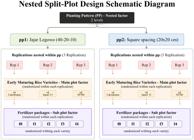
The study took place in Maradekaya Village, Bajeng, Gowa Regency, South Sulawesi, from April to July 2025. The experiment was arranged in a nested split-plot design. Planting pattern was treated as the nested factor, with three replications nested within each planting pattern. Rice varieties were assigned as main plots within each replication, and fertilizer packages were assigned as subplots within each variety main plot. A schematic representation of the experimental design is presented in Figure 1. Two planting patterns were tested: Jajar Legowo (40-20-10) (pp1) and a square pattern of 20 × 20 cm (pp2). The main plots featured three varieties: Cakrabuana (v1), Inpari 13 (v2), and M70D (v3). The subplots consisted of five fertilizer packages: (f0) no fertilization; (f1) 100 kg ha−1 of subsidized urea and 300 kg ha−1 of subsidized NPK fertilizer; (f2) 100 kg ha−1 of non-subsidized urea and 300 kg ha−1 of subsidized NPK fertilizer; (f3) 100 kg ha−1 of trichocompost, 100 kg ha−1 of non-subsidized urea, and 300 kg ha−1 of subsidized NPK fertilizer; and (f4) 100 kg ha−1 of trichocompost, 3.3 mL L−1 of biofertilizer, 100 kg ha−1 of non-subsidized urea, and 300 kg ha−1 of subsidized NPK fertilizer. Each treatment combination was repeated three times, leading to a total of 90 experimental plots. Each plot spanned an area of 12 m2.
2.2. Rice varieties and subsidized and non-subsidized fertilizer sources
The varieties used in this study were selected because they represent early maturing rice varieties that are currently available to Indonesian farmers from both public and private breeding programs. Their inclusion was intended to represent the various diversity of early maturing rice germplasm in Indonesia. Inpari 13 is a nationally released variety with broad farmer adoption. Cakrabuana is a newly developed climate-adaptive early maturing variety, and M70D is a commercially distributed private-sector variety. All three varieties have a growth duration of less than 100 days and are recognized foNon-subsidizedial to support higher cropping intensity (CI). In addition to their broad relevance for the Indonesian rice agroecosystem, the selected varieties have distinct genetic backgrounds, allowing the evaluation of potential differences in varietal response to planting patterns and fertilizer management.
In this study, there are subsidized and non-subsidized fertilizer sources commonly available to Indonesian rice farmers thus it is utilized in this study. In Indonesia, subsidized urea and NPK fertilizers are government-regulated products distributed at controlled prices to eligible smallholder farmers. These fertilizers meet national quality standards and generally provide the basic nutrient composition required for rice cultivation, including NPK (Fahmid et al., 2022). In contrast, non-subsidized fertilizers are commercially available products sold at market prices and are often formulated to provide enhanced agronomic performance (Rahmadani et al., 2024).
2.3. Fertilizer application
Chemical and organic fertilizers were applied in two split applications at 7 and 22 days after transplanting (DAT), with 30% and 70% of the total fertilizer dose applied during the first and second applications, respectively. For the f4 treatment, biofertilizer was applied separately as a liquid suspension at a concentration of 3.3 mL L−1 of water (50 mL diluted in 15 L of water), following the manufacturer's recommendation. The solution was applied using a 15-L knapsack sprayer and uniformly distributed across the designated treatment plots, corresponding to an application volume of approximately 1.67 L plot−1 (12 m2) per application. Biofertilizer applications were conducted at 9 and 25 DAT. To preserve microbial viability, the biofertilizer was applied separately and was not mixed with chemical fertilizers or pesticides during application.
2.4. Research procedure
The procedural approach utilized a modified version of the conventional field cultivation method outlined by Anshori et al. (2024a), Musa et al. (2025), and Sulaiman et al. (2025). The process began with plowing and stockpiling the land. Plots measuring 3 m2 by 4 m2 were set up, with a 1 m2 space separating them. Seeds were soaked for a day before placement in a nursery bed. After 15 days, seedlings were transplanted into the field according to treatment spacing guidelines. Maintenance included replanting, weeding, fertilization, irrigation, and pest control. Weeding was performed manually and chemically 30 days after planting. Seven days after weeding, dead or damaged seedlings were replaced. Following mechanical weeding, pesticides were applied using a sprayer. Fertilizers were applied according to treatment. Pesticides were selected based on the pest type and infestation level.
Irrigation management was standardized across all treatments and conducted according to crop growth stages rather than treatment type. Irrigation was initiated six days after the first fertilization, and water was maintained at approximately 5 cm above the soil surface during the early vegetative stage. One day before each fertilizer application, the water level was temporarily lowered to improve the fertilizer-soil contact and nutrient absorption. Irrigation was resumed two days after fertilization and maintained at adequate levels to support plant growth. Following the second fertilization, irrigation was temporarily suspended and resumed five days later to maintain optimal soil moisture and favorable soil physical conditions. During the panicle initiation (primordial) stage, the water depth was increased to approximately 10 cm to support reproductive development and suppress excessive tiller formation (Feng et al., 2021; Yuan et al., 2024).
Continuous flooding was maintained from panicle initiation until the late grain-filling stage. Irrigation was terminated approximately two weeks before harvest to promote grain maturation, reduce lodging risk, and facilitate field drying prior to harvest. Data collection began at physiological maturity and continued through harvest to gather all observational parameters. Harvesting occurred when grains at the panicle base solidified and two-thirds of the panicle reached physiological maturity, shown by straw yellowing.
2.5. Observation parameter
The observed parameters included plant height (PH) (cm), number of total tillers (NTT), flag leaf length (FLL) (cm), flag leaf width (FLW) (cm), panicle per clump (PPC), weight per panicle (WPP) (g), number of total grains (NTG), weight of 1000 grains (W1000G) (g), and yield (Y) (ton ha-1).
2.6. Statistical analysis
The analysis began with variance testing at 5% significance to assess treatment effects, followed by two-way Pearson correlation analysis of traits to investigate the relationships between observed traits. Data showing significant single and interaction effects were further assessed using the Duncan Multiple Range Test (DMRT) at 5% significance to evaluate the effects. Analyses were performed using STAR 2.0.1, software developed by the International Rice Research Institute (IRRI).
3. Results
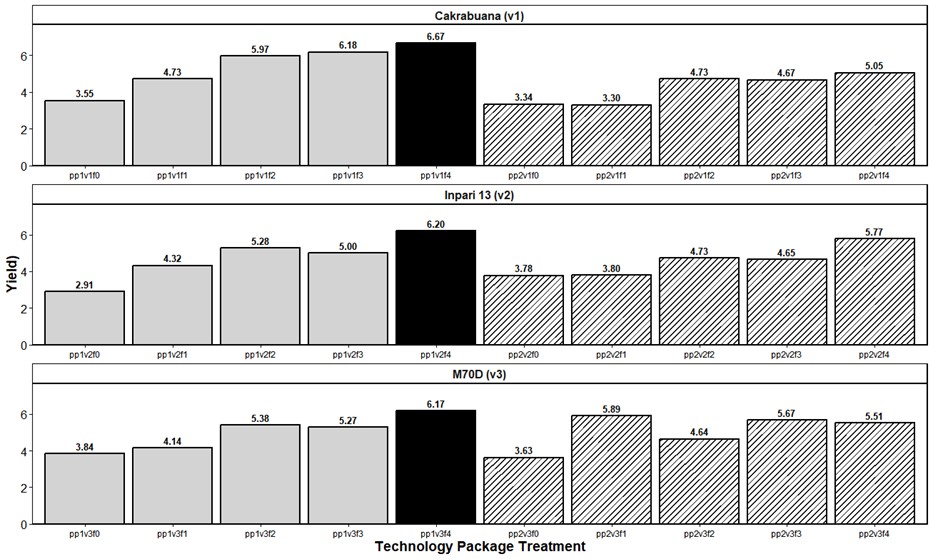
The performance of early maturing rice varieties under different technology package combinations was assessed based on vegetative growth, yield components, and yield. As presented in Table 1, substantial variation in agronomic traits and yield was observed among technology package combinations. Yield generally increased with fertilizer application compared with the unfertilized control (f0). Under the Jajar Legowo planting pattern (pp1), the highest yield (6.67 t ha−1) was obtained from Cakrabuana supplied with 100 kg ha−1 trichocompost, 3.3 mL L−1 biofertilizer, 100 kg ha−1 non-subsidized urea, and 300 kg ha−1 subsidized NPK fertilizer (f4). Under the square planting pattern (pp2), the highest yield (5.89 t ha−1) was recorded in M70D receiving 100 kg ha−1 subsidized urea and 300 kg ha−1 subsidized NPK fertilizer (f1) (Figure 2).
Mean performance of agronomic traits and grain yield under different technology package combinations.
Several yield-related traits, including panicles per clump, panicle weight, number of total grains, and weight of 1000 grain, also showed variation in each technology package. The tallest plants were observed in M70D fertilized with 100 kg ha−1 non-subsidized urea and 300 kg ha−1 subsidized NPK fertilizer (f2) under pp1 (108.47 cm), while the highest number of total grains (412 grains panicle−1) was recorded in Inpari 13 supplied with 100 kg ha−1 trichocompost, 3.3 mL L−1 biofertilizer, 100 kg ha−1 non-subsidized urea, and 300 kg ha−1 subsidized NPK fertilizer (f4) under pp2. Overall, fertilizer packages integrating organic amendments, biofertilizers, and inorganic fertilizers tended to produce superior agronomic performance and yield.
The analysis of variance results showed that plant height (PH) was significantly affected by fertilizer management (F), with a mean square value of 139.65, while planting pattern (PP) and variety (V) had no significant effect (Table 2). The number of total tillers (NTT) showed no effect from the treatment factors, except for planting pattern (192.4284). As for flag leaf length (FLL) and flag leaf width (FLW), none of the treatment factors showed a significant effect. While panicles per clump (PPC) was highly significantly affected by fertilizer management (9.68) and planting pattern (90.5007), but not by variety. Weight per panicle (WPP) was highly significantly affected by fertilizer management (12.47), while PP and V showed no effect. The total number of total grains (NTG) was significantly affected by variety (13641.05) and highly significantly by fertilizer management (24221.97). The weight of 1000 grain (W1000G) was significantly affected by fertilizer management (108.86). Yield (Y) showed a significant effect from fertilizer management (15.05), while PP and V did not show any difference. The coefficient of variation values (CV a and CV b) ranged from 5.15–43.82% depending on the observed character.
Analysis of variance of single effect between planting pattern and fertilizer management on early maturing rice variety growth.
Analysis of variance interactions showed that most traits had no significant effects across treatment combinations (Table 3). The PP × V interaction was significant only for the number of total grains (NTG), showing a highly significant effect with a mean square value of 25,390.82**. The V × F interaction had no significant effect on any observed traits. The PP × F interaction also showed no significant effect on traits. In the PP × V × F interaction, only the number of total grains (NTG) showed a significant effect (6,108.47*), while other traits, including plant height (PH), number of total tillers (NTT), flag leaf length (FLL), flag leaf width (FLW), panicles per clump (PPC), weight per panicle (WPP), weight of 1000 grains (W1000G), and yield (Y), showed no significant differences across treatment interactions.
Analysis of variance of interaction between planting pattern and fertilizer management on early maturing rice variety growth.
Correlation analysis (Table 4) showed that panicle per clump (PPC) was highly correlated with plant height (0.50**) and total number of tillers (0.81**). Weight per panicle (WPP) showed a significant correlation with total tillers (0.38*) and a highly significant correlation with yield (0.65**). The number of total grains (NTG) correlated significantly with PPC (0.46*) and was highly significantly correlated with WPP (0.78**) and yield (0.59**). The weight of 1000 grain (W1000G) showed a significant correlation with total tillers (0.45*), number of total grains (0.38*), and a highly significant correlation with PPC (0.55**) and WPP (0.55**). Yield (Y) correlated significantly with plant height (0.39*) and highly significantly with weight per panicle (0.65**), number of total grain (0.59**), and weight of 1000 grain (0.51**). Other traits did not show significant relationships at the test level.
The DMRT results for fertilizer management, which had a significant effect on PH, WPP, and W1000G (Table 5), showed that treatment f2 was not significantly different from f4 and f3 in terms of PH, WPP, and W1000G. Conversely, f3 was not significantly different from f1 in terms of the PH and W1000G parameters. In contrast, f2 and f4 were significantly different from f0 and f1 in terms of PH, WPP, and W1000G values.
The DMRT results for the number of total grains (NTG) character, which has significance in the PP × V × F interaction, in the pp1 cropping pattern showed that for the Cakrabuana variety, all fertilizer management from f0 to f4 were not significantly different from each other (Table 6). For the Inpari 13 variety, doses f1, f2, and f4 were not significantly different, while f0 was significantly different from the higher doses. For the M70D variety, doses f2, f3, and f4 were not significantly different, while f0 and f1 were significantly different from the three higher doses. In the pp2 planting pattern, the Cakrabuana variety showed that most fertilizer management were not significantly different, but f0 was significantly different from several higher doses. In the Inpari 13 variety, all fertilizer management from f0 to f4 were not significantly different, so there were no differences between doses. In the M70D variety, doses f1 and f3 were not significantly different from each other, while doses f0, f2, and f4 were in different groups and therefore significantly different from doses f1 and f3.
4. Discussion
4.1. Performance of early-maturing rice under different technology package combinations
The study demonstrated that early-maturing rice varieties exhibited distinct growth and yield patterns in response to variations in planting pattern and fertilizer management. The observed variation in agronomic traits and yield among technology package combinations suggests that the response of early-maturing rice varieties was strongly influenced by the interaction between planting pattern, varietal characteristics, and nutrient management. The generally higher yields obtained under fertilized treatments compared with the unfertilized control indicate that nutrient availability was a major limiting factor for growth and reproductive development. Similar responses have been reported in previous studies, which demonstrated that an adequate nutrient supply significantly enhances rice growth, yield components, and grain productivity (Paramesh et al., 2023). In particular, the superior performance of the integrated fertilizer package containing trichocompost, biofertilizer, non-subsidized urea, and subsidized NPK fertilizer may be attributed to the complementary effects of organic and inorganic nutrient sources. Trichocompost likely improved soil physical, chemical, and biological properties, while biofertilizers enhanced nutrient availability and uptake efficiency, thereby promoting greater panicle formation, grain filling, and biomass accumulation. These findings are consistent with reports indicating that integrated fertilizer management can improve nutrient-use efficiency and sustain higher rice yields than sole inorganic fertilization (Urmi et al., 2022).
The higher yields observed under the Jajar Legowo planting pattern, particularly in Cakrabuana, may be associated with improved light interception, air circulation, and resource utilization resulting from the wider spatial arrangement of plants. Previous studies have reported that the Jajar Legowo system increases the border-row effect and enhances photosynthetic efficiency, ultimately contributing to greater yield (Yuliawan et al., 2023). Furthermore, the variation in yield components among varieties indicates differences in genetic potential and resource allocation strategies, as reflected by the higher grain number produced by Inpari 13 and the greater vegetative growth exhibited by M70D. Genotypic differences in nutrient uptake, assimilate partitioning, and sink capacity have been widely recognized as important determinants of rice productivity under varying environmental and management conditions (Vishwakarma et al., 2023). Collectively, these findings suggest that maximizing the productivity of early-maturing rice requires not only adequate nutrient inputs but also the selection of appropriate variety and planting pattern combinations that optimize the conversion of vegetative growth into yield.
4.2. Role of vegetative growth in supporting yield formation in early maturing rice
The vegetative performance observed in early-maturing rice varieties may have played an important supporting role in determining yield. Unlike medium- to late-maturing rice cultivars, early-maturing varieties have a shorter vegetative growth period and must establish sufficient photosynthetic capacity within a limited timeframe. In the present study, treatments with higher yields generally exhibited greater tiller production and larger flag leaf dimensions, indicating more effective canopy development during the vegetative stage. Increased tiller numbers provide the basis for the formation of productive panicles, while larger flag leaves contribute substantially to photosynthate production during grain filling. Consequently, although reproductive traits such as productive panicles, grain number, and grain weight directly determine final yield, the development of these yield components is closely supported by vegetative traits established early in the crop cycle.
This finding suggests that successful management of early-maturing rice should focus not only on maximizing reproductive performance but also on promoting rapid vegetative establishment to compensate for the shortened growth duration characteristic of these varieties. Similar observations have been reported by Won et al. (2020), who found that vigorous early tillering and enhanced leaf development were essential for maintaining yield potential in early-maturing rice cultivars. Likewise, Mi et al. (2025) demonstrated that flag leaf morphology significantly influenced assimilate production and translocation during grain filling, thereby indirectly contributing to yield formation. Furthermore, Anshori et al. (2024a) reported that the ability of early-maturing rice genotypes to rapidly accumulate tillers, especially productive tillers, during the limited vegetative phase was a key factor supporting subsequent reproductive development and grain production.
4.3. Effects of planting pattern, variety, and fertilizer management on agronomic traits
Analysis of variance was used to assess the treatment effect on early maturing rice variety traits. Among these factors, fertilizer management (F) emerged as the most critical in influencing several agronomic traits, including plant height (PH), panicle number per clump (PPC), weight per panicle (WPP), number of total grain (NTG), and yield (Y), which align with the research of Sulaiman et al. (2025), who showed that fertilizer, especially nitrogen, is the primary factor influencing production in rice. The pronounced sensitivity of these traits to fertilizer input underscores the reliance of early-maturing rice varieties on optimal nutrient conditions to support both their vegetative and reproductive growth phase (Musa et al., 2025). These varieties, known for their quick tiller formation and rapid panicle differentiation, require adequate fertilization to ensure sufficient biomass accumulation and grain development. The significant effect of F on yield-related parameters highlights the importance of nutrient management in achieving maximum productivity in intensive cropping systems.
The planting pattern (PP) exerted a significant influence exclusively on the number of total tillers (NTT) and the panicle per clump (PPC). This observation indicates that the spatial arrangement predominantly affects early vegetative growth, particularly the formation of tillers, which was supported by Yuliawan (et al., 2023), who found that jajar legowo can increase yield higher than standard tile planting pattern. The increased tillering capacity observed under jajar legowo suggests that improvements in plant spatial arrangement can enhance resource utilization efficiency during early growth, resulting in a greater number of productive tillers and panicles at the reproductive stage.
Despite these advantages, the planting pattern did not significantly affect the yield. Nevertheless, Figure 2. Nevertheless, Figure 2 shows a consistent trend in which the Jajar Legowo system produced numerically higher yields than the 20 × 20 cm square planting pattern across most fertilizer levels and varieties. The absence of a significant effect may partly be attributed to the experimental design. In the nested split-plot arrangement, the planting pattern was assigned as the whole-plot factor and evaluated with only three replications, resulting in a relatively large whole-plot error term compared with the subplot factors. Consequently, the statistical power to detect yield differences attributable to the planting pattern was lower, even when a consistent positive yield trend was present.
In addition, the three tested varieties were selected as early-maturing cultivars with growth durations of less than 100 days and were specifically developed to maintain stable productivity under intensive cropping systems. Such genotypes often possess compensatory mechanisms that enable reductions in one yield component to be offset by improvements in others. Therefore, although square planting generally produced fewer tillers and panicles, plants were still able to maintain grain production through efficient assimilate partitioning, productive tiller survival, and grain filling. Similar compensatory responses have been reported by Farooq et al. (2022), who found that lower tiller densities in rice did not necessarily result in reduced yield because of adjustments in grain filling efficiency and sink strength. Therefore, the present findings indicate that planting patterns influenced the yield formation process, but its effect on final yield was moderated by both the compensatory capacity of early-maturing rice varieties and the inherent variability associated with the whole-plot structure of the experimental design.
4.4. Relationships between agronomic traits and yield
Correlation analysis underscores the interconnected nature of agronomic traits influencing yield development. Yield (Y) demonstrated strong positive correlations with weight per panicle (WPP), total number of grains (NTG), and weight of 1000 grain (W1000G), highlighting the pivotal role of reproductive traits in determining productivity. The robust association between WPP and NTG suggests that both the size of the sink (number of grains) and the strength of the sink (grain weight capacity) are significant contributors to yield performance (Gunasekaran et al., 2023). The notable correlation between panicle per plant (PPC), number of tillers per plant (NTT), and plant height (PH) indicates that vegetative vigor supports panicle formation (Mohapatra et al., 2025), although its direct effect on yield is less pronounced compared to reproductive traits. These findings imply that enhancing yield in early-maturing rice varieties necessitates improving sink capacity through optimal nutrient management rather than solely focusing on promoting vegetative traits.
4.5. Response of early-maturing rice to different fertilizer management packages
The DMRT results further confirmed that fertilizer management was the most influential factor in key agronomic parameters. Fertilizer treatments f2 and f3 consistently produced key character values at optimal levels, reflecting that plants require a threshold of nutrient sufficiency before they can maximize panicle formation and yield accumulation, which is in line with the findings of Musa et al. (2025). Once this threshold is reached, increasing the dose no longer significantly improves performance, and the plant response tends to level off. Conversely, f0 and f1 always showed lower values, indicating that the limited nutrient supply could not support the nutritional needs of rice growth (Qi et al., 2023), especially during the reproductive phase, which is very demanding in terms of nutrient availability.
The contrasting responses to fertilizer management treatment among Cakrabuana, Inpari 13, and M70D likely reflect differences in growth duration and assimilate allocation patterns. Cakrabuana consistently produced the highest yield under favorable fertilizer conditions, suggesting a greater capacity to convert absorbed nutrients into reproductive biomass and grain production. Similar varietal differences in nutrient-use efficiency and yield formation have been reported by Gweyi-Onyango et al. (2021). Inpari 13, by contrast, was characterized by a higher number of total grains (NTG), indicating that its yield formation strategy relied primarily on increasing sink size through greater grain production. This finding is consistent with previous studies showing that grain number is a major determinant of yield potential in rice (Cheng et al., 2022).
In contrast, M70D, the earliest-maturing variety evaluated in this study, exhibited relatively vigorous vegetative growth but produced fewer grains than the other varieties. M70D was developed as an ultra-early maturing variety capable of reaching harvest maturity in approximately 70 days after planting (Sutrisna et al., 2024). The reduced grain production observed in this study may therefore be associated with the shorter duration available for biomass accumulation, panicle development and grain filling. Similar observations have been reported in early maturing rice, where accelerated crop development reduces the time available for reproductive sink establishment and grain filling (Yun, 2023). Consequently, fertilizer application in M70D appeared to stimulate vegetative growth more strongly than reproductive development, whereas Cakrabuana and Inpari 13 translated improved nutrient availability into greater grain production and yield.
5. Conclusions
Fertilizer management was the primary factor influencing the growth and productivity of early-maturing rice, while planting pattern mainly affected tiller and panicle formation. Yield was strongly associated with reproductive traits, particularly panicle weight, total grain number, and 1000-grain weight, although vegetative development remained important in supporting yield formation during the shortened growth cycle of early-maturing varieties. Among the evaluated technology packages, Jajar Legowo combined with moderate fertilizer management consisting of 100 kg ha−1 non-subsidized urea and 300 kg ha−1 subsidized NPK fertilizer, with or without 100 kg ha−1 trichocompost (f2–f3), provided the most favorable performance. Although planting pattern did not significantly affect yield, Jajar Legowo consistently produced higher numerical yields across treatments. Among the tested varieties, Cakrabuana showed the most favorable response to improved nutrient management. These findings indicate that integrating appropriate planting patterns and fertilizer management can enhance the productivity of early-maturing rice. Further research on this topic in various agroclimates is needed to optimize the application of technology packages to for early maturing rice variety.
Acknowledgements
This work was supported by the Indonesian Agency for Agricultural Engineering and Modernization, Ministry of Agriculture, Jakarta, Indonesia, under a scheme of collaborative funding.
Data Availability Statement
The dataset analyzed or produced in this study can be requested from the corresponding author of this study.
References
-
ABID, J., AHMED, S., XIA, T. and WANG, M., 2024. Rice as a nutritional grain: examining its role in healthy products and disease prevention. Food Reviews International, vol. 40, no. 8, pp. 3055-3078. https://doi.org/10.1080/87559129.2024.2335897
» https://doi.org/10.1080/87559129.2024.2335897 -
ALAM, M., LOU, G., ABBAS, W., OSTI, R., AHMAD, A., BISTA, S., AHIAKPA, J.K. and HE, Y., 2024. Improving rice grain quality through ecotype breeding for enhancing food and nutritional security in Asia–Pacific region. Rice (New York, N.Y.), vol. 17, no. 1, pp. 47. https://doi.org/10.1186/s12284-024-00725-9 PMid:39102064.
» https://doi.org/10.1186/s12284-024-00725-9 -
ANSHORI, M.F., MUSA, Y., FARID, M., JAYADI, M., BAHRUN, A.H., YASSI, A., SULAIMAN, A.A., HUANG, Y.C., CASIMERO, M., LLORCA, L., SUWARNO, W.B., PUTRA, M.M., SEMBIRING, H., PURWOKO, B.S., WASONGA, D.O. and SELEIMAN, M.F., 2024a. A new concept in assessing adaptability index for superior potential cropping intensity in early-maturing rice. Frontiers in Sustainable Food Systems, vol. 8, pp. 1407880. https://doi.org/10.3389/fsufs.2024.1407880
» https://doi.org/10.3389/fsufs.2024.1407880 -
ANSHORI, M.F., MUSA, Y., FARID, M., JAYADI, M., PADJUNG, R., KAIMUDDIN, K., HUANG, Y.C., CASIMERO, M., BOGAYONG, I., SUWARNO, W.B., SEMBIRING, H., PURWOKO, B.S., NUR, A., WAHYUNI, W., WASONGA, D.O. and SELEIMAN, M.F., 2024b. A comprehensive multivariate approach for G×E interaction analysis in early maturing rice varieties. Frontiers in Plant Science, vol. 15, pp. 1462981. https://doi.org/10.3389/fpls.2024.1462981 PMid:39411651.
» https://doi.org/10.3389/fpls.2024.1462981 -
BAHARUDDIN, A.K., PADJUNG, R., KAIMUDDIN, K., MUSA, Y., BAHRUN, A.H., YASSI, A., CASIMERO, M., LLORCA, L., BUGAYONG, I., JARDINERO, B., SEMBIRING, H., NUR, A., WASONGA, D.O., SELEIMAN, M.F. and ANSHORI, M.F., 2025. Validation assessment of nitrogen and irrigation effects on early maturing rice varieties Cakrabuana and Inpari 13 through ORYZA (v3) modeling. Frontiers in Sustainable Food Systems, vol. 9, pp. 1541691. https://doi.org/10.3389/fsufs.2025.1541691
» https://doi.org/10.3389/fsufs.2025.1541691 -
BAHRUN, A.H., RIADI, M., YUNUS MUSA, M.F., WIDIAYANI, N., NURLELA, N., SAKINAH, A.I., BAHARUDDIN, A.K., HUANG, C. and CASIMERO, M., 2025. A novel approach to evaluate the interaction effects of nano silica bokashi fertilizer on several rice varieties using multivariate analysis. International Journal of Agriculture and Biosciences, vol. 14, no. 1, pp. 136-144. https://doi.org/10.47278/journal.ijab/2024.197
» https://doi.org/10.47278/journal.ijab/2024.197 -
BEDING, P.A., PALOBO, F., TIRO, B.M.W., LEWAHERILLA, N.E. and SOPLANIT, A., 2023. Rice growth response and yield to different planting systems in Merauke Regency, South Papua. IOP Conference Series. Earth and Environmental Science, vol. 2023, no. 1, pp. 12011. https://doi.org/10.1088/1755-1315/1287/1/012011
» https://doi.org/10.1088/1755-1315/1287/1/012011 -
BIN RAHMAN, A.R. and ZHANG, J., 2023. Trends in rice research: 2030 and beyond. Food and Energy Security, vol. 12, no. 2, pp. e390. https://doi.org/10.1002/fes3.390
» https://doi.org/10.1002/fes3.390 -
CHEN, J., CAO, F., LIU, Y., TAO, Z., LEI, T., ABOU-ELWAFA, S.F. and HUANG, M., 2022a. Comparison of short-duration and long-duration rice cultivars cultivated in various planting densities. Agronomy, vol. 12, no. 8, pp. 1739. https://doi.org/10.3390/agronomy12081739
» https://doi.org/10.3390/agronomy12081739 -
CHEN, L.H., CHENG, Z.X., XU, M., YANG, Z.J. and YANG, L.T., 2022b. Effects of nitrogen deficiency on the metabolism of organic acids and amino acids in Oryza sativa. Plants, vol. 11, no. 19, pp. 2576. https://doi.org/10.3390/plants11192576 PMid:36235442.
» https://doi.org/10.3390/plants11192576 -
CHENG, F., BIN, S., IQBAL, A., HE, L., WEI, S., ZHENG, H., YUAN, P., LIANG, H., ALI, I., XIE, D., YANG, X., XU, A., ULLAH, S. and JIANG, L., 2022. High sink capacity improves rice grain yield by promoting nitrogen and dry matter accumulation. Agronomy (Basel), vol. 12, no. 7, pp. 1688. https://doi.org/10.3390/agronomy12071688
» https://doi.org/10.3390/agronomy12071688 -
DONG, L., YANG, T., MA, L. and LI, Y., 2025. Optimization of row and hill spacing patterns improved rice population structure and increased rice yield. Frontiers in Plant Science, vol. 16, pp. 1570845. https://doi.org/10.3389/fpls.2025.1570845 PMid:40491825.
» https://doi.org/10.3389/fpls.2025.1570845 -
FADAH, I., LUTFY, C. and AMRUHU, A., 2024. Analysis of rice trade and food security in Southeast Asian countries. KnE Social Sciences, vol. 2024, pp. 641-653. https://doi.org/10.18502/kss.v9i21.16772
» https://doi.org/10.18502/kss.v9i21.16772 -
FAHMID, I.M., JAMIL, A., WAHYUDI, W., AGUSTIAN, A., HATTA, M., ALDILLAH, R., YOFA, R.D., SUMEDI., SUMARYANTO. and SUSILOWATI, S.H., 2022. Study of the impact of increasing the highest retail price of subsidized fertilizer on rice production in Indonesia. Open Agriculture, vol. 7, no. 1, pp. 348-359. https://doi.org/10.1515/opag-2022-0087
» https://doi.org/10.1515/opag-2022-0087 -
FAROOQ, M.S., KHASKHELI, M.A., UZAIR, M., XU, Y., WATTOO, F.M., REHMAN, O.U., AMATUS, G., FATIMA, H., KHAN, S.A., FIAZ, S., YOUSUF, M., RAMZAN KHAN, M., KHAN, N., ATTIA, K.A., ERCISLI, S. and GOLOKHVAST, K.S., 2022. Inquiring the inter-relationships amongst grain-filling, grain-yield, and grain-quality of Japonica rice at high latitudes of China. Frontiers in Genetics, vol. 13, pp. 988256. https://doi.org/10.3389/fgene.2022.988256 PMid:36338987.
» https://doi.org/10.3389/fgene.2022.988256 -
FENG, Z., QI, Z., ZHANG, Z., ZHENG, E., YU, J. and ZHENG, Y., 2021. Effective tiller numbers, photosynthetic and yield response of rice (Oryza sativa) to shallow wet–dry irrigation water controlled at tillering stage in black soil area. Agricultural Research, vol. 10, no. 1, pp. 97-104. https://doi.org/10.1007/s40003-020-00485-0
» https://doi.org/10.1007/s40003-020-00485-0 -
FUJII, K., 2024. Plant strategy of root system architecture and exudates for acquiring soil nutrients. Ecological Research, vol. 39, no. 5, pp. 623-633. https://doi.org/10.1111/1440-1703.12477
» https://doi.org/10.1111/1440-1703.12477 - GULSHAN, T., VERMA, A., AYOUB, L., SHARMA, J., SHARMA, T., BHADU, A. and SINGH, B., 2022. Increasing nutrient use efficiency in crops through biofertilizers. The Pharma Innovation Journal, vol. 11, no. 6, pp. 2003-2010.
-
GUNASEKARAN, A., SESHADRI, G., RAMASAMY, S., MUTHURAJAN, R. and KARUPPASAMY, K.S., 2023. Identification of newer stable genetic sources for high grain number per panicle and understanding the gene action for important panicle traits in rice. Plants, vol. 12, no. 2, pp. 250. https://doi.org/10.3390/plants12020250 PMid:36678963.
» https://doi.org/10.3390/plants12020250 -
GUO, X. and ISLAM, M., 2025. Advancing food security and proposing future strategies: a comparative performance analysis of Global Food Security Index and annual population changes of top five populous countries. PLoS One, vol. 20, no. 5, pp. e0324231. https://doi.org/10.1371/journal.pone.0324231 PMid:40397971.
» https://doi.org/10.1371/journal.pone.0324231 -
GWEYI-ONYANGO, J.P., NTINYARI, W., OGOLLAEGESA, A., MOSE, R., NJINJU, S., GIWETA, M. and MASSO, C., 2021. Differences in seasons and rice varieties provide opportunities for improving nitrogen use efficiency and management in irrigated rice in Kenya. Environmental Research Letters, vol. 16, no. 7, pp. 075003. https://doi.org/10.1088/1748-9326/ac03dd
» https://doi.org/10.1088/1748-9326/ac03dd -
HAQUE, M.A., BHUYAN, M.I. and JAHIRUDDIN, M., 2025. Impacts of plant spacing and nitrogen on wet season rice yield in the non-saline coast of Bangladesh. International Journal of Plant Production, vol. 19, no. 3, pp. 439-448. https://doi.org/10.1007/s42106-025-00345-3
» https://doi.org/10.1007/s42106-025-00345-3 - HUSSAIN, S., HUANG, J., HUANG, J., AHMAD, S., NANDA, S., ANWAR, S., SHAKOOR, A., ZHU, C., ZHU, L., CAO, X., JIN, Q. and ZHANG, J., 2020. Rice production under climate change: adaptations and mitigating strategies. In: S. FAHAD, M. HASANUZZAMAN, M. ALAM and H. ULLAH, eds. Environment, climate, plant and vegetation growth Cham: Springer, pp. 659-686.
-
ISMAIL, H., KAMAL, M.R., ABDULLAH, A.F. and MOHD, M.S.F., 2020. Climate-smart agro-hydrological model for a large scale rice irrigation scheme in Malaysia. Applied Sciences (Basel, Switzerland), vol. 10, no. 11, pp. 3906. https://doi.org/10.3390/app10113906
» https://doi.org/10.3390/app10113906 -
JUKANTI, A.K., KARAPATI, D., BHARALI, V., GUDLA, M., THATI, S., YADLA, S., KUMAR, M. and SUNDARAM, R.M., 2025. From gene to plate: molecular insights into and health implications of rice (Oryza sativa L.) grain protein. International Journal of Molecular Sciences, vol. 26, no. 7, pp. 3163. https://doi.org/10.3390/ijms26073163 PMid:40243926.
» https://doi.org/10.3390/ijms26073163 -
KALAITZIDIS, A., KADOGLIDOU, K., MYLONAS, I., GHOGHOBERIDZE, S., NINOU, E. and KATSANTONIS, D., 2025. Investigating the impact of tillering on yield and yield-related traits in European rice cultivars. Agriculture, vol. 15, no. 1, pp. 6. https://doi.org/10.3390/agriculture15060616
» https://doi.org/10.3390/agriculture15060616 -
KOMALAWATI, K., PRASETYO, T. and ARIANTI, F.D., 2023. The impact of cropping systems on rice production in rice-based intensive agroecosystems. IOP Conference Series. Earth and Environmental Science, vol. 1177, no. 1, pp. 12017. https://doi.org/10.1088/1755-1315/1177/1/012017
» https://doi.org/10.1088/1755-1315/1177/1/012017 -
LIANG, H., GU, B., WANG, T., RONG, L., SUN, W. and WU, Z., 2022. Relationship between protein structure and eating quality of rice under different nitrogen application rate. Cereal Chemistry, vol. 99, no. 3, pp. 692-703. https://doi.org/10.1002/cche.10530
» https://doi.org/10.1002/cche.10530 -
MAGHFIROH, I., SUPRIYADI, S. and MULIAWATI, E.S., 2023. Effect of jajar legowo planting system on microclimate factors, growth, and rice yield. E3S Web of Conferences, vol. 467, pp. 01009. https://doi.org/10.1051/e3sconf/202346701009
» https://doi.org/10.1051/e3sconf/202346701009 -
MI, K., LU, Y., ZHANG, M., XU, F., YANG, Y., ZHANG, H. and ZHANG, H., 2025. Studies on the mechanism of the formation of yield differences in indica–japonica hybrid rice. BMC Plant Biology, vol. 25, no. 1, pp. 1084. https://doi.org/10.1186/s12870-025-07105-5 PMid:40826016.
» https://doi.org/10.1186/s12870-025-07105-5 -
MINARSIH, S., DYAH ARIANTI, F., SAMIJAN, S. and NURWAHYUNI, E., 2023. Rice production with Jajar Legowo planting system without insertion on irrigated paddy fields. E3S Web of Conferences, vol. 444, pp. 4008. https://doi.org/10.1051/e3sconf/202344404008
» https://doi.org/10.1051/e3sconf/202344404008 -
MISU, I.J., KAYESS, M.O., SIDDIQUI, M.N., GUPTA, D.R., ISLAM, M.N. and ISLAM, T., 2025. Microbiome engineering for sustainable rice production: strategies for biofertilization, stress tolerance, and climate resilience. Microorganisms, vol. 13, no. 2, pp. 233. https://doi.org/10.3390/microorganisms13020233 PMid:40005600.
» https://doi.org/10.3390/microorganisms13020233 -
MOHAPATRA, P.K., SARKAR, R.K., PANDA, D. and KARIALI, E., 2025. Staging of rice plant growth and development. In: P.K. MOHAPATRA, R.K. SARKAR, D. PANDA and E. KARIALI, eds. Tillering behavior of rice plant Singapore: Springer Nature, pp. 105-139. https://doi.org/10.1007/978-981-97-5235-5_4
» https://doi.org/10.1007/978-981-97-5235-5_4 -
MUSA, Y., PADJUNG, R., NASARUDDIN, N., FARID, M., SOMA, A.S., BAHARUDDIN, A.K., AL QAUTZAR, M.F., FAKHRI, R.M., CASIMERO, M., NUR, A., SELEIMAN, M.F., ALOTAIBI, M., ALI, N. and ANSHORI, M.F., 2025. Comprehensive evaluation of nitrogen fertilization impact on early maturing rice varieties using multivariate analysis and vegetation indices. Frontiers in Sustainable Food Systems, vol. 9, pp. 1615799. https://doi.org/10.3389/fsufs.2025.1615799
» https://doi.org/10.3389/fsufs.2025.1615799 -
NOVIANA, I., HARYATI, Y., SARI, R. and SUNANDAR, N., 2021. Adaptation to climate change by using drought tolerant and early maturing rice varieties in Majalengka Regency. IOP Conference Series. Earth and Environmental Science, vol. 648, no. 1, pp. 12118. https://doi.org/10.1088/1755-1315/648/1/012118
» https://doi.org/10.1088/1755-1315/648/1/012118 -
PARAMESH, V., KUMAR, P., BHAGAT, T., NATH, A.J., MANOHARA, K.K., DAS, B., DESAI, B.F., JHA, P.K. and PRASAD, P.V.V., 2023. Integrated nutrient management enhances yield, improves soil quality, and conserves energy under the lowland rice–rice cropping system. Agronomy (Basel), vol. 13, no. 6, pp. 1557. https://doi.org/10.3390/agronomy13061557
» https://doi.org/10.3390/agronomy13061557 -
QI, Z., LING, F., JIA, D., CUI, J., ZHANG, Z., XU, C., YU, L., GUAN, C., WANG, Y., ZHANG, M. and DOU, J., 2023. Effects of low nitrogen on seedling growth, photosynthetic characteristics and antioxidant system of rice varieties with different nitrogen efficiencies. Scientific Reports, vol. 13, no. 1, pp. 19780. https://doi.org/10.1038/s41598-023-47260-z PMid:37957233.
» https://doi.org/10.1038/s41598-023-47260-z -
QI, Z., XU, C., TANG, R., ZHANG, Q., SUN, W., GUAN, C., WANG, Y., ZHANG, M., DING, J., ZHANG, Y., YANG, H., YANG, Y., LIU, X., ZHANG, Z. and LING, F., 2025. Response of photosynthesis and chlorophyll fluorescence to nitrogen changes in rice with different nitrogen use efficiencies. Plants, vol. 14, no. 10, pp. 1465. https://doi.org/10.3390/plants14101465 PMid:40431029.
» https://doi.org/10.3390/plants14101465 - RAHMADANI, S.K.I., ADRIAFIRNA, R.A.S., ROHMAH, E.N.M. and ATASA, D., 2024. Improving farmer knowledge on the use of subsidized and nonsubsidized fertilizers in Sukoanyar Village, Turi Subdistrict, Lamongan Regency. Jati Emas., vol. 8, no. 3, pp. 27-32.
-
RAWUNG, J.B.M., INDRASTI, R. and SUDOLAR, N.R., 2021. The impact of technological innovation of Jajar Legowo 2:1 planting system on rice business income. IOP Conference Series. Earth and Environmental Science, vol. 807, no. 3, pp. 32052. https://doi.org/10.1088/1755-1315/807/3/032052
» https://doi.org/10.1088/1755-1315/807/3/032052 -
SALEEM, A., ANWAR, S., NAWAZ, T., FAHAD, S., SAUD, S., UR RAHMAN, T., KHAN, M.N.R. and NAWAZ, T., 2025. Securing a sustainable future: the climate change threat to agriculture, food security, and sustainable development goals. Journal of Umm Al-Qura University for ApNon-subsidizedds, vol. 11, no. 1, pp. 595-611. https://doi.org/10.1007/s43994-024-00177-3
» https://doi.org/10.1007/s43994-024-00177-3 -
SAMARASINGHE, B.K.D.J.R., ZHU, Y., ABEYNAYAKE, N.R., ZENG, X., MATHAVAN, B., WANNINAYAKE, R.W.W.M.P.K., RASHEED, S. and BAH, A.S., 2025. Climate change and rice production in Sri Lanka: short-run vs. long-run symmetric and asymmetric effects. Frontiers in Sustainable Food Systems, vol. 9, pp. 1592542. https://doi.org/10.3389/fsufs.2025.1592542
» https://doi.org/10.3389/fsufs.2025.1592542 -
SANDHU, N., YADAV, S., KUMAR SINGH, V. and KUMAR, A., 2021. Effective crop management and modern breeding strategies to ensure higher crop productivity under direct seeded rice cultivation system: A review. Agronomy (Basel), vol. 11, no. 6, pp. 1264. https://doi.org/10.3390/agronomy11071264
» https://doi.org/10.3390/agronomy11071264 -
SAUD, S., WANG, D., FAHAD, S., ALHARBY, H.F., BAMAGOOS, A.A., MJRASHI, A., ALABDALLAH, N.M., ALZAHRANI, S.S., ABDELGAWAD, H., ADNAN, M., SAYYED, R.Z., ALI, S. and HASSAN, S., 2022. Comprehensive impacts of climate change on rice production and adaptive strategies in China. Frontiers in Microbiology, vol. 13, pp. 926059. https://doi.org/10.3389/fmicb.2022.926059 PMid:35875578.
» https://doi.org/10.3389/fmicb.2022.926059 -
SETIAWATI, R.I.S., JAENUDIN, M., AMINI, A.F. and PUSPITA, N.P.R., 2025. Short and long term determinants of Indonesia’s rice import: an error correction model approach. Jurnal Ekonomi & Studi Pembangunan, vol. 26, no. 1, pp. 61-79. https://doi.org/10.18196/jesp.v26i1.24963
» https://doi.org/10.18196/jesp.v26i1.24963 -
SITARESMI, T., HAIRMANSIS, A., BAYUARDI SUWARNO, W., DARADJAT, A.A. and NUGRAHA, Y., 2025. Genetic improvement from 50 years of rice breeding in Indonesia. Journal of Crop Improvement, vol. 39, no. 1, pp. 1-27. https://doi.org/10.1080/15427528.2025.2575385
» https://doi.org/10.1080/15427528.2025.2575385 -
SULAIMAN, A.A., MUSA, Y., ARSYAD, M., YASSI, A., FARID, M., BAHRUN, A.H., DJUFRY, F., DIRPAN, A., DEWI, I.S., NUGRAHA, Y., PURWOKO, B.S., SEMBIRING, H., NUR, A., CASIMERO, M., BAHARUDDIN, A.K. and ANSHORI, M.F., 2025. Amphibious rice policy and development for climate adaptation effort in Indonesia: integrating bibliometric and field insights. Frontiers in Sustainable Food Systems, vol. 9, pp. 1648630. https://doi.org/10.3389/fsufs.2025.1648630
» https://doi.org/10.3389/fsufs.2025.1648630 -
SURIYAGODA, L., SIRISENA, D., KEKULANDARA, D., BANDARANAYAKE, P., SAMARASINGHE, G. and WISSUWA, M., 2020. Biomass and nutrient accumulation rates of rice cultivars differing in their growth duration when grown in fertile and low-fertile soils. Journal of Plant Nutrition, vol. 43, no. 2, pp. 251-269. https://doi.org/10.1080/01904167.2019.1676903
» https://doi.org/10.1080/01904167.2019.1676903 -
SUTRISNA, N., SURDIANTO, Y., SUSANTO, B., SUSANTO, H., WIRATNO., HARYATI, Y., NURAWAN, A., ISHAQ, I., SYAKIR, M. and KILFI, G.C., 2024. Assessment of increasing rice plant index 400 with the application of environmentally friendly rice cultivation technology in irrigation land, Banjar City, West Java. IOP Conference Series. Earth and Environmental Science, vol. 1364, no. 1, pp. 12054. https://doi.org/10.1088/1755-1315/1364/1/012054
» https://doi.org/10.1088/1755-1315/1364/1/012054 -
TANG, L., SONG, J., CUI, Y., FAN, H. and WANG, J., 2025. Research progress on a wide and narrow row cropping system for crops. Agronomy (Basel), vol. 15, no. 2, pp. 248. https://doi.org/10.3390/agronomy15010248
» https://doi.org/10.3390/agronomy15010248 -
URMI, T.A., RAHMAN, M.M., ISLAM, M.M., ISLAM, M.A., JAHAN, N.A., MIA, M.A.B., AKHTER, S., SIDDIQUI, M.H. and KALAJI, H.M., 2022. Integrated nutrient management for rice yield, soil fertility, and carbon sequestration. Plants, vol. 11, no. 1, pp. 138. https://doi.org/10.3390/plants11010138 PMid:35009141.
» https://doi.org/10.3390/plants11010138 -
VAKESWARAN, V., NARAYANASAMY, D., ROHINI, B., SENTHILVALAVAN, P. and UMARANI, R., 2025. Impact of hierarchy of tillers on resource allocation and seed productivity of short and medium duration rice varieties. Applied Ecology and Environmental Research, vol. 23, no. 1, pp. 1-15. https://doi.org/10.15666/aeer/2301_967979
» https://doi.org/10.15666/aeer/2301_967979 -
VISHWAKARMA, C., KRISHNA, G.K., KAPOOR, R.T., MATHUR, K., DALAL, M., SINGH, N.K., MOHAPATRA, T. and CHINNUSAMY, V., 2023. Physiological analysis of source–sink relationship in rice genotypes with contrasting grain yields. Plants, vol. 13, no. 1, pp. 62. https://doi.org/10.3390/plants13010062 PMid:38202369.
» https://doi.org/10.3390/plants13010062 -
VO, T.B.T., JOHNSON, K., WASSMANN, R., SANDER, B.O. and ASCH, F., 2024. Varietal effects on greenhouse gas emissions from rice production systems under different water management in the Vietnamese Mekong Delta. Journal Agronomy & Crop Science, vol. 210, no. 1, pp. e12669. https://doi.org/10.1111/jac.12669
» https://doi.org/10.1111/jac.12669 -
WAHID, A. and SUBAGIO, H., 2021. Prospect of development of 2:1 Jajar Legowo planting system technology in the development of rice area, Takalar District. IOP Conference Series. Earth and Environmental Science, vol. 911, no. 1, pp. 12069. https://doi.org/10.1088/1755-1315/911/1/012069
» https://doi.org/10.1088/1755-1315/911/1/012069 -
WANG, Y., LI, S., ZHAO, J., WANG, C., FENG, Y., ZHAO, M., SHI, X., CHEN, F. and CHU, Q., 2025. Planting date adjustment and varietal replacement can effectively adapt to climate warming in China southern rice area. Agricultural Systems, vol. 226, pp. 104330. https://doi.org/10.1016/j.agsy.2025.104330
» https://doi.org/10.1016/j.agsy.2025.104330 -
WEI, X., XIE, B., WAN, C., SONG, R., ZHONG, W., XIN, S. and SONG, K., 2024. Enhancing soil health and plant growth through microbial fertilizers: mechanisms, benefits, and sustainable agricultural practices. Agronomy (Basel), vol. 14, no. 3, pp. 609. https://doi.org/10.3390/agronomy14030609
» https://doi.org/10.3390/agronomy14030609 -
WON, P.L., LIU, H., BANAYO, N.P., NIE, L., PENG, S., ISLAM, M.R., STA CRUZ, P., COLLARD, B.C.Y. and KATO, Y., 2020. Identification and characterization of high‐yielding, short‐duration rice genotypes for tropical Asia. Crop Science, vol. 60, no. 5, pp. 2241-2250. https://doi.org/10.1002/csc2.20183 PMid:33303998.
» https://doi.org/10.1002/csc2.20183 -
XIONG, Q., TANG, G., ZHONG, L., HE, H. and CHEN, X., 2018. Response to nitrogen deficiency and compensation on physiological characteristics, yield formation, and nitrogen utilization of rice. Frontiers in Plant Science, vol. 9, pp. 1075. https://doi.org/10.3389/fpls.2018.01075 PMid:30087689.
» https://doi.org/10.3389/fpls.2018.01075 -
YASEEN, U., DEVNITA, R., NURBAITY, A., FITRIATIN, B.N., SISWANTO, S.Y. and DRISTIARINI, R.Z., 2025. Soil erosion and food security in Asia’s most populous nations: a systematic review from China, India, and Indonesia. Discover Soil, vol. 2, no. 1, pp. 60. https://doi.org/10.1007/s44378-025-00091-y
» https://doi.org/10.1007/s44378-025-00091-y -
YUAN, R., MAO, Y., ZHANG, D., WANG, S., ZHANG, H., WU, M., YE, M. and ZHANG, Z., 2024. The formation of rice tillers and factors influencing it. Agronomy (Basel), vol. 14, no. 12, pp. 2904. https://doi.org/10.3390/agronomy14122904
» https://doi.org/10.3390/agronomy14122904 -
YULIAWAN, T., OUE, H., ICHWAN, N. and UKPOJU, A., 2023. Comparison of plant growth and yield of rice under double-row and tile transplanting systems. IOP Conference Series. Earth and Environmental Science, vol. 1182, no. 1, pp. 12039. https://doi.org/10.1088/1755-1315/1182/1/012039
» https://doi.org/10.1088/1755-1315/1182/1/012039 -
YUN, Y., 2023. Changes in the growth and yield of an extremely early-maturing rice variety according to transplanting density. Agriculture, vol. 13, no. 3, pp. 717. https://doi.org/10.3390/agriculture13030717
» https://doi.org/10.3390/agriculture13030717 -
ZHANG, H., JIANG, S., DU, B., ZHOU, Q., WU, Q. and ZHU, J., 2023. Tillage intensity and planting density significantly affected photosynthesis, growth, and yield of rice. Journal of Plant Growth Regulation, vol. 42, no. 4, pp. 2662-2671. https://doi.org/10.1007/s00344-022-10735-w
» https://doi.org/10.1007/s00344-022-10735-w -
ZHOU, C., JIA, B., WANG, S., HUANG, Y., WANG, Y., HAN, K. and WANG, W., 2021. Effects of nitrogen fertilizer applications on photosynthetic production and yield of japonica rice. International Journal of Plant Production, vol. 15, no. 4, pp. 599-613. https://doi.org/10.1007/s42106-021-00156-2
» https://doi.org/10.1007/s42106-021-00156-2 -
ZHOU, W., YAN, F., CHEN, Y. and REN, W., 2022. Optimized nitrogen application increases rice yield by improving the quality of tillers. Plant Production Science, vol. 25, no. 3, pp. 311-319. https://doi.org/10.1080/1343943X.2022.2061538
» https://doi.org/10.1080/1343943X.2022.2061538
Edited by
-
Editor:
Takako Matsumura Tundisi