 Ceratitis capitata (Diptera: Tephritidae) susceptibility to bait toxic
Abstract
The aim of this research was to evaluate the susceptibility of C. capitata to insecticides composed of malathion, deltamethrin and spinetoram associated with the food attractants Biofruit®, Cera Trap® and sugarcane molasses. The baits were formulated through mixtures of attractants and insecticides, at the concentration recommended by the manufacturer (C100) and a concentration corresponding to 80% of the recommended concentration (C80). After offering the baits, their toxicity was evaluated depending on the evaluation time. Higher susceptibility rates were found in formulations with malathion at C80, with a LT50 of 1 h, regardless of the attractant used. The baits formulated with spinetoram at C80 reached LT50 after 6 hours. The lowest susceptibility was observed in baits using deltamethrin, regardless of the concentration and attractant used. Toxic baits formulated with malathion and spinetoram remain efficient in controlling C. capitata, even with a 20% reduction in the concentration recommended by the manufacturer for each product and can be formulated with Biofruit®, Trap® Wax and sugar cane molasses without negative compromise of the expected result.
Keywords:
toxic bait; malathion; deltamethrin; spinetoram; fruit flies
Resumo
O objetivo desta pesquisa foi avaliar a suscetibilidade de C. capitata aos inseticidas compostos por malathion, deltametrina e espinetoram associados aos atrativos alimentares Biofruit®, Cera Trap® e melaço de cana-de-açúcar. As iscas foram formuladas através de misturas de atrativos e inseticidas, na concentração recomendada pelo fabricante (C100) e concentração correspondente a 80% da concentração recomendada (C80). Após oferta das iscas, avaliou-se sua toxicidade em função do momento de avaliação. Maiores taxas de suscetibilidade foram encontradas nas formulações com malathion a C80, com TL50 de 1 h, independente do atrativo utilizado. As iscas formuladas com espinetoram a C80 atingiram LT50 após 6 horas. A menor suscetibilidade foi observada nas iscas utilizando deltametrina, independente da concentração e do atrativo utilizado. As iscas tóxicas formuladas com malathion e espinetoram permanecem eficientes no controle de C. capitata, mesmo com redução de 20% na concentração recomendada pelo fabricante para cada produto e podem ser formuladas com Biofruit®, Trap® Wax e melaço-de-cana sem comprometimento negativo do resultado esperado.
Palavras-chave:
isca tóxica; malathion; deltametrina; espinetoram; moscas-das-frutas
1. Introduction
Toxic baits are combinations of insecticides with protein sources, with the purpose of attracting, inducing ingestion, and causing the death of the target insect more effectively. The use of toxic food baits has become one of the main methods of controlling fruit flies, mainly species such as Anastrepha fraterculus (Wiedemann) and Ceratitis capitata (Wiedemann), (Diptera: Tephritidae) (Piovesan et al., 2023).
Ceratitis capitata (Wiedemann, 1824) (Diptera: Tephritidae) is considered a pest of global importance and stands out among other tephritids for being a cosmopolitan species and for its high polyphagy power, infesting around 360 botanical species (Bernardi et al., 2019; Al-Behadili et al., 2020). In general, the damage is caused by females when they lay their eggs in the fruits, which will give rise to larvae and feed on the pulp, making their commercialization impossible, mainly in foreign trade due to the quarantine restrictions imposed by some countries free from this pest (Baronio et al., 2018, 2019a).
C. capitata management has been carried out mainly using the chemical method with insecticide applications in full leaf coverage. However, this application method is more generic, presenting disadvantages such as the large amount of active ingredients released into the environment and the lack of selection of non-target organisms (Benelli et al., 2021). For this purpose, the use of toxic baits appears as a good alternative, because they guarantee control of the pest without the need for insecticide applications in the entire planting area.
The success of the baits depends mainly on the effectiveness of the toxicant (Gazit and Akiva, 2017). Insecticides from the organophosphate, pyrethroid, and spinosyn chemical groups have been the most used as lethal agents for these formulations as they act both through contact, and ingestion and have records for the control of C. capitata (Brasil, 2023).
As with insecticides, the choice of food attractants is a point that deserves extreme importance in the formulation of toxic baits, as they need to have the capacity to compete attractively with the natural food available in the insect habitat, in addition to having phagostimulant characteristics, to be consumed by flies (Raga and Sato, 2005). Different food attractants are used to formulate toxic baits, however, sugar cane molasses and hydrolyzed proteins have been the most used attractants (Botton et al., 2016; Raga and Galdino, 2018; Santos et al., 2022).
The odor and palatability of the attractants influence the greater consumption of the bait, reducing the need for a high concentration of the toxicant (Grout et al., 2018). This is a point of extreme relevance, considering that even after partial degradation of the active ingredient over time, toxic baits will continue to be efficient, solving one of the main problems in using them in the field. Therefore, it is necessary to conduct studies to verify the degree of susceptibility of the pest to toxic baits, regarding possible degradation and reduction of the effect of active ingredients and their food attractants. Therefore, this research aimed to evaluate the susceptibility of C. capitata to insecticides composed of malathion, deltamethrin, and spinetoram associated with the food attractants Biofruit®, Cera Trap®, and Sugarcane molasses.
2. Material and Methods
The experiment was conducted at the Invertebrate Laboratory (LABIN), belonging to the Biosciences Department of the Agricultural Sciences Center (CCA) of the Federal University of Paraíba (UFPB), Campus II, Areia – PB.
The adult insects (maximum five days old) in the tests came from the C. capitata population maintained in the laboratory for eight years, free from insecticide selection pressure. In the larval stage, the insects were fed an artificial diet consisting of 400g of carrot, 4g of nipagin, and 80g of brewer's yeast (Brito, 2007), and during the adult stage with a 10% honey solution, kept in an air-conditioned room with a temperature of 25 ± 2 °C, relative humidity of 70 ± 10% and photophase of 12 hours.
The selected insecticides for the study were commercial formulations with the active ingredients deltamethrin, spinetoram, and malathion. These were chosen based on the following criteria: for being registered with the Ministry of Agriculture, Livestock and Supply (MAPA) for the control of C. capitata; because they are part of different chemical groups; present contact and ingestion mode of action; because they fall between categories IV and V of the toxicological classification, considered as a low-toxic product or unlikely to cause acute harm and because they are easy to acquire and offer good value for money.
For the tests, the products were used at the maximum concentration (C100) of the commercial formulation registered for C. capitata (in mL/100 L-1 or g/ha-1), following the description on the labels of each product and the instructions provided. by MAPA and at a concentration of 80% (C80) obtained through a 20% reduction in C100 (Table 1). Distilled water was used as a control treatment.
To compose the toxic baits, the food attractants Biofruit® (hydrolyzed protein), Cera Trap® (hydrolyzed protein of animal origin), and sugar cane molasses (previously diluted in 3.0, 1.5 and 7.0% water, respectively), mixed with the active ingredients deltamethrin, spinetoram, and malathion. After mixing the formulations, 40 μL of each bait were deposited on cotton pads on 18 × 18 mm coverslips, remaining for 2 hours at a temperature of 25 °C to allow partial drying, and then offered to the insects. The concentrations of the attractants were defined according to the manufacturers' recommendations and methodologies by Baronio et al. (2019b) and Nunes et al. (2019).
The bioassays were carried out in the laboratory under controlled conditions (temperature 25 ± 2 °C, relative humidity 70 ± 10% and photoperiod 12 hours). Adult insects were captured from breeding cages in glass tubes (25 × 85 cm) sealed with PVC plastic film, where they were anesthetized in the cold (-1 °C/4 min). After sedation, they were placed in cages made with transparent plastic containers (200 mL), lined with filter paper at the bottom, without a lid, which was replaced by voile fabric, where they had contact with the baits 4 hours. according to the methodology adapted from.18 After the time had elapsed, the baits were removed from the cages and the insects were fed with water and 10% honey solution throughout the evaluation period (1, 3, 6, 12, 24, 48, 72 and 96 hours).
The experimental design was completely randomized in a 3 × 3 × 2 factorial scheme (3 insecticides, 3 food attractants, and 2 concentrations), with 10 replications per treatment composed of 5 couples (n = 100).
Mortality data for C. capitata adults were corrected using the Abbott (1925) formula and subsequently, the interaction of factors for insect mortality was evaluated using a generalized linear model with binomial distribution. After adjusting the model, it was evaluated with a half-normal graph from the “hnp” package (Moral et al., 2017). Means were compared using the “glht” function from the “multcomp” package (Hothorn et al., 2008).
The evaluation of the effect of baits on insect survival was determined from survival curves, and respective lethal times using Kaplan-Meier analysis, comparing survival curves using the log-rank test. All statistical analyzes were performed using R software (R Core Team, 2022).
3. Results
Analyzing the toxicity of the baits on C. capitata, a significant interaction (P < 0.05) of insecticidal factors vs concentration vs food attractant was observed. At C100 there was no significant difference between the attractants in baits with deltamethrin, with mortality being less than 50%, thus considered less efficient when compared to the insecticide’s malathion and spinetoram. There was also no statistical difference in attractants in mixtures with malathion, however, C. capitata adults were more susceptible to these formulations (mortality ranging from 55.29 to 60.00%). However, in baits with spinetoram, formulations with Molasses, and Trap® Wax were more efficient (mortality of 75.29 and 67.05% respectively) than with Biofruit® (50.58%) (Table 2).
Efficiency of toxic baits formulated with deltamethrin, spinetoram and malathion plus the food attractants Biofruit®, Cera Trap® and sugar cane molasses according to adult mortality from Ceratitis capitata, after 72 hours of ingestion.
For C80, the attractants showed no statistical difference in the formulations using deltamethrin, with a mortality rate of less than 35%. In baits with spinetoram, the attractants differed from each other, with higher mortality for Biofruit (96.42%) and lower for Cera Trap (72.61%), both with no difference for Molasses (85.71%). Similar results were also observed for baits using malathion, which showed higher mortality for the Molasses attractant (98.80%), followed by the Biofruit® attractant (91.66%) and Cera Trap® (88.09%). Comparing the efficiency of the baits about the insecticide concentrations, it was observed that malathion at C80 was more efficient than C100 for all the attractants used. The C80 concentration of spinetoram was also more efficient than the recommended concentration when mixed with Biofruit® (Table 2).
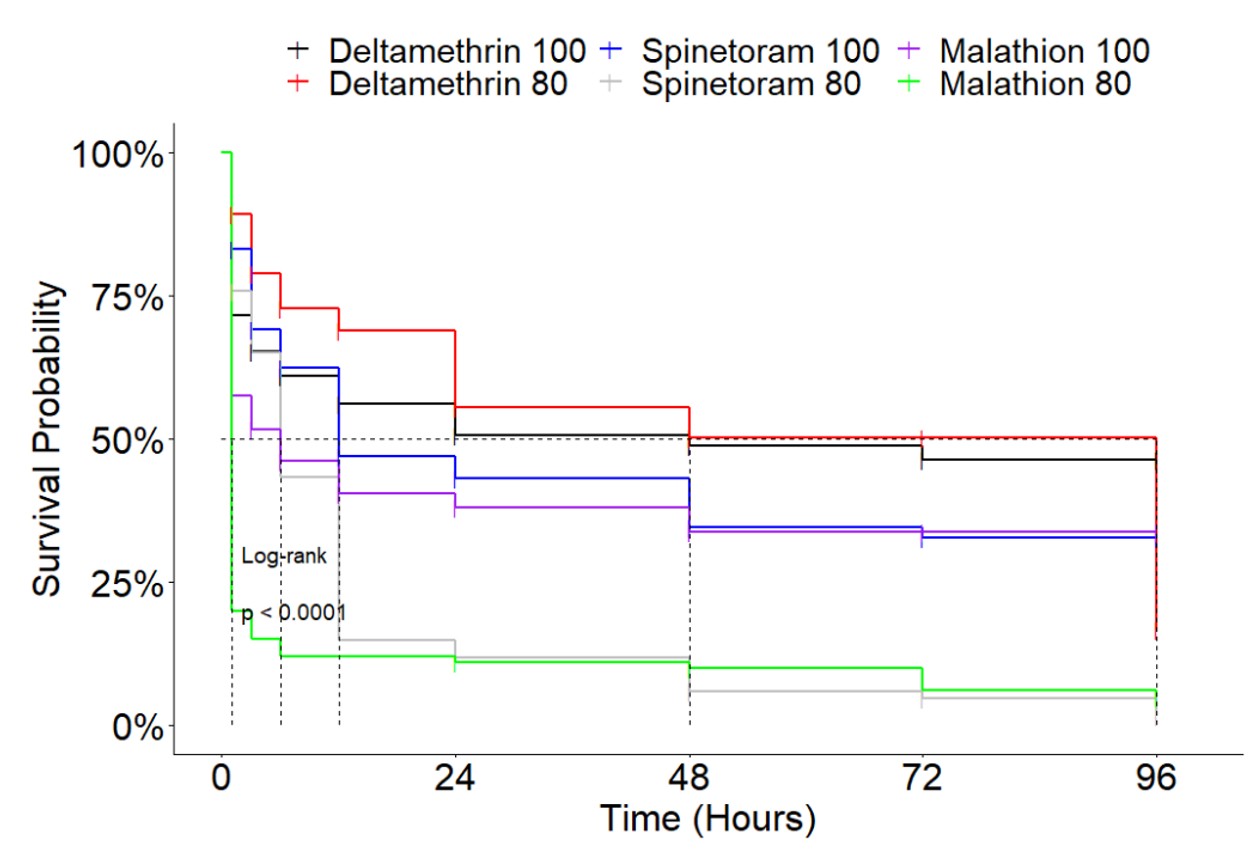
According to the survival curves of C. capitata treated with baits using the Biofruit attractant, there was a significant difference between the treatments (P < 0.0001). C. capitata adults were susceptible to all toxic bait formulations depending on time. Malathion at C80 caused rapid mortality with a median lethal time (LT50) of 1 h, a value significantly different from that obtained in all other treatments. The baits formulated with spinetoram at C80 (LT50 = 6 hours) and malathion at C100 (LT50 = 6 hours) presented an intermediate median lethal time, with overlapping confidence intervals. In contrast, baits formulated with deltamethrin at C80 exhibited a survival time similar to baits formulated with deltamethrin at C100 (LT50 values of 96 hours and 42 hours, respectively), being considered less efficient than the other baits (Table 3, Figure 1).
LT50 lethal time (hours) and confidence interval (CI) in Ceratitis capitata adults exposed to toxic baits.

Efficiency of toxic baits using different concentrations of deltamethrin, spinetoram and malathion with the attractant Biofruit® on Ceratitis capitata, according to the probability of survival as a function of time.
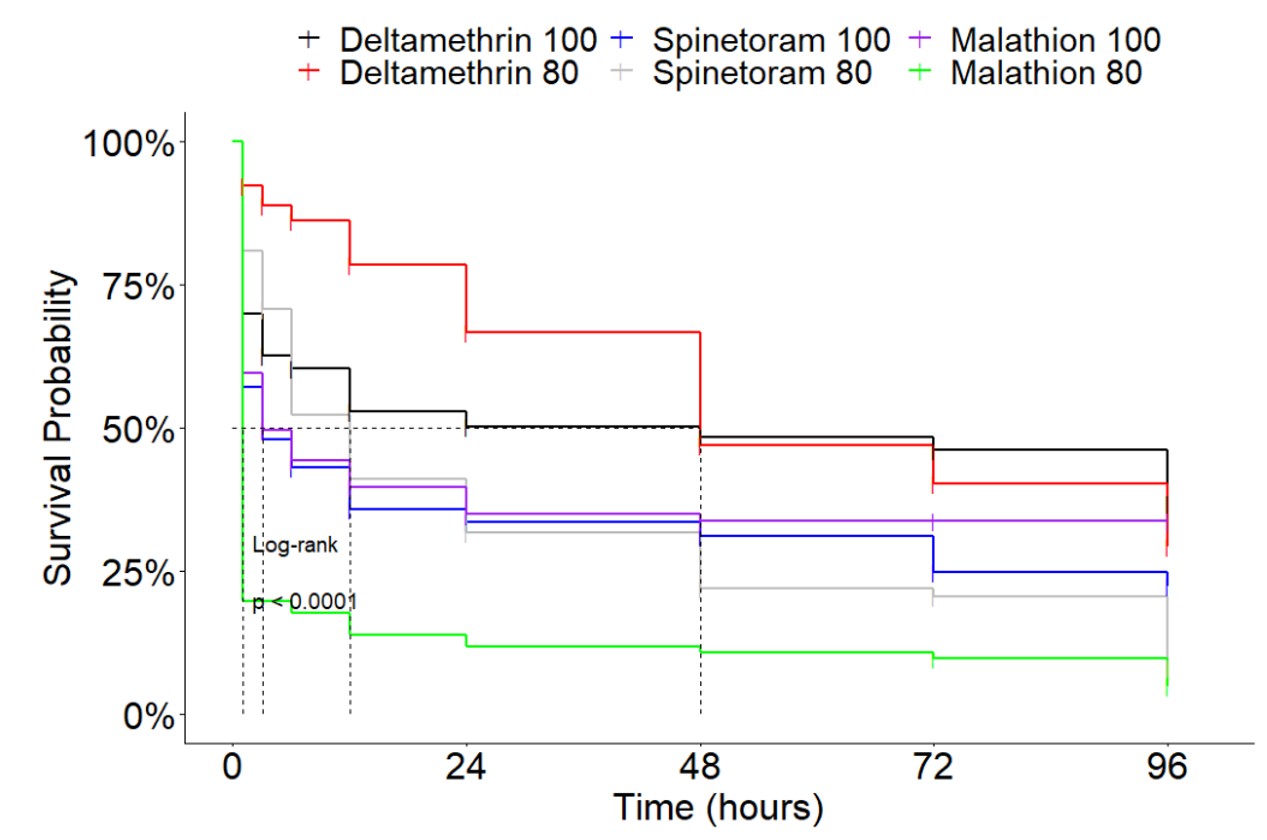
When the baits were formulated with the Cera Trap® attractant, there was a significant difference in survival (P< 0.001). The baits formulated with malathion at C80 caused greater susceptibility in C. capitata insects, with lower LT50 values (1 hour), differing from the insecticides spinetoram and malathion at C100 with LT50 = 3 hours in both, which presented overlapping confidence intervals. In contrast, formulations with deltamethrin at C80 and C100 presented LT50 = 48 hours (Table 3, Figure 2).

Efficiency of toxic baits using different concentrations of deltamethrin, spinetoram and malathion with the attractant Cera Trap® on Ceratitis capitata, according to the probability of survival as a function of time.
In the formulation with the attractive sugar cane molasses, there was a significant difference in survival (P< 0.001) and susceptibility was observed in all toxic baits. For the insecticide malathion at C80 (LT50 = 1 hour), a shorter median lethal time was required, indicating greater susceptibility of adults to this formulation. In contrast, the longest lethal time was observed in toxic baits with deltamethrin for C80 and C100, which had their confidence intervals overlapping with LT50 of 24 and 12 hours, respectively (Table 3, Figure 3).

Efficiency of toxic baits using different concentrations of deltamethrin, spinetoram and malathion with the attractant sugar cane molasses on Ceratitis capitata, according to the probability of survival as a function of time.
4. Discussion
The malathion and spinetoram formulations were more efficient at C80, which may be related to the acceptance and consumption of the baits. This is because lower concentrations are more attractive and less repellent, possibly due to the dilution of the active ingredient (Baldin et al., 2018). Similar result to studies by Gazit and Akiva (2017), lower concentrations of malathion provided greater intake of baits when tested on fruit flies.
It can also be highlighted that even after a 20% reduction in the initial concentration, malathion and spinetoram were efficient in controlling C. capitata. This finding is considered important for integrated pest management, considering that one of the main limitations of the use of toxic baits is the degradation of active ingredients, resulting in low persistence of formulations in the field (Harter et al., 2015).
Malathion presented high levels of mortality, reaching 50% of the population within a short period of 1 hour after treatment. Rapid action of malathion was also observed by Reynolds et al. (2017), who found that this insecticide presented LT50 in less than 1 hour for the fruit fly Bactrocera tryoni. Similar findings were found by Harter et al., 2015, who found a mortality of 84.8% in 24 hours in adults of A. fraterculus. The effectiveness of malathion can be explained by the form of action of organophosphates, which act by inhibiting nerve transmissions and causing the death of insects shortly after contact or ingestion of the product (Harter et al., 2015).
As with malathion, high mortality was also observed for baits with spinetoram, in this case, a longer exposure time was necessary. Spinosyns, in turn, act in the insect organism slowly, causing the death of individuals by inducing paralysis (Harter et al., 2015). This may explain the need for a longer time to reach 50% mortality of the population in this study.
The effect of deltamethrin at both concentrations was delayed when compared to malathion and spinetoram, which does not match its rapid mode of action, which acts by blocking sodium channels, interrupting normal electrical signalling in nerve cells (Casida and Durkin, 2013; Santos et al., 2016). However, results similar to those found in this work were seen by Baronio et al. (2019a), who, when testing a toxic bait composed of Biofruit® and deltamethrin, observed LT50 28.8 hours after ingesting the bait.
Considering the persistence of toxicity and the rapidity of action of products on C. capitata, the effectiveness of toxic baits formulated with food attractants and with insecticides malathion and spinetoram in concentrations of 80% (C80) in relation to the recommended one is proven.
Regarding the positive results for the food attractants used (Biofruit®, Cera Trap®, and Sugarcane Molasses), it is clear the possibility of mixing insecticides with these food sources without compromising the efficiency of the lethal agents used.
Other studies that can evaluate the effectiveness of toxic baits on C. capitata after degradation of part of its active ingredients in semi-field and field conditions are necessary, as natural conditions will make the results more reliable, especially if these studies evaluate the susceptibility of populations of C. capitata from different locations.
5. Conclusions
Toxic baits formulated with malathion and spinetoram remain efficient in controlling C. capitata after a 20% reduction in the concentration recommended by the manufacturer of each product and can be formulated with Biofruit®, Cera Trap®, or sugar cane molasses without compromising the expected outcome. C. capitata have low susceptibility to toxic bait formulations formulated with deltamethrin.
Data Availability Statement
The entire data set that supports the results of this study was published in the article itself.
Acknowledgements
The authors thank the Federal University of Paraiba (UFPB) for providing the facilities for this research, and the Brazilian Coordination for the Improvement of Higher Education Personnel (CAPES) for granting study scholarships.
Referências
-
ABBOTT, W.S., 1925. A method of computing the effectiveness of an insecticide. Journal of Economic Entomology, vol. 18, no. 2, pp. 265-267. http://doi.org/10.1093/jee/18.2.265a
» http://doi.org/10.1093/jee/18.2.265a -
AL-BEHADILI, F.J., AGARWAL, M., XU, W. and REN, Y., 2020. Mediterranean fruit fly Ceratitis capitata (Diptera: Tephritidae) eggs and larvae responses to a low-oxygen/high-nitrogen atmosphere. Insects, vol. 11, no. 11, pp. 802. http://doi.org/10.3390/insects11110802 PMid:33203006.
» http://doi.org/10.3390/insects11110802 -
BALDIN, M.M., SCHUTZE, X.I., BARONIO, A.C., GARCIA, R.M.F. and BOTTON, M., 2018. Concentration and lethal time of toxic baits based on spinosyns on Ceratitis capitata and Diachasmimorpha longicaudata Pesquisa Agropecuária Tropical, vol. 48, no. 3, pp. 323-330. http://doi.org/10.1590/1983-40632018v4852480
» http://doi.org/10.1590/1983-40632018v4852480 -
BARONIO, C.A., BERNARDI, D., PARANHOS, B.A.J., GARCIA, F.R.M. and BOTTON, M., 2018. Population suppression of Ceratitis capitata (Wiedemann) on table grapes using toxic baits. Anais da Academia Brasileira de Ciências, vol. 90, no. 4, pp. 3963-3973. http://doi.org/10.1590/0001-3765201820180707 PMid:30517227.
» http://doi.org/10.1590/0001-3765201820180707 -
BARONIO, C.A., BERNARDI, D., SCHUTZE, I.X., BALDIN, M.M., MACHOTA JUNIOR, R., GARCIA, F.R.M. and BOTTO, M., 2019a. Toxicities of insecticidal toxic baits to control Ceratitis capitata (Diptera: Tephritidae): implications for field management. Journal of Economic Entomology, vol. 112, no. 6, pp. 2782-2789. http://doi.org/10.1093/jee/toz194 PMid:31290548.
» http://doi.org/10.1093/jee/toz194 -
BARONIO, C.A., BERNARDI, D., NUNES, M.Z., PASINATO, J., GARCIA, F.R.M. and BOTTON, M., 2019b. Bioassay method for toxicity studies of toxic bait formulations to Ceratitis capitata (Diptera: Tephritidae). Neotropical Entomology, vol. 48, no. 2, pp. 356-363. http://doi.org/10.1007/s13744-018-0653-0 PMid:30519927.
» http://doi.org/10.1007/s13744-018-0653-0 -
BENELLI, G., RIZZO, R., ZENI, V., GOVIGLI, A., SAMKOVÁ, A., SINACORI, M., LO VERDE, G., PAVELA, R., CAPPELLACCI, L., PETRELLI, R., SPINOZZI, E., MORSHEDLOO, M.R., MAGGI, F. and CANALE, A., 2021. Carlina acaulis and Trachyspermum ammi essential oils formulated in protein baits are highly toxic and reduce aggressiveness in the medfly, Ceratitis capitata. Industrial Crops and Products, vol. 161, pp. 113191. http://doi.org/10.1016/j.indcrop.2020.113191
» http://doi.org/10.1016/j.indcrop.2020.113191 -
BERNARDI, D., NONDILLO, A., BARONIO, C.A., BORTOLI, L.C., MACHOTA JUNIOR, R., TREPTOW, R.C.B., GEISLER, F.C.S., NEITZKE, C.G., NAVA, D.E. and BOTTON, M., 2019. Side effects of toxic bait formulations on Diachasmimorpha longicaudata (Hymenoptera: braconidae). Scientific Reports, vol. 9, no. 1, pp. 12550. http://doi.org/10.1038/s41598-019-49106-z PMid:31467411.
» http://doi.org/10.1038/s41598-019-49106-z - BOTTON, M.C.J., ARIOLI, R., MACHOTA, J.R., NUNES, M.Z. and ROSA, J.M., 2016. Fruit flies in temperate fruit growing: current situation and control prospects through the use of new formulations of toxic baits and mass trapping. Santa Catarina Agriculture., vol. 29, pp. 103-108.
-
BRASIL. Ministério da Agricultura e Pecuária – MAPA, 2023 [viewed 20 January 2023]. AGROFIT [online]. Available from: https://agrofit.agricultura.gov.br/agrofit_cons/principal_agrofit_cons
» https://agrofit.agricultura.gov.br/agrofit_cons/principal_agrofit_cons - BRITO, C.H., 2007. Influence of heat treatments on the control of the larval phase of Ceratitis capitata Wied. (Diptera: Tephritidae) in sapodilla fruits (Achras sapota L.). Areia: Universidade Federal da Paraíba. Tese de Doutorado em Agronomia.
-
CASIDA, J.E. and DURKIN, K.A., 2013. Neuroactive insecticides: targets, selectivity, resistance, and secondary effects. Annual Review of Entomology, vol. 58, no. 1, pp. 99-117. http://doi.org/10.1146/annurev-ento-120811-153645 PMid:23317040.
» http://doi.org/10.1146/annurev-ento-120811-153645 -
GAZIT, Y. and AKIVA, R., 2017. Toxicity of malathion and spinosad to Bactrocera zonata and Ceratitis capitata (Diptera: Tephritidae). The Florida Entomologist, vol. 100, no. 2, pp. 385-389. http://doi.org/10.1653/024.100.0240
» http://doi.org/10.1653/024.100.0240 -
GROUT, T.G., STEPHEN, P.R. and RISON, J.-L., 2018. Cyantraniliprole can replace malathion in baits for Ceratitis capitata (Diptera: Tephritidae). Crop Protection, vol. 112, pp. 304-312. http://doi.org/10.1016/j.cropro.2018.06.018
» http://doi.org/10.1016/j.cropro.2018.06.018 -
HARTER, W.R., BOTTON, M., NAVA, D.E., GRUTZMACHER, A.D., GONÇALVES, R.S., MACHOTA JUNIOR, R., BERNARDI, D. and ZANARDI, O.Z., 2015. Toxicities and residual effects of toxic baits containing spinosad or malathion to control the adult Anastrepha fraterculus (Diptera: Tephritidae). The Florida Entomologist, vol. 98, no. 1, pp. 202-208. http://doi.org/10.1653/024.098.0135
» http://doi.org/10.1653/024.098.0135 -
HOTHORN, T., BRETZ, F. and WESTFALL, P., 2008. Simultaneous inference in General Parametric Models. Biometrical Journal. Biometrische Zeitschrift, vol. 50, no. 3, pp. 346-363. http://doi.org/10.1002/bimj.200810425
» http://doi.org/10.1002/bimj.200810425 -
MORAL, R.A., HINDE, J. and DEMÉTRIO, C.G.B., 2017. Half-normal plots and overdispersed models in R: the hnp package. Journal of Statistical Software, vol. 81, no. 10, pp. 10. http://doi.org/10.18637/jss.v081.i10
» http://doi.org/10.18637/jss.v081.i10 - NUNES, M., BARONIO, C., MACHOTA JUNIOR, R., BORTOLINI, L., PASINATO, J., BALDIN, M. and BOTTON, M., 2019. Recommendations for the evaluation of toxic baits on the fruit flies Anastrepha fraterculus and Ceratitis capitata (Diptera: Tephritidae) in the laboratory Bento Gonçalves: Embrapa Uva e Vinho.
-
PIOVESAN, B., CONTRERAS MIRANDA, J.A., GONÇALVES, R.D.S., DANIEL NÖRNBERG, S., BERNARDI, D., BOTTON, M. and NAVA, D.E., 2023. Lethal and sublethal effects of toxic bait formulations on Doryctobracon areolatus (Hymenoptera: Braconidae) and implications for integrated fruit fly management. Journal of Economic Entomology, vol. 116, no. 3, pp. 855-863. http://doi.org/10.1093/jee/toad069 PMid:37032527.
» http://doi.org/10.1093/jee/toad069 - R CORE TEAM, 2022. R: a language and environment for statistical computing Vienna: R Foundation for Statistical Computing.
- RAGA, A. and GALDINO, L.T., 2018. Fatal attraction. Cultivate HF, vol. 109, pp. 20-23.
-
RAGA, A. and SATO, M.E., 2005. Effect of spinosad bait against Ceratitis capitata (Wied.) and Anastrepha fraterculus (Wied.) (Diptera: Tephritidae) in laboratory. Neotropical Entomology, vol. 34, no. 5, pp. 815-822. http://doi.org/10.1590/S1519-566X2005000500014
» http://doi.org/10.1590/S1519-566X2005000500014 -
REYNOLDS, O.L., OSBORNE, T.J. and BARCHIA, I., 2017. Efficacy of chemicals for the potential management of the Queensland fruit fly Bactrocera tryoni (Froggatt) (Diptera: Tephritidae). Insects, vol. 8, no. 2, pp. 49. http://doi.org/10.3390/insects8020049 PMid:28486404.
» http://doi.org/10.3390/insects8020049 -
SANTOS, J.P., ARIOLI, C.J., ROSA, J.M. and MENEZES-NETTO, A.C., 2022. Efficiency of food lures for capture and monitoring of south american fruit fly in asian pear orchard. Revista Caatinga, vol. 35, no. 3, pp. 722-729. http://doi.org/10.1590/1983-21252022v35n323rc
» http://doi.org/10.1590/1983-21252022v35n323rc -
SANTOS, M.F., CAMPOS, M.R., BRAVIM, J.N., OLIVEIRA, E.E. and GUEDES, R.N.C., 2016. Non-targeted insecticidal stress on the Neotropical brown stink bug Euschistus heros Crop Protection, vol. 82, pp. 10-16. http://doi.org/10.1016/j.cropro.2015.12.023
» http://doi.org/10.1016/j.cropro.2015.12.023