 Elicitation of Piper sarmentosum callus with heavy metals: enhanced secondary metabolites, antioxidant and antimicrobial activities
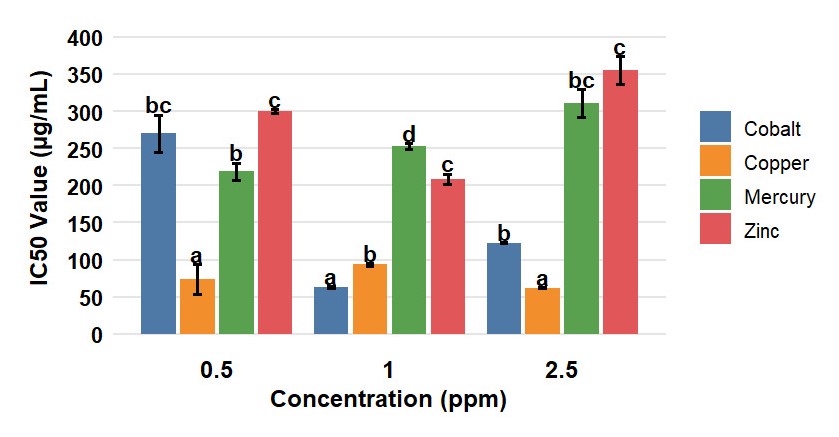
Piper sarmentosum is a medicinal plant with rich bioactive secondary metabolites. This work investigated the effects of heavy metal triggers (cobalt, copper, zinc, and mercury) on callus growth, secondary metabolites, antioxidant, and antimicrobial activities in P. sarmentosum cell cultures. Callus was induced on MS solid medium with 2 mg/L 2,4-D and 0.5 mg/L BAP, then subcultured on MS liquid medium containing 1.5 mg/L 2,4-D and 1.5 mg/L BAP with the addition of elicitors at concentrations of 0.5; 1; and 2.5 mg/L. Elicitation did not contribute significantly to callus biomass (p>0.05). All extracts contained alkaloids and flavonoids, while terpenoids/steroids and saponins were not detected. GC-MS analysis identified 42 compounds. Cobalt and copper extracts accumulated fatty acid methyl esters (0.14-0.61%) and alkaloids, including pipataline (0.03%) in the copper extract. Zinc and mercury extracts were dominated by glycerides (0.23-1.79%). The highest antioxidant activity was shown by 1 mg/L cobalt (IC50 62.55 ± 2.08 µg/mL) and 2.5 mg/L copper (IC50 61.72 ± 1.31 µg/mL), while zinc and mercury showed very weak activity (IC50 >200 µg/mL). All extracts inhibited Staphylococcus aureus, Escherichia coli, and Candida albicans. Cobalt 2.5 mg/L at 750 mg/L concentration showed the strongest activity against S. aureus (40.37 ± 3.56 mm), zinc 2.5 mg/L at 750 mg/L concentration against E. coli (36.05 ± 3.86 mm), and cobalt 2.5 mg/L at 500 mg/L concentration against C. albicans (41.62 ± 4.83 mm). Cobalt and copper at optimal concentrations effectively enhanced antioxidant and antimicrobial activities. To our knowledge, this is the first comparative study of four heavy metal elicitors inP. sarmentosumcallus.
Keywords:
Piper sarmentosum; bioactivities; callus culture; heavy metals; secondary metabolites
 Thumbnail