 Spatial and social determinants of tuberculosis in the Brazilian Amazon: a five-year multilevel and cluster-based analysis in Pará state, 2018-2022
Abstract
Tuberculosis remains a major public health concern in Brazil, particularly in the Amazon region, where its distribution is shaped by persistent social inequalities and environmental pressures. This study analyzed the spatial and sociodemographic dynamics of tuberculosis in the state of Pará, Northern Brazil, between 2018 and 2022. A total of 26,127 confirmed cases were identified through the Notifiable Diseases Information System and the National Registry of Health Establishments. We applied empirical Bayes smoothing and Kulldorff’s spatial scan statistic to detect high-risk territorial clusters and used multilevel logistic regression to assess individual and contextual predictors of unfavorable treatment outcomes. The disease primarily affected men, young adults aged 15-49 years, individuals with low educational attainment, and those self-identified as of mixed race. Spatial analysis revealed persistent high-risk clusters in the Metropolitan Region of Belém and a progressive expansion into Southeastern and South-Central municipalities. Lower education and Black or mixed-race identity were independently associated with a higher likelihood of unfavorable outcomes. The findings underscore the importance of integrating spatial epidemiology with multilevel modeling to uncover both individual and territorial determinants of tuberculosis. They highlight the need for geographically targeted interventions, the expansion of primary care services, and intersectoral public policies aimed at mitigating structural vulnerabilities in the Brazilian Amazon. Our results provide evidence to support precision public health strategies and enhance local planning in regions of high social and environmental risk.
Keywords:
tuberculosis; spatial analysis; multilevel modeling; Brazilian Amazon
Resumo
A tuberculose permanece como um grave problema de saúde pública no Brasil, sobretudo na região Amazônica, onde sua distribuição reflete desigualdades sociais históricas e pressões ambientais persistentes. Este estudo analisou a dinâmica espacial e sociodemográfica da tuberculose no estado do Pará, Norte do Brasil, entre 2018 e 2022. Foram identificados 26.127 casos confirmados por meio do Sistema de Informação de Agravos de Notificação e do Cadastro Nacional de Estabelecimentos de Saúde. Aplicou-se o alisamento empírico de Bayes e a estatística de varredura espacial de Kulldorff para detectar aglomerados territoriais de alto risco, e utilizou-se regressão logística multinível para avaliar preditores individuais e contextuais de desfechos desfavoráveis. A doença afetou principalmente homens, adultos jovens entre 15 e 49 anos, indivíduos com baixa escolaridade e autodeclarados de raça parda. A análise espacial revelou a persistência de clusters urbanos de alto risco na Região Metropolitana de Belém e uma expansão progressiva da doença para os municípios do Sudeste e Centro-Sul. Escolaridade mais baixa e identidade racial preta ou parda estiveram associadas, de forma independente, a piores desfechos no tratamento. Os achados reforçam a importância de integrar análises espaciais e modelagem multinível para revelar determinantes individuais e territoriais da tuberculose. Evidenciam a necessidade de intervenções geograficamente focalizadas, expansão da atenção primária e políticas públicas intersetoriais para mitigação das vulnerabilidades estruturais na Amazônia brasileira. Os resultados oferecem subsídios para estratégias de saúde pública de precisão e para o fortalecimento do planejamento local em contextos de risco social e ambiental elevado.
Palavras-chave:
tuberculose; análise espacial; modelagem multinível; Amazônia brasileira
1. Introduction
Tuberculosis (TB) remains one of the leading causes of morbidity and mortality worldwide, with 10.6 million cases and 1.6 million deaths recorded in 2023 (WHO, 2023). In Brazil, persistent social inequalities and environmental transformations pose major challenges to TB control, particularly in the Amazon region (Pereira et al., 2022).
Pará State, one of the largest territories in the Brazilian Amazon, exhibits high TB incidence rates intertwined with rapid demographic shifts, mining-driven migration, and urban sprawl (Tavares-Cohén et al., 2025). Vulnerable populations — predominantly young adult males, individuals of mixed or black race, and those with low educational attainment — are disproportionately affected, reflecting the interplay of social determinants of health (Hino et al., 2021; Kharwadkar et al., 2022).
Moreover, climate change impacts, such as altered rainfall patterns and increased environmental degradation, may exacerbate TB transmission dynamics, while the COVID-19 pandemic has disrupted TB control efforts globally (Aquino et al., 2020)
Despite the national commitment to the End TB Strategy and the Sustainable Development Goal (SDG) 3.3, gaps remain in understanding the spatial and sociodemographic distribution of TB in vulnerable Amazonian contexts (Romanello et al., 2021).
This study aims to analyze the spatial patterns and sociodemographic determinants of TB in Pará State from 2018 to 2022, employing geospatial and multilevel statistical approaches to identify critical areas and inform targeted public health interventions.
2. Methods
2.1. Study design
This was an ecological, cross-sectional study conducted at the municipal level in the state of Pará, Brazil, encompassing all 144 municipalities that comprise the state. Ecological designs are useful for analyzing population-level patterns and territorial inequalities, although they are limited by the potential for ecological fallacy. The unit of analysis was the municipality.
2.2. Data sources and extraction procedures
Data were extracted in March 2024 from the Notifiable Diseases Information System (SINAN) and the National Registry of Health Establishments (CNES), both maintained by the Brazilian Ministry of Health. All confirmed cases of pulmonary and extrapulmonary TB, classified as new or relapsed and reported between 2018 and 2022, were included. Cases with outcomes classified as “transfer out” or “change of diagnosis” were excluded from the analysis.
Data processing was performed using R software (version 4.3.2). Data cleaning involved removal of duplicate records, detection of implausible or extreme values (e.g., negative age or age over 120 years), and standardization of variables based on classifications from the Brazilian Institute of Geography and Statistics (IBGE) and the World Health Organization (WHO). Inconsistent records accounted for approximately 1.8% of the initial sample. Annual population estimates for each municipality were obtained from IBGE and used as denominators to calculate incidence rates.
2.3. Study variables
The dependent variables analyzed in this study were: (i) the annual TB incidence rate per 100,000 inhabitants, calculated for each municipality in Pará State; and (ii) the treatment outcome, categorized as favorable (cure or treatment completion) or unfavorable (treatment failure, loss to follow-up, or death). Independent variables included sex (male or female), age group (<15 years, 15-49 years, >49 years), race/skin color (white, black, mixed, or other), educational level (illiterate, elementary, secondary, or higher education), and year of notification (2018 to 2022).
2.4. Spatial analysis
Spatial analyses were performed using ArcGIS Pro version 3.2 (ESRI Inc.) and SaTScan version 10.1. Crude incidence rates were smoothed using the Empirical Bayes method to correct for random variation in municipalities with small populations. Spatial autocorrelation was assessed using Global Moran’s I, and Local Indicators of Spatial Association (LISA) were applied to identify local clustering patterns (Tavares-Cohén et al., 2025).
High-risk spatial clusters were identified using Kulldorff’s spatial scan statistic, implemented through a discrete Poisson model in SaTScan. Each municipality was georeferenced using its centroid. The likelihood ratio statistic compared the incidence of cases inside the circular scanning window with the incidence outside. Relative risk (RR) was calculated as the ratio between the observed and expected rates inside and outside the window. The expected number of cases was estimated based on each municipality’s population. The maximum scanning window was set at 50% of the total population, and statistical significance was determined via 9,999 Monte Carlo simulations, with p < 0.05 considered significant. Municipalities were assigned to clusters based on their geographic inclusion within the identified windows.
2.5. Temporal trend analysis
Temporal trends in TB incidence between 2018 and 2022 were evaluated using Poisson regression modelswith a log link function. The dependent variable was the annual number of TB cases per municipality, with the natural logarithm of the population used as an offset to calculate incidence rates. The regression coefficient (β) estimated the annual linear trend. Sensitivity analyses were conducted excluding the year 2020 due to potential underreporting during the COVID-19 pandemic.
2.6. Multilevel statistical modeling
To evaluate factors associated with unfavorable treatment outcomes, a multilevel logistic regression model was applied with two hierarchical levels: individuals (level 1) nested within their municipalities of residence (level 2). The dependent variable was the treatment outcome, coded as favorable (0) or unfavorable (1). A null model (random intercept only) was initially fitted to estimate between-municipality variance. Subsequently, a fully adjusted model was constructed including sex, age group, race/skin color, and educational level as fixed effects.
Associations between variables were quantified using Odds Ratios (OR), accompanied by their respective 95% confidence intervals (CI). The Intraclass Correlation Coefficient (ICC) was employed to estimate the proportion of total variance attributable to contextual effects at the municipal level. Multicollinearity diagnostics were conducted using the Variance Inflation Factor (VIF), with all covariates presenting values below the critical threshold of 5, indicating acceptable levels of collinearity. Model fit was assessed through the Akaike Information Criterion (AIC), allowing comparative evaluation of model performance. All statistical analyses were carried out using Stata SE, version 17.0.
2.7. Subgroup analysis
A subgroup analysis was conducted to assess the vulnerability of children and adolescents under 15 years of age. Individuals in this age group were stratified according to whether they resided in municipalities identified as high-risk clusters or in non-cluster areas. To estimate the relative risk (RR) of TB occurrence in cluster areas, a robust Poisson regression model was used, adjusting for variance to ensure consistent estimates. Results were presented as RR with 95% confidence intervals, and statistical significance was set at p < 0.05. These analyses were also performed using Stata SE version 17.0.
3. Results
3.1. Sociodemographic profile
During the study period from 2018 to 2022, a total of 26,127 cases of TB were reported in the state of Pará, Brazil. Table 1 presents the sociodemographic characteristics of these TB cases. The majority were male (71.63%) and aged between 15 and 49 years (75.27%). Regarding race/skin color, 65.30% self-identified as mixed-race (pardo), and 71.54% of individuals had an educational attainment of elementary school or lower (Table 1).
3.2. Spatial distribution and cluster detection
Poisson regression analysis revealed a statistically significant upward trend in TB incidence across Pará State between 2018 and 2022 (β = 0.024; p < 0.001), with a notably higher growth rate observed in Southeastern municipalities.
Spatial analysis identified statistically significant high-risk clusters (p < 0.001) predominantly concentrated in the Metropolitan Region of Belém and the Southeastern region of Pará, with relative risks (RR) ranging from 1.90 to 2.40. These clusters were persistent throughout the study period and exhibited progressive territorial expansion toward the Central-Western region of the state. Table 2 presents details of the primary clusters detected by SaTScan (Table 2).
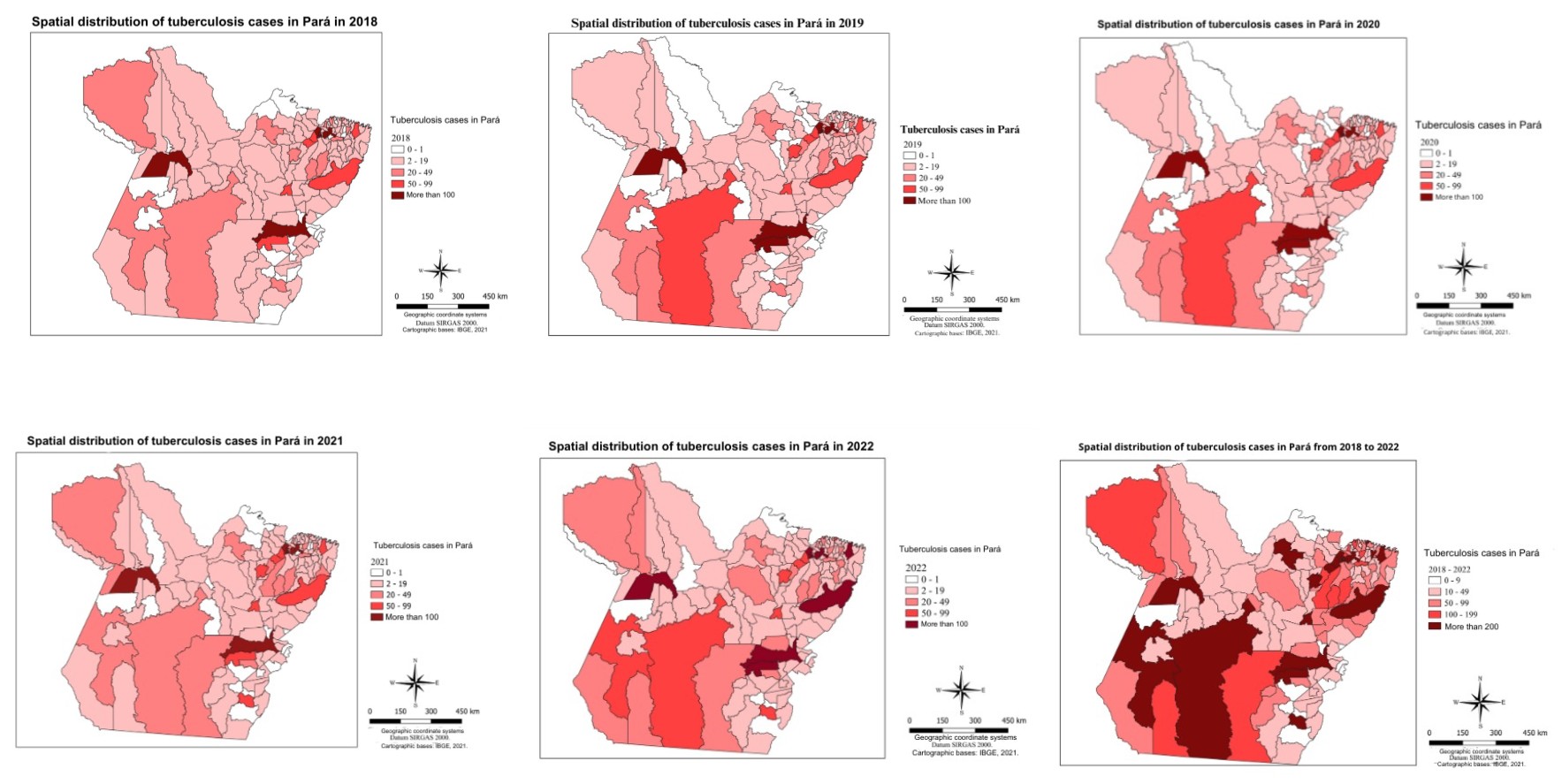
A series of annual spatial maps (Figure 1) illustrate the evolution of TB distribution across the state. In 2018 and 2019, cases were primarily concentrated in metropolitan areas and selected municipalities in the Southeast. By 2020, spatial dispersion became more evident, extending into the South and Central zones. This pattern intensified in 2021 and 2022, particularly in municipalities such as Marabá, Parauapebas, and Redenção, where case density surpassed 100 cases per year. The cumulative distribution (Figure 1) confirms that the highest concentration zones are also regions experiencing rapid urbanization, extractive activity, and demographic flux (Figure 1).
Annual spatial distribution of TB cases in Pará, 2018-2022. Maps show confirmed cases by municipality. The cumulative map (bottom right) highlights the spread toward Central and Southern regions.
A subgroup analysis focused on children under 15 years of age (n = 2,445) showed that those residing in high-risk cluster areas had a significantly elevated risk of TB compared to those in non-cluster municipalities, with a relative risk of 1.9 (95% CI: 1.4-2.6). These findings highlight the disproportionate vulnerability of pediatric populations in endemic areas.
3.3. Multilevel regression analysis
Multilevel logistic regression models revealed that male sex, mixed-race identity, and low educational attainment were independently associated with unfavorable treatment outcomes (Table 3). Specifically, being male was associated with 1.72 times greater odds of unfavorable outcomes (OR=1.72; 95%CI: 1.65-1.79; p<0.001), mixed race with 1.45 times greater odds (OR=1.45; 95%CI: 1.36-1.54; p<0.001), and low education with 1.81 times greater odds (OR=1.81; 95%CI: 1.72-1.91; p<0.001) (Table 3).
Multilevel Logistic Regression Results for Unfavorable TB Treatment Outcomes, Pará State, 2018-2022.
The intraclass correlation coefficient (ICC) indicated that 18.5% of the variance in treatment outcomes was attributable to differences at the municipal level (Table 3).
3.4. Subgroup analyses
Subgroup analyses showed that individuals aged <15 years living in high-risk cluster areas had a relative risk of 1.9 (95% CI: 1.4-2.6) compared to those residing outside cluster regions.
4. Discussion
This study reveals a persistent and territorially concentrated burden of TB in the state of Pará, Brazil, between 2018 and 2022. The epidemiological profile was marked by predominance among males, young adults aged 15-49 years, individuals of mixed race, and those with low educational attainment—an expression of longstanding social inequities in the Brazilian Amazon (IBGE, 2020). Spatial analysis uncovered stable high-risk clusters in the Metropolitan Region of Belém and a progressive expansion into Southeastern and Central municipalities, particularly in mining-intensive and rapidly urbanizing areas (Zambonin et al., 2024). These clusters were statistically robust and persistent over time, underscoring the endemic nature of TB in specific territories shaped by socioeconomic vulnerability and structural neglect (Fernandes et al., 2021; Patwary et al., 2024).
Our multilevel regression analysis confirms the independent association between male sex, low education, mixed-race identity, and unfavorable treatment outcomes. These results echo international findings from high-burden settings such as sub-Saharan Africa and Southeast Asia, while aligning with national studies that emphasize how race, poverty, and weak health infrastructure intersect to sustain TB transmission in Brazil (Kharwadkar et al., 2022; WHO, 2023). Importantly, the intraclass correlation coefficient (ICC) demonstrated that a significant portion of outcome variability (18.5%) was attributable to municipal-level effects—highlighting the role of contextual determinants beyond individual characteristics (Visca et al., 2021).
In Pará, this territorial heterogeneity is magnified by macroeconomic dynamics. The Southeastern region, where mining and extractive industries have expanded in recent decades, has experienced demographic pressure due to labor migration, informal urban settlements, and inadequate health infrastructure (Romanello et al., 2021). These conditions facilitate TB transmission and delay diagnosis, particularly in peripheral and rural frontier zones (Chavez-Rimache et al., 2023). Overlapping vulnerabilities—such as crowded housing, food insecurity, and environmental degradation—create syndemic scenarios that challenge the reach of the Unified Health System (SUS).
From a methodological perspective, this study offers a unique contribution by integrating Bayesian smoothing techniques, spatial scan statistics, and multilevel logistic regression within a single analytical framework. While prior Brazilian studies have explored spatial clustering or social determinants in isolation, few have simultaneously modeled individual- and municipal-level risks with such precision. This integrated approach strengthens the explanatory power of epidemiological findings and enhances their utility for policy formulation. It allows not only for identification of high-burden territories but also for the recognition of who, within these territories, is at greatest risk of poor outcomes.
These findings reinforce the urgency of geographically targeted TB control strategies that consider both individual vulnerability and territorial risk. We recommend the implementation of mobile screening units in identified clusters, especially in municipalities such as Parauapebas, Canaã dos Carajás, and Marabá, where extractive economies intersect with health system fragility. TB surveillance must be integrated into municipal development plans, particularly in areas of accelerated urbanization (Hino et al., 2021). Moreover, the Family Health Strategy (ESF) must be expanded to rural and peri-urban areas, supported by territorial governance mechanisms capable of intersectoral coordination (Hino et al., 2021; Fernandes et al., 2021).
It is also essential to incorporate social protection policies—such as linkage with the Cadastro Único, Bolsa Família, and the recently restructured Auxílio Brasil—as part of a broader social determinants approach to TB control (Brasil, 2019). Environmental and occupational health strategies, aligned with One Health principles, are particularly relevant in extractive zones with high ecological stress. Investment in geoinformation systems and data interoperability (e.g., e-SUS AB, SIVEP-TB, SINAN, CNES) can support real-time decision-making and improve resource allocation.
This study has limitations inherent to the use of secondary surveillance data, including potential underreporting, especially during the COVID-19 pandemic. The absence of individual-level variables such as comorbidities (e.g., HIV, diabetes), income, housing conditions, and treatment adherence limits causal inferences. In addition, spatial interpretation is subject to ecological fallacy, and the scale of analysis (municipal level) may mask intra-urban inequalities.
Nonetheless, the results presented here provide actionable evidence for precision public health approaches in the Brazilian Amazon. Future research should incorporate longitudinal designs to assess the impact of land use, mining expansion, and environmental degradation on TB incidence. Mixed-methods studies could explore the lived experiences of TB patients in cluster municipalities, and genomic epidemiology may be useful to trace intra- and inter-municipal transmission patterns.
Aligning Brazil’s regional TB response with the WHO End TB Strategy and Sustainable Development Goals (SDGs) will require confronting the unequal geographies of disease—moving beyond isolated biomedical interventions toward integrated, equity-driven, and territorially grounded health actions.
5. Conclusion
This study identified the persistence of high tuberculosis rates in Pará State between 2018 and 2022, with a predominance among men, young adults, individuals with low educational attainment, and those belonging to racially vulnerable groups. Spatial analysis revealed the persistence of urban clusters, particularly in the Metropolitan Region of Belém, as well as the progressive inland spread of cases toward the South-Central and Southeastern regions of the state. The findings underscore the need to strengthen epidemiological surveillance, expand access to primary healthcare, and address social inequalities in priority areas. Geospatial analysis proved to be an effective tool for guiding targeted public policies and territorial interventions. Future research should consider the effects of environmental changes, migratory flows, and socioeconomic conditions on the distribution of tuberculosis, to improve control strategies in highly vulnerable settings.
Data Availability Statement
The entire data set that supports the results of this study was published in the article itself.
References
-
AQUINO, E.M.L., SILVEIRA, I.H., PESCARINI, J.M., AQUINO, R., SOUZA-FILHO, J.A., ROCHA, A.S., FERREIRA, A., VICTOR, A., TEIXEIRA, C., MACHADO, D.B., PAIXÃO, E., ALVES, F.J.O., PILECCO, F., MENEZES, G., GABRIELLI, L., LEITE, L., ALMEIDA, M.C.C., ORTELAN, N., FERNANDES, Q.H.R.F., ORTIZ, R.J.F., PALMEIRA, R.N., PINTO JUNIOR, E.P., ARAGÃO, E., SOUZA, L.E.P.F., BARRAL NETTO, M., TEIXEIRA, M.G., BARRETO, M.L., ICHIHARA, M.Y. and LIMA, R.T.R.S., 2020. Medidas de distanciamento social no controle da pandemia de COVID-19: potenciais impactos e desafios no Brasil. Ciencia & Saude Coletiva, vol. 25, suppl. 1, pp. 2423-2446. http://doi.org/10.1590/1413-81232020256.1.10502020
» http://doi.org/10.1590/1413-81232020256.1.10502020 -
BRASIL. Ministério da Saúde, Secretaria de Vigilância em Saúde. Departamento de Vigilância das Doenças Transmissíveis, 2019 [viewed 7 May 2025]. Manual de recomendações para o controle da tuberculose no Brasil [online]. 2. ed. Brasília: Ministério da Saúde. Available from: https://bvsms.saude.gov.br/bvs/publicacoes/manual_recomendacoes_controle_tuberculose_brasil_2_ed.pdf
» https://bvsms.saude.gov.br/bvs/publicacoes/manual_recomendacoes_controle_tuberculose_brasil_2_ed.pdf -
CHAVEZ-RIMACHE, L., UGARTE-GIL, C. and BRUNETTE, M.J., 2023. The community as an active part in the implementation of interventions for the prevention and care of tuberculosis: a scoping review. PLOS Global Public Health, vol. 3, no. 12, pp. e0001482. http://doi.org/10.1371/journal.pgph.0001482 PMid:38100540.
» http://doi.org/10.1371/journal.pgph.0001482 -
FERNANDES, F.M.C., COUTO JUNIOR, A.F., BRAGA, J.U., OLIVEIRA, S. and EVANGELISTA, M.S.N., 2021. Environmental and social effects on the incidence of tuberculosis in three Brazilian municipalities and in Federal District. Journal of Infection in Developing Countries, vol. 15, no. 8, pp. 1139-1146. http://doi.org/10.3855/jidc.13674 PMid:34516422.
» http://doi.org/10.3855/jidc.13674 -
HINO, P., YAMAMOTO, T.T., BASTOS, S.H., BERALDO, A.A., FIGUEIREDO, T.M.R.M. and BERTOLOZZI, M.R., 2021. Tuberculosis in the street population: a systematic review. Revista da Escola de Enfermagem da USP., vol. 55, pp. e03688. http://doi.org/10.1590/s1980-220x2019039603688 PMid:33825785.
» http://doi.org/10.1590/s1980-220x2019039603688 -
INSTITUTO BRASILEIRO DE GEOGRAFIA E ESTATÍSTICA – IBGE, 2020 [viewed 7 May 2025]. Estimativas da população residente para os municípios e unidades da federação brasileira com dados de referência em 1º de julho de 2020 [online]. Available from: https://www.ibge.gov.br/pt/statistics/social/population/18448-estimativas-de-população-residente-para-municipais-e-unidades-da-federação.html
» https://www.ibge.gov.br/pt/statistics/social/population/18448-estimativas-de-população-residente-para-municipais-e-unidades-da-federação.html -
KHARWADKAR, S., ATTANAYAKE, V., DUNCAN, J., NAVARATNE, N. and BENSON, J., 2022. The impact of climate change on the risk factors for tuberculosis: a systematic review. Environmental Research, vol. 212, no. Pt C, pp. 113436. http://doi.org/10.1016/j.envres.2022.113436 PMid:35550808.
» http://doi.org/10.1016/j.envres.2022.113436 -
PATWARY, M.M., BARDHAN, M., HAQUE, M.A., MONIRUZZAMAN, S., GUSTAVSSON, J., KHAN, M.M.H., KOIVISTO, J., SALWA, M., MASHREKY, S.R., RAHMAN, A.K.M.F., TASNIM, A., ISLAM, M.R., ALAM, M.A., HASAN, M., HARUN, M.A.Y.A., NYBERG, L. and ISLAM, M.A., 2024. Impact of extreme weather events on mental health in South and Southeast Asia: a two decades of systematic review of observational studies. Environmental Research, vol. 250, pp. 118436. http://doi.org/10.1016/j.envres.2024.118436 PMid:38354890.
» http://doi.org/10.1016/j.envres.2024.118436 - PEREIRA, H.O., MENDES, L.S. and SOUZA, G.O., 2022. Desenvolvimento e vulnerabilidade social em municípios minerados: uma análise para o estado do Pará. Revista de Desenvolvimento Econômico, vol. 5, no. 10, pp. 77-96.
-
ROMANELLO, M., MCGUSHIN, A., DI NAPOLI, C., DRUMMOND, P., HUGHES, N., JAMART, L., KENNARD, H., LAMPARD, P., SOLANO RODRIGUEZ, B., ARNELL, N., AYEB-KARLSSON, S., BELESOVA, K., CAI, W., CAMPBELL-LENDRUM, D., CAPSTICK, S., CHAMBERS, J., CHU, L., CIAMPI, L., DALIN, C., DASANDI, N., DASGUPTA, S., DAVIES, M., DOMINGUEZ-SALAS, P., DUBROW, R., EBI, K.L., ECKELMAN, M., EKINS, P., ESCOBAR, L.E., GEORGESON, L., GRACE, D., GRAHAM, H., GUNTHER, S.H., HARTINGER, S., HE, K., HEAVISIDE, C., HESS, J., HSU, S.C., JANKIN, S., JIMENEZ, M.P., KELMAN, I., KIESEWETTER, G., KINNEY, P.L., KJELLSTROM, T., KNIVETON, D., LEE, J.K.W., LEMKE, B., LIU, Y., LIU, Z., LOTT, M., LOWE, R., MARTINEZ-URTAZA, J., MASLIN, M., MCALLISTER, L., MCMICHAEL, C., MI, Z., MILNER, J., MINOR, K., MOHAJERI, N., MORADI-LAKEH, M., MORRISSEY, K., MUNZERT, S., MURRAY, K.A., NEVILLE, T., NILSSON, M., OBRADOVICH, N., SEWE, M.O., ORESZCZYN, T., OTTO, M., OWFI, F., PEARMAN, O., PENCHEON, D., RABBANIHA, M., ROBINSON, E., ROCKLÖV, J., SALAS, R.N., SEMENZA, J.C., SHERMAN, J., SHI, L., SPRINGMANN, M., TABATABAEI, M., TAYLOR, J., TRINANES, J., SHUMAKE-GUILLEMOT, J., VU, B., WAGNER, F., WILKINSON, P., WINNING, M., YGLESIAS, M., ZHANG, S., GONG, P., MONTGOMERY, H., COSTELLO, A. and HAMILTON, I., 2021. The 2021 report of the Lancet Countdown on health and climate change: code red for a healthy future. Lancet, vol. 398, no. 10311, pp. 1619-1662. http://doi.org/10.1016/S0140-6736(21)01787-6 PMid:34687662.
» http://doi.org/10.1016/S0140-6736(21)01787-6 -
TAVARES-COHÉN, G.A., SIMÕES-CASTRO, A.P., ANDRADE-SALES, C., MENDONÇA-CAVALCANTE, P.A., MOREIRA-SENA, M.P., BRITO-ALVES, B.C., EL-AWAR, U.G., ARAUJO-SARDINHA, A.W., AZEVEDO-RIBEIRO, C.H.M., FERNANDES-VIEIRA, J.L. and PEREIRA-SENA, L.W., 2025. Impact of climate change and social determinants on the spatial and epidemiological distribution of tuberculosis in the state of Pará: a perspective for COP 30. Brazilian Journal of Biology = Revista Brasileira de Biologia, vol. 85, pp. e293623. http://doi.org/10.1590/1519-6984.293623 PMid:40243877.
» http://doi.org/10.1590/1519-6984.293623 -
VISCA, D., ONG, C.W.M., TIBERI, S., CENTIS, R., D’AMBROSIO, L., CHEN, B., MUELLER, J., MUELLER, P., DUARTE, R., DALCOLMO, M., SOTGIU, G., MIGLIORI, G.B. and GOLETTI, D., 2021. Tuberculosis and COVID-19 interaction: a review of biological, clinical and public health effects. Pulmonology, vol. 27, no. 2, pp. 151-165. http://doi.org/10.1016/j.pulmoe.2020.12.012 PMid:33547029.
» http://doi.org/10.1016/j.pulmoe.2020.12.012 -
WORLD HEALTH ORGANIZATION – WHO, 2023 [viewed 7 May 2025]. Global tuberculosis report 2023 [online]. Geneva: World Health Organization. Available from: https://www.who.int/publications/i/item/9789240083851
» https://www.who.int/publications/i/item/9789240083851 -
ZAMBONIN, F., SOUZA JÚNIOR, N.C., MACIEL, E. and BRAGA, J., 2024. Spatial overlap between latent Mycobacterium tuberculosis infection and Venezuelan migrants. Research Square http://doi.org/10.21203/rs.3.rs-4541906/v1 In press.
» http://doi.org/10.21203/rs.3.rs-4541906/v1
Edited by
-
Editor:
Takako Matsumura Tundisi