 Evaluating trap nest attractiveness: seasonal and spatial patterns of stingless bee (Apidae: Meliponini) foraging in artificial nests in Brazilian savanna
Abstract
The use of trap nests is an effective strategy for capturing stingless bee colonies. This study evaluated the efficiency of different trap volumes and attractive fixation techniques. The experiment was conducted between 2023 and 2024 in a Cerrado fragment. No trap resulted in colony capture, but 44 bee visits were recorded from the species Tetragona quadrangula (n=33), Trigona sp. (n=6), Apis mellifera (n=3), and Tetragonisca angustula (n=2). The 1.5 L and 5 L traps exhibited greater visitor diversity. The presence of tracing paper did not significantly influence species composition (R=-0.002; p=0.848), whereas trap volume had a significant effect. Larger traps (5 L) were the most visited, followed by smaller ones (1.5 and 2 L). Overall, bees preferred larger-volume traps, regardless of the presence of vegetal paper. The evaluation of bait attractiveness over time did not indicate a significant trend concerning the use of tracing paper, either in traps with or without paper. Environmental conditions influenced bee activity: the average temperature ranged between 26 and 30ºC for most of the study but dropped to 22ºC in the last three months, during which visits ceased. The highest number of visits was recorded in August 2023, with Tetragona quadrangula predominating. Pearson correlation analysis indicated a significant relationship between T. angustula and Trigona sp., but the low sample size of T. angustula (n=2) prevents more robust conclusions. These results can help optimize the use of traps for stingless bee management, contributing to the conservation of these pollinators in the Cerrado.
Keywords:
bee conservation; capture bait; cerrado; meliponiculture; sample techniques
Resumo
O uso de ninhos-armadilha é uma estratégia eficaz para capturar colônias de abelhas sem ferrão. Este estudo avaliou a eficiência de diferentes volumes de armadilha e técnicas de fixação atrativa. O experimento foi conduzido entre 2023 e 2024 em um fragmento de Cerrado. Nenhuma armadilha resultou na captura de colônias, mas foram registradas 44 visitas de abelhas das espécies Tetragona quadrangula (n=33), Trigona sp. (n=6), Apis mellifera (n=3) e Tetragonisca angustula (n=2). As armadilhas de 1,5 L e 5 L apresentam maior diversidade de visitantes. A presença de papel vegetal não influenciou significativamente a composição de espécies (R=-0,002; p=0,848), enquanto o volume da armadilha teve efeito significativo. Armadilhas maiores (5 L) foram as mais visitadas, seguidas pelas menores (1,5 e 2 L). No geral, as abelhas preferiram armadilhas de maior volume, independentemente da presença de papel vegetal. A avaliação da atratividade das iscas ao longo do tempo não indicou uma tendência significativa quanto ao uso de papel vegetal, tanto em armadilhas com quanto sem papel. As condições ambientais influenciaram a atividade das abelhas: a temperatura média variou entre 26 e 30 °C durante a maior parte do estudo, mas caiu para 22 °C nos últimos três meses, período em que as visitas cessaram. O maior número de visitas foi registrado em agosto de 2023, com predominância de Tetragona quadrangula. A análise de correlação de Pearson indicou uma relação significativa entre T. angustula e Trigona sp., mas o pequeno tamanho amostral de T. angustula (n = 2) impede conclusões mais robustas. Esses resultados podem auxiliar na otimização do uso de armadilhas para o manejo de abelhas sem ferrão, contribuindo para a conservação desses polinizadores no Cerrado.
Palavras-chave:
conservação de abelhas; iscas de captura; cerrado; meliponicultura; técnicas de amostragem
1. Introduction
Bees belong to the order Hymenoptera and Corbiculate bees are a group within the subfamily Apinae, characterized by a specialized structure known as the corbicula, or pollen basket, located on their hind legs (Peters et al., 2017). The current hypothesis is that the initial divergence of corbiculate bees occurred during the Late Cretaceous in South America, after its separation from Africa (Melo, 2020). While some bees carry pollen and floral oils in the plumose scopa on their hind legs, the ancestral lineage of corbiculate bees lost the scopa and developed a corbicula on the outer surface of the hind tibia. This major evolutionary innovation is likely related to the use of plant resins as nesting material (Melo, 2020).
Stingless bees belong to the tribe Meliponini, exhibit high diversity in the tropics and are known for their advanced social organization (Michener, 2012). More than 600 species of stingless bees have been described, belonging to approximately 61 genera (Rasmussen and Cameron, 2010; Ascher and Pickering, 2026). Their high diversity may be influenced by tropical environmental conditions, such as elevated temperatures and intense biological activity, which drive accelerated metabolic processes that may act as selective pressures favoring specialization in specific ecological niches (Araujo et al., 2004; Currie et al., 2004; Ollerton et al., 2011; Gonzalez et al., 2022).
Stingless bee nests follow a basic architectural pattern, including a protective batumen layer, storage pots, brood combs, and an entrance, usually located within one of three cavities. The internal temperature of these nests is crucial for colony development, being maintained between 28 and 34 °C to prevent negative metabolic impacts (Michener, 2012; Melo, 2020). Various tree species are used as nesting sites, with a preference for large trunks and pre-existing cavities, such as those found in botanical families like Anacardiaceae, Euphorbiaceae, and Vochysiaceae, the latter being common in the Cerrado biome (Kajobe, 2012; Serra et al., 2009).
Colony founding occurs through fission, differing from the swarming behavior of honey bees (Apis mellifera Linnaeus, 1758). Worker bees establish the new colony first, and only when the structure is nearly complete does the virgin queen relocate to the new nest (Kwapong et al., 2010; Oliveira et al., 2013). To ensure sustainable colony acquisition, meliponiculture has been historically practiced by various communities, promoting both bee conservation and enhanced agricultural productivity through pollination, therefore, testing new methodologies can be useful for breeders in managing bait nests (Souza et al., 2013; Real-Luna et al., 2022). One of the most effective methods is the use of trap nests, or bait hives, containing resin and wax attractants to lure colonies seeking shelter (Rahimi et al., 2021; Kwapong et al., 2010). This technique, regulated by Resolution No. 496/2020 of the Brazilian Ministry of the Environment, allows for the ecologically responsible capture of colonies and has been widely applied in research involving both social and solitary bees (Brasil, 2020; Costa and Gonçalves, 2019).
These traps can be made using simple, locally available materials such as wooden boards, planks, bamboo, clay pots, and coconut shells. Additionally, factors such as nest volume, position, and entrance orientation influence the trap’s attractiveness and the species captured (Kwapong et al., 2010). Using polyethylene terephthalate (PET) bottles as trap nests provides a sustainable alternative to plastic disposal. This practice prevents the release of harmful microplastics into ecosystems (Dhaka et al., 2022) while supporting stingless bee conservation in the face of increasing habitat loss.
Stingless bees, due to their diversity and ecological importance, may benefit from such alternatives, which not only reduce plastic waste but also provide artificial habitats that assist in the maintenance and monitoring of populations in fragmented landscapes like the Cerrado. In this context, the present study aims to investigate the effects of trap nest volume and attractive fixation techniques on the efficiency of bee capture, contributing both to conservation science and sustainable bee management practices. Thus, the objective of this study was to evaluate the efficiency of stingless bee capture using trap nests of different volumes and attractive fixation methods in a Cerrado fragment. Specifically, we assessed whether trap nests of varying volumes attract different species compositions and richness, which trap nests are most attractive, and whether there are differences in species composition and richness between traps with and without tracing paper over time after attractant replenishment.
2. Materials and Methods
2.1. Study area
Fieldwork was conducted in the Parque Natural Municipal de Rondonópolis (16°29′15.55″S; 54°37′36.66″W), a 146‑ha remnant of native vegetation within the urban area of Rondonópolis, Mato Grosso, Brazil (Figure 1). The park comprises riparian forest along the Rio Vermelho, gallery forest of the Lourencinho stream, seasonally flooded wetlands and temporary lagoons, and cerrado sensu stricto vegetation. According to SEMMA (2018), these habitats correspond to the “Forest Cerrado” and “Cerrado stricto sensu” subtypes.

(A) Location of the Rondonópolis, indicating the state of Mato Grosso and Cerrado domain. (B) Rondonópolis Municipal State Park location and (C) diagram of the trail used to install the trap nests represented by dot.
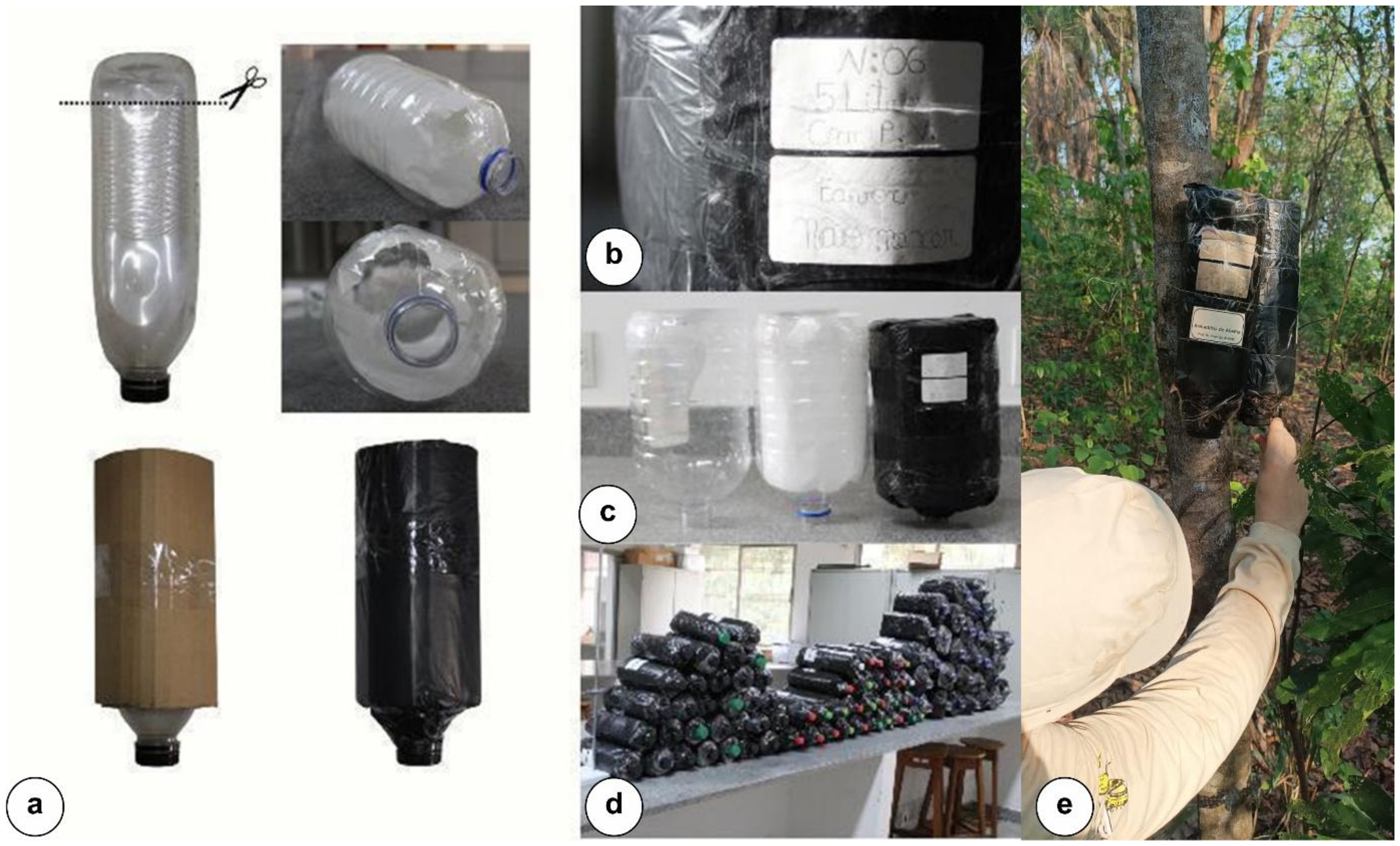
We tested three bottle volumes (1.5 L, 2 L, 5 L) and two interior‑lining treatments (with or without tracing paper). Each trap was assembled from a cleaned PET bottle, black plastic trash bag, cardboard, vegetal paper, and adhesive tape. The assembly process consisted of 1) cutting the PET bottle approximately 10 cm above the base to form a lid; 2) inserting a sheet of tracing paper so that it covers the walls, and covering the bottom with the cut-out base, applying tape to hold it in place; 3) Covering the PET bottle with a piece of cardboard for thermal insulation; 4) covering the bottle again with a black plastic garbage bag until the inside was completely dark (Figure 2A). Then, identify the trap with the variables of each of the treatments on a label, containing the bottle number, volume and presence of tracing paper (Figure 2B). According to the procedure, it was 5) applying 30 mL of attractant (composed of wax and propolis/geopropolis produced artisanally by meliponiculturists) to 1.5- and 2-liter bottles, or 60 mL to 5-liter bottles; 6) letting it sit overnight so that the attractant could dry; 7) making a hole in the lid; 8) an using Apis mellifera wax at the entrance of the bottle, pushing it a little into the container. The untreated traps (without tracing paper) do not receive any cuts, starting the process from step 3. The use of a sheet of tracing paper covering the inner wall of the bottle followed the model proposed by Aranda et al. (2022) (Figure 2C-D).

Model of nest-trap assembly with 1.5-liter PET bottle used in the project. (A) The bottle cut 10 cm from the base to form a lid. With the lid ready, a sheet of tracing paper is placed covering the entire interior. Then, the bottle is covered with cardboard and a black plastic bag; (B) Identification of each bottle with trap number, volume, information about the tracing paper and warning text; (C-D) Model of 5-liter bottle with and without the use of tracing paper and finished traps ready for installation; (E) Instalation of nest-trap.
Before starting the study, we investigated the absorbency of an attractant by parchment paper, comparing it with a bottle without parchment paper as a control. To determine the volume of attractant retained in each treatment, 50 mL of attractant was measured in a graduated cylinder, which was then added to each treatment, shaken for 30 seconds, and returned to the graduated cylinder until the drops stopped, leaving it to rest in the bottle for 2 minutes to establish the amount of attractant remaining in each treatment in order to compare the absorbency of the attractant by the parchment paper. We used two identical 2 L bottles, one with a sheet of tracing paper wrapped around its interior and the other without this sheet.
The results revealed that the bottle with parchment paper returned 44 ml of the attractant, while the bottle without parchment paper returned 49 mL. This difference suggests that the parchment paper had an impact on the absorption of the attractant, retaining part of it, which should be considered when evaluating the effectiveness of this material as a contributor to trap efficiency.
Ninety trap nests were constructed and distributed across 15 sampling points, each point with six trap nests installed, one trap of each volume (1.5, 2 and 5 liters), with and without the presence of tracing paper (Figure 1A), which passes through riparian forest, gallery forest and “Cerradão”. GPS coordinates were recorded for each point. Traps were suspended in trees approximately 1.5 m above the ground in shaded microhabitats (Figure 2E). To maintain attractive efficacy, we reapplied the bee attractive every 12 weeks (on 02 July 2023, 25 October 2023, 17 January 2024, and 10 April 2024). This interval was chosen experimentally due to the lack of a standardized protocol for attractive renewal in comparable studies, and we chose to establish this time interval precisely to verify a possible efficiency curve in attraction in relation to exposure time and loss of attractiveness.
2.2. Sampling and monitoring
The traps were installed in July 2023 and removed at the end of July 2024, completing one year of collection. Over the months, the traps were observed biweekly in order to define a timeline indicating when and which trap nest could be occupied and by which genus and species of bee. If the trap was found and inhabited by another animal, its internal cleaning was carried out and if it was deteriorated with torn regions that affected the darkness inside, it was repaired. The trap nests were only considered occupied, that is, with a founded nest, if events such as the formation of a complete or incomplete nest entrance at the trap or the construction of internal structures were observed (Cruz et al. 2022). Visits to the baits during foraging activities by foragers were also considered. The observation of visits by forager bees that were possibly exploring the baits was computed, with a waiting period of approximately 3 minutes at each observed sampling point to record the visits. Collections were authorized in accordance with the permanent license for the collection of biological material provided by the Ministry of the Environment and the Chico Mendes Institute for Biodiversity (MMA-ICMBio-SISBIO no. 61938-4 - Authentication code: 0619380420210819). The identification of bee species was carried out based on specialized literature (Silveira et al., 2002; Engel et al., 2023) down to the lowest possible taxonomic level. The confirmation of species and records using images from the bee catalog (A.B.E.L.H.A, 2016), species distribution through the website specieslink.net/ (CRIA, 2022), Moure Catalog (Camargo et al., 2024) and illustrated photographic guide (Costa, 2019).
2.3. Data analysis
For data analysis, the richness of observed species was described, as well as the frequency of records for each of them. Regarding the occupant species, a two-factor similarity analysis (ANOSIM) was used. To evaluate only the attractiveness, considering the number of visits, regardless of the species, the analysis of variance (ANOVA) test was used to evaluate the volumes (once the data met the test assumptions) and to compare between the presence and absence of tracing paper, the Chi-square test was used. Regarding the duration of attractiveness between with and without tracing paper, it was evaluated using the nonparametric Mann-Kendall test. Pearson's correlation analysis was performed between the climatic parameters (precipitation (mm) and temperature (ºC) and the presence of the species. For all analyses, we used alpha 0.05. The temperature and precipitation data were obtained from the Agritempo (2024) website.
3. Results
During preliminary inspections of the trail, we recorded three natural stingless‐bee nests: one arboreal nest of Tetragona clavipes (Fabricius, 1804) near sampling points 13–14, one ground nest of Trigona sp. in leaf litter close to point 9 (Figure 3A, B), and two nests in a dead palm trunk—an Apis mellifera nest at the trunk apex and a Nannotrigona testaceicornis (Lepeletier, 1836) nest midway down the trunk (Figure 3C). Throughout field visits, foraging individuals of Trigona sp. and Tetragona sp. were commonly observed flying along the trail. Two species of Tetragona, (T. quadrangula (Lepeletier, 1836 and T. clavipes) are reported in the region. No trap nests were occupied (i.e., no complete nests founded) during the experiment. However, we documented 44 bee visits to the traps, representing four taxa: Tetragona quadrangula; n = 33), Trigona sp. (n = 6), Apis mellifera (n = 3), and Tetragonisca angustula (Latreille, 1811; n = 2) .

(A) Natural arboreal nest of Tetragona clavipes near sampling points 13 and 14; (B) Natural nest on the ground of Trigona sp. near point 9; (C) Nest of Nannotrigona testaceicornis in a palm trunk (Rondonópolis Municipal Natural Park).
3.1. Species diversity and composition
Trap nests of 1.5 L and 5.0 L exhibited higher species richness than 2.0 L traps (Figure 4A). Two‑factor ANOSIM revealed no significant effect on species composition (R = –0.02, p = 0.848), whereas trap volume had a significant effect (R = 0.32, p = 0.030; Figure 4B). One‑way ANOVA showed significant differences in mean visit counts among trap volumes (F = 46.90, p = 0.010). Five‑liter traps received the most visits (n = 29), followed by 1.5 L traps (n = 9) and 2.0 L traps (n = 6) (Figure 4A). Chi‑square analysis detected no significant difference in overall visitation between presence (n = 20) and absent (n = 24) of tracing paper. (χ2= 0.68, p = 0.71; Figure 4B).

Composition of species that visited traps with (A) different volumes and (B) traps with and without tracing paper; (C) Number of visits observed in the baits in the different plots of the experiment; (D) Number of visits over time, after application of the attractant for stingless native bees, in traps with and without tracing paper.
3.2. Spatial patterns and temporal dynamics
Among the 15 sampling sites, point 13 recorded the highest number of visits (n = 9), followed by points 9 (n = 7) and 2 (n = 6). Points 13 and 3 exhibited the greatest species richness (three species each; Figure 4C). Assessment of visitation trends over time (pre‑replenishment interval) showed no significant monotonic trend for either treatment. Traps with tracing paper yielded a Mann–Kendall slope (S) of 0 (p = 0.50), and traps without tracing paper had S = –1 (p = 0.50), indicating no systematic change in attractiveness (Figure 4D). Between 12 and 45 days, after attractive application, visit counts fluctuated between two and nine, reflecting relatively high foraging activity during this period.
Over the sampling period (July 2023–July 2024), mean monthly temperature remained relatively stable between 26 °C and 30 °C, except during the final two months when it declined to approximately 22 °C. Whenever monthly mean temperature approached or fell below 25 °C—in April, June and July 2024—no bee visits were recorded, with the sole exception of August 2023 (the first month of sampling), which exhibited the highest number of visits (Figure 5A). In contrast to temperature, precipitation exhibited pronounced seasonal variation. From August to November 2023, rainfall increased irregularly, stabilized between December 2023 and February 2024, and peaked in March 2024 at over 250 mm. Beginning in April, rainfall dropped sharply below 50 mm, marking the onset of the dry season that persisted until the end of sampling (Figure 5A).

Monthly variation of (A) average temperature and accumulated precipitation and (B) visits observed in trap nests by different bee species between August 2023 and July 2024.
August 2023 recorded the greatest number of visits (n = 14), exclusively by Tetragona quadrangula. Visits then declined steeply, followed by a gradual recovery accompanied by increased species richness. In September, Apis mellifera predominated—its only recorded month (Figure 5B). October saw the first occurrence of Trigona sp., and December the sole record of Tetragonisca angustula, making December the most taxonomically diverse month with three species. From January to April 2024, visits were markedly low, with only occasional records of Trigona sp. and T. quadrangula, until a temporary rebound in May. Thereafter, visits fell again in June and July, with none recorded (Figure 5B).
Pearson’s correlation matrix (Figure 6) revealed a moderate positive correlation (r = 0.55) between temperature (°C) and precipitation (mm) over the study period, indicating that higher temperatures tended to coincide with greater rainfall. Correlations between temperature and species presence were generally low but positive. Precipitation showed a weak positive correlation with T. angustula (r = 0.29), a weak negative correlation with T. quadrangula (r = –0.17), and near-zero correlations with A. mellifera (r = 0.04) and Trigona sp. (r = 0.00). The only statistically strong association was between T. angustula and Trigona sp. (r = 0.59), suggesting potential temporal overlap in their foraging activity; however, the very low sample size for T. angustula (n = 2) limits meaningful interpretation. All other interspecific correlations were close to zero or negative, indicating little to no linear relationship in their occurrence patterns (Figure 6).

Pearson correlation matrix between environmental variables, temperature (ºC) and precipitation (mm) and presence of bee species. Tetragona quadrangula, Trigona sp., Apis mellifera and Tetragonisca angustula. Colors indicate the strength and direction of correlations, with shades of blue for positive correlations, shades of red for negative correlations and white for null correlation. The gray square indicates the only significant correlation.
4. Discussion
Suitable nesting sites are a key limiting resource for stingless bees, and their availability often governs nest abundance and distribution. Although our trap nests remain unoccupied, it is important to consider that urban landscapes can exert complex and sometimes conflicting effects on stingless‑bee communities. The Parque Natural Municipal de Rondonópolis, while a protected green fragment, lies within a heavily urbanized matrix, which likely alters local population dynamics. Habitat fragmentation, floral resource availability, and competition with other species are all factors that may explain the absence of trap‑nest occupation (Siqueira et al., 2012; Vieira et al., 2016). Moreover, the lack of nesting could also reflect there may be available natural spaces for nesting or our attractive blend was not sufficiently effective for certain taxa.
Our data demonstrated that 5‑L traps predominantly attracted Tetragona quadrangula; n = 25), with a small number of Trigona sp. visits, whereas smaller traps (2 L and 1.5 L) recorded fewer visits (n = 3 and n = 5, respectively). The 1.5‑L traps yielded a more balanced assemblage—T. quadrangula (n = 5), Trigona sp. (n = 1), and Apis mellifera (n = 3)—suggesting that larger volumes may be suboptimal for capturing smaller species, perhaps due to species‑specific resource‑partitioning behaviors or nesting preferences. In 2‑L traps, T. quadrangula and Trigona sp. were observed equally (n = 3 each), while A. mellifera and Tetragonisca angustula were absent.
Despite not locating any natural nests of T. quadrangula during field surveys, only a single T. clavipes nest, T. quadrangula was the most frequent trap visitor. This species is known for forming large colonies and employing competitive foraging strategies to monopolize rich, productive floral resources, thereby securing the energetic supply necessary to sustain its population size (Ramalho et al., 1990). Such competitive foraging behavior likely underlies its dominance in our visitation records.
Overall, the predominance of T. quadrangula visits in larger traps, coupled with the balanced species representation in smaller traps, underscores the importance of trap‑nest volume as a determinant of sampling bias in stingless‑bee surveys. Future studies should explore a broader range of attractant formulations and microhabitat conditions, as well as the inclusion of natural nesting materials (e.g., resin‑soaked substrates), to enhance occupancy rates. Additionally, long‑term monitoring across seasons and landscape gradients would help elucidate how urbanization, resource availability, and interspecific interactions jointly influence nest‑site selection in stingless bees.
Arena et al. (2018) deployed 72 trap nests in Atlantic Forest fragments, of which only four (5.5 %) were occupied by Scaptotrigona postica. They concluded that artificial refuges are more likely to be colonized in the forest core and that capture rates increase when traps are hung on large trees surrounded by abundant, high‑quality floral resources. Unfortunately, the Parque Natural Municipal de Rondonópolis fragment does not permit access to dense interior forest; our traps were therefore restricted to key points along the trail near the Rio Vermelho riparian zone. Although none of our traps achieved nest founding, our total sample size (90 traps over 12 months) is comparable to similar studies, which have deployed between 72 and 720 traps across two to four distinct sites for six to 24 months (Arena et al., 2018; Cruz et al., 2022; Silva et al., 2014; Oliveira et al., 2013). Those studies were conducted in Atlantic Forest and Amazonian fragments, whereas ours represents a pioneering investigation of trap‑nest attractiveness to stingless bees in the Cerrado biome.
We detected no significant difference in total visits between traps lined with vegetal paper and unlined traps, although unlined traps were visited slightly more often (n = 24 vs. 20). Vegetal paper was used primarily to facilitate manipulation of retrieved colonies (Aranda et al., 2022), when saturated with propolis and wax it appears more natural and less artificial. However, other nest characteristics—such as the requirement for a preexisting cavity and the visual appearance of the entrance—likely exert a greater influence on attractiveness than either extended odor retention by the vegetal paper or trap volume per se, as suggested by Cruz et al. (2022). Given the absence of a temporal trend in attractiveness between lined and unlined traps, extending the interval between attractant renewals and prolonging the sampling period may further clarify the role of vegetal paper in modulating trap‑nest appeal.
The 70‑day interval for attractant reapplication may have been insufficient to reveal significant differences in trap‑nest efficiency over time. Our visitation data peaked in the first month following application and then declined, indicating a strong initial lure effect that wanes thereafter. Arena et al. (2018) replenished attractants every two months in Atlantic Forest fragments, whereas Silva et al. (2014) refreshed baits monthly for 18 months, returning after one year to adjust the traps again. A six‑month reapplication interval, as used by Oliveira et al. (2013), might better illuminate whether vegetal paper extends attractant longevity and influences trap performance.
Sampling point 13 (n = 9 visits, the most active site) lies between an abandoned Trigona clavipes nest and a large Enterolobium contortisiliquum (Vell.) Morong (tamboril tree). Although Tetragona quadrangula frequently foraged on this tree’s resin, point 12 (adjacent to the tamboril) recorded visits predominately by Apis mellifera. Traps situated along the river margin (points 2, 3, 6, 9, 12, 13) received more visits than those deeper in the forest fragment (points 4, 5, 7, 8, 11, 14, 15). Proximity to watercourses not only facilitates trap access but also coincides with a higher density of dead palm trunks—often excavated by Rhynchophorus palmarum (Linnaeus 1764) beetles—which provide abundant natural cavities for solitary and social bees. Such substrate availability likely augments local nest‑site preference and may explain increased bee activity near the river.
Several stingless‑bee species synchronize intense resource collection and storage with the wet season to buffer against dry‑season scarcity (Aleixo et al., 2017). In our study, T. quadrangula exhibited heightened foraging activity at the onset of rain, maintained moderate activity during peak precipitation, and ceased foraging as the dry season commenced. Comparable behavioral thermoregulation has been observed in Melipona subnitida Ducke (1910), whose foraging is optimal between 22 °C and 34 °C, with high temperatures suppressing activity (Maia‑Silva et al., 2015). Given that T. quadrangula dominated our sample and that its peak visits occurred at mean temperatures of 27–31 °C during rainy months, this species appears to favor mid‑range temperatures under wetter conditions.
Although only two visits by Tetragonisca angustula were recorded, its moderate positive correlation with Trigona sp. (r = 0.59) may reflect temporal overlap in resource use or shared habitat preferences (Hubbell and Johnson, 1977). Both species exploit similar floral resources in the Cerrado, such as Andira humilis, Styrax camporum, Eupatorium squalidum, Gochnatia barrosii, and Byrsonima intermedia, despite T. angustula narrower niche breadth compared to Trigona spinipes (Nogueira‑Ferreira and Augusto, 2007). Their synchronous activity peaks, particularly in December when species richness was highest, suggest that concurrent resource phenology rather than identical floral preferences may drive their co‑occurrence.
Overall, our findings underscore the importance of trap‑nest design (volume, lining) and deployment strategy (microhabitat selection, replenishment schedule) in sampling stingless‑bee assemblages. Future research should extend reapplication intervals, incorporate a wider range of attractant blends, and deploy traps across diverse microhabitats, particularly in forest interiors, to better capture nesting events. Longitudinal studies spanning multiple seasons and landscape contexts will further elucidate how environmental variables and interspecific interactions govern trap‑nest colonization in stingless bees.
5. Conclusions
Our year-long study in an urban Cerrado fragment indicates that while PET trap nests attracted frequent visitations, primarily by Tetragona quadrangular none resulted in permanent colonization. The preference for 5 L traps suggests that larger cavities better mimic natural nesting sites for dominant species, whereas the use of vegetal paper showed no significant benefit for attractant longevity. Visitation was strongly driven by environmental factors, peaking above 25 °C and near natural cavity sources like riparian margins. These results suggest that in highly urbanized areas, successful colonization may require more specific microhabitat selection or refined attractant formulations, with reapplication intervals adjusted to seasonal climate dynamics
Our work provides the first systematic assessment of trap‑nest methodology in a Cerrado urban fragment. Future protocols should (1) diversify cavity volumes to sample across colony sizes, (2) explore alternate attractants or natural nesting materials, (3) extend monitoring into interior forest patches, and (4) adjust replenishment schedules to match local climatic and resource phenology.
Acknowledgements
We thank the Federal University of Mato Grosso do Sul (Portaria UFMS 141/2020) for institutional support and the Coordination for the Improvement of Higher Education Personnel—Brazil (CAPES, Portaria 206/2018, Finance Code 001) for providing the scholarship to the first author that made this work possible.
-
Data availability Statement
The entire dataset supporting the results of this study was published in the article itself.
References
-
AGRITEMPO, 2024 [viewed 11 November 2024]. Dados de temperatura e precipitação de Mato Grosso [online]. Available from: https://www.agritempo.gov.br/br/estado/MT/estatistica/
» https://www.agritempo.gov.br/br/estado/MT/estatistica/ -
ALEIXO, K.P., MENEZES, C., IMPERATRIZ-FONSECA, V.L. and SILVA, C.I., 2017. Seasonal availability of floral resources and ambient temperature shape stingless bee foraging behavior (Scaptotrigona aff. depilis). Apidologie, vol. 48, no. 1, pp. 117-127. https://doi.org/10.1007/s13592-016-0456-4
» https://doi.org/10.1007/s13592-016-0456-4 -
ARANDA, R., BENETTI, C. and OLIVEIRA, V.T.N., 2022. Método potencial para otimização de captura e manejo de abelhas nativas sem ferrão (Hymenoptera: Apidae: Meliponini) em iscas atrativas. Entomolpgical Communication, vol. 4, pp. ec04021. https://doi.org/10.37486/2675-1305.ec04021
» https://doi.org/10.37486/2675-1305.ec04021 -
ARAÚJO, E.D., COSTA, M., CHAUD-NETTO, J. and FOWLER, H.G., 2004. Body size and flight distance in stingless bees (Hymenoptera: Meliponini): inference of flight range and possible ecological implications. Brazilian Journal of Biology = Revista Brasileira de Biologia, vol. 64, no. 3B, pp. 563-568. https://doi.org/10.1590/S1519-69842004000400003 PMid:15619994.
» https://doi.org/10.1590/S1519-69842004000400003 -
ARENA, M.V., MARTINES, M.R., SILVA, T.N., DESTÉFANI, F.C., MASCOTTI, J.C., SILVA-ZACARIN, E.C. and TOPPA, R.H., 2018. Multiple-scale approach for evaluating the occupation of stingless bees in Atlantic forest patches. Forest Ecology and Management, vol. 430, pp. 509-516. https://doi.org/10.1016/j.foreco.2018.08.038
» https://doi.org/10.1016/j.foreco.2018.08.038 -
ASCHER, J.S. and PICKERING, J., 2026 [viewed 30 January 2026]. Discover Life's bee species guide and world checklist (Hymenoptera: Apoidea: Anthophila) [online]. Available from: www.discoverlife.org
» www.discoverlife.org -
ASSOCIAÇÃO BRASILEIRA DE ESTUDO DAS ABELHAS - A.B.E.L.H.A, 2016 [viewed 9 May 2022]. Sistema de Informação Científica sobre Abelhas Neotropicais [online]. Available from: https://abelha.org.br/infoa-b-e-l-h-a/
» https://abelha.org.br/infoa-b-e-l-h-a/ -
BRASIL. Ministério do Meio Ambiente – MMA, 2020. Resolução nº 496, de 19 de agosto de 2020. Disciplina o uso e o manejo sustentáveis das abelhas-nativas-sem-ferrão em meliponicultura Diário Oficial da República Federativa do Brasil, Brasília, 20 ago. Avaliable from: https://www.in.gov.br/en/web/dou/-/resolucao-n-496-de-19-de-agosto-de-2020-273217120
» https://www.in.gov.br/en/web/dou/-/resolucao-n-496-de-19-de-agosto-de-2020-273217120 -
CAMARGO, J.M.F., PEDRO, S.E.M. and MELO, G.A.R., 2024 [viewed 30 January 2026]. Meliponini Lepeletier, 1836. In: J.S. MOURE, D. URBAN and G.A.R. MELO, eds. Catálogo de Abelhas (Hymenoptera, Apoidea) na Região Neotropical [online]. Available from: https://moure.cria.org.br/catalogue
» https://moure.cria.org.br/catalogue - CENTRO DE REFERÊNCIA EM INFORMAÇÃO AMBIENTAL – CRIA, 2022.speciesLink: rede de conhecimento sobre biodiversidade CRIA.
-
COSTA, C.C.F.D. and GONÇALVES, R.B., 2019. What do we know about Neotropical trap-nesting bees? Synopsis about their nest biology and taxonomy. Papéis Avulsos de Zoologia, vol. 59, pp. e20195926. https://doi.org/10.11606/1807-0205/2019.59.26
» https://doi.org/10.11606/1807-0205/2019.59.26 - COSTA, L., 2019. Guia Fotográfico de Identificação de Abelhas Sem Ferrão, para resgate em áreas de supressão florestal Belém: Instituto Tecnológico Vale.
-
CRUZ, I.A., NUNES-SILVA, C.G. and CARVALHO-ZILSE, G.A., 2022. Efficiency of trap nests in attracting stingless bees in the central Brazilian Amazon. Acta Amazonica, vol. 52, no. 4, pp. 315-322. https://doi.org/10.1590/1809-4392202103402
» https://doi.org/10.1590/1809-4392202103402 -
CURRIE, D.J., MITTELBACH, G.G., CORNELL, H.V., FIELD, R., GUÉGAN, J.F., HAWKINS, B.A., KAUFMAN, D.M., KERR, J.T., OBERDORFF, T., O’BRIEN, E. and TURNER, J.R.G., 2004. Predictions and tests of climate‐based hypotheses of broad‐scale variation in taxonomic richness. Ecology Letters, vol. 7, no. 12, pp. 1121-1134. https://doi.org/10.1111/j.1461-0248.2004.00671.x
» https://doi.org/10.1111/j.1461-0248.2004.00671.x -
DHAKA, V., SINGH, S., ANIL, A.G., NAIK, T.S.S.K., GARG, S., SAMUEL, J., KUMAR, M., RAMAMURTHY, P.C. and SINGH, J., 2022. Occurrence, toxicity and remediation of polyethylene terephthalate plastics. A review. Environmental Chemistry Letters, vol. 20, no. 3, pp. 1777-1800. https://doi.org/10.1007/s10311-021-01384-8 PMid:35039752.
» https://doi.org/10.1007/s10311-021-01384-8 -
ENGEL, M.S., RASMUSSEN, C., AYALA, R. and DE OLIVEIRA, F.F., 2023. Stingless bee classification and biology (Hymenoptera, Apidae): a review, with an updated key to genera and subgenera. ZooKeys, vol. 1172, pp. 239-312. https://doi.org/10.3897/zookeys.1172.104944 PMid:37547181.
» https://doi.org/10.3897/zookeys.1172.104944 -
GONZALEZ, V.H., OYEN, K., VITALE, N. and OSPINA, R., 2022. Neotropical stingless bees display a strong response in cold tolerance with changes in elevation. Conservation Physiology, vol. 10, no. 1, pp. coac073. https://doi.org/10.1093/conphys/coac073 PMid:36570736.
» https://doi.org/10.1093/conphys/coac073 -
HUBBELL, S.P. and JOHNSON, L.K., 1977. Competition and nest spacing in a tropical stingless bee community. Ecology, vol. 58, no. 5, pp. 949-963. https://doi.org/10.2307/1936917
» https://doi.org/10.2307/1936917 - KAJOBE, R., 2012. Important bee plants for African and other stingless bees. In: P. VTI, S.R.M. PEDRO, D. ROUBIK, eds. Pot-honey: a legacy of stingless bees New York: Springer New York, pp 315-335.
- KWAPONG, P., AIDOO, K., COMBEY, R. and KARIKARI, A., 2010. Stingless bees. Importance, management and utilization. A training manual for stingless beekeeping Gana: Unimax Macmillan.
-
MAIA-SILVA, C., HRNCIR, M., DA SILVA, C.I. and IMPERATRIZ-FONSECA, V.L., 2015. Survival strategies of stingless bees (Melipona subnitida) in an unpredictable environment, the Brazilian tropical dry forest. Apidologie, vol. 46, no. 5, pp. 631-643. https://doi.org/10.1007/s13592-015-0354-1
» https://doi.org/10.1007/s13592-015-0354-1 - MELO, G.A., 2020. Stingless bees (meliponini). In: C.K. STARR, ed. Encyclopedia of social insects Cham: Springer, pp. 1-18.
-
MICHENER, C.D., 2012. The meliponini. In: P. VTI, S.R.M. PEDRO, D. ROUBIK, eds. Pot-honey: a legacy of stingless bees New York: Springer New York, pp. 3-17. https://doi.org/10.1007/978-1-4614-4960-7_1
» https://doi.org/10.1007/978-1-4614-4960-7_1 - NOGUEIRA-FERREIRA, F.H. and AUGUSTO, S.C., 2007. Amplitude de nicho e similaridade no uso de recursos florais por abelhas eussociais em uma área de cerrado. Bioscience Journal, vol. 23, no. 1, suppl. 1, pp. 45-51.
-
OLIVEIRA, R.C., MENEZES, C., SOARES, A.E.E. and FONSECA, V.L.I., 2013. Trap-nests for stingless bees (Hymenoptera, Meliponini). Apidologie, vol. 44, no. 1, pp. 29-37. https://doi.org/10.1007/s13592-012-0152-y
» https://doi.org/10.1007/s13592-012-0152-y -
OLLERTON, J., WINFREE, R. and TARRANT, S., 2011. How many flowering plants are pollinated by animals? Oikos, vol. 120, no. 3, pp. 321-326. https://doi.org/10.1111/j.1600-0706.2010.18644.x
» https://doi.org/10.1111/j.1600-0706.2010.18644.x -
PETERS, R.S., KROGMANN, L., MAYER, C., DONATH, A., GUNKEL, S., MEUSEMANN, K., KOZLOV, A., PODSIADLOWSKI, L., PETERSEN, M., LANFEAR, R., DIEZ, P.A., HERATY, J., KJER, K.M., KLOPFSTEIN, S., MEIER, R., POLIDORI, C., SCHMITT, T., LIU, S., ZHOU, X., WAPPLER, T., RUST, J., MISOF, B. and NIEHUIS, O., 2017. Evolutionary history of the Hymenoptera. Current Biology: CB, vol. 27, no. 7, pp. 1013-1018. https://doi.org/10.1016/j.cub.2017.01.027 PMid:28343967.
» https://doi.org/10.1016/j.cub.2017.01.027 -
RAHIMI, E., BARGHJELVEH, S. and DONG, P., 2021. How effective are artificial nests in attracting bees? A review. Journal of Ecology and Environment, vol. 45, no. 1, pp. 16. https://doi.org/10.1186/s41610-021-00192-z
» https://doi.org/10.1186/s41610-021-00192-z -
RAMALHO, M., KLEINERT-GIOVANNINI, A. and IMPERATRIZ-FONSECA, V.L., 1990. Important bee plants for stingless bees (Melipona and Trigonini) and Africanized honeybees (Apis mellifera) in neotropical habitats: a review. Apidologie, vol. 21, no. 5, pp. 469-488. https://doi.org/10.1051/apido:19900508
» https://doi.org/10.1051/apido:19900508 -
RASMUSSEN, C. and CAMERON, S.A., 2010. Global stingless bee phylogeny supports ancient divergence, vicariance, and long distance dispersal. Biological Journal of the Linnean Society. Linnean Society of London, vol. 99, no. 1, pp. 206-232. https://doi.org/10.1111/j.1095-8312.2009.01341.x
» https://doi.org/10.1111/j.1095-8312.2009.01341.x -
REAL-LUNA, N., RIVERA-HERNÁNDEZ, J.E., ALCÁNTARA-SALINAS, G., ROJAS-MALAVASI, G., MORALES-VARGAS, A.P. and PÉREZ-SATO, J.A., 2022. Las abejas sin aguijón (Tribu Meliponini) en los agroecosistemas de América Latina. Revista Mexicana de Ciencias Agrícolas, vol. 13, no. 2, pp. 331-344. https://doi.org/10.29312/remexca.v13i2.2866
» https://doi.org/10.29312/remexca.v13i2.2866 - SECRETARIA MUNICIPAL DO MEIO AMBIENTE DE RONDONÓPOLIS - SEMMA, 2018. Estudo técnico para Criação de Unidade de Conservação Municipal em Rondonópolis-MT Rondonópolis: SEMMA.
-
SERRA, B.D., DRUMMOND, M.S., LACERDA, L.D.M. and AKATSU, I.P., 2009. Abundância, distribuição espacial de ninhos de abelhas Meliponina (Hymenoptera, Apidae, Apini) e espécies vegetais utilizadas para nidificação em áreas de cerrado do Maranhão. Iheringia. Série Zoologia, vol. 99, no. 1, pp. 12-17. https://doi.org/10.1590/S0073-47212009000100002
» https://doi.org/10.1590/S0073-47212009000100002 -
SILVA, M.D., RAMALHO, M. and MONTEIRO, D., 2014. Communities of social bees (Apidae: Meliponini) in trap-nests: the spatial dynamics of reproduction in an area of Atlantic Forest. Neotropical Entomology, vol. 43, no. 4, pp. 307-313. https://doi.org/10.1007/s13744-014-0219-8 PMid:27193808.
» https://doi.org/10.1007/s13744-014-0219-8 - SILVEIRA, F.A., MELO, G.A. and ALMEIDA, E.A., 2002.Abelhas brasileiras: sistemática e identificação Guilherme Carnevale Carmona.
-
SIQUEIRA, E.N.L., BARTELLI, B.F., NASCIMENTO, A.R.T. and NOGUEIRA-FERREIRA, F.H., 2012. Diversity and nesting substrates of stingless bees (Hymenoptera, Meliponina) in a forest remnant.Psyche: Journal of Entomology, vol. 2012, no. 1, pp. 370895. https://doi.org/10.1155/2012/370895
» https://doi.org/10.1155/2012/370895 - SOUZA, B.A., LOPES, M.T.R. and PEREIRA, F.M., 2013. Cultural aspects of meliponiculture. In: P. VTI, S.R.M. PEDRO and D. ROUBIK, eds. Stingless bees process honey and pollen in cerumen pots Caracas: Universidad de Los Andes.
-
VIEIRA, K.M., NETTO, P., AMARAL, D.L., MENDES, S.S., CASTRO, L.C. and PREZOTO, F., 2016. Nesting stingless bees in urban areas: a reevaluation after eight years. Sociobiology, vol. 63, no. 3, pp. 976-981. https://doi.org/10.13102/sociobiology.v63i3.778
» https://doi.org/10.13102/sociobiology.v63i3.778
Edited by
-
Editor:
Takako Matsumura Tundisi
The entire dataset supporting the results of this study was published in the article itself.