 Effects of intensive long-term pollution on macroinvertebrates communities of the middle Tietê River basin (São Paulo, Brazil)
Abstract
The study investigates the impact of long-term intensive pollution on benthic macroinvertebrates in the middle Tietê River basin. We performed two distinct comparisons: (i) between two lotic systems with contrasting water quality, the highly degraded Tietê River and the low-impacted tributary Peixe River, to assess the direct effects of pollution; and (ii) between the Tietê River and a marginal lagoon, to assess the effects of distinct hydrodynamic patterns, lotic versus lentic, on highly polluted systems. Sampling occurred in the rainy and dry seasons, including both biological and environmental variables from water and sediment – five points per environment. The Tietê River and its marginal lagoon exhibited a severe state of degradation, characterized by high water concentrations of phosphorus, nitrogen and conductivity, as well as high organic matter percentage in the sediment (silt/fine sand). Different from the Tietê River, the oxygen and pH were high in the lagoon, associated to the phytoplankton metabolism, which growths intensively due to the lentic condition. The Peixe River showed a contrasting better water quality, and coarser (sand) and less organic sediments. Macroinvertebrates in the Tietê River were strongly dominated by tolerant taxa, particularly Oligochaeta, whereas the Peixe River community exhibited a more structured assemblage, with higher taxonomic richness and diversity, including sensitive groups such as Ephemeroptera. The marginal lagoon showed a simplified community, similar to the main river. The chronic pollution of Tietê minimizes the effects of the seasonal hydrodynamics. Main statistical variation occurred in the spatial scale (among sites). The marginal lagoon probably lost its fundamental ecological function, as a diversified and nursery habitat, acting as retention system of pollutants. The study shows the urgent necessity of large-scale sewage treatment in the metropolitan São Paulo. It became also evident that the remaining regional biodiversity is restricted to the low-impact tributary.
Keywords:
benthos; bioindicators; eutrophication; Oligochaeta; biodiversity refuges
Resumo
O estudo investiga o impacto da poluição persistente sobre a comunidade de macroinvertebrados da bacia do médio rio Tietê. Foram feitas duas análises comparativas: (i) entre dois sistemas lóticos com qualidades de água contrastantes, o altamente degradado rio Tietê e o tributário pouco impactado Rio do Peixe, a fim de determinar os efeitos diretos da poluição; e (ii) entre o Rio Tietê e uma lagoa marginal, para determinar os efeitos de padrões hidrodinâmicos distintos, lótico versus lêntico, em sistemas altamente poluídos. As amostragens ocorreram nas estações chuvosa e seca, incluindo tanto variáveis biológicas como ambientais – cinco pontos por ambiente. O rio Tietê e sua lagoa marginal apresentaram um estado severo de degradação, caracterizado por elevadas concentrações de fósforo, nitrogênio e condutividade na água, bem como alto percentual de matéria orgânica no sedimento (silte/areia fina). Diferente do rio Tietê, o oxigênio e o pH foram elevados na lagoa, associados ao metabolismo do fitoplâncton, que cresce intensivamente devido à condição lêntica. Em contraste, a qualidade de água no rio foi Peixe mostrou-se muito melhor, e o sedimentos mais grosso (arenoso) e menos orgânico. Os macroinvertebrados do rio Tietê apresentaram forte dominância por táxons tolerantes, particularmente Oligochaeta, enquanto a comunidade do rio do Peixe mostrou-se mais bem estruturada, com maior riqueza e diversidade, incluindo grupos sensíveis como os Ephemeroptera. A lagoa marginal apresentou uma comunidade simplificada, similar ao rio principal. A poluição crônica do rio Tietê minimiza os efeitos da hidrodinâmica sazonal. A principal variação estatística ocorreu na escala espacial (entre locais). Provavelmente, a lagoa marginal perdeu sua função ecológica fundamental, como habitat berçário e diversificado, atuando como um sistema de retenção de poluentes. O estudo mostra a necessidade urgente de sistemas de tratamento de esgoto em larga escala na região metropolitana de São Paulo. Também ficou evidente que o remanescente de biodiversidade regional se encontra restrito ao tributário pouco impactado.
Palavras-chave:
bentos; bioindicadores; eutrofização; Oligochaeta; refúgios de biodiversidade
1. Introduction
Artificial eutrophication of freshwater ecosystems is one of the most pervasive human impacts worldwide (Vörösmarty et al., 2010; LeMoal et al., 2019). Increased inputs of nutrients, particularly phosphorus and nitrogen, promote excessive growth of tolerant primary producers, disrupting ecosystem structure and function and ultimately reducing environmental quality (Schindler et al., 2016; Hwang, 2020). Despite decades of research and management efforts (e.g. Harper, 1992; Carpenter, 2008; Ansari and Gill, 2013; Costa et al., 2018; Hwang, 2020), eutrophication remains a major challenge for water resource management (Reddy et al., 2018; Rivas et al., 2020; Akinnawo, 2023).
In Brazil, as in many developing countries, domestic sewage discharges are the main driver of eutrophication (Martinelli et al., 2002; Barreto et al., 2013, CETESB, 2023). A remarkable example is the Tietê River, widely recognized as one of the most polluted large rivers in the country (Tundisi et al., 2008; SOS Mata Atlântica 2025; 2026). For more than a century, it has received multiple types of effluents, particularly from the São Paulo metropolitan region, which hosts more than 20 million inhabitants. This process began in the early 19th century, following an intensive urban expansion and industrial growth (Buckeridge and Ribeiro, 2018). In addition to sewage discharges, huge diffuse loads of agrochemicals and plastic waste also contaminate the river (Rodgher et al., 2005; Silva et al., 2022; Moraes et al., 2024; Mariano et al., 2025).
Pollution-induced environmental changes strongly influence aquatic communities. Under degraded conditions, sensitive taxa may decline or disappear due to factors such as oxygen depletion, while tolerant organisms become dominant (Santiago and Beasley, 2023; Linares et al., 2024). Benthic macroinvertebrates, a key functional group involved in nutrient cycling and energy transfer within food webs, are particularly useful bioindicators (e.g. Rosenberg and Resh, 1994; Clarke et al., 2008; Nicola et al., 2010; Allan et al., 2021; Gao et al., 2023; Heβ et al, 2024; Su et al., 2025), including the tropical aquatic ecosystems (Barbosa et al., 2001; Fierro et al., 2017; Barrilli et al., 2021; Coayla-Peñaloza et al., 2024; Madureira et al., 2024).
In this context, our study aimed to evaluate the effects of long-term pollution on benthic macroinvertebrate communities in the middle Tietê River basin. We compared (i) the highly polluted Tietê River with a direct low-impacted tributary (a regional reference of unpolluted water), to assess the effects of pollution on regional lotic systems (Tietê vs Peixes). We also compared (ii) the Tietê River with a marginal lagoon, a type of ecosystem commonly found in the area. For this second comparison, the objective was to understand how the increase in the retention time of the Tietê polluted water affect the environmental conditions and macroinvertebrates (Tietê vs lagoon) – the governmental authorities have considered a local infrastructure project of dam construction. Effects of seasonality (rainy vs. dry) (iii) on environmental variables and community structure was also a question we intended to answer.
Our main hypotheses: (i) the Tietê River would exhibit reduced diversity and dominance of tolerant taxa relative to the Peixe River; (ii) due the restricted hydrodynamics (low connection/high water retention time), the lagoon would have distinct environmental conditions and an even lower macroinvertebrates diversity, sustained by higher abundance of the tolerant taxa; and (iii) seasonal variation would be evident, with the low flow period (decreased water quality condition) negatively influencing the macroinvertebrates of Tietê River and lagoon.
Finally, it is also important to mention that despite its large extension, 1136 km long, and social, economic and environmental relevance for the State of São Paulo, most studies on the Tietê River have focused on lentic or semi-lentic stretches under influence of six hydropower reservoirs located in the middle-inferior and lower stretches. The lotic (free flowing) stretches, upstream the first reservoir and with the worst water quality condition, where this research was carried out (middle-superior), is still relatively understudied.
2. Material and Methods
2.1. Study area
The study was conducted in the middle Tietê River basin, municipality of Anhembi (Figure 1), approximately 160 km downstream São Paulo city, in a straight line, and 350 km following the river's meanders. Three distinct sites were selected: the Tietê River (22º47’ 31.0” S and 48º05’ 48.8” W), one of its marginal lagoon (22º47’41.70” S and 48º6’24.02” W), and a left bank tributary, the Peixe River (22º49’ 42.8” S and 48º06’ 0.5” W). Peixe is influenced by only one small municipality (Bofete, 10,460 inhabitants), located 35 km (in a straight line) upstream the sampling point.

Map of the study area with the three sampling sites in the middle Tietê basin: Tietê River, marginal lagoon, and Peixe River.
It is important to mention that this stretch of the Tietê River, located in the upper- middle basin, is still free of damming, unlike the middle and lower stretches affected by a cascade of six large hydropower reservoirs.
2.2. Sampling and laboratory analyses
Sampling was conducted at the rainy season (April 2021) and during the dry season (August 2021) to assess the effects of seasonality. The accumulated precipitation in the city of São Paulo (São Paulo-Mirante meteorological station; https://bdmep.inmet.gov.br/) in the quarters preceding the samplings was 534 mm (January, February, and March) and 100 mm (May, June, and July), respectively.
Longitudinal transects of 1 km per studied environment, with 5 equidistant sampling points (replicates) each, were established in the three studied environment. The tributary transect was located a few km before its confluence with the Tietê River to avoid the mixing zone.
For the physicochemical characterization of the bottom water column (ca. 0.20 to 0.30m above the sediment surface), the following variables were measured: temperature (°C), pH, oxidation-reduction potential (ORP) (mV), electric conductivity (μS/cm), turbidity (NTU), dissolved oxygen (mg/L), total dissolved solids (TDS) (g/L), and depth (m). At each environment transect, five independent measurements were recorded using a pre-calibrated HORIBA multiparameter probe model U-52.
Sediment was collected at each of the five sampling points using a Van Veen grab (0.0198 m2 opening), for the determination of organic matter (OM) (mass %), and granulometric texture (grain size) (Φ), following methodology described by Hakanson and Jansson (1983). Total phosphorus concentration (mg/g dry weight) was determined according to Andersen (1976) and APHA (2017). Elemental nitrogen content (mass %) was measured using a CHNS elemental analyzer (PerkinElmer, model EA 2400 Series II).
Macroinvertebrates were collected in triplicates at five equidistant sampling points per transect, using a Van Veen grab (0.0198 m2 opening). Considering the three sites and the two seasonal campaigns (rainy and dry), a total of 30 composite samples were processed. All communities’ attributes are represented by the mean values (and standard deviations) among the triplicates. The samples were immediately washed (on-site) in a 250 μm nylon mesh net and the remaining content was stored in plastic bags and fixed with 8% formalin. In the laboratory, samples were washed again through a 250 μm metallic mesh sieve, stored in plastic recipients and preserved in 70% alcohol. Sorting, identification, and quantification of organisms were then carried out using a stereomicroscope (Olympus SZ51-ILST). For detailed visualization of external morphological features, an optical standard microscope (Zeiss Axiostar) was used. Organisms were identified to the lowest possible taxonomic level, based on the specialized literature (e.g. Lopretto and Tell, 1995; Mugnai et al., 2010; Trivinho-Strixino, 2011; Pereira et al., 2012; Thorp and Rogers, 2014; Marchese et al., 2020).
2.3. Data analysis
Limnological variables were log10(x + 1)-transformed (except pH) to improve normality and homoscedasticity. Comparisons were evaluated using Shapiro–Wilk tests on residuals and Levene’s test for homogeneity of variances. Differences in environmental variables were assessed using two-way Analysis of Variance (ANOVA), considering Site and Season as fixed factors, including their interaction. When significant effects were detected (p < 0.05), post hoc comparisons were performed using estimated marginal means (EMMeans). Principal Component Analysis (PCA) was used to ordinate the environmental variables considering sites and seasons.
To account for differences among sites, the subsequent comparative analyses were conducted under three scenarios: (i) comparison between lotic systems (Tietê River vs. Peixe River), to evaluate pollution effects; (ii) comparison between the Tietê River and its marginal lagoon, to assess the effects of the increased retention time (of highly polluted waters) effects; (iii) comparison between periods (seasonality) and (iv) interactions Locals/Periods.
Macroinvertebrate data were converted to density (ind. m−2). Community structure was described using taxonomic richness (S), total density, Shannon diversity (H'), and Pielou’s evenness (J'). The effects of Site and Season on biotic metrics were primarily assessed using two-way ANOVA, including their interaction. When assumptions of normality were not met, non-parametric Wilcoxon (Mann–Whitney) tests were applied for pairwise comparisons between sites (Tietê vs. Peixe and Tietê vs. marginal lagoon), particularly to support specific ecological contrasts.
A distance-based redundancy analysis (db-RDA) was performed to evaluate the relationship between community composition and environmental variables. Species data were Hellinger-transformed, and Bray–Curtis dissimilarity was used. The significance of the model, individual axes, and environmental predictors was assessed using Permutational Multivariate Analysis of Variance (PERMANOVA) with 999 permutations.
All analyses were performed in R (v. 4.2.1) using the packages vegan, stats, and ggplot2.
2.4. Use of Artificial Intelligence resources
As non-native English speakers, during the preparation of this work the authors used ChatGPT (OpenAI) to improve the clarity, coherence, and overall quality of the English writing. The authors reviewed and edited the final version of the text and take full responsibility for its content.
3. Results
3.1. Environmental variables and seasonality
Mean values and standard deviations of the limnological variables are presented in Table 1. Clear environmental differences were observed among the systems studied.
Mean ± standard deviation values of the limnological variables in the middle Tietê basin selected sites (Tietê River, lagoon and Peixe River), during the rainy and dry seasons.
The Tietê River was characterized by higher electrical conductivity, ORP, total dissolved solids, temperature and nutrient concentrations (nitrogen and phosphorus), along with lower dissolved oxygen levels, for both seasons. In the lagoon nutrients were also very high, especially phosphorus, as well as the pH and turbidity, and lower ORP. Contrasting results were observed in Peixe River, exhibited lower temperature, lower nutrient concentrations and higher ORP and oxygen availability.
Sediment composition also differed among sites. Fine sediments (silt) predominated in the Tietê River throughout both seasons. In the marginal lagoon, the substrate shifted from silt in the rainy season to fine sand in the dry season. The Peixe River presented coarser substrates, ranging from fine to medium sand. Organic matter was higher in Tietê and marginal lagoon.
Two-way ANOVA comparing the rivers Tietê and Peixe (Supplementary Material Table S1) revealed strong local effect, with significant differences in 11 of the 12 variables analyzed (p < 0.05). Depth was the only variable that did not differ between rivers (p = 0.154). Seasonal effects were also significant for dissolved oxygen, conductivity, temperature, pH, Φ, ORP, and total dissolved solids. Significant interactions between local and period were detected for dissolved oxygen (p = 0.012), pH (p = 0.003), and ORP (p = 0.002), indicating that seasonal variation differed between rivers.
Comparison between the Tietê River and the marginal lagoon (Supplementary Material Table S2) showed no significant spatial differences for nutrients and organic matter (p > 0.05). However, the other variables differed significantly, either between locals or between periods, including dissolved oxygen, conductivity, temperature, pH, Φ, ORP, and total dissolved solids. Significant interaction effects were observed for dissolved oxygen (p = 0.004), conductivity (p = 0.016), pH (p = 0.002), ORP (p < 0.001), and turbidity (p = 0.001). Depth differed between sites (p = 0.001) but was not affected by seasonality.
The PCA based on 12 limnological variables explained 88.7% of the total data variance on the first two axes (Axis 1: 60.5%; Axis 2: 28.2%), and revealed a clear spatial organization among sites (Figure 2). Axis 1 separated the Peixe River (positive side) from the more impacted systems (Tietê River and marginal lagoon) (negative side). This gradient was associated with higher dissolved oxygen and ORP in the Peixe River, and higher nutrient concentrations, conductivity, total dissolved solids, temperature, and organic matter in the Tietê River and marginal lagoon. Axis 2 distinguished the marginal lagoon from the Tietê River, being mainly associated with the lagoon higher turbidity and pH values, particularly during the dry season. In contrast, the Tietê River was associated with higher nutrient concentrations and finer sediment fractions (higher Φ values). This spatial pattern was consistent across seasons, although the marginal lagoon exhibited higher seasonal differentiation.

Principal Component Analysis (PCA) based on the limnological variables measured in the middle Tietê basin selected sites (Tietê River, marginal lagoon and Peixe River), during the rainy and dry seasons.
3.2. Benthic macroinvertebrates community
A total of 37 taxa belonging to the phyla Platyhelminthes, Nematoda, Mollusca, Annelida, and Arthropoda were identified during the study (Table 2).
Composition, density (ind. m-2) (mean and standard deviations) and richness of benthic macroinvertebrates found in the middle Tietê basin selected sites (Tietê River, marginal lagoon and Peixe River), during the rainy and dry seasons.
3.2.1. Lotic systems comparison (Tietê River vs. Peixe River)
Marked differences in community structure were observed between the two rivers. The Peixe River presented higher taxonomic richness, with up to 27 taxa in the rainy season, whereas the Tietê River reached a maximum of 11 taxa.
The Tietê River community was strongly dominated by Oligochaeta, representing 89–99% of total abundance (Figure 3). In contrast, the Peixe River exhibited a more balanced assemblage, including taxa such as Ephemeroptera and the bivalve Corbicula fluminea.

Relative abundance of benthic macroinvertebrates taxa in the middle Tietê basin selected sites (Tietê River, marginal lagoon and Peixe River), during the rainy and dry seasons.
Two-way ANOVA (Supplementary Material Table S3) indicated significantly higher Shannon diversity (F1,16 = 47.78, p < 0.001) and Pielou’s evenness (F1,16 = 13.05, p = 0.004) for the Peixe River. A significant interaction effect was detected for Shannon diversity (p = 0.050), indicating that seasonal variation differed between rivers. Total density did not differ significantly between locals (p > 0.05).
3.2.2. Retention effect of polluted waters (Tietê River vs. Marginal Lagoon)
The marginal lagoon exhibited low taxonomic richness (6–8 taxa) and was also dominated by Oligochaeta. However, density values were highly variable, showing extreme density peaks, reaching up to 10,161 ind. m−2 during the rainy season.
Despite these differences in abundance, no significant differences were detected between the marginal lagoon and the Tietê River for richness, Shannon diversity, or evenness (p > 0.05 for all metrics) (Supplementary Material Table S4), indicating similar community structure between these sites.
The oligochaete Branchiura sowerbyi was recorded exclusively in the marginal lagoon.
3.3. Environmental drivers of community structure
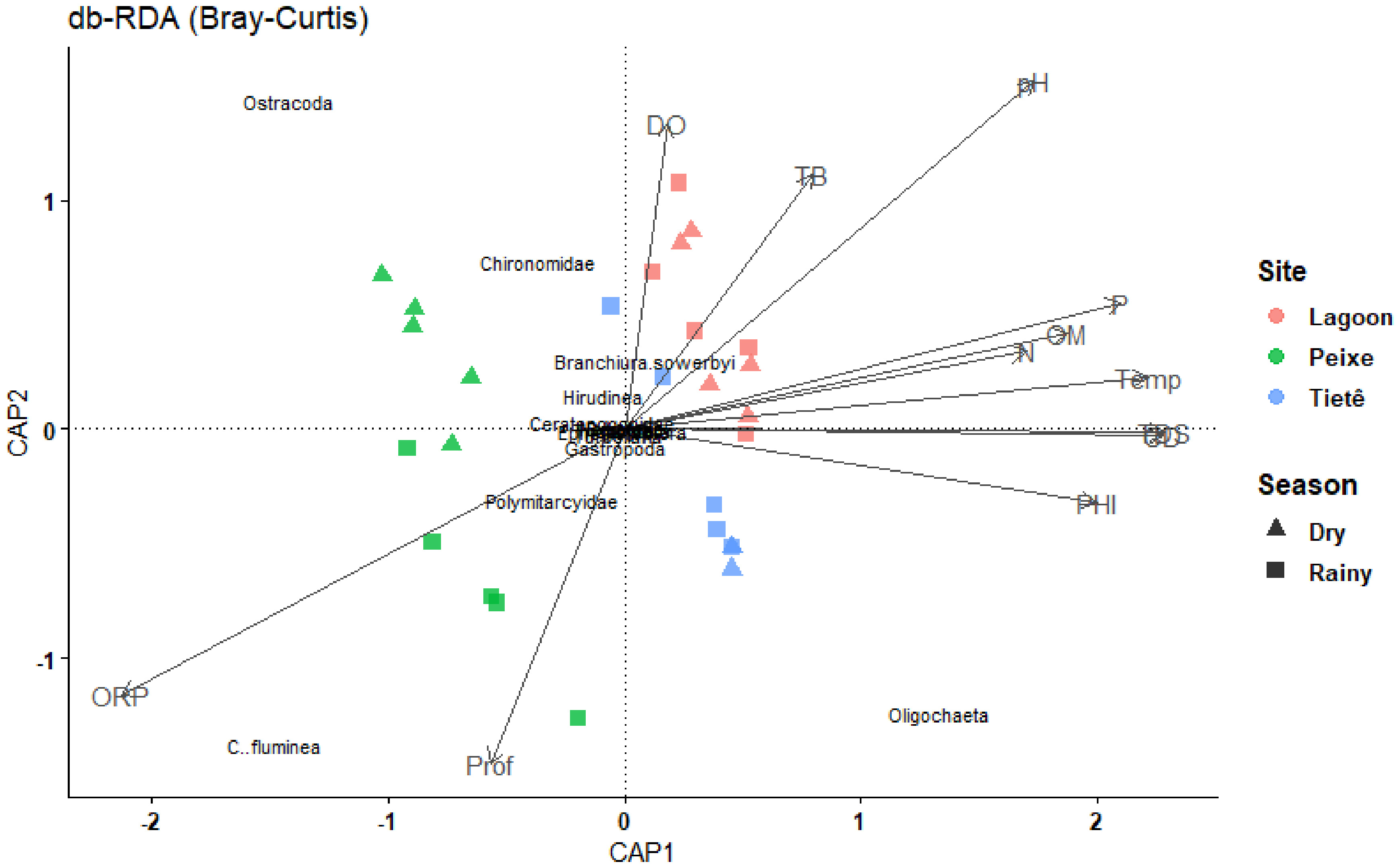
The db-RDA explained a substantial proportion of the variation in macroinvertebrate composition (R2 = 0.82; adjusted R2 = 0.70). The first two canonical axes were significant (CAP1: p = 0.001; CAP2: p = 0.003) (Figure 4).

Relationship between the distribution of benthic macroinvertebrates taxa and environmental variables in the middle Tietê basin selected sites (Tietê River, marginal lagoon and Peixe River), during the rainy and dry seasons. Ostrac: Ostracoda; C.flum: Corbicula fluminea; Oligo: Oligochaeta; Temp: Temperature; P: Phosphorus; N: Nitrogen.
Significant environmental predictors included total phosphorus (p = 0.001), Φ (p = 0.002), nitrogen (p = 0.010), temperature (p = 0.010), dissolved oxygen (p = 0.015), pH (p = 0.016), conductivity (p = 0.027), and organic matter (p = 0.049). ORP, turbidity, total dissolved solids, and depth were not significant (p > 0.05).
Axis 1 represented a gradient associated with nutrient enrichment and physicochemical changes, separating more impacted sites from less disturbed conditions. Oligochaeta were associated with higher nutrient concentrations, finer sediments, and higher temperatures.
4. Discussion
In the beginning of the 21st century the potential organic pollution load in the State of São Paulo was estimated in 1.5 million Kg DBO day-1, mainly based on the number of inhabitants (Martinelli et al., 2002). At that time, only 17% of the domestic sewage was treated, with an enormous remaining load of 1.24 million Kg DBO day-1 (Martinelli et al., 2002). After two decades, this pervasive condition, regionally or even for the entire continent, is still critical (Rivas et al., 2020).
The long-term pollution in the Tietê River is an example of the typical scenario of worldwide anthropogenic eutrophication (LeMoal et al., 2019; Tiwari and Pal, 2022). When compared to the low-impacted tributary (Peixe River) all limnological variables (except depth) showed statistical significantly difference, showing a clear state of degradation of the main river (e.g. higher nutrients and conductivity; lower dissolved oxygen), as well more organic and finer (silt/fine sand) sediments. Interesting differences were also seen between Tietê River and lagoon. The lentic system exhibited significantly higher values of dissolved oxygen and pH, particularly during the dry season, probably associated to intense phytoplankton metabolism. In a parallel study, Silva (2023) registered extremely high chlorophyll-a values (550 times higher compared to the Tietê and Peixe Rivers) in the marginal lagoon. Such high primary productivity can lead to oxygen supersaturation during the daytime (when our measurements were taken), masking uninterrupted degradation processes, such as organic enrichment and recurrent nighttime hypoxia (Nguyen et al., 2016; Zhang et al., 2026).
Eutrophication acts as a strong environmental filter on aquatic communities, including conspicuous biological simplifications in the benthic macroinvertebrates (Dong et al., 2023). This kind of impact restricts the presence of sensitive taxa, favoring a restrict group of tolerant and opportunistic ones, as the Oligochaeta (Rosa et al., 2022), tolerant to hypoxia and high organic loads (Fierro et al., 2017; Zhang et al., 2024). This process has been reported under a wide range of disturbed conditions, including severe pollution, toxic sediments, and oxygen depletion (Barrilli et al., 2021; Gao et al., 2023; HEß et al., 2024; Su et al., 2025).
In the present study, the near exclusion of more sensitive insect taxa, and prevalence of Oligochaeta in the Tietê River and its marginal lagoon, corroborate the environmental degradation showed by the limnological measurements. Reduced biota richness also affects key ecosystem processes, including nutrient cycling and trophic interactions, i.e., biodiversity loss in polluted systems is followed by functional impairment (Yang et al, 2024).
In contrast, the better environmental condition of Peixe River supports a more structured and diverse macroinvertebrate community. The occurrence of the semi-sensitive taxa Polymitarcyidae (Ephemeroptera), for instance, is indicative of well-oxygenated and less disturbed habitats (Gargiulo et al., 2016; CETESB, 2023). The macroinvertebrates results for the tributary evidences its importance for the conservation of regional aquatic biodiversity. Studies on fish communities, for instance, has demonstrated the great importance of low-impacted tributaries as biodiversity refuges within impacted large river basins of the upper Paraná region (Vianna and Nogueira, 2008; Marques et al. 2018; Urbanski and Nogueira, 2024).
The high abundance of the bivalve Corbicula fluminea in the Peixe River is also a distinctive macroinvertebrate characteristic. This invasive species has a wide ecological tolerance and dispersal capacity (Vianna and Avelar, 2010) and is commonly found in high abundance in unpolluted rivers of the upper Paraná basin (Jorcin and Nogueira, 2008; Jorcin et al., 2009). The absence in the Tietê River and marginal lagoon suggests that the species is intolerant to extreme eutrophic conditions, as high concentration of particulate loads can negatively affect the filter-feeding bivalves (Arruda et al., 2003). In addition to water quality stressors, physical characteristics of the habitat, such as sediment texture (coarser in Peixes River), can also be influential in structuring benthic assemblages (Larsen et al., 2010).
It is well reported that floodplain habitats are typically characterized as biodiversity-rich ecotones and nursery sites, where hydrological connectivity promotes species exchange and ecological diversification (Tockner et al., 2000; Davanso and Henry, 2006; Thomaz et al., 2006; Ferrareze and Nogueira, 2011; Chanut et al., 2019; Osório and Rodrigues, 2021). However, this assumption seems not to apply to the Tietê River marginal lagoon, where the macroinvertebrate structure is simplified, similar to the one found in the main river channel. Instead of promoting ecological diversification, the highly polluted Tietê lagoon promotes environmentally poor homogenization.
Despite the similarities of the macroinvertebrate community’s structure, temporal fluctuations were more pronounced in the marginal lagoon, compared to the Tietê River. In the lagoon the total density was three times higher in the rainy season, while in the river variation was minimum. Higher richness and densities in the lagoon during the rainy season can be attributed to the combined effects of hydrological pulses and retention processes, usual in marginal environments (Wohl, 2021). Increased connectivity during flood periods enhances the input of nutrients, fine sediments, and organic matter, favoring opportunistic taxa (Dornfeld et al., 2006). As detritivorous organisms, predominantly, the Oligochaeta benefit from enhanced organic matter availability (Brinkhurst and Austin, 1979), taking to a rapid population growth, as observed in our study.
The exclusive occurrence of the Oligochaeta Branchiura sowerbyi in the marginal lagoon is another evidence that supports the role of local environmental conditions in structuring communities. This species, widely recognized as an indicator of organic enrichment, has been reported for other lentic/semi-lentic environments (hydropower reservoirs) of the Tietê River basin (Pamplin and Rocha, 2007; Suriani et al., 2007).
The importance of the environmental filters was further corroborated through the db-RDA results, which identified nutrient concentrations, sediment grain size, temperature, and dissolved oxygen as key drivers of community composition. These findings highlight the combined influence of water quality and substrate characteristics in shaping species distribution. The strong association between Oligochaeta and nutrient-rich, fine-sediment highlight the role of eutrophication and active sedimentation processes in the selection of simplified assemblages.
Flow regime variability usually has a determinant influence on the macroinvertebrate dynamics (Monk et al., 2008). In case of the middle Tietê River basin, despite the fact that seasonal variation influenced several environmental variables, its effect on community structure was secondary, in relation to the spatial organization (different sites). This suggests that the chronic pollution of Tietê acts as a continuous factor of disturbance that prevails over the effects of seasonal hydrological fluctuations. In urbanized watersheds, rainfall events can intensify pollutant inputs, particularly during initial runoff (Lee et al., 2004), while subsequent increases in water volume may promote dilution. In the Tietê River, intense rainfall events have been associated with transitory severe deterioration of water quality (SOS Mata Atlântica, 2015) (kilometers of black spot in metropolitan São Paulo). The deleterious effects of the downstream displacement of this massive pollution load still need proper evaluation.
5. Conclusion
This study demonstrates that chronic eutrophication in the Tietê River basin leads to profound alterations in benthic macroinvertebrate communities, characterized by reduced diversity, strong dominance of tolerant taxa, and simplified community structure.
The contrast between the degraded Tietê River and the relatively preserved Peixe River highlights the importance of low-impacted tributaries (pristine ones no longer exist), as biodiversity refuges in disturbed large river basins. The results also reveal that under persistent pollution, marginal lagoons may lose their prominent ecological function, as diversified and nursery habitats and instead act as zones of degradation, accumulating nutrients and excessive organic matter.
Efforts to restore ecological integrity in large river systems must consider reductions in nutrient/pollutants inputs (sanitation measures), in order to improve the water quality along the main channel. Nevertheless, associated habitats, such as marginal lagoons and tributaries, should not be neglected in long-term management perspectives, due to their critical role to reestablish sound ecological processes and recover the regional biodiversity.
Supplementary Material
Supplementary material accompanies this paper.
Table S1
.
Table S2
Table S3
Table S4
This material is available as part of the online article from https://doi.org/10.1590/1519-6984.302978
Acknowledgements
We thank all members of the Laboratório de Ecologia de Águas Continentais (LEAC) for their valuable assistance during the field and laboratory work; to Adriana Jorcin for her support in the identification of macroinvertebrates. We also thank Limnética Consultancy for logistical support. This study was financed by the Coordenação de Aperfeiçoamento de Pessoal de Nível Superior (CAPES), Brazil (proc. 88887.903465/2023-00).
Data Availability Statement
All relevant data are fully included within the main text and tables (including supplementary material) of the manuscript.
References
-
AKINNAWO, S.O., 2023. Eutrophication: causes, consequences, physical, chemical and biological techniques for mitigation strategies. Environmental Challenges, vol. 12, pp. 100733. https://doi.org/10.1016/j.envc.2023.100733
» https://doi.org/10.1016/j.envc.2023.100733 -
ALLAN, J.D., CASTILLO, M.M. and CAPPS, K.A., 2021. Stream ecology: structure and function of running waters. Cham: Springer Nature. https://doi.org/10.1007/978-3-030-61286-3
» https://doi.org/10.1007/978-3-030-61286-3 - AMERICAN PUBLIC HEALTH ASSOCIATION – APHA, 2017. Standard Methods for the Examination of Water and Wastewater. 23rd ed. Washington, DC: American Public Health Association, 1546 p.
-
ANDERSEN, J., 1976. An ignition method for determination of total phosphorus in lake sediments. Water Research, vol. 10, no. 4, pp. 329-331. https://doi.org/10.1016/0043-1354(76)90175-5
» https://doi.org/10.1016/0043-1354(76)90175-5 -
ANSARI, A.A. and GILL, S.S., 2013. Eutrophication: causes, consequences and control Dordrecht: Springer. https://doi.org/10.1007/978-90-481-9625-8
» https://doi.org/10.1007/978-90-481-9625-8 -
ARRUDA, E.P., DOMANESCHI, O. and AMARAL, A.C.Z., 2003. Mollusc feeding guilds on sandy beaches in São Paulo State Brazil. Marine Biology, vol. 143, no. 4, pp. 691-701. https://doi.org/10.1007/s00227-003-1103-y
» https://doi.org/10.1007/s00227-003-1103-y -
BARBOSA, F.A.R., CALLISTO, M. and GALDEAN, N., 2001. The diversity of benthic macroinvertebrates as an indicator of water quality and ecosystem health: a case study for Brazil. Aquatic Ecosystem Health & Management, vol. 4, no. 1, pp. 51-59. https://doi.org/10.1080/146349801753569270
» https://doi.org/10.1080/146349801753569270 - BARRETO, L.V., BARROS, F.M., BONOMO, P., ROCHA, F.A. and AMORIM, J.S., 2013. Eutrofização em rios brasileiros. Enciclopédia Biosfera Centro Científico Conhecer, vol. 9, pp. 2165-2179.
-
BARRILLI, G.H.C., NEGREIROS, N.F., ROCHA, O. and VERANI, J.R., 2021. Macroinvertebrates responses based on chemical and physical variables in urban streams. Papéis Avulsos de Zoologia, vol. 61, pp. e20216183. https://doi.org/10.11606/1807-0205/2021.61.83
» https://doi.org/10.11606/1807-0205/2021.61.83 -
BRINKHURST, R.O. and AUSTIN, M.J., 1979. Assimilation by aquatic oligochaeta. Internationale Revue der Gesamten Hydrobiologie, vol. 64, no. 2, pp. 245-250. https://doi.org/10.1002/iroh.19790640209
» https://doi.org/10.1002/iroh.19790640209 -
BUCKERIDGE, M. and RIBEIRO, W.C. 2018. Livro branco da água. A crise hídrica na Região Metropolitana de São Paulo em 2013-2015: origens, impactos e soluções. São Paulo: Universidade de São Paulo, Instituto de Estudos Avançados. https://doi.org/10.11606/9788563007094
» https://doi.org/10.11606/9788563007094 -
CARPENTER, S.R., 2008. Phosphorus control is critical to mitigating eutrophication. Proceedings of the National Academy of Sciences of the United States of America, vol. 105, no. 32, pp. 11039-11040. https://doi.org/10.1073/pnas.0806112105 PMid:18685114.
» https://doi.org/10.1073/pnas.0806112105 -
CHANUT, P.C.M., DATRY, T., GABBUD, C. and ROBINSON, C.T., 2019. Direct and indirect effects of flood regime on macroinvertebrate assemblages in a floodplain riverscape. Ecohydrology, vol. 12, no. 5, pp. e2095. https://doi.org/10.1002/eco.2095
» https://doi.org/10.1002/eco.2095 -
CLARKE, A., MAC NALLY, R., BOND, N. and LAKE, P.S., 2008. Macroinvertebrate diversity in headwater streams: a review. Freshwater Biology, vol. 53, no. 9, pp. 1707-1721. https://doi.org/10.1111/j.1365-2427.2008.02041.x
» https://doi.org/10.1111/j.1365-2427.2008.02041.x -
COAYLA-PEÑALOZA, P., CHENEAUX-DIAZ, A.A., MORENOSALAZAR, C.V., CRUZ-REMACHE, C.E. and DAMBORENEA, C., 2024. Aquatic macroinvertebrate community and water quality in River Tambo, Arequipa region, Peru. Revista de Biología Tropical, vol. 72, no. 1, pp. e56670. https://doi.org/10.15517/rev.biol.trop..v72i1.56670
» https://doi.org/10.15517/rev.biol.trop..v72i1.56670 -
COMPANHIA AMBIENTAL DO ESTADO DE SÃO PAULO – CETESB, 2023 [viewed 19 November 2025]. Qualidade das águas interiores no estado de São Paulo 2022 [online]. São Paulo: CETESB, 95 p. Available from: https://cetesb.sp.gov.br/aguas-interiores/publicacoes-e-relatorios/
» https://cetesb.sp.gov.br/aguas-interiores/publicacoes-e-relatorios/ -
COSTA, J.A., SOUZA, J.P., TEIXEIRA, A.P., NABOUT, J.C. and CARNEIRO, F.M., 2018. Eutrophication in aquatic ecosystems: a scientometric study. Acta Limnologica Brasiliensia, vol. 30, no. 0. https://doi.org/10.1590/s2179-975x3016
» https://doi.org/10.1590/s2179-975x3016 -
DAVANSO, R.C.S. and HENRY, R., 2006 [viewed 19 November 2025]. A biodiversidade bentônica em lagoa marginal ao rio Paranapanema na zona de sua desembocadura, na represa de Jurumirim [online]. Acta Scientiarum. Biological Sciences, vol. 28, no. 4, pp. 347-357. Available from: https://www.redalyc.org/articulo.oa?id=187115766006
» https://www.redalyc.org/articulo.oa?id=187115766006 -
DONG, R., PENG, K., ZHANG, Q., HEINO, J., CAI, Y. and GONG, Z., 2023. Spatial and temporal variation in lake macroinvertebrate communities is decreased by eutrophication. Environmental Research, vol. 243, pp. 117872. https://doi.org/10.1016/j.envres.2023.117872 PMid:38086502.
» https://doi.org/10.1016/j.envres.2023.117872 - DORNFELD, C.B., ALVES, R.G., LEITE, M.A. and ESPINDOLA, E.L.G., 2006. Oligochaeta in eutrophic reservoir: the case of Salto Grande reservoir and their main affluent(Americana, Sao Paulo, Brazil). Acta Limnologica Brasiliensia, vol. 18, no. 2, pp. 189-197.
-
FERRAREZE, M. and NOGUEIRA, M.G., 2011. Importance of lateral lagoons for the ichthyofauna in a large tropical reservoir. Brazilian Journal of Biology, vol. 71, no. 4, pp. 807-820. https://doi.org/10.1590/S1519-69842011000500002
» https://doi.org/10.1590/S1519-69842011000500002 -
FIERRO, P., BERTRÁN, C., TAPIA, J., HAUENSTEIN, E., PEÑA-CORTÉS, F., VERGARA, C., CERNA, C. and VARGAS-CHACOFF, L., 2017. Effects of local land-use on riparian vegetation, water quality, and the functional organization of macroinvertebrate assemblages. The Science of the Total Environment, vol. 609, pp. 724-734. https://doi.org/10.1016/j.scitotenv.2017.07.197 PMid:28763669.
» https://doi.org/10.1016/j.scitotenv.2017.07.197 -
GAO, Q., ZHANG, Q., ZENG, J., YIN, Z., LIU, J., LIU, G. and PENG, M., 2023. Macroinvertebrate community structure, pollution tolerance, diversity and feeding functional groups in polluted urban rivers under different black and odorous levels. Ecological Indicators, vol. 156, pp. 111148. https://doi.org/10.1016/j.ecolind.2023.111148
» https://doi.org/10.1016/j.ecolind.2023.111148 -
GARGIULO, J.R.B.C., MERCANTE, C.T.J., BRANDIMARTE, A.L. and MENEZES, L.C.B.D., 2016. Benthic macroinvertebrates as bioindicators of water quality in Billings Reservoir fishing sites (SP, Brazil). Acta Limnologica Brasiliensia, vol. 28, no. 0, pp. e17. https://doi.org/10.1590/S2179-975X2315
» https://doi.org/10.1590/S2179-975X2315 -
HÅKANSON, L. and JANSSON, M. , 1983. Principles of lake sedimentology. Caldwell: Blackburn Press. https://doi.org/10.1007/978-3-642-69274-1
» https://doi.org/10.1007/978-3-642-69274-1 -
HARPER, D., 1992. Eutrophication of freshwaters. London: Chapman and Hall. https://doi.org/10.1007/978-94-011-3082-0
» https://doi.org/10.1007/978-94-011-3082-0 -
HEß, S., HOF, D., OETKEN, M. and SUNDERMANN, A., 2024. Macroinvertebrate communities respond strongly but non-specifically to a toxicity gradient derived by effect-based methods. Environmental Pollution, vol. 356, pp. 124330. https://doi.org/10.1016/j.envpol.2024.124330 PMid:38848961.
» https://doi.org/10.1016/j.envpol.2024.124330 -
HWANG, S.J., 2020. Eutrophication and the ecological health risk. International Journal of Environmental Research and Public Health, vol. 17, no. 17, pp. 6332. https://doi.org/10.3390/ijerph17176332 PMid:32878106.
» https://doi.org/10.3390/ijerph17176332 -
JORCIN, A. and NOGUEIRA, M., 2008. Benthic macroinvertebrates in the Paranapanema reservoir cascade (southeast Brazil). Brazilian Journal of Biology. Brazilian Journal of Biology, vol. 68, no. 4, pp. 1013-1024. https://doi.org/10.1590/S1519-69842008000500009 PMid:19197472.
» https://doi.org/10.1590/S1519-69842008000500009 -
JORCIN, A., NOGUEIRA, M. and BELMONT, R., 2009. Spatial and temporal distribution of the zoobenthos community during the filling up period of Porto Primavera Reservoir (Paraná River, Brazil). Brazilian Journal of Biology. Brazilian Journal of Biology, vol. 69, no. 1, pp. 19-29. https://doi.org/10.1590/S1519-69842009000100003 PMid:19347142.
» https://doi.org/10.1590/S1519-69842009000100003 -
LARSEN, S., PACE, G. and ORMEROD, S.J., 2010. Experimental effects of sediment deposition on the structure and function of macroinvertebrate assemblages in temperate streams. River Research and Applications. River Research and Applications, vol. 27, no. 2, pp. 257-267. https://doi.org/10.1002/rra.1361
» https://doi.org/10.1002/rra.1361 -
LE MOAL, M., GASCUEL-ODOUX, C., MÉNESGUEN, A., SOUCHON, Y., ÉTRILLARD, C., LEVAIN, A., MOATAR, F., PANNARD, A., SOUCHU, P., LEFEBVRE, A. and PINAY, G., 2019. Eutrophication: a new wine in an old bottle? The Science of the Total Environment, vol. 651, no. Pt 1, pp. 1-11. https://doi.org/10.1016/j.scitotenv.2018.09.139 PMid:30223216.
» https://doi.org/10.1016/j.scitotenv.2018.09.139 -
LEE, H., LAU, S.L., KAYHANIAN, M. and STENSTROM, M.K., 2004. Seasonal first flush phenomenon of urban stormwater discharges. Water Research, vol. 38, no. 19, pp. 4153-4163. https://doi.org/10.1016/j.watres.2004.07.012 PMid:15491663.
» https://doi.org/10.1016/j.watres.2004.07.012 -
LINARES, M.S., MACEDO, D.R., HUGHES, R.M. and CALLISTO, M., 2024. City bug, country bug: how do benthic macroinvertebrate assemblages respond to an urbanization gradient taxonomically and functionally?Water Biology and Security. Online (Bergheim), vol. 4, no. 3, pp. 100343. https://doi.org/10.1016/j.watbs.2024.100343
» https://doi.org/10.1016/j.watbs.2024.100343 -
LOPRETTO, E.C. and TELL, G. 1995 [viewed 19 November 2025]. Ecosistemas de aguas continentales: metodologías para su estudio [online]. Available from: https://naturalis.fcnym.unlp.edu.ar/handle/628872547/52913
» https://naturalis.fcnym.unlp.edu.ar/handle/628872547/52913 -
MADUREIRA, K.H., FERREIRA, V. and CALLISTO, M., 2024. Rehabilitation of tropical urban streams improves their structure and functioning. The Science of the Total Environment, vol. 926, pp. 171935. https://doi.org/10.1016/j.scitotenv.2024.171935 PMid:38527547.
» https://doi.org/10.1016/j.scitotenv.2024.171935 -
MARCHESE, M.R., ALVES, R.G., OCEGUERA-FIGUEROA, A., GLASBY, C.J., GIL, J., MARTIN, D., TIM, T., GELDER, S.R. and DAMBORENEA, C., 2020. Phylum Annelida. In: D. CHRISTOPHER ROGERS, C. DAMBORENEA and J. THORP, eds.Thorp and Covich’s Freshwater Invertebrates London: Academic Press, pp. 431-486.. https://doi.org/10.1016/B978-0-12-804225-0.00012-5
» https://doi.org/10.1016/B978-0-12-804225-0.00012-5 -
MARIANO, G., MAGRO, C., URBANSKI, B.Q. and NOGUEIRA, M.G., 2025. Microplastic contamination in the highly polluted Tietê River (São Paulo, Brazil): an unsustainable human-nature relationship. Environmental Monitoring and Assessment, vol. 197, no. 4, pp. 387. https://doi.org/10.1007/s10661-025-13829-6 PMid:40074977.
» https://doi.org/10.1007/s10661-025-13829-6 -
MARQUES, H., DIAS, J.H.P., PERBICHE-NEVES, G., KASHIWAQUI, E.A.L. and RAMOS, I.P., 2018. Importance of dam-free tributaries for conserving fish biodiversity in Neotropical reservoirs. Biological Conservation, vol. 224, pp. 347-354. https://doi.org/10.1016/j.biocon.2018.05.027
» https://doi.org/10.1016/j.biocon.2018.05.027 -
MARTINELLI, L.A., SILVA, A.M., CAMARGO, P.B., MORETTI, L.R., TOMAZELLI, A.C., SILVA, D.M.L., FISCHER, E.G., SONODA, K.C. and SALOMÃO, M.S.M.B., 2002. Levantamento das cargas orgânicas lançadas nos rios do estado de São Paulo. Biota Neotropica, vol. 2, no. 2, pp. 1-18. https://doi.org/10.1590/S1676-06032002000200006
» https://doi.org/10.1590/S1676-06032002000200006 -
MONK, W.A., WOOD, P.J., HANNAH, D.M. and WILSON, D.A., 2008. Macroinvertebrate community response to inter‐annual and regional river flow regime dynamics. River Research and Applications, vol. 24, no. 7, pp. 988-1001. https://doi.org/10.1002/rra.1120
» https://doi.org/10.1002/rra.1120 -
MORAES, N.G., OLIVATTO, G.P., DE OLIVEIRA LOURENÇO, F.M., LOURENÇO, A.L.A., GARCIA, G.M., PIMPINATO, R.F. and TORNISIELO, V.L., 2024. Contamination by microplastics and sorbed organic pollutants in the surface waters of the Tietê River, São Paulo-SP, Brazil. Heliyon, vol. 10, no. 16, pp. e36047. https://doi.org/10.1016/j.heliyon.2024.e36047 PMid:39224265.
» https://doi.org/10.1016/j.heliyon.2024.e36047 - MUGNAI, R., NESSIMIAN, J.L. and BAPTISTA, D.F., 2010. Manual de identificação de macroinvertebrados aquáticos do Estado do Rio de Janeiro: para atividades técnicas, de ensino e treinamento em programas de avaliação da qualidade ecológica dos ecossistemas lóticos. Rio de Janeiro: Technical Books Editora.
-
NGUYEN, D.V., NGUYEN, A.B. and HOANG, T.H., 2016 [viewed 19 November 2025]. Dissolved oxygen as an indicator for eutrophication in freshwater lakes [online]. In Proceedings of International Conference on Environmental Engineering and Management for Sustainable Development Available from: http://hdl.handle.net/1854/LU-01HF3VE41JR69HSG6THXVP8BVS
» http://hdl.handle.net/1854/LU-01HF3VE41JR69HSG6THXVP8BVS -
NICOLA, G.G., ALMODÓVAR, A. and ELVIRA, B., 2010. Effects of environmental factors and predation on benthic communities in headwater streams. Aquatic Sciences, vol. 72, no. 4, pp. 419-429. https://doi.org/10.1007/s00027-010-0145-8
» https://doi.org/10.1007/s00027-010-0145-8 -
OSÓRIO, N.C. and RODRIGUES, L., 2021. Upper Paraná River floodplain: synthesizing knowledge over time. Acta Limnologica Brasiliensia, vol. 33, pp. e103. https://doi.org/10.1590/s2179-975x9420
» https://doi.org/10.1590/s2179-975x9420 - PAMPLIN, P.A.Z. and ROCHA, O., 2007. Temporal and bathymetric distribution of benthic macroinvertebrates in the Ponte Nova Reservoir‚ Tietê river (São Paulo‚ Brazil). Acta Limnologica Brasiliensia, vol. 19, no. 4, pp. 439.
- PEREIRA, D., MANSUR, M.C.D. and PIMPÃO, D.M., 2012. Identificação e diferenciação dos bivalves límnicos invasores dos demais bivalves nativos do Brasil. In: M.C.D MANSUR, ed. Moluscos límnicos invasores no Brasil: biologia, prevenção e controle. Porto Alegre: Redes Editora, pp. 75-94.
-
REDDY, V., CUNHA, D. and KURIAN, M., 2018. A Water–Energy–Food nexus perspective on the challenge of eutrophication. Water (Basel), vol. 10, no. 2, pp. 101. https://doi.org/10.3390/w10020101
» https://doi.org/10.3390/w10020101 -
RIVAS, E.J.G., PÉREZ, G.R., TUNDISI, J.G., VAMMEN, K., ÖRMECI, B. and FORDE, M., 2020. Eutrophication: a growing problem in the Americas and the Caribbean. Brazilian Journal of Biology, vol. 80, no. 3, pp. 688-689. https://doi.org/10.1590/1519-6984.200001 PMid:32696849.
» https://doi.org/10.1590/1519-6984.200001 -
RODGHER, S., ESPÍNDOLA, E.L.G., ROCHA, O., FRACÁCIO, R., PEREIRA, R.H.G. and RODRIGUES, M.H.S., 2005. Limnological and ecotoxicological studies in the cascade of reservoirs in the Tietê river (São Paulo, Brazil). Brazilian Journal of Biology, vol. 65, no. 4, pp. 697-710. https://doi.org/10.1590/S1519-69842005000400017 PMid:16532194.
» https://doi.org/10.1590/S1519-69842005000400017 -
ROSA, J., DE OLIVEIRA, F.R., PEREIRA, L.F., DE MELO SILVA, M. and DE DEUS BUENO-KRAWCZYK, A.C., 2022. Temporal variation in Oligochaeta species composition in an anthropized stretch of a Neotropical urban river.International Journal of Limnology. Online (Bergheim), vol. 58, pp. 6. https://doi.org/10.1051/limn/2022006
» https://doi.org/10.1051/limn/2022006 - ROSENBERG, D.M. and RESH, V.H., 1994. Freshwater biomonitoring and benthic macroinvertebrates New York: Chapman and Hall.
-
SANTIAGO, L. and BEASLEY, C.R., 2023. Benthic macroinvertebrates associated with riparian habitat structural diversity in an eastern amazon stream urbanization gradient. Floresta e Ambiente, vol. 30, no. 3, pp. e20220092. https://doi.org/10.1590/2179-8087-floram-2022-0092
» https://doi.org/10.1590/2179-8087-floram-2022-0092 -
SCHINDLER, D.W., CARPENTER, S.R., CHAPRA, S.C., HECKY, R.E. and ORIHEL, D.M., 2016. Reducing phosphorus to curb lake eutrophication is a success. Environmental Science & Technology, vol. 50, no. 17, pp. 8923-8929. https://doi.org/10.1021/acs.est.6b02204 PMid:27494041.
» https://doi.org/10.1021/acs.est.6b02204 -
SILVA, F.L., FUSHITA, Â.T., DA CUNHA-SANTINO, M.B. and BIANCHINI, I., 2022. Adopting basic quality tools and landscape analysis for applied limnology: an approach for freshwater reservoir management. Sustainable Water Resources Management, vol. 8, no. 3, pp. 65. https://doi.org/10.1007/s40899-022-00655-8
» https://doi.org/10.1007/s40899-022-00655-8 - SILVA, G.M., 2023. Efeito da poluição de uma megalópole sobre o zooplâncton e a contaminação por microplásticos no médio rio Tietê (SP) Botucatu: Universidade Estadual Paulista, Instituto de Biociências. Dissertação de Mestrado em Zoologia.
-
SOS MATA ATLÂNTICA, 2015 [viewed 19 November 2025]. Observando o Tietê: O retrato da qualidade da água e a evolução dos indicadores de impacto do Projeto Tietê [online]. Available from: https://cms.sosma.org.br/wp-content/uploads/2015/09/relatorio-Tiete-2015_OK.pdf
» https://cms.sosma.org.br/wp-content/uploads/2015/09/relatorio-Tiete-2015_OK.pdf -
SOS MATA ATLÂNTICA, 2025 [viewed 19 November 2025]. Observando o Tietê 2025: relatório de monitoramento da qualidade da água do rio Tietê [online]. Accessed from: https://www.sosma.org.br/sobre/relatorios-e-balancos
» https://www.sosma.org.br/sobre/relatorios-e-balancos -
SOS MATA ATLÂNTICA, 2026 [viewed 19 November 2025]. Observando os Rios 2026: o retrato da qualidade da água nas bacias da Mata Atlântica [online]. Accessed from: https://www.sosma.org.br/sobre/relatorios-e-balancos
» https://www.sosma.org.br/sobre/relatorios-e-balancos -
SU, L., RUAN, W., OU, T., ZHANG, J., DAI, Y., TAO, R., ZHANG, X., TAM, N.F.Y., YANG, Y. and TAI, Y., 2025. Responses and influencing factors of benthic macroinvertebrate recovery in restored subtropical urban rivers. Ecological Engineering, vol. 219, pp. 107687. https://doi.org/10.1016/j.ecoleng.2025.107687
» https://doi.org/10.1016/j.ecoleng.2025.107687 - SURIANI, A.L., FRANÇA, R.S., PAMPLIN, P.A.Z., MARCHESE, M., LUCCA, J.V. and ROCHA, O., 2007. Species richness and distribution of oligochaetes in six reservoirs on Middle and Low Tietê River (SP, Brazil). Acta Limnologica Brasiliensia, vol. 19, no. 4, pp. 415-426.
-
THOMAZ, S.M., BINI, L.M. and BOZELLI, R.L., 2006. 2007. Floods increase similarity among aquatic habitats in river-floodplain systems.Hydrobiologia. Hydrobiologia, vol. 579, no. 1, pp. 1-13. https://doi.org/10.1007/s10750-006-0285-y
» https://doi.org/10.1007/s10750-006-0285-y - THORP, J.H. and ROGERS, D.C., 2014.Thorp and Covich’s freshwater invertebrates: ecology and general biology. London: Academic Press.
-
TIWARI, A.K. and PAL, D.B., 2022. Nutrients contamination and eutrophication in the river ecosystem. In: S. Madhav, S. Kanhaiya, A. Lal Srivastav, V. B. Singh and P. Singh, editors. Ecological significance of river ecosystems: challenges and management strategies.Amsterdam: Elsevier. p. 203-216. https://doi.org/10.1016/B978-0-323-85045-2.00001-7
» https://doi.org/10.1016/B978-0-323-85045-2.00001-7 -
TOCKNER, K., MALARD, F. and WARD, J.V., 2000. An extension of the flood pulse concept. Hydrological Processes, vol. 14, no. 16–17, pp. 2861-2883. https://doi.org/10.1002/1099-1085(200011/12)14:16/17<2861::AID-HYP124>3.0.CO;2-F
» https://doi.org/10.1002/1099-1085(200011/12)14:16/17<2861::AID-HYP124>3.0.CO;2-F - TRIVINHO-STRIXINO, S., 2011. Larvas de Chironomidae: guia de identificação.São Carlos: UFSCar.
-
TUNDISI, J.G., MATSUMURA-TUNDISI, T. and ABE, D., 2008. The ecological dynamics of Barra Bonita (Tietê River, SP, Brazil) reservoir: implications for its biodiversity. Brazilian Journal of Biology, vol. 68, no. 4, (suppl.), pp. 1079-1098. https://doi.org/10.1590/S1519-69842008000500015 PMid:19197478.
» https://doi.org/10.1590/S1519-69842008000500015 -
URBANSKI, B. and NOGUEIRA, M.G., 2024. Excessive eutrophication as a chemical barrier for fish fauna dispersion: a case study in the emblematic Tietê River (São Paulo, Brazil). Water (Basel), vol. 16, no. 10, pp. 1383. https://doi.org/10.3390/w16101383
» https://doi.org/10.3390/w16101383 -
VIANNA, M.P. and AVELAR, W.E.P., 2010 [viewed 19 November 2025]. Ocorrência da espécie invasora Corbicula fluminea (Bivalvia, Corbiculidae) no rio Sapucaí (São Paulo, Brasil) [online]. Biotemas, vol. 23, no. 3, pp. 59-66. Available from: https://dialnet.unirioja.es/servlet/articulo?codigo=9908899
» https://dialnet.unirioja.es/servlet/articulo?codigo=9908899 - VIANNA, N.C. and NOGUEIRA, M.G., 2008. Ichthyoplankton and limnological factors in the Cinzas River-an alternative spawning site for fishes in the middle Paranapanema River basin, Brazil. Acta Limnologica Brasiliensia, vol. 20, no. 2, pp. 139-151.
-
VÖRÖSMARTY, C.J., MCINTYRE, P.B., GESSNER, M.O., DUDGEON, D., PRUSEVICH, A., GREEN, P., GLIDDEN, S., BUNN, S.E., SULLIVAN, C.A., LIERMANN, C. and DAVIES, P.M., 2010. Global threats to human water security and river biodiversity. Nature, vol. 467, no. 7315, pp. 555-561. https://doi.org/10.1038/nature09440 PMid:20882010.
» https://doi.org/10.1038/nature09440 -
WOHL, E., 2021. An integrative conceptualization of floodplain storage. Reviews of Geophysics, vol. 59, no. 2, pp. e202000724. https://doi.org/10.1029/2020RG000724
» https://doi.org/10.1029/2020RG000724 -
YANG, P., JIANG, X., XIE, Z. and HEINO, J., 2024. Eutrophication is better indicatedby functional traits than taxonomic composition of macroinvertebrate assemblages in floodplain lakes.Biodiversity and Conservation. Online (Bergheim), vol. 33, no. 14, pp. 4257-4274. https://doi.org/10.1007/s10531-024-02950-6
» https://doi.org/10.1007/s10531-024-02950-6 -
ZHANG, D., ZHANG, W., WANG, W. and SHAN, B., 2026. Widespread dissolved oxygen supersaturation in Chinese warming lakes. Environmental Research, vol. 297, pp. 124145. https://doi.org/10.1016/j.envres.2026.124145 PMid:41765313.
» https://doi.org/10.1016/j.envres.2026.124145 -
ZHANG, M., SHANG, G. and DING, S., 2024. Community structural and functional features of benthic macroinvertebrates in a Cascade-Dams river. Diversity, vol. 16, no. 12, pp. 772. https://doi.org/10.3390/d16120772
» https://doi.org/10.3390/d16120772
Edited by
-
Editor:
Takako Matsumura Tundisi