 First record of Crepidobothrium sp. (Cestoda, Proteocephalidae) in Bothrops atrox (Serpentes, Viperidae) in Amazonian Brazil
Abstract
The objective of this study was to document the infection by cestodes Crepidobothrium sp. in Bothrops atrox, which are from the Tapajós National Forest, located in the western part of Pará state, Brazil. Thirty-six specimens of B. atrox were examined, of which 13 individuals (36%) were infected by Crepidobothrium sp. and a total of 147 parasites were collected from these hosts. The mean abundance of these endoparasites was 4.1 and the mean infection intensity was 11.3. In relation to parasitic infection sites, 88.4% of these cestodes were found in the small intestine, 9.52% in the large intestine and 2% in the stomach of the hosts. This was the first report of Crepidobothrium sp. in B. atrox in the Brazilian Amazon.
Keywords:
endoparasites; jararaca; amazonian snake
Resumo
O objetivo deste estudo foi registrar infecção por cestoides Crepidobothrium sp. em Bothrops atrox, as quais são provenientes da floresta Nacional do Tapajós, localizada no oeste do estado do Pará, Brasil. Foram examinados 36 espécimes de B. atrox, dos quais 13 indivíduos (36%) estavam infectados por Crepidobothrium sp. e um total de 147 parasitos foram coletados desses hospedeiros. A abundância média desses endoparasitos foi de 4,1 e intensidade média de infecção de 11,3. Em relação aos sítios de infecção parasitária, 88,4% destes cestoides foram encontrados no intestino delgado, 9,52% no intestino grosso e 2% no estômago dos hospedeiros. Este foi o primeiro relato de Crepidobothrium sp. em B. atrox na Amazônia brasileira.
Palavras-chave:
endoparasitas; jararaca; cobra amazônica
1. Introduction
Tapeworms belong to the monophyletic group of flatworms, which are obligate endoparasites of vertebrates inhabit the digestive tract of hosts such as birds, mammals and elasmobranchs (Caira and Jensen, 2017). Cestodes comprise the second most diverse group of flatworms in terms of species, with more than 5,000 species, distributed in 751 currently recognized genera, and are found in hosts of terrestrial, marine and freshwater environments (Waeschenbach et al., 2012; Caira and Littlewood, 2013). The life cycle of tapeworms can involve diverse intermediate hosts that are transmitted exclusively through the diet of the hosts, generally within a wide variety of animal phyla, mainly arthropod species (Caira and Littlewood, 2013; Littlewood et al., 2015).
The most notable group of tapeworms in snakes belongs to the family Proteocephalidae La Rue, 1911, found in diverse of Old and New World hosts (Freze, 1965; Rego, 1994; Ernst, 2006). Within this family, the genus Crepidobothrium Monticelli, 1900 has been identified as parasitizing only South American snakes (Rego, 1994). Tapeworms Crepidobothrium gerrardii Baird, 1860 have been recorded parasitizing snakes of the families Boidae such as Eunectes murinus Linnaeus, 1758 in Venezuela and Boa constrictor Linnaeus, 1758 in Belém municipality, Brazil, as well as viperidae Bothrops jararaca Wied, 1824 in state of Bahia, Brazil (Chambrier 1988, 1989a).
Viperid snakes of the genus Bothrops Wagler, 1824 are abundant and widely distributed from Mexico to Argentina, with 48 known species (Nogueira et al., 2019). In Brazil, species of this genus are distributed throughout the country, with 31 species (Nogueira et al., 2019; Guedes et al., 2023), making it the most speciose genus of the family Viperidae in the country (Campbell and Lamar, 2004; Uetz et al., 2023). Bothrops atrox Linnaeus, 1758, is a snake most found in the Brazilian Amazon. Members of the species are medium-sized snakes, reaching 125 cm in length, are more active during the rainy season, and inhabit a wide variety of environments with different vegetation, including forests and open areas near the banks of rivers and streams (Martins et al., 2002; Silva et al., 2019). Species of Bothrops present food habit carnivorous (Silva et al., 2019), makes them susceptible to parasitic infections. While the association between Crepidobothrium species and viperid snakes is already known, there are no reports of infection in h B. atrox.
The current study reports the first record of parasitism by Crepidobothrium sp. in B. atrox from the Brazilian Amazon.
2. Materials and Methods
2.1. Study area
The study area was located in the Tapajós National Forest (Flona do Tapajós), a federal conservation unit established by decree No. 73,684 on February 19, 1974, which covers some 582,149 hectares across four municipalities (Aveiro, Belterra, Rurópolis and Placas) in state of Pará, Brazil (Brocardo & Giacomin, 2021). The Tapajós Flona consists of a dryland forest, classified as dense ombrophilous forest (Veloso et al., 1991), with predominantly AmW climate (hot and humid tropical climate) and mean temperature of 25°C (Peel et al., 2007).
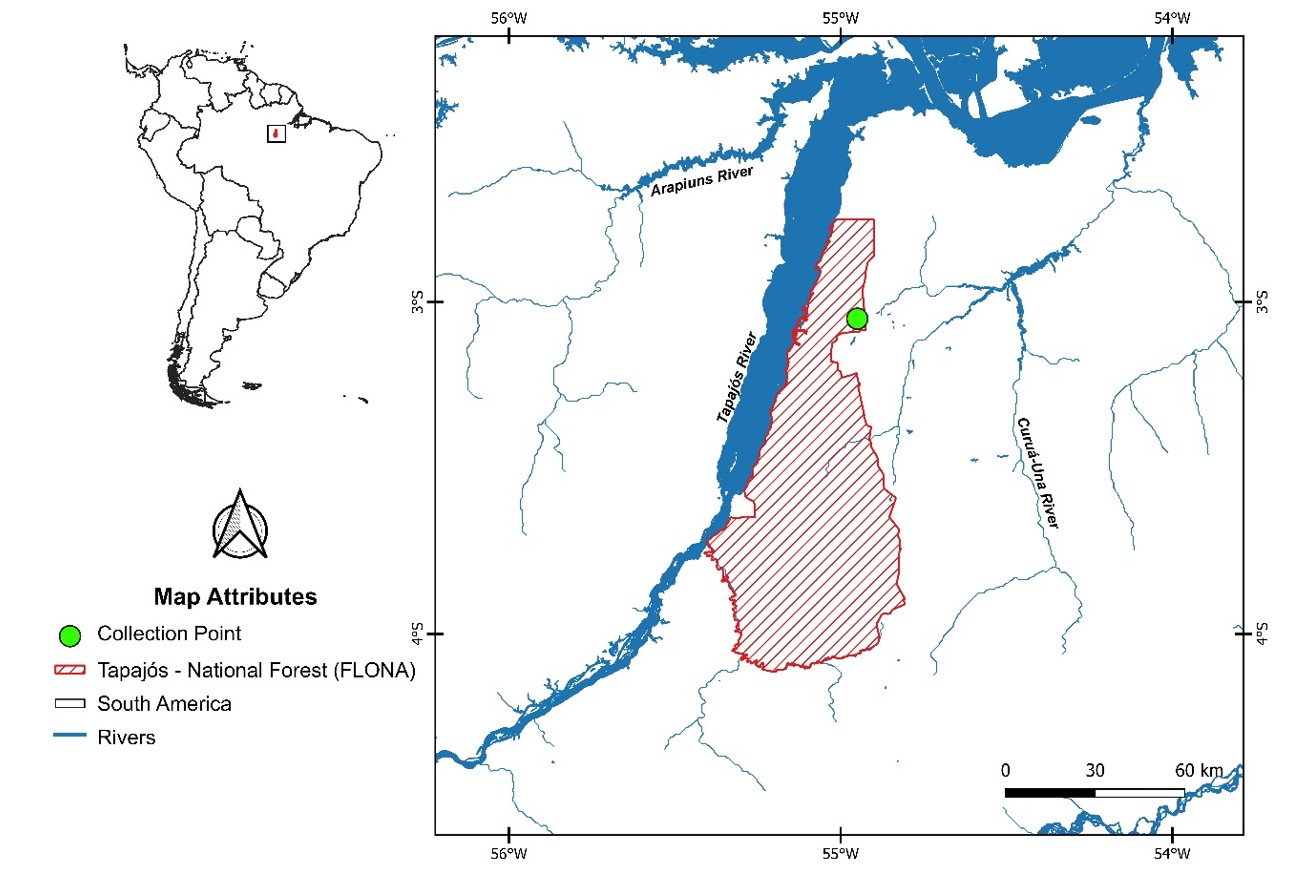
The specimens of B. atrox were collected at km 83 on highway BR 163 (Figure 1), during December 2009 and December 2011, using pitfall traps (Cechin and Martins, 2000). Following collection, snakes were euthanized by cardiac puncture with 1 mL of anesthetic (Lidocaine hydrochloride and Epinephrine). Such procedures are in accordance with Resolution No. 714 of June 20, 2002 (Federal Council of Veterinary Medicine – CFMV), with the Brazilian College of Animal Experimentation – COBEA. Specimens of hosts were subsequently fixed with 10% formalin, preserved in 70% alcohol and deposited in the Herpetological Collection of the Amazonian Herpetology Research Unit (LPHA) of the Unama University Center, Santarém, Pará, Brazil. The snakes were identified using Uetz et al. (2023). License for sample collection of snakes (Sisbio No. 14018-8) was obtained in Chico Mendes Institute for Biodiversity Conservation (ICMBio).
Map showing the collection area of Bothrops atrox in the conservation unit of the Tapajós National Forest, state of Pará, Brazil.
2.2. Parasite collection and morphological characterization
Once hosts were anesthetized and euthanized, an incision was made in the ventral part of the specimens with a scalpel and exam for endoparasites was then performed with the aid of a stereomicroscope. All endoparasites found were removed and placed in microtubes with a 70% alcohol solution for later morphological characterization and identification, and cestodes were subsequently fixed in Raliett Heney solution and stained in the carmine stain method. For morphological characterization, the specimens of cestodes were photographed in microscope (Zeiss Axioplan, Lab. A1, Germany) with an Axiocam camera (ERc 5s, Germany), and the images were processed with Zen Blue Edition 2 software. Parasite taxonomic identification was performed using recommendations of Rego et al. (1974) and Chambrier (1989b). Specimens of parasites were subsequently fixed on glass slides with coverslip and deposited in the Herpetological Collection (UFOPA-PCes01), at the Federal University of Western Pará, Santarém, Pará, Brazil. The ecological terms (prevalence, abundance and mean intensity) were calculated according to Bush et al. (1997), and Quantitative Parasitology 3.0 software (Reiczigel et al., 2019).
3. Results
Of 36 B. atrox collected, 13 (36.1% I.C: 20.4% - 51.7%) were parasitized by a cestode species and a total of 147 parasites were recovered, and mean abundance of 4.1 (I.C: 8.4% - 18.7%) and mean intensity of 11.3 (I.C: 6.1% - 16.4%). For infection sites, 88.4% (n = 130) of the cestodes were found in the small intestine, 9.52% (n = 14) in the large intestine and 2% (n = 3) in the stomach of hosts.
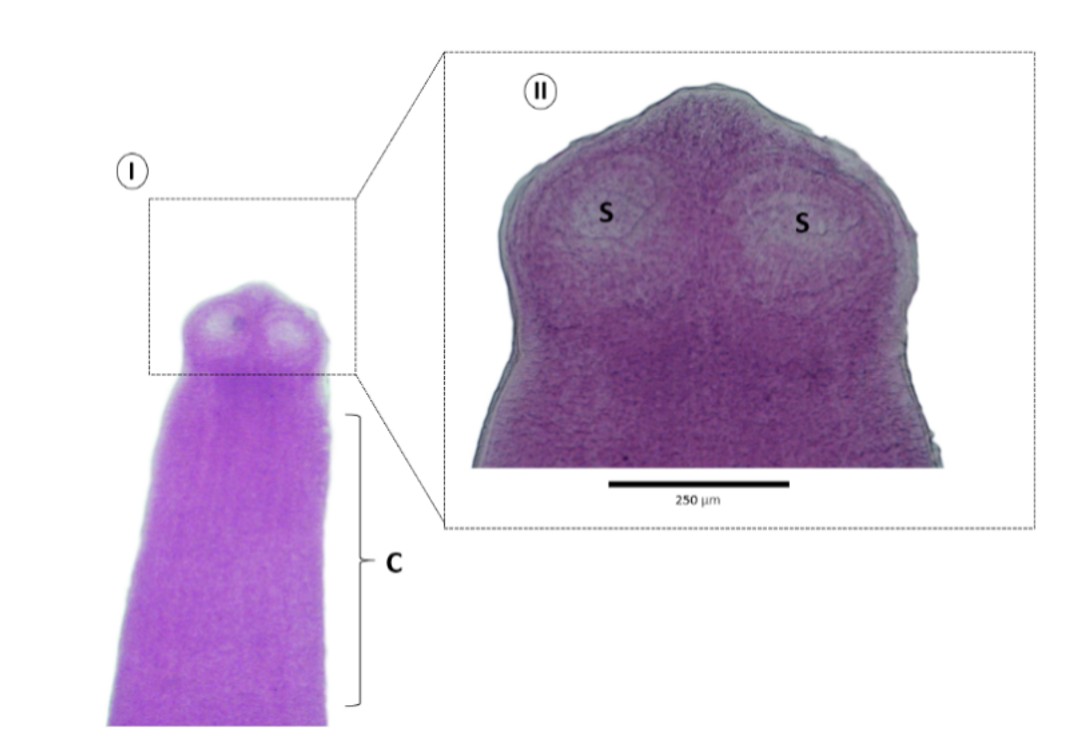
Based on the morphology of the cestodes, such as proglottids and scolex, these were identified as Crepidobothrium Monticelli, 1900, presenting the diagnoses for genus as such large scolex with vestigial apical organ, with four prominent and notched suckers at posterior margin (hear or horseshoe-shaped) with a well-marked cord-shaped border (Figure 2 and 3).

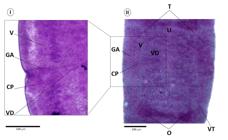
Mature proglottid from Crepidobothrium sp. showing genital atrium (GA), cirrus-pouch (CP), vagina (V), testes (T), vas deferens (VD), uterus (U), ovary (O) and vitellaria (VT). Carmine staining.
4. Discussion
We present here the first record of Crepidobothrium sp. infecting B. atrox, expanding the knowledge concerning these cestode parasites with capable for infecting this species of Viperidae snake with a wide distribution in South America. Taxonomic studies on cestodes of genus Crepidobothrium validated s only five species parasite parasitizing species of snakes: Crepidobothrium gerrardii Baird, 1860; Crepidobothrium dollfusi Freze, 1965; Crepidobothrium lachesidis MacCallum, 1921; Crepidobothrium viperis Beddard, 1913 and Crepidobothrium garonii Chambrier, 1988 (Chambrier 1988, 1989a, b). Chambrier (1989b) reported that there appears to be a host-specificity between Crepidobothrium species and snake species. Unfortunately, studies to identification of the species was not carried out as the collection of the material had been preserved for a long time, rendering it impossible to examine the structures of the mature proglottids. This study corroborates the records previous by Silva et al. (2001), and Chambrier (1989a, b), who recorded Crepidobothrium sp. parasitizing Bothrops moojeni Hoge, 1966 and B. jararaca Wied-Neuwied, 1824 from states of Mato Grosso do Sul, São Paulo and Bahia (Brazil), respectively. However, this is the first record of these cestodes for B. atrox from the Brazilian Amazon.
In reptiles, parasite diversity varies according to diet, habitat use and availability, as well as environmental factors, locomotion patterns, longevity and size, so that reptile parasite richness and sites of infection are closely linked (Aho, 1990). According to Benesh et al. (2021), the complex life cycle of cestodes includes intermediate hosts, with food ingestion being the means by which the definitive host is infected. Bothrops atrox eats a variety of prey across its ontogenetic development, with young individuals tending to consume ectothermic prey such as frogs, lizards, snakes and centipedes, while adults prefer endothermic prey, such as small mammals (Ferreira Bisneto and Kaefer, 2019). However, studies analyzing about diversity species of intermediate hosts and their contribution in snakes infection, definitive hosts, are scarce, therefore requiring urgent investigations.
Many species of tapeworms have been recorded from all orders of reptiles, acting as definitive, paratenic or intermediate hosts (Frezza et al., 2021; Scholz et al., 2023). Although most are non-pathogenic for hosts, in cases with high infection rates, cachexia and death have been reported (Fraser et al., 2002). Despite several detailed ecological studies with B. atrox (Frazão et al., 2020; Martins and Oliveira, 1998; Masseli et al., 2019; Oliveira and Martins, 2001), knowledges about parasites diversity and parasite-host interactions in Neotropical snakes are yet limited, and thus require further investigations. Furthermore, comprehensive studies to investigate the diversity of potential hosts, the main infection routes related to these cestodes and its pathological effects in definitive hosts are required to better elucidate the dynamic of this interaction.
Data Availability Statement
I hereby declare that the entire data set that supports the results of this study is presented in the article itself, in a clear and complete manner, and that access to external sources is not necessary for the reproducibility of the findings.
Acknowledgements
We would like to thank Adrian Barnett who translated this article from Portuguese. This work was supported by Fundação Amazônia de Amparo aos Estudos e Pesquisas (FAPESPA) through the funding of the master's scholarship. The authors would like to thank the Coordenação de Aperfeiçoamento de Pessoal de Nível Superior (CAPES) for the grant scholarship awarded to Tássio Alves-Coêlho and Darlison Chagas-de-Souza (Process #88887.598663/2021-00 and Process #88887.636892/2021-00 respectively). Finally, we would like to thank PPGBEES/UFOPA for the financial support provided through Research Support Program no. 02/2024.
References
-
AHO, J.M., 1990. Helminth communities of amphibians and reptiles: comparative approaches to understanding patterns and processes. In: G.W. ESCH, A.O. BUSCH and J.M. AHO, eds. Parasite communities: patterns and processes New York: Chapman & Hall, pp. 157-195. http://doi.org/10.1007/978-94-009-0837-6_7
» http://doi.org/10.1007/978-94-009-0837-6_7 -
BENESH, D.P., PARKER, G. and CHUBB, J.C., 2021. Life-cycle complexity in helminths: what are the benefits? Evolution, vol. 75, no. 8, pp. 1936-1952. http://doi.org/10.1111/evo.14299 PMid:34184269.
» http://doi.org/10.1111/evo.14299 - BROCARDO, C.R. and GIACOMIN, L.L., 2021. Biodiversidade na floresta nacional do tapajós e na reserva extrativista tapajós – arapiuns Santarém: UFOPA, vol. 1, 443 p.
-
BUSH, A.O., LAFFERTY, K.D., LOTZ, J.M. and SHOSTAK, A.W., 1997. Parasitology meets ecology on its own terms: margolis et al. revisited. The Journal of Parasitology, vol. 83, no. 4, pp. 575-583. http://doi.org/10.2307/3284227 PMid:9267395.
» http://doi.org/10.2307/3284227 - CAIRA, J.N. and JENSEN, K., 2017. Planetary biodiversity inventory (2008–2017): tapeworms from vertebrate bowels of the earth Lawrence: KU Natural History Museum.
-
CAIRA, J.N. and LITTLEWOOD, D.T.J., 2013. Worms, Platyhelminthes. In: S.A. LEVIN, ed. Encyclopedia of biodiversity San Diego: Academic Press, pp. 437-469. http://doi.org/10.1016/B978-0-12-384719-5.00166-0
» http://doi.org/10.1016/B978-0-12-384719-5.00166-0 - CAMPBELL, J.A. and LAMAR, W.W., 2004. The venomous reptiles of the Western Hemisphere Ithaca: Comstock Pub. Associates.
-
CECHIN, S.Z. and MARTINS, M., 2000. Eficiência de armadilhas de queda (pitfall traps) em amostragens de anfíbios e répteis no Brasil. Revista Brasileira de Zoologia, vol. 17, no. 3, pp. 729-740. http://doi.org/10.1590/S0101-81752000000300017
» http://doi.org/10.1590/S0101-81752000000300017 -
CHAMBRIER, A., 1988. Crepidobothrium garzonii n. sp. (Cestoda: Proteocephalidae) parasite de Bothrops alternatus Dum., Bibr. Et Dum., 1854 (Serpentes: Viperidae) au Paraguay. Revue Suisse de Zoologie, vol. 95, no. 4, pp. 1163-1170. http://doi.org/10.5962/bhl.part.81958
» http://doi.org/10.5962/bhl.part.81958 -
CHAMBRIER, A., 1989a. Révision du genre Crepidobothrium Monticelli, 1900 (Cestoda: Proteocephalidae) parasite d’Ophidiens néotropicaux. I. C. gerrardii (Baird, 1860) et C. viperis (Beddard, 1913). Revue Suisse de Zoologie, vol. 96, no. 2, pp. 191-217. http://doi.org/10.5962/bhl.part.117763
» http://doi.org/10.5962/bhl.part.117763 -
CHAMBRIER, A., 1989b. Révision du genre Crepidobothrium Monticelli, 1900 (Cestoda: Proteocephalidae) parasite d’Ophidiens néotropicaux. II. C. dollfusi Freze, 1965, C. lachesidis (MacCallum, 1921) et conclusions. Revue Suisse de Zoologie, vol. 96, no. 2, pp. 345-380. http://doi.org/10.5962/bhl.part.117769
» http://doi.org/10.5962/bhl.part.117769 - ERNST, C.H., 2006. Sinopse de helmintos endoparasitários em cobras dos Estados Unidos e Canadá. Sociedade para o Estudo de Anfíbios e Répteis, no. 34.
-
FERREIRA BISNETO, P. and KAEFER, I.L., 2019. Reproductive and feeding biology of the common lancehead Bothrops atrox (Serpentes, Viperidae) from central and southwestern Brazilian Amazonia. Acta Amazonica, vol. 49, no. 2, pp. 105-113. http://doi.org/10.1590/1809-4392201802371
» http://doi.org/10.1590/1809-4392201802371 - FRASER, A., ELAYOUBI, F. and CRAIG, S.P., 2002. Detection of cestode infections in definitive hosts: present status and futuro advances. In: P. CRAIG and Z. PAWLOWSKI, eds. Cestode zoonoses: echinococcosis and cysticercosis: An emergent and global problem Amsterdam: IOS Press, pp. 157-175.
-
FRAZÃO, L., OLIVEIRA, M.E., MENIN, M., CAMPOS, J., ALMEIDA, A., KAEFER, I.L. and HRBEK, T., 2020. Species richness and composition of snake assemblages in poorly accessible areas in the Brazilian Amazonia. Biota Neotropica, vol. 20, no. 1, e20180661. http://doi.org/10.1590/1676-0611-bn-2018-0661
» http://doi.org/10.1590/1676-0611-bn-2018-0661 - FREZE, V.I., 1965. Proteocephalata in Fish, Amphibians and Reptiles. In: K.I. SKRYABIN, ed. Essentials of Cestodology Moscow: Nauka, vol. 5, 538 p. (In Russian).
-
FREZZA, T.F., SANI, A.A., SOUZA, G.T.R. and SANTOS, L.C., 2021. Helmintos parasitos de répteis e anfíbios no estado de São Paulo, Brasil. Interfaces Científicas - Saúde e Ambiente, vol. 8, no. 3, pp. 32-59. http://doi.org/10.17564/2316-3798.2021v8n3p32-59
» http://doi.org/10.17564/2316-3798.2021v8n3p32-59 - GUEDES, T.B., ENTIAUSPE-NETO, O.M. and COSTA, H.C., 2023. Lista de répteis do Brasil: atualização de 2022. Herpetologia Brasileira, vol. 12, no. 1, pp. 56-161. http://doi.org/10.5281/ZENODO.7829013.
-
LITTLEWOOD, D.T.J., BRAY, R.A. and WAESCHENBACH, A., 2015. Phylogenetic patterns of diversity in the cestodes and trematodes. In: S. MORAND, B.R. KRASNOV and D.T.J. LITTLEWOOD, eds. Parasite diversity and diversification: evolutionary ecology meets phylogenetics Cambridge: University Press, pp. 304-319. http://doi.org/10.1017/CBO9781139794749.020
» http://doi.org/10.1017/CBO9781139794749.020 - MARTINS, M. and OLIVEIRA, M.E., 1998. Natural history of snakes in forests of the Manaus region, Central Amazonia, Brazil. Herpetological Natural History, vol. 6, no. 2, pp. 78-150.
- MARTINS, M., MARQUES, O.A.V. and SAZIMA, I., 2002. Ecological and phylogenetic correlates of feeding habits in Neotropical pitvipers of the genus Bothrops In: M.H. SCHUETT, M.E. DOUGLAS and H.W. GREENE, ed. Biology of the vipers Eagle Mountain: Eagle Mountain Publishing, pp. 307-328.
-
MASSELI, G.S., BRUCE, A.D., SANTOS, J.G.D., VINCEN, T. and KAEFER, I.L., 2019. Composition and ecology of a snake assemblage in an upland forest from Central Amazonia. Anais da Academia Brasileira de Ciências, vol. 91, suppl. 1, e20190080. http://doi.org/10.1590/0001-3765201920190080 PMid:31017189.
» http://doi.org/10.1590/0001-3765201920190080 -
NOGUEIRA, C.C., ARGÔLO, A.J.S., ARZAMENDIA, V., AZEVEDO, J.A., BARBO, F.E., BÉRNILS, R.S., BOLOCHIO, B.E., BORGES-MARTINS, M., BRASIL-GODINHO, M., BRAZ, H., BUONONATO, M.A., CISNEROS-HEREDIA, D.F., COLLI, G.R., COSTA, H.C., FRANCO, F.L., GIRAUDO, A., GONZALEZ, R.C., GUEDES, T., HOOGMOED, M.S., MARQUES, O.A.V., MONTINGELLI, G.G., PASSOS, P., PRUDENTE, A.L.C., RIVAS, G.A., SANCHEZ, P.M., SERRANO, F.C., SILVA, N.J., STRÜSSMANN, C., VIEIRA-ALENCAR, J.P.S., ZAHER, H., SAWAYA, R.J. and MARTINS, M., 2019. Atlas of Brazilian Snakes: verified point-locality maps to mitigate the Wallacean shortfall in a megadiverse snake fauna. South American Journal of Herpetology, vol. 14, no. sp1, pp. 1-274. http://doi.org/10.2994/SAJH-D-19-00120.1
» http://doi.org/10.2994/SAJH-D-19-00120.1 - OLIVEIRA, M.E. and MARTINS, M., 2001. When and where to find a pitviper: activity patterns and habitat use of the lancehead, Bothrops atrox, in central Amazonia, Brazil. Herpetological Natural History, vol. 8, no. 2, pp. 101-110.
-
PEEL, M.C., FINLAYSON, B.L. and MCMAHON, T.A., 2007. Updated world map of the Köppen-Geiger climate classification. Hydrology and Earth System Sciences, vol. 11, no. 5, pp. 1633-1644. http://doi.org/10.5194/hess-11-1633-2007
» http://doi.org/10.5194/hess-11-1633-2007 - REGO, A.A., SANTOS, J.C. and SILVA, P.P., 1974. Estudos de cestóides de peixes do Brasil.Memorias do Instituto Oswaldo Cruz, vol. 72, pp. 187-204. https://doi.org/10.1590/S0074-02761974000200004.
- REGO, A.A., 1994. Order Proteocephalidea Mola, 1928. In: L.F. KHALIL, A. JONES and R.A. BRAY, eds. Keys to the cestode parasites of vertebrates Wallingford: CAB International, pp. 257-293.
-
REICZIGEL, J., MAROZZI, M., FÁBIÁN, I. and RÓZSA, L., 2019. Biostatistics for parasitologists: a primer to quantitative parasitology. Trends in Parasitology, vol. 35, no. 4, pp. 277-281. http://doi.org/10.1016/j.pt.2019.01.003 PMid:30713051.
» http://doi.org/10.1016/j.pt.2019.01.003 -
SCHOLZ, T., CHAMBRIER, A., MCALLISTER, C.T., TKACH, V.V. and KUCHTA, R., 2023. Tapeworms (Cestoda: Ophiotaenia) from the northern cottonmouth (Agkistrodon piscivorus). The Journal of Parasitology, vol. 109, no. 5, pp. 464-479. http://doi.org/10.1645/23-32 PMid:37713534.
» http://doi.org/10.1645/23-32 -
SILVA, K.M.P., SILVA, K.B., SUEIRO, L.R., OLIVEIRA, M.E.E.S. and ALMEIDA-SANTOS, S.M., 2019. Reproductive biology of Bothrops atrox (Serpentes, Viperidae, Crotalinae) from the Brazilian Amazon. Herpetologica, vol. 75, no. 3, pp. 198-207. http://doi.org/10.1655/D-18-00023
» http://doi.org/10.1655/D-18-00023 -
SILVA, R.J.D., KARASAWA, A.S.M., CHERUBINI, A.L., BARRELLA, T.H., LOPES, C.A.D.M. and AMARANTE, A.F.T., 2001. The occurrence of Crepidobothrium sp.(Cestoda, Proteocephalidae) in Bothrops moojeni (Hoge)(Serpentes, Viperidae). Revista Brasileira de Zoologia, vol. 18, no. 2, pp. 375-379. http://doi.org/10.1590/S0101-81752001000200006
» http://doi.org/10.1590/S0101-81752001000200006 -
UETZ, P., FREED, P., AGUILAR, R., REYES, F., KUDERA, J. and HOŠEK, J., 2023 [viewed 30 May 2024]. The Reptile Database Available from: http://www.reptile-database.org
» http://www.reptile-database.org - VELOSO, H.P., RANGEL-FILHO, A.L.R. and LIMA, J.C.A., 1991. Classificação da vegetação brasileira, adaptada a um sistema universal Rio de Janeiro: IBGE.
- WAESCHENBACH, A., WEBSTER, B.L. and LITTLEWOOD, D.T.J., 2012. Adding resolution to ordinal level relationships of tapeworms (Platyhelminthes: Cestoda) with large fragments of mtDNA. Molecular Phylogenetics and Evolution, vol. 63, no. 3, pp. 834-847. http://doi.org/10.1016/j.ympev.2012.02.020. PMid:22406529.
Edited by
-
Editor:
Takako Matsumura Tundisi