
 Production and quality evaluation of high fiber functional cupcake using watermelon
Abstract
This study evaluated the effects of partially replacing wheat flour with watermelon peel powder (WPP) at substitution levels of 5%, 10%, 15%, and 20% on the quality characteristics of cupcakes. We conducted comprehensive analyses of chemical composition, physical properties, color parameters, staling behavior, and sensory attributes, comparing all results against a control sample. Our findings demonstrated that WPP incorporation significantly enhanced the nutritional profile, with dietary fiber content increasing proportionally from 2.73% in the control to 53.86% at the 20% substitution level. Similarly, ash content showed a gradual increase with higher WPP levels. The functional properties of WPP proved superior to wheat flour, particularly in water-holding capacity, though it exhibited lower oil-holding capacity. Physical characterization revealed that specific volume and weight increased with substitution levels, while color measurements indicated progressive darkening as WPP percentage increased. Sensory evaluation results established that cupcakes containing up to 10% WPP maintained acceptability scores comparable to the control across all attributes, while higher substitution levels led to significantly lower scores in texture, appearance, and overall acceptability. These results indicate that watermelon peel powder can be successfully incorporated into cupcake formulations at up to 10% substitution level, producing nutritionally enhanced, high-fiber bakery products without compromising sensory quality, thereby offering a sustainable approach to valorizing agricultural by-products.
Keywords:
cupcake; watermelon peel; chemical composition; physical; color; sensory properties
Resumo
Este estudo avaliou os efeitos da substituição parcial da farinha de trigo por farinha de casca de melancia (FCM) em níveis de substituição de 5%, 10%, 15% e 20% nas características de qualidade de cupcakes. Foram realizadas análises abrangentes da composição química, propriedades físicas, parâmetros de cor, comportamento de envelhecimento e atributos sensoriais, comparando todos os resultados com uma amostra controle. Os resultados demonstraram que a incorporação de FCM melhorou significativamente o perfil nutricional, com o teor de fibra alimentar aumentando proporcionalmente de 2,73% no controle para 53,86% no nível de substituição de 20%. Da mesma forma, o teor de cinzas apresentou um aumento gradual com níveis mais altos de FCM. As propriedades funcionais de fCM mostraram-se superiores às da farinha de trigo, particularmente na capacidade de retenção de água, embora tenha apresentado menor capacidade de retenção de óleo. A caracterização física revelou que o volume e o peso específicos aumentaram com os níveis de substituição, enquanto as medições de cor indicaram um escurecimento progressivo à medida que a porcentagem de FCM aumentou. Os resultados da avaliação sensorial estabeleceram que cupcakes contendo até 10% de FCM mantiveram pontuações de aceitabilidade comparáveis ao controle em todos os atributos, enquanto níveis de substituição mais elevados levaram a pontuações significativamente mais baixas em textura, aparência e aceitabilidade geral. Esses resultados indicam que a farinha de casca de melancia pode ser incorporada com sucesso em formulações de cupcake com nível de substituição de até 10%, produzindo produtos de panificação enriquecidos nutricionalmente e com alto teor de fibra, sem comprometer a qualidade sensorial, oferecendo assim uma abordagem sustentável para valorizar subprodutos agrícolas.
Palavras-chave:
cupcake; casca de melancia; composição química; física; cor; propriedades sensoriais
1. Introduction
Cake stands as one of the most popular bakery products globally, appreciated by diverse consumer groups for its convenience, variety, and affordability (Ahmed et al., 2024; Yaseen, 2023). Concurrently, the significant issue of fruit and vegetable waste has prompted increased interest in repurposing these by-products within the food industry. Such waste streams are recognized as valuable sources of dietary fiber and beneficial phytochemicals (Lau et al., 2021). Notably, the dietary fiber derived from fruits and vegetables often contains a higher proportion of soluble fiber, which differs from the predominantly insoluble fiber, like cellulose and hemicellulose, found in grains (Herbafood, 2002; Redgwell and Fischer, 2005).
Driven by the pursuit of sustainability and enhanced nutrition, the development of fiber-enriched foods has become a key research focus (Grigelmo-Miguel and Martin-Belloso, 1999; Tudorica et al., 2002). Watermelon, a widely cultivated crop in warm climates, presents a notable opportunity in this context. Approximately 50% of the fruit's mass, consisting of rind and peel, is often discarded as waste despite its potential value (USDA, 2004). This underutilized resource is not merely a source of fiber; preliminary studies indicate that watermelon peel contains proteins, fats, carbohydrates, and essential minerals (Koocheki et al., 2007). More importantly, it is a repository of specific amino acids like citrulline and arginine, alongside antioxidant compounds such as carotenoids and phenols, which are associated with reduced risk of chronic diseases (Giovannucci, 1999; Rao, 2006).
While the incorporation of various fruit and vegetable by-products, including apple pomace and banana peels, into baked goods like bread and biscuits has been documented (Santos et al., 2025; Kumaraguruparaswami et al., 2025; Lau et al., 2021; Sudha et al., 2007) their application in cake systems, particularly cupcakes, is less explored. Cupcakes represent a unique food matrix with distinct sensory and textural expectations from consumers. The functional properties of watermelon peel powder (WPP) such as its high water-holding capacity and unique phytochemical profile may interact with the cupcake matrix differently than in other bakery products (Ben Romdhane et al., 2024; Silva et al., 2024). While the incorporation of various fruit and vegetable by products into baked goods like bread and biscuits has been documented, their application in cake systems, particularly cupcakes, remains underexplored. Cupcakes represent a unique food matrix with distinct sensory and textural expectations. This study provides a comprehensive analysis of the effects of WPP at multiple substitution levels (5%, 10%, 15%, and 20%) on the chemical, physical, and sensory properties of cupcakes. The novelty of this work lies in its systematic approach to determining the optimal substitution level (10%) that significantly enhances dietary fiber content while maintaining acceptable sensory quality, thereby offering new insights into the sustainable valorization of watermelon peel in a popular confectionery product.
2. Materials and Methods
2.1. Materials
The study utilized watermelon peels sourced from fresh watermelons purchased at the local market in Qassim, Saudi Arabia. Wheat flour with a 70% extraction rate was obtained from the Saudi Grains Organization (SAGO) in the Qassim Region. Other ingredients, including sugar, whole fresh eggs, milk, shortening, baking powder, vanilla, and packaging materials, were also procured from the local market in Qassim. The chemicals required for the chemical analyses were supplied by Arkan Development Company Limited, located in Qassim, Saudi Arabia.
2.2. Methods
2.2.1. Preparation of watermelon peel
After separating the peels from the fruits, they are thoroughly washed with water to remove any remaining fruit particles. The peels are then drained, cut into small pieces pieces (approximately 1 cm × 1 cm), and dried in an air-drying oven at 50 °C for 24 hours. Once dried, they are ground using a laboratory mill and sifted through a 0.5 mm sieve to obtain a fine powder. This powder is stored in sealed glass containers at room temperature until use and analysis, following the method described by Jeddou et al. (2016).
2.2.2. Preparation of cupcake samples
Cupcakes partially substituted with watermelon peel powder, along with a control sample, were prepared following the method described by Bennion and Bamford (1973). The ingredients were weighed according to the proportions listed in Table 1. Sugar and softened butter were mixed for 3 minutes—first at a slow speed for one minute, then at medium speed for two minutes. Eggs and vanilla were added and mixed for 2 minutes at medium speed. Milk, baking powder, and wheat flour were then incorporated, with part of the wheat flour being replaced by peel powder according to the specified ratios, and mixed for 4 minutes. Forty grams of the prepared cake mixture were placed into cupcake molds and baked in an electric oven at 180 °C for 30 minutes. After baking, the cupcakes were removed from the oven, allowed to cool at room temperature for an hour, and then packed in plastic bags until analysis.
2.2.3. Determination of functional properties
The water holding capacity (WHC) and oil holding capacity (OHC) of wheat flour and watermelon peel powder used in the cupcake preparation were measured following the method outlined byAlkarkhi et al. (2010). The specific density of these ingredients was determined using a density bottle at 20 °C, as described byKaur and Singh (2005). Additionally, the swelling index for both wheat flour and watermelon peel powder was estimated according to the procedure detailed by Robertson et al. (2000).
2.2.4. Chemical analysis of wheat flour, watermelon peel, and cupcakes
The moisture, fat, crude protein, ash, and dietary fiber contents of various cupcake samples, including those made with 100% wheat flour and those with 5%, 10%, 15%, and 20% watermelon peel, were analyzed using the methods outlined in AOAC (2008). Total carbohydrates were calculated by difference.
2.2.5. Physical properties of cupcakes
The weight (g) of the cupcake samples was measured one hour after baking and cooling, and the average weight was recorded. The volume (cm3) of the various cupcake types was determined using the rapeseed displacement method as described by AACC (2000). Specific volume (cm3/g) and specific weight (g/cm3) were then calculated according to the same method (AACC, 2000).
2.2.6. Determination of cupcakes color
The color of the cupcake samples was measured using the Hunter Lab, following the method outlined in (Francis, 1983). The X1, X2, Y, and Z values were converted to the color coordinates L, a, and b using the device’s formula.
2.2.7. Staling for cupcake samples
The samples, partially substituted with watermelon peel powder, were compared with the control sample immediately after leveling and cooling, as well as throughout a 9-day storage period at room temperature (approximately 25±2 °C). This comparison utilized the alkaline water retention capacity (AWRC) method described in AACC (2000).
2.2.8. Sensory evaluation of cupcakes
The sensory evaluation of cupcakes partially substituted with watermelon peel powder was conducted immediately after production. A panel of sixty semi-trained panelists, comprising staff and postgraduate students from the Department of Food Science and Technology, College of Agriculture, Qassim University, participated in the assessment. The panel consisted of 30 males and 30 females, aged between 25 and 50 years, all familiar with the quality attributes of bakery products. The evaluation of quality characteristics was performed according to the method described by AACC (2000). Prior to the session, each panelist received comprehensive instructions on the evaluation procedure and the use of the scoring sheet. The evaluations were carried out in individual booths under controlled lighting conditions. All cupcake samples were coded with random three-digit numbers and presented in randomized order to prevent bias. The results were subsequently compared with a control sample prepared entirely from wheat flour.
2.2.9. Statistical analysis
All measurements were performed in triplicate (n=3) to ensure statistical reliability, with the sample size determined based on previous similar studies and pilot tests that showed consistent results with three replicates. The experimental design was a completely randomized design, and data were analyzed using one-way analysis of variance (ANOVA) followed by Duncan’s Multiple Range Test for mean separation at p ≤ 0.05. Statistical analysis was performed using SAS version 8.10 (SAS Institute, Cary, NC, USA). For sensory evaluation, sixty panelists (30 males and 30 females, aged 25–50 years) were recruited from the staff and postgraduate students of the Department of Food Science and Technology, College of Agriculture, Qassim University. The study was approved by the Institutional Review Board of Qassim University. Inclusion criteria required panelists to be regular consumers of bakery products and free from any food allergies. Panelists received a 2-hour training session on the sensory attributes of cupcakes and the use of the scoring sheet. They were compensated with a small gift for their participation (SAS Institute, 2004).
3. Results and Discussion
3.1. Functional characteristics of wheat flour and watermelon peel powder (WPP)
Water holding capacity (WHC) refers to the ability of a wet material to retain water when subjected to gravity or external pressure, such as centrifugation (Alfredo et al., 2009). WHC is a crucial measure in assessing the quality of bakery products. The WHC of wheat flour and watermelon peel powder used in the partially substituted cupcakes was evaluated to determine the quality of the final product and its consumer acceptability. As shown in Table 2, all functional characteristics (WHC, specific density, and swelling index) of watermelon peel powder were superior to those of wheat flour, except for oil holding capacity, which was lower.
3.2. Chemical composition and color of wheat flour and WPP
The chemical composition of wheat flour and watermelon peel powder (WPP) was analyzed before and after converting the peels into flour powder. The results, presented in Table 3 detail the protein, fat, ash, raw fiber, and total carbohydrate content on a dry weight basis, as well as moisture content. The findings indicate that WPP has higher levels of ash, fat, and fiber compared to wheat flour, while the other components are present in lower amounts. These results are consistent with previous studies, such as those by researchers Sudha et al. (2007) and El-Badry et al. (2014), which also found that WPP contains higher ash and fiber content than wheat flour. Conversely, wheat flour has a higher total carbohydrate content than WPP. Therefore, watermelon peel powder is a valuable source of fiber and minerals and can be beneficial for food enhancement.
Color is a crucial quality standard in food products, significantly influencing consumer acceptance. Changes in color due to dietary fiber can limit its applicability in food. Various factors, including the type of fruit and its ripeness, affect color. Specifically, during the drying process of watermelon peel powder (WPP), exposure to certain temperatures can cause non-enzymatic browning, leading to a darker product. The color of both raw materials and finished products directly impacts consumer acceptance, as it affects the composition and proportion of additives used, as well as production conditions.
The color analysis of wheat flour and WPP used in cupcake preparation, as shown in Table 3, revealed significant differences (p < 0.05) in all color values. The L value, indicating the degree of lightness to darkness, was lowest in the WPP sample compared to wheat flour. Conversely, the b and a values, representing red/green and yellow/blue hues respectively, were higher in the WPP sample.
3.3. Chemical composition of cupcake containing WPP
Table 4 reveals that watermelon peels have higher fiber, moisture, and ash content, but lower protein, fat, and carbohydrate levels compared to wheat flour. Additionally, the chemical composition analysis of cupcakes partially substituted with watermelon peel powder indicates a gradual decrease in fat, protein, and carbohydrate percentages as the proportion of WPP increases.
3.4. Physical properties of cupcake containing WPP
Table 5 presents the physical characteristics (weight, volume, specific volume, and specific weight) of cupcakes partially substituted with watermelon peel powder (WPP) at levels of 5%, 10%, 15%, and 20%. The weights of all samples were measured one hour after baking. The results indicate that as the percentage of WPP increased, the weight of the cupcakes also increased, reaching 35.60 g at 20% substitution. This increase is attributed to the high water-holding capacity of WPP, which enhances water retention in the cupcake matrix, leading to greater weight.
The volume (cm3) and specific volume (cm3/g) of the cupcakes showed that the control sample had the highest values, while the 5% WPP sample had the lowest. However, as the substitution level increased, both volume and specific volume gradually increased, consistent with findings by Singh et al. (1995).
Figure 1 illustrates the specific weight values of the cupcake mixtures with WPP substitutions of 5%, 10%, 15%, and 20%. The 5% WPP sample exhibited lower density and swelling index, contributing to its lower weight. Conversely, as the WPP percentage increased, the specific weight of the mixtures also increased, with the 20% WPP mixture reaching a specific weight of (1.02).
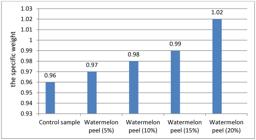
Specific weight of cupcake samples with different levels of watermelon peel powder (WPP) substitution. Error bars represent standard errors (n=3).
3.5. Color parameters of cupcake with different levels of WPP
Table 6 presents the color analysis of cupcake samples with varying levels of watermelon peel powder (WPP) substitution (5%, 10%, 15%, and 20%). The lightness (L) values, indicating the degree of white to brown, showed significant differences (p < 0.05) between the WPP-substituted samples and the control. For redness (a), values ranged from 0.64 in the control sample to 3.09 in the 20% WPP sample. Notably, there were no significant differences (p < 0.05) between the 5% and 10% WPP samples (2.08 and 2.26, respectively), nor between the 15% and 20% WPP samples (2.88 and 3.09, respectively). The progressive darkening of cupcakes with increasing WPP levels, as indicated by decreasing L* values, can be attributed to non-enzymatic browning reactions (Maillard reaction and caramelization) and the oxidation of phenolic compounds during drying and baking. The increase in a* (redness) and b* (yellowness) values is likely due to the presence of natural pigments in the watermelon peel, such as carotenoids and chlorophyll, which may undergo degradation and interaction with other components during processing.
3.6. Staling for partially replaced cupcake with WPP
The study examined the effect of storage at room temperature for 1, 3, 6, and 9 days on the staling of cupcakes partially substituted with watermelon peel powder (WPP) at levels of 5%, 10%, 15%, and 20%. Table 7 shows that the staling ratio of cupcakes with WPP ranged from 182.00% to 148.33%. The 5% WPP cupcakes had the lowest staling percentage after one day of storage, likely due to the presence of ingredients that delay staling by moisturizing fats, sugar, and milk. Conversely, the highest staling percentage was observed in the 20% WPP cupcakes after nine days of storage. The staling of cupcakes is influenced by the redistribution of water and the recrystallization of starch. The higher water-holding capacity of WPP may reduce the mobility of water in the cupcake matrix, thereby slowing down starch retrogradation and reducing firmness over time. However, at higher substitution levels, the increased fiber content might disrupt the gluten network and starch structure, leading to a denser crumb and potentially accelerating staling. The observed decrease in staling percentage with increasing WPP levels up to 20% suggests that the water-binding capacity of WPP plays a significant role in retarding staling, consistent with the findings of Al-Sayed and Ahmed (2013).
3.7. Sensory evaluation of cupcake containing WPP
The sensory evaluation of cupcakes substituted with watermelon peel powder (WPP) at levels of 5%, 10%, 15%, and 20% was conducted. Table 8 shows that the cupcakes with 5% WPP substitution achieved the highest appearance score of 14.70, matching the control sample. In terms of cup and shell color, the 20% WPP sample had the lowest values. A gradual decline in all sensory characteristics was observed as the WPP substitution percentage increased.
The sensory evaluation results indicate no significant differences between the 5% WPP-substituted cupcakes and the control sample for most attributes, suggesting that the nutritional and sensory qualities were maintained at this level. However, at higher substitution levels (10%, 15%, and 20%), there were progressive and statistically significant reductions in sensory scores for appearance, texture, taste, and overall acceptability. This indicates that while a 5% substitution is acceptable, higher levels lead to a decline in sensory quality (Ben Romdhane et al., 2024; El-Badry et al., 2014).
The significant decrease in overall acceptability at 20% substitution is likely due to multiple factors. The increased fiber content notably alters the texture, making the cupcakes denser and harder, as corroborated by the texture analysis data. Furthermore, the darker color (lower L* values) and stronger vegetal notes from the peel powder become more pronounced, negatively influencing consumer perception (Gül and Özkan, 2025) (Figure 2).

Appearance of cupcake samples containing different percentages of watermelon peel powder (WPP): (A) Control, (B) 5% WPP, (C) 10% WPP, (D) 15% WPP, (E) 20% WPP.
The observed increase in hardness and reduction in volume at higher WPP levels can be attributed to the dilution of gluten and disruption of the starch-protein matrix by insoluble fibers, which limit gas retention and lead to a denser crumb structure. The higher water-holding capacity of WPP may also compete with starch for water, affecting gelatinization and staling behavior
4. Conclusion
This study demonstrates that watermelon peel powder (WPP) can be successfully incorporated into cupcakes to enhance dietary fiber content. The optimal substitution level was found to be 10%, which provided a substantial increase in fiber (22.33%) without significantly compromising sensory acceptability. The functional properties of WPP, particularly its high water-holding capacity, contributed to improved moisture retention and reduced staling. These findings offer a practical approach for the food industry to develop healthier, high-fiber bakery products while valorizing agricultural by-products, contributing to sustainable food production. Future research should focus on optimizing the particle size and processing conditions of WPP to allow for higher substitution levels and investigate the long-term storage stability of WPP-enriched cupcakes.
Data Availability Statement
The article contains the information that was utilized to support the study's conclusions.
References
-
AHMED, W.E., RAGAB, I., GADALLAH, M.G.E., ALHOMAID, R.M. and ALMUJAYDIL, M.S., 2024. Effect of sprouting whole wheat grain on the sensory quality, physicochemical properties, and Antioxidant activity of cupcakes. Applied Food Research, vol. 4, no. 1, pp. 100412. https://doi.org/10.1016/j.afres.2024.100412
» https://doi.org/10.1016/j.afres.2024.100412 -
ALFREDO, V.-O., GABRIEL, R.-R., LUIS, C.-G. and DAVID, B.-A., 2009. Physicochemical properties of a fibrous fraction from chia (Salvia hispanica L.). Lebensmittel-Wissenschaft + Technologie, vol. 42, no. 1, pp. 168-173. https://doi.org/10.1016/j.lwt.2008.05.012
» https://doi.org/10.1016/j.lwt.2008.05.012 - ALKARKHI, A. F., SAIFULLAH, R., SHIN, Y. Y. and EASA, A. M., 2010. Physicochemical properties of banana peel flour as influenced by variety and stage of ripeness: multivariate statistical analysis. Asian Journal of Food and Agro-Industry, vol. 3, pp. 349-362.
-
AL-SAYED, H.M. and AHMED, A.R., 2013. Utilization of watermelon rinds and sharlyn melon peels as a natural source of dietary fiber and antioxidants in cake. Annals of Agricultural Science, vol. 58, no. 1, pp. 83-95. https://doi.org/10.1016/j.aoas.2013.01.012
» https://doi.org/10.1016/j.aoas.2013.01.012 - AMERICAN ASSOCIATION OF CEREAL CHEMISTS – AACC, 2000. Approved methods of the American Association of Cereal Chemists 10th ed. Saint Paul: AACC.
- ASSOCIATION OF OFFICIAL ANALYTICAL CHEMISTS – AOAC, 2008. Official methods of analysis of the Association of Official Analytical Chemists 16th ed. Washington, D.C.: AOAC.
-
BEN ROMDHANE, M., BOUALLEGUE, A., BOURHIA, M., BOUGATEF, A., SALAMATULLAH, A.M., ELLOUZ-CHAABOUNI, S. and HADDAR, A., 2024. Watermelon rind dietary fibers as natural source to enhance texture of wheat bread. Foods, vol. 13, no. 18, pp. 2909. https://doi.org/10.3390/foods13182909 PMid:39335838.
» https://doi.org/10.3390/foods13182909 - BENNION, E.B. and BAMFORD, G.S.T., 1973. The technology of cake making. 5th ed. New York: Springer. Cake making process, pp. 225-230.
- EL-BADRY, N., EL-WASEIF, M., BADR, S. and ALI, H., 2014. Effect of addition watermelon rind powder on the rheological, physiochemical and sensory quality attributes of pan bread. Middle East Journal of Applied Sciences, vol. 4, no. 4, pp. 1051-1046.
- FRANCIS, F., 1983. Colorimetry of Foods. In: M. PELEG and E.B. BAGLY, eds. Physical properties of foods Westport: AVI Publishing Company Inc., pp. 105-123.
-
GIOVANNUCCI, E., 1999. Tomatoes, tomato-based products, lycopene, and cancer: review of the epidemiologic literature. Journal of the National Cancer Institute, vol. 91, no. 4, pp. 317-331. https://doi.org/10.1093/jnci/91.4.317 PMid:10050865.
» https://doi.org/10.1093/jnci/91.4.317 -
GRIGELMO-MIGUEL, N. and MARTIN-BELLOSO, O., 1999. Influence of fruit dietary fibre addition on physical and sensorial properties of strawberry jams. Journal of Food Engineering, vol. 41, no. 1, pp. 13-21. https://doi.org/10.1016/S0260-8774(99)00067-9
» https://doi.org/10.1016/S0260-8774(99)00067-9 -
GÜL, H. and ÖZKAN, H., 2025. Evaluation of the impact of fig (Ficus carica L.) seed flour on the physicochemical, textural and sensory attributes of gluten-free muffins. Bulletin of University of Agricultural Sciences and Veterinary Medicine Cluj-Napoca. Food Science and Technology, vol. 82, no. 1, pp. 119-134. https://doi.org/10.15835/buasvmcn-fst:2025.0003
» https://doi.org/10.15835/buasvmcn-fst:2025.0003 -
HERBAFOOD, 2002 [viewed 4 August 2025]. Herbacel AQ Plus: apple and citrus fibre [online]. Available from: https://www.herbafood.de/wp-content/uploads/Salesflyer_Herbacel-AQ-Plus-Improve-your-Nutri-Score-rating-with-multifunctional-fibres.pdf
» https://www.herbafood.de/wp-content/uploads/Salesflyer_Herbacel-AQ-Plus-Improve-your-Nutri-Score-rating-with-multifunctional-fibres.pdf -
JEDDOU, K.B., CHAARI, F., MAKTOUF, S., NOURI-ELLOUZ, O., HELBERT, C.B. and GHORBEL, R.E., 2016. Structural, functional, and antioxidant properties of water-soluble polysaccharides from potatoes peels. Food Chemistry, vol. 205, pp. 97-105. https://doi.org/10.1016/j.foodchem.2016.02.108 PMid:27006219.
» https://doi.org/10.1016/j.foodchem.2016.02.108 -
KAUR, M. and SINGH, N., 2005. Studies on functional, thermal and pasting properties of flours from different chickpea (Cicer arietinum L.) cultivars. Food Chemistry, vol. 91, no. 3, pp. 403-411. https://doi.org/10.1016/j.foodchem.2004.06.015
» https://doi.org/10.1016/j.foodchem.2004.06.015 - KOOCHEKI, A., RAZAVI, S.M.A., MILANI, E., MOGHADAM, T., ABEDINI, M., ALAMATIYAN, S. and IZADKHAH, S., 2007. Physical properties of watermelon seed as a function of moisture content and variety. International Agrophysics, vol. 21, no. 4, pp. 349-359.
-
KUMARAGURUPARASWAMI, M., SUBRAMANI, D. and S R, P., 2025. Food wastes and by‐products as valuable ingredients for processed foods. Journal of Food Process Engineering, vol. 48, no. 8, e70199. https://doi.org/10.1111/jfpe.70199
» https://doi.org/10.1111/jfpe.70199 -
LAU, K.Q., SABRAN, M.R. and SHAFIE, S.R., 2021. Utilization of vegetable and fruit by-products as functional ingredient and food. Frontiers in Nutrition, vol. 8, pp. 661693. https://doi.org/10.3389/fnut.2021.661693 PMid:34211995.
» https://doi.org/10.3389/fnut.2021.661693 - RAO, A.V., 2006. Tomatoes, lycopene and human health: preventing chronic diseases Badalona: Caledonian Science Press.
-
REDGWELL, R.J. and FISCHER, M., 2005. Dietary fiber as a versatile food component: an industrial perspective. Molecular Nutrition & Food Research, vol. 49, no. 6, pp. 521-535. https://doi.org/10.1002/mnfr.200500028 PMid:15926144.
» https://doi.org/10.1002/mnfr.200500028 -
ROBERTSON, J.A., DE MONREDON, F.D., DYSSELER, P., GUILLON, F., AMADO, R. and THIBAULT, J.-F., 2000. Hydration properties of dietary fibre and resistant starch: a European collaborative study. Lebensmittel-Wissenschaft + Technologie, vol. 33, no. 2, pp. 72-79. https://doi.org/10.1006/fstl.1999.0595
» https://doi.org/10.1006/fstl.1999.0595 -
SANTOS, B.B., FERNANDES, L.C., BURAK, N.M., ISAKA, G.V., PIMENTEL, T.C. and ROSSET, M., 2025. Valorization of melon (Cucumis melo L.) peels as flour for vegan and gluten-free muffins. Applied Sciences, vol. 15, no. 17, pp. 9680. https://doi.org/10.3390/app15179680
» https://doi.org/10.3390/app15179680 - SAS INSTITUTE, 2004. SAS/STAT user’s guide: statistics, system for Windows, version 8.10 (release 8.01 TS level 01M0) [software]. Cary: SAS Institute Inc.
-
SILVA, M.A., GONÇALVES ALBUQUERQUE, T., ESPÍRITO SANTO, L., MOTTA, C., ALMEIDA, A., AZEVEDO, R., ALVES, R.C., OLIVEIRA, M.B.P. and COSTA, H.S., 2024. Exploring the functional features of melon peel flour for healthier bakery products. Foods, vol. 14, no. 1, pp. 40. https://doi.org/10.3390/foods14010040 PMid:39796330.
» https://doi.org/10.3390/foods14010040 -
SINGH, B., SEKHON, K. and SINGH, N., 1995. Suitability of full fat and defatted rice bran obtained from Indian rice for use in food products. Plant Foods for Human Nutrition, vol. 47, no. 3, pp. 191-200. https://doi.org/10.1007/BF01088327 PMid:7659697.
» https://doi.org/10.1007/BF01088327 -
SUDHA, M., BASKARAN, V. and LEELAVATHI, K., 2007. Apple pomace as a source of dietary fiber and polyphenols and its effect on the rheological characteristics and cake making. Food Chemistry, vol. 104, no. 2, pp. 686-692. https://doi.org/10.1016/j.foodchem.2006.12.016
» https://doi.org/10.1016/j.foodchem.2006.12.016 -
TUDORICA, C., KURI, V. and BRENNAN, C., 2002. Nutritional and physicochemical characteristics of dietary fiber enriched pasta. Journal of Agricultural and Food Chemistry, vol. 50, no. 2, pp. 347-356. https://doi.org/10.1021/jf0106953 PMid:11782206.
» https://doi.org/10.1021/jf0106953 - UNITED STATES DEPARTMENT OF AGRICULTURE – USDA, 2004. USDA National Nutrient Database for Standard Reference, Release 17 Beltsville: USDA Agricultural Research Service; Beltsville Human Nutrition Research Center.
-
YASEEN, E.G., 2023. Effect of utilizing of quinoa, rice and corn flours on physicochemical properties and sensory characteristics of gluten free cupcake. Annals of Agricultural Sciences, Moshtohor, vol. 61, no. 1, pp. 119-126. https://doi.org/10.21608/assjm.2023.299587
» https://doi.org/10.21608/assjm.2023.299587
Editor:


