 Reproduction of leaf-cutting ant workers: breaking the queen monopoly
Abstract
The complex colony organization with labor division, age polyethism and polymorphism, specialized tasks among younger and older workers, subdivision into subcastes, and the cultivation of symbiotic fungus as the primary food source, distinguishes leaf-cutting ants of the genera Atta, Acromyrmex, and Amoimyrmex. The queen of these ants usually monopolizes reproduction, but polyandry, polygyny, and orphaning can favor egg-laying by unfertilized workers, resulting in the production of males. Behavioral and chemical mechanisms, including egg protection and recognition through cuticular signals, regulate complex interactions between individuals and the colony. Understanding the evolution of social behavior and the mechanisms sustaining highly organized societies depends on studies of social structure, labor division, and reproductive strategies of leaf-cutting ants. This knowledge may facilitate the management of biological fascinating species yet agricultural and forestry pests.
Keywords:
Acromyrmex; leaf-cutting ants; polygyny; worker reproduction
Resumo
A complexa organização da colônia, com divisão de trabalho, polietismo etário e polimorfismo, tarefas especializadas entre operárias mais jovens e mais velhas, subdivisão em subcastas e o cultivo de fungo simbionte como principal fonte de alimento, distingue as formigas cortadeiras dos gêneros Atta, Acromyrmex e Amoimyrmex. A rainha dessas formigas geralmente monopoliza a reprodução, mas poliandria, poliginia e a orfandade da colônia podem favorecer a postura de ovos por operárias não fecundadas, resultando na produção de machos. Mecanismos comportamentais e químicos, incluindo proteção dos ovos e reconhecimento por meio de sinais cuticulares, regulam interações complexas entre os indivíduos e a colônia. A compreensão da evolução do comportamento social e dos mecanismos que sustentam sociedades altamente organizadas depende de estudos sobre estrutura social, divisão de trabalho e estratégias reprodutivas das formigas cortadeiras. Esse conhecimento pode facilitar o manejo de espécies biologicamente fascinantes, mas que também são pragas agrícolas e florestais.
Palavras-chave:
Acromyrmex; formigas cortadeiras; poliginia; reprodução de operárias
1. Leaf-cutting Ants
The tribe Attini, with 49 genera and 2,726 described species (Bolton, 2025), includes the leaf-cutting ants of the genera Atta, Acromyrmex, and Amoimyrmex, which are pests in forest plantations, agriculture, and livestock (Britto et al., 2016; Camargo et al., 2025; Soares et al., 2025), but play important roles in nutrient cycling and seed dispersal (Schaefer et al., 2021; Oliveira et al., 2023) across the Americas. These ants comprise 53 species and 26 subspecies, those species and subspecies of Atta and Acromyrmex, besides Amoimyrmex bruchi, Amoimyrmex silvestrii, and Amoimyrmex striatus (Cristiano et al., 2020).
2. Sex Determination and Reproduction of Leaf-cutting ant Workers
Ants are social insects, often living in populous colonies with the queen laying fertilized and unfertilized eggs, with a haplodiploid sex determination system in which females are diploid and males haploid, the latter produced by arrhenotokous parthenogenesis (Hamilton, 1964a, b). Leaf-cutting ants are divided into two castes: the queen, responsible for reproduction, and the workers, performing most other colony functions, although with colony structure, behavioral diversity, and inter- and intraspecific conflicts (Wilson, 1971). The behavior of leaf-cutting ant workers is altruistic due to kin selection, even in the presence of reproductive conflicts among nest females over male parentage (Hamilton, 1972; Heinze et al., 1997). The rearing of their own offspring by workers, instead of those of the queen, generates potential reproductive conflict in monogynous (single-queen) and monandrous (single-mated) colonies. The kin selection hypothesis is based in the concept of inclusive fitness, in which individuals increase their evolutionary success by producing direct offspring and favoring close relatives who sharing part of their genes (Hamilton, 1964a, b). The coefficient of relatedness (r) expresses the probability of two individuals sharing an identical allele by common descent, with r= 0.375 between half-sister workers, and the queen being genetically closer to her worker offspring (r= 0.5) than workers are to each other (r= 0.25). Workers may invest to producing their own offspring to increase their fitness, while the queen favors her direct descendants, resulting in reproductive conflict within the colony (Ratnieks, 1988). Polyandrous queens mate with two or more males (Ratnieks, 1988), which increases the relatedness of the workers produced to the offspring of their half-sisters (r= 0.125), thereby reducing reproductive conflict in male production. Polyandry enhances control over the reproductive hierarchy within the colony but exposes the queens to greater risks as they seek additional mates during the nuptial flight. Hypotheses proposed to explain the evolution of polyandry in social insects (Page Junior, 1986) include an increase in population longevity and, consequently, in colony size (Wilson, 1962); enhanced genetic variability among the brood and the colony, which improves caste determination and/or increases genotypic diversity among workers (Wilson, 1962; Walker, 1980); energetic efficiency, since queens mate during one period in their lifetime (Parker, 1970; Alcock et al. 1978); and the maintenance of populous colonies, as queens store large numbers of spermatozoa to use throughout their lives (Parker, 1970; Trivers and Hare, 1976; Cole, 1983). Polyandry varies among leaf-cutting ant species, with queens of Acromyrmex octospinosus, Acromyrmex versicolor, Atta colombica, Atta laevigata, Atta sexdens, and Atta texana mating on average with four to six (Boomsma et al., 1999); three (Reichardt and Wheeler, 1996); one to five (Fjerdingstad and Boomsma, 1998); more than three (Corso and Serzedello, 1981); three to eight (Kerr, 1961); and one (Moser 1967) males, respectively, thereby increasing genetic variability within highly complex societies comprising thousands of individuals. Haplometrosis and pleometrosis are additional reproductive strategies that maintain and enhance genotypic variability, leading respectively to monogynous colonies founded by one, and polygynous colonies by two or more newly fertilized females (Hölldobler and Wilson, 1990). Polygyny increases genetic variability in social insects, especially in monandrous queens, such as those of lower attine ants with smaller colonies and using different substrates for fungal cultivation compared to higher Attini, such as Atta and Acromyrmex (Urrea-Valencia et al., 2023). The effective number of matings in Apterostigma collare (Villesen et al., 1999), Apterostigma mayri (Murakami et al., 2000), Cyphomyrmex costatus (Murakami et al., 2000), Cyphomyrmex longiscapus and Myrmicocrypta ednaella (Villesen et al., 1999), and C. rimosus (Murakami et al., 2000) was 1.09, 1.04, 1.0, and 1.14, respectively, indicating monandry. Polygyny has been reported in colonies with polyandrous queens of the leaf-cutting ants Acromyrmex subterraneus brunneus (Delabie, 1989), Acromyrmex subterraneus molestans (Souza et al., 2005), Acromyrmex subterraneus subterraneus (Della Lucia and Vilela, 1986), A. versicolor (Rissing et al., 1986), and A. texana (Moser and Lewis, 1981; Mintzer and Vinson, 1985; Mintzer, 1987). Two to three queens were found during the excavation of A. octospinosus nests in the reproductive period when males and queens were produced (Boomsma et al., 1999), and virgin females of Acromyrmex rugosus foraged for plant substrates alongside workers (Camargo R.S., personal observation). Workers detected the relatedness of male brood through policing behavior and removed eggs laid by others (Cole, 1983; Ratnieks, 1988), thereby reducing asymmetry in male relatedness and, consequently, the conflict between queen and workers (Sundström and Boomsma, 2001). Moreover, conflict among multiple workers favoring their own offspring can replace that between individuals of this caste and the queen, but the queen’s mating frequency influences the degree of conflict over male relatedness. Queen death renders the colony orphaned, as leaf-cutting ants do not replace their queen, but workers can lay eggs producing males (Dijkstra and Boomsma, 2006) (Figure 1). Workers reproduced in orphaned colonies of Acromyrmex echinatior and A. octospinosus (Dijkstra et al., 2005; Febvay and Ogier, 1984), A. lobicornis, A. subterraneus brunneus, and A. rugosus rugosus (Fowler, 1978; Weber, 1972; Camargo et al., 2006a), with greater phenotypic variation among males produced by workers than by queens (Fowler, 1978; Camargo et al., 2006b; Dijkstra and Boomsma, 2007). The production of males in orphaned colonies of Atta cephalotes, A. colombica, and A. sexdens suggests an active participation of workers in this additional reproductive role (Dijkstra and Boomsma, 2006).

Ovaries of medium and large workers of Acromyrmex subterraneus brunneus (Hymenoptera: Formicidae) with ovarioles (Ov) without (A and B) and with (C and D) oocytes (Oo). Sp – Spermathecae.
3. Trophic Eggs or Reproductive Eggs?
The queen of leaf-cutting ants, during colony foundation, produces trophic eggs, which are large and soft, and reproductive ones, smaller and firmer (Autuori, 1940; Bazire-Benazet, 1957). The queen or larvae consume the former, and the unconsumed ones are left on the fungus garden and probably colonized by it (Bazire-Benazet, 1957). Medium and young workers of A. laevigata (body length 4 to 8 mm) produced trophic eggs while attending the queen, which were consumed by her or by her brood. However, Acromyrmex workers can produce unfertilized, haploid eggs (Weber, 1972), as reported for A. lobicornis after two months isolated from the queen (Bazire-Benazet, 1970). Males of different sizes were observed in orphaned colonies of A. subterraneus brunneus and A. rugosus, apparently capable of mating (Fowler, 1978; Camargo et al., 2006a), but those from orphaned colonies of A. colombica were unable to mate due to reduced body and genital size and rudimentary wings (Dijkstra and Boomsma 2006). Tiny sexual forms were found in queenright colonies, such as the microgynes of A. cephalotes and males of Atta sexdens rubropilosa (Bueno et al., 2002), but workers in orphaned Acromyrmex colonies, maintained in the laboratory with extremely reduced fungus gardens, did not reproduce and discarded late-instar larvae onto refuse piles outside the nest, probably due to their poor nutrition (Dijkstra and Boomsma, 2006). Acromyrmex larvae fed on trophic and reproductive eggs in queenless colonies (Camargo et al., 2006b), and queens during the claustral period (nest founding) (Autuori, 1940, 1942), as well as larvae in adult colonies of Atta sexdens rubropilosa, fed on the former (Schneider, 2003). Most Atta worker ovaries are rudimentary, producing large, soft, and yolkless trophic eggs, unlike those of the queen; however, Acromyrmex worker eggs resemble those of the queen but with less yolk, appearing as food for larvae, especially in A. echinatior (Dijkstra et al., 2005). The consumption of protein-rich trophic eggs improves larval growth and enhances reproduction in Acromyrmex. Queen eggs from subspecies of A. subterraneus are not all viable, and not all larvae developed in small fungus chambers; the smallest ones were isolated from the original colony to serve as food for other larvae (Figure 2). A. subterraneus queens laid viable and nonviable eggs, the latter probably as food for their larvae and workers, but the lack of trophic eggs compromises larva development in this ant (Andrade, 2002). The number of trophic eggs produced by larger Acromyrmex workers is often higher than that of smaller ones, indicating that these workers are the main source of these eggs, although the contribution of small workers (head width 0.7–1.1 mm) should also be investigated (Dijkstra et al., 2005). Larger workers of A. subterraneus brunneus care for the brood during the first weeks of life (up to 13 weeks) and may leave the nest from the 14 weeks. Age polyethism, with tasks changing according to age, was described in A. subterraneus brunneus and A. versicolor, with young larger workers caring for the brood (Julian and Fewell, 2004). Morphological and age-based subcastes within the nest increase interaction among groups and energy transfer to larvae through feeding on the symbiotic fungus (via staphylae) and trophic eggs. The provision of essential nutrients to the brood reduces sibling cannibalism, especially in extreme environments with a high risk of starvation risks (Perry and Roitberg, 2006), and consequently larval mortality.
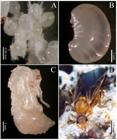
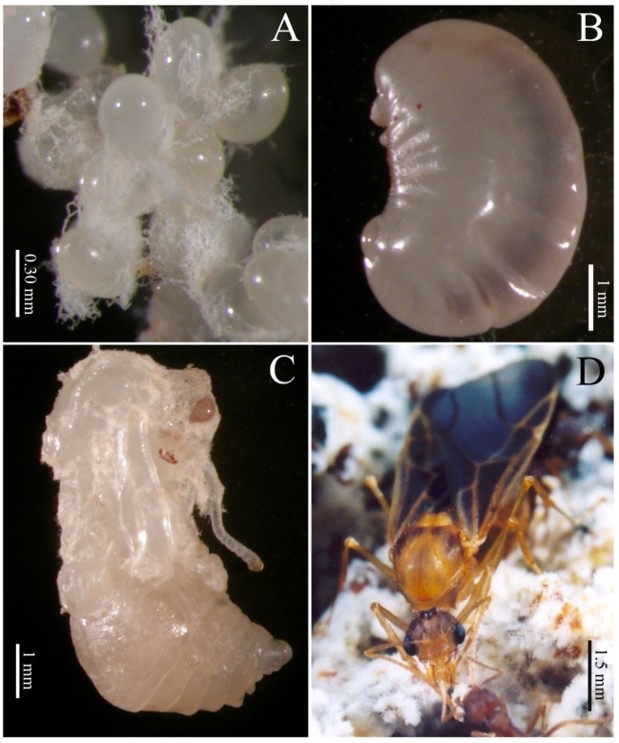
Developmental stages of males of Acromyrmex subterraneus brunneus (Hymenoptera: Formicidae) in queenless subcolonies with eggs covered by mycelia (A), larva (B), pupa (C), and newly emerged adult (D).
4. Brood Care in Queenless Colonies
Brood care by leaf-cutting ants is complex, as reported for 13 behavioral acts for Atta sexdens rubropilosa, including cleaning, assistance during emergence, transport of eggs, larvae, and pupae, and feeding larvae with staphylae, manipulated fungus, intact hyphae, and trophic eggs (Schneider, 2003). Many of these behaviors are poorly known (Fowler, 1983; Wilson, 1983), but likely its functions are similar to those described for A. subterraneus brunneus (Table 1). Licking the brood is associated with cleaning and sanitation; transport is related to microclimate management or response to nest disturbances (Bollazzi and Roces, 2002); and larval feeding involves nutrition and the transfer of substances via ingestion of fecal fluid (Figures 3, 4, 5) (Schneider, 2003; Lopes et al., 2005). The behavioral repertoire of winged adults in leaf-cutting ants is generally more limited, including self-grooming, mutual grooming among workers, food reception, and in some cases, independent feeding (Hölldobler and Wilson, 1990). Males of lower Attini, such as Mycetarotes parallelus, receive minimal care, limited to cleaning (Diniz and Bueno, 2010), unlike those of A. cephalotes, requiring greater effort to obtain food in quantities similar to females (Bass and Cherrett, 1995) due to the need of carbohydrate for the nuptial flight and locating females, and dying after copulation (Jutsum and Quinlan, 1978). The behavioral repertoire in orphaned colonies reflects adaptations and social organization in leaf-cutting ants, especially in the absence of the fertile caste (Camargo et al., 2006b)
Behavioral acts (BA) including licking the larvae body (La), transporting larvae (Tr), feeding larvae with hyphae (Al), scraping the larval mouthparts (Ra), ingesting fecal fluid excreted by larvae (In), and depositing hyphae on larvae (De), and their likely functions performed by workers of Acromyrmex subterraneus brunneus (Hymenoptera: Formicidae) in brood care and references (Ref.).
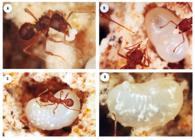
Behavioral acts performed by workers of Acromyrmex subterraneus brunneus (Hymenoptera: Formicidae): Transport of hyphae or staphylae (A); chewing/manipulating hyphal or staphylae tufts (B); feeding larvae with hyphae (Ali) (C); placing hyphae on the larvae (D). The photos are a courtesy of Camargo et al. (2006a).

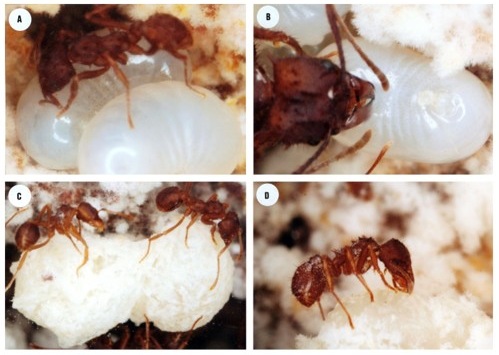
Behavioral acts performed by workers of Acromyrmex subterraneus brunneus (Hymenoptera: Formicidae): licking the larval body (La) (A); ingesting fecal fluid excreted by the larva (In) (B); licking the pupal body (C); detail of licking the pupal body (D). The photos are a courtesy of Camargo et al. (2006a).

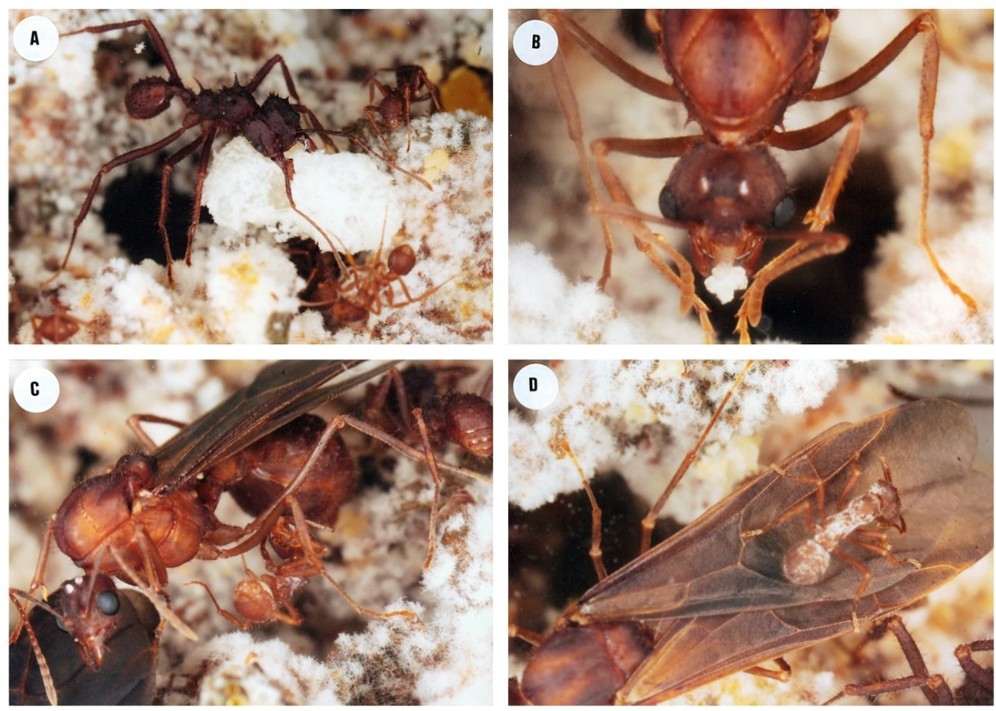
Behavioral acts performed by workers and males of Acromyrmex subterraneus brunneus (Hymenoptera: Formicidae): transport of pupae (A); collecting staphylae and self-feeding (B); mutual grooming between worker and male (C and D); and worker on the male wing covered by the specialized symbiotic bacterium (Pseudonocardiaceae) associated with Acromyrmex (D) (Currie et al., 2003). The photos are a courtesy of Camargo et al. (2006a).’
5. Communication between Queen and Workers
The division of labor in social colonies is clear, with the queen responsible for reproduction, and the sterile workers maintaining the colony (Robinson, 1992). Chemical and physical signals are more important for individual and collective behaviors in larger societies with more pronounced dimorphism, predominantly via pheromones, with the queen not only reproducing and maintaining social cohesion in the colony through chemical control of worker reproduction in larger colonies (Wilson, 1971; Keller and Nonacs, 1993; Moreira et al., 2004). On the other hand, her power relatively lower than in smaller societies (Keller and Nonacs 1993; Bourke and Ratnieks 1999), with dimorphism between worker and reproductive castes and direct physical suppression, including aggression and egg cannibalism, occurring more frequently (Wilson, 1971; Keller and Nonacs, 1993; Bourke, 1999). Cuticular hydrocarbons, through mutual grooming and self-grooming, maintain colony odor homeostasis for communication between the queen and workers (Wilson, 1971; Naumann, 1991; Jaccoud et al., 1999). Hydrocarbons produced by the queen of Camponotus floridanus and conveyed on the eggs regulated worker reproduction (Endler et al., 2004), which may also occur in leaf-cutting ants. Oral trophallaxis, a common mechanism in ants to transferring food and substances, may also disperse chemical signals, although its frequency and importance in leaf-cutting ants are controversial. Fluid absorption species of Acromyrmex is low, suggesting that this process is not the main pathway to transferring substances between these ants (Wilson, 1971; Littledyke and Cherrett, 1976; Paul and Roces, 2003; Erthal Junior et al., 2004). Selective pressures adjust behavioral acts for colony continuity and caste hierarchical rigidity, including reproduction among leaf-cutting ant workers, breaking the queen’s reproductive monopoly. Understanding the mechanisms that regulating reproduction by workers is essential to elucidate the evolutionary processes that shaped the complex social organization of leaf-cutting ants.
6. Conclusion
Reproduction among leaf-cutting ant workers may breake the queen reproductive monopoly under certain social and ecological conditions. This reproductive flexibility indicates that caste hierarchical rigidity is the result of dynamic selective pressures, allowing behavioral adjustments ensuring colony continuity. Thus, understanding the mechanisms regulating reproduction among workers is essential to elucidate the evolutionary processes that shaped the complex social organization of leaf cutting ants.
Acknowledgements
Luiz Carlos Forti was the recipient of a grant from Conselho Nacional de Desenvolvimento Científico e Tecnológico (CNPq) (Grant 301-938/2017-2). We thank CNPq (Grant No. 445997/2024-9) and FAPEG (Grant No. 2025 10267001634) for supporting the PELD CEMA Project; and CNPq for the PQ-C Research Productivity Fellowship (Grant No. 302200/2025-8) awarded to Frederico Guilherme.
Data Availability Statement
The data that support the findings of this study are available from the corresponding author upon reasonable request.
References
-
ALCOCK, J., BARROWS, E.M., GORDH, G., HUBBARD, L.J., KIRKENDALL, L., PYLE, D.W., PONDER, T.L. and ZALOM, F.G., 1978. The ecology and evolution of male reproductive behaviour in the bees and wasp. Zoological Journal of the Linnean Society, vol. 64, no. 4, pp. 293-326. https://doi.org/10.1111/j.1096-3642.1978.tb01075.x
» https://doi.org/10.1111/j.1096-3642.1978.tb01075.x - ANDRADE, A.P.P., 2002. Biologia e taxonomia comparada das subespécies de Acromyrmex subterraneus Forel, 1893 (Hymenoptera, Formicidae) e contaminação das operárias por iscas tóxicas Botucatu: Instituto de Biociências, Universidade Estadual Paulista, 168 p. Tese (Doutorado em Ciências Biológicas, Zoologia).
- AUTUORI, M., 1940. Algumas observações sobre formigas cultivadoras de fungo (Hym. Formicidae). Revista de Etologia, vol. 11, pp. 215-226.
- AUTUORI, M., 1942. Contribuição para o conhecimento da saúva (Atta spp.–Hymenoptera–Formicidae). II. O sauveiro inicial (Atta sexdens rubropilosa, Forel, 1908). Arquivos do Instituto Biológico, vol. 13, pp. 67-86.
-
BASS, M. and CHERRETT, J.M., 1995. Fungal hyphae as a source of nutrients for the leaf‐cutting ant Atta sexdens. Physiological Entomology, vol. 20, no. 1, pp. 1-6. https://doi.org/10.1111/j.1365-3032.1995.tb00793.x
» https://doi.org/10.1111/j.1365-3032.1995.tb00793.x - BAZIRE-BENAZET, M., 1957. Sur la formation de l’oeuf alimentaire chez Atta sexdens rubropilosa, Forel, 1908 (Hym., Formicidae). Comptes Rendus Hebdomadaires des Séances de l’Académie des Sciences, vol. 244, pp. 1277-1280.
- BAZIRE-BENAZET, M., 1970. La ponte des ouvrières d’Atta laevigata Fred. Smith 1858 (Hym. Form.). Comptes Rendus Hebdomadaires des Séances de l’Académie des Sciences, vol. 270, no. 12, pp. 1614-1615. PMid:4986352.
-
BOLLAZZI, M. and ROCES, F., 2002. Thermal preference for fungus culturing and brood location by workers of the thatching grass-cutting ant Acromyrmex heyeri. Insectes Sociaux, vol. 49, no. 2, pp. 153-157. https://doi.org/10.1007/s00040-002-8295-x
» https://doi.org/10.1007/s00040-002-8295-x -
BOLTON, B., 2025 [viewed 9 March 2026]. An online catalog of the ants of the world [online]. Available from: https://antcat.org
» https://antcat.org -
BOOMSMA, J.J., FJERDINGSTAD, E.J. and FRYDENBERG, J., 1999. Multiple paternity, relatedness and genetic diversity in Acromyrmex leaf-cutter ants. Proceedings. Biological Sciences, vol. 266, no. 1416, pp. 249-254. https://doi.org/10.1098/rspb.1999.0629
» https://doi.org/10.1098/rspb.1999.0629 -
BOURKE, A.F.G. and RATNIEKS, F.L.W., 1999. Kin conflict over caste determination in social Hymenoptera. Behavioral Ecology and Sociobiology, vol. 46, no. 5, pp. 87-297. https://doi.org/10.1007/s002650050622
» https://doi.org/10.1007/s002650050622 -
BOURKE, A.F.G., 1999. Colony size, social complexity and reproductive conflict in social insects. Journal of Evolutionary Biology, vol. 12, no. 2, pp. 245-257. https://doi.org/10.1046/j.1420-9101.1999.00028.x
» https://doi.org/10.1046/j.1420-9101.1999.00028.x - BRITTO, J.S., FORTI, L.C., OLIVEIRA, M.A., ZANETTI, R., WILCKEN, C.F., ZANUNCIO, J.C., LOECK, A.E., CALDATO, N., NAGAMOTO, N.S., LEMES, P.G. and CAMARGO, R.S., 2016. Use of alternatives to PFOS, its salts and PFOSF for the control of leafcutting ants Atta and Acromyrmex. International Journal of Research in Environmental Studies, vol. 3, pp. 11-92.
-
BUENO, O.C., HEBLING, M.J., SCHNEIDER, M.O., PAGNOCCA, F.C. and BACCI JUNIOR, M., 2002. Occurrence of winged forms of Atta sexdens rubropilosa Forel (Hymenoptera: Formicidae) in laboratory colonies. Neotropical Entomology, vol. 31, no. 3, pp. 469-473. https://doi.org/10.1590/S1519-566X2002000300019
» https://doi.org/10.1590/S1519-566X2002000300019 -
CAMARGO, R.S., LOPES, J.F.S. and FORTI, L.C., 2006a. Behavioural responses of workers towards worker‐produced male larvae and queen‐produced worker larvae in Acromyrmex subterraneus brunneus Forel, 1911 (Hym., Formicidae). Journal of Applied Entomology, vol. 130, no. 1, pp. 56-60. https://doi.org/10.1111/j.1439-0418.2005.01026.x
» https://doi.org/10.1111/j.1439-0418.2005.01026.x - CAMARGO, R.S., FORTI, L.C., LOPES, J.F. and ANDRADE, A.P.P., 2006b. Brood care and male behavior in queenless Acromyrmex subterraneus brunneus (Hymenoptera: Formicidae) colonies under laboratory conditions. Sociobiology, vol. 48, pp. 717-726.
-
CAMARGO, R.S., FORTI, L.C., NASCIMENTO, D.L., OLIVEIRA, N.C., ZANUNCIO, J.C., SERRÃO, J.E., MOREIRA, A.A., MATOS, C.A.O., GUILHERME, F.A.G. and CASTELLANI, M.A., 2025. Foundation and architecture of leaf-cutting ant nests in the genus Atta Fabricius (Hymenoptera: formicidae). Brazilian Journal of Biology, vol. 85, pp. e295961. https://doi.org/10.1590/1519-6984.295961 PMid:41124391.
» https://doi.org/10.1590/1519-6984.295961 -
COLE, B.J., 1983. Multiple mating and the evolution of social behavior in the Hymenoptera. Behavioral Ecology and Sociobiology, vol. 12, no. 3, pp. 191-201. https://doi.org/10.1007/BF00290771
» https://doi.org/10.1007/BF00290771 - CORSO, C.R. and SERZEDELLO, A., 1981. A study of multiple mating habit in Atta laevigata based on the DNA content. Comparative Biochemistry and Physiology, vol. 69, pp. 901-902.
-
CRISTIANO, M.P., CARDOSO, D.C., SANDOVAL‐GÓMEZ, V.E. and SIMÕES‐GOMES, F.C., 2020. Amoimyrmex Cristiano, Cardoso and Sandoval, gen. nov. (Hymenoptera: Formicidae): a new genus of leaf‐cutting ants revealed by multilocus molecular phylogenetic and morphological analyses. Austral Entomology, vol. 59, no. 4, pp. 643-676. https://doi.org/10.1111/aen.12493
» https://doi.org/10.1111/aen.12493 -
CURRIE, C.R., WONG, B., STUART, A.E., SCHULTZ, T.R., REHNER, S.A., MUELLER, U.G. and STRAUS, N.A., 2003. Ancient tripartite coevolution in the attine ant-microbe symbiosis. Science, vol. 299, no. 5605, pp. 386-388. https://doi.org/10.1126/science.1078155 PMid:12532015.
» https://doi.org/10.1126/science.1078155 -
DELABIE, J.H.C., 1989. Observações sobre a ocorrência de poliginia em colônias de Acromyrmex subterraneus brunneus Forel, 1893, em cacauais (Formicidae, Myrmicinae, Attini). Anais da Sociedade Entomológica do Brasil, vol. 18, no. 1, pp. 193-197. https://doi.org/10.37486/0301-8059.v18i1.581
» https://doi.org/10.37486/0301-8059.v18i1.581 -
DELLA-LUCIA, T.M.C. and VILELA, E.F., 1986. Ocorrência de poliginia em Acromyrmex subterraneus Forel, 1893 (Hymenoptera: formicidae). Anais da Sociedade Entomológica do Brasil, vol. 15, no. 2, pp. 379-380. https://doi.org/10.37486/0301-8059.v15i2.437
» https://doi.org/10.37486/0301-8059.v15i2.437 -
DIJKSTRA, M.B. and BOOMSMA, J.J., 2006. Are workers of Atta leafcutter ants capable of reproduction? Insectes Sociaux, vol. 53, no. 2, pp. 136-140. https://doi.org/10.1007/s00040-005-0848-3
» https://doi.org/10.1007/s00040-005-0848-3 -
DIJKSTRA, M.B. and BOOMSMA, J.J., 2007. The economy of worker reproduction in Acromyrmex leafcutter ants. Animal Behaviour, vol. 74, no. 3, pp. 519-529. https://doi.org/10.1016/j.anbehav.2006.11.020
» https://doi.org/10.1016/j.anbehav.2006.11.020 -
DIJKSTRA, M.B., NASH, D.R. and BOOMSMA, J.J., 2005. Self-restraint and sterility in workers of Acromyrmex and Atta leafcutter ants. Insectes Sociaux, vol. 52, no. 1, pp. 67-76. https://doi.org/10.1007/s00040-004-0775-8
» https://doi.org/10.1007/s00040-004-0775-8 -
DINIZ, E.A. and BUENO, O.C., 2010. Evolution of substrate preparation behaviors for cultivation of symbiotic fungus in Attine ants (Hymenoptera: formicidae). Journal of Insect Behavior, vol. 23, no. 3, pp. 205-214. https://doi.org/10.1007/s10905-010-9207-y
» https://doi.org/10.1007/s10905-010-9207-y -
ENDLER, A., LIEBIG, J., SCHMITT, T., PARKER, J.E., JONES, G.R., SCHREIER, P. and HÖLLDOBLER, B., 2004. Surface hydrocarbons of queen eggs regulate worker reproduction in a social insect. Proceedings of the National Academy of Sciences of the United States of America, vol. 101, no. 9, pp. 2945-2950. https://doi.org/10.1073/pnas.0308447101 PMid:14993614.
» https://doi.org/10.1073/pnas.0308447101 -
ERTHAL JUNIOR, M., SILVA, C.P. and SAMUELS, R.I., 2004. Digestive enzymes of leaf-cutting ants, Acromyrmex subterraneus (Hymenoptera: Formicidae: Attini): distribution in the gut of adult workers and partial characterization. Journal of Insect Physiology, vol. 50, no. 10, pp. 881-891. https://doi.org/10.1016/j.jinsphys.2004.06.009 PMid:15518656.
» https://doi.org/10.1016/j.jinsphys.2004.06.009 - FEBVAY, G. and OGIER, C., 1984. Observations sur une ponte fertile d’ouvrieres d’Acromyrmex octospinosus (Reich) (Hymenoptera – Formicidae). Turrialba, vol. 34, pp. 107-108.
-
FJERDINGSTAD, E.J. and BOOMSMA, J.J., 1998. Multiple mating increases the sperm stores of Atta colombica leafcutter ant queens. Behavioral Ecology and Sociobiology, vol. 42, no. 4, pp. 257-261. https://doi.org/10.1007/s002650050437
» https://doi.org/10.1007/s002650050437 - FOWLER, H.G., 1978. Variación sexual diferencial en Acromyrmex rugosus rugosus (Hymenoptera, Formicidae, Attini). Neotrópica, vol. 24, pp. 141-144.
- FOWLER, H.G., 1983. Latitudinal gradients and diversity of the leaf-cutting ants (Atta and Acromyrmex) (Hymenoptera: Formicidae). Revista de Biología Tropical, vol. 31, pp. 213-216.
-
HAMILTON, W.D., 1964a. The genetical evolution of social behaviour. I. Journal of Theoretical Biology, vol. 7, no. 1, pp. 1-16. https://doi.org/10.1016/0022-5193(64)90038-4 PMid:5875341.
» https://doi.org/10.1016/0022-5193(64)90038-4 -
HAMILTON, W.D., 1964b. The genetical evolution of social behaviour. II. Journal of Theoretical Biology, vol. 7, no. 1, pp. 17-52. https://doi.org/10.1016/0022-5193(64)90039-6 PMid:5875340.
» https://doi.org/10.1016/0022-5193(64)90039-6 -
HAMILTON, W.D., 1972. Altruism and related phenomena, mainly in social insects. Annual Review of Ecology and Systematics, vol. 3, no. 1, pp. 193-232. https://doi.org/10.1146/annurev.es.03.110172.001205
» https://doi.org/10.1146/annurev.es.03.110172.001205 -
HEINZE, J., PUCHINGER, W. and HÖLLDOBLER, B., 1997. Worker reproduction and social hierarchies in Leptothorax ants. Animal Behaviour, vol. 54, no. 4, pp. 849-864. https://doi.org/10.1006/anbe.1996.0511 PMid:9344438.
» https://doi.org/10.1006/anbe.1996.0511 -
HÖLLDOBLER, B. and WILSON, E.O., 1990. The ants Cambridge: The Belknap Press of Harvard University Press. https://doi.org/10.1007/978-3-662-10306-7
» https://doi.org/10.1007/978-3-662-10306-7 -
JACCOUD, D.B., HUGHES, W.O.H. and JACKSON, C.W., 1999. The epizootiology of a Metarhizium infection in mini‐nests of the leaf‐cutting ant Atta sexdens rubropilosa. Entomologia Experimentalis et Applicata, vol. 93, no. 1, pp. 51-61. https://doi.org/10.1046/j.1570-7458.1999.00561.x
» https://doi.org/10.1046/j.1570-7458.1999.00561.x -
JULIAN, G.E. and FEWELL, J.H., 2004. Genetic variation and task specialization in the desert leaf-cutter ant, Acromyrmex versicolor. Animal Behaviour, vol. 68, no. 1, pp. 1-8. https://doi.org/10.1016/j.anbehav.2003.06.023
» https://doi.org/10.1016/j.anbehav.2003.06.023 -
JUTSUM, A.R. and QUINLAN, R.J., 1978. Flight and substrate utilisation in laboratory-reared males of Atta sexdens. Journal of Insect Physiology, vol. 24, no. 12, pp. 821-825. https://doi.org/10.1016/0022-1910(78)90102-6
» https://doi.org/10.1016/0022-1910(78)90102-6 -
KELLER, L. and NONACS, P., 1993. The role of queen pheromones in social insects: queen control or queen signal? Animal Behaviour, vol. 45, no. 4, pp. 787-794. https://doi.org/10.1006/anbe.1993.1092
» https://doi.org/10.1006/anbe.1993.1092 - KERR, W.E., 1961. Acasalamento de rainhas com vários machos em duas espécies da tribo Attini (Hymenoptera: formicoidea). Revista Brasileira de Biologia, vol. 21, pp. 45-48.
-
LAPOLLA, J.S., MUELLER, U.G., SEID, M. and COVER, S.P., 2002. Predation by the army ant Neivamyrmex rugulosus on the fungus-growing ant Trachymyrmex arizonensis. Insectes Sociaux, vol. 49, no. 3, pp. 251-256. https://doi.org/10.1007/s00040-002-8310-2
» https://doi.org/10.1007/s00040-002-8310-2 -
LITTLEDYKE, M. and CHERRETT, J.M., 1976. Direct ingestion of plant sap from cut leaves by the leaf-cutting ants Atta cephalotes (L.) and Acromyrmex octospinosus (Reich) (Formicidae, Attini). Bulletin of Entomological Research, vol. 66, no. 2, pp. 205-217. https://doi.org/10.1017/S0007485300006647
» https://doi.org/10.1017/S0007485300006647 -
LOPES, J.F.S., HUGHES, W.O., CAMARGO, R.S. and FORTI, L.C., 2005. Larval isolation and brood care in Acromyrmex leaf-cutting ants. Insectes Sociaux, vol. 52, no. 4, pp. 333-338. https://doi.org/10.1007/s00040-005-0816-y
» https://doi.org/10.1007/s00040-005-0816-y - MINTZER, A.C. and VINSON, S.B., 1985. Cooperative colony foundation by female of the leafcutting ant Atta texana in the laboratory. New York Entomological Society, vol. 93, pp. 1047-1051.
-
MINTZER, A.C., 1987. Primary polygyny in the ant Atta texana: number and weight of females and colony foundation success in the laboratory. Insectes Sociaux, vol. 34, no. 2, pp. 108-117. https://doi.org/10.1007/BF02223829
» https://doi.org/10.1007/BF02223829 -
MOREIRA, A., FORTI, L.C., ANDRADE, A.P., BOARETTO, M.A. and LOPES, J., 2004. Nest architecture of Atta laevigata (F. Smith, 1858) (Hymenoptera: formicidae). Studies on Neotropical Fauna and Environment, vol. 39, no. 2, pp. 109-116. https://doi.org/10.1080/01650520412331333756
» https://doi.org/10.1080/01650520412331333756 - MOSER, J.C. and LEWIS, J.R., 1981. Multiple nest queens of Atta texana (Buckley, 1960) (Hym.: formicidae). Turrialba, vol. 31, pp. 256-257.
-
MOSER, J.C., 1967. Mating activities of Atta texana (Hymenoptera, Formicidae). Insectes Sociaux, vol. 14, no. 3, pp. 295-312. https://doi.org/10.1007/BF02252831
» https://doi.org/10.1007/BF02252831 -
MURAKAMI, T., HIGASHI, S. and WINDSOR, D., 2000. Mating frequency, colony size, polyethism and sex ratio in fungus-growing ants (Attini). Behavioral Ecology and Sociobiology, vol. 48, no. 4, pp. 276-284. https://doi.org/10.1007/s002650000243
» https://doi.org/10.1007/s002650000243 -
NAUMANN, K., 1991. Grooming behaviors and the translocation of queen mandibular gland pheromone on worker honey bees (Apis mellifera L). Apidologie, vol. 22, no. 5, pp. 523-531. https://doi.org/10.1051/apido:19910505
» https://doi.org/10.1051/apido:19910505 -
OLIVEIRA, F.M.P., KNOECHELMANN, C.M., WIRTH, R., TABARELLI, M. and LEAL, I.R., 2023. Leaf-cutting ant nests support less dense and impoverished seed assemblages in a human-modified Caatinga dry forest. Biotropica, vol. 55, no. 2, pp. 444-453. https://doi.org/10.1111/btp.13198
» https://doi.org/10.1111/btp.13198 -
PAGE JUNIOR, R.E., 1986. Sperm utilization in social insects. Annual Review of Entomology, vol. 31, no. 1, pp. 297-320. https://doi.org/10.1146/annurev.en.31.010186.001501
» https://doi.org/10.1146/annurev.en.31.010186.001501 -
PARKER, G.A., 1970. Sperm competition and its evolutionary consequences in the insects. Biological Reviews of the Cambridge Philosophical Society, vol. 45, no. 4, pp. 525-567. https://doi.org/10.1111/j.1469-185X.1970.tb01176.x
» https://doi.org/10.1111/j.1469-185X.1970.tb01176.x -
PAUL, J. and ROCES, F., 2003. Fluid intake rates in ants correlate with their feeding habits. Journal of Insect Physiology, vol. 49, no. 4, pp. 347-357. https://doi.org/10.1016/S0022-1910(03)00019-2 PMid:12769988.
» https://doi.org/10.1016/S0022-1910(03)00019-2 -
PERRY, J. and ROITBERG, B., 2006. Trophic egg laying: hypotheses and tests. Oikos, vol. 112, pp. 706-714. https://doi.org/10.1111/j.0030-1299.2006.14498.x
» https://doi.org/10.1111/j.0030-1299.2006.14498.x -
RATNIEKS, F.L.W., 1988. Reproductive harmony via mutual policing by workers in eusocial Hymenoptera. The American Naturalist, vol. 132, no. 2, pp. 217-236. https://doi.org/10.1086/284846
» https://doi.org/10.1086/284846 -
REICHARDT, A.K. and WHEELER, D.E., 1996. Multiple mating in the ant Acromyrmex versicolor: a case of female control. Behavioral Ecology and Sociobiology, vol. 38, no. 4, pp. 219-225. https://doi.org/10.1007/s002650050235
» https://doi.org/10.1007/s002650050235 -
RISSING, S.W., JOHSON, R.A. and POLLOCK, G.B., 1986. Natal nest distribution and pleometrosis in the desert leaf-cutter ant Acromyrmex versicolor (Pergande) (Hymenoptera: Formicidae). Psyche (Cambridge, Massachusetts), vol. 93, no. 3-4, pp. 177-186. https://doi.org/10.1155/1986/36205
» https://doi.org/10.1155/1986/36205 -
ROBINSON, G.E., 1992. Regulation of division of labor in insect societies. Annual Review of Entomology, vol. 37, no. 1, pp. 637-665. https://doi.org/10.1146/annurev.en.37.010192.003225 PMid:1539941.
» https://doi.org/10.1146/annurev.en.37.010192.003225 -
SCHAEFER, C., HENRIQUES, R.J., GOMES, L.P., GORSANI, R.G., SANTOS, M.F.S. and FERNANDES, D.P.D., 2021. Interplays between Atta ants (Formicidae: Attini), soils and environmental properties in the Brazilian Neotropics: a preliminary assessment. Revista Brasileira de Ciência do Solo, vol. 45, pp. e0210073. https://doi.org/10.36783/18069657rbcs20210073
» https://doi.org/10.36783/18069657rbcs20210073 - SCHNEIDER, M.D.O., 2003. Comportamento de cuidado da prole da saúva-limão Atta sexdens rubropilosa Forel, 1908 (Hymenoptera, Formicidae) Rio Claro: Universidade Estadual Paulista. Dissertação.
-
SOARES, R.S., MOREIRA, A.A., CASTELLANI, M.A., FORTI, L.C., CAMARGO, R.S., NASCIMENTO, D.L., MATOS, C.A.O., LEITE, S.A., CARDOSO, A.C.P., ZANUNCIO, J.C., SABATTINI, J.A. and OLIVEIRA, N.C., 2025. The nest architecture of the leaf-cutting ant Atta sexdens (Hymenoptera: formicidae). Brazilian Journal of Biology, vol. 85, pp. e295068. https://doi.org/10.1590/1519-6984.295068 PMid:40990791.
» https://doi.org/10.1590/1519-6984.295068 -
SOUZA, D.J., DELLA LUCIA, T.M.C. and LIMA, E.R., 2005. Queen adoption in colonies of the leaf-cutting ant Acromyrmex subterraneus molestans (Hymenoptera: Formicidae). Behavioural Processes, vol. 70, no. 1, pp. 62-68. https://doi.org/10.1016/j.beproc.2005.04.002 PMid:15916864.
» https://doi.org/10.1016/j.beproc.2005.04.002 -
SUNDSTRÖM, L. and BOOMSMA, J.J., 2001. Conflicts and alliances in insect families. Heredity, vol. 86, no. Pt 5, pp. 515-521. https://doi.org/10.1046/j.1365-2540.2001.00884.x PMid:11554967.
» https://doi.org/10.1046/j.1365-2540.2001.00884.x -
SWARTZ, M.B., 1998. Predation on an Atta cephalotes colony by an army ant Nomamyrmex esenbecki. Biotropica, vol. 30, no. 4, pp. 682-684. https://doi.org/10.1111/j.1744-7429.1998.tb00110.x
» https://doi.org/10.1111/j.1744-7429.1998.tb00110.x -
TRIVERS, R. and HARE, H., 1976. Haplodiploidy and the evolution of the social insects. Science, vol. 191, no. 4224, pp. 249-263. https://doi.org/10.1126/science.1108197 PMid:1108197.
» https://doi.org/10.1126/science.1108197 -
URREA-VALENCIA, S., BIZARRIA JÚNIOR, R., KOOIJ, P.W., MONTOYA, Q.V. and RODRIGUES, A., 2023. Unraveling fungal species cultivated by lower attine ants. Mycological Progress, vol. 22, no. 9, pp. 66. https://doi.org/10.1007/s11557-023-01912-6
» https://doi.org/10.1007/s11557-023-01912-6 -
VILLESEN, P., GERTSCH, P.J., FRYDENBERG, J., MUELLER, U.G. and BOOMSMA, J.J., 1999. Evolutionary transition from single to multiple mating in fungus-growing ants. Molecular Ecology, vol. 8, no. 11, pp. 1819-1825. https://doi.org/10.1046/j.1365-294x.1999.00767.x PMid:10620226.
» https://doi.org/10.1046/j.1365-294x.1999.00767.x -
WALKER, W.F., 1980. Sperm utilization strategies in nonsocial insects. The American Naturalist, vol. 115, no. 6, pp. 780-799. https://doi.org/10.1086/283600
» https://doi.org/10.1086/283600 - WEBER, N.A., 1972. Gardening ants: the Attines. Philadelphia: American Philosophical Society, 146 p.
-
WILSON, E.O., 1962. Social modifications related to rareness in ant species. Evolution, vol. 17, no. 2, pp. 249-253. https://doi.org/10.1111/j.1558-5646.1963.tb03274.x
» https://doi.org/10.1111/j.1558-5646.1963.tb03274.x - WILSON, E.O., 1971. The insect societies. Cambridge: Belknap Press of Harvard University Press.
-
WILSON, E.O., 1983. Caste and division of labor in leaf-cutter ants (Hymenoptera: Formicidae: Atta) III. Ergonomic resiliency in foraging by A. cephalotes. Behavioral Ecology and Sociobiology, vol. 14, no. 1, pp. 47-54. https://doi.org/10.1007/BF00366655
» https://doi.org/10.1007/BF00366655
Edited by
-
Editor:
Takako Matsumura Tundisi