 First record of infestation by the coffee scale insect Cerococcus parahybensis (Hempel, 1927) (Hemiptera: Coccidae) in ornamental plants in the Brejo Paraibano Region
Cerococcus parahybensis (Hempel, 1927) (Hemiptera: Coccidae) is a scale insect historically known for its importance in coffee cultivation (Coffea arabica L.). It was initially reported in the state of Paraíba in the early 20th century (Fornazier et al., 2017). Despite its former impact on regional coffee production, recent records of its potential damage have been scarce (Souza Junior, 2024).
The decline of coffee production in Paraíba for over a hundred years was attributed to heavy infestations of C. parahybensis (Moreira, 1997). However, in the past five years, the Brejo Paraibano region has undertaken efforts to revive coffee cultivation by evaluating varieties and genotypes from the state of Minas Gerais, which has attracted the interest of many producers and led to new plantations in the municipalities of Areia, Bananeiras, Borborema, Pilões, Serraria, and Alagoa Grande. In the already established crops, high infestations of this scale insect have been observed (Ramalho, 2020; Sousa-Neto, 2021; Souza-Junior, 2024).
Given that local coffee farming is concentrated among small producers and the region hosts several floriculture businesses, infestations of C. parahybensis were also observed in ornamental plants: golden shrimp plant (Pachystachys lutea) (Acanthaceae) and mussaenda (Mussaenda erythrophylla) (Rubiaceae) in the municipality of Areia, PB. The specimen was collected in April 2025 from these ornamental plants (Figure 1). The identification was made based exclusively on the morphological characteristics described by Hempel (1927), confirmed under a stereomicroscope at the Entomology Laboratory of the Center for Agricultural Sciences of the Federal University of Paraíba - UFPB. However, the use of molecular tools could provide more definitive confirmation of the species' identity, especially in regions where morphologically similar species may occur. Future studies may benefit from incorporating molecular analyses to confirm the species' identification.
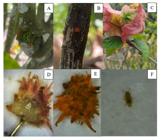
Infestation of Cerococcus parahybensis in ornamental plants: golden shrimp plant (Pachystachys lutea) in images A and B, and mussaenda (Mussaenda erythrophylla) in C. Adults of C. parahybensis observed on the ventral (D) and dorsal (E) parts of the body, and a nymph (F). Specimens were collected in a private floriculture in the municipality of Areia, Paraíba.
In this context, it is plausible to assume that, after more than one hundred years without recorded presence in the region’s coffee fields, C. parahybensis maintained its population in alternative hosts, such as these ornamental species. This fact may explain the recurring infestations in new coffee plantations and also represents a phytosanitary risk for the regional floriculture industry.
The occurrence of C. parahybensis in ornamental plants such as yellow shrimp and mussaenda highlights the ecological plasticity of the species and its ability to infest non-traditional hosts, raising important ecological questions about the adaptation of this pest to new environments. This finding underscores the importance of periodic monitoring, given the potential spread of scale insects and their possible impacts on both ornamental flora and agricultural crops. This study presents a new record of the species occurring in golden shrimp plant and mussaenda in the municipality of Areia, state of Paraíba, Brazil.
Acknowledgements
We thank the Federal University of Paraíba (UFPB), the Entomology Laboratory (LEN) team, the Coffee Studies Group (NECAF), and Professor José Bruno Malaquias, faculty member at UFPB.
Data Availability Statement
The entire data set that supports the results of this study was published in the article itself.
References
-
FORNAZIER, M.J., MARTINS, D.S., WILLINK, M.C.G., PIROVANI, V.D., FERREIRA, P.S.F. and ZANUNCIO, J.C., 2017. Scale insects (Hemiptera: Coccoidea) associated with arabica coffee and geographical distribution in the neotropical region. Anais da Academia Brasileira de Ciências, vol. 89, no. 4, pp. 3083-3092. http://doi.org/10.1590/0001-3765201720160689 PMid:29236860.
» http://doi.org/10.1590/0001-3765201720160689 - HEMPEL, A., 1927. Cerococcus parahybensis n. sp. Preliminary note. Revista do Museu Paulista, vol. 15, pp. 387-390.
- RAMALHO, A.R., 2020. Evidence of dating and identification of the cultivar Coffea arabica L., of the remaining coffee trees in the municipality of Serraria (Paraíba) Porto Velho: EMBRAPA. 6 p.
-
SOUSA-NETO, A.T., 2021 [viewed 23 April 2025]. Adaptação de genótipos de café arábica no município de Areia - PB (Ano II) Universidade Federal da Paraíba, Areia, 33 p. Trabalho de Conclusão de Curso (Título de Engenheiro Agrônomo). Available from: https://repositorio.ufpb.br/jspui/handle/123456789/20470
» https://repositorio.ufpb.br/jspui/handle/123456789/20470 -
SOUZA-JUNIOR, S.L., 2024 [viewed 20 April 2025]. Infestação e controle de insetos pragas no cafeeiro em Areia-PB Universidade Federal da Paraíba, Areia, 34 p. Dissertação (Mestre em Agronomia). Available from: https://repositorio.ufpb.br/jspui/handle/123456789/33647
» https://repositorio.ufpb.br/jspui/handle/123456789/33647
Edited by
-
Editor:
Takako Matsumura Tundisi