
 Harvest and essential oil yield during a prolonged peppermint (Mentha piperita L.) growing period under the influence of a phytoene desaturase inhibitor
Abstract
Mentha piperita L. is a well-known source of essential oil and its components, which are widely used in different spheres of national economy. Although, it is more traditional under conditions of Non-Chernozem zone to cultivate the crop no more than 3 years in a row, prolonged growing period could provide a significant addition of the products, especially under application of growth regulator – phytoene desaturase inhibitor. Average values of green mass, dry leaf yield, yield of essential oil and total menthol obtained for first three years of growing differ more or less pronounced from levels of these parameters the plants demonstrated after all five years of the experiment. Results comparison showed specificity of noted effects for different peppermint varieties used in the experiment.
Keywords:
Mentha piperita L.; diflufenican; phytoene desaturase inhibitor; growing period; essential oil
Resumo
Mentha piperita L. é uma fonte bem conhecida de óleo essencial e seus componentes, amplamente utilizados em diferentes setores da economia nacional. Embora seja mais tradicional, em condições da Zona não-Chernozem, cultivar a planta por no máximo 3 anos consecutivos, um período de cultivo prolongado pode proporcionar um aumento significativo na produção, especialmente com a aplicação do regulador de crescimento – inibidor da fitoeno dessaturase. Os valores médios de massa verde, rendimento de folhas secas, rendimento de óleo essencial e teor total de mentol obtidos nos três primeiros anos de cultivo diferem, em maior ou menor grau, dos níveis desses parâmetros apresentados pelas plantas após os cinco anos do experimento. A comparação dos resultados mostrou a especificidade dos efeitos observados para as diferentes variedades de hortelã-pimenta utilizadas no experimento.
Palavras-chave:
Mentha piperita L.; diflufenican; inibidor da fitoeno dessaturase; período de cultivo; óleo essencial
1. Introduction
On the territory of Russia Mentha piperita L. has been cultivated since the end of 18th century (Shelepova et al., 2021a). The growing period of peppermint as a cultural plant depends primarily on the purpose of the variety, as well as on the crop cultivation culture and the region of cultivation (Zhivchikov and Zhivchikova, 2020; Morozov et al., 2012; Dmitrieva et al., 2011). It is possible to grow peppermint as a perennial crop in the Central region of the Non-Chernozem zone of Russia, but growing period directly affects the characteristics of essential oil yield (Shcherbakov, 1975; Dmitrieva et al., 2012) as well as growing conditions in general (Telci et al., 2011). On average, in this region, peppermint is introduced into crop rotations for three consecutive years in one field (Morozov, 2019). At the same time, the harvest of the 1st and 2nd years of cultivation is traditionally intended for leaves obtaining, but starting from the 2nd and the whole third year – for essential oil yield (Shuvaeva and Borodkina, 2018). In more southern regions of cultivation, the growing period of a perennial crop increases by several years (Sushkova, 2019).
In our research we wanted to trace the dynamics of peppermint cultivation, changes of the crop productivity indicators and the quality of essential oil during the longest possible growing period under conditions of Moscow region in combination with application of phytoene desaturase inhibitor.
Previously, we have already studied the effect of diflufenican on the component composition of the essential oil of M. piperita L. variety Yantarnaya (Sushkova et al., 2016, 2018; Lukomets et al., 2016). Also, the severity of changes in the accumulation of components of the essential oil of peppermint variety Krasnodarskaya 2 (et al., 2013) caused by the use of the phytoindesaturase inhibitor diflufenican, depending on its dose and the period of collection of plant materials, was evaluated.
According to the mechanism of action of the herbicide Alistair Grand (CropScience, 2025) declared by the manufacturer BayerCropsScience, the antidote included in the preparation mefenpyr-diethyl promotes the rapid decomposition of mesosulfuron-methyl and iodosulfuron-methyl-sodium in cultivated plants treated with the herbicide, which confirms that that the main active ingredient that affects the plant is diflufenican.
Diflufenican is an inhibitor of carotenoid synthesis, has a systemic and contact effect, is adsorbed mainly by seedlings and has a limited ability to translocate in the plant.
According to the manufacturer Bayer CropScience (2025), diflufenican is contained in the preparation in an amount of 180.0 g/l. The mechanism of action of the other two active ingredients - mesosulfuron-methyl (6.0 g/l) and iodosulfuron-methyl-sodium (4.5 g/l) is to disrupt the activity of the enzyme acetolactate synthase (ALS), which leads to a stop in cell division and growth plants. The composition of the herbicide also includes the antidote mefenpyr-diethyl (27.0 g/l), which promotes the rapid decomposition of mesosulfuron-methyl and iodosulfuron-methyl-sodium in cultivated plants treated with the drug. This ensures high selectivity and eliminates the manifestation of phytotoxicity.
To assess the possible influence of additional components present in the used preparation (Alistair Grand), we compared the impact on the yield and composition of peppermint essential oil by Alistair Grand and the main active ingredient, diflufenican (Sushkova et al., 2018). The influence of additional active substances in the composition of the herbicide is manifested only in the severity of changes, often having the character of a trend - there is a significantly identical direction of changes in metabolic processes and biosynthesis of secondary metabolites (including an increase in the accumulation of essential oils), when using both diflufenican separately and the herbicide itself .
The choice of the drug used was made in favor of the herbicide Alistair Grand on the basis that its main active ingredient is diflufenican (according to the manufacturer), which has the mechanism of action of interest to us and it was the only registered diflufenican-containing drug at the time of the experiment.
Diflufenican is an inhibitor of phytoene desaturase, one of the enzymes that catalyze the biosynthesis of carotenoids.
Phytoene desaturase inhibitors interrupt the process of isoprenoid condensation at the stage of formation of geranylgeranyl pyrophosphate (C20) and subsequent formation of carotenoids (Sushkova et al., 2013). It is assumed that in this case, excessive accumulation of the product (C20) and its transformation into diterpenoids, and farnesyl pyrophosphate and geranyl pyrophosphate into sesqui- and monoterpenoid components of the essential oil are possible.
It should be noted that prior to the industrial implementation of the method of using Alistair grand as a growth-regulating drug on peppermint (Mentha piperita L.), registration tests of the drug on this crop should first be carried out in order to subsequently obtain its state registration as a pesticide approved for use on medicinal plants.
This article presents research on the development and testing of a new strategy for managing the yield and composition of essential oils in different peppermint cultivars, with the aim of altering the content of the main components—menthol and its precursors in the essential oil biosynthesis pathway.
The following objectives were addressed in the study:
-
To assess the effect of diflufenican on the yield and harvest of peppermint essential oil;
-
To study the effect of diflufenican on the direction and severity of changes in the qualitative and quantitative composition of peppermint essential oil;
-
To determine the effect of treatment with a phytoene desaturase inhibitor on the composition of peppermint essential oil and evaluate the potential for using the resulting essential oil in various sectors of the national economy.
-
To evaluate the feasibility of optimizing production through a cost-effective method for cultivating peppermint as a perennial medicinal crop.
2. Materials and Methods
2.1. Plant material
The objects of the study were three varieties of peppermint: Krasnodarskaya 2, Yantarnaya and Chernolistnaya (Bochkarev et al., 2015).
Krasnodarskaya 2 – a variety of universal purpose, can be used both for its leaves and for obtaining extractable essential oil. The variety of a pepper type, the originators of the variety are Research Institute of Agriculture of Crimea and Prilutskaya experimental station of Institute of All-Russian Scientific Research Institute of Medicinal and Aromatic Plants (FSBSI VILAR). A plant with a thick stem, pyramidal shape, the upper branches are shorter than the lower ones, the leaf is large, serrated. In terms of resistance to shedding of leaves and lodging, the variety is moderately resistant (Figure 1).

Variety Yantarnaya – included in the State Register of the Russian Federation for all zones of cultivation. The applicant and originator is All-Russian Scientific Research Institute of Medicinal and Aromatic Plants. This is variety of universal use. The leaf is yellow-green, corrugated, hairless, the flower is pale lilac (Figure 2).

Variety Chernolistnaya – a variety developed by All-Russian Scientific Research Institute of Medicinal and Aromatic Plants. Originator is Ukrainian Experimental Station. A variety of special purpose, cultivates for leaves. The plant is of a closed form, the stem is branched, hairless, with anthocyanin coloration. The plant is not prone to lodging. The lower branches are attached low. The leaf is large, broadly ovate, serrated, dark green (Figure 3).
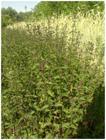
Planting was carried out in furrows to a depth of 4-6 cm in spring (III decade of April). Rhizomes and creeping shoots served as planting material.
2.2. Plant growing conditions
The studies were carried out in 2012-2016 on a small-plot micro-field experiment (in triplicate, random arrangement of plots) of the experimental territory of All-Russian Scientific Research Institute of Medicinal and Aromatic Plants.
The soil on which the culture grew was sod-podzolic, medium loamy, humus – 2.5%, рНКСI = 5.5. According to the availability of mobile forms of phosphorus, the soil belongs to class III (146 mg/kg), and according to the content of exchangeable potassium - to class IV (180 mg/kg). The content of readily hydrolysable nitrogen, determined by the method of Tyurin and Kononova, is 55 mg/kg of soil, which makes it possible to attribute these soils to the 3rd class in terms of availability.
During the laying of the experiment (1 year of research), the mineral fertilizer "Universal 2" was introduced with the content of the main nutrients in terms of active ingredients: N - 12%, P2O5 - 8%, K2O - 14% at a dose of 0.02 kg/m2 in furrows when planting rhizomes in accordance with the methodological recommendations of VILAR. The field processing and plant care were carried out in accordance with the agrotechnical measures recommended for this zone (Terekhin and Vandyshev, 2008).
2.3. Treatments
Phytoene desaturase inhibitor we chose – diflufenican, 2',4'-difluoro-2-(α,α,α-trifluoro-m-tolyloxy)nicotinanilide (CAS N 83164-33-4). This active ingredient inhibits the formation of carotenoids, disrupting photosynthesis (Cramp et al., 1987; Haynes and Kirkwood, 1992; Miras-Moreno et al., 2019).
We applied diflufenican as part of Alister Grand drug (CropScience, 2025). According to the manufacturer second component of the drug mefenpyr-diethyl, works like an antidote accelerating breakdown of mesosulfuron-methyl and iodosulfuron-methyl-sodium (other components of the drug) in cultivated plants, which confirms that the main active ingredient that affects the plant and affects essential oil accumulation is diflufenican.
During the flowering period of the culture, the plants were treated with the working solution of Alister Grand in three different doses – 0.01 (I); 0.001 (II); 0.0001 (III) g/m2 in terms of the active ingredient (a.i.) diflufenican, based on its content in the herbicide declared by the manufacturer, the control variant was sprayed with distilled water.
The plant material was collected and dried in 2 cuttings – 10 and 20 days after treatment.
2.4. Laboratory experiment
Laboratory studies included: analysis of plant material and extraction of essential oil by a modified hydrodistillation method according to Ginzberg (Russia, 1988, 1990, 2017), determination of the agrochemical characteristics of the soil: humus according to Tyurin (Russia, 1992), the content of mobile forms of phosphorus according to Kirsanov (Russia, 2013), exchangeable potassium (Russia, 1991), easily hydrolysable nitrogen according to the method of Tyurin and Kononova. The quantitative and qualitative composition of the components of peppermint essential oil was determined by gas chromatography with flame ionization and mass spectrometric detection (as more appropriate to the experiment purpose than more traditional HPLC (Britton et al., 1987; Barry and Pallett, 1990; Hu et al., 2021; Qin et al., 2022) using certified equipment of the Department of Chemistry of the Federal State Budgetary Educational Institution of Higher Education RGAU-MSHA named after K.A. Timiryazev, Clarus 600 GC/MS gas-liquid chromatograph, manufacturer Perkin Elmer Lift and Analytical Sсiences (accreditation certificate No. ROSS RU.0001.516875).
Residual amounts of Diflufenican in the essential oil were determined by GC-MS and were not detected (Figures 4 and 5).


2.5. Statistical analysis
The analyzes were repeated three times, the significance level of the confidence interval was 95%, the calculations were carried out using the Microsoft Excel program, version 2019.
3. Results and Discussion
To assess the potential yield of a perennial peppermint crop in the conditions of the Moscow region, we use an array of obtained long-term data on crop yields on average during five years of the field experiment (Table 1).
3.1. The effect of different doses of diflufenican on the yield of different peppermint varieties (2012-2016)
To assess the productivity of peppermint under growing conditions in the Non-Chernozem zone (Moscow region) and to identify patterns that actually took place we compare the average yield values for the first three years of the study. The yield calculated in this way for the Krasnodarskaya 2 variety compared to the control was significantly lower (by 1.2 times in both cases) for the variants of the experiment with spraying with Alistair Grand in the first and third variants, for the second variant there was a pronounced effect of reducing the yield relative to the control . In our opinion, this is due to the specific responsiveness of the variety to the action of the drug in the highest and lowest concentrations used (Figure 6).

The effect of different doses of diflufenican on the yield of different peppermint varieties, g/m2 (average for 2012-2014).
For Yantarnaya variety, there was no significant difference in yield between the control, first, second and third variants of the experiment (168.4; 157.1; 162.2 and 161.4 g/m2, respectively), which indicates a low susceptibility of vegetative and generative plant organs of this variety to a change in the content of phytoene desaturase (Morozov, 2018).
The yield of Chernolistnaya variety in the third variant slightly differed from the control variant, without showing a significant difference. However, in the variant with the use of the drug in the first two concentrations, the average yield for three years decreased significantly - by 19 and 12%, respectively.
Comparing the three-year average yield of the peppermint varieties used in our study, we can conclude that the treatment of plants with the drug in the studied concentrations either leads to a significant decrease in yield in terms of dry weight, as evidenced by the data on Krasnodarskaya 2 variety in the first and third variants, and for Chernolistnaya variety in the first and second, either does not have any pronounced effect on the productivity of the crop – as can be seen in the example of Yantarnaya variety.
3.2. The effect of different doses of diflufenican on the yield of different peppermint varieties (2012-2016)
We also decided to look at average peppermint yield data over five years of the experiment.
As can be seen from Figure 7, for five years, the yield of peppermint variety Yantarnaya was in the range from 149.6 to 160.1 g/m2 and these values are higher compared to other varieties – Krasnodarskaya 2 from 142.6 to 149.7 and Chernolistnaya from 147.4 to 152.0 g/m2. This can be explained by the fact that Yantarnaya variety was originally created in Central Russia, while the Krasnodarskaya 2 and Chernolistnaya varieties are varieties of southern selection and may have low productivity in more northern growing conditions (Morozov, 2013).

The effect of different doses of diflufenican on the yield of different peppermint varieties, g/m2 (average for 2012-2016).
The data on the yield of Krasnodarskaya 2 variety against the yield of other varieties differ more strongly due to the fact that we present the results on average for five years, and Krasnodarskaya 2 variety degenerates strongly over five years of vegetation in the Moscow Region.
Yield of Chernolistnaya variety did not differ significantly in the experimental variants for all years of vegetation, which is explained by the effect of smoothing the sample for five years of the experiment.
It can be concluded that for the cultivation of peppermint in the long term in the conditions of the Non-Chernozem Zone (Moscow Region), Yantarnaya variety is generally more suitable for use as a perennial crop than Krasnodarskaya 2, which has reduced its average productivity over these five years (Figure 8) actually by 15%, while for Yantarnaya and Chernolistnaya this decrease did not exceed 7 and 10%, respectively.

3.3. Essential oil yield
In order to evaluate the biological productivity of the studied crop under growing conditions of Non-chernozem zone (Moscow region), we also compared an average data for the first three years of growing and for all five years of the field experiment (Tables 2 and 3).
3.3.1. Biological productivity of peppermint varieties for 2012-2014
The content of essential oil in peppermint plants of the studied varieties varies greatly in all variants of the experiment. The highest content exceeds the lowest by almost 2 times.
Comparing the amount of total menthol for all varieties, we can say that these varieties are low-menthol, because the values for the content of total menthol in the essential oil do not exceed 50%. The maximum content of total menthol was obtained for Krasnodarskaya 2 variety in the first variant, but it did not exceed the threshold value for low-menthol varieties.
On Krasnodarskaya 2 variety, the use of the drug in the first dose showed the best result in terms of the menthol content, however, accumulation of essential oil on Krasnodarskaya 2 variety in the first variant was minimal compared to the other options, which is explained by the low yield of air-dry raw materials and the low content of essential oil in it – less than 2%.
The highest yield of Krasnodarskaya 2 variety among the variants with the use of various drug doses was observed in the second variant, which, in combination with the highest content of essential oil in all variants, ultimately gave maximum collection essential oil and total menthol yield – higher than in the control variant by 15 and 7% respectively.
For Yantarnaya variety, the maximum collection of essential oil was observed in the variants with the use of the drug in the second and third doses (no significant difference was observed). This is due to the maximum essential oil content in the raw material in these options, although the yield for all options, including control, does not differ significantly. However, accumulation of total menthol is significantly higher in the third variant – by 8%.
For Chernolistnaya variety, there was a pronounced tendency to reduce both the harvest and the content of essential oil in the third variant in relation to the control variant, which led to a significant decrease in the essential oil yield – by 13%. In general, Chernolistnaya variety responded negatively to the effect of various concentrations of the drug, which we observe in accumulation of essential oil and total menthol. Unlike other varieties, it was for Chernolistnaya variety that the second concentration of the drug gave the lowest total menthol yield – 1.4 times less than the control variant.
The maximum levels of bioproductivity indicators – the collection of essential oil and total menthol were shown by Yantarnaya variety under application of drug in the third dose.
In the same variant, the maximum value for essential oil yield and total menthol was demonstrated among for the variants with drug application on Chernolistnaya variety, however, in general, the use of the drug reduced the overall bioproductivity of plants.
Comparing essential oil and total menthol yield between the variants of the experiment with the drug application and the control variant, it can be argued that Chernolistnaya variety expressed a specific response chosen phytoene desaturase inhibitor. Perhaps this is due to the fact that Chernolistnaya variety is mainly cultivated for leaves.
3.3.2. Biological productivity of peppermint varieties for 2012-2016
The highest content of essential oil in peppermint of all three varieties for all variants of the experiment, but for five years of vegetation exceeds the lowest by 1.8 times (Table 3).
The content of total menthol for all five years again didn’t exceed 50% of the total content of essential oil in the studied raw materials, which again confirms the low-menthol type of the studied varieties (Orav et al., 2013; Shelepova et al., 2021b).
Maximum content of total menthol in general for all the years of growing Krasnodarskaya 2 variety was obtained already under application of the first drug dose.
Comparing the variants of the experiment with the application of different doses of the drug, it is worth noting that the maximum content of essential oil accumulated in the third variant, which subsequently led to the highest essential oil yield in the same variant.
However, we obtained comparable data on accumulation of essential oil and total menthol in the second variant, which was similar with pattern for first three years of vegetation.
For Krasnodarskaya 2 variety grown for five years no significant increase in essential oil and total menthol accumulation was observed in all variants of the experiment with drug application in comparison to the control.
This is explained by the fact that simultaneously with a small decrease in the content of essential oil and total menthol, crop yield has significantly decreased over the years.
For Yantarnaya variety, maximum collection of essential oil and total menthol continues to be in the third variant, which is explained by a pronounced tendency of crop yield to increase in this variant and maximum essential oil content among the variants of experiment.
Evaluating experimental data of Chernolistnaya variety over five years, it is impossible to unambiguously say about the effect of a particular dose of the drug, because all the obtained indicators of plant bioproductivity insignificantly differ slightly from each other by experimental options and no tendency to increase or decrease in indicators is observed. However, comparing the indicators for the first three years of vegetation and for all five, we can say with confidence that in the control variant for five years there is a decrease in crop yield by 11%, essential oil content by 18%, and its yield by 24%. At the same time, the content of total menthol increased by 25%, but due to a decrease in the total crop yield, total menthol yield fell by 14%. The decrease of crop harvest and a drop of essential oil yield explained by the difference in the hydrothermal coefficient (HTC) – for five years of growing the crop it was 1.5, and for the first three years – 1.4. That is, the last two wet years of the experiment, in combination with a drop in the overall bioproductive potential of the crop, created unfavorable conditions for crop yield formation and accumulation of essential oil.
However, with an increase in the percentage of total menthol in the essential oil, the share of its collection in kg/ha of the total yield remained practically unchanged. Thus, for the first three years this parameter was 0.77%; and for all five years – 0.75%. This shows that concentration of total menthol in essential oil more depends on plant genetics than on exogenous factors (Gašić et al., 1987).
The results obtained for Mentha piperita L. was close to effects demonstrated by other cultures under influence of diflufenican. For Elsholtzia ciliatа (Thunb.) Hyl. application of diflufenican-containing drug in dose equal of 0.01 g/m2 decreased an intensity of plant biochemical processes including essential oils accumulation (Dmitrieva et al., 2016, 2018, 2020; Baibekov et al., 2020). On the other hand plants of E. ciliatа treated with diflufenican solutions equal to 0.001 and 0.0001 g/m2 increased essential oils yield, what is similar to pattern we observed for Mentha piperita in current experiment.
4. Conclusion
Under the conditions of cultivation in the Non-Chernozem zone (Moscow region), both for three and five years, the most effective in terms of the yield of raw materials and essential oil yield per square meter of Yantarnaya variety combined with application of diflufenican in dose 0.001 g/m2.
Variety Chernolistnaya both for three years and for all five years of vegetation will not reliably respond to different doses of the drug. Therefore, the use of the drug in order to increase the crop yield and the yield of essential oil for this variety is impractical.
In order to use peppermint for leaves and essential oil, it is more expedient to cultivate Krasnodarskaya 2 variety for three years using the drug in dose 0.001 g/m2.
Acknowledgements
The research was carried out at the expense of the university development program within the framework of the strategic academic lordship program “Priority 2030”.
Data Availability Statement
Data available.
References.
-
BAIBEKOV, R., DMITRIEVA, V., BELOPUKHOV, S., DMITRIEV, L. and SUCHKOVA, L., 2020. Influence of deflufenican herbicide on the chemical composition of essential oil Elsholtzia ciliata (Thunb.) Hyl. Problems of Biological Medical and Pharmaceutical Chemistry, vol. 23, no. 4, pp. 3-9. https://doi.org/10.29296/25877313-2020-04-01
» https://doi.org/10.29296/25877313-2020-04-01 -
BARRY, P. and PALLETT, K., 1990. Herbicidal inhibition of carotenogenesis detected by HPLC. Zeitschrift für Naturforschung. C, A Journal of Biosciences, vol. 45, no. 5, pp. 492-497. https://doi.org/10.1515/znc-1990-0533
» https://doi.org/10.1515/znc-1990-0533 - BOCHKAREV, N., ZELENCOV, S., SHUVAEVA, T. and BORODKINA, A., 2015. Taxonomy, morphology and breeding of menthol mints. Nauchno-Tehnicheskiy Byulleten Vserossiiskogo Nauchno-Issledovatelskogo Instituta Maslichnykh Kultur, vol. 2, pp. 106-124.
- BRITTON, G., BARRY, P. and YOUNG, A., 1987. Mode of action of diflufenican: Its evaluation by HPLC. In Proceedings of the British Crop Protection Conference–Weeds, 16-19 November 1987, Brighton. Alton: BCPC Publications, pp. 1015-1022.
-
CRAMP, M., GILMOUR, J., HATTON, L., HEWETT, R., NOLAN, C. and PARNELL, E., 1987. Design and synthesis of N-(2,4-difluorophenyl)-2-(3-trifluoromethylphenoxy)-3-pyridinecarboxamide (diflufenican), a novel pre- and early post-emergence herbicide for use in winter cereals. Pesticide Science, vol. 18, no. 1, pp. 15-28. https://doi.org/10.1002/ps.2780180103
» https://doi.org/10.1002/ps.2780180103 -
CROPSCIENCE, 2025 [viewed 25 August 2025]. World Alistair® Grand [online]. Available from: https://www.cropscience.bayer.ru/product/alister-grand
» https://www.cropscience.bayer.ru/product/alister-grand - DMITRIEVA, V., DMITRIEV, L., MOROZOV, A. and KONON, N., 2011. Cultivation of sod-podzolic soil as a way of external influence on essential oil components ratio of low-menthol Mentha piperita L. varieties. Doklady RSAU-MTAA, vol. 1, no. 283, pp. 370-375.
- DMITRIEVA, V., DMITRIEV, L. and BELOPUKHOV, S., 2012. The study of the volatile oils content in the essential oil crops in the Non-chernozem zone in Russia. Izvestiya of Timiryazev Agricultural Academy, no. spe, pp. 124-136.
- DMITRIEVA, V., DMITRIEV, L. and BELOPUKHOV, S., 2016. Preharvest treatment with herbicides plant Elsholtzia ciliata. New and Nontraditional Plants and Prospects for Their Use, vol. 12, pp. 111-114.
- DMITRIEVA, V., BELOPUKHOV, S., DMITRIEV, L. and SUSHKOVA, L., 2018. Regulation of essential oil components ratios in Elsholtzia ciliata (Thunb.) Hyl. under conditions of Russian Non-chernozem zone. In: 100th Anniversary of A.I. Shreter, 2018, Moscow. Moscow: VILAR, pp. 87-92.
- DMITRIEVA, V., SUSHKOVA, L. and DMITRIEV, L., 2020. Regulation of essential oil components ratios in Elsholtzia ciliata (Thunb.) Hyl. In: Proceedings of the Conference, 2018, Moscow. Moscow: RSAU-MTAA, pp. 405-409.
-
GAŠIĆ, O., MIMICA-DUKIĆ, N., ADAMOVIĆ, D. and BOROJEVIĆ, K., 1987. Variability of content and composition of essential oil in different genotypes of peppermint. Biochemical Systematics and Ecology, vol. 15, no. 3, pp. 335-340. https://doi.org/10.1016/0305-1978(87)90008-1
» https://doi.org/10.1016/0305-1978(87)90008-1 -
HAYNES, C. and KIRKWOOD, R., 1992. Studies on the mode of action of diflufenican in selected crop and weed species: basis of selectivity of pre- and early post-emergence applications. Pesticide Science, vol. 35, no. 2, pp. 161-165. https://doi.org/10.1002/ps.2780350210
» https://doi.org/10.1002/ps.2780350210 -
HU, Z., LI, J., ZHANG, Y. and SHI, Y., 2021. Determination of residue of diflufenican in wheat and soil by ultra-high-pressure liquid chromatography and mass spectrometry conditions. Journal of the Science of Food and Agriculture, vol. 101, no. 1, pp. 215-219. https://doi.org/10.1002/jsfa.10633 PMid:32623721.
» https://doi.org/10.1002/jsfa.10633 - LUKOMETS, V., SUSHKOVA, L., BELOPUKHOV, S., DMITRIEV, L. and DMITRIEVA, V., 2016. Biosynthesis of components in ethereal mint of the variety Amber under the influence of preharvesting treatment by herbicide. Vestnik of Russian Agricultural Science, vol. 3, pp. 31-33.
-
MIRAS-MORENO, B., PEDREÑO, M.A., FRASER, P.D., SABATER-JARA, A.B. and ALMAGRO, L., 2019. Effect of diflufenican on total carotenoid and phytoene production in carrot suspension-cultured cells. Planta, vol. 249, no. 1, pp. 113-122. https://doi.org/10.1007/s00425-018-2966-y PMid:30083808.
» https://doi.org/10.1007/s00425-018-2966-y - MOROZOV, A., 2013. Agrobiological foundations of varietal technology for the cultivation of peppermint (Mentha piperita L.) in the Non-Chernozem zone of Russia Moscow: All-Russian Scientific Research Institute of Medicinal and Aromatic Plants. Doctoral Dissertation.
-
MOROZOV, A., 2018. Mint selection for different specific purposes. Vestnik Rossiyskoy Selskokhozyaystvennoy Nauki, vol. 5, no. 5, pp. 52-55. https://doi.org/10.30850/vrsn/2018/5/52-55
» https://doi.org/10.30850/vrsn/2018/5/52-55 - MOROZOV, A., 2019. Peppermint: Varieties and cultivation technology in non-chernozem zone of Russia. Moscow: De’Libri.
- MOROZOV, A., DMITRIEVA, V. and DMITRIEV, L., 2012. Effect of cultivation of sod-podzolic soil on the formation of chemical composition aspic oil of Mentha piperita L. Butlerov Communications, vol. 29, no. 3, pp. 125-131.
-
ORAV, A., KAPP, K. and RAAL, A., 2013. Chemosystematic markers for the essential oils in leaves of Mentha species cultivated or growing naturally in Estonia. Proceedings of the Estonian Academy of Sciences, vol. 62, no. 3, pp. 175-186. https://doi.org/10.3176/proc.2013.3.03
» https://doi.org/10.3176/proc.2013.3.03 -
QIN, F., BI, Y., HAN, L., SONG, S. and LV, X., 2022. Method validation and residue analysis of mesosulfuron-methyl and diflufenican in wheat field trial by liquid chromatography with tandem mass spectrometry. Food Analytical Methods, vol. 15, no. 10, pp. 2617-2624. https://doi.org/10.1007/s12161-022-02296-1
» https://doi.org/10.1007/s12161-022-02296-1 - RUSSIA, 1988. GOST 17082.5-88: essential oil crops: industrial raw materials: methods for determining the mass fraction of essential oil. Moscow.
- RUSSIA, 1990. GOST 28605-90: essential oil raw material floral-herbal raw material. methods of sampling. Moscow.
- RUSSIA, 1991. GOST 26210-91: soils: determination of exchangeable potassium by Maslova method. Moscow.
- RUSSIA, 1992. GOST 26213-91: soils: methods for determining organic matter. Moscow.
- RUSSIA, 2013. GOST R 54650-2011: soils: determination of mobile phosphorus and potassium compounds by Kirsanov method modified by CINAO Moscow.
- RUSSIA, 2017. GOST 31791-2017: essential oils and floral herbaceous essential oil raw materials: technical conditions. Moscow.
- SHCHERBAKOV, S., 1975. Rekomendatsii po vyrashchivaniyu vysokikh urozhaev myaty. Moscow: Urozhay.
-
SHELEPOVA, O., OLEKHNOVICH, L., KONOVALOVA, L., KHUSNETDINOVA, T., GULEVICH, A. and BARANOVA, E., 2021a. Assessment of essential oil yield in three mint species in the climatic conditions of Central Russia. Agronomy Research, vol. 19, no. 4, pp. 1970-1980. https://doi.org/10.15159/AR.21.113
» https://doi.org/10.15159/AR.21.113 -
SHELEPOVA, O., TKACHEVA, E. and GOLOSOVA, E., 2021b. The history of the introduction of peppermint (Mentha piperita L.) in Imperial Russia. BIO Web of Conferences, vol. 38, pp. 00115. https://doi.org/10.1051/bioconf/20213800115
» https://doi.org/10.1051/bioconf/20213800115 -
SHUVAEVA, T. and BORODKINA, A., 2018. Technology of cultivation transitory mint of the second to third years of life. Oil Crops: Scientific and Technical Bulletin of V.S. Pustovoit All-Russian Research Institute of Oil Crops, vol. 1, no. 173, pp. 67-70. https://doi.org/10.25230/2412-608X-2018-1-173-67-70
» https://doi.org/10.25230/2412-608X-2018-1-173-67-70 - SUSHKOVA, L., 2019. Genetic peculiarities of peppermint and exogenous mobilization of its adaptive potential. In: Role of metabolomics in perfection of biotechnological means of production, 2018, Moscow. Moscow: VILAR, pp. 368–370.
- SUSHKOVA, L., DMITRIEV, L., LITVINSKII, V. and DMITRIEVA, V., 2018. The study of exogenous influence of growth-regulating chemicals on metabolic processes of terpenoids in peppermint. In: 100th Anniversary of A.I. Shreter, 2018, Moscow. Moscow: VILAR, pp. 64–69.
- SUSHKOVA, L., DMITRIEVA, V., DMITRIEV, L. and BELOPUKHOV, S., 2016. The pre-harvest herbicide treatment of the plants of Mentha piperita L. variety Yantarnaya. New and Unconventional Plants and Prospects for Their Use, vol. 12, pp. 154.
-
SUSHKOVA, L., LITVINSKII, V., BELOPUKHOV, S. and DMITRIEV, L. 2013. Changes in peppermint essential oil content under influence of diflufenican-based drug. Agrochemical Herald, vol. 1, pp. 43-49. https://doi.org/10.24412/1029-2551-2023-1-007
» https://doi.org/10.24412/1029-2551-2023-1-007 -
TELCI, I., KACAR, O., BAYRAM, E., ARABACI, O., DEMIRTAŞ, İ., YILMAZ, G., OZCAN, I., SONMEZ, C. and GÖKSU, E., 2011. The effect of ecological conditions on yield and quality traits of selected peppermint (Mentha piperita L.) clones. Industrial Crops and Products, vol. 34, no. 1, pp. 1193-1197. https://doi.org/10.1016/j.indcrop.2011.04.010
» https://doi.org/10.1016/j.indcrop.2011.04.010 - TEREKHIN, A. and VANDYSHEV, V., 2008. Technology of medicinal plants’ cultivation Moscow: Peoples’ Friendship University of Russia.
-
ZHIVCHIKOV, A. and ZHIVCHIKOVA, R., 2020. Features of growing peppermint in the Far East. Far East Agrarian Bulletin, vol. 2, no. 54, pp. 5-14. https://doi.org/10.24411/1999-6837-2020-12015
» https://doi.org/10.24411/1999-6837-2020-12015
Edited by
-
Editor:
Takako Matsumura Tundisi


