
 Trends of farmers in Jordan: Madaba Province towards applying climate change adaptation practices to protect their agricultural crops
Abstract
Jordan is a highly vulnerable country to the negative impacts of climate change. It’s suffering from unprecedented waves of drought and high temperatures, which threaten mostly rainfed agriculture. Farmers in Madaba Province depend on rainfed agriculture and are, unfortunately extremely, distressed from climate change impacts on their crops. Limited studies have been conducted about climate change impacts on agricultural crops and methods for adaptation from the point of view of Madaba farmers. The aims of this study were to find out the extent of knowledge that Madaba farmers possess about the impacts of climate change on agriculture and what adaptation practices they use, in addition to the challenges they face in this aspect and the solutions that might be helpful to enrich their knowledge to encounter climate change impacts. In this study, 353 farmers from Madaba responded to a questionnaire to determine their trends towards climate change and the adaptation practices they apply to encounter such a problem. The results showed that farmers' knowledge about climate change and the agricultural practices for adaptation was moderate (M= 2.32, M= 2.15, respectively) and came primarily from other farmers' experiences. The results also showed that farmers applied adaptation practices at a moderate level (M= 2.64), while surface tillage and crop rotation were the most frequently used methods to mitigate climate change. Furthermore, data indicated that the lack of government support for farmers was the most significant challenge to applying the adaptation measures. The study also demonstrated that increasing government support for farmers and providing them with training courses were among the most acceptable solutions for addressing the risks of climate change. Finally, the study showed that age and education level played a significant role in the extent to which farmers adopted adaptation methods to mitigate climate change consequences. It is hoped that this study will guide the government and decision-makers to become aware of the most important challenges facing Madaba farmers due to climate change and to exert greater effort in improving and following up on the plans they have prepared to confront these threats to agriculture in a more effective and practical way.
Keywords:
adaptation; agriculture; climate change; Jordan; Madaba
Resumo
A Jordânia é um país altamente vulnerável aos impactos negativos das mudanças climáticas, na medida em que sofre com ondas sem precedentes de seca e altas temperaturas, que ameaçam principalmente a agricultura de sequeiro. Os agricultores da Província de Madaba dependem da agricultura de sequeiro e, infelizmente, estão extremamente afetados pelos impactos das mudanças climáticas em suas plantações. Estudos sobre os impactos das mudanças climáticas nas culturas agrícolas e os métodos de adaptação sob a perspectiva dos agricultores de Madaba são limitados. Os objetivos deste estudo foram descobrir o nível de conhecimento que os agricultores de Madaba possuem sobre os impactos das mudanças climáticas na agricultura e quais práticas de adaptação eles utilizam, além dos desafios que enfrentam nesse aspecto e das soluções que podem ser úteis para enriquecer seu conhecimento e lidar com os impactos das mudanças climáticas. Neste estudo, 353 agricultores de Madaba responderam a um questionário para determinar suas tendências em relação às mudanças climáticas e às práticas de adaptação que aplicam para enfrentar esse problema. Os resultados mostraram que o conhecimento dos agricultores sobre as mudanças climáticas e as práticas agrícolas de adaptação era moderado (M = 2,32 e M = 2,15, respectivamente) e provinha principalmente das experiências de outros agricultores. Os resultados também mostraram que os agricultores aplicavam práticas de adaptação em um nível moderado (M = 2,64), sendo o cultivo superficial e a rotação de culturas os métodos mais frequentemente utilizados para mitigar as mudanças climáticas. Além disso, os dados indicaram que a falta de apoio governamental aos agricultores era o desafio mais significativo para a aplicação das medidas de adaptação. O estudo também demonstrou que o aumento do apoio governamental aos agricultores e a oferta de cursos de capacitação estavam entre as soluções mais aceitáveis para lidar com os riscos das mudanças climáticas. Por fim, o estudo mostrou que a idade e o nível de escolaridade desempenharam um papel significativo, na medida em que os agricultores adotaram métodos de adaptação para mitigar as consequências das mudanças climáticas. Espera-se que este estudo oriente o governo e os tomadores de decisão a tomarem consciência dos desafios mais importantes enfrentados pelos agricultores de Madaba devido às mudanças climáticas e a envidarem maiores esforços para aprimorar e acompanhar os planos que elaboraram para enfrentar essas ameaças à agricultura de forma mais eficaz e prática.
Palavras-chave:
adaptação; agricultura; mudanças climáticas; Jordânia; Madaba
1. Introduction
Jordan is a small country in Middle East where dry to semi-arid conditions prevail. The annual precipitation is less than 50 millimeters, which made Jordan rank second in the world list of countries in terms of poor water status (Al Adaileh et al., 2019; Jordan, 2022). Climate change poses an additional burden on Jordan, threatening all productive sectors, especially agriculture, which is mostly rainfed through exposure to s extreme temperatures, droughts, and high soil salinity. Jordan has been keen to implement numerous efforts to address the negative impacts of climate change on productive sectors, especially agriculture. For example, in 2009, the Ministry of Environment issued the second national communication report (SNC), which identified the sectors most threatened by climate change (Jordan, 2009). Also, in 2022, the Ministry of Environment released the first Climate Change National Adaptation Plan (NAP), which addressed the efforts to confront climate change in the framework of the country’s development policy (Jordan, 2022). Improving irrigation system efficiency, using supplemental irrigation, cultivating tolerant varieties and crop diversification were among these adaptation efforts included in the plan. Unfortunately, few studies have monitored the extent of implementation of this plan by the farmers. Madaba is a governorate in Jordan, located southwest of the capital Amman. Madaba is distinguished by its unique historical and archaeological significance, in addition to its important agricultural significance as it ranks second in Jordan in terms of wheat production, which gives it a great role in maintaining food security in Jordan (Sarayrah et al., 2024). Due to diverse topography and fertile soil, Madaba provides Jordan with significant amounts of cereals (Abu Nwar, 2024).
Meanwhile, there is a data gap about the extent of Madaba farmers' knowledge regarding specific agricultural measures for adaptation, and whether they are actually practicing these measures or not. According to Admasu et al. (2024), farmers who possessed adequate information about the impacts of climate change on agriculture were found to be more competent in applying resilient measures to face this problem and more confident about the feasibility of such measures. Our study aimed to find out how farmers in Madaba rate their knowledge about the impacts of climate change on agriculture and what adaptation practices they use to encounter such threats. Also, the study searched the challenges that Madaba farmers face in terms of applying the adaptation practices and the solutions that might improve their knowledge about these practices that might reduce climate change impacts on their crops. There are no previous studies on the extent to which farmers in Madaba apply certain agricultural practices to reduce the impact of climate change on their crops. So, this study is the first of its kind in this field, which gives it significant importance. We hope that the findings of this study will be recognized by the government and incorporated into its plans to overcome the real difficulties farmers face in this domain in a more realistic and practical manner.
2. Materials and Methods
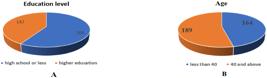
A descriptive approach was applied in this study. Based on the Department of Statistics report (Jordan, 2024), 4,293 farmers are currently working in the plant production sector in Madaba. So, a sample of 353 farmers of Madaba received a questionnaire including several questions to find out their trends towards adaptation to climate change. Two demographic factors (education level and age) were investigated to find out their influence on the extent to which the farmers apply some adaptation agricultural measures to encounter the negative impacts of climate change (Figure 1)
The study hypotheses (H0) were based on the assumption that there were no statistically significant differences in the extent to which farmers in Madaba apply agricultural adaptation practices to mitigate the negative impacts of climate change, attributed to education level and age. The questionnaire was developed by referring to primary and secondary sources, including specialized books, reports from the Ministries of Agriculture and Environment, the Department of Statistics in Jordan, and scientific articles.
The questionnaire consisted of these statements:
-
1- The level of Madaba farmers general knowledge about the impacts of climate change and adaptation measures that reduce these impacts on crops.
-
2- The sources of information used by Madaba farmers.
-
3- The extent to which Madaba farmers apply some adaptation agricultural practices to encounter climate change impacts on their crops.
-
4- The challenges facing Madaba farmers in terms of applying the adaptation practices.
-
5- Assessment of the effectiveness of some of the proposed solutions to improve farmers knowledge about the practices to reduce the impacts of climate change on their crops from Madaba farmers perspective.
The questionnaire validity was evaluated by referring to academic people from Jordanian universities, in addition to researchers from Ministries of Agriculture and Environment, and the National Agricultural Research Center (NARC).
Cronbach's alpha test was applied to test the reliability of the study tool. Cronbach's alpha value for all statements included in the questionnaire (0.931) was significant as it was more than the acceptable threshold (0.70).
The obtained results were analyzed by applying the Statistical Package for the Social Sciences (SPSS). The following statistical tests were used.
-
Cronbach's Alpha reliability test.
-
Percentages were utilized to indicate the sources of information used by Madaba farmers on adaptation practices to climate change impacts on crops.
-
Means and standard deviations were employed as techniques for descriptive statistical analysis to represent the trends of Madaba farmers.
-
T-test was employed to determine if there were statistically significant differences in the extent to which the respondents apply the adaptation practices attributed to education level and age at p < 0.05.
The study used a scale of five distinct levels (none = 0, limited= 1, moderate = 2, high= 3, very high= 4) based on a Likert scale, and the relative responses was determined according to the equation:
Level interval = Maximum level – Minimum level = 1.33
Number of levels
The final levels of responses were (low: 0.00-1.33, Moderate: 1.34 – 2.67, and High: 2.68– 4.00).
3. Results
3.1. The level of Farmers general knowledge about the impacts of climate change and adaptation measures that reduce these impacts on crops
Data recorded in Table (1) showed that farmers had scored their knowledge about the impacts of climate change and adaptation measures as moderate (M= 2.58, M= 2.15, respectively). Also, data revealed that, farmers’ familiarity with the measures that reduce the impact of climate change on crops was of moderate level (Table 1).
Level of farmers general knowledge about the impacts of climate change and adaptation measures.
Meanwhile, Madaba farmers expressed a high need to improve their knowledge about the adaptation methods (M= 3.37) (Table 1). On the other hand, attending workshops and training on climate-smart agriculture was limited by most farmers (M = 1.25), which expresses limited engagement in formal learning opportunities.
Moreover, farmers in our study scored the role of the Ministry of Agriculture guiding farmers on measures that reduce the consequences of climate change on their crops as a moderate (M = 2.41) (Table 1).
On the other hand, the farmers showed that practicing adaptation measures was highly important (M = 3.96,), indicating that the farmers strongly recognize the need to act against climate impacts on their crops (Table 1).
3.2. Sources for information on measures that decrease the impact of climate change on crops
The largest portion of the participants in this study revealed that they depend on other farmers experiences to know more about climate change adaptation methods to protect on their crops (40.52%) (Figure 2). Meanwhile, (28.33%) of the respondents got their information from the agricultural extension agents , while only (3.39%) of the farmers referred to specialized books (Figure 2).

3.3. The extent to which the farmer uses the following agricultural practices for adaptation
Our data showed that Madaba farmers have applied climate change adaptation measures listed in the questionnaire to a moderate level (M = 2.64) (Table 2), while surface tillage (3.61) and crop rotation (3.55) were the most practices that adopted by the respondents (Table 2). On the other hand, the adoption of innovative irrigation technologies was notably low (M = 1.23) (Table 2)
Moreover, farmers agreement was of moderate level regarding the cultivation of heat, drought, and salinity-resistant crop varieties (M = 2.49) and the creation of resilient infrastructure or natural protective features (M = 2.38) (Table 2).
Sharing knowledge and experiences on climate adaptation was highly rated by Madaba farmers (M = 3.28) (Table 2), while crop diversification (M = 2.59) and the use of weather forecasts (M = 2.51) received moderate ratings.
Meanwhile, Madaba farmers considered their current practices to be somewhat helpful but insufficient to fully mitigate climate impacts, as evidenced by the moderate rating for perceived effectiveness of adaptation measures (M = 2.13) (Table 2).
3.4. The challenges of applying practices for adaptation from Madaba farmers point of view
According to our study, the farmers from Madaba rated all the statements listed in Table 3 as highly challenging to encounter climate change impacts on agriculture from their perspective. Lacke of governmental support was the most challenging (3.91) (Table 3).
Challenges facing Madaba farmers in terms of applying adaptation practices to confront climate change impacts.
3.5. Farmers assessment of the effectiveness of the proposed solutions to improve their knowledge about adaptation practices to climate change
Madaba farmers had highly agreed with most of the suggested solutions that might help them to be more adaptive to climate change (Table 4). The statement: (Supporting farmers by providing material and logistical assistance to encourage them to apply adaptation methods to encounter climate change threats on their crops) scored the highest rate (3.96) followed by (Attend workshops to raise awareness of measures that decline the consequences of climate change on their crops) (Table 4).
Farmers assessment of the effectiveness of the proposed solutions to improve their knowledge about adaptation practices to climate change.
3.6. Demographic factors affecting the extent to which the respondents apply some adaptation practices to encounter climate change attributed to education level and age
The results in Tables 5 and 6 indicated that the extent to which the respondents apply some adaptation practices to encounter the impacts of climate change was influenced significantly by education level and age, in favor of older and less educated farmers.
T-test for the differences in extent to which Madaba farmers use some adaptation practices attributed to education.
T-test for the differences in extent to which Madaba farmers use some adaptation practices attributed to age.
4. Discussions
4.1. The level of Farmers general knowledge about the impacts of climate change and adaptation measures that reduce these impacts on crops
The obtained results indicated that farmers had scored their knowledge about the impacts of climate change and adaptation measures as moderate. According to recent statistics on agricultural production in Jordan a sharp decline was recorded in production volume due to several reasons, primarily climate change (Department of statistics, 2024). Although Madaba farmers scored their knowledge in this domain as moderate, it is obvious there are still considerable deficiencies in their technical knowledge and involvement in adaptation strategies that resulted in such decline in size of their crops production.
Additionally, our data showed that, farmers’ familiarity with the measures that reduce the impact of climate change on crops was of moderate level (Table 1). Similar findings were reported by Islam et al. (2019) in their study, which took place in four villages in Bangladesh, as they found that most of the farmers had moderate knowledge of such threats to agriculture and attributed their findings to a lack of extension. According to Rwema et al. (2025), it has been observed in agricultural systems in many developing regions that farmers' ability to adapt was limited due to inadequate access to information, training, and institutional support.
Meanwhile, Madaba farmers expressed a high need to improve their knowledge about the adaptation methods (Table 1). This strong response would indicate that the farmers recognize the importance to improve their limited knowledge. According to the FAO (2016), farmers expressed strong interest in gaining more knowledge and training in climate-smart agriculture.
Attending workshops and training on climate-smart agriculture was limited by most farmers, (Table 1) which expresses limited engagement in formal learning opportunities, which might prevent spreading knowledge about adaptation methods that would limit the impacts of climate change on crops. Khanal et al. (2018) conducted a study to determine the barriers that prevented Nepalese rice farmers from practicing climate change resilient practices, and they found that the respondents didn’t access training and extension services adequately, which prevented the farmers from getting the skills and technologies required to deal with these impacts.
Farmers in our study scored the role of the Ministry of Agriculture guiding farmers on measures that reduce the consequences of climate change on their crops as a moderate (Table 1)which would indicate that governmental strategy and effort on this aspect need to be revised as soon as possible to meet farmers’ needs.
Also, the farmers in our study showed that practicing adaptation measures was highly important indicating that the farmers strongly recognize the need to act against climate impacts on their crops.
Our results in Table 1 revealed that the farmers express a strong desire to improve their knowledge about the measures that would reduce the damage caused by climate change on their crops, but their desire is hindered by a lack of training and governmental support.
4.2. Sources for information on measures that decrease the impact of climate change on crops
The respondents in this study revealed that they depend mainly on the other farmers experiences to know more about climate change adaptation methods to protect on their crops (Figure 2). Many studies reported that it was very important to specify the source of information used by the farmers in this domain and to find out how competent these sources were, as it was found that the farmers who were well informed by the consequences of climate change and the practices that would reduce such impacts were more competent, and less stressed regarding such threat (Mitter et al., 2019). According to Smit et al. (2000); farmers in U.S. Corn Belt were found to take information about adaptation to climate change impacts from their own and other people experiences as they find it clear and applicable. Meanwhile, Popoola et al. (2020) reported that the farmers in Eastern Cape Province, South Africa, depend mainly on public extension as a source of information.
In our study, farmers who referred to specialized books were very limited, which might refer to the nature of information that is usually found in the scientific specialized books, which the farmer might find unclear or difficult to understand. The farmer usually needs to be ready to use information to manage his crops under such critical climate change threats. This requires a concerted effort from the Ministry of Agriculture and its agricultural extension directorates to disseminate clear, applicable, and appropriate knowledge to Jordanian farmers on how to adapt to the negative impacts of climate change on crops. This can be achieved through specialized workshops and training courses, especially given that Jordan is already suffering from the severe damages of climate change, such as reduced rainfall, drought, and soil salinity.
4.3. The extent to which the farmer uses the following agricultural practices for adaptation
The obtained results showed that Madaba farmers have applied climate change adaptation measures listed in the questionnaire to a moderate level, which implies that farmers are aware of climate change adaptation measures, but still, they apply these practices moderately, which might refer to a lack of knowledge, resources, or governmental support.
Also, the results showed that surface tillage and crop rotation were the most practices that adopted by the respondents (Table 2). Surface tillage and crop rotation have been traditionally adopted by many farmers in dry lands like Jordan, which has been facing two of the most severe consequences of climate change: drought and salinity, as these two practices were found to be highly effective in maintaining soil humidity in addition to being low-cost (ICARDA, 2015).
According to our data, the adoption of innovative irrigation technologies was notably low, suggesting that new water management methods like drip irrigation, rainwater harvesting, and soil moisture sensors are not widely utilized as they are expensive and not affordable by the Jordanian farmers. This finding agrees with Gebrehiwot and van der Veen (2013), in addition to Alauddin and Sarker (2014), as they reported that financial and technological barriers were the main reasons behind preventing small farmers from acquiring modern irrigation technologies and technical training.
Meanwhile, farmers agreed moderately regarding the cultivation of heat, drought, and salinity-resistant crop varieties and the creation of resilient infrastructure or natural protective features (Table 2). This implies that the farmers' awareness of the importance of such measures was somewhat limited. According to (Wheeler and von Braun, 2013), spreading climate-resilient crop varieties is a slow process, while the cost of infrastructure can’t be afforded by many small farmers. On the other hand, our findings disagreed with Chowdhury et al. (2025), who reported that new irrigation facilities, drought-tolerant varieties, and adopting new technologies were the most applied strategies for facing the impacts of climate change on crops by farmers in dry areas located in the northwest of Bangladesh.
According to our findings, Madaba farmers rated highly sharing knowledge and experiences as a strategy to adapt to the consequences of climate change (Table 2), which might be due to the fact that knowledge coming from community members is highly trusted and easily adapted by rural community farmers (Mertz et al., 2009). In Africa, there is an interesting example on knowledge sharing called Africa Adapt, which is a network for sharing African adaptation knowledge within the community where institutes and farmers share their own experiences on climate change mitigation practices (MacQueen, 2009). Such a network is essentially needed in a country like Jordan, which severely suffers from the harsh impacts of climate change.
Moreover, crop diversification and the use of weather forecasts received moderate ratings by Madaba farmers (Table 2). Diversification was reported as an effective measure to mitigate climate change impacts (Altieri et al., 2015). According to Ferry and Montalembert (2025), most Malagasy farmers applied crop diversification to address the threats of climate change, especially drought. However, the moderate score on weather forecasts might indicate that farmers recognize its importance; but accuracy and availability of localized forecasts might limit its usefulness (Hansen et al., 2011).
Meanwhile, Madaba farmers considered their current practices to be somewhat helpful but insufficient to fully mitigate climate impacts, (Table 2). Adger et al. (2009) reported that such a response might be due to climate-related challenges as well as the slow nature of adaptation, which would make farmers feel that the adaptation practices they applied were insufficiently satisfactory.
4.4. The challenges of applying practices for adaptation from Madaba farmers point of view
According to our study, the farmers from Madaba rated all the statements listed in Table 4 as highly challenging to encounter climate change impacts on agriculture from their perspective, while lack of governmental support was the most challenging (Table 3). Many research had investigated the challenges facing farmers through their adaptation journey against climate change. For example, Ekstrom and Moser (2014), reported several obstacles facing the farmers in California included financial, attitudinal, information and legal barriers. Also, Adusei (2021) found that in the Asokwa community in Kumasi, poverty, inadequate government support, and limited knowledge were the most critical barriers to adaptation to climate change.
Alie et al. (2024) reported that identifying obstacles encountered by farmers in their adaptation journey to climate change is crucial to guide decision-makers in the governments to set policies that would work diligently to remove obstacles facing farmers and create a stimulating environment for them to implement all agricultural practices that are more resilient to climate change.
4.5. Farmers assessment of the effectiveness of the proposed solutions to improve their knowledge about adaptation practices to climate change
The participants of the current study had highly agreed with most of the suggested solutions that might help them to be more adaptive to climate change, and the statement: (Supporting farmers by providing material and logistical assistance to encourage them to apply adaptation methods to encounter climate change threats on their crops) scored the highest rate (Table 4). In a related study; Makamane et al. (2025) reported that the farmers in Eastern Cape Province of South Africa saw that technical support and training for extension officers would improve adaptation by the farmers. Also, periodic workshops and intensifying efforts of extension services were recommended by the farmers in northeastern Ghana to support their adaptation efforts to encounter climate change impacts (Antwi-Agyei and Stringer, 2021).
4.6. Demographic factors affecting the extent to which the respondents apply some adaptation practices to encounter climate change attributed to education level and age
Data in Tables 5 and 6 indicated that the extent to which the respondents apply some adaptation practices to encounter the impacts of climate change was influenced significantly by education level and age, in favor of older and less educated farmers. Our findings agreed with Hlatshwayo et al. (2021), who concluded that older and less educated farmers in South Africa were more involved in adaptation measures in response to climate change because they apply traditional practices and more daring in the adoption of new adaptation measures. Also, Naicker et al. (2025) concluded that majority of the farmers in in KwaZulu Natal Province in South Africa who received less than high school education were more adaptive to climate change in their agricultural practices than those who were more educated.
5. Conclusions
Jordan is suffering from the negative impacts of climate change, which have led it to rank second among the world's most water-scarce countries. Given Jordan's heavy reliance on rain-fed agriculture, climate change poses a genuine threat to Jordanian farmers. Our study on Madaba farmers' trends towards climate change and application of adaptive agricultural methods to protect their crops from the risks of climate change revealed a real need to activate the government's role in providing financial and logistical support to farmers to encourage them to adopt climate-adaptive farming methods, in addition to make greater efforts in disseminating agricultural information about these methods and training farmers on their application. It is crucial for the government to set policies that would work practically to improve farmers' ability to face the risks of climate change, remove challenges facing farmers, and create a stimulating environment for them to adopt suitable agricultural practices that are adaptive to climate change.
Data Availability Statement
The entire data set that supports the results of this study was published in the article itself.
References
- ABU NWAR, L., 2024. Strawberry value chain assessment in Madaba Amman: National Agricultural Research Centre NARC, 35 p.
-
ADMASU, G., HAJI, J., SIYUM, C. and NDEMO, E., 2024. Impact of climate change adaptation strategies on food security of farm households in rural Dire Dawa Administration, Ethiopia. Sustainable Agriculture Research, vol. 13, no. 2, pp. 1-15. https://doi.org/10.5539/sar.v13n2p1
» https://doi.org/10.5539/sar.v13n2p1 -
ADGER, W.N., DESSAI, S., GOULDEN, M., HULME, M., LORENZONI, I., NELSON, D.R., NAESS, L.O., WOLF, J. and WREFORD, A., 2009. Are there social limits to adaptation to climate change? Climatic Change, vol. 93, no. 3-4, pp. 335-354. https://doi.org/10.1007/s10584-008-9520-z
» https://doi.org/10.1007/s10584-008-9520-z -
ADUSEI, F.Y., 2021. Climate-smart agriculture from the intensive vegetable farmers perspective. Big Data in Agriculture, vol. 10, no. 2, pp. 100-107. https://doi.org/10.26480/bda.02.2021.100.107
» https://doi.org/10.26480/bda.02.2021.100.107 -
AL ADAILEH, H., AL QINNA, M., BARTA, K., AL‑KARABLIEH, E., RAKONCZAI, J. and ALOBEIAAT, A., 2019. A drought adaptation management system for groundwater resources based on combined drought index and vulnerability analysis. Earth Systems and Environment, vol. 3, no. 3, pp. 445-461. https://doi.org/10.1007/s41748-019-00118-9
» https://doi.org/10.1007/s41748-019-00118-9 -
ALIE, M.E.K., YATEH, M., BAVUMIRAGIRA, J.P. and LIAO, Z., 2024. Identifying challenging barriers to farmers’ adaptation to climate change in Bo district, Sierra Leone: A review. Journal of Water and Climate Change, vol. 15, no. 7, pp. 2992-3014. https://doi.org/10.2166/wcc.2024.634
» https://doi.org/10.2166/wcc.2024.634 -
ALTIERI, M.A., NICHOLLS, C.I., HENAO, A. and LANA, M.A., 2015. Agroecology and the design of climate change-resilient farming systems. Agronomy for Sustainable Development, vol. 35, no. 3, pp. 869-890. https://doi.org/10.1007/s13593-015-0285-2
» https://doi.org/10.1007/s13593-015-0285-2 -
ANTWI-AGYEI, P. and STRINGER, C., 2021. Improving the effectiveness of agricultural extension services in supporting farmers to adapt to climate change: insights from northeastern Ghana. Climate Risk Management, vol. 32, pp. 100304. https://doi.org/10.1016/j.crm.2021.100304
» https://doi.org/10.1016/j.crm.2021.100304 -
CHOWDHURY, J.A.S., KHALEK, M.A. and KAMRUZZAMAN, M., 2025. Farmers’ climate change perception, impacts and adaptation strategies in response to drought in the Northwest area of Bangladesh. Climate Services, vol. 38, pp. 100540. https://doi.org/10.1016/j.cliser.2025.100540
» https://doi.org/10.1016/j.cliser.2025.100540 - JORDAN. Department of Statistics Reports, 2024. Jordan Statistical Yearbook 2024 Amman: Department of Statistics Report.
- JORDAN. Ministry of Environment, 2009. Jordan’s Second National Communication (SNC) report Amman: Ministry of Environment.
- JORDAN. Ministry of Environment, 2022. The National Climate Change Adaptation Plan of Jordan Amman: Ministry of Environment, 80 p.
-
GEBREHIWOT, T. and VAN DER VEEN, A., 2013. Farm-level adaptation to climate change: The case of farmers in the Nile Basin of Ethiopia. Environmental Management, vol. 52, no. 1, pp. 29-44. https://doi.org/10.1007/s00267-013-0039-3 PMid:23728486.
» https://doi.org/10.1007/s00267-013-0039-3 -
ALAUDDIN, M. and SARKER, M.A.R., 2014. Climate change and farm-level adaptation decisions and strategies in drought-prone and groundwater-depleted areas of Bangladesh: an empirical investigation. Ecological Economics, vol. 106, pp. 204-213. https://doi.org/10.1016/j.ecolecon.2014.07.025
» https://doi.org/10.1016/j.ecolecon.2014.07.025 -
EKSTROM, J.A. and MOSER, S.C., 2014. Identifying and overcoming barriers in urban climate adaptation: Case study findings from the San Francisco Bay Area, California, USA. Urban Climate, vol. 9, pp. 54-74. https://doi.org/10.1016/j.uclim.2014.06.002
» https://doi.org/10.1016/j.uclim.2014.06.002 - FOOD AND AGRICULTURE ORGANIZATION OF THE UNITED NATIONS – FAO, 2016. The state of food and agriculture: Climate change, agriculture and food security Rome: FAO.
-
FERRY, M. and MONTALEMBERT, J.M., 2025. Mitigating climate vulnerability: the crop diversification effect. Ecological Economics, vol. 233, pp. 108568. https://doi.org/10.1016/j.ecolecon.2025.108568
» https://doi.org/10.1016/j.ecolecon.2025.108568 -
HANSEN, J.W., MASON, S.J., SUN, L. and TALL, A., 2011. Review of seasonal climate forecasting for agriculture in sub-Saharan Africa. Experimental Agriculture, vol. 47, no. 2, pp. 205-240. https://doi.org/10.1017/S0014479710000876
» https://doi.org/10.1017/S0014479710000876 -
HLATSHWAYO, S., NGIDI, M., OJO, T., MODI, A., MABHAUDHI, T. and SLOTOW, R., 2021. A typology of the level of market participation among smallholder farmers in South Africa: Limpopo and Mpumalanga provinces. Sustainability, vol. 13, no. 14, pp. 7699. https://doi.org/10.3390/su13147699 PMid:37701078.
» https://doi.org/10.3390/su13147699 - INTERNATIONAL CENTER FOR AGRICULTURAL RESEARCH IN THE DRY AREAS – ICARDA, 2015. Mapping climate change in Iraq and Jordan Beirut: ICARDA.
-
ISLAM, M.S., KABIR, M.H., ALI, M.S., SULTANA, M.S. and MAHASIN, M., 2019. Farmers’ knowledge on climate change effects in agriculture. Agricultural Sciences, vol. 10, no. 3, pp. 386-394. https://doi.org/10.4236/as.2019.103031
» https://doi.org/10.4236/as.2019.103031 -
KHANAL, U., WILSON, C., HOANG, V.N. and LEE, B., 2018. Farmers’ adaptation to climate change, its determinants and impacts on rice yield in Nepal. Ecological Economics, vol. 144, pp. 139-147. https://doi.org/10.1016/j.ecolecon.2017.08.006
» https://doi.org/10.1016/j.ecolecon.2017.08.006 - MACQUEEN, D., 2009. Web 2.0 tools to promote social networking for the Forest Connect alliance. Participatory Learning and Action, vol. 59, pp. 34-39.
-
MAKAMANE, A., LOKI, O., SWANEPOEL, J., ZENDA, M. and VAN NIEKERK, J., 2025. Farmers’ perceptions on the capacity of extension practitioners on climate change in the Eastern Cape Province of South Africa. Frontiers in Climate, vol. 7, pp. 1534254. https://doi.org/10.3389/fclim.2025.1534254
» https://doi.org/10.3389/fclim.2025.1534254 -
MERTZ, O., MBOW, C., REENBERG, A. and DIOUF, A., 2009. Farmers’ perceptions of climate change and agricultural adaptation strategies in rural Sahel. Environmental Management, vol. 43, no. 5, pp. 804-816. https://doi.org/10.1007/s00267-008-9197-0 PMid:18810526.
» https://doi.org/10.1007/s00267-008-9197-0 -
MITTER, H., LARCHER, M., SCHONHART, M., STOTTINGER, M. and SCHMID, E., 2019. Exploring farmers’ climate change perceptions and adaptation intentions: empirical evidence from Austria. Environmental Management, vol. 63, no. 6, pp. 804-821. https://doi.org/10.1007/s00267-019-01158-7 PMid:30989322.
» https://doi.org/10.1007/s00267-019-01158-7 -
NAICKER, M., NAIDOO, D., HLATSHWAYO, S.I. and NGIDI, M.S., 2025. Factors affecting the choice and level of adaptation strategies among smallholder farmers in KwaZulu Natal province. Sustainability, vol. 17, no. 2, pp. 488. https://doi.org/10.3390/su17020488 PMid:40276303.
» https://doi.org/10.3390/su17020488 -
POPOOLA, O.O., YUSUF, S.F.G. and MONDE, N., 2020. Information sources and constraints to climate change adaptation amongst smallholder farmers in Amathole District Municipality, Eastern Cape Province, South Africa. Sustainability, vol. 12, no. 14, pp. 5846. https://doi.org/10.3390/su12145846
» https://doi.org/10.3390/su12145846 -
RWEMA, M., SAFARI, B., SYLLA, M.B., ROININEN, L. and LAINE, M., 2025. Understanding farmers’ knowledge, perceptions, and adaptation strategies to climate change in eastern Rwanda. Sustainability, vol. 17, no. 15, pp. 6721. https://doi.org/10.3390/su17156721
» https://doi.org/10.3390/su17156721 -
SARAYRAH, H., HAYEK, W., THNEIBAT, A. and IBRAHIM, M., 2024. Mapping of population growth influence on land use transformation from 1994 to 2015 in Madaba Governorate, Jordan. Environmental Monitoring and Assessment, vol. 196, no. 3, pp. 250-260. https://doi.org/10.1007/s10661-024-12436-1 PMid:38340236.
» https://doi.org/10.1007/s10661-024-12436-1 -
SMIT, B., BURTON, I., KLEIN, R.J. and WANDEL, J., 2000. An anatomy of adaptation to climate change and variability. Climatic Change, vol. 45, no. 1, pp. 223-251. https://doi.org/10.1023/A:1005661622966
» https://doi.org/10.1023/A:1005661622966 -
WHEELER, T. and VON BRAUN, J., 2013. Climate change impacts on global food security. Science, vol. 341, no. 6145, pp. 508-513. https://doi.org/10.1126/science.1239402 PMid:23908229.
» https://doi.org/10.1126/science.1239402
Edited by
-
Editor:
Takako Matsumura Tundisi


