
 Physiological and colorimetric phenotyping in obtaining genetic gains by indirect selection in Capsicum
Abstract
For the development, growth and reproduction of plants, light is one of the most important environmental factors. This work presents the characterization of accessions of three Capsicum species from the germplasm bank of the Universidade Estadual do Norte Fluminense Darcy Ribeiro (UENF) Campos dos Goytacazes, Rio de Janeiro, Brazil, in terms of physicochemical traits of ripe fruits, and the influence of light and temperature on leaf reflectance indices. Eleven accessions were grown under shade and direct sun conditions at UENF. The experimental design used randomized blocks in a simple genotype x environment factorial with three replications. Three ripe fruits were collected from each plant for physicochemical phenotyping. Fruit color and total soluble solids (TSS) content were assessed using colorimetry and digital refractometry, respectively. Leaf reflectance indices were obtained during the fruiting stage in the three accessions. The data were subjected to analysis of variance and Scott-Knott and Tukey tests. Canonical correlation analysis was used to estimate existing relationships between colorimetric and physiological traits. Fruits were graded into seven color categories using a colorimeter: red, dark red, light yellow, pale yellow-orange, orange, orange with purple spots, and brown. Significant variability in TSS was recorded (5.59 to 13.04 ºBrix). Normalized Difference Vegetation Index (NDVI) and Water Band Index (WBI) traits co-associated at high magnitude with colorimetric traits, thus offering an alternative for indirect selection promoting genetic gains in Capsicum.
Keywords:
spectral reflectance; genetic resources; abiotic stress; plant breeding
Resumo
A luz é um dos principais fatores ambientais para o desenvolvimento, crescimento e reprodução das plantas. Este trabalho apresenta a caracterização de acessos de três espécies de Capsicum do banco de germoplasma da Universidade Estadual do Norte Fluminense Darcy Ribeiro (UENF) quanto a características físico-químicas de frutos maduros, a influência da luz e da temperatura nos índices de refletância foliar. Onze acessos foram cultivados em condições de sombreamento e a pleno sol, na UENF, em Campos dos Goytacazes, Rio de Janeiro, Brazil. O delineamento experimental utilizado foi blocos ao acaso, em arranjo fatorial simples genótipo x ambiente, com três repetições. Para a fenotipagem físico-química foram coletados três frutos maduros de cada planta. Colorímetro e refratômetro digital foram usados para caracterizar a cor e quantificar o teor de sólidos solúveis totais (SST), respectivamente. Os índices de refletância foliar foram obtidos durante a fase de frutificação, em três acessos. Os dados foram submetidos à análise de variância e aos testes de Scott-Knott e Tukey. Foi utilizada a análise de correlação canônica para estimar as associações existentes entre as características colorimétricas e fisiológicas. Com o colorímetro foi possível classificar os frutos em sete classes de cores: vermelho, vermelho-escuro, amarelo-claro, amarelo-alaranjado pálido, laranja, laranja com manchas roxas e marrons. Foi constatada grande variabilidade para SST (5,59 a 13,04 ºBrix). As características NDVI e WBI se associaram em elevada magnitude com as características colorimétricas, tornando-se em opção para a seleção indireta visando a ganhos genéticos em Capsicum spp.
Palavras-chave:
refletância espectral; recursos genéticos; estresse abiótico; melhoramento genético
1. Introduction
Brazil represents a center of Capsicum diversity, as the country hosts domesticated, semi-domesticated and wild species (Barboza and Bianchetti, 2005). The Amazon Basin region is considered the center of domestication of Capsicum chinense Jacq. which has been cited as the most Brazilian of the domesticated species (Moses et al., 2014).
The continuous selection by farmers and breeders of variations created by natural and artificial hybridization of domesticated cultivars has resulted in a great diversity of fruit color and shape, as well as metabolites (Anyaoha et al., 2020). This wide range of variability has fostered the use of fruits in different market niches. It is important to highlight the use of fruits by the pharmaceutical industry, as they contain chemical compounds used in the treatment of diseases such as cancer, in addition to their anti-inflammatory, antimicrobial, and antioxidant properties (Chapa-Oliver and Mejía-Teniente, 2016; Ghiasi et al., 2019).
According to the latest FAO data, about 38 million tons of fresh peppers and 4.3 million tons of dried peppers were produced worldwide in 2019, with an area under cultivation of about 3.7 million hectares. Yellow fruits have a higher market value than red and green fruits (Lama et al., 2020).
Light is the main environmental factor responsible for the expression of organ pigmentation in plants (Llorente et al., 2017). Solar radiation increases the accumulation of carotenoids and flavonoids and accelerates the breakdown of chlorophyll in immature fruits (Pizarro and Stange, 2009; Zoratti et al., 2014). Light stimulates photosynthesis and thus the formation, development, and final yield of peppers (Yoon et al., 2020). In pepper, light quality is a very important factor for leaf physiology. Therefore, translating light information into variables that can be quantified using easily handled equipment is a very important tool for rapid, non-destructive, and inexpensive phenotyping of plant tissues, which can facilitate indirect selection of economically important traits related to colorimetric factors.
In this context, the bottlenecks in plant phenotyping observed at the beginning of the 21st century are being overcome (Jiang et al., 2018). Currently, a combination of various technologies, such as non-invasive imaging, spectroscopy, image analysis, robotics, and high-performance computing, are based on non-destructive, high-throughput measurements that are used to repeatedly assess functional traits throughout the growth stage of the plant. Such advances have reduced the time required for field assessment procedures, making the entire lifecycle measurement process more dynamic and less dependent on periodic destructive testing (Furbank and Tester, 2011; Araus et al., 2018; Kamphorst et al., 2019; Kamphorst et al., 2020a; Lima et al., 2021; Bispo et al., 2024).
Spectral reflectance indices are tools that allow rapid and accurate selection of superior genotypes on a large scale in large improved populations (Rebetzke et al., 2016; Liu et al., 2019). Carotenoid content, chlorophyll, water, and dry matter are significant specific absorption traits that influence the reflectance and transmittance spectra of leaves (Jiang et al., 2018). Breeders can correlate these leaf pigments with other agronomic traits to indirectly select for superior genotypes. For example, since Normalized Difference Vegetation Index (NDVI) can be correlated with productivity, it should be assessed at different stages of grain filling (Christopher et al., 2016).
More recently, the combination of physiological information, such as canopy temperature, and information related to the conversion of images into quantifiable traits has improved the determination of phenotypic expression of traits in abiotic stress studies (Cabrera-Bosquet et al., 2011; Romano et al., 2011; Cairns et al., 2012; Zia et al., 2013; Adebayo et al., 2014; Araus et al., 2018; Kamphorst et al., 2019; Kamphorst et al., 2020b; Lima et al., 2021). This has proven to be a significant advantage for achieving genetic gains through indirect selection of economically important traits in a faster and more easily quantifiable manner, in addition to promoting the practice of more sustainable agriculture.
The aim of this study was to phenotype accessions of Capsicum spp. from the germplasm bank of the Universidade Estadual do Norte Fluminense Darcy Ribeiro (UENF) in relation to the physicochemical and physiological traits of fruits and leaves in contrasting environments.
2. Material and Methods
2.1. Vegetable material and experimental design
The experiment was carried out at the Universidade Estadual do Norte Fluminense Darcy Ribeiro, UENF, in Campos dos Goytacazes, Rio de Janeiro, Brazil, between the months of September 2018 and February 2019. Eleven accessions of Capsicum spp. comprising the species Capsicum annuum L. var. annuum, Capsicum baccatum var. pendulum (Willd.) Eshbaugh and Capsicum chinense Jacq. from the UENF genebank were used. The accessions used were: UENF 1720, UENF 1768, UENF 2079, UENF 2116, UENF 1715, UENF 2051, UENF 1730, UENF 1791, UENF 1732, UENF 1381 and ‘Ikeda’. A randomized block design with three replications was used, with six plants per plot in two environments with different lighting conditions (greenhouse and direct sunlight). The physicochemical characteristics evaluated were total soluble solids (TSS) content and color. All physicochemical analyses were performed on fresh fruit.
2.2. Color assessment
A Minolta® Model CR-300 colorimeter was used to evaluate the color of the fruit (Figure 1). Three assessments were performed at different points on the fruit. The instrument allowed the color to be expressed in three coordinates: L*, a* and b*, according to the CIE (International Lighting Commission) protocols. In colorimetry, the L* axis represents luminosity, which varies from zero to 100 (black to white). In turn, a* and b* are color directions, where a* positive (+) refers to the red axis, a* negative (-) to the green axis, b* positive (+) to the yellow axis and b* negative (-) to the blue axis.
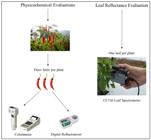
Physicochemical and leaf reflectance evaluations in fruits and leaves of Capsicum spp., respectively.
The colorimetric chroma index (C*), or chroma index, was estimated from the values of L*, a*, and b*. This index defines a measure of color saturation or intensity and ranges from pale colors (low value) to bright colors (high value) and was estimated by the expression: C* = (a2 + b2) ½ (Oliveira et al., 2010). The device was calibrated on a white ceramic plate using the D65 illuminant (z = 93.6; x = 0.3133; y = 0.3195).
2.3. Total soluble solids
The juice of each fruit was extracted to determine the total soluble solids (TSS) content using an ATAGO model PR 201 digital refractometer, with readings expressed in Brix (Figure 1). The refractometer was calibrated (“reset”) with distilled water prior to each sample reading.
2.4. Leaf reflectance
To evaluate the influence of environmental conditions on the leaf reflectance index of Capsicum plants, a portable CI-710 leaf spectrometer configured for reflectance measurements was used. Measurements were taken on leaves from four plants in the plot (Figure 1). Only one representative accession of each of the three species studied was included in this evaluation: UENF 1381 (C. annuum), UENF 1732 (C. baccatum) and UENF 2079 (C. chinense). The three accessions were selected based on their relevance to the germplasm bank, standing out for their disease resistance and the presence of desirable agronomic traits, which makes them representative and strategic for physiological evaluation. The evaluations were carried out at the fruiting stage in the middle part of the adaxial surface of the leaf. The estimated reflectance indices were:
-
Normalized Difference Vegetation Index (NDVI) = (R800 - R680) / (R800 + R680) (Rouse et al., 1974): ratio between the difference in reflectivities of the near infrared and the visible red bands and the sum of these reflectivities. This indicator is sensitive to the amount and condition of vegetation, with values ranging from -1 to 1; and
-
Water band index (WBI) = R900/R970 (Peñuelas et al., 1997): used to track changes in relative water content (RWC), leaf water potential and stomatal conductance, with ranges from -1 to 1.
Air temperature and relative humidity were monitored daily with a digital thermohygrometer (INSTRUTHERM, model HT-600), and light intensity was measured with a Spectrum® Technologies light sensor.
2.5. Statistical analyses
Analysis of individual and joint variance was performed. Genetic parameters were estimated and trait means were compared using the Scott-Knott and Tukey cluster tests at 5% probability. Canonical correlation analysis was used to estimate the existing associations between physiological and colorimetric traits. The canonical correlations were estimated by combining the covariance values within and between the traits of the complex variables of the two groups (S11, S22 and S12) and the weight of the traits of each group.: a’ = [a1 a2…ap] is the vector 1 × p of weights of the traits of Group I; and b’ = [b1 b2…bq] is the 1 × q vector of weights of the traits of Group II. The first canonical correlation is defined by the one that maximizes the relationship between X1 and Y1 through the expression: r1= Côv (X1,Y1)/ √Vˆ(X1). Vˆ(Y1), in which Côv (X1, Y1) = a′S12b; Vˆ = a′S11a; Vˆ = b′S22b (Cruz et al., 2014; Kamphorst et al., 2020a). All analyses were performed with the aid of the program Genes (Cruz, 2013).
3. Results
There was a significant difference for all the variables analyzed for genotypes at p < 0.01, indicating the existence of variability among accessions to be used for genetic enhancement. The environment was significant only for colorimetric variables, indicating that the environment, composed of all non-genetic factors, modifies the mean values of these traits. The G x E interaction was also significant, indicating that the phenotypic responses of each genotype to environmental variation were generally different, reducing the association between phenotype and genotype. The experimental coefficients of variation (CV%) were low for all variables, demonstrating the reliability of the data and the presence of limited uncontrollable environmental interference during the experiment (Table 1).
Summary of the analysis of variance of physiological and physicochemical traits of accessions of Capsicum spp. in contrasting light environments.
According to the average value of each color estimator (L*, a*, b* and C*), it was possible to classify the fruit color into seven color classes (Table 2). The values of a* for red fruits ranged from 30.80 to 40.63 and for b* from 14.62 to 32.30. For yellow fruits, the values ranged from 1.86 to 4.54 for a* and from 23.26 to 25.71 for b*. For orange fruits, a* and b* values ranged from 23.26 to 31.97 and 30.06 to 40.44, respectively. For brown fruits, the mean estimates of a* and b* were 3.27 and 4.76, respectively. The L* and C* estimators resulted in the following colorimetric discriminations of fruits: red (UENF 1732), dark red (UENF 1768, UENF 1381, UENF 1720, UENF 2079, and UENF 1422), light yellow (UENF 2051), pale yellow-orange (UENF 1715), orange (UENF 2116), orange with purple spots (UENF 1791), and brown (UENF 1730) (Figure 2). Lighter fruits (yellow and orange) had higher L* values, while darker fruits (red and brown) had lower L* phenotypic estimates. Accessions UENF 1715 and UENF 2116 provided lower phenotypic estimates of L* when grown in direct sunlight, resulting in fruits with darker hues compared to accessions grown in a greenhouse.
Means of L*, a*, b* and C* colorimetric estimators and TSS content in fruit of Capsicum spp. cultivated under contrasting light environment.
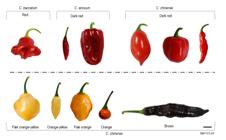
Regarding C*, whose variable is defined as the degree of color saturation and represents a quantitative attribute for colorimetric intensity, lower values were observed for accessions UENF 1715, UENF 2051 and UENF 1730. These accessions have opaque, neutral-colored fruits (yellow and brown) with low color saturation, while fruits with pure colors (red and orange) have high saturation and are brighter. Accessions UENF 1381 and UENF 1422, belonging to the species C. annuum, provided lower C* values in fruits grown under direct sunlight, indicating that the reduction in color intensity may have occurred due to abiotic stress. Accessions UENF 2079, UENF 1720, UENF 1732 and UENF 1422 showed intense red shades, a coloration considered excellent for paprika production.
With respect to the total soluble solids content, there was a large variability, ranging from 5.59 to 13.04º Brix. The accessions UENF 1381 and UENF 2051, grown under direct sunlight, had a lower variation in TSS estimates, with average expressed magnitudes of 10.58 and 6.30, respectively, while in the greenhouse the values expressed for these genotypes were 13.04 and 7.76, respectively. Consistent with the trend for TSS, L*, a*, b* and C* estimators generally expressed lower values in fruits from plants grown under direct sunlight.
Canonical correlation analysis was performed for the physiological variables WBI and NDVI (Group I) and for the colorimetric traits L*, a*, and b* (Group II).
The χ2 test, showed that the first and second canonical pairs were significant in both environments (p < 0.05). The correlation coefficients (r) for the first and second canonical pairs were 1.00 and 0.99, respectively, in both environments (Table 3). This indicates that the traits are not independent of each other, and that the colorimetric traits of the fruits in Group II are associated with the variables related to the reflectance indices in Group I. Thus, the two pairs of canonical variables are of importance for the study, as they enable the maximization of the relationship between the reflectance index and colorimetric characteristics, thus supporting the use of a perspective seeking to detect traits that favor indirect selection and, hence, genetic gains.
Estimates of weighting coefficients of two canonical pairs between groups of physiological and colorimetric traits among accessions of Capsicum spp. evaluated in full light environment and in a greenhouse.
4. Discussion
The environment had a negative influence on the C* values, with lower estimates observed in fruits grown under direct sunlight. Accessions UENF 1381 and UENF 1422, belonging to the species C. annuum, were the most affected genotypes in the direct sunlight environment due to abiotic stress caused by the light. Therefore, higher levels of temperature and luminosity cause a reduction in the color intensity of fruits of the C. annuum species. This finding is particularly relevant for breeding programs targeting field-grown crops (Jeeatid et al., 2017).
Accessions UENF 2079, UENF 1720, UENF 1732, and UENF 1422 showed the intense red coloration prized in the production of paprika. In fact, commercial paprika quality is determined by the intensity of the red hues. Dark red paprika is classified as Grade A; neutral red is classified as Grade B; and red mixed with yellow and brown is classified as Grade C. The degradation of carotenoids in red peppers is an autocatalytic oxidative reaction that depends on the supply of light or heat, the availability of molecular oxygen, and the presence of antioxidants (Ergüneş and Tarhan, 2006).
Accessions UENF 1715 and UENF 1720 showed yellow coloration. These accessions are promising for future studies on genetic enhancement to achieve yellow fruits for use in the pharmaceutical industry, since yellow pepper contains capsaicin, vitamins, and antioxidants such as β-carotene, lutein, antheraxanthin, and zeaxanthin, which are associated with the maintenance of good health (Wahyuni et al., 2011).
The results showed a large variability in the total soluble solids content, with estimated values ranging from 5.59 to 13.04º Brix. These results were higher than those obtained in other studies on Capsicum. While Moreira et al. (2017) also obtained less discrepant values for 'Magali' peppers (3.5 to 4.0º Brix) in postharvest fruits, Oliveira et al. (2018) obtained values ranging from 6.79 to 9.91º Brix in peppercorn fruits (C. chinense).
Among the eleven accessions studied, only UENF 1381 and UENF 2051, cultivated under direct sunlight, showed a reduction in Brix values, with estimates of 10.58 and 6.30º, respectively, while in the greenhouse the values expressed were 13.04 and 7.76º, respectively. In contrast to the results of the present study, Jiménez León et al. (2013), when evaluating two cultivars of C. annuum from an open field and a greenhouse, found higher Brix values associated with cultivation under direct sunlight. Given these conflicting results, the authors of the present study recommend that further research be conducted to determine the influence of environmental factors, particularly light intensity, on maximum TSS levels.
Since the consumer pepper market values fruit with higher total soluble solids, identifying genotypes with higher Brix values for use in breeding programs is a worthwhile research objective. This is especially true because the higher the Brix of the pulp, the less energy is required to produce concentrated pulp, and in this sense, each degree of increase in raw material Brix results in a 20% increase in industrial yield (Koetz et al., 2010). Thus, the genotypes UENF 1381 and UENF 1791 are very promising for use in the processing industry, with the prospect of higher yields in the production of sauces.
In general, the accessions grown under direct sunlight also showed lower estimates of mean values for the fruit colorimetric traits L*, a*, b* and C*. These results indicate that abiotic factors such as temperature, relative humidity, and luminosity influenced the physicochemical traits of Capsicum spp. Other quality attributes may also have been influenced by the environment, such as the concentration of capsaicinoids. Although not evaluated in this work, there are reports in the literature that shading above 50% has resulted in higher capsaicinoid yields, and specific shading levels can be managed to maximize the yield of this alkaloid for C. chinense cultivars (Jeeatid et al., 2018; Tripodi et al., 2018; Arce-Rodríguez and Ochoa-Alejo, 2019).
The fruit color variability observed in the germplasm bank accessions may prove valuable for different market niches. These fruits could be sold on the fresh market as well as for processing based on color and other agronomic attributes. For example, red, yellow, and orange fruits are used in the production of sauces and preserves, while producers seek dark red fruits for paprika production and as coloring and flavoring agents (Guzman et al., 2020).
Significant positive and negative associations were found between physiological and colorimetric traits in both environments (Table 3). In the first canonical pair, the physiological variables WBI and NDVI had a positive association consistent with L*, with values ranging from 1.1687 to 0.26858, respectively; the opposite trend was observed for a* and b*, with values of -0.57399 and -0.55128, respectively. There was also a positive association for the physiological traits in the second canonical pair (r = 0.99). However, this association was observed for the variable b*, with values of 0.76212 for WBI and 1.36903 for NDVI. In turn, associations in the opposite direction were observed for the physiological variables L* and a*, with respective values varying from -2.5128 to -1.8513 (Table 3).
Canonical correlation analysis reveals the association between different groups of variables simultaneously. This analysis quantifies the possibility of indirect gains from selection in correlated traits; it is also useful for establishing a selection index and for assessing the complexity of the variables under study (Cruz et al., 2014). More recently, it has been used to identify adaptive loci and phenotypic responses to climate (Kamphorst et al., 2020b; Blanco-Pastor et al., 2021).
The WBI index is a good indicator of leaf water content (Sims and Gamon, 2003), with values close to 1 indicating high leaf water content and an association with greater leaf area (Liu et al., 2019). WBI is therefore an indicator of plant water status, as phenology and yield are correlated with water status and can be used to monitor seasonal and drought effects (Claudio et al., 2006; Kamphorst et al., 2020a; Kamphorst et al., 2020b). WBI was positively associated with L*, a result that is promising for the crop under study, especially since there have been no studies on the association between these two traits, especially using high-performance phenotyping to identify these traits.
The Normalized Difference Vegetation Index (NDVI) has been used to predict grain yield, vegetation cover, senescence, leaf area index, water stress, and canopy photosynthesis measured at different stages of crop development (Liquan et al., 2013; Li et al., 2014; Sanchez-Bragado et al., 2020). NDVI is the normalized ratio of the difference between light reflected in the red and near infrared bands of the electromagnetic spectrum (Rouse et al., 1974). It is based on the fact that in healthy, living canopies, most red light is absorbed by photosynthetic pigments, while near-infrared light is reflected as a result of light scattering in the internal leaf structure and canopy architecture. Physiologically, these values reflect an integrated mixture of biomass (or leaf area) and leaf chlorophyll (Jeeatid et al., 2017).
The positive association between NDVI and L* is a promising result for indirect trait selection in Capsicum. While studying maize, Santana et al. (2021) obtained positive associations between NDVI among physiological-agronomic variables, including leaf nitrogen, plant height, number of rows per cob, and number of grains per row; according to the authors, NDVI was one of the physiological variables that most represented agronomic characters in the maize crop.
In terms of high-yield phenotyping, the CI-710 has proven to be a powerful tool for estimating various leaf indices. Alsina et al. (2016) obtained excellent results in determining chlorophyll content in lettuce, mustard, radish, and kale crops, with NDVI and SIPI being the indices that best correlated with chlorophyll a content and the sum of chlorophyll a and b. The authors concluded that the CI-710 spectrometer can completely replace destructive biochemical analyses. Other researchers have also obtained satisfactory results using the same instrument. Oliveira et al. (2017), when estimating nitrogen concentrations in eucalyptus leaves, obtained strong correlation results with the NDVI and PRI indices. And Janeczko et al. (2018), using the WBI, SIPI and PRI indexes, detected metabolic disorders before the appearance of visible symptoms of virus infection in Capsicum spp.
Despite the potential of modern phenomics, no studies have reported the effects of abiotic stress on leaf pigments of Capsicum spp. plants. This fact signals the need for related research to generate additional results that can help improve the efficiency of identifying superior genotypes that meet the needs of producers and consumers.
5. Conclusions
This study highlights the potential of the three Capsicum species for genetic improvement programs, given their diversity in fruit color and total soluble solids content, traits that can be aligned with specific market demands. The exposure to direct sunlight had a detrimental effect on both the color intensity and soluble solids of the fruit, thereby underscoring the influence of environmental conditions on fruit quality. The application of canonical correlation analysis proved effective in linking physiological and colorimetric traits, reinforcing its value as a tool for the indirect selection of superior genotypes. Furthermore, colorimetry was identified as a useful, non-destructive approach for monitoring agronomic traits through physiological indices, particularly in large-scale breeding populations.
Acknowledgements
This research was supported by the Coordenação de Aperfeiçoamento de Pessoal de Nível Superior – Brasil (CAPES) – Financing Code 001, the Conselho Nacional de Desenvolvimento Científico e Tecnológico (CNPq), and the Fundação Carlos Chagas Filho de Amparo à Pesquisa do Estado do Rio de Janeiro (FAPERJ).
Data Availability Statement
The entire data set that supports the results of this study was published in the article itself.
References
-
ADEBAYO, M.A., MENKIR, A., BLAY, E., GRACEN, V., DANQUAH, E. and HEARNE, S., 2014. Genetic analysis of drought tolerance in adapted× exotic crosses of maize inbred lines under managed stress conditions. Euphytica, vol. 196, no. 2, pp. 261-270. http://doi.org/10.1007/s10681-013-1029-5
» http://doi.org/10.1007/s10681-013-1029-5 - ALSINA, I., DŪMA, M., DUBOVA, L., ŠENBERGA, A. and DAĢIS, S., 2016. Comparison of different chlorophylls determination methods for leafy vegetables. Agronomy Research, vol. 14, no. 2, pp. 309-316.
-
ANYAOHA, C.O., ADEMOYEGUN, O.T. and AFUAPE, S.O., 2020. Agro-morphological and nutritional variability among elite Nsukka yellow spice pepper breeding lines. International Journal of Vegetable Science, vol. 26, no. 5, pp. 516-531. http://doi.org/10.1080/19315260.2019.1667470
» http://doi.org/10.1080/19315260.2019.1667470 -
ARAUS, J.L., KEFAUVER, S.C., ZAMAN-ALLAH, M., OLSEN, M.S. and CAIRNS, J.E., 2018. Translating high-throughput phenotyping into genetic gain. Trends in Plant Science, vol. 23, no. 5, pp. 451-466. http://doi.org/10.1016/j.tplants.2018.02.001 PMid:29555431.
» http://doi.org/10.1016/j.tplants.2018.02.001 -
ARCE-RODRÍGUEZ, M.L. and OCHOA-ALEJO, N., 2019. Biochemistry and molecular biology of capsaicinoid biosynthesis: recent advances and perspectives. Plant Cell Reports, vol. 38, no. 9, pp. 1017-1030. http://doi.org/10.1007/s00299-019-02406-0 PMid:30941502.
» http://doi.org/10.1007/s00299-019-02406-0 -
BARBOZA, G.E. and BIANCHETTI, L.D.B., 2005. Three new species of Capsicum (Solanaceae) and a key to the wild species from Brazil. Systematic Botany, vol. 30, no. 4, pp. 863-871. http://doi.org/10.1600/036364405775097905
» http://doi.org/10.1600/036364405775097905 -
BISPO, R.B., ARAÚJO, M.S.B., ALENCAR, A.A.S., SUDRÉ, C.P. and RODRIGUES, R., 2024. Sensors applied to plant breeding: Leaf Reflectance Indices (LRIs) and Resistance to Anthracnose in Capsicum annuum L. var. annuum. Advances in Remote Sensing, vol. 13, no. 1, pp. 1-17. http://doi.org/10.4236/ars.2024.131001
» http://doi.org/10.4236/ars.2024.131001 -
BLANCO-PASTOR, J.L., BARRE, P., KEEP, T., LEDAUPHIN, T., ESCOBAR‐GUTIÉRREZ, A., ROSCHANSKI, A.M., WILLNER, E., DEHMER, K.J., HEGARTY, H., MUYLLE, H., VEECKMAN, E., VANDEPOELE, K., RUTTINK, T., ROLDÁN-RUIZ, I., MANEL, S. and SAMPOUX, J.P., 2021. Canonical correlations reveal adaptive loci and phenotypic responses to climate in perennial ryegrass. Molecular Ecology Resources, vol. 21, no. 3, pp. 849-870. http://doi.org/10.1111/1755-0998.13289 PMid:33098268.
» http://doi.org/10.1111/1755-0998.13289 -
CABRERA-BOSQUET, L., MOLERO, G., STELLACCI, A., BORT, J., NOGUÉS, S. and ARAUS, J.L., 2011. NDVI as a potential tool for predicting biomass, plant nitrogen content and growth in wheat genotypes subjected to different water and nitrogen conditions. Cereal Research Communication, vol. 39, no. 1, pp. 147–159 https://doi.org/10.1556/CRC.39.2011.1.15
» https://doi.org/10.1556/CRC.39.2011.1.15 -
CAIRNS, J.E., SANCHEZ, C., VARGAS, M., ORDOÑEZ, R. and ARAUS, J.L., 2012. Dissecting maize productivity: ideotypes associated with grain yield under drought stress and well‐watered conditions. Journal of Integrative Plant Biology, vol. 54, no. 12, pp. 1007-1020. http://doi.org/10.1111/j.1744-7909.2012.01156.x PMid:22925524.
» http://doi.org/10.1111/j.1744-7909.2012.01156.x -
CHAPA-OLIVER, A.M. and MEJÍA-TENIENTE, L., 2016. Capsaicin: from plants to a cancer-suppressing agent. Molecules, vol. 21, no. 8, pp. 931. http://doi.org/10.3390/molecules21080931 PMid:27472308.
» http://doi.org/10.3390/molecules21080931 -
CHRISTOPHER, J.T., CHRISTOPHER, M.J., BORRELL, A.K., FLETCHER, S. and CHENU, K., 2016. Stay-green traits to improve wheat adaptation in well-watered and water-limited environments. Journal of Experimental Botany, vol. 67, no. 17, pp. 5159-5172. http://doi.org/10.1093/jxb/erw276 PMid:27443279.
» http://doi.org/10.1093/jxb/erw276 -
CLAUDIO, H.C., CHENG, Y., FUENTES, D.A., GAMON, J.A., LUO, H., OECHEL, W., QIU, H.L., RAHMAN, A.F. and SIMS, D.A., 2006. Monitoring drought effects on vegetation water content and fluxes in chaparral with the 970 nm water band index. Remote Sensing of Environment, vol. 103, no. 3, pp. 304-311. http://doi.org/10.1016/j.rse.2005.07.015
» http://doi.org/10.1016/j.rse.2005.07.015 - CRUZ, C.D., 2013. Genes: um pacote de software para análise em estatística experimental e genética quantitativa. Acta Scientiarum. Agronomy, vol. 35, pp. 271-276. https://doi.org/10.4025/actasciagron.v35i3.21251.
- CRUZ, C.D., CARNEIRO, P.C.S. and REGAZZI, A.J. 2014. Modelos Biométricos Aplicados ao Melhoramento Genético 4nd ed. Viçosa: UFV. 514 p.
-
ERGÜNEŞ, G. and TARHAN, S., 2006. Color retention of red peppers by chemical pretreatments during greenhouse and open sun drying. Journal of Food Engineering, vol. 76, no. 3, pp. 446-452. http://doi.org/10.1016/j.jfoodeng.2005.05.046
» http://doi.org/10.1016/j.jfoodeng.2005.05.046 -
FURBANK, R.T. and TESTER, M., 2011. Phenomics–technologies to relieve the phenotyping bottleneck. Trends in Plant Science, vol. 16, no. 12, pp. 635-644. http://doi.org/10.1016/j.tplants.2011.09.005 PMid:22074787.
» http://doi.org/10.1016/j.tplants.2011.09.005 -
GHIASI, Z., ESMAELI, F., AGHAJANI, M., GHAZI-KHANSARI, M., FARAMARZI, M.A. and AMANI, A., 2019. Enhancing analgesic and anti-inflammatory effects of capsaicin when loaded into olive oil nanoemulsion: an in vivo study. International Journal of Pharmaceutics, vol. 559, pp. 341-347. http://doi.org/10.1016/j.ijpharm.2019.01.043 PMid:30710660.
» http://doi.org/10.1016/j.ijpharm.2019.01.043 -
GUZMAN, I., VARGAS, K., CHACON, F., MCKENZIE, C. and BOSLAND, P.W., 2020. Health-promoting carotenoids and phenolics in 31 Capsicum accessions. HortScience, vol. 56, no. 1, pp. 36-41. http://doi.org/10.21273/HORTSCI15039-20
» http://doi.org/10.21273/HORTSCI15039-20 -
JANECZKO, A., DZIURKA, M., GULLNER, G., KOCUREK, M., RYS, M., SAJA, D., SKOCZOWSKI, A., TÓBIAS, I., KORNAS, A. and BARNA, B., 2018. Comparative studies of compatible and incompatible pepper–Tobamovirus interactions and the evaluation of effects of 24-epibrassinolide. Photosynthetica, vol. 56, no. 3, pp. 763-775. http://doi.org/10.1007/s11099-017-0725-0
» http://doi.org/10.1007/s11099-017-0725-0 -
JEEATID, N., SURIHARN, B., TECHAWONGSTIEN, S., CHANTHAI, S., BOSLAND, P.W. and TECHAWONGSTIEN, S., 2018. Evaluation of the effect of genotype-by-environment interaction on capsaicinoid production in hot pepper hybrids (Capsicum chinense Jacq.) under controlled environment. Scientia Horticulturae, vol. 235, pp. 334-339. http://doi.org/10.1016/j.scienta.2018.03.022
» http://doi.org/10.1016/j.scienta.2018.03.022 -
JEEATID, N., TECHAWONGSTIEN, S., SURIHARN, B., BOSLAND, P.W. and TECHAWONGSTIEN, S., 2017. Light intensity affects capsaicinoid accumulation in hot pepper (Capsicum chinense Jacq.) cultivars. Horticulture, Environment and Biotechnology, vol. 58, no. 2, pp. 103-110. http://doi.org/10.1007/s13580-017-0165-6
» http://doi.org/10.1007/s13580-017-0165-6 -
JIANG, J., COMAR, A., BURGER, P., BANCAL, P., WEISS, M. and BARET, F., 2018. Estimation of leaf traits from reflectance measurements: comparison between methods based on vegetation indices and several versions of the PROSPECT model. Plant Methods, vol. 14, no. 1, pp. 1-16. http://doi.org/10.1186/s13007-018-0291-x PMid:29581726.
» http://doi.org/10.1186/s13007-018-0291-x -
JIMÉNEZ LEÓN, J., LÓPEZ ELÍAS, J., HUEZ LÓPEZ, M.A., GARCÍA LÓPEZ, A.M., SOTO ORTIZ, R. and ESCOBOZA GARCÍA, L.F., 2013. Postharvest quality and shelf life of green pepper (Capsicum annuum L.) grown under open-field and greenhouse conditions. Idesia, vol. 31, no. 4, pp. 35-41. http://doi.org/10.4067/S0718-34292013000400005
» http://doi.org/10.4067/S0718-34292013000400005 -
KAMPHORST, S.H., AMARAL-JÚNIOR, A.T., LIMA, V.J., GUIMARÃES, L.J.M., SCHMITT, K.F.M., LEITE, J.T., SANTOS, P.H.A.D., CHAVES, M.M., MAFRA, G.S., SANTOS-JÚNIOR, D.R., CRUZ, C.D. and CAMPOSTRINI, E., 2019. Can genetic progress for drought tolerance in popcorn be achieved by indirect selection? Agronomy, vol. 9, no. 12, pp. 792. http://doi.org/10.3390/agronomy9120792
» http://doi.org/10.3390/agronomy9120792 -
KAMPHORST, S.H., AMARAL-JÚNIOR, A.T., LIMA, V.J., SANTOS, P.H.A.D., RODRIGUES, W.P., VIVAS, J.M.S., GONÇALVES, G.M.B., SCHMITT, K.F.M., LEITE, J.T., VIVAS, M., MORA-POBLETE, F., VERGARA-DÍAZ, O., ORTEGA, J.L.A., RAMALHO, J.C. and CAMPOSTRINI, E., 2020a. Comparison of selection traits for effective popcorn (Zea mays L. var. Everta) breeding under water limiting conditions. Frontiers in Plant Science, vol. 11, pp. 1-18. http://doi.org/10.3389/fpls.2020.01289 PMid:32973848.
» http://doi.org/10.3389/fpls.2020.01289 -
KAMPHORST, S.H., GONÇALVES, G.M.B., AMARAL-JÚNIOR, A.T., LIMA, V.J., LEITE, J.T., SCHMITT, K.F.M., SANTOS-JUNIOR, D.R.S., SANTOS, J.S., OLIVEIRA, F.T., CORRÊA, C.C.G., RODRIGUES, W.P. and CAMPOSTRINI, E., 2020b. Screening of popcorn genotypes for drought tolerance using canonical correlations. Agronomy, vol. 1, no. 10, pp. 1519. http://doi.org/10.3390/agronomy10101519
» http://doi.org/10.3390/agronomy10101519 -
KOETZ, M., MASCA, M.G.C.C., CARNEIRO, L.C., RAGAGNIN, V.A., SENA-JÚNIOR, D.G. and GOMES-FILHO, R.R. 2010. Caracterização agronômica e Brix em frutos de tomate industrial sob irrigação por gotejamento no Sudoeste de Goiás. Revista brasileira de agricultura irrigada, vol. 4, no. 1, pp. 14-22.http://doi.org/10.7127/rbai.v4n100028
» http://doi.org/10.7127/rbai.v4n100028 -
LAMA, K., ALKALAI-TUVIA, S., CHALUPOWICZ, D. and FALLIK, E., 2020. Extended storage of yellow pepper fruits at suboptimal temperatures may alter their physical and nutritional quality. Agronomy, vol. 10, no. 8, pp. 1109. http://doi.org/10.3390/agronomy10081109
» http://doi.org/10.3390/agronomy10081109 -
LI, F., MIAO, Y., FENG, G., YUAN, F., YUE, S., GAO, X., LIU, Y., LIU, B., USTIN, S.L. and CHEN, X., 2014. Improving estimation of summer maize nitrogen status with red edge-based spectral vegetation indices. Field Crops Research, vol. 157, pp. 111-123. http://doi.org/10.1016/j.fcr.2013.12.018
» http://doi.org/10.1016/j.fcr.2013.12.018 -
LIMA, V.J., GRACIA-ROMERO, A., REZZOUK, F.Z., DIEZ-FRAILE, M.C., ARAUS-GONZALEZ, I., KAMPHORST, S.H., AMARAL JÚNIOR, A.T., KEFAUVER, S.C., APARICIO, N. and ARAUS, J.L., 2021. Comparative performance of high-yielding European wheat cultivars under contrasting Mediterranean conditions. Frontiers in Plant Science, vol. 12, pp. 687622. http://doi.org/10.3389/fpls.2021.687622 PMid:34267771.
» http://doi.org/10.3389/fpls.2021.687622 -
LI-QUAN, J., FU-CHENG, Z., DE-CHENG, W., JIAN-HUA, Y., DA-LEI, L. and WEI-PING, L., 2013. Effects of nitrogen application on accumulation and distribution of nitrogen, phosphorus, and potassium of summer maize under super-high yield conditions. Acta Agronomica Sinica, vol. 39, no. 8, pp. 1478-1490. http://doi.org/10.3724/SP.J.1006.2013.01478
» http://doi.org/10.3724/SP.J.1006.2013.01478 -
LIU, C., PINTO, F., COSSANI, C.M., SUKUMARAN, S. and REYNOLDS, M.P., 2019. Spectral reflectance indices as proxies for yield potential and heat stress tolerance in spring wheat: heritability estimates and marker-trait associations. Frontiers of Agricultural Science and Engineering, vol. 6, no. 3, pp. 296-308. http://doi.org/10.15302/J-FASE-2019269
» http://doi.org/10.15302/J-FASE-2019269 -
LLORENTE, B., MARTINEZ-GARCIA, J.F., STANGE, C. and RODRIGUEZ-CONCEPCION, M., 2017. Illuminating colors: regulation of carotenoid biosynthesis and accumulation by light. Current Opinion in Plant Biology, vol. 37, pp. 49-55. http://doi.org/10.1016/j.pbi.2017.03.011 PMid:28411584.
» http://doi.org/10.1016/j.pbi.2017.03.011 - MOREIRA, E.G.S., SANCHES, A.G., SILVA, M.B., MACEDO, J., COSTA, S.S.C. and CORDEIRO, C.A.M., 2017. Utilização de filme comestível na conservação pós-colheita do pimentão ‘magali’. Scientia Agrária Paranaensis, vol. 16, no. 1, pp. 120-126.
-
MOSES, M., UMAHARAN, P. and DAYANANDAN, S., 2014. Microsatellite based analysis of the genetic structure and diversity of Capsicum chinense in the Neotropics. Genetic Resources and Crop Evolution, vol. 61, no. 4, pp. 741-755. http://doi.org/10.1007/s10722-013-0069-y
» http://doi.org/10.1007/s10722-013-0069-y - OLIVEIRA, G.H.H., CORRÊA, P.C., BAPTESTINI, F.M., FREITAS, R.L. and VASCONCELLOS, D., 2010. Controle do amadurecimento de goiabas ‘Pedro Sato’ tratadas por frio. Enciclopédia Biosfera, vol. 6, pp. 1-15.
-
OLIVEIRA, G.S., COSTA, N.A., PINTO, C.M.F., PINTO, C.L.O., DONZELES, S.M.L. and MARTINS, E.M.F., 2018. Avaliação de coberturas comestíveis para conservação de pimenta-biquinho (Capsicum chinense Jacq.). Revista Brasileira de Agropecuária Sustentável, vol. 8, no. 4, pp. 19-29. http://doi.org/10.21206/rbas.v8i4.3078
» http://doi.org/10.21206/rbas.v8i4.3078 -
OLIVEIRA, L.F.R.D., OLIVEIRA, M.L.R.D., GOMES, F.S. and SANTANA, R.C., 2017. Estimating foliar nitrogen in Eucalyptus using vegetation indexes. Scientia Agrícola, vol. 74, no. 2, pp. 142-147. http://doi.org/10.1590/1678-992x-2015-0477
» http://doi.org/10.1590/1678-992x-2015-0477 -
PEÑUELAS, J., PINOL, J., OGAYA, R. and FILELLA, I., 1997. Estimation of plant water concentration by the reflectance water index WI (R900/R970). International Journal of Remote Sensing, vol. 18, no. 13, pp. 2869-2875. http://doi.org/10.1080/014311697217396
» http://doi.org/10.1080/014311697217396 -
PIZARRO, L. and STANGE, C., 2009. Light-dependent regulation of carotenoid biosynthesis in plants. Ciencia e Investigación Agraria, vol. 36, no. 2, pp. 143-162. http://doi.org/10.4067/S0718-16202009000200001
» http://doi.org/10.4067/S0718-16202009000200001 -
REBETZKE, G.J., JIMENEZ-BERNI, J.A., BOVILL, W.D., DEERY, D.M. and JAMES, R.A., 2016. High-throughput phenotyping technologies allow accurate selection of stay-green. Journal of Experimental Botany, vol. 67, no. 17, pp. 4919-4924. http://doi.org/10.1093/jxb/erw301 PMid:27604804.
» http://doi.org/10.1093/jxb/erw301 -
ROMANO, G., ZIA, S., SPREER, W., SANCHEZ, C., CAIRNS, J., ARAUS, J.L. and MÜLLER, J., 2011. Use of thermography for high throughput phenotyping of tropical maize adaptation in water stress. Computers and Electronics in Agriculture, vol. 79, no. 1, pp. 67-74. http://doi.org/10.1016/j.compag.2011.08.011
» http://doi.org/10.1016/j.compag.2011.08.011 - ROUSE, J., HAAS, R.H., SCHELL, J.A. and DEERING, D.W., 1974 [viewed 20 Aug. 2024]. Monitoring Vegetation Systems in The Great Plains with Erts. NASA Special Publication [online], vol. 351, pp. 309. Available from: https://ntrs.nasa.gov/citations/19740022614.
-
SANCHEZ-BRAGADO, R., NEWCOMB, M., CHAIRI, F., CONDORELLI, G.E., WARD, R.W., WHITE, J.W., MACCAFERRI, M., TUBEROSA, R., ARAUS, J.L. and SERRET-MOLINS, M.D., 2020. Carbon Isotope Composition and the NDVI as Phenotyping Approaches for Drought Adaptation in Durum Wheat: Beyond Trait Selection. Agronomy, vol. 10, no. 11, pp. 1679. http://doi.org/10.3390/agronomy10111679
» http://doi.org/10.3390/agronomy10111679 -
SANTANA, D.C., FLORES, M.D.S., COTRIM, M.F., RODRIGUES, E.V., SANTOS, A.D., TEODORO, L.P.R., BAIO, F.H.R., SILVA JUNIOR, C.A. and TEODORO, P.E., 2021. Genotype × trait biplot and canonical correlations for spectral and agronomic traits in corn. Agronomy Journal, vol. 113, no. 2, pp. 1197-1204. http://doi.org/10.1002/agj2.20581
» http://doi.org/10.1002/agj2.20581 -
SIMS, D.A. and GAMON, J.A., 2003. Estimation of vegetation water content and photosynthetic tissue area from spectral reflectance: a comparison of indices based on liquid water and chlorophyll absorption features. Remote Sensing of Environment, vol. 84, no. 4, pp. 526-537. http://doi.org/10.1016/S0034-4257(02)00151-7
» http://doi.org/10.1016/S0034-4257(02)00151-7 -
TRIPODI, P., CARDI, T., BIANCHI, G., MIGLIORI, C.A., SCHIAVI, M., ROTINO, G.L. and LO SCALZO, R., 2018. Genetic and environmental factors underlying variation in yield performance and bioactive compound content of hot pepper varieties (Capsicum annuum) cultivated in two contrasting Italian locations. European Food Research and Technology, vol. 244, no. 9, pp. 1555-1567. http://doi.org/10.1007/s00217-018-3069-5
» http://doi.org/10.1007/s00217-018-3069-5 -
WAHYUNI, Y., BALLESTER, A.R., SUDARMONOWATI, E., BINO, R.J. and BOVY, A.G., 2011. Metabolite biodiversity in pepper (Capsicum) fruits of thirty-two diverse accessions: variation in health-related compounds and implications for breeding. Phytochemistry, vol. 72, no. 11-12, pp. 1358-1370. http://doi.org/10.1016/j.phytochem.2011.03.016 PMid:21514607.
» http://doi.org/10.1016/j.phytochem.2011.03.016 -
YOON, H.I., KANG, J.H., KANG, W.H. and SON, J.E., 2020. Subtle changes in solar radiation under a green-to-red conversion film affect the photosynthetic performance and chlorophyll fluorescence of sweet pepper. Photosynthetica, vol. 58, no. 5, pp. 1107-1115. http://doi.org/10.32615/ps.2020.057
» http://doi.org/10.32615/ps.2020.057 -
ZIA, S., ROMANO, G., SPREER, W., SANCHEZ, C., CAIRNS, J., ARAUS, J.L. and MÜLLER, J., 2013. Infrared Thermal Imaging as a Rapid Tool for Identifying Water-Stress Tolerant Maize Genotypes of Different Phenology. Journal Agronomy & Crop Science, vol. 199, no. 2, pp. 75-84. http://doi.org/10.1111/j.1439-037X.2012.00537.x
» http://doi.org/10.1111/j.1439-037X.2012.00537.x -
ZORATTI, L., KARPPINEN, K., LUENGO-ESCOBAR, A., HÄGGMAN, H. and JAAKOLA, L., 2014. Light-controlled flavonoid biosynthesis in fruits. Frontiers in Plant Science, vol. 5, pp. 109012. http://doi.org/10.3389/fpls.2014.00534 PMid:25346743.
» http://doi.org/10.3389/fpls.2014.00534
Edited by
-
Editor:
Jairo Lizandro Schmitt


