 Null models for understand intertidal decapods communities in North Patagonian beach (Pelluhuin, 41°S, Chile)
Abstract
The intertidal decapods in continental Chile are characterized by its species sharing with Peruvian coast along practically all coast, being coexisting species that has not studied with details its interspecific interactions. The aim of the present study is apply null models for understand if the intertidal decapod community is random or not-random. The results revealed that species associations were random, due probably to many species repeated in samples, and the niche sharing results revealed that species reported do not share niche, and in consequence there is not interspecific competition. Finally, to the obtained data, was estimated alpha and beta diversity indices, species accumulation curves, and multivariate patterns using Bray–Curtis dissimilarity and NMDS. These results confirmed a homogeneous community structure with low richness and limited spatial variation, supporting the random pattern observed in species associations. The obtained results partially agree with other similar observations for Chilean coast, and it would be explained due the oceanographic conditions.
Keywords:
intertidal decapods; null models; northern Patagonia; rocky shore
Resumo
Os decápodes da zona entremarés do Chile continental são caracterizados pelo compartilhamento de espécies com a costa peruana ao longo de praticamente toda a extensão litorânea, sendo espécies coexistentes cujas interações interespecíficas não foram estudadas em detalhe. O objetivo do presente estudo é aplicar modelos nulos para avaliar se a comunidade de decápodes da zona entremarés apresenta uma padrão aleatório ou não aleatório. Os resultados revelaram que as associações de espécies foram aleatórias, provavelmente devido à repetição de muitas espécies nas amostras. A análise de compartilhamento de nicho indicou que as espécies relatadas não compartilham nicho e, consequentemente, não existe competição interespecífica. Além disso, com base nos dados obtidos, foram estimados os índices de diversidade alfa e beta, as curvas de acumulação de espécies e os padrões multivariados utilizando a dissimilaridade de Bray-Curtis e NMDS. Estes resultados confirmaram uma estrutura comunitária homogênea, com baixa riqueza e variação espacial limitada, corroborando o padrão aleatório observado nas associações de espécies. Os resultados obtidos concordam parcialmente com outras observações semelhantes para a costa chilena, o que pode ser explicado pelas condições oceanográficas locais.
Palavras-chave:
decápodes da zona entremarés; modelos nulos; norte da Patagônia; costa rochosa
1. Introduction
The intertidal decapods in Chilean coast is characterized by the presence of shared species with Peruvian coast along all continental territory, and subantarctic species in southern latitudes (Santelices, 1992; Retamal and Moyano, 2010). The species richness is high in northern Chilean coast (18-30°S) due the exposure of Humboldt stream that generates upwelling process that causes high productivity environments (Andrade et al., 2022; De los Ríos-Escalante et al., 2020, 2022, 2023). Whereas in northern Patagonia (38-41°S), the presence of coast with marked wave exposure and low productivity conditions does not allow high species richness (Retamal and Moyano, 2010; De los Ríos et al., 2018). Finally in Patagonia, at south of 41° latitude the presence of inner seas and relative low human intervention allow the presence of high crustacean diversity (Santelices, 1992; Retamal and Moyano, 2010).
The Patagonian is characterized by the presence of inner seas that are protected to waves, with marked tidal variations, with nutrients inputs from surrounding basin, that is characterized by native perennial forests, and relative low human intervention (Figueroa-Muñoz et al., 2020, 2021). In this scenario, it is necessary to study if the decapod community has a structured pattern, considering the situation of relative low pristine conditions. In order to study communities, one of the focus areas is to use null models, which are based on the previous condition that the community is either random, or that there is no structure (Gotelli, 2000). These models are more robust than other kinds of statistical analysis (Tondoh, 2006; Tiho and Johens, 2007). A null model is applied in this study in order to better understand the ecology of intertidal decapod community on northern Patagonian beach.
2. Material and Methods
Study site: the site corresponds to a sandy beach with small rounded stones called Pelluhuin beach (41°29’13”S; 72°54’16”W; Figure 1) at four km at south of Puerto Montt, in a semi-rural zone, the site was visited in 24 February 2020, during low tide.

Data collection: the first species identification was done in situ were based on literature descriptions (Retamal, 2000), and taxonomic identification was confirmed by WORMS (2024). Random quadrants (10*10 cm) were released in studied sites (n = 90 for each site) during low tide, it was considering this size of quadrant on the basis of the fast movements of littoral decapods (De los Ríos-Escalante et al., 2022), and this size of quadrant would be more adequate for fast movement species and the irregular conformation of the site rounded rocks (Underwood and Chapman, 2005; Manriquez, 2021; De los Ríos-Escalante et al., 2022). Manually entered data were recorded in a field copybook.
Data analysis – Null models: A community is structured by competition when the C-score is significantly larger than expected by chance (Gotelli, 2000; Tondoh, 2006; Tiho and Johens, 2007). Consequently, we compared co-occurrence patterns with null expectations via simulation using statistical null models Fixed-Fixed (Gotelli and Ellison, 2013). In this model, the row and column sums of the matrix are preserved. Thus, each random community contains the same number of species as the original community (fixed column), and each species occurs with the same frequency as in the original community (fixed row). In fixed-equiprobable algorithm, only the row sums are fixed, and the columns are treated as equiprobable, this null model treats all the samples (columns) as equally suitable for all species (Tondoh, 2006; Tiho and Johens, 2007). In the fixed-proportional algorithm, the species occurrence totals are maintained as in the original community, and the probability that a species occurs in a sample (= column) is proportional to the column total for that sample (Tondoh, 2006; Tiho and Johens, 2007). The null model analyses were performed using the software R (R Development Core Team, 2024) and the package EcosimR (Gotelli and Ellison, 2013; Carvajal-Quintero et al., 2015).
For niche overlap analysis, an individual matrix was built in which rows and columns represented species and sites, respectively. This matrix was used to test if the niche overlap significantly differed from the corresponding value under the null hypothesis (random assemblage). These analyses were applied to data from the second field period and were based on Pianka index. The models show the probability of niche sharing compared to the niche overlap of the theoretically simulated community (Gotelli and Ellison, 2013). The niche amplitude can be retained or reshuffled when it is retained it preserves the specialization of each species.
In contrast, when it is reshuffled, it uses a wide utilization gradient of specialisation. Furthermore, zero participation in the observed matrix can be maintained or omitted. In the present study, we used the RA3 algorithm (Gotelli and Ellison, 2013; Carvajal-Quintero et al., 2015). This algorithm retains the amplitude and reshuffles the zero conditions (Gotelli and Ellison, 2013). This null model analysis was carried out using the software R (R Development Core Team, 2024) and the package EcosimR (Gotelli and Ellison, 2013; Carvajal-Quintero et al., 2015).
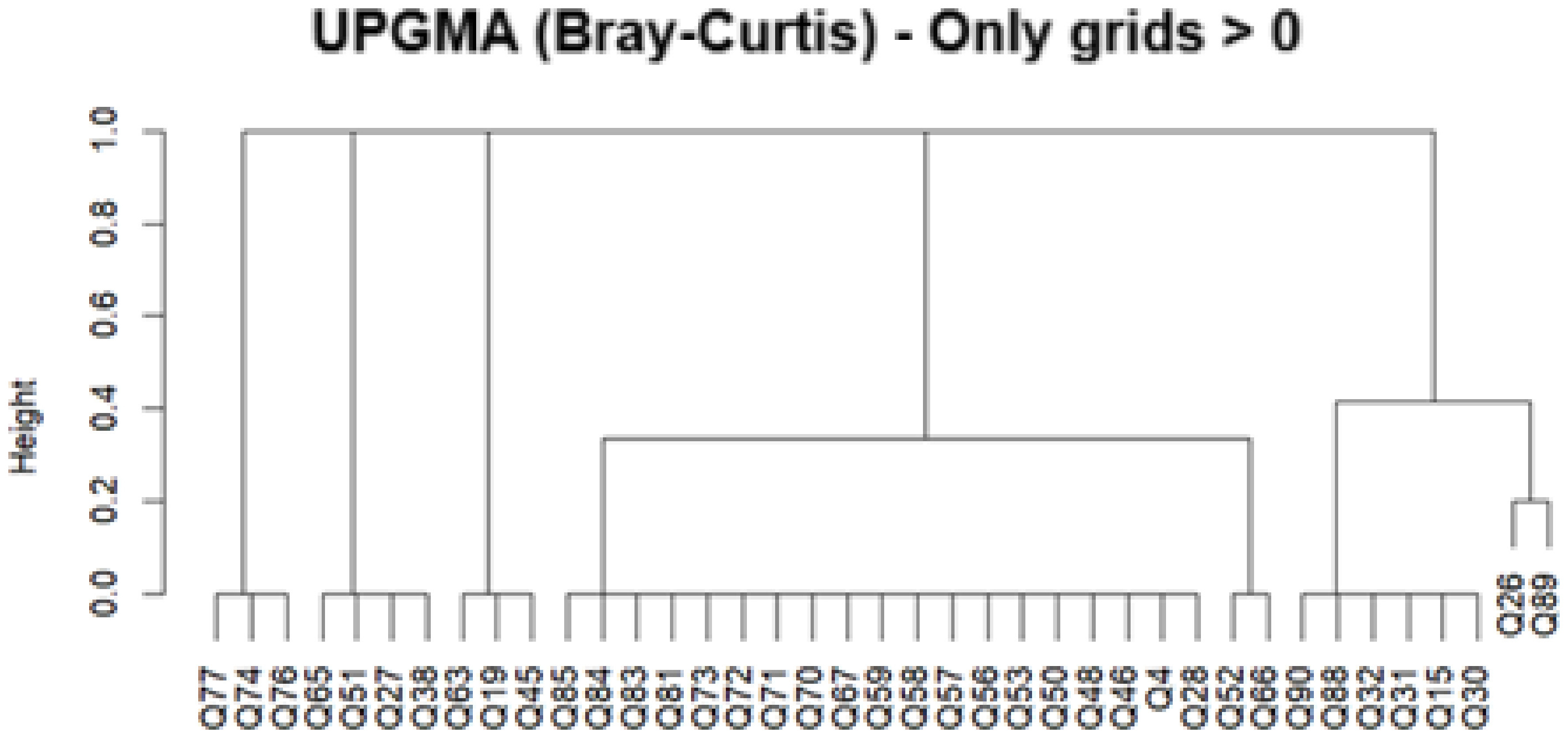
Data analysis – statistical community ecology: As first step the rarefaction curve was obtained with “specaccum” function of vegan R package (Oksanen et al., 2022) using random permutation (“random”). It used 1000 permutations for estimate the mean and 95% as confidence interval evaluating the sufficiency of sampling efforts and saturation trend. As second step, the Bray-Curtis distance was calculated using the “vegdist” function of vegan R package (Oksanen et al., 2022). The hierarchical joining was done using “hclust” function using UPGMA method identifying the different grid groups with similar composition and posterior visualization using dendrograms. As third analysis was applied a non metric ordination with NMDS using vegan R package (Oksanen et al., 2022) on the Bray-Curtis distances, previous to the ordination it was done the Hellinger transformation using “decostand(…, Hellinger)” function for decrease the dominant species influence, the obtained stress (0) denoted perfect adjust.
3. Results
The results denoted the presence of five decapods species (Table 1): Cyclograpsus cinereus Dana, 1851, Cancer porteri Rathbun, 1930, Betaeus truncatus Dana, 1852; Petrolisthes granulosus (Guerin, 1835) and Homolaspis plana (H. Milne-Edwards, 1835). The results denoted a density variable between 0.033 ind/0.01m2 (C. cinereus and C. porteri; Table 1) and 0.122 ind/0.01m2 (P. granulosus, Table 1).The results of null models revealed that species associations were random for fixed-fixed, whereas denoted structured pattern for fixed-equiprobable and fixed proportional simulation models (Table 2, Figure 1), that would be due many repeated species by samples, whereas the results of niche sharing revealed that species would not share ecological niche, and in consequence it would have not interspecific competition (Table 2, Figure 2).
Results of mean ± standard deviation by grid (0.01 m2; n = 90) for decapods species reported at studied site.

Results of species co-occurrence null models (A) species co-occurrence: fixed-fixed; (B) species co-occurrence: fixed-equiprobable; (C) species co-occurrence: fixed proportional; (D) Niche sharing).
The species accumulated curve revealed a marked initial increase and a marked saturation trend, that revealed enough sampling procedure (Figure 3). The dissimilitude (Bray-Curtis) and UPGMA analysis revealed a dendrogram with few groups with high internal similarity (heigh < 0.3; Figure 4) that indicated identic specific composition between grids. Finally, the NMDS ordination (Figure 5) denoted zero value of stress, without detectable composition gradient that confirmed the structural homogeneity.


4. Discussion
The results of the present study indicate that the intertidal decapod assemblage inhabiting the northern Patagonian rocky shore is characterized by a largely random pattern of species co-occurrence, low species richness (De los Ríos-Escalante et al., 2020), and a markedly homogeneous community structure. The application of different null model algorithms revealed that, when both row and column totals were constrained (fixed–fixed model), species associations did not deviate from random expectations, suggesting the absence of strong deterministic biotic interactions shaping community assembly (Carvajal-Quintero et al., 2015).
Random or weakly structured co-occurrence patterns have been frequently reported in ecological communities when conservative null models are applied, particularly in systems dominated by strong environmental filtering (Freilich et al., 2018). In intertidal habitats, physical stressors such as wave exposure, substrate instability, and tidal fluctuations often impose constraints that override competitive exclusion, resulting in assemblages governed primarily by stochastic colonization and persistence processes rather than niche partitioning (Bertness et al., 2014).
The absence of significant niche overlap, as revealed by the Pianka index null model, further supports the hypothesis that interspecific competition is not a dominant structuring force in the studied assemblage. Similar findings have been reported in marine and freshwater communities where low niche overlap reflects either broad resource availability or low population densities that reduce encounter rates among species (Carvajal-Quintero et al., 2015). In this context, the observed lack of niche sharing may be interpreted as a consequence of environmental constraints limiting species abundances rather than active resource partitioning (De los Ríos-Escalante et al., 2023).
The results obtained from complementary community ecology analyses reinforce this interpretation (Anderson et al., 2011). The rapid saturation of the rarefaction curve indicates adequate sampling effort and confirms the intrinsically low richness of the assemblage. Likewise, the Bray–Curtis dissimilarity analysis and NMDS ordination revealed minimal spatial variation among sampling units, indicating a structurally homogeneous community (Soininen et al., 2018). Low beta diversity and weak compositional turnover are typical features of environmentally uniform or physically stressful habitats, where species pools are restricted and assemblages are repeatedly assembled from the same subset of tolerant taxa (Anderson et al., 2011; Soininen et al., 2018).
From a broader theoretical perspective, the observed patterns are consistent with predictions derived from neutral and quasi-neutral models of community assembly, in which demographic stochasticity and dispersal limitation play a major role, and species are functionally equivalent at local scales (Rosindell et al., 2011; Freilich et al., 2018). While neutral theory does not preclude the existence of niche differences, it provides a useful baseline against which deviations driven by environmental gradients or biotic interactions can be assessed. In the present study, the lack of detectable deviation from null expectations suggests that neutral or environmentally filtered processes dominate the assembly of the intertidal decapod community at the spatial scale considered (Leibold and Chase, 2018).
Finally, it is important to note that random co-occurrence patterns should not be interpreted as ecological triviality. On the contrary, such patterns provide valuable insight into the mechanisms underlying community organization, particularly in systems where abiotic constraints limit the scope for competitive interactions (Leibold and Chase, 2018). Future studies integrating temporal replication, functional trait analyses, and broader spatial gradients along the Chilean coast would help to clarify the relative contributions of stochastic and deterministic processes in shaping intertidal decapod assemblages.
Acknowledgements
The present study was funded by project MECESUP UCT 0804. The author express their gratitude to M.I. and S.M.A. for their valuable suggestions for improve the manuscript. C.E express his gratitude to project Fondecyt Regular 1240447
Data Availability Statement
Research data is only available upon request.
References
-
ANDERSON, M.J., CRIST, T.O., CHASE, J.M., VELLEND, M., INOUYE, B.D., FREESTONE, A.L., SANDERS, N.J., CORNELL, H.V., COMITA, L.S., DAVIES, K.F., HARRISON, S.P., KRAFT, N.J.B., STEGEN, J.C. and SWENSON, N.G., 2011. Navigating the multiple meanings of β diversity: a roadmap for the practicing ecologist. Ecology Letters, vol. 14, no. 1, pp. 19-28. https://doi.org/10.1111/j.1461-0248.2010.01552.x
» https://doi.org/10.1111/j.1461-0248.2010.01552.x -
ANDRADE, D., VENTURA, M.J., STELLA, C. and DE LOS RÍOS-ESCALANTE, P., 2022. Size overlap in intertidal decapod communities on a central Chilean rocky beach (El Quisco, 32°24’S, Valparaíso region, Chile). Crustaceana, vol. 95, no. 4, pp. 489-495. https://doi.org/10.1163/15685403-bja10203
» https://doi.org/10.1163/15685403-bja10203 - BERTNESS, M.D., BRUNO, J.F., SILLIMAN, B.R. and STACHOWICZ, J.J., 2014. Marine community ecology and conservation. Sunderland: Sinauer Associates.
-
CARVAJAL-QUINTERO, J.D., ESCOBAR, F., ALVARADO, F., VILLA-NAVARRO, F.A., JARAMILLO-VILLA, U. and MALDONADO-OCAMPO, J.A., 2015. Variation in freshwater fish assemblages along a regional elevation gradient in the northern Andes, Colombia. Ecology and Evolution, vol. 5, no. 13, pp. 2608-2620. https://doi.org/10.1002/ece3.1539 PMid:26257874.
» https://doi.org/10.1002/ece3.1539 -
DE LOS RÍOS, P., FIGUEROA-MUÑOZ, G. and KIES, F., 2018. Presence of Cyrtograpsus angulatus Dana, 1851 (Decapoda, Brachyura) on the Chilean Northern Patagonian coast. Crustaceana, vol. 91, no. 3, pp. 35-361. https://doi.org/10.1163/15685403-00003767
» https://doi.org/10.1163/15685403-00003767 -
DE LOS RÍOS-ESCALANTE, P., FIGUEROA-MUÑOZ, G., RETAMAL, M.A., VEGA-AGUAYO, R. and ESSE, C., 2020. Size overlap in intertidal decapod communities along the Chilean coast. Scientia Marina, vol. 84, no. 2, pp. 151-154. https://doi.org/10.3989/scimar.04973.14A
» https://doi.org/10.3989/scimar.04973.14A -
DE LOS RIOS-ESCALANTE, P., ESSE, C., RETAMAL, M.A., ZÚÑIGA, O., FAJARDO, M. and GHORY, F., 2022. Spatial distribution of Cyclograpsus cinereus Dana 1851 on the Rocky Shores of Antofagasta (23°27′ S, Chile). Diversity, vol. 14, no. 6, pp. 418. https://doi.org/10.3390/d14060418
» https://doi.org/10.3390/d14060418 -
DE LOS RÍOS-ESCALANTE, P., IBÁÑEZ-ARANCIBIA, E., ESSE, C., ZÚÑIGA, O., FAJARDO, M. and GHORY, F.S., 2023. Null models to explain highly diverse community of intertidal decapods on a temperate rocky coast in Antofagasta, northern Chile (23º27ʹS). Journal of Crustacean Biology, vol. 43, no. 3, pp. ruad048. https://doi.org/10.1093/jcbiol/ruad048
» https://doi.org/10.1093/jcbiol/ruad048 -
FIGUEROA-MUÑOZ, G., RETAMAL, M., DE LOS RÍOS, P., ESSE, C., PÉREZ-SCHULTHEISS, J., VEGA-AGUAYO, R., BOYERO, L. and CORREA-ARANEDA, F., 2020. Scavenging crustacean fauna in the Chilean Pat. Scientific Reports, vol. 10, no. 1, pp. 5940. https://doi.org/10.1038/s41598-020-62570-2 PMid:32246079.
» https://doi.org/10.1038/s41598-020-62570-2 -
FIGUEROA-MUÑOZ, G., MOLINET, C., DÍAZ, M. and DE LOS RÍOS-ESCALANTE, P., 2021. Decapods associated with the Southern king crab (Lithodes santolla) fishery in Central Patagonia (44◦ S, Chile). Journal of Marine Science and Engineering, vol. 9, no. 12, pp. 1353. https://doi.org/10.3390/jmse9121353
» https://doi.org/10.3390/jmse9121353 -
FREILICH, M.A., WIETERS, E., BROITMAN, B.R., MARQUET, P.A. and NAVARRETE, S.A., 2018. Species co-occurrence networks: can they reveal trophic and non-trophic interactions in ecological communities? Ecology, vol. 99, no. 3, pp. 690-699. https://doi.org/10.1002/ecy.2142 PMid:29336480.
» https://doi.org/10.1002/ecy.2142 -
GOTELLI, N.J., 2000. Null model analysis of species co-occurrence patterns. Ecology, vol. 81, no. 9, pp. 2606-2621. https://doi.org/10.1890/0012-9658(2000)081[2606:NMAOSC]2.0.CO;2
» https://doi.org/10.1890/0012-9658(2000)081[2606:NMAOSC]2.0.CO;2 -
GOTELLI, N.J. and ELLISON, A.M., 2013 [viewed 5 August 2025]. EcoSimR 1.00 [software]. Available from: http://www.uvm.edu/~ngotelli/EcoSim/EcoSim.html
» http://www.uvm.edu/~ngotelli/EcoSim/EcoSim.html -
LEIBOLD, M.A. and CHASE, J.M., 2018. Metacommunity ecology Princeton: Princeton University Press. https://doi.org/10.1515/9781400889068
» https://doi.org/10.1515/9781400889068 - MANRIQUEZ, P.H., 2021. Muestreo y análisis de comunidades intermareales de fondos duros. In: J.C. CASTILLA, J.M. FARIÑA and A. CAAMAÑO, eds. Programas de monitoreo del medio marítimo costero. Diseños experimentales, muestreos, métodos de análisis y estadística asociada. Santiago de Chile: Ediciones Pontificia Universidad Católica de Chile, pp. 233-256.
-
OKSANEN, J., SIMPSON, G.L., BLANCHET, F.G., KINDT, R., LEGENDRE, P., MINCHIN, P.R., O’HARA, R.B., SOLYMOS, P., STEVENS, M.H.H., SZOECS, E. and WAGNER, H., 2022 [viewed 5 August 2025]. vegan: Community Ecology Package. R package version 2.6-4 [software]. Vienna: R Foundation for Statistical Computing. Available from: https://CRAN.R-project.org/package=vegan
» https://CRAN.R-project.org/package=vegan - R DEVELOPMENT CORE TEAM, 2024. R: a language and environment for statistical computing Vienna: R Foundation for Statistical Computing.
- RETAMAL, M., 2000. Los decápodos chilenos. Berlin: Springer. CD-ROM.
-
RETAMAL, M.A. and MOYANO, H.I., 2010. Zoogeography of Chilean marine and freshwater decapod crustaceans. Latin American Journal of Aquatic Research, vol. 38, no. 3, pp. 302-328. https://doi.org/10.3856/vol38-issue3-fulltext-1
» https://doi.org/10.3856/vol38-issue3-fulltext-1 -
ROSINDELL, J., HUBBELL, S.P. and ETIENNE, R.S., 2011. The unified neutral theory of biodiversity at age ten. Trends in Ecology & Evolution, vol. 26, no. 7, pp. 340-348. https://doi.org/10.1016/j.tree.2011.03.024 PMid:21561679.
» https://doi.org/10.1016/j.tree.2011.03.024 - SANTELICES, B., 1992. Algas marinas de Chile: distribución, ecología, utilización y diversidad Santiago de Chile: Ediciones Pontificia Universidad Católica de Chile.
- SOININEN, J., HEINO, J. and WANG, J., 2018. A meta-analysis of nestedness and turnover components of beta diversity. Ecology, vol. 99, no. 1, pp. 1-10. PMid:29347979.
-
TIHO, S. and JOHENS, G., 2007. Co-occurrence of earthworms in urban surroundings: a null model analysis of community structure. European Journal of Soil Biology, vol. 43, no. 2, pp. 84-90. https://doi.org/10.1016/j.ejsobi.2006.10.004
» https://doi.org/10.1016/j.ejsobi.2006.10.004 -
TONDOH, J.E., 2006. Seasonal changes in earthworm diversity and community structure in Central Côte d’Ivoire. European Journal of Soil Biology, vol. 42, pp. S334-S340. https://doi.org/10.1016/j.ejsobi.2006.09.003
» https://doi.org/10.1016/j.ejsobi.2006.09.003 - UNDERWOOD, A.J. and CHAPMAN, M.G., 2005. Design and analysis in benthic surveys in environmental sampling. In: A. ELEFTHERIOU and A. MCINTYRE, eds. Methods for the study of marine benthos 3rd ed. Oxford: Blackwell Science, pp. 1-42.
-
WORLD REGISTER OF MARINE SPECIES – WoRMS [online], 2024 [viewed 10 May 2025]. Available from: https://www.marinespecies.org
» https://www.marinespecies.org
Edited by
-
Editor:
Takako Matsumura Tundisi