 Population fluctuation of Anastrepha (Diptera: Tephritidae) in an Atlantic Forest fragment in Northeast Brazil
Abstract
Fruit flies are important agricultural pests of cultivated fruit trees, which makes it necessary to conduct studies that analyze the population fluctuations of these insects, whether in agricultural or natural environments. This study investigated the diversity and population fluctuations of Anastrepha (Diptera: Tephritidae) in an Atlantic Forest fragment in Mata do Pau-Ferro State Park, Areia, Paraíba. Thirty-two McPhail traps containing food attractants were installed in closed and open canopy areas, positioned 2 and 4 m high, between February 2023 and January 2024. We evaluated the population fluctuations of the species and correlated their occurrence through Pearson's correlation analysis with the climatic factors of rainfall, temperature, and humidity. A total of 207 specimens were collected, with a predominance of females (87%), and ten species of Anastrepha were identified, of which Anastrepha obliqua (Macquart) was the most abundant (38.64%), followed by A. fraterculus (Wiedemann) (12.07%) and A. bahiensis Lima (11.12%). The highest number of species was recorded in the months of January and July. The closed canopy area presented greater species richness and abundance (66.82% of individuals). A. bahiensis was more captured between September and November in traps positioned at 4 meters. In the closed canopy, there was a positive correlation between A. obliqua, A. matertela Zucchi and A. barbiellinii Lima and temperature, whereas in the closed canopy, A. obliqua and A. bahiensis demonstrated a strong and significant positive correlation with precipitation. The results highlight the importance of systematic monitoring in natural areas to support integrated pest management in adjacent commercial orchards.
Keywords:
climate; diversity; fruit flies; monitoring
Resumo
As moscas-das-frutas são importantes pragas agrícolas de fruteiras cultivadas, o que torna necessário a realização de estudos que analisem a flutuação populacional desses insetos, seja em ambientes agrícolas ou naturais. Este estudo investigou a diversidade e a flutuação populacional de Anastrepha (Diptera: Tephritidae) em um fragmento de Mata Atlântica no Parque Estadual Mata do Pau-Ferro, Areia, Paraíba. Foram instaladas 32 armadilhas do tipo McPhail, contendo atrativos alimentares, em áreas de dossel fechado e aberto, posicionadas a 2 e 4 m de altura, entre fevereiro de 2023 e janeiro de 2024. Avaliamos a flutuação populacional das espécies e correlacionamos sua ocorrência, por meio da análise de correlação de Pearson, com os fatores climáticos de precipitação pluviométrica, temperatura e umidade. Foram coletados 207 espécimes, com predomínio de fêmeas (87%), sendo identificadas dez espécies de Anastrepha, das quais Anastrepha obliqua (Macquart) foi a mais abundante (38,64%), seguida por A. fraterculus (Wiedemann) (12,07%) e A. bahiensis Lima (11,12%). O maior número de espécies foi registrado nos meses de janeiro e julho. A área de dossel fechado apresentou maior riqueza e abundância de espécies (66,82% dos indivíduos). A. bahiensis demonstrou maior ocorrência entre setembro a novembro nas armadilhas posicionadas a 4 m. No dossel fechado houve correlação positiva entre A. obliqua, A. matertela Zucchi e A. barbiellinii Lima e a temperatura, enquanto no dossel fechado A. obliqua e A. bahiensis demonstraram correlação positiva forte e significativa com a precipitação. Os resultados destacam a importância do monitoramento sistemático em áreas naturais como subsídio ao manejo integrado de pragas em pomares comerciais adjacentes.
Palavras-chave:
clima; diversidade; moscas-das-frutas; monitoramento
1. Introduction
The production of fresh fruit in Brazil, which is intended for both domestic consumption and export, is an expanding agricultural activity. The Northeast Region comprises approximately 52% of the national area dedicated to fruit growing, followed by the Southeast Region, with 26% (Vidal, 2021). However, several phytosanitary factors negatively affect this production, with emphasis on the incidence of insect pests, such as fruit flies (Diptera: Tephritidae) (Tiring and Satar, 2021).
Fruit flies belong to the order Diptera, and within this order, the Tephritidae family represents a group with high ecological and economic relevance due to its high species richness and wide range of host plants (Martinez et al., 2020; Louzeiro et al., 2021). Species of the genera Anastrepha and Ceratitis are considered important agricultural pests, especially in tropical regions, and affect crops such as mango (Mangifera indica L.), guava (Psidium guajava L.), apple (Malus domestica Borkh.) and citrus (Citrus spp.), with losses that can reach 100% of production in the absence of adequate control (Monteiro et al., 2021; Raga and Souza-Filho, 2021; Megha et al., 2023; Martins et al., 2024).
The population dynamics of these pests vary over time and are influenced by abiotic factors such as temperature, precipitation, and humidity, as well as biotic factors such as predation, parasitism, and competition (Alves et al., 2020). Understanding the mechanisms that regulate these fluctuations is essential for developing robust population models and planning integrated management strategies (Boulahia-Kheder, 2021).
Decision-making for efficient control of fruit flies is conditioned by knowledge of the seasonality of occurrence of the species, which allows for adjustments in monitoring and the rational use of phytosanitary products, reducing costs and environmental impacts (Dias et al., 2018). The use of traps with food attractants, such as the McPhail and Jackson models, is a widely used methodology for this purpose, allowing population monitoring and correlation with climate variables (Hernández-Ortiz et al., 2021).
Despite advances in knowledge about tephritids in Brazil, there are still important gaps regarding the bioecology of these pests in certain regions, especially in Northeast Brazil, where the diversity and abundance of species remain poorly documented in Atlantic Forest environments (Araújo et al., 2021).
The population dynamics of Anastrepha species are closely linked to the availability and phenology of fruiting hosts, which vary both seasonally and vertically in forested environments. These trophic interactions are key to understanding the spatial and temporal distribution of fruit flies (Coelho et al., 2024; Barreto et al., 2022). Previous studies have highlighted that the presence, abundance, and reproductive success of tephritid flies are strongly influenced by the diversity and fruiting patterns of native and exotic host plants (Aluja et al., 2012; Araújo et al., 2022; Tiring and Satar, 2021). However, studies that explicitly integrate host plant height, fruit availability, and fly population fluctuations—particularly in natural or semi-natural Atlantic Forest fragments—remain scarce. Addressing these interactions is essential to improve our ecological understanding of fruit fly behavior and distribution.
Therefore, this study aimed to investigate the richness of fruit fly species in a fragment of the Atlantic Forest describe population fluctuations of the captured species and verify the existence of correlations between these patterns and the climatic variables. The results provide information that can be used to support the development of more efficient monitoring and management strategies, in addition to expanding the knowledge of Tephritidae fauna in Northeast Brazil.
2. Material and Methods
2.1. Area of study
This study was conducted in Mata do Pau-Ferro State Park, located in the municipality of Areia, Paraíba, 9 km from the municipal headquarters, in the community of Chã de Jardim (06°57’48”S; 35°45’59”W), covering an area of approximately 608 ha (Figure 1). The site is classified as a highland marsh, with altitudes ranging from 400 to 600 m, characterized by rugged topography, which includes valleys, slopes and steep hills, in addition to the predominance of podzolic soils (EMBRAPA, 2016).
Sampling areas for fruit flies in Mata do Pau-Ferro State Park, in the municipality of Areia, state of Paraíba, Brazil.
According to the Köppen classification, the climate of the study area is classified as “As”, characterized as a tropical, semihumid climate, with rain in the autumn‒winter period. It has an average annual temperature of 22 °C, an average relative humidity of 80% and an average annual precipitation of 1400 mm (Alvares et al., 2013).
The Mata do Pau-Ferro State Park is the most representative fragment of the Atlantic Forest in the state of Paraíba. This forest remnant is favored by the physical and natural characteristics of the high-altitude marshes present in the Caatinga areas in brazilian Northeast, which are wetter than the semiarid regions surrounding it, due to the orographic effects on precipitation and temperature reduction (Barbosa et al., 2004).
The vegetation cover is composed of Open Ombrophilous Forest and Montane Semideciduous Seasonal Forest (IBGE, 2012), sheltering a diversity of species typical of the Atlantic Forest, in addition to representatives of the Caatinga. The main botanical families present in the study area include Anacardiaceae, Annonaceae, Apocynaceae, Bignoniaceae, Euphorbiaceae, Fabaceae, Lauraceae, Malpighiaceae, Malvaceae, Myrtaceae, Rubiaceae, Rutaceae and Sapindaceae (Andrade et al., 2006).
2.2. Population fluctuations in fruit fly species
Thirty-two McPhail traps were installed in Mata do Pau-Ferro State Park to sample different environments for collecting fruit flies from February 1, 2023, to January 31, 2024, totaling one year of collection. The traps were positioned in closed and open canopy areas within the study area and were systematically selected on the basis of forest cover characteristics, proximity to the edge, and level of human action.
The closed canopy collection area has typical Atlantic Forest vegetation, characterized by tall understory trees with closed crowns and few signs of human intervention. There is a significant presence of medium-sized shrubs, as well as medium- to low-sized herbaceous and semiherbaceous plants. In contrast, the open canopy area is composed of an open field with native and exotic vegetation. Owing to its proximity to the edge of State Park, this area presents a greater degree of anthropization, with a predominance of more open and low vegetation, mainly grasses (Andrade et al., 2006).
Within the study area, in the two selected areas (closed and open canopies), the traps were distributed in eight blocks. Each block contained two traps positioned at 4 m and two at 2 m, with a minimum distance between them of 50 m and 100 m between blocks (Figure 1). All traps were numbered and georeferenced following the methodology proposed by Ribeiro et al. (2021) and Soares et al. (2023).
Putrescine and ammonium acetate were used to attract fruit flies, products frequently used in monitoring programs for economically important fruit flies (Thomas et al., 2001; Holler et al., 2006). Two hundred fifty milliliters of propylene glycol (C3H8O2) were added to each trap to preserve the collected insects. The traps were inspected biweekly over the course of a year.
2.3. Specimen screening, preparation and identification
The material collected during the biweekly inspections was taken to the Invertebrate Laboratory (LABIN) of the Center for Agricultural Sciences of the Federal University of Paraíba (CCA/UFPB), where the process of screening and separating the fruit flies of interest was carried out.
The samples were then sent for species-level identification to the Insect Taxonomy Laboratory of the Department of Entomology and Acarology of the Luiz de Queiroz College of Agriculture (LTI/ESALQ/USP). Taxonomic identification was performed only on females, since the identification of Anastrepha species is based mainly on the analysis of the aculeus (Zucchi et al., 2023) and on the dichotomous keys of Zucchi (2000) and Norrbom et al. (2012).
The collected fruit fly samples were stored in 5 mL vials containing 99% alcohol to preserve the genetic material of the samples. Labels containing the following information were added to the vials: country, state, municipality, location, geographic coordinates, altitude, collection date, collection method and collectors according to Savaris and Lampert (2023).
2.4. Obtaining meteorological data
The meteorological data on temperature, humidity and rainfall were obtained from the website of the National Institute of Meteorology (INMET) at the automatic station in the municipality of Areia, Paraíba, located at the Center for Agricultural Sciences of the Federal University of Paraíba (CCA/UFPB). The data were collected from 02/01/2023 to 01/31/2024, totaling a period of one year.
2.5. Data analysis
To investigate the relationships between climatic variables and the occurrence of Anastrepha species, a Pearson correlation analysis was performed, and population fluctuation graphs were created via Microsoft Excel. The correlation quantified the intensity and direction of linear associations between precipitation, temperature, humidity, and the abundance of species in closed and open canopies. The results are represented in correlation matrices with coefficients (r) and significance values (p<0.05) and are visualized with color gradients to facilitate interpretation. Statistical analyses were conducted in R software (R Core Team, 2020) with the ggcorrplot and ggplot2 packages.
3. Results
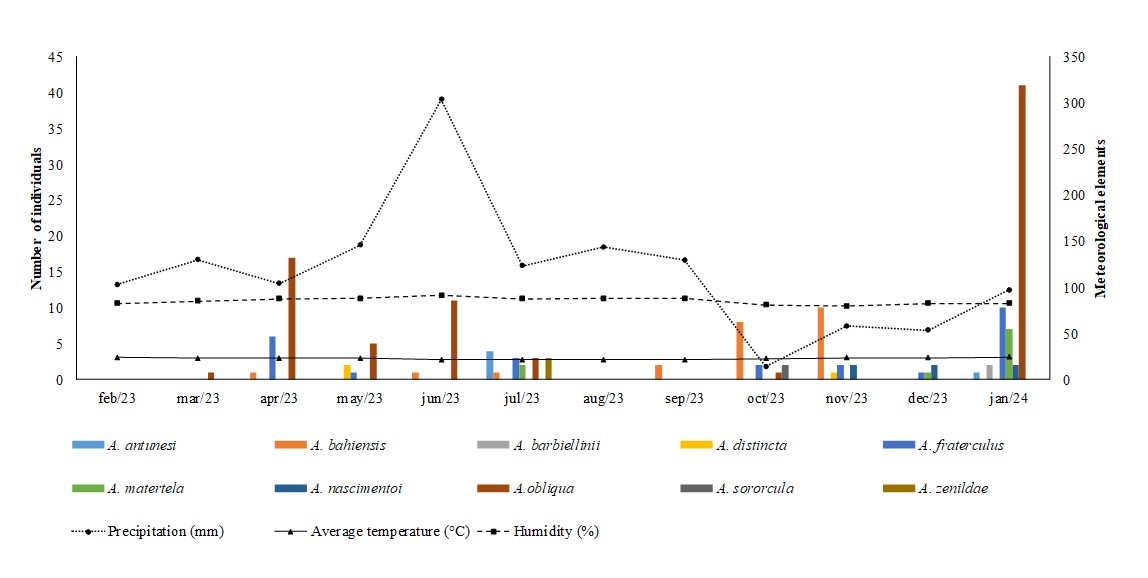
During the collection period from February 2023 to January 2024, a total of 207 Anastrepha specimens, 27 males and 180 females, were collected. When analyzing the fluctuation of fruit fly species captured in Mata do Pau-Ferro State Park, it is observed that Anastrepha obliqua (Macquart) was the most collected species, representing 38.64% of the total specimens collected, followed by Anastrepha fraterculus (Wiedemann) (12.07%) and Anastrepha bahiensis Lima (11.12%). The analysis of the fluctuations of fruit fly species in Mata do Pau-Ferro State Park revealed that Anastrepha obliqua (Macquart) was the most captured species, representing 38.64% of the individuals collected, followed by Anastrepha fraterculus (Wiedemann) (12.07%) and Anastrepha bahiensis Lima (11.12%). In terms of annual fluctuations, the highest occurrence of species was recorded in the months of January, July with 6 species and October and November with 4 species. On the other hand, the months of February, August and September presented the lowest occurrence of fruit fly species (Figure 2).
Population fluctuation of Anastrepha in an Atlantic Forest fragment in Northeastern Brazil from February 2023 to January 2024.
In the closed canopy environment, a site that experienced less anthropic action, 10 species of fruit flies were captured: Anastrepha antunesi Lima, A. bahiensis, A. barbiellinii Lima, A. distincta Greene, A. fraterculus, A. matertela Zucchi, A. nascimentoi Zucchi, A. obliqua, A. sororcula Zucchi and A. zenildae Zucchi. At this site, 139 of the total 207 specimens collected in the study were captured, with A. obliqua being the most captured species (62), followed by A. bahiensis (21) and A. fraterculus (15) (Figure 3).
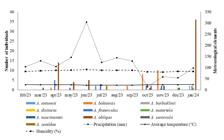
Population fluctuation of Anastrepha in an Atlantic Forest fragment in the Brazilian Northeast in a closed canopy area from February/23 to January/24.
In the open canopy environment, characterized by open vegetation and greater human intervention, eight species of fruit flies were collected, a smaller number than in the closed canopy environment, with the species A. barbiellinii and A. sororcula not being captured. The species collected in greatest numbers in this environment were distributed as follows: A. obliqua (17), A. fraterculus (10) and A. matertela (8) (Figure 4).
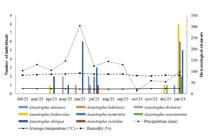
Population fluctuation of Anastrepha in an Atlantic Forest fragment in Northeast Brazil in an open canopy area from February 23 to January 24.
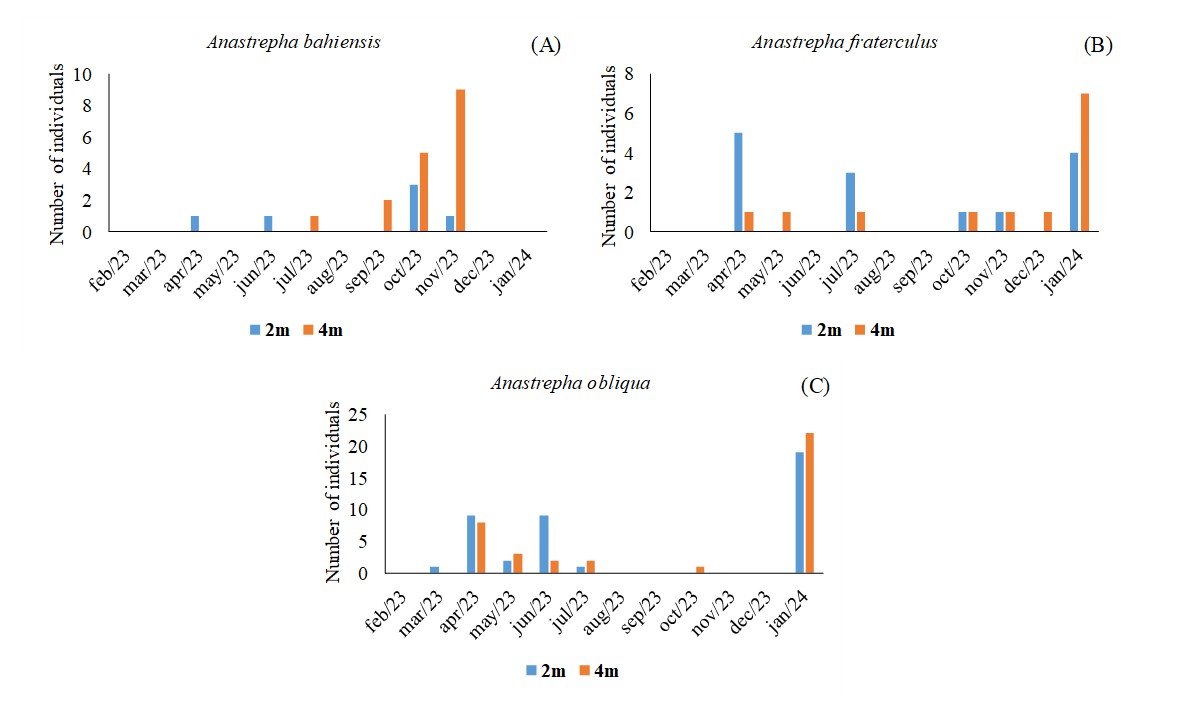
Among the most captured species identified during the study period were A. obliqua, A. fraterculus and A. bahiensis. Figure 5 shows the fluctuations of these species throughout the analyzed period and their occurrence at the different heights of the traps used in the research (2 and 4 m). The species A. obliqua was most frequently found between April and July, demonstrating greater abundance in January 2024, with a balance in both 2-meter and 4-meter traps, with the latter having the lowest incidence (Figure 5C). A. fraterculus was most frequently found between October 23 and January 24, and, similar to the previous species, there was no apparent difference between trap heights, occurring similarly in both (Figure 5B).
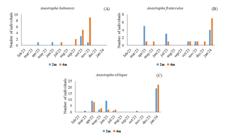
Population fluctuations of Anastrepha in a fragment of the Atlantic Forest in Northeast Brazil in traps positioned at 2 and 4 m from February 23 to January 24.
The greatest variation observed between trap heights and the number of fruit flies captured occurred with A. bahiensis, which was most prevalent between September and November, being captured in greater numbers by traps positioned at a height of 4 m. Among the total number of samples of this species collected, 73.91% were captured in the 4-meter trap, whereas the other 26.08% were captured in the 2-meter trap (Figure 5A).
In the Pearson correlation analysis for the closed-canopy environment, most of the Anastrepha species studied tended to be negatively correlated with precipitation, although not all correlations were statistically significant (p < 0.05). A. sororcula and A. bahiensis presented the strongest negative and statistically closest correlations of p < 0.05 with precipitation (r = -0.46, p 0.136 and r = -0.52, p = 0.085, respectively) (Figure 6).

Pearson correlation analysis between the climatic factors of precipitation, temperature and humidity and the occurrence of Anastrepha in a closed canopy environment.
Like precipitation, humidity tends to be negatively correlated with the occurrence of several Anastrepha species. A. bahiensis, again stands out for their strong negative and statistically significant correlation, now with humidity (r = -0.62, p = 0.031). A. nascimentoi also presents a notable negative correlation, although with a p-value marginally above 0.05 (r = -0.572, p = 0.052) not demonstrating significance (Figure 6).
In terms of temperature, A. barbiellinii, A. matertela and A. obliqua presented notable positive correlations with temperature (r = 0.44, p = 0.149, r = 0.51, p = 0.093 and r = 0.46, p = 0.137, respectively), indicating that temperature may favor their occurrence (Figure 6).
In the open canopy environment, the results of the Pearson correlation analysis indicate that the climatic variables influence the studied species differently. A positive, strong and statistically significant correlation was observed between precipitation and the abundances of A. obliqua (r = 0.62, p = 0.032) and A. bahiensis (r = 0.63, p = 0.027), suggesting that periods of greater rainfall may favor population increases in these species. In particular, A. bahiensis also exhibited a negative, strong and significant correlation with temperature (r = -0.59, p = 0.043), indicating that increases in temperature may be a limiting factor for its population. Some correlations tended toward statistical significance (p < 0.05). Notably, temperature tended to be positively correlated with A. nascimentoi (r = 0.52, p = 0.081), and humidity tended to be positively correlated with A. bahiensis (r = 0.54, p = 0.068) (Figure 7).
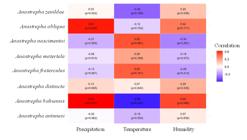
Pearson correlation analysis between the climatic factors of precipitation, temperature and humidity and the occurrence of Anastrepha in an open canopy environment.
4. Discussion
Our results demonstrated that there was greater population fluctuation for A. obliqua (38.64%), followed by A. fraterculus (12.07%) and A. bahiensis (11.12%). These results are consistent with the findings of Feitosa et al. (2008) in Piauí and Oliveira et al. (2009) in Ceará, who also identified A. obliqua as the predominant species in mango orchards. However, population peaks occurred in different periods: while in Ceará, there was an increase between April and June, in this study, the highest densities were observed in the months of the second half of the year (July, October and November) and in January, which can be attributed to the climatic conditions and the phenology of the hosts in each region of the study (Lemos et al., 2015; Martínez-Flores et al., 2023).
In the sampled environments, no specimens of Ceratitis capitata (Wiedemann) were collected; this species is generally recorded in commercial and domestic orchards in surveys in the state of Paraíba (Araújo et al., 2021; Silva et al., 2021). This fact corroborates the hypothesis that less altered native environments do not favor the occurrence of exotic and highly generalist species, whose presence seems to depend strongly on the availability of cultivated fruits and anthropized habitats (Berrones-Morales et al., 2020).
In the analysis of population fluctuations, A. obliqua, A. fraterculus and A. matertela presented significant population increases in January 2024, with the resumption of rainfall, after a period of low rainfall recorded from August to December 2023. This was evident in the open-canopy area, as no fruit fly species were recorded between September and November 2023, a period when precipitation significantly decreased. This behavior was also reported by Martins et al. (2024) e Alves et al. (2020), who reported a population increase in fruit flies after a period of low rainfall and the resumption of the beginning of the rains. Rainfall increases soil moisture, where fruit flies carry out their pupal stage, thus facilitating their development (Montoya et al., 2008).
Biotic and abiotic factors, such as fruit availability, temperature, and humidity, are determinants of tephritid population fluctuations (Aluja, 1994; Alberti et al., 2012; Duarte et al., 2012). Our results indicate that the highest species richness records occurred in July, October, November 2023, and January 2024, a period that coincides with the fruiting of some hosts in the area, such as Myrtaceae and Sapindaceae, and with the resumption of rainfall (Andrade et al., 2006). Fruiting, in particular, is a phenological component that is directly associated with the population increase of fruit fly species (Tiring and Satar, 2021).
The analysis of the environment revealed greater species richness and abundance in the closed canopy area than in the open canopy area. This result can be attributed to the greater diversity of hosts and the formation of favorable microclimates under the closed canopy (Araujo et al., 2005; Duarte et al., 2012; Aluja et al., 2012).
The scarcity of species in the open canopy area between July and December coincides with the period of low precipitation, highlighting the influence of water availability on population dynamics. Studies carried out in different states of Brazil, such as Roraima (Lima et al., 2012), Mato Grosso do Sul (Canesin and Uchôa-Fernandes, 2007) and Santa Catarina (Alberti et al., 2012), reinforce the importance of precipitation and host availability for the occurrence of Anastrepha.
In terms of trap height (2 and 4 m), A. obliqua, A. fraterculus and A. bahiensis were the most captured species. A. obliqua showed a balanced distribution between both heights, with peaks in April–July and January. A. fraterculus was concentrated between October and January, also without apparent differences between heights. Although these studies did not evaluate trap height, similar seasonal patterns for these especies were reported by Araujo et al. (2019) and Montes et al. (2011) in agricultural environments, highlighting the influence of land use and host availability on fruit fly dynamics.
The greatest disparity between heights was observed for A. bahiensis, with 73.91% of individuals captured at 4 m, suggesting a preference for upper vegetation strata. This species is known to infest larger hosts, such as Moraceae and Myrtaceae (Façanha et al., 2019; Zucchi and Moraes, 2025). Previous studies have also revealed similar vertical behavior in A. obliqua and A. fraterculus (Soares et al., 2023; Salles, 1995), reinforcing the hypothesis that factors such as feeding habits and host height influence the vertical distribution of the species. Ribeiro et al., (2021) and Araújo et al., (2022) highlight those variables such as light, humidity and fruit availability along the vertical gradient can modify the ecological roles played by fruit flies, with important implications for targeted fauna monitoring and integrated pest management in landscapes that combine natural fragments and cropping systems.
Pearson's correlation analysis revealed that precipitation is a key climatic factor that positively and significantly influences the abundance of A. obliqua and A. bahiensis (Canesin and Uchôa-Fernandes, 2007). On the other hand, temperature appears to be a limiting factor for A. bahiensis, which, like other fruit flies, has a reduced occurrence at relatively high temperatures (Silva et al., 2014).
Humidity, in turn, did not prove to be a statistically proven factor influencing any of the species in the context of this study. Araujo et al. (2008), studying the Caatinga of Ceará, observed population peaks between April and August, especially under intermediate humidity conditions (60–80%). This range also seems to have been favorable to the populations in this study; however, they did not present significant results from a statistical point of view.
Although the isolated effects of climatic factors are limited, when these factors are considered together, especially precipitation and temperature, their impact becomes more evident. Studies such as those by Calore et al. (2013) and Parra et al. (1982) demonstrated that higher temperatures favor the development of tephritids by accelerating their life cycle, whereas extreme humidity can limit their survival (Aluja, 1994; Lopes et al., 2008).
Thus, the results of this study corroborate previous findings by indicating that host diversity and climatic factors act together to affect the population dynamics of fruit flies. The studied area, a fragment of the Atlantic Forest, can function as a reproductive refuge, especially during periods of host scarcity in commercial crops.
Although no systematic survey of fruit availability was conducted during the sampling period, native and exotic host plants known to support Anastrepha species were observed near the traps, including Psidium guajava, Eugenia spp., and Spondias spp. These hosts exhibit asynchronous fruiting throughout the year and likely play a significant role in sustaining local fruit fly populations (Coelho et al., 2024; Zucchi, 2000). Similar findings have been reported in other regions of Brazil, where host availability and diversity were strongly associated with species richness and abundance of tephritid flies (Barreto et al., 2022).
In our study, the peaks in species occurrence appear to coincide with periods of increased fruit availability, suggesting that host phenology exerts a strong influence on seasonal abundance. Nonetheless, we recognize the limitation of not having quantified fruiting phenology, and we emphasize the need for future studies that integrate detailed host availability, vertical distribution of resources, and fly population data to deepen our understanding of these ecological relationships.
Therefore, systematic monitoring of tephritid fauna in natural areas is essential, as these environments may serve as reservoirs of pest species that could potentially impact commercial orchards if established nearby. Continuous studies are recommended to expand the knowledge about the ecology of these pests and guide more effective control actions.
5. Conclusions
In the sampled area, within Mata do Pau-Ferro State Park, located in Areia – PB, the highest number of species occurs in the months of July 2023 and January 2024, with A. obliqua being the most frequent species in the analyzed period. The highest population peak is recorded in January 2024. Compared with the open canopy environment, the closed canopy environment presented a greater abundance of species. Among the climatic factors, precipitation and temperature have the greatest influence on the occurrence of fruit flies.
Acknowledgements
This work was carried out with the support of the Coordination for the Improvement of Higher Education Personnel – Brazil (CAPES) – Financing Code 001. The authors would like to thank the Superintendence of Environmental Administration (SUDEMA) of the state of Paraíba for authorizing research at the Mata do Pau Ferro State Park Conservation Unit (Process No. SUD-PRC-2023/01031).
Data Availability Statement
The research data are only available upon request to the corresponding author.
References
-
ALBERTI, S., BOGUS, G.M. and GARCIA, F.R.M., 2012. Flutuação populacional de moscas-das-frutas (Diptera: Tephritidae) em pomares de pessegueiro e maracujazeiro em Iraceminha, Santa Catarina. Biotemas, vol. 25, no. 1, pp. 53-58. http://doi.org/10.5007/2175-7925.2012v25n2p53
» http://doi.org/10.5007/2175-7925.2012v25n2p53 -
ALUJA, M., 1994. Bionomics and management of Anastrepha. Annual Review of Entomology, vol. 39, no. 1, pp. 155-178. http://doi.org/10.1146/annurev.en.39.010194.001103
» http://doi.org/10.1146/annurev.en.39.010194.001103 -
ALUJA, M., ORDANO, M., GUILLEN, L. and RULL, J., 2012. Understanding long- term fruit fly (Diptera: Tephritidae) population dynamies: implication for area wide management. Journal of Economic Entomology, vol. 105, no. 3, pp. 823-836. http://doi.org/10.1603/EC11353 PMid:22812118.
» http://doi.org/10.1603/EC11353 -
ALVARES, C.A., STAPE, J.L., SENTELHAS, P.C., MORAES-GONÇALVES, J.L. and SPAROVEK, G., 2013. Köppen’s climate classification map for Brazil. Meteorologische Zeitschrift, vol. 22, no. 6, pp. 711-728. http://doi.org/10.1127/0941-2948/2013/0507
» http://doi.org/10.1127/0941-2948/2013/0507 -
ALVES, E.C., DANTAS, J.F., FREIRE, J.L.O., ARAUJO, E.L. and MACEDO, L.P.M., 2020. Fruit fly (Diptera: Tephritidae) associated with mango tree in the eastern Seridó region of Paraíba, Brazil. Revista Verde de Agroecologia e Desenvolvimento Sustentável, vol. 15, no. 2, pp. 127-132. http://doi.org/10.18378/rvads.v15i2.7529
» http://doi.org/10.18378/rvads.v15i2.7529 -
ANDRADE, L.A., OLIVEIRA, F.X., NASCIMENTO, I.S., FABRICANTE, J.R., SAMPAIO, E.V. and BARBOSA, M.R., 2006. Análise florística e estrutural de matas ciliares ocorrentes em brejo de altitude no município de Areia, Paraíba. Agrária, vol. 1, no. 1, pp. 31-40. http://doi.org/10.5039/agraria.v1i1a47
» http://doi.org/10.5039/agraria.v1i1a47 -
ARAÚJO, E.D.S., SILVA, L.B., JESUS, R.F.D., OLIVEIRA, T.R.D., LOPES, J.W.B. and LOPES, G.N., 2022. Tritrophic relations and spatial distribution of fruit flies (Diptera: Tephritidae) in the Cerrado and Caatinga regions in Piauí, Brazil. Revista Brasileira de Entomologia, vol. 66, no. 2, e20210117. http://doi.org/10.1590/1806-9665-rbent-2021-0117
» http://doi.org/10.1590/1806-9665-rbent-2021-0117 -
ARAÚJO, J.R.E.S., GONZAGA, K.S., SANTOS, J.P.O., CARTAXO, P.H.A., OLIVEIRA, G.M., ARAÚJO, H.M., LACERDA, L.B. and SABINO, B.T.S., 2021. Espécies de moscas-das-frutas descritas na Paraíba e atrativos utilizados para o manejo. Scientific Electronic Archives, vol. 14, no. 7, pp. 18-24. http://doi.org/10.36560/14720211334
» http://doi.org/10.36560/14720211334 -
ARAUJO, M.R., URAMOTO, K., FERREIRA, E.N.L., MESQUITA-FILHO, W., WALDER, J.M.M., SAVARIS, M. and ZUCCHI, R.A., 2019. Fruit fly (Diptera: Tephritidae) diversity and host relationships in diverse environments estimated with two sampling methods. Environmental Entomology, vol. 48, no. 1, pp. 227-233. http://doi.org/10.1093/ee/nvy177 PMid:30544259.
» http://doi.org/10.1093/ee/nvy177 - ARAUJO, E.L., SILVA, R.K., GUIMARÃES, J.A., SILVA, J.G. and BITTENCOURT, M.A., 2008. Levantamento e flutuação populacional de moscas-das-frutas (Diptera: Tephritidae) em goiaba Psidium guajava L., no município de Russas (CE). Revista Caatinga, vol. 21, no. 1, pp. 138-146.
-
ARAUJO, E.L., MEDEIROS, M.K.M., SILVA, V.E. and ZUCCHI, R.A., 2005. Moscas-das-frutas (Diptera: Tephritidae) no semiárido do Rio Grande do Norte: plantas hospedeiras e índices de infestação. Neotropical Entomology, vol. 34, no. 6, pp. 889-894. http://doi.org/10.1590/S1519-566X2005000600003
» http://doi.org/10.1590/S1519-566X2005000600003 - BARBOSA, M.R.V., AGRA, M.F., SAMPAIO, E.V.S.B., CUNHA, J.P. and ANDRADE, L.A., 2004. Diversidade florística na Mata do Pau-Ferro, Areia, Paraíba. In: K.C. PÔRTO, J.J.P. CABRAL and M. TABARELLI, eds. Brejos de altitude em Pernambuco e Paraíba. Brasília: Ministério do Meio Ambiente, pp. 111-121.
-
BARRETO, M.R., SOUSA, M.D.S.M., ADAIME, R. and ZUCCHI, R.A., 2022. Fruit flies in the Mato Grosso state, Brazil: increasing knowledge about diversity, host plants and parasitoids. Agrária, vol. 17, no. 2, pp. 1-6. http://doi.org/10.5039/agraria.v17i2a1500
» http://doi.org/10.5039/agraria.v17i2a1500 -
BERRONES-MORALES M., VANOYE-ELIGIO V., CORONADO-BLANCO J.M., GAONA-GARCÍA G. and SÁNCHEZ-RAMOS G., 2020. Species diversity of fruit flies (Diptera: Tephritidae) through different ecosystems in a Neotropical transition zone in Mexico.Journal of Insect Conservation, vol. 24, pp. 219–231. https://doi.org/10.1007/s10841-019-00192-4
» https://doi.org/10.1007/s10841-019-00192-4 -
BOULAHIA-KHEDER, S., 2021. Review on major fruit flies (Diptera: Tephritidae) in North Africa: Bioecological traits and future trends. Crop Protection, vol. 140, pp. 105416. http://doi.org/10.1016/j.cropro.2020.105416
» http://doi.org/10.1016/j.cropro.2020.105416 -
CALORE, R.A., GALLI, J.C., PAZINI, W.C., DUARTE, R.T. and GALLI, J.A., 2013. Fatores climáticos na dinâmica populacional de Anastrepha spp. (Diptera: Tephritidae) e de Scymnus spp. (Coleoptera: Coccinellidae) em um pomar experimental de goiaba (Psidium guajava L.). Revista Brasileira de Fruticultura, vol. 35, no. 1, pp. 67-74. http://doi.org/10.1590/S0100-29452013000100009
» http://doi.org/10.1590/S0100-29452013000100009 -
CANESIN, A. and UCHÔA-FERNANDES, M.A., 2007. Analise faunística e flutuação populacional de moscas das frutas (Diptera, Tephritidae) em um fragmento de floresta semidecídua em Dourados, Mato grosso do Sul, Brasil. Revista Brasileira de Zoologia, vol. 24, no. 4, pp. 185-190. http://doi.org/10.1590/S0101-81752007000100023
» http://doi.org/10.1590/S0101-81752007000100023 -
COELHO, R.S., ALVARENGA, C., PEC, M., RODRIGUES-SILVA, A.L., PECHE, P.M., ALVES, E. and MARUCCI, R., 2024. Fruit flies (Diptera: Tephritidae) in Minas Gerais, Brazil: trophic interactions and new reports. Insects, vol. 16, no. 1, pp. 17. http://doi.org/10.3390/insects16010017 PMid:39859598.
» http://doi.org/10.3390/insects16010017 -
DIAS, N.P., ZOTTI, M.J., MONTOYA, P., CARVALHO, I.R. and NAVA, D.E., 2018. Fruit fly management research: a systematic review of monitoring and control tactics in the world. Crop Protection, vol. 112, pp. 187-200. http://doi.org/10.1016/j.cropro.2018.05.019
» http://doi.org/10.1016/j.cropro.2018.05.019 -
DUARTE, R.T., GALLI, J.C. and PAZINI, W.C., 2012. Dinâmica populacional de moscas-das-frutas (Diptera: Tephritidae) em pomar de goiaba no município de Jaboticabal – SP. Revista Agroecossistemas, vol. 4, no. 1, pp. 33-41. http://doi.org/10.18542/ragros.v4i1.1048
» http://doi.org/10.18542/ragros.v4i1.1048 -
EMPRESA BRASILEIRA DE PESQUISAS AGROPECUÁRIAS – EMBRAPA, 2016 [viewed 2 April 2024]. Solos do nordeste [online]. Available from: http://www.uep.cnps.embrapa.br/solos/index.php?link=pi
» http://www.uep.cnps.embrapa.br/solos/index.php?link=pi -
FAÇANHA, T.P., LEMOS, W.D.P., SILVA, L.C.D., RAMOS, A.R.F. and SILVA, J.G., 2019. First record of Anastrepha bahiensis Lima (Diptera: Tephritidae) infesting fruits of Averrhoa carambola L. in the eastern Amazon, Brazil. Revista Brasileira de Entomologia, vol. 63, no. 4, pp. 275-276. http://doi.org/10.1016/j.rbe.2019.07.001
» http://doi.org/10.1016/j.rbe.2019.07.001 -
FEITOSA, S.S., SILVA, P.R.R., PÁDUA, L.E.D.M., CARVALHO, E.M.S., PAZ, J.K.D.S. and PAIVA, D.R.D., 2008. Flutuação populacional de moscas-das-frutas (Diptera: Tephritidae) associadas a variedades de manga no município de José de Freitas-Piauí. Revista Brasileira de Fruticultura, vol. 30, no. 1, pp. 112-117. http://doi.org/10.1590/S0100-29452008000100021
» http://doi.org/10.1590/S0100-29452008000100021 - HERNÁNDEZ-ORTIZ, V., HERNÁNDEZ-LÓPEZ, M. and DZUL-CAUICH, J.F., 2021. Sampling methods of true fruit flies (Tephritidae). In: C.J. SANTOS and G.W. FERNANDES, eds. Measuring arthropod biodiversity: a handbook of sampling methods. Cham: Springer, pp. 205-222.
-
HOLLER, T., SIVINSKI, J., JENKINS, C. and FRASER, S., 2006. A comparison of yeast hydrolysate and synthetic food attractants for capture of Anastrepha suspensa (Diptera: Tephritidae). The Florida Entomologist, vol. 89, no. 3, pp. 419-420. http://doi.org/10.1653/0015-4040(2006)89[419:ACOYHA]2.0.CO;2
» http://doi.org/10.1653/0015-4040(2006)89[419:ACOYHA]2.0.CO;2 - INSTITUTO BRASILEIRO DE GEOGRAFIA E ESTATÍSTICA – IBGE, 2012. Manual técnico da vegetação brasileira. Rio de Janeiro: IBGE, 272 p.
- LEMOS, L.J.U., SOUZA-FILHO, M.F.D., URAMOTO, K., LOPES, G.N. and ZUCCHI, R.A., 2015. Espécies de Anastrepha (Diptera: Tephritidae) em pomares de goiaba: diversidade, flutuação populacional e fenologia do hospedeiro. Arquivos do Instituto Biológico, vol. 82, pp. 1-5. http://doi.org/10.1590/1808-1657000552013.
-
LIMA, A.B., LIMA, A.C.S., OLIVEIRA, A.H.C. and SANTOS, N.S., 2012. Ocorrência de moscas-das-frutas (Diptera: Tephritidae) em mangueiras (Mangifera indica L.) em Boa Vista, Roraima. Revista Agro@mbiente, vol. 6, no. 2, pp. 79-183. http://doi.org/10.18227/1982-8470ragro.v6i2.813
» http://doi.org/10.18227/1982-8470ragro.v6i2.813 - LOPES, J.R.S., MARQUES, R.N. and YAMAMOTO, P.T., 2008. Subsídios para o manejo de insetos vetores em citros. In: P.T. YAMAMOTO, ed. Manejo integrado de pragas dos citros. Piracicaba: CP2, 336 p.
-
LOUZEIRO, L.R.F., SOUZA-FILHO, M.F., RAGA, A. and GISLOTI, L.J., 2021. Incidence of frugivorous flies (Tephritidae and Lonchaeidae), fruit losses and the dispersal of flies through the transportation of fresh fruit. Journal of Asia-Pacific Entomology, vol. 24, no. 1, pp. 50-60. http://doi.org/10.1016/j.aspen.2020.11.006
» http://doi.org/10.1016/j.aspen.2020.11.006 -
MARTÍNEZ-FLORES, A.M., RODRÍGUEZ, W.D., HERNÁNDEZ SALCIDO, P.G., GUAPO MORA, L.A., VALDERRAMA HERRERA, M. and NAVARRETE MAYA, R., 2023. The influence of temperature and precipitation on the abundance of Anastrepha ludens and A. obliqua (Diptera: Tephritidae), in “Barranqueño” mango (Mangifera indica) in Jalisco, Mexico. Phytoparasitica, vol. 51, no. 1, pp. 29-40. http://doi.org/10.1007/s12600-022-01034-x
» http://doi.org/10.1007/s12600-022-01034-x -
MARTINEZ, F.J., NORRBOM, A.L., SCHLISERMAN, P. and CAMPANELLA, M.V., 2020. Tephritidae flies associated with Chuquiraga avellanedae (Asteraceae) in Patagonia, Argentina. Anais da Academia Brasileira de Ciências, vol. 92, no. 2, suppl. 2, e20191524. http://doi.org/10.1590/0001-3765202020191524 PMid:33053070.
» http://doi.org/10.1590/0001-3765202020191524 -
MARTINS, D.D.S., FORNAZIER, M.L., URAMOTO, K., GUIMARÃES, J.A., FERREIRA, P.S.F., VENTURA, J.A., GUARÇONI, R.C., CULIK, M.P., ZANUNCIO-JUNIOR, J.S. and FORNAZIER, M.J., 2024. Frugivorous flies (Diptera: Tephritidae; Lonchaeidae) associated with guava tree: species diversity, parasitoids and population fluctuation in the Espírito Santo state, Brazil. Pesquisa Agropecuária Tropical, vol. 54, e77329. http://doi.org/10.1590/1983-40632024v5477329
» http://doi.org/10.1590/1983-40632024v5477329 -
MEGHA, R., SINGH, S.K., SRIVASTAV, M., KALIA, V., SHARMA, N., KUMAR, C. and SINGH, N., 2023. The population dynamics of fruit flies and correlation matrix with weather and host variables in mango (Mangifera indica) orchards. Indian Journal of Agricultural Sciences, vol. 93, no. 10, pp. 1132-1138. http://doi.org/10.56093/ijas.v93i10.138967
» http://doi.org/10.56093/ijas.v93i10.138967 -
MONTEIRO, L.B., NISHIMURA, G. and MONTEIRO, R.S., 2021. Natural parasitism in fruit fly (Diptera: Tephritidae) and interaction with wild hosts surrounding apple orchards adjacent to Atlantic Forest fragments in Paraná State, Brazil. Brazilian Journal of Biology = Revista Brasileira de Biologia, vol. 83, e250505. http://doi.org/10.1590/1519-6984.250505 PMid:34669805.
» http://doi.org/10.1590/1519-6984.250505 -
MONTES, S.M.N.M., RAGA, A. and SOUZA-FILHO, M.F., 2011. Levantamento de espécies de Anastrepha (Diptera: Tephritidae) em áreas de cucurbitáceas sob sistema de mitigação de risco. Arquivos do Instituto Biológico, vol. 78, no. 2, pp. 317-320. http://doi.org/10.1590/1808-1657v78p3172011
» http://doi.org/10.1590/1808-1657v78p3172011 -
MONTOYA, P., FLORES, S. and TOLEDO, J., 2008. Effect of rainfall and soil moisture on survival of adults and immature stages of Anastrepha ludens and A. obliqua (Diptera: Tephritidae) under semifield conditions. Florida Entomologist, vol. 91, no. 4, pp. 643-650. http://doi.org/10.1653/0015-4040-91.4.643
» http://doi.org/10.1653/0015-4040-91.4.643 -
NORRBOM, A.L., KORYTKOWSKI, C.A., ZUCCHI, R.A., URAMOTO, K., VENABLE, G.L., MCCORMICK, J., DALLWITZ, M.J., 2012 [viewed 21 November 2023]. Anastrepha and Toxotrypana: descriptions, illustrations, and interactive keys [online]. Available from: https://www.delta-intkey.com/anatox/index.htm
» https://www.delta-intkey.com/anatox/index.htm - OLIVEIRA, J.J.D., ROCHA, A.C.P., ALMEIDA, E.S., NOGUEIRA, C.H.F. and ARAUJO, E.L., 2009. Espécies e flutuação populacional de moscas-das-frutas em um pomar comercial de mangueira, no litoral do Estado do Ceará. Revista Caatinga, vol. 22, no. 1, pp. 222-228.
- PARRA, J.R.P., ZUCCHI, R.A. and SILVEIRA-NETO, S., 1982. Flutuação populacional e atividade diária de voo da mosca-do-mediterrâneo em cafeeiros “Mundo Novo”. Pesquisa Agropecuária Brasileira, vol. 17, no. 7, pp. 985-992.
- RAGA, A. and SOUZA-FILHO, M.F., 2021. Manual de moscas-das-frutas: medidas para o controle sustentável 1. ed. Araraquara: Fundecitrus, 33 p.
-
R CORE TEAM, 2020 [viewed 28 February 2024]. R: a language and environment for statistical computing; version 3.0.1 [online]. Vienna: R foundation for Statistical Computing. Available from: http://www.R-project.org/
» http://www.R-project.org/ -
RIBEIRO, J.G.G., SOARES, N.S., MESQUITA-FILHO, W., ARAUJO, M.R., ZUCCHI, R.A. and SAVARIS, M., 2021. Influence of the height of multilure traps in the collection of Ceratitis capitata (Wiedemann) (Diptera: Tephritidae). EntomoBrasilis, vol. 14, e934. http://doi.org/10.12741/ebrasilis.v14.e934
» http://doi.org/10.12741/ebrasilis.v14.e934 -
SALLES, L.A.B., 1995. Estratificação vertical da incidência de Anastrepha fraterculus (Wied.) em fruteiras no sul do Brasil. Anais da Sociedade Entomológica do Brasil, vol. 24, no. 3, pp. 423-428. http://doi.org/10.37486/0301-8059.v24i3.1048
» http://doi.org/10.37486/0301-8059.v24i3.1048 - SAVARIS M. and LAMPERT S., 2023. Métodos de coleta, montagem e preservação das moscas-das-frutas. In: ZUCCHI R.A., MALAVASI A., ADAIME A. and NAVA D.E., eds. Moscas-das-frutas no Brasil – conhecimento básico e aplicado Editora Fealq: Piracicaba, pp. 17–43.
-
SOARES, N.S., RIBEIRO, J.G., MESQUITA-FILHO, W., ARAUJO, M.R., ZUCCHI, R.A. and SAVARIS, M., 2023. Flight height and diversity of Anastrepha (Diptera: Tephritidae) in an anthropic environment. Neotropical Entomology, vol. 52, no. 5, pp. 826-836. http://doi.org/10.1007/s13744-023-01062-0 PMid:37495765.
» http://doi.org/10.1007/s13744-023-01062-0 -
SILVA, F.F.D., REDAELLI, L.R., MEIRELLES, R.N. and DAL SOGLIO, F.K., 2014. Danos de moscas-das-frutas (Diptera, Tephritidae) em citros, manejados no sistema orgânico de produção. Revista Ceres, vol. 61, no. 5, pp. 637-642. http://doi.org/10.1590/0034-737X201461050006
» http://doi.org/10.1590/0034-737X201461050006 -
SILVA, J.G.D., BRITO, C.H.D., OLIVEIRA, R.D., ARAÚJO, E.L., GONZAGA, K.S. and LOPES, G.N., 2021. Biodiversity and population distribution of fruit fly (Diptera: Tephritidae) in domestic orchards of Paraíba state, Brazil.Revista Caatinga, vol. 34, pp. 242–248. https://doi.org/10.1590/1983-21252021v34n125rc
» https://doi.org/10.1590/1983-21252021v34n125rc -
THOMAS, D.B., HOLLER, T.C., HEATH, R.R., SALINAS, E.J. and MOSES, A.L., 2001. Trap lure combinations for surveillance of Anastrepha fruit flies (Diptera: Tephritidae). The Florida Entomologist, vol. 84, no. 3, pp. 344-351. http://doi.org/10.2307/3496491
» http://doi.org/10.2307/3496491 -
TIRING, G. and SATAR, S., 2021. Annual population fluctuations of Mediterranean fruit fly in the Eastern Mediterranean Region of Turkey: problem of nonmarketing fruit. Phytoparasitica, vol. 49, no. 5, pp. 807-817. http://doi.org/10.1007/s12600-021-00932-w
» http://doi.org/10.1007/s12600-021-00932-w - VIDAL, M.F., 2021. Produção comercial de frutas na área de atuação do BNB. Fortaleza: Banco do Nordeste do Brasil. Caderno Setorial ETENE, no. 168.
- ZUCCHI, R.A., 2000. Taxonomia. In: A. MALAVASI and R.A. ZUCCHI, eds. Moscas-das-frutas de importância econômica no Brasil: conhecimento básico e aplicado Ribeirão Preto: Holos, pp. 285-290.
-
ZUCCHI, R.A. and MORAES, R.C.B., 2025 [viewed 1 April 2025]. Fruit flies in Brazil: Anastrepha species their host plants and parasitoids [online]. Available from: http://www.lea.esalq.usp.br/anastrepha
» http://www.lea.esalq.usp.br/anastrepha - ZUCCHI, R.A., MALAVASI, A., ADAIME, A. and NAVA, D.E., 2023. Moscas-das-frutas no Brasil – conhecimento básico e aplicado Editora Fealq: Piracicaba, pp. 17–43.
Edited by
-
Editor:
Takako Matsumura Tundisi