 Potent antioxidant and anticancer efficacy of Brassica oleracea var acephala extracts: a cytomorphological and antidiabetic assessment
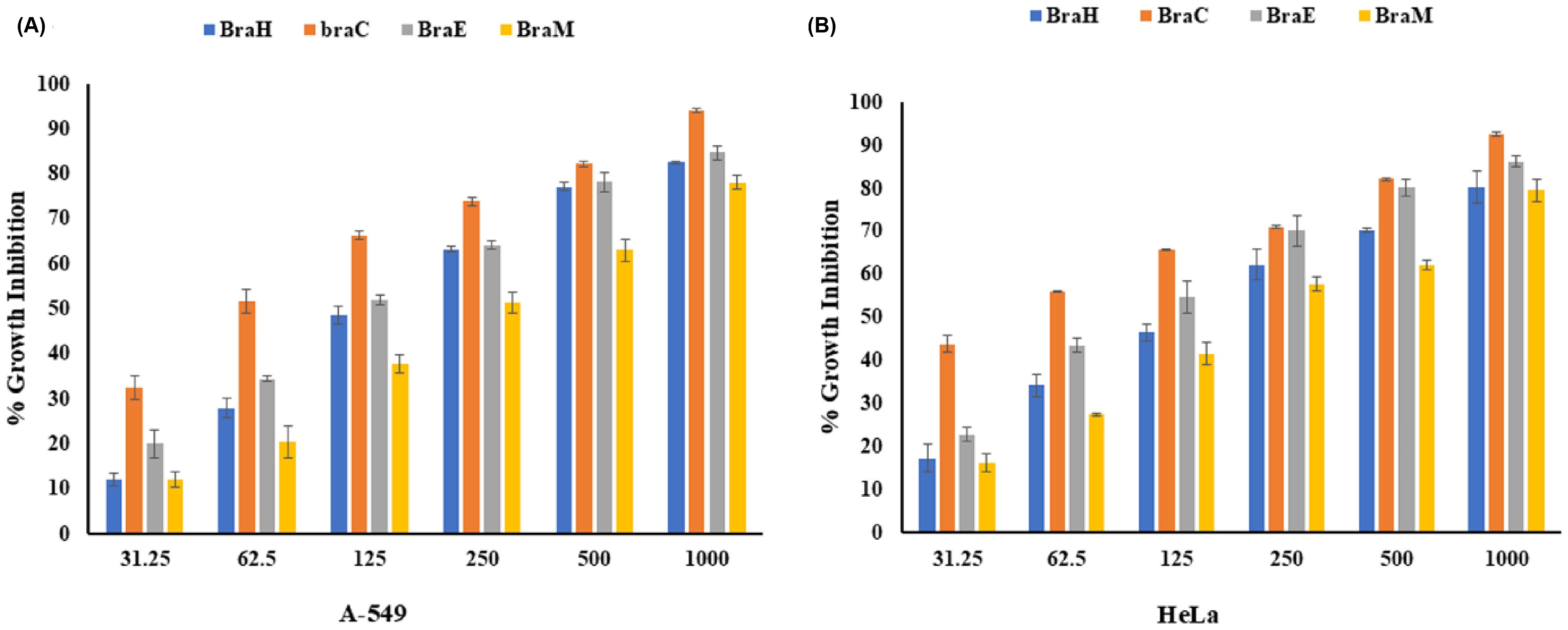
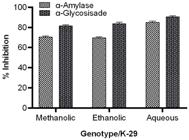
This study elucidates the antioxidant, anticancer, and antidiabetic properties of various extracts from Brassica oleracea var acephala (labeled K-29), specifically hexane (BraH), chloroform (BraC), ethyl acetate (BraE), and methanol (BraM) fractions. Antioxidant efficacy was determined through DPPH, ABTS, and FRAP assays, demonstrating a polarity-dependent increase in activity. Among the tested extracts, BraM exhibited most pronounced antioxidant activity, with IC50 values of 49.32 µg/mL, 60.10 µg/mL, and 67.73 µg/mL in DPPH, ABTS, and FRAP assays, respectively, achieving inhibition rates of 92.14%, 90.33%, and 88.35%. BraE displayed moderate antioxidant potential (71.25 µg/mL to 97.64 µg/mL), while BraH exhibited the lowest activity (170.88 µg/mL to 263.29 µg/mL). Antiproliferative activity was assessed against A549 and HeLa cell lines, with BraC showing the most potent cytotoxic effects, as reflected by GI50 values of 65.09 µg/mL and 37.00 µg/mL for A549 and HeLa cells, respectively. The antidiabetic potential of K-29 was further evaluated via α-amylase and α-glucosidase inhibition assays, where the aqueous extract demonstrated the highest inhibition rates of 85.08% and 89.55%, respectively, followed by BraM (71.52% and 81.86%), while BraE exhibited minimal inhibitory activity. These results underscore the therapeutic promise of Brassica oleracea extracts as potent natural antioxidants, anticancer agents, and antidiabetic interventions.
Keywords:
DPPH; ABTS; FRAP; apoptosis; antidiabetic; α-amylase; α-glucosidase
 Thumbnail
 Thumbnail
 Thumbnail
 Thumbnail
 Thumbnail