 How do plant growth-promoting bacteria and auxin influence the nutrition and morphophysiology of soybean?
Abstract
Co-inoculation of plant growth-promoting bacteria and the application of hormones can be practical for soybeans. We aimed to evaluate the effect of co-inoculation methods of Azospirillum brasilense + Pseudomonas fluorescens and auxin application on the nutrition and morphophysiology of soybeans. The co-inoculation methods were: control; inoculation with Bradyrhizobium spp. only; and co-inoculation with Bradyrhizobium spp. and a commercial source containing A. brasilense + P. fluorescens applied via seed, via foliar at stage V3, or via seed + foliar, associated or not with the application of auxin at stage V4. The application of auxin had little influence on photochemical yield. The best values of photochemical activity in the reaction centers of photosystem II occurred in plants co-inoculated via seed + foliar. Photosynthesis was higher in plants co-inoculated via seed and via seed + foliar, as were intrinsic carboxylation and water use efficiency. The highest nitrogen contents were observed in the control treatment and in the seed + foliar co-inoculation, regardless of auxin application. The control plants showed higher potassium, magnesium, and sulfur contents, while auxin application increased calcium content in plants. The application of auxin contributed to an increase in leaf area and biomass of leaves, roots, and nodules. Co-inoculation via foliar and seed + foliar routes anticipated flowering and increased the number of pods per plant. Co-inoculation of A. brasilense + P. fluorescens via seed + foliar routes promoted improvements in soybean morphophysiology, while auxin application contributed positively to soybean morphophysiology and nutrition.
Keywords:
Azospirillum brasilense; co-inoculation; photosynthesis; photochemical yields; Pseudomonas fluorescens
Resumo
A coinoculação de bactérias promotoras do crescimento vegetal associada e aplicação de hormônios podem ser praticas a soja. Objetivamos avaliar o efeito de métodos de co-inoculação de Azospirillum brasilense + Pseudomonas fluorescens e aplicação de auxina na nutrição e a morfofisiologia da soja. Os métodos de co-inoculação foram: controle; inoculação apenas com Bradyrhizobium spp.; e coinoculação com Bradyrhizobium spp. e uma fonte comercial contendo A. brasilense + P. fluorescens aplicada via semente, via foliar no estádio V3 ou via semente + foliar, associada ou não à aplicação de auxina no estádio V4. A aplicação de auxina pouco influenciou o rendimento fotoquímico. Os melhores valores de atividade fotoquímica nos centros de reação do fotossistema II ocorreram nas plantas coinoculadas via semente + foliar. A fotossíntese foi maior em plantas coinoculadas via semente e via semente + foliar, assim como a carboxilação intrínseca e a eficiência do uso da água. Os maiores teores de nitrogênio foram observados no tratamento controle e na coinoculação via semente + foliar, independentemente da aplicação de auxina. As plantas controle apresentaram maiores teores de potássio, magnésio e enxofre, enquanto a aplicação de auxina aumentou o teor de cálcio nas plantas. A aplicação de auxina contribuiu para o aumento da área foliar e de biomassa de folhas, raízes e nódulos. A co-inoculação via foliar e via semente + foliar antecipou o florescimento e aumentou o número de vagens por planta. A coinoculação de A. brasilense + P. fluorescens via semente + foliar promoveu melhorias na morfofisiologia da soja, enquanto a aplicação de auxina contribuíram positivamente na morfofisiologia e nutrição da soja.
Palavras-chave:
Azospirillum brasilense; co-inoculação; fotossíntese; rendimentos fotoquímicos; Pseudomonas fluorescens
1. Introduction
Soybean [Glycine max (L.) Merril, Fabaceae] is a leguminous plant of economic representation in Brazilian and global agribusiness. The search for technologies that assist in the availability and efficient use of nutrients and act beneficially on leaf metabolism has increased. Beneficial microorganisms classified as plant growth-promoting bacteria (PGPB) are considered promising bioinputs due to their positive effects on photosynthetic metabolism and nutritional efficiency.
Among PGPB used for co-inoculation, Azospirillum brasilense and Pseudomonas fluorescens stand out. A. brasilense acts as a growth promoter, being able to live freely in the soil without the need to associate with plants and form nodules (Barbosa et al., 2022), has the capacity to fix atmospheric N, and induces the synthesis of phytohormones such as auxin, stimulating root growth and better uptake of water and nutrients (Fukami et al., 2018; Cassán et al., 2020; Ferreira et al., 2020). Pseudomonas fluorescens has also been widely used in commercial formulations due to its ability to solubilize phosphorus by converting insoluble inorganic phosphates into soluble forms (Yaashikaa et al., 2020) and to mitigate abiotic stresses (Zarei et al., 2019), highlighting its potential for use in sustainable agriculture.
Another important management is physiological positioning using products with hormonal action. Indole-3-acetic acid acts (IAA) in several ways in the growth and development of plants, being the predominantly most used source of auxin (Shahzad et al., 2022). It is a hormone frequently used to promote growth in plants, since when used in low concentrations it positively affects cell division, elongation, structuring of adventitious roots, induction of embryogenesis, and callus initiation (Talukdar et al., 2022).
Conversely, studies evaluating different co-inoculation methods of A. brasilense + P. fluorescens combined with auxin application remain limited. We hypothesized that the combined use of PGPB and auxin enhances soybean morphophysiology, nutrition, and growth. Therefore, this study evaluated the effects of co-inoculation methods of A. brasilense + P. fluorescens with auxin application on soybean nutrition and morphophysiology.
2. Material and Methods
2.1. General conditions
The experiment was carried out in plastic pots with a capacity of 8 kg, under greenhouse conditions, at the Faculty of Agricultural Sciences, Federal University of Grande Dourados (UFGD), Dourados, Mato Grosso do Sul, Brazil (22.19662° S, 54.93385° W). The soil used was classified as an Oxisol (USDA classification), with particle-size distribution of 48.76% clay, 44.56% sand, and 6.68% silt. The chemical attributes of the soil used were: pH H2O= 5.8, P= 2.68 mg dm-3, K, Ca, Mg, H + Al and Al: 0.46, 7.1, 2.5, 5.0 e 0.21 cmolc dm-3, respectively, S= 0.69 mg SO4 dm3, CEC pH 7= 14.96 cmolc dm-3, organic matter= 27.33 g dm-3, Mn, Fe, Cu, Zn, and B= 622.09, 17.31, 30.65, 0.02, and 0.12 mg dm-3, respectively, and V%= 66.6.
Temperature and relative humidity data in the environment during the experimental period were frequently measured with a thermo-hygrometer and presented in Figure 1.

Average temperature and relative humidity conditions of greenhouse during the experimental period. E1: first evaluation (36 DAS), E2: second evaluation (40 DAS), E3: third assessment (44 DAS), and EE: end destructive evaluation (49 DAS). DAS: days after sowing.
2.2. Co-inoculation and auxin application
The experimental design was a randomized block design arranged in a 4 × 2 factorial scheme with four replications, and each experimental unit consisted of one pot containing two plants. Treatments were defined as follows: (1) CK, control, inoculated only with Bradyrhizobium spp. via seed. Co-inoculation treatments consisted of Bradyrhizobium spp. combined with a commercial formulation containing A. brasilense + P. fluorescens (AP), applied via seed (APs; 150 mL ha−1, according to the manufacturer’s recommendation), via foliar application (APf; 0.5 L ha−1), or via seed + foliar application (APs+f). Foliar applications of AP were performed at the V3 growth stage. All co-inoculation treatments and the control were evaluated with or without foliar application of auxin at a dose of 0.5 L ha−1, applied at the V4 growth stage, according to the manufacturer’s recommendation.
All soybean seeds cv. M6410 inoculated with Bradyrhizobium elkani and B. japoninicum strains SEMIA 587 and SEMIA 5080, respectively, with 50 mL for every 50 kg seed–1, manufacturer's recommendation. Subsequently, seeds from the corresponding plots were co-inoculated with A. brasilense Ab-V6 + P. fluorescens CCTB03 (1 x 10⁸ Colony Forming Units mL–1), at 150 mL ha–1 such as recommended by manufacturer. The composition of auxin source used was: 2-(1H-indol-3-yl) acetic acid [Indol-3-ylacetic acid ([[indoleacetic acid)] 0.03 g L–1 (0.003% m v–1); other ingredients: 999.97 g L–1 [99.997% m v–1]).
Foliar application of A. brasilense + P. fluorescens and auxin was carried out in the morning at the corresponding stages, using a backpack sprayer pressurized with CO2, coupled to a bar with four fan-type spray nozzles spaced 0.5 m apart, whose pressure was regulated to 41 PSI and the spray volume was adjusted to 200 L ha–1. At 10 days after sowing (DAS), the plots were thinned, keeping only two plants per pot. At 36 DAS, maintenance fertilization was carried out with potassium chloride at a dose of 72 kg ha–1.
2.3. Phytosanitary management
During the cultivation cycle, phytosanitary management was performed to control Bemisia tabaci, with two applications of the active ingredients bifenthrin and acetamiprid at 13 and 20 days after sowing (DAS). A preventive fungicide application with difenoconazole was also performed at 33 DAS.
2.4. Phenological description
Phenological development was monitored weekly by visual assessment throughout the experimental period, from sowing to harvest, and expressed as days after sowing (DAS).
Non-destructive evaluations, including chlorophyll index, photochemical parameters, and gas exchange, were performed at 36, 40, and 44 DAS. Destructive evaluations of nutritional status, growth, and development were conducted at 49 DAS. Harvest was performed when more than 50% of the plants reached the R3/R4 reproductive stage.
2.5. Chlorophyll and photochemical processes
The chlorophyll index, photochemical aspects and gas exchange were carried out on fully expanded leaves located in the middle third, between 8 and 11 a.m., with photosynthetic active radiation (PAR) > 900 µmol photons m–2 s–1. The chlorophyll index was determined using a portable chlorophyll meter SPAD (Soil Plant Analyzer Development).
For chlorophyll a fluorescence, leaves were subjected to dark conditions for 30 minutes, using adapter clips. After this period, using a portable fluorometer (OS-30p; Opti-Sciences Chlorophyll Fluorometer, Hudson, NY, USA) under light flash of 1,500 µmol m–2 s–1, the initial chlorophyll fluorescence (F0) and photochemical potential quantum efficiency in photosystem II (Fv/Fm) and absorbed energy conversion efficiency (Fv/F0) was calculated. The electron transport rate (ETR) was calculated based on the proposal by Laisk and Loreto (1996).
2.6. Gas exchanges
The CO2 assimilation (photosynthesis) (A; μmol CO2 m–2 s–1), stomatal conductance (gs; mol H2O m–2 s–1) were quantified using a portable Infra Red Gas Analysis meter (IRGA, LCIPro-SD, Model ADC BioScientific Ltd.). Subsequently, water use efficiency (WUE; µmol CO2 mmol H2O m–2 s–1) and instantaneous carboxylation efficiency (A/Ci; μmol mol CO2 m–2 s–1) were calculated.
2.7. Growth and development
Plant height and root length were measured with ruler and leaf area using an area integrator model LICOR 3100. The leaves, branches, roots, and nodules fresh were weighed on a thousandsimal precision scale and were dried in an oven with forced air circulation at 60 ± 5 °C, and weighed according to dry mass.
At end of the experimental period (49 DAS), a composite sample was collected in function on each treatment (co-inoculation method, without or with auxin) and the chemical attributes were characterized (Table 1) and total number of pods was counted for characterization purposes.
Chemical attributes of Oxisol used in the experiment in function of co-inoculation methods with Azospirillum brasilense + Pseudomonas fluorescens, without or with foliar application of auxin, at 49 days after sowing.
2.8. Nutritional content
From the dry material, the leaves were ground in a Willey knife mill and the nitrogen (N), phosphorus (P), potassium (K), calcium (Ca), magnesium (Mg), and sulfur (S) contents were determined according to Malavolta et al. (1997).
2.9. Data analysis
Data from each evaluation period in days after sowing (36, 40, and 44 DAS) were analyzed individually, i.e., not comparing them statistically. All data were subjected to analysis of variance (ANOVA), and when significant by the F test (p ≤ 0.05), the means were compared by Tukey test for co-inoculation methods of A. brasilense + P. fluorescens and F test for auxin application, all at p ≤ 0.05 ± standard error. Information on phenology, visual aspects, and total number of pods were presented in a descriptive manner with the aim of characterization, that is, without statistical comparison.
3. Results and Discussion
We accept the hypothesis initial that the co-inoculation of A. brasilense + P. fluorescens and auxin application contributed on morphophysiology, but with variations for nutritional status. In addition, the mode of action of A. brasilense + P. fluorescens was variable to the auxin application, in which we observed better co-inoculation efficiency when the plants with auxin, different from that observed in CK plants. For photochemical yields, auxin application had little influence on these indicators, demonstrating little participation of hormone in this process, unlike gas exchanges, which was favored by the auxin application.
In general, the emergence of soybean seedlings was observed at 4 days after sowing (DAS). The formation of pair of unifoliate leaves was observed in all plants at 11 DAS, and the plants began the emergence of two fully developed trefoils at 20 DAS and stabilization at 26 DAS in all treatments. We identified differences between the beginning of flowering of plants in function of co-inoculation methods, in which at 34 DAS, 75% of plants co-inoculated with APf emitted flowers, while at 35, 36, and 37 DAS the plants cultivated with APs+f, APs, and CK initiated the floral emission process, respectively. Full flowering and beginning of pod emission were observed at 45 DAS in most plots of the experiment.
The chlorophyll index was influenced by auxin application at 36 DAS with highest value (44.19 SPAD) in plants with auxin application (Figure 2A) in function of association with gene transcriptions, although we did not determine this in our study. This is because there are reports that auxin acts in the induction of genes involved in chlorophyll biosynthesis (Yuan et al., 2019; Liu et al., 2020).

Chlorophyll index (A), electron transport rate – ETR (B), initial fluorescence – F0 (C), absorbed energy conversion efficiency – Fv/F0 (D), photochemical potential quantum efficiency in photosystem II – Fv/Fm (E, F) in soybean plants cultivated in function of co-inoculation methods of Azospirillum brasilense + Pseudomonas fluorescens, without or with auxin application in function of evaluation periods. Capital letters compare the effects of co-inoculation methods by Tukey test (p ≤ 0.05) and lowercase letters compare the effect of foliar auxin application by F test (p ≤ 0.05), both ± standard error. DAS: days after sowing, CK: without co-inoculation, APs: co-inoculation via seed, APf: co-inoculation via foliar, and APs+f: co-inoculation via seed + via foliar.
Auxin also participates in chloroplast development, regulating gene expressions (Iribe and Pena, 2020), which contributes to greater efficiency of the biosynthesis route. Similarly, Yuan et al. (2018) and Feng et al. (2023), observed an increase in chlorophyll content in plants treated with auxin in their studies with Solanum lycopersicum L. and Setaria italica L., respectively.
In our study, the effect of auxin on chlorophyll was observed at 36 DAS, and we suggest that after this period the plants direct the metabolic function of auxin to the reproductive phase, since at 34 DAS the emission of flowers began, acting effectively in the biochemical phase of photosynthesis for the production of carbohydrates and maintenance of the draining organs in formation. According to Obeso (2002), generally when the plant begins the reproductive stage there is a greater demand for metabolic energy for this process, reinforcing our proposed idea.
The electron transport rate (ETR), initial chlorophyll a fluorescence (F0), and absorbed energy conversion efficiency (Fv/F0) were influenced by co-inoculation methods, all at 44 DAS (Figure 2). The photochemical potential quantum efficiency of photosystem II (Fv/Fm) was influenced by co-inoculation methods at 36 DAS and by the interaction between the factors under study at 44 DAS.
At 44 DAS, highest values of ETR and Fv/F0 and lowest F0 occurred in plants co-inoculated with APs+f, differing from those with APf (Figures 2BD), in which for Fv/F0 with APs+ f presented the highest values among all treatments. The mechanisms of action of co-inoculation on photochemical yields are poorly understood and elucidated. In general, we observed that co-inoculation with APf promotes greater energy expenditure.
At 36 DAS the highest Fv/Fm values occurred in CK, APf, and APs+f plants and the lowest in those co-inoculated with APs (Figure 2E). At 44 DAS, we observed that with auxin the highest values (0.783) of Fv/Fm occurred in plants co-inoculated with APs+f, differing from those with APs and APf (Figure 2F), compared to plants without auxin, which lowest value observed (0.637) was from plants co-inoculated of APf.
Although there are no descriptions in the literature about this mode of action, we suggest that this response at 44 DAS is associated with the maintenance and establishment of the symbiosis of microorganism with the plant, resulting in lower Fv/F0 and ETR, increasing F0, compromising the photochemical efficiency in the reaction centers of PSII, here represented by Fv/Fm.
We associated the observed decrease in photochemical yields with a possible metabolic adjustment under APf, rather than a direct increase in metabolic expenditure. It is possible that, under this condition, plants modulated their photochemical efficiency to support faster developmental progression. In our study, this interpretation is supported indirectly by the anticipation of the crop cycle, as plants co-inoculated with APf exhibited accelerated development compared to the other treatments. However, this response should be interpreted as a physiological adjustment associated with developmental timing, rather than as direct evidence of increased metabolic costs.
Conversely, when co-inoculation is performed using the APs+f, a positive reaction occurs with lower energy expenditure, since the plant has already performed its interaction with the microorganism previously owing to previous co-inoculation via seed, that is, prior to via leaf, making this method less stressful for the plant. This statement can be proven by the higher values of photochemical indicators and lower initial chlorophyll a fluorescence.
At 44 DAS the plants presented an advanced reproductive stage, and at this stage there is greater translocation of photoassimilates to the draining organs (Obeso, 2002). The combination of translocation of photoassimilates, the establishment of APf symbiotic relationship, and all the factors mentioned above together, resulted in lower efficiency of chlorophyll fluorescence aspects during this period. Conversely, this behavior was not observed at 36 DAS for Fv/Fm with the APf in which, in this period, plants had only started the reproductive stage two days earlier, thus indicating that the metabolic expenditure intensifies as the reproductive phase of plant progresses.
Photosynthesis (A) and intrinsic carboxylation efficiency (A/Ci) were influenced by co-inoculation methods at 36 and 44 DAS, while were influenced by the interaction between the factors under study at 40 DAS. At 36 DAS, the highest A and A/Ci (13.47 μmol CO2 m–2 s–1 and 0.0444 μmol mol CO2 m–2 s–1, respectively) were observed in plants co-inoculated with APs+f, both differing of plants with APs with lowest values (Figures 3AB).

Photosynthesis – A (A, C, E) and intrinsic carboxylation efficiency – A/Ci (B, D, F) in soybean plants cultivated in function of co-inoculation methods with Azospirillum brasilense + Pseudomonas fluorescens, without or with auxin application in function of evaluation periods. Capital letters compare the effects of co-inoculation methods by Tukey test (p ≤ 0.05) and lowercase letters compare the effect of foliar auxin application by F test (p ≤ 0.05), both ± standard error. DAS: days after sowing, CK: without co-inoculation, APs: co-inoculation via seed, APf: co-inoculation via foliar, and APs+f: co-inoculation via seed + via foliar.
At 40 DAS, in which in without auxin did not statistical difference between co-inoculation methods, while when applying auxin, the lowest values of A and A/Ci (10.67 μmol CO2 m–2 s–1 and 0.0326 μmol mol CO2 m–2 s–1, respectively) occurred in plants co-inoculated with APs, differing from the other methods (Figures 3CD). At 44 DAS, the highest A and A/Ci values occurred when co-inoculated of A. brasilense + P. fluorescens, regarding method, differing only from CK plants.
In addition, at 40 DAS, there is interaction between the co-inoculation methods and auxin for A and A/Ci, where it is possible to verify a mutual contribution between the factors. Auxin acts on the transcriptions and gene expressions of chlorophyll and chloroplast, and N is directly linked to the proteins involved in carboxylation reactions, contributing to better photosynthetic yield (Evans and Clarke, 2019; Liu et al., 2020; Iribe and Pena, 2020), such observed in our study.
Co-inoculation with APs was less efficient in terms of net photosynthesis (A) and intrinsic carboxylation efficiency (A/Ci) evaluated at 36, 40, and 44 DAS. As an isolated co-inoculation method, APs likely provides insufficient nutrient supplementation for the biochemical reactions of photosynthesis when compared to APs+f. Although co-inoculation with APf showed greater energy dissipation in chlorophyll fluorescence parameters, this response was not reflected in A and A/Ci. This pattern may be associated with the rapid availability of N fixed by the bacteria in aerial tissues, resulting in a compensatory effect during the biochemical phase of photosynthesis.
Within this physiological context, variations in stomatal behavior help explain the observed responses in water use efficiency. Stomatal conductance (gs) was influenced by co-inoculation methods at 40 DAS and by the interaction between factors at 44 DAS, whereas water use efficiency (WUE) was affected by co-inoculation methods at 36 DAS and by the interaction between factors at 44 DAS. The highest gs value (0.29 mol H2O m−2 s−1) occurred in plants co-inoculated with APs+f, differing from the other methods at 40 DAS (Figure 4B). At 44 DAS, plants treated with auxin showed no statistical differences in gs among co-inoculation methods; however, in the absence of auxin, plants receiving APs+f and APf exhibited higher gs than CK plants (Figure 4D).

Water use efficiency – WUE (A, C) and stomatal conductance – gs (B, D) in soybean plants cultivated in function of co-inoculation methods of Azospirillum brasilense + Pseudomonas fluorescens, without or with auxin application in function of evaluation periods. Capital letters compare the effects of co-inoculation methods by Tukey test (p ≤ 0.05) and lowercase letters compare effect of foliar auxin application by F test (p ≤ 0.05), both ± standard error. DAS: days after sowing, CK: without co-inoculation, APs: co-inoculation via seed, APf: co-inoculation via foliar, and APs+f: co-inoculation via seed + via foliar.
We observed higher WUE values (2.83 µmol CO2 mmol H2O m–2 s–1) in plants co-inoculated with APs+f, differing only from those with APs, which presented a lower value (2.31 µmol CO2 mmol H2O m–2 s–1) at 36 DAS (Figure 4A). At 44 DAS, without auxin, the better WUE occurred in plants co-inoculated with APs and APf, with values (2.54 and 2.43 µmol CO2 mmol H2O m–2 s–1, respectively), differing from CK plants. With auxin, the highest WUE value (2.63 µmol CO2 mmol H2O m–2 s–1) occurred in plants with APs+f, differing from those CK plants and co-inoculated with APs (Figure 4C).
Studies show that the WUE is positively influenced by the interaction between plant/PGPB and its genetic base. Conversely, gs tends to be reduced, causing a lower rate of leaf transpiration (data not shown) under the same conditions, without affecting the photosynthetic efficiency of the plant (Franks et al., 2015; Kandel et al., 2022). In our study, the interaction of co-inoculation methods APs+f corroborates these results, since the WUE values remained stable at both 40 and 44 DAS, indicating that there was a statistical difference between the values, but that such difference does not directly influence with photosynthetic indicators.
The interaction of auxin with co-inoculation methods corroborates the results of gs, since auxin acts on cell elongation, supporting the theory of acid growth (Talukdar et al., 2022; Zhang et al., 2022), and consequently indirectly increases the activity of gs, which leads to a significant increase in stomatal open and CO2 assimilation.
The leaf area was significantly influenced by the auxin application and root length of soybean plants was influenced by co-inoculation methods. The values of roots and nodules fresh masses and roots and leaves dry masses were influenced only by auxin application. Conversely, nodules dry mass was influenced by the interaction between the factors under study. The highest leaf area values (486.28 cm2) were observed in plants that received auxin application (Figure 5A). The highest root length (98.75 cm) was observed in plants co-inoculated with APs+f, differing from CK plants (Figure 5B).

Leaf area (A), root length (B), root fresh mass (C), root dry mass (D), leaves dry mass (E), nodules fresh mass (F), and nodules dry mass (G), in soybean plants cultivated in function of co-inoculation methods with Azospirillum brasilense + Pseudomonas fluorescens, without or with auxin application, at 49 days after sowing. Capital letters compare the effects of co-inoculation methods by Tukey test (p ≤ 0.05) and lowercase letters compare effect of foliar auxin application by F test (p ≤ 0.05), both ± standard error. CK: without co-inoculation, APs: co-inoculation via seed, APf: co-inoculation via foliar, and APs+f: co-inoculation via seed + via foliar.
The highest values of roots and nodules fresh masses and leaves and roots dry masses occurred in plants with auxin (Figures 5CD-E-F). We observed that for nodules dry mass, without auxin there was no statistical difference between co-inoculation methods (Figure 5G), while with auxin the plants without co-inoculation showed a higher value (0.5440 g per plant), especially in comparison to those without auxin. In plants with auxin, the lowest value was observed in plants with APf. However, the highest (0.4725 g per plant) value observed in plants without auxin were those co-inoculated with APf.
PGPB act in synergy with the host plant, where there is a mutual benefit between the individuals involved (Dias and Santos, 2022). In our study, better root development of plants co-inoculated with APs+f can be explained by the synthesis of auxin and better nutrients uptake in function of action of these microorganisms. Studies show that root growth is strongly and positively affected by the action of bacteria (Lin et al., 2020; Mir et al., 2020), improving nutrient exploitation in the rhizosphere area.
The role of auxin in nodulation can be explained by the fact that the presence of the hormone contributes to the infection zones and the beginning of nodule formation and differentiation, as observed in soybean plants (Tu et al., 2024). This information corroborates what was described by Velandia et al. (2022) and justifies our better results for nodule masses with auxin.
In addition, auxin is involved in cell enlargement, cell relaxation and endoreduplication (a series of replications of a cell's DNA contributes to cell enlargement in some species during leaf expansion) (Wu et al., 2021; Kołodziejczyk et al., 2023). Linked to this, we have the beneficial action of auxin in photosynthetic processes, positively reflecting the increase in leaf area and biomass values as observed in our study. Similarly, Mir et al. (2020) observed growth gains in leaf area and biomass production in Brassica juncea L. plants that received auxin application.
Inoculation with Bradyrhizobium in soybean is widely reported in the literature and applied in agriculture, being an efficient method for N fixation in order to promote plant growth and development. In our study, this traditional method of inoculation together with the application of auxin proved to be more efficient in terms of the nodules dry mass characteristic and this can be explained by the fact that auxin is associated with the process of nodulation organogenesis (Velandia et al., 2022).
In general, all co-inoculation methods associated with auxin application tended to reduce nodule dry mass, although there was a statistical difference between CK and APf plants. Could the interaction between these two factors have caused an excess of auxin? We believe so! Possibly a high concentration of auxin in the plant, which may have caused an imbalance of this and other hormones in nodulation, since according to Cassán et al. (2020) and Mehmood et al. (2023), Azospirillum and Pseudomonas, same groups of PGPB used for co-inoculation in our study, have a broad capacity for phytohormone synthesis, including auxin. Auxin applied exogenously associated with that synthesized by microorganisms may exceed the required endogenous quantity in the plant.
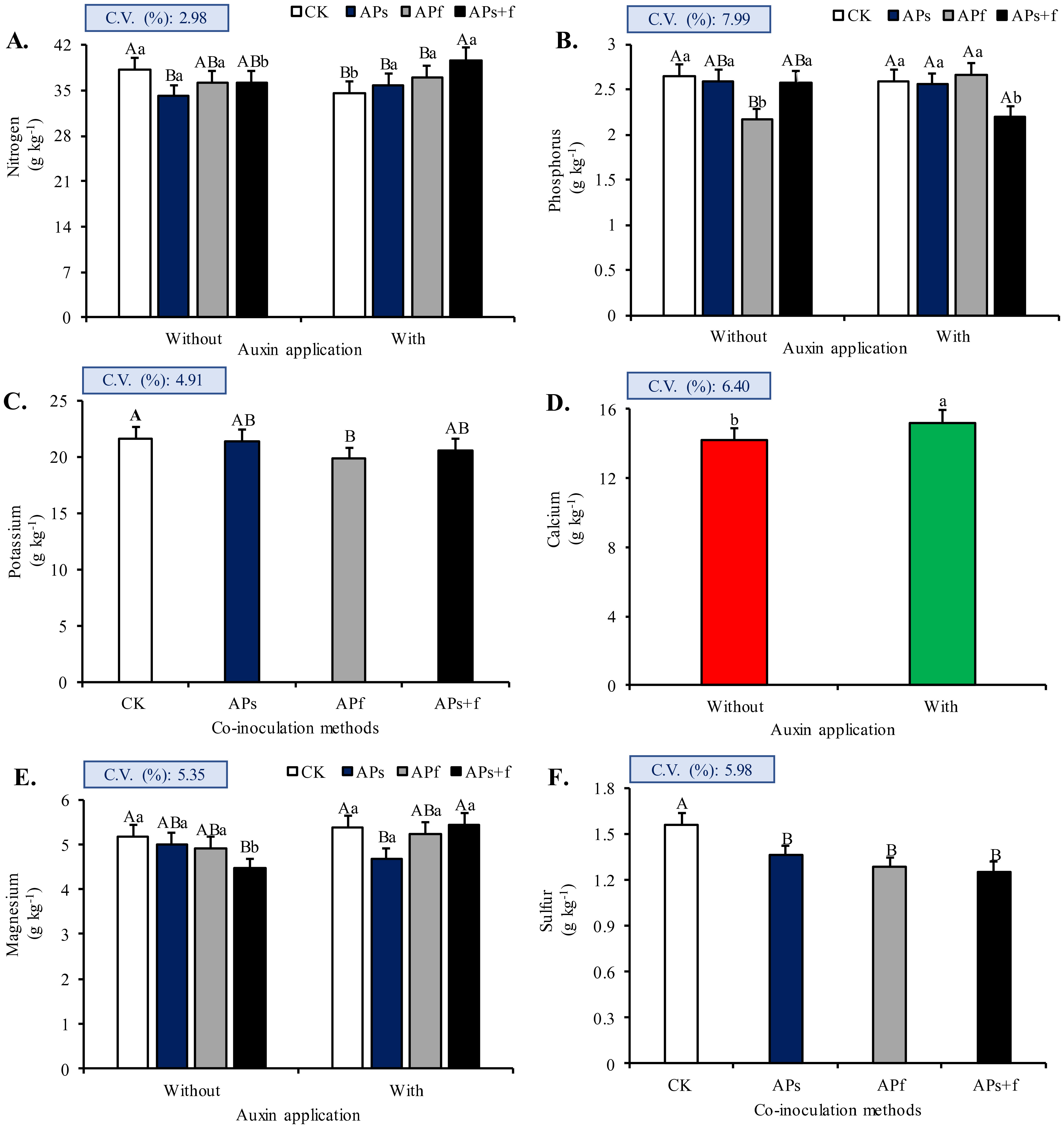
The N, P and Mg contents were influenced by interaction of co-inoculation methods and auxin application (Figure 6). K and S contents were influenced by the isolated effect of co-inoculation methods, while Ca was influenced by auxin application. The highest N content (39.65 g kg–1) in plants co-inoculated with APs+f and auxin, differing statistically from other methods (Figure 6A), while without auxin, CK plants showed highest value (38.16 g kg–1), differing only from those observed in plants with APs.

Total content of nitrogen (A), phosphorus (B), potassium (C), calcium (D), magnesium (E), and sulfur (F) in soybean leaves cultivated in function of co-inoculation methods with Azospirillum brasilense + Pseudomonas fluorescens, without or with auxin application, at 49 days after sowing. Capital letters compare the effects of co-inoculation methods by Tukey test (p ≤ 0.05) and lowercase letters compare effect of foliar auxin application by F test (p ≤ 0.05), both ± standard error. CK: without co-inoculation, APs: co-inoculation via seed, APf: co-inoculation via foliar, and APs+f: co-inoculation via seed + via foliar.
In splitting, CK and APs+f plants showed higher N values without and with auxin, respectively. Regarding P content, with auxin there was no difference between the co-inoculation methods, but without auxin the highest value (2.64 g kg–1) occurred in CK plants, differing from plants with APf (Figure 6B).
For K, the highest value (21.57 g kg–1) in CK plants, differing only from APf, which presented a lower value (19.84 g kg–1) (Figure 6C). Ca was higher (15.21 g kg–1) in plants with auxin (Figure 6D). Mg contents were higher (5.36 and 5.43 g kg–1) in CK and APs+f plants with auxin, respectively, differing from plants with APs (Figure 6E), while without auxin CK plants showed higher values (5.16 g kg–1), differing from plants with APs+f. The S content was higher (1.55 g kg–1) in CK plants, differing from other co-inoculation methods (Figure 6F). The descending order of nutritional requirement was N > K > Ca > Mg > P > S.
PGPB have a broad capacity to fix N atmospheric and make it available to plants. Among the species Azospirillum, Pseudomonas, and Bradyrhizobium stand out (Ferreira et al., 2020; Nagpal et al., 2021; Saini et al., 2023), same ones used in our study. Therefore, we verified that co-inoculation contributed to the fixation and subsequent N assimilation, a fact reinforced in our study with the increase in N in plants co-inoculated with APs+f, especially with auxin, which explains the higher values observed, especially for gas exchange.
We associated the behavior of N in plants and its fixation by bacteria with the results of A and A/Ci obtained in our study, since the association of co-inoculation methods with APs+f corroborated greater N fixation, as observed in our study, reinforcing its role as supplement in the mineral nutrition of plants, improving CO2 carboxylation and yield of photosynthesis at 36, 40, and 44 DAS. According to Lopes et al. (2018) and Boleta et al. (2020) observed that inoculation of P. fluorescens and A. brasilense favored the increase in N content in Brachiaria brizantha and Triticum spp., respectively, similarly at observed in our study with soybean.
The increase in N in the tissue contributes positively to the synthesis of proteins that participate in the development of the light assimilation complex and in carboxylation reactions (Evans and Clarke, 2019), a response observed especially with PGPB. In study, Yamori et al. (2011) investigated in some plant species such as Oryza sativa L., Triticum aestivum L., Spinacia oleracea L. and Nicotiana tabacum L., and observed that as the N content increased in leaf, there was an increase in the chlorophyll content and RuBisCO activity.
The P content can be explained by the greater uptake of nutrient by the roots with the APf together with auxin, since when auxin was applied there was greater root growth, consequently greater exploration of the rhizosphere area and nutrients uptake. Conversely, without auxin, APf was less efficient in terms of foliar P accumulation.
P. fluorescens is capable of solubilizing P, but when applied via foliar application, there are no reports in the literature about the transport of bacteria to the root of plant where it would effectively carry out its activity. We suggest that the association of the APs+f co-inoculation method together with the application of auxin leads to an imbalance of the hormone in the plant, resulting in a lower efficiency of the phosphorus uptake pathways, an aspect observed in our study.
CK plants was sufficient to increase the K content in leaves, since in the literature this inoculation has shown a promising role in increasing K in plants, with no such effective participation of other microorganisms in this condition when in the presence of Bradyrhizobium spp. Jabborova et al. (2021) observed that when performing a single inoculation with Bradyrhizobium spp. in soybean, there was an increase in potassium content both under normal growing conditions and under stress.
Auxin promotes greater Ca uptake in soybean leaves, an aspect observed in our study, because its action is evidenced as an inducer of Ca2+ signals (Vanneste and Friml, 2013), which resulted in biomass accumulation. The responses of Mg in soybean leaves were the same as those of N, proving that A. brasilense and P. fluorescens also have a good capacity to provide magnesium to soybean plants.
It is noteworthy that only with Bradyrhizobium (CK) the best result in nodule dry mass is associated with increased S in this same condition. S participates in the transport in the symbiosome membrane and symbiotic regeneration of the nodule protein, contributing to symbiotic functionality and boosting N fixation (Becana et al., 2018; Hu et al., 2023; Siegl et al., 2024).
Plants that received the auxin application showed greater development of shoot, where in all co-inoculation methods, the plants had darker green color and higher leaf area compared to the other plants without auxin (Figure 7).

Visual aspect of the development of soybean plants in function of co-inoculation methods of Azospirillum brasilense + Pseudomonas fluorescens, without or with auxin application, at 49 days after sowing. CK: without co-inoculation, APs: co-inoculation via seed, APf: co-inoculation via foliar and APs+f: co-inoculation via seed + via foliar.
We observed that the highest numbers of pods total in the experiment were observed in plants co-inoculated with APf and APs+f, especially compared with APs, regardless of auxin application (Table 2). Conversely, without auxin the number of pods was higher compared to those that received the phytohormone under same conditions.
Characterization of total number of pods in soybean plants cultivated in function to co-inoculation methods of Azospirillum brasilense + Pseudomonas fluorescens without or with foliar application of auxin, at 49 days after sowing.
We believe that the increase in the total number of pods may be associated with plant growth–promoting effects related to phytohormonal modulation and improved nutrient availability, rather than a direct causal effect of auxin alone. PGPB are known to influence hormonal balance and plant development, which may contribute to accelerated crop development and, consequently, a higher number of pods. In agreement with our results, Rego et al. (2018) reported an increase in the number of pods in soybean co-inoculated with Azospirillum brasilense. Similarly, Sulewska et al. (2019) observed an increase in the total number of pods in Lupinus albus L. when co-inoculated with Pseudomonas fluorescens.
Auxin is involved in stimulating root growth and development (Roychoudhry and Kepinski, 2022), which facilitates greater nutrient uptake through greater exploration of the rhizosphere area. However, when we do not apply auxin, we have proven that Bradyrhizobium has good efficiency in biological nitrogen fixation, as already reported in literature, but when hormone is applied, it has a potentiating effect together with other microorganisms.
From our study it was possible to verify that both the PGPB co-inoculation methods, as well as the application of exogenous auxin are promising practices for improving photosynthetic metabolism, nutritional status, and increasing biomass in soybean plants, resulting in greater numbers of pods. In future perspectives, we suggest new studies directed at the activity of antioxidant metabolism in the plant, aiming to understand the interaction between the plant and PGPB via the leaves. In addition, it is important to conduct experiments that consider the final stage of the crop cycle in order to verify productivity analysis.
4. Conclusions
Foliar application of auxin and co-inoculation of Azospirillum brasilense + Pseudomonas fluorescens, particularly via seed + foliar application, enhanced photosynthetic performance, mineral metabolism, and overall development of soybean plants. Auxin application promoted plant growth, biomass accumulation, and nodulation, while co-inoculation with A. brasilense + P. fluorescens, regardless of auxin, improved photochemical efficiency and gas exchange parameters. Although foliar co-inoculation resulted in lower chlorophyll a fluorescence indicator, this response was associated with compensatory physiological adjustments that favored increased gas exchange efficiency.
From an agronomic perspective, these results indicate that the combined use of PGPB, especially through integrated seed and foliar application strategies, represents a promising tool to enhance soybean physiological performance and crop establishment. Such practices may contribute to more efficient resource use and improved plant development under field conditions, reinforcing their potential applicability in sustainable soybean production systems.
Acknowledgements
The authors thank Coordenação de Aperfeiçoamento de Pessoal de Nível Superior (CAPES) and Conselho Nacional de Desenvolvimento Científico e Tecnológico (CNPq), for granting the scholarships, and the Fundação de Apoio ao Desenvolvimento do Ensino, Ciência e Tecnologia do Estado de Mato Grosso do Sul (FUNDECT), for financial support.
Data Availability Statement
The entire data set that supports the results of this study was published in the article itself.
References
-
BARBOSA, J.Z., ROBERTO, L.A., HUNGRIA, M., CORRÊA, R.S., MAGRI, E. and CORREIA, T.D., 2022. Meta-analysis of maize responses to Azospirillum brasilense inoculation in Brazil: benefits and lessons to improve inoculation efficiency. Applied Soil Ecology, vol. 170, pp. e104276. http://doi.org/10.1016/j.apsoil.2021.104276
» http://doi.org/10.1016/j.apsoil.2021.104276 -
BECANA, M., WIENKOOP, S. and MATAMOROS, M.A., 2018. Sulfur transport and metabolism in legume root nodules. Frontiers in Plant Science, vol. 9, pp. 1434. http://doi.org/10.3389/fpls.2018.01434 PMid:30364181.
» http://doi.org/10.3389/fpls.2018.01434 -
BOLETA, E.H.M., GALINDO, F.V., JALAL, A., SANTINI, J.M.K., RODRIGUES, W.L., LIMA, B.H., ARF, O., SILVA, M.R., BUZETTI, S. and TEIXEIRA FILHO, M.C.M.T., 2020. Inoculation with growth-promoting bacteria Azospirillum brasilense and its effects on productivity and nutritional accumulation of wheat cultivars. Frontiers in Sustainable Food Systems, vol. 4, pp. e607262. http://doi.org/10.3389/fsufs.2020.607262
» http://doi.org/10.3389/fsufs.2020.607262 -
CASSÁN, F., CONIGLIO, A., LÓPEZ, G., MOLINA, R., NIEVAS, S., CARLAN, C.L.N., DONADIO, F., TORRES, D., ROSAS, S., PEDROSA, F.O., SOUZA, E., ZORITA, M.D., BASHAN, L. and MORA, V., 2020. Everything you must know about Azospirillum and its impact on agriculture and beyond. Biology and Fertility of Soils, vol. 56, no. 4, pp. 461-479. http://doi.org/10.1007/s00374-020-01463-y
» http://doi.org/10.1007/s00374-020-01463-y -
DIAS, A.S. and SANTOS, C.C., 2022. Bactérias promotoras de crescimento de plantas: conceitos e potencial de uso. Editora Pantanal, vol. 98p. http://doi.org/10.46420/9786581460631
» http://doi.org/10.46420/9786581460631 -
EVANS, J.R. and CLARKE, V.C., 2019. The nitrogen cost of photosynthesis. Journal of Experimental Botany, vol. 70, no. 1, pp. 7-15. http://doi.org/10.1093/jxb/ery366 PMid:30357381.
» http://doi.org/10.1093/jxb/ery366 -
FENG, Z., ZHAO, J., NIE, M., QU, F., LI, X. and WANG, J., 2023. Effects of exogenous auxin on yield in foxtail millet (Setaria italica L.) when applied at the grain-filling stage. Frontiers in Plant Science, vol. 13, pp. 1019152. http://doi.org/10.3389/fpls.2022.1019152 PMid:36684766.
» http://doi.org/10.3389/fpls.2022.1019152 -
FERREIRA, L.L., MOREIRA, N.V., CARVALHO, I.R., SANTOS, N.S.C., FERNANDES, M.S., PEREIRA, A.I.A., CURVÊLO, C.R.S., SILVA, R.V., AMARAL, U. and SILVA, R.A., 2020. Spacing between rows of soybean genotypes: averages, regressions and correlations in yield levels. Research. Social Development, vol. 9, pp. e952997793. http://doi.org/10.33448/rsd-v9i9.7793
» http://doi.org/10.33448/rsd-v9i9.7793 -
FRANKS, P.J., ADAMS, T.W.D., HARPER, Z.J.B. and GRAY, J.E., 2015. Increasing water‐use efficiency directly through genetic manipulation of stomatal density. The New Phytologist, vol. 207, no. 1, pp. 188-195. http://doi.org/10.1111/nph.13347 PMid:25754246.
» http://doi.org/10.1111/nph.13347 -
FUKAMI, J., CEREZINI, P. and HUNGRIA, M., 2018. Azospirillum: benefits that go far beyond biological nitrogen fixation. AMB Express, vol. 8, no. 1, pp. 73. http://doi.org/10.1186/s13568-018-0608-1 PMid:29728787.
» http://doi.org/10.1186/s13568-018-0608-1 -
HU, Y., CHEN, Y., YANG, X., DENG, L. and LU, X., 2023. Enhancing soybean yield: the synergy of sulfur and rhizobia inoculation. Plants, vol. 12, no. 22, pp. e13911. http://doi.org/10.3390/plants12223911 PMid:38005808.
» http://doi.org/10.3390/plants12223911 -
IRIBE, A.S. and PENA, C., 2020. Auxins, the hidden player in chloroplast development. Plant Cell Reports, vol. 39, no. 12, pp. 1595-1608. http://doi.org/10.1007/s00299-020-02596-y PMid:32960306.
» http://doi.org/10.1007/s00299-020-02596-y -
JABBOROVA, D., KANNEPALLI, A., DAVRANOV, K., NARIMANOV, A., ENAKIEV, Y., SYED, A., ELGORBAN, E.A.M., BAHKALI, A.H., WIRTH, S., SAYYED, R.Z. and GAFUR, A., 2021. Co-inoculation of rhizobacteria promotes growth, yield, and nutrient contents in soybean and improves soil enzymes and nutrients under drought conditions. Scientific Reports, vol. 11, no. 1, pp. 22081. http://doi.org/10.1038/s41598-021-01337-9 PMid:34764331.
» http://doi.org/10.1038/s41598-021-01337-9 -
KANDEL, S., POKHREL, A., SHARMA, R., RAYAMAJHI, K. and CHAUDHARY, S., 2022. Efficacy of co-inoculation of the Rhizobium and Pseudomonas in combination with chemical fertilizer on the productivity of rice under legume-based cropping system. Journal of Agriculture and Natural Resources, vol. 5, no. 1, pp. 121-129. http://doi.org/10.3126/janr.v5i1.50695
» http://doi.org/10.3126/janr.v5i1.50695 -
KOŁODZIEJCZYK, I., TOMCZYK, P. and KAŹMIERCZAK, A., 2023. Endoreplication: why are we not using its full application potential? International Journal of Molecular Sciences, vol. 24, no. 14, pp. e11859. http://doi.org/10.3390/ijms241411859 PMid:37511616.
» http://doi.org/10.3390/ijms241411859 -
LAISK, A. and LORETO, F., 1996. Determining photosynthetic parameters from leaf CO2 exchange and chlorophyll fluorescence. Ribulose-1,5-bisphosphate carboxylase/oxygenase specificity factor, dark respiration in the light, excitation distribution between photosystems, alternative electron transport rate, and mesophyll diffusion resistance. Plant Physiology, vol. 110, no. 3, pp. 903-912. http://doi.org/10.1104/pp.110.3.903 PMid:12226229.
» http://doi.org/10.1104/pp.110.3.903 -
LIN, Y., WATTS, D.B., KLOEPPER, J.W., FENG, Y. and TORBERT, H.A., 2020. Influence of plant growth-promoting rhizobacteria on corn growth under drought stress. Communications in Soil Science and Plant Analysis, vol. 51, no. 2, pp. 250-264. http://doi.org/10.1080/00103624.2019.1705329
» http://doi.org/10.1080/00103624.2019.1705329 -
LIU, L., LIN, N., LIU, X., YANG, S., WANG, W. and WAN, X., 2020. From chloroplast biogenesis to chlorophyll accumulation: the interplay of light and hormones on gene expression in Camellia sinensis cv. Shuchazao leaves. Frontiers in Plant Science, vol. 11, pp. 256. http://doi.org/10.3389/fpls.2020.00256 PMid:32218794.
» http://doi.org/10.3389/fpls.2020.00256 -
LOPES, M.J.S., DIAS FILHO, M.B., CASTRO, T.H.R., FILIPPI, M.C.C. and SILVA, G.B., 2018. Effect of Pseudomonas fluorescens and Burkholderia pyrrocinia on the growth improvement and physiological responses in Brachiaria brizantha. American Journal of Plant Sciences, vol. 9, no. 2, pp. 250-265. http://doi.org/10.4236/ajps.2018.92021
» http://doi.org/10.4236/ajps.2018.92021 - MALAVOLTA, E., VITTI, G.C. and OLIVEIRA, A.S., 1997. Avaliação do estado nutricional das plantas: princípios e aplicações Piracicaba, SP: Potafos, 319 p.
-
MEHMOOD, N., SAEED, M., ZAFARULLAH, S., HYDER, S., RIZVI, Z.F., GONDAL, A.S., JAMIL, N., IQBAL, R., ALI, B., ERCISLI, S. and KUPE, M., 2023. Multifaceted impacts of plant-beneficial Pseudomonas spp. in managing various plant diseases and crop yield improvement. ACS Omega, vol. 8, no. 25, pp. 22296-22315. http://doi.org/10.1021/acsomega.3c00870 PMid:37396244.
» http://doi.org/10.1021/acsomega.3c00870 -
MIR, A.R., SIDDIQUI, H., ALAM, P. and HAYAT, S., 2020. Foliar spray of auxin/IAA modulates photosynthesis, elemental composition, ROS localization and antioxidant machinery to promote growth of Brassica juncea. Physiology and Molecular Biology of Plants, vol. 26, no. 12, pp. 2503-2520. http://doi.org/10.1007/s12298-020-00914-y PMid:33424161.
» http://doi.org/10.1007/s12298-020-00914-y -
NAGPAL, S., SHARMA, P., SIRARI, A., KUMAWAT, K.C., WATI, L., GUPTA, S.C. and MANDAHAL, K.S., 2021. Chickpea (Cicer arietinum L.) as model legume for decoding the co-existence of Pseudomonas fluorescens and Mesorhizobium sp. as bio-fertilizer under diverse agro-climatic zones. Microbiological Research, vol. 247, pp. 126720. http://doi.org/10.1016/j.micres.2021.126720 PMid:33592359.
» http://doi.org/10.1016/j.micres.2021.126720 -
OBESO, J.R., 2002. The costs of reproduction in plants. The New Phytologist, vol. 155, no. 3, pp. 321-348. http://doi.org/10.1046/j.1469-8137.2002.00477.x PMid:33873312.
» http://doi.org/10.1046/j.1469-8137.2002.00477.x -
REGO, C.H.Q., CARDOSO, F.B., CÂNDIDO, A.C.S., TEODORO, P.E. and ALVES, C.Z., 2018. Co‐inoculation with Bradyrhizobium and Azospirillum increases yield and quality of soybean seeds. Agronomy Journal, vol. 110, no. 6, pp. 2302-2309. http://doi.org/10.2134/agronj2018.04.0278
» http://doi.org/10.2134/agronj2018.04.0278 -
ROYCHOUDHRY, S. and KEPINSKI, S., 2022. Auxin in root development. Cold Spring Harbor Perspectives in Biology, vol. 14, no. 4, pp. e039933. http://doi.org/10.1101/cshperspect.a039933 PMid:34312248.
» http://doi.org/10.1101/cshperspect.a039933 -
SAINI, S., LOHANI, S., KHATI, P. and RANI, V., 2023. PGPR-mediated mitigation of biotic and abiotic stress in plants. In: S. GANGOLA, S. KUMAR, S. JOSHI and P. BHATT, eds. Advanced microbial technology for sustainable agriculture and environment. Cambridge, MA: Academic Press, pp. 199-227. http://doi.org/10.1016/B978-0-323-95090-9.00013-3
» http://doi.org/10.1016/B978-0-323-95090-9.00013-3 -
SHAHZAD, K., SIDDIQI, E.H., AHMAD, S., ZEB, U., MUHAMMAD, I., KHAN, H., ZHAO, G.F. and LI, Z.H., 2022. Exogenous application of indole-3-acetic acid to ameliorate salt induced harmful effects on four eggplants (Solanum melongena L.) varieties. Scientia Horticulturae, vol. 292, pp. e110662. http://doi.org/10.1016/j.scienta.2021.110662
» http://doi.org/10.1016/j.scienta.2021.110662 -
SIEGL, A., AFJEHI-SADAT, L. and WIENKOOP, S., 2024. Systemic long-distance sulfur transport and its role in symbiotic root nodule protein turnover. Journal of Plant Physiology, vol. 297, pp. 154260. http://doi.org/10.1016/j.jplph.2024.154260 PMid:38701679.
» http://doi.org/10.1016/j.jplph.2024.154260 -
SULEWSKA, H., RATAJCZAK, K., NIEWIADOMSKA, A. and PANASIEWICZ, K., 2019. The use of microorganisms as bio-fertilizers in the cultivation of white lupine. Open Chemistry, vol. 17, no. 1, pp. 813-822. http://doi.org/10.1515/chem-2019-0089
» http://doi.org/10.1515/chem-2019-0089 -
TALUKDAR, M., SWAIN, D.K. and BHADORIA, P.B.S., 2022. Effect of IAA and BAP application in varying concentration on seed yield and oil quality of Guizotia abyssinica (Lf) Cass. Annals of Agricultural Science, vol. 67, no. 1, pp. 15-23. http://doi.org/10.1016/j.aoas.2022.02.002
» http://doi.org/10.1016/j.aoas.2022.02.002 -
TU, T., GAO, Z., LI, L., CHEN, J., YE, K., XU, T., MAI, S., HAN, Q., CHEN, C., WU, S., DONG, Y., CHEN, J., HUANG, L., GUAN, Y., XIE, F. and CHEN, X., 2024. Soybean symbiotic-nodule zonation and cell differentiation are defined by NIN2 signaling and GH3-dependent auxin homeostasis. Developmental Cell, vol. 59, no. 16, pp. 2254-2269.e6. http://doi.org/10.1016/j.devcel.2024.07.001 PMid:39053471.
» http://doi.org/10.1016/j.devcel.2024.07.001 -
VANNESTE, S. and FRIML, J., 2013. Calcium: the missing link in auxin action. Plants, vol. 2, no. 4, pp. 650-675. http://doi.org/10.3390/plants2040650 PMid:27137397.
» http://doi.org/10.3390/plants2040650 -
VELANDIA, K., REID, J.B. and FOO, E., 2022. Right time, right place: the dynamic role of hormones in rhizobial infection and nodulation of legumes. Plant Communications, vol. 3, no. 5, pp. 100327. http://doi.org/10.1016/j.xplc.2022.100327 PMid:35605199.
» http://doi.org/10.1016/j.xplc.2022.100327 -
WU, W., DU, K., KANG, X. and WEI, H., 2021. The diverse roles of cytokinins in regulating leaf development. Horticulture Research, vol. 8, no. 1, pp. 118. http://doi.org/10.1038/s41438-021-00558-3 PMid:34059666.
» http://doi.org/10.1038/s41438-021-00558-3 -
YAASHIKAA, P.R., KUMAR, P.S., VARJANI, S., TAMILSELVI, S. and SARAVANAN, A., 2020. Formulation and combinatorial effect of Pseudomonas fluorescens and Bacillus coagulans as biocontrol agents. Biocatalysis and Agricultural Biotechnology, vol. 30, pp. e101868. http://doi.org/10.1016/j.bcab.2020.101868
» http://doi.org/10.1016/j.bcab.2020.101868 -
YAMORI, W., NAGAI, T. and MAKINO, A., 2011. The rate‐limiting step for CO2 assimilation at different temperatures is influenced by the leaf nitrogen content in several C3 crop species. Plant, Cell & Environment, vol. 34, no. 5, pp. 764-777. http://doi.org/10.1111/j.1365-3040.2011.02280.x PMid:21241332.
» http://doi.org/10.1111/j.1365-3040.2011.02280.x -
YUAN, Y., MEI, L., WU, M., WEI, W., SHAN, W., GONG, Z., ZHANG, Q., YANG, F., YAN, F., ZHANG, Q., LUO, Y., XU, X., ZHANG, W., MIAO, M., LU, W., LI, Z. and DENG, W., 2018. SlARF10, an auxin response factor, is involved in chlorophyll and sugar accumulation during tomato fruit development. Journal of Experimental Botany, vol. 69, no. 22, pp. 5507-5518. http://doi.org/10.1093/jxb/ery328 PMid:30219898.
» http://doi.org/10.1093/jxb/ery328 -
YUAN, Y., XU, X., GONG, Z., TANG, Y., WU, M., YAN, F., ZHANG, X., ZHANG, Q., YANG, F., HU, X., YANG, Q., LUO, Y., MEI, L., ZHANG, W., JIANG, C.Z., LU, W., LI, Z. and DENG, W., 2019. Auxin response factor 6A regulates photosynthesis, sugar accumulation, and fruit development in tomato. Horticulture Research, vol. 6, no. 1, pp. 85. http://doi.org/10.1038/s41438-019-0167-x PMid:31645946.
» http://doi.org/10.1038/s41438-019-0167-x -
ZAREI, T., MORADI, A., KAZEMEINI, S.A., FARAJEE, H. and YADAVI, A., 2019. Improving sweet corn (Zea mays L. var saccharata) growth and yield using Pseudomonas fluorescens inoculation under varied watering regimes. Agricultural Water Management, vol. 226, pp. e105757. http://doi.org/10.1016/j.agwat.2019.105757
» http://doi.org/10.1016/j.agwat.2019.105757 -
ZHANG, M., GAO, C., XU, L., NIU, L., LIU, Q., HUANG, Y., LV, G., YANG, H. and LI, M., 2022. Melatonin and indole-3-acetic acid synergistically regulate plant growth and stress resistance. Cells, vol. 11, no. 20, pp. e3250. http://doi.org/10.3390/cells11203250 PMid:36291118.
» http://doi.org/10.3390/cells11203250
Edited by
-
Editor:
Takako Matsumura Tundisi