 Association between environmental conservation status and the abundance phlebotomine sand flies (Diptera: Psychodidae) in Northeastern Brazil
Abstract
Leishmaniasis is a vector-borne disease transmitted by sand flies bites and is highly endemic in Brazil. This study evaluated the presence and abundance of sand flies in managed (clean) and unmanaged (dirty) peridomestic environments associated with domestic animal shelters. The study was conducted in two sampling areas in the municipality of Caxias, Maranhão, Brazil: one rural area (Bom Jardim) and one urban area (Salobro). In each area, eight peridomiciles (N = 16) with active domestic animal shelters were selected, including four households with managed yards and four with unmanaged yards. Sand flies were collected monthly over a two-year period (24 months) using CDC-type light traps installed in animal shelters within the peridomiciles. A total of 11,252 sand flies were collected, with a higher relative abundance in the urban area (73%; N = 8,174) compared to the rural area (27%; N = 3,078). In both areas, sand flies abundance was higher in managed peridomiciles, accounting for 85% of specimens in the urban area and 55% in the rural area, with a predominance of vector species Lutzomyia longipalpis with (87.39%) and Nyssomyia whitmani with (10.02%). The results indicate that, regardless of peridomicile management, sand flies vectors were abundant, highlighting the presence of domestic animals as a key factor in attracting these insects.
Keywords:
endemic diseases; leishmaniasis; sand flies; yard cleanings
Resumo
A leishmaniose é uma doença transmitida por vetores por meio da picada de flebotomíneos e é altamente endêmica no Brasil. Este estudo avaliou a presença e a abundância de flebotomíneos em quintais limpos (manejados) e sujos (não manejados) de ambientes peridomiciliares com a presença de abrigos de animais domésticos. O estudo foi conduzido em duas áreas amostrais localizadas no município de Caxias, Maranhão, Brasil: uma área rural (Bom Jardim) e uma área urbana (Salobro). Em cada área, foram selecionados oito peridomicílios (N = 16) com abrigos ativos de animais domésticos, sendo quatro residências com quintais manejados e quatro com quintais não manejados. As coletas de flebotomíneos foram realizadas mensalmente ao longo de dois anos (24 meses), utilizando armadilhas luminosas do tipo CDC instaladas nos abrigos de animais dos peridomicílios. Foram coletados 11.252 flebotomíneos, com maior abundância relativa na área urbana (73%; N = 8.174) em comparação à área rural (27%; N = 3.078). Em ambas as áreas, a abundância relativa foi maior nos ambientes manejados, correspondendo a 85% na área urbana e 55% na área rural, com predominância das espécies vetoras Lutzomyia longipalpis com (87,39%) e Nyssomyia whitmani com (10,02%). Os resultados indicam que, independentemente do manejo do peridomicílio, houve elevada presença de flebotomíneos vetores, evidenciando que a presença de animais domésticos desempenha papel fundamental na atração desses insetos.
Palavras-chave:
doenças endêmicas; leishmanioses; flebotomíneos; manejo de quintais
1. Introduction
Leishmaniasis comprises a complex of neglected tropical diseases caused by protozoan parasites of the genus Leishmania (Kinetoplastida, Trypanosomatidae), transmitted to humans and other animals through the bites of infected female sand flies (Diptera, Psychodidae) (Maroli et al., 2013; Cecílio et al., 2022; WHO, 2026). Phlebotomine sand flies are small dipterans belonging to the family Psychodidae and are widely distributed in tropical and subtropical regions worldwide. Females exhibit hematophagous behavior, and several species obtain blood meals from a wide range of vertebrate hosts, including domestic dogs and humans (Young and Duran, 1994; OPS, 2024).
Some sand flies species are capable of transmitting pathogens to vertebrate hosts (Costa and Souza, 2018). Among these pathogens are protozoan parasites of the genus Leishmania Ross, 1903 (Ward and Friaha, 1977), bacteria of the genus Bartonella Barton, 1909 (Schultz, 1968), and several arboviruses (Tesh et al., 1974; Romero-Ricardo et al., 2025; Maroli et al., 2013). Sand flies play a central role in the epidemiology of leishmaniasis, highlighting the need for continuous monitoring and effective control strategies targeting these insects (Gaglio et al., 2018).
In the American continent, leishmaniasis presents two main clinical forms: cutaneous leishmaniasis (CL), the most common manifestation, and visceral leishmaniasis (VL), also known as kala-azar, which is the most severe form of the disease and may be fatal if left untreated, in more than 95% of cases if untreated (WHO, 2024) In addition, canine leishmaniasis affects domestic dogs, the main reservoir of Leishmania (Leishmania) infantum (WHO, 2026).
Cutaneous leishmaniasis exhibits a range of clinical manifestations in humans, including localized cutaneous leishmaniasis, diffuse cutaneous leishmaniasis, and mucocutaneous leishmaniasis. Visceral leishmaniasis is a systemic disease that primarily affects the spleen, liver, and bone marrow, but may also involve the lungs, intestines, and lymph nodes, often leading to death when diagnosis and treatment are delayed (OPS, 2023).
In Brazil, leishmaniasis has a high epidemiological burden, with a predominance of the cutaneous form. Over the last 12 years, a higher concentration of cases has been observed in the North and Northeast regions, considered endemic areas for the disease (Rego et al., 2023; Brasil, 2014, 2017, 2026). The state of Maranhão is considered endemic, and during the research period from 2013 to 2015, 173 cases of leishmaniasis, 108 cases of visceral leishmaniasis (VL), and 65 cases of cutaneous leishmaniasis were recorded. To this day, the state remains one of the most endemic in the Northeast region (Brasil, 2026). The municipality of Caxias is considered endemic, with annual records of cases of visceral leishmaniasis (VL) and cutaneous leishmaniasis (CL). During this study, 132 cases of leishmaniasis were recorded, with 96 cases of visceral leishmaniasis and 36 cases of cutaneous leishmaniasis, and the number of cases currently remains the same (Maranhão, 2015a, b, 2026a, 2026b).
Sand flies are traditionally associated with forested environments, the expansion of leishmaniasis in recent decades has been strongly linked to environmental changes such as land occupation, deforestation, urban expansion, climatic factors and socioeconomic determinants (Rebêlo et al., 2019; Carvalho et al., 2020). These processes increase human exposure to vectors and favor the adaptation of certain sand flies species to rural and peri-urban peridomestic environments (Cruz et al., 2026; Dias et al., 2026; Guimarães-e-Silva et al., 2017; Pereira-Filho et al., 2018; Rebêlo et al., 2019). This scenario has contributed to changes in the epidemiological profile of leishmaniasis, which is increasingly transmitted in these modified environments (Abrantes et al., 2018; Garcia et al., 2025).
The distribution of CL is strongly associated with the environmental suitability of Nyssomyia whitmani (Antunes and Coutinho, 1939). The climatic and vegetation cover variables exert a direct influence on the presence of the vector, with a significant overlap observed between environmentally favorable areas and regions where the disease occurs (Costa et al., 2018). VL presents a distribution pattern strongly associated with environmental and structural conditions, especially inadequate basic sanitation, poor solid waste management, and deforestation processes (Araújo et al., 2025).
Sand flies are a primary target of leishmaniasis control programs implemented by public health agencies, but the control strategies vary according to the clinical form. For visceral leishmaniasis, recommended actions include periodic cleaning of yards and removal of decomposing organic matter, appropriate disposal of organic waste, sanitation of domestic animal shelters, and chemical control using insecticides applied to household walls and animal shelters. In recent years, the use of impregnated collars on dogs has grown, following recommendations from the ministry. For CL, the Ministry of Health emphasizes personal protective measures, such as the use of repellents and avoidance of exposure during peak vector activity periods (dusk and night), particularly in endemic environments (Amora et al., 2006; Romero and Boelaert, 2010; Brasil, 2010, 2014, 2017; Coura-Vital et al., 2018).
Therefore, more sustainable and complementary measures are recommended, such as environmental management through the cleaning of peridomiciles, vacant lots, and public spaces, aiming to alter environmental conditions that favor the establishment of breeding sites for immature vector stages (Brasil, 2014). In this context, the present study aimed to assess sand flies density in managed (clean) and unmanaged (dirty) peridomestic environments associated with domestic animal shelters in urban and rural areas with transmission of cutaneous and visceral leishmaniasis.
2. Material and Methods
2.1. Study area
The study was conducted in the municipality of Caxias (04°51’32” S, 43°21’22” W), located in the eastern mesoregion of the state of Maranhão, northeastern Brazil. Caxias covers an area of approximately 5,150.67 km2 and has an estimated population of 164,880 inhabitants (IBGE, 2024) (Figure 1). The municipality comprises both urban and rural areas, with approximately 76% of the population residing in the urban zone (Pereira et al., 2021).

Location of sandfly sampling points where traps were installed in the Salobro I neighborhood and Bom Jardim II location, Caxias, Maranhão, Brazil.
The local climate is classified as hot semi-humid to semi-arid, corresponding to the Aw and As categories of the Köppen climate classification. The region exhibits a well-defined rainy season from January to June, with an average temperature of 26.1 °C, and a dry season from July to December, during which average temperatures reach 35.6 °C. The vegetation is predominantly characteristic of the Brazilian savanna (Cerrado) biome (Maranhão, 2002).
This study is characterized as a non-interventional observational study, based on a comparative analysis of the fauna between two types of areas: a rural area and an urban area. A rural area located in the second district, represented by the Bom Jardim region (05°02’23” S, 43°18’02” W), and an urban area located in the municipal headquarters, represented by the Salobro region (04°53’05” S, 43°22’18” W). Both areas are considered endemic, with annual notifications of autochthonous cases of visceral and cutaneous leishmaniasis (Brasil, 2010).
Peridomestic environments were defined as areas surrounding households, including backyards and adjacent spaces, comprising permanent and temporary structures, accumulated materials, fences delimiting household boundaries, and shelters for domestic animals raised for subsistence or commercial purposes (e.g., chickens, pigs, cattle, and poultry), as well as pets (dogs, cats, horses) and synanthropic animals (e.g., rodents, non-human primates, bats, among others).
2.2. Characterization of peridomiciles
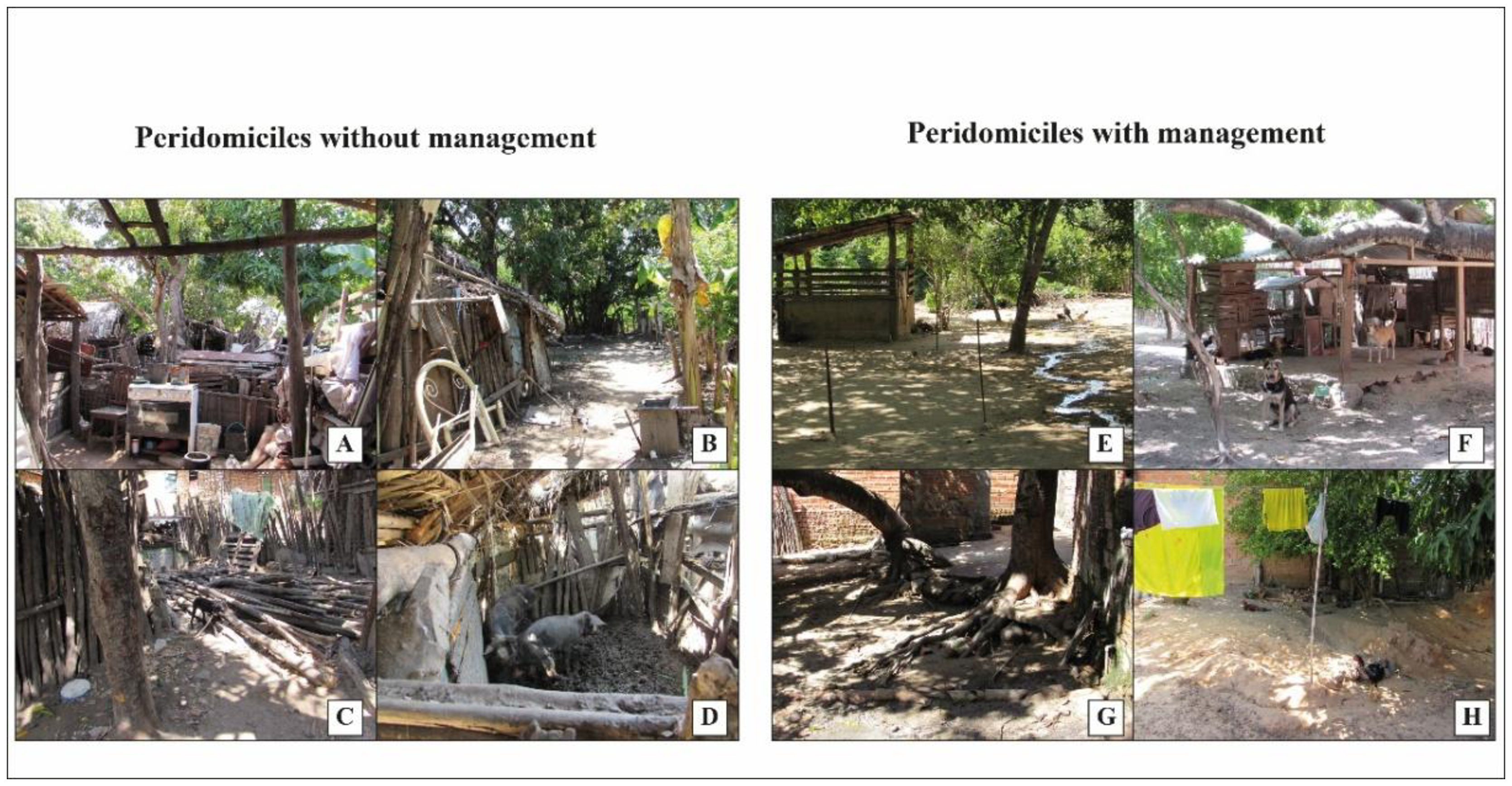
The Salobro neighborhood (urban area) is located along the margins of the BR-316 highway and comprises 963 households, with an estimated population of 2,383 inhabitants. The area is crossed by the Salobro stream and contains patches of vegetation. In this area, the peridomestic environments classified as unmanaged (dirty) are highlighted in Figures 2AD and Figures 2EH (Table 1).

Peridomestic environments with and without management in the urban area (Salobro). (A-D) Unmanaged peridomiciles: (A, B) presence of debris, vegetation, and a dog; (C) accumulation of wood in a shaded area with a dog; (D) pig rearing in a pigsty. (E-H) Managed peridomiciles: (E) presence of chickens and open sewage; (F) presence of a dog and vegetation; (G, H) rocky area with the presence of chickens and vegetation in shaded conditions. Source: A.S. Guimarães-e-Silva, 2015.
Checklist of sand fly species collected using CDC-traps between March 2013 and February 2015 in rural and urban areas of the municipality of Caxias, Maranhão State, Brazil.
Managed (clean) peridomestic environments were defined as those in which animal shelters, such as pigpens, were regularly sanitized through the removal of waste and daily washing of cement-based structures, in addition to the proper management and removal of accumulated household garbage (Figures 2EH) (Table 1).
The Bom Jardim village (rural area) is located approximately 23 km from the urban center of Caxias and is crossed by the Poraquê stream. The village comprises 103 households, with an estimated population of 256 inhabitants, and agriculture represents the main source of income for local residents (LEI MUNICIPAL Nº 1838/2009; Sousa et al., 2015). The area exhibits degradation of native vegetation resulting from human activities associated with subsistence farming.
The village is characterized by the rearing of pigs, chickens, and cattle, as well as the presence of domestic animals such as horses and dogs. Peridomestic environments in this rural area are spatially larger and more densely vegetated, often located near remnant forest fragments, when compared to those in the urban area. In this area, both unmanaged (dirty) peridomestic environments (Figures 3AD) and managed (clean) peridomestic environments (Figures 3EH) were selected for the study (Table 1).

Peridomestic environments with and without management in the rural area (Bom Jardim village). (A-D) Unmanaged peridomiciles: (A) deactivated and abandoned outbuilding; (B) seedbed surrounded by vegetation; (C) presence of debris, chickens, and dense surrounding vegetation; (D) oven house with surrounding vegetation and presence of chickens. (E-H) Managed peridomiciles: (E) presence of potted plants and seedbeds; (F) pigsty with surrounding vegetation; (G) chicken coop; (H) shaded area with trees and a deactivated outbuilding. Source: A.S. Guimarães-e-Silva, 2015.
The local population maintains the practice of rearing domestic animals, including chickens, horses, and pigs. For sand flies sampling, in both rural and urban areas, eight peridomiciles containing active animal shelters (chicken coops and pigpens) were selected. These included four managed (clean) peridomiciles, designated I-IV, and four unmanaged (dirty) peridomiciles, designated V-VIII (Table 2).
Sand flies collected using CDC - traps installed in domestic animal shelters in managed (clean) and unmanaged (dirty) peridomiciliary environments in the urban area (Salobro) and rural area (Bom Jardim) of the municipality of Caxias, Maranhão State, Brazil.
In both study areas, the cleaning of animal shelters followed similar routines. Overall, chicken coops were cleaned once per month, with the removal of accumulated feces and organic material. In contrast, pigsties with cement floors were cleaned daily, involving the removal of feces followed by washing with soap and water.
2.3. Ethics statement
The collection of sand flies was approved by the Instituto Chico Mendes de Conservação da Biodiversidade Permission (Nº. 46319-1).
2.4. Sand fly collection and identification
Sand flies collections were carried out monthly over two consecutive years, from March 2013 to February 2015, in each selected peridomicile. Sampling was performed using CDC (Centers for Disease Control and Prevention) light traps powered by 6-V batteries, installed in domestic animal shelters at a height of approximately 1.5 m above ground level. Traps operated for 12 consecutive hours, from 18:00 to 06:00 h on the following day, and were always set during the new moon phase, how moonlight can reduce the efficiency of CDC light traps (Camargo et al., 2015).
The sampling effort in each area totaled 4,608 trap-hours, calculated as 8 traps × 12 h × 2 consecutive nights × 24 months.
Captured insects were transported to the Entomology Laboratory of the Zoonosis Surveillance Unit of Caxias (UVZ/Caxias) for sorting and clarification. Species identification was performed using the dichotomous keys proposed by Young and Duran (1994), following the taxonomic classification of Galati (2003), with generic abbreviations standardized according to Marcondes (2007).
Phlebotomine sand flies were captured over two years (March 2013 to February 2015), between 6:00 PM and 6:00 AM, once a month, for two consecutive nights, using CDC (Center on Disease Control) type light traps in two selected areas (rural and urban). In each area, one trap was installed 1.5 m above the ground, in peridomestic areas, specifically in domestic animal shelters (pigsty, chicken coop, or stable), located a maximum of 30 m from residences, always maintaining the same installation point. The traps were distributed across eight collection points per area, totaling 16 traps. The sampling effort corresponded to 16 traps x 12 hours x 2 nights for 24 months, totaling 9,216 hours of collection. All collection points were georeferenced using the Global Positioning System (GPS), with the consent of the residents. All specimens found were morphologically identified using the key proposed by Galati (2003).
2.5. Data analysis
Relative abundance was calculated as the percentage of individuals of each species in relation to the total number of sand flies collected, and species richness was defined as the total number of species identified in each area and environmental condition. Diversity was assessed using the Rényi diversity profile, which allows comparisons among environments across different diversity orders (α).
To evaluate differences in sand flies abundance and diversity, the effects of Area (urban vs. rural), Environmental condition (managed/clean vs. unmanaged/dirty), and the interaction between these factors were analyzed. A two-way factorial analysis of variance (ANOVA; Area × Environmental condition) was applied to test for differences in total abundance between groups. When pairwise comparisons were required (e.g., clean vs. dirty peridomiciles within the same area), Student’s t-test was used.
Differences in species composition between areas and environmental conditions were explored using Nonmetric Multidimensional Scaling (NMDS). Abundance data were converted into dissimilarity matrices using the Bray-Curtis index, and ordination was performed in two dimensions (k = 2) with 500 iterations to minimize stress.
All statistical analyses were performed using Paleontological Statistics software (version 4.03) - PAST, adopting a significance level of 5% (p < 0.05).
3. Results
Sand flies collections yielded a total of 11,252 specimens, belonging to eight genera and 16 species. The relative abundance of sand flies was higher in the urban area (72.64%) than in the rural area (27.36%); however, this difference was not statistically significant (F = 1.414; p = 0.2075). Species richness was higher in the rural area, with 13 species, compared to 11 species recorded in the urban area.
In both areas, Lutzomyia (Lutzomyia) longipalpis was the most abundant species, representing 87.39% of all captured specimens. Its dominance was particularly evident in the urban area, where it accounted for 97.87% of the specimens (N = 8,174), whereas in the rural area it showed lower relative abundance. The second most abundant species was Nyssomyia whitmani (10.02%; N = 1,128), which predominated in the rural area (33.72%; N = 1,038) (Table 1).
Regarding peridomiciliary conditions, sand flies predominated in managed (clean) environments in both the urban (55.04%; N = 8,174) and rural areas (85.02%; N = 3,078). Nevertheless, no significant differences in total abundance were detected between clean and unmanaged (dirty) peridomiciles in either the urban area (t = 0.145; p = 0.886) or the rural area (t = 0.9045; p = 0.3740) (Tables 2 and 3).
Number of domestic animals recorded in managed (clean) and unmanaged (dirty) environments in rural and urban areas of the municipality of Caxias, Maranhão State, Brazil.
In the urban area, sand flies showed relative abundance greater than 50% in pigsties under both clean (52.95%) and dirty (72.08%) conditions. Lutzomyia (L.) longipalpis was recorded in all peridomiciles (I-VIII), occurring in both clean (55.31%; N = 4,425) and dirty (44.69%; N = 3,575) environments. Nyssomyia whitmani was also captured in nearly all peridomiciles (I-VIII), except peridomicile V, and was more frequent in clean (63.33%; N = 57) than in dirty environments (36.67%; N = 33) (Table 2).
In the rural area, the highest relative abundance of sand flies in clean environments was observed in the chicken coop (56.02%; N = 2,617; peridomicile III), whereas in dirty environments the highest abundance occurred in the pigsty (42.73%; N = 461; peridomicile VIII). Both vector species, Lutzomyia (L.) longipalpis (clean: 56.63%; dirty: 76.14%) and Nyssomyia whitmani (clean: 37.87%; dirty: 10.20%), were recorded in all rural peridomiciles (I-VIII), regardless of environmental management (Table 3).
The NMDS ordination revealed a clear separation in species composition between urban and rural areas, as well as between clean and dirty peridomiciliary environments within the urban area (Figure 4). According to the Rényi diversity profile, species diversity was higher in the rural area than in the urban area, while no marked differences were observed between clean and dirty environments in either area (Figure 5).

Nonmetric Multidimensional Scaling (NMDS) ordination based on the Bray-Curtis dissimilarity matrix using relative abundance of sand fly species collected in managed (clean) and unmanaged (dirty) peridomiciliary environments in urban and rural areas of the municipality of Caxias, Maranhão State, Brazil. Urban clean environments are shown in green, urban dirty in blue, rural clean in orange, and rural dirty in red.

Rényi diversity profiles for sand fly assemblages in managed (clean) and unmanaged (dirty) peridomiciliary environments in rural and urban areas of the municipality of Caxias, Maranhão State, Brazil, from March 2013 to February 2015. Rural clean environments are shown in black, rural dirty in red, urban clean in blue, and urban dirty in green. Diversity orders are represented by α = 0 (log species richness), α = 1 (Shannon index), and α = 2 (Simpson index).
4. Discussion
Considering that the presence of domestic animals in backyards is a fundamental factor in attracting hematophagous insects (Bandeira et al., 2017; Luz-Requena et al., 2026), this study showed that the presence of domestic animal shelters in peridomestic environments of human habitation may have influenced the large number of sand flies specimens captured, including vector species, regardless of whether the environment was clean or dirty.
Furthermore, another study on management aimed at controlling the biting midge (Culicoides of the Ceratopogonidae family), also performed in Maranhão, demonstrated that environmental management practices in areas with the presence of animals do not appear to significantly influence the reduction of mosquito abundance; however, this management practice cannot be discarded and/or neglected in vector control strategies (Bandeira et al., 2017).
Our results also revealed that the relative abundance of sand flies was higher in urban areas; however, species richness was greater in the area. These results are in agreement with the literature, where these studies demonstrate that in rural areas the number of identified species is higher (Guimarães-e-Silva et al., 2017; Carvalho-Silva et al., 2022; Virgens et al., 2015), however, in urban areas, the abundance is higher, especially the abundance of vector species, as Lu. longipalpis e Ny. whitmani (Guimarães-e-Silva et al., 2017; Ribeiro-da-Silva et al., 2019; Carvalho-Silva et al., 2022). Furthermore, the relative abundance of sandflies was higher in peridomestic environments with management (clean) in both areas studied (rural and urban), where the vector Lu. longipalpis was dominant, demonstrating the high adaptation of that species to anthropized environments.
Due to the fact that this sand flies the main vector of Leishmania (Leishmania) infantum in Brazil, several studies performed over the years have focused on this vector from different regions of Brazil, including the state of Maranhão (Araújo et al., 2000; Carvalho et al., 2000; Guimarães-e-Silva et al., 2012, 2017; Penha et al., 2013; Silva et al., 2015, 2016; Pereira Filho et al., 2015; Ribeiro-da-Silva et al., 2019; Carvalho-Silva et al., 2022). Entomological surveys have shown that of all the species of sand flies found in the peridomiciles of rural and urban human residences, Lu. longipalpis always appears with an abundance higher than 50%, especially in areas of VL transmission (Rangel and Lainson, 2003; Gontijo and Melo, 2004; Ximenes et al., 2007; Conceição-Silva and Alves, 2014; Carvalho-Silva et al., 2022). This dominance is due to its ability to feed on various domestic animals, mainly dogs, chickens and synanthropic animals, such as mainly rodents and foxes, humans also included (Forattini, 1973).
The abundance of Lu. longipalpis in those anthropized environments, rural and urban, is due to the changes suffered in its natural habitat, caused by intensive deforestation, complemented by the rarefaction of the vertebrate fauna (blood hosts) and rural exodus (Andrade-de-Sousa et al., 2026). This process occurs at the same time that human population density increases in urban areas, without an improvement in health infrastructure; and, to make matters worse, rural migrants continue to raise large numbers of domestic animals on the outskirts of cities. Those conditions favor, above all, populations of Lu. longipalpis, which have demonstrated adaptability to these new environments (Madeira et al., 2003), where the presence of dogs with a high prevalence of infection by L. infantum, including in the dermis, functions as an excellent reservoir, as the dog acts as a source of infection for phlebotomine sandflies during blood feeding (Mattos Junior et al., 2004; Luvizotto et al., 2005).
It is worth noting here that the results of finding a higher abundance of sandflies in peridomiciles characterized as clean cannot be considered as absolute, since leishmaniosis is a multifactorial problem because, when carrying out analyses that associate the abundance of insects with the peridomicile, the characteristics of the residences themselves must also be considered (Calderon-Anyosa et al., 2018). In a review study, a significant association between housing characteristics (e.g., walls, roof, floors, or windows) and leishmaniosis infection or insect density was reported, displaying that housing characteristics may play a key role in insect attraction (Calderon-Anyosa et al., 2018). Here we did not make the association with the characteristics of the residences.
Ny. whitmani is recognized as a competent vector of L. (Viannia) shawi and L. (Viannia) braziliensis (Silva and Vasconcelos, 2005; Oliveira-Pereira et al., 2006; OPS, 2023). Although it occurs over several months of the year, an increase in its abundance is observed during periods of higher rainfall. Furthermore, it maintains a characteristic behavior of wild environments, as described by Barros et al. (2000) and Pinheiro et al. (2013).
However, the study of phlebotomine sand flies is extremely relevant, related to the correlation of the density of the vector with peridomestic aspects, such as the presence of vegetation, roots, tree trunks and organic matter in the soil, as these are factors that favor the proliferation of possible shelters and breeding grounds for those insects, combined with the presence of domestic animals, which are food sources for phlebotomine sand flies (Camargo-Neves et al., 2001). Other authors evaluated the impact of two techniques for controlling leishmaniosis in an endemic area, environmental management and chemical spraying, where they found that implementation of actions aimed at environmental management are more effective in controlling the vector Lu. longipalpis than chemical spraying (Oliveira Lara-Silva et al., 2017).
A research done in the metropolitan region of Belo Horizonte (Brazil) evaluated the risk factors that would be contributing to the contamination of the population by VL and indicated that the frequency and variety of domestic animals, abundant organic matter, inadequate storage of garbage, bricks and stones piled up in the yard, presence of trees and vegetable gardens are relevant characteristics for the occurrence of phlebotomine sand flies (Moreno et al., 2005). In another study, also in Belo Horizonte, it was indicated that nearness to areas of vegetation, villages, favelas and watercourses have little influence on the incidence of VL cases (Saraiva et al., 2011).
Caxias County is an area that presents endemic foci, both of TL and of human and canine VL, throughout its rural and urban territory (Guimarães-e-Silva et al., 2023). In this study, we demonstrated a diversity (16 species) and abundance (N = 11,252) of sandfly species in the peridomiciles of rural and urban areas of Caxias, with a higher relative abundance of the vectors Lu. longipalpis and Ny. whitmani, present in domestic animal shelters, especially chicken coops and pigsties.
Although we consider seasonal analyses important, it was not the objective of this manuscript to explore this type of analysis; however, we added the difference in the number of phlebotomine sand flies between the dry and rainy seasons and in the two areas. It was observed that phlebotomine sand flies were collected in both seasons; however, the overall abundance was greater in the rainy season and in the urban area, with April 2013 being the most representative month, followed by January 2015.
The abundance of phlebotomine sand flies exhibits significant seasonal variation, being directly influenced by climatic conditions, especially temperature and availability. Although these sand flies are present throughout the year, an increase in population density is observed during warmer and more humid periods, such as spring and summer, when environmental conditions favor the development of immature forms, with variations according to the characteristics of each area (Melo Nascimento et al., 2024).
5. Conclusion
We conclude that the presence of sand flies was greater in urban areas, despite no difference in abundance observed through statistical analyses, thus reducing the broad adaptation of these samples to different contexts. There was greater species richness in the rural environment, while the composition was strongly dominated by Lu. longipalpis, especially in the urban area, highlighting the role of these species in the transmission of diseases in these areas. Ny whitmani, on the other hand, showed greater representation in the rural environment, reinforcing the epidemiological importance of this species in this environment.
There was no significant association of phlebotomine sand fly predominance in managed (clean) or unmanaged environments, which shows that isolated management may not be sufficient to reduce vector density. On the other hand, the presence of animal shelters stands out in both areas, as these places are important for maintaining sand fly populations.
Acknowledgements
To the Municipal Health Department of Caxias, to the Center for Zoonosis Control-CCZ, to the Technicians of the Entomology Laboratory of the CCZ and to the Epidemiological Surveillance of the Municipality of Caxias, for their support. To the Conselho Nacional de Desenvolvimento Científico e Tecnológico (CNPq) for the productivity grant granted to JMMR.
Data Availability Statement
The entire data set that supports the results of this study was published in the article itself.
References
-
ABRANTES, T.R., WERNECK, G.L., ALMEIDA, A.S. and FIGUEIREDO, F.B., 2018. Fatores ambientais associados à ocorrência de leishmaniose visceral canina em uma área de recente introdução da doença no estado do Rio de Janeiro, Brasil. Cadernos de Saúde Pública, vol. 34, no. 1, e00021117. https://doi.org/10.1590/0102-311x00021117 PMid:29412315.
» https://doi.org/10.1590/0102-311x00021117 -
AMÓRA, S.S.A., SANTOS, M.J.P., ALVES, N.D., GONÇALVES-DA-COSTA, S.C., CALABRESE, K.S., MONTEIRO, A.J. and ROCHA, M.F.G., 2006. Fatores relacionados com a positividade de cães para leishmaniose visceral em área endêmica do estado do Rio Grande do Norte, Brasil. Ciência Rural, vol. 36, no. 6, pp. 1854-1859. https://doi.org/10.1590/S0103-84782006000600029
» https://doi.org/10.1590/S0103-84782006000600029 -
ANDRADE-DE-SOUSA, I.B., COSTA, G.B., BARBOSA, W.Z., MAGALHÃES, K.A., PUSSI, K.F., ARECO, M.A.L., CHAVES JÚNIOR, S.P., DE ALMEIDA, P.S., LIMA JUNIOR, M.S.D.C. and NEITZKE-ABREU, H.C., 2026. Characterization of sand fly (Diptera: Psychodidae: Phlebotominae) fauna and potential hosts of Leishmania in a military area of Dourados, Mato Grosso do Sul, Brazil. Journal of Medical Entomology, vol. 63, no. 1, pp. tjaf156. https://doi.org/10.1093/jme/tjaf156 PMid:41124330.
» https://doi.org/10.1093/jme/tjaf156 - ARAÚJO, J.C., REBÊLO, J.M.M., CARVALHO, M.L. and BARROS, V.L.L., 2000. Composição dos flebotomíneos (Diptera: Psychodidae) do município de Raposa, Maranhão, Brasil, área endêmica de leishmanioses. Entomología y Vectores, vol. 7, pp. 33-47.
-
ARAÚJO, Q.M.D.S., SILVA, J.R.S., DE CARVALHO, C.C.N., LIMA, P.D., SILVA, A.R.S.T., JAIN, S., DANTAS-TORRES, F., BATISTA, E.J.O., SANTOS, I.G.A. and DOLABELLA, S.S., 2025. Spatiotemporal analysis of environmental factors associated with visceral leishmaniasis in northeastern Brazil, 2007-2022. Scientific Reports, vol. 15, no. 1, pp. 25186. https://doi.org/10.1038/s41598-025-11366-3 PMid:40646247.
» https://doi.org/10.1038/s41598-025-11366-3 -
BANDEIRA, M.C.A., BRITO, G.A., PENHA, A., SANTOS, C.L.C. and REBÊLO, J.M.M., 2017. The influence of environmental management and animal shelters in vector control of Culicoides (Diptera: Ceratopogonidae) in northeastern Brazil. Journal of Vector Ecology: Journal of the Society for Vector Ecology, vol. 42, no. 1, pp. 113-119. https://doi.org/10.1111/jvec.12245 PMid:28504450.
» https://doi.org/10.1111/jvec.12245 -
BARROS, V.L., REBÊLO, J.M.M. and SILVA, F.S., 2000. Flebotomíneos (Diptera, Psychodidae) de capoeira do município do Paço do Lumiar, Estado do Maranhão, Brasil. Área endêmica de leishmanioses. Cadernos de Saúde Pública, vol. 16, no. 1, pp. 265-270. https://doi.org/10.1590/S0102-311X2000000100030 PMid:10738174.
» https://doi.org/10.1590/S0102-311X2000000100030 -
BRASIL. Ministério da Saúde. Secretaria de Vigilância em Saúde, 2010 [viewed 16 October 2025]. Manual de vigilância da Leishmaniose Tegumentar Americana [online]. Brasília: Ministério da Saúde. Available from: http://portal.saude.gov.br/opition=comcontent&id=11018&Itemid=667
» http://portal.saude.gov.br/opition=comcontent&id=11018&Itemid=667 - BRASIL. Ministério da Saúde, 2014. Manual de vigilância e controle da leishmaniose visceral. Brasília: Ministério da Saúde.
- BRASIL. Ministério da Saúde, 2017. Manual de vigilância da leishmaniose tegumentar Brasília: Ministério da Saúde.
-
BRASIL. Ministério da Saúde, 2026 [viewed 10 April 2026]. Painel epidemiológico de notificação de casos da leishmaniose visceral e cutânea [online]. Available from: https://www.gov.br/saude/pt-br
» https://www.gov.br/saude/pt-br -
CALDERON-ANYOSA, R., GALVEZ-PETZOLDT, C., GARCIA, P.J. and CARCAMO, C.P., 2018. Housing characteristics and leishmaniasis: a systematic review. The American Journal of Tropical Medicine and Hygiene, vol. 99, no. 6, pp. 1547-1554. https://doi.org/10.4269/ajtmh.18-0037 PMid:30382013.
» https://doi.org/10.4269/ajtmh.18-0037 - CAMARGO, A.J.A., OLIVEIRA, C.M., FRIZZAS, M.R., SONODA, K.C. and CORRÊA, D.C.V., 2015. Coleções entomológicas: legislação brasileira, coleta, curadoria e taxonomia para as principais ordens Brasília: Embrapa.
-
CAMARGO-NEVES, V.L.F., KATZ, G., RODAS, L.A.C., POLETTO, D.W., LAGE, L.C., SPÍNOLA, R.M.F. and CRUZ, O.G., 2001. Utilização de ferramentas de análise espacial na vigilância epidemiológica da leishmaniose visceral americana em Araçatuba, São Paulo, Brasil, 1998-1999. Cadernos de Saúde Pública, vol. 17, no. 5, pp. 1263-1267. https://doi.org/10.1590/S0102-311X2001000500026 PMid:11679900.
» https://doi.org/10.1590/S0102-311X2001000500026 -
CARVALHO, B.M., PEREZ, L.P., OLIVEIRA, B.F.A., JACOBSON, L.S.V., HORTA, M.A., SOBRAL, A. and HACON, S.S., 2020. Doenças transmitidas por vetores no Brasil: mudanças climáticas e cenários futuros de aquecimento global. Sustainability in Debate, vol. 11, no. 3, pp. 383-404. https://doi.org/10.18472/SustDeb.v11n3.2020.33985
» https://doi.org/10.18472/SustDeb.v11n3.2020.33985 - CARVALHO, M., REBÊLO, J.M.M., ARAÚJO, J. and BARROS, V., 2000. Aspectos ecológicos dos flebotomíneos (Diptera: Psychodidae) do município de São José de Ribamar, Maranhão, Brasil. Entomología y Vectores, vol. 7, pp. 19-32.
-
CARVALHO-SILVA, R., RIBEIRO-DA-SILVA, R.C.R., CRUZ, L.N.P.D., OLIVEIRA, M.S., AMOEDO, P.M., REBÊLO, J.M.M., GUIMARÃES-E-SILVA, A.S. and PINHEIRO, V.C.S., 2022. Predominance of Leishmania (Leishmania) amazonensis DNA in Lutzomyia longipalpis sand flies (Diptera: Psychodidae) from an endemic area for leishmaniasis in northeastern Brazil. Revista do Instituto de Medicina Tropical de São Paulo, vol. 64, e32. https://doi.org/10.1590/s1678-9946202264032 PMid:35544910.
» https://doi.org/10.1590/s1678-9946202264032 -
CECÍLIO, P., CORDEIRO-DA-SILVA, A. and OLIVEIRA, F., 2022. Sand flies: basic information on the vectors of leishmaniasis and their interactions with Leishmania parasites. Communications Biology, vol. 5, no. 1, pp. 305. https://doi.org/10.1038/s42003-022-03240-z PMid:35379881.
» https://doi.org/10.1038/s42003-022-03240-z -
CONCEIÇÃO-SILVA, F. and ALVES, C.R., 2014. Leishmanioses do continente americano Rio de Janeiro: Editora Fiocruz. https://doi.org/10.7476/9788575415689
» https://doi.org/10.7476/9788575415689 -
COSTA, W.A. and SOUZA, N.A., 2018. Sand flies: medical importance. In: E.F. RANGEL and J.J. SHAW, eds. Brazilian sand flies. Cham: Springer, pp. 1-8. https://doi.org/10.1007/978-3-319-75544-1_1
» https://doi.org/10.1007/978-3-319-75544-1_1 -
COSTA, D.N.C.C., BERMUDI, P.M.M.B., RODAS, L.A.C., NUNES, C.M., HIRAMOTO, R.M., TOLEZANO, J.E., CIPRIANO, R.S., CARDOSO, G.C.D., CODEÇO, C.T. and CHIARAVALLOTI-NETO, F., 2018. Leishmaniose visceral em humanos e relação com medidas de controle vetorial e canino. Revista de Saúde Pública, vol. 52, pp. 92. https://doi.org/10.11606/S1518-8787.2018052000381
» https://doi.org/10.11606/S1518-8787.2018052000381 -
COURA-VITAL, W., LEAL, G.G.D.A., MARQUES, L.A., PINHEIRO, A.D.C., CARNEIRO, M. and REIS, A.B., 2018. Effectiveness of deltamethrin-impregnated dog collars on the incidence of canine infection by Leishmania infantum: a large scale intervention study in an endemic area in Brazil. PLoS One, vol. 13, no. 12, e0208613. https://doi.org/10.1371/journal.pone.0208613 PMid:30532255.
» https://doi.org/10.1371/journal.pone.0208613 -
CRUZ, G.B.V., MORAES, J.L.P., MAGALHÃES, Y.N.O., BANDEIRA, M.C.A., AZEVEDO, J.W.J., SÁ-SILVA, J.R., LEITE, H.H.B. and REBÊLO, J.M.M., 2026. Distribuição espaço-temporal de flebotomíneos (Diptera: Psychodidae) na Amazônia do Maranhão, Brasil. Caderno Pedagógico, vol. 23, no. 2, e23092. https://doi.org/10.54033/cadpedv23n2-003
» https://doi.org/10.54033/cadpedv23n2-003 -
DIAS, E.S., MICHALSKY, É.M., ROCHA, M.F.D., PEREIRA, N.C.L., SARAIVA, L., LARA-SILVA, F.D.O. and FORTES-DIAS, C.L., 2026. Sand fly (Diptera: Psychodidae: Phlebotominae) species composition in an area with a recent American Tegumentary Leishmaniasis outbreak in Minas Gerais, Brazil. Journal of Medical Entomology, vol. 63, no. 1, pp. tjaf152. https://doi.org/10.1093/jme/tjaf152 PMid:41144367.
» https://doi.org/10.1093/jme/tjaf152 - FORATTINI, O.P., 1973. Entomologia médica IV: Psychodidae, Phlebotominae, leishmaniose e bartonelose São Paulo: Edgard Blücher.
-
GAGLIO, G., NAPOLI, E., ARFUSO, F., ABBATE, J., GIANETTO, S. and BRIANTI, E., 2018. Do different LED colors influence sand fly collection by light trap in the Mediterranean? BioMed Research International, vol. 2018, pp. 1-7. https://doi.org/10.1155/2018/6432637
» https://doi.org/10.1155/2018/6432637 - GALATI, E.A.B., 2003. Classification of Phlebotominae. In: E.F. RANGEL and R. LAINSON, eds. Flebotomíneos do Brasil. Rio de Janeiro: Editora Fiocruz, pp. 23-175.
-
GARCIA, F.C., SANTOS, C.F.R.D., SANTOS, L.D., MIRANDA, P.R.B., BASSI, Ê.J. and ANDERSON, L., 2025. Entomological study of Phlebotomine Sand flies in Maceió (Brazil): 2011-2020 analysis. Brazilian Journal of Biology, vol. 85, e290425. https://doi.org/10.1590/1519-6984.290425 PMid:40396822.
» https://doi.org/10.1590/1519-6984.290425 -
GONTIJO, C.M.F. and MELO, M.N., 2004. Leishmaniose visceral no Brasil: quadro atual, desafios e perspectivas. Revista Brasileira de Epidemiologia = Brazilian Journal of Epidemiology, vol. 7, no. 3, pp. 338-349. https://doi.org/10.1590/S1415-790X2004000300011
» https://doi.org/10.1590/S1415-790X2004000300011 - GUIMARÃES-E-SILVA, A.S., LEONARDO, F.S., COSTA, E.R.S., ALCÂNTARA, S.H., PINHEIRO, V.C.S. and REBÊLO, J.M.M., 2012. The Occurrence of Flebotomines (Diptera psychodae) in a Leishmaniasis-Endemic Area. Revista Paraense de Medicina, vol. 26, no. 2, pp. 23-28.
-
GUIMARÃES-E-SILVA, A.S., SILVA, S.O., RIBEIRO-DA-SILVA, R.C., PINHEIRO, V.C.S., REBÊLO, J.M.M. and MELO, M.N., 2017. Leishmania infection and blood food sources of phlebotomines in an endemic area of Brazil. PLoS One, vol. 12, e0179052. https://doi.org/10.1371/journal.pone.0179052 PMid:28837565.
» https://doi.org/10.1371/journal.pone.0179052 -
GUIMARÃES-E-SILVA, A.S., DE SOUSA OLIVEIRA, R., PIMENTEL, K.B.A., RIBEIRO DA SILVA, R.C., RODRIGUES, B.L., REBÊLO, J.M.M. and PINHEIRO, V.C.S., 2023. Spatiotemporal distribution of leishmaniasis in an endemic area of northeast Brazil: implications for intervention actions. Journal of Medical Entomology, vol. 60, no. 1, pp. 165-172. https://doi.org/10.1093/jme/tjac123 PMid:36287635.
» https://doi.org/10.1093/jme/tjac123 -
INSTITUTO BRASILEIRO DE GEOGRAFIA E ESTATÍSTICA – IBGE, 2024 [viewed 10 April 2026]. Censo Demográfico 2010 [online]. Available from: https://cidades.ibge.gov.br
» https://cidades.ibge.gov.br - LUVIZOTTO, M.C.R., FERRARI, H.F. and MOREIRA, M.A.B., 2005. Lesão nodular na cavidade oral de cão causada porLeishmaniasp.: relato de casos. Arquivo Brasileiro de Medicina Veterinária e Zootecnia, vol. 57, pp. 18-19.
-
LUZ-REQUENA, K.A.M., SUTO, T.M.T., RANGEL, O., STRINGHETA, R.C.L.D.L., SANTOS-DONI, T.R., RODAS, L.A.C. and BRESCIANI, K.D.S., 2026. Impact of Integrated Control Interventions on Sandfly Populations in Human and Canine Visceral Leishmaniasis Control in Araçatuba, State of São Paulo, Brazil. Insects, vol. 17, no. 1, pp. 125. https://doi.org/10.3390/insects17010125 PMid:41598978.
» https://doi.org/10.3390/insects17010125 -
MADEIRA, M.F., UCHOA, C.M.A., LEAL, C.A., SILVA, R.M.M., DUARTE, R., MAGALHÃES, C.M. and SERRA, C.M.B., 2003. Leishmania (viannia) braziliensis em cães naturalmente infectados. Revista da Sociedade Brasileira de Medicina Tropical, vol. 36, no. 5, pp. 551-555. https://doi.org/10.1590/S0037-86822003000500002 PMid:14576867.
» https://doi.org/10.1590/S0037-86822003000500002 - MARANHÃO. Gerência de Planejamento e Desenvolvimento Econômico – GEPLAN, 2002. Atlas do Maranhão. 2. ed. São Luís: GEPLAN.
- MARANHÃO. Sistema de Informação Nacional, 2015a. Investigação de Leishmaniose Visceral e Tegumentar no Município de Caxias, Maranhão, Brasil. São Luís: SINAN/NET.
- MARANHÃO. Sistema de Informação Nacional, 2015b. Investigação de Leishmaniose Visceral e Tegumentar no Estado do Maranhão, Brasil. São Luís: SINAN/SES-MA.
- MARANHÃO. Sistema de Informação Nacional, 2026a. Investigação de Leishmaniose Visceral e Tegumentar no Estado do Maranhão, Brasil. São Luís: SINAN/SES-MA.
- MARANHÃO. Sistema de Informação Nacional, 2026b. Investigação de Leishmaniose Visceral e Tegumentar no Município de Caxias, Maranhão, Brasil. São Luís: SINAN/NET.
-
MARCONDES, C.B., 2007. A proposal of generic and subgeneric abbreviations for phlebotomine sand flies (Diptera: psychodidae). Entomological News, vol. 118, pp. 351-356. https://doi.org/10.3157/0013-872X(2007)118[351:APOGAS]2.0.CO;2
» https://doi.org/10.3157/0013-872X(2007)118[351:APOGAS]2.0.CO;2 -
MAROLI, M., FELICIANGELI, M.D., BICHAUD, L., CHARREL, R.N. and GRADONI, L., 2013. Phlebotomine sandflies and the spreading of leishmaniases and other diseases of public health concern. Medical and Veterinary Entomology, vol. 27, no. 2, pp. 123-147. https://doi.org/10.1111/j.1365-2915.2012.01034.x PMid:22924419.
» https://doi.org/10.1111/j.1365-2915.2012.01034.x -
MATTOS JUNIOR, D.G., PINHEIRO, J.M., MENEZES, R.C. and COSTA, D.A., 2004. Aspectos clínicos e de laboratório de cães soropositivos para leishmaniose. Arquivo Brasileiro de Medicina Veterinária e Zootecnia, vol. 56, no. 1, pp. 199-122. https://doi.org/10.1590/S0102-09352004000100019
» https://doi.org/10.1590/S0102-09352004000100019 -
MELO NASCIMENTO, J., MORAES, J.L.P., BANDEIRA, M.D.C.A., PINHEIRO, V.C.S. and REBÊLO, J.M.M., 2024. Sazonalidade de flebotomíneos (Diptera, Psychodidae) em áreas florestais degradadas na Amazônia oriental. Caderno Pedagógico, vol. 21, no. 7, e5350. https://doi.org/10.54033/cadpedv21n7-013
» https://doi.org/10.54033/cadpedv21n7-013 -
MORENO, E.C., MELO, M.N., GENARO, O., LAMBERTUCCI, J.R., SERUFO, J.C., ANDRADE, A.S.R., ANTUNES, C.M.F. and CARNEIRO, M., 2005. Risk factors for Leishmania chagasi infection in an urban area of Minas Gerais State. Revista da Sociedade Brasileira de Medicina Tropical, vol. 38, no. 6, pp. 456-463. https://doi.org/10.1590/S0037-86822005000600002 PMid:16410918.
» https://doi.org/10.1590/S0037-86822005000600002 -
OLIVEIRA LARA-SILVA, F., MICHALSKY, E.M., FORTES-DIAS, C.L., FIUZA, V.O.P. and DIAS, E.S., 2017. Evaluation of chemical spraying and environmental management efficacy in areas with minor previous application of integrated control actions for visceral leishmaniasis in Brazil. Acta Tropica, vol. 176, pp. 109-113. https://doi.org/10.1016/j.actatropica.2017.07.029 PMid:28760482.
» https://doi.org/10.1016/j.actatropica.2017.07.029 -
OLIVEIRA-PEREIRA, Y.N., REBÊLO, J.M.M., MORAES, J.L.P. and PEREIRA, S.R.F., 2006. Diagnóstico molecular da taxa de infecção natural de flebotomíneos (Psychodidae, Lutzomyia) por Leishmaniasp na Amazônia maranhense. Revista da Sociedade Brasileira de Medicina Tropical, vol. 39, no. 6, pp. 540-543. https://doi.org/10.1590/S0037-86822006000600005 PMid:17308698.
» https://doi.org/10.1590/S0037-86822006000600005 -
ORGANIZACIÓN PANAMERICANA DE LA SALUD – OPS, 2023 [viewed 10 April 2026]. Manual de procedimientos para la vigilancia y el control de las en la región de las Américas [online]. Available from: https://iris.paho.org/handle/10665.2/57740
» https://iris.paho.org/handle/10665.2/57740 -
ORGANIZACIÓN PANAMERICANA DE LA SALUD – OPS, 2024 [viewed 10 April 2026]. Manual de procedimientos para la vigilancia y el control de las en la región de las Américas [online]. Available from: https://iris.paho.org/handle/10665.2/57740
» https://iris.paho.org/handle/10665.2/57740 -
PENHA, T.A., SANTOS, A.C.G., REBÊLO, J.M.M., MORAES, J.L.P. and GUERRA, R.M.S.N.C., 2013. Fauna de flebotomíneos (Diptera: Psychodidae) em área endêmica de leishmaniose visceral canina na região metropolitana de São Luís - MA, Brasil. Biotemas, vol. 26, no. 2, pp. 121-127. https://doi.org/10.5007/2175-7925.2013v26n2p121
» https://doi.org/10.5007/2175-7925.2013v26n2p121 -
PEREIRA, P.B., NUNES, H.K. and ARAÚJO, F.D.A., 2021. Análise multitemporal de uso, ocupação e cobertura da terra na zona Leste da cidade de Caxias/Maranhão/Brasil. Rev Bras Geogr Fisica, vol. 14, no. 3, pp. 1415-1428. https://doi.org/10.26848/rbgf.v14.3.p1415-1428
» https://doi.org/10.26848/rbgf.v14.3.p1415-1428 -
PEREIRA-FILHO, A.A., BANDEIRA, M.D.C.A., FONTELES, R.S., MORAES, J.L.P., LOPES, C.R.G., MELO, M.N. and REBÊLO, J.M.M., 2015. An ecological study of sand flies (Diptera: Psychodidae) in the vicinity of Lençóis Maranhenses National Park, Maranhão, Brazil. Parasites & Vectors, vol. 8, no. 1, pp. 442. https://doi.org/10.1186/s13071-015-1045-5 PMid:26315017.
» https://doi.org/10.1186/s13071-015-1045-5 -
PEREIRA-FILHO, A.A., FONTELES, R.S., BANDEIRA, M.C.A., MORAES, J.L.P., REBÊLO, J.M.M. and MELO, M.N., 2018. Molecular identification of Leishmania spp. in sand flies (Diptera: Psychodidae: Phlebotominae) in the Lençóis Maranhenses National Park, Brazil. Journal of Medical Entomology, vol. 55, no. 4, pp. 989-994. https://doi.org/10.1093/jme/tjy014
» https://doi.org/10.1093/jme/tjy014 -
PINHEIRO, M.P.G., TAVARES DA SILVA, J.H., DA ESCÓSSIA PEGADO SILVA, V., DE ANDRADE, M.J.M. and FREIRE DE MELO XIMENES, M.D.F., 2013. Lutzomyis wellcomei Fraiha, Shaw & Lainson (Diptera, Psychodidae, Phlebotominae) em Fragmento de Mata Atlântica do Rio Grande do Norte, Nordeste do Brasil. EntomoBrasilis, vol. 6, no. 3, pp. 232-238. https://doi.org/10.12741/ebrasilis.v6i3.314
» https://doi.org/10.12741/ebrasilis.v6i3.314 - RANGEL, E.F. and LAINSON, R., 2003. Flebotomíneos do Brasil Rio de Janeiro: Editora Fiocruz.
-
REBÊLO, J.M.M., MORAES, J.L.P., CRUZ, G.B.V., ANDRADE-SILVA, J., BANDEIRA, M.C.A., PEREIRA, Y.N.O. and SANTOS, C.L.C., 2019. Influence of deforestation on the structure of the sand fly community (Diptera: Psychodidae) in the eastern Amazon. Journal of Medical Entomology, vol. 56, pp. 1004-1012. https://doi.org/10.1093/jme/tjz014 PMid:30887047.
» https://doi.org/10.1093/jme/tjz014 -
REGO, J.R.B.O., CAVALCANTI MANSO, O.G.F., D’ALMEIDA FILHO, L.F., POL-FACHIN, L. and FONTES LIMA, A.L.T., 2023. Leishmaniose tegumentar americana: características epidemiológicas dos últimos 10 anos de notificação. Brazilian Journal of Implantology and Health Sciences, vol. 5, no. 3, pp. 751-765. https://doi.org/10.36557/2674-8169.2023v5n3p751-765
» https://doi.org/10.36557/2674-8169.2023v5n3p751-765 -
RIBEIRO-DA-SILVA, R.C., GUIMARÃES E SILVA, A.S., DA SILVA SOUSA, S.S., BEZERRA, J.M.T., MACÁRIO REBÊLO, J.M. and PINHEIRO, V.C.S., 2019. Occurrence of Phlebotominae (Diptera: Psychodidae) in urban leishmaniasis transmission foci in North-Eastern Brazil. Journal of Medical Entomology, vol. 56, no. 1, pp. 247-253. https://doi.org/10.1093/jme/tjy182 PMid:30380076.
» https://doi.org/10.1093/jme/tjy182 -
ROMERO, G.A. and BOELAERT, M., 2010. Controle da leishmaniose visceral na América Latina: uma revisão sistemática. PLoS Neglected Tropical Diseases, vol. 4, e584. https://doi.org/10.1371/journal.pntd.0000584 PMid:20098726.
» https://doi.org/10.1371/journal.pntd.0000584 -
ROMERO-RICARDO, L., PATERNINA-TUIRÁN, L. and BEJARANO-MARTÍNEZ, E., 2025. First report of phleboviruses in phlebotomine sandfly communities from northern Colombia. Actualidades Biológicas, vol. 47, no. 123, e4708. https://doi.org/10.17533/udea.acbi/v47n123a08
» https://doi.org/10.17533/udea.acbi/v47n123a08 -
SARAIVA, L., ANDRADE FILHO, J.D., FALCÃO, A.L., DE CARVALHO, D.A.A., DE SOUZA, C.M., FREITAS, C.R., GOMES LOPES, C.R., MORENO, E.C. and MELO, M.N., 2011. Phlebotominae fauna (Diptera: Psychodidae) in an urban district of Belo Horizonte, Brazil, endemic for visceral leishmaniasis: characterization of favored locations as determined by spatial analysis. Acta Tropica, vol. 117, no. 2, pp. 137-145. https://doi.org/10.1016/j.actatropica.2010.11.007 PMid:21110938.
» https://doi.org/10.1016/j.actatropica.2010.11.007 -
SCHULTZ, M.G., 1968. A history of bartonellosis (Carrion’s disease). The American Journal of Tropical Medicine and Hygiene, vol. 17, no. 4, pp. 503-515. https://doi.org/10.4269/ajtmh.1968.17.503
» https://doi.org/10.4269/ajtmh.1968.17.503 -
SILVA, D.F. and VASCONCELOS, S.D., 2005. Flebotomíneos em fragmentos de Mata Atlântica na Região Metropolitana do Recife, PE. Revista da Sociedade Brasileira de Medicina Tropical, vol. 38, no. 3, pp. 264-266. https://doi.org/10.1590/S0037-86822005000300013 PMid:15895182.
» https://doi.org/10.1590/S0037-86822005000300013 -
SILVA, L.B., AQUINO, D.M.C., LEONARDO, F.S., GUIMARÃES-E-SILVA, A.S., MELO, M.N., REBÊLO, J.M.M. and PINHEIRO, V.C.S., 2015. Flebotomíneos (Diptera: Psychodidae) em focos urbanos de leishmaniose visceral no estado do Maranhão, Brasil. Revista de Patologia Tropical, vol. 44, no. 2, pp. 181-193. https://doi.org/10.5216/rpt.v44i2.36649
» https://doi.org/10.5216/rpt.v44i2.36649 -
SILVA, L.B., AQUINO, D.M.C., BEZERRA, J.M.T., MELO, M.N., LEONARDO, F.S., GUIMARÃES-E-SILVA, A.S. and PINHEIRO, V.C.S., 2016. Fatores associados à leishmaniose visceral na área endêmica de Codó, Maranhão, Brasil. Revista de Epidemiologia e Controle de Infecção, vol. 6, no. 2, pp. 74-80. https://doi.org/10.17058/reci.v6i2.6419
» https://doi.org/10.17058/reci.v6i2.6419 - SOUSA, I.G., VIANNA, J.M. and MENESES, R.L., 2015. Cartografias invisíveis Caxias: Academia Caxiense de Letras.
-
TESH, R.B., CHANIOTIS, B.N., PERALTA, P.H. and JOHNSON, K.M., 1974. Ecology of viruses isolated from Panamanian phlebotomine sandflies. The American Journal of Tropical Medicine and Hygiene, vol. 23, no. 2, pp. 258-269. https://doi.org/10.4269/ajtmh.1974.23.258
» https://doi.org/10.4269/ajtmh.1974.23.258 -
VIRGENS, T.M., REZENDE, H.R., SOUZA PINTO, I. and FALQUETO, A., 2015. Sand fly fauna (Diptera: Psychodidae) from the Goytacazes National Forest and surrounding areas of southeastern Brazil. Journal of Vector Ecology: Journal of the Society for Vector Ecology, vol. 40, no. 1, pp. 28-35. https://doi.org/10.1111/jvec.12129 PMid:26047181.
» https://doi.org/10.1111/jvec.12129 -
WARD, R.D. and FRIAHA, H., 1977. Lutzomyia umbratilis n. sp. A sand fly previously identified as L. anduzei (Rozeboom, 1942) (Diptera: Psychodidae). Journal of Medical Entomology, vol. 14, pp. 313-317. https://doi.org/10.1093/jmedent/14.3.313
» https://doi.org/10.1093/jmedent/14.3.313 -
WORLD HEALTH ORGANIZATION – WHO, 2024 [viewed 10 April 2026]. Animal health terrestrial manual [online]. Available from: https://www.woah.org/fileadmin/Home/fr/Health_standards/tahm/3.01.11_LEISHMANIOSIS.pdf
» https://www.woah.org/fileadmin/Home/fr/Health_standards/tahm/3.01.11_LEISHMANIOSIS.pdf -
WORLD HEALTH ORGANIZATION – WHO, 2026 [viewed 10 April 2026]. Leishmaniasis [online]. Available from: http://www.who.int/news-room/fact-sheets/detail/leishmaniasis
» http://www.who.int/news-room/fact-sheets/detail/leishmaniasis -
XIMENES, M.F.F.M., SILVA, V.P., QUEIROZ, P.V., REGO, M.M., CORTEZ, A.M., BATISTA, L.M., MEDEIROS, A.S. and JERONIMIO, S.M., 2007. Flebotomíneos (Diptera: Psychodidae) e leishmanioses no Rio Grande do Norte, Nordeste do Brasil: reflexos do ambiente antrópico. Neotropical Entomology, vol. 36, no. 1, pp. 128-137. https://doi.org/10.1590/S1519-566X2007000100016 PMid:17420871.
» https://doi.org/10.1590/S1519-566X2007000100016 -
YOUNG, D. and DURAN, M., 1994. Guide to the identification and geographic distribution of Lutzomyia sand flies in Mexico, the West Indies, Central and South America (Diptera: Psychodidae) Gainesville: Associated Publishers American Entomological Institute. https://doi.org/10.21236/ADA285737
» https://doi.org/10.21236/ADA285737
Edited by
-
Editor:
Takako Matsumura Tundisi